
Eugenia Bone's Blog
February 17, 2012
Recipes for Lent
February 22 is Ash Wednesday, the first day of Lent. My dad is Italian and I grew up in a household where Catholic holiday traditions were practiced, at least, those traditions that are related to food. We all sat down to a three course Sunday lunch every week, and to varying degrees, we all still do. We head out to my parent's place where my dad, at 85, still cooks the meal. We eat lamb on Easter, and observe La Vigilia, the traditional fish dinner, on Christmas Eve. La Vigilia is in essence a fast…a fast that is a feast.
 Eugenia Bone
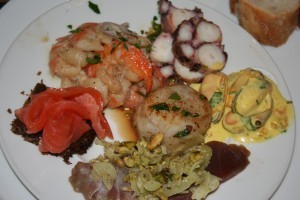
Our Christmas Eve antipasto plate, starting at 12 o clock: octopus terrine, mussels with saffron mayo, tuna with fennel/pistachio sauce, smoked salmon, shrimp with white beans, and a scallop in the middle.
It is a fast because no meat is served. Likewise, during Lent, many Catholics give up meat. Hardcore Lentenistas will give up meat and dairy products for the entire season—Ash Wednesday until Easter Sunday–but most just fast on Fridays.
I've always been fascinated with Lenten dishes. They transform a meal characterized by denial into something extravagant. I am interested in Lenten dishes for the same reason I am interested in the idea of preserving foods and using those preserved foods in subsequent meals. The saying "Necessity is the mother of invention" applies. From limitations, either set by us or by our circumstances, comes ingenuity and inspiration. My creative abilities are stretched when I can only cook with restricted ingredients, or must make a meal from a product I canned the summer before. When my creativity is challenged, it opens my mind to new ideas. And suddenly what was a deprivation yesterday, becomes a blessing today.
So the Lenten recipes that are turning me on right now are Italian and Mexican recipes that contain nuts and raisins. I usually don't like fruits in savory dishes, but I find these dishes rather spectacular, albeit humble.
 Eugenia Bone
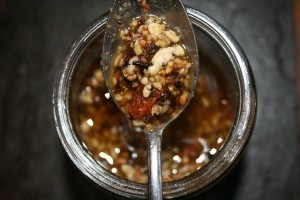
Foriana Sauce
Makes 3 half-pint jars
Foriana sauce comes from the island of Ischia off the coast of Naples, where it is served on pasta as a Lenten dish. From Well-Preserved (Clarkson Potter, 2009)
1 cup walnuts
1 cup pine nuts
5 tablespoons sliced garlic (about 10 large cloves)
3 teaspoons dried oregano
3 tablespoons olive oil plus more for covering the jars
1/2 cup white raisins
Salt and freshly ground black pepper to taste
Olive oil to cover
Place the walnuts, pine nuts, and garlic in a food processor and pulse to a fine chop, until the nuts are like damp granola. Add the oregano and pulse a few more times to combine.
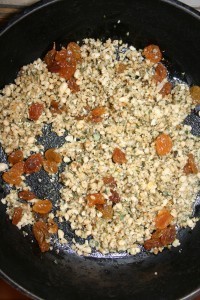
Heat the olive oil in a medium sized skillet over a medium heat. Add the nut mixture, the raisins, and salt and pepper to taste.
 Eugenia Bone
Foriana ingredients, ready to saute.
Cook for about 5 minutes, stirring constantly to avoid burning or searing.
Bring 3 half-pint jars, their lids and bands to a boil in a large pot of water with a fitted rack. Boil for 10 minutes. Remove the jars with tongs (the tongs don't need to be sterilized). When the jars are dry but still hot, pack in the Foriana sauce, eliminating as many air pockets as you can. (I press down with the knuckles of my index and middle fingers to pack the sauce—be sure your hands are clean.) Fill the jars to about 1 inch below the rim. Add a 1/2 inch layer of oil to cover. Wipe the rim with a paper towel, place on the lid and screw on the band.
The Foriana sauce will keep in the refrigerator for about 10 days. Check on the sauce a day after you make it: you may need to add more oil to ensure it is completely covered.
Be sure to cover the surface of the Foriana sauce with oil after each use. Remove only the quantity of sauce that you need for a dish and allow that to come to room temperature. Cover the remaining sauce in the jar with oil and promptly return it to the fridge.
Broiled Clams Foriana
Serves 4 as an hors d'oeuvres
To open hard-shelled clams you will need a clam knife: this is a double-edged blade that is not too sharp, but has a thin edge. Cover the clams with water. They will open slightly. Grasp the clam in your palm (I wear a kitchen mitt for protection) with the muscle that holds the shell closed against your hand. Slip the knife between the shells and slide it through to the muscle. Cut through the muscle holding the shells together. Try not to spill the juices—they add flavor–and loosen the meat. Or you can ask your fishmonger to open the clams for you. If you are really struggling, place the clams in the freezer for about 15 minutes and they will open easily although you will find yourself splitting the meat.
Sometimes I serve these clams on a plate as a first course, in which case, I use the larger cherrystone clams, snip the meat into small pieces, and use double the stuffing recipe (but 3 clams per person is plenty—they're rich).
12 littleneck clams on the half shell
4 tablespoons Foriana sauce
2 tablespoons grated Parmesan cheese
2 tablespoons unsalted butter
Place the clams on a broiling tray. Add the Parmesan cheese to the Foriana sauce and mix well. Spoon enough Foriana sauce to cover each clam—about 1 teaspoon. Cut bits of the butter over the clams, so that each gets a smidgeon.
Adjust the rack under your broiler about 6 to 8 inches below the flames. Preheat your broiler to hot. Place the clams under the broiler and cook a couple of minutes, until golden. Keep an eye on them, as the raisins in the Foriana sauce burn easily.
Allow to cool enough to handle, and serve.
 Eugenia Bone
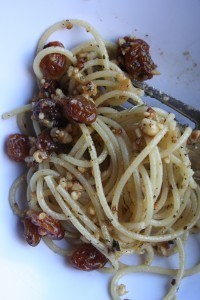
Spaghettini with Foriana sauce
Pasta with Foriana Sauce
Serves 4
I often serve this for vegetarians, who are always thrilled.
1 pint Foriana sauce, drained of preserving oil
3/4 pound of spaghettini or spaghetti
4 tablespoons pecorino cheese
Cook the pasta in boiling water until it is al dente. Toss with the Foriana sauce. If you need to add a little more oil it's okay.
Garnish with grated pecorino cheese.
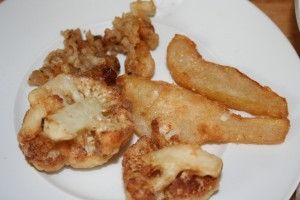 Eugenia Bone
Fried cauliflower, pear, and raisins.
Fried Cauliflower, Pear, and Raisins
Serves 4
This is a dish from le Marche. It is usually eaten on Christmas day, but it has all the markings of a Lenten dish.
2 cups cauliflower flowerettes, trimmed to bite sized pieces
2 Bosc pears, peeled, quartered, with cores scooped out (I use a melon-baller)
1 cup white raisins
2 cups flour
3 cups lager beer
3 teaspoons baking powder
Vegetable oil (not extra virgin olive oil—it's too heavy for this dish)
Salt to taste
Combine the flour, beer, baking powder, and a pinch of salt in a bowl and refrigerate for 1 hour (a little more or less is okay).
In the meantime, cook the cauliflower in boiling water for a few minutes, until it is al dente (probe the pieces with the tine of a fork. You should be able to spear the cauliflower, but still feel some resistance).
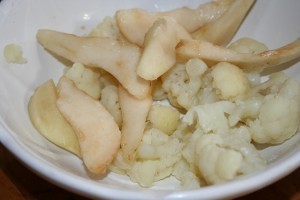 Eugenia Bone
Cauliflower and pears, ready to fry.
Place 3/4 of an inch of vegetable oil in a large non-stick skillet. Heat the oil over a high heat. The oil must be very hot. You can test it by throwing a dash of flour into the oil. If the flour pops, the oil is ready for frying.
Dunk cauliflower in the batter and place them gently in the hot oil. Don't put too many flowerettes in at once or it will bring down the temperature of the oil, and they mustn't touch sides or they will stick together. Do not flip the cauliflower over until you can see the lower edges have turned golden brown, about 2 minutes. If you are using an iron skillet and the cauliflower sticks, let them cook 30 seconds more. Turn the flowerettes over with tongs and fry for an addition minute, then remove them and drain them on paper towels.
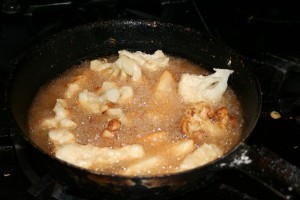 Eugenia Bone
The oil must be very hot.
Continue frying the pears, and then the raisins the same way. The raisins will cook the quickest. Sprinkle with salt and serve promptly.
Cilantro Rice with Poblanos
Serves 4
This is a variation on a classic Mexican Lenten dish, adapted from a recipe by Diane Kennedy, the first lady of English-language Mexican cookery.
1 medium onion, chopped (about 1/2 cup)
1/3 cup water
1/2 cup cilantro, chopped
1 garlic clove, chopped (about 1 teaspoon)
4 small poblano chiles
2 – 3 tablespoons olive oil
1 cup long-grained rice (I like Uncle Ben's)
2 cups milk
1/4 cup slivered blanched almonds
1/4 cup white raisins
4 strips Monterey Jack cheese
Combine the onion, water, cilantro, and garlic in a blender and puree them until they are liquefied (makes about 1 cup).
Char the poblanos. Place the peppers directly on your gas burner, or under a gas or electric broiler and allow the skin of the peppers to blister. Turn them so that they blister all over. If you over-char the peppers and they get black blisters, it's okay—the pepper will be overcooked in that place, but it is still good. As soon as the peppers are cool enough to handle, remove the charred skin. It will peel off easily. If some spots stick, leave them. Carefully cut around the stem and gently tug out the seedpod and veins, leaving the chile otherwise in tact. Rinse any remaining seeds out of pepper.
Heat the oil in a small casserole dish with a fitted top. Roll the oil around so that it coats the inside of the dish. Add the rice and cook it until it begins to discolor, about 3 minutes. Be sure to stir often, to keep the rice from sticking. Add the cilantro water to the rice and stir it well. It will bubble up ferociously, and then settle down. Cook the rice and cilantro water over a medium low heat, covered, for about 15 minutes, until the rice has absorbed all the cilantro water and is beginning to look dried out.
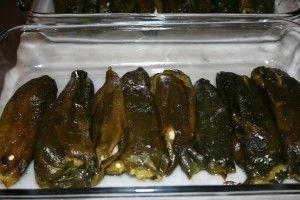 Eugenia Bone
Stuffed poblano peppers, ready to bury in the rice.
Then add the milk and salt to taste. Stir, cover the pot, and cook the rice for 10 minutes over a medium low heat. Add the almonds and raisins, recover, and continue cooking for another 5 minutes, until the rice is very tender and soft. It should be rather loose, too, like risotto.
Insert 1 strip of jack cheese into each pepper.
 Eugenia Bone
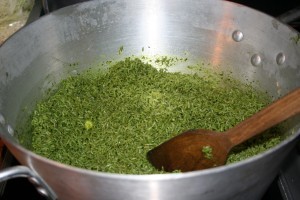
The rice and parsley water combined. Next milk will be added.
When the rice is cooked, dig four small trenches in the rice and insert a poblano chile in each. Cover the pot and continue cooking the rice until the cheese in the peppers is soft, a few minutes. Serve immediately.
 Eugenia Bone
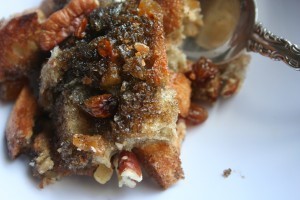
Mexican bread pudding
Capirotada (Bread Pudding)
Serves 4
This is a traditional Lenten dessert from Mexico. The recipe is adapted from a lovely blog called homesicktexan. The cheese works as a binder for the other ingredients. This dish is quite sweet and utterly addicting.
1 cup brown sugar
1 cup water
1/2 teaspoon powdered cinnamon
1/4 teaspoon powdered cloves
4 cups cubed and toasted bread
2 tablespoons melted butter
3/4 cup of shredded Monterey Jack cheese
3/4 cup pecans, toasted and chopped
1/4 cup white raisins
Powdered sugar for garnish
Preheat the oven to 350 degrees.
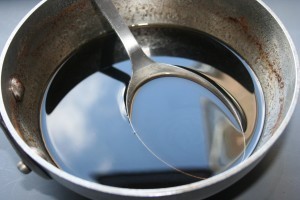
Make a syrup by boiling the sugar, water, cinnamon, and cloves together until it is reduced by one third—about 10 minutes. The syrup with seem dirty—that's the powdered spices. It's okay.
 Eugenia Bone
Brown sugar and spice syrup
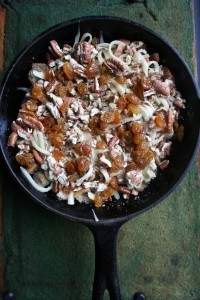
Butter a medium-sized (9-inch) cast-iron skillet. Dump half the bread in and pour over the melted butter. Toss to coat. Pour half of the syrup over the bread and toss to coat. Add the cheese, pecans, and raisins. Add the remaining bread to the pot with the remaining syrup and toss to coat. Pour the syrup-drenched bread on top of the skillet, over the other ingredients.
 Eugenia Bone
The bread pudding, before the final layer of bread is added.
Cover with foil and bake for 20 minutes. Remove foil and bake for 15 minutes more. You will smell the bread pudding.
Garnish with powdered sugar if you like.


Recipes for Lent
February 5, 2012
The Honeybells Are In!
 Eugenia Bone
Honeybells
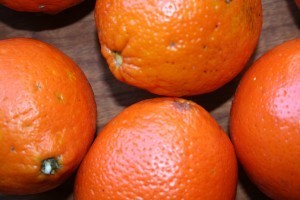
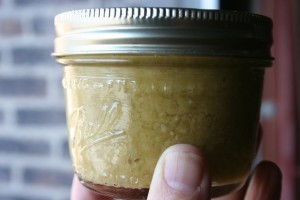
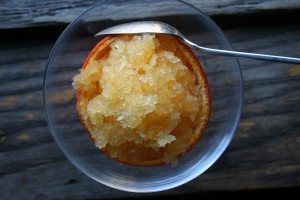
Every year I order these wonderful citrus fruits from Florida (they aren't technically oranges). They make a fantastic marmalade and the sweetest juice. This year I added to my repertoire and made a very tasty granita with Honeybell juice and ginger syrup and a soft tapenade with green olives, Honeybell juice (although any sweet orange juice will do) and a tiny amount of sugar. It is surprising: tart and sweet, refreshing and complex. I am thinking about ways to use it besides a condiment on a cheese platter, and I'll address that in my next post, but for the time being, here is the recipe.
 Eugenia Bone
Green olive and Honeybell Tapenade
Green Olive and Honeybell Tapenade
Makes 1 cup
1 cup green olives, pitted (I used Cerignola)
½ cup Honeybell orange juice
1 tablespoon sugar
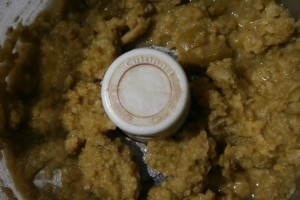
Combine all of the ingredients in a food processor and pulse to blend. I left it a bit grainy.
 Eugenia Bone
You can grind the tapenade as soft or grainy as you like.
Spoon the tapenade into a sterilized ½ pint jar and store in the refrigerator for up to 10 days. (To sterilize the jar, boil the jar, band, and used lid–you don't need a new lid if you are not processing–in water for 10 minutes at sea level, adding 1 minute for every 1,000 feet above sea level.)
 Eugenia Bone
Honeybell Ginger Granita
Honeybell Ginger Granita
Makes about 2 cups
I like to serve this granita in frozen Honeybell shells
1 cup Honeybell orange juice
¼ cup ginger syrup (see this post for the recipe)
Combine the juice and syrup in a small metal baking pan, and put into freezer. (If you use a narrow, deep pan the granita will take longer to freeze than a shallow, wide pan.)
After about an hour, run the tines of a fork through the slush to loosen it up and return to the freezer. After another hour or so do it again. Usually two times is enough for the crystals to become very flaky and dry.
Transfer the granita to a freezer jar or food grade plastic container and keep in the freezer, for months!
To serve, spoon the granita into glasses or frozen orange shells.
The Honeybells Are In!
January 25, 2012
A Few Recipes Utilizing Ginger Syrup
 Eugenia Bone
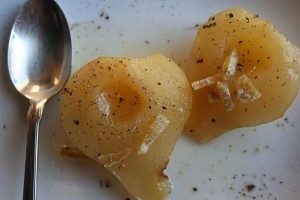
poached pears with ginger syrup
I am totally in love with my ginger syrup and have been experimenting with it…actually, dumping it into all sorts of things: tea in the morning, over vanilla ice cream and garnished with a crumble of Amaretto cookies (don't they ever go bad?), as a sauce for panna cotta and poached pears. I've also used the crystallized ginger as a garnish, which is pretty to look at, but easy to overdo: they're hot! Below are the recipes for the panna cotta and pears. Both are elegant and easy, and perfect for company.
Just a reminder: it is Honeybell Tangelo season. Honeybells make the most delicious marmalade and the sweetest juice. See my post of two years ago here for the recipe.
Honeybell marmalade is rather easy to burn—I did it this year, to my dismay. But I canned it anyway, with a good shot of orange liquor added. I'm calling it, rather disingenuously, "Burnt Sienna." I rarely name my preserves (only Candy Cane jelly comes to mind: a combination of crabapple and spearmint), but I just couldn't write Honeydew on the lid, and Charred Marmalade didn't sound very appetizing. It tasted okay, just not sunshiny sweet, as it is very caramelized. It's definitely not right for English muffins, but it would be good smeared on a slow cooked pork shoulder or tucked under the skin of a chicken.
I should point out that I ruin various preserves all the time; sometimes my crabapple jelly is like glue, my blueberry jam watery, and my peaches almost always float, damn it. I know there are some who think that people like me, who write professionally about food, never make mistakes, that every jar is perfect. But the truth is, if I can develop a recipe that works perfectly on the first try, I consider myself lucky; and if I can perform a recipe without mucking it up because I got distracted looking at my emails or watching Judge Judy (one of my guilty pleasures), then I am downright grateful.
So here's to all the burnt, watery, gloppy, too sweet, not sweet enough, too vinegary, gluey, and just plan nasty preserves out there. I think I'll have a ginger syrup martini. (Watch out: ginger syrup cooked too fast and hot crystallizes like rock candy. I should know. I've done it.)
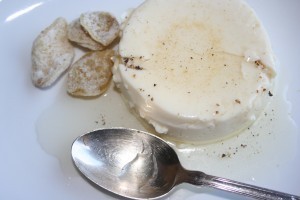 Eugenia Bone
Panna Cotta with Ginger Syrup
Serves 4
If the powdered ginger does not dissolve thoroughly in the hot cream, strain the cream/sugar/ginger mixture through a fine sieve as you add it to the gelatin.
2 cups heavy cream
½ cup sugar
1 heaping teaspoon powdered ginger
1 packet powdered gelatin
3 tablespoons cold water
8 tablespoons ginger syrup
Freshly ground black pepper to garnish
Heat the heavy cream, sugar, and powdered ginger in a saucepan over a medium low heat. Whisk to dissolve the sugar. Remove from the heat.
Lightly oil 4 ½-cup capacity ramekins with corn or safflower oil. Do not use olive oil. The taste is too strong.
Pour the gelatin into a 2-cup capacity bowl and add the water to soften. Pour the warm cream and sugar mixture over it. Whisk until the gelatin is dissolved.
Pour the mixture into the ramekins. Refrigerate for 4 to 6 hours. If you let the panna cotta sit in the fridge for more than 12 hours it may get tough.
To serve, run a sharp knife around the edge of the panna cotta and tap the ramekin upside down on a serving plate. You may need the tip of you knife to loosen the top of the panna cotta from the bottom of the ramekin.
Garnish with warmed, room temp, or cool ginger syrup and a few grinds of fresh black pepper.
 Eugenia Bone
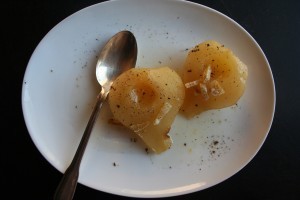
poached pears with ginger syrup
Poached Pears with Ginger Syrup
Serves 4
You can use any sort of pear in this recipe, even little Seckels, though I usually choose Bosc. Select pears that are not yet table ripe: very ripe pears may disintegrate during poaching.
4 pears, peeled, sliced in half, and cored (See Note)
1/3 cup orange juice (I used Honeybell tangelo juice)
1/4 cup sweet or dry white wine
1/3 cup granulated sugar
1 cinnamon stick (about 3 inches long)
1 bay leaf
A few small slices fresh ginger
1 wedge lemon
6 whole cloves
8 tablespoons ginger syrup
A few pieces of crystallized ginger, minced
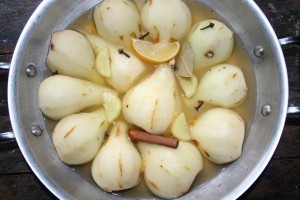
Place the pears in a low pot with a fitted cover. Add the juice, wine, sugar, cinnamon, bay, fresh ginger, lemon, and cloves.
 Eugenia Bone
pears ready to poach
Cover and poach over a medium heat for 10 minutes until the pears are tender. Remove the pears and set aside. Reduce the liquid and spices for a few minutes to thicken (this may not be necessary). Strain the syrup and add to the pears.
You can hold the pears in their liquid for a few days, though they do get a little boggy after 24 hours.
Serve the pears garnished with warmed, room temp, or cool ginger syrup, garnished with crystallized ginger bits.
Note: I use a melon-baller to remove the core
A Few Recipes Utilizing Ginger Syrup
January 10, 2012
Ginger Syrup
 Eugenia Bone
We threw a party this year for New Year's Eve. As far as I am concerned a New Year's Eve party is successful if it is easy for me to stay up until midnight. Lucky for us, our guests came in waves all night, bringing fresh energy and assorted fresh goodies with them.
 Eugenia Bone
Food historian Betty Fussell charming Spectaularlydelicious.com's Sean Sullivan
We had asked guests to bring a finger food of some sort, and many marvelous homemade concoctions showed up: a beautiful country pate with cornichons, a bushel of pristine Bluepoint oysters, paddlefish caviar from Montana, a fabulous potato torta, homemade spinach pies and little soft sandwiches with proscuitto and baby spinach, boiled fingerling potatoes served with homemade aioli, cheese and breads and sausages, endive filled with all sorts of savory things, creamy gravlox on cucumber rounds, buttery anchovies on crostini spread with fatty Icelandic butter, a number of delicious homemade pizzas, a tray of sweet stuffed eggs, a rather unbelievable kugelhopf cake with associated table décor, cases of Gruet sparkling wine, constant martinis—though I serve them in 2-ounce glasses: they're tiny—crunchy macaroons, including the potentially lethal Tonka Bean macaroon, a beautiful tin of Christmas cookies, and a platter of rich, black chocolate cupcakes with chocolate icing. Even though I hired a housekeeper to help, the place was trashed. I was finding champagne glasses under chairs and oyster shells on the bookshelves for two days. Unsurprisingly, New Year's day was slow. Very slow.
 Eugenia Bone
New Year's Day
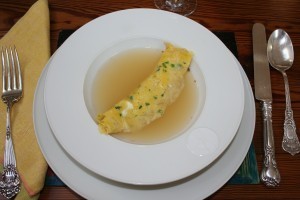
We ate a restorative pho broth with pieces of the potato torta in it, which actually has a precedent in all sorts of cuisines. In Italy, a popular dish is chicken stock with crespini, a delicate crepe flavored with Parmesan cheese and parsley. We had it on Christmas Day.
 Eugenia Bone
Chicken stock with crespini
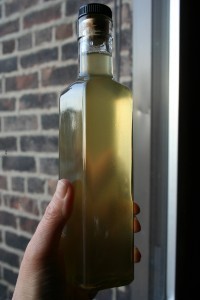
Anyway, the thing I really wanted was a ginger ale, but nobody in the house was willing to get dressed and go to the store. That's when it occurred to me that having some ginger syrup on hand would have been a very good idea (we had lots of leftover soda water from the party).
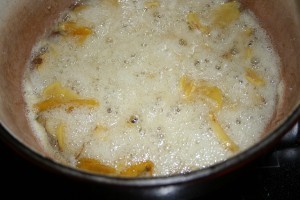
Ginger syrup is very easy to make, with two caveats. There is no USDA data that I could find with processing times. While some people think ginger syrup can be processed like a berry syrup, I don't think so. Ginger has a pH of 5.6 to 5.9, above the safe limit for water bath processing without added acid. Sugar is a preservative, but not in the same way acid preserves. Sugar preserves like salt does, by dehydrating the food and in so doing, creating a hostile environment for spoilers. Syrup is, by its very nature, wet. It seems ginger syrup would likely have to be pressure canned. The problem with that idea is the syrup is rather fragile: After a few days in the fridge ginger syrup loses its oomph. (The pungent gingerole compounds degrade into milder flavored compounds over time.) I think pressure canning may decimate the flavor, though I haven't tried it yet as I still need to figure out a safe processing time. So Caveat #1 is, you have to refrigerate the syrup. Caveat #2 is, if allowed to boil too long,
 Eugenia Bone
Don't let your syrup boil hard.
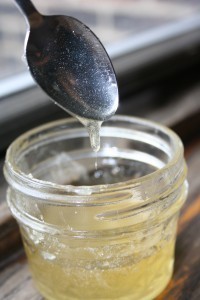
And allow the syrup to get too thick,
 Eugenia Bone
This syrup is too heavy.
The syrup will crystallize when cool.
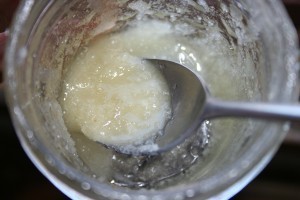 Eugenia Bone
This syrup wants to be rock candy.
You will find yourself scraping away at the candy in the bottom of your jar to get a spoonful of the stuff, although it still dissolves in soda and tastes great. But it's best to just watch the syrup and make sure you don't overcook it.
I added a small red hot pepper and some lemon rind to amp up the flavor, and I like it very much, though their inclusion is totally optional. To serve the ginger ale, I combine about 2 teaspoons per half cup of soda water and stir, and then pour over ice.
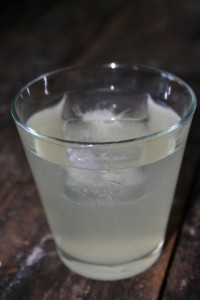 Eugenia Bone
Homemade ginger ale
It is totally fresh, easy, delicious. Of course, you can always go the next step and make fermented ginger ale. But being a rather low-tech sort, I like the simplicity of having the syrup on hand.
With the leftover ginger slices, I made crystallized ginger, which is not necessarily something I eat very much of, but I have a few ideas which may be fodder for a future post.
Until then, Happy New Year!
Ginger Syrup
Makes 1 ½ cups syrup
When buying ginger look for a smooth, hard rhizome with a pungent smell. Wrinkled, scabby ginger rhizomes will be fibrous and have a faded taste.
½ lb ginger, peeled and sliced into thin discs
1 ½ cups sugar
2 cups water
2 or 3 pieces lemon zest
1 small dried hot pepper
Place all the ingredients in a heavy-bottomed pot and bring to a boil over a medium high heat.
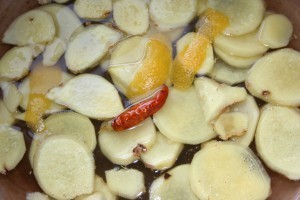 Eugenia Bone
Cut the ginger into thin discs if you want to make crystallized ginger later.
Lower the heat to low and simmer for 30 minutes. At this point I removed the red pepper—you don't have to. Continue cooking for another 30 minutes, until the syrup is reduced by 50%. Allow to cool enough to handle. Strain (reserve the ginger pieces) and pour into sterilized jars. One and a half cups of syrup will fit nicely into 3 half pint jars, or an 8.5 ounce bottle. (To sterilize, boil the jars in water for 10 minutes at sea level, adding 1 minute for every 1,000 feet above sea level.)
The syrup holds in the fridge for a week, although the flavor may begin to fade even earlier.
Crystallized Ginger
Makes ½ pint ginger pieces
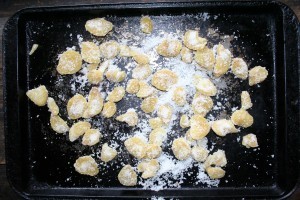 Eugenia Bone
Crystallized ginger
In a bowl combine the strained ginger pieces and a cup of granulated sugar. Toss well. Pour the sugar and ginger pieces onto a cookie sheet and place in a dry spot in the house. I put mine on the radiator overnight.
You may need to press some sugar into pieces of ginger that seem juicy. This usually happens with the thicker discs of ginger. After about 12 hours the ginger should feel dry and rubbery.
Store in a clean jar. Holds indefinitely.
Ginger Syrup
December 23, 2011
Applesauce and Applesauce Recipes
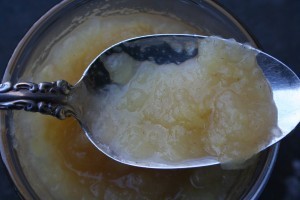 Eugenia Bone
Homemade Applesauce
Around Christmas time every year in New York my friend Diane throws a potato pancake party. In the eight years or so that I've known her, I've seen those potato pancakes evolve. This year she nailed it: they were rich and light, crispy and potatoey. The best ever.
My small contribution to the party was homemade applesauce. There really is no good reason to buy commercial applesauce, because homemade is not only ridiculously easy to make, but superior in both taste and texture. At the potato pancake party, Diane's guests ignored the sour cream and instead, loaded up on applesauce.
I had some left over, and with it made an old-fashioned applesauce cake with walnuts and white raisins that had a real holiday feel to it (I just made it yesterday but it is mostly gone now, the crumbled remains being what is left after the teenagers raided the kitchen in the wee hours).
Here are the recipes:
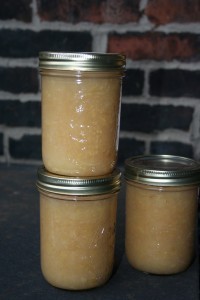 Eugenia Bone
Applesauce
Makes 3-4 pints
The best tasting applesauce is made from sweet apples, not tart apples like Granny Smiths, and a combination of sweet apples is even better. If you make applesauce with tart apples, you will have to add sugar, sometimes a lot. But you may find a combination of sweet apples will need no sugar at all.
5 pounds sweet apples
About 2 cups apple juice or cider (optional)
2 teaspoons cinnamon
Sugar to taste
Quarter the apples and remove the seeds, but leave on the skins. Pour the apple juice or cider into the bottom of a big pot. (You can use plain water, too.) Add enough water to produce a generous 2 inches of liquid in the pot. Add the apples, cover, and place over a medium low heat. Cook until the apples are soft, about 15 minutes.
Allow the apples to cool, and then press them through a food mill. (If you don't have a food mill, consider getting one: it is very useful tool and inexpensive, too.)
Taste the applesauce. Add the cinnamon to your taste, ditto the sugar as you may or may not think the sauce needs it. You can also have some fun: spike the applesauce with calvados, orange zest, nutmeg…none of which will affect the processing instructions.
Have ready 4 very clean pint jars and bands, with new lids that have been simmered in hot water for a few minutes to soften the rubberized flange. (You can also do ½ pints, or a combination of pints and half pints—the processing time remains the same.)
Pour the sauce into very clean pint jars, leaving ½ inch headroom. Place on the lids and screw on the bands fingertip tight. Place in a deep pot with a rack (a rack is preferable, but honestly I rarely use my big canner for small batch canning—I just use my pasta pot even though it doesn't have a rack) and cover with water by 2 to 3 inches.
Bring the water to a boil and process the jars for 10 minutes at sea level, adding 1 minute for every 1,000 feet above sea level.
Remove the jars and allow to cool. Check the seals and store in a cool dark place for up to a year. There may be some oxidation with applesauce—meaning the top of the applesauce inside the jar made darken. It's okay. Refrigerate after opening.
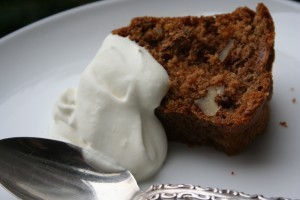 Eugenia Bone
Old-Fasioned Applesauce Cake
Old-Fashioned Applesauce Cake
Makes a 9-inch tube cake
This recipe doubles very well. You can substitute currants, pecans, dried cranberries, cherries, and bits of dried apricots if you like, but keep to the quantities in the recipe or the cake will be heavy. As it is, this cake is light and spicy. I serve it with whipped cream, but a confectioner's sugar glaze would be good, or even something as luscious as cream cheese or fudge frosting.
1 stick butter, softened at room temperature
1 cup sugar
1 cup (1/2 pint) applesauce
1 ½ cups flour
½ teaspoon cinnamon
½ teaspoon nutmeg
Rounded ¾ teaspoon baking soda
½ cup chopped walnuts
½ cup white raisins
1 teaspoon vanilla extract (see note)
Preheat the oven to 325F.
In a large bowl beat the butter and sugar together until light and fluffy. Add the applesauce and combine. The batter make look curdled—it's okay.
Sift together the flour, cinnamon, nutmeg, and baking soda.
Remove two tablespoons of the flour mixture and place in a small bowl. Toss the walnuts and raisins in this flour.
Mix the flour into the batter and combine well, but do not beat beyond combining or the crumb of cake will be less delicate. Stir in the vanilla and the flour-coated fruit and nut mixture.
Pour the batter into a buttered and floured 9-inch tube pan. Tap the pan on your counter to distribute the batter evenly. Bake for about 45 minutes, until you can smell the cake and a knife inserted into the cakes comes out clean. Allow to cool. Then turn over onto a rack to complete cooling.
Frost or serve with a dollop of sweetened whip cream. (You can add a little calvados to the whipped cream, too.)
Note: I used my own homemade vanilla extract. It is not quite as strong as commercial, so you may want to add about ¾ of a teaspoon of commercial extract.
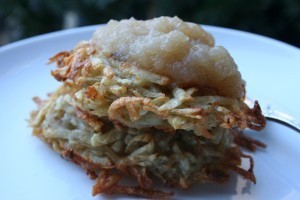 Eugenia Bone
Potato Pancakes with Homemade Applesauce
Aunt Lois' Potato Pancakes
Makes 16 pancakes
The trick to these pancakes is to do them in small batches. Diane knocks herself out to make a hundred of them for a party, but I think 16 pancakes for 4 people are perfect. They make a great side dish, and are wonderful with a piece of broiled fish on top.
4 large baking potatoes
4 tablespoons onion, minced
1 teaspoon salt
Dash pepper
Dash cinnamon
3 tablespoons flour or potato starch
2 eggs, beaten
1/2 teaspoon baking powder
Safflower oil
Mix together the dry ingredients and set aside.
Peel the potatoes and grate on the large holes of the grater. Long pieces are best. Place the potatoes in a bowl and toss with the onions. Add the dry ingredients and toss well. This may take a bit of time—you don't want the dry ingredients to be well distributed. Add the eggs and combine well.
In the meantime, heat about an inch of oil in a nonstick frying pan over a high heat. Test the heat by inserting a little piece of potato in the oil. If it bubbles, the oil is ready.
Using a slotted spoon, scoop up a spoonful of the potato mixture, allowing the excess liquid to drain off. Drop the spoonful of potatoes into the oil.
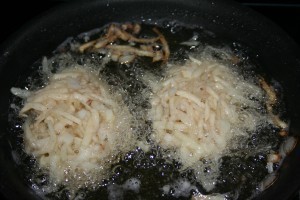 Eugenia Bone
Let the pancakes cook until just golden underneath
Fry for about 2 minutes on each side, until they are just golden.
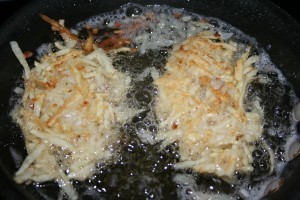 Eugenia Bone
Turn the pancakes over when they are just golden
Do not flip over a pancake until it is golden on the downside, otherwise they may fall apart and be greasy. They will not be cooked through. It's okay. As you get toward the bottom of the bowl the potatoes will be wetter. They will take a bit of pressing to remove more liquid, and will take a bit longer to cook.
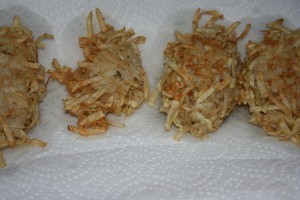 Eugenia Bone
These are draining, and ready to freeze or go ahead and bake
Drain on paper towels.
You can refrigerate or freeze the pancakes at this point, for up to two months.
To serve, preheat the oven to 350F.
Place the pancakes on a baking tray and cook for about 10 minutes on each side. They will turn a rich golden brown. They may need to be dried on a paper towel before serving.
Happy Holidays to all my readers!
December 22, 2011
Applesauce and Applesauce Recipes
Eugenia Bone's Blog

- Eugenia Bone's profile
- 36 followers

