Jake Berman's Blog
July 9, 2026


May 4, 2026
Jake's California and NY primary election endorsements, 2026
CALIFORNIA (election day is June 2nd):
 Governor: Tom Steyer.Steyer is the only serious choice. His top two issues are "fix the housing crisis" and "tax the rich," which neatly encapsulate the problems that the state faces. I like Steyer's housing plans - they are basically sound and get into the weeds of the issues. He and his team have thought about the hard work of fixing the state. This includes things like taxing commercial property at market rates, express permitting, fixing housing finance, and reforming local impact fees. I have my qualms about electing a billionaire, but he is far better than the other options.Xavier Becerra doesn't take the housing crisis seriously. The first two issues on Becerra's platform are universal health care and fighting Trump, with housing a distant third. And while I support universal healthcare in California, the whole project is dead on arrival as long as Trump is in the White House. (California needs federal money to put universal health care in place.)Katie Porter is apparently an over-the-top terrible person to work for, and she's worse on housing than Steyer.Antonio Villaraigosa, Tony Thurmond, and Matt Mahan are unremarkable and no hope of winning.Steve Hilton is a carpetbagging Trumpy crank from England.Chad Bianco is a homegrown Trumpy crank from Riverside.
 Mayor of LA: Nithya Raman.Raman is the only person in the race that actually wants to fix the housing crisis, and she has been in the correct place on the vast majority of housing and transport issues. This is rare in a city as poorly governed as LA.Karen Bass, the incumbent mayor, is corrupt, botched the Palisades Fire response, and has persistently blocked efforts to fix LA's transport and housing problems. When she came into office, she signed Executive Directive 1, expediting processing of all affordable housing and homeless shelter projects. This was a big deal, and people started building affordable housing under E.D. 1 - so obviously, she immediately backed away from it and started reversing herself. She also delayed the K Line Northern Extension to West Hollywood because it would pass deep beneath one of her friend's houses.Spencer Pratt is a spoiled Trumpy crank from Pacific Palisades. Don't elect reality TV stars. Please.
NEW YORK (election day is June 23):
Mayor of LA: Nithya Raman.Raman is the only person in the race that actually wants to fix the housing crisis, and she has been in the correct place on the vast majority of housing and transport issues. This is rare in a city as poorly governed as LA.Karen Bass, the incumbent mayor, is corrupt, botched the Palisades Fire response, and has persistently blocked efforts to fix LA's transport and housing problems. When she came into office, she signed Executive Directive 1, expediting processing of all affordable housing and homeless shelter projects. This was a big deal, and people started building affordable housing under E.D. 1 - so obviously, she immediately backed away from it and started reversing herself. She also delayed the K Line Northern Extension to West Hollywood because it would pass deep beneath one of her friend's houses.Spencer Pratt is a spoiled Trumpy crank from Pacific Palisades. Don't elect reality TV stars. Please.
NEW YORK (election day is June 23):
State Senate, District 27 (Manhattan below 14th St): Grace Lee.
I have personally met Assemblymember Lee and her staff. She's receptive to proposals to figure out how to build new housing and fix the MTA, even if I personally disagree with some of the votes that she's taken. Yuh-Line Niou represented this area in the Assembly, and Niou is a NIMBY. She has plenty of ways to keep people in their existing apartments, but she has no plan to build new housing, unless it's to pass a pie-in-the-sky bill to establish a state public housing authority. This is not a serious solution to New York's housing crisis.
Like it or not, private developers build the vast majority new housing in New York, and they do it far cheaper than the publicly-funded affordable housing system because of all the bureaucracy associated with the public system.
This is doubly galling because District 27 includes the Financial District, where the office vacancy rate is at 20% - twice the pre-pandemic rate. There's tons of privately-owned buildings ripe for conversion... and Niou's is leaving all of that on the table. State Assembly, District 65 (Manhattan, Financial District, Chinatown, Lower East Side): Jasmin Sanchez.
Note: This is based on my experience attending a candidate forum that my neighbors organized. This type of hyperlocal politics is not particularly well covered in the press, so my impressions are going to be more impressionistic - and in any case, none of the candidates is a YIMBY. I'm making the best of a bad situation.

Jasmin Sanchez approached people in good faith, and had by far the best command of the issues facing the neighborhood. I don't completely agree with her on housing - but she's willing to listen. One thing I found refreshing was that she told it to us straight when she hadn't studied an issue in depth, and that level of humility is good in a public official. Having strong opinions are great ways to accumulate likes on social media, but not great ways to run a government.Jacky Wong. Wong is my second choice. He's not the most charismatic, but he has clearly thought about how to build new rent-stabilized apartments in NYC with his proposal to expand the 485X program.Illapa Saritupac has no business running for office. He didn't know the MTA is a state agency, not a city agency. This is something that a candidate for State Assembly has to know, and it's disqualifying that he doesn't.
I asked him a softball question - "did he support the Mayor's free bus plan, and how would he pay for it," and he gave me some gobbledygook answer about how the MTA is a city agency, not a state one.
Finally, his housing stance is the same as Yuh-Line Niou's - i.e., that the State should build public housing instead of private developers. This, I'm sure, plays great at DSA meetings but doesn't get more things built.Mariama James and Lilah Mejia had proposals which were nothing to write home about. I left the forum with no memories of why they were running for office, and their platforms were nothing special.Wei-Li Tjong is president of the huge Seward Park co-op complex, and his tenure as president has been marked by a months-long lobby renovation drama. I can't recommend him.
Let me know what you think in the comments.
April 22, 2026
March 3, 2026
Let's talk about the California High Speed Rail Authority business plan.

The California High Speed Rail Authority put out its 2026 business plan, which shows some pretty aggressive savings in the full line construction - $2 billion reduction for the initial Merced-Bakersfield segment, $10 billion reduction for the San Francisco-Gilroy segment, and huge cost reductions in Southern California by upgrading the existing Palmdale-Los Angeles commuter rail line instead of carving a new right of way.
While the Merced-Bakersfield savings are accrued through better project management, the big savings between San Francisco and Gilroy are done by reducing the maximum speed from 220 MPH to 110 MPH. The same goes for the Palmdale to Los Angeles section, eliminating a bunch of tunnels that were originally planned.
[image error]
[image error]
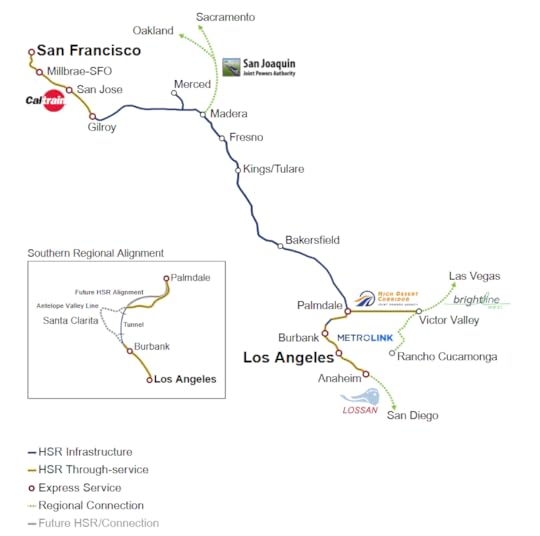
This is an intelligent move. At its core, a San Francisco-LA high speed rail line is really about building a 220 mph high-speed line between Gilroy, at the southern edge of the Bay Area, and Palmdale, at the northern edge of Los Angeles County. Something similar is happening with Brightline West, the privately funded bullet train from LA to Las Vegas. The fast part is from Rancho Cucamonga in San Bernardino County to Vegas, and it can reach LA proper via the existing San Bernardino commuter rail.
There are tradeoffs. Using the existing commuter rail tracks to approach LA and San Francisco makes the trip slower. An express train from the SF Caltrain Depot to LA Union Station is about 2 hours, 40 minutes with all the tunnelling originally planned. With the slower 110 mph sections, you lose about 20-30 minutes, making it roughly ~3 hours, 5 minutes from SF to LA by the express train.
The slower interim route shouldn't really discourage the High Speed Rail Authority from going forward with this plan. The biggest reason is simple: money. Even with the slower travel times, 3 hours from downtown to downtown is going to be a popular, lucrative route. (The 160 mph Acela Express which connects Boston, New York and Washington DC is highly profitable, despite running at slower speeds.)
I'm glad that the High Speed Rail Authority is thinking strategically about this stuff. Once the system is up and running and turning a profit, passengers will wonder how they ever lived without it.
January 25, 2026
Don't fall into the trap of glamorizing rural life.
This is going to be a bit of a change from my usual urban posting.
I want to talk about my trip back to visit my grandmother's tiny Kansas hometown, and why it's a bad idea to romanticize living in rural America.
I've seen a lot of posts bouncing around the Internet talking about how people can should move to rural America, where land is cheap, cost of living is low, and so on. This post on Twitter is one of the species. You see this a lot, where influencers push young people struggling to make it in a major metropolis to seek out small Midwestern towns and settle down to a simpler life.
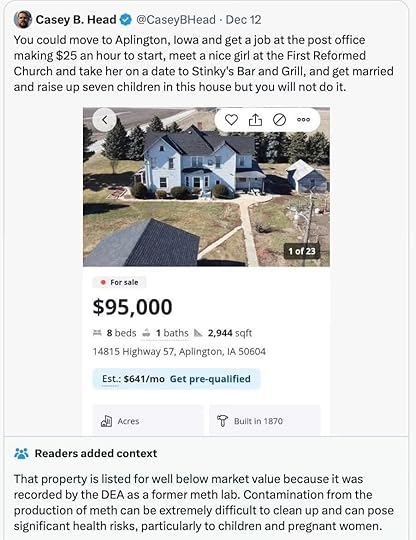
I'm going to engage with the original post in good faith, because my late grandmother came from one of those towns: Attica, Harper County, Kansas, population 516. (I'll set aside the fact the house in the original post has 8 bedrooms and one bathroom, is a former meth lab, and that the original poster is a stockbroker living an hour and 45 minutes from downtown Boston.)
Granny was the brilliant daughter of Attica's town doctor. Her father would sometimes take payment for his services in chickens. Growing up there, she was a voracious reader, skipped multiple grades, learned to drive at 12, and started college at 16, in an age when women's education was still controversial. She couldn't wait to get the hell out of Attica, a small town full of small people - which is how she eventually ended up in New York City, where she met my grandfather. They settled down in Boston, where she lived for the rest of her life.
I went to visit Attica a year and a half ago to satisfy my curiosity. I immediately understood why she wanted to leave.
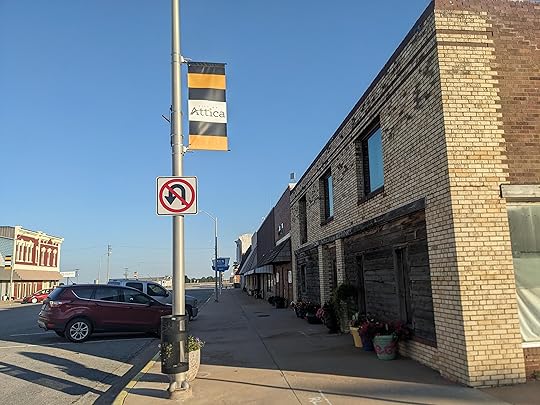
Attica was a Great Plains town of little importance a century ago when Granny was growing up, and it remains so today. Attica was incorporated in 1885, with 1500 people. When Granny was a girl a century ago, it had 750; now, it has 516. It's a poor, dying town in a state full of poor, dying towns. In places like Attica, most of the jobs are tied to institutions: public schools, a college, a hospital, a prison. Attica is comparatively lucky because it has K-12 schools and a nursing home. But it's 11 miles to the nearest hospital, 13 to the nearest pharmacy, and 17 to the nearest supermarket.
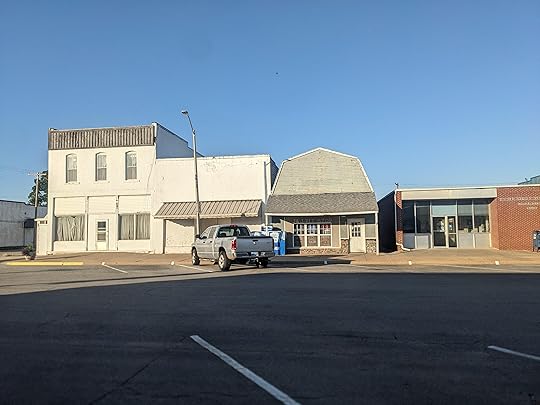
The county's statistics tell a story, too. Life expectancy in Harper County is 75.1 years, worse than Bangladesh, Iran and El Salvador. The median family in Attica made $42,708 a year, less than the pay flipping burgers at In-N-Out in LA.
Outside Attica, the Harper County side roads are still dirt. That one came as a shock to me, because I'm no stranger to rural areas. I went to high school in California's Central Valley. My first job was working for the irrigation district in San Joaquin County, famous for its almonds, peaches and dairy. I spent summers as a kid with my aunt and uncle, who lived out in the country with cows and persimmon trees. The rural areas I know best, like the Central Valley, aren't wealthy - but at least they can afford paved roads.
There are no good options for places like this. Harper County has lost half its population in the last 80 years and the jobs aren't coming back anytime soon. There's just not much future in places like Attica. The best thing anyone can do is to create opportunities so that young people can seek their fortunes somewhere else. It does no good for anyone to pretend otherwise.
December 26, 2025
California has done the big stuff to fix the housing crisis. What comes next?

There's been a lot of progress to fix California's housing crisis, because the State Legislature has finally decided to fix things. Credit where credit is due. There's going to be two parts to this post. The first part will be a summary of what the Legislature has done to fix things; the second will be what the legislature needs to get done. You'll note that there's not a whole lot of local reforms in here. Some city councils have acted in good faith to do their part, like Sacramento, Oakland and Berkeley. But most, like LA, SF and San Jose, have fought these reforms tooth and nail.
Let's talk about what the Legislature has fixed so far.
There are a lot of major reforms on this list. So far, they've:
Reformed the minimum parking law. In most places it used to be legally required to absurd amounts of parking for commercial and residential buildings. This is how you get crazy stuff like the Beverly Center in West LA, which is half parking by square footage, or my old place in Koreatown, which was a 1000-square-foot apartment with 800 square feet of parking. Bill AB2097 reformed the law so that no parking is required close to public transportation. (This was a pet project of Glendale Assemblymember Friedman, who is now in Congress.)Re-legalized small-scale redevelopment. In 2016, the State legalized ADUs (aka casitas/in-law units/granny flats) statewide. It's been a massive success at building housing on the cheap, and an entire cottage industry of ADU builders has grown up. The City of LA even got in on the game and released a standard ADU pattern that can be used by anyone. The follow-up bills to that have expanded the ADU law to cover other types of small-scale buildings that any general contractor can build. SB9 legalized duplexes statewide. SB684 and SB1123 made it legal to build small-lot townhouses in apartment zones and vacant single-family lots. (They really should allow townhouses in all single-family lots, but I digress.)Rezoned the whole state to allow apartments near transit. The big rezoning bill, SB79, passed this year after seven years of brutal political fights. (Notably, its predecessors, SB827 and SB50, fell short in 2018 and 2020 Newsom's desk.) SB79 legalizes mid-rise apartments near high-capacity transit, like Metro lines and frequent Metrolink. This is how walkable cities like SF, DC, Boston and Philadelphia were built in the past. It marks a sort of back-to-the-future.CEQA reform. For decades, the California Environmental Quality Act was used by nosy neighbors in bad faith to stop new housing and transit from being built. No longer. In 2020, the Legislature temporarily exempted transit, pedestrian and bike projects from CEQA under SB288, and made the exemption permanent in 2025. New housing was exempted from CEQA this year, through Bill AB130/SB131.Now, all of these laws seem like kind of scattershot, because there's no silver bullet to solve the housing crisis. But collectively, it's a huge deal. It's a laundry list of the big stuff that was wrong with California housing policy.
What comes next: sweating the small stuff
Now that the big stuff has been dealt with, it's time for the legislature to start sweating the details. There's a whole laundry list of things to fix.
Making it possible to build condos again. New condo construction has almost completely stalled in California in the last 15 years because of the unintended consequences of California's condo defect law. Unlike other states, California allows condo owners to sue for defective construction up to 10 years after construction is complete. (This is much longer than rental buildings, which have a four-year statute of limitations.) Making matters worse, going to court is the only available method of redress. This system has to be changed.Other places, like New Jersey and Canada, have a standardized defect resolution program which is much cheaper than suing in court. Another alternative is to simply shorten the statute of limitations so that the warranty period doesn't overlap with normal wear and tear.Building code reform. California is really behind the curve when it comes to its building codes. There's two big changes that have to happen.
Number 1 is to reform the stair code. Yes, really. The vast majority of US apartment buildings are legally required to have two sets of staircases, and California is no exception. This two stair requirement dates back to the bad old days, when buildings were built with worse materials and were more likely to catch fire, but it's now obsolete thanks to modern building materials and firefighting advances. Single-stair apartment buildings just as safe in a fire as double-stair buildings. (Single-stair buildings have been legal in New York City and Seattle for decades, which allows us to compare apples to apples.)
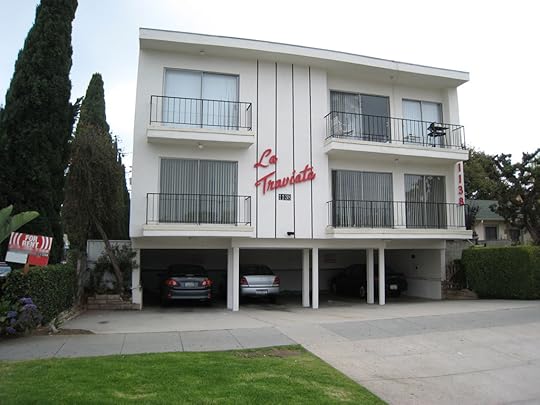
The double stair requirement is a huge drawback in three ways. First, two sets of stairs usually makes it geometrically impossible to build an apartment building on a typical 50' x 125' lot. Developers have to buy adjoining lots to build a code-compliant apartment building, which raises costs. (The most common type of LA apartment - the postwar dingbat - was almost always built on a single lot.)
The postwar dingbat, a classic single lot apartment building. Illegal to build nowadays.
Second, two stair buildings make for worse apartments. It's common for double-stair apartments to only get sunlight from one direction because all units have to face the hallway. Single-stair buildings don't have this problem because apartments wrap around the staircase and elevator, giving sunlight from multiple directions. Third, single-stair buildings make it easier to build family-sized 3-4 bedroom apartments - something that's completely normal in Europe but extremely rare in LA.
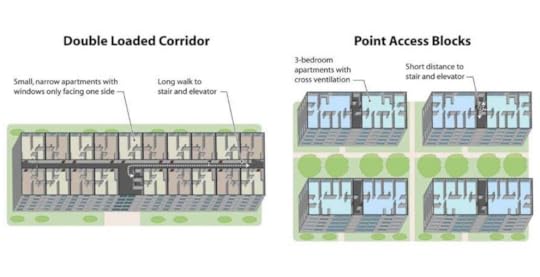 Single-stair apartment buildings give better light and air than double-stair buildings. Image credit: Alfred Twu.
The other big fix is to make the building code uniform statewide. While there is a state building code, every city customizes it. These local modifications make it more complicated for developers to cross municipal lines, and they make construction more expensive. In France, by comparison, there is one national building code, which makes it possible to do things at industrial scale. For example, it's common in France to have factory-built bathroom modules, which are prefabricated and plopped in wholesale in during the construction process, instead of each bathroom being built on-site from scratch as in the US.
The French manufacture bathrooms at scale.
[image error]
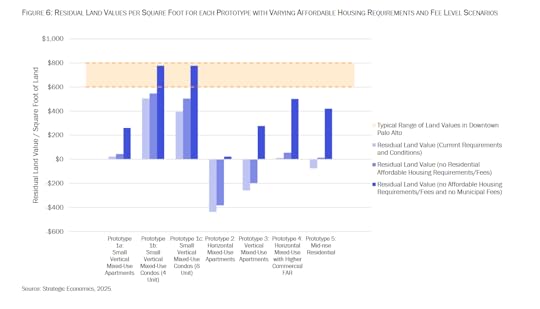
Impact fees. It's common for cities to charge fees to build new apartment buildings. But it's even more common for city fees to be used as a weapon against apartment developers. Take Palo Alto in NorCal, for example. There, the fees are so high that they effectively ban new apartment construction downtown. It's effectively a 15% tax on new construction. (If someone has a study from LA that analyzes this dynamic, I'd love to see it.)
Uniform anti-displacement standards. We all agree that it's bad when people get displaced from their neighborhoods by gentrification. But the current law is a patchwork of different standards, and it's genuinely hard to determine what's kosher, even for lawyers. For a simple example: SB684 (the townhouse law) bans the demolition of units occupied by tenants in the last five years. The standard under SB79 (the homes-near-transit law) is seven years. And that's just the beginning of it. There really needs to be a state-level fix for this, one uniform standard. Colleagues who work in Sacramento are aware of this problem; they're going to try to put a uniform standard soon.Affordable housing reform. A lot of cities require a percentage of new units to be rent-controlled. Pasadena requires 20%; Whittier requires 15%; Beverly Hills requires 10%; unincorporated LA County ranges between 10 and 20%. (Unless you're in the Antelope Valley or Santa Clarita.) It sounds like a good idea to require a percentage of new units to be affordable. But the money for those below-market units have to come from somewhere, and the money ain't coming from the gov.
Some developers deal with this by building ultra-luxury units, which turn enough of a profit that they can afford the rent-controlled units. Some can finagle it so there's a way to square the circle. But a lot of them see these requirements and say "lol nope, I'm out." NIMBY city councils know this dynamic very well. You'll often see them require high affordable housing percentages in bad faith, knowing that 20 percent of zero is zero.
There's a few different ways to fix this. The obvious one is to fund the mandatory affordable units directly, like Portland does. Another way is to replace the affordability mandate with an expanded density bonus. That is, if developers build X units of unprofitable affordable housing, they can build an extra Y units of profitable market-rate housing, like what LA City already does with the Transit Oriented Communities program. A third way is simply to make it unnecessary, by building so much housing that it doesn't matter whether a unit is rent-controlled or not. (That's what they did in Austin.) Hey, a guy can dream, right?Proposition 13. Last but not least, there's Proposition 13. For those who don't know what it does, Proposition 13 is the law that got us into this mess in the first place: property tax is based on the price the owner paid, not what it's actually worth. Identical properties can have wildly different valuations because of this. Just to give a personal example, my brother used to live in a building with three identical units in it. His landlady bought it during the Great Recession, and paid $5200 a year in tax. The downstairs neighbor bought in '07 during the real estate boom, and pays $9100 a year in tax. The upstairs neighbor bought in 2020 and he pays $11000 a year in tax. Aside from being on different floors, they're exactly identical units.
Worse, Proposition 13 also applies to commercial property, industrial property, and rental real estate, so landowners never have to sell. To give an example of what this looks like, check out this empty lot in Inglewood. It's currently valued at $402,000 under Prop. 13. The lot has been vacant for over a decade. The owner has been trying to flip it for a decade, putting it up for sale no less than four times. And because the property taxes are artificially low, there's no incentive for the owner to sell. It's legitimately the third rail of California politics. An attempt in 2020 to abolish Prop. 13 for commercial, industrial and agricultural property narrowly failed. I fully expect more reform attempts as the housing crisis gets worse, but I don't think it'll happen while Gavin Newsom is in office.
So, What's the TL;DR, then?
There's been honest-to-god progress on the housing front, and thankfully the big stuff is done. Now it comes time to do the hard work of getting the details right. But it's not going to be easy. NIMBYism has been a dominant force in California politics for half a century. We're winning - but the long war continues.
October 26, 2025
Let's talk about tech billionaires' plan to build a new city of 400,000 an hour away from San Francisco.
A group of tech billionaires has quietly bought up 78 square miles of Solano County, California, halfway between San Francisco, where I grew up, and Sacramento, where I used to work. The funders are a who's who of the tech industry, including Reid Hoffman, founder of LinkedIn; Marc Andreessen, founder of Netscape and venture capital firm Andreesen Horowitz; and Laurene Powell Jobs, the Apple founder's widow. They want to build a new city of 400,000 people there, i.e., about the size of Oakland. It's called California Forever.

The group released their city plans to the public a couple weeks ago, and I had to write a review, because the level of ambition is off the charts. Nobody has ever tried to deliberately plan a new city this size in the United States.
Bottom-line, up front: The design is seductive. It has a lot of good ideas. But let's be real here: the California Forever people expect 400,000 people to live an hour's drive from where the jobs are. Who are we kidding here?
I. It's trying to be a traditionally planned city, with good bones.
[image error]
 [image error]
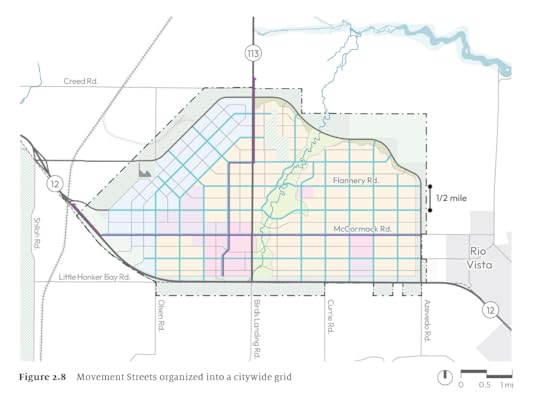
California Forever gets the basics right. The first thing I noticed is, the street plan is a grid. Grids are good because they're versatile and scalable: grids work for cities of every size, whether it's Manhattan, Kansas or Manhattan, New York. There's a reason that cities have used them since ancient times. Hell, Piraeus, near Athens, is still using the street grid laid out in 450 BC.
In the 21st century, a grid is an unusual choice. Most new neighborhoods in the 21st century are designed with winding main roads and cul-de-sacs, a system that starts breaking down once a suburb tries to urbanize. Perimeter Center, Atlanta, and Tysons Corner outside DC both have this problem. Metro extensions to Tysons and Perimeter Center have somewhat alleviated the traffic snarl, but it's only really a half-measure because the bones of both places are so bad.
Likewise, the transport plan within California Forever is back to the future, relying on a city bus network and bike lanes. The streets are wider than necessary, but this is a relatively minor quibble compared to the basic soundness of the design.
2: The zoning plan is straight out of 1920, and I mean that in a good way.
The zoning plan is also another Back to the Future, and it's quite excellent. Suburban developments in California usually are around 8-9 net units per acre. This level of density is nowhere near enough to be sustainable in the long term. After about 50 years, the tax base can't support the physical infrastructure, which is why so much of the older suburbs in NorCal are visibly falling apart. Even rich ones like Davis have this problem.

California Forever wants to use rowhouses as the basic housing unit.
California Forever wants to average 30 units an acre, using the rowhouse as the basis of the city, just like Philadelphia and San Francisco. I'm a huge fan of rowhouse neighborhoods, because they're cheap to build and administer. This is because of two quirks of the law. Condos use the more expensive International Building Code standard, and there's a whole lot of bureaucracy required to administer a condo board. With rowhouses, the building code standards are looser, any general contractor can build them, and the buyer owns the land outright.
I am concerned that the density they're aiming for is actually too low. California Forever is aiming for a full-build population density of about 5,000 people per square mile, about the same as San Jose or Cleveland. This is double the density of what you see in most outer-ring suburbs, but it sure as hell ain't European. For comparison, in Vienna, an old airbase is being redeveloped as a neighborhood called Seestadt Aspern. The Viennese are aiming for a density of 25,000 people per square mile. (San Francisco has a population density of 19,000 per square mile, by comparison.)
Newly-built Viennese neighborhood Seestadt Aspern.
You might be wondering, "Jake, why are you skeptical? There's well-planned transit, biking, traditional neighborhoods, new housing... why is this a bad idea? You've gone on for 500 words so far, and you still haven't said one explicitly bad thing about this so far."
Yeah, about that.
III: Remind me again, how are these 400,000 residents supposed to get to work?
It comes down to three words: location, location, location. California Forever is in the middle of nowhere, 14 miles west of Suisun City. With no traffic, San Francisco and Sacramento are each an hour away, and San Jose is an hour and a half. It's nowhere near the jobs, and California Forever's plan includes no new mass transit infrastructure to get its 400,000 residents to those jobs. The plan basically handwaves the problem, saying that they're going to run express buses to the nearest Amtrak commuter train station, 15 miles away. I looked at this, and I was like, "you've got to be shitting me." It's a huge oversight, and one that caused me to change my mind on the wisdom of this whole scheme.
Think about that comparison for a second. The California Forever people want to build a city the size of Oakland. Oakland has nine Bay Area Rapid Transit stations and two Amtrak stations. It has a proper downtown of its own. California Forever's plan is to put 400,000 people in the middle of nowhere, and expect a few express buses to do the job. Who are we kidding here?
The thing that drives me crazy is, it would be so straightforward to address this problem, because the Capitol Corridor commuter rail is within striking distance. If you upgraded the Capitol Corridor to the standard of the Spanish Madrid-Toledo line, with additional trackage to stop at California Forever, commuters would be a half-hour from Sacramento and Oakland, and 45 minutes from San Jose. And as a bonus, that would take tons of cars off the freeway. But that's not in the plans, and I don't think it ever was.
IV: California Forever is tech moguls who don't know what they're doing playing SimCity.
This fundamentally flawed plan to build a city in the middle of nowhere reflects the mentalities of the tech billionaires that funded it. In the tech business, old but functional systems that require a ton of effort to keep working, you junk old kit and replace it. The technical term is "legacy system". California Forever has the same kind of vibe. Your old city isn't working? Fine, just build a new one.
That style of thinking drives me crazy, because the core of Silicon Valley is an easy technical challenge to fix for an urbanist. The core of Silicon Valley isn't SF or Oakland, even though SF and Oakland get most of the press. Rather, Silicon Valley's true center is in San Mateo and Santa Clara counties, 45 minutes south of SF.
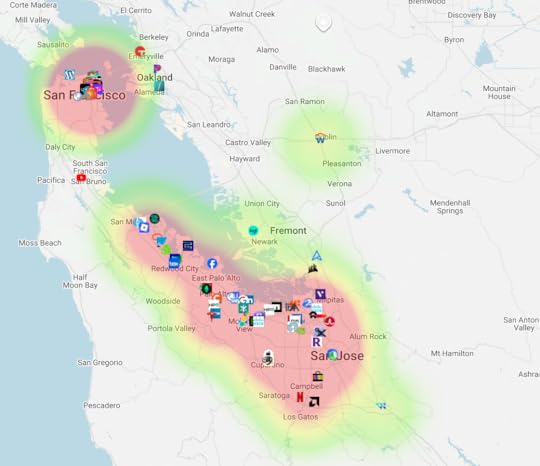
The bulk of the big tech companies aren't in SF - they're down the Peninsula. Via siliconvalleymap.org.
The place that invented the future is an expansive, expensive sprawl of bland, copy-pasted office parks and tract homes. The 1990s-vintage light rail system is a ghost train. The Santa Clara Valley Transportation Authority's light rail system has 42 miles of track, and carries fewer riders than the 9-mile Tempo busway in Oakland. As of this writing, the median home in Silicon Valley sells for $1.6 million.
Karina Station, San Jose: all kinds of opportunities to build on top of the surface parking lots.
If you want to see what this looks like, here's the view from Karina Station, San Jose, outside PayPal's global HQ. There's tons of underused land available, and a light rail station used by only 110 people a day - i.e, less than one rush hour bus in Oakland. PayPal HQ alone has 25 acres of surface parking. Under SB79, the new zoning reform law, it's now legal to build 2900 homes there without touching a single square foot of office space. At an average household size of 2.8, that's 8,100 people who could live in one company's mostly-empty parking lots.
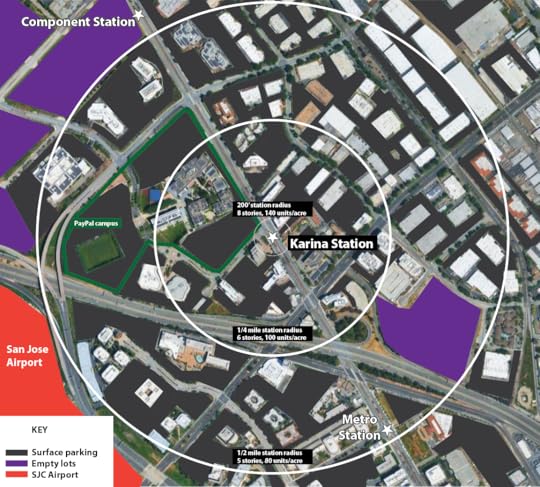
San Jose: tons of jobs - and plenty of surface parking ripe for redevelopment.
The billionaires could absolutely have thrown their weight around to fix Silicon Valley. They are no strangers to exercising power. But building apartments near underused train stations requires doing the hard work of fixing an existing place. It requires working with a legacy system, and California Forever's backers have shown little interest in doing that. The people funding California Forever don't want the existing Bay Area to build more housing - Andreessen even wrote a letter to his city council to that effect.
That's why I don't like California Forever. It's fundamentally wasteful to build a new city in the middle of nowhere, when there's just so much available land and infrastructure in the Bay Area that's ready for reuse. If the tech billionaires had put a fraction as much effort in to fixing the Bay Area as they did into playing SimCity (Solano County edition), we wouldn't be in this mess in the first place.
October 5, 2025
Jake's Endorsements, November 2025 NYC general election
I've been asked by a good number of people on Bluesky and elsewhere for my voting endorsements. I've collected my voting recommendations here.

CANDIDATES
NYC Mayor: Zohran Mamdani. I was publicly skeptical of him in the primary, and I'm still not crazy about a lot of his ideas. But he's the best option in the field because he's correctly identified what NYC's problems are, and he's surrounded himself with competent people. The alternatives are far worse. Andrew Cuomo ran the subways into the ground when he was governor. Curtis Sliwa is an incoherent crank, even though some of his ideas are good and he genuinely wants the best for the city. Eric Adams, mercifully, dropped out.
Public Advocate: Both candidates suck. Jumaane Williams is a NIMBY slumlord who keeps making bad-faith commentary about how Eric Adams's rezoning plan, City of Yes, needs more "real affordability" and more "community involvement" of the kind that got us into this mess in the first place. The Republican, Gonzalo Duran, wants stronger rent control measures and even more hyperlocal control over development decisions. One is nominally a Democrat and the other is nominally a Republican but they're effectively the same on housing. Personally, I'm writing in Abby, my friend Amanda's dog. Abby is very cute, and will do no harm if she is elected.

Abby the Dog would make a better Public Advocate than either candidate.
Comptroller: Mark Levine. Levine is the kind of earnest Jewish guy who has kept the mayor's office honest, and he's been excellent on bus lanes and expanding bike lanes.
Manhattan Judges: No recommendation. I don't litigate anymore, so I can't offer public endorsements beyond the courthouse scuttlebutt I hear from friends and colleagues.
Manhattan DA: Alvin Bragg. Crime is down in NYC. I give him bonus points because Bragg had the stones to go after Trump and secure a conviction when so many other prosecutors failed.
Manhattan Borough President: Brad Hoylman-Sigal. Hoylman-Sigal supports more bus lanes and a resumption of outdoor dining, and has been an effective legislator in Albany. I endorse him wholeheartedly.
Brooklyn Borough President: Antonio Reynoso. Reynoso vocally backed City of Yes, and has consistently supported reforming the laws to address the housing crisis. He's also been really good on biking, pedestrian and transit infrastructure. I offer him my unqualified support.
City Council, District 1 (LES, Chinatown, Tribeca, FiDi): Both candidates suck. Christopher Marte, the incumbent city councilman, is awful. Marte opposed Mayor Adams's City of Yes housing plan - one of the few good things that Adams did. I loathe Adams, but credit where credit is due: City of Yes was genuinely good, and it's a shame that the City Council watered it down. Marte's also against congestion pricing. Strike two. And while he's not as openly corrupt as Eric Adams, I will note that Marte's brother mysteriously managed to get one of the first legal marijuana dispensary permits in the neighborhood at a time when those were nearly impossible to get. Strike three.
I would love to vote for someone else, but the other candidate is Helen Qiu, a MAGA pastor with a completely unserious plan to fix the housing crisis that's so stupid it's not even worth my time to break it down. Seriously, the sum total of her plan is "abolish rent control and allow public housing tenants to buy their apartments." That's not a plan or even the outline of a plan - that's a tweet.
My neighborhood deserves a real alternative, so I'm writing in Nira the Cat. Nira is a native New Yorker, a lawyer barred in CATalonia, and she lives in the district (about 15 feet away from my bedroom). Nira's extremely good at keeping my apartment rodent-free, which is a major accomplishment in NYC.
 Nira the Cat, Esq. would make a great city councilor.
City Council, District 36 (Bed-Stuy, Crown Heights): Chi Osse. This is my old neighborhood on Brooklyn. Osse is a thoughtful councilman who has been aggressively promoting better housing policy, and Osse has clearly gotten into the weeds of how to fix the zoning and building codes. He also sponsored the law to abolish mandatory broker fees. I moved back to Manhattan a few weeks ago, but he deserves your vote.
BALLOT PROPOSITIONS
Proposal 1 (Cross-country ski trails in the Adirondacks): Planning to vote no, but open to hearing other opinions. There are plenty of upstate ski resorts already, and the State had to bail out the upstate resorts less than a decade ago.
Proposals 2 + 3 (Streamlined review for affordable housing and small projects): YES, YES, YES. New housing is forced to go through way too much bureaucracy already, and anything that can speed the process is good.
Proposal 4 (Affordable Housing Appeals Board): YES, YES, YES. Currently, city councilors have the power to veto affordable housing in their districts. Proposal 4 would strip this authority, and instead put it in the hands of a three-person committee made up of the Boro President, City Council Speaker and Mayor. This is good, because the new committee answers to the whole borough and whole city, not to just the hyperlocal concerns of one neighborhood.
Proposal 5 (Creating a new digital city map): Yes. The current official city map uses paper maps. Centralizing and digitizing this function is a no-brainer.
Proposal 6 (moving local elections to even years): Yes. Right now, NYC local elections are held in odd-numbered years, when fewer people turn out to vote. Holding local elections in presidential years increases voter turnout dramatically and reduces election administration costs. California experimented with this law and it was a huge success.
September 13, 2025
HELL YEAH. California finally legalized apartment buildings near transit, statewide. Let's talk about the consequences.
BOTTOM LINE, UP FRONT: The big rezoning bill, SB79, passed the Legislature and it is a big fucking deal for dealing with the housing crisis. Because now it's legal to build apartments near public transit, statewide.
Side note before I begin - this post is about LA, but everything about this also applies to the Bay Area.
There are two crises that California faces these days. #1 is the housing crisis, because there just isn't enough housing to match the number of jobs. The housing crisis exists because cities have made it nearly impossible to build new housing. Some suburbs, like El Segundo, Beverly Hills, and Alhambra, have barely grown in 40-50 years despite skyrocketing demand.
The State has been trying to force cities to get their shit together for decades. The State created tools that local governments could choose to build more housing on their own terms, and city councils basically shrugged. The State tried to throw money at the problem and fund new affordable housing, but city councils buried new affordable housing in red tape - it costs almost as much to build a new rent-controlled apartment as to buy a single-family home. The State tried a quota system for cities, and LA cities were supposed to build 1.3 million homes by 2029. But cities put on a dog and pony show, promptly returned to business as usual, and Newsom chickened out. LA's cities are on pace to build 467,000, less than a third of the target.
Crisis #2 is the transportation. Traffic is horrible, and public transport isn't very useful, and it's facing a post-pandemic funding crisis. Transit works in New York, Tokyo and London because because they build stuff within walking distance of the stations. If you go to LA Metro stations in Rancho Park or El Segundo ... there's just not much there.
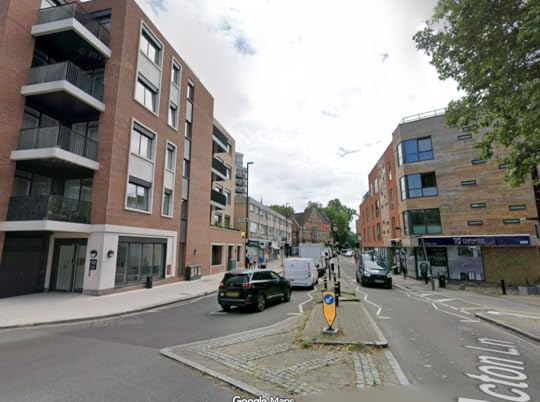
London's train stations have stuff you can walk to nearby...
[image error]
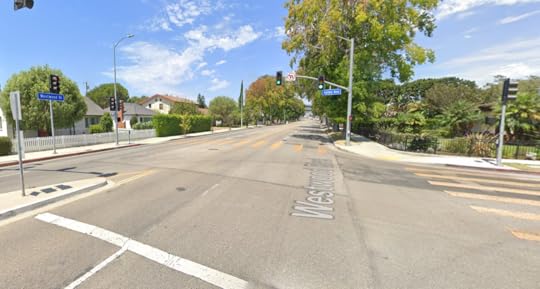
... while LA's do not.
This year, the Legislature finally got serious. They passed laws streamlining the California Environmental Quality Act and allowing builders to get inspections done faster. (Buildings departments are legendary for being slow and corrupt.) SB79 completes the trifecta of big reforms this year. SB79 does two things: it legalizes apartments near public transit, overriding local laws, and it also allows public transit agencies to act as real estate developers on the land they own. Let's talk about what's in the bill; and here's a map of affected areas.
THE BASICS OF THE BILL.
There's two parts to the bill. There's the actual zoning standards, which a city can tweak but not override. There's also no way for a city to legally deny a building that matches the law.
1: WHAT THESE NEW APARTMENTS CAN LOOK LIKE.
Rather than giving a laundry list, SB79's key provisions are best listed as a table. Here's what you can build:
Transit typeHow close to the transit?Legal heightUnits per acreAllowable square footageWhat does this look like?SubwayWithin 200'9 stories160 units/acre4.5x the lot sizeThis building from K-townSubway< 1/4 mile7 stories120 units/acre3.5x lot sizeThis building from K-townSubway1/4-1/2 mile, city size >35,0006 stories100 units/acre3x lot sizeThis building from Pasadena-----------------------Light rail, busway, frequent MetrolinkWithin 200'8 stories140 units/acre4x lot sizeThis building from SFLight rail, busway, frequent Metrolink< 1/4 mile6 stories100 units/acre3x lot sizeThis building from PasadenaLight rail, busway, frequent Metrolink1/4-1/2 mile, city size >35,0005 stories80 units/acre2.5x lot sizeThis building from NYCSB79 buildings have a requirement to build rent-controlled units (or equivalent below-market-rate condos). It's a sliding scale, based on the income level restriction. Keep in mind, "low-income housing" is a descriptor based purely on family size and salary, not a proxy for moral fiber or anything.
Apartment typeIncome limit (family of 4)Who makes that much money?PercentageExtremely low income$45k (30% of median)a restaurant waiter (before tips)7%Very low income$75k (50% of LA median)LAUSD teachers10%Low-income$121k (80% of LA median)A Cedars-Sinai nurse13%SB79's flavor of zoning actually reflects a return to the old way of doing things. In the past, LA allowed way more to be built than today. In 1960, LA City alone was zoned for 10 million homes, and by the 21st century, that number had been cut in half. I suspect that Sacramento would never have intervened if the cities hadn't been so unwilling to change. The cities fucked around, and oh boy, did they find out.
2: TRANSIT AGENCIES CAN BUILD APARTMENTS ON LAND THEY OWN.
The second part of the legislation is that Metro, and other transit agencies now have legal authority to develop land that they own near transit stations. This isn't a big deal in the short term. But in the long term, it opens the door for one of the things that made Tokyo's transit system so good - because Japanese transit operators develop and operate real estate. 20% of Japan Rail's revenue comes from its real estate unit. This isn't a new thing in Los Angeles, either. It's actually the oldest thing in LA. The old Red Car system made their real money developing real estate near the stations. This was normal during a century ago - Oakland's streetcar company was owned by a company called the "Realty Syndicate."
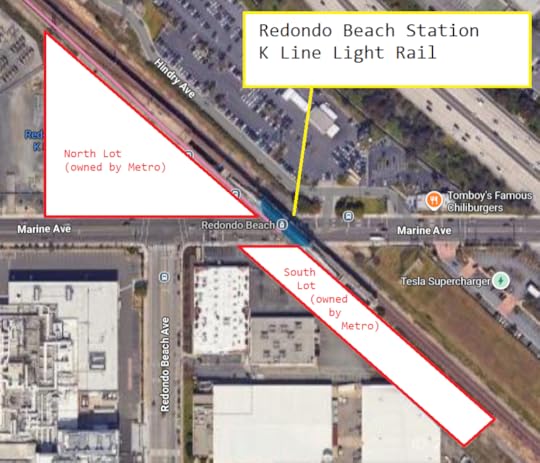
There's tons of opportunities for Metro and Metrolink to take advantage of, because much of the transit network was built as park-and-ride. Here's Redondo Beach station on the Pink Line, for example. There's four full acres of land that's used for parking lots - enough to house 2,000 people under SB79's baseline zoning.
3: WHERE SB79 DOESN'T APPLY.
Now, SB79 does have safeguards, because you don't want people to live in Bad Places. Nobody wants a repeat of the Palisades Fire. Thus, SB 79 doesn't apply to:
Fire zonesAreas vulnerable to sea level riseBuildings with rent-controlled apartmentsDesignated historic areas (with limitations to prevent abuse)These are pretty common-sense limitations, and they're probably going to have to be adjusted in the future.
THE END OF THE BEGINNING.
Now, I'm not going to say this is going to fix the housing market overnight. This is a crisis 50 years in the making. And the market is difficult, because the Administration's tariffs and immigration raids have wreaked hell on the construction industry. But it's still a big fucking deal, guys.
It's going to take more more reforms, more fixes to make LA and the Bay Area work again. But things are finally getting fixed. Let's do this.
September 9, 2025
new event: september 17, 7pm, cordelia wine bar, brooklyn
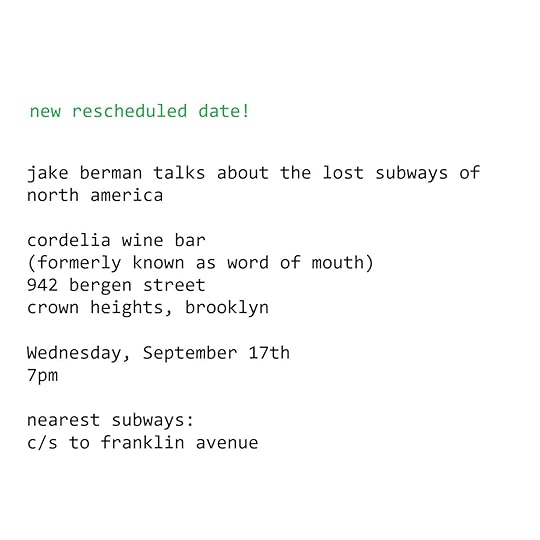
the event in brooklyn that was originally cancelled is back on for next week. see you there?
note: this is a non-ticketed event; come as you are.