
Debbi Mack's Blog
February 28, 2026
Interview with Joy Ann Ribar – S. 11, Ep. 18
My guest interview this week on the Crime Cafe podcast is with the author of two mystery series, Joy Ann Ribar.
Learn all about the Deep Lakes and Bay Browning series here!
Transcript available here.
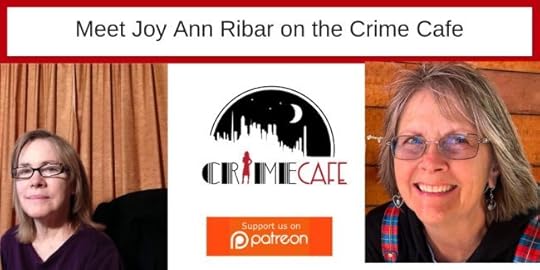
Debbi (00:12): Hi, everyone. I hope the year is going well for everybody. Today I have as my guest, the author of two mystery series, the Deep Lakes Cozy Mysteries and the Bay Browning Mysteries. She is also a frequent traveler by RV with her husband and has blogged about some of her travels that have included some landmarks of literary note I might add. It is my pleasure to introduce my guest mystery author, Joanne Ribar. I’m sorry, Joy Ann Ribar. I mispronounced your first name instead of your last.
Joy (01:35): Something is always bound to trip somebody up. It’s quite right. It’s so nice to be here with you today, Debbi. I feel like I’ve waited for this day forever.
Debbi (01:47): I feel like I wait for a lot of things forever. I got to tell you. Yeah, the waiting is the hardest part. Oh boy. Don’t sue me, Tom Petty, please. It was just a small snippet. I didn’t even really sing it.
Joy (02:02): Right. Exactly. Anyway, less than 30 seconds. I think you’re good.
Debbi (02:05): Oh, there’s no real. Yeah, there is no nothing like that. It’s all very depends on all these factors as they put it. It’s like a combination of factors. Anyway, having said all that, how are you doing today?
Joy (02:22): I’m doing really well. Speaking to you from Arizona today, which is a whole lot different than Wisconsin right now. Wisconsin is very snowy. They just got dumped on again and here in Arizona it’s sunny and dry.
Debbi (02:38): Oh my gosh. Wow. Yeah, it’s better than … we’ve got snow all over the place here and we have more snow here in Maryland. That’s supposed to be coming, so that’s throwing all sorts of spokes in our … sticks in our spokes, so to speak.
Joy (02:55): Right. A wrench in the works.
Debbi (02:58): Yeah. Totally a monkey wrench in the works for sure. I mean, it just screws you up all around. Traveling. Any sort of plans you have, who knows? Maybe things will happen, maybe they won’t.
Joy (03:10): Right.
Debbi (03:11): I’m curious, did you have a career before you started writing fiction or have you always written fiction?
Joy (03:17): Oh, definitely. I’ve had a few careers. I started life as a, well, I was a journalist first and worked as a newspaper reporter and an assistant editor and a photographer, and then I went on to work for a law firm as a paralegal. So I did a lot of legal writing, which everything I’ve done seems to be centered around writing. And then I became an English teacher and I taught high school English, followed by college English. And then in 2017 I became a semi-retired part-time teacher. Found out I had a lot of time on my hands and decided I would try to do some writing of my own with fiction. And so I wrote my first book in 2018.
Debbi (04:14): And which book was that?
Joy (04:16): And that was Deep Dark Secrets, and it was the first in the Deep Lakes Cozy Mysteries. I wrote it in real time. It was January. I was in Wisconsin, looked out the window. It was snowing. It was cold. The streets were quiet, the snow was piling up in the crooks of the trees, and I thought, it’s beautiful out here, but how do I share the beauty of winter with readers who don’t know winter? And that was kind of how all of my mysteries then became set in different seasons in Wisconsin because I wanted to focus on the season even as much as I wanted to give them a good mystery.
Debbi (05:02): That’s really interesting. It’s like you’re focusing on a local area and the way it changes over time.
Joy (05:10): Yes, yes, exactly. And in that series, which there are five books plus a standalone Christmas book, but I wrote each one in a season and I picked up, I just continued where the last one left off as far as it being set in the same year, but in the next season and in the next season. That was how I set those mysteries, and it really gave the characters a chance to evolve even within their own relationships and in their own maybe quirks and obstacles in life.
Debbi (05:50): It’s really fascinating because this is the first time I’ve heard somebody talk so much about setting, the setting as a part of the story.
Joy (06:00): And I think for me, because it’s a cozy series, it was so important to have that setting become a place where maybe people wanted to come and visit and escape. It became a central part because it was a small town or it is a small town set in a tourist town, and everybody knows everybody. And so all of the shops have their own kind of personalities, and the people come and go, and they’re recurring characters. So it almost is kind of like a TV series in a way where people can come in and they know exactly what to expect. They come to that town, they come to the bakery, they come to the wine lounge, they go to the waterfall park. They just know what they’re going to get every time they come and visit.
Debbi (06:54): Yeah, yeah, that’s really cool. I think our environments do affect us as people, so definitely living in Wisconsin would have a different effect on people than say a person living in Arizona, their environment.
Joy (07:11): Definitely. And I think the more I travel, certainly the more I am aware of how local things really are in this really huge country that we live in. And I talked to so many readers who have never been to Wisconsin, and you get your own conception of a place. I mean, I think of Florida and the first thing I think of is Disney World. So people think of Wisconsin, and what I hear from people is, oh, it’s cold there, but it’s not cold all the time. It does get cold, but that’s only part of Wisconsin. And I really wanted people to see that there were so many layers in Wisconsin and so much different kinds of beauty, because again, I think people also think farmland. And there’s a lot more than farmland in Wisconsin too. There’s many different landscapes.
Debbi (08:11): Well, Madison is a really nice little town. I went there for a Bouchercon once. I really loved it. It was so walkable.
Joy (08:20): It is, and it’s such a popular community. It’s very artsy and cultural and yeah, I love Madison. That’s where I went to college, so it’s kind of one of my favorite places too, to be in Wisconsin.
Debbi (08:36): Kind of like the old stomping grounds.
Joy (08:38): Yes, indeed.
Debbi (08:41): You had, I think, mentioned in one of the descriptions of this series that they’re kind of like standalones in the same place. You could start with any of them?
Joy (08:52): What I would say is, I mean, you actually could, but what I would say is there’s a definite arc in my main character. She very much changes from somebody who is very unsure of herself in the beginning because she starts doing this amateur investigative reporting, and she doesn’t know how to ask questions. She doesn’t know who she should talk to. She certainly knows she shouldn’t cross police tape, but she does anyway. And she knows some things about the law because she herself had worked in the legal field for a time before she decided to run a bakery in a wine lounge.
(09:40): But there’s a definite arc to her character. Her character changes quite a lot and evolves quite a lot from being that uncertain person as she goes through a lot of different things throughout the series and also even in her relationships. Those change as well. Be that, and after having said that though, I’m a person who, I read series sometimes and there’s 25 books, and I’m not sure I’m going to commit to 25 books. And if I see something and I pick it up and I say, this catches my eye because of the plot line or the concept, I read the back of that book and I tell people the same thing. If you read the back of my book and you say, oh, this is cool. This is about a legendary curse, which is my second book. Oh, this is really cool. This is about birding. If somebody is really into that and says, I just want to pick up book three or four, I say, go for it.
Debbi (10:45): But you still have a protagonist who is, I take it a reporter or a …
Joy (10:50): She is.
Debbi (10:50): Kind of a newbie reporter,
Joy (10:52): A newbie reporter. She has a lot to prove. In the first book, she conveys to the readers that she wanted to be an investigative journalist, and the local newspaper editor would not hire her. Instead, he wanted her to hire her to print stories about her winery and recipes from the bakery and things like that. And she took that, took that as a little bit of an insult, like, oh, maybe you’re not taking me seriously because I’m a woman, or maybe you’re just not taking me seriously because you think I just bake for a living. And so it’s an opportunity that happens with her in the first book, is she stumbles upon a crime scene or a suspicious murder. It isn’t even a crime scene, but it’s a suspicious death. And she says, it’s January in Wisconsin. There’s not a lot going on at the bakery. I think I’m just going to poke around a little bit and ask some questions. And so she evolves in the newspaper reporting sideline that she has, and eventually she gets hired by a regional paper to just be an occasional reporter. But lucky for her, even in this beautiful cozy town, there seems to be a lot of murders.
Debbi (12:20): Nobody’s immune from murder, even small towns.
Joy (12:24): No, exactly.
Debbi (12:27): Let’s see. So how is the Bay Browning series different? I noticed that it tends to be more literary focused.
Joy (12:36): Yes. So for me, the series was born out of the fact that I was missing teaching literature. I actually really loved teaching literature. I loved having discussions with my high school students about classical books and poetry, and I was missing that. And I thought, well, what can I do? And then somehow this new character came to me and I said, oh, I could write a series that has some literary themes without being too much like literature. So it includes those literary themes, and each one focuses on a different thematic piece of literature. My first one focuses on mythology, and that was one of my students’ favorite subjects. And I thought, well, that’s really approachable and mythology is something that’s loaded with symbolism. And a plot line came to me, and I just created this character who was an English professor. She doesn’t want anything to do with murder investigations.
(13:48): She isn’t the least bit interested. She’s introverted. She’d rather just read her books by the fire, grade her papers, stay in her office, teach her classes, and repeat the routine. But murder comes calling to her. It comes calling in a dry cleaning mix up where she ends up with a murder victim’s coat instead of her own. And that’s where she finds a clue. And then she starts to piece things together. And also, her sister is highly involved in the very first book. Her sister lands on her doorstep after she’s been in prison for three years because she’s a con artist and got caught up in fraud and larceny, and now she’s on parole, and now she’s come back to her sister and said, I need a stable place to live, and will you help me out? So they have their own conflicts that they have to work out within the family, but then together they are also able to work on solving the crimes that they end up entangled in.
Debbi (15:08): They end up. I love that. I love it when people end up somehow entangled in things. You love that. I mean, that is pretty much the premise of almost every Hitchcock movie. Oh, I’m suddenly entangled in a horrible mess.
Joy (15:25): Right. Right. And as of course, for these people, main characters, it happens over and over and over again. But for the rest of us in the real world, you can easily see that there are times you can be in the wrong place at the wrong time, and you can totally understand how it could at least happen once.
Debbi (15:46): Yes, absolutely. That’s the thing about fiction. You have to sell it. You have to make people believe it, unlike reality, which is you can’t recreate reality and have people believe it. Reality is stranger than fiction.
Joy (16:05): It is. It definitely is.
Debbi (16:08): Yeah. So let’s see. How do you choose a topic? I see that you’re really informed by your past doing paralegal work as well as being an English teacher, to which I want to say bravo or brava actually, because I’m always in favor of teachers, good teachers.
Joy (16:28): Thank you.
Debbi (16:29): Good teachers have kept me sustained throughout the years when I wanted to be a writer, but wasn’t yet, technically, even though I was writing all the time.
Joy (16:40): Right.
Debbi (16:41): Let’s see. How do you choose, say, a topic, a particular topic for a book?
Joy (16:49): That’s a good question. Well, one thing I do is I’m an avid newspaper reader, so of course now newspapers are largely online, so I’m an avid online news reader. And the more you read, the more topics that come to mind. There’s so much going on out there, and there’s so much that’s covered. I think about when, oh, I, when was actually in a real newspaper reporter back in the 1980s, it wasn’t like you might have access to a lot of different topics, but you had to go digging for that. Now it all kind of comes to you. It’s a bombardment. So as I scroll through even headlines and pick and choose and look at the quirky things, or I look at real crimes, I look at just quirky hobbies or quirky, anything that seems of human interest to me. And if I read the article, I might say, oh, there’s just one tiny little thread that I could pull out of here, and wouldn’t that be a great topic for a mystery? And I start and I just go, jot it down. I have a notebook that I keep ideas in, and then I have to test them on my characters because I listen to my characters. And I think, is this true? Does this work in Wisconsin? Does it work? Where they live, where they work, who they are, who they hang out with, their occupation? Is it realistically something that could intersect in their lives? And there’s more ideas than I have time to write at this point.
Debbi (18:43): That is so true. The ideas are plentiful. It’s a matter of writing them and creating a story around them. That’s the rub.
Joy (18:54): It is. Oh, it is.
Debbi (18:55): What kind of writing schedule do you keep?
Joy (18:57): I like to write in the morning, and then I will take a break and I will go out for a walk, and then I’ll come back because a lot of times I take a break. Sometimes I take a break, I’m stuck. Sometimes it’s just because I know I’ve been sitting too long and it is time to move. And walking for me is just the place where ideas just loosen up. It’s like a great tool. It’s like great lubricant for the brain, and then I’ll go back at it. So I will try to spend about five hours a day in the writing world, maybe a little longer if things are really flowing. Or as I have a friend who says, if the syrup is pouring, then, then I’ll go a little longer, and I do like five days a week. But if I’m in the thick of a book and it’s really knocking on my door, finish me, finish me, finish me, then I’ll just write every day with just a little breaks in between. It just depends on how driven I feel. And sometimes, and I am a person who does write at the keyboard, so if it’s going, it’s going and I run with it because I don’t like to put the brakes on, if it’s really coming onto the page
Debbi (20:36): When you’re on a roll there, you want to keep it going.
Joy (20:38): Yes.
Debbi (20:39): Absolutely. What authors have you found most inspiring in your own writing journey?
Joy (20:47): Ooh, I read a lot of different authors. I mean, I do love so many of the classical authors that I’ve taught, including Jane Austin, which I think probably inspires a lot of women, I suppose. But in the modern world, I really like Mary Roach. She does nonfiction and she writes nonfiction from the most interesting viewpoints, and also by interviewing people with experiences within the book, she writes, she wrote a book called Fuzz, which is when wildlife breaks the law, so the intersection of humans and wildlife and what that looks like. And she also wrote a book called Stiff, which is about the life of a cadaver. I mean, it’s absolutely fascinating. And yeah, it’s intriguing, and it’s so entertaining too. She makes nonfiction very interesting. And in certain memoirs, like Michelle Obama’s memoir was really, I’m trying to remembering things that were more impactful to me. And I don’t just read female authors either, but I do gravitate toward women. I just read The Glassmaker, and I cannot remember the name of the person who wrote it, Khaled Hosseini, who wrote A Thousand Splendid Suns and The Kite Runner. I love the way he weaves the story together. Mitch Albom wrote, he wrote, I mean, obviously for me, his most famous book is Tuesdays with Morrie, and it was the book that I taught in my high school class. So it was such an approachable and relatable book for young adults, and I have a great admiration for everything that book brought to me in my classroom. So there are a lot, a lot.
Debbi (23:09): Is there a crime writer that you really like? Either old or new.
Joy (23:17): Old school, Agatha Christie, but in the new, I really like John DeDakis. He has written, he’s written a really good series featuring a female protagonist who is also a, she’s a journalist, but also works in the government. Lark Chadwick. His series is remarkable, and he is not afraid to tackle issues that are affecting our society today. So I give him a lot of bonus points. I give any author a lot of bonus points for tackling so many issues that are going on in our society today, because it’s not always easy to do that in real time. It’s a lot easier to do it when you can be retrospectively or historically not easy to do things in real time. It can affect, well, a lot of things, but we’re in a tough business. So I mean, I try to stay, stay on my reader’s good side. Maybe I shouldn’t even admit that on a podcast, but I do. When you’re writing cozy mysteries, I think that you bend towards certain themes and stay away from others. And yeah.
Debbi (25:01): There’s a certain amount of comfort I think that people seek from cozy mysteries. It’s okay to tackle tough subjects as long as you can provide that comfort in there somewhere. That’s my sense of it.
Joy (25:15): Yeah, no, I agree with you. And in my first series, my Deep Lake series, Frankie, who is my main character, she’s such an idealist, and she’s so interested in the restoration of balance and social justice. So even though it’s a cozy mystery, she likes to weigh in at the end. There’s always a newspaper article that she writes at the end that is her opinion piece. And in that she always wants to talk about, here’s the lesson that should be learned from this crime that happened to our, it happened to our community. That’s how she sees it. She lives in a small town, and it affects the whole community. And so even though I want it to be cozy, I am dealing with, there’s a victim, there’s a victim there, and I feel like that victim needs to have some justice. And what is the message that we can take away?
Debbi (26:19): I guess one message is that everybody’s important to a community in some way.
Joy (26:24): Exactly.
Debbi (26:24): Which is very much a great English teacher message. I love it.
Joy (26:29): Thank you. Thank you.
Debbi (26:31): Really, honestly, teachers, I just admire teachers. I really do. Let’s see. Do you ever have moments where you just say, geez, what was I thinking? Starting this story?
Joy (26:46): Yes. Yeah, I do. I mean, I think plotting is convoluted. You start with an idea, and it seems like such a good idea until you start hammering it out sentence by sentence, chapter by chapter, and then saying like, okay, I don’t know if I have anything else to say, or now I’m here and I have no idea how I’m going to get to this end, that I’ve already created the end, but what’s all this middle stuff that I have to put together yet? And yeah, it’s like you made the most complicated cake and you’ve got one layer, but you dunno what to fill it with.
Debbi (27:29): Yeah. It’s funny how you get those moments and then maybe you take a walk and then something comes alive and sparks.
Joy (27:37): It does, it does.
Debbi (27:38): It tends to work for me, it tends to work itself out with motion and time. It’s like if I take a walk, maybe I’ll stop thinking about it so much, and things will occur, and maybe by the time the walk is over or maybe the next day, it’s like, okay, now I have something. Sometimes if you sleep on it.
Joy (28:01): Yes, yes. If you sleep on it, invariably, I’m going to wake up in the middle of the night with the idea and say, I have to get up right now and jot it down. If I just jot down some keywords, I can get it back and then I can go back to sleep. But I think that what you said is so important that I think a lot of times authors feel like, well, this is my job. I better be sitting at this computer every single day hammering this out. And I think just because you have a writing schedule, you also have to know when it’s important to walk away for a while. And I’ve walked away for two weeks and gone back and then reread everything I wrote up to that point, and then realized, oh my gosh, the answer’s right here.
Debbi (28:52): Yes, yes.
Joy (28:52): I needed to walk away.
Debbi (28:54): You have to get away. You can’t see the forest for the trees kind of thing. Just walk away and then look at it again. It’s amazing sometimes.
Joy (29:04): It is. It is.
Debbi (29:07): It really is. Is there anything, any advice that you would give, you would like to give to anyone who is interested in having a writing career? What advice would you give to somebody starting out?
Joy (29:18): Well, a couple of things that maybe a lot of things, but one thing that I think is really important is to join a writing group of whatever kind. When I first started writing, there weren’t any writing groups in my area. I wasn’t sure how to find a writing group, but I found the Wisconsin Writers Association, and I think every state or has a writer’s group or writer’s organization that someone can join. And those people, writers, authors are very generous people. They’re busy, but they’re generous. They’re giving up their time, they’re giving advice and even saying, oh, sure, I’ll read what you wrote, or whatever connection you need, or whatever you don’t know that you need to know, I’ll at least point you in the right direction. So I think that’s important is to not be alone, because otherwise it’s a very isolating place. It’s just you and your world.
(30:24): And the other thing that I have actually told some authors is don’t be a perfectionist. Because if you think that you will not finish your book or release your book, publish your book, query your book, until it’s perfect, you will never do it. So you have to let go of that perfectionism, because I think for perfectionists, it’s never going to be good enough. I know, because I taught a lot of perfectionists at the high school and college level, and you have to pry the paper out of their hands and say, just let me read it. No, it’s not good enough. No, just let me read it. And I think writers have to let go of that idea that I need it to be perfect before I’m going to pass it along, because it will never be perfect.
Debbi (31:20): That’s right. Perfection is impossible to achieve, and really just let it go. Let it be what it is. Well, I want to thank you so much for being on today, Joy. Thank you.
Joy (31:33): Thank you. I appreciate being here.
Debbi (31:35): Well, I’m glad you were able to be here. So thanks again. And to everyone listening, please check out my blog or check out Patreon or Substack where I have posted the details of Joy ‘s book giveaway. On that note, thanks again for listening and to my patrons, thank you so much for your support. I really appreciate it. Until next time, take care and happy reading. Be seeing you!
*****
Check us out on Patreon!

The post Interview with Joy Ann Ribar – S. 11, Ep. 18 appeared first on Debbi Mack.


February 26, 2026
My Book Review of ‘Crooks’
Hi, today I’m reviewing Crooks by Lou Berney. I really love this book. It’s such clean writing and so just vivid and the kind of thing that you get to know the characters who are all very distinctive and part of this family, the Mercurios, and it’s just fun and funny and each of them has a story. They all interconnect in some way, I guess I have to be honest here because I read it on a Kindle app and that is not my favorite way to read anything. But really appreciating the story I think is going to take getting a print edition because I want to see all the ways that these people connected with each other that I might’ve missed as I was breezing through an e-copy. It’s very easy to miss stuff and not know what you’re missing and not be able to go back to it because you didn’t think to mark it or anything.
So yeah, if I were to say adapt this into a movie or a TV show, I would want to get a print copy and follow a little bit of advice about adaptation from fact and fiction into film. The Art of Adaptation: Turning Fact and Fiction into Film, ”How to Transform Novels, Plays and True-Life Stories into Screenplays” by Linda Seger. All the answers you need are right here, right? Maybe not, but I think this is a really good start.
If you’re interested in adapting material from one form of media to another, adapting your IP intellectual property, which I think I’ve already explained, you have as the writer of your book. Okay, I just dropped the book. Clumsy me, my clumsy hands. Anyway, all I wanted to say was that book could really help you out, or somebody who knows adaptation could really help you out. Maybe you would like a coach. Maybe you would like to pick my brain about what I’ve done to adapt my own novels, the approach that I’ve taken.
The first time I had to adapt one of my own novels, which was at the request of a producer, and I was like, “Hmm, I wonder if I can really do justice to this thing.” So I tried to think differently about the whole thing and tried to think about it visually.
What would I want the first thing on the screen to be if I made this into a movie? And that was the approach I took. It was like, it wasn’t the book at all. It was from the book. It was not a scene from the book, but it was a scene that could have been from the book, let’s put it that way.
So anyhow, that was all I had to say. Lou Berney’s book, Crooks is a really great read. I really enjoyed it and I really want to get a print copy now so I can go through and mark it and see if I can turn this thing. But first of course, I would need to talk to the rights holder. I mean, before I got really serious about it, but I might want to do it anyway just because I might want to read this again just to reenjoy the story. It was that good. I loved it that much. Crooks by Lou Berney. Yes, thank you and be seeing you. Have a nice day.
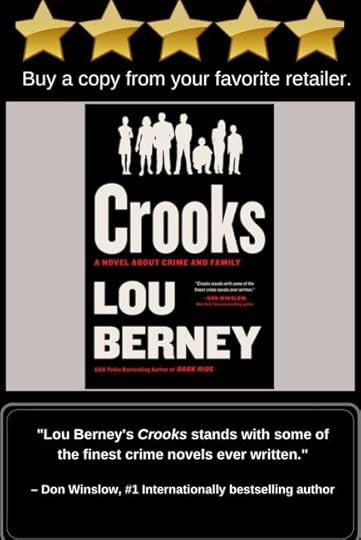
You can get the book from these retailers:
Barnes & Noble: https://www.barnesandnoble.com/w/crooks-lou-berney/1147137413
Amazon: https://mybook.to/Crooks-Ebook
Bookshop.org: https://bit.ly/Crooks-Indie
The post My Book Review of ‘Crooks’ appeared first on Debbi Mack.
February 24, 2026
The Crime Cafe with Joy Ann Ribar
Our guest this week on the Crime Cafe is Joy Ann Ribar.
Check out our discussion about the Deep Lakes and Bay Browning series, not to mention the great state of Wisconsin!
Hey, I like music! 🙂
The post The Crime Cafe with Joy Ann Ribar appeared first on Debbi Mack.
February 17, 2026
Guest Post and Book Giveaway from Joy Ann Ribar
This week on the Crime Cafe podcast, Joy Ann Ribar will be my guest. She’s also giving away an ebook or paperback book from the Bay Browning series. Winner gets to choose which book. Here’s the latest.
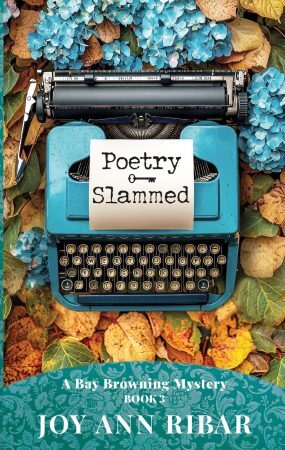
To enter the giveaway, just email Joy Ann at ribarjoy@gmail.com
And, without further, here’s her guest post!
Olympic Training For Authors
by Joy Ann Ribar
To say writing more than one mystery series is the same as competing in two Olympic events might be accurate if the two events were in the same sport. In reality, penning two mystery series is more like competing in figure skating and speed skating – the commonality is that both series are written just as both Olympic events are done on skates.
An Olympian might be comfortable in their signature event, the one they perfected after ten thousand hours of practice, but what happens when the Olympian is driven to compete in another event?
The same dilemma happens to authors.
You just got comfortable with one series, maybe you’re three or four books in. Your style is spot on. Your characters are refined. Your plots have an edge. Then, another story idea invades your brain, an itch demanding to be scratched.
For five years, I wrote the Deep Lakes cozy mystery series, five books in five years. I understood what my characters wanted, their motivations, how they would evolve. I could traverse the picturesque tourist town of Deep Lakes like my own hometown; it was mapped in my brain. I recognized victims and villains and could navigate in one smooth swish from exposition to conflict to resolution, cozy style.
Enter the Bay Browning mysteries, with its edgy vibe, literary elements, and paranormal twist. Three books in three years entered the market in a disruptive pattern. The first Bay was published while I circled back to the sixth Deep Lakes, then dove back into the Bay books again.
If you’re an author writing more than one series, I have a few coaching tips to share.
Start with a training manual. Often this is called the Series Bible.List your characters by name and physical descriptionCharacter backgrounds: life events, occupation, family, education, etc.Character quirks, habits, goals, strengths, weaknesses, conflictsCharacter arc in progressList the important places in your setting – streets, bodies of water, names of businesses, favorite spots where your characters hang outList important keepsakes or objects connected to your characters and their significance. (Bay Browning collects blue-green Roman glass. Her sister has a treasure box of Florida shells. Frankie has a delft locket.)General description of each book’s plot (Since I write mysteries, I include murder weapon, motive for the murder, clues discovered, red herrings)Keep your muscles in shape. For writers, that would be the brain.Exercise your muscle memory by frequently connecting to your main characters.While writing in one series, take your other series characters out for a spin. (I like to take meditation walks when I’m stuck on a plot point. I also spend time with my main characters from either series, imagine their conversations, even allow them to talk across series.)Jot down new story ideas for the next book and the next whenever the Muse visits.Do some heavy lifting: after finishing a book in one series, read passages from the other series before you write even one sentence in the newest book for that series. Remember, if you haven’t jumped from the diving board in some time, you won’t be starting on the high dive. Get reacquainted with the water.Consider your training center and gear. This is good advice for writers of all kinds.Keep your writing space free of distractions.Consider more than one space to maximize inspiration and productivity: home office, library, a space in nature, a retreat.Be ready to write anywhere you may be – carry a notebook, a small tote or case with paper or journal and pens, a portable tablet, your phone (I use a notes app when I walk), or a recording deviceJoin a critique group or other writing communitySwap your writing/books with other authors as reviewersOffer your writing to beta readers or in ARC form on promotional sitesIf you’re a new author, just starting on the first in a possible series, do yourself a favor and create that training manual/bible with your first book. You will save yourself precious time when you write the second installment of your series.
Authors need daily workouts just like Olympians. Even though the brain is a complex organ, like the muscles in the body, it flourishes when stimulated, exercised, and nurtured. Writing is a skill that loves routine and daily practice – the routine creates flexibility so writers can perform mental gymnastics with finesse. Like Olympians, we authors enjoy the adrenaline rush from accomplishing words on the page, honing a story, and offering our best to the world. And yes, seeing your work in print does feel like winning a gold medal.
*****
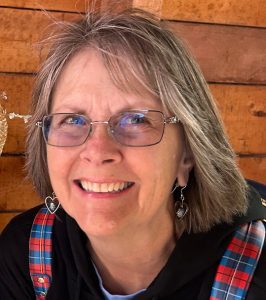 About the Author
Joy Ann Ribar is an RV author, writing on the road with her author husband, LJ, roaming around in their Winnebago View. Joy’s cocktail of careers includes news reporter, paralegal, English educator, and aquaponics greenhouse technician, all of which prove useful in penning mysteries.
If you want pastries without calories, wine without the hangover, and drama with a dose of laughter, come home to Wisconsin and the Deep Lakes Mysteries. Frankie Champagne and her business partner, Carmen, serve up pastries (recipes included), fruity wines, and witty conversations at Bubble & Bake, while they investigate crimes on the side.
Joy’s Bay Browning Mysteries blend edgy, traditional, and paranormal elements twisted around classical literary themes that readers will recognize. Join Bay and Cass, a pair of polar opposite sisters in a mid-size Wisconsin town, trying to avoid trouble, even as trouble finds them. The Medusa Murders is a triple award-winner (Book Fest, Readers Favorite, PenCraft). Shake-speared in the Park is currently a finalist for the Mystery and Mayhem 2025 award from Chanticleer International Book Awards. Her newest installment in the series, Poetry Slammed, was published in January.
The post Guest Post and Book Giveaway from Joy Ann Ribar appeared first on Debbi Mack.
February 15, 2026
Philip Marlowe in ‘The Dancing Hands’ – S. 11, Ep. 17
This episode of the Crime Cafe podcast features an entry from The Adventures of Philip Marlowe, which you can get without the ads here or here. Other than the one in the Old Time Radio broadcast replay. It’s called “The Dancing Hands”, which doesn’t sound particularly on-brand.
Enjoy the show!
Perhaps someday, I’ll be able to afford making transcripts of all these episodes! Hey, I can dream … 🙂
The post Philip Marlowe in ‘The Dancing Hands’ – S. 11, Ep. 17 appeared first on Debbi Mack.
February 10, 2026
Philip Marlowe in ‘The Dancing Hands’
In the absence of a guest, I hope you will enjoy this episode from the Old Time Radio Show archives.
Presenting Philip Marlowe in “The Dancing Hands”! 🙂
Enjoy! 🙂
PS: Take it for a test run? Got a half-off promotion running.
The post Philip Marlowe in ‘The Dancing Hands’ appeared first on Debbi Mack.
January 31, 2026
Philip Marlowe in ‘The Grim Hunters’ – S. 11, Ep. 16
This episode of the Crime Cafe podcast features an entry from The Adventures of Philip Marlowe, which you can get without the ads here or here. Other than the one in the Old Time Radio broadcast replay. 🙂
Someday, perhaps, I’ll make enough money to create transcripts of the Philip Marlowe episodes.
Would you be willing to pay (even a buck) for that, said the New York Times bestselling author? 🙂
PS: I just blew through finished this book. I think I’ve been as direct as humanly possible. 🙂
Every writer on the internet should read this book.
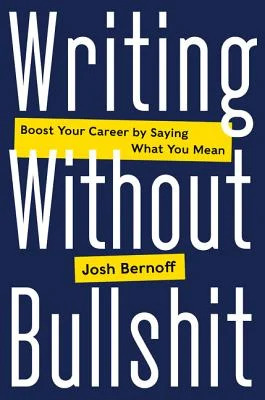
The post Philip Marlowe in ‘The Grim Hunters’ – S. 11, Ep. 16 appeared first on Debbi Mack.
January 29, 2026
My Book Review of ‘Things That Are Funny on a Submarine But Not Really’
Hi everyone. Today I’m reviewing Things That Are Funny on a Submarine But Not Really. I love the title. It’s by Yannick Murphy and that’s a she and she does one hell of a job in this book of giving you a sense of what life might be like on a submarine. Things that are funny, but not really. And it’s a very, very interesting read. As I was doing a review on Storygraph, I thought about the way the book, the pacing of the book and I thought it really has a kind of a slow pace, but I found you’re drawn into it inexorably though. It’s like, you got to keep reading this. Even though it feels like things are happening slowly, but then that would be life on a submarine, right? It’s like you get into this routine.
So anyway, but mysterious things happen. Stuff happens that eventually leads to a death. I won’t go into detail. I will just say that the language in this book reminded me so much of firefighters. So much. It made me wonder if Yannick Murphy knows firefighters or if she just knows people in the military and they all talk like this. Firefighters, police, military, they have a language all their own and I love it. And just an attitude all their own. And I just love that too. But I guess the thing about this book is that it’s very funny and it’s thought-provoking. And it’s just a great, great story.
All sorts of themes come up in this book. I’m reminded of themes like the difficulty of adjusting from military life to civilian life. I mean, this protagonist clearly has PTSD, especially toward the end. It’s called out a lot. And I just thought that that was just a great thing to do. I mean, it is a very real problem. Sometimes I wonder if we are all suffering a little bit from PTSD due to the strain the internet and its various wonders is putting on us. I know it’s putting some strain on me right now. Anyway, having said that, Things That Are Funny on a Submarine, But Not Really also made me think of themes of community. Here’s a man who was in a community, in a big steel tube of dumb. With these guys, they all share something. It’s like a community can be a submarine or a college or a workplace.
And that made me think of all the communities I’ve been a part of. I’ve been part of the legal community. I’ve been part of the college community a few times. I’ve been part of the library community, the journalism community, the author community, and now the screenwriting and filmmaking community.
Which community do I serve best? Wow. Trying to think about that sometimes gets a little bit much, especially with all of the communities out there being formed right now and saying, “Join us. We have things that can help you as a [fill in the blank].” Well, what if you’re multi-hyphenate? Which community are you in then? Where do you place most of your effort? You know something? Sometimes it’s best simply not to have ambitions, but simply to seek out that which is most appealing and which helps you the most. It’s not a matter of comfort. It’s a matter of desire. I don’t write because it’s easy. I don’t do anything because it’s easy. I do something when it truly makes me feel alive. Right now, the internet is not doing that for me. Also, when I was thinking about, there’s an issue of treason that comes up in here.
That’s all I’ll say. What would constitute treason, I wonder, to the indie author community? That’s it. That’s all I’ll say. The end. Be seeing you.

You can get the ebook from these retailers.
You can also get it in print from my online bookstore and support indie bookstores.
The post My Book Review of ‘Things That Are Funny on a Submarine But Not Really’ appeared first on Debbi Mack.
January 27, 2026
Philip Marlowe in ‘The Grim Hunters’
This week, we don’t have a guest, but we do have another exciting episode from the folks at Old Time Radio Researchers! Yay! 🙂
I’m not sure if this story is about Philip Marlowe or about mystery writers in general. 🙂
PS: I am the worst marketer evah! 🙂
The post Philip Marlowe in ‘The Grim Hunters’ appeared first on Debbi Mack.
January 13, 2026
The Crime Cafe with Ryan Steck
This week on the Crime Cafe, Ryan Steck and I discuss his thriller novels and his Substack newsletter The Real Book Spy.
Check out our discussion here!
Support the podcast! Become a patron and enjoy ad-free episodes, excerpts from my upcoming Erica Jensen novel, and bonus episodes. Check us out on Patreon!
The post The Crime Cafe with Ryan Steck appeared first on Debbi Mack.


