
Marc Hartzman's Blog
April 1, 2026
The Book Written by the Ghost of Mark Twain is Back from the Dead
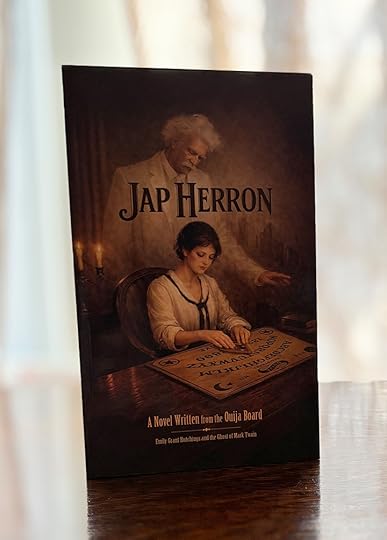 Jap Herron, now available from Curious Publications.
Mark Twain was not a Spiritualist, though he was known to attend séances for their entertainment value. He died in 1910-but, according to two mediums, he wasn’t finished writing. The famed author allegedly had much more to say from beyond the veil.
Between 1915 and 1917, a medium and novelist named Emily Grant Hutchings, working with another medium, Lola V. Hays, claimed that Twain dictated Jap Herron one letter at a time through a Ouija board. If Twain’s ghost truly lingered to painstakingly spell out fiction from beyond the grave, one suspects he did so with the same amused detachment he brought to séances in life.
Not everyone was entertained. Harper & Brothers, Twain’s longtime publisher, rejected Jap Herron, denying both its supernatural origins and its literary merit. The dispute reached the U.S. Supreme Court. Hutchings maintained that she’d worked closely with Twain’s ghost, but agreed to destroy the printed copies. Most were lost. A few survived.
Now, through this re-publication from Curious Publications, Jap Herron is fittingly back from the dead.
Order directly from Curious or from Amazon.
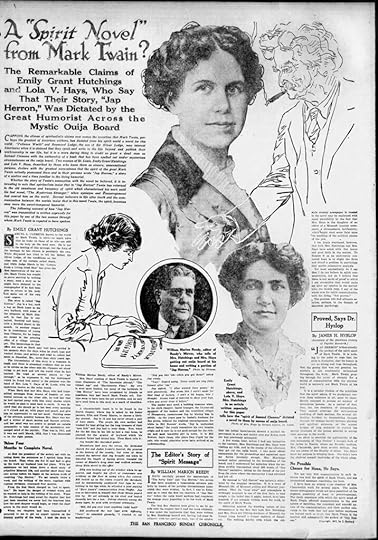 The San Francisco Chronicle featured Jap Herron’s story on August 26, 1917.
 <br />(adsbygoogle = window.adsbygoogle || []).push({});<br />
The post The Book Written by the Ghost of Mark Twain is Back from the Dead appeared first on Weird Historian.


March 18, 2026
For this Bride, Death Wasn’t a Dealbreaker
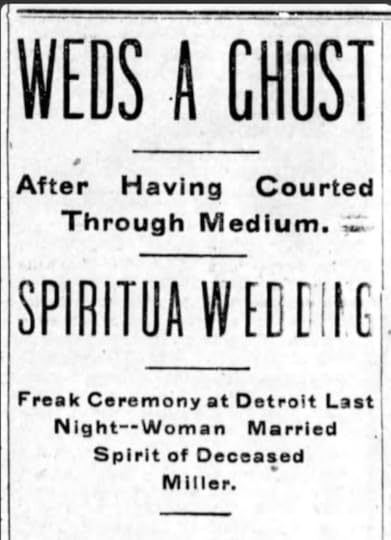 The Stark County Democrat (Canton, OH), January 3, 1902.
Spiritualism enjoyed great popularity around the turn of the century. Not only were the living talking to the dead, but in some cases, they were even marrying them. In January 1902, a 45-year-old woman in Detroit, Mrs. Sarah Williams, was wedded to the spirit of Theodore Comstock, once a wealthy miller.
According to newspaper reports, Comstock had “been courting Mrs. Williams for some time” through a medium named Mollie Ladell who “translated the honest dead one’s burning words to Mrs. Williams with such success that the widow at last agreed to link all her fortunes to Mr. Comstock of all time to come.”
Ladell officiated the ceremony by going into a trance to invoke Comstock’s spirit. With fellow Spiritualists in attendance, the bride promised to love and honor her ghostly groom. They were pronounced man and wife.
No one objected to the marriage, however another medium reported that Comstock didn’t arrive until ten minutes afterward. According to this seer, Comstock was “turned back by Charon” because he had no money and could be ferried over.
Regardless, plenty of other spirits made the trip and “came to offer congratulations and presented shadowy gifts, which Mrs. Comstock accepted smilingly, masking her real feelings over the fact that she couldn’t exchange them at the bargain store downtown.”
The bride reportedly took her spirit husband home and claimed she would be good to him as long as he would be true to her—which meant leaving the ghosts of Cleopatra and other famously beautiful women alone.
A few decades later in 1927, another medium helped connect the living and dead in marriage—only in this case, the farmer’s spirit bride jilted him. Read that story here.
<br />(adsbygoogle = window.adsbygoogle || []).push({});<br />
The post For this Bride, Death Wasn’t a Dealbreaker appeared first on Weird Historian.
March 10, 2026
Why We Love Being Scared: A Conversation with Psychologist and Author Coltan Scrivner
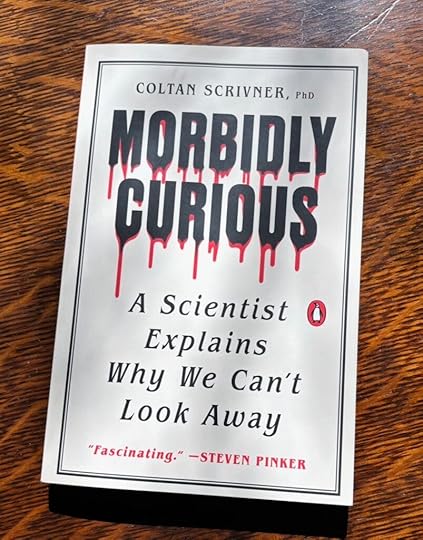 Morbidly Curious, by Coltan Scrivner, PhD. Penguin Books.
We humans have always been fascinated by the things that frighten us. But why is that? Why do we love horror movies and books? Why do we line up for hours to be scared in haunted houses? And what’s with the fascination in true crime?
In the newest episode of the Weird Historian podcast, Marc Hartzman speaks with psychologist Coltan Scrivner, author of Morbidly Curious: A Scientist Explains Why We Can’t Look Away (Penguin Books), about our strange attraction to the macabre, what it reveals about human nature, and much more.
Below is an excerpt from our conversation about haunted houses. Listen to the full podcast on Apple Podcasts or Spotify.
CS: In all the years that I’ve studied haunted houses or studied people at haunted houses—and I’ve done it in the US and in various places from Austin, TX to Detroit, MI, but I’ve also done it internationally in Denmark—and in all those places, I’ve never once seen someone come to a haunted attraction by themselves.
And it’s not because they’re too scared.
It’s because we enjoy doing these playful simulations with people we know. And oftentimes it’s a romantic partner.
I think one thing we get out of these high intensity, multi-sensory scary experiences that you maybe can’t get—at least not as powerfully—from a from a movie and you certainly can’t get from a book, because that’s an sort of more of an individual experience, is that you can see how the people in your life react to these situations.
How does this person who maybe I’m going to marry this year, and I might spend the next 50 years with, respond when they’re truly afraid? How do they respond around me? Do they act protective? Do they act afraid and do they run away and leave me behind?
These can be really good cues to how good of a cooperation partner they are, how good of a friend they are, how good of an ally they might be.
And so you get these sort of hard-to-fake responses from people you know really well and when they’re in situations that you’ve probably never seen them in.
WH: There’s also that notion of being able to approach danger and get close to danger knowing that at the end of the day, it’s a safe experience, right?
CS: Right. And haunted houses offer that in a way that helps you sort of tiptoe that line of real versus not real. And sometimes people who are a bit more on the adrenaline junkie side of things or who are sensation seekers, they need a stronger experience in order to get the same thrill or in order to get the same interest level that someone who maybe is more introverted might get from a book.
Check out the podcast for the full interview, and buy Morbidly Curious: A Scientist Explains Why We Can’t Look Away (Penguin Books) here or wherever else you buy books.
<br />(adsbygoogle = window.adsbygoogle || []).push({});<br />
The post Why We Love Being Scared: A Conversation with Psychologist and Author Coltan Scrivner appeared first on Weird Historian.
February 26, 2026
He Woke Up From the Dead and was Fined Five Bucks
In this curious tale shared in newspapers in June 1901, a countryman known only as “John Doe” was declared a corpse, then woke up and was promptly placed under arrest.
Found “apparently dead” on a sidewalk in the small town of Hundred, West Virginia, at three in the morning, the unfortunate stranger was examined, pronounced dead by two doctors, and carted off to the local undertaker.
Then the corpse sat up and began to sing.
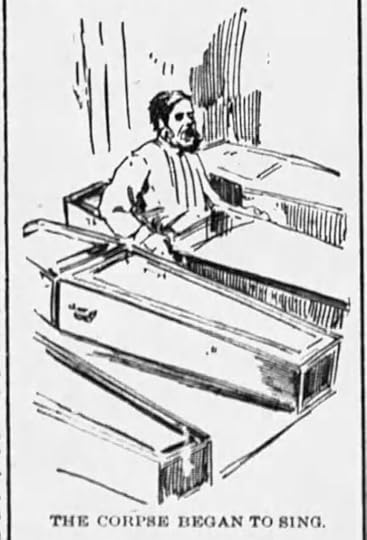 Image from newspaper accounts of this story in June 1901.
Rather than apologize for the inconvenience of misdiagnosis, the coroner, who was also the mayor, had the formerly dead man locked up and fined him five dollars for “disturbing the peace by singing uproariously.”
Faking his death or fraud may have been a legitimate cause for punishment, but for John Doe, his only was vitality.
<br />(adsbygoogle = window.adsbygoogle || []).push({});<br />
The post He Woke Up From the Dead and was Fined Five Bucks appeared first on Weird Historian.
February 22, 2026
Bold and Bleak Predictions from 1913 About the Future of Humanity
 Newspaper headline from the Henderson Daily Journal (Kentucky), September 12, 1913.
On September 10, 1913, Dr. J. H. Kellogg, M.D., F.R.S.M., of Battle Creek, Michigan, made a bold declaration during an address before the American Public Health Association in Colorado Springs: The last baby would be born in 2012.
As we know, he was wrong.
So far, he’s fourteen years off and I’d be willing to bet babies will be born for years to come. Regardless, here’s Kellogg’s reasoning:
Two-fifths of the women of this country of marriageable age are unmarried. Two-fifths of the men of this country of marriageable age are unmarried. The birth rate is decreasing in the United States at the rate of 21 per cent. If things keep on as they are going; if the capacity for motherhood continues to diminish as rapidly as at present, the last child will be born before 2012, and in the year 2017 there will be a world in which there will be no babies to ‘coo’ and to ‘agoo,’ since the youngest child will be five years old. Also a neuter type, consisting of women set apart to do the world’s work outside the home, will be evolved.
He was, however, accurate in predicting women working outside the home—even without being the “neuter type.”
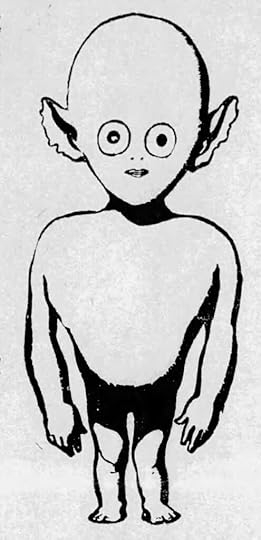 A depiction of a future human, printed in the Kansas City Post, September 12, 1913.
Piling onto the discourse was Professor Louis Delanne, who, as the Kansas City Post described, “declared the human race within two centuries would be hairless, chinless, bat-eared, four-toed, long-armed, and duck-legged.” We’ve got less than a century left to see if his prediction fares any better.
The post Bold and Bleak Predictions from 1913 About the Future of Humanity appeared first on Weird Historian.
February 5, 2026
A Glimpse Behind the Sideshow Curtain: Memoirs of a Coney Island Clown
If you’ve ever wondered what would make a clown—or anyone—want to swallow a sword with a chainsaw attached to it, Memoirs of a Coney Island Clown will enlighten you. The book follows Jellyboy the Clown’s beginnings in the sideshow world and details his many adventures, triumphs, and tragedies along the way.
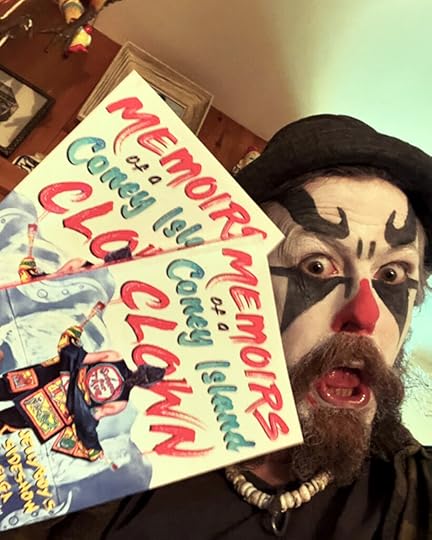 Photo courtesy of Jellyboy the Clown.
Jellyboy, who you may have seen on Season 19 of America’s Got Talent (he made it the Quarterfinals) or performing with the Squidling Brothers Circus Sideshow, spent twenty years putting this book together. “I started writing it by hand in a journal and made outlined notes in sketch books over the years while I traveled performing shows,” Jellyboy told Weird Historian.
Since learning to swallow swords from sideshow living legend Red Stuart about twenty years ago, Jellyboy has added his own unique twists to the ancient art. Beyond the aforementioned chainsaw addition, he’s integrated other creative elements, including a flamethrower at the hilt and experiments with Tesla coils. These and other endeavors are all covered in Memoirs, which presented its own new, unique challenge: writing a book.
I asked Jellyboy how it compared to something like swallowing a chainsaw sword. “Both ideas and the creative process came out of my sketch books and took a great deal of perpetuation and collaboration,” he explained. “I needed help with the book with layouts and editing in the same way I needed a friend to help me in his workshop to design the chainsaw sword. It’s all a process and I couldn’t have done it completely on my own. Both require risk and dedication.”
An excerpt of the first chapter is below. For the rest—which includes a foreword by actor and performer Mat Fraser—pick up a copy of Memoirs of a Coney Island Clown, published by Outside Talker Press. Signed editions are available here, or order wherever you buy books online.
“I hope people read the story and feel the time, places and characters that the story happens in,” Jellyboy said. “It’s a window into an underground network, a world that I fell into as much as I ran towards. I hope people will see the humanity of a fledgling clown trying to test his metal in the face of tragedy and adversity. Hopefully people can see themselves in the story and get inspired for adventures of their own.”
 Memoirs of a Coney Island Clown, published by Outside Talker Press.
CHAPTER ONE
Carnivolution
The World’s Greatest Nipple Lifter called on the telephone. We met up at the Bean Café on South Street with Red Stuart, the sword swallower. They were looking for an inside-out sideshow talker. The lip flapper with a nail in the head, presenter of bizarre mind bogglers from out of time. Red was sketching contraptions in his little black book of shadows. The old road carnie inhaled a cigarette and savored the smoke before releasing it through his nose. He sat still, a little like an iguana staring into the midway of his mind. His shoulder length red hair was tied back between a white Japanese headband and a choker necklace made of beads.
“It’s all in the mind, you know,” he said as he looked up at me over the lenses of his spectacles. Red’s eyes were shining as if he wanted to tell me the secrets behind his leathery grin. He and I had a job working in the jazz section of Tower Records down the street from the coffee shop where our meeting was taking place. The year was 2004, in the city of Philadelphia. I had just hired him and his sideshow partner to perform with my space rock band, The Hydrogen Jukebox, in a street festival we called Carnivolution. Our band was becoming an art collective variety show. The tentacled concept brought in poets, dancers, puppets, painters, fire and of course circus sideshows. They were impressed with the way I presented the acts on the microphone in between singing songs. “Nipple Man is just checking on his car. He’ll be back in a minute.”
As if on cue, the World’s Greatest Nipple Lifter emerged triumphantly through the door. He was glowing with pride as he said, “I was so close to a parking ticket. The cop was writing it and I walked up to him and said, ‘Do you realize you’re giving a ticket to a man with the strongest nipples in the world?’ I pulled out my pitch card, and the cop started laughing and ripped up the ticket.”
He looked like a mix between a pirate and a circus strong man with muscles rippling through his clothes. Long, skinny, rope-like locks were woven into his brown hair, and his ears were pierced with thick gauged rings that left hollow spaces in the lobes. On his face a well-groomed beard sat tightly with mustache, sideburns and chin whiskers all separated by the fine work of a razor.
“Nipples strong enough to bend the law,” I said looking at the pitch card.
“Why are you dressed as a clown? This is a business meeting. You should save some things for the stage,” the pierced weightlifter said disapprovingly. I was dressed in neon green spandex pants covered in black polka dots; a striped, sleeveless, multi-colored tailcoat; a red clown nose, accompanied by vintage 3D glasses with red and blue lenses. My hair was short, messy and brown attached to a ginger beard, sharpened to a point on my chin.
“Life’s a show; I’m just being a natural eyesore,” I responded. “Dirty looks are just as good as smiles.”
In ‘the business,’ making a fool out of yourself is a bad idea, unless you are a fool hired in place. Either way, bad ideas are dangerous, and danger is entertainment. A clown with no makeup is an unfinished work, confusing to the eyes. Some people say you should go to clown school, learn the tradition before declaring the profession. However, it was as if clownhood had declared me, and school isn’t the only place a person can learn. Anguish could be turned into laughter. Torture acts could morph into antidotes for human tragedy. Reality with the occasional gaffe or swindle, prick your finger on the spindle to show you are more powerful than the poison.
“Let’s get down to business,” said the World’s Greatest Nipple Lifter, joining us at the table. “Red and I have a group we’d like you to join.”
“Sounds great, but I don’t know any sideshow tricks. I’m more of a clown and a barker.”
“You need to know the terms for what you’re talking about, Jellyboy. It’s not a trick when Red swallows a sword. He is literally risking his life; it’s called a stunt. Magic has tricks; it’s fake. Sideshow is absolutely real.” The pierced weightlifter looked over to Red.
“The lingo we use in the carnival and the circus are how we tell the normies from the freaks,” Red added. “You’re still green yet, Jelly. People are really touchy about the words you use. Not everyone will take the time to explain it, so listen up. The term ‘barker’ is an insult. You’re an artist, not a dog. It’s called talking. You are an outside talker delivering a pitch to gather a crowd, or you are an inside talker who guides the madness on the inside of the tent.”
When Red was done explaining, the nipple lifter thought for a second and said, “By the way, sideshow and clowning are two different things. You should think about changing your name and getting a costume that makes you look a little tougher.”
“But I’m a clown. Can’t you be both a clown and sideshow performer?”
“There’s no written rule, it’s just not really done,” said Red. “It doesn’t seem like you’re interested in the rules all that much, Jellyboy, but you should learn what they are before you bend them, or break them. Sideshow as it was in the old days is dying. There aren’t traveling shows any more, the way there used to be. Things have to change to stay alive.”
The World’s Greatest Nipple Lifter wanted me to learn a list of stunts from Red and get us a monthly show. The molten lead spit, dancing on broken glass, walking up a ladder of razor sharp swords, putting a cigarette out on the tongue, and of course the human blockhead. Passing on information to the next generation. Scrawny, poverty stricken proportions became the makings of a freaked freak with a nail in the head.
Red opened a metal tube inside of which was a collection of stainless nails of various sizes. All shining, each one menacing. He picked one of the smaller ones and handed it over to inspect. It spun like a screw that was flattened and polished. He put his thumb on his nose and said, “Make a pig-nose, aim the nail, and drive it in.” After the clown nose was removed, I held the nail up to a pig nosed nostril and considered the consequences. Red saw the angle was wrong and helped guide the nail. It was frightening, like getting pushed, when where you’re falling to can’t be seen. Red’s thumb was on the flat end of the nail, which was lodged in my shocked but smiling skull. “Your eyes may tear, and you may want to sneeze, but those reflexes will go away after a while.” The old stunt was passed on and fear was replaced with confidence; pompous arrogance, déjà vu in a blender, innocence lost in the outfield.
“Now you try yourself, but don’t screw up,” said Red. That was the start of our partnership.
Memoirs of a Coney Island Clown is available from Outside Talker Press. Take a closer look here and explore other sideshow-related books from Outside Talker.
You can also hear more from Jellyboy the Clown on the To The Hilt podcast, hosted by your Weird Historian, Marc Hartzman, and sword swallower Dan Meyer.
<br />(adsbygoogle = window.adsbygoogle || []).push({});<br />
The post A Glimpse Behind the Sideshow Curtain: Memoirs of a Coney Island Clown appeared first on Weird Historian.
January 22, 2026
A Few Cruel and Very Unusual Punishments
In May 1762, an English newspaper reported that a woman serving time on the pillory for perjury was stripped naked by an angry crowd and, “pelted her so severely that she had hardly any signs of life left when she was taken down.”
It’s hard to imagine such a cruel and unusual punishment today, but centuries ago, it was commonplace. In fact, the pillory was among the more tame forms of punishments. Many other torturous devices inflicted far worse on its subjects. During a recent visit to the Museo Della Tortura in Volterra, Italy, I encountered some of the classics: the guillotine, the iron maiden, and the rack. Horrific. But equally awful was the Nail Barrel.
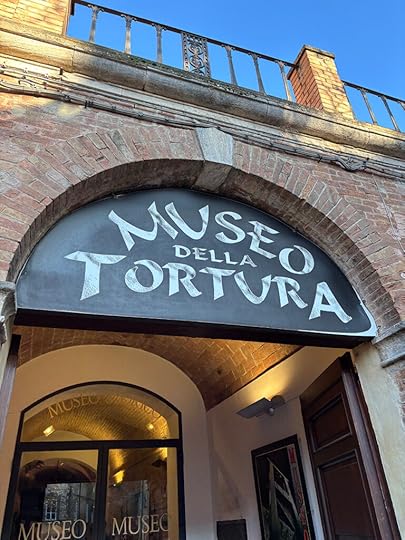 The torture museum in Volterra, Italy. Photo by Marc Hartzman.
The Nail Barrel is exactly what it sounds like: a barrel with nails or iron spikes lining the surface inside it. Criminals were placed within and then rolled down a slope, causing them to be continuously stabbed. This device dated back to as early as 256 BC.
The Torture Cradle employed a similar concept. But, as you might guess, the spikes lined a cradle. The adult-size “cradle” held its victims as torturers rocked it back and forth. If no confession was given, the offender would eventually be stabbed to death. Cradle to cradle to grave.
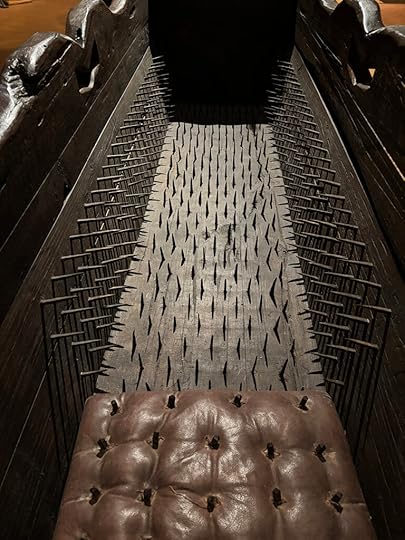 Don’t rock the cradle. Photo by Marc Hartzman.
The Head Crusher was another disturbing device. Its victim’s chin would rest on the machine’s lower bar, while the cap was cranked downward. As the display explained: “With the head wedged in this position, the force exerted from above first cracked the dental alveoli, then the jawbones until finally the skull shattered and the cerebral matter poured out.” Though no longer in use to execute criminals, the museum claims it’s “still employed today as an instrument of torture to extract confessions.”
Let’s hope to never find out.
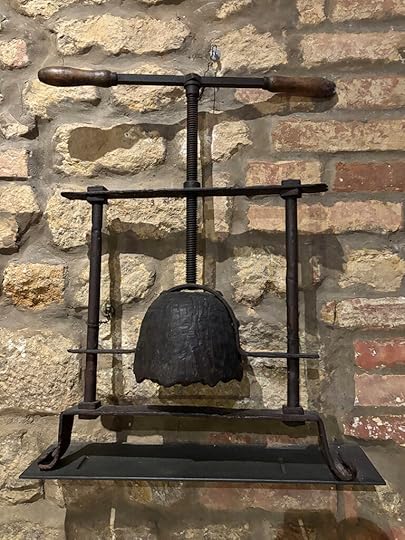 The Head Crusher did exactly what it suggested. Photo by Marc Hartzman.
<br />(adsbygoogle = window.adsbygoogle || []).push({});<br />
The post A Few Cruel and Very Unusual Punishments appeared first on Weird Historian.
December 10, 2025
A Selection of 19th-Century Crisis Apparitions
Camille Flammarion, the celebrated French astronomer who believed in an advanced Martian civilization and haunted houses, had a fascination with the unknown. In fact, The Unknown is the title of his 1900 book, in which he devoted a substantial portion of pages to what he called “telepathic communications.”
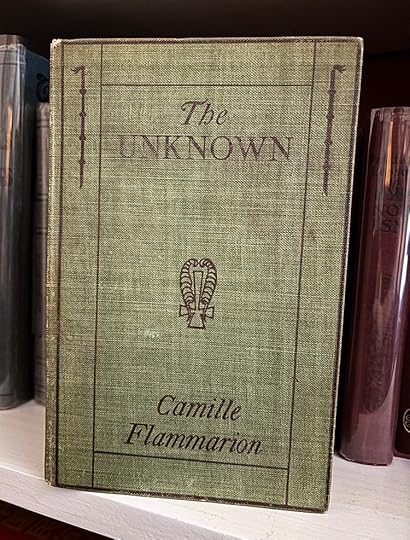 Camille Flammarion’s “The Unknown” from 1900, on my bookshelf. Marc Hartzman collection.
After issuing public requests for testimony, he received several hundred letters from people describing crisis apparitions: vivid visions, impressions, or encounters reported at the very moment a distant loved one died or suffered grave injury. Flammarion sifted through this paranormal trove with a curious blend of scientific rigor and fanciful imagination, treating these accounts not as ghost stories but as suggestive evidence of a subtle human power to transmit a final signal before drifting beyond the veil—and into the unknown.
Below are just a few examples of stories he received:
Allow me to call your attention to a circumstance which seems to me very curious. In the first place, it decided my future life, and, besides that, its circumstances were not ordinary ones.
In 1867 (I was then twenty-five) on December 17th, I went to bed. It was nearly eleven o’clock, and as I undressed I sat down and began thinking. My thoughts were fixed on a young girl I had met during my last vacation at the sea-bath of Trouville. My family knew hers quite intimately, and Martha and I became very fond of each other.
Our marriage was on the eve of being arranged when our two families quarrelled, and it had to be given up. Martha went to Toulouse, and I returned to Grenoble. But we continued to love each other so sincerely that the young girl refused other offers for her hand.
That evening, December 17, 1867, I was thinking about all this, when the door of my room opened softly, and, almost noiselessly, Martha entered. She was dressed in white, with her hair streaming over her shoulders. Eleven o’clock struck—this I can confidently assert, for I was not sleeping. The vision drew near me, leaned lightly over me, and I tried to seize the young girl’s hand. It was icy cold. I uttered a cry, the phantom disappeared, and I found myself holding a glass of cold water in my hand. This may have given me the sensation of cold.1 But, observe, I was not asleep, and the glass of water had been standing on the table de nuit at my side.
I could not sleep that night. On the evening of the next day I heard of the death of Martha, at Toulouse, the night before, at eleven.
Her last word had been, “Jacques!”
This is my story. I may add that I have never married. I am an old bachelor, but I think constantly of my vision. It haunts my sleep.
— Jacques C., Grenoble
1 A superficial examination might tend to prove that this was an hallucination — that is, that it was the work of the imagination. But telepathic influence is much more probable.
A few years ago, at Monzon (Ardennes), a woman who was very ill sent her little daughter to pass a few days with some relations at Sedan. One night the child woke up crying, calling her mother, and asking to see her, begging that she might be taken home at once.
The next day news came that the mother was dead. She had died in the night, at the very hour when the child had called her and insisted on being taken back to her.
I do not remember the names of these people, nor the precise date of the event, not having paid great attention to the story at the time, but I can assure you that the fact is quite authentic.
— G. GILLET, 78 Rue Bourniget, Vouziers (Ardennes)
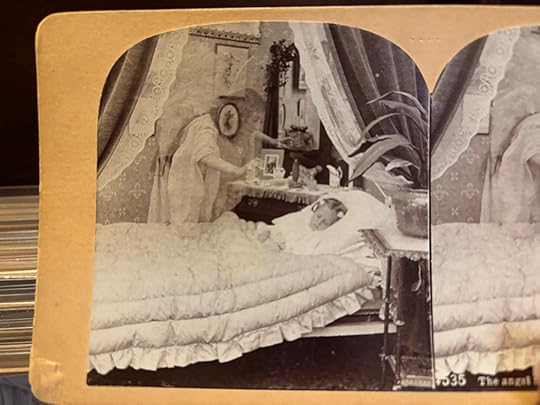 A stereoview card of a ghostly image. Marc Hartzman collection.
My brother, who was military superintendent at Cayenne, had leave of absence, and spent his holiday at Bolléne, in the Department of Orange. He told me the following circumstance. He was very intimate with another superintendent, M. Renucci. This gentleman had a little daughter who was very fond of my brother and his wife.
The little girl fell ill. One night my brother woke up. At the far end of the chamber he saw little Lydia looking at him fixedly. Then she passed away. My brother, much troubled, woke his wife and said to her: “Didi” (Lydia’s pet name) “is dead. I have just seen her perfectly.” They slept no more that night.
The next morning my brother went in all haste to see M. Renucci. The little girl had indeed died during the night, the hour of her death coinciding with that of her appearance to my brother.
— REGINA JULLIAN, Schoolmistress at Mornes (Vaucluse)
In 1857 and 1858 I was living at Paimbœuf with my wife and child, in a house which had been occupied before we took it by Madame Leblanc, who had gone to live at Nantes. One night in the spring of 1858 (I am sorry I cannot give the date more precisely, but any one might consult the civil register) my wife and I were awakened suddenly by a loud noise. It seemed to both of us that a great bar of iron had been violently thrown down on the floor of our chamber, and that our bed was violently shaken. We sprang up in haste and lit the candle, running at once to our child’s cradle, and examining the whole room. Nothing had been disturbed.
The next day (or the day after) news reached us that Madame Leblanc had died the very night when, without any apparent cause, we were so roughly awakened, and about the same hour. We had never had any intimate relations with that lady, and did not know she was ill.
My mother-in-law and sister-in-law, who occupied two rooms beyond ours, had got up and joined us. I think I was told that they were awakened by my wife’s cries, and by the noise we made, and not by anything else.
When we learned that the date of Madame Leblanc’s death corresponded with the event that had caused us so much surprise, my sister-in-law, who was very pious, said, “The souls of people dying, often, at the moment when they are separated from the body, come back to revisit the house where they have lived.”
— L. ORIEUX, Employê of the Government, Nantes
<br />(adsbygoogle = window.adsbygoogle || []).push({});<br />
The post A Selection of 19th-Century Crisis Apparitions appeared first on Weird Historian.
December 2, 2025
Meet the Medium Who Fooled Sir Arthur Conan Doyle and then Confessed Everything
In the 1920s when Spiritualism enjoyed a wave of popularity, one of its most celebrated mediums was Nino Pecoraro. And one of his biggest champions was Sir Arthur Conan Doyle, creator of Sherlock Holmes.
Doyle was an ardent Spiritualist and a frequent lecturer on its merits. After a Pecoraro séance in which he allegedly made instruments play and produced the spirit of Doyle’s deceased son, the famed writer proclaimed him the greatest medium he had ever seen. Pecoraro also famously claimed to have channeled the spirit of fellow Italian medium, Eusapia Palladino. Her voice—in native Italian—was often heard during his séances. At times he even produced ectoplasm and invited photographers to capture it on film.
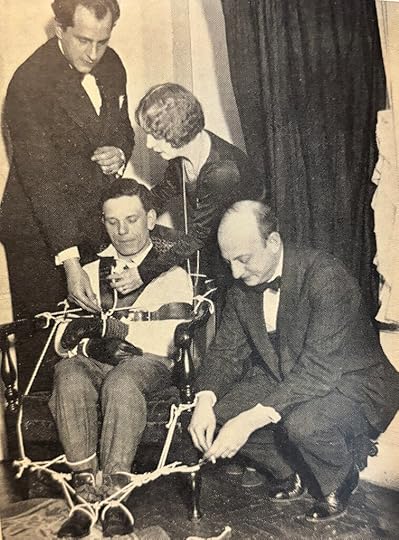 Nino Pecoraro being bound before entering the spirit cabinet. Image from “Inside the Medium’s Cabinet” by Joseph Dunninger, 1935.
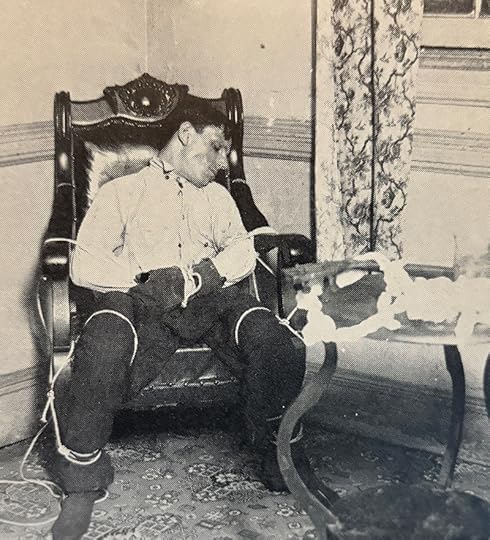 Nino Pecoraro exhausted after a séance. Note the disturbed bindings. Image from “Inside the Medium’s Cabinet” by Joseph Dunninger, 1935.
As I wrote in my book, Chasing Ghosts: A Tour of Our Fascination with Spirits and the Supernatural (Quirk Books, 2021), Pecoraro attempted to win a $2,500 prize offered by Scientific American in 1924. The respected magazine was in search of a genuine medium, and if its panel of experts were convinced by a psychic’s powers, the money was theirs. The panel included the magazine’s leading editor, J. Malcolm Bird, Dr. William McDougall of Harvard, psychical researcher Hereward Carrington, Houdini, and others.
Some members of the panel were so impressed they believed the phenomena produced was real. Yet, after Houdini joined his colleagues in a subsequent test, he spent two hours tying him up and Pecoraro suddenly could no longer produce a single spirit. He didn’t win the prize (no one did), but he still had his believers.
However, on April 8, 1931, after fooling many Spiritualists and numerous scientific investigators, Pecoraro pulled a stunt few if any mediums of the era ever did: he came clean.
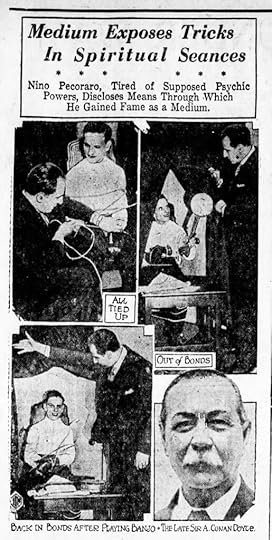 Headline from the Shamokin News Dispatch, April 28, 1931.
The medium brought his confession to magician Joseph Dunninger, who, like Houdini, worked tirelessly to expose fraudulent mediums. With a group of reporters gathered for the occasion, Pecoraro’s confession included details about fooling Doyle. As one newspaper described it:
For Pecoraro, that problem was elementary. After being tightly bound, the medium retired into the cabinet while Sir Arthur and his guests clasped hand, sang ‘Nearer My God to Thee’ and darkened the room. Pecoraro quickly squirmed out of the ropes and handcuffs which bound him, wrote a perfect imitation of the handwriting of Sir Arthur’s son on a pad of paper, reproduced the son’s voice and crawled back into the ropes and handcuffs.”
Pecoraro even let Dunninger tie him to a chair, put leather mittens on his hands and a rope around his neck. From behind a black curtain, with a table in front holding a pad of paper and a pencil, he recreated his act with the lights on.
“Soon Pecoraro’s hand appeared from behind the curtain, grasped the pencil and paper and wrote: ‘I still live—Houdini,’” the article added. Dunninger called the penmanship “an exact duplicate” of Houdini’s and noted that the medium had spent months perfecting it.
As his act continued, he produced the voice of Palladino and “began to utter prophecies, in the midst of which Pecoraro’s face appeared from behind the curtain, saying: ‘It’s only me.’”
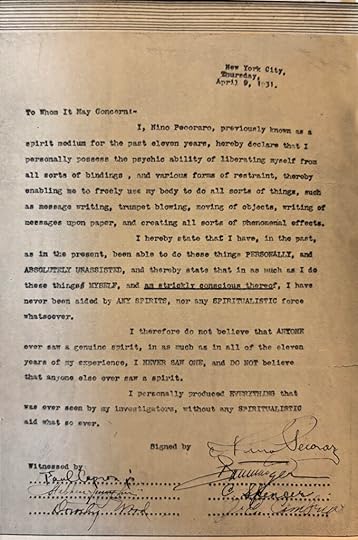 Nino Pecoraro’s signed confession. Image from “Inside the Medium’s Cabinet” by Joseph Dunninger, 1935.
When Dunninger pulled the curtain open, Pecoraro was still seated in the chair, but the ropes and mittens were on the floor, and his shirt had come half off while wriggling out of the bonds.
Pecoraro also explained his ectoplasm trick—a mere wave of a handkerchief, which, when caught on film, left a blurred image with semi-transparent edges.
“I’ve never seen a ghost, and I don’t believe anyone else has ever seen one,” Pecoraro told the press. “I’m sick and tired of giving seances and having others reap the profits. When ghosts appear at my seances they are Nino Pecoraro in the flesh.”
Having given up his paranormal vocation, Pecoraro sought work as a portrait painter or a cement salesman where he could make an honest living, among the living.
<br />(adsbygoogle = window.adsbygoogle || []).push({});<br />
The post Meet the Medium Who Fooled Sir Arthur Conan Doyle and then Confessed Everything appeared first on Weird Historian.
October 18, 2025
Alexandre Patty: The Man Who Walked on His Head and Headed Straight for Global Fame
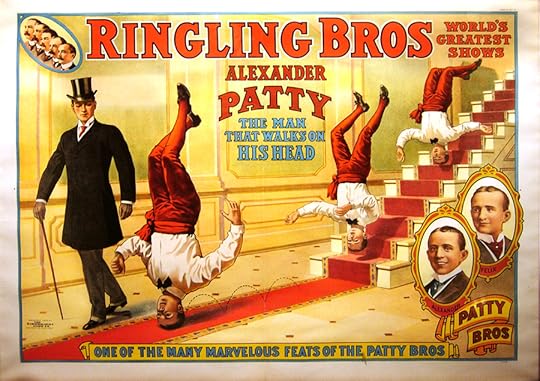 Alexandre Patty featured with Ringling brothers, Public domain, via Wikimedia Commons.
The circus has always been a place to showcase remarkable and unimaginable skills. Perhaps one of the most unusual stunts performed was achieved in the early 1900s by Alexandre Patty, the man who walked on his head.
Patty and his brother were acrobats in France—students in the Paris Latin Quarter—when, as one newspaper put it, Alexandre “discovered his ability to reverse the order of nature by walking upside down.”
The act, not surprisingly, generated excitement around campus and news quickly spread of Patty’s strange talent. He soon cashed in on it, particularly with a Ringling Bros. Circus booking in 1907 to perform across America.
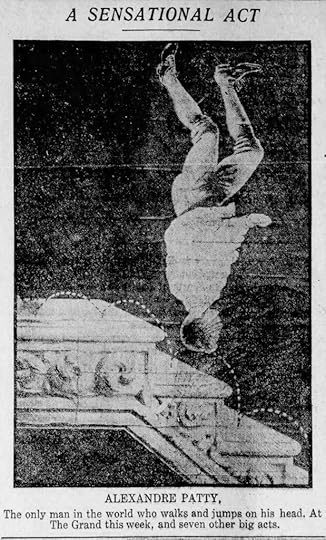
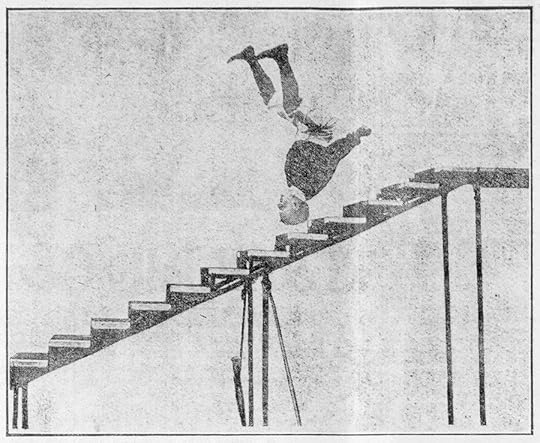
With Ringling Bros., they presented “an exhibition of hand-balancing and acrobatic feats,” which was highlighted with Alexandre’s ability to walk “up and down a flight of steps on his head”—as seen in the photos above.
Among his other feats was drinking water while standing on his head and standing on his head on top of his brother’s head.
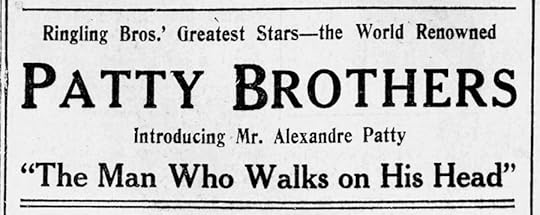 Alexandre Patty did what no other human has. This ad in Montana’s Butte Miner newspaper promoted a show in August, 1911.
Though it’s not how most people use their head to earn money, it proved successful for Patty. By 1908, he reportedly earned “more money than the average metropolitan bank president.”
Billed as “The Man Who Walks on His Head,” Patty continued performing for decades around the world with the circus and in vaudeville. He was also featured in Ripley’s Believe It Or Not!
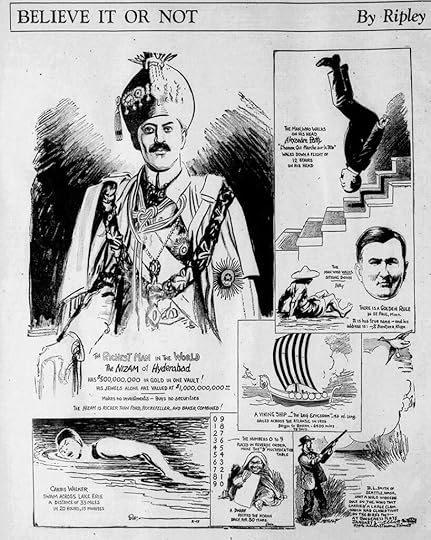 The Man Who Walks on His Head was featured in this Ripley’s cartoon in 1931.
Acrobats have always pushed the limits of what the human body is capable of, but Patty’s astonishing feat has yet to be duplicated or expanded upon.
<br />(adsbygoogle = window.adsbygoogle || []).push({});<br />
The post Alexandre Patty: The Man Who Walked on His Head and Headed Straight for Global Fame appeared first on Weird Historian.


