Laura Grace Weldon's Blog
October 29, 2025
My Guru

This is Fergus Festus. For the very best of reasons, he is named after a town in Missouri.
Because I had asthma as a child, I grew up without dogs. I wasn’t allowed to pet a dog. Or visit a friend’s home if that home contained dogs. I wished with my whole being to someday share my life with a dog.
I have now had dogs most of my adult years and, thanks to extensive tutoring by those dogs, I’ve finally learned how to open my life fully to them. Ours has evolved into a crate-free, pet food-from-scratch, dog-forward sort of home.
I have loved many dogs, each for being completely themselves, but never had an animal companion quite like this one. He is the only dog I’ve known who gives long hugs with his cheek against us and his front legs around us.
He is even more so an eye contact creature. He searches for my gaze in that deep pool of openness way that baby’s eyes do. He gladly does his own thing while I work at my desk, but when I’m on the couch or the floor he stays on my lap as I read a book or talk or look at my phone. Even though I rest one hand on him, scratch him lightly, sometimes it is not enough.
Look at me ,he says, his thoughts almost clear as speech. I do. I look into his eyes and wonder what he’s thinking and say a few sweet words to him and rub his little body, then go back to what I was doing.
No, he says. Really look. So I do, I really do.
I look and see a little ways beyond looking. I sink into the quiet awareness he offers any time I can settle myself into it. He’s not demanding attention, he’s giving it. He’s not seeking love, he is tutoring me in love’s mutuality.
As we gaze at each other I can’t help but draw in a deep breath and let out an even deeper exhale. This is what presence feels like. It’s an entry into the space/no space between us that Buber called I and Thou.
We’re all aware terror is being stoked and terror is happening in the US and around the world. I pay attention to news from a variety of sources. I do what I can to push back. But I simply can’t face it constantly. I find refuge in the powerful healing energy of stories written and shared in my writing classes. I find refuge in family gatherings, with the faces and voices of the people I love filling our home. I find it in quiet rituals of morning coffee with the spouse, taking walks, preparing meals. I find it in good books and good conversation. I find it sitting quietly with my guru.
How are you finding refuge in these times?


August 29, 2025
Chaos Gardening

Apparently there’s a newish fad in the horticulture world called “chaos gardening.” This is described in UK’s House and Garden as “inspired by the unruly growth of nature and a whiff of rebellion against the control and neatness of traditional horticulture.”
Oh honey, many of us have been chaos gardening for a very long time.
I’ve never had the energy, money, or interest to maintain neatly weeded and mulched gardens. The last time we spread mulch was at least eight years ago. It was free municipal mulch which I discovered to my discomfort, less than a day after spreading it, was full of chopped up poison ivy.
I have no garden beds in straight lines by choice. No plantings in straight rows either. I commonly don’t remember what I’ve planted until it grows. I’ve attempted to keep up on the weeding side of things, but have always failed. Laziness, mostly, but also a quiet delight in the marvelous plants we call weeds. (Well, it took me a long time to admit a grudging respect for thistles but I’m mostly there now.)

My husband and I have developed a nearly effort-free method of weed control that uses newspaper and the occasional tape-free stretch of cardboard between plants, with wide rows left free to grow vegetation we occasionally mow. By “occasionally” I mean we keep the growth low when young plants are establishing themselves. Then the weather gets too hot and we get too lazy to mow. By late August it’s a wildly alive mess of feral loveliness.
I’ve gardened since I was 18. (One of my first crops were apparently mistaken for magic mushrooms….) The obligation to keep up with the maintenance necessary for typical gardening used to slurp the joy right out for me. Instead I’ve learned to appreciate how perfectly the land cares for itself in concert with wildlife and weather and seasons. And yes, I’ve gone more and more toward the chaos end of things.
This year, however, I’m well beyond chaos gardening.

One side of the house is planted with bulbs, sedum, hydrangeas, and other perennials but is currently nearly overwhelmed by strawberries that self-seeded from pots on a nearby porch.
Another side of the house has struggled to grow almost anything. I finally discovered after years of trying to establish an herb bed that the problem was due to deeply embedded landscape “fabric” put down by the former owner. As I’ve written elsewhere, products like landscape fabric, plastic mulch, astroturf, and other so-called weed solutions suppress the development of mycorrhizal fungi essential to plant health. They also wreck the habitat for beneficial soil-dwelling creatures, overheat the ground, prevent organic matter from being incorporated into the soil, and impede the health of plant roots. Their presence wrecks the necessary carbon dioxide and oxygen exchange between soil and air—essentially suffocating the soil. If that’s not alarming enough, landscape fabric contains petrochemicals which break down into toxic substances including microplastics. One analysis shows that three feet of landscape fabric can release hundreds of millions of microplastic particles. I think we’ve dug up all that awful plastic, it’s long past time to haul compost from out back to spread over the bed and start over next spring.

The front garden bed I established using soil dug up for septic repair remains a flourishing mess. Ancient pine trees at either side of the bed grow a bit more brown every years. Clematis does its best to climb up the moon mosaic. Lamb’s ear spreads from its spot under the trumpet man sculpture to pop up everywhere (no surprise, as it’s related to mint). Most of the rest are weeds I’ve come to consider friends.
Then there are our vegetable gardens. The asparagus patch, by this time of year, is a towering mass of vegetation. It offers a marvelous hiding place for all sorts of creatures and I’m pretty sure a nesting site for various sparrows as well as the Eastern meadowlark family we’ve seen all summer.

The side vegetable patch is a productive jumble. I wade in to pick tomatoes, eggplant, peppers, cucumbers, chard, leeks, and other delights. Each step brings up a rustle of butterflies, crickets, and other creatures.
And our hoop house out back hasn’t had its rows mowed in many weeks. There, too, are heavy harvests of tomatoes and peppers, but mostly grapes. We have picked at least four five-pound pails of grapes the last few weeks and are so weary of canning juice that I’ve been giving grapes away.

The pasture where our cows once grazed, where I’d hoped we might have a herd of sheep or a few donkeys, is now a meadow of its own making.

The sides of our pond and creeks have always been left unmowed, growing only with what naturally wants to grow. Our wooded acres are riddled with fallen ash and beech trees quietly fostering new life. All of these places are beautifully alive.

I’m mostly at peace with the chaos here, although my better self would like to tend more closely to our gardens. But my husband and I just don’t have the gumption right now to do more. We are exhausted by a country in chaos. Democracy is being undermined by well-funded extremists, authoritarianism is marching in, inequality is compounded, genocide not only ignored but fostered, and all the while the climate every life form relies on to survive is being sacrificed for profit.
Chaos, I’m reminded by evolutionary cosmologist Brian Swimme, is one of the powers of the universe. We’re here thanks to the cataclysmic death of stars. Their explosions provided the iron circulating in our blood, the calcium making up our bones, the oxygen we inhale. Cataclysms on our planet have caused five major extinctions. (We humans are causing the sixth.) We have endured many other catastrophes including wars, famine, plagues. And yet, from the cataclysmic death of stars, we get to live on a planet graced by orioles, humpback whales, monarch butterflies, sunsets, tides, elephants, newborn humans. We are all part of one another, composed of star stuff.
May long and gentle rains like this one fall on every parched landscape. May beauty pair with chaos and peace rise from cataclysm.
July 18, 2025
Seeing Each Other As Loves

If there’s a deep end, I just jumped in.
I have long used endearments when addressing humans I love but also dogs, cats, cows, goats, birds, insects, and yes, the beings most consider inanimate objects. I’ve probably been in above my head for a long time because I can’t help myself from addressing participants in my writing classes as “dear people” and “beloved writers” and worse.
But today I was checking out at the local market. I always put my fabric bags on the belt before loading my items. The cute young checkout person was preoccupied talking to the cute young bagging person, and I was preoccupied with ineptly “tapping” my card, so none of us noticed right away that the bagger was loading my things into plastic despite the sturdy cloth bags in front of her. “Oh, sorry love,” I said “but I brought cloth bags.” She looked up, startled. Then she said, “I’ve never been corrected so sweetly.” She went back to talking to the cute checkout guy.
I recognize calling a stranger “love” is likely a step too far. I know some people actively detest being called “honey” or “dear” or other overly familiar words. That’s their right and I want to respect that. Actually, I rarely use endearments when speaking to strangers. But some people have a gleam so noticeable to me, even if they seem shut down (maybe especially if they seem shut down) that I can’t help myself.
Brief conversations with strangers filled with dry wit, shared insight, and surprising alignment seem to happen more often for me now. That’s a side benefit of getting older. Those of us who are dismissed as irrelevant are, in a way, freer. Who expects to have a moment where they are seen, really seen, by someone who comfortably goes about unseen?
I used to call only the people I love “loves.” Maybe I’ve watched too many UK series or read too many old British novels, but that word is stuck now. It’s the way I hope to see others — as loves. As beautiful people. As complex and strange and conflicted as we all are.
Seeing others as whole people is particularly difficult when we’re pitted against one another by systemic forces that place seemingly insurmountable barriers between us.
And yet, some people step beautifully beyond these divisions. Last week I read about an LA man who approached a phalanx of federal agents working for ICE, all of them heavily armed and masked up to their eyeballs. Much as I like to think I am a pacifist, I see them as poorly paid* enemies of justice and compassion and democracy itself. The man who approached them was carrying little white slips of paper that turned out to be copies of his most recent two-week pay stub. He walked along the line attempting to pass out these slips, saying some version of, “I know everyone needs a paycheck, but you don’t have to do this. Come work with us. This is what a union carpenter makes.”
This man saw these armed agents as fellow human who need to work, just as he does. Seeing others in their full humanity is the heart of nonviolent action. Fact-filled or expletive-filled rants against someone is useless in changing their minds, and is likely to more firmly entrench their views. As Stephen Jay Gould noted, “leave an escape hatch for your opponent so that he can gracefully swing over to your side without an embarrassing loss of face.”
Open dialogue with the very people she condemned is what inspired Megan Phelps-Roper to renounce her membership in the extremist Westboro Baptist Church. It’s what led neo-Nazi skinhead Christian Picciolini to stop spreading hate and work to lead others away from such ideologies. It’s how Daryl Davis, a Black man, befriends Ku Klux Klan members in hopes they will have a change of heart.
Oh, I did another quick errand at another locally owned store. My cashier was a beautiful young man with the fluffiest of Afros. We commiserated over the bankruptcy of a longstanding area business. Somehow, in the magical way conversations happen, he told me he was a “survivor” of hideous corporate policies from his last job and we agreed rapacious capitalism was destroying our country and I told him about our food co-op. As I left, he blew me a kiss.

*These federal agents are no longer poorly paid. Thanks to the horrific tax overhaul bill recently signed, the budget for ICE enforcement is larger than Russia’s total military budget. ICE is now the highest-funded federal law enforcement agency in history, with more money than the budgets of the DEA, ATF, FBI, US Marshals, and Bureau of Prisons combined. Starting this week, these masked warrantless federal agents will be offered a signing bonus of 42K and a six-figure salary.
July 8, 2025
Timeless Beach

I am sitting on the sand while my three beloved grandchildren run in and out of Lake Erie’s waves at Cleveland’s Huntington Beach. I’ve taken the day off work to savor our time together. I never even think to open the book I brought. Instead I am watchful while at the same time caught up in my own wonderings, the way elders have surely been for millennia.
From even a short distance every wet head bobbing up in the water is dark, every happy shout is unintelligible. Time shifts the way it sometimes does. This scene could just as easily be 100 years ago, when Cleveland Metroparks made this beach a public recreation area and summer-weary families came here to cool down. This could be hundreds of years ago, the shoreline rimmed by huge sycamore trees, land crisscrossed by bison trails, with the Erie peoples’ large palisaded villages a short walk away. This could be a thousand years ago, another grandmother sitting near the water’s edge.
I’m reminded how fully alive each person is in each era in every part of the world. A prehistoric teenaged boy proudly shared his first big kill with his tribe, strutting just a little as he went to sit by the fire with a full belly. A pregnant Norte Chico woman leaned back gratefully to let others braid her hair in what we now call Peru. Old men gossiped about their neighbors as they relaxed near a fountain in ancient Beijing. A Berber trader worried his load of goods might fetch less than the expected price when he reached the marketplace. A little Victorian-era girl gleefully tattled on her brother for cursing.

It seems strange that we don’t see our lives as an unbroken continuum with everyone who ever lived or will live. It seems impossible we aren’t fully aware that the person behind us in line at the store or the person continents away knows same thirst and same hunger we do; feels the same emotions as we do; wants to have a life of meaning as we do. Well into a future I hope is a kind and healthy one, people will surely be sitting in this same spot savoring a summer day.
Right now sunlight glints off the water. A line of ducks passes in a perfect procession. When the kids come to towel off I tell them I’m thinking this scene could be from any era — just happy people playing as people like to do. I am brought back from my musings by a child. This one points to the teenagers who just arrived and says, “It couldn’t be any moment in history, Nana, because they brought Super Soakers.”

May 21, 2025
A Glorious Shade of Purple

I was stuck in the miseries this morning due to small funked up health problems and huge funked up world problems. I try, as a practice, to have a silent but earnest conversation with my insides when the miseries have a grip on me. I say to pain or fear or despair I see you, I acknowledge you, help me learn from you and beyond you. (Okay, sometimes my inner conversation isn’t all that polite.)
And I try, as a practice, to look around me with gratitude even if, like this morning, it felt like I was spreading a thin layer of appreciation over a turbulent inner mess. As I drove to meet someone I love for our weekly walk, I did what I could to savor the air’s spring freshness. I did what I could to notice light flickering through the trees, flower baskets hanging from storefronts, and the kindness of a driver waving another car ahead.
My mind drifted right back to the morass.
I don’t know how any of us go on with our ordinary lives lately. I am among those privileged enough to have my days largely unchanged, so far, despite—among other tragedies—a climate pushed past the tipping point, despite the ongoing genocide of the Palestinian people, despite all three branches of government stomping directly into authoritarianism. I’m aware my puny efforts to protest, write letters, support good causes, even drive around with a handmade protest sign on my car aren’t enough. I simply hope it’s a teensy contribution toward the transformative 3.5 percent rule invoked by Erica Chenoweth, author of Why Civil Resistance Works. After researching hundreds of social/political change movements over the last century, Dr. Chenoweth found that nonviolent campaigns are twice as likely to achieve their goals as violent campaigns. And although the exact dynamics depend on many factors, her data shows it takes around 3.5% of the population actively participating in the protests to ensure serious political change. But what are the chances it can happen here, I grumbled to myself.
And then I drove past a dumpster. A beautiful dumpster.

It was a deep purple, a purple most often seen in delphiniums, pansies, hydrangeas, and irises. The sort of purple that would look good as a velvet dress or painted across a domed ceiling scattered with gleaming constellations. My mind gladly rested on that color purple for the rest of the drive.
On my way home after the walk and an appointment, I went the long way just so I could take that dumpster’s picture. It was right outside a small locally owned flooring shop. As I got out of the car I realized the dumpster had recently been painted. I could almost see the former lettering under its shiny new color. Someone, maybe the shop owner, had chosen that color. Chosen to grace this useful, much-maligned object with beauty. For all I know, it’s the only dumpster that color for thousands of miles.

I’m plotting to drag my spouse to that shop to see if we can afford to do something about our kitchen’s falling apart linoleum. Whether we can or can’t, I’m going to tell the shop owner how much that glorious purple dumpster lifted my sagging spirits. As Alice Walker wrote in her magnificent The Color Purple, “I think it pisses God off if you walk by the color purple in a field somewhere and don’t notice it.”
Maybe that applies to the color purple anywhere we find it.

April 23, 2025
It’s Not Us Vs Them
Connie Lim, who performs as MILCK, co-wrote “Quiet” ten years ago. It was a very personal song in response to sexual assault and abuse she experienced in her teens. She sang it, along with a cappella singers, at the Women’s March in 2017. Their performance, captured on a phone, still brings tears to my eyes.
I was there at the march (late, because our bus broke down) along with a half million other marchers. There were military vehicles parked on street corners to deal with what the new administration assumed would be violence but, of course, it was an entirely peaceful rally. Many homeowners had welcome signs on their lawns, some put out offerings of water bottles and snacks. Everywhere we went our fellow marchers as well as DC businesses were gracious and helpful. After the march was over it took hours for thousands of buses to load up and head out from the parking lots, returning marchers to all parts of the country. On that dark January night they looked like ribbons of light pulling out onto the roads.
Recently, Ms. Lim was asked by a woman if she, as a Republican, could also sing “Quiet.” On her Instagram page, Ms. Lim wrote,
“As a musician, a woman, and survivor of domestic violence, I felt grief to know that politics would create division to the point that someone would wonder if a song of survival could be for her, too. What if we can looked beyond… and wonder about what we have in common? I want to offer bridges through art. To create innovative coalitions that rise above the illusions of categories. We are entering a time where we must resist binary thinking. To seek the river beneath the river.”
We are not as polarized as we’re said to be here in America. Hear me out! I know there are vast differences in the spectrum from left to right. But in poll after poll, it’s clear we want stronger practices in place to keep our our water clean, our food safety assured, our roads and bridges maintained. We want decent workplaces and the best possible lives for our children.
Whatever our partisan affiliation, most humans want the same things. An affordable home, access to good food, meaningful work, quality healthcare, and enough time outside of work to do what brings us joy. We also want the rights assured by law including due process, equal protection under the law, the right to worship as we choose, to protest, and to vote in fair elections. Nearly all of us want our tax dollars do some good for actual people rather than giving it to big corporations and billionaires.
A recent Pew report showed 86% of Americans believe small businesses have a positive effect on this country. Only 29% believe the same about large corporations. A Navigator study found 7 out of 10 Americans say big corporations and the ultra rich are more responsible for the amount of taxes they pay than poor Americans who don’t pay taxes. And Americans are not doing well, financially. Overall, 76 percent of people in households making less than 100K describe themselves as struggling to make ends meet or unable to make ends meet.
New research shows striking bipartisan consensus on the challenges facing the next generation and the solutions to address them. When asked if the federal government should prioritize policies that benefit young people 88% of Republicans, 83% of Democrats, and 75% of independents agreed. Across parties, three-quarters or more of parents say a paid family, parental, and medical leave program for workers who need to provide short-term care for family members would make the lives of American children better, as well as more tax credits for programs that support families, and more government funding to help parents afford child care and after-school programs.
A recent Gallup poll showed 48 percent of Americans see climate change as a serious threat and 37 percent say they have been personally affected by an extreme weather event in their area within the past two years. The majority of people polled in 2024 agree climate change is human-driven. Three-quarters of Americans, regardless of where they live, say they experienced unusually hot or cold days this year. About half experienced extreme storms, 43 percent experienced flooding, 35 percent experienced droughts and water shortages, and a quarter experienced a wildfire. To avoid these extreme climate events, 1 in 5 Americans say they would consider moving. Six out of 10 Americans say they would support wind turbines and solar farms being built in their communities — that number includes over half of Republicans.
A sweeping majority of Americans, including Republicans, oppose cuts to Social Security, Medicare, and Medicaid. Sixty-two percent of U.S. adults, the highest percentage in more than a decade, say it is the federal government’s responsibility to ensure all Americans have healthcare coverage.
Let’s just take the well-being of children as an example. However people voted, it’s hard for me to imagine most of us really want the FDA to suspend quality control testing of milk, while also suspending programs ensuring accurate testing for bird flu and pathogens in dairy products. I don’t think we want to halt research on environmental hazards faced by children, including exposure to wildfire smoke, effects of pesticide exposure, and preventing forever chemicals like PFAS from contaminating the food supply. I don’t believe most of us want funding indefinitely withdrawn that covers: investigations of child sexual abuse and internet crimes against children; response to reports of missing children; and preventing youth violence. I don’t think we want the farm-to-school grants cancelled—the ones buying fresh food from small local farmers for healthier school lunches. And there’s talk of eliminating Head Start programs altogether. These are just a few examples—from this week!— of the vicious cuts that stand in counterpoint to the lavish benefits afforded to the super rich as well as the largest corporations.
(I am still unable to imagine why anyone wants our tax dollars—somewhere in the region of 25 billion so far—to finance the ongoing genocide of the Palestinian people. Currently the number of unique and precious lives lost is 50,810 Palestinian and 1,706 Israeli human beings. Maybe my imagination is faulty.)
We are told, lectured, screamed at that the “other side” is out to get us. A majority of Americans polled say that legislators, pundits, and TV news personalities increase division in the country. At the same time, one in three Americans get most of their political information from friends both in real life and on social media. When our social circles are a monoculture of opinion we don’t learn from the stories and life experiences of people whose beliefs and opinions differ from ours. This not only diminishes mutual understanding, it fosters increasingly extreme viewpoints.
For many decades, Americans got their news from mostly local newspapers along with national news broadcasts hosted by folks like Walter Cronkite. It gave each community a closer look at what was happening around them— house fires, crimes, high school sports, city council votes— as well as a common national narrative that made some space for different opinions. Now people have different opinions based on different “facts.” Deliberately false stories and memes spread with a force too fast for fact checkers. And many refuse to believe fact checkers when lies are exposed. Despite jibes against “left-learning” and “mainstream media,” when the audience size of popular online shows — podcasts, streams, and other long-form content–is assessed for right-leaning or left-leaning ideological bent, it turns out conservative shows dominate the ecosystem. That holds true even when the content is not explicitly political but oriented to comedy, sports, gaming, or entertainment. Historian Anne Applebaum writes in her book, Twilight of Democracy,
“The issue is not merely one of false stories, incorrect facts, or even the election campaigns and spin doctors: the social media algorithms themselves encourage false perceptions of the world. People click on the news they want to hear; Facebook, YouTube, and Google then show them more of whatever it is that they already favor, whether it is a certain brand of soap or a particular form of politics. The algorithms radicalize those who use them too…
Because they have been designed to keep you online, the algorithms also favor emotions, especially anger and fear. And because the sites are addictive, they affect people in ways they don’t expect. Anger becomes a habit. Divisiveness becomes normal. [Online content] already helps shape how politicians and journalists interpret the world and portray it. Polarization has moved from the online world into reality.”
Our nervous systems can easily become accustomed to daily, hourly, even minute-by-minute doses of anger. As an emotion, anger feels energizing. It stomps the brakes on moral and rational perspectives because it originates from the more primordial parts of our brain. It may provide a rush, similar to thrill-seeking activities that trigger dopamine releases— the way gambling might do for someone addicted to betting on poker. Anger can actually serve as a comfort zone, connecting us with other like-minded people and distracting us from uncertainty, emptiness, or fear.
My wise and entirely charming friend Michael said, at our recent book group meeting, “Hate is the new energy drink.” Except it’s not new. Those with wealth and power have long fostered hatred to achieve their own aims. People screaming about immigration or immunizations or who is using what bathroom are distracted while the elite grab more and more for themselves. More of your rights, your security, your future.
This needs to stop. Instead we need to talk to each other, person to person. We need to truly listen and hear the stories behind the anger.
Open dialogue with the very people she condemned is what inspired Megan Phelps-Roper to renounce her membership in the extremist Westboro Baptist Church. It’s what led neo-Nazi skinhead Christian Picciolini to stop spreading hate and work to lead others away from such ideologies. It’s how Daryl Davis, as an African American, befriends Ku Klux Klan members in hopes they will have a change of heart.
As Brandon Stanton writes in Humans,
“Our struggles connect us. We relate to the challenges of other people much more than we relate to their victories. We empathize with pain much more than joy. The moment we truly see ourselves in another person is when we realize that we’ve felt the exact same pain…. Maybe pain is the most universal feeling. Maybe there’s an invisible, connective thread that runs between the loneliness of an old man and the hunger of an impoverished child. Maybe pain isn’t divisible… Recognizing pain in another person is the primary driver of empathy. It’s the beginning of compassion.”

March 6, 2025
Cutting More Than Fabric

Dorothy was the oldest, over 70. Ann almost that. Then Betty, the most eccentric person I’d met up to that point. Marge, mother of four, who was the kindest manager ever. And on down in age to me in college, all of us working at the JoAnn Fabrics store in Lakewood, Ohio where our hands constantly lifted, measured, smoothed oceans of fabric we unrolled to sail our scissors across.
I started working there at 18, newly married, attending college full time but still keeping up volunteer hours in my field plus my 25 to 30 hours a week work schedule. The store was on busy Detroit Avenue where shopkeepers helped each other out. Where a young Downs Syndrome man rode his bicycle to visit stores up and down the street, his friends the clerks. And where people of all sorts came to dream up projects of all sorts—puppet theater curtains, wedding dresses, a giant stuffed dragon, a sling to carry a crippled dog, stage props and costumes, elaborate quilts, holiday gifts, Halloween outfits, and the one lady who so loved a particular upholstery fabric that she spent hundreds buying enough yardage to staple to her wall.
We spent long hours on our feet, often skipping breaks during big sales to keep from abandoning coworkers to a crowd of customers. We calculated yardage and price on paper receipts, consulting a ragged chart to determine discount percentages until the math became automatic. It was a place made magic by the endless enthusiasm of crafting something new. As we worked we talked, singing of possibilities to customers, singing of our lives to one another. In spare moments we rerolled bolts and priced remnants and filed patterns in this place of women’s voices. When men came in we sang a jostling tune, calling out merry asides while they plotted unfamiliar projects. They, women-splained, laughed back.
Like many companies, there weren’t enough employee hours to keep products perfectly stocked, deliveries unpacked, paperwork done, sales targets met. But there were perks. At the time, employees could buy a pattern along with the fabric and necessary notions for half off if they were willing to let the store use the finished item as a display for a few weeks. I remember Fiona’s gorgeous tailored work, tiny to fit her petite self and precisely made as designer clothes. I remember Marge’s baby quilts and Jean’s soft flowered tops. In my third year working there, one of my half-off projects was a lined wool blazer in dark heathered purple along with a patterned wool blend skirt. I made both to wear on job interviews for my upcoming graduation. Even at half off, the fabric was pricey for me. It hung as a store display while I waited for those interviews. My degree was in social work, a field which a new conservative administration was busy defunding. The grant I was offered to get a masters was defunded too. Not long after, my new husband helpfully did the laundry and shrunk the blazer I’d made to what seemed like a doll’s size, its lining hanging out like a cow’s prolapse. It didn’t matter, the jobs I applied for didn’t materialize.

I recently read that JoAnn Fabrics has declared bankruptcy. This Ohio-based company is closing all of its 800 stores. Any of us who sew find this strange since their stores are always busy. When there’s a big sale they are crowded with long lines where a “what are you making?” camaraderie develops among those holding stacks of material.
This once small Ohio chain grew through business practices standard in unchecked capitalism. It drove small fabric stores out of business, bought up smaller chains, competed heavily with art supply stores, and eventually dived deep into the craft market to compete there too. I was much less interested in what they carried after the majority of their ever-larger stores sold cheap holiday items, stinky candles, craft kits, and tacky imported décor but, still, could rely on them for any color of thread I needed and a huge array of fabrics to choose from.
The ambition that expanded the company also took it down, starting when it sold out to a private equity firm. Hedge funds and private equity are well-practiced in cannibalizing a company by loading it with debt, destroying its credit, and extracting value while paying themselves handsomely even as the business succumbs. A company’s purchase by private equity in a leveraged buyout is simply destruction for profit. We’ve seen this happen over and over. That’s what killed Sears, Kmart, Toys R Us, Red Lobster, TGI Fridays and many other longstanding companies. Private equity is rapidly acquiring healthcare concerns including dialysis centers, nursing homes, optometrist practices, dental practices, clinics, medical labs, urgent care centers, and entire hospital systems. They are buying up daycare centers, veterinary practices, and automotive service companies. They also own companies familiar to most of us including Neiman Marcus, Del Monte Foods, Dell, PetSmart, Staples, Hertz, Century 21 Real Estate, Coldwell Banker, Petco, Yankee Candle, David’s Bridal, Barnes and Noble, Beech-Nut, Evenflo, Snapple, Bob Evans, Sealy, and various dollar store chains. Private equity portfolio companies are about 10 times more likely to go bankrupt than non-private equity-owned companies.
At the same time, the vulture capitalists are not held personally responsible for what they are doing to the workers or their pension funds, let alone to the people these companies exist to serve. Here’s an example from Plunder: Private Equity’s Plan to Pillage America by Brendan Ballou.
“Consider the pillaging of HCR ManorCare, once the second-largest nursing home chain in America. In 2007, a private equity firm, the Carlyle Group, bought ManorCare for a little over $6 billion, most of which was borrowed money that ManorCare, not Carlyle, would have to pay back. As the nursing home chain’s new owner, Carlyle sold nearly all of ManorCare’s real estate and quickly recovered the money it put into the purchase. But the move forced ManorCare to pay nearly half a billion dollars a year in rent to occupy buildings it once owned. Moreover, Carlyle extracted over $80 million in transaction and advisory fees that ManorCare paid for the privilege of being bought and sold by Carlyle. These payments made Carlyle’s founders billionaires many times over. But they drained ManorCare of the money it needed to operate and care for its residents. As a result of these financial machinations, ManorCare was forced to lay off hundreds of workers and institute various cost-cutting programs. Health code violations spiked. An unknowable number of residents suffered. …. Such cost cutting eviscerated the business and in 2018 the company filed for bankruptcy with over $7 billion in dept. Yet despite the bankruptcy, the deal was almost certainly profitable for Carlyle… That the business itself collapsed was, in a sense, immaterial to Carlyle.”
Ballou goes on to note that Carlyle avoided legal liability for its actions. Residents’ families who sued Carlyle for wrongful deaths had their cases dismissed, since as a private equity firm Carlyle didn’t technically “own” ManorCare. The three main private equity firms, together, are the third, fourth, and fifth largest employers in America after Walmart and Amazon.
I know I’ve strayed far enough, and return now to my tale of working at JoAnns. Even when our store was crowded, my coworkers and I made it a cheery place. Except those hours when regional managers invaded. These humorless middle management types in cheap polyester suits insisted we greet each customer with whatever slogan had been mandated by the main office, which we never did when they weren’t present. We saw no reason to recite some impersonal words rather than greeting regular customers by name and asking how work was going on the prom dress or shower curtain they’d been making last time we saw them.
While these men were there our merriment paused, our voices stilted as we did their bidding — move tables, hang new ceiling signs, change the fabric displays to whatever polka-dot or animal print theme was directed, carry deliveries left at the front door, grunting and sweating while they sat consulting clipboarded sheets from the main office and never, ever got up to help.
I was learning to speak up. Or, more accurately, I was freer to speak up because I didn’t need the job as badly as my coworkers. When these men called us girls no matter our ages, I started to sing back women! though they pretended not to hear. I wrote down their most outrageous quotes under cartoons I drew and posted them in the back room. They pretended not to notice.
One day I hung the arm of an unused mannequin over our sole employee toilet, the one they spattered with pee while facing a toilet tank topped with tampons and tissues. The arm held a gracefully draped fabric remnant on which I’d written put the seat down. They said nothing but put the seat down and when they left our laughter was music sewn into the space we took back.

February 17, 2025
A Reason To Pause

This morning I noticed a downy woodpecker hanging from the side of our porch rail, unmoving. I kept an eye on it as I made a second cup of coffee, fed the dogs, and stirred some flour into Vern (our sourdough starter). It was still there, puffed up in the cold, when I rinsed sprouting beans and defrosted some tomatillos from last autumn’s garden. I needed to get to my desk. Editing deadlines do not stretch well. But I couldn’t stop watching this little beauty who may have been in trouble. Maybe he had suffered a blow to the head from hitting a window? Maybe been attacked by a cat? Maybe gotten into the poison some people in our rural community (very unwisely) leave out to control rodents in their barns?
Mark and I both ended up at the window, just watching. Mark keeps multiple feeders stocked with seed, suet, and raw peanuts. It’s a ridiculous cost, but then we don’t buy fast food or go on vacation, rarely even go to restaurants. This is the main line item in our entertainment spending.*
When I was a kid I loved The Tough Winter by Robert Lawson. In it the animals endure a harsh, nearly unsurvivable winter but the rabbits, field mice, deer, and others rely on each other until the “folks” come back home to resume leaving out winter offerings of hay, apples, nuts, grain, and more. As a nine-year-old, I cherished the inner candlelight feeling this generosity gave me. Behind my childhood home there was a small forest. There, well away from the sight of houses was my special place, a little rise of ground between two trees, where I liked to sit quietly. Sometimes I’d filch a bit of limp iceberg lettuce or a wizened apple from our family fridge to leave there. But when I checked the next day, there was never even a nibble taken from my offerings.
Now the whole area around our birdfeeders has become a communion table where–depending on the time of year–ducks, geese, groundhogs, raccoons, rabbits, skunks, and opossums gather on their own schedules: dawn to dusk and beyond, feeding on the dropped seed as well as whatever else we scatter for them. It’s an evening ritual here to briefly turn on a single backyard light to see what creatures are in attendance. In that light we’ve seen mother opossums with their babies clinging to them, mother skunks with a little line of distinctly marked kits wobbling behind, and baby raccoons tumbling around each other while their mother eats.
On and off, for close to an hour, Mark and I kept stopping by the window to check on the little woodpecker. Finally he moved as if waking up. He looked around, then lifted into flight. It seems he’d only been napping! His presence gave us a wondrous reprieve, letting our concerns narrow to this one precious life. We didn’t dwell on our fears for this climate, this democracy, this world. We just watched and cared. Thank you, little downy woodpecker. You helped restore our spirits.

*Yes, I understand there are reasons to avoid feeding wildlife.
February 5, 2025
Close Enough To Smell The Evil
 “Lucifer” by Franz Stuck
I had a brush with evil when I was 13. Newly 13. A still playing with stuffed animals 13.
The shape this evil took was the grinning faux-benign variety which hid malicious intent. I didn’t realize the danger until too late. I was small and it had all the power vested in a well-liked man.
I didn’t tell anyone, in part to spare my family the (perceived) shame, in part because I thought I was sparing his family, but mostly because I couldn’t bear to think about let alone talk about what happened. Already an anxious child, my mind turned every more relentlessly to understanding why people were cruel.
It was an ongoing concern. Years earlier I’d asked too many questions about pictures I saw in news magazines. Why troops bombed villages, why pollution was dumped into rivers, why anyone, anywhere, was starving. My parents, realizing there were truly no good answers to repeated “but why” questions, cancelled the magazines.
The year I turned 13 read Elie Wiesel’s memoir, Night. His account of surviving the Holocaust gave me a glimpse of how vast evil could be. I embarked on a decades-long quest to understand what caused this largest of evils. I read every Holocaust memoir in the library, initially thinking this had been the only genocide, until I stumbled on other examples in history. Pogroms and holy wars and witch hunts and enslavement and horrors imposed by colonizers. It wasn’t all in the distant past. I read about genocides of the Herero people, the Armenians, the Ukrainians, the Chinese. This led me to horrors still being visited upon people, including by the US. Every book broke me a little bit more on my path from Wiesel’s book to Dee Brown’s Bury My Heart At Wounded Knee.
I gradually recharted the quest, seeking to answer for myself why people were kind. I tried to do what good I could as well, but it never felt like enough. It still doesn’t.
I’m seeing what I’d describe as evil going on now. The heedless destruction of the very planet that sustains life in order to continue extracting every ounce of profit. The beyond-devastating mayhem and death in Palestine, funded largely by US tax dollars (whose country our current president says he wants to “own“). Empathy mocked as “woke” while measures taken to ensure inclusion and equality are discarded. The people (elected and unelected) currently in US government who are overtly doing everything possible to undermine democracy itself.
But “evil” isn’t a word that helps us understand why.
We humans have been on this planet such a short time, something like 50,000 years (although new evidence shows it may be much longer). We only developed written language around five thousands years ago. Modern capitalism and its attendant ills only emerged in the nineteenth century. Biologically and emotionally, we are still hunter-gatherers. We evolved to be a compassionate and collaborative species. We are still learning how to live in populous cities rather than nomadic tribes of around 60 people. Our technological advancements and our weapons have developed far more quickly than our ethics around their use. We have yet to grasp just how dangerous rigid economic and political systems can be, particularly when war, crisis, and division benefit the powerful.
Currently we live in a system that thrives on fostering divisions — divisions between our daily lives and nature, between our morals and actions, between our minds and bodies, between haves and have-nots, between any perceived differences from one person to another. The result is individuals likely more disconnected than in any time in history, with fragments of authentic community between us, making us much more in need of products to fill that emptiness and work hours to afford those products — good for capitalism, bad for us and the planet.
We ignore the separations between us at our peril. Perhaps even more dangerously, we ignore what is separate within us. Denying the fullness of who we are doesn’t allow us to be whole. When we acknowledge that each of us has the capacity for evil as well as good, for greed as well as generosity, for lies as well as truth—then we can see ourselves and each other more clearly. There’s less need to fall back on blame or fear. We can awaken to the boundless energy in real choices to tell the truth, to act with kindness, to do what’s best for us as a community of beings.
I’m not losing hope. There’s humanity even in the people committing evil. I’m not deluded enough to believe that my phone calls and letters and protests will change things, but I will keep on trying. And I will keep trying to understand all the whys I can. That’s the good I can do right now.
“If only it were so simple! If only there were evil people somewhere insidiously committing evil deeds, and it were necessary only to separate them from the rest of us and destroy them. But the line dividing good and evil cuts through the heart of every human being. And who is willing to destroy a piece of his own heart? ” ~Aleksandr Solzhenitsyn
January 1, 2025
Favorite 2024 Reads

This has been a year of roller coaster ups and downs. Many tender moments and tiny delights in my life. Many heart-wrenching miseries in the larger world, some of them well-funded by our own tax dollars. I’m tempted to elaborate on this, but cannot summon the energy because I am enduring day four of my first-ever bout with covid. This bout did its best to ruin our holidays and we’re still desperately hoping it didn’t infect any of our loved ones. (Sad and guilt-sodden update, it did infect our loved ones.)
Thank goodness for the restorative, mind-stretching, soul-rejuvenating power of books. Here’s a short list of my standout reads from the last 12 months. (Many more on my Goodreads running tally, necessary because I’m not great at remembering titles.) And no, once again I haven’t included poetry books. I’d have to take a week off from actual work to list all my favorites this year, or any year.
~
NONFICTION
Wordslut: A Feminist Guide to Taking Back the English Language by Amanda Montell. Late one night I was in bed reading Amanda Montell’s wonderful book. I often read well into the quiet hours while my sleeps-through-anything spouse snoozes next to me. Until I got to an intriguing and (at 1 am, hilarious) passage quoting UPenn linguist Mark Liberman. I giggled so much that I woke the nonmobile, older, rural male who’d been faintly snoring. The next morning he diplomatically claimed he didn’t recall me calling him Norm. Here’s that passage:
“For decades, linguists have agreed that young, urban females tend to be our linguistic innovators. As South Korea is to beauty products and Silicon Valley is to apps, women in their teens, twenties, and thirties create–and/or incubate–future language trends… ‘It’s generally pretty well known that if you identify a sound change in progress, then young people will be leading old people, and women tend to be maybe half a generation ahead of males,’ Liberman says. (Fun fact: linguists have also determined that the least innovative language users are nonmobile, older, rural male, which they’ve majestically given the acronym ‘NORMs.’)”

Wilding: Returning Nature to a British Farm by Isabella Tree. This is a deeply lived and well-researched marvel of a book. It overlaps with quite a few other books I’ve read in the last decade, yet it is singular in its approach and offers all sorts of insights. Here are a few: “They estimate that if organic matter in the world’s farmed soils was increased by as little as 1.6 per cent, the problem of climate change would be solved.” Plus quite logical evidence that grazing animals are healthier themselves and for the planet, including lower methane emissions, when animals graze on common plants and herbs naturally growing in biodiverse pastures. And this,
“Children who spent time in green spaces between the ages of seven and twelve tend to think of nature as magical. As adults they are the people most likely to be indignant about lack of nature protection, while those who have had no such experience tend to regard nature as hostile or irrelevant and are indifferent to its loss. By expurgating nature from children’s lives we are depriving the environment of its champions for the future.”

In My Time of Dying: How I Came Face To Face With The Idea of an Afterlife by Sebastian Junger. The author regularly put his life on the line as a war reporter. But he was at home with his family when he nearly died. That’s when Junger, an atheist, was visited by his dead father. The experience moved the author to go on a scientific, philosophical, and personal examination of what happens after we die. He writes, “Every object is a miracle compared to nothingness and every moment an infinity when correctly understood to be all we’ll ever get.”

The Universe in 100 Colors: Weird and Wondrous Colors from Science and Nature by Tyler Thrasher The images, book design, and succinct passages for each color are all beautifully done. This is one of those books that inspired me to say to whoever was in the room, “You’ve got to hear this” before reading aloud a paragraph or two about Pompeian Red, Earth Aurora Green, Yinmn Blue, or Cystoseira Tamariscifolia. Any book that amplifies how amazing our world is, is a book worth savoring.

The Fearless Benjamin Lay: The Quaker Dwarf Who Became the First Revolutionary Abolitionist by Marcus Rediker. This book intersects with all sorts of my fascinations including pacificism, living up to one’s values, and most particularly how to to tilt history toward greater compassion. I was so taken with Benjamin Lay that I took copious notes while reading in hopes of including it in an essay that I have not (yet) written. Benjamin Lay lived as moral a life as he could, for example refusing to eat animals, ride animals, or tolerate their abuse. Well before other more well-known abolitionists, he did his best to shame those who enslaved people. He convinced his friend Benjamin Franklin to publish his book, one of the first books demanding abolition. He may well have also been the first to make public protest a form of performance art.
“Benjamin was thrice an outsider to mainstream society, as a religious radical, an abolitionist, and a dwarf. His experience as a little person, coupled with commitment of universal love to all peoples, turned compassion into active solidarity. Benjamin’s life as a dwarf was thus another key to his radicalism—a deep source of his empathy with enslaved and other poor people, with animals, and with all of the natural world.”
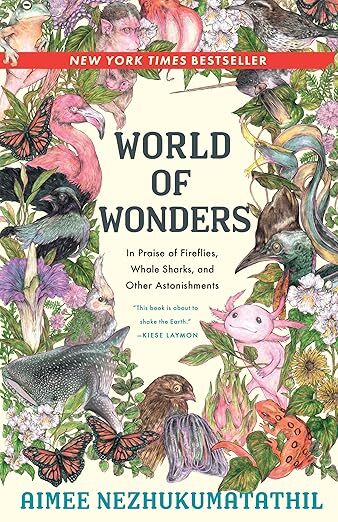

World of Wonders: In Praise of Fireflies, Whale Sharks, and Other Astonishments by Aimee Nexhukumatathil. This book is made up of beautifully written essays on the many ways nature has shaped the author’s life and outlook. I was so entranced by one passage that I brought it up for weeks any time I encountered someone I hadn’t already told. Here it is:
“There’s a spot over Lake Superior where migrating butterflies veer sharply. No one understood why they made such a quick turn at that specific place until a geologist finally made the connection: a mountain rose out of the water in that exact location thousands of years ago. These butterflies and their offspring can still remember a mass they’ve never seen.”
The whole book is a marvel. Here’s one more quick excerpt:
“I know I will search for fireflies all the rest of my days, even though they dwindle a little bit more each year. I can’t help it. They blink on and off, a lime glow to the summer night air, as if to say: I am still here, you are still here, I am still here, you are still here, I am, you are, over and over again. Perhaps I can will it to be true. Perhaps I can keep those summer nights with my family inside an empty jam jar, with holes poked in the lid, a twig and a few strands of grass tucked inside. And for those unimaginable nights in the future, when I know I’ll miss my mother the most, I will let that jar’s sweet glow serve as a night-light to cool and cut the air for me.”
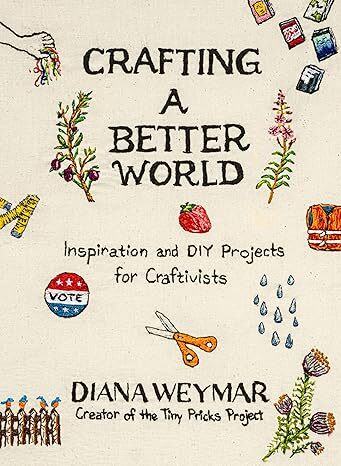

Crafting A Better World: Inspiration and DIY Projects for Craftivists by Diana Weymar. I’ve been following the author’s Tiny Pricks Project, which uses the delicate art of embroidery to stitch the most outrageous political quotes. Even when we vote, march, volunteer, and donate it’s easy to feel hopeless. This (like Craftivist books I’ve previously recommended) inspires us to action through creativity. The author has collected projects and ideas from activists including Guerilla Girls, Roz Chast, and Gisele Fetterman. When the outrages become more audacious, our art and our play need to be more audacious too!

The Comfort of Crows by Margaret Renkl. This was a surprise gift from a friend (thank you Martha!) which made each page sweeter. Renkl mixes science and her own life in seamlessly written essays that can’t help but lure readers outside to pay closer attention to all the life that’s going on around them. She writes, “I stand at the window looking out, trying to remember the truths that nature always brings home. That what lies before me is not all there is. That time is ever passing, and not only when I notice. That strife and pain are no more unexpected than pleasure and joy. That merely by breathing I belong to the eternal.” She doesn’t shy away from the very damning changes imposed on the world by industrialized countries. She lives quietly and does what she can and urges us to do the same, eyes open. Here’s another glimpse:
“Even now, with the natural world in so much trouble—even now, with the patterns of my daily life changing in ways I don’t always welcome or understand—radiant things are bursting forth in the darkest places, in the smallest nooks and deepest cracks of the hidden world. I mean to keep looking every single day until I find them.”

Extreme Birds: The World’s Most Extraordinary and Bizarre Birds by Dominic Couzens. We’ve gotten ever more bird-obsessed since the beginning of lockdown. Some blame goes to the marvelous Merlin Bird ID app from the Cornell Lab, a must for anyone curious about the birds they’re hearing. My husband maintains five different feeders plus, ahem, grain and raw peanuts on the ground for visitors that include many ducks and one pheasant we’ve named Edwin. Back to the book at hand. This volume is arranged in categories like Longest Legs and Widest Wingspan, but those are just a excuse to entice anyone from age 8 to 108. The photos are incredible and each two-page spread includes just enough text to leave you eager to learn more.
~
NONFICTION-MEMOIR
Another Word for Love by Carvell Wallace. Wallace is a man whose soul is both stirred and stirring. He gives us the forward motion of memoir through the decades while also pausing to let us muse with him over life-sized unanswerable questions. In one gorgeously written passage he begins with a picture of his grandparents and takes us with him as he considers facial characteristics passed down through the family, imagines his fourth great-grandmother as a young woman gazing at the stars, offers her a vision of his children with their “bubbling anarchy of tender ages, their faces unbroken by grief and exhaustion…” and ends with his own struggle to be “far enough away to understand and close enough to grieve.”
Here’s another passage that sings with wisdom:
“To be a man as I learned it was to be contained, held within, under control. Unripped and unbroken. Everything I learned about the body early on was about control and containment. Men were not to leak or make too much noise or express too much or lose a grip on anything. Not on your body. Not on anyone else’s. This makes the world a fundamentally terrifying and destabilizing place for men because what the earth is, at its spiritual core, is a thing uncontained. It is liquid and explosive, the chaos of leaves and rivers, mountains of lava, fecund and overflowing.
To be a man as manhood was taught to me is to be fiercely at odds with the earth, which is to say it is fiercely at odds with the divine. It is to be in battle with the divine because to be a man is to be in control and the divine is the complete opposite of control. This is why men are so violent and angry and destructive to ourselves and to you and to the world. We teach each other to hate what we cannot control, and nothing, literally nothing, can be truly controlled.
Look at the earth, how it insists itself upon our buildings and shopping malls and golf courses and hiking trails. Look at how we have tried for centuries to overwhelm the earth and instead the earth has overwhelmed us, calmly, innocently, and with all the tender savagery of a stream running down a gentle slope. What is a body for in the midst of that kind of simple and inevitable passing?”
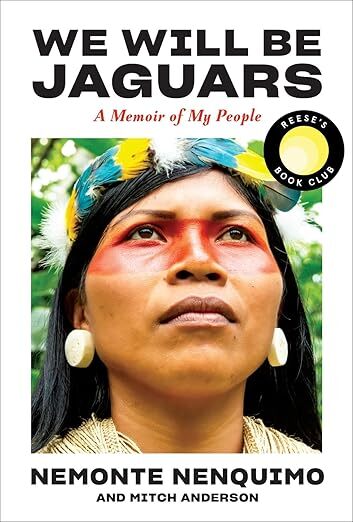

We Will Be Jaguars : A Memoir of My People by Nemonte Nenquimo. This is powerful, essential reading. The author tells of her family, her entire people, who are threatened by the ongoing encroachment of Big Oil. What can tribal people do when facing extinction of their way of life and the ecosystems they have long upheld? Seems unimaginable when up against global economic interests and the will of governments, abetted by missionaries and the corrosive effects of commerce. Yet Nenquimo dreamed the way forward. This is not only an account of deep suffering. It is also one of stories, dreams, love, and tremendous victory.
Here’s a quote from one of the final chapters, when the author is in a courtroom standoff.
“I turned my gaze to the judges and realized that if they were to see us, to truly see us, then we must also see them. Not as enemies, not as heartless judges, not as caricatures of conquest but rather as people, like us, capable of love and hate, of joy and grief. As souls that were here on this earth in these bodies for just a momentary flash. Maybe if we showed them that we were capable of seeing them, then they would see us, hear us, learn from us? … Maybe violence is born in the chasms between us, within us? Maybe the conquest, at its root, has always been about that chasm, a pain so lonely, so unbearable, so spiritually numbing that violence becomes the only path, the narrow trail to being human, to feeling something, anything.”

Something In The Woods Loves You by Jarod K. Anderson. One night I went to bed early with this book, meaning to read a chapter or two. I ended up reading the whole book. My lord, do I ever feel understood, even if what I’ve been through is nothing approaching Jarod’s experience. His meaning-making from time in nature is, as I expected, truly inspiring. So too his unexpected meaning-making out of the suicidal impulse itself. There I was sitting up in a tiny circle of lamplight in my dark room at midnight circling wise words about how a culture without whimsy is dangerous and how the air is charged with a kind of aliveness in the presence of a wild animal, wrapped up completely in his words.
A few weeks earlier I’d sent a copy of Something In The Woods Loves You to a dear friend who is enduring another bout of severe depression. I meant to read a library copy first, to assure myself she might find it helpful, as I didn’t want to impose yet another well-meaning “do this and you’ll feel better” sort of gift. My library copy didn’t come in week after week, so I finally had this sent to her home sight unseen out of sheer trust in Jarod after loving his poetry for so long. Thankfully she enjoy reading it. The copy I sat up half the night reading? It was her gift to me. It’s that good.

Lights on a Ground of Darkness: An Evocation of a Place and Time by Ted Kooser. Beautiful writing, as one might expect in a poet’s memoir. This short (72 pages!) memoir evokes a specific Midwestern time and place, all the more poignant for its distance from today. Here’s a passage about his elderly father visiting a relative dying in a nursing home.
“Now, as he rushes through people calling and calling to him, his heart tapping in his ears, he feels how frail and light he may soon become. He wants more gravity, he wants to hold himself down, to keep himself together for a little longer, to cherish the softening muscles wrapped like weights around his bones. How little this skull of thin, translucent bone must weigh. How fragile and infirm (and yet how precious to him) are its tiny sutures, the pearly, polished sockets for the eyes.
He stares past the girl painting her nails at the information desk, past the big windows in the visiting room that open upon beds of white petunias drooping in the heat, past the empty iron benches in the neatly mown grass. The cornfield looks as if it were made of electricity. It has suddenly come upon him that he is seventy years old and incapable of walking in any other direction that straight into the future. Flowered sport shirt; thin, spotted arms.”

They Called Me a Lioness: A Palestinian Girl’s Fight for Freedom by Ahed Tamimi. The long struggle of the Palestinian people is made vivid through the author’s experiences as her close-knit family and village stand up (with all they have — songs, chants, and rocks) to the brutality of occupying Israelis. It’s even more heartbreaking to recognize this book was published before the current ongoing genocide began. I read this memoir earlier this week during long afternoon while coughing and shivering with covid. That night her stories came alive in my dreams. Maybe because Ahed is so determined and brave, those dreams were not nightmares.

Slow Noodles: A Cambodian Memoir of Love, Loss, and Family Recipes by Chantha Nguon. The author shares her experiences as a Cambodian refugee who lost her home, her family, her country in the horrors of the Pol Pot regime. She writes, “When you must flee and can carry only one thing, what will it be? What single seed from your old life will be the most useful in helping you sow a new one?” Nguon relies on her mother’s “slow noodles” approach to healing and to cooking, one that prioritizes time and care over expediency. This a testament to the power of culinary heritage to spark the author’s hope for an authentic life (and includes 20 Khmer recipes). Here’s a taste of her words. “But if there’s one thing I learned from my mother, it’s that losing everything is not the end of the story. She taught me that lost civilizations can be rebuilt from zero, even if the task will require many generations of work.”

The Body Is A Doorway: A Journey Beyond Healing, Hope, and the Human by Sophie Strand. I was grateful to get an arc of this book, due out in early March. Sophie Strand senses and understands in ways more whole, more alive, than most writers I have encountered in my decades as an avid reader. She brings this full beingness to all her work and this book is a standout. The Body Is A Doorway has widened and deepened the way I see my own health challenges. Here’s a passage from one of the closing chapters:
“How can we be well inside of an Earth we are actively harming?.. I want to suggest that we are all haunted. Not by flashbacks and memories. But by an imaginary idea of wholeness. By the idea that there is a normal body that renders our body deviant. That there is another version of us — a healthy version… That we must spend our every waking hour, our hard-earned money, our dedicated spiritual and physical focus, striving toward this other us…
For so long I’d viewed comfort and relaxation and ease as the goals that medical and psychological treatment were supposed to provide… I learned that we were supposed to create safe spaces and healthy boundaries…
Trauma does not belong to an individual. It is a web. It is not an object that can be removed. Your body’s innate ability to dance with harm and with discomfort is not always a problem. It is a relational tactic. A nonconsensual opening to both the good and the bad, the human and the nonhuman. .. I finally stopped defending the doorway of my own body. .Let it in. The love. The wonder. The pain. The uncertainty.”
Here’s another bit to give you a sense of her work:
“Every story, like every human body, is an ecosystem of other stories: the virus author that ‘taught’ us mammals how to develop wombs, the ancient ecological pressures that molded us into multicellularity, our pulsing microbiome, our fungi-dusted skin, our metabolic reciprocity with every substance we breathe and drink and eat. Every recombinatory miracle of genetics gave birth not to an individual on a hero’s journey, but to a biodiversity of competing and converging aliveness.”

Breaking Through: My Life in Science by Katalin Karikó. Breaking Through begins as a vivid coming-of-age story in postwar Hungary, showing us how Dr. Karikó developed the resilience and unquenchable curiosity that led to her remarkable breakthroughs. She takes us along through significant career drawbacks that would have daunted most other scientists. Her explanations of the work leading to mRNA is fascinating. She let her own experience demonstrate how innovation is easily stifled in our money and power-focused institutions. I also appreciate what this brave woman is doing for healthcare both now and for our collective futures.
~

There Are Rivers in the Sky by Elif Shafak In this beautifully written and brilliant novel, the author does with water what Richard Power did with trees – science, history, art, and meaning flow through the underlying theme of water. She writes, “In this land where the stones are ancient and the stories are spoken but rarely written down, it is the rivers that govern the days of our lives. Many kings have come and many kings have gone, and God knows most were ruthless, but here in Mesopotamia, my love, never forget the only true ruler is water.” I can’t wait to read her other books.

Sandwich by Catherine Newman. I would gladly read about everything this family does through the eyes of the main character. Rocky is my kind of wry bittersweet. She and I share the same neuroses, our grown kids are similarly brilliant and funny (even if she has a too-perfect-to-be-true spouse). And I appreciate how well she inserts candid humor into scenes.
Here’s how she describes being examined by a doctor on a the paper-covered exam table:
“I sit up so I could feel more like a human woman than like a pile of old ham slices wrapped in deli paper.”
After Rocky’s mother is taken to the hospital, daughter Willa remonstrates her grandmother:
“I told you to drink something!” Willa says, because her genetic inheritance includes scolding the people you’re worried about.”

The God Of The Woods by Liz Moore. This immersive, character-rich mystery centers on class divides with all its embedded cruelties. I don’t read many mysteries, so my perspective may be limited, but I definitely did not see it ending the way it did — all the more satisfying.

by Jodi Picoult. Why, when I read 100+ books a year, haven’t I read Jody Picoult’s tremendously popular books? I don’t have any idea. Maybe, subconsciously, I heard her books described (or dismissed) too many times as beach reads, as a typical airport fiction, as chick lit. To me, those dismissals are the fire burning under this wow of a novel.
By Any Other Name is a deeply researched and compelling work that manages to encompass centuries-long misogyny and chronic literary snobbishness in parallel stories—current day Melina Green and sixteenth century Emilia Bassano. Bassano’s story is the stronger of the two and could have been the standalone tale, but I see the need for the current story as a mirror. Probably as a mirror to readers like me who weren’t aware they dismiss too easily. I will never see Shakespeare’s name again without thinking of this book

Night Wherever We Go by Tracey Rose Peyton This is an incredible debut novel packed with humanity and its ugly failings. The author effortlessly lets her readers into the lives of these the enslaved women. And lets us feel the pull of relationship with the beyond-human in passages that stood out for me, like these:
“Some feet ahead, she spotted a chaste tree, its bright purple flowers just beginning to open. She wandered over to it, sensing some vibration calling to her. An unbelievable phenomenon she realized whenever she tried to describe it, but she had known it all her life–this ability to hear plants and trees whispering to her, offering her help.”
“We wanted to be inside the prayer and song, the deep vibration and sweaty fist of it, but couldn’t muster any of the necessary stuff to get up inside it. Some of us understood that these were relationships one remade over and over again. All the time, one was seeking alignment with God, with her Dead, with the trees and animals alike. All these relationships required sun and tending to, but the youngest among us didn’t understand the back-and-forth.”
“She picked up a stick and carried it low, scraping a trail in the dirt. A circle, a pointed arrow, a series of linked curlicues. She was pointing souls now. A whole army of them to nest inside the four walls. And she hoped by the time she got there, a war would be happening between her saints and his. She crossed herself and spun, left then right, as if she was trying to reach some hinge in the air, unlatching some hidden thing where all the otherworldly help could pour out of.”

Shy Creatures by Clare Chambers. It is a reader’s joy to start a book by an author new to her and realize, within a few pages, she’s found another author to love. This is an absorbing and deftly written novel that maintains its excellence all the way through to an unexpectedly redemptive ending. I will be hustling to read Clare Chambers’ other works.

Night Watch by Jayne Anne Phillips. This is a complex, brutal, and powerfully written work set in the Civil War era. The history itself is fascinating. I was particularly drawn to the character Dearbhla. Night Watch has much to say about trauma and its aftereffects both on individuals and a time period. (For those who appreciate advance warnings, there is a great deal of suffering in these pages.)

Our Missing Hearts by Celeste Ng. This is an essential book for our times. Today’s angry voices denouncing books and the study of history and diversity itself have gotten their way in Celeste Ng’s novel. In some unnamed near-future, economic strife and simmering anti-Asian racism is used to justify the shock doctrine-like creation of a sweeping new law called PACT: Preserving American Culture and Traditions. Free access to books and music is gone. History is censored. People are rewarded for informing on “troublemakers.” The law also prevents the spread of “un-American views” by permanently removing children from families thought to be sympathetic to Asian countries or from parents thought to harbor un-patriotic opinions, even thought to doubt the benefit of PACT itself. In the potentially not-far-off world of Our Missing Hearts we come to know a linguist and poet who have a child named Bird. We come to see the unflagging heroism of librarians. We feel the power of etymology, and folktales, and of symbols that lift from poetry into larger purpose.

Everyone In My Family Has Killed Someone by Benjamin Stevenson. This is a fresh and clever take on the mystery genre (at least in my admittedly limited experience). The narrator’s career centers around teaching others about the craft of writing mysteries, although he has not published one himself. Lots of asides to the reader about rules of mystery writing, very meta, even if a bit murder-y for my taste. I was happy to discover this is the first book in a series of three.

The Golden Spoon by Jessa Maxwell. This is a charming, character focused mystery with a resoundingly positive ending. (Well, not positive for some of them.) I found it a delightful retreat from a chaotic world and I recommend it to anyone needing their own 288 pages of sweet as well as savory escapism.
~
You know my yearly book lists are a poorly veiled attempt to hear about your favorite reads. Please comment with some titles you love.