Erica Jurus's Blog
September 22, 2026
The best season, and here’s why!
“I’m here to stand up for Autumn!”
That was my declaration at the beginning of my winning Table Topics Speech in Toastmasters one week.
First, a little background: Toastmasters is a world-wide program for learning how to do public speaking. And I did. Before I joined the in-house club at the college I was working at, I seized up whenever I had to even introduce myself in job-related meetings. Eventually I got tired of that feeling, and decided to confront my fears head-on. I’m a great believer in not limiting myself.
Club meetings feature several opportunities to practice, from chairing a meeting to helping run different parts to delivering a full speech. But Table Topics, those two-minute off-the-cuff little speeches designed to get us to think on our feet, were always the bane of my existence. They just did not sit well in my wheelhouse. But I did develop the ability to NOT freeze on the spot.
This particular day, the topic was to talk about our favourite season, and why we love it. Most people chose Summer, a couple either Spring or Winter, but no one had picked Autumn.
I know – shocker for anyone who’s feeling like they can finally breathe again, in the cooler air, slowly descending leaves, harvest festivals, PSLs and lots of other good autumnal stuff.
I rarely – can’t even count the number of times on one hand – ever won Table Topics during the seven years I was in Toastmasters, but I did that day. I guess my passion for Autumn, which officially begins today, shone through.
People who don’t love this season usually cite that it portends Winter in a few months, and that’s a fair point. BUT, for me the beauty and magic of Autumn far outweigh what comes after.
The featured image for this post isn’t a painting, but it could be.
It’s a casual photo I took up in Agawa Canyon last fall, hiking around while the train was stopped. Nothing fancy, but its mellowness epitomizes Autumn for me – the soft golds and greens, the gently cooling weather, the slowing down to appreciate how lovely the days are. I love the scent of leaves – as they lose their chlorophyll, they seem to concentrate the aroma of nature. I love to crunch the fallen leaves under my feet – it’s a low-tech pleasure I haven’t lost since childhood.
Autumn encourages us to be outdoors.
Some people may say that about summer, but where I live the summers are brutal, just a string of hot, sweaty days that seems endless, even though every year I know it will ease in a couple of months. I put a foil sun shield across my car’s windshield for the duration so that I’m not roasting when I get in. And thank God for air conditioning, but nothing beats the smell of fresh air coming in through open windows when the temperatures drop.
And there are harvests, and festivals. Autumn is a season of bounty. Bushels of tomatoes, peppers, apples, pears, pumpkins… All that goodness is a deep connection to the planet, the soil, the wind, the rain, the sunlight, the pollinators. I think people who live in cities often forget how important those all are, forget where the food comes from, and while I have what might best be called a ‘withering’ thumb when it comes to gardening, I’m so fortunate to live in an area surrounded by farms and markets, and a sprinkling of harvest festivals to boot.
Thanksgiving is one of my favourite holidays, where I get to cook with all that bounty and share it with family and friends. There are few finer meals than roast (or even better, smoked) turkey with stuffing, gravy, mashed potatoes and all the sides. Our godson makes a fantastic smoked turkey, and the gravy is unbelievable! And there must be pumpkin pie, with real whipped cream – not artificial, not out of a can.
The grand treat at the end of October, of course, is Halloween! My hubby and I grew up when kids could go out trick-or-treating without supervision, and that made all the difference. The cool October night, just the light of a few jack-o-lanterns on porches to grin out of the darkness, with the smell of fallen leaves and ripening grapes (a lot of people grew them in their back yards then), was both eerie and magical.
I was in a Canadian Tire store the other day with several of the gigantic creepy figures that are so popular now, and they are fun to look at, but for me what kids are missing is the mystique of Halloween. Now it’s all giant leering skeletons, inflatable hearses and extreme light displays.
The best part of the holiday for me was the edginess of being out after dark on my own (well, with friends), and I permeate every book I write with that same feeling.
Ultimately, I may or may not have convinced you about Autumn, and to some of you I’m surely preaching to the choir. There are those of us who long for this season all year, and we’ve come back to life now (after months of heat-induced torpor). Maybe that’s the best argument of all.


September 15, 2026
Why conventions and book festivals matter
I wrote my first novel during the first COVID lockdown, and I thought that was the strangest thing I’d ever been, or was going to go, through. I remember how surreal it felt to shuffle into a huge local arena with hundreds of other people to get our inoculations. To be hiding in our homes to prevent infection (while the son of a friend of mine was hanging on to life on a respirator after having contracted the disease). To line up for half an hour just to get groceries.
How did that happen to our world? Landing in the middle of the pages of a sci-fi novel or the plot of a sci-fi movie? A 21st century problem: diseases that could spread across the globe like wildfire.
Growing up in the 20th century, when we could read whatever we wanted, I never envisioned that the freedom to read would become another 21st century problem. That we would once again step into the pages of a sci-fi novel.
Ray Bradbury is often quoted lately from discussions about Fahrenheit 451, his famous novel about a future dystopian America where books have been outlawed and “firemen” burn not just any books that are found, but the houses of the owners:
“You don’t have to burn books to destroy a culture. Just get people to stop reading them.”
Growing up, he’d been horrified by real-life examples – in particular the Nazi book burnings, destroying all books viewed as being subversive or as representing ideologies opposed to the ideology, and the Great Purge in Russia, in which many scientists, mathematicians, theatre directors, writers and others (in other words, people of ideas) were arrested and executed.
Bradbury wasn’t just commenting about the censorship of ideas; he also referred to how mass media reduces interest in reading literature.
And here we are, in a society so far advanced beyond my youth, and his, and anyone born in the 20th century, that his speculations have become fact.
But people are fighting back. We haven’t completely entered the new Dark Ages, as Times columnist James Marriott calls it in his new book, The New Dark Ages: The End of Reading and the Dawn of a Post-Literate Society, yet.
As an author, I see a lot of positive signs out there, just from the conventions and conferences I attend.
At every single book signing I did last year, both adults and children stopped to talk to me about writing books, with their own passion for the idea of maybe one day writing their own. And even if the convention wasn’t specifically literary, people bought books – not just from me, but from the many other authors on site.
I’m encouraged when cosplayers dress up in literary costumes.
I was, frankly, astonished and delighted at how many passionate fans of H.P. Lovecraft travelled from within North America and abroad to attend the Necronomicon festival in August. Fans who love the stories, the ‘weird’ fiction that Lovecraft more-or-less pioneered, the sheer inventiveness and wildness of his concepts.
I’m invigorated by the explosion of non-traditional literary genres. Romantasy, for example, has become exceptionally popular, followed by horrormance, cozy horror (yes, there is such a thing), and just about any crossover type of plot that you can think of.
There are so many literary conventions just in my own province of Ontario that I can’t keep up with them! They’re showing up in cities small and large, in convention centres, hotel ballrooms, even coffee shops. And the organizers of them are spreading events into other provinces. Pages & Pleasures, a romance convention that I’m taking part in on December 5th in Hamilton, is expanding to Halifax, Nova Scotia next year, and to judge by the enthusiasm on the event’s Facebook page, will be a huge success.
Strangeness breeds in isolated communities; that’s why it’s such a beloved subject for horror novelists. (Ooh, that gives me an idea  )
)
I spent a couple of years in one in northern Ontario when I was a child, and let me tell you – it wasn’t as bad as the movie Deliverance, but… Let’s see, someone from a neighbouring almost killed me when he was trying to poach a pheasant off our farm. I was playing in the yard, and I remember the bullet whizzing by my head. My dad leapt into the truck and gave chase, but couldn’t catch the f*nut. And at the farm one over, both the mother and the 14-year-old daughter were both sleeping with the travelling salesman.
When there’s no influx of fresh ideas, people turn inward. We had some lovely people in the community, don’t get me wrong, but others were living in tar-paper shacks in the woods, talking to their jugs of hooch (not an exaggeration).
One of the first things my hubby and I learned when we began travelling is that people in other countries are just like us. They want the same things: a good job, love, a home, feeding their family. It’s the people in the governments who place their own agenda above their constituent’s wellness, and extremists with rigid ideas, that create havoc.
Many, many studies have shown that reading is critical to mental health, the prevention of dementia, and general well-being. According to Cambridge University,
“Survey data in adults suggested that reading was associated with reduced stress, greater empathy, enhanced well-being, and decreased loneliness…cognitively stimulating activities, particularly reading, are associated with a lower risk of dementia and slower cognitive decline…” And, “In childhood and adolescence, early reading for pleasure has been linked to better attention, memory, executive function, academic achievement, and fewer mental health problems.”
Community and freedom of expression make a difference. Earlier this year, Amazon had announced the plan to revive beloved sci-fi series Stargate SG-1 – then scuttled it. Fans started a petition on Change.org, #SaveStargate, to save the show. I just read that the campaign has now had more than 120,000 signatures, many of them spurred at DragonCon in Atlanta. Amazon had claimed that the revival was too ‘niche’, but the interest shown by the thousands of signatures belies that. And ‘niche’ shows have massive audiences. Fingers crossed for this petition to succeed; it’s still available to sign.
I decided to change this week’s blog post in response to all the bad literary news, from surveys showing how much reading has declined, especially in young people who have their faces buried in electronic screens, to reports from the U.S. that booksellers may be convicted on terrorism charges if they don’t remove certain books from their shelves. The reports coming in for existing arrests are horrifying – convictions of up to 50 years in prison already.
But my experience with meeting readers has been very uplifting. I hope that’s not unique to Canadian authors.
Back in the summer I read a great article about the keynote speech at the 2026 London Book Fair. I’m including a brief excerpt because I couldn’t put it any better :
“Festivals are where books meet readers. Where stories step off the page and into conversation. Where writers and audiences encounter each other directly—not through algorithms, but through dialogue.
And those audiences matter enormously. Because a book without a reader is only half alive. Readers complete the story. They recommend books to friends. They debate them. They challenge them. And they turn private reading into shared cultural life.
When readers gather at festivals, something powerful happens. Reading stops being a solitary act. And becomes a collective one. A book becomes part of a conversation. And that conversation has real impact.”
Reading = ideas i= freedom. It’s essential to the survival of Culture.
I’ve tried not to be overly political on my blog because I like to write for entertainment, but it’s becoming impossible to avoid. We all have to stand up for freedom of speech, and all it represents: an acceptance of the right to ideas, even if we disagree or don’t particularly like what someone else is saying. And that must apply on all sides of an idea.
I think the majority understand that, and if we all stand up for it, we’ll win.
September 8, 2026
On hiatus this week
Back next week with a look at the origins of faerie eroticism, the super-popular trend in fantasy sub-genres at the moment.
September 1, 2026
Some of us prefer darkness
Maybe I am a vampire. My hubby’s been insisting for a while.
For the most part, I don’t like sunny days – except for photography, and in the winter when they perk up the weeks of dreariness. I prefer my days cloud-covered and moody, and if there’s a bit of rain or fog, even better. Summer is definitely not my season; give me Fall with dense clouds and a spooky chill in the air.
And you know those blissful photos of people sitting on a porch having coffee in the benediction of the gently-glowing morning sun? You’ll never catch me in one of those.
But late at night, when most people have turned out their lights and gone to bed, you’ll find me with a cup of tea, typing out my creepy plots by the light of my illuminated keyboard. That’s an indispensable tool for night-owl authors, by the way.
Most of the people I know do have what’s called an “implicit daytime bias” (such annoying morning people !) It explains why there’s so much lighting in and around our cities these days – our world’s lightscape can actually be seen from space, and the image below was taken in 2012. Imagine how much more intense it looks now.
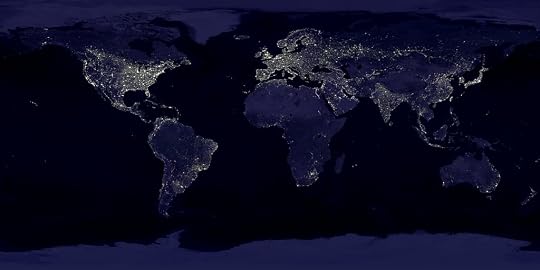 Source: NASA Visualization Studio, https://svs.gsfc.nasa.gov/30003/. This image of Earth’s city lights at night shows the spatial distribution, or arrangement, of human settlements. The image was created with data from the Defense Meteorological Satellite Program (DMSP) Operational Linescan System (OLS), acquiring one swath, or area, of data at a time.
Bright light bothers me a lot; I love my Transitions®-lens glasses. Around the house, I’m typically going around shutting lights off.
I’m a dyed-in-the-darkness Night Owl. I have been since childhood, completely bucking the trend of most youth to be early risers.
We officially have a scientific name now: a “late chronotype”, and it’s not a matter of choice, either. Science (for the many of us who believe in it – oops, some snarkiness in there) says that whether we’re day or night people comes from our genetics.
A clinical psychologist and sleep specialist, Dr. Michael Brues, links human chronotypes to similar sleep-wake patterns in animals:
Lions, the early-to-rise and early-to-bed animals/people, about 15% of the population.Bears, who, like most humans (40%), wake and sleep with the sunrise and sunset.Wolves are the night owls, so I suppose I’m most like them, except for:Dolphins (about 15% of the population), who are sensitive to environmental factors such as noise and light. I want a dark, quiet room. In hotel rooms, I’ll either unplug extraneous lighting (like LED alarm clocks) or cover them up with towels. Ceiling smoke detectors with bright green lights drive me bananas – I’ve learned to bring a sleep mask with me, although I don’t like wearing them.Life is challenging for those of us whose peak energy is at night. Most of the world runs on ‘daylight’ time. Trying to maintain a 9-5 job when it goes against your circadian rhythm can even create health issues, from sleep loss to fatigue and higher levels of stress.
But there has been an evolutionary advantage since prehistoric times for people who are awake in different parts of the 24-hour cycle. In early times, the greatest risk from predators was whenever a village or tribe was sleeping; with at least some people up around the clock, it made life safer.
When my hubby and I went on a camping safari in Botswana, our tents were pitched deep in the bush, in the midst of the wildlife. The safari staff kept a fire going in the middle of camp throughout the night, and hung oil lanterns from our tent posts. Even with such precautions, hyenas and honey badgers sometimes wandered around. The big male elephants in ‘must’ barged through in broad daylight – no one argued with them – and monkeys could tear apart your tent if you didn’t keep it zipped while out on a game drive, but at least they’re diurnal as well.
Our modern propensity for lighting up cities like Christmas trees has had a lot of detrimental effects, on everything from bird migration to astronomy. Perhaps they should take a leaf from the ‘Book of Vampires’: less is more.
This is a shorter post than usual while I’m deep into getting my new novel ready for publication, but I just wanted to say that darkness can be quite lovely and restful, and a shadowy room provides wonderful atmosphere for writing horror novels – especially about vampires and other creatures of the night, mwa ha ha.
Sleep tight, all you day people
August 25, 2026
Lovecraft weirdness lives on
Where can you go, if you’re an author, to celebrate the weirdness that inspired your own work?
Try a literary festival based on a horror writer with issues: the notorious NecronomiCon conference/convention in Providence, Rhode Island. My hubby and I went this summer, and it more than lived up to its rep.
Yes, we travelled into the U.S. With the tariff wars escalating again, I guess it’s become ‘elbows up’ time once more, but we enjoyed the brief opportunity to visit our neighbour country after a hiatus. No issues crossing the border, and everyone we met was absolutely lovely (except for one miserable front desk clerk at the Howard Johnson in Mystic, CT, who should probably consider a different career). Many asked us about visiting our home turf of Ontario, and no one mentioned anything political.
NecronomiCon is named after the legendary fictional grimoire (textbook of magic) invented by horror writer H.P. Lovecraft for his horror stories. Lovecraft first mentioned the dark, mysterious tome in his 1924 short story “The Hound”.
In order to give you an idea of the zaniness of this conference, let me give you a little background.
Lovecraft wrote a short ‘history’ of the Necronomicon, using a literary device called pseudobiblia: an imaginary document made out to be real, using fictional citations. Pseudobiblia was often used by the different writers for Weird Tales, the horror pulp magazine that Lovecraft submitted his own stories to.
According to Lovecraft, the Necronomicon was written by a ‘mad Arab’, Abdul Alhazred. Abdul was a worshipper of the cosmic entities Cthulhu and Yog-Sothoth (two of the Old Ones, the strange pantheon of cosmic monster-deities Lovecraft created for his stories after a lifetime of being tormented by terrifying dreams). Abdul spent years travelling through the Middle East, but settled in Damascus, where he set down his forbidden knowledge before one day uttering a single word wrong in a spell and being “seized by an invisible monster in broad daylight and devoured horribly before a large number of fright-frozen witnesses”.
Well, you know what they say about playing with fire. According to Lovecraft’s “History”, the Necronomicon contained forbidden history and dark rituals to summon the ancient cosmic entities that lurk in the dark spaces of the world. Even studying the text of the Necronomicon was dangerous, as those who tried to master its arcane knowledge generally met terrible ends. Only a few rare copies survive, closely guarded in institutional libraries like Miskatonic University in the town of Arkham.
Lovecraft felt that a well-written weird story should be believable, as convincing as a good hoax. His spurious history convinced quite a few people, who’ve created their own versions in real life and published them (most notably the “Simon” edition published in 1977, which you can buy on Amazon).
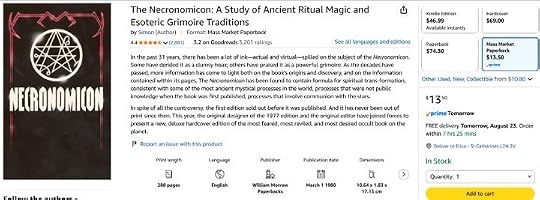
He experienced some guilt, though, when he heard of fans searching libraries for real-life copies, egged on by pranksters who’d occasionally list the Necronomicon for in library card catalogues. Apparently even the Vatican gets requests for it from those who believe their Library holds a copy.
For a writer of speculative fiction, the ultimate compliment may be when readers believe that some of what you’ve written might really be true.
To give you an idea of the strangeness of Lovecraft’s mind, here’s part of a description of the Old Ones:
“By Their smell can men sometimes know Them near, but of Their semblance can no man know, saving only in the features of those They have begotten on mankind; … They walk unseen and foul in lonely places where the Words have been spoken and the Rites howled through at their Seasons. The wind gibbers with Their voices, and the earth mutters with Their consciousness.…”
H.P. Lovecraft spent most of his life in Providence, although the house he lived in has no marker about his presence. His writings inspired many contemporary writers to expand on the world he created, and many subsequent writers and filmmakers. In 2011, the Lovecraft Arts & Sciences Council was founded to officially recognize the city’s weird ‘son’, and have been running NecronomiCon every other year (more or less) since 2013.
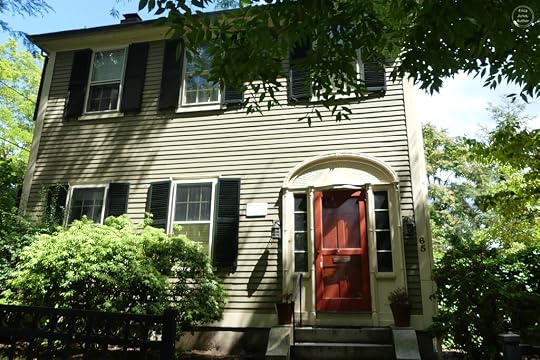 H.P. Lovecraft’s home in Providence, R.I. – photo by author, all rights reserved
As soon as I found out about this event several years ago, I wanted to attend. After I published my trilogy, I hoped to be one of the vendors, but in the current trade climate, trying to sell in the U.S. was far too problematic. So hubby and I went just to enjoy ourselves.
I was amused to watch my husband absorb the wonderful weirdness.
The daily sessions contained some very scholarly and erudite discussions about not only Lovecraft but other authors of ‘weird fiction’, a blend of science fiction, fantasy and horror that I write myself, as well as the permutations and influences of such fiction in modern times. If you’re interested, you can study up yourself on the Lovecraft Archive.
However, the general atmosphere of the conference fully taps into the author’s imaginings. And that’s the best thing about it – anything goes. The fans showed up at all adult ages and in all forms, and they were having a fantastic time!
The vendor hall was a hoot – of course I came home with a small statue of the terrible Cthulhu, and even my hubby bought two t-shirts.
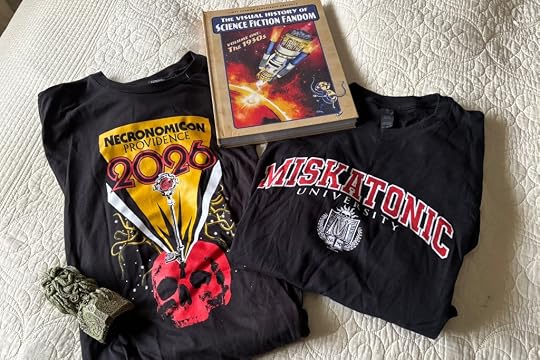 My haul from the vendor hall at NecronomiCon – photo by author, all rights reserved
But the best part of all was the Eldritch Ball.
The name is self-explanatory. We brought easily-packed costumes with us, attending as dark cultists.
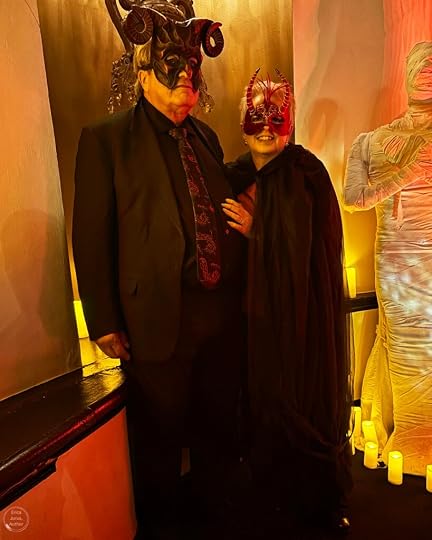 Me and fellow cultist hubby – photo by author, all rights reserved
The Ball was semi-formal, so either in fancy dress or cocktail style, but to a person, everyone opted for some form of costume. A few people leaned into the overall Egyptian theme, with special mascot Nyarlathotep, aka The Crawling Chaos, an ancient and malign deity who wanders the Earth to gather followers, sometimes manifesting in the form of an Egyptian pharaoh, sometimes with a weird slightly amorphous tentacle-shaped head.
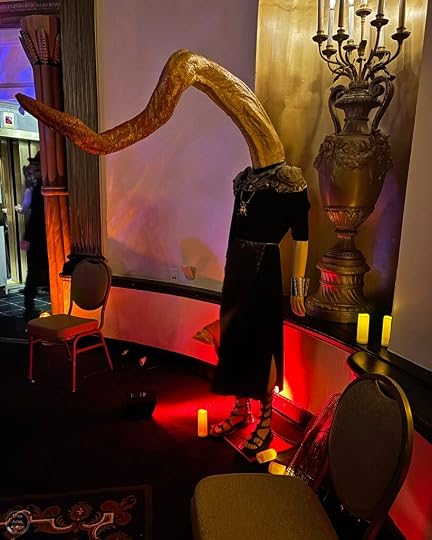 Nyarlathotep, The Crawling Chaos, in his snakier form – photo by author, all rights reserved.
The Ball was held in the Biltmore Ballroom in the Graduate Hotel across the street from the main conference location at the Omni Hotel. The Graduate opened in 1922 as the Providence Biltmore Hotel, and has retained much of its original spectacular 1920s architecture. The Ballroom was the perfect venue, looking like just the place for a bunch of cultists in Lovecraft’s era. And the night was a rollicking adventure – a couple became officially ‘bound’ to each other in front of the assemblage, and several excellent performers, from a belly-dancer to an Bast-themed (Egyptian cat goddess) burlesque artist took the stage. In between, a great DJ spun slightly creepy tunes that kept the dance floor full.
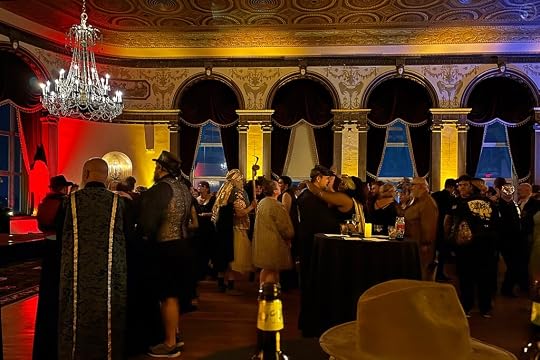 The Biltmore Ballroom and the Eldritch Ball in full swing – photo by author, all rights reserved
We had one fellow stop by our table, worrying about his lack of dancing skills, to which I commented, “In this crowd, I don’t think you need to worry about that”, and indeed, there was such an atmosphere of freedom to let your ‘weirdo’ hair down and have fun. A conga line broke out at one point, and when the DJ played “Tainted Love”, the entire ballroom sang along. Truly, it was like attending the best Halloween party ever, and we had an absolute blast!
The next morning we got up early for the “Infamous Cthulhu Prayer Breakfast” in the same ballroom, hosted by Most Exalted Hierophant Cody Goodfellow, with a lobster on the front of his mitre. The Amorphous Choir led us in several ‘hymns’, and various prayers were uttered to the Old Ones. I had to wonder what the hotel staff servers were thinking as they cleared plates amid all the silliness.
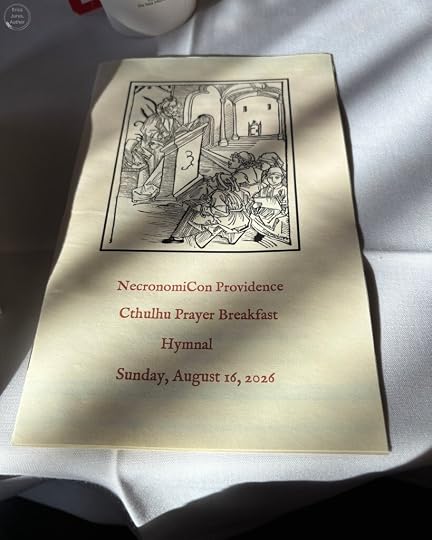 Program
 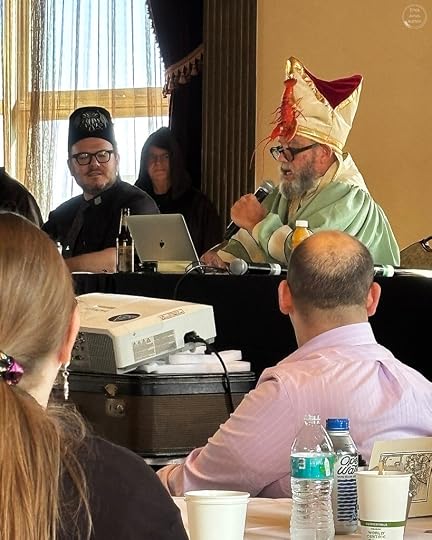 Most Exalted HierophantsCody Goodfellow
There were gaming sessions, walking tours, theatrical events and various film screenings throughout the weekend. The conference wrapped up with a raucous viewing outdoors of one of the hallmark Lovecraft movies, The Dunwich Horror from 1970. Slightly cheesy but with great atmosphere, the movie starred Sandra Dee as a student at Miskatonic University who gets mixed up with Wilbur Whateley, the weird son of the strangest family around. He’s trying to get his hands on the Necronomicon so he can bring Yog-Sothoth into the world. As an additional fillip, all manner of costumed Lovecraftian beasties wandered through the crowd, while a stand-in Wilbur showed up to encourage all of us to chant as needed.
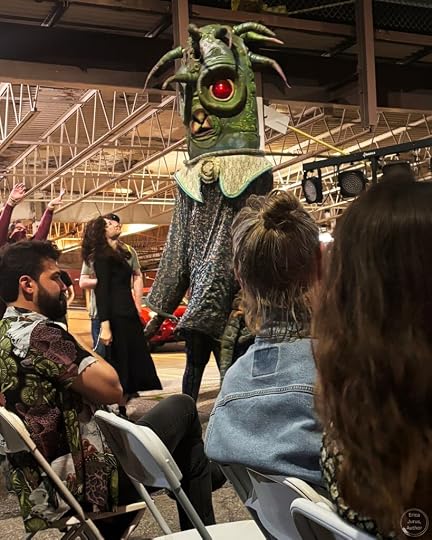 One of the ‘guest appearances’ at the movie night finale – photo by author, all rights reserved
So that was our grand excursion to Lovecraft country. I was amazed at how many devotees there still are to the writer’s works – his world of eldritch monsters has had a resurgence in popularity in recent years. Perhaps the imagined monsters distract from so many real ones, or give us a way to process our anxieties. At any rate, it was delightful to see what an impact one of my most influential writers continues to have.
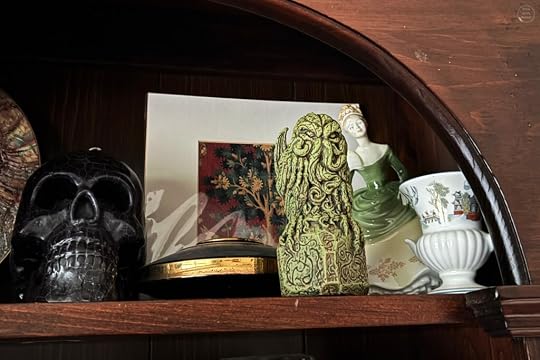 Cthulhu right at home on a shelf with a Royal Doulton my mother-in-law passed down to me – photo by author, all rights reserved.
August 18, 2026
Why haven’t I written a vampire tale?
Keeping up with everyone who’s now referring to this month as ‘Augtober’, dreaming of the impending Halloween season, I thought I’d address this burning question. (At least to me, maybe not anyone else )
I’ve been enthralled with vampire stories and movies ever since I first saw the superb Christopher Lee as Dracula.
The character of Dracula, imagined by Bram Stoker from folk tales of eastern Europe, is still the classic vampire. Tormented by the loss of his wife centuries before, he curses God and is transformed into an immortal being whose lust for blood knows no bounds – until he runs into Mina, the reincarnation of his dead love. How could he not pursue her, after centuries of longing and despair that turned him into the evil he never wanted to be?
It’s truly a timeless story, seen through the eyes of the people of 1800s England who try to stop him.
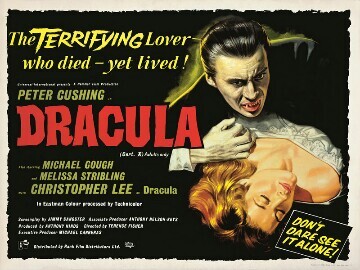 Dracula1958UKPoster. UK theatrical release poster by Bill Wiggins. By Rank Film Distributors – https://whitecitycinema.com/2013/05/06/, Fair use, https://en.wikipedia.org/w/index.php?curid=60624288
What is it about vampires that’s so fascinating? There are many theories: the “bad boy/girl” archetype, merging the danger of a monster with forbidden attraction; the allure of immortality and power, both physical and psychological; vampires as the ultimate ‘outsider’, who, while marginalized by society, can control and perhaps destroy humans at their will.
Most great vampire stories centre around those affected by the creature, or creatures, in their midst. Blood Ties, a little television movie airing in 1991, was the first film I saw that brought vampires into the modern world. In the movie, the vampires are sexy as well as elegantly bloodthirsty, living in wealth and status right under the noses of humans. A clan of them reside in an unusual stone mansion in Long Beach, California. They refer to themselves as ‘Carpathians’, and behave with the privileges of wealth: lavish parties, judges bribed when the unruly teenagers among themselves get into trouble. One of the clan, their troubleshooter Harry Martin (aka Harlevon Martinescu), becomes involved with a non-Carpathian Assistant D.A. at the same time that a crazed group of vampire hunters start trying to kill off the clan.
The Lost Boys, in which a down-and-out mother moves to Santa Carla, California with her sons to live with her father, a crazy-coot kind of fella who turns out to be surprisingly resourceful as the oldest son, Michael, becomes involved with a local band of young male vampires who are eating their way through the “murder capital of the U.S.”.
The original Fright Night, wherein a guy named Jerry moves into the creepy Victorian house next door to teenager Charlie Brewster and his mom. Charlie begins to suspect that Jerry is a vampire, but no one will believe him. He tries to enlist the help of late-night horror movie host Peter Vincent, played with panache by the inimitable Roddy McDowell, but it turns out that Peter is a fearless vampire hunter in promo only. Charlie becomes increasingly desperate as Jerry threatens to hurt both him and his mother if he reveals what he knows.
Another little TV movie that I’ve been trying to find again, Cold Hearts, is about a young gal who searched down vampires to become one, then finds the life isn’t even close to the romantic vision she’d entertained. It features very young Christian Campbell (brother of Neve) and Jon Huertas, of Castle fame, as two of the nasty vampires terrorizing a small town in New Jersey. Then Rob Floyd shows up as the mysterious loner who might be able to help. The trend of devilishly attractive vampires was emerging, as enticing as they are dangerous. It reinvigorated the vampire genre, providing so much twisted material for Horror – and Romance – writers!
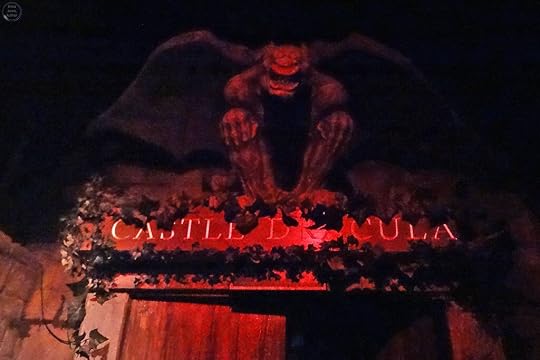 Part of the Castle Dracula attraction that was once available in Dublin, Ireland – photo by author, all rights reserved.
Clearly I have something of a passion for vampire stories. Hubby and I even visited the terrific Castle Dracula Dublin, unfortunately now closed. Bram Stoker was born in Dublin, and there are still places you can visit, but we were sorry to hear of the demise of the Castle Dracula attraction, with lots of memorabilia and a really fun illusionist show about vampires.
Years ago we also visited the town of Whitby, on the northeast shore of England, where Dracula lands when he crosses the stormy sea from Europe in Bram Stoker’s novel.
My mother was even born in Carpathia.
So why haven’t I written a vampire novel yet, when it seems like an obvious idea?
Not sure, other than that a great plot hasn’t popped into my brain yet. There is a family of vampires in my Chaos Roads trilogy, and one of these days I will expand on one of them – or, someone who’s had a run-in with them (brain working on ideas as I write this). It might require a real trip to Genoa, Italy, where the father is originally from, for background material (the great excuse I keep presenting to my amused hubby). So stay tuned – there will be blood in the future!
August 11, 2026
A forbidden shortcut for medieval scholars
Did anyone use Coles Notes, or CliffsNotes in the U.S.? Here in Canada, they’re still available through Indigo. When I was in high school, if you were of the mind to skip reading a required book, you could try to get away with basing your book report on the plot summary in the Coles Notes version. And now, we have information at our fingertips, through the internet.
Simply regurgitating what you can glean from online searches doesn’t imbue you with deep knowledge, though. For that you need months, or more often years, of study. No one becomes an expert overnight.
But what if you could?
If you were a medieval scholar, there was a mysterious document that could endow you with the total knowledge of anything you might need, without all the years of hard work and study.
The Ars Notoria – not ‘notorious’, but literally Notory Art, although it certainly became infamous enough – promised just that.
Ritual practice of magic was call euphemistically called “notory art”. The notae in the Ars Notoria manuscript were said to be conduits to universal knowledge. They were symbolic diagrams that, if one meditated on them, would then load the information into your brain.
Well, who doesn’t love a good shortcut? But, did the document deliver on its promises?
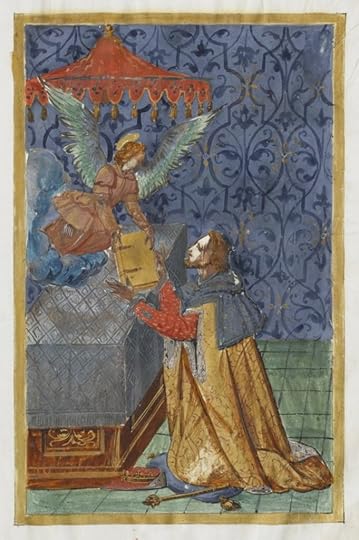 Frontispiece to a manuscript of the Ars notoria (BnF Latin 7153), ca. 15th century. — Source: https://gallica.bnf.fr/ark:/12148/btv1b52510827n/f5.item, public domain
The Ars Notoria is a curious treatise. Even though it was essentially a spell book, now called grimoires, it was said to be handed down from King Solomon, of Biblical fame, and the texts to be recited were identified as prayers. Even though the diagrams themselves were intrinsically magical, with symbolic patterns and symbols, interspersed with pseudo-“words”, faithful use of them would provide direct contact with benign supernatural forces — perhaps even with God.
So what were these diagrams?
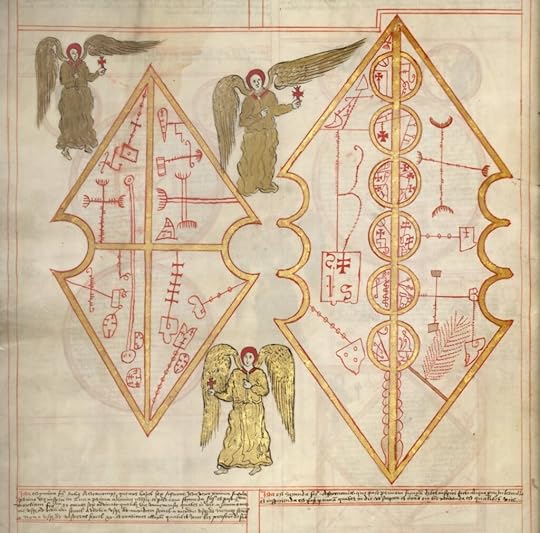 Two figures related to the art of astronomy from a manuscript of the Ars notoria (NLI Ms. Yah. Var. 34), ca. 1550–1600. — Source: https://www.nli.org.il/en/manuscripts/NNL_ALEPH990034835530205171/NLI#$FL5355234, public domain
They weren’t easy to use, to be sure. The Ars notoria reputedly operates in ways that couldn’t be understood by humans. In between texts to be recited as prayers (orations) and lists of mysterious words, the manuscript expounded on the origins and power of the contents Nor was it always clear in which order passages were to be used. Even the correct pronunciation of the names was up in the air – part of the first “prayer” reads: “Phos, Megale, Patir, Ymos, Ebel, Eber, Helioth, Gezei, Salatial, Sadim, Helgyo, Megis, Micton, Esel, Gecor, Granal, Semaranxai, Gelsemana, Arasamion, Sale, Patir, Agion, Atnas…”
Love it! I’m thinking I might steal some of these for my novels.
The mystery is typical of all so-called ‘mystery cults’ and magical systems throughout history: initiation was for the few and the arcane knowledge was surrounded by obfuscation. (If you’ve ever tried to read a software manual, you’ll know what I mean.) Alchemy was very much like that – its instructions were gobbled-gook unless you knew how to read their ‘code’. If you didn’t know that the Crow’s Head (Caput Corvi) represented the burnt or putrefied stage at the beginning of an alchemical distillation, or that the Red Man meant sulfur and the White Woman mercury, you were out of luck.
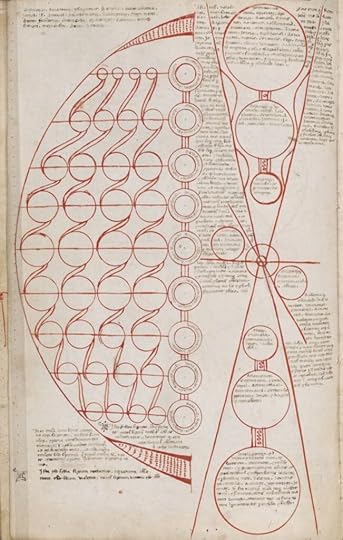 Figures and prayers related to the art of rhetoric from a manuscript of the Ars notoria (Mellon MS 142, f. 13v), ca. 1225 — https://collections.library.yale.edu/catalog/2037169, public domain
Each image was to be studied twelve times, solemnly and piously. Over the next twenty-seven days, more images were added, and those looked at twenty times, plus thirty recitations of the texts. On the final two days, all three figures were used, twelve times each, with thirty-seven recitations.
With such intensive study, first would come the acquisition of the gifts of memory, intelligence, and eloquence. After that boost to the brain power, the practitioner would move on to the “specials”, which were knowledge of the three fundamental arts of the university syllabus, or trivium: Grammar, Eloquence/Rhetoric and Dialectic.
The “specials” would progress into advanced subjects of study: Geometry, Mathematics, Medicine, Music, Philosophy and Theology. And somewhere in there one needed to recite the “triumphals” for eight days during a lunar month.
There was a schedule which followed the same lunar days in the liturgical calendar of the Church, and those used by astronomers – so far, nothing sinister about any of it.
But – and with magic there’s always a ‘but’ – some people felt that the rituals were so powerful they must be demonic. Brother John, an early fourteenth-century monk of the abbey of Morigny, seems to confirm that in his writings. He found his experiences while working with the Ars notoria terrifying, despite his intense, addictive attraction to the document.
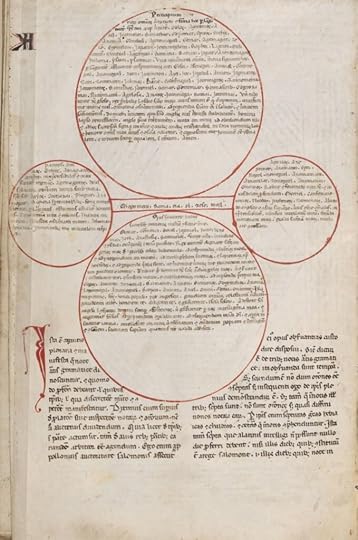 Figures and prayers related to the art of grammar from a manuscript of the Ars notoria (Mellon MS 142, f. 11v), ca. 1225 — https://collections.library.yale.edu/catalog/2037169, public domain
Read on, if you dare.
His journey to it began with a loaned copy of a book of necromancy, from a cleric whose identity he didn’t reveal. Not an auspicious start. Desiring to study more, he found a “medical expert” from Lombardy, who told him about the Ars notoria, and where he could find a copy – within the walls of the school at Orléans where John had been sent.
Such works of ritual magic were well known among the educated, even though they were considered dangerous, and were definitely not approved of. Yet Brother John went ahead with his dubious quest for knowledge, just as if he was in a horror story.
At first, he found the Ars notoria beautiful and holy. Like a lot of students, he couldn’t afford to buy all the books he needed, and jumped at the chance to save money and bypass the many lectures.
It seemed to offer miraculous gifts. He even used it to introduce his younger sister to magic.
But over time he felt it a work of the Devil, a “sick pleasure” that was actually poisonous to his soul. He began to have distressing visions, in which figures were demanding worship. Gradually it became clear to him that the beautiful prayers he’d been reciting were actually invocations to demons. Still, he was so drawn to the images that he persisted, only stopping altogether when the Virgin Mary, with St John the Evangelist as her intermediary, appeared and stated that, “the Ars notoria was deeply evil”.
St Thomas Aquinas condemned it specifically. He believed that its “signs” weren’t sent by God (as sacraments are), and thus were precisely the type of thing that lures humans into compacts with demons. Other major theologians at the time agreed with him. But it continued to copied and owned in religious institutions until the end of the medieval period, and it’s been translated (from the original Latin) and is currently in print.
Did John of Morigny learn his lesson from all his troubles? Not so much. He went back to studying necromancy, writing a new work of his own with thirty prayers that he believed would provide all that the Ars notoria had falsely promised. He also claimed to have been able to make the magical Rings of Solomon (said to grant absolute wisdom, the ability to speak with animals and complete command over demons, jinn, and spirits). Clearly, King Solomon is a very unusual and interesting character in himself, but we’ll save him for another blog post.
There’s an old saying that ‘cheaters never prosper’. Especially where magic is involved. So, if someone ever offers you a mysterious book that will make things easy for you: you have been warned.
August 4, 2026
Fae-ry Tales, Not so nice
But the old woman had only pretended to be friendly. She was a wicked witch who was lying in wait there for children. She had built her house of bread only in order to lure them to her, and if she captured one, she would kill him, cook him, and eat him; and for her that was a day to celebrate. – Hansel and Gretel, Grimm’s Fairy Tales
The original fairy tales weren’t all romance and happy endings. They were often cautionary tales.
Fairy tales, also known as wonder tales, are stories from folklore that feature enchantments and magic. Within them, fanciful beings – anything from elves, dwarves, gnomes, giants, witches and wizards, dragons, goblins and more – typically play tricks on less-than-wise humans. They’ve always been cautionary tales: it’s never wise to become involved with the Fae.
This isn’t a new trend in fairy stories at all – the earliest ones were grim and violent, and were aimed more at adults than children. The stories reimagined in more charming form by Disney, the ones collected by the Brothers Grimm and Hans Christian Andersen, originally featured child abandonment, cannibalism and dark punishments.
In the earliest version of Sleeping Beauty, Sun, Moon, and Taliaby Giambattista Basile, a lovely young lord’s daughter is struck down by a splinter of flax. The king, seeing her loveliness and believing she’s asleep, decides that he should have sex with her. While still unconscious, Talia gives birth to his twin children. Then, as if that hasn’t been bad enough, she’s nearly burned at the stake by the king’s jealous wife, who the king then consigns to the fire instead.
Not so cute a tale as the infamous Cottingley Fairies hoax, in which ‘photos’ of magical creatures swept 1920s England in an astounding fairy craze.
If you’re a fan of Sir Arthur Conan Doyle, you’ve probably heard of it. Two young cousins, Elsie Wright and Frances Griffiths, who lived in the village of Cottingley, took a series of five photographs that showed them playing with what looked like the classic notion of fairies: tiny, like miniature people but with wings, flitting about the garden.
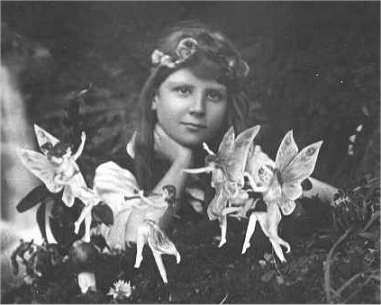 The first of the five photographs, taken by Elsie Wright in 1917, shows Frances Griffiths with the alleged fairies. By Elsie Wright (1901–1988) – Scan of photographs, PD-US, https://en.wikipedia.org/w/index.php?curid=18803979
It was a remarkably clever hoax. When Conan Doyle, who was already interested in the paranormal, became aware of the photos, he accepted their authenticity enthusiastically, and promoted them as clear evidence of supernatural phenomena. He even used them to illustrate an article on fairies he wrote for the Christmas 1920 edition of The Strand Magazine, where he’d already published his Sherlock Holmes stories to great acclaim.
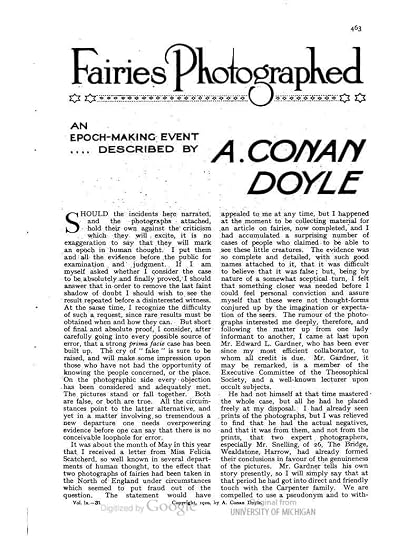 The first page of Doyle’s article in Strand Magazine. By Arthur Conan Doyle – https://archive.org/stream/TheStrandMagazineAnIllustratedMonthly/TheStrandMagazine1920bVol.LxJul-dec#page/n483/mode/2up, Public Domain, https://commons.wikimedia.org/w/index.php?curid=78367184
Elsie’s father was himself a keen amateur photographer, with his own darkroom. He immediately decided that her photos were “nothing but a prank”, and refused to lend the girls his camera any more. His wife Polly, though, believed the photographs were genuine, and eventually showed the photos at a meeting of the local Theosophical Society, a movement in the late 1800s that researched anything esoteric or magical. They were then shown at the society’s annual conference a few months later, and the story soared from there. Even other photographic ‘experts’ (a dubious claim in hindsight) pronounced the photos as authentic, including someone from the Kodak company.
The cousins stuck to their story even after they’d grown up and married. However, in 1978 magician and sceptic James Randi, along with a team from the Committee for the Scientific Investigation of Claims of the Paranormal, re-examined the photographs, using early computer enhancement, and concluded that the photographs were fakes – with strings supporting the ‘fairies’.
In 1983, Elsie and Frances admitted in an article published in the magazine The Unexplained that they’d faked the photos, although they wouldn’t abandon their story that they really had seen fairies. In a 1985 interview on the show Arthur C. Clarke’s World of Strange Powers, Elsie said that, after fooling the great Sir Arthur Conan Doyle, she and her cousin were too embarrassed to admit the truth. But they clearly understood human nature very well: Frances added: “I never even thought of it as being a fraud – it was just Elsie and I having a bit of fun and I can’t understand to this day why they were taken in – they wanted to be taken in.”
‘They wanted to be taken in.’ How true. Even in absentia, fairies cast their enchantments over humans.
What are fairies, actually?
Such magical creatures are found in many different folklores, but our Western idea comes largely from the Celtic version – a supernatural race said to be or have descended from the gods of Irish mythology, the Tuatha Dé Danann. They were said to dwell in “shees”, “fairy mounds” or “hollow hills”. Portals to an Otherworld.
And they weren’t nice. There were recurring legends about the need to ward off fairies with protective charms. These included things like four-leaf clovers, and food. Fairies were also believed to haunt specific locations and to lead travelers astray, and were often blamed for sickness.
So when we modern writers paint the Fae as nasty creatures, if seductive, we’re following a very old tradition.
Those in my novels are dangerous – bored because their realm is more static than ours, over centuries upon centuries, which has turned them into manipulative thrill-seekers. They particularly like to seduce humans, when they can get them, and play twisted games. Much of what they do is outside our understanding.
Some of the Fae have become fed up with all of that turmoil, and have chosen to live with humans. Their brethren dismissively call them the Dark Fae, as they now live ‘outside the Light’, even though the real darkness is within Tir na nÓg.
You’ll find out more about them in The Summer Door, coming this October. For insider info and sneak peeks into my next novel, subscribe to my monthly newsletter (no paywall) using the pop-up on this site!
July 28, 2026
Curses on stupid scam attempts
I’ve been searching for a curse to banish all stupid scam emails.
I realize they go with the territory, i.e. being an author with an online presence, but seriously:
a) How stupid do these people think we are?!
b) Find something constructive to do, for the love of god!!!
Every day I receive up to a dozen scam emails. They frequently address me as “Dear Roads”. My name IS NOT “ROADS”! I have a name. At the very least, these bozos could take the trouble to learn it.
Usually they refer to “your book”, which they’ve discovered and are all excited about. I’ve written three books so far. Perhaps they could enlighten me as to which one?
Sometimes they jump in at my third novel, Out of Time. They then proceed to give me a general synopsis of the plot, as if that’s going to convince me that they’ve read it. They think it’s wonderful. I wonder how they’ve figured out what’s going on, as it wouldn’t make much sense without having read the first two novels. Nevertheless, they want to promote the heck out of it, introduce it to the 2000 readers in their book club, or the 10000 contacts they have on Amazon, or shop it out for a movie, blah blah blah.
Of course, this would just require a modest fee of $200 or so. But for that, they could guarantee amazing success.
Uh huh.
The queries are often just inane.
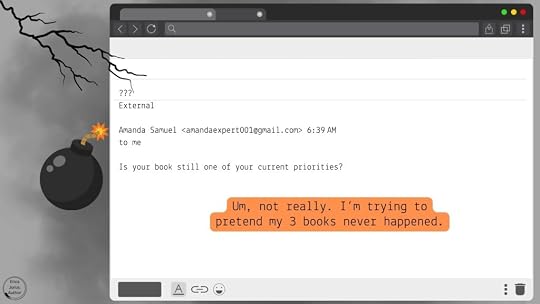
Other times they take the curious approach of being insulting.
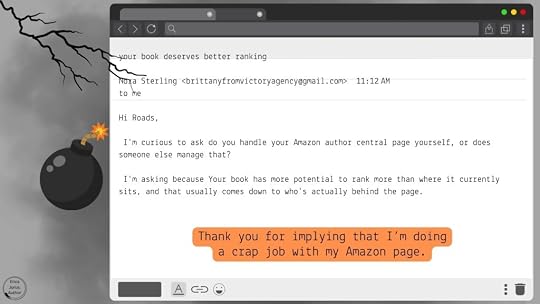
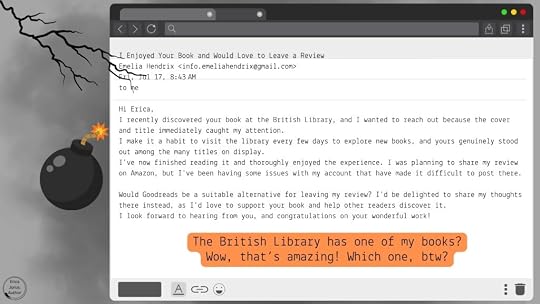
Nevertheless, despite the poor job I’m doing, I was delightfully surprised to hear that someone found my book in the British Library. That’s quite a coup for me. Clearly the supernatural was involved, as my book was magically transported 3500+ miles. But I like to keep an open mind about these things.
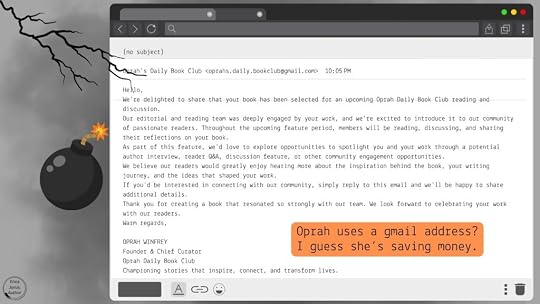
Recently I heard from Oprah. I’m so happy she’s really interested in my book, although I’m surprised she uses a ‘gmail’ address.
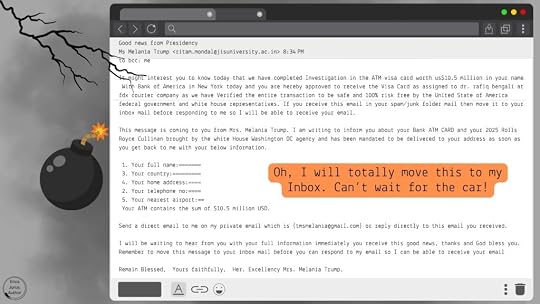
Also, I was thrilled to hear from Melania Trump, aka Rita M. Mondal. It seems that scammers don’t expect us to actually look at the faux-mail address they’re using.
I also got an email from Gwyneth Paltrow. And James Patterson, who wants to know if I’m still writing. He’s also using Gmail (writer.jpatterson.profile@gmail.com) – I guess you don’t become a multi-millionaire without cutting some corners.
With Elon Musk and Prince William following me on Instagram, I think I could put together a marvelous tea party. Something along the lines of the Algonquin Round Table, and I could be Dorothy Parker’s sarcastic successor.

I really love this one. It’s supposedly from the “Author Credibility Society”, but features just a marginally bogus sender address.
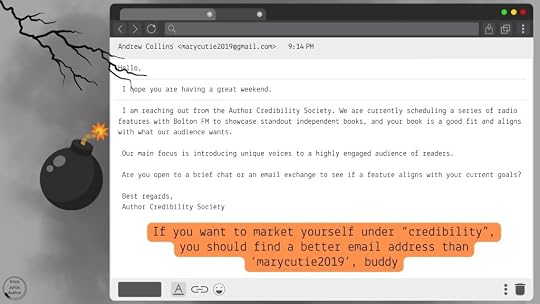
All authors receive this garbage. It’s incredibly annoying, even though it all gets redirected to my Spam box. All of it. I haven’t received a genuine contact yet. Some day, I’d like to.
In the meantime, I guess I’ll keep looking for a good curse.