Erica Jurus's Blog
April 21, 2026
What lurks in the fog?
Fog: “a weather condition in which very small drops of water come together to form a thick cloud close to the land or sea, making it difficult to see” Cambridge Dictionary
Not long after I graduated from university, I worked on a funded project at a horticultural research station that happened to be located not far from a lake. One day I had to go over to the experimental building to check on something I can’t recall other than that it required a wrench. The quickest way to get there was through the rose garden. A thick fog had rolled in, so here I was, trudging through the rose paths and swinging a heavy wrench.
I was thoroughly enjoying the walk, and for some reason it reminded me of Monty Python and the Holy Grail, one scene in particular. So I found myself tolling the wrench like a medieval bell and crying, “Bring out your dead, bring out your dead,” in a British accent.
Luckily the fog was so dense that it obscured the sound, and no one ever noticed my few minutes of atmospheric silliness, although I still snicker about it years later
The point is that fog lends itself to flights of the imagination. It shrouds the world in mystery, hiding a criminal’s dark doings, or ghostly pirates, or slithering monsters. It’s a gift not only to Halloween party planners but also to writers and countless film-makers.
And it just looks really cool.
Except when you’re trying to drive through it and can’t see past a few yards. During that same work term, I ran into a heavy bank of it on the morning highway, and narrowly avoided a 44-car pileup. I was one of only a handful of employees who made it in to work that day.
Fog obscures reality. It stretches the boundaries of what’s outside our window – there could be anything out there that we don’t know about.
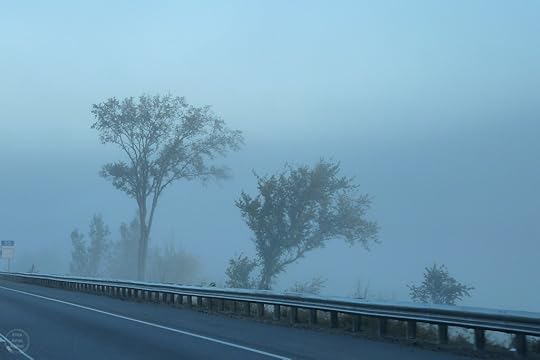 Fog on a road trip one autumn; photo by E. Jurus, all rights reserved
Did you know that fog is basically a cloud down along the ground? While it’s composed of condensed water vapor, it will only form when the air contains pollutants like dust. The vapour then forms tiny droplets around these minute solid particles. Sea fog forms when vapour condenses around bits of salt, for example.
The air must be very humid for fog to form, so it’s a natural around lakes and oceans. But why did my hubby and I drive into a wide blanket of it on top of the Niagara Escarpment the other day? It was glorious, to be sure, and not so bad that we couldn’t see the road, but it seemed so odd when we’d climbed around six hundred feet above all the large lakes in the area. However, there’d been a lot of rain in previous days, and it was still strewn across most of the fields in vast puddles. A temperature inversion could have gathered up the humidity and played with it.
Grand Banks off the coast of Newfoundland is the foggiest place in the world. There the warm Gulf Stream from the Atlantic Ocean collides with the cold Labrador Current, creating almost daily dense fog. Watch this video by Andrew Perry, “Fog rolling over Long Range Mountains in Lark Harbour Newfoundland”, (click on the screenshot below) for a scene that looks like it climbed straight out of a Stephen King novel.
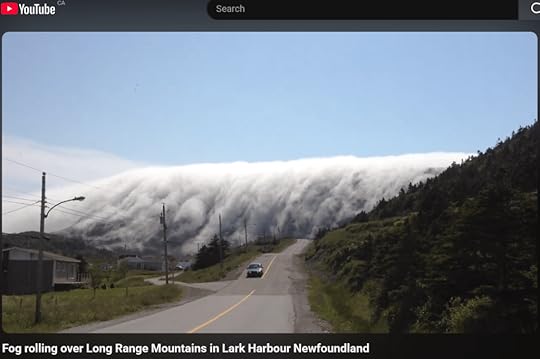 Fog rolling over Long Range Mountains in Lark Harbour Newfoundland, posted oh YouTube by Andrew Perry https://www.youtube.com/watch?v=xhndDBfMAg0
When a writer or a film-maker injects fog into a story, it usually means that something creepy is afoot. I’ve used it myself, since I write paranormal thrillers. In fact, whenever a Gate to one of the metaphysical Roads in my novels activates, it generates mist as the environments outside and inside the Gate’s event horizon meet.
Fog works really well to create a sense of unease. It tends to isolate people into their own small pocket of visibility. It deadens sound. And it obscures whatever may be beyond. All of these factors can create disorientation, distrust, fright. It’s perfect for horror movies.
Fog has a respectable pedigree in films. In quite a few, it’s a major character in its own right. Stephen King’s horror novella The Mist features a strange fog enveloping a small town, trapping quite a few residents inside a grocery store as it descends. Any who try to escape vanish screaming. King plays out an interesting scenario as the residents panic and a religious zealot tries to convince them that the mist is God’s vengeance for their sins – requiring a sacrifice. The movie version is eerily effective as the fog rolls in, slowly and ominously.
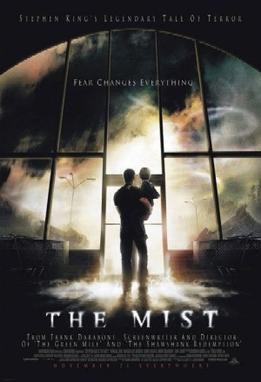 Theatrical release poster By IMP Awards / 2007 Movie Poster Gallery / The Mist Poster (#1 of 4), Fair use, https://en.wikipedia.org/w/index.php?curid=12530561
Another movie that made great use of fog as a harbinger of doom was John Carpenter’s The Fog (1980). In it, a mysterious, glowing fog creeps in from the sea to take over another small town. The movie was a relatively low-budget production, but used dark settings and the desolation of the town to great effect.
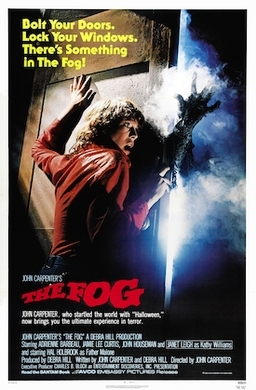 Theatrical release poster By Avco Embassy Pictures/ Debra Hill – This image can be obtained anywhere online or directly from the film’s initial distributors. This particular image was taken from the internet, at: https://www.imdb.com/title/tt0080749/, Fair use, https://en.wikipedia.org/w/index.php?curid=48724378
A much earlier British film called The City of the Dead (Horror Hotel in the United States) shrouded a small Massachusetts town (it’s always the small towns that disappear into the fog, isn’t it) as a young college student comes to research witchcraft on the advice of her professor, played by the almost-always sinister Christopher Lee. The fog conceals the town’s sins, as the student discovers during her investigations.
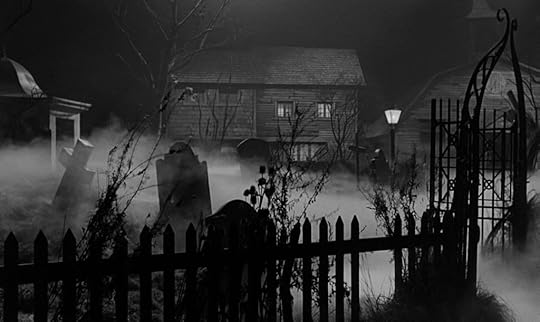 Screenshot of one of the movie stills from City of the Dead on IMDB (source: https://www.imdb.com/title/tt0053719/?ref_=nv_sr_srsg_2_tt_4_nm_4_in_0_q_city%20of%20the%20dead)
And of course, there’s The Haunted Palace. , the film made by Roger Corman of H.P. Lovecraft’s novel, The Case of Charles Dexter Ward. With Vincent Price and another creepy seaside Massachusetts village that exudes fog, how can anything but disaster befall? (See my previous blog post, The Lovecraft Legacy, for more info about author Lovecraft’s enduring influence on books and film.)
My hubby and I love visiting haunted attractions in October (well, mostly me), and of course they all use fog for effect. It’s one of the easiest ways to create a spooky atmosphere throughout a large area. Several years ago we arrived at Busch Gardens in Virginia mid-afternoon to walk around and get our bearings, but we were really there for the fantastic evening event, Howl-o-Scream. We had a delicious dinner, and as dusk fell fog began to arise from behind bushes, until the place resembled a horror movie. Lanterns glowed eerily as we wandered through the mists to enjoy the night’s haunted entertainments. So much fun!
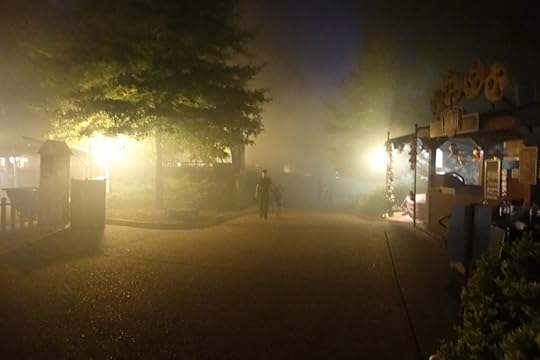 Busch Gardens, Virginia, filled with fog on an October night. Photo by E. Jurus, all rights reserved.
I definitely recommend Howl-o-Scream for an autumn visit some time. It’s more edgy than Disney, but still fun enough for kids, and, at least when we were there, there was only a single, reasonable ticket price for the entire day. (At the present time the theme park hasn’t posted 2026 info.)
During this time of Halfoween, as we approach the exact opposite point on the calendar (known as Walpurgis Nacht, the night of the year when it was believed that witches celebrated a sabbath and evil powers were at their strongest), I’ve provided you with more ideas on how to ward off the evil by the light of your reading lamp or your television  Make some tea or hot chocolate, pull up a chair, and get to it!
And no, I’m not going to tell you what’s in the fog. You must find out for yourself.
Writing is like driving at night in the fog. You can only see as far as your headlights, but you can make the whole trip that way. E. L. Doctorow


April 14, 2026
Creating cursed places – inspiration from Dark Shadows
“If I could speak the language of rabbits, they would be amazed, and I would be their king. I would be kind to my rabbit subjects. At first.” Rajesh Koothrappali, Big Bang Theory
Have you ever played a Simulator game? One where you create a community, placing homes, stores, a hospital, a flower shop, and so on, wherever you feel they should go?
If you have, if you’ve enjoyed your god-like powers to shape your community in whatever way pleases you, you’ll understand a little of what it’s like being a fiction writer. Especially someone who writes fantasy or paranormal stories.
Many authors create a ‘community’ that our protagonist lives in, and where the action takes place. Cabot Cove in the Murder She Wrote television series (a ‘cozy’ town that I certainly wouldn’t want to live in, because everybody gets murdered!), or Kembleford in the Father Brown television series, are classic examples.
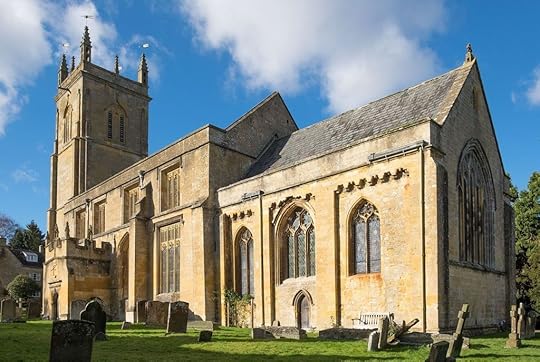 Father Brown’s church in Kembleford, better known as St. Peter and St. Paul in the real town of Blockley; source: By DeFacto – Own work, CC BY-SA 4.0, https://commons.wikimedia.org/w/index.php?curid=55884080
 I’ve done the same with my town of Llithfaen. It was interesting to make up a town that sits on three ley lines and is prone to hauntings and other weird things, together with a small college where courses in esoteric subjects are taught and there’s a library with a restricted floor that houses a collection of amazing ancient artifacts.
My imaginary town has to follow some rules, though. It must have streets and homes, and shops and services that sustain its residents, such as a hospital where the physicians are used to some very strange cases. There’s a library with an unusual window with an Egyptian motif, a carousel that could fill your nightmares, and a bookstore that I quite literally dreamt about for years and finally brought to life in my novels. (More about that in another post!)
Atmosphere is critical in paranormal and horror novels, of course. My town of Llithfaen was founded by Brother Domitian, a travelling monk from Wales who’d had something of a classical education. His legacy appears in many of the later place names, such as Hermes Square, Demeter Street, and Aenon Cemetery. And because he grew up in medieval Wales, there are numerous stone-walled passageways around the rabbit-warren of streets in the centre of town.
All places evolve, even small towns. Later additions to the town, such as the railroad tracks and train station, added an industrial flavour, along with the Winchester Tile Factory. After the trains no longer traversed such a remote community and the factory shut down, it transformed into a modern condo building that Rad Enkara, the college’s archeology professor, lives in. Several retired train cars were repurposed as the Hobo Lounge restaurant out in the woods east of Grey Marsh.
The surrounding waters add a murky marine atmosphere, especially the Marsh, where nothing lives except the nasty green Wraiths. The marina on the Acheron River adjacent to Chimera Park is a bustling place on warm spring and summer days, but the old Carrigan Boatworks on the other side of the bridge have been closed up ever since a destructive attack by a mysterious monster decades ago.
It’s not as easy as you might think to fashion an entire town, but it is fun.
I created an informal map in PowerPoint, which I’m very familiar with, so that I could lay out everything that had to fit within the parameters of that little pocket of weirdness. It allowed me to be consistent in my novels, and also to plot the action in various scenes that move around the town.
And when my beta readers asked for the map of the town, and of the college campus, to be included in the books, I was gratified that they were so interested in the details of what I’d created.
All writers have influences, and I mentioned one of my largest last week: H.P. Lovecraft. The alternate version of New England that he wrote was so powerful that, like the Sherlock Holmes stories, many readers became convinced that it was real. I think that’s what every writer hopes for, to have that kind of impact.
Lovecraft created his own weird town, Arkham, and even sketched out a map for reference. Thirty years later, my single greatest influence, heavily impacted in its own turn by Lovecraft’s writing, was the first supernatural soap opera, Dark Shadows, set in the eerie town of Collinsport. To this day, I have a thing for the ambience of towns and villages near water.
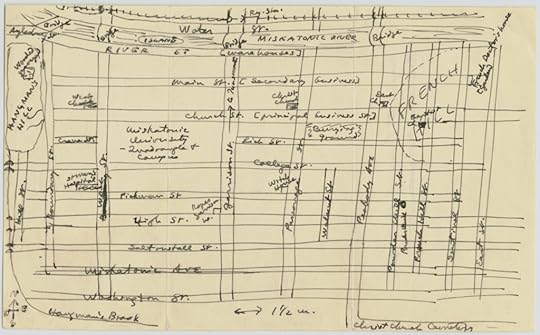 H. P. Lovecraft’s personal map of Arkham, Massachusetts. Source: By H. P. Lovecraft – https://repository.library.brown.edu/studio/item/bdr:927157/, Public Domain, https://commons.wikimedia.org/w/index.php?curid=110340050
 If you’ve only ever seen Tim Burton’s movie version, for the love of all that’s unholy, don’t go by that – it doesn’t represent the original series well at all. (Sorry Tim, but I’m afraid the comedic approach didn’t work.)
I still remember the first day my brother and I came across Dark Shadows on the telly, and the intro of dark crashing waves and eerie theme music began to play, segueing into an image of the Collinwood Mansion shrouded in fog. Whenever we watched each episode, that intro catapulted us into the strange world of the soap as we waited impatiently to find out what was going to happen next.
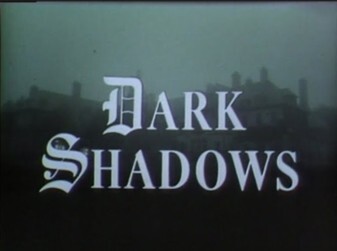 Dark Shadows intro – click on image to see the video on YouTube
Dark Shadows aired weekdays on the ABC network from June 27, 1966, to April 2, 1971. The show centred around the lives and tribulations of the wealthy but rather cursed Collins family of a town in Maine named after them. It was originally supposed to be a largely gothic family saga, but wasn’t doing well enough in the ratings, so the writers began introducing a few supernatural elements, and that transmuted the entire show into something dark, dangerous and exciting.
The tortured family vampire, 175-year-old Barnabas Collins, who was accidentally released from his coffin partway into the first season, made the show a cult hit for the ages. Barnabas was played by a little-known Canadian actor, Jonathan Frid, who, although not conventionally good-looking, captured his character’s angst and menace so well that he became the unlikely romantic hero of the show.
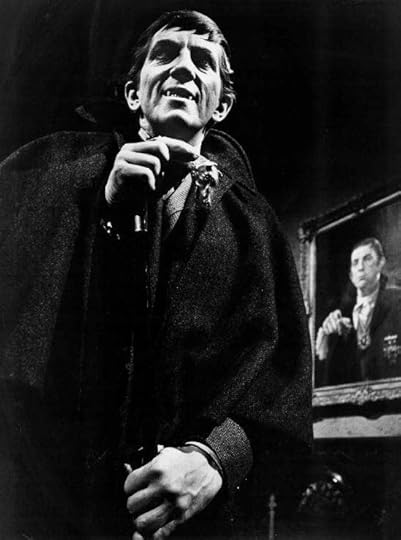 Photo of Jonathan Frid as Barnabas Collins from the daytime drama Dark Shadows. By ABC Television – eBay itemphoto frontphoto back, Public Domain, https://commons.wikimedia.org/w/index.php?curid=22444685
The supernatural focus then became the main driver of the plots on the show, exploring ghosts, werewolves, witches and warlocks, time travel and many other ideas cribbed from classic horror stories.
The town of Collinsport provided so much atmosphere for the series. Every great story has an intensely evocative setting, and it was certainly so on Dark Shadows.
It all begins with Victoria Winters, an orphan who journeys by train to the mysterious town of Collinsport, Maine, to unravel the mysteries of her past. Her employer is Elizabeth Collins Stoddard (played by veteran actress Joan Bennett with great gravitas), who lives in an enormous gothic mansion overlooking the sea. Elizabeth’s brother, Roger Collins, a widower, also lives in the house with his troubled son David, as well as Elizabeth’s headstrong daughter Carolyn Stoddard, and a rather grim-looking housekeeper.
Julia Hoffman is the local doctor who earnestly but annoyingly meddles in everything. Willie Loomis is the hapless groundskeeper who, searching for treasure, lets ancestor Barnabas Collins out of his coffin to terrorize Collinsport. Many other characters make regular appearances in their places of business or as victims of the curse that seems to afflict both the Collins family and their town.
Collinwood Mansion is the main setting. The huge Carey Mansion in Newport, Rhode Island was used for the intro, as Collinwood contains over 40 rooms, although, like the gothic novel Rebecca by Daphne du Maurier, many of them are closed off in more modern times. As in any good gothic mansion, there are also secret passageways, rooms that alter depending on who enters them, and a time-traveling stairway.
Because of all the rumours about the mansion, most of Collinsport’s residents are afraid to even drive by it.
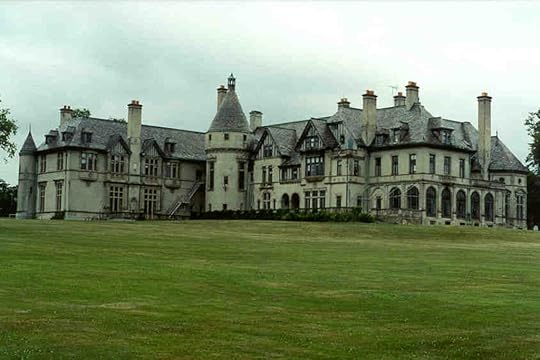 Collinwood, as represented in the original show by Seaview Terrace (later known as Carey Mansion) in Newport, Rhode Island; source: By Jim McCullars MccullarsJ – Own work (Original text: self-made), CC BY 2.5, https://commons.wikimedia.org/w/index.php?curid=40042966
Although most of the action takes place in the large foyer, where an imposing portrait of Barnabas Collins hangs, its grand staircase, and the sitting room with big windows, a massive fireplace and a dry bar with crystal decanters so that everyone can pop back much-needed liquors after all the peculiar things that happen, the rest of the mansion is fully fleshed out. We also see the garden terrace and various parts of the grounds where people are usually running in fear, as well as the original mansion on the estate, into which Barnabas, now posing as his own descendant newly arrived from the U.K., moves into.
I think Dark Shadows was unique not only in its premise but also in how much it spread the plots not only through the weird mansion but also to many parts of the town.
The Collinsport Inn is a three-story inn located on the main street. A tavern called the Blue Whale is a regular haunt for the town, and for Carolyn Stoddard when she’s feeling rebellious. It’s famous for some of the very best seafood in the area. Braithwaite & Sons are the local jewelers and silversmiths, one of whom was portrayed by a pre-Barney Miller Abe Vigoda. In fact, quite a few early actors in this series went on to achieve later fame, so it’s fun to pick them out while watching.
There’s a department store, general store, hospital, Eagle Hill Cemetery (where Barnabas was entombed), a beach called Lookout Point, fog-filled alleyways where Barnabas attacks his victims, and so much more.
One shop that became my favourite place in the series is a cozy antique store owned by Philip and Megan Todd. In the ‘Leviathans’ plot line, which embroiled many of the residents of Collinwood and Collinsport in a scenario inspired directly by H.P. Lovecraft’s Elder Gods mythos, the baby monster is taken in by the Todds and housed in a locked room above the shop, where it goes through increasingly older iterations until finally the adult creature manifests as the dangerously attractive Jeb Hawkes. Jeb becomes obsessed with beautiful Carolyn as soon as he lays eyes on her, and decides to change the rules so that he can have her. We never see Jeb’s true form as the Leviathan, only hear its terrifying breathing behind the old wooden door in the antique shop.
I’ve read that the Leviathan plot line wasn’t very popular, but my brother, mother (she got hooked on the show as well) and I loved it – so twisty and romantic.
Dark Shadows was filmed live, so there were no retakes if the props malfunctioned or an actor fumbled their lines (which happened quite often, although they were all adept at covering their slip-ups). The special effects of ghostly manifestations, witchy powers, horrifying dreams and the like look very dated now, but the show was powerfully effective at the time and has a dedicated fan base to this day.
In many ways, the town of Llithfaen is my equivalent to Collinsport, with the Wychwood estate subbing in for Collinwood. It’s been a pure delight to pay homage to my beloved old TV series, which gave me so much joy when I was younger so that I could pass that along to all of my readers.
I chose to avoid the gothic or Victorian clichés for my creepy mansion, Wychwood. On one of our road trips I came across a mansion in Ontario that was white in colour but just had a certain ‘look’ to it, which I described in book one of the trilogy. I’m not going to reveal where it is, so that the owners never get any fans trying to see it personally.
My hubby and I visited one of the Dark Shadows locations, from one of the companion movies. The estate is called Lyndhurst, in the Hudson River Valley in NY State. We couldn’t take photos inside, but I here’s an external shot for you. Some day I’d love to go to the Carey Mansion, even just to see the outside, which was so iconic in the original series.
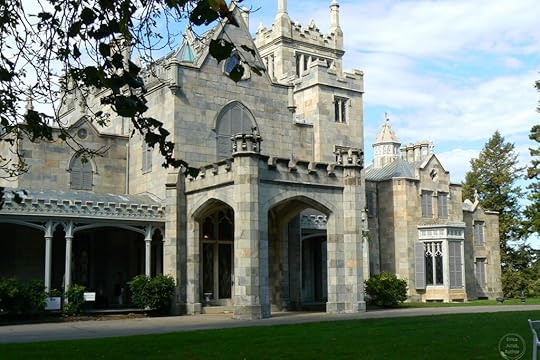 Lyndhurst Mansion, Tarrytown, NY – photo by E. Jurus, all rights reserved
For those of you who’ve finished the Chaos Roads trilogy, there will be more to come about uncanny Llithfaen this fall in my next novel, The Summer Door, wherein another resident of Llithfaen becomes involved in a dark and baleful romance of her own.
Follow my Instagram feed for periodic updates, and subscribe to my newsletter here on this website for exclusive details.
April 7, 2026
The Lovecraft Legacy
“…he had had an unprecedented dream of great Cyclopean cities of Titan blocks and sky-flung monoliths, all dripping with green ooze and sinister with latent horror.”
The Call of Cthulhu, H.P. Lovecraft
We’re going to begin April/Halfoween with a creeping whisper rather than a bang.
There are authors who’ve created such an mesmerizing world that it grabs hold of our collective conscious and won’t let go. We have J.R.R. Tolkien and Lewis Carroll and A.A. Milne, who wrote what we’d now call ‘cozy’ fantasies, and then we have H.P. Lovecraft, who produced from his tortured imagination a mythos of ancient, dreadful cosmic gods that contemporary and later authors felt compelled to add on to long before that became a ‘thing’.
The “Great Old Ones” are gods from space who’ve existed since Earth began, having the ability to travel between planets, and once ruled ours. Since then, they’ve fallen into in a deathlike sleep, but they’re not truly dead, and have the ability to influence our minds and dreams. They’re said to know everything happening in the universe.
[image error]An artist’s visual representation of Cthulhu; By Dominique Signoret (signodom.club.fr), CC BY-SA 3.0, https://commons.wikimedia.org/w/index.php?curid=1003104They exist outside of normal space-time, and live inside the Earth, deep in the sea, and in other dimensions. Although they attract and are worshipped by crazed cults, anyone who sees their natural form is driven incurably mad.
Then there are the lesser gods, the “Great Ones” (not actually very great), who once lived on the world’s mountain peaks, but were driven off by the spread of humanity and had to leave Earth entirely.
This is a fairly dry-ish listing that doesn’t evoke the subtle, insidious horror of Lovecraft’s writing. He places the extraordinary among the ordinary, so that we can imagine ourselves in the shoes of the troubled protagonists/victims, trying desperately to survive.
Lovecraft’s own background could have been the basis for a horror story. Both of his parents ended up institutionalized, which perhaps gave him the idea of cosmic-induced insanity. As a child he also suffered from night terrors and vivid dreams involving shadowy creatures he called “Night Gaunts”.
Fortunately, his grandfather liked to tell him stories, and his childhood home had a large library that contained classical literature, scientific works, and early ‘weird fiction’. That’s not just a descriptor – it’s a subgenre of speculative fiction that originated in the late 19th and early 20th centuries. Author China Miéville defines it as “usually, roughly, conceived of as a rather breathless and generically slippery macabre fiction, a dark fantastic (‘horror’ plus ‘fantasy’) often featuring nontraditional alien monsters (thus plus ‘science fiction’)”.
Later on, Lovecraft cited Edgar Allan Poe as the first author of weird fiction, as in a type of supernatural fiction different from traditional Gothic literature, and Poe was himself a major source of inspiration for Lovecraft.
I think the appeal of weird fiction is how far it colours outside the lines. Lovecraft imagined a universe populated by vast monsters that would happily squash us like bugs, unless they could manipulate us into worshipping them in horrendously twisted ways. And that was the only way to survive knowledge of these alien gods without, or perhaps because of, losing one’s mind. Each story featured mysterious happenings and forbidden knowledge, always an intriguing combination.
He created a recurrently eerie setting: a warped version of New England, centering around the strange town of Arkham in Massachusetts, somewhere north of Boston, and its…unconventional educational institution, MIskatonic University. The countryside was populated with eerie towns like Dunwich and Innsmouth that reflected his own views of New England as a grim place with mysterious backwoods and abandoned farmhouses. To visit any of these places was to court doom, either from the abnormal inhabitants or the monsters they invited.
[image error]Pays de Lovecraft — Wikipédia; Carte détaillée des lieux associés au pays de Lovecraft, à la fois réels et imaginaires, sur la côte du comté d’Essex au Massachusetts. Par Hoodinski — Travail personnel, CC BY-SA 3.0, https://commons.wikimedia.org/w/index.php?curid=15255916On top of that, Miskatonic U’s library was known for its collection of occult books (of course). It also housed one of the few genuine copies of the Necronomicon, a forbidden textbook of magic that contained an account of the Old Ones (the alien god-monsters), their history, and the means for summoning them. And there were plenty of people who wanted to get their hands on it.
Lovecraft said that the title came to him in a dream, and it was a creation that so captured the imagination that a lot of people thought the book wasn’t fictional. He felt guilty when he heard of fans searching libraries for copies of it (the Vatican regularly gets requests from people who believe it has a copy). He always felt that a well-written weird story should be believable in its own way, and wrote about the Necronomicon in several stories as ‘first-hand testimonials’. He also allowed other authors to build on the universe he created with additional stories and references to the book, creating “a background of evil verisimilitude”.
The verisimilitude clearly worked, as many contemporary writers of his, such as August Derleth, and succeeding creators, from writers to filmmakers, have either produced his novels as movies (live and animated), or homages to them.
I’m not certain when I began reading Lovecraft’s works, but I certainly noticed his influence in my favourite television show ever, the original Dark Shadows. His imprint was all over the cursed Collins family and the spooky coastal fishing town they founded, Collinsport. The descendants of Isaac Collins all lived in a magnificently creepy mansion, a forty-room edifice built in 1795 near Widows’ Hill. Collinsport was a fully-realized town in the series, with places like the Blue Whale tavern and Todds’ Antique Shop. The antique shop became the centrepiece of a storyline about the Leviathans, a race of beings who ruled the Earth before mankind came into existence, with hideous and inhuman true forms. Sound familiar? Creator Dan Curtis produced something remarkable for the era, the first horror TV series. He took inspiration from all legends and stories – vampires, werewolves, witches, Jekyll & Hyde – but for me the Leviathan cycle was the best of all.
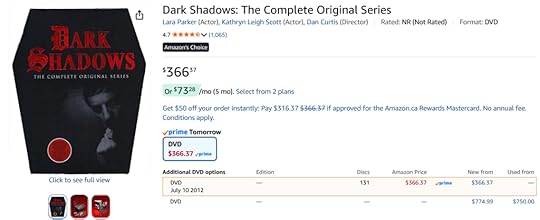 I have the complete original series on dvd, and yes, it comes in a coffin-shaped box. Screenshot from Amazon.ca.
You’ll be familiar with some very well-known modern artists who cite Lovecraft as inspiration – writers Stephen King and Neil Gaiman, filmmakers John Carpenter, Roger Corman and Guillermo del Toro.
H.P. Lovecraft has many detractors for his sometimes virulent personal and political views, with deep prejudices against non-white races. But there was just something so potent about his stories that fans, while wrestling with his persona, continue to enjoy the universe he created.
If you’re already a fan, then you’re likely aware of the many tributes to his work, from movies to board games.
If you need an introduction, I can recommend a terrific vintage horror movie I was delighted to stumble across a couple of weeks ago, The Haunted Palace. Directed by Roger Corman in 1963, as a matter of fact.
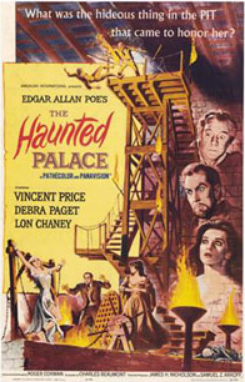 The Haunted Palace movie poster; By The poster art can or could be obtained from American International Pictures., Fair use, https://en.wikipedia.org/w/index.php?curid=11400468
It’s a marvellously eerie movie set in the seaside town of Arkham, filled with mists and cobblestones. We first see it in 1765, when the inhabitants believe that a grand “palace” overlooking the town is owned by Joseph Curwen (played by the wonderful Vincent Price), is a warlock who’s responsible for young maidens disappearing. They capture and burn him at the stake, but he curses the town and vows revenge. 110 years later, Curwen’s great-great-grandson, Charles Dexter Ward, and his wife Anne, have inherited the palace. When they arrive in Arkham, they find a town full of deformed people who are very hostile. When they finally arrive at the palace, Charles is surprised by struck by his strong resemblance to his ancestor, via a portrait on the wall, and how well he seems to know the palace despite never having been there.
I won’t spoil anything for you. The movie is based on Lovecraft’s story titled The Case of Charles Dexter Ward.
There are far too many Lovecraft-referenced works to mention here. But I’ll give you a few fun ones.
In 1991 a movie called Cast a Deadly Spell featured a hard-boiled detective named Lovecraft who lives in an alternate reality where magic is accepted and practiced openly. Lovecraft has, for reasons of his own which we discover to the follow-up movie Witch Hunt, given up using magic, but still must navigate a dastardly plot to find and use – you may have guessed it – the Necronomicon. The movies are both campy fun if you want to watch a pair of light horror movies.
[image error]In the popular vein of piggybacking on existing stories/characters, author James Lovegrove has written a series of books called The Cthulhu Casebooks, in which he pits Sherlock Holmes and Dr. Watson against the world of Lovecraft’s monsters. The first in the series is called Sherlock Holmes and the Shadwell Shadows. They’re an entertaining addition to the enduring alternate world that H.P. Lovecraft created a century ago, and there are other completely separate novels as well.
There are a variety of board games set in the Lovecraft universe. I’ve obtained a copy of one called Elder Sign for myself.
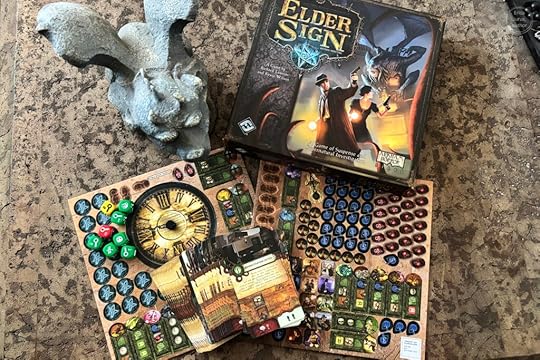 The Elder Sign board/card game, waiting for me to try it out – photo by author, all rights reserved
It’s promoted as a good introductory game, although I’ve been so busy I haven’t had time to actually play it yet (or give you a review). The maker’s description sounds like fun, though:
It is 1926, and the museum’s extensive collection of exotic curios and occult artifacts poses a threat to the barriers between our world and the elder evils lurking between dimensions. Gates to the beyond begin to leak open, and terrifying creatures of increasing strength steal through them. Animals, the mad, and those of more susceptible minds are driven to desperation by the supernatural forces the portals unleash. Only a handful of investigators race against time to locate the eldritch symbols necessary to seal the portals forever. Only they can stop the Ancient One beyond from finding its way to Earth and reducing humanity to cinders.
I do also have the Monopoly: Cthulhu game. It sounded promising, and I played it with friends who were familiar with the Lovecraft world, but we petered out after a while. Interestingly, it no longer appears to be available on Amazon. The Boardgame Geek website gives it a 5.5 rating out of 10.
Well, I’ve offered you a number of ways to dive into the Lovecraft canon, if you’d like to see what all the fuss is about. Let me know which ideas you try out, and if you’re already a fan, I’d love to hear your thoughts about any of this, because you’ll find the same influence throughout my Chaos Roads Trilogy.
Happy start to Halfoween month!
March 31, 2026
April fun in a crazy world
Why are you looking at a graphic of Halloween stuff above?
Because I don’t know about you, but I’ve had enough of the world at the moment!
It’s finally Spring, and I want to have some fun after a long and stressful winter.
April is “Halfway to Halloween” month – also known as Halfoween. Thanks to the legions of fans of our coolest October holiday, this pre-celebration six months ahead of time is steadily growing in popularity. I follow someone on Instagram who lives in a town I’d like to live in, Sleepy Hollow, NY, and it’s probably no surprise that the town goes all out for Halfoween. Wish hubby and I could drive down there and join them, but we can’t due to some of the craziness I’m trying to ignore for the coming month.
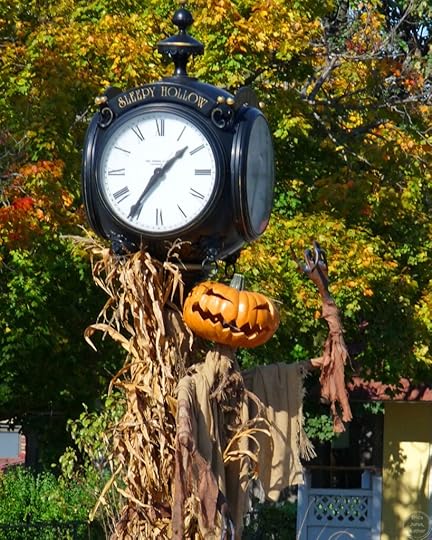 Sleepy Hollow town clock in autumn – photo by author, all rights reserved
I’ve been a fan of Halloween from childhood. October 31 was the best night of the year, for several reasons.
Dressing up as someone from the movies! My mom who was happy to help me make costumes, rejigged from a trunk of old clothing and what few props we could buy at the time.Going out after dark without your parents. This gave a certain edge to the night, because there were a few houses in the neighbourhood whose owner we didn’t know, and that looked a little creepy lit only by streetlight.To this day, I still feel there’s nothing better than walking under the stars from one jack o’lantern-lit porch to another, with a chill in the air and leaves underfoot.Bringing home sacks of candy, and we were allowed to eat as much as we wanted. There was even one house that gave out big popcorn balls, and a hair salon that handed out candy apples. I mean, how much better could things get?As I grew older, I began holding Halloween parties instead, and those were almost as much fun. In fact, most of my fondest memories from childhood revolve around the Halloween season. I love the classic colour combo of orange and black, and all variations thereof. I love the creepy music. I love vintage horror movies. Halloween decorations (not gory, just fun) always bring a smile to my face.
So Halfoween is right up my alley!
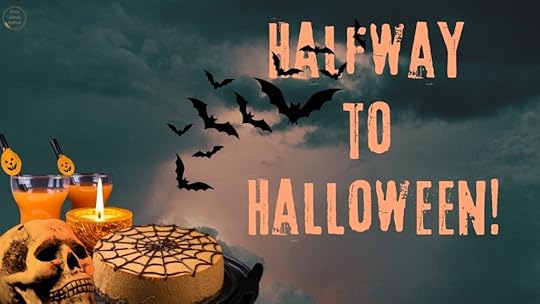
How does one celebrate it in the absence of pumpkins and Halloween candies? Oh, many, many ways. Halfoween is considered a kind of Halloween-‘light’ affair, although of course you can pull out the super-frightening stuff if you wish. But generally, think of a cozier ambience – a Halloween lap blanket, pumpkin pies and cupcakes, hot chocolate with black sprinkles, you get the idea. Make a mug of tea and catch up on your paranormal reading, or watch some of the many vintage horror movies that are more about ambience than blood and guts. Some of my favourite lighter modern movies include:
Hocus Pocus (of course) Halloweentown (and sequels) Girl Vs Monster The Boy Who Cried WerewolfA Halfoween party would be an option! If I weren’t so busy working on my horror novel, I’d consider it! Supplies are all around if you know where to look. Most bakeries now offer pumpkin pie year-round, although baking your own is easy, fun and therapeutic. I even found orange-frosted cupcakes in the bakery section of a local grocery store the other day, and, although I didn’t ask, it wouldn’t surprise me if they were willing to custom-bake a Halloween-themed cake.
Boutique stores are popping up all over with esoteric offerings, if you need or want some decor. And while fresh pumpkins are still out of season, it wouldn’t be difficult to put together an autumnal flower arrangement in a vase – there are plenty of orange and purple-coloured flowers around, even in grocery stores. I bought a spring planter today for our front porch that has some glorious orange and burgundy pansies in it.
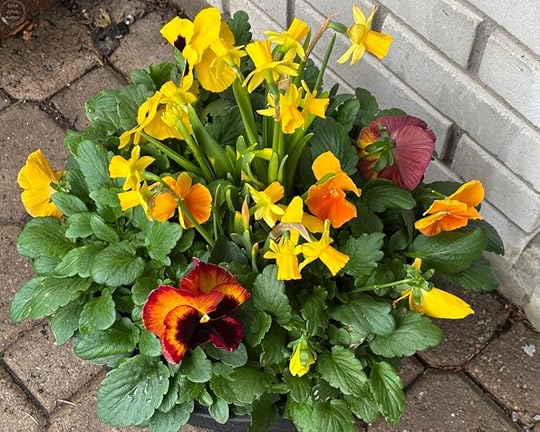 Spring planter in fall colours – photo by author, all rights reserved
So that’s my choice of sheer fun for April. I’ve already pulled out a few Halloween decorations, and no doubt plenty of pumpkin-flavoured baked treats will begin making an appearance as well. More ideas in my April newsletter – sign up via the pop-up box on this website (it’s the double opt-in box, make sure you’ve selected the right one).
What would you like to do for fun for the month? Think way outside the box – what’s something you might not ordinarily consider? This is a mental vacation from global stress, so make it good. And let me know what you come up with – perhaps you’ll inspire others to do the same.
March 24, 2026
March Madness in Bookland
‘But I don’t want to go among mad people,’ said Alice. ‘Oh, you can’t help that,’ said the cat. ‘We’re all mad here.’ Alice in Wonderland, Lewis Carroll
Do you also feel as if we’ve all tumbled down a rabbit-hole into a strange world where nothing makes sense?
When I was previewing selected themes for my social posts this month, ‘March Madness’ up, but it didn’t resonate with me. This week, however, I feel like the entire world’s caught on, and I’m left scratching my head in bewilderment.
Comics publisher Fantagraphics just announced on their Facebook feed that a ship carrying copies of one of their new publications, an anthology by cartoonist Roberta Gregory, was struck by a missile in the Persian Gulf. I haven’t been able to determine why this particular cargo was in the middle of the current war, since Fantagraphics appears to be a U.S. publisher. The good news is that the ship and its crew made it safely out of there, but the book’s launch has had to be postponed. And to top things off, Fantagraphics has noted that insurance for the shipment doesn’t cover acts of war.
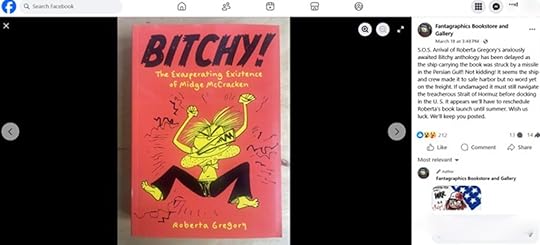 Source: Fantagraphics public Facebook page
For some reason, the humble little book keeps getting embroiled in contentiousness.
The war on book banning in the U.S. rages on. This week, a library director in Rutherford County, Tennessee, officially refused to comply with her board’s order to move more than 100 books, many with LGBTQ+ content, from “children’s” and “teen” to the adult section because they were deemed “age-inappropriate”, even though they were specifically written for those age groups. It’s seen as a way to censor knowledge of the differences among us. A children’s book author I know told me that she has to jump through all kinds of hoops to get her books approved, so the books in question wouldn’t have made it onto the shelves lightly. The director may lose her job over this, but she’s taken a stand, and has the support of a number of organizations that advocate for free expression and writers’ rights.
In the never-ending saga of the author of The Salt Path, a new controversy has come to light. In 2019, Raynor Winn was awarded the £10,000 Christopher Bland Prize for debut novelists for her breakout novel about walking the coastal path of England after she and her husband Moth lost their home and he was diagnosed with a terminal disease. Having already being outed about the legitimacy of that book and even Wynn’s diagnosis, it’s now come out that she won the £10,000 prize under false pretenses: it wasn’t the first book she’d written. A previous novel had been published under the alias Izzy Wyn-Thomas through a company she and her hubby briefly owned. Read more about the original story in my blog post The salty path of veracity.
Hoaxes and frauds involving books are nothing new at all. There are many notorious instances over several centuries. In the 9th century someone, or more than one person, forged a set of papal and council decrees supposedly collected by Saint Isidore of Sevilla. Called The False Decretals, they were falsifications of church law, in a determined attempt to separate Church and State. Deciding that their end goal would never be achieved legitimately, the forgers came up with the idea of writing fake rulings by long-dead popes and kings. Unlike later forgeries, they were generally accepted as authentic for several centuries and had considerable influence. Even though they were definitively refuted in the 17th century, they’d done their job.
The medieval forgers’ purpose was to foment a revolution in church law, but for more recent writers, I can imagine the motivation: fame, recognition, probably piles of money. It’s something most, if not all, writers would like. We work hard, put ourselves out there on the printed page, and hope for some validation. But what if that validation isn’t earned?
In 1970, novelist Clifford Irving decided to create a bogus ‘autobiography’ of eccentric business magnate Howard Hughes. Ironically, Irving had written a biography of a Hungarian art forger named Elmyr de Hory in 1969. Perhaps he drew inspiration from de Hory’s story, because he proceeded to do some forging of his own. Irving claimed that he and Hughes had been corresponding by mail, and proffered Hughes ‘hand-written’ notes. He received a $765,000 advance from publisher McGraw-Hill, Inc., and hoped to slide the book under recluse Hughes’ radar. However, Hughes eventually did come forward, quite publicly. Irving went on to serve 17 months in prison for fraud. His story was featured in Orson Welles’s final film F for Fake!
James Frey published a searing ‘memoir’ in 2003 of his struggles with alcohol and drug addiction called A Million Little Pieces. It went on to become a huge bestseller just two years later when Oprah Winfrey chose it for her book club. But the following year everything collapsed like a house of cards, after much of it was exposed as balderdash. It was a massive literary scandal.
Readers expect that what they read, especially if it’s a memoir, but even with fiction novels, is authentic/authentically written. And now we come to a story that’s been breaking all over the place: a novel partially produced by AI. It’s a sad tale, and I’m not sure why it’s being blasted around so much, but it’s a cautionary tale on all sides.
In 2025, indie author Mia Ballard self-published her novel “Shy Girl,” a ‘femgore’ (a very popular subgenre these days) revenge story of a young woman who’s held hostage by a man she met online and forced to live as his pet before she begins to release her rage. The book was a hit, and achieved every writer’s dream: it was picked up by a major publisher, Hachette in the U.K.
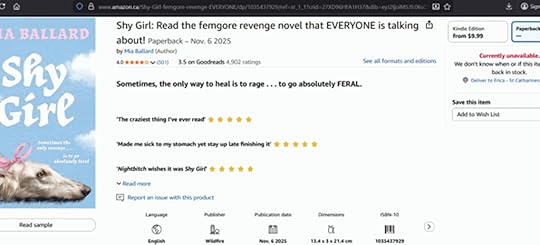 Source: public listing of the Hachette version of novel Shy Girl on Amazon.ca
But problems soon arose. I haven’t read the book – in fact I wasn’t aware of it at all until it began popping up in my literary news feeds – but here’s what I’ve gleaned from the media:
Ballard cribbed a copyrighted artwork of a dog from the internet for her cover. It was a painting called Dreamer by Whyn Lewis. There was then an ‘anonymous’ post on a literary forum wherein the writer of Shy Girl admitted that they’d used an already-manipulated image of the painting and couldn’t trace the original artist. They assumed that hardly anyone would read the book, but later regretted not doing their due-diligence. They’d been contacted by the artist, who asked that they disclose all royalties earned from the book due to the infringement, and take down any remaining use of her artwork.When the book began to gain popularity and rave reviews, big publisher Hachette became interested. Oddly, they chose to use a similar image on their version of the cover. The book was released in the U.K., and then people began to post their belief that AI had been used to write it. Apparently there are some ‘tells’ that give AI away: repeated words, gaps in logic, an inconsistent ‘voice’ (a characteristic feel to an author’s writing), overuse of melodramatic adjectives and too much use of the rule of three (a long-standing writing principle that grouping things like characters or examples in threes is more satisfying and effective).Now, let me just say that a lot of this could have occurred naturally. Authors often fall back on their favourite words and repeat them throughout their first draft; I always do a word search on my first edit to weed those out and improve the writing. Melodramatic adjectives are nothing new either – they’re usually just a sign of bad writing. And some authors may have read about the Rule of Three and decided they should use it.
However, Max Spero, founder of Pangram, heard about Shy Girl and decided to run the full text through his A.I. detection software. It indicated that the book was 78 percent A.I. generated. Readers began to react strongly, and the phrase “AI slop” came up.
Mia Ballard is a black author, and there have been allegations of racism in the intense furor that’s since landed her in the hospital with stress. It’s certainly not unheard of. She maintains that she wrote the original story, but then gave it to a friend to edit, and that’s where the AI crept in. However, editors aren’t supposed to rewrite the text, just guide the author toward a better book.
In situations like this, the responsibility falls on the author, together with the publisher, to make sure they’re putting out something authentic. The Salt Path seemed to show that doing a long walk in the fresh air could reverse a terminal disease. It offered hope to a lot of people in the same boat, and they felt betrayed when the truth came out.
Publishers and authors are struggling to maintain their credence in the face of the AI storm. In the U.K., the Society of Authors has launched a ’Human Authored’ scheme. Authors can register their books and download a “Human Authored” logo to put on their back cover.
With so much misuse of AI to scrape material from legit books without authors’ permissions or reimbursement, and the lack of adequate legislation, writers now feel we have to formally state that we’ve actually written our own book. From what I understand, quite a few book reviewers and influencers endorsed Shy Girl, so this massive kerfuffle leaves them pretty gun-shy.
You know, there will always be people who abuse a situation or a technology. As I commented to one influencer, all any of us can do is act in good faith under the best circumstances we have available.
So I will continue to write my novels, from scratch (and design my own covers using copyright-free fonts and graphics), and edited without the use of any AI whatsoever. I prefer to be an authentic creator, human and as real as it gets. It’s what readers want, and I believe there are many of us prepared to try and restore some sanity to our topsy-turvy world.
March 17, 2026
Irish travel: inspired by books
When I turned the final page of The Lord of the Rings trilogy, I wanted to crawl back inside. While the books are overly-descriptive for some people, I found the details of Middle Earth so fascinating that I couldn’t get enough of them. I wanted to visit Middle Earth, follow the Road of adventure as Bilbo sang about it:
The Road goes ever on and on,
Down from the door where it began.
Now far ahead the Road has gone,
And I must follow, if I can,
Pursuing it with eager feet,
Until it joins some larger way
Where many paths and errands meet.
And whither then? I cannot say.
This song inspired me so much that eventually I became a traveller myself – sadly without wizards, trolls, Ents, dragons, or any other of the wonderful and sometimes terrifying creatures in Tolkien’s books. And three years ago I published the first book in my Chaos Roads urban fantasy series, also about Roads that can take you to exciting places.
My hubby and I often do road trips, whether at home in North America or in far-flung countries. If you’re up to the driving, sometimes on the other side of the road, it’s really the best way to see most places. You can plan your own route, see things that aren’t on standard tour itineraries, spend as much time as you want in interesting locations without having to adhere to a pre-defined schedule.
A few years ago we even did a road trip in New Zealand, and of course one of the places we visited was the film set of Hobbiton, which luckily has been preserved by the family who owns the land and turned into the most popular attraction in the entire country.
But today’s about St. Patrick’s Day, and travel to Ireland. I think I may surprise you with my inspiration for some of the sightseeing we did there. Although we did enjoy the Dracula’s Castle illusion show (sadly, no longer available), and see Oscar Wilde’s statue in Dublin, among other literary things, the series of novels that immersed me in the Irish landscape and culture was the Fever series by Karen Marie Moning.
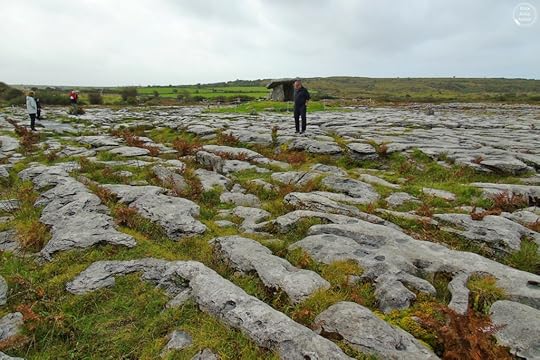 Hubby walking the Burren – photo by author, all rights reserved
Now, you may see them listed under the Romance category, but they’re really brilliantly-written Urban Fantasy – funny, gut-wrenching, sexy, frightening. When I first picked up the starting book, Darkfever, my initial reaction was: oh, another book about the Fae and a human with special abilities, blah, blah, blah. But I gave it a try anyway, and found the writing so engaging and the mythology so inventive that it’s become my favourite urban fantasy series.
Here’s the general beginning of the story: MacKayla Lane, a happy, carefree young woman in Georgia, is devastated to learn one day that her beloved sister, who’s been attending university in Dublin, Ireland, has been brutally murdered. MacKayla (Mac) and her parents can’t get satisfaction from the Irish police from our side of the Pond, so Mac decides to go to Dublin and do some investigating herself, much against her parents’ wishes.
Once she arrives, she begins to have strange experiences, and, without giving too much away, learns that she is descended from a long line of Sidhe-Seers – those who can see the not-very-nice Sidhe (aka Fae) who typically wander through humanity invisibly preying on us in various forms. Of course, this gets her into a lot of trouble, but, finding herself lost one day in an eerie, deserted section of Dublin whose existence everyone seems to have forgotten, she meets a man named Jericho Barrons. He offers his protection, for a price: he’s searching for a dreadful ancient artifact and wants to use her special abilities to find it.
That’s all I’m going to say – I’ll let you have the fun of experiencing this magical, thrilling series for yourself. When we visited Ireland in person, of course we spent some time in Dublin, especially Temple Bar, which features in the books quite a bit, but I had a long list of things to see once we picked up our rental car. Most of them weren’t in the Fever novels, but one place that was, and that had really taken up residence in my head, was a strange piece of geology on Ireland’s west coast called The Burren.
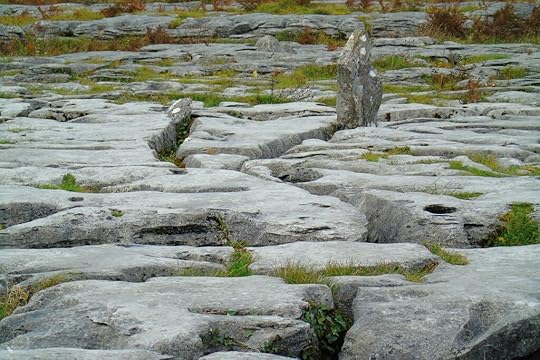 Closeup of the Burren’s eerie landscape – photo by the author, all rights reserved
In the books, at one point Mac is kidnapped and trapped beneath the layers of the Burren’s rocks, where she’s tortured for a time. The locale sounded so interesting, AND there’s a famous portal tomb there, Poulnabrone, that we killed two birds with one stone, as it were, and braved an extremely narrow, one-lane road, to find it.
God bless my patient hubby, who had to navigate Irish roads. If another car had come along in the opposite direction while we were partway to Poulnabrone, one of us would have had to back up for over a mile. Madness, but it was worth it.
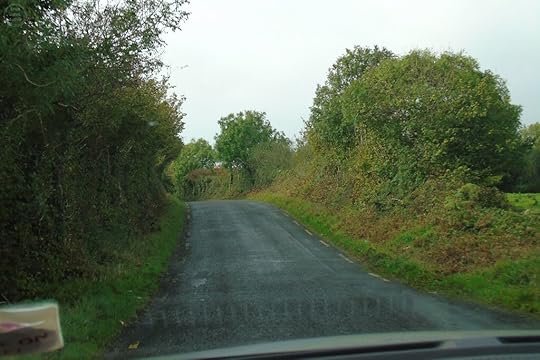 Road to Poulnabrone – photo by the author, all rights reserved
The Burren is a geological formation largely in County Clare, although it even extends out into Galway Bay. Its boundaries are loosely defined, and it ranges anywhere from around 250 to over 500 square kilometres, depending on who you talk to. It has a bed of limestone up to 800 metres (2,624 feet) thick in places, and while I’m not claustrophobic, author Moning’s description of Mac’s sensations being captive under all of that rock is vivid.
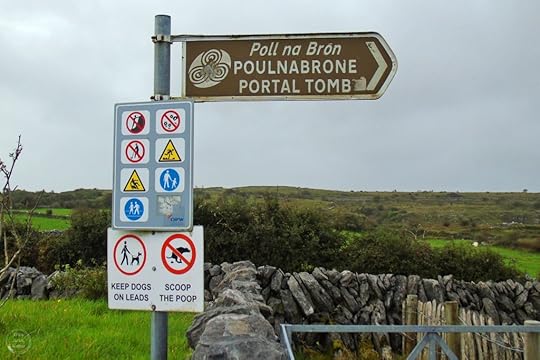 photo by the author, all rights reserved
The Burren’s landscape looks like something not-of-this-earth. It’s called “glacio-karst: glaciers around 16,000 years ago scraped down the limestone rock, and fissures called ‘grikes’ formed as rainwater then dissolved thin veins within the rock. It’s so strange to walk on, like a crazed netting of cracks and holes, through which small, scrubby vegetation has taken hold.
We were there on a chilly, grey day, blending the real world with something imaginary. You can’t miss the Poulnabrone Dolmen – it sits like a weird stone house not far from the parking lot.
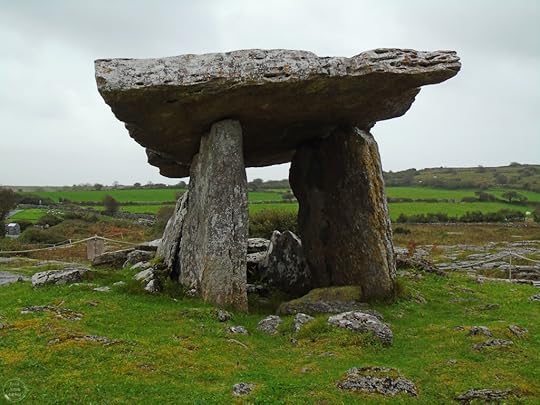 Poulnabrone portal tomb – photo by the author, all rights reserved
Poulnabrone is a phonetic transcription from the Irish Poll na Brón – meaning”Hole (or Pool) of the Quernstone, or, “Hole of Sorrows”.
Dolmens, or portal tombs, are essentially two massive upright pieces of stone, forming the ‘portal’, and covered with an even larger capstone. The two ends are open to the air. These tombs are believed to have ritual purposes, to send the deceased onward to their deserved afterlife. Remnants of bodies have been found beneath them, and they’re not unique to Ireland by a long shot. Strolling around it, you can’t help but wonder why this particular design, and how on earth the builders managed to get the incredibly heavy pieces of rock into place.
It was a fantastically eerie place to visit, with only a handful of other people around, treading carefully in the chill breeze. And years later, when I began featuring strange portals to other places in my novels, I look back on these photos with special fondness.
I’m not sure how long we spent there, but on the way out there was a very wizardly-looking fellow selling handmade Celtic-style jewellery, from whom I bought a lovely pendant. By that point, we needed two things: a bathroom, and some hot tea. Luckily, just down the road we found a farm that had both. There’s nothing like a stiff cup of Irish tea (they make it much stronger than we do in Canada) and some pastries to raise your flagging energy levels. Then we were off on the next leg of the trip, but our sojourn at the Burren was unforgettable.
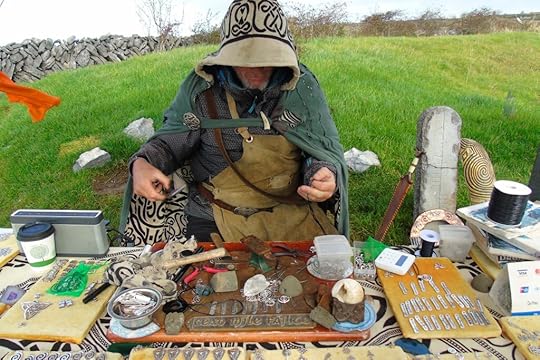 The jewellery maker outside Poulnabrone – photo by the author, all rights reserved
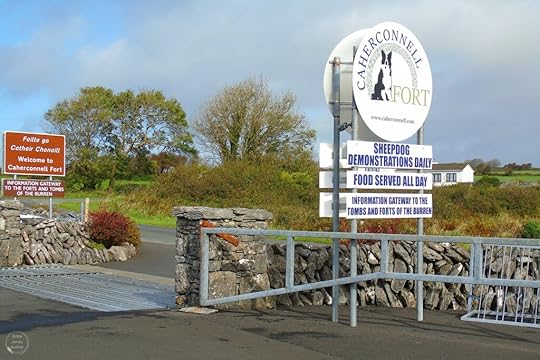 Where we stopped for tea – photo by the author, all rights reserved
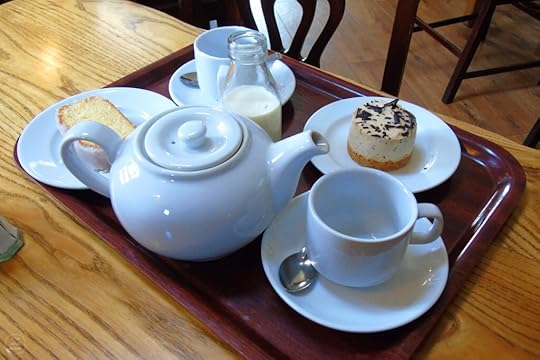 Tea at Caherconnell Farm – photo by the author, all rights reserved
The area isn’t on most preplanned tours of Ireland that I’ve seen, although we did spy the odd narrow bus testing itself on the slender roads. (Seriously, on some of them I could have stuck my hand out my window and touched the stone walls along the periphery. There’s no shoulder to speak of, ever.) If you’re lucky enough to find such a tour, don’t miss the opportunity – an incredible opportunity to visit a very ancient part of the country. Otherwise, you’ll have to rent a vehicle, steel yourself for some nerve-wracking driving, and pray for the luck of the Irish!
March 10, 2026
Being a bold woman today
“And I may say, once for all, carefully weighing my words, that in no part of the world have I seen stones cut with such mathematical precision and admirable skill as in Peru, and in no part of Peru are there any to surpass those which are scattered over the plain of Tiahuanuco.” Peru; incidents of travel and exploration in the land of the Incas, by Squier, E. G. (Ephraim George), 1821-1888
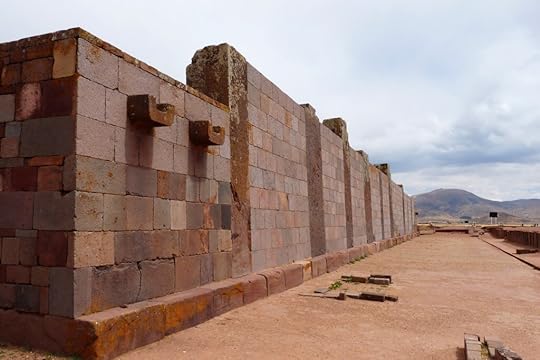 Walls of Tiwanaku, Bolivia – by author, all rights reserved
In 2007 I camped deep in the African bush. In 2012 I explored the ruins of Tiwanaku (Tiahuanaco) a city in the Andes so high and remote that few travellers will ever go there. In 2015 my hubby and I hiked part of the Hooker Valley trail in New Zealand, beneath the peaks that Sir Edmund Hillary practiced his climbing on to prepare for Mt. Everest.
In 2023 I took perhaps my greatest leap of faith and published my first novel.
I am an explorer and adventurer. Just a minor one, venturing out to see the world and expand my horizons. I’m far from the league of women highlighted in an article I saw yesterday on BBC Essentials.
But I’m never more alive than when my hubby and I are standing, or walking, or riding, someplace we’ve never been – preferably thousands of miles from home.
 Riding in a pop-top safari van in Kenya – photo by author, all rights reserved
When I was a child, m family lived in a very small, very rural community in northern Ontario. It was incredibly beautiful, especially in the autumn, but many of the residents became quite insulated. One fellow lived in the bush in a tar-papered shack. I’m not sure what he did – hunting and trapping, I think, with some moonshine production for entertainment. At our closest neighbours, both the mother and 14-year-old daughter were having a fling with the same travelling salesman. Once kids grew into restless teenagers and bussed to the nearest town with a high school (30 miles away), they typically joined gangs and got into trouble.
I resolved to travel at a very young age. After having my tonsils removed while we still lived there, I was housebound for over a week (protocol at the time). Since I couldn’t go on the exciting monthly shopping expedition, my brother took pity on me and brought back a picture book all about the world. There were wondrous, exotic things in there, and I decided that one day I’d see those places for myself. And, luckily marrying a guy who was just as keen, we’ve done just that.
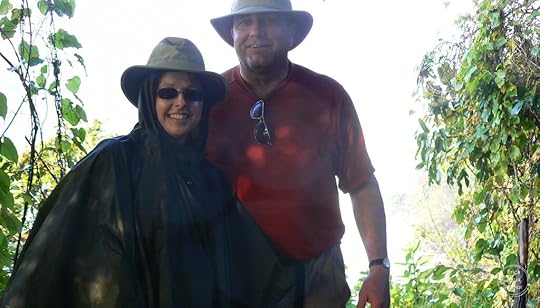 Soaked at Victoria Falls, Zimbabwe – photo belongs to author, all rights reserved
So now, my ‘comfort zone’ is quite large. I’ve seen many other ways of life, learned a lot about other cultures, taken many different kinds of transport – including a camel in the Sahara and a river boat on the Zambezi. My explorations haven’t been earth-shaking, or world-changing. Maybe we’ve shown our younger family members that there’s a whole world out there to see, and sometimes we’ve taken others along with us to help them get started.
And I’ve striven to bring my same love of adventure (and my knowledge of the planet) to my novels, which I think of like an Indiana Jones-style adventure with far more supernatural.
Intrepid women have been inventing their own lives for centuries. In the 1700s, Jeanne Baret, a French explorer and botanist, disguised herself as a man and became the first woman to circumnavigate the globe. And Anne Bonny charted her own course by becoming a famous pirate. Marianne North, coming into some means in the mid-1800s, decided she didn’t want to get married and settle down, and spent the bulk of her life travelling the world and producing amazing botanical paintings. In 1889, journalist Nellie Bly beat the around-the-world-in-80-days scenario laid out by author Jules Verne.
In modern times, women have changed the face of science, medicine, art, film and many other fields. There are quite a few female authors writing horror novels, romantasy novels, even “spicy” (erotic) novels with hordes of fans.
Truly, the sky’s the limit if we are willing to take those first few steps. For inspiration, read this article on the BBC website, Beyond the boy’s club: The women at the frontier of adventure, about some truly amazing female explorers who are pushing boundaries far greater than any of mine.
Now what does it take to become an explorer? Not as much as you might think, according to a companion article on the BBC, You’re either an explorer, or you’re not. Which one are you?
 Suspension bridge on the Hooker Valley track, New Zealand – photo by author, all rights reserved
One of the main requirements is being something of a risk-taker.
There’s a theory that people who become explorers have more activity in the limbic system of their brains, which is stimulated by novelty and the rewarding feeling of conquering something. I will say that, when we were in Peru, I was concerned about the high altitude – with good reason, of course. When the tour we were on brought us to the highest point that the main road through the Andes reaches, a little over 16,000 feet (classified as “very high”), and we stood on what felt like the roof of the world, shuffling around like we’d aged 20 years but surviving in the thin air, I felt an amazing sense of accomplishment.
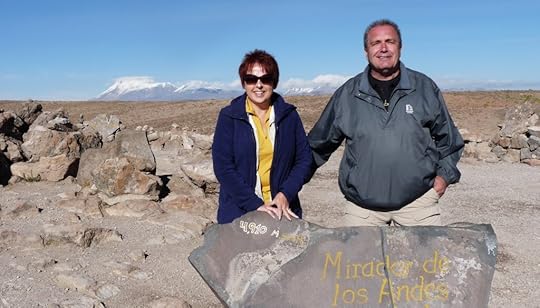 Standing at the highest road point in the Andes – photo belongs to author, all rights reserved
And there we have another trait of explorers: we thrive on positive reinforcement. But that reinforcement doesn’t have to come from anything extreme. While I now understand why people climb Mt. Everest, I have no desire to do it myself – nor will I ever have the stamina. The article mentions that there’s much satisfaction to be had in just going somewhere you haven’t been before.
The biggest point is to be willing to step outside your comfort zone. Apparently back in prehistory, there were always individuals who were willing to go just that much farther to find better places to live and gather food. Andrew Evans, a travel writer and TV host, comments in the article that “I feel as if it’s human nature to go beyond the horizon. Once we understand one horizon we keep walking to the next and then to the next.”
Maybe that horizon is a new job. I belong to a small business group of women who’ve created their own profession, from life coaching to landscaping to home/office organizing. So far I’ve been the sole author, but that may change as another woman has become inspired to turn her vast knowledge of the Canadian wine industry into a book. Fantastic!
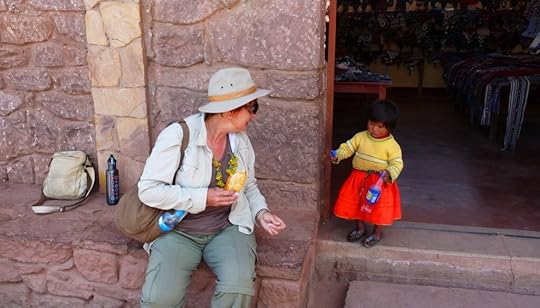 Playing a game with a little girl on Taquile Island, Lake Titicaca, Peru – photo belongs to author, all rights reserved
The thing about taking one step outside your comfort zone, then another, then more, is that they become easier. You may stub your toe, but that goes with the territory – you learn from it and move on. I could tell stories about some of the crazy things that have happened on the journeys my hubby and I have taken – so, so many things, and honestly we find them all hilarious. Here’s the best part: you get better and better as you go!
There’s an old truism that I think captures the essence of exploring: the journey is more important than the destination. It could be for you.
March 3, 2026
Characters from books to screen: good, bad, misguided
About 30 minutes into the first Lord of the Rings movie, I was ticked off, and spent the next three hours fuming. Now, for that movie my problem wasn’t with the casting – except for the ridiculous choice of actress to play Lady Arwen – but with the many, many changes to the plot and tone. For example, some odd reason, Peter Jackson chose to reveal the wizard Saruman’s corruption at the very beginning, when that was meant to be a stunning revelation later in the books. I couldn’t see that it improved the story at all. And that’s just one error.
But although I’ve been digressing a smidge, the anecdote illustrates how fans can react when a film production makes radical changes to some of their favourite elements.
We all understand that some changes must be made to translate a beloved novel to the big screen. Opinions can be sharply divided no matter what choices the producers and casting directors make. I recall the kerfuffle when Michelle Pfeiffer was cast as Cat Woman in Batman Returns (1992), but I thought she was fantastic in the role and wore that slinky, black vinyl catsuit like nobody’s business.
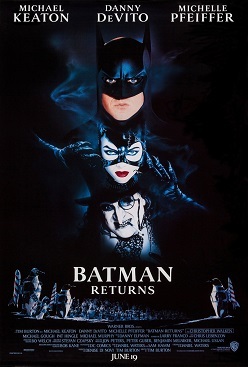 Poster for Batman Returns; By IMP Awards, Fair use, https://en.wikipedia.org/w/index.php?curid=5714498
I also thought that Danny DeVito did an amazing job as the Penguin; unfortunately his part was written in such a strange way that I don’t think it resonated with the audience.
Let’s look at a very divisive movie series, the Twilight saga. I will go on record that I think the casting was excellent. I felt that Kristen Stewart was perfectly cast as Bella Swan, pretty enough pre-vampirisim (sorry, spoiler alert) to convey why a lot of the males in her new high school were interested in her, carrying off the endearing clumsiness of the character well, etc. The movies were well made and had great musical accompaniment. The ONLY problem I have with them lies outside of Hollywood’s transformation – it has to do with the original novels, which portrayed vampires as having to avoid sunlight because they “sparkle” in it. As a long-time fan of the vampire canon, it makes absolutely no sense at all for vampires to sparkle. If Stephenie Meyer wants to ‘splain her logic to me, she’s welcome to try.
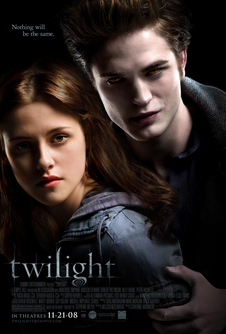 Poster for Twilight movie (2008); By Impawards, Fair use, https://en.wikipedia.org/w/index.php?curid=21976665
When our family visited the “Bloomland in Oz” exhibit at the Royal Botanical Gardens in Burlington, Ontario this past weekend, I was wondering if they were going to pattern the look of the two main female Ozian characters after the hugely-successful Wicked books/musicals/movies, but instead they went back to L. Frank Baum’s original books, which didn’t actually provide much of a description.
It made the displays really interesting. I think my favourite was the Wicked Witch of the West. In the books, she was described only as “the Wicked Witch of the West had but one eye, yet that was as powerful as a telescope, and could see everywhere.” Not much to go on at all.
When Hollywood produced its iconic movie, they had fourteen Oz novels to contend with, containing a complicated plot that outshines even my own! Much of Baum’s tales didn’t make it into the movie – Princess Ozma, the rightful ruler of Oz; the great Deadly Desert that completely surrounds Oz; the fact that Glinda the Good Witch has a large army of female soldiers…
Most of the Wicked Witch’s power lies in the creatures she controls, which in the movie consisted only of the terrifying Flying Monkeys and her troop of soldiers. However, in the books she also had a swarm of black bees, a flock of forty crows, a pack of forty great wolves and an army of Winkies. An enchanted Golden Cap gave her the ability to compels the winged monkeys to do her bidding.
The producers cherry-picked aspects of the entire tale, and created one of the most beloved movies of all time.
But in the process, they also created an almost indelible image of an evil witch, dressed all in black and hunched over a broom, with a long hooked nose and startling green skin, stirring a big black cauldron when she’s not flying about and cackling.
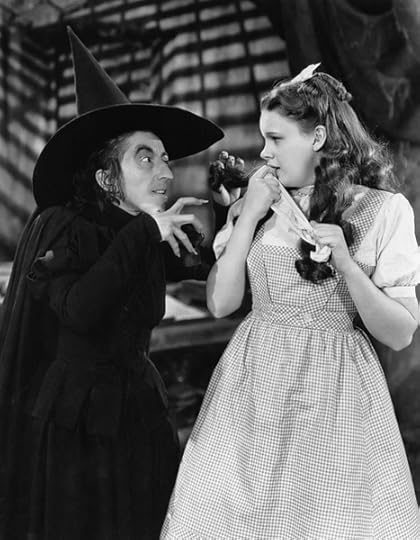 Margaret Hamilton as the Wicked Witch of the West (left) and Judy Garland as Dorothy Gale (right)
By It is unclear as to whether the press-materials were distributed by publicity agencies representing the respective subjects or if they were distributed by the producers of the respective projects they were a part of at the time(s) of publication (c. 1968 and/or c. 1970). – eBay item #1 photo front photo backeBay item #2 photo front photo back, Public Domain, https://commons.wikimedia.org/w/index.php?curid=20805975
I have a friend who came to one of our Halloween parties dressed as just such a witch, with a long putty nose. As more people arrived and the rooms of our house grew warmer, her nose began to soften and drift off to one side or the other. It was impossible to talk to her with a straight face!
RBG did a wonderful job of bringing the Wicked Witch to life in a stunning garment of elegant purple. If I were a witch, I think I might wear something equally chic. There’s no reason a wicked witch can’t be stylishly dramatic, is there?
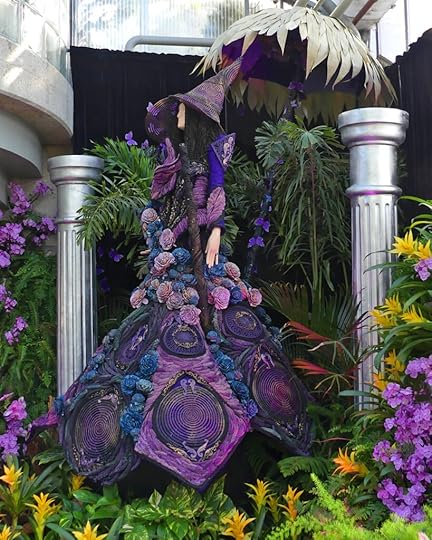 The Wicked Witch of the West at the Royal Botanical Garden’s “Bloomland in Oz” – photo by E. Jurus, all rights reserved.
Actress Margaret Hamilton’s portrayal of the Wicked Witch came to represent an archetype of human wickedness, even transmuting the normally soothing colour of green into something fearsome. To up the stakes very quickly once Dorothy arrives in Munchkinland, the movie made the Wicked Witch even meaner and malevolent, and she appeared in the film much sooner and more often than in Baum’s original story.
The same characterization carried over to the 2013 film Oz the Great and Powerful, vibrant green skin and all. In that movie, the Witch started out as the beautiful young Theodora, nice and wanting peace in the land, but tricked by her malicious older sister Evanora into thinking she’s been betrayed by the man she fell in love with. Theodora then turns poisonously green, and even her facial features distort because of her terrible anger.
As far as Glinda goes, she wore white in Baum’s novels. She was depicted as a beautiful young woman with long, red hair and blue eyes. She was, interestingly, much older than her appearance would suggest, but knowing how to keep young-looking (one presumes by magical means). She had ruled the Quadling Country ever since she overthrew the Wicked Witch of the South when Princess Ozma’s grandfather was “King of Oz”.
However, an early illustration of Glinda in pink cemented that image through almost all the movies, especially in the most recent two Wicked films – except for the 2013 movie, which restored her white dress.
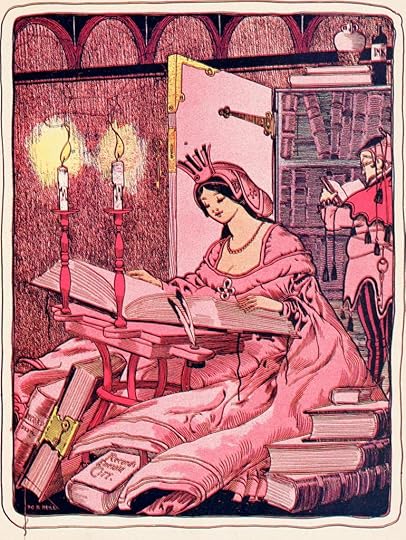 Glinda depicted in The Marvelous Land of Oz, illustrated by John R. Neill
By Internet Archive Book Images – https://www.flickr.com/photos/internetarchivebookimages/14566659598/Source book page: https://archive.org/stream/marvelouslandofo00baum/marvelouslandofo00baum#page/n270/mode/1up, No restrictions, https://commons.wikimedia.org/w/index.php?curid=44162188
People have asked me how I might cast some of my characters if a movie or series were ever made of my books, and I truly don’t know. The characters are very diverse, and their heritage is a significant part of their background, so I’d be quite perturbed if a producer wanted to change anything. As to the plot, over the trilogy it’s so layered that the books would work best as a series. There’s not a wasted word or scene in any of the books, but perhaps a producer could see a way to condense them into film format while still retaining the sense of the story.
I’ve been thoroughly enjoying the Percy Jackson series on Disney Plus, much more so than the movies, which simply didn’t have the time to portray all the nuances of the mythology. But there’s been quite a fuss made about the casting of black actress Leah Sava’ Jeffries in the role of Percy’s friend Annabeth Chase, who was Caucasian in the books. However, author Rick Riordan, a co-producer of the series, is happy with her casting, saying that she captures the spirit of the character.
There’s been plenty of controversy about the new Wuthering Heights movie, from Heathcliff’s appearance to the transmogrification of the story into more of a romance. I haven’t seen it myself, but I’ve been told it at least retains the nastiness of Heathcliff’s relentless vengeance.
So what’s the answer for an author who signs on to have their book(s) made into film? (Of course, Emily Brontë no longer has a say in the matter.)
Do we get our socks in a knot if too many changes are made, or just be happy that our work is coming to the big screen? Do we balk, or take the money and run? What if the movie turns our work into a timeless classic?
Well, if I’m ever thrust into that enviable position, I’ll fill you in on how I sweat out those decisions. In the meantime, what are some of your favourite character translations onto the big screen, OR which did you absolutely loathe?
You can read Baum’s Oz stories for free by downloading from https://gutenberg.org/ebooks/55.
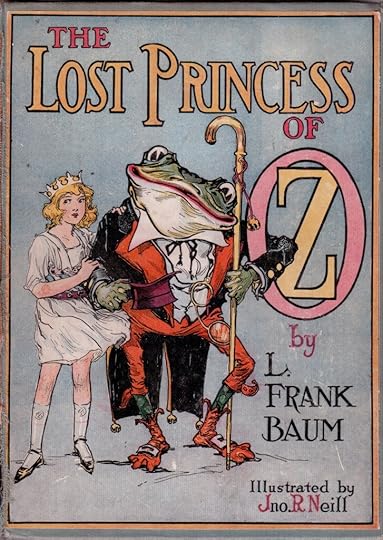 The Lost Princess of Oz by L. Frank Baum, Illustrated by John. R Neill, Copyright The Reilly & Britton Co., Chicago, 1917 Flickr data on 2011-08-23: Tags: public domain, book, vintage, illustration, drawing, OZ, The Lost Princess of OZ, 1917 License: CC BY 2.0 User: perpetualplum Sue Clark
By John R. Neill – Flickr: Cover ~ The Lost Princess of Oz, Public Domain, https://commons.wikimedia.org/w/index.php?curid=16196897
February 24, 2026
When life mirrors my books!
My hubby, along with a number of people I know, isn’t a particular fan of vegetables. He’ll eat them under sufferance because he knows they’re good for him, and because I won’t let him eat just meat, potatoes and gravy all the time. So I can only imagine his reaction to being charged a plant’s weight in gold to have some of it.
For this plant, with golden flowers, was craved by ancient cooks for its spicy flavour. It was essential for physicians for curing just about anything, and was so prized for its scent that ancient writers mentioned that frequently. And apparently it was also a potent aphrodisiac.
Julius Caesar’s treasury had stockpiles not just of gold, but of over a thousand pounds of the plant called silphion, or silphium, whose saplings alone were as valuable as silver. Roman poets and singers even sang ditties about it.
So what happened to this phenomenal plant? Why did it disappear from historical record by the early 1st century AD? At that time, Roman chronicler Pliny the Elder wrote that “Just one stalk has been found, and it has been given to the Emperor Nero.”
It was an essential item of trade from the ancient North African city of Cyrene, in what’s now Libya, and was so important to the city’s economy that an image was stamped on the back of its coins, with the king’s image on the front.
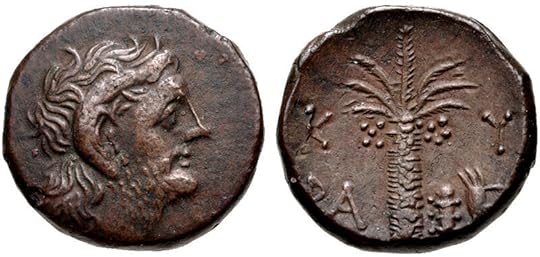 Coin of Magas as king of Cyrene, circa 282/75 to 261 BC; By Classical Numismatic Group, Inc. http://www.cngcoins.com, CC BY-SA 3.0, https://commons.wikimedia.org/w/index.php?curid=60068526
It’s a typical story, I think: over-consumption. Because according to the records, no one ever managed to cultivate the plant, and once all the specimens disappeared from the wild, that was the end. This is believed to be the first recorded extinction of any species, whether plant or animal, and a cautionary ecological tale as well. For centuries botanical explorers have hunted it unsuccessfully across three continents.
My novels cover a lot of ground through history and across fantastic dimensions, so I mine ancient history and cultures for ideas, with as much realism as I can manage. When I came across the story of silphion a while back, I knew I had the perfect ingredient for a potion that my brilliant apothecary and herbalist Elspeth Surgeoner concocts to help out the – well, let’s just say a certain special-interest group in the town of Llithfaen. She’s found a way to revive the ancient plant and cultivate it.
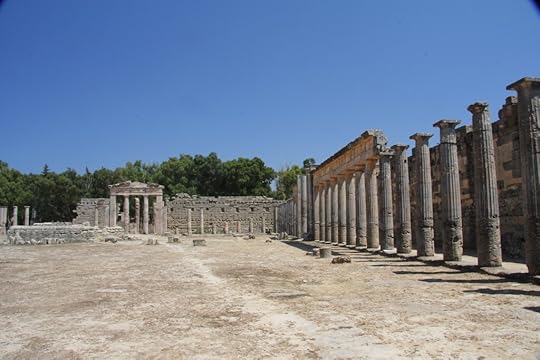 Gymnasium of Cyrene; By joepyrek from Richmond, Va, USA – Cyrene (45), CC BY-SA 2.0, https://commons.wikimedia.org/w/index.php?curid=78506043
But no one from the Dark Ages onward has known what silphion truly looked like, apart from the odd written description and its depiction in artwork. If it hasn’t actually gone extinct, identifying it today would be challenging.
Imagine my delight when I read the news of a professor in Turkey who believes he’s found a descendant of the very plant, growing wild among the foothills of his country.
In 1983 Professor Mahmut Miski was led by two boys from a small Cappadocian village to their family farm, where several unusually tall Ferula drudeana plants (in the same family as fennel) were growing. They had thick stems that exuded an acrid resin.
Professor Miski’s field of research is pharmacognosy, the study of medicines derived from natural sources. He took an interest in this yellow-flowered species, and as time went on, began to notice several aspects of the Ferula plant which has led him to speculate that it might be the legendary ancient vegetable.
One characteristic was the aroma of its root ball, which has a highly attractive, slightly medicinal odor reminiscent of pine and eucalyptus.
Then he observed that insects attracted to the plant’s sap began to mate. This made him think of silphion’s reputed aphrodisiac properties.
There were other significant similarities, and analyses of the root extracts in his lab at the University of Istanbul have revealed a chemical bonanza of compounds, including those with contraceptive, anti-inflammatory and even cancer-fighting properties.
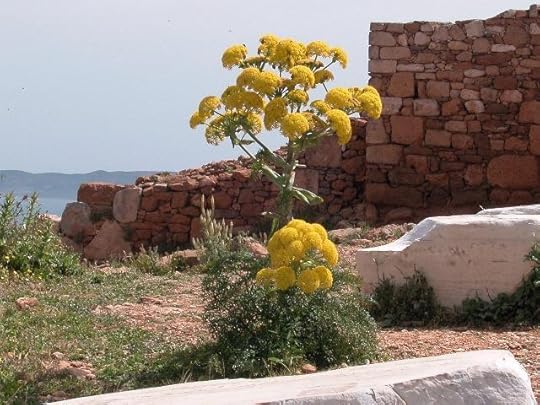 Silphion would look similar to the Giant fennel, ferula communis; CC BY-SA 3.0, https://commons.wikimedia.org/w/index.php?curid=513685
Research is ongoing, and the professor and his team have, with some difficulty, managed to cultivate the plant. One day, perhaps, we might all be able to taste something that was thought completely lost to the mists of ancient Greece and Rome. At the very least, it shows that my tale of Elspeth’s botanical success isn’t completely far-fetched – score one for the author! Click here for more information on my Chaos Roads trilogy.
February 17, 2026
The Lost Ark, a real-life treasure hunt
If you were going to bring back the early adventure epics to the big screen, what better story than a roguish professor and archeologist searching for the greatest lost treasure in history?
The Ark of the Covenant was the most important artifact of biblical times – the repository of God’s words and laws engraved personally into blocks of stone, and held in a fabulous crate built to His exact specifications.
For anyone who hasn’t watched the 1956 movie The Ten Commandments, after the Israelites fled Egypt during the Exodus, they made camp at Sinai, where they stayed for two years. Yahweh (God) gave Moses two Tablets of the Law, on which he had inscribed his ten commandments, on Mount Sinai. Then He directed the tablets to be placed in a special chest for transport, the Ark of the Covenant.
It was to be made of acacia wood, 2.5 x 1.5 x 1.5 cubits in size (3.75 x 2.25 x 2.25 feet), with gold overlay inside and out. The box would be born with carrying poles also made out of acacia wood, inserted through four rings attached to each bottom corner. Inside, there would be the Tablets, a pot of manna, and the rod of Moses’ brother Aaron, which had miraculous powers.
Interesting specifications, aren’t they? Aaron’s staff, for example, must have been on the short side, for even if laid diagonally inside the Ark, it could only be a maximum of about 4.3 feet. If we assume that the tablets filled the space, they would have been quite large, but that’s speculation at best. And why a pot of manna?
Symbolic, presumably. As described by ancient writings, manna arrived with the night dew as “a fine, flake-like thing” like frost on the ground. It melted in the heat and had to be gathered before the sun came up. God’s consolation while he made the Israelites wander the desert for 40 years, it would only fall for six days, i.e. not on the Sabbath, and Friday’s portion was doubled.
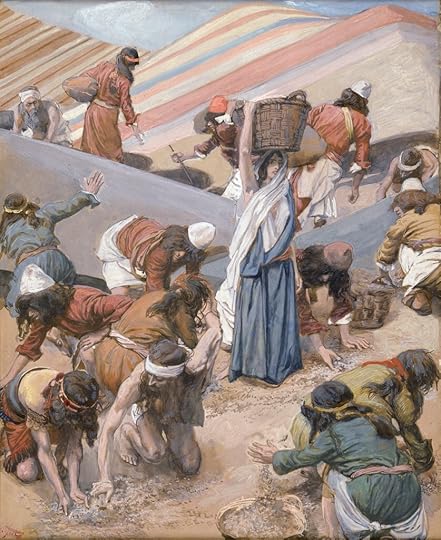 The Gathering of the Manna by James Tissot, By James Tissot – https://thejewishmuseum.org/collection/26365-the-gathering-of-the-manna, Public Domain, https://commons.wikimedia.org/w/index.php?curid=8849141
Perhaps the manna was a reminder that God could giveth or taketh away, depending on how well pleased he was with his followers.
At any rate, the Ark was created with remarkable gravity. A man named Bezalel was chosen by God to build the it, “filled … with the Spirit of God, with wisdom, with understanding, with knowledge and with all kinds of skills — to make artistic designs for work in gold, silver and bronze, to cut and set stones, to work in wood, and to engage in all kinds of crafts.” (Exodus 31:3-5).
As you read further, about how lethal the Ark could be, God must have given Bezalel, and his assistant Oholiab, special protection during the construction.
Two cherubim (angels) were to be sculpted out of gold for the lid, and were to have “their wings spread upward, overshadowing the cover with them. The cherubim are to face each other, looking toward the cover.” (Exodus) The lid would serve as Yahweh’s throne, as he had told Moses: “There, above the cover between the two cherubim that are over the ark of the covenant law, I will meet with you and give you all my commands for the Israelites” (Exodus 25:22).
The Ark was to be placed within a shrine known as the Tabernacle, a tent with a curtain that prevented people from viewing the Ark inside it. The Tabernacle was also known as the Tent of the Congregation or Tent of Meeting, where God would appear when on Earth. It was fairly elaborate, with had an inner sanctuary, the Holy of Holies, to contain the Ark, four layers of curtains and several ritual instruments, including a menorah. An altar and incense burners were to be placed in front of the curtain.
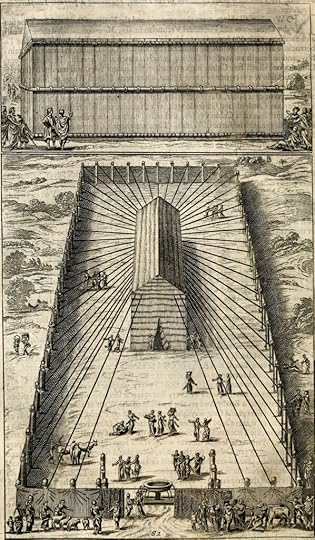 The tabernacle, engraving from Robert Arnauld d’Andilly‘s 1683 translation of Josephus. By Internet Archive Book Images – https://www.flickr.com/photos/internetarchivebookimages/14781191601/Source book page: https://archive.org/stream/worksofjosephus00jose/worksofjosephus00jose#page/n101/mode/1up, No restrictions, https://commons.wikimedia.org/w/index.php?curid=42024038
A complex and costly incense was made from frankincense, galbanum (an aromatic resin with an intensely fresh, woody, and slightly balsamic scent), gum resin, and onycham (a rare, ancient aromatic ingredient used in holy incense, made from the dried shell of sea snails and renowned for its pungent, earthy and musk-like scent). It was to be burned twice a day, at morning and sunset, by Aaron, the brother of Moses, and his sons.
The Ark was so heavy that, according to some stories, it kept itself aloft (levitation?) so that the special bearers could move it from place to place.
There is a second story in the Book of Deuteronomy about the construction of the ark as a much simpler vessel for the tablets, made just of wood. Some scholars believe that multiple arks may have been constructed, used at the same time or different times, which would put an entirely different spin on things.
For the Ark of the Covenant was portrayed in writings as a fearsome thing, capable of great destruction. As it led the Israelites through the desert, it was often accompanied by a pillar of fire or smoke, and possibly emitted fire to burn away thorns, insects, and snakes in its path. Crikey!
It required strict handling and could be lethal to those not careful enough. The Law specifically prohibited directly touching the holy Ark, even by the Levites responsible for it. On a day when the Ark was on an ox cart being transported from Judah, the oxen stumbled and a man named Uzzah reached out to steady it. He died instantly, ‘struck down by God’s anger’.
It was said to be able to release blinding light and fire, and some kind of destructive energy that made it a formidable weapon, even bringing down the walls of Jericho. Yet somehow the Philistines managed to capture it and take it to the temple of the god Dagon in Ashdod. It was a bad move, as they were then afflicted with disease and had to return it to the Israelites.
All of these stories have led to speculation that the Ark was some form of energy battery, or perhaps even radioactive. Certainly the Ark of the Covenant was a very curious artifact, and its disappearance is shrouded in just as much mystery. The Ark vanished when the Babylonians conquered Jerusalem in 587 B.C.
The Ark moved around quite a bit, but eventually it was kept in Jerusalem, in the innermost chamber of the temple. Later it was thought to have been placed in the Temple of Solomon, and after that it vanished from historical record. Most scholars assume that it remained in the temple until the destruction of Jerusalem by the Babylonians in 586 B.C., about 400 years, but it wasn’t mentioned in the list of spoils the Babylonians looted. So, there are theories that either:
a ) the Ark was taken from Jerusalem during the reign of Solomon’s son Rehoboam by Pharaoh Shishak during a part military campaign,
b) hidden in a cave on Mount Nebo by the prophet Jeremiah who said that this “place shall remain unknown until God gathers his people together again and shows his mercy” (2 Maccabees 2:7),
c) hidden some years before the Babylonian destruction of the First Temple by King Josiah, who foresaw the threat, or
d) taken to Ethiopia by the Queen of Sheba, who visited Solomon and had a son by him.
The Church of Our Lady Mary of Zion in Axum is adamant that they have the Ark, although only the Guardian of the Ark is allowed to view it. However, during World War II a scholar named Edward Ullendorff saw the Ark and said it wasn’t the original. But if there actually were more than one Ark..?
The Lemba people of South Africa and Zimbabwe claim that their ancestors have the Ark, and call it the ngoma lungundu “voice of God”. Their ancestors brought it south and hid it in a deep cave in the Dumghe mountains, their spiritual home.
There’s even a theory that the Ark fell into the hands of the enigmatic Knights Templar, who at one point set up headquarters in Jerusalem 30 years after the Crusaders seized the city, occupying the area near what’s today known as the Dome of the Rock. If they found the Ark, they may then have secretly taken it to England or France, and possibly hidden it beneath the cathedral of Chartres.
The Ark of the Covenant is shrouded in so much legend that finding it would eclipse any other discovery in history.
Assuming that it could be safely excavated and handled – not sure I’d want to risk it.
The Book of Revelation claims that the Ark won’t be seen again until the end times. Imbued with so much power, by the hand of God himself, perhaps that’s best after all.
(In the meantime, you can read about artifacts with special powers around the world in my Chaos Roads trilogy  )
)