
Alan Jacobs's Blog
April 23, 2026
tools, jobs
At the start of a session, I might pull a trick from my meditation or yoga practice and say, as we’re opening our computers, that I know how tempting it is to check our carts, our socials, our text messages. I feel the pull, too. But for the next ninety minutes, we’re scrubbing in [like surgeons preparing for surgery]. Laptops are for notes and the text. Phones are face down. If your attention drifts, notice it. Bring yourself back. The drift isn’t failure. Noticing it is the lesson, and it’s what experts do.
My opening comments matter because they reframe distraction not as transgression but as training. Students begin to understand that governing their own attention is part of their education, not a prerequisite for it. I can see it in the room in little ways: in the phone turned over, deliberately, on the table; in the student’s instinct to shut the laptop immediately after we’ve searched up some supporting fact; in the occasional guilty grin of acknowledgment.
What I’m wondering is how Neuman assesses the usefulness of this strategy. Does he have any idea how many of his students text or watch TikToks or get ChatGPT to answer his questions during the 90 minutes of class, and how often they do so? I don’t see how he could know, but student behavior makes a difference, doesn’t it?
He frames the opening of class as a kind of intellectual “scrubbing in,” but do the students buy that account? Do they see it as a worthwhile discipline or just another annoying thing a prof asks them to do? And even if they do buy it and want to practice accordingly, how well do they maintain that discipline? Sure, the occasional break in concentration could be a teachable moment, but what if concentration is rarely or never achieved?
My guess — and it is of course only a guess, though one based on a great deal of careful observation — is that almost 100% of his students do something other than look at “notes and the text” during the class. I would also guess that the average student performs that looking-at-something-else every two or three minutes during the class, and that a good many students never have only the text and notes before them.
If my guesses are anywhere in the ballpark, then Neuman may not be using the proper tools for the job. But then again, that may depend on what he thinks the job is.
Later in the essay he writes,
I want students to distinguish between designing a prompt to generate a research archive and outsourcing an argument to AI. To feel the difference between generating a draft and thinking through a problem. This doesn’t require surveillance software or anti-AI pledges. It requires teaching students to ask: Why am I using this tool? What is the goal of this assignment? Where are the stakes?
As far as I can tell, students already understand perfectly well the difference between “designing a prompt to generate a research archive and outsourcing an argument to AI” — they’re bright, and the distinction isn’t a difficult one — but when given the chance most of them choose the latter because it means they spend less time working and thus can spend more time doing things they’d rather do.
Sure, learning to think through a problem would be a good thing, but there are many other good things, for instance, binge-watching Severance. Why not do the more enjoyable one? Students are, after all, like the rest of us, rational utility maximizers, and there is utility in doing what you enjoy. Especially when you tell yourself that you’re under a tremendous amount of pressure and really need the break; and that you’ll always have chatbots ready to hand if asked to do a difficult intellectual job in the future.
Neuman’s goals for his students are wholly admirable, but it seems to me that his methods are ill-suited to the motives, preferences, and temptations of actual human beings.
In my classes students look at books, notebooks, printouts, whiteboard commentary, one another, and me, because those are pretty much the only options available. (The walls in our recently renovated building are featureless.) This is not about “banning AI” but rather acknowledging that learning to read and write and think with pen and paper, and without screens and an internet connection, is valuable; and would be valuable even if we didn’t know that reading on paper is associated with superior comprehension. But we do know that: it’s been demonstrated in study after study after study.
Attentive reading is difficult in the best of circumstances, so why make things harder by subjecting people to a massively distracting environment? I just don’t get it. The right tools for the job, I say, and my job, as I understand it, is to help my students become better readers and better thinkers about what they read. If you define your job differently you might use other tools, I guess.
I’m looking at what I’ve written here and wondering whether it’s worth posting. I don’t want to be overly critical; all of us in this line of work have a rugged row to hoe, and we all struggle to find a path that works for us and our students. Maybe I should just say that if I had to teach the way Neuman does I’d quit tomorrow and see if I could get a job as a Wal-Mart greeter. But just in case there’s something more than mere preference at work in this piece I’m gonna put it up.


April 13, 2026
powers
Preface: For a hundred years now devotees of Sherlock Holmes have been playing the Great Game, a hermeneutical exercise based on the premise that the Holmes stories are not fiction but rather absolutely reliable historical records. Therefore any inconsistencies in the stories must have an explanation, however complex and recondite, that saves the appearances and sustains our confidence in Watson as faithful narrator. I think that’s the proper attitude to take when writing about the world of Star Trek. It’s certainly the most enjoyable attitude to take.
In “True Q” (ST:TNG 6.6) we meet a young woman named Amanda who, having grown up believing herself to be human, discovers that she is in fact a member of another race — Q, beings who live in an alternate universe or dimension known as the Q Continuum — and therefore “nearly omnipotent.” She is forced to decide whether she will live as a human, forswearing the use of her vast powers, or instead accept those powers and join Q, within which she will, it is said, learn the proper use of them.
Even as she is trying to decide, she sees that an away team from the Enterprise is threatened with death by explosion — a powerful device of some kind is getting out of control in a kinda handwavy fashion — as they visit a grossly polluted planet whose degraded atmosphere they are hoping to ameliorate. Amanda instinctively arrests the vaguely described runaway process and, while she’s at it, removes the pollutants from the entire planet, leaving it no longer a gritty brownish-orange but rather a freshly-scrubbed green and blue. Yes, she realizes, she is Q after all, and will go with her people to learn the proper exercise of her powers.
All the members of the race/species/whatever are called Q, unfortunately, so from now on the one representative whom we regularly see on ST:TNG — this guy:

— will be called Q, and the species will be called, imaginatively enough I think, the Queues.
Nearly omnipotent: I don’t believe the show ever tells us what the limits on the Queues’ powers actually are, but we do know that they aren’t omniscient — the things human beings do are often surprising to them, and at the outset of this episode they do not know whether Amanda is “true Q” or not — and they do not seem to be omnibenevolent. Q himself largely behaves in a way that humans think childish — though there are possible exceptions, typically involving an unexplained fascination with and even affection for Captain Picard; but this apparent generosity does not, as far as I can see, extend to anyone else. In any case, here he tests Amanda’s powers by causing the warp core of the Enterprise to go nova, as it were, to discover whether she can stop it. If she had not been able to, or had not tried, then everyone on the Enterprise would have died.
Q is a classic Trickster in that he is not obviously malicious but also does not seem to care how much damage he does to anyone else as he goes about his business or his play. Which raises the question: Is he in this sense representative of the Queues? He has gotten into trouble with the others in the past, once being stripped of all his powers and, temporarily as it turned out, demoted to mortal human status. But they send him to investigate who Amanda really is, so that indicates some level of trust. We know (from this very episode) that the Queues will destroy members of their collective who stray too far from its core values, so I think we can assume that Q is a fairly representative Queue. Within normal parameters anyway.
All of which raises another question: What, for the Queues, is the “proper exercise of their powers”? Because what Amanda just did to rescue a dying planet from the abuses of its apex species does not seem to be within the Queue remit. By this point we’ve seen Q a number of times, and he has never lifted one finger to reduce suffering. The best that can be said for him is that he often refrains from inflicting suffering he has threatened to inflict. If any other Queues behave differently, we don’t hear about it.
Why is that? The options:
Q is different than his colleagues, and not in a good way: there are Queues elsewhere in the universe limiting the damage that species as stupid and vicious as Homo sapiens are doing to their environments and fellow creatures. (One thing we don’t know is how many Queues there are: maybe they’re doing the best they can but stupidity and viciousness are so pervasive that they can’t keep up.)Queues are as amoral and self-serving as Q typically appears: they simply don’t care about the suffering of lesser beings. In time Amanda will learn not to waste her time on things like that, and will learn to seek her own gratification, whatever that might be. Different strokes for different q-folks.Queues are Daoists: they understand that actions, however benevolently intended, are likely to have unintended effects. For instance, to rescue people who have grossly polluted their own planet might lead other civilizations to believe that they too can serve their own appetites in the expectation that some Great Power will rescue them from the consequences. You never know. (Remember, we have seen that the Queues are not omniscient.) Therefore Amanda might be taught that her own actions, however generous in inspiration, are not wise: it is better to practice wuwei.Choose your own adventure.
April 11, 2026
the martyr’s crown
I read everything, or very nearly so, that my friend Adam Roberts publishes, online or in print, so when I read this post by Adam I immediately checked to see if indeed I did respond — and in most cases I did. One of Adam’s essays in particular, this post from 2017, now strikes me as particularly important, and my response to it somewhat trivial. (It’s possible that I also responded in an email, but if so I can’t find it.) Now that I read the post again, something leaps out at me that I regret not having acknowledged at the time. TYhe context here is Shusaku Endo’s novel Silence.
Adam writes,
If you were tortured for your beliefs, it would of course take strength to hold out. But if others are tortured for your beliefs, and you still refuse to yield, do we still call that strength? Doesn’t it look more like a kind of pitilessness? Or even disingenuousness, like a person donating to charity with somebody else’s money and taking all the credit? […]
What would Christ have done if the the Sanhedrin, or Pilate, had not tortured and crucified him, but had instead made him watch as they tortured and crucified his disciples, or his mother, or random citizens? He was strong enough to accept his own suffering, but would he have been strong enough to endure that? And if he was, if he gladly accepted the suffering of others whilst he himself remained unharmed, would we even call that strength?
This is a powerful point. But to the question “He was strong enough to accept his own suffering, but would he have been strong enough to endure that?” we have an answer: Yes. Indeed, Jesus promised that we his followers would suffer on account of him and that he would not intervene to prevent that suffering:
“Behold, I am sending you out as sheep in the midst of wolves, so be wise as serpents and innocent as doves. Beware of men, for they will deliver you over to courts and flog you in their synagogues, and you will be dragged before governors and kings for my sake, to bear witness before them and the Gentiles. When they deliver you over, do not be anxious how you are to speak or what you are to say, for what you are to say will be given to you in that hour. For it is not you who speak, but the Spirit of your Father speaking through you. Brother will deliver brother over to death, and the father his child, and children will rise against parents and have them put to death, and you will be hated by all for my name’s sake. But the one who endures to the end will be saved. […]
“So have no fear of them, for nothing is covered that will not be revealed, or hidden that will not be known. What I tell you in the dark, say in the light, and what you hear whispered, proclaim on the housetops. And do not fear those who kill the body but cannot kill the soul. Rather fear him who can destroy both soul and body in hell. Are not two sparrows sold for a penny? And not one of them will fall to the ground apart from your Father. But even the hairs of your head are all numbered.”
And on those who do suffer in this cause he pronounces a great blessing: “Blessed are those who are persecuted for righteousness’ sake, for theirs is the kingdom of heaven. Blessed are you when others revile you and persecute you and utter all kinds of evil against you falsely on my account. Rejoice and be glad, for your reward is great in heaven, for so they persecuted the prophets who were before you.” This idea, that we should rejoice in our sufferings, is strongly reinforced by Paul and Peter.
So, if we look with a cold and remorseless eye at these passage, then we will say that when Rodrigues apostatizes to end the suffering of his fellow Christians, he is depriving them of a great blessing, he is denying them what Christians have historically called “the martyr’s crown.” And he knows this:
But I know what you will say: ‘Their death was not meaningless. It was a stone which in time will be the foundation of the Church; and the Lord never gives us a trial which we cannot overcome… Like the numerous Japanese martyrs who have gone before, they now enjoy everlasting happiness.’ I also, of course, am convinced of all this.
But then, having made that acknowledgment, he continues: “And yet, why does this feeling of grief remain in my heart?”
That feeling of grief remains because Rodrigues is doing precisely what I would do in the same situation: He is weighing options in the balance. He’s looking for an optimal strategy. He’s thinking:
If Jesus’s promises are true, then their suffering will end soon and their reward will be great: their glory will last forever. As Paul says, “the sufferings of this present time are not worth comparing with the glory that is to be revealed to us.”If Jesus’s promises are not true, then their suffering now is enormous and pointless, and anything that I can do to end that suffering is what I should do.And even if Jesus’s promises are true, and my intervention would deprive my friends of the martyr’s crown, they still belong to Him and will be among the blessed in Heaven.Therefore apostatizing makes sense, because it eliminates a potential great evil without exacting a terrible cost.So Rodrigues and I reason. And the reasoning is sound! — but it’s not the reasoning of a truly faithful person. The truly faithful person says, “I will follow Jesus, I will trust wholly in Him, I will not hedge my bets or count the cost of obedience.”
I see that, but when I try even to contemplate such faith, I am like Kierkegaard’s Johannes de silentio contemplating Abraham, the sine qua non of faith:
Love, after all, has its priests in the poets, and occasionally one hears a voice that knows how to keep it in shape; but about faith one hears not a word, who speaks in this passion’s praises? Philosophy goes further. Theology sits all painted at the window courting philosophy’s favour, offering philosophy its delights. It is said to be hard to understand Hegel, while understanding Abraham, why, that’s a bagatelle. To go beyond Hegel, that is a miracle, but to go beyond Abraham is the simplest of all. I for my part have devoted considerable time to understanding the Hegelian philosophy, believe also that I have more or less understood it, am rash enough to believe that at those points where, despite the trouble taken, I cannot understand it, the reason is that Hegel himself hasn’t been altogether clear. All this I do easily, naturally, without it causing me any mental strain. But when I have to think about Abraham I am virtually annihilated.
Me too. Faith such as that is beyond my capacity to achieve — indeed, even to imagine.
April 10, 2026
pocket full of … kryptonite? sunshine?
Long-time readers know of my love for and commitment to the open web: sites with no intervening platform, no paywall, just sitting there on the World Wide Web in plain HTML which cats and dogs can read! (Allusion alert.) My buddy Austin Kleon — with his 300k Substack subscribers  — teases me about this. This is me in blue:
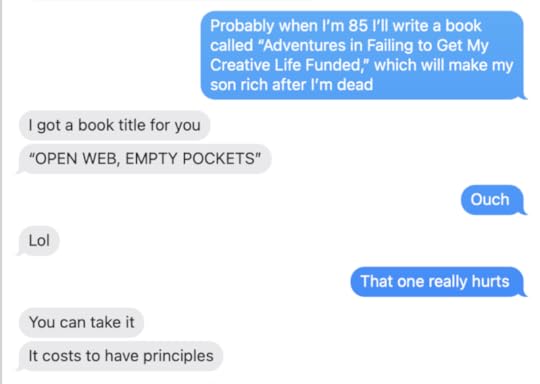
He has a point, but here I am, still, out here on the range — and when I decided to start a big project about the films of Terrence Malick, as I just did, I put it on the open web too. Why?
My economic model — post everything that I own on the open web and ask for donations at my Buy Me a Coffee page — suits my anarchist principles. Voluntary collaboration, give and give back, etc.
As long as I still have a full-time professor’s salary — that is, for the next thirteen months — I can afford to have at least a few such principles.
But when I lose that salary and have to downsize my life, I still plan to be here, because I don’t think I would gain much by moving to Substack, or anywhere else. I have a small audience and I am just not wired to do any of the things I would need to do to grow it — for instance, promote myself on Substack Notes, write clickbaity posts with clickbaity titles, etc. And that crap probably wouldn’t work anyway. Signing up to support me at BMAC may be slightly more difficult for most readers than signing up at Substack, but not much: I have no reason to think that if I went to Substack I would get an influx of new paid subscribers. I have my number, and though I’d love to get it to the Thousand True Fans stage, I’m not convinced Substack would help me do that. Besides:
Substack is a platform and platforms enshittify, they just do. They’re designed to enshittify, and to be unresponsive to their users. Substack is already a worse environment for writing and publishing than it was three or four years ago — to me at least, its attempt to transform itself into a social network is nightmarish — and it will degrade further rather than improve. If I end up needing more money because an endless war in the Middle East has gas at eight bucks a gallon and my electric bill at a thousand bucks a month, I’d rather work as a greeter at Walmart than write for a platform. Over the long haul I really do believe that the open web is the safer and better option, at least for me.
So here I am, writing away, and hoping that in my declining years there will be at least a little spare change in my pockets. And that I won’t have to take the Walmart Option.
P.S. Austin’s new book is gonna be terrific.
April 8, 2026
the rest is …
As regular readers of mine know, I have long been a big fan of The Rest Is History podcast: I joined the Club as a Friend of the Show within weeks of its inception. But in the last year or so the show has, or so it seems to me anyway, been declining in quality. Earlier episodes were typically informed either by the hosts’ own expertise or by their thoughtful assessment of the work of excellent historians. Lately, though, I’ve sometimes felt that I am listening to Dominic and Tom working their way through notes prepared by ChatGPT on the basis of Wikipedia pages — sometimes, not always, but often enough that I find myself not finishing series, something that would have been unthinkable for me, say, two years ago. But there’s just not sufficient value-added in such episodes.
I also have a sense that when they’re less intellectually engaged with the material, both hosts lean into the parts they play, Tom doing his (I hope intentionally) terrible accents, Dominic performing his crusty semi-posh scoffer from the era of Stanley Baldwin.
That kind of thing comes and goes, but what has come to stay, I fear, is a kind of compulsive mocking of anything and everything American. Perhaps this is the result of frustration with the current U.S. government that can’t be directly expressed — “We’re not a politics podcast,” as Dominic often says — but that is difficult to suppress. Such frustration is understandable, and if T & D did occasionally shout with anger at the latest imbecility emerging from the White House I would not only forgive them, I would cheer them on. But that doesn’t happen.
What does happen is a low-level but constant sniping and sneering at virtually every element of American culture. For instance: recently, in a series of episodes on the Ku Klux Klan, Tom decided that the Southern accent he wanted to imitate, in reading Klan speeches or newspaper editorials, was that of Cletus from The Simpsons, AKA Cletus the Slack-Jawed Yokel. A more pompous diction would’ve been more appropriate, but Tom wasn’t interested in reinforcing the point that these people were evil (which they were); instead he wanted to indicate that they were stupid (which, alas, they were not). I’m a Southerner, I’m used to this sort of attitude — it’s almost universal among non-Southerners, and especially common among Brits — but when it goes on and on and on, it gets wearisome.
I could cite a number of examples along these lines, all from episodes on U.S. history, of which there are many; and those might have worn me down eventually. But what has really alienated me from the show is the way such sneers make their way into episodes that have nothing to do with the United States. The breaking point came for me just a few days ago, when I was listening to the first episode of a series on Samurai culture in Japan. A passing reference to a group of Samurai visiting San Francisco prompted, for reasons unknown and indeed unimaginable to me, a digression on how terrible cheese is in America. Yes, that is correct: a seething hatred of my country’s cheeses found its way into a story about Samurai.*
When I heard that I recalled several other examples — though none quite as absurd — of sniggering at things American in episodes unconnected to this country. And it occurred to me that such commentary, while it is probably delightful to many listeners, is a kind of toll that I have to pay to keep up with The Rest Is History. If the show were as consistently good as it used to be I might — maybe — pay that toll, but it’s not. So I canceled my membership and deleted the show from my podcast feed.
* In this they did what cultural chauvinists always do: treat the best form of X in their culture as their standard and the worst form of X in another culture as that culture’s standard. Thus what their culture does is always, amazingly, better than what any other culture does.
redistributing
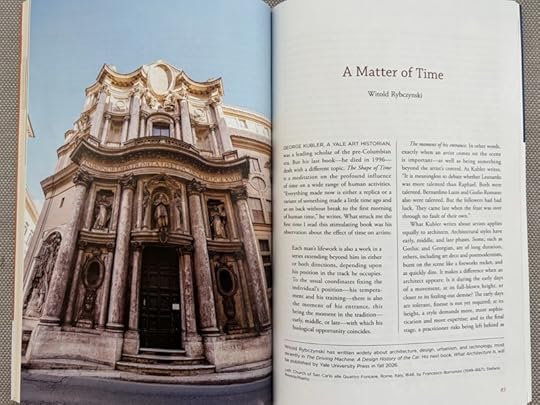
A wonderful essay in the new issue of Hedgehog Review, and a welcome reminder of how much better reading in print is than reading online: the beautiful high-resolution photography, the excellent typography and layout, the complete absence of flickering ads, pop-ups, notifications from other tabs or other apps.
How much is that kind of thing worth to you? Maybe not much, but it’s worth thinking about, I believe. I’ve written before about this, but let me reaffirm: There’s a lot to be gained through redistributing your media portfolio.
Forget streaming music: buy vinyl or CDs or even digital files. Listen to the music you love best until it wears grooves in your mind, just as we just to do back in the Media Stone Age. Infinitely better than filling your ears 18 hours a day with AI slop (labeled, lyingly, as coming from reputable musicians) on Spotify. For the amount of money you spend on one streaming service, you can in a year (especially if you shop with care) pick up enough wonderful music to last you a lifetime. If you buy digital files you won’t even need new equipment, but it’s worth remembering how cheap CDs are, even new ones. Portable CD players too.
Subscribe to fewer TV/movie sites. I’ve never subscribed to HBO or Hulu or DisneyPlus, and here’s my relationship with Netflix: every once in a while I subscribe for a month just to watch a few things I really want to see. Last time that happened? Three years ago, when Apollo 10½ came out. I don’t miss any of those services, ever. We have a family Apple Plus account, so when I want to watch digital movies or TV I use that, but mainly I buy Blu-Rays and watch the best ones over and over. If you don’t want to or can’t pay full price, you can buy them cheap from eBay or Half Price Books.
Subscribe to fewer Substacks and to more print periodicals. Keep them lying around and read them when you need a break from screens. Write in them. Cover them with sticky notes. Tear out pages you like and put them in folders, just as my late and much-missed friend Brett Foster used to do, if that’s what turns you on. (I loved looking through Brett’s scrap folders, full of torn-out pieces of newspaper and scribbled lines of poetry.)
Just try it! Cancel a few digital subscriptions and start enjoying the blessings of physical media, of really owning what you really like. After a few months you can go back to Rent-a-Life and full-time chasing the Discourse if you want. But I bet you won’t want.
April 6, 2026
comments
Now that I’m writing for The Dispatch, I’m re-acquainting myself with what it’s like to have comments on my posts. I learned the Iron Laws of the Comments Section many years ago, and only need to refresh myself. In a general-interest publication — as opposed to a personal blog, where people behave somewhat differently — these are the Laws:
98% of those who read your post do not comment on it. 90% of those who comment do not read your post at all: maybe the title reminded them of something they want to say on a related or semi-related subject, or maybe they’re just hanging out with other people who comment and you have nothing to do with the occasion. In this group are also the If-I-had-been-asked-to-write-on-this-subject-I-woulda-said commenters. 6% of those who comment read part of your post and then are struck or offended by something and simply have to comment immediately, without waiting to see if you have anticipated their response, without even waiting to see whether that paragraph that says “On the one hand” is succeeded by a paragraph saying “On the other hand.” These are the people who say that they are surprised or disappointed that you failed to make a point that in fact you did make: they just didn’t read far enough to see it. 3% of those who comment have read the post but don’t understand it. This may be their fault for reading carelessly or your fault for writing unclearly — but who am I kidding? Come on. It’s their fault. 1% pf those who comment are trolls. Those who have read and understood the post, whether they agree with it or not, will email you if they have something to say.March 30, 2026
against AI?
Paul Kingsnorth’s Writers Against AI campaign asks writers to make the following three pledges:
I will not use AI in my work as a writer.I will not support writers who use AI in their work.I will support writers, illustrators, editors and others in related fields whose work is entirely human-made.
I think I qualify on the first count? But it depends on what is meant by “my work as a writer.”
I use Claude several times a week, for various things. In some recent and wholly representative queries, I asked for
a basic Alfredo sauce recipe a limoncello recipe a guide to the Chicago Cubs 2026 roster, minor league prospects, and likelihood of success an explanation of the Newark airport’s bad reputation guidance for travel from Newark to midtown ManhattanNo problems there. But I think I may run afoul of Kingsnorth’s strictures in one significant way.
My chief means of brainstorming is to dictate thoughts into my Sony voice recorder. I have written (with Claude’s help!) a script that converts those .mp3 files into Apple’s preferred .m4a and uploads them to the Voice Memos app. That app automatically produces a transcript, which I then copy and paste into Claude with the following prompt:
I’m about to paste in a chunk of text. Please punctuate it and eliminate repetitions and filled pauses, but otherwise leave the text unchanged.
I do this on a fairly regular basis, and while I think that my “leave the text unchanged” order means that I comply with the spirit of Writers Against AI, I am not meeting the criteria demanded by the letter.
I’m okay with that.
Here’s another way in which I may not meet the pledge. I have no interest in writing a “personal” journal, but on the first day of every month I create a new text-file journal of ideas. Then at the end of each year I concatenate the monthly entries into a single file. I uploaded the 2020-2025 journals to Claude and asked for an analysis of the key themes, and asked especially for identification of the ideas that never bore obvious fruit. The results have been very interesting and very helpful.
For one thing, I learned — which of course I could have found out easily on my own — that in those six years I wrote 312,818 words in the journals. (Almost nothing! This blog contains roughly 2,200,000 words.)
Second, I learned that my kvetching about whether to keep using an iPad or not is “the most durable theme in all six journals. Explicitly self-condemned as ‘pointless’ since 2021. Present in every single year, including December 2025.”

But maybe the most interesting thing is this:
The theology of culture based on Ruskin’s Seven Lamps of Architecture has been flagged more times, more explicitly, and with more urgency than any other unwritten piece in the entire six-year corpus. Every time it surfaces, it is called something he “really should write.” It has never been written.
The Seven Lamps as a theology of culture would unite almost everything else in this analysis: the pre-evangelism / awakening affections project, the defense of beauty, the broken-world theology, the rehumanization argument, and his sustained engagement with Ruskin as one of the writers who refused to separate theology from aesthetics, ethics from economics. It is not incidental that this is the most flagged unwritten piece.
That’s … useful to know. But the reason I haven’t written this book is simple: I am the only person in the entire world who would be interested in it.
March 26, 2026
what’s in a name?
Probably many people have said this before, but it just occurred to me this past week as I have been teaching the dialogue under discussion.
The Platonic dialogue that we call the Republic bears the Greek title Πολιτεία (Politeia), which Allan Bloom suggests might best be translated Regime — or, periphrastically, “the organization of the polis.” But we do not know whether this is what Plato himself titled the dialogue or whether the title was provided by others. I suspect the latter, because I think Politeia is a singularly inapt title. Consider:
The dialogue begins with Socrates and friends (plus a rival or two) trying to decide what just action is. Does it consist, as Polemarchus says, in doing good to your friends and dealing out pain to your enemies? Or is it, as Thrasymachus says, nothing more than might-makes-right, the strong exercising power over the weak? Socrates, as is his wont, demonstrates the problems with both of these answers, but that doesn’t get anyone any closer to the correct answer.
So he makes the (rather strange) suggestion that because a city is something larger and more consequential than an individual, it might be helpful to ask what the Just City is — and then, if you can discern that, you can retrospectively apply that structure to individual persons. So off we go on a long — a very long — excursus on what a Just City would be and how you would build one.
But as the various arguments develop, Socrates keeps bringing his interlocutors back to reflection on the tripartite structure of the human soul: the rational part (logistikon), the spirited part (thumoeides), and the appetitive part (epithumētikon). He argues that just as the individual person should be governed by reason, so too the Just City will necessarily be governed by the philosopher, rather than the “spirited” warrior or the ordinary person driven here and there by his desires.
Increasingly, though, as we near the conclusion of the dialogue, the political concerns fade and Socrates shows himself concerned to demonstrate one final, absolutely essential triple argument:
A man will be just if he is governed by reason;The true philosopher is the just man;The just man is the happiest man.“Happiness” here is eudaomonia, which philosophers these days, aware of the superficial character of most modern uses of “happiness,” have learned to call flourishing. The just man — regardless of whether he enjoys wealth and power or, conversely, is convicted of and executed for impiety and corrupting the city’s youth — flourishes more than any other person. (Conversely, the tyrant, who is utterly in bondage to his appetites, is the unhappiest of men: he is afflicted by kakodaimonia.)
And the dialogue ends with the Myth of Er, which suggests that the cosmos itself inscribes reward for just men and punishment for wicked ones, especially for tyrants. The political questions which have occupied Socrates and his friends intermittently throughout the dialogue have disappeared, yielding to a sharpened version of the question with which we began: “What is justice?” has been rephrased as “What is flourishing?”
The title of this great dialogue should therefore be not Politeia but rather Eudaimonia.
March 21, 2026
Worf has feelings

There are some terrific episodes in ST:TNG season 5, but more than anything else this is The Season When Worf Gets in Touch with His Feelings. This happens over the course of several episodes, primarily through Worf’s interactions with Troi — and yes, I know they become an item later on. But let’s forget about that for now.
In “New Ground,” Worf’s son Alexander is misbehaving, and Worf tells Troi that he has decided to send Alexander to a Klingon school.
Troi: I see.
Worf: [Pause] You disapprove.
Troi: I’m not here to approve or disapprove of how you raise your son. My concern right now is how this decision is going to affect you. How will you feel when Alexander’s gone?
Worf thinks about and answers her question, and she tells him “You can’t hide from your feelings” along with other similar therapeutic maxims, which he takes on board. But that’s not what should have happened. Here’s what should have happened:
Worf: Of course you disapprove, and you mean me to know that you disapprove. If I were making a decision you approved of you wouldn’t ask any questions. I am proud to be an officer in Starfleet, and I see many virtues in the culture of the Federation, but one of the most annoying elements of your culture is its faux-neutral paternalism. You judge other cultures by your own values, and what you primarily want — indeed, demand — from other cultures is that they share your pretense of being nonjudgmental. The whole point of bringing a Klingon like me into Starfleet is to transform me into an acceptable facsimile of a Federation liberal — and I have to admit that the long slow process of gentle but constant pressure and manipulation is having an effect on me. But let’s not pretend that this softening of my Klingon sensibilities isn’t your purpose in this conversation, and the purpose of your Captain in having me on the Enterprise. Over time I will become more like you, but none of you will become more like a Klingon, will you? But I ask you to have this much respect for me: for the next few minutes, set aside the pretense and admit your disapproval of my decision. Then we may discuss the matter openly and honestly.
(Surely some right-wing cultural commentator has written “The Feminization of Worf: A Lamentation.”)
The inability of liberalism to interrogate its own premises, and its own level of commitment to those premises, is well-known to anyone who has encountered a regnant liberal society. Another 5th-season illustration of this willful blindness comes in the episode called “Ethics,” in which poor Worf, having been subjected already to liberalization, is now subjected to a spinal injury which costs him the use of his legs. He is operated on by Dr. Russell, a surgeon who turns out to be a habitual risk-taker: some of her previous patients had died while undergoing experimental procedures. And indeed her operation on Worf, while at first apparently successful, goes badly wrong, though the wrongness gets corrected and Worf eventually regains the use of his legs.
Afterwards, Dr. Crusher denounces Russell’s methods, and Russell shakes her head and walks away without a reply. But she could have, and should have, answered thus:
Russell: You know, Dr. Crusher, that Worf planned to enact the Hegh’bat, the Klingon suicide ritual, and only refrained because this operation offered him the possibility, which you could not offer him, of restoring the use of his legs. If I had declined to perform this operation, Worf would be dead. Is that the outcome you would prefer? To maintain your elevated principles at the cost of your colleague’s life?
To which the likeliest answer from Dr. Crusher is that she and the other members of the Enterprise could have dissuaded Worf from performing the Hegh’bat — that is, convinced him to repudiate his own culture’s ideals and replace them with those of the Federation. But for lovers of the Federation this would have been an unpleasant conversation to have — better for Dr. Russell to walk away in silence and spare us the discomfort.
The Federation on steroids: that’s Iain M. Banks’s great creation the Culture — about which I wrote at some length here. The Culture has its own version of the Federation’s Prime Directive, but here’s the thing: a prime directive is not an unbreakable directive. And as Carl Schmitt taught us, even the most liberal society, perhaps especially the most liberal society, must be prepared to declare a state of exception — the point at which the fundamental principles of the social order must give way to something more … rigorous. Banks’s Culture has a unit called Special Circumstances, and the whole point of Special Circumstances is to exist in the state of exception. Special Circumstances is where the liberal utopia becomes decidedly illiberal. A conversation from one of Banks’s novels:
“In Special Circumstances we deal in the moral equivalent of black holes, where the normal laws — the rules of right and wrong that people imagine apply everywhere else in the universe — break down; beyond those metaphysical event horizons, there exist … special circumstances.” She smiled. “That’s us. That’s our territory; our domain.”
“To some people,” he said, “that might sound like just a good excuse for bad behavior.”
Sma shrugged. “And perhaps they would be right. Maybe that is all it is ….But if nothing else, at least we need an excuse; think how many people need none at all.”
My comment at that point: “The liberal conscience at its self-soothing work!”
(There’s actually a Banks short story, “The State of the Art,” in which representatives of the Culture investigate the Earth and see clearly that the “incontestably neurotic and clinically insane species” that runs the place ought to be eradicated. However, humanity has produced Star Trek. So it’s a wash. They leave us alone.)
I bet there’s not going to be a story arc on ST:TNG in which Riker, inspired by Worf’s courage and honor, strives to transform himself into a Klingon warrior. But there ought to be.
Alan Jacobs's Blog

- Alan Jacobs's profile
- 542 followers

