Jutta Eckstein's Blog
July 21, 2021
Using Sociocracy for Deciding on Salary Increase
 During the meeting (that happens in a metaphorical circle), PO is the moderator and ensures everyone is heard and has their time to speak. First goes the person requesting, presenting work and what they expect to achieve on the next cycle. Then everyone else has time to comment and make observations of the presentation and the general work performance of the requester. It can be a hard conversation, and the facilitator is prepared to allow a constructive and direct interaction, maintaining a level of safety and support to the person. The group goes in rounds making comments and at the end decision based on consent is made. The salary request should is defined (all the numbers are open, and people can speak freely to defend their positions). The decision on this group is taken as final, and the salary is adjusted.Rules to invite someone to the process: Someone you have worked with collaborated with in the past and have experience with your work. People are incentivized to bring not only their direct coworkers but anyone their work affects.
I only participate in meetings like this for people that work with me, and usually don’t know what happens for others. We, as leadership, decide on the overall “salary increase budget”, without any saying on whats is decided on each specific case we were not invited. Before arriving at this process we had years of experimentation: self assigning salaries, no facilitation, flat increases, and salary tables…. and probably the next cycle will include some experimentation. The process can long and stressful for people and should change somehow.
A culture of feedback and inclusive conversations is a prerequisite to this. And we tend to monitor situations where people feel left out or not treated fairly. After 10 years on this, we are just scratching the surface
The post Using Sociocracy for Deciding on Salary Increase appeared first on Agile BOSSA nova – Jutta Eckstein & John Buck.


December 26, 2020
Improve your retrospectives by learning from science!
How well are retrospectives serving you? We assume you follow the retrospective agenda by starting with setting the stage, then gathering data, followed by generating insights before you decide on actions and close the retrospectives. We furthermore hope that at your next retrospective you look back to your earlier decisions in order to evaluate if you managed to implement these actions and if they made any difference.
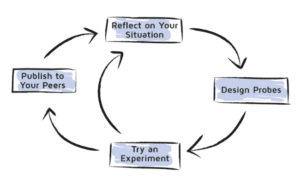
However, how do you know it was those actions that made a difference? Further, if they did make a difference, what kind of difference did they make? What you need to be able to answer these questions is a more scientific approach for your retrospectives. This means that for every action (or experiment) under consideration, explore what is your hypothesis – what do you assume will happen by taking that action? And moreover, how can you later tell if this hypothesis was validated or not?
It’s all about the logical process you follow. If you look at all the facts and decide to act on what seems like the best solution, you are being a good detective. You are using what is called “abductive logic.” That can lead to effective improvements, and yet it can also lead to a good deal of flailing around: the same problem occurring again or resurfacing in a different form – in any case it’s not solved. Another approach is to become a good scientist – to use “inductive logic.”
Inductive logic means that when a team during a retrospective thinks of an action to address a problem, it pauses to ask “What is our hypothesis?” An hypothesis says “Given this background and based on this general theory or accepted approach, if we do x, y, z, we expect to see the following outcome, which we shall measure by the following. Furthermore, we predict that the measurements will be l, m, n. This hypothesis forms the basis of an experiment.
Measurement is critical. You need first to know what your measurements are before you start your experiment so that you have something to compare to your later results! If you are uncertain about “how to measure anything” we highly recommend the book with that title by Douglas W. Hubbard. The measurements can be objective or subjective. Even better, you can look for ways to have a “control group.” For example, some people on your team try a new method and another team member keeps doing it the old way. Or, you might be able to compare between teams.
Only with a hypothesis and an experimental plan with adequate measurements will you be able to tell if you might need a different action or if you have to rethink your hypothesis. In our book on company-wide agility, we call this process “probing” and this helps you not only improve continuously but also innovate sustainably.
There is one more aspect to probes: the possibility of publication. “What happens in a retrospective stays in the retrospective” is a familiar mantra and must, of course, be respected. However, if you discover a process or procedure that seems to make a big difference, you may wish, with everyone’s consent, to tell others about your findings. Publication, in ways that respect the privacy of the retrospective, could be very important because the act of publishing your results asks others to try to replicate what you think you have learned. You will learn from their experiences and validate that what you have uncovered is truly a new discovery.
So consider developing probes in your retrospectives, becoming more like scientists and less like detectives.
Let us know how it goes!
The post Improve your retrospectives by learning from science! appeared first on Agile BOSSA nova – Jutta Eckstein & John Buck.
April 21, 2020
Narrathon: Creating & Sharing Probes for Nourishing Learning
posted by Siddharth Shukla (and below by Sanchita Mukhopadhyay, Nagini Chandramouli, and Charu Arora)
This year AgilityToday gave everyone a chance to learn more on Probes though Narrathon. A Narrathon, a peer learning experience, was organized where participants guided and mentored each other in capturing their learning as PROBES. Over all efforts was shepherded by founder & designer of Probes, Jutta Eckstein, and John Buck.
The group consisted of 10 people (including Jutta & John) from different locations working in different organizations as Scrum Master, Agile Coach, Transformation Coach, Individual Consultants etc.
John Buck
Deepti Jain
Jutta Eckstein
Siddharth Shukla
Ashish Agarwal
Nagini Chadramouli
Vikramjit Singh
Sanchita Mukhopadhyay
Charu Arora
Chetan VR
Complete Narrathon was divided into 4 online sessions across 3 months where complete group met and worked on their understanding on Probes. In between these sessions many multiple offline communications happened, and group members met in smaller groups to discuss and mentor each other.
During the period participants had the opportunity to choose any experiment that they did or want to conduct in their organizations. During sessions participants learned about Probes and its components:
Name
Background
Hypothesis
Safe-to-fail experiment
With continuous mentoring and guidance provided by Jutta and John as well as from peers, participants continuously worked on feedback and kept on improving the content which resulted in improved and better Probes.
At the end of Narrathon each participant had a completely different perspective about Probes and its importance. Before ending the complete learning and sharing experience all participants decided on next steps below are few common ones:
Sharing the knowledge and Probes within local meetup groups to get more feedback.
Cultivate a habit of experiment and form a community of practice to share each other learnings.
At last I would like to thank Deepti for taking initiative and organizing such learning sessions. And thanks to Jutta and John for guiding and mentoring us throughout this period and helping each one of us to learn PROBES.
Other participants experiences:
Sanchita Mukhopadhyay
When I joined Narrathon 2020 I never thought that it would be such an incredible learning journey for me. Thanks to John Buck and Jutta Eckstein for taking us to the world of writing probes, teach us how probe nourishes collaborative learning and culture of experimentation. We learnt What is Probe, Why should we probe, How to write/design a good probe, Why it is important to measure before and after experimentation.
The method of teaching was virtual yet so well coordinated, structured with nicely formatted learning content. It was an amazing experience of group learning with classwork, homework, break-out sessions and of course lot of fun with it.
The outcomes of this Narrathon (some good probes written by our group) are already finding their ways of publication and implementation. So our next steps are clear and I am sure we all will make best use of this learning by sharing with others.
Nagini Chandramouli
Narration: Ah.. We started with an expectation to explore what a “PROBE” is and Jutta Eckstein and John Buck took us through the background, format and the way a probe is written. That’s it , we all became excited and started converting some of our Agile challenges into our own PROBE.
We had 4 sessions where we reviewed each others PROBES, had group discussions, supported our PROBE with a hypothesis and an experiment which would result in measurable outcomes, fine tuned them, learnt from others PROBES, Improvising them, conducting these experiments in our work spaces , specially the concept of sfae to fail, and finally in the last session,
we all felt we learned a very new tool “PROBE” to help us think deep, experiment, socialize our challenge in a different way.
We decided to publish our finished PROBES to larger audiences and also help interested agilistes to learn about “PROBE”. Many thanks to Jutta and John for their guidance and mentoring during this journey and thanks to Deepti Jiain to provide this opportunity.
Now I have a new tool in my kitty to help me in my professional development.
Charu Arora
In today’s world where disruption has become the new norm, it is inevitable to achieve agility without experimentation. Equally is important how experiments are carried out and learning are captured from it.
Narrathon, an online peer learning series about probes- coached and mentored by Jutta Eckstein and John Buck has been a remarkable learning experience about experimentation.
The series constituted of well-structured sessions with focus on different aspects of probes. Starting from ‘situation to be addressed’ to ‘hypothesize with supporting experiment’, it also emphasized on validating the experiment with pre/post measures and ‘control experiment’ to further strengthen the reliability of results. Focus was also on scaling experiment to the next level as subsequent step. The series also highlighted the importance of sharing and publishing the learning which not only helps building knowledge but also in cultivating and promoting the culture of experimentation.
This whole learning journey wouldn’t have been amazing without wonderful peers who brainstormed and provided constructive feedback to each other’s probe.
Find out more
Description of Narrathon
Abstracts of Probes
The post Narrathon: Creating & Sharing Probes for Nourishing Learning appeared first on Agile BOSSA nova – Jutta Eckstein & John Buck.
September 9, 2019
Organizational Open Space for Unleashing Innovation
Today’s pressure on companies from VUCA and digitalization requires companies to be innovative at all times. Companies typically respond by organizing Design Thinking sessions, inviting employees to various Think Tanks, providing space for Start-Ups etc. Yet, these approaches are only single sparks in time, invite only a predefined set of people, and proceed from the assumption that management is responsible for inducing innovation. They jump to the demands of VUCA and digitalization rather than boldly leveraging VUCA and digitalization.
These methods often miss the innovative power of the whole staff. All too often people get hired if they look like a good match for a predefined job description and are then expected to fulfill that job. From the employee’s viewpoint, he or she looks at the job description and thinks, “I’m a good match and now I know what I am supposed to do.” From the employee’s viewpoint, he or she looks at the job description and thinks, “I’m a good match and now I know what I am supposed to do.” Yet, every individual has more to offer than defined in a job description. So, if their first priority is always to fulfill the expectations of that “job box”, the individual’s potential outside that box goes to waste. While few managers would likely dispute that the key to leveraging VUCA is leveraging every individual’s innovative potential, the reality is that managers don’t have the capacity to think about each individual’s skill set and design a way to use those skill sets effectively. Stacking and rearranging “job description boxes” is a lot easier than accounting for the individuals occupying those boxes. A question then is how can a company gain the capacity to “leverage VUCA by considering every individual’s innovative potential”?
There is a known facilitation technique for achieving this increase in capacity. Called Open Space (or to be precise Open Space Technology – see Owen and the principles listed in the Appendix), it has proven successful in mobilizing everyone’s innovative thinking during a one-time event. Many conferences or rather Unconferences use this power by saying: “do not to limit yourself by a predefined program, but to use all possible ideas of the people who are present to discuss (and solve) the issues that are present with the people.” So Open Space invites everyone to bring their full potential (and not only the expertise that goes with a predefined concept) to this one-time event, quite outside of their job descriptions.
Ensuring that a company can benefit from individuals bringing their full potential not only during a one-time event but in their daily work requires a different application of Open Space principles called “Organizational Open Space”: The primary change is that in an event, the “space is opened” at the beginning of the event and closed at the end. With Organizational Open Space (as it has been introduced by BOSSA nova, see Eckstein & Buck), the space is always open.
For example, video game developer Valve Corporation invites staff to suggest ideas about a new game or improvements to existing games whenever the idea occurs to them during the work week. If there are any colleagues who believe in this new idea, they will join together to make it happen. Another example: at W.L. Gore (the outdoor equipper) everyone is invited constantly to suggest a new product, a new feature (or maybe even a new process.) In both cases, if enough staff are interested in implementing this product, feature, or process, that interested group will pursue it. If there is not enough interest for the idea, the idea dies because the missing passion signals that it is probably not worth implementing. The opposite is also possible. If staff tires of an activity, they can stop doing it, so long as they take care of existing customers.
Note that passion in Organizational Open Space is always bounded by responsibility. You don’t suddenly drop a product line and leave loyal customers stranded or you don’t start working on a product that goes against the company’s ethical values. “Passion bounded by responsibility” allows a company to leverage the innovative power of each employee.
Organizational Open Space can be implemented in small steps, for example:
Invite employees to select their teams. In this case management decides upfront what work needs to be done and how many teams are needed, and then staff is invited to follow their passion and choose the team they want to work on (see Mamoli & Mole). This self-organizing step can be organized at a specially called event.
The next step could be for management to invite everyone to suggest what work needs to be done and what kind of teams will be needed to get that work done. Then everyone self-selects their teams as in step 1. The whole process can be implemented through a series of special Open Space events.
And as a kind of a final step, management can create an invitation, open at all times, for staff to initiate new products whenever they are moved to do so – or to sunset older products and services that have run their course.
When fully implemented, Organizational Open Space is not tied to special events. It is an organizational strategy (or if you will an organizational mindset or attitude to innovation).
Note that, there are a number of techniques with jargon that can be confusing. They sound similar to each other but are quite different. For example, the following shouldn’t be confused with Organizational Open Space:
“Open Space” is used for facilitating different events by many companies that are going through an agile transition. For example, “Open Space Agility” is an approach to implementing Agile that calls for frequent Open Space events to support the Agile transition. (see Daniel Mezick et.al)
“Liberating Structures” offer different facilitation techniques (amongst them Open Space) that can be used for different – agile or not – events.
“Open Plan” is sometimes referred to as an open space office. Open Plan is an interior design for offices in which people have space to collaborate in different areas, the space is open (no cubicles) and often people don’t have an assigned desk but work at a spot that supports their actual task best.
In summary, Organizational Open Space is not about facilitating a meeting but about using Open Space principles in an organization. As Open Space uses these principles for facilitating an event, Organizational Open Space uses these principles as a strategy to leverage the innovative potential of everyone working for the organization.
When deciding to “leave the space open at all times” you’re entering an advanced management approach that expands the responsibility for managing innovation to all employees. Innovation no longer relies solely on assignments via job descriptions, or a few “innovative” people (like the R&D department) or on specific events like think tanks. Innovation happens all the time by everyone.
References
Eckstein, J. & Buck, J: Company-wide Agility with Beyond Budgeting, Open Space & Sociocracy: Survive & Thrive on Disruption. CreateSpace. 2018.
Mamoli, S. & Mole, D.: Creating Great Teams: How Self-Selection Lets People Excel. Pragmatic Bookshelf. 2015.
Mezick, D. et.al: The Open Space Agility Handbook. Freestanding Press. 2015.
Owen, H.: Open Space Technology. A User’s Guide. Berrett-Koehler Publishers. 2008, 3rd ed.
Wikipedia on Open Space: https://en.wikipedia.org/wiki/Open_Space_Technology
Appendix
Open Space Principles
From Wikipedia on Open Space: https://en.wikipedia.org/wiki/Open_Space_Technology
Whoever comes is the right people …reminds participants that they don’t need the CEO and 100 people to get something done, you need people who care. And, absent the direction or control exerted in a traditional meeting, that’s who shows up in the various breakout sessions of an Open Space meeting.
Whenever it starts is the right time …reminds participants that “spirit and creativity do not run on the clock.”
Wherever it is, is the right place …reminds participants that space is opening everywhere all the time. Please be conscious and aware.
Whatever happens is the only thing that could have, be prepared to be surprised! …reminds participants that once something has happened, it’s done—and no amount of fretting, complaining or otherwise rehashing can change that. Move on. The second part reminds us that it is all good.
When it’s over, it’s over (within this session) …reminds participants that we never know how long it will take to resolve an issue, once raised, but that whenever the issue or work or conversation is finished, move on to the next thing. Don’t keep rehashing just because there’s 30 minutes left in the session. Do the work, not the time.
In addition to these five principles there is a law available, called the “Law of Two Feet”: If at any time during our time together you find yourself in any situation where you are neither learning nor contributing, use your two feet, go someplace else.
The post Organizational Open Space for Unleashing Innovation appeared first on Agile BOSSA nova – Jutta Eckstein & John Buck.
March 15, 2019
Yes, Cross-functional Teams, but Real Ones!
If you start with Agile, one of the first things you typically do is come up with a team. And yes of course, the team will be cross-functional. But what’s actually meant with cross-functionality? At first people (in software) understand this as different kind of developers (e.g. backend & front end experts) and also testers are working together at the same features / user stories. And, there is even some business knowledge in the team through the product owner. That is fine, but this is only a start. In fact, if you check with the Agile Fluency Model this is the first shift for your agile journey and is called the ‘Team Culture Shift’.
Yet, if a company decides an agile team isn’t enough it will invest in a different shift. And some of those other shifts require implementing real cross-functional teams. Meaning, the whole team has the full business expertise, knows the market, can even disrupt the market and isn’t waiting for some person (e.g. the Product Owner) to decide on priorities. It also means the team fully understands the company’s business and has a holistic view of it, knowing its contribution to the company’s value stream. Thus, a cross-functional team is overcoming the limitations of the classic stovepipes in organizations.
Like a lot of other companies, one of our clients, an insurance company, is currently facing the challenge of digitalization. They now understand that digitalization means software is their product and no longer insurance policies. In this company, the teams in software are using Scrum. Next to software there is the business and the mathematicians who have the domain knowledge about insurance. The next leap is bringing these different units together (not only through the interface of the Product Owner) to form teams that are actually as knowledgeable about business, contracts, mathematics, sales, marketing, and everything else that is relevant for the company’s value stream as they are in software. The leap means for the Scrum teams that they can’t “hide” behind their backlog or the Product Owner, but need to explore and learn about the market, their customers, and the company’s value stream themselves. Basically it means that now the agile teams’ focus is beyond software.
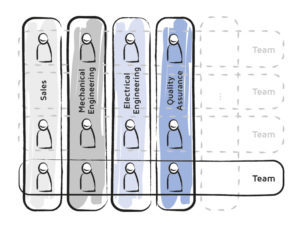
Another example: a large charity, a university, a construction company. What would a cross-functional team look like in one of those organizations? First, the organization might have classic stovepipes. Schools of a university would focus on music, or English, or economics, or agriculture, and so forth. They would publish in different professional journals and be invited to attend totally different professional conferences. Thus, a cross-functional team at a university might include professors from widely different schools as well as representatives from the administration. But, what would they focus on? Their customers of course! Their customers would include students, the various professions and industries they serve, and also the other members of the university. They would produce insights gained by combining their studies. (Note: this output would be something other than the classic survey course for freshmen that might look at a topic from the standpoint of various disciplines but rather a real synthesis of those disciplines.)
As can be learned from the Agile Fluency Model, it is fine to start with cross-functional teams that span the different software expertise and support these teams with some business know-how. Yet, if you are thinking of implementing company-wide agility, the expertise of real cross-functional teams spans beyond software and comprehends the whole value stream. In order to do so, ask, does the team really mirror our overall organization in its assignment and authorized scope of action? Are additional skills or more empowerment needed to make the team mirror the whole?
The post Yes, Cross-functional Teams, but Real Ones! appeared first on Agile BOSSA nova – Jutta Eckstein & John Buck.
December 4, 2018
How can you make salary decisions jointly and thus equivalent?
We often get asked how to make performance evaluations or discussions about salary increases more equivalent and agile. In general, also for cases like these, you can use inspect-and-adapt – so, consider what makes sense (the plan), execute, inspect, and then adapt it.
Here’s an example: A colleague of mine, who is the director of a company, reported that they used this approach to make the decisions on salaries more agile. However, it wasn’t the management starting this process (note, any change can start anywhere), instead it was a small group of people who decided on a series of experiments. At first all members of the small group decided to make all their salaries transparent amongst themselves. This created already some discussion both within this group but also in the whole company. Then that group even went a step further and they made their salaries transparent to all their colleagues. More and more colleagues followed their role-model. The discussion that followed triggered the creation of a new process that they changed also a few times and is currently settled like this:
There is an elected person taking part in all salary discussions (salary representative)
Before salary discussions start, management calculates how much money is available for increases (increase budget)
Management defines a set of company interests that are so important that they should be supported by every employee (e.g. the employee helps to achieve both customer and team satisfaction)
In the salary discussion meeting the following people take part:
The person under discussion
Two people the person under discussion invites (typically peers)
The elected salary representative
The director of the branch the person under discussion works
The salary discussion follows a defined process:
Agreement on the goal of the meeting
Open discussion which completes the picture about the person under discussion by hearing from all perspectives on the person’s growth, achievements, or under-achievements.
Everyone decides by playing a card how the person under discussion is doing in terms of the defined company interests. The cards reflect if there are examples that the person has shown the support of this company interest, e.g. if the person has tried to support it, has supported it sometimes, is supporting it many times, is even inspiring others to support that goal, or if there are no such examples. The group doesn’t try to reach consensus on this, it only uses the company interests and the cards for heaving an in-depth exchange and completing the joint understanding on the person’s contributions.
Knowing the person’s actual salary, everyone writes secretly on a sticky note the suggested new salary. After everyone has shown their suggestion and provided some rationale, the group agrees on a suggested new salary for the person.
Only after all salary discussions (with all employees) have been carried out, the management adds up all the deltas of the suggested salary increases and verifies if this is within the increase budget. If the sum of all deltas overruns the increase budget, all deltas are proportionally deducted.
This is a very specific example of applying company-wide agility. Yet, we invite you to look at it as an example probe that you can use -maybe in an adapted way- in your own context. We look forward to hear about your experience!
The post How can you make salary decisions jointly and thus equivalent? appeared first on Agile BOSSA nova – Jutta Eckstein & John Buck.
August 21, 2018
No Organization is an Island
Being connected to society is an essential ingredient to long-term profitability. If a company is not giving back to society, it is likely to be viewed as untrustworthy and distrust will undermine all aspects of the business (including finding talent).
For example, some years ago a large European insurance company announced that it would make a huge Agile transformation. Last year, it had a very profitable year, it was swimming in money – perhaps related to its decision to use Agile. However, the company has announced that it will sell its company sports facility, end the current employee subsidy, and rent it to a company that runs luxury fitness clubs. The company will make more profit from the property, but now many of the employees will not be able to have sports access. Society understood this news as “if the company is really Agile, why are they treating their employees like that?” and “that company is really greedy – watch out if they want to do business with you,” and “I wonder what other damage they are doing?”
 Is your company doing a good job of participating in society? One typical metric is economical, but what about environmental, societal, or social? Note, that these metrics influence each other. It is not just a marketing question, “How do people perceive our company.” There are deeper aspects such as the impact on morale when employees are genuinely contributing to society, a perspective that the company is actually doing good for the society it is part of. Even customers may feel inspired if they know that the money they are paying the company is not just going for profit but for societal betterment.
But, how can your company become a warmly welcomed member of society? One way is to participate in networks. Following we list a number of networks that may possibly interest you – or at least inspire you to look for networks relevant to the type of work you do.
Global Compact : A United Nations call for companies to align strategies and operations with human rights, labour, environment, and anti-corruption principles.
Climate Group : A powerful network of companies and governments to ensure prosperity by keeping global warming under 2°Celsius.
Institute for Multi Stakeholder Initiative Integrity : A nonprofit that promotes collaborations between businesses, civil society and other stakeholders that seek to address issues of mutual concern, including human rights and sustainability.
For a more complete list of suggested networks see Part IV of our book Company-wide Agility with Beyond Budgeting, Open Space & Sociocracy.
Involvement can start anywhere. You can take the initiative to recommend company involvement in large networks such as these. However, beyond that what about your department? Can your department or unit get involved in your local area. We are thinking of the story of a group of programmers who decided to adopt a foster child by contributing to a nonprofit organization. They contributed money, letters to the child, and built a relationship with the community in which the child lived. Needless to say, on the job, they were a very productive group of programmers!
The post No Organization is an Island appeared first on Agile BOSSA nova – Jutta Eckstein & John Buck.
Changing the Culture by Changing Habits
We hear people often say that an Agile transformation implies a culture change and that this culture change refers actually to a change of the mindset. However, what does this really mean, and how can you possibly change the culture (or help others do it)?
The very first answer is, you will not change the culture and / or mindset by talking about values, or printing the values together with the company’s vision in big letters at the front door. In our experience, culture only changes when habits and behaviors change. One of the definitions of culture is: “It’s the stories we tell ourselves about ourselves” — and the stories are based on our experiences based on our behaviors. So, different behaviors and thus habits lead to different stories. Of course, a well done story (for example, a moving speech by a respected senior leader) can also affect behaviors. So, if you want to change culture, where should you focus in this complex system of behaviors and stories?
What kind of behaviors should you focus on, which ones will make the differences an Agile transformation requires? To answer this question, we look deeply at the company’s basic make up. What makes a company? It is actually the strategy (referring also to the company’s purpose), the structure, and the processes. This is sometimes also stated as the company:
Is an organization (expressed by its strategy)
Has an organization (shown by its structure)
Is being organized (exposed by its processes)
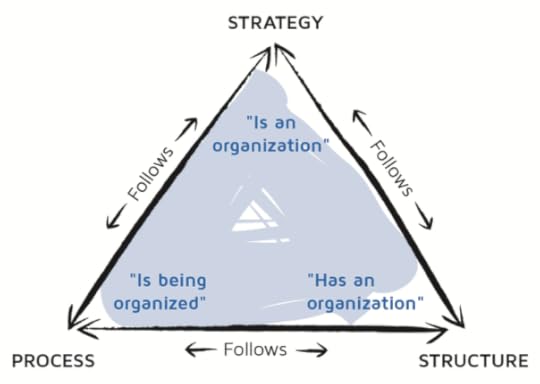
The interesting thing is, strategy, structure, and processes influence each other. So if you start changing one, it will have an impact on the others. (If you’re curious, you can search with your favorite search engine for “strategy follows structure” and for “structure follows strategy.” You’ll find there are many reports, even research studies either way.)
Now, coming back to that question: What kind of behaviors you should focus on: Actually it doesn’t really matter. You can start changing behaviors in terms of your strategy, your structure, or your processes and the unchanged part of your company will follow at least a bit, which makes culture change both easy and hard. It would be nice to have a recipe and, on the other hand, you can just start e.g. with your biggest pain points, your research, or what speaks most to you.
For example, you could start changing your structure by using self-selecting teams for your next project. You would identify:
The goal of the project (or product).
The skills and capabilities needed (which could also be acquired on the go).
The amount of people and / or teams are needed.
And then …
…invite people to self-select if they want to work on the project and in which team.
You will notice quickly that the team will start coming up with a process that will suit them best, because the invitation and empowerment for self-selection leverages their commitment to everything involved with the project. (And most often, you will find that they will make some corrections: a few different skills are actually required and more or less people than you originally thought, etc. They will start adapting right away..)
You are also likely to find that the change toward self-selected teams has great innovative power, often leading individuals and teams to suggest new products and projects because invitation often triggers passion. Moreover, the people who take part in this self-selection experience will share this experience with their peers. The experience will become one of the stories employees tell in- and outside of the company about themselves. Those stories will in turn affect future behavior.
Culture will not change by propagating different values. Culture can only change by changing habits and behaviors. These in turn will change values, plans, procedures, and norms and finally the “stories we tell ourselves about ourselves” regarding our bottomline assumptions and beliefs. And although changing the culture of a company takes a long time, changing a behavior can be done quickly. Thus, you can easily change your culture one behavior at a time, and the stories about that one behavior will ripple out to change other behaviors.
The post Changing the Culture by Changing Habits appeared first on Agile BOSSA nova – Jutta Eckstein & John Buck.
July 28, 2018
BOSSA Nova Leader In Singapore & Taiwan
This article is the fourth in a series looking ING, Ericsson, Spotify, Statoil, Titansoft (of Singapore), Walmart, and BOSSA nova. “BOSSA,” a synthesis of Beyond Budgeting, Open Space, Sociocracy, and Agile, provides an overall framework that can guide probes and experiments for implementing company-wide nimbleness and agility.
Yves Lin of Titansoft contributed his insights to the new book about BOSSA nova called Company-wide Agility with Beyond Budgeting, Open Space, & Sociocracy in which he describes how Titansoft deeply practices its motto “Never Stop Improving!” A 12-year old company with 200 employees Singapore and Taiwan, Titansoft offers games as well as software development and systems services in 10 languages and 50 countries. Yves describes how Titansoft’s motto has made it the first company in the world to adopt the full BOSSA nova synthesis. It is a story of continuous experimentation and learning.
Titansoft and Agile & Scrum
“In 2014 Titansoft started to adopt Agile and Scrum. The reason back then was simple. We just thought that “Agile is faster”. What happened in the next three months after the adoption was unexpected. We started to realize the power of Agile lies in the transparency it creates. We are now able to inspect what we are doing and improve ourselves constantly. We had two product development departments and 5 teams in Singapore then. In terms of organizational structure, we made some changes seeing how Scrum emphasizes self-managing teams. There are no more team leads in teams. No one within teams has authority over other members. The Scrum Master is positioned outside of the team and elected by the team.
“Things appeared to be running well. People started to have more communication and share their thoughts more openly. While these were good signs, we also found ourselves facing new problems. What about communication across different teams? Across departments? Beyond physical offices? We started to see long discussions happening within teams. Decisions not being made due to disagreements. Most critically, the organization goal was not being communicated to teams.
“We needed a way to create common visions and align goals across the organization, and learn how to broaden everyone’s perspectives and understand each other. Early 2016, we started to find ways to overcome these new challenges. The first few approaches we experimented with were facilitation and Open Space. Learning from the experts, we engaged the Institute of Cultural Affairs (ICA) trainers to conduct ORID (analyze a situation Objective, Reflective, Interpretive, and Decisional) and Consensus workshops and trainings for our senior staff.”
Open Space
Driven by its motto, Titansoft did not stop with Agile.
“Our first organization-wide Open Space theme was: ‘As an organization as well as individuals, what can we do to support each other to grow?’ It was a day where the entire company was invited to take a break from work, come together and discuss topics relevant to the theme. Some topics concluded at the end of the day included: training packages for newcomers, what’s preventing you from growing as an individual, building vulnerability-based trust in teams and full stack PHP development.
“Recognizing the positive feedback from staff about our first Open Space, we decided to plan for our next. Our second company-wide Open Space in the same year was themed around: How can we create the most impact in the next three months? Results from both Open Spaces were evident. We saw members raising varied topics that concerned them, heard differing opinions across roles, and most importantly, employees were given opportunities to listen to diverse perspectives beyond their own. The difficult part emerged after the Open Space happened. How do we sustain momentum for the action topics generated?
“Another learning took place, and we decided to try something different again. We hosted our first Participatory Strategic Planning Workshop facilitated by experts from ICA in the same year. A two-day workshop bringing together people across the organization to create strategies for action which will be led by champions to bring back and work on within teams. Through a structured planning process which incorporates consensus building, focused conversations, and an implementation process, we were able to generate a company-wide strategy led by champions in various areas.”
Sociocracy in Titansoft
Although they saw fascinating results from facilitation and Open Space approaches, problems endured: action and implementation plans still failed to be carried out.
“Could it be because the action arenas did not fit into teams’ daily tasks and there were no official chain of controls from departments to teams? Tasks related to products were accomplished; however, organizational tasks related to recruitment, training and public affairs were easily neglected and left in the dust.
“We introduced the sociocracy framework to the organization early 2017 to address these issues, focusing firstly on creating the circle structure and double-linking for more transparent flow of information. The key driving factor behind the adoption was the need to scale effectively. We believe that sociocracy can further strengthen intra-team and inter-team self-organization and communication, and install a communication chain flow from departments to teams, ultimately driving the execution of organizational tasks.
“The double-linking model encourages participation in policy decision-making by members of both circles. Each circle has its own focus and in-links can drive team to move forward. The higher circle and top circle is now more aware of what is happening in teams and able to surface problems earlier. Members have clearer channels to give feedback through two-way communication. Policies, strategies and company-wide goals are more easily clarified and circulated among circles, forging stronger alignment together.
“Yet, sociocracy is not without its limitations. First and foremost, it is a complex framework consisting of many patterns and principles. Many patterns are easily adopted, but prioritizing which one to work on and mastering the framework is challenging. It is difficult to see how far we can go in adopting sociocracy, and success stories are few. The in-links can also easily become the bottleneck for information flow, as they carry more responsibilities including representing decision-making for the team.”
Beyond Budgeting
As of this writing, Titansoft has started experimenting with the 12 principles of Beyond Budgeting to integrate its personnel and financial management systems into its agile philosophy and to reap the productivity benefits that can flow from a deep trust culture. They believe it will provide a infrastructure vital to the company’s future growth.
We can only wonder, where will Titansoft’s “Never Stop Improving” journey take them next![image error]
The post BOSSA Nova Leader In Singapore & Taiwan appeared first on Agile BOSSA nova – Jutta Eckstein & John Buck.
July 9, 2018
Does Walmart Do The BOSSA Nova?
This article is the third in a series looking at ING, Ericsson, Walmart, Spotify, Statoil, Titansoft (of Singapore) in relation to BOSSA nova. “BOSSA” a synthesis of Beyond Budgeting, Open Space, Sociocracy, and Agile, provides an overall framework that can guide probes and experiments for implementing company-wide nimbleness and agility.
Todd Kromann of Walmart contributed to the new book about BOSSA nova called Company-wide Agility with Beyond Budgeting, Open Space, & Sociocracy in which he describes Walmart’s rapid adoption of Agile. With 11,718 stores and clubs in 28 countries, operating under 59 different names, Arkansas-based Walmart is the world’s largest company by revenue and the largest private employer in the world with 2.3 million workers.
According to Todd, a tiny cohort of four agile coaches was able to invite thousands of information technology (IT) employees and contractors at Walmart to shift the organization’s work from 10% agile to 90% agile in less than two years. “We simply invited the people doing the work into Open Space, in more than 30 one-day events, hundreds at a time.”
Using Open Space, Walmart found it was possible to accelerate the probe and experiment process that underpins many transformations from months and years to a few days by engaging everyone and their imaginations in the process.
“We didn’t impose a methodology, a tool or a metric. We offered invitation, autonomy, and options. We asked everyone to find ways to make their work more agile. That was the purpose, and all the ideas went up on the wall, completely open and transparent. As the work took off, ‘Agile Champions’ helped the four coaches spread the invitation and the results.
“Formally, the business adopted agile concepts such as founder’s mentality, design thinking and Team of Teams. These were promoted from the CEO level and the IT coaches had little involvement. Walmart has several agile ‘thought leaders’ on it’s board of directors and they contributed to the net effect.”
Involvement of the very top levels of an organization seems key to any transformation. In essence, the Board members brought into the company wisdom accumulated in their years of experimentation in other settings. Furthermore, they didn’t order a transformation, they invited everyone to join in.
Because Walmart’s process was very open, it’s hard to define the scope of the project. The scope could be as low as 4000 or into the 10’s of thousands, depending on whom you ask. The Bentonville, Arkansas business departments were included (it was open) and business folks usually opted to attend. However, it is not clear how far agile ideas flowed beyond the IT arena.
“Today, I get reference checks for Agile coaches from Walmart, and these are often people I’ve never met. Any of our champions claim that title. I think that’s a side effect of an open transformation. So, the concept of 4 coaches is only correct in the narrow sense of 4 people whose full time job was coaching. By the end we scaled up to 6 full time coaches in Bentonville and perhaps a dozen worldwide. This was federated so, again, it’s hard to define.
“While the numbers are hard to pin down, the net effect is not. We are now 100% agile in that it’s more awkward to opt out than to opt in. We no longer have any Agile coaches. If you ask anyone at Walmart how we became agile, they will likely say they did it by themselves