
Barry Miles's Blog
September 7, 2026
July – Aug
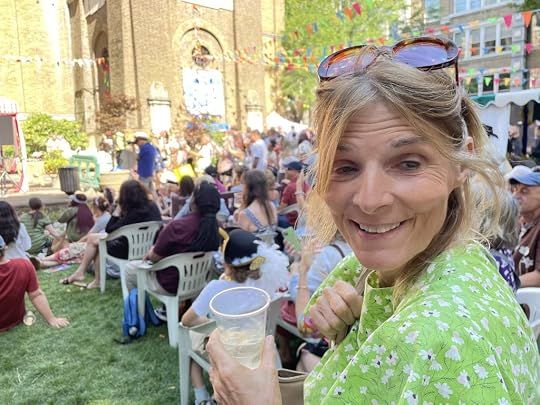
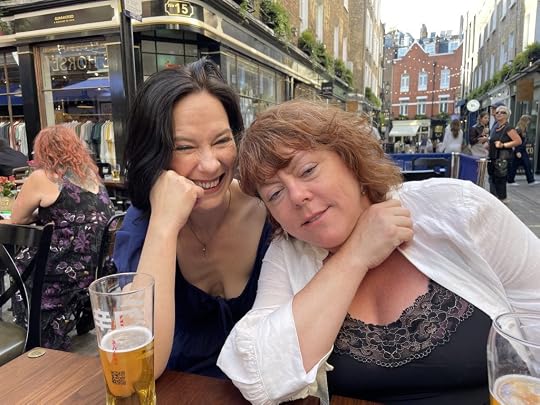
July 19th was the annual Soho Fete. This is a village event, not aimed at tourists. Soho is a village despite being in Central London and a surprising number of people live here or near here and know each other. The fete is the same each year: the snail race, the tug-of-war between the police and the fire fighters, the French House drinks bar, the drag acts and the community singing. This year I went with my old friend Harriet. There weren’t enough seats as usual so in the end we slipped over to the White Horse in Newburgh Street, where I knew we’d find Lucy and there she was, with Celine from the Academy Club.
Next came a quick visit to see Marsha in Norwich. More sunshine and fresh air. It was just a long weekend but worth it to see her.
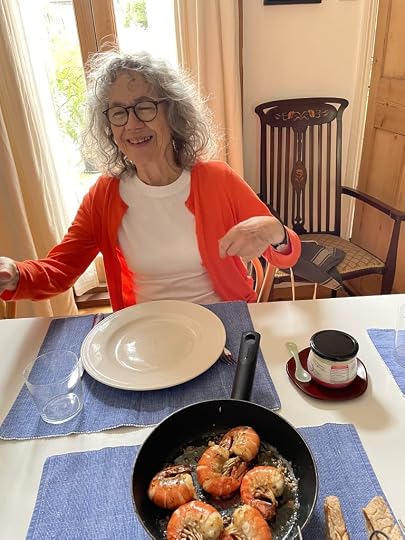
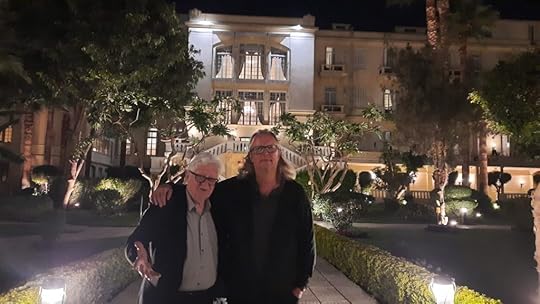
More travel when I went to Liverpool on August 7th. Problems with the train both ways, but that’s typical of Britain and one of the reasons I try not to leave London except to go to the airports or on Eurostar. But Liverpool was fun. I was there to help Catherine Marcangeli finish her work on the Adrian Henri archive. We found some treasures and of course wined and dined. Here she is with Steve. It’s a fabulous house. Again a short visit with no time to see other friends or look at Liverpool.
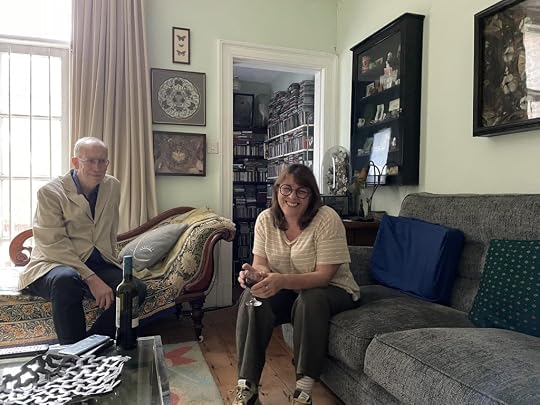
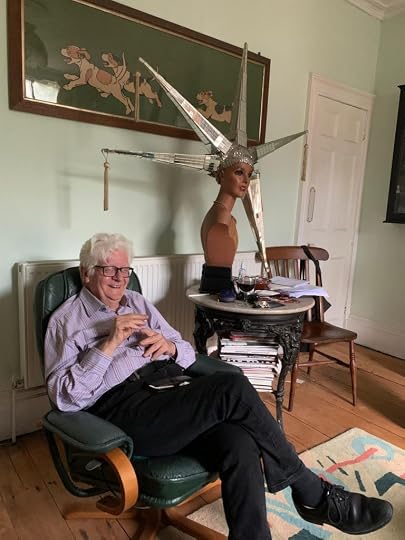
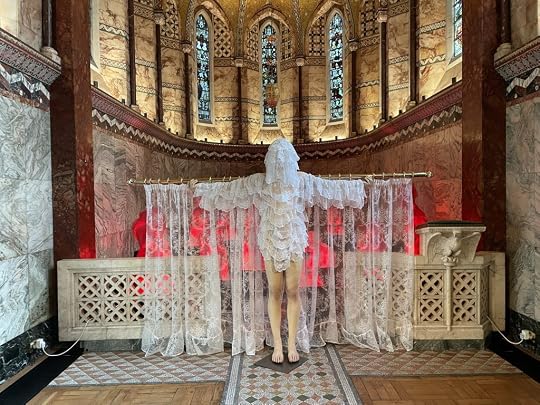
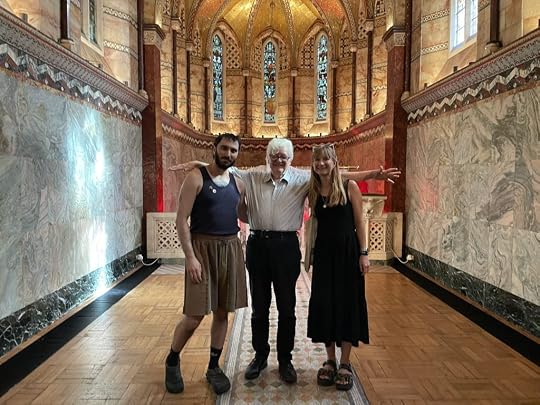
Back on familiar ground, the Fitzroy Chapel just round the corner from where I live. Hannah and I stopped by to see Furniture World, Sam Keelan’s new film and installation. It’s wonderfully British: ‘Furniture World is a film about a man whose body is merged with a netted curtain.’ It’s an attack on middle-class values so watch out! Here we all are in the chapel: Claire Watt on the right is the David Bowie Research Fellow at his archive at V&A.east who came to talk about David’s interest in Burroughs.
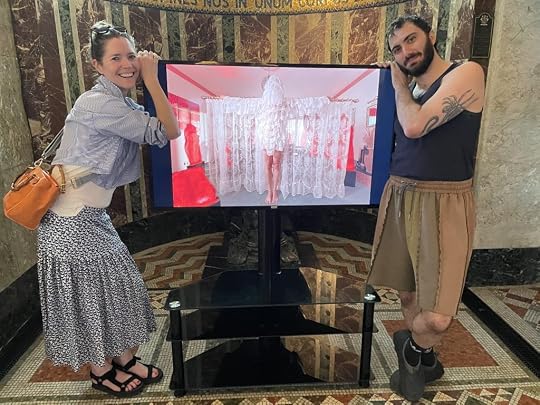
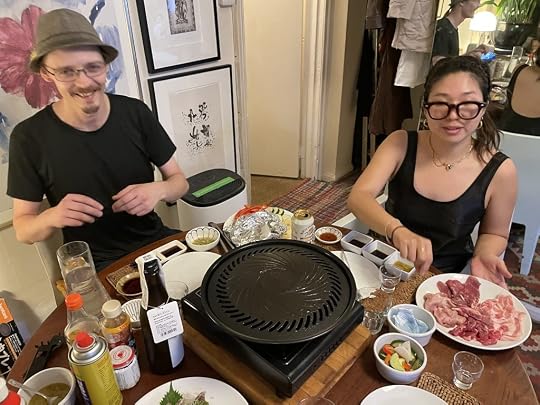
Next we have a family shot: Minako has bought some new kitchen equipment and it works. Theo looks on happily.
Hannah Watson publisher of Trolley Books, is doing the third and final volume of my ‘autobiography’: In The Eighties. In fact it extends a bit into the nineties to finish off the stories of my friendships with Allen Ginsberg and William Burroughs who both died in the nineties. I’ve worked with Trolley before on several projects. It is largely a photographic and visually oriented press, and we are putting a lot of photographs into this new book, rather like the illustrated edition of my In The Sixties.
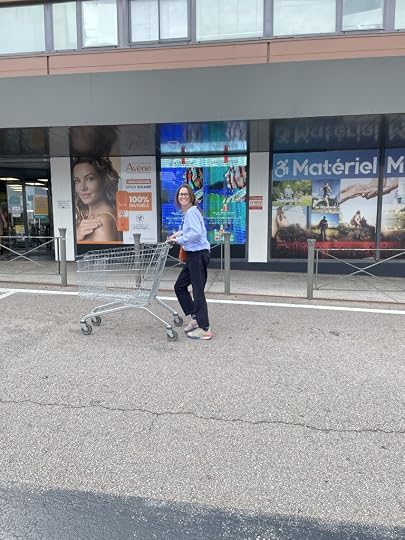
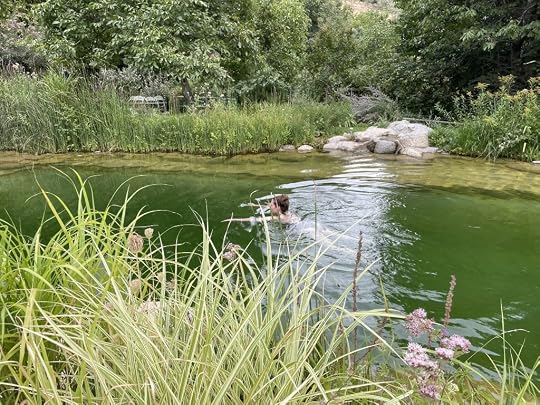
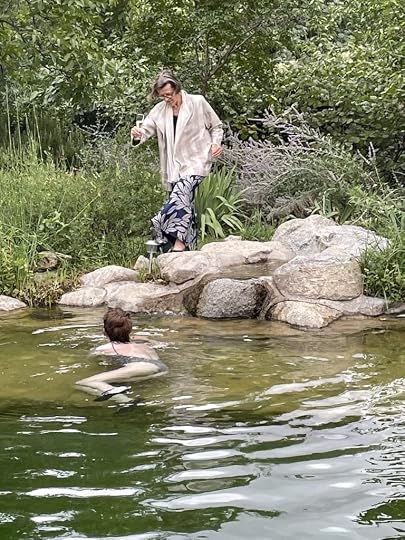
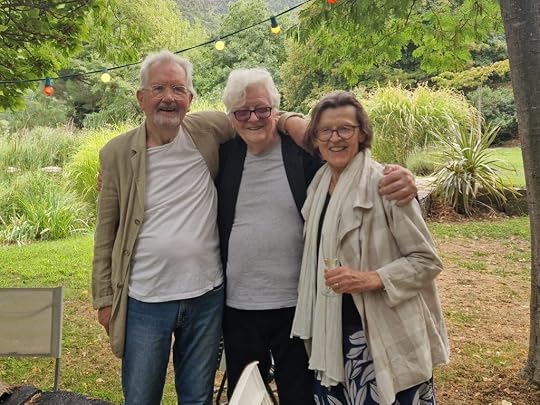
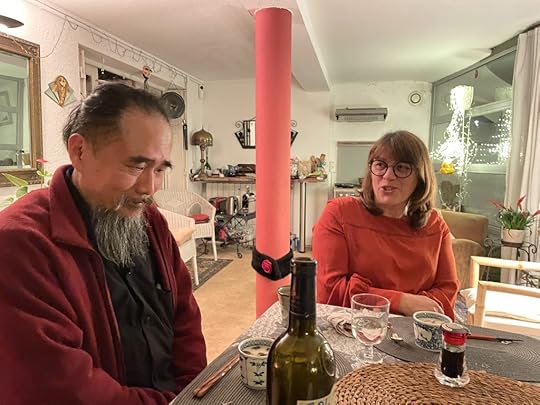
In order to work with no distractions we went down to France for a week where we could position all the pictures without interruption. We did it and even had time for a few dinners with friends. Here’s Hannah with a trolley – obviously – and seeing how an earlier publisher dealt with images. My old friend Martha had us over for a swim and a meal. Here is Martha bringing a glass of bubbly to Hannah in the swimming pond. Such a considerate host. My friends Gordon and Roslyn, who have appeared in this blog before, were also at Martha’s for a proper Pyrenees summer dinner.
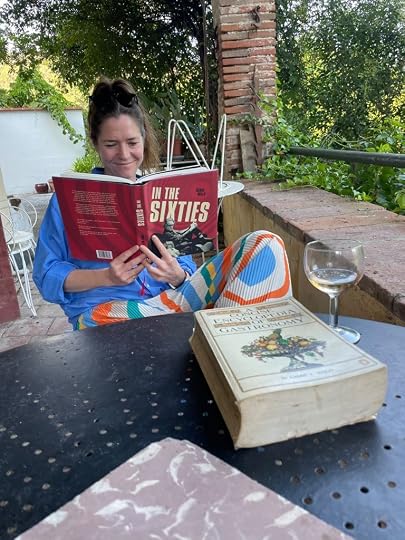

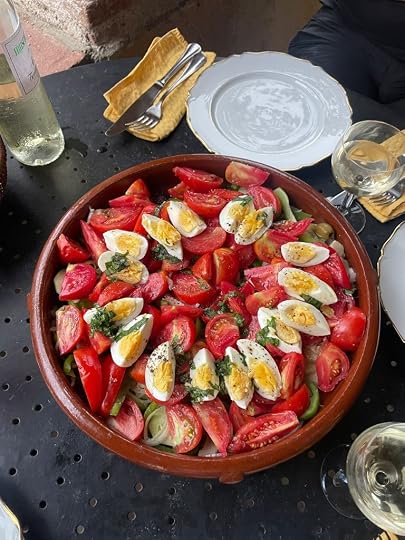
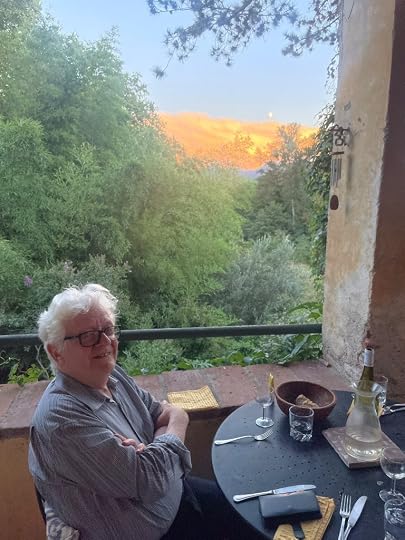
Back at the house, Richard Grayson and Suzy Treister came over for the night. I had been reading Cuisine Nicoise, by the disgraced mayor of Nice Jacques Medecin. His recipes are very strict. Hannah made a correct salade niçoise (no potatoes, no boiled vegetables, no vinegar) that I followed with a daub niçoise and it all went down well. That evening there was a terrific electric storm so loud we sometimes had to stop talking because it was so loud. There was a tornado near Carcassonne, which is not that far away. The sky that evening appeared to be on fire.
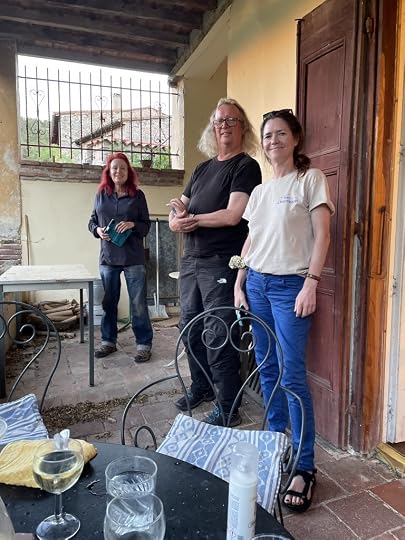
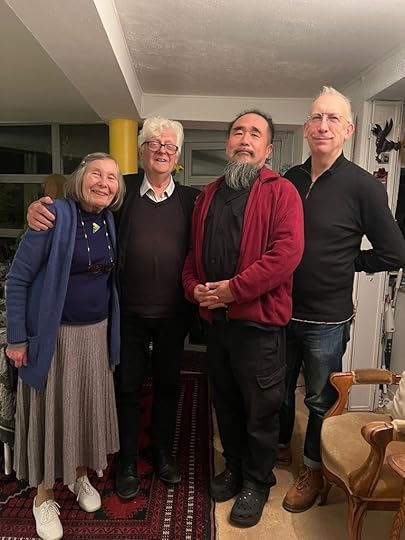
On September 1st, Luzius Martin came to town from Basel. Following our usual pattern, he and Terry Wilson dined with us one night, followed by a restaurant the next day. After eating in Dean Street we found ourselves in the French, as you do, where we ran into Clive Jenkins and, following the rules of the Dean Street Shuffle, continued on to Gerry’s, which I hadn’t been to in ages and where they had a entertaining little combo using a real double bass, which I always like. It was a proper Soho evening. Here’s Terry and I at the French, and with Luzius and Clive at Gerry’s.
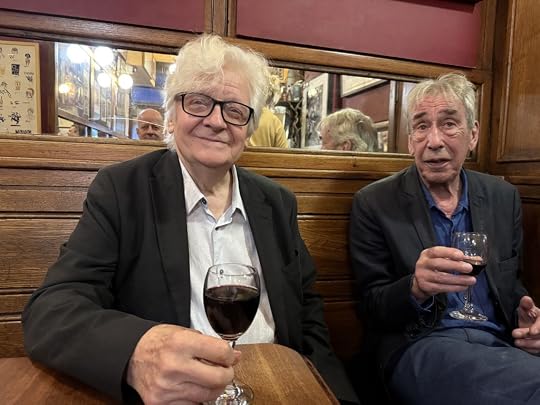
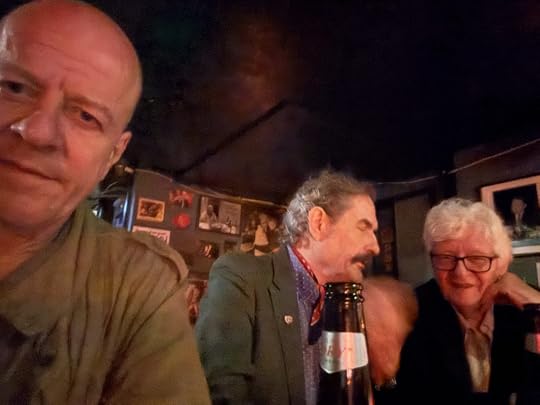
On Friday the 4th, the European Beat Studies Network annual conference opened at the Horse Hospital. The theme this year was William Burroughs in London and they had invited Iain Sinclair and me to give a conversation moderated by Oliver Harris. It seemed to go okay. I got a few laughs and read them a text by Bill from the early eighties showing his fond memories of the place:
Dalmeney Court. What a dreary, dreary interlude that was. The hangovers, the dead end hopeless when my adolescent K said: “We never had a chance!” The Angus Steak House. How many diners there alone after three quarter of a pint of whiskey, half a bottle of inferior Beaujolais with the steak and baked potato a bit unsteady of course they loved me there. I can see the head waiters smile. They were Spanish I think or Italian. The snotty clerk at, forget the name, the other shop like Fortum & Mason. “Are you next sir?” And pretending not to find what I am pointing at. “You mean this sir?…or this…oh that.” A weary time. Guy Fawkes had the right idea. Blow the whole shit house sky high.
Of course Bill didn’t always feel that way. His history in any city was to initially complain and dislike it, then grow to love it, then eventually to grow dissatisfied and begin to hate it again. This applied to Mexico City, Tangier, Paris, London and finally New York in the seventies and eighties.
I found the conference arrangements a bit strange: there was no stage. There is now a bar on the raised level in the room – perhaps that is where water was available. The speakers were seated in the dark and back lit, and therefore, if you could see them at all, it was hard to see their faces. I seemed to know about half the audience: Demi Raven and Janet, Kurt Hemmer and Erin, Lars Movin, Michele Corleoni to name just those who had come from abroad. Hannah came to check out the place and Roberta bought Burroughs masks, as seen here.
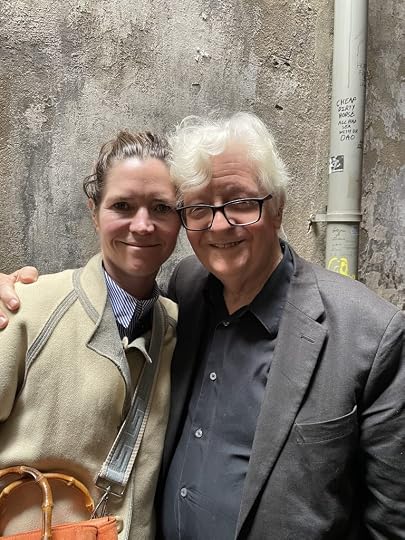
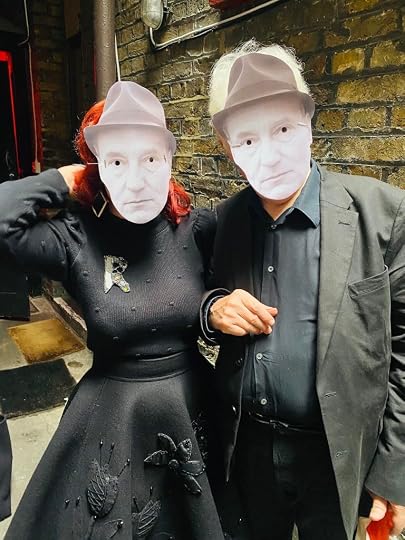
And let’s not forget the continuing struggle of the Palestinians to get their country back. From the river to the sea, it’s all Palestine.



July 18, 2026
July
Jesse Goodman and his friends had been working hard for several months to put on the London end of the celebration of Allen Ginsberg’s 100th anniversary. There were other events in San Francisco, New York and in Continental Europe. In London there was a concert at Queen Elizabeth Hall, with a large number of musicians all reading or singing Allen’s poems to a musical backing. This was followed by two days of panel discussions at Swedenborg House. For me, the celebrations began when Camila flew into town to take part because she had arranged for the organisers and other friends to visit William Blake’s cottage in Felpham. The day after that I had organised a dinner for ten of the participants at my place. Then came the concert and after that the two days of panel discussions, both of which I participated in. By the end of it I had almost lost my voice and was totally exhausted but it was a wonderful experience, and I think Jesse, Peter Hale and their pals did a terrific job.
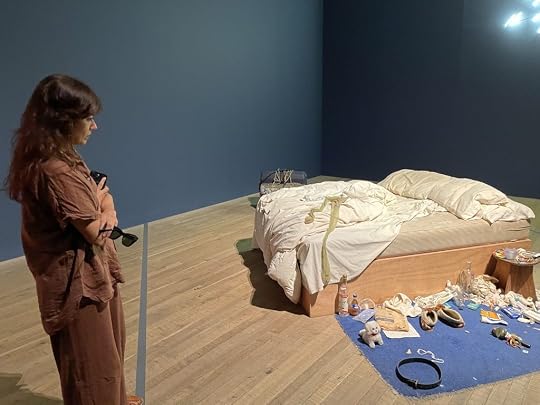
Camila arrived on July 9th and we had time to quickly catch the Frida Kahlo and Tracy Emin shows at Tate. I like Emin’s work as a conceptual artist, but her drawing is appalling; truly awful: there’s no form, no weight, no spatial awareness. Naturally she was made professor of drawing at the Royal Academy. That’s Britain for you.
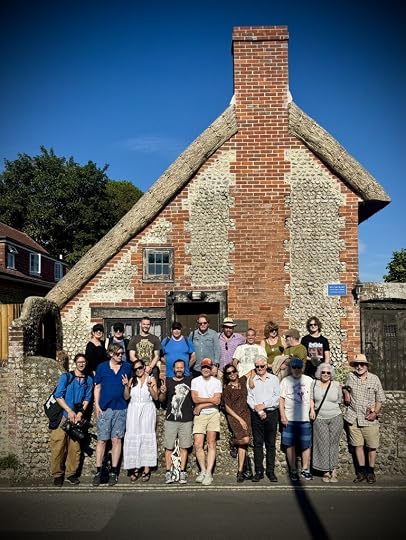
Next day came the Magical Mystery Tour. Camila is on the board of both the Blake Society and the William Blake Cottage Trust and arranged for us all to visit the cottage which is on the Sussex coast. Ginsberg had been there and managed to gain access when it was still lived in, and of course, Blake was one of the greatest influences on Allen’s life. Nineteen of us, including Jesse’s parents visiting from Chicago, Thurston Moore and Eva, Gina Birch from the Raincoats, Peter Hale who runs the Allen Ginsberg Trust in New York, Stephen Coates, Steven Taylor Allen’s accompanist, and the rest of us piled into the coach at Swedenborg House and made the long trip to Felpham. It was long because the coach driver insisted on a half hour break after only two hours on the road.
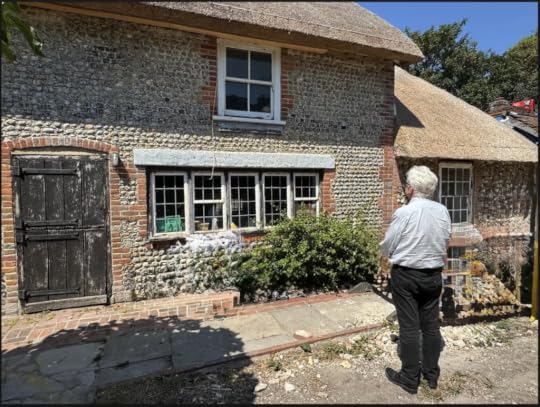
The building is still standing, but the doors and windows are not original, much of the pointing is new, and it obviously has a new roof – thatch doesn’t last long – the staircase is new and many internal walls are missing. Though it is still where Blake lived for three years 1800-1803, there is no trace of him, no vibe, no sense of his presence. It seems to me pointless to try and recreate the building as it looked during that particular point in time. There is not enough there to restore, and no artifacts of his have survived so any future furniture and furnishings will be conjectural. I say this as a lifetime member of the Society for the Protection of Ancient Buildings, (SPAB) where our philosophy is always to preserve the complete history of a building, not attempt some fanciful reconstruction of an imagined past.
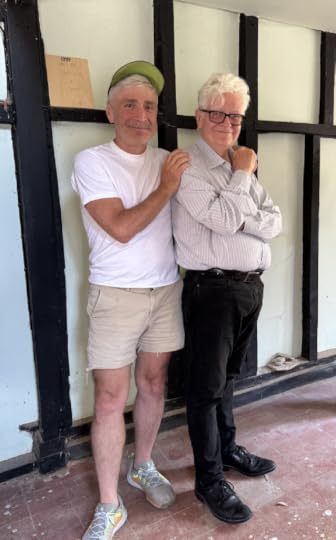
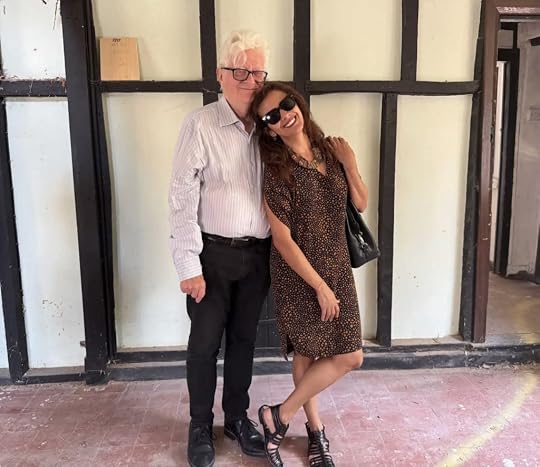
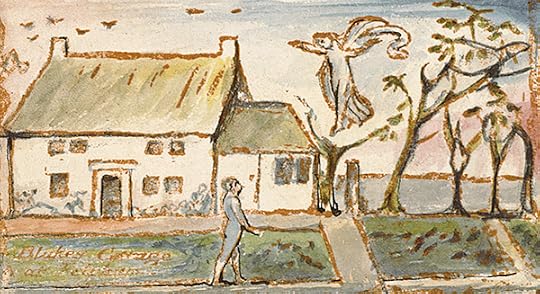
They have already taken off a floor to create a one-story extension as drawn from memory at a later date by Blake in the margin of a page from Milton, which shows how much the building has changed. (The sketch also includes an angel, which they are not hoping to recreate.) It would have been better to leave it and use the space for storage or administration as the new look is purely conjectural. Here we see the new pointing above the new window, a disgruntled SPAB member, me with Peter Hale and with Camila.
That said, it is still an admirable venture and should be supported. The intention is to house a Blake Museum there and one of the artifacts will be the pump organ that Allen used to compose his musical settings of Blake’s Songs of Innocence and of Experience.
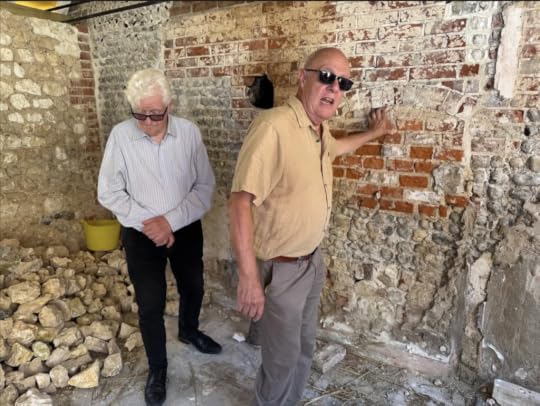
After a tour of the cottage, which is really a building site and therefore quite dangerous, we moved on to the Fox, a local pub outside which Blake had a confrontation in a story far too long to tell here. The pub has repositioned itself as part of the Blake heritage industry but was in fact burned down in 1947 and was rebuilt so is not the building that Blake once drank in. It is still an attractive place for a drink though their food is absurdly overpriced and not particularly good. The sea is only two minutes’ walk down the road from the cottage and Gina managed to have a quick swim.
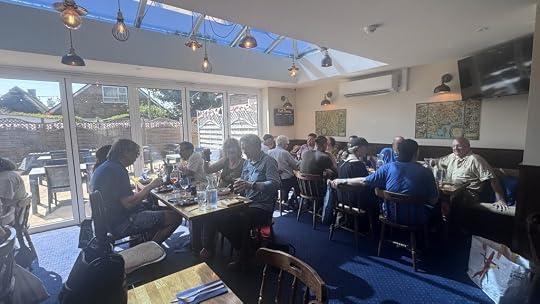
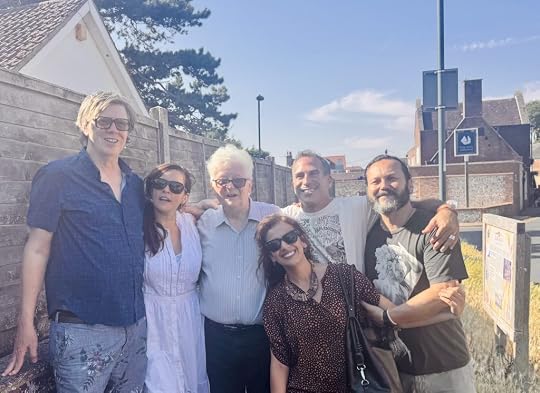
Here we have the coach party at table and the obligatory group shot: Thurston, Eva, Me, Camila, Jesse and Maxi. It was a fun day and I very much enjoyed it.
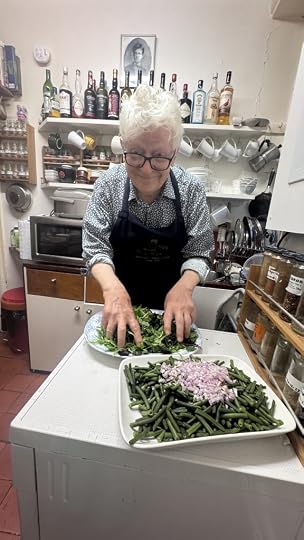
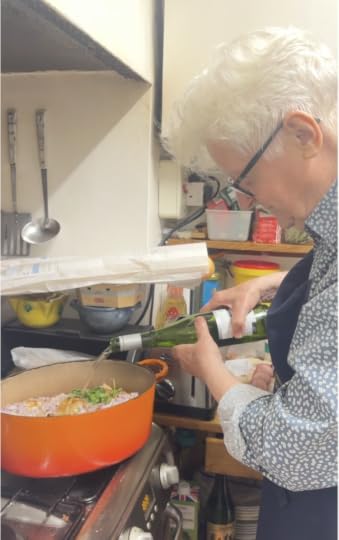
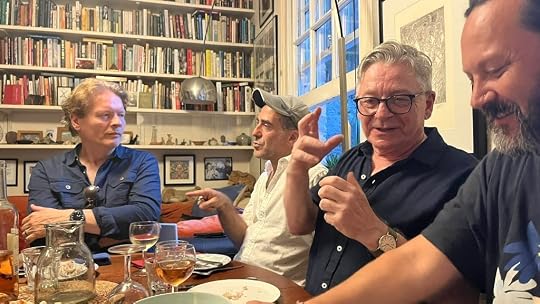
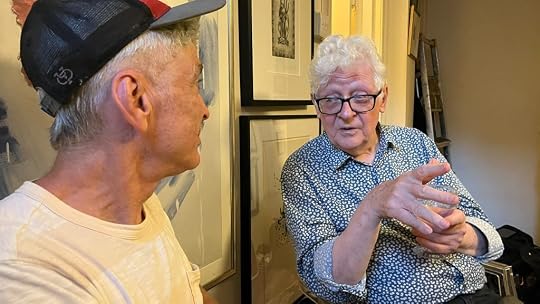
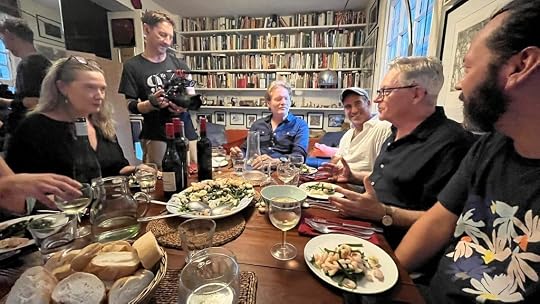
Saturday, the next day, I had arranged a dinner party for ten people. Steven Taylor, who was Allen’s accompanist from 1976 until his death in 1997 and Judy came, along with Jesse who organised the London celebrations and Maxi his partner; photographer Antonio Pagano; Peter Hale who runs the Allen Ginsberg Estate in New York; Stephen Coates, composer and media connection, and film-maker Ben Northover who you would find unnervingly shooting behind your shoulder just as a tasty bit of gossip was about to be revealed. Camila and I completed the numbers. Here we have part preparation of the starter, watched over by Rimbaud, followed by the addition of wine to the main chicken and cream course. Then comes Stephen, Jesse, Steven and Maxi, followed by Peter Hale and I in deep discussion and Ben filming Steven’s conversation. Most of the wine was French.
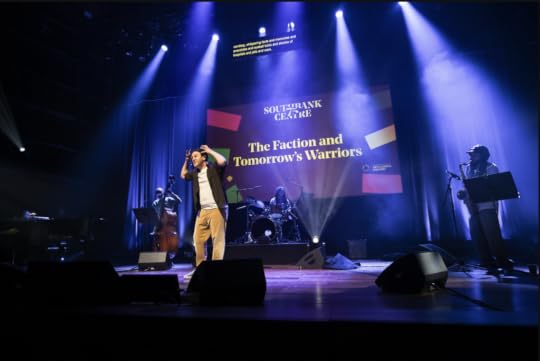
The main event occurred at Queen Elizabeth Hall on the Sunday; an extraordinary display of talent, when a dozen or more artists performed Allen’s poems to a wide variety of musical settings. The Faction and Tomorrow’s Warriers did Howl evoking forties Bebop with a classic jazz lineup of piano, saxophone, bass and drums. The Faction himself had, astonishingly, committed the whole of Howl to memory, though his delivery of it was, perhaps not surprisingly, a bit thespy.
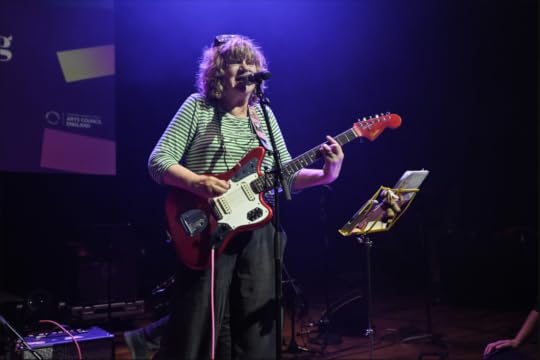
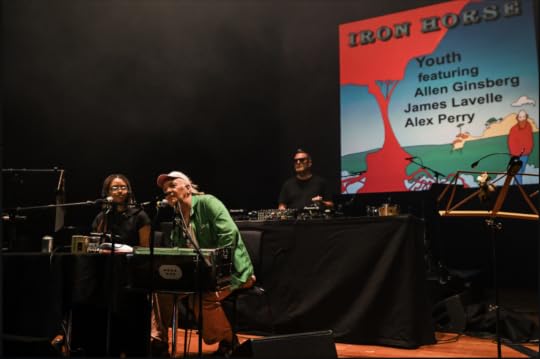
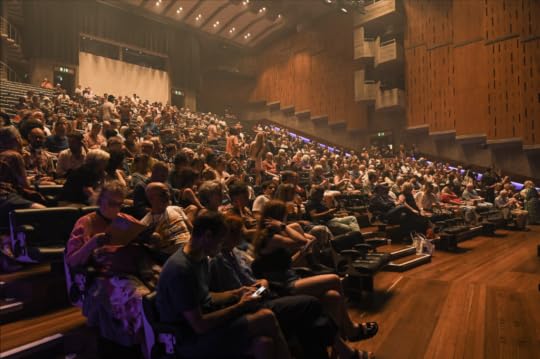
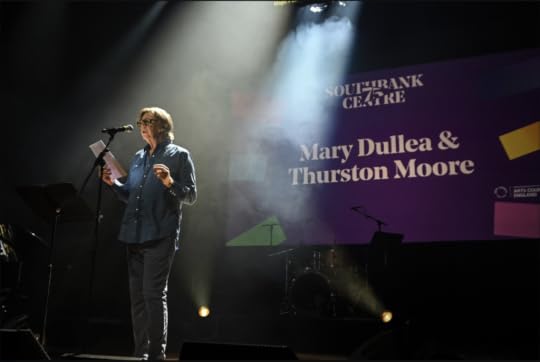
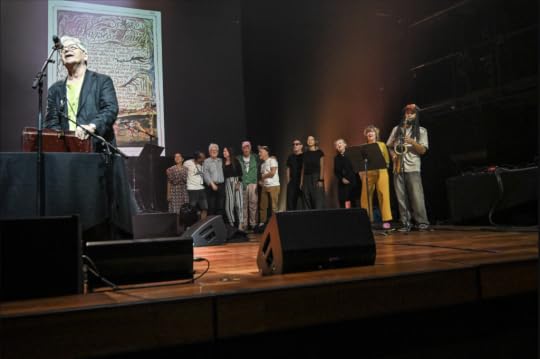
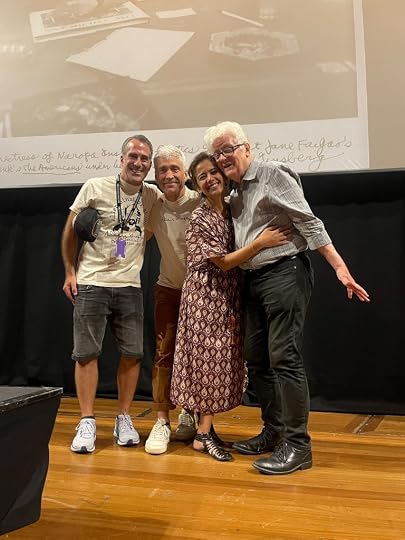
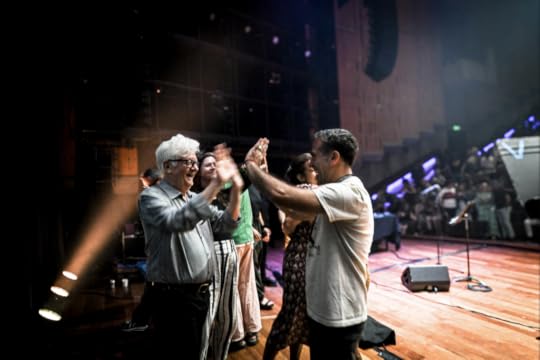
Other performers included Thurston Moore solo and with Mary Dullca; Stew, Art Terry & JT Taylor; Gina Birch & Karen Townshend; a remarkable rendition of ‘Iron Horse’ by Youth featuring Alex Perry; Joelle Taylor; and a rousing version of William Blake’s ‘Nurses’ Song’ by Steven Taylor in which the full cast, joined in. Jesse got Camila, Hannah and me to join he and Peter Hale in the lineup next to Youth, Gina and the others. I can now tell people I’ve performed onstage at Queen Elizabeth Hall! Here are Antonio Pagano’s beautiful pictures of the event, beginning with Gina Birch; then Youth; The Faction showing the combo; the all-important audience; Thurston Moore and finally Steven Taylor performing William Blake’s ‘Nurses Song’ with us all in the background chorus line. As you can see, we were very pleased with the way the whole event had come off. The last picture shows me congratulating Jesse who organised it all with Peter Hale, who is also shown here with us.
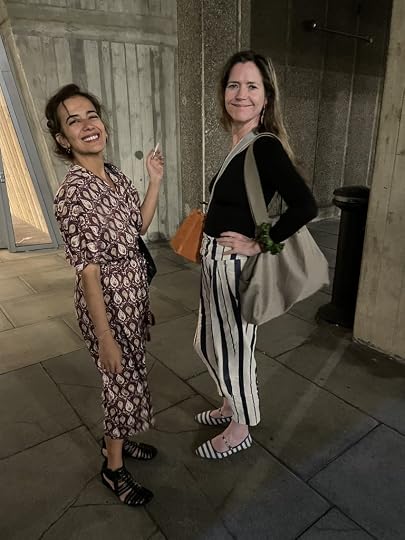
There were drinks afterwards but in keeping with the usual early-night-for-everyone policies of Britain, the bar in the Hall closed earlier than a pub normally would and we were ushered to a different building, where it turned out that the bar had also just shut. Here are Camila and Hannah between bars.
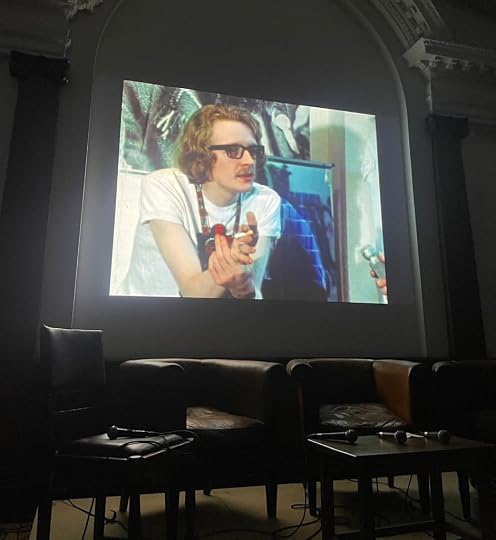
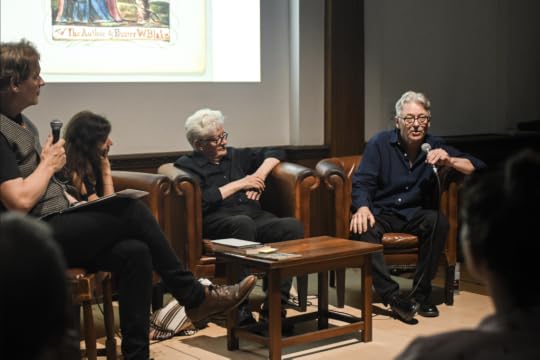
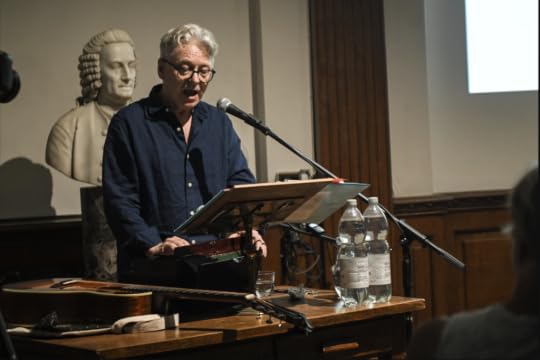
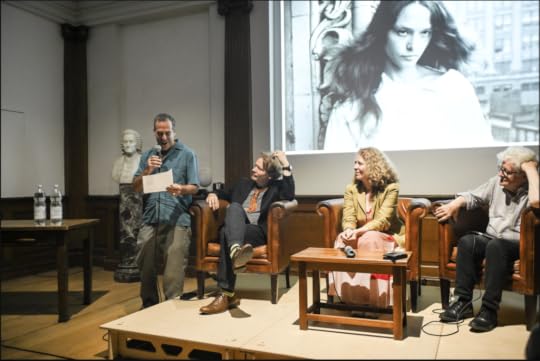
The next day, July 13th, saw the first of the panel discussions. It opened with a screening of Iain Sinclair’s 1967 film Ah! Sunflower. I am interviewed in it and someone called out ‘Theo’, the name of my son, when I appeared on screen. It’s true, he does look a lot like me then. In the first half Stephen Coates moderated a discussion between Camila, Iain and me about Allen in Britain, his relationship with Blake, and the making of Iain’s film. Then, after the interval, he directed Camila, me and Steven Taylor in a discussion about Allen’s music, before Steven played some of the numbers that he and Allen did together. Here we are, first with Iain, then with Steven.
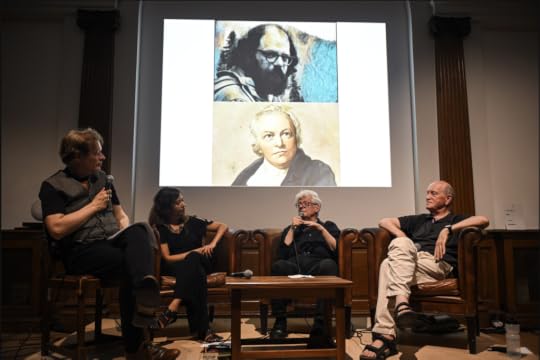
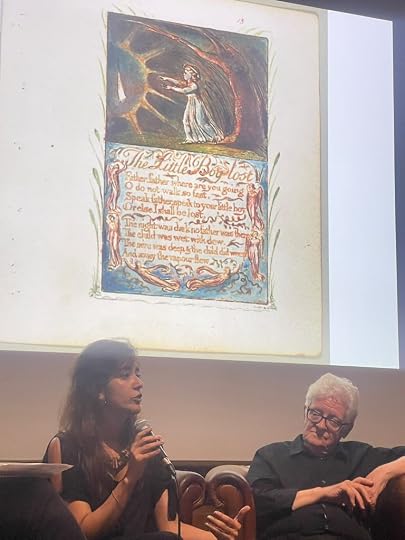
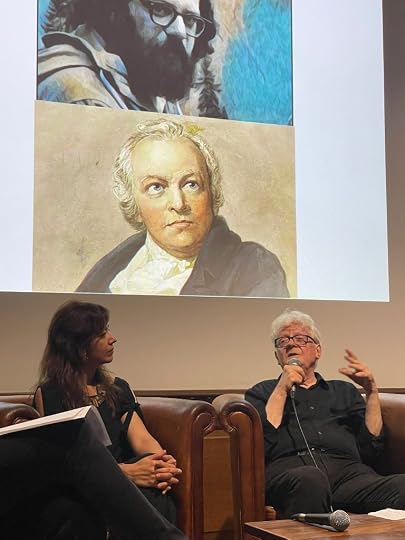
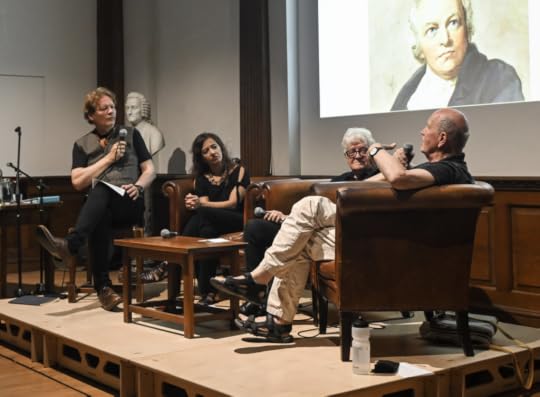
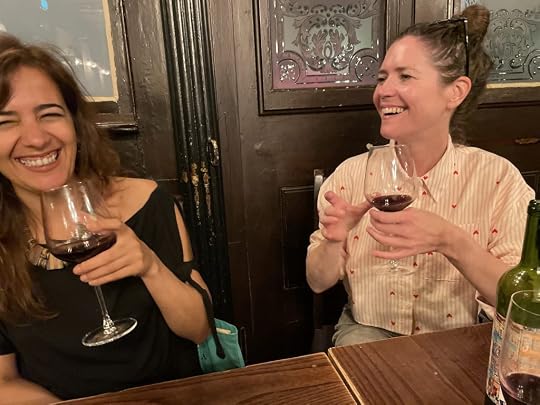
Afterwards Camila, Hannah, Roberta and I repaired to the Museum Tavern, where they, of course, closed early as we were the only customers.
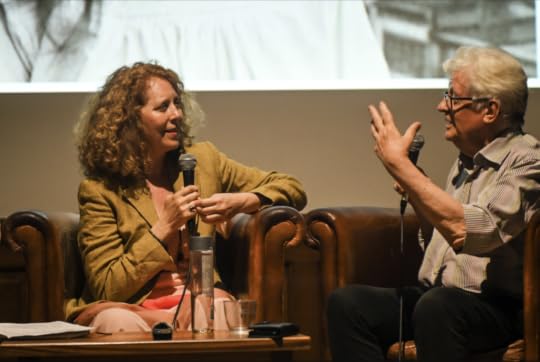
The following day Steven was supposed to interview Anne Waldman and Alystyre Julian on stage about Alystyre’s documentary film Outrider about Anne. I was to help out. Alystyre and Ann had premiered the film in a number of European cities but on this occasion, Anne was ill and unable to attend so Alystyre had to present it by herself for the first time. Normally Anne would have taken the brunt of questioning, as it’s about her, so it must have been stressful for Alystyre. Also, the reason Anne was on the bill, was to talk about her relationship with Allen. It was, after all, a celebration of his centenary. Anne had worked with him for years as co-director of the Jack Kerouac School of Disembodied Poetics at Naropa in Boulder, Colorado. Without Anne present, the discussion had to be about the film which had little to do with Allen. However, Steven is a very good, experienced interviewer, and we all did our best and I thought it worked out pretty well. Alystyre had many interesting things to say. The evening ended with a poem by Allen about Anne, read by Jesse, which marked the end of the days of celebration. I was so exhausted I left without even saying goodbye to half the people I should have and staggered home. I think we did Allen proud.
July 16, 2026
May-June 2026
There were a few nice meals later in the month. Camila dropped by for a light lunch; in town for a Paul Simon concert. Another day Jesse, Maxi and Antonio came over to discuss the upcoming Ginsberg celebrations. I made a Poulet en gelée. The month ended with a pleasant evening at Simon and Ginette’s; Simon still in recovery from a fall in Paris months ago. As they say, young people fall over, we old folks ‘take a fall’.
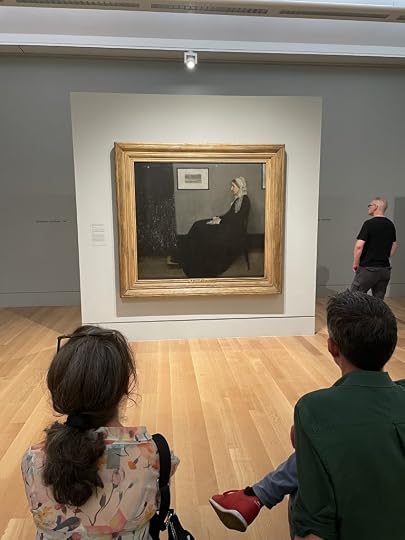
I very much enjoyed the Whistler show at Tate. He was one of the first artists I responded to as a teenager – 15 years old. I hadn’t seen his work in some time and they were bigger than I remembered. The energy and power is still there. My friend Kipps and I admired his arrogance as we first explored art before we went up to art school.
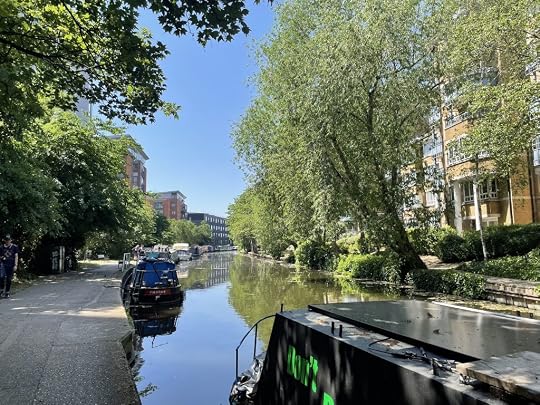
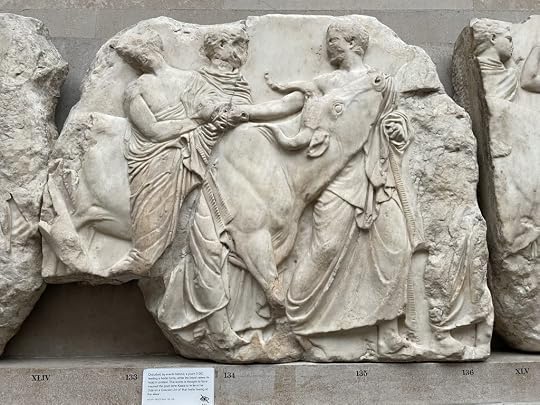
The heatwave had not yet kicked in and London was very pleasant. After a visit to the eye clinic, I took a stroll near Little Venice. Beautiful this time of year. I am a member of the British Museum and live within easy walking distance, so I often take a short cut through on my way to the London Review Bookshop. One day there were fewer tourists than usual, so I had a look at the Parthenon Frieze. I have always enjoyed the carvings of cattle on it, particularly South Frieze 132-136 where a heifer raises its head in protest when the youth leading it turns. This panel is supposed to be the inspiration for ‘that heifer lowing at the skies’ in Ode on a Grecian Urn by John Keats.
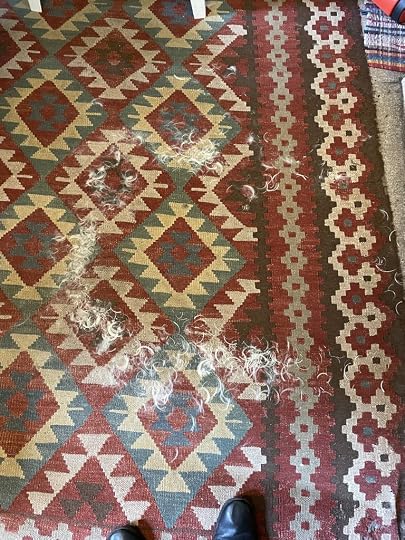
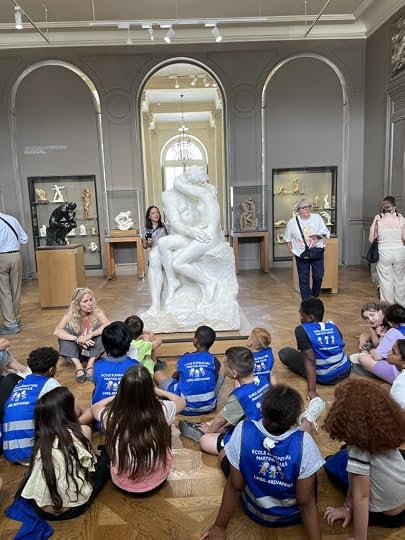
June 14 was haircut day and Mina trimmed off a ring of hair. I was off to France with Marsha the next day. We stayed with Catherine and Steve in Sud Pigalle. I wanted to show Marsha some of the sights and at the Rodin Museum we encountered a wonderful example of the French education system: elementary students having love explained to them.
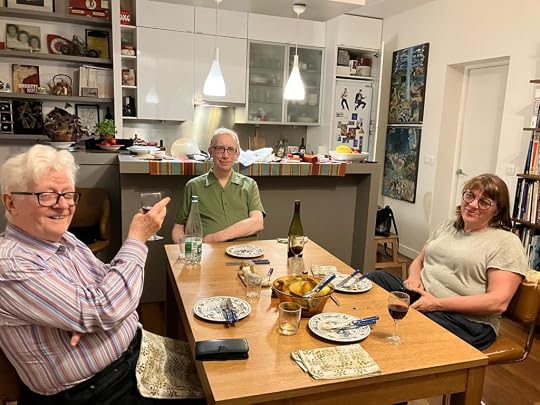
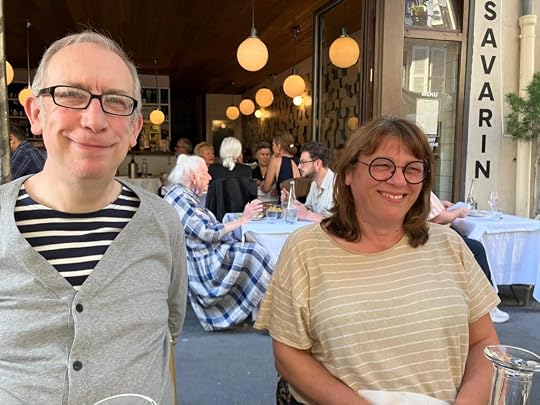
We tried a new restaurant just a few doors down the street from Catherine and Steve’s place and the food was superb. We all spent a pleasant meal and evening people-watching, that great Parisian sport.
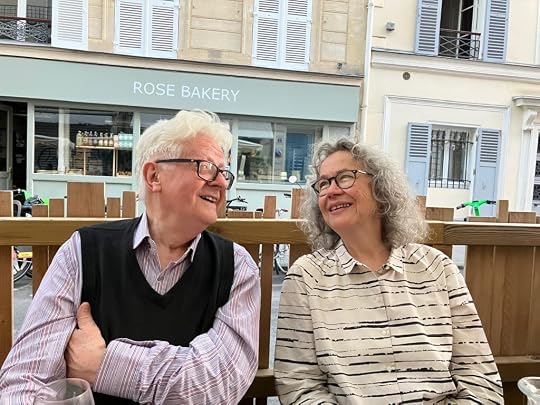
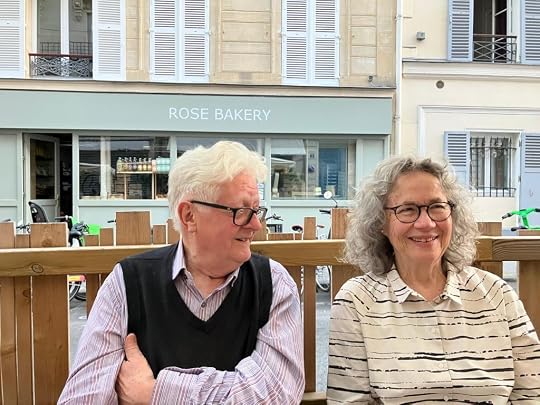
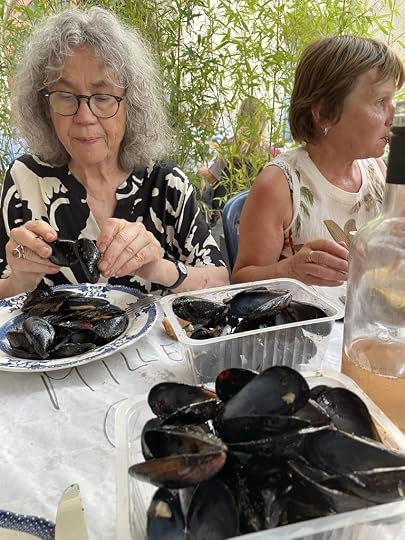
There was more food down in Catllar, in the Pyrenees where they had a moules festival (muscles) on June 20th. Marsha and I spent several weeks working on her memoir of Australian Oz, UK Oz and the founding of Spare Rib magazine. We got a huge amount done. It was very hot so we rarely went out. Just kept the shutters closed.
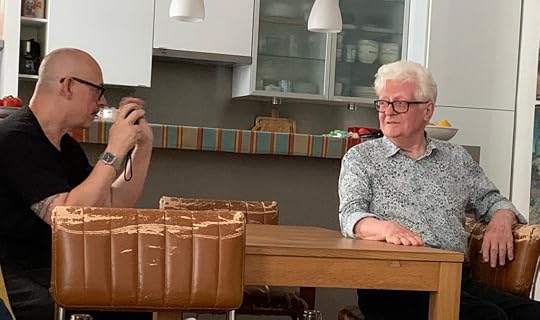
Back on Paris, Steve’s photographer friend Michele Corleoni (yes, it’s his real name) wanted to take some pictures of me for his Beat Generation project so I tried to look old and wise.
May 24, 2026
April – May 2026
Back in Britain after Rome and Paris and the usual culture-shock after going to my local supermarket, negotiating aisles of crisps and processed snacks, only to find that they don’t even have any parsley. (Local Sainsbury’s and Tesco.) What crap the British eat.
I just read that Christine Ruiz-Picasso died (April 6). She was 97. Rosemary and I met here through our friend, cookery writer Martha Shulman who lived, for a time, in Christine’s apartment of blvd St Germain in Paris. We met Christine in 1988, at her house near Apt in Provence. It was designed to look like a small hill town, with roofs set at different angles. The indoor pool extended outside. There was only one bedroom, guests stayed in a large ancient, converted farm building further down the track. I was astonished to see a large Picasso of a cockerel in her kitchen, exposed to cooking fumes, and delighted to see that the fronts of the drawers in our bedroom were painted with bullfighting scenes, obviously done for Bernard, her son by Paolo, Picasso’s eldest son (with Olga Khokhlova). She was friendly, charming and a delightful host.
Christine and Bernard donated 233 Picassos to a museum in Malaga, where Picasso was born which opened ion 2003 and which has since received over 10 million visitors. I remember seeing some of the works in her house: two monochromatic portraits in the living room, fronted by a large sculpture and other early works. She kept most of her pictures in a safety vault but rotated the pictures on a regular basis. Now everyone can see them.
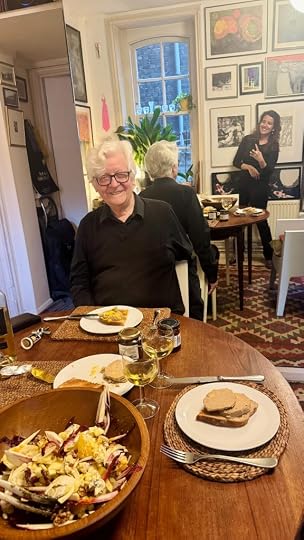
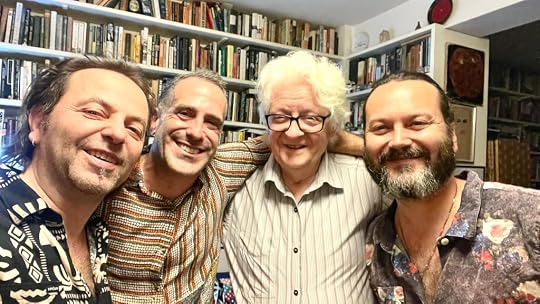
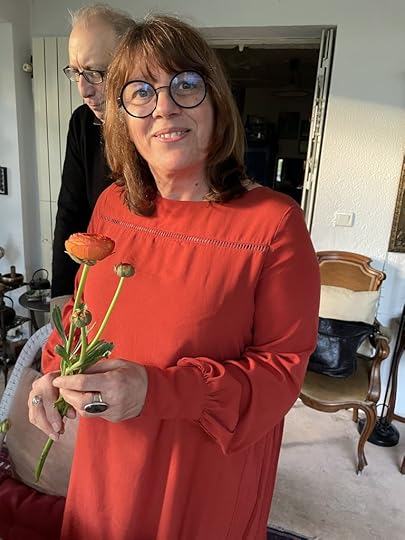
Fran Bentley invited me to dinner to meet up with Suzanne Kaplan who was visiting from India where she has lived for many decades, and Julia, another old friend. Fran and Suzy had been friends with my wife Rosemary since college days in Bristol and through her I’ve known them both for 45 years or so. Like all old people, most of the time was spent in talking about illness, and failing that, previous illness. We all agreed that there’s nothing great about getting old. But it was great to see that there is still that spark of life in them, and me, after all those years. Here’s Julia, Fran and Suzy.
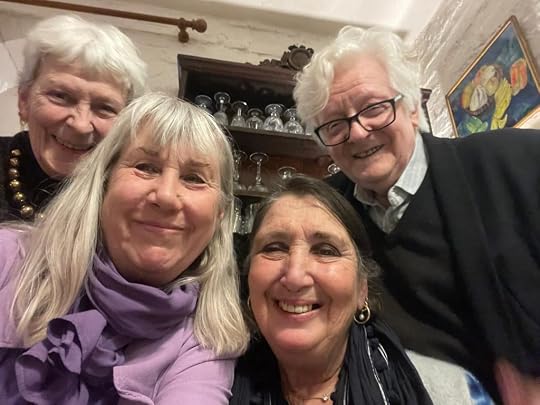
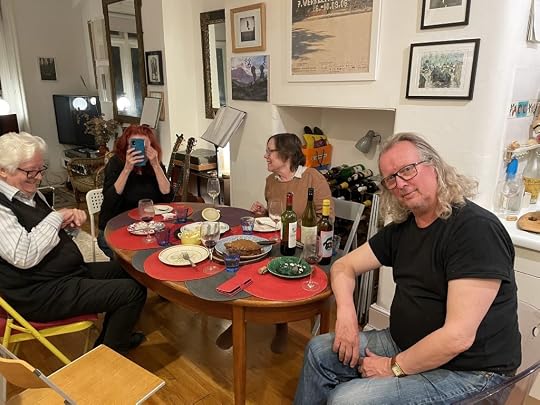
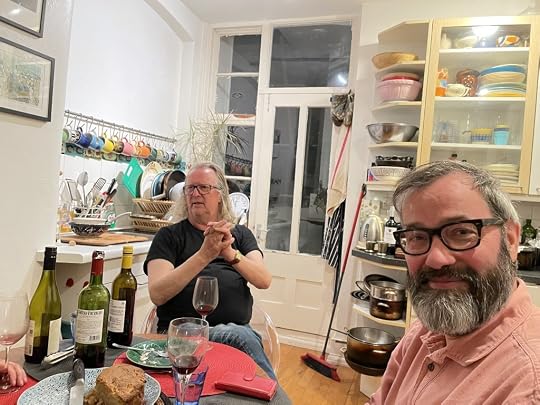
A few more old friends. This dinner is at Richard Grayson and Suzy Treister’s flat overlooking Parliament Hill Fields. We’d been together in Egypt a couple of months before. Ingrid Swenson and Andrew Wilson were also there, whom I hadn’t seen in an age., so a younger crowd, more art gossip, less illness. (More drinking). I stayed over. Me, Suzy, Ingrid, Richard and Richard with Andrew.
Spring is here so I spent a few days with my friend Marsha Rowe in Norwich:
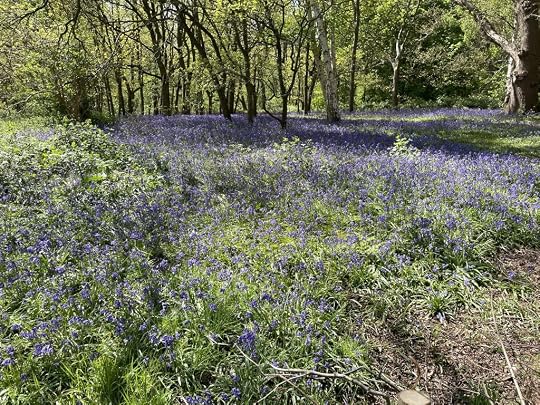
The blue bell is the sweetest flower / That waves in summer air;
Its blossoms have the mightiest power / To soothe my spirit’s care.
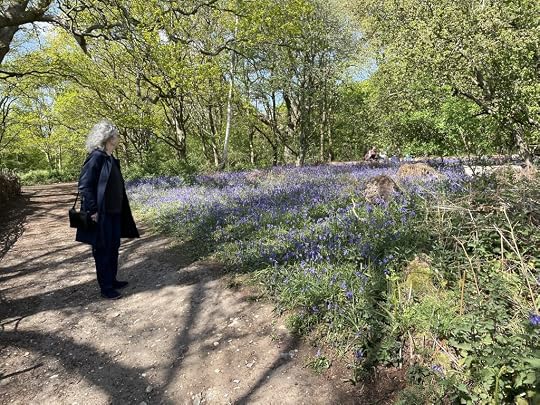
So wrote 20-year-old Emily Brontë. I hadn’t seen a spread of bluebells like those in the woods next to the Sainsbury Centre at UEA since I was a child. They really do relax you.
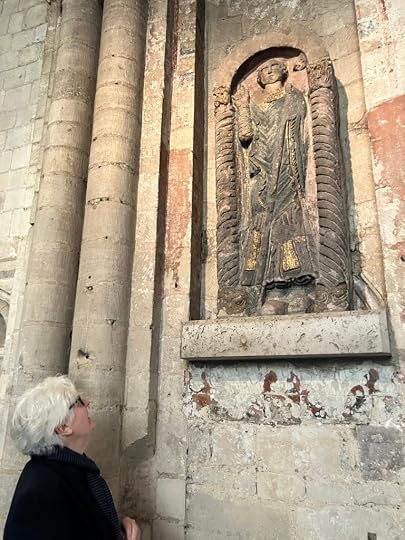
I thought I’d remember Norwich as I’d been there about 45 years ago but nothing remained in my head, it was all new except a vague memory to do with the levels of the chancel roof in the cathedral, which had clearly been raised. Norwich cathedral is superb and even has a plaque dedicated to St. Felix which visiting Australians who were involved with Oz magazine always find amusing because it reminds them of Felix Dennis.
I rarely leave the West End and this was the first time I’ve travelled in Britain in many years except to go to the airport. I expected the complicated arrangements with the train tickets, but eventually got the correct ones – absurdly two single tickets are cheaper than a return, but that’s Britain for you. Norwich was a delight: the lanes, the winding alleys filled with independent bookshops, antique shops, cafes, pubs and restaurants, and a refreshing lack of chains. Architecturally it is beautiful, particularly the areas near the castle and the cathedral, but also the river walk. The students around the art school were very colourful: bright red hair is in, as are brightly coloured dresses. In my art school days we wore black. Unlike London, which is too crowded and the pavements are usually too narrow, Norwich has many pavement cafés, like Paris, where one can sit and people-watch. As this is one of my favourite activities I loved it there. I now see why people go to college in Norwich and never leave though the university itself, UEA, foolishly, was built three miles out of town instead of integrating it into the city. It does have some wonderful features, but its insularity is not one of them.
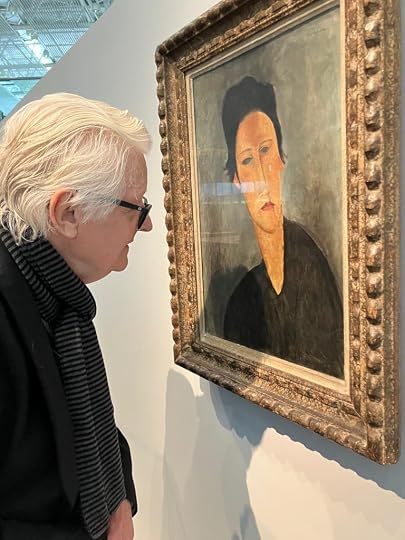
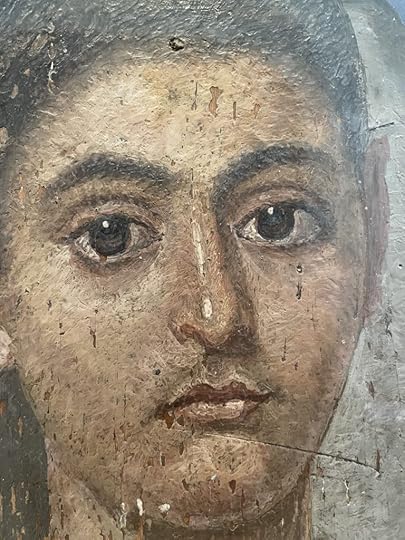
The Sainsbury Centre is at UEA and for some reason I had never even heard of it. It is an amazing display of pictures and sculpture: A life-size bronze Degas dancer, Modigliani, Arp, Picasso, Gaugin and six Francis Bacons, including a terrific Pope; unfortunately his triptych of Isabel Rawsthorne was not on display (I’ve since learned). They have some fine work by Alberto Giacometti and there is a further gathering of more than 20 drawings by him, also not on display. I assume they are available on request. It’s a huge collection. There’s a nice thick Auerbach. All of this is displayed alongside a huge collection of art from Oceania, Africa and the Americas. Finally, there are interesting medieval European and ancient Egyptian works including a beautiful Fayum mummy portrait. In the extensive grounds stand a large Henry Moore and, my favourite, a version of Vladimir Tatlin’s Monument to the Third International. It’s a personal collection reflecting the superb taste of a pair of very rich collectors. It was a beautiful day, ideal to sit outside the café and enjoy the view of the Tatlin. (It’s a Richard Rogers building).
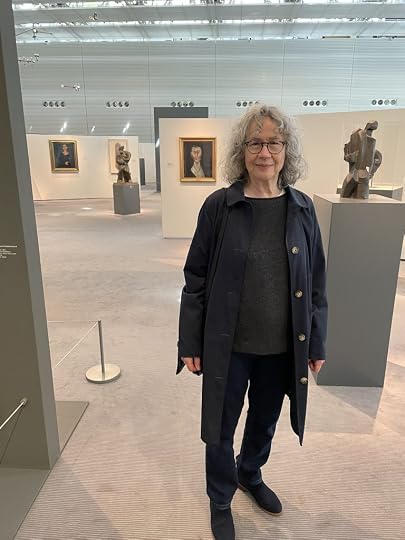
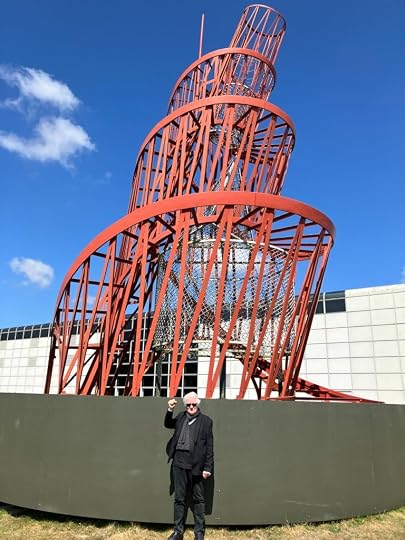
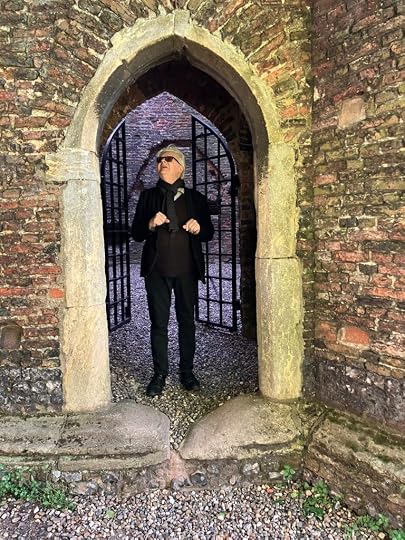
Just walking along the riverside you encounter bits and pieces of medieval buildings. Just perfect for me. And Marsha knew what they all are. It’s a lovely town and it was a lovely visit.
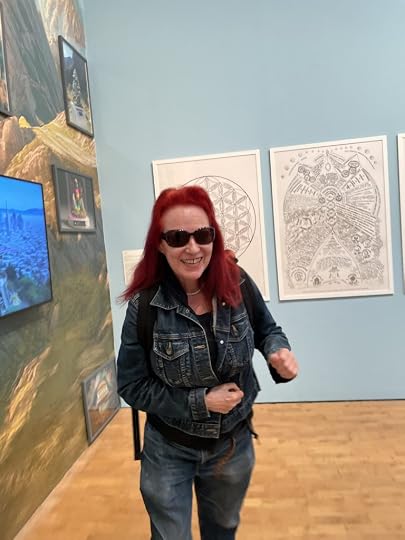
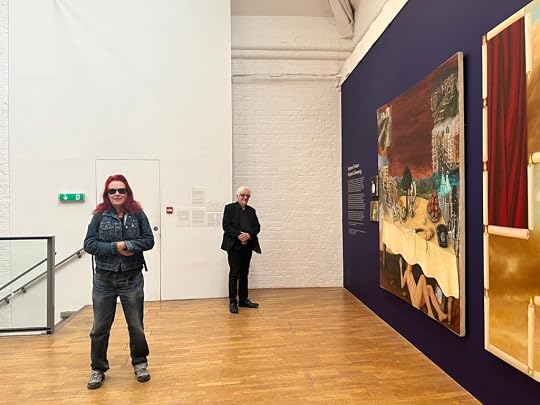
Back to town and the very next day another train ride, this time to Oxford to see Suzanne Treister’s retrospective at Modern Art Oxford. I missed the p.v. but with a bit of encouragement from Suzy to get me out of town, I managed to catch the show just before it closed. And I’m very glad that I did. Called Prophetic Dreaming, it filled a number of huge rooms, and, as Suzy works very much in series, contains hundreds of works. Impossible to do them justice here so go to Suzy’s official site to see the work:
https://www.suzannetreister.net/InstallationV/2025_MAOxford/menu.html
Israel continues its Genocide against the Palestinians. From the river to the sea it is all Palestine! (This picture of Gaza is from 2023, before the present war).

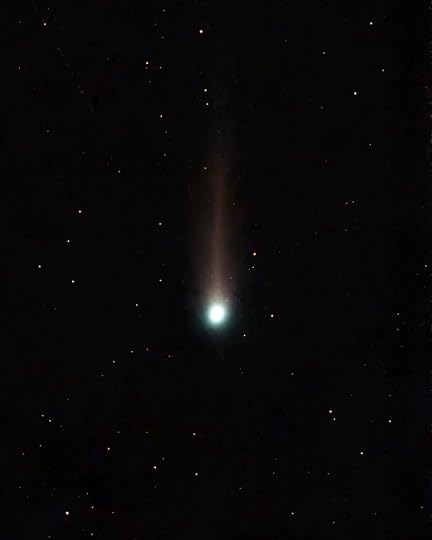
Finally, just to get a bit of perspective, here’s a picture of C/2025 R3 PANSTARRS, a comet from the Oort cloud, now visible from Earth. It won’t be back for another 170,000 years.
April 20, 2026
April 2026
It is always wonderful to arrive in Paris. If I could afford it I would live there. It has changed almost beyond recognition since John Dunbar and I visited in 1966 for me to buy the remaining stock from Gaït Frogé’s Libraire Anglais, that she was closing, and John arranging to represent Denise René’s artists in Britain, at our new Indica Books and Gallery. Fortunately, the built environment remains much the same, but you can no longer turn up in the Left Bank and wander around for a few blocks until you find a cheap room. Even in the 1970s the 6th arrondissement was filled with cheap hotels and cafés, but alas no more.
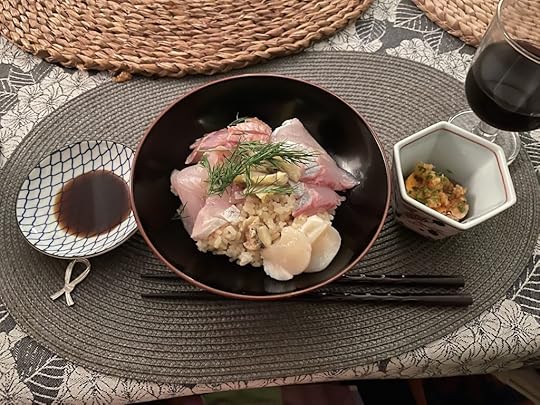
I was staying with my friends Catherine Marcangeli and Steve Shepherd in the 9th. Through them I have met a number of new friends – not so new anymore – and they are very much a central part of my understanding of what Paris is. On my first day there, the 5th April, the day Allen Ginsberg died, – I thought of him – we went out to Montreuil to visit Brunhild and Junya. I have written about Junya’s brilliant cuisine before so just one picture of it this time. It is always so nice to see them.
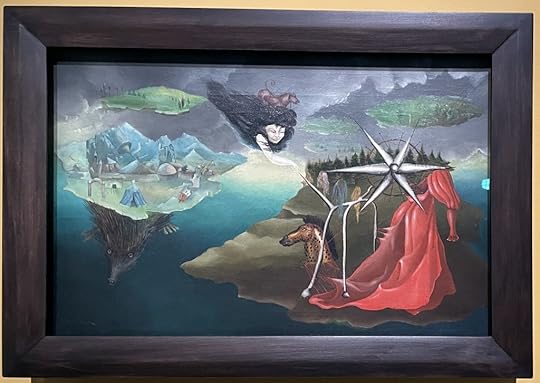
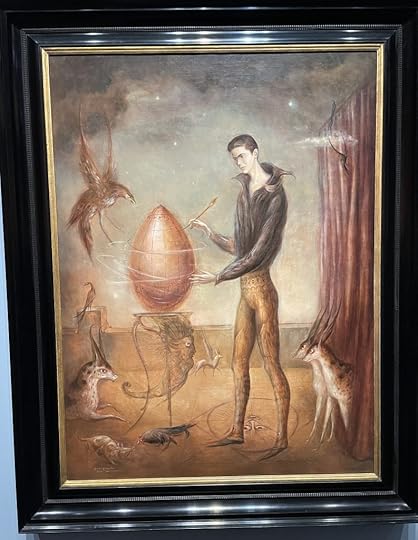
The next day Catherine and I went to the Leonora Carrington show at the Musée Luxembourg. There were a lot of juvenile works as well as a large selection of her later painting. As Catherine said, ‘It was very interesting’ but not exciting. This was a rare chance to see a large selection of Carrington’s work, and so valuable in that sense. We are not likely to get the chance again soon. She occupies an important part of the history of Surrealism but, with the odd exception, the work didn’t move either of us very much. Here are two I did like.
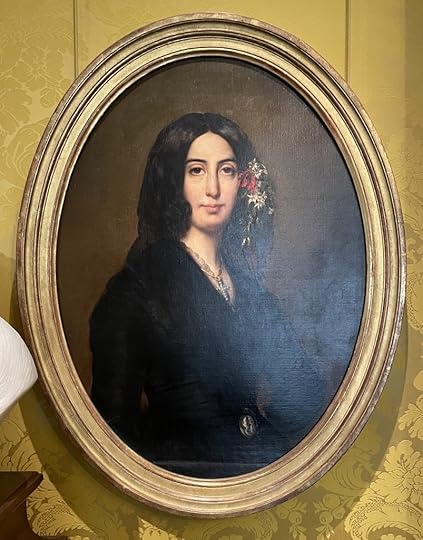
The Musée de la vie romantique has reopened after being closed for renovation so Steve and I went to see what they had done to it. It’s all much cleaner and newly painted. They’ve moved the ticket office for special shows and have rehung the entire display. Georges Sand has been brought down to eye-level and can now be seen on a wall instead of from across a room with a rope making you keep your distance. It remains one of my favourite museums in Paris.
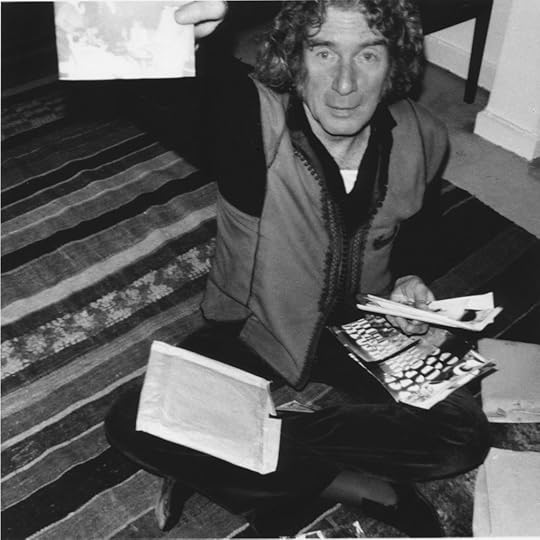
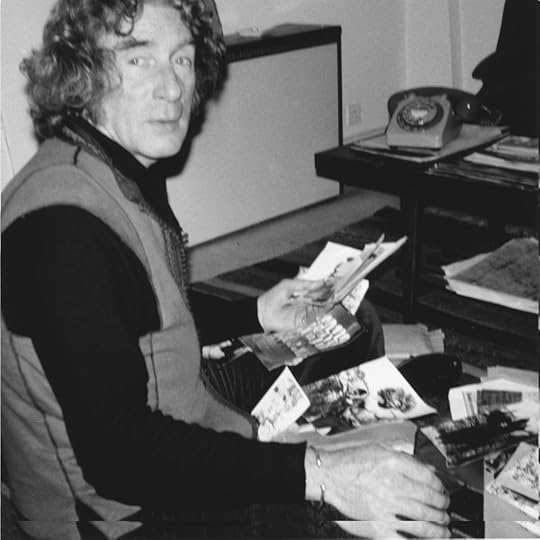
Aside from seeing friends, I was in Paris to attend the vernissage of the much-delayed Brion Gysin show at the Musée d’art modern de Paris. I wrote one of the essays for the catalogue and Catherine translated it. Brion was an old friend. We first met at the end of 1965 through Ian Sommerville but I spent the most time with him in 1972 when I was describing William Burroughs’ archive in London. Brion came over from Paris to assist and took over Bill’s flat in Duke Street Saint James’s while Bill moved to a smaller flat in the same building. So for a month or so I worked each day with the both of them, though Brion was often out with his various boyfriends. He brought a pile of new material with him to add to the archive as well as some of his own papers, including his correspondence with Alice B. Toklas, which I sold on his behalf.
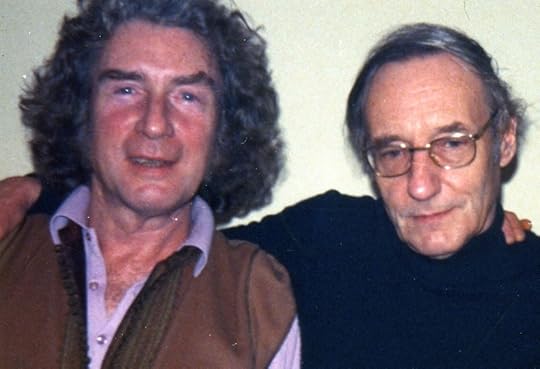
This was a very difficult period in Brion’s life. At the end of 1974 he developed colon cancer and underwent a number of horrific surgeries. I remember visiting him at the Royal Free Hospital in Hampstead where he had his own room. A young man was sitting at the foot of his bed, wearing a Levi jacket and jeans. He casually rolled a huge spliff and fired it up, passing it immediately to Brion. He left shortly afterwards. I asked Brion if this was wise behaviour, as the smell of the joint was still very strong. Brion, who was suffering from extreme depression, beamed at me and began laughing. ‘My dear,’ he said. ‘That was the surgeon who operated on me!’ Brion had a West Indian nurse at the Royal Free who cared for him so well that Brion fell in love and wanted to marry her. They had little in common of course, but her concern and compassion was something that he was unused to, and which, in his vulnerable position, moved him deeply. Here’s Brion in 1972 at 8 Duke St St James’s, working with me on the Burroughs Archive.
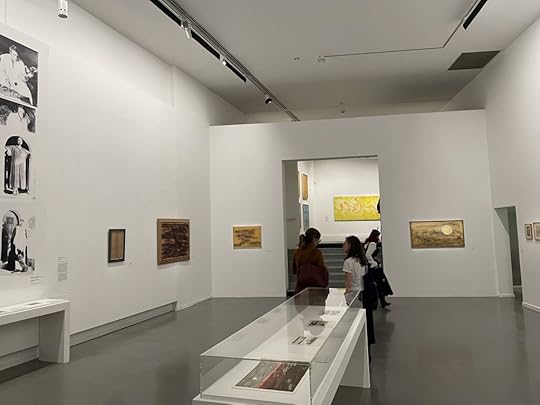
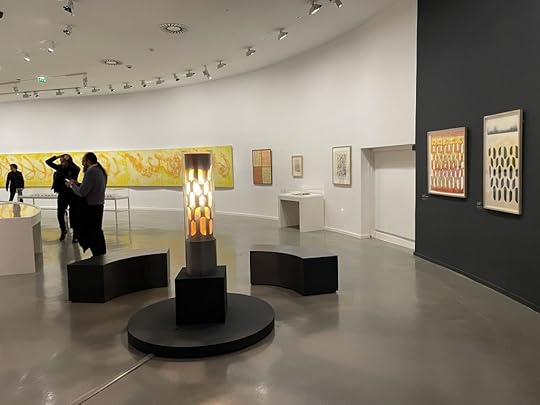
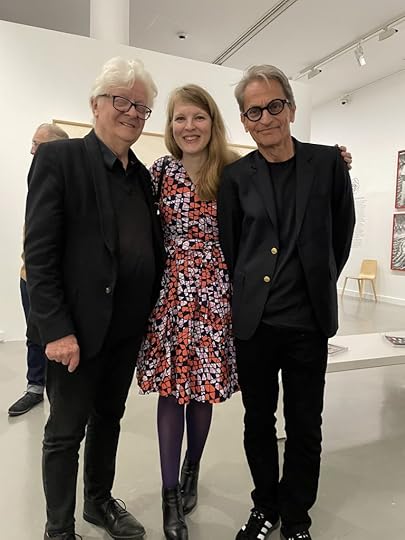
The exhibition at MAM. began as a joint show of Burroughs and Gysin and the curators, Olivier Weil and Hélène-Florence Leroy came to London several times and went through the photographs and memorabilia in my collection while planning the show, but then many things changed. Burroughs got bricked out of the show and Hélène left MAM. Olivier continued on his own. Brion left hundreds of artworks to MAM so they had a lot to choose from in their own collection, but they also brought in things. The resulting show is superb. Olivier has told Brion’s story – much needed as most people have never heard of him or know little about him – but punctuated the narrative with carefully chosen works that certainly stopped me in my tracks. Sometimes Brion’s work is really beautiful. There were pieces there that I had not seen before as well as his 16.4 metre ‘Calligraffiti of Fire, his magnum opus. There are photographs and, of course, a Dreamachine that Jean-Jacques Lebel was convinced was turning at the wrong speed. Unfortunately, I was coming down with a nasty attack of bronchitis but managed to attend and not cough over anyone. Here’s a view of the hang and of Olivier and Hélène.
Two days later there was another private view, this time of a Gysin selling show held at the New Galerie. They had a collection of very desirable works and had also dedicated a room in the cave to documentary clips of Brion talking and being interviewed, some of which I had not seen. The crowd spread outside where tables and chairs were available and drinks and food brought in from the local café was served in the spring sunshine. It was a very pleasant scene. We had already booked a table for ten at Chez René, one of my favourite restaurants. Catherine has been going there for decades and introduced me to it. I had a very traditional meal of escargots followed by Rognon de veau entier in a mustard sauce – a portion big enough for three, well it does say ‘entier’. This is the place for andouillette and bone marrow, proper old-style French food.
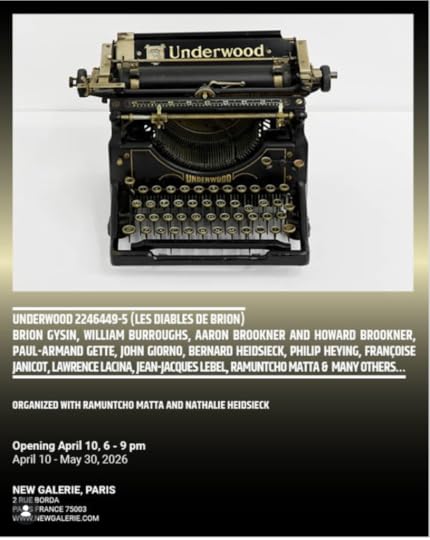
April 15, 2026
March 2026
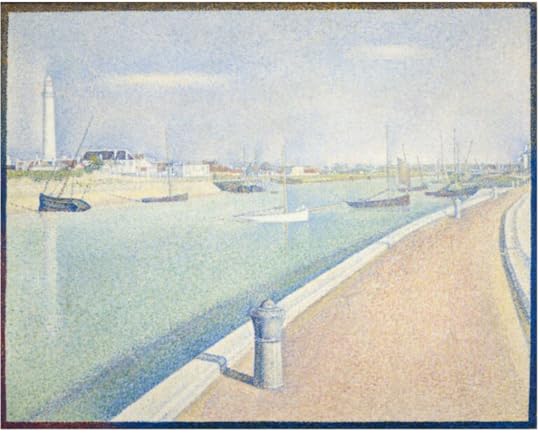
I went twice to the Seurat show at the Courtauld, the second time with Jill, when we ran into Olivier Weil who is curating the Gysin show in Paris. He was intrigued to see that none of the pictures had come from the Musée d’Orsay. I normally enjoy Seurat’s work, but this selection – Seurat and the Sea – seemed to miss the point for me. He is all about light, but the picture plane has to come into it and he clearly either didn’t understand how reflections and shadows actually work or was being so sloppy he didn’t care. To paint the reflection of one boat then leave it out on another turns the area of paint between them into an area of uncertainty. The reflection of a tower is simply wrong, and the eye notices this and it jars. Maybe he just wasn’t as good a painter as I thought he was even though I love Bathers at Asniérs and La Grande Jatte.
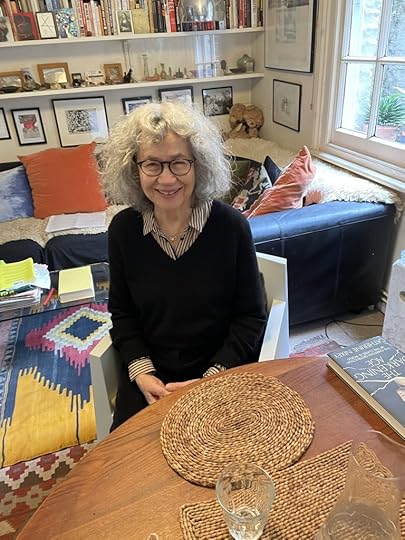
My friend Marsha came from Norwich to spend a few days with me which was fun. She had worked on both Australian and UK Oz magazine and was the co-founder and the editor of Spare Rib, Britain’s first feminist magazine. We have a lot in common.
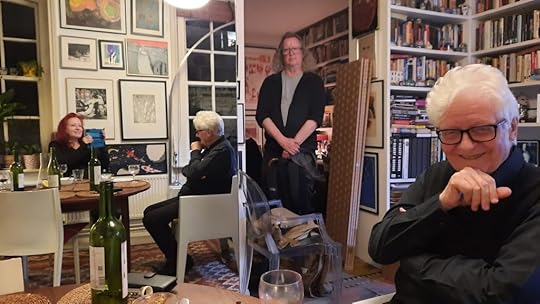
Suzy and Richard came to dinner to reminisce about out our Egyptian travels and Suzy took this photograph using the wall mirror which looks like a collage but isn’t.
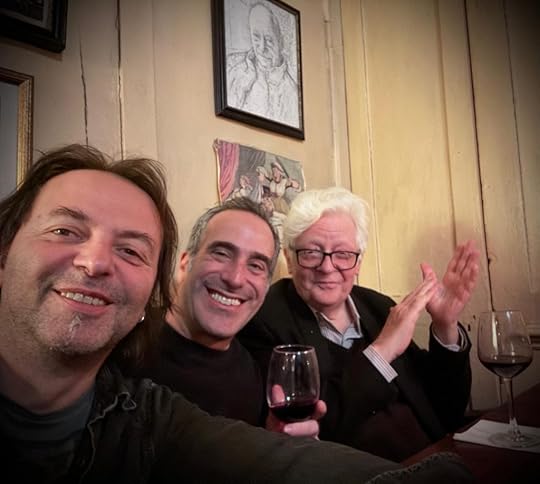
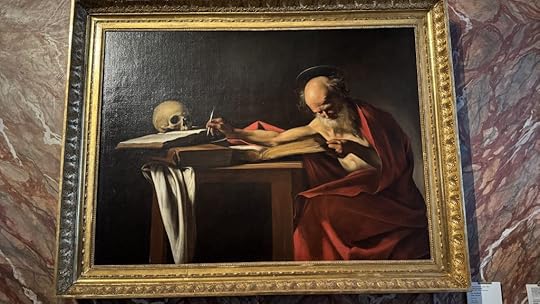
On the 17th Antonio, Jesse and I met at the Academy to further plot the celebration of Allen Ginsberg’s 100th anniversary. The main event will be held at the Queen Elizabeth Hall with panel discussions at Swedenborg House. Here I can be seen applauding one of our joint decisions. Jesse and I had previously visited the Wallace Collection to see the Caravaggio on temporary loan – my second visit. There were a lot of dinners that month: Lucy came to visit and Theo and Mina took me to my favourite local Italian, Demartino, which is about as authentic an Italian trattoria as you can get in London. It was advance planning for my next trip.
Everything went according to plan. Camila and I met at Fiumicino Airport, landing from Lisbon and London at almost the same time. There was no cab line but as usual, although there are supposed to be fixed rates, we ended up paying more than we should have. We were staying at my friend Maria’s B&B, a self-contained part of her flat just south of the Vatican. Maria wasn’t there but arrangements had been made and we were just in time for dinner at the local trattoria.
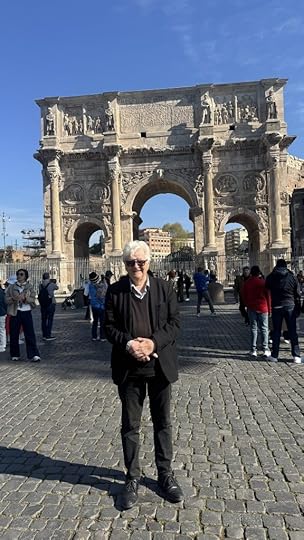
Easter is not the best time to visit Rome, the Pope is doing his thing, but Camila teaches at university and the Easter break was the only time she could get away. The weather forecast was not good but our first day happened to be sunny. I had never been into the Colosseum, just admired what is left of the outside. We arrived first at the Arch of Constantine (AD 315) which is made up of recycled marble mostly from one previous arch, with friezes and roundels all taken from older monuments and recut to depict Constantine. I particularly liked the ‘disgruntled river-gods’ – as Amanda Claridge calls them – reclining in the spandrels of the lateral archways.
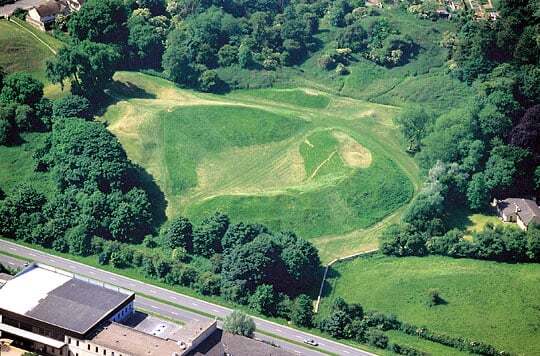
I had Amanda Claridge’s book Rome: an Oxford Archaeological Guide [2nd rev ed, 2010] with me as it is the standard work. It is best to simply photograph those pages you are likely to need each day as it weighs a lot. And so to the Colosseum. I have always been fascinated by the Colosseum because my hometown of Cirencester, the Roman Corinium, had its own amphitheatre. Ours housed 8,000 people and was about the cheapest model you could get, whereas the Roman original was the first, by far the largest and architecturally sophisticated. We used to call the one in Cirencester ‘the Humpty-dumps’.
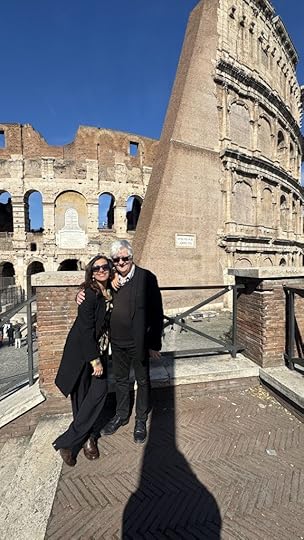
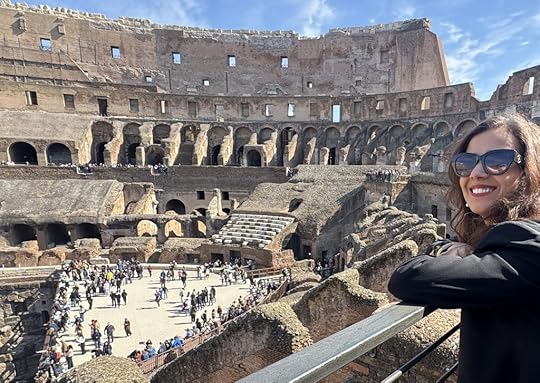
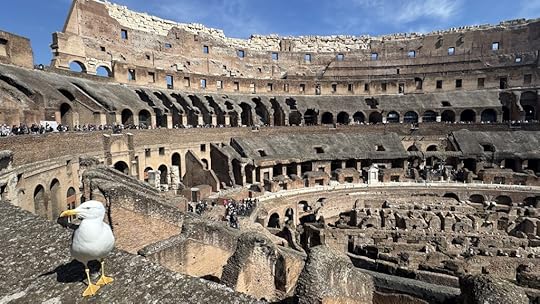
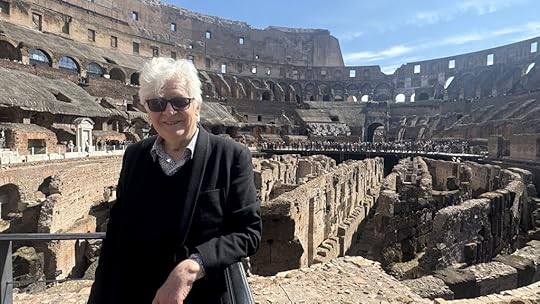
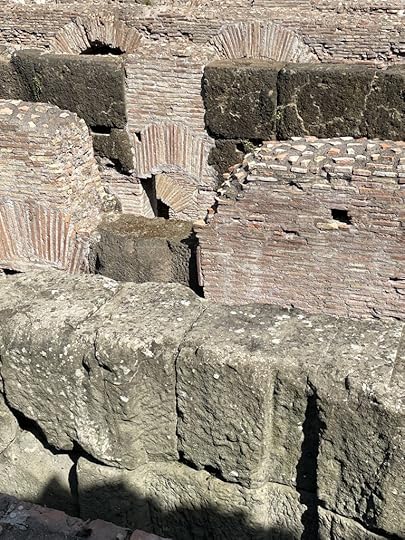
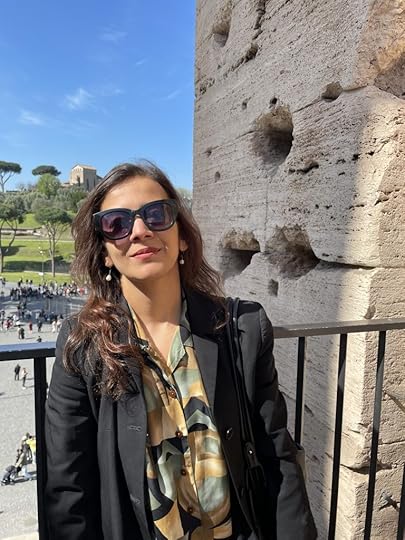
Vespasian built the Colosseum between AD 70 and 79 (it was completed in AD 80 after his death) as a triumphal monument in the Roman tradition from his share of the spoils of war, in this case the Jewish Triumph of AD 70 when the Romans returned with 50,000 kilos of gold and silver taken from the Temple at Jerusalem. It’s huge, it held 50,000 people, and I think much of its appeal comes from the fact that it is so familiar. The view inside is so like that of the Albert Hall or the Dome or the thousands of other auditoriums based on it. A Calendar of AD 358, when it was almost 300 years old, claimed it held 87,000 but it was adapted over time. There was a strict seating hierarchy: senators closest to the arena, then knights, then plebeians and right at the top, the poor, slaves and any women who dared attend. These top tiers were all of wood. The middle three ranges had stone seating and Claridge reminds us that the section of marble seating low down on the east side is ‘an erroneous piece of reconstruction done in the 1930s’. There’s loads about it on the web. Here are a few views, showing how much of the South side has been robbed, and how much of the below stage structure has survived.
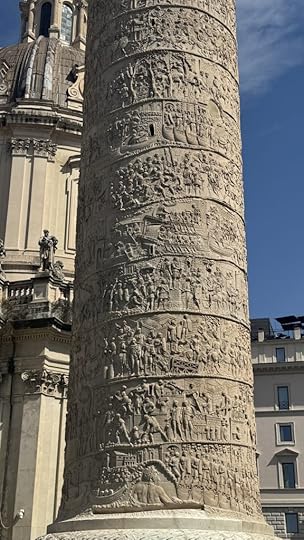
It was a good day to see Trajan’s Column, (AD 113) with strong shadows, though it is now thought the reliefs on the side were never meant for close inspection but were added later as an act of piety when the column became his tomb. For an up-close look, you get a better view by examining the plaster casts in the Victoria and Albert Museum which were made before Rome’s air pollution did its work and which you can get closer to. The pedestal room beneath the column in the V&A used to be a favourite place for staff trysts, but all that changed when the Cast Rooms were restored.
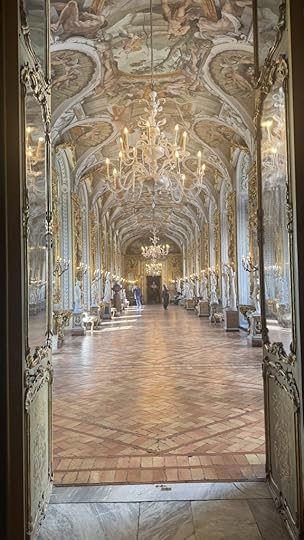
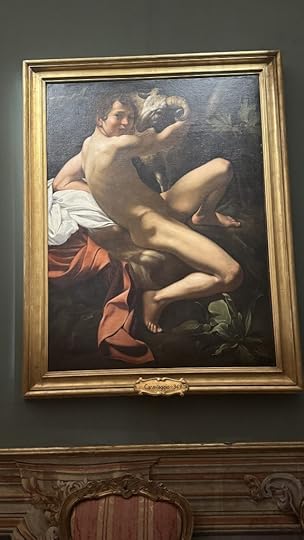
We did not restrict ourselves to Classical Rome but also encompassed the Italian Renaissance, being good tourists. There is so much to see. There are more than 20 museums just specialising in Classical Rome and we only saw two. There are even more Baroque palaces. The Galleria Doria Pamphilj is the sort of palace I normally avoid as I can’t stand Baroque furnishings and most of its art leaves me cold. However, this palace – still in private hands – contains some exceptional paintings; notably Velázquez’s Portrait of Innocent X (1650), one of Francis Bacon’s favourites, and three Caravaggios. This museum is number one on my friend Valerie’s Caravaggio Trail and also contains Raphael, Lippi, Titian and all the usual suspects. Here’s your man’s John the Baptist (1602).
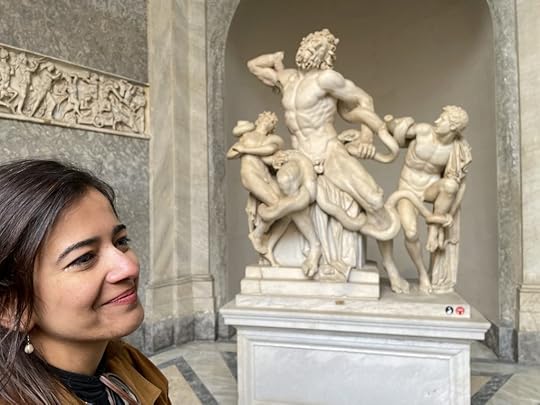
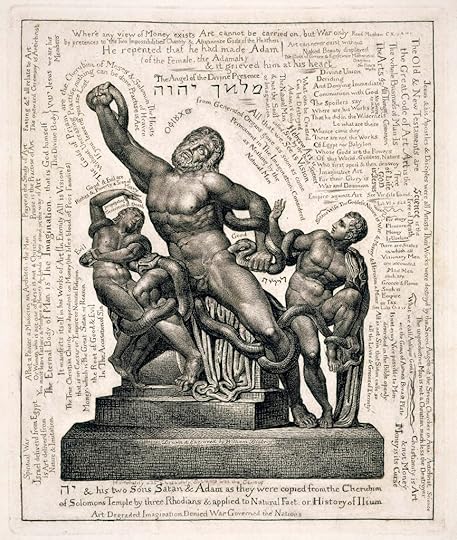
Despite having ‘jump the line’ tickets, we hung around outside the Vatican Museum for some time. But if you will go to the Vatican at Easter you are asking for trouble. It is one of the world’s greatest collections. Having recently been in Egypt I was prepared to miss the Egyptian museum which I seem to remember consists almost entirely of statues of Sekhmet, my favourite goddess, but there is much else to see. I tried to go straight to the Sistine Chapel, which is about a kilometre away from the entrance at the other end of the building, and work our way back, but the one-way crowd control system somehow subverted this and we were straight away in Bramante’s Octagonal courtyard, face to face with the Laocöon statue group. (C1 BC). Laocöon was the priest of Apollo at Troy and the work depicts he and his two sons being strangled by two snakes. It’s a vigorous piece of work. We had a facsimile of it in my art college in the early sixties, as did most other art colleges. It was first dug up in 1506 and at one point Michelangelo was thought to have made it and faked a Roman attribution. It was well known in London from copies in the eighteenth century and William Blake did several engravings of it. Camila, who is a Blake specialist, burst into tears upon seeing the real thing for the first time. Here’s Blake’s engraving and his complex commentary.
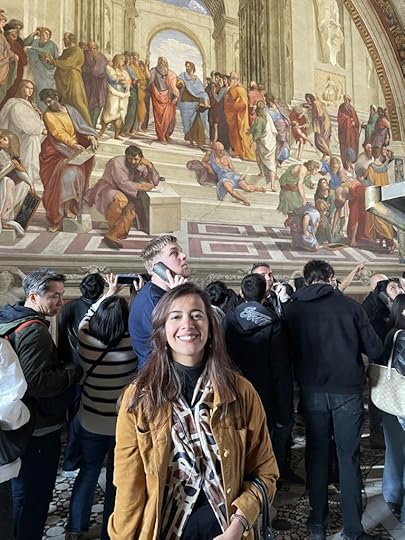
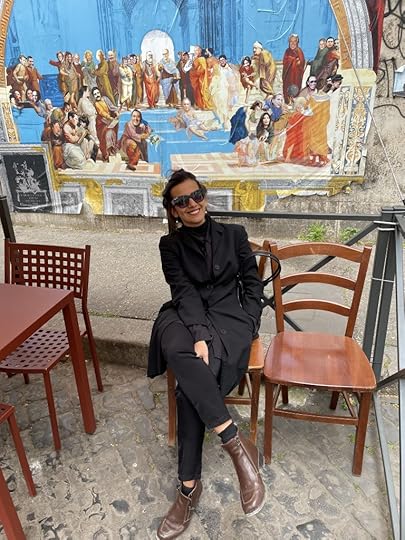
You must pass through the Raphael rooms before you reach the Sistine Chapel and so naturally pass through the Stanza della Segnatura which houses The School of Athens (1509-1511), his best known work; his Mona Lisa, his David. Astonishingly, most of the thick crowds of tourists, following flags or teddy bears on sticks, didn’t stop or even seem aware that they were missing one of the high points of the Vatican Museum. We stopped and had a good look. A few days later, we found a large-scale reproduction of it pasted on the wall of an outdoor café in Trastevere, where the faces were all substituted with contemporary actors and personalities (I didn’t recognise any of them, sadly).
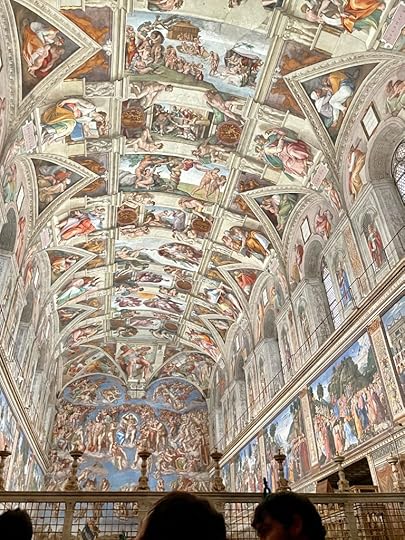
From Raphael it is still quite a treck before you emerge, accompanied by a thousand others, into the Sistine Chapel where attendants keep the line moving, shoving people into the middle if they want to stop and look. Smart phones raised they march dutifully on. In fact, photography is not allowed so there is much remonstration. Here’s one I took back in March 2023. We found seats by the side and looked up until our necks hurt. We were very lucky because Michelangelo’s The Last Judgement, (1536-1541) the fresco that covers the whole altar wall of the chapel, had been covered for restoration until presumably only a day or two before we got there. They had hoped to finish before Easter and did so, just. It had been coated in a white film, caused by the breath of so many visitors. New ventilation has apparently been installed.
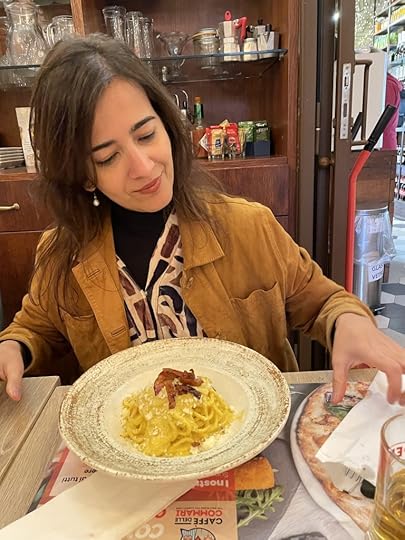
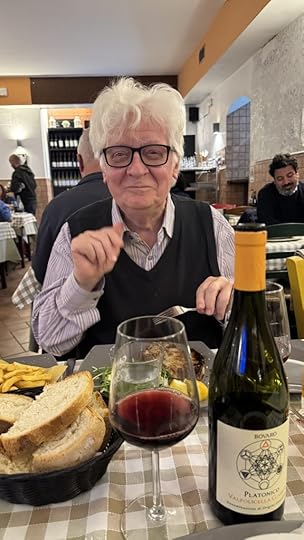
Did I mention the food? A meal with a decent bottle of Valpolicella or Montepulciano costs about half as much as it would do near me in Fitzrovia. And it tastes better.
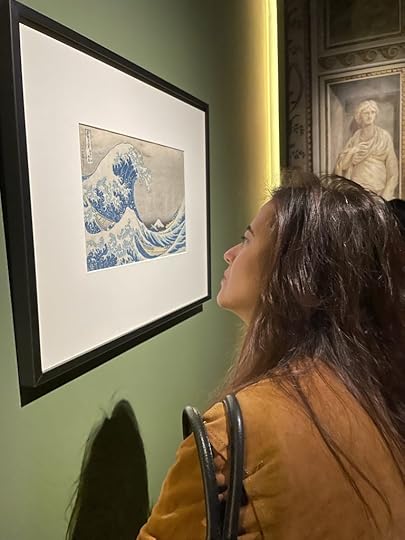
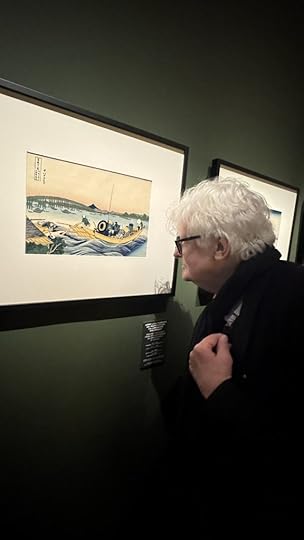
We happened to coincide with the largest exhibition of Hokusai ever held in Italy. The Palazzo Bonaparte featured over 200 works borrowed from the National Museum of Krakow, and at Camila’s urging we went to see it. His attention to detail and delicately balanced compositions are a delight to see. My complaint has always been that all his women look alike: a standard doll-like face with no personality, presumably reflecting the society he was depicting. It was great to see though.
The last time I was in Rome the Pantheon was free to enter. Now that there is a fee there are enormous queues and even the line with tickets bought on-line is long. I was surprised because unless you enjoy architectural history, there is really very little to see. The Pantheon is one of my top ten favourite buildings. It has influenced so much Western architecture and even now is a breathtaking piece of construction. Until a few years ago it was the widest unreinforced concrete dome in the world, and its internal decoration can be found in Regency buildings all across Britain. Of course, Greek Revival architecture stems from Greek originals but the Pantheon with its smooth, more slender columns, was also a template for Britain. (My other favourite buildings include Borobudur; the Hagia Sophia; Karnak; Notre-Dame de Paris; the Alhambra; Casa Batlló and the Duomo di Milano.) The only light comes from the oculus at the top which also lets in the rain, but there is a proper drainage system to cater for that. The main ‘site’ is the tomb of Raphael; the dome is all. Everyone has fun taking photographs.
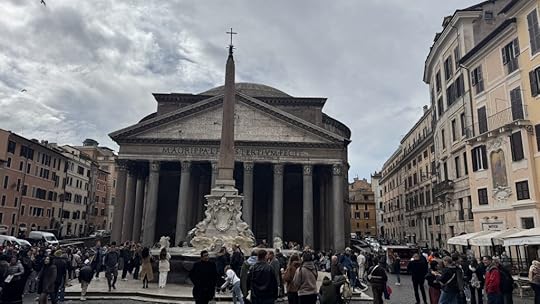
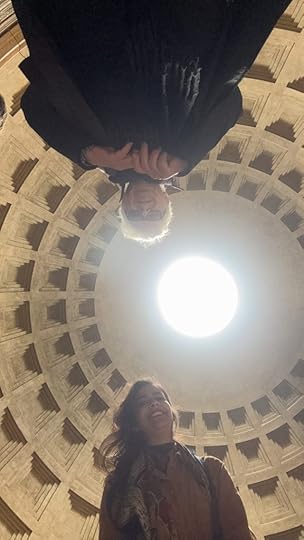
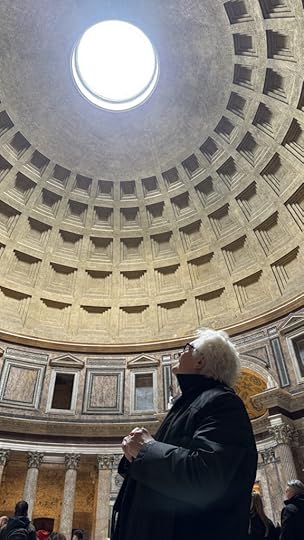
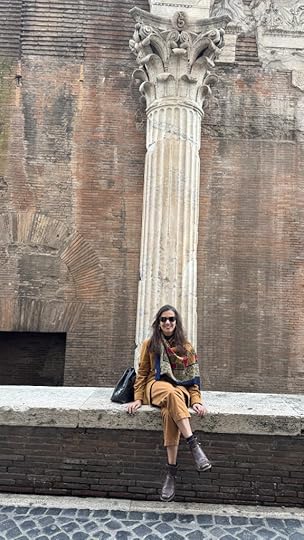
There’s some nice carved marble round the back, too, that most tourists don’t bother to go and look it. The road goes through what was once a building, so we are looking at an inside wall.
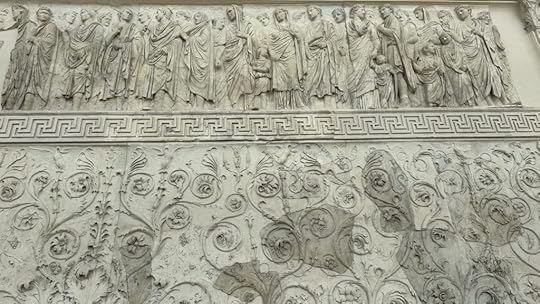
This was our day to visit the Villa Borghese but we stopped off enroute to see the Ara Pacis (13 BC). This altar dedicated to the Pax Romana of Augustus is no longer where it was originally built. It was found in pieces, many of which were then scattered to collections in Naples, Florence, Vienna and Rome but by 1937, after a very large new find, the pieces were reassembled (except for those in the Louvre who, already pissed off at having to return so much of the stuff that Napolean stole, are represented by a cast.) There is a lot of controversy over the overblown installation building by Richard Meier that many people feel is so unsympathetic to the surrounding architecture it should be pulled down. But the altar itself has a remarkable frieze showing priests and the Imperial family chatting and interacting with small children holding their hands or tugging at their togas. Different as Classical Rome was, with its gladiators and Vestal Virgins, these human gestures resonate for me and provide a connection to our ancestors across two thousand years.
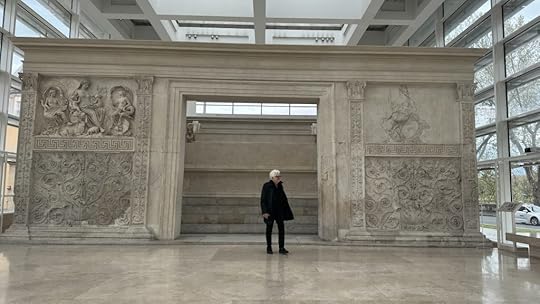
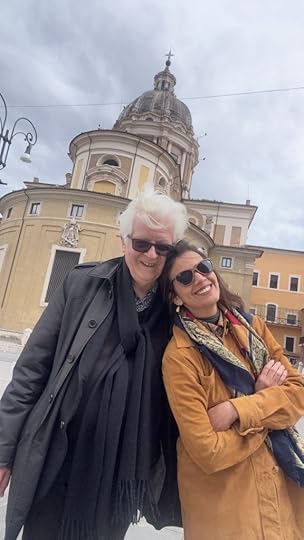
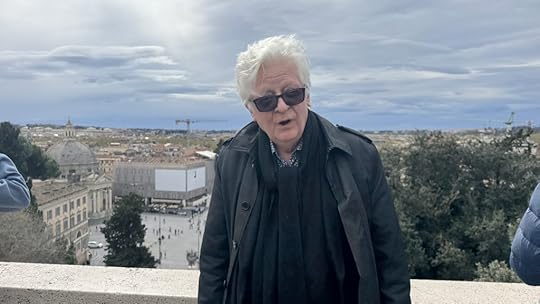
We stopped off for selfies then walked to the Villa Borghese. I’d forgotten quite how steep the climb is up to the park from the Piazza del Popolo but managed it, just. It is a beautiful park housing a number of important museums but worth a visit in its own right. We were heading to the Galleria Borghese and its collection of Renaissance art.
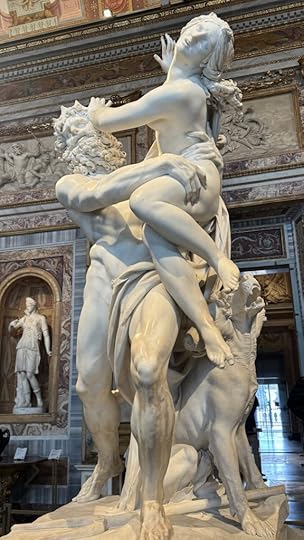
You can’t just show up and book a ticket at the Galleria Borghese. The building stands over a network of tunnels and caves, some from antiquity some natural, and cannot take too much weight. Only 300 visitors are permitted on the ground floor and just 90 at a time on the first floor. Consequently, admittance is restricted to tour groups which you must book ahead. Unfortunately, this means you are at the mercy of your tour guide. Ours was a great fan of Bernini, whose most celebrated early sculptures are all there, and spent an inordinate amount of time extolling his virtues. I can’t stand Bernini and see his statues as contrived and artificial, little more than the 17th century equivalent of Playboy magazine. However, in every room there is a Bernini there is also a group of Roman statues which to me are of far more interest.
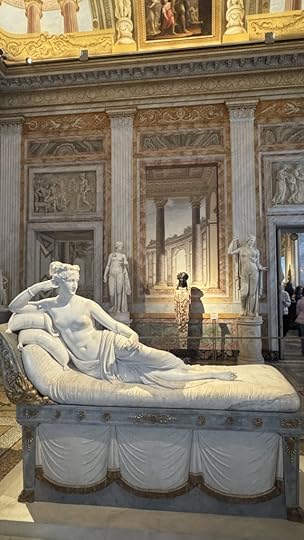
The collection includes Raphael’s Sacred and Profane Love, which I was able to sit and appreciate alone while the tour group were clustered around a writhing figure at the other end of the room. The greatest treasures for me are their six Caravaggios and his Young, Sick Bacchus (1593) in particular which is also an early self-portrait. Naturally the guide was also very keen on Canova’s Venus Victrix, (1805) a portrait of Pauline Bonaparte (sister of the emperor) commissioned by her husband Camillo Borghese. It was unusual for an aristocrat to be portrayed naked, but Canova also did a naked statue of Nappy that is now in Apsley House on Hyde Park Corner so it balances out.
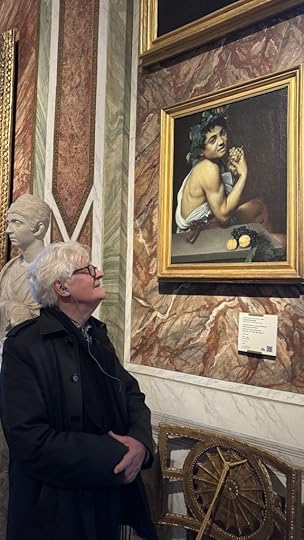
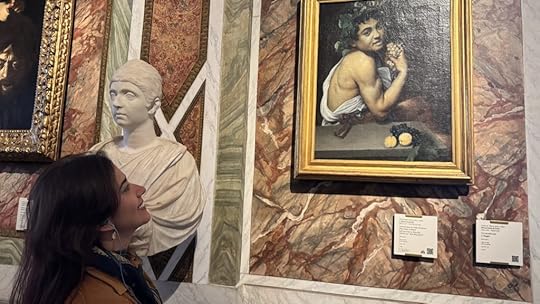
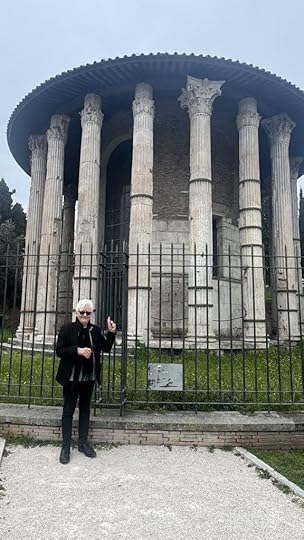
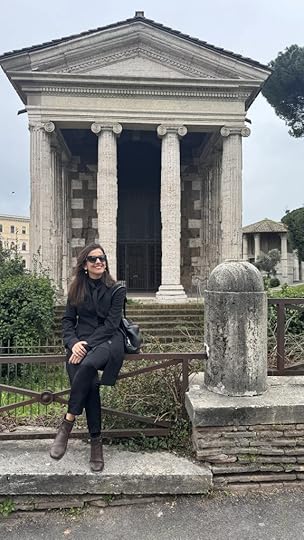
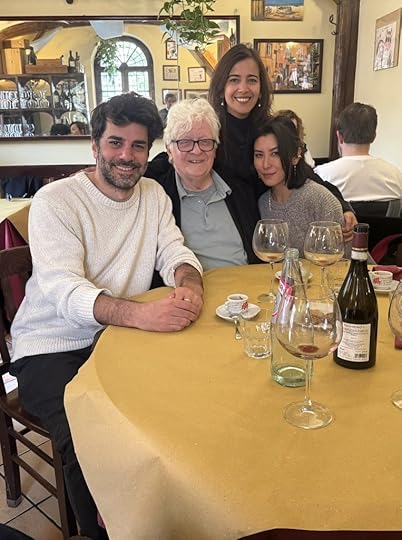
Camila is a wonderful travelling companion. She laughs at my jokes (!) and is prepared to accompany me to lessor known sites that I particularly like. On the 2nd we slowed the pace first by visiting the two little temples just over the bridge from Trastevere: the Temple of Vesta (late 2nd c BC) and the Temple of Portunus (70 BC). Both are remarkably complete. The former is a circular Hercules temple and retains its Corinthian columns though its marble entablature and original roof are gone. I like its size and beauty – the columns come from Greece and have integrated bases. And just next door stands the perfect little Temple of Portunus, set on a high podium to keep it clear of the flooding Tiber. We were on our way to Trastevere to meet Camilia’s friends. It was a truly international lunch: Benjamin is from Iran, I am a Brit, Camila is Brazilian and Britney is from Hawaii. And we all like wine. We did pop into a bookstore on the way back. Being an old bookseller – in every sense – I can’t help but check them out. This is the Open Door bookshop, a very nice place.
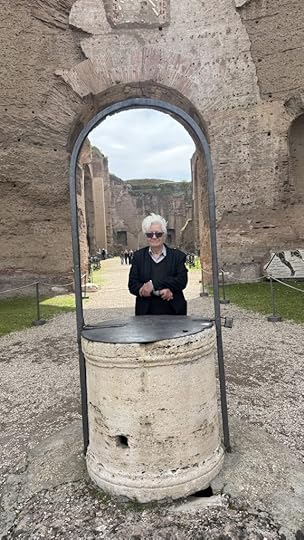
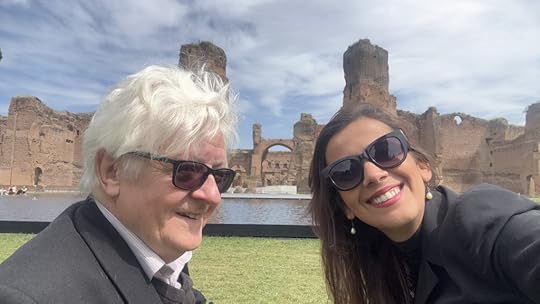
The next day we visited the Terme di Caracalla, (211-16 AD) south of the Colosseum. These are huge, capable of holding as many as 10,000 people and were in use for more than 300 years. As usual the Christians robbed the marble for their ghastly churches and moved the statuary to their palaces: the Farnese Hercules now in Naples is from there as are the winged thunderbolts in the Duomo in Pisa. But a huge amount remains: large areas of mosaic floor are intact and even fragments of wall mosaics are on display near their original positions. The site includes a large central garden which, in the spring sunshine, was quite delightful.
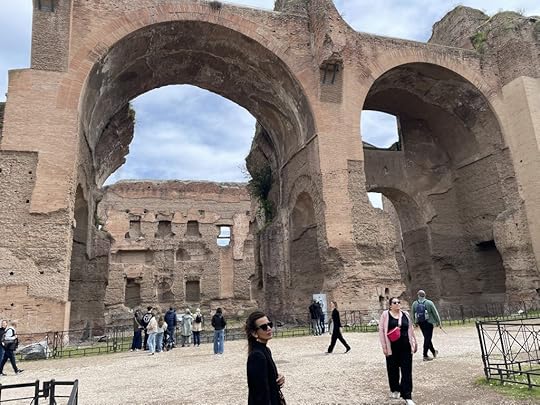
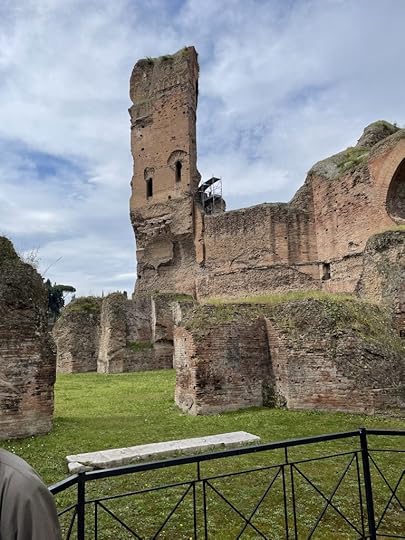
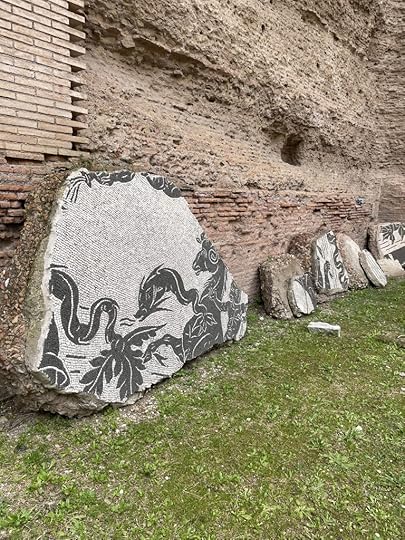
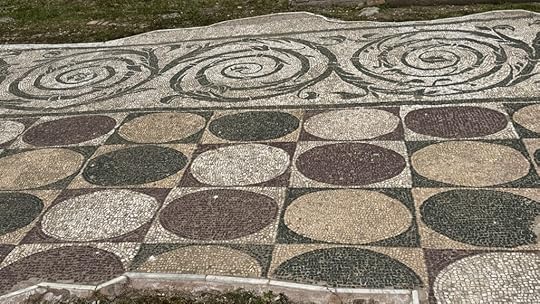
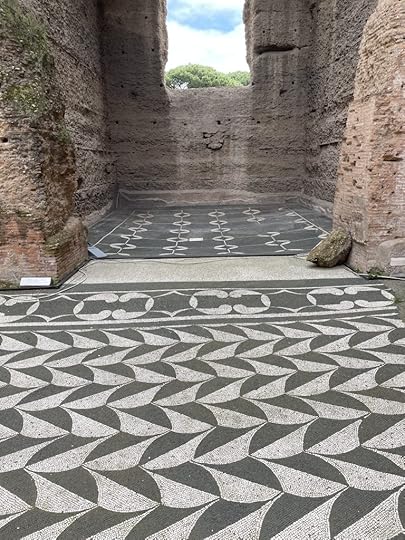
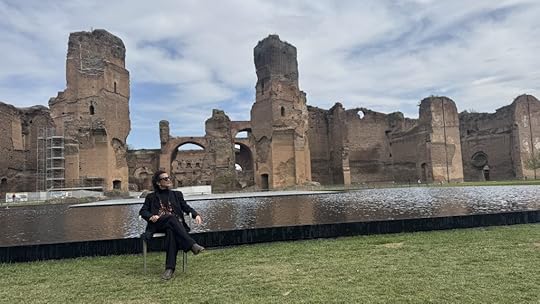
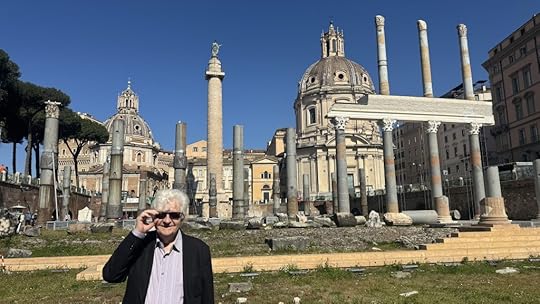
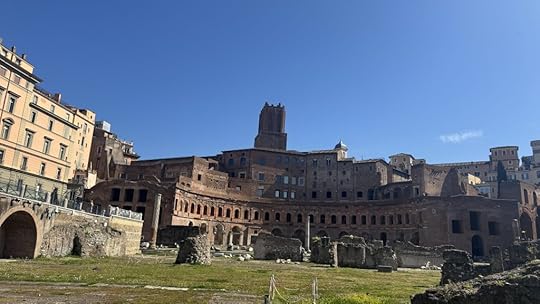
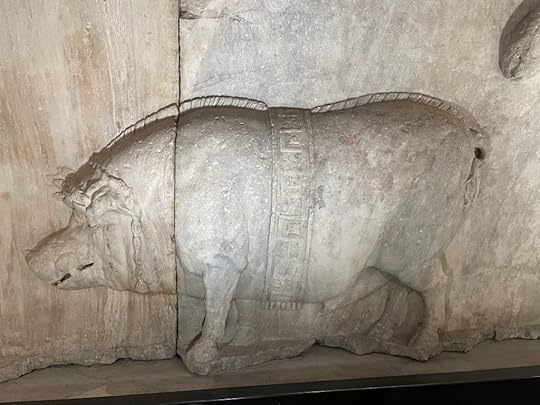
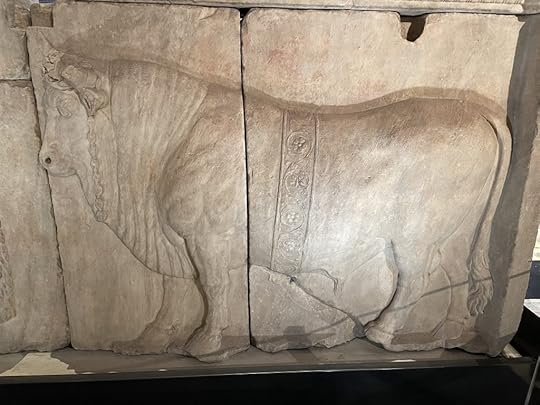
The weather held and using our Archaeological Park membership cards we covered the whole site from Trajan’s Column down to the Colosseum. This is the area of the Imperial Forums, and there are a number of them, making it quite hard to decipher. In fact, it would take a week to do a proper historical tour of the site. We just wandered and absorbed the atmosphere. To the north-west you get a good view of Trajan’s Markets, basically a Roman shopping mall, nestled closely against his forum. It recently featured in Emily In Paris-Rome if you watch such a thing. Some buildings are open and I loved the life-sized livestock in the Forum Romanum, particularly the pigs.
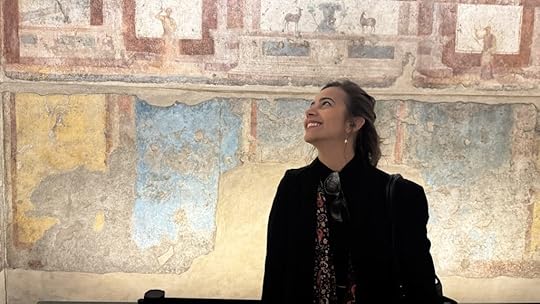
When I was a rock critic there was a well-known saying that ‘Writing about music is like dancing about architecture.’ Well, here’s proof that you can. We were admiring the only group of columns still standing from antiquity when an Indian couple offered to take our picture. It was a nice gesture. It is not all columns and statues; some painting remains though nothing like as extensive as in Pompei. The site is well managed with clear pathways leading through it and adequate signage. I did occasionally catch a glimpse of Rome 2000 years before, the senators in their togas, the merchants in their shops. It is a time machine.
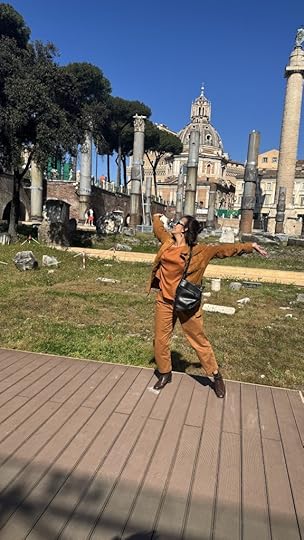
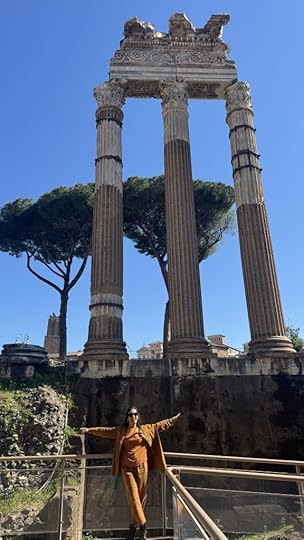
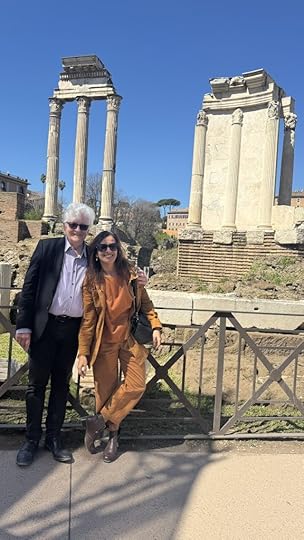
That evening we returned to Fiumicino Airport. Camila to Lisbon and her students, me to Paris where there was a Brion Gysin show awaiting me.
March 8, 2026
February continued
On February 17 we flew down to Luxor, the ancient Thebes. It’s a short flight, just under an hour. We couldn’t get into the Nefertiti but booked the hotel next door. This used to be the Suzanne, but now has the slightly unfortunate name of the S. S. Luxor. Just like the Carlton in Cairo, the only coffee provided at breakfast is Nescafe. For real coffee you have to pay extra and even then there’s not much coffee in it. The lift is more modern than the Carlton in that it has a door, and you can buy a beer in the lobby. (Warning: Sakara King Beer is 10%, more than twice as strong as in Britain, but they also do Stella at 4.5% a bit stronger than the UK.)
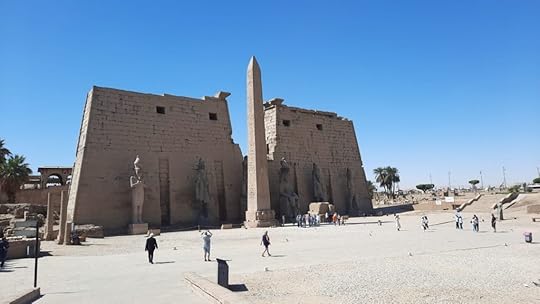
The S. S. Luxor has the same wonderful view of Luxor Temple and the avenue of the Sphinxes which goes all the way to the Karnak complex, 2.7 k away. The temple is remarkably well preserved, with most of the first pylon intact (the wall-like structure with a ‘v’ shape in the middle referencing the slot cut in a cliff by a waterfall. Only one obelisk remains to guard it – the missing right-hand one is now at the place de la Concorde in Paris. Some large statues have been moved there to replace the missing ones. It would be nice if they replaced the brightly coloured banners that once flew from the niches.
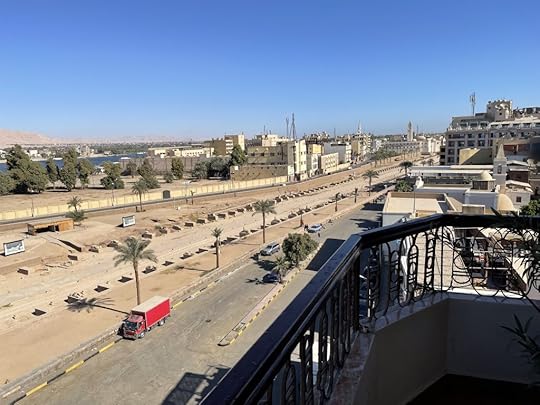
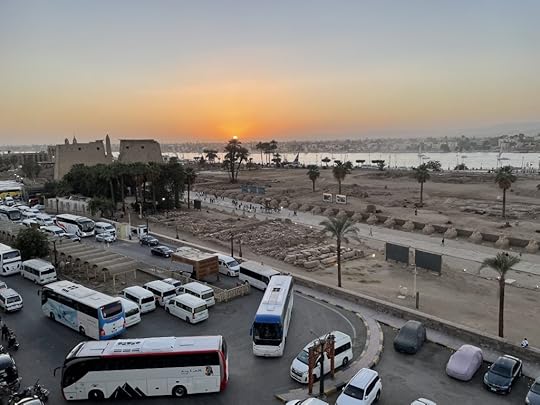
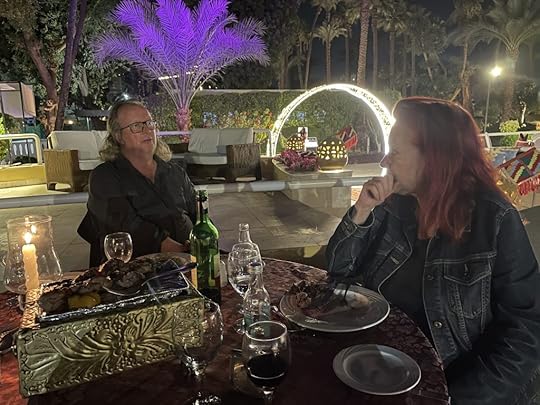
As the S. S. Luxor does not do food other than breakfast our first move was to go to the Winter Palace, the luxury hotel facing the Nile where Howard Carter, Lord Carnarvon and other archaeologists and aristos stayed in the twenties and where the discovery of Tutankhamun’s tomb in 1922 was first announced to the world’s press. We ate in the garden. Such luxury.
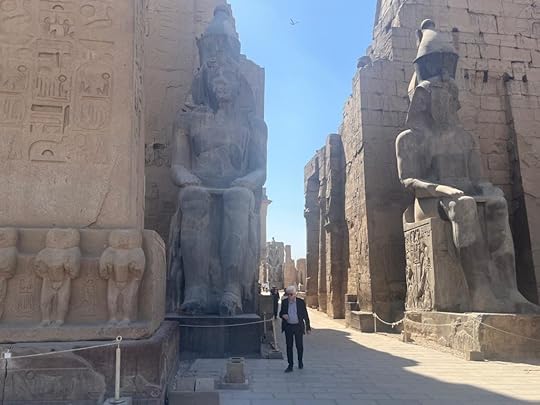
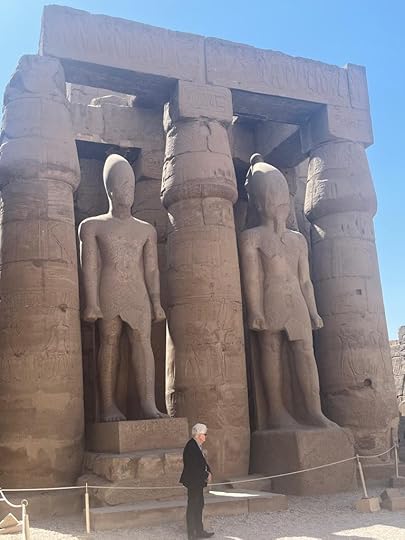
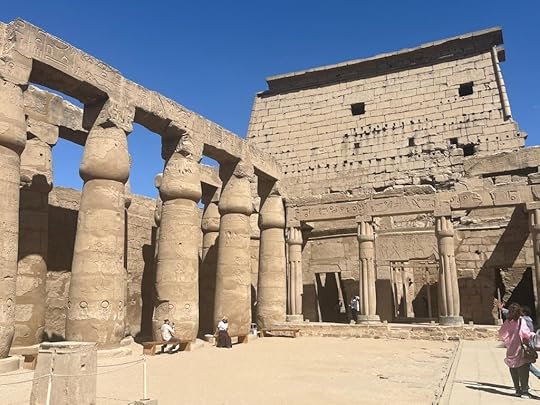
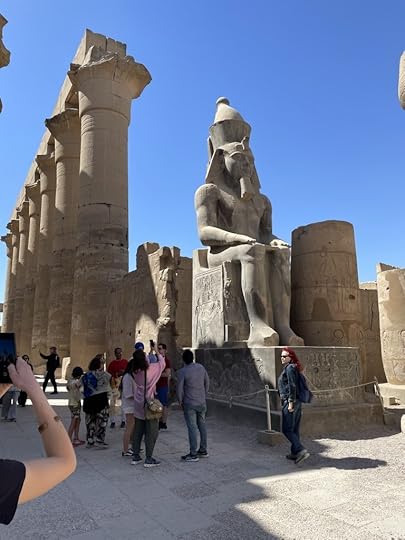
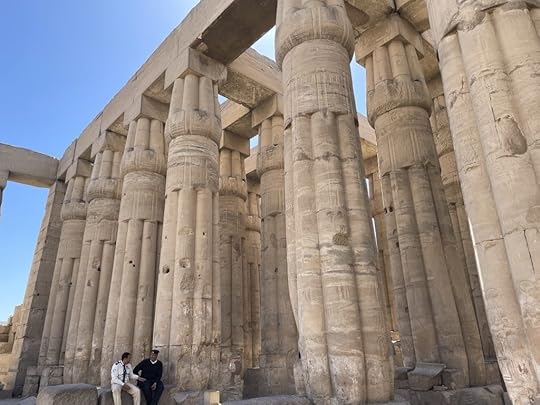
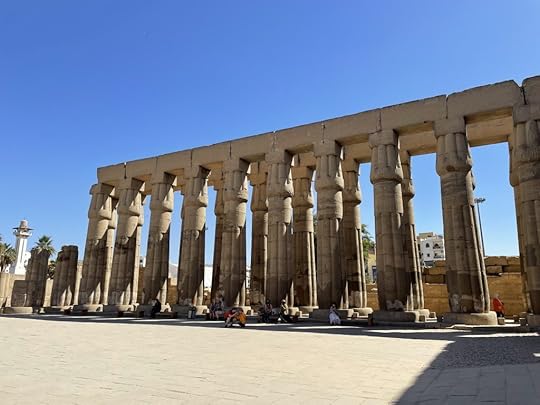
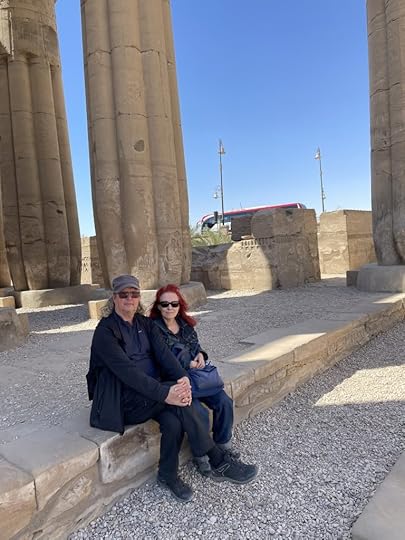
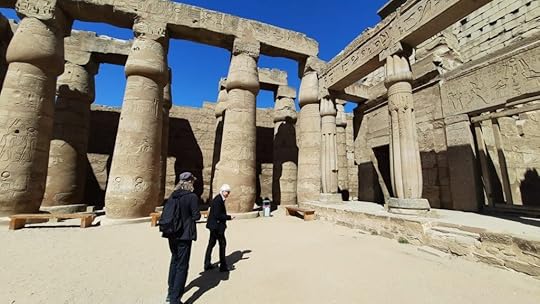
Next day we started our explorations gently by visiting the Luxor temple, just across the street. After passing through the first pylon, you enter the Great Court of Rameses II where the 74 columns still show their origins as bundled papyrus with bud capitals and there are a couple of huge statues of him. Then come pairs of open-flower papyrus columns which still have their architrave blocks followed by another court of papyrus columns. The huge size and scale of it all is overwhelming, partly because of its great age. It was built by Amenhotep III (1390-52 BC, finished by Tutankhamun (1336-27 BC then added to by Rameses II (1279-1213 BC, died at the age of 90 or 91). Much of the colour is still there, also, preserved in the dry desert climate.
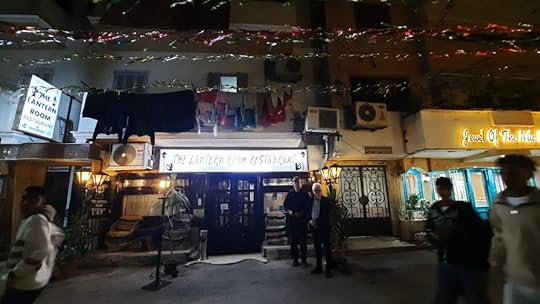
One key thing for British travellers is, of course, the provision of alcohol. International hotels are fine but not surprisingly most restaurants serving Egyptian food do not sell wine or beer. It is not difficult to get a drink in Cairo but in a small town like Luxor it becomes more problematic. The Lantern is one of the highly recommended restaurants in this respect as it’s English run. It’s never going to get a Michelin star but the food is okay. The washing dripped on me as we walked in.
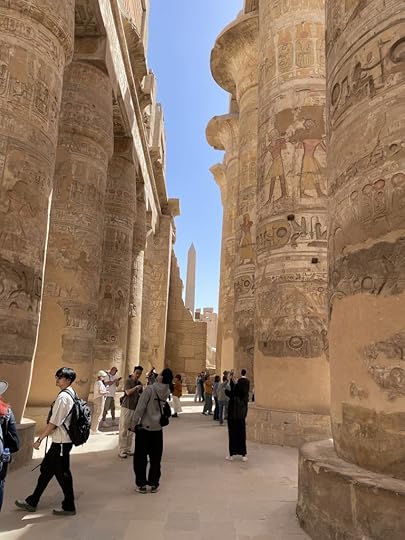
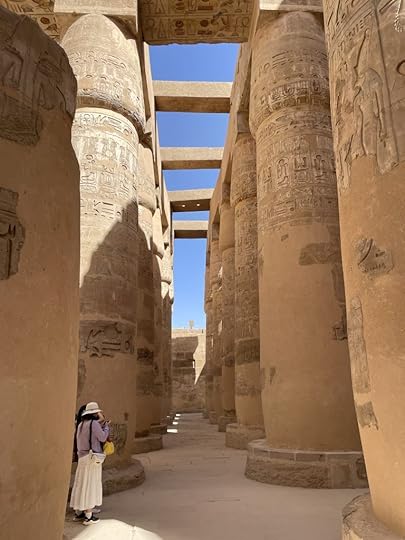
Karnak is one of the wonders of the world. You could spend a month there and still not see all the carvings and colours. You enter in it down an avenue of sphinxes with ram’s heads. As I described it in great detail in this blog just a year ago I won’t repeat myself except to ID the pictures.
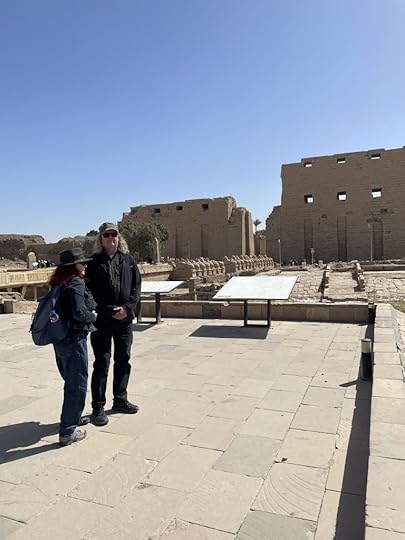
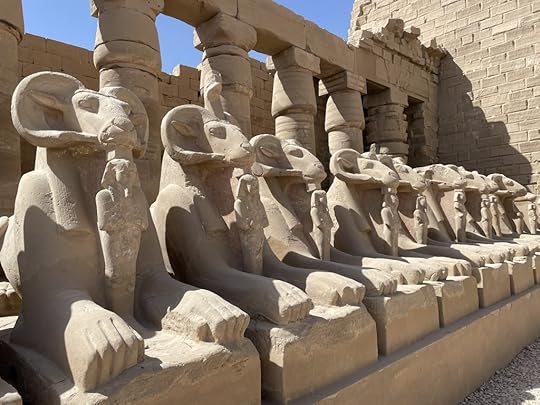
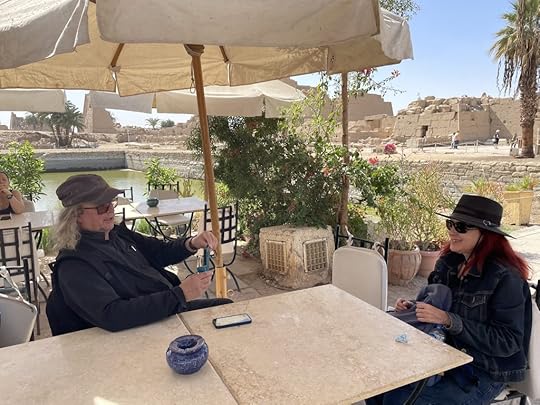
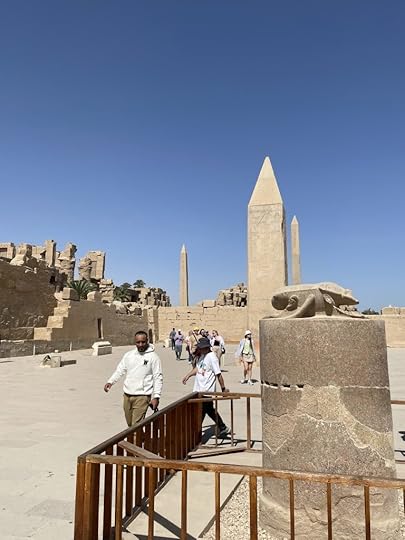
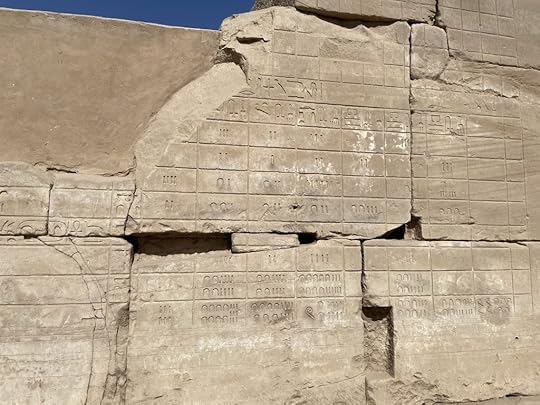
It seemed as if this visit there were far more fashion shoots than before and young Oriental women in particular had dressed the part as spirits of the Nile or some idealised goddesses, sometimes great groups of them. We returned twice to the pleasant café out by the side of the sacred lake which tourists didn’t seem to find. We saw the giant scarab and the wall of Egyptian bureaucracy; the accounting of offerings literally carved in stone.
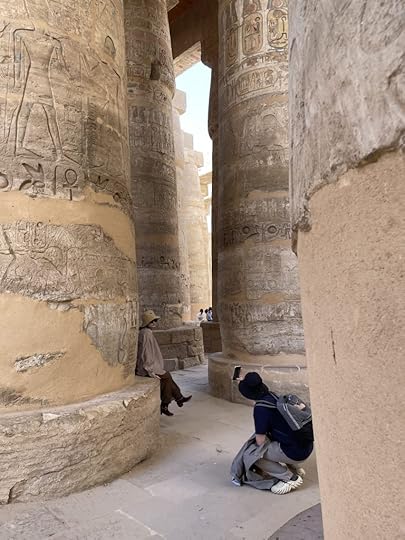
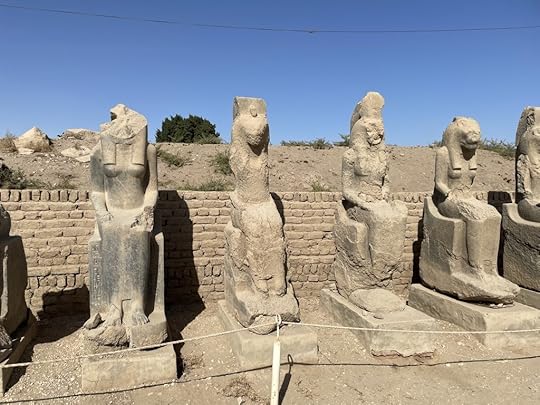
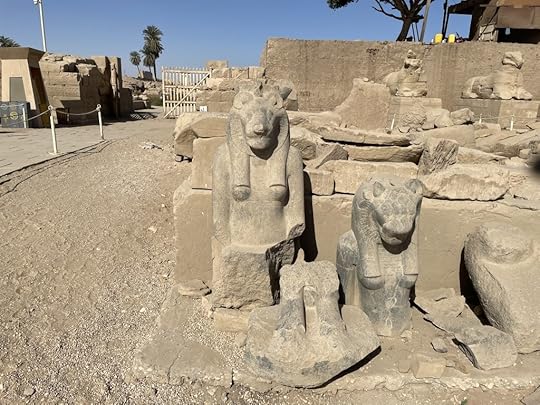
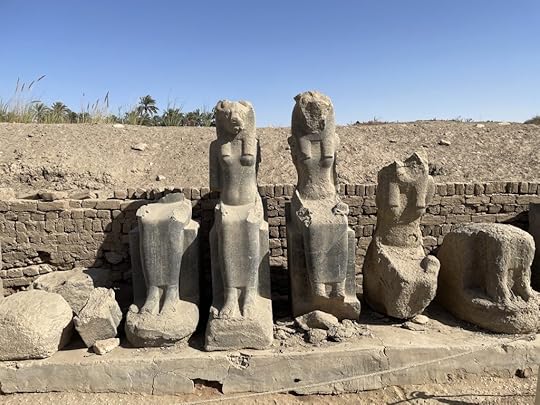
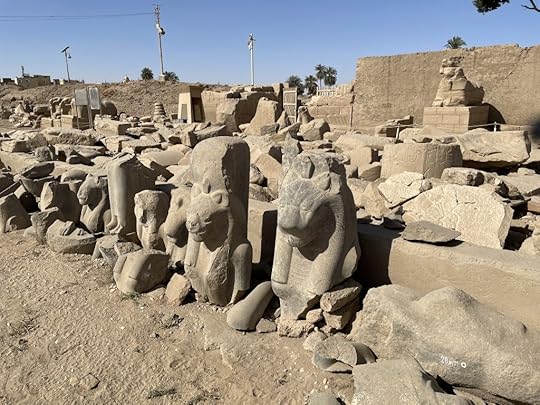
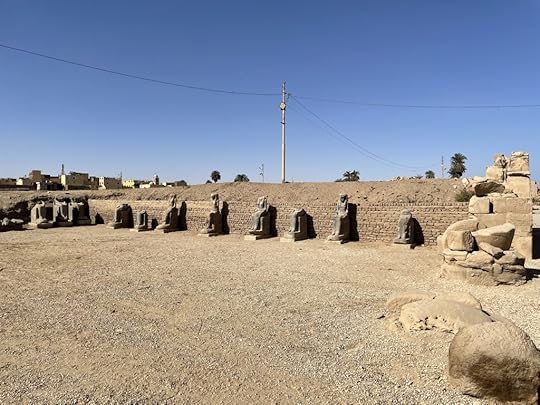
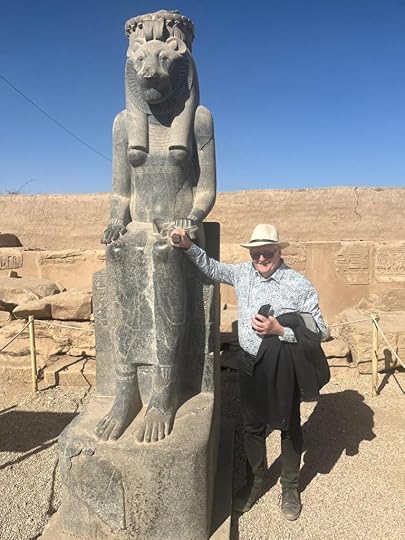
When Theo and I were there we did not have time to find the precinct of Mut which is situated some distance from the main temple complex in the direction of the avenue of the sphinxes. You pass where they terminate, in a wasteland of barely uncovered ruins, and finally reach a large wooden gate. Here an old retainer spent a great deal of time examining our tickets before unlocking it and letting us in. We were the only visitors. All four sides of a courtyard once held row of statues of the goddess Sekhmet, who I must have mentioned before as she’s my favourite goddess. And in the centre, jumbled lines of Sekhmet body parts, rows of feet, rows of heads, rows of torsos await future archaeologists’ attention. Presumably modern computer science would be able to scan them and fit them all back together. The British Museum has some superb examples of Sekhmet taken from this very place. It had not occurred to me that they were probably broken when they acquired them as they look in beautiful condition now. There is one large Sekhmet in the precinct, intact except for her sun-disk and she allowed me to hold her ankh while Suzy took a picture.
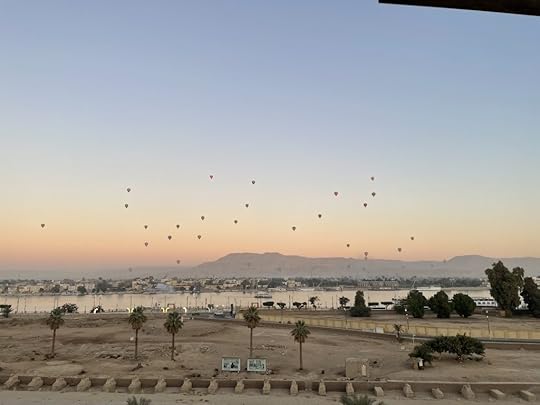
I awoke with the call to prayer the next morning and saw the hot air balloons ascending over the Nile. This is one of the local attractions and does look spectacular. Trouble is, they lift off at 6am.
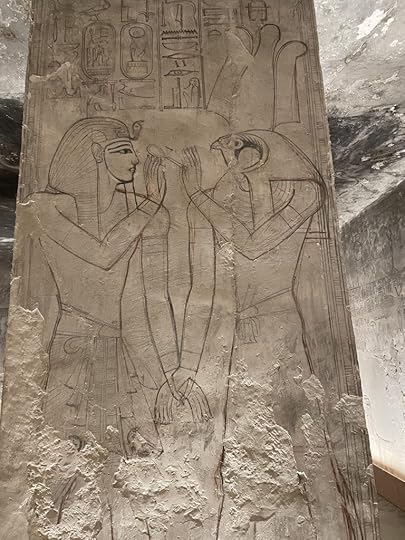
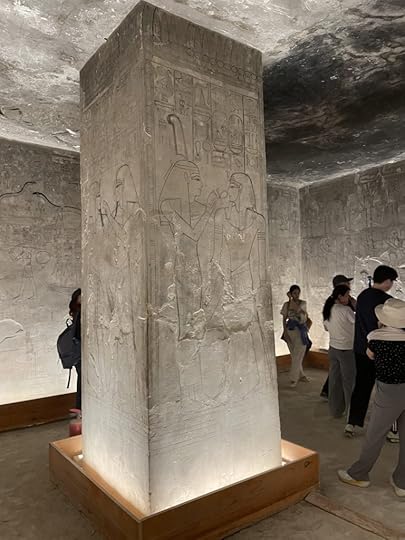
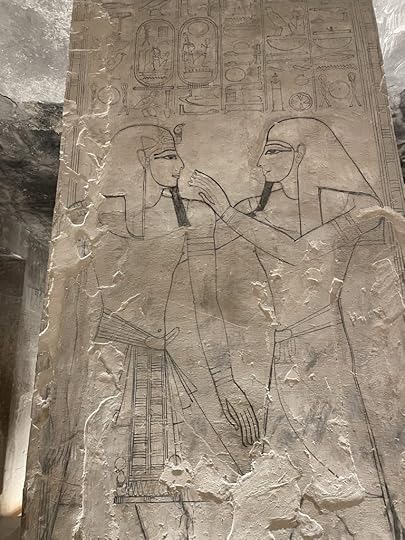
The 20th was Valley of the Kings day and we first went to Seti I’s tomb, (KV17) my favourite, which has the unfinished preparatory drawings on some of the columns as there was not enough time to complete the tomb when Seti died in 1279 BC. There is a looseness and openness about them that you don’t get in the beautifully finished works. You can relate more fully to the original artist, standing where you are, drawing on the white plaster almost three and half thousand years before. I particularly like the last picture, of Seti (on the left) with the god Atum.
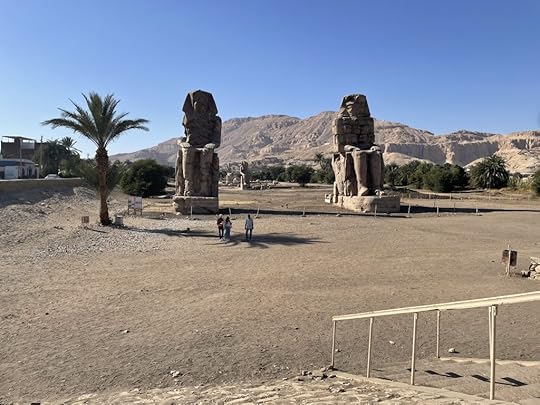
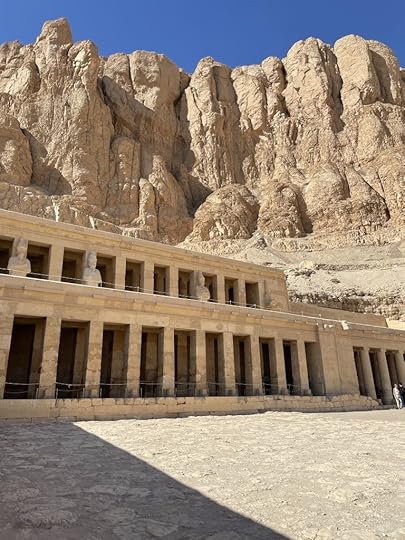
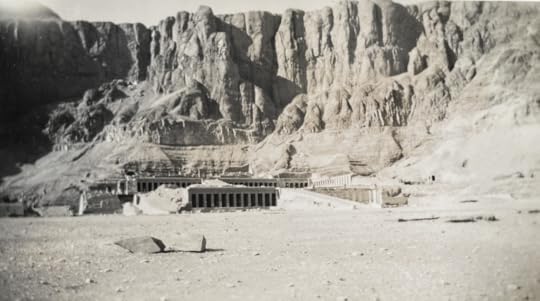
We made a quick stop at the Colossi of Memnon (1350 BC), two giant statues of the Pharaoh Amenhotep III which once guarded the entrance to his mortuary temple, now gone. We continued to the mortuary temple of Queen Hatshepsut. My friend Egyptologist Tom Hardwich is appalled by the restauration of this temple by a Polish team which has virtually recreated the building but to the layman it now provides an almost magical experience. When I returned to London, I dug out my father’s photo album which I hadn’t looked at in decades, but which contains family snaps and pictures taken by him. He was based in Cairo during the war and took part in the Battle of Al Alamain in 1942 in the desert close to Cairo. As well as pictures of tanks roaring across the desert, taken with a Brownie box camera, I was astonished to find a photograph of Hatshepsut’s temple, taken by him. He never spoke about his wartime experience, and I had no idea that he was ever in Luxor as the British forces were concentrated mostly in Cairo and Port Said.
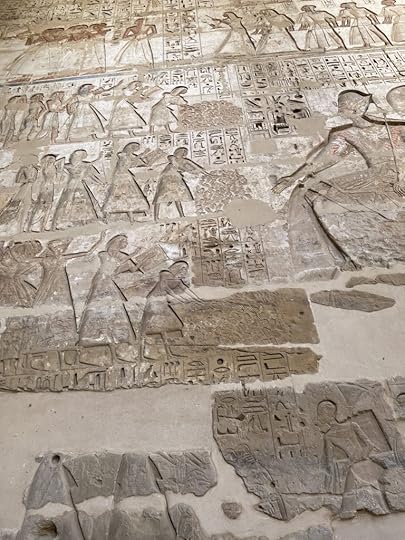
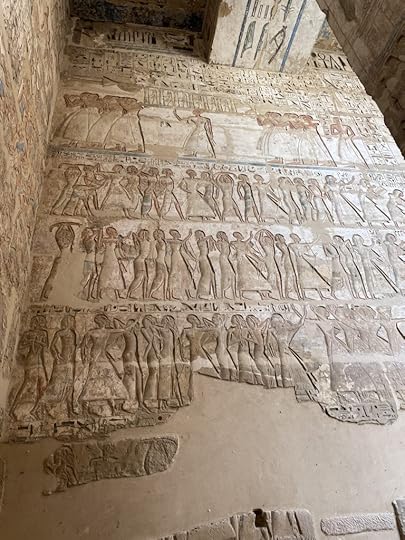
Next day, the 21st, we visited the Habu temple. It is decorated largely with celebrations of military triumph: massive wall carvings showing soldiers piling up hands, severed from their enemies. It’s all rather gruesome, but the low reliefs show a degree of animation unusual in Egyptian art. The Habu temple has a pleasant outdoor café located behind the first pylon which I recommend to visitors.
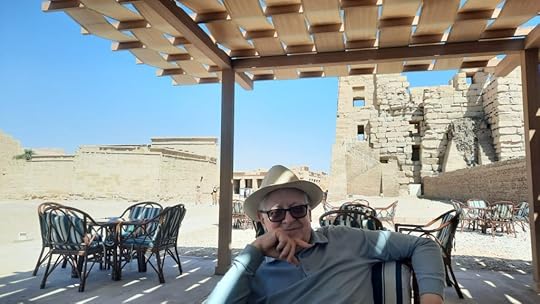
My friend the writer Maria Golia invited us to lunch. She lives in a house that she built herself next to the south wall of the Habu temple so it was just around the corner. She has no address, as such, so there was a bit of a problem finding her as I couldn’t quite remember how to find her house even though there are only about a dozen houses in the settlement. She welcomed us and showed us around – her rooftop view is astounding. It was my birthday, so she produced a candle and turned an apple crumble into a birthday cake! It was very kind of her and a delightful meal. I didn’t want to leave. Next day we flew back to Cairo for our final excursion, this time to Saqqara.
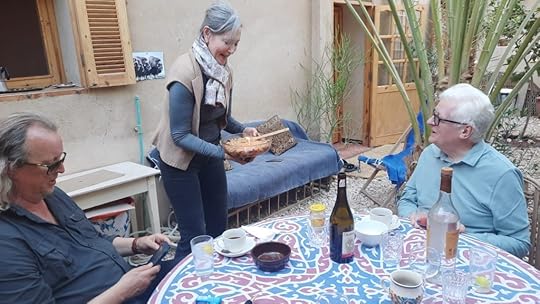
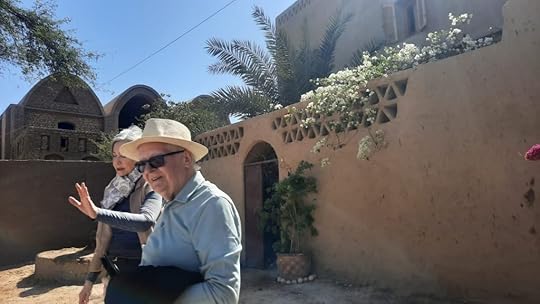
Back at the Carlton, in a better room this time with a proper shower, it felt like coming home. Ramadan posed less of a problem in the big city: during Ramadan no restaurant is allowed to serve alcohol, and no Egyptians are permitted to drink alcohol in public, even in a hotel. We had Egyptian guests over for a drink, only to find they had to drink lemonade or peppermint tea when they would normally have enjoyed a glass of Omar Khayyam. The regime micro-controls its citizens. Naturally the Carlton ran out of wine on our last evening; we should have bought supplies and kept emergency rations in our rooms.
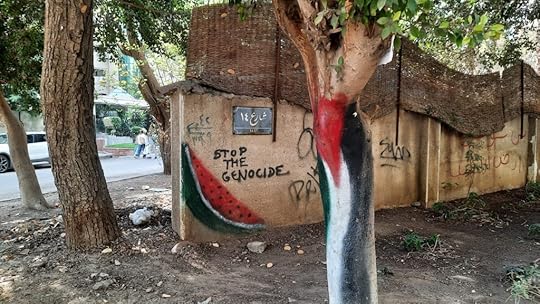
We saw Mira Shihadeh when we were first in Cairo and had drinks at the Café Riche. This time we went to her house in Maadi. Maadi is a leafy suburb, about 12 kilometres upriver from the Downtown area, a drive that is best avoided in rush hour. It is a low-rise area filled with trees and gardens, and, like the equally upmarket Zamalek area, it is home to several dozen embassies as well as up-market restaurants and shops. As usual, we couldn’t find her house. In fact the Uber driver had dropped us very close, but she was a little further up the street, so we wandered around for a half hour before managing to contact her on the phone. It should have been easy because her Palestinian flag was easily visible from the street, and she was responsible for the Palestinian graffiti at the end of the block. The watermelon is used as a symbol because the Israelis prohibited the use of the Palestinian flag within the Zionist colony and a watermelon has the same colours.
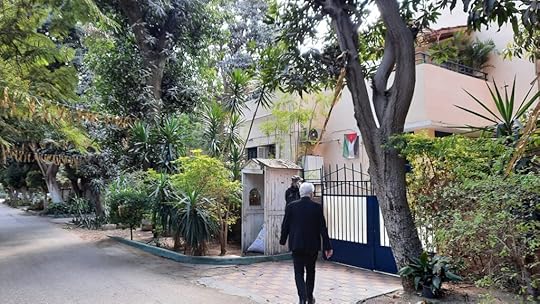
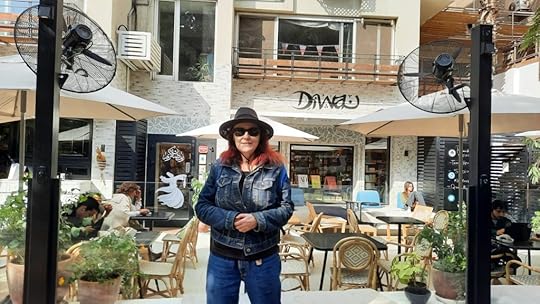
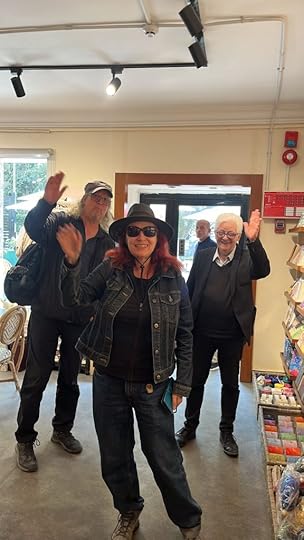
Mira showed us around the house. We looked at her paintings which are inspired by yoga and ballet poses – she taught yoga for 20 years – and by the protesters during the 2011 Revolution. We sat for a while on her terrace, then went to visit the local Diwan bookshop. Both Suzy and I had read Nadia Wassef’s autobiography Chronicles of a Cairo Bookseller, so it was great to find that Mira actually knew her. Diwan sells English language and Arab books. The shop could not have been in greater contrast to most of Cairo. A clean sunny area out front where people sat drinking coffee or snacks from the shop café with no beggars and very little passing traffic. It houses a selection of books, mostly in English, concentrating on the arts and self-help. The contrast between the stock and staff in places like this is hard to ignore. Statutory minimum wage for this type of work is EGP 7,000 a month (£103.92) and the average monthly salary in Cairo is EGP 9,780 (£145.19), so it’s unlikely that Diwan pays much more than that, whereas an art book can easily cost EGP 1,000 (£14.85) or more. No wonder Wassef complains of constant theft in her book. There is no solution to this, short of making the shops into collectives and somehow paying back the capital but then why not start their own? It’s unlikely that there are government loans or incentives for this kind of trade. Mira sent a picture of us all waving to Nadia Wassef. Then to the Villa Belle Epoque for a meal in the garden. But for the fact that they don’t serve alcohol, we could have been in Provence.
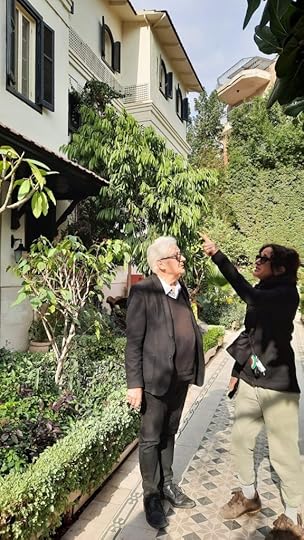
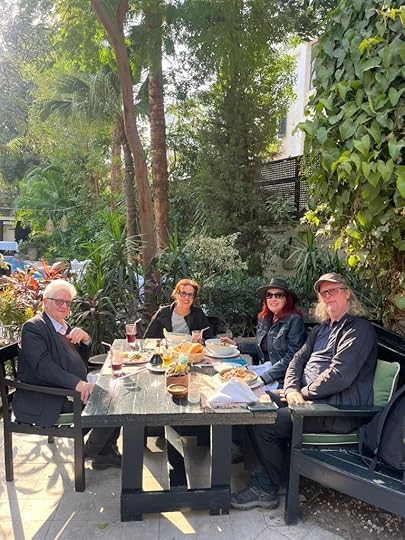
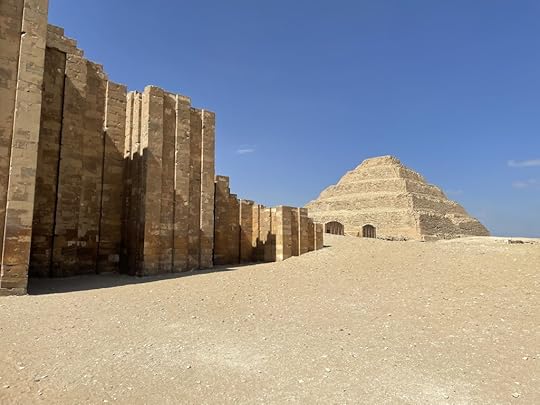
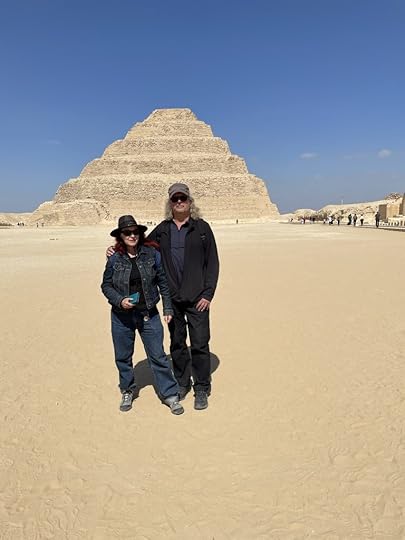
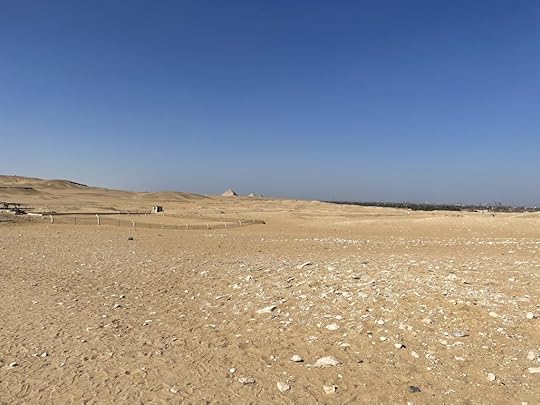
We hired a car for the day and set off to Saqqara. This is a huge site, and new discoveries seem to be made every few months. However, we concentrated on the highlights, of which the Stepped Pyramid of Djoser is the star. It is the first ever pyramid and was built between 2670 and 2650 BC, in the Third Dynasty for the Pharaoh Djoser. (Oddly enough, it is almost exactly contemporary with the pyramids at Caral-Supe in Peru which date to 2627 BC). It’s big, it was originally 62.5 meters tall (205 feet) and covered in polished white limestone. Sixteen other kings built their pyramids at Saqqara, which are in various states of preservation and are mostly closed and some of which are dangerous to explore. They dot the horizon. When Rosemary and I first visited Saqqara ten years ago with Tom Hardwick, the Stepped Pyramid was still undergoing its 14-year restoration, and one side was covered with scaffolding. But now the work is complete and the site looks wonderful. The restoration is sensitive and the surrounding archaeological site clean and well laid out. The site includes a temple structure with the usual row of columns and a wall. There’s a good Wikipedia article about it.
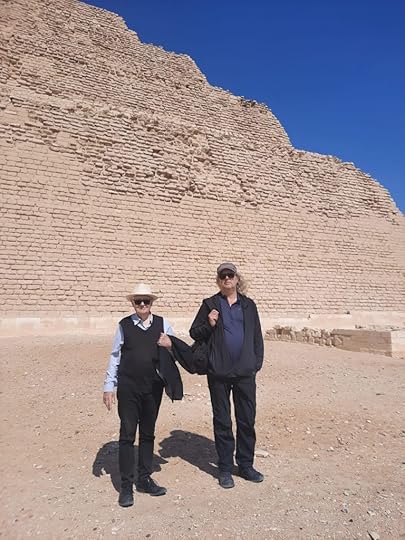
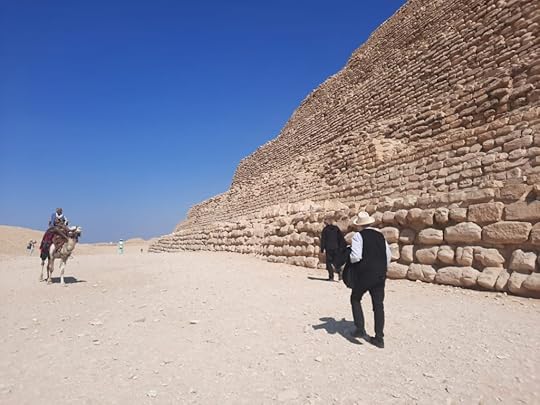
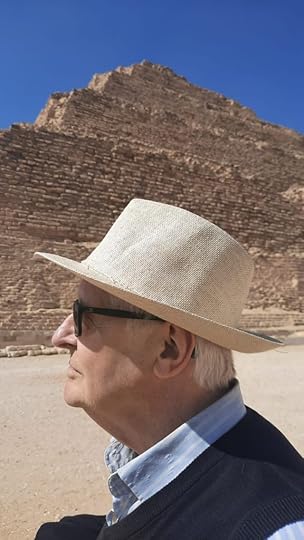
One of the most extraordinary sites at Saqqara is the Serapeum where they buried the sacred bulls of the Apis Cult. The Apis bulls were thought to be the incarnations of the God Ptah who, when they died became immortal as Osiris-Apis. The cult was in existence for about 1400 years but the ones in the Serapeum are from the late period, ending around 30 BC. The bulls are buried in tombs lining long underground galleries. Each Apis sarcophagi weighs about 40 tons and they have lids weighing in at about 25 tons. The oldest sarcophagi here is from 550 BC. The labour involved in excavating these catacombs is mind-boggling. There are two dozen sarcophagi in the Serapeum, all but two of which were robbed in antiquity and all the grave goods stolen. Older burials have isolated tombs dotted around the area. The Serapeum was once approached by an avenue of 370 to 380 sphinxes, but they have all been removed with some in the Louvre and most of them in the Kunsthistoriches Museum in Vienna. Looking across what is now a flat piece of desert you would never know a funerary complex once stood there or that these amazing tombs lie beneath the sand.
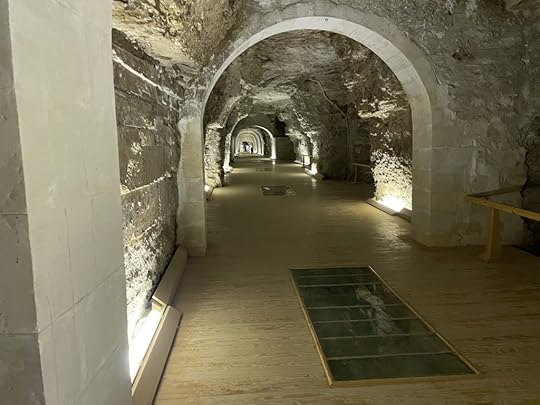
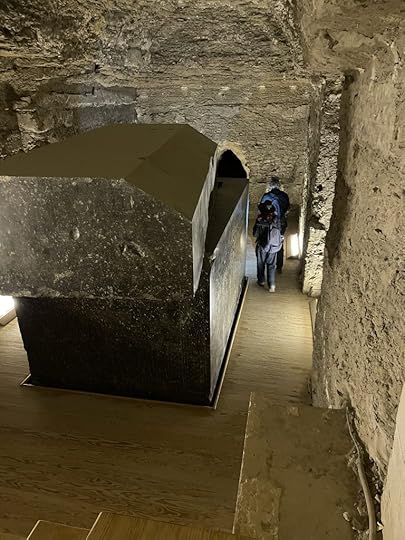
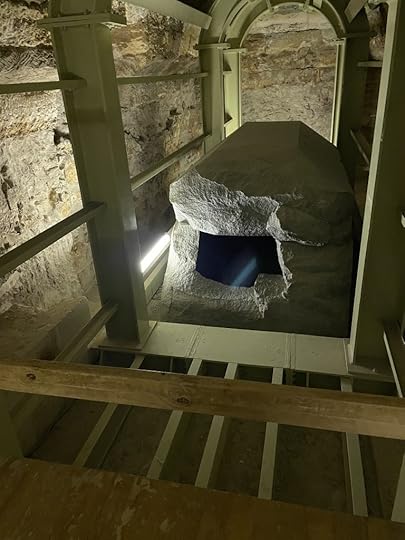
February 28, 2026
February
Off we go on a new trip and the sign on the seat back of the British Airways flight to Cairo suggested a very intellectual clientele indeed. I tucked my copy of Waguih Ghali’s Beer in the Snooker Club in the pocket and looked around to see if the flight consisted entirely of Egyptologists.

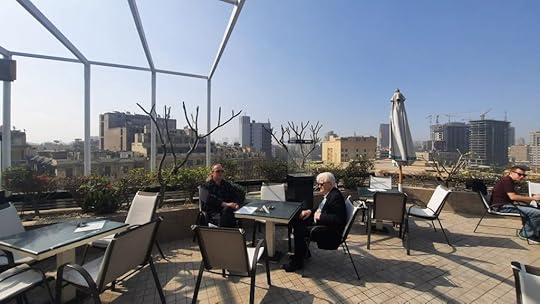
When I returned from Egypt with my son Theo a year ago, I enthused so much about the trip to my friends Richard Grayson and Suzy Treister that, after an evening of fine food and wine, we had agreed that we should all go there together. It took a while before plans were firmed up but on February 10th, we went through the first of many security checks at LHR. We stayed at the Carlton which is a fine old thirties building that has seen better days – particularly the bathroom fittings – but has a great roof garden which becomes a pleasant club in the evening , with a snooker table, candles on tables, and a view of rooftop Cairo, serving wine, beer and reasonable food at about half London prices.
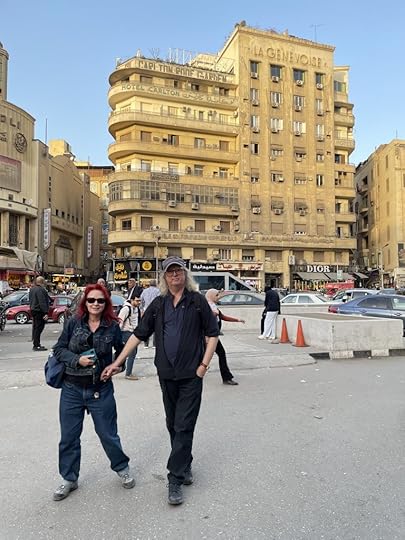
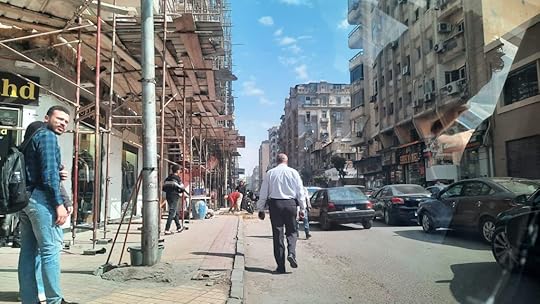
The usual problems of tourism are clear cut in Cairo. Tourists come to see the remains of an ancient civilisation that lasted 3,000 years and have little, or no interest, in the subsequent 2,000 years or in present day Cairo. It therefore comes as quite a shock to find themselves in a Third World country. The Greater Cairo Metropolitan area has between 22 and 23 million people, and they are very poor, and they want your money. The city is on its last legs: it seems as if anything that can be smashed, has been smashed and the debris left where it landed. The pavements are impossible to walk along because jagged bits of iron stick up, manhole covers are missing, every time a cable or a pipe is laid the trench is only loosely infilled with sand and a few rocks, and the pavement tiles themselves are often loose and frequently missing. Consequently people mostly walk on in the road, where the traffic is thick, the level of pollution almost makes you retch, and crossing the road requires a strong belief that they will indeed stop when you walk out into the traffic – all the time avoiding the potholes, some big enough to bury a dead dog. Suzy, Richard and I quickly became adept at the road crossing skill but never managed the insouciance of my friend Mira who appeared to not bother to look at the traffic at all, just stepped straight out in front of oncoming cars.
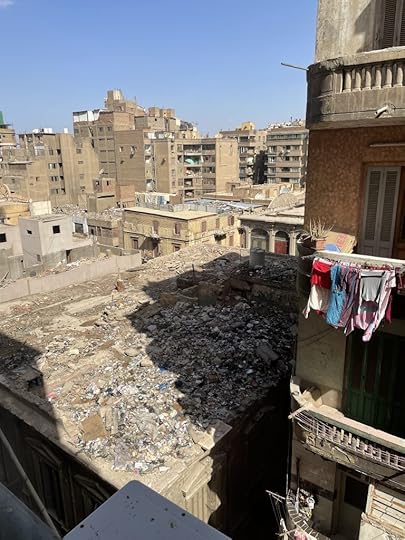
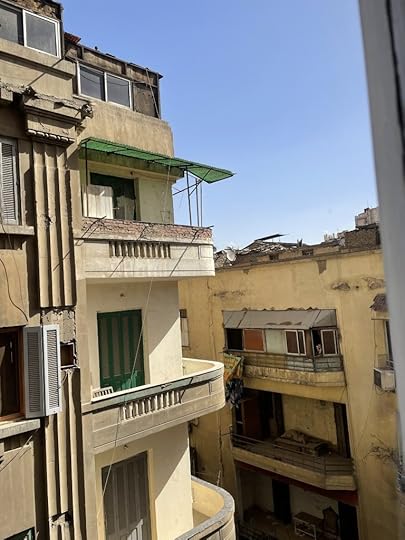
Piles of trash and rubbish are not confined to the street, however. After the failed 2011 Revolution there was a period of free-for-all when a shantytown of shacks was built on the rooftops. Most of these have now been pulled down, but no-one has bothered to remove the piles of broken concrete and mud-bricks which now litter the rooftops. Here’s the view from my room at the Carlton:
Rather than confront the conmen and hustlers at the Pyramids on our first day, we paid a sedate visit to the old Egyptian Museum in Tahrir Square, still open although many of its treasures have been transferred to the Grand Egyptian Museum out by the Pyramids. The galleries which once contained the treasures of Tutankhamun’s tomb are now empty, and there are great gaps in other places, but many wonderful things remain such as the Narmer Palette, made c3000-3,000 BC which shows the unification of Upper and Lower Egypt by King Narmer. It is the earliest record of a king wearing both crowns. Phonetically his name means King Catfish and there is a beautiful carving of such a fish at the top of the panel. When our Egyptologist friend Tom Hardwick explained the meaning of the palette to Rosemary and I, on a visit ten years ago, a crowd gathered around, thinking he was a guide. He could have been, of course, as he certainly knows far more than most of the people showing tourists round. The palette has been referred to as ‘the oldest Egyptian historical record.’ It is about the same age as the original earthwork enclosure of Stonehenge or 500 years older than the first stone circle and shows how much more advanced the Egyptians were than anything happening in northern Europe at the time.
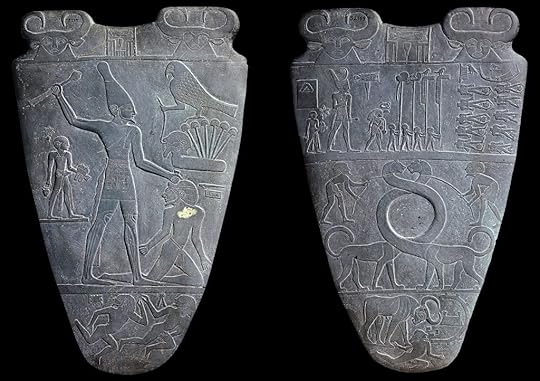 Narmer palette
The other great things, for me, in the museum are the statues of Akhenaten (who reigned 1353-1336 BC.) He began life as Amenhotep IV but in the fifth year of his reign became Akhenaten when he introduced monotheism in the worship of the Aten, or life force as represented by the sun. Among his wives was Nefertiti, mother of his son Tutankhamun. He also introduced an extraordinary new fashion, depicting himself, his wives and children, with elongated heads and large bulbous stomachs and thighs. Heree I am with him to give him scale.
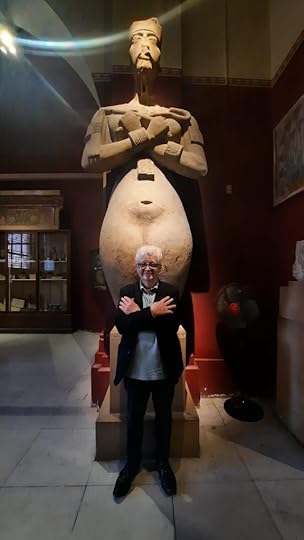
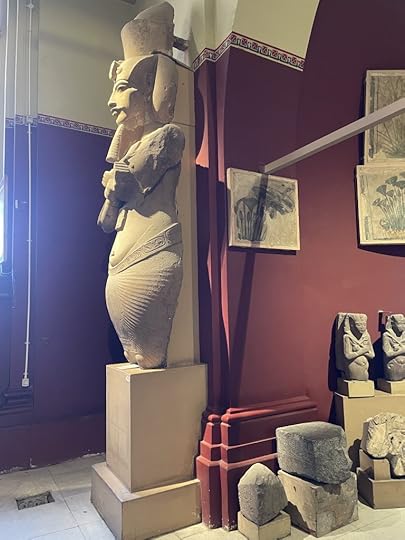
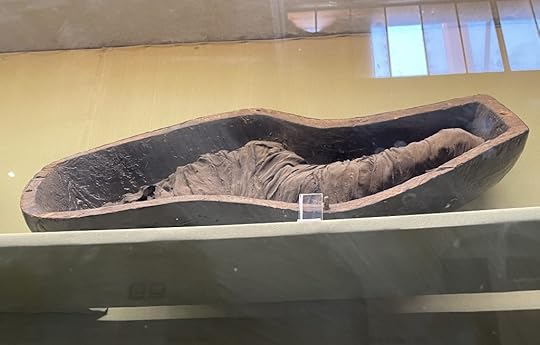
You needed food in the afterlife and there are rows of mummified ducks and, one of my favourites, a mummified leg of lamb, shown here.
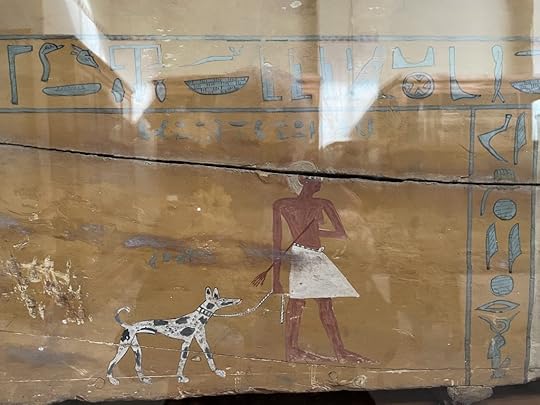
The Museum looked like this when Theo and I saw it a year ago: vitrines standing at angles, some of their contents tipped over; labels missing; piles of objects near a service elevator already dusty, awaiting transport, and many objects with their original faded nineteen-thirties English language (or French) type-written labels, often surprisingly candid ‘these work is not very good’ or ‘of little interest’. Everywhere there are exquisite details like the man taking his dog for a walk. We took two days to see it and only scratched the surface as they say. It is a space in stasis, frozen in time, while someone, somewhere, decides what to do with it. It is marvellous, filled with character, a complex toybox of discovery unlike the ghastly bling of the Grand Egyptian Museum that we went to see the next day. Some cases are empty, other have one remaining object, but you can be sure it would look nice on display in your home. There are rooms of ostraca, the flakes of stone or broken pottery used for preliminary drawings or as notepads, where almost every object deserves study.
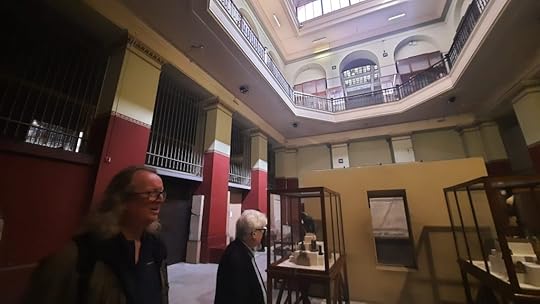
Egyptians get up early. The call to prayer is amplified at high volume just before 5:00am throughout the city, making it virtually impossible to ignore. In fact, it is not long since the whole society lived by the ancient rhythm of rising with the sun and sleeping shortly after dark. The construction of the Aswan Dam finally brought a widespread electricity supply, and with it the ability for students to study after dark, for families to eat later, and more recently air conditioning. However, a dawn start with an early breakfast with the main meal late in the afternoon is still very common. To delicate Europeans like Suzy, Richard and me, the Muezzin’s sing-song wake-up call was less than welcome, but it’s their country. I wonder what the 15% Coptic Christians think about it. It meant I never had a decent night’s sleep the whole time I was there. Too much of a night-person.
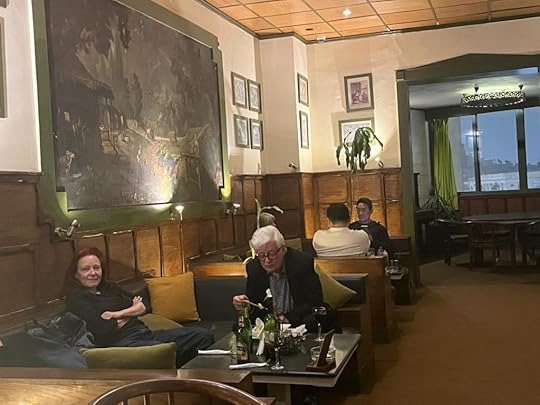
Of course the greatest treasure in Egypt is the contents of Tutankhamun’s tomb, still housed in the old Tahrir Square Museum when Theo and I were in Cairo a year ago, now occupying a whole gallery at the GEM, the Grand Egyptian Museum on the edge of the desert out by the Pyramids. The less said about the building the better, but it most reminds me of Cairo International Airport. Soulless. I understand that Irish architects Heneghan Peng at one point tried to take their name off of it because of so much interference from know-nothing politicians, but it still features heavily on their website.
The galleries are all on a high level, reached by a grand staircase, littered with wonderful examples of Egyptian statuary. Not everyone wants to climb a long series of steps to reach the main displays but there are no lifts, only one narrow, London underground-sized, escalator, with three stops, to take tens of thousands of people to the top. It is already jam-packed and, as this is Egypt, the likelihood of at least one stage failing is great. The busier London tube stations usually have two each way for far less people.
The first day we concentrated on Tutankhamun: the four great shrines that fit into each other like Russian dolls and which, in turn, contained sarcophagi fitted into each other. Again, each of these deserves hours of study but most people gaze open-mouthed at so much gold, take a picture and move on. Tut’s gold funerary mask now appears suspended above the crowds in its bullet-proof vitrine while worshipful crowds take thousands of selfies. In a way, the purpose of mummification and preservation seems to have worked for him for although Howard Carter was nothing more than a modern-day tomb robber, Tut is still being worshiped whereas when he was sealed in his tomb, he was just a footnote in history as a minor pharaoh in a list of hundreds.
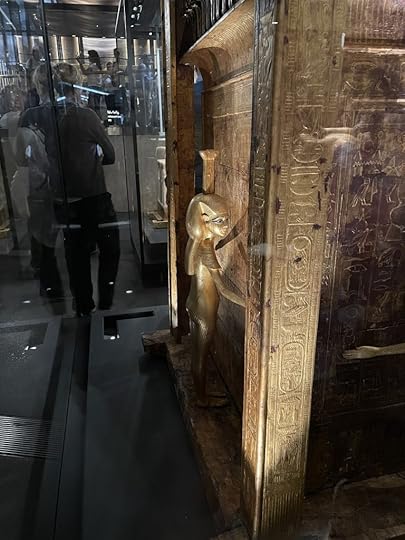
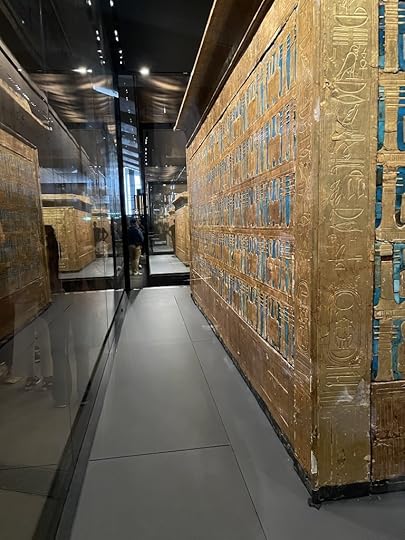
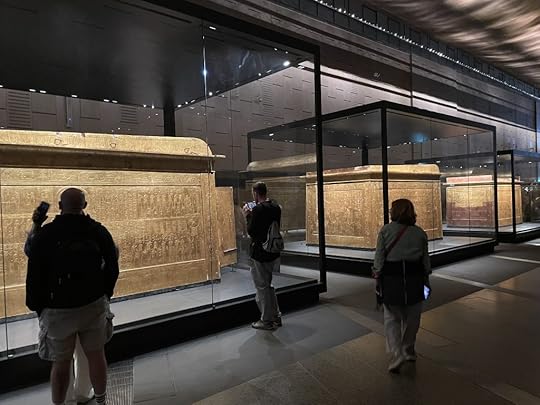
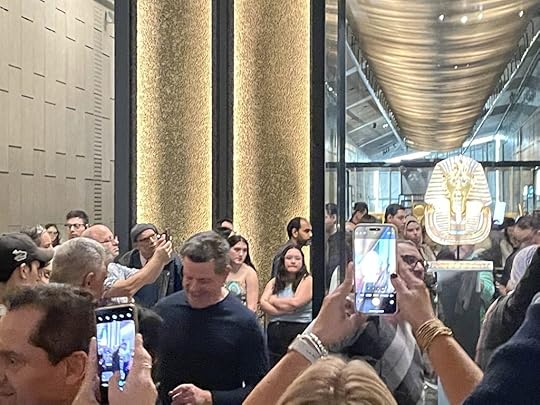
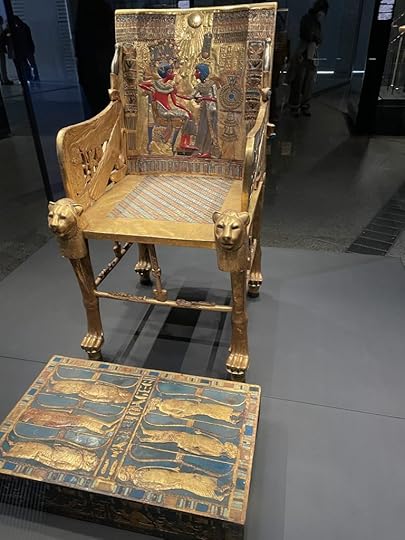
There are over 1000 objects from his tomb on display, some of them truly extraordinary such as his throne. There are chariots, slippers, toys, all manner of jars and vessels. It takes a day just to see this section of the museum. It had been misty all morning, but when we left the museum, a full-scale sandstorm had evolved and you couldn’t even see the pyramids, which are only 2 k away and are normally easily visible from Cairo 18 k away. In fact, it was already becoming hard to see clearly across the giant central atrium, which is open to the elements in the museum (another future conservation problem?). We left in a hurry, and I had a bad cough for days.
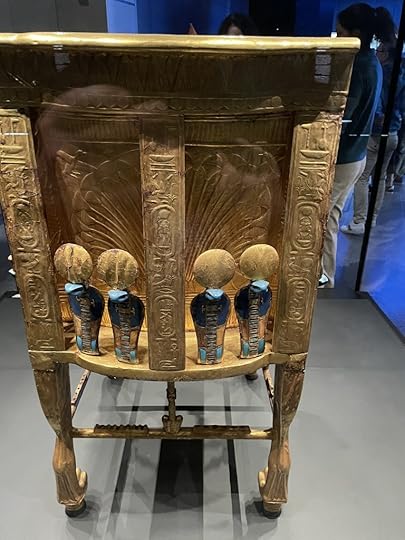
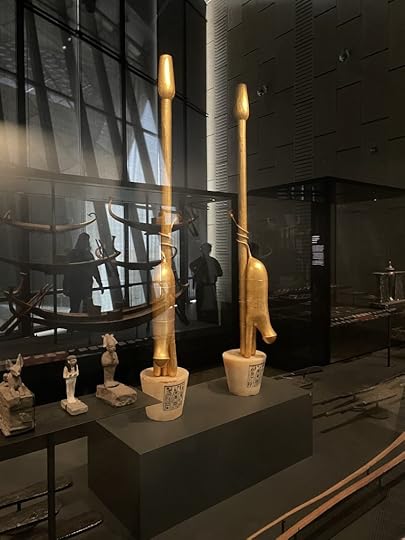
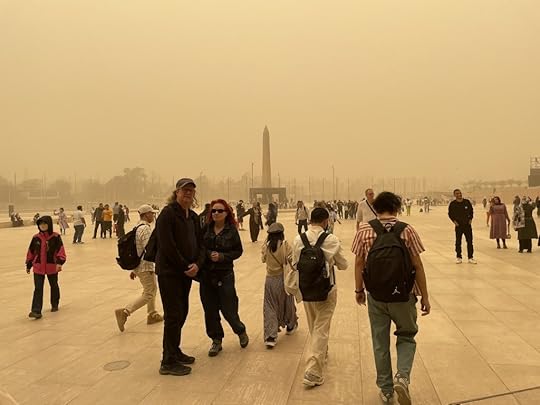
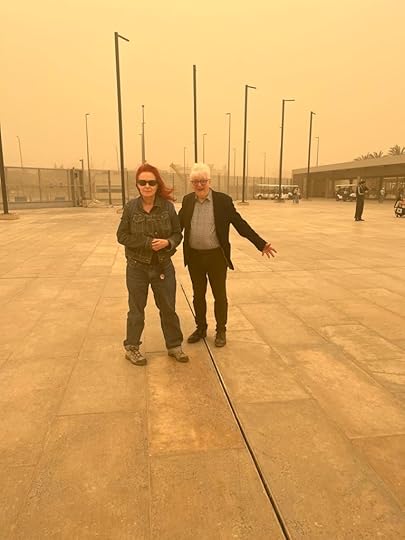
It was still a bit misty the next day, Valentine’s Day, so we explored Cairo instead of continuing our visit to the Giza plateau. I have never been a fan of the Copts, or of any of the Judaeo-Christian religions for that matter, but I dutifully walked through the Coptic Museum which only confirmed to me how much art and culture declined after Christianity destroyed the old Classical culture. The museum has a collection of rather nice Ottoman windows.
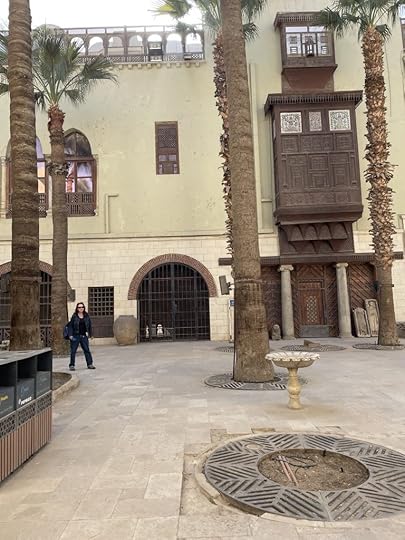
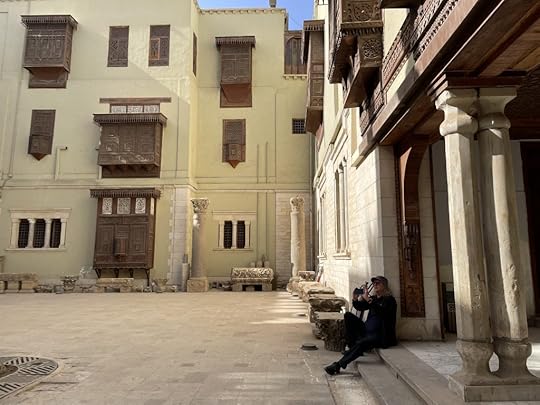
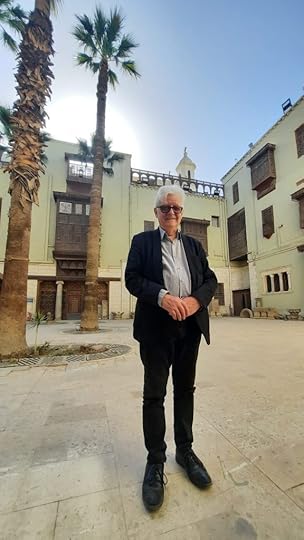
Back in Cairo we met my friend Mira for an early meal at Café Riche. The café is a great place or coffee, beer or wine but the food is pretty bad. In fact it is hard to get any at all. It turned out that they had run out of both the rabbit and the quail that we ordered, to the delight of the smirking young waiter. Mira is Palestinian, but from her looks they assumed she was a European. She grew up in Cairo and had a few words; they soon found some quail, which they proceeded to grill to a crisp.
I still love Café Riche because it is in the tradition of the great Parisian cafes where writers and politicians gather. Gamel Abdel Nasser planned the overthrow of King Farouk here, Naguib Mahfouz mentions it in a number of his novels and it would close on Fridays for him to hold meetings with his fellow intellectuals. It served as a refuge for injured protesters from nearby Tahrir Square during the 2011 revolution. Here’s Mira showing some of her paintings to Richard and Suzy at the café.
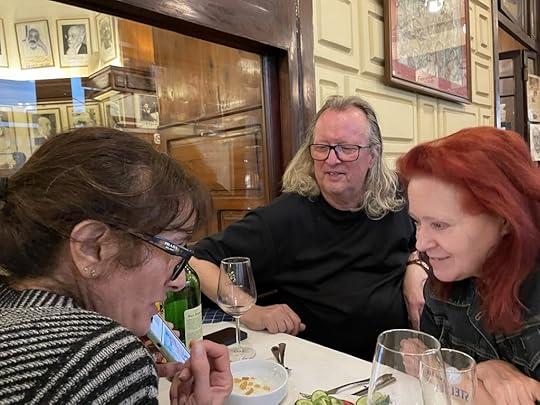
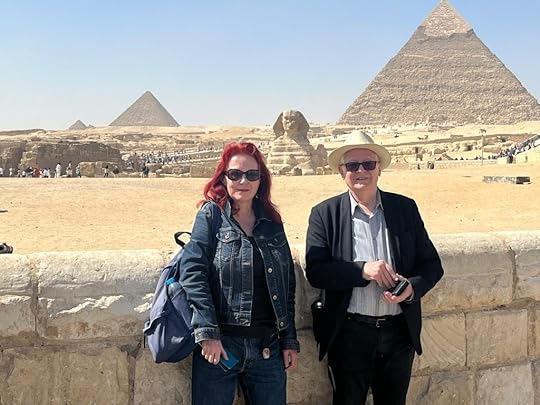
The next day the air was clear so off we went to see the rest of the Great Egyptian Museum and the Pyramids. It is quite a long drive, through some of the most horrific slums I have ever seen. The plan is to have a dedicated Metro stop at GEM, but I’ll never see that in my lifetime. It was rewarding to have a second look because even those objects you had looked at before seemed to have new qualities, inscriptions or traces of colour. Our driver, Muhammed, was waiting and when we were through we were soon at the Pyramids. There were none of the crowds that Theo and I had to fight through the year before and suddenly, there we were walking past the Sphinx on our way to the Great Pyramid.
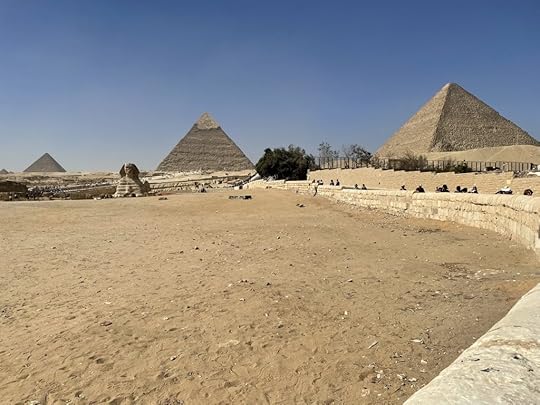
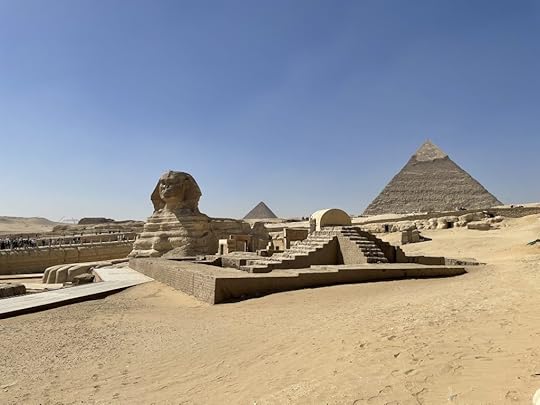
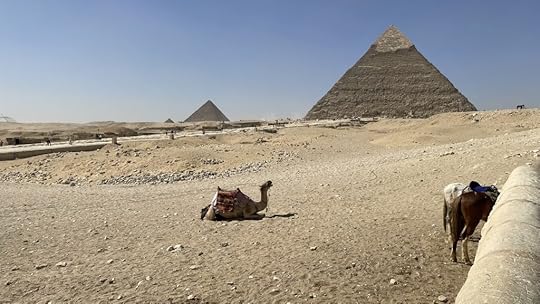
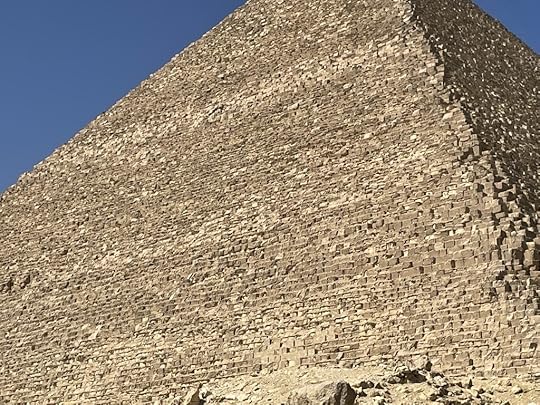
It was already quite hot, and as I am now 83 I felt the need for a little sit down so I suggested Suzy and Richard explore on their own and I would rest and contemplate the Great Pyramid for a bit. There was no-one around this corner of the building so for about quarter of an hour I had Khufu’s tomb all to myself. The more you look at it, the more details emerge. There are different strata, corresponding to the layers of rock quarried to build it, each block dug out, shaped, shipped to the site and placed so that each layer of rock in the quarry is disenable in the final structure.
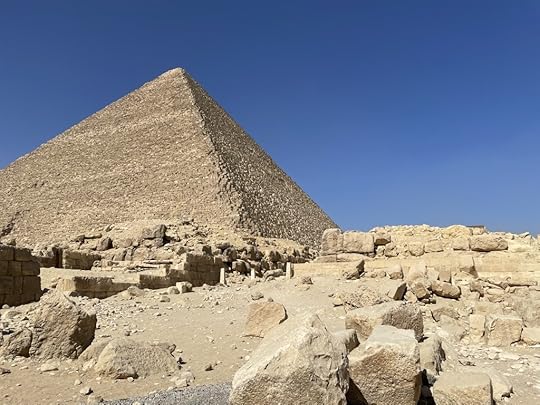
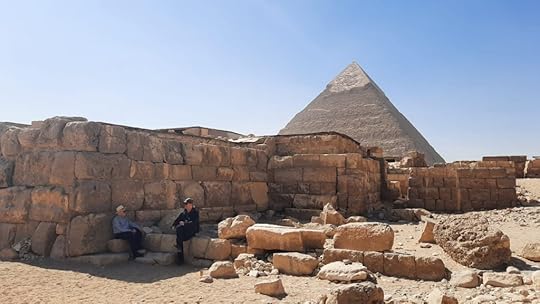
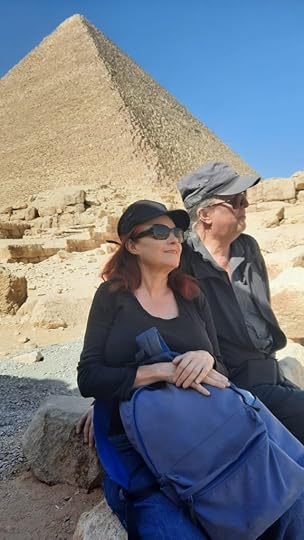
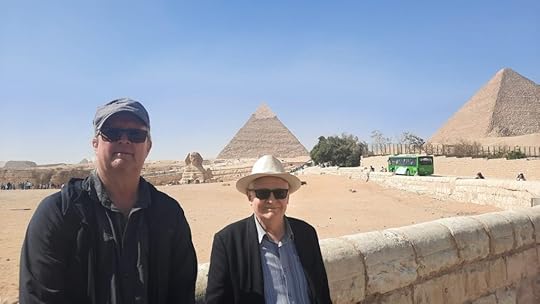
Then a young Egyptian family arrived, looking for shade. They each said ‘Hello’ politely as they passed, and in each case I replied. They settled in a little distance from me, then the man held up a plastic bag of food and pointed to his mouth. He was very kindly asking if I would like to join them. It is in their religion and culture to welcome and feed strangers, so I was honoured to be included, but none-the-less I declined, not having a word of Egyptian, and not wanting to spoil their picnic. They finished and left, each saying goodbye in turn – the two teenage daughters giggling a bit. Then they turned and came back. They took a photograph of each of them standing next to me, smiling, we each said goodbye again, and they were gone. It was a delightful experience. Then Suzy and Richard returned having walked right round the pyramid and experienced its massive bulk and after a rest we walked back to the gate.
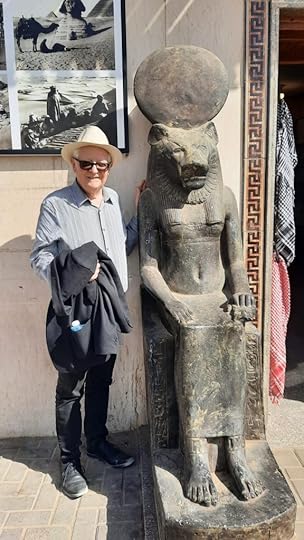
Outside one of the shops at the entrance to the complex was a copy of my favourite goddess Sehkmet. She was just about my size. What a pussycat! There would be plenty more of her where we were going.
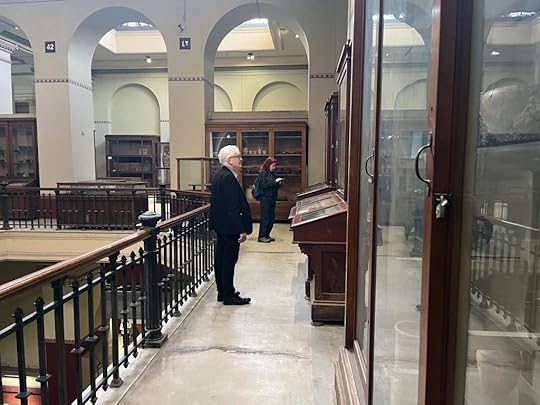
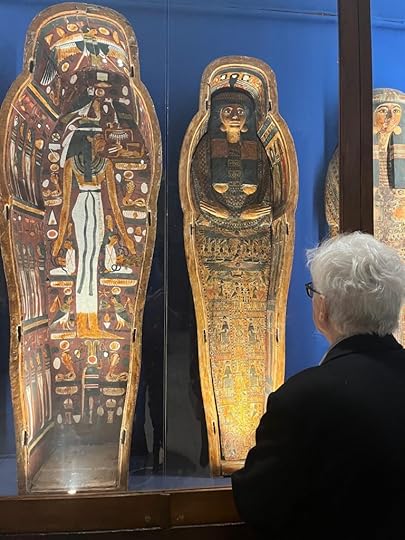
On the 16th we finished off the Egyptian Museum in Tahrir Square, as we had only managed to see the ground floor, where all the larger objects are located, on our first visit. Now we poked around in the upper galleries which, in many ways, are more rewarding. How long the museum will stay in this intermediary state is hard to tell but it is magical.
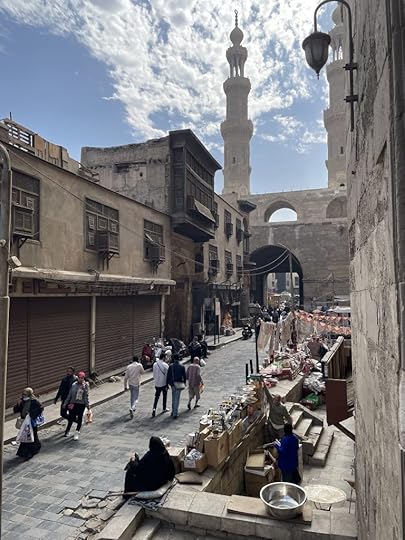
Our last day in Cairo (we were to return in a week) was spent in the medieval section. Richard and Suzy explored the Mosque of Sultan al-Muayyad Shaykh, but I chose to stay outside the door and just people-watch. Not much had changed on the street for centuries and I loved it, just observing la vie quotidienne: the old lady dressed in black who arrived, set down her cushion, arranged her few vegetables, and sat, immobile as she must have done for years. The Ottoman windows overlooking the street and the mosque at the end; it was a timeless scene.
February 7, 2026
January 2026
Though hardly a dry January, life was relatively quiet as we recovered from Victor’s visit and the Christmas festivities. Marsha returned to Norwich, I took down the Christmas decorations and Hannah and I continued work on the picture research for In the 80s, the follow up to my In the Sixties and In the Seventies memoirs. I like working with her because she is very decisive in her choices and there is no messing about. The pictures are either in or out.
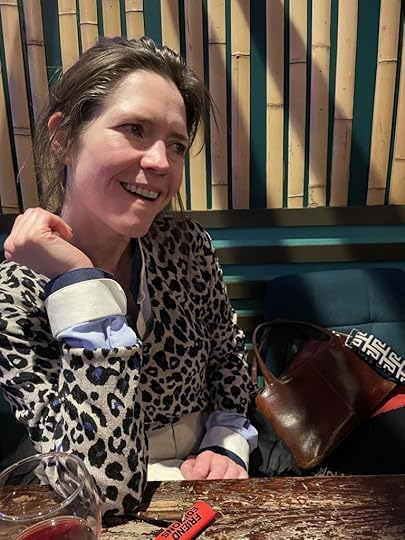
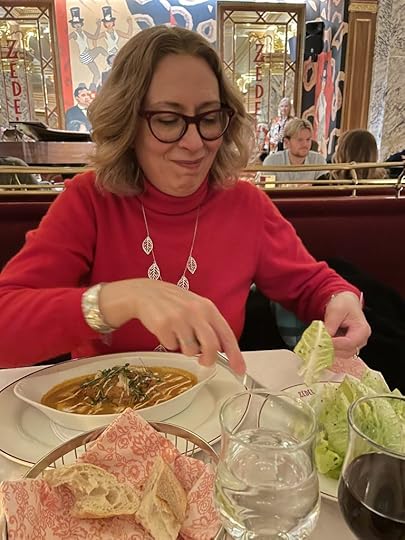
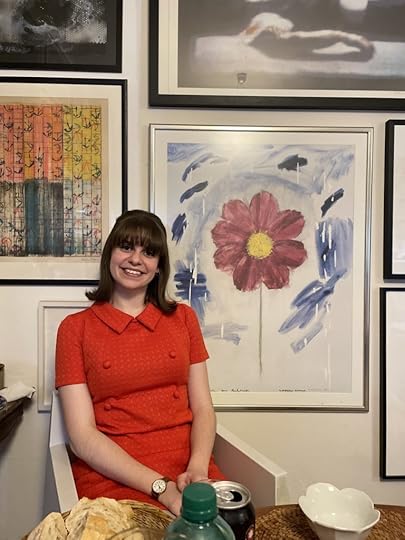
My wonderful neighbour Valerie had me over for dinner and we also had an evening at the Colony Room Green followed by Zeidel – here she is tackling a tough lettuce – which rather wiped me out for a day or two.
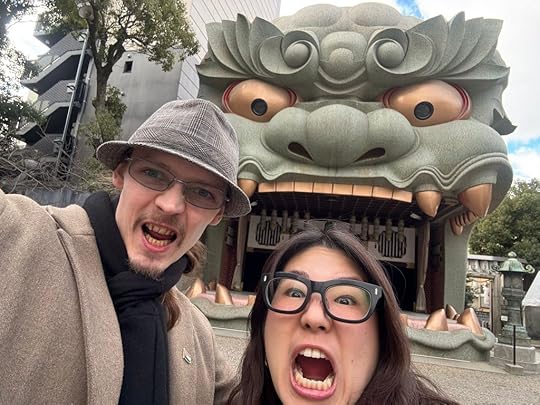
And all this time Theo and Mina were in Japan. I followed their progress via a stream of photographs and also, in a parallel Japanese experience, reading Asako Yuzuki’s Butter, accurately described on the cover blurb as ‘a vivid, unsettling exploration of misogyny, obsession and the transgressive pleasures of food in Japan.’ It’s a book filled with tempting descriptions of food, recipes and a terrific storyline. I haven’t read such an interesting fictional work (though it’s based on a true story) in several years. Highly recommended.
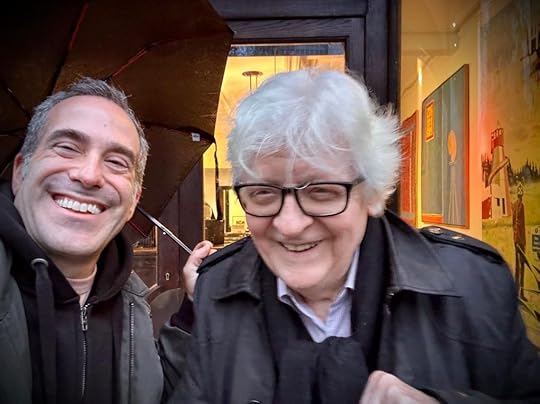
Jesse Goodman and I met up with Luke Ingram from the Wylie Agency to discuss plans for the 100th anniversary of Allen Ginsberg’s birth which will be celebrated on July 11th at Queen Elizabeth Hall. There will probably also be panel discussions, film screenings and the like at the October Gallery and possibly other venues. Here are Jesse and me in Soho.
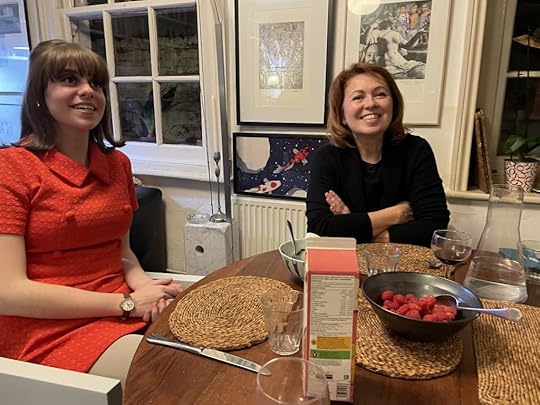
I received an e-mail from Marella Paramatti, whom I hadn’t seen since she invited me to attend the 2013 Mantova Festivaletteratura that September. I had very fond memories of the festival and of her, so it was great to hear from her. She was passing through London on her way to Liverpool with her daughter Olivia to some Beatles event – they are both big Beatles fans; (Olivia is the biggest). I had no idea that a 16-year-old girl from Mantua would know all about different vinyl pressings of Beatles records or manage to dress and look as if she just stepped out of the mid-Sixties. Her hairstyle, which she does herself, was totally accurate for the period. Astonishing. Here is Olivia with a Paul McCartney print. She turned 17 the next day.
I had to go to Basel at the end of the month to see my old friend Luzius Martin who is working on the restoration of what remains of the Ian Sommerville archive. It was cold and wet but another old friend – Udo Breger, whom I’ve known for more than 50 years – lives in Luzius’s building, where I was staying, so it was a very social visit.
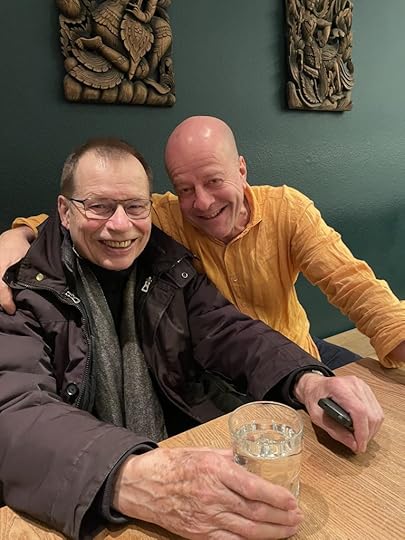
In Basel I was fortunate to coincide with the truly wonderful Cezanne show at the Fondation Beyeler of 80 late oil paintings and watercolours. The show is of perfect size. I don’t believe you can take in much more than 80 pictures at any one viewing so it was just right. Many old favourites were there, including the Card Players from the Courtauld, but displayed next to another version of the same subject, and there were many pictures I’d not seen before. It runs until 25 May. Next day we visited the Kunstmuseum, one of the greatest museums in the world, not just Switzerland. We concentrated on modern works as a follow-up to Cezanne who was, as Picasso said, ‘the father of us all.’ It was great to see Cezanne’s influence on Matisse and so many of the other artists represented there. I’d been there the year before with Luzius when we’d concentrated on the older work: Leonardo, Holbein and co. so it was good to be selective. They have a beautiful tiny Pollock, a great Franz Klein, two huge Rothkos; rooms of Picassos, of Paul Klee, of Leger, one and a half rooms of Giacomettis – my favourite rooms in the museum – and an enormous Helen Frankenthaler – they have a Frankenthaler show coming up: April 18-August 23 featuring over 50 pictures which I hope I can get to see. I wrote my NDD essay on her work at art school back in 1963.
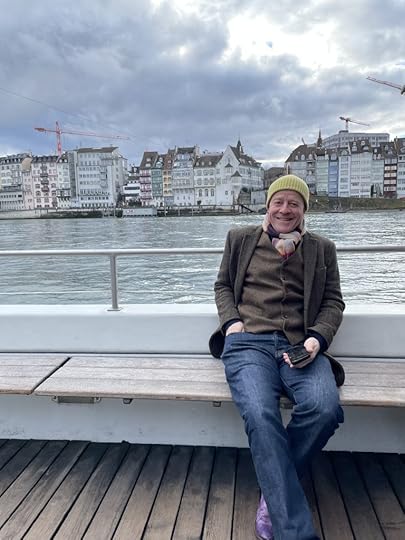
 Frankenthaler, Helen, 1964-1989, undated
According to the latest figures released by the Gaza Ministry of Health (GMoH) on December 23rd 2025, Israel had killed at least 70,937 Palestinians and wounded 171,192; of those identified fatalities, 53% were women, children or elderly. When will talks about reparations begin? When will the Palestinians get their country back?

January 24, 2026
December
There was a private view at the October Gallery on December 3rd where I was pleased to run into Liliane Lijn. We showed her at the Indica Gallery back in 1966. She is going from strength to strength and has more shows and projects than ever.
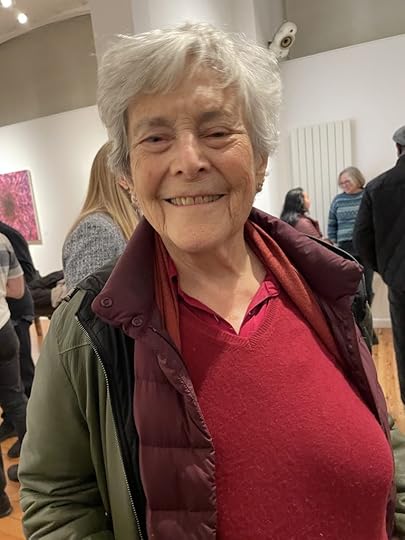
My old friend Victor Bockris made a rare visit to London. We first met in 1973 (I think), introduced in New York by Allen Ginsberg. It was at a poetry reading at Barnard College and he said, ‘There’s someone over there that you should meet. I think you’ll get on.’ He was right. During the seventies and eighties Victor and I were very close. I hardly saw him in the last 35 years as I rarely went to the States and he moved, first to Florida to be with his father, then to Philadelphia. I had not seen him in 11 years.
One evening Jim Pennington came to dinner. Jim has a thing about obsolete pieces of office equipment and in this case brought with him a Polaroid camera with some clearly out of date film. The pictures came out very dark and Victor suggested that more light was needed. He proposed the bathroom, which had super new LED-lighting and so, like the old fools that we were, we crowded into the shower while my son Theo took pictures. Naturally Victor leaned against the shower controls and we all got soaked., Victor more than anyone, requiring a complete change of clothes. He paraded the red suit he wore in Lisbon.
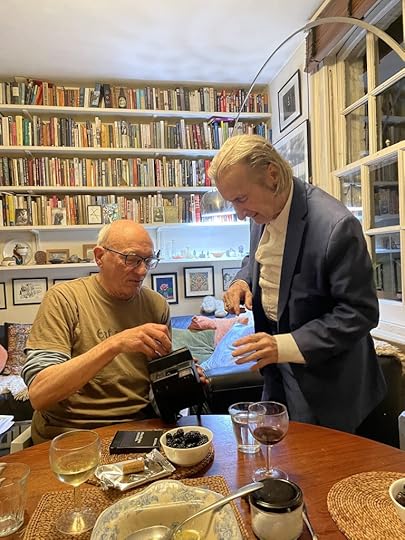
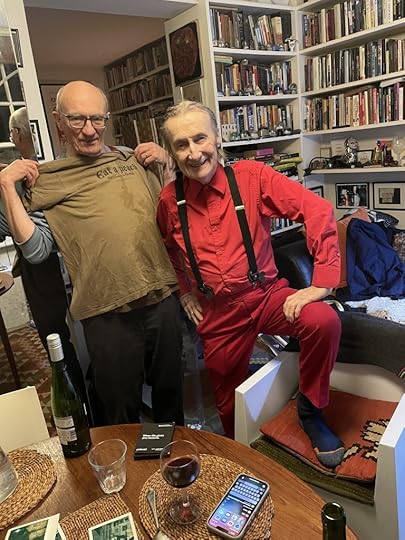
I did an interview at Darren Coffield’s Colony-Room-Green on the 8th. We got a full house, but that’s not difficult as it is a small room and it was free. Here we are with Roberta before she returned to Slovakia for Christmas.
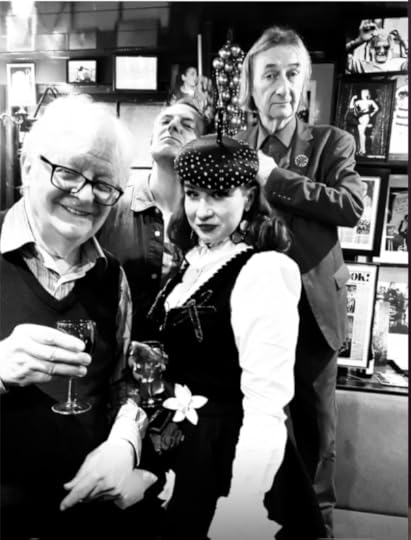
2026 will be the 100th anniversary of Allen Ginsberg’s birth – June 3, 2026 and his friends are preparing various celebrations in his honour. Jesse Goodman and Antonio and I met to discuss some of the proposals at the Colony-Room on the 16th and it looks like we will be able to give him a good show if they work out.
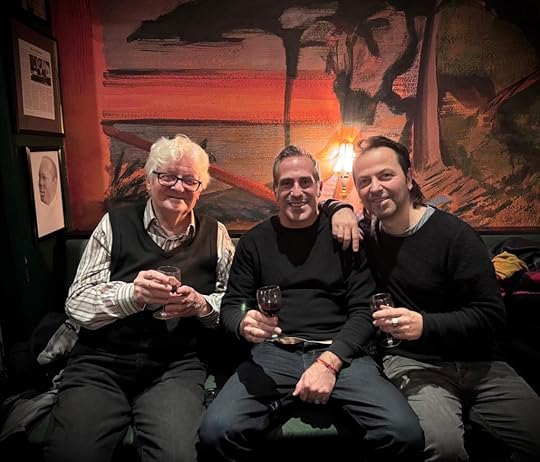
The next day I spent the afternoon working on the illustrations for my upcoming In The Eighties (a follow on from my In the Sixties and In the Seventies) with my friend and publisher Hannah Watson from Trolley Books. She just had a dramatic new haircut in Paris that reminded me immediately of Francoise Hardy, so we spent quite a lot of time looking at pictures of her and comparing them. And also got quite a lot of work done.
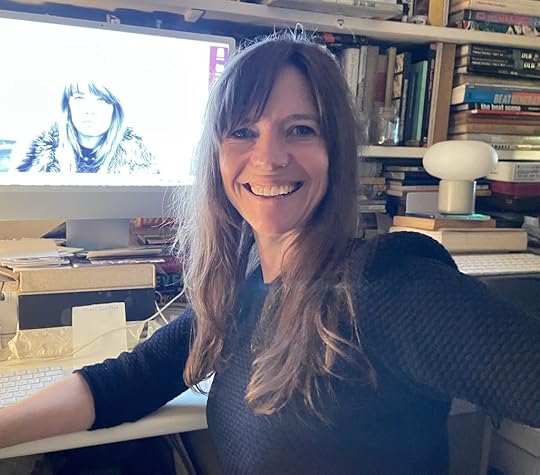
On the 22nd, Marina came over, visiting from Lisbon where I’d last seen her. We went to the Picasso Theatre show at Tate Modern. As usual the pictures were lit from so high above that they had a dark shadow across the top, altering the picture ratio and, of course, obscuring detail. It is not difficult to fly lighting just over people’s heads so that pictures are not changed in this way. Whoever hung the show should be fired, but it is common in London. The Courtauld does it too, and the National. Any roadie could do it for them. They don’t have a clue. As for the show. Some engravings and etchings were hung so far above eye-level that you couldn’t see any of the detail. There were none of Picasso’s actual backdrops. It was a very amateurish, badly conceived show, made up almost entirely of their own holdings and so they were charging an outrageous entry fee for pictures that could normally be seen free (if you asked to see them in advance). Many of the pictures were, of course, wonderful. To me Picasso is still the master.
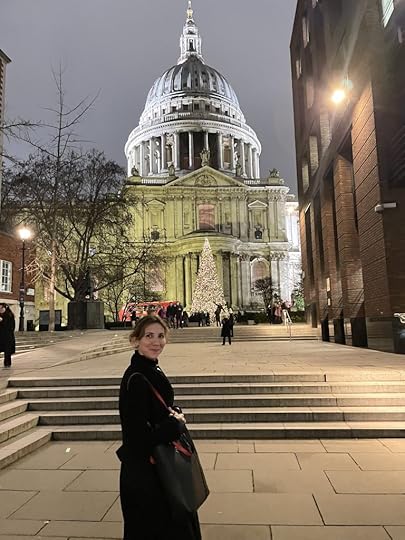
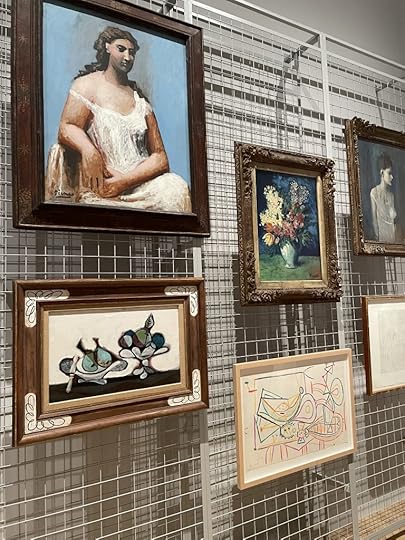
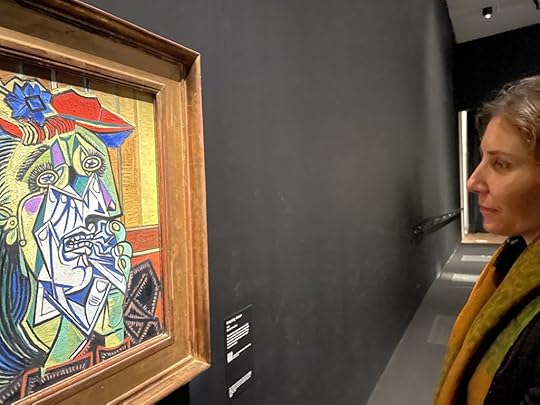
That evening we ate quail wrapped in prosciutto with pears and roasties. Victor loves his roasties.
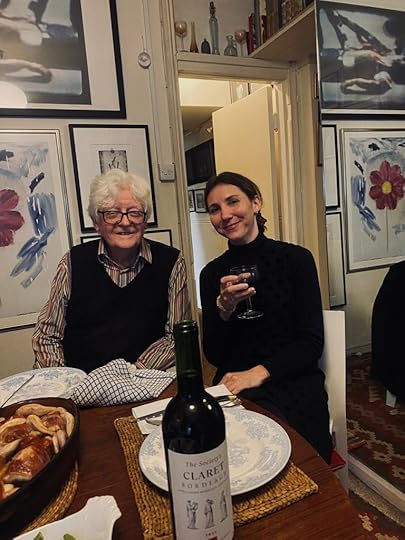
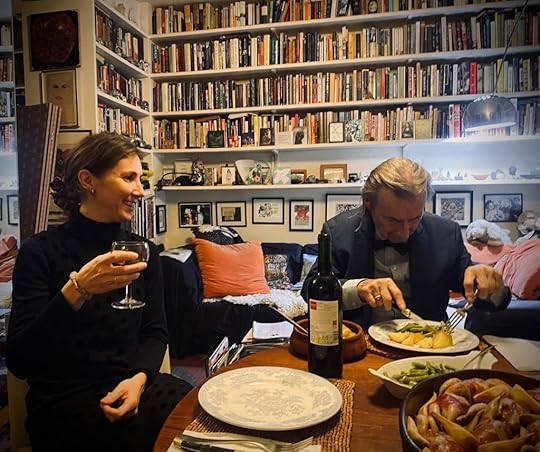
The next evening it was Victor’s turn to be interviewed by Darren at the Colony Room Green. Another good turn-out, only two days before Christmas. It went very well. Victor used New York audience tactics on them: no talking in the back, no statements, only questions.
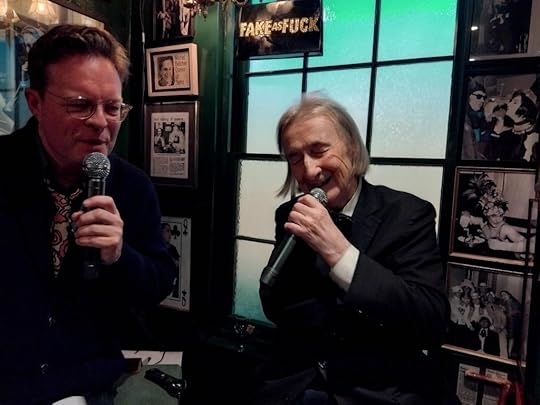
Victor flew back to New York on Christmas Day, and Theo and Mina took a cab at 4:45am on Boxing Day to Heathrow to fly to Tokyo. Suddenly the flat was empty. But not for long as my good friend Marsha Rowe came to stay. We celebrated New Year together and had a wonderful visit.
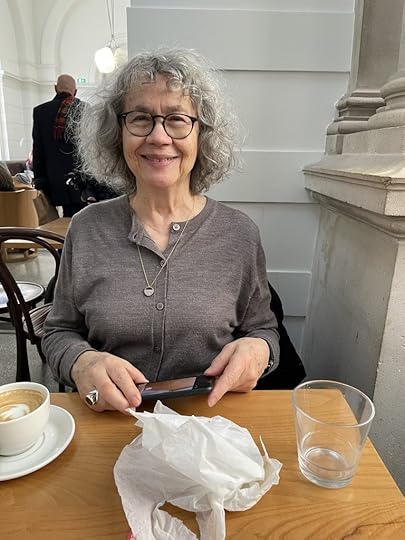
She may have moved to the right, but for my generation, Brigitte Bardot was an important part of our lives. She died December 29. RIP.
Let’s end 2025 with an inspiring photograph: the last CIA flight out of Saigon in 1975 after the Vietnamese whipped America’s ass.
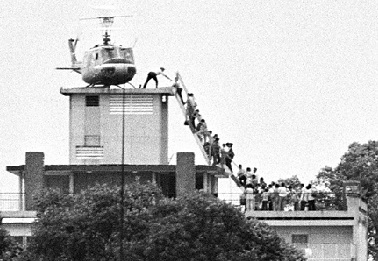
Barry Miles's Blog
- Barry Miles's profile
- 154 followers
