
February
Off we go on a new trip and the sign on the seat back of the British Airways flight to Cairo suggested a very intellectual clientele indeed. I tucked my copy of Waguih Ghali’s Beer in the Snooker Club in the pocket and looked around to see if the flight consisted entirely of Egyptologists.

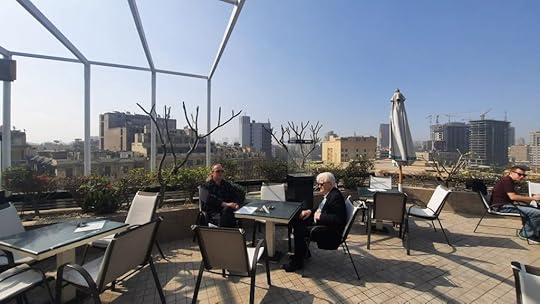
When I returned from Egypt with my son Theo a year ago, I enthused so much about the trip to my friends Richard Grayson and Suzy Treister that, after an evening of fine food and wine, we had agreed that we should all go there together. It took a while before plans were firmed up but on February 10th, we went through the first of many security checks at LHR. We stayed at the Carlton which is a fine old thirties building that has seen better days – particularly the bathroom fittings – but has a great roof garden which becomes a pleasant club in the evening , with a snooker table, candles on tables, and a view of rooftop Cairo, serving wine, beer and reasonable food at about half London prices.
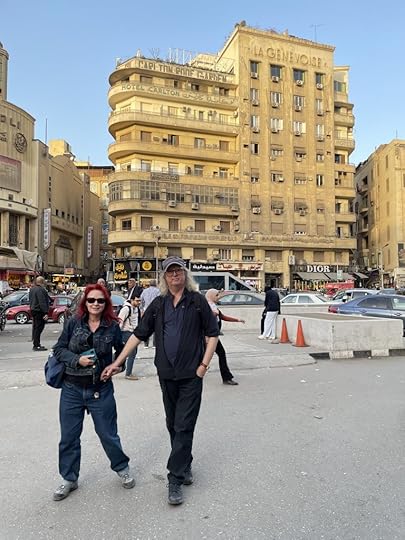
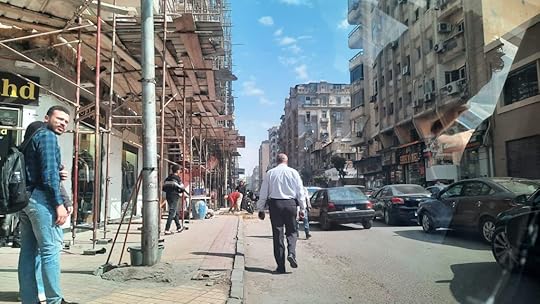
The usual problems of tourism are clear cut in Cairo. Tourists come to see the remains of an ancient civilisation that lasted 3,000 years and have little, or no interest, in the subsequent 2,000 years or in present day Cairo. It therefore comes as quite a shock to find themselves in a Third World country. The Greater Cairo Metropolitan area has between 22 and 23 million people, and they are very poor, and they want your money. The city is on its last legs: it seems as if anything that can be smashed, has been smashed and the debris left where it landed. The pavements are impossible to walk along because jagged bits of iron stick up, manhole covers are missing, every time a cable or a pipe is laid the trench is only loosely infilled with sand and a few rocks, and the pavement tiles themselves are often loose and frequently missing. Consequently people mostly walk on in the road, where the traffic is thick, the level of pollution almost makes you retch, and crossing the road requires a strong belief that they will indeed stop when you walk out into the traffic – all the time avoiding the potholes, some big enough to bury a dead dog. Suzy, Richard and I quickly became adept at the road crossing skill but never managed the insouciance of my friend Mira who appeared to not bother to look at the traffic at all, just stepped straight out in front of oncoming cars.
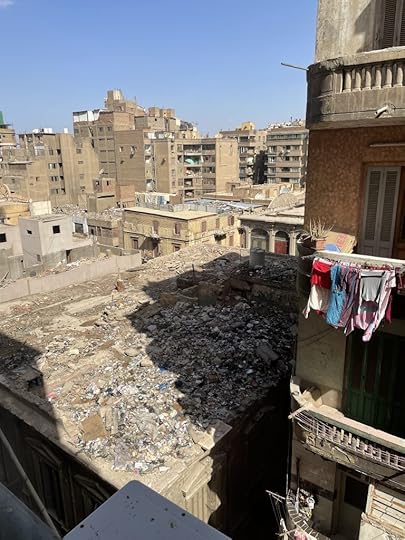
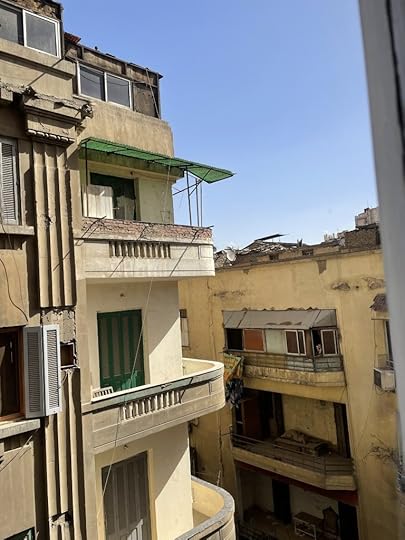
Piles of trash and rubbish are not confined to the street, however. After the failed 2011 Revolution there was a period of free-for-all when a shantytown of shacks was built on the rooftops. Most of these have now been pulled down, but no-one has bothered to remove the piles of broken concrete and mud-bricks which now litter the rooftops. Here’s the view from my room at the Carlton:
Rather than confront the conmen and hustlers at the Pyramids on our first day, we paid a sedate visit to the old Egyptian Museum in Tahrir Square, still open although many of its treasures have been transferred to the Grand Egyptian Museum out by the Pyramids. The galleries which once contained the treasures of Tutankhamun’s tomb are now empty, and there are great gaps in other places, but many wonderful things remain such as the Narmer Palette, made c3000-3,000 BC which shows the unification of Upper and Lower Egypt by King Narmer. It is the earliest record of a king wearing both crowns. Phonetically his name means King Catfish and there is a beautiful carving of such a fish at the top of the panel. When our Egyptologist friend Tom Hardwick explained the meaning of the palette to Rosemary and I, on a visit ten years ago, a crowd gathered around, thinking he was a guide. He could have been, of course, as he certainly knows far more than most of the people showing tourists round. The palette has been referred to as ‘the oldest Egyptian historical record.’ It is about the same age as the original earthwork enclosure of Stonehenge or 500 years older than the first stone circle and shows how much more advanced the Egyptians were than anything happening in northern Europe at the time.
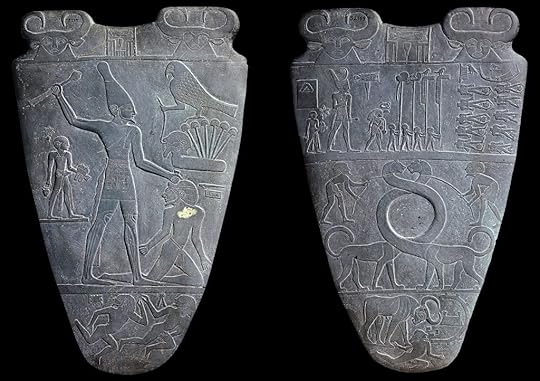 Narmer palette
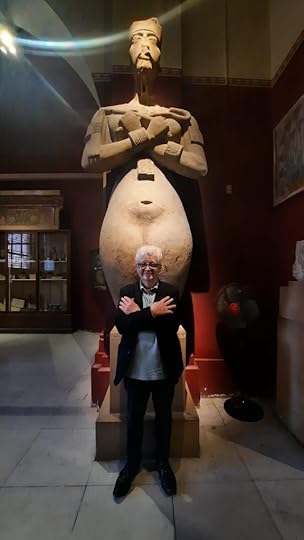
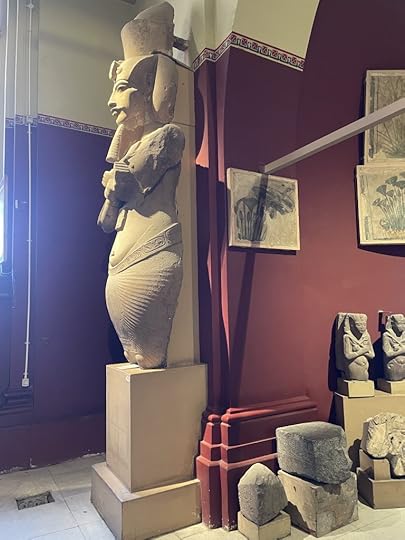
The other great things, for me, in the museum are the statues of Akhenaten (who reigned 1353-1336 BC.) He began life as Amenhotep IV but in the fifth year of his reign became Akhenaten when he introduced monotheism in the worship of the Aten, or life force as represented by the sun. Among his wives was Nefertiti, mother of his son Tutankhamun. He also introduced an extraordinary new fashion, depicting himself, his wives and children, with elongated heads and large bulbous stomachs and thighs. Heree I am with him to give him scale.
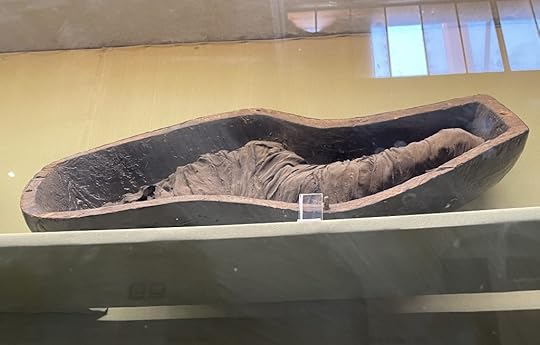
You needed food in the afterlife and there are rows of mummified ducks and, one of my favourites, a mummified leg of lamb, shown here.
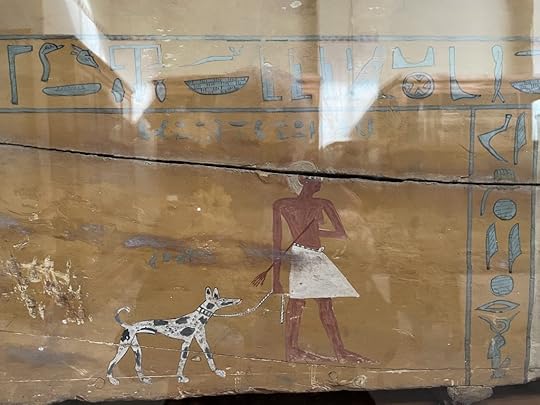
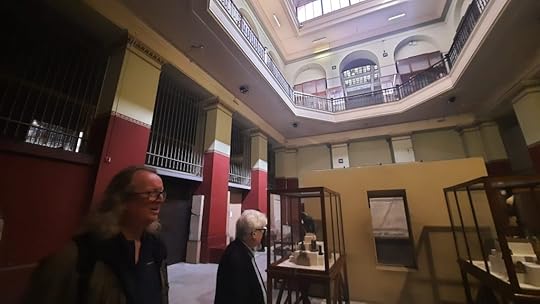
The Museum looked like this when Theo and I saw it a year ago: vitrines standing at angles, some of their contents tipped over; labels missing; piles of objects near a service elevator already dusty, awaiting transport, and many objects with their original faded nineteen-thirties English language (or French) type-written labels, often surprisingly candid ‘these work is not very good’ or ‘of little interest’. Everywhere there are exquisite details like the man taking his dog for a walk. We took two days to see it and only scratched the surface as they say. It is a space in stasis, frozen in time, while someone, somewhere, decides what to do with it. It is marvellous, filled with character, a complex toybox of discovery unlike the ghastly bling of the Grand Egyptian Museum that we went to see the next day. Some cases are empty, other have one remaining object, but you can be sure it would look nice on display in your home. There are rooms of ostraca, the flakes of stone or broken pottery used for preliminary drawings or as notepads, where almost every object deserves study.
Egyptians get up early. The call to prayer is amplified at high volume just before 5:00am throughout the city, making it virtually impossible to ignore. In fact, it is not long since the whole society lived by the ancient rhythm of rising with the sun and sleeping shortly after dark. The construction of the Aswan Dam finally brought a widespread electricity supply, and with it the ability for students to study after dark, for families to eat later, and more recently air conditioning. However, a dawn start with an early breakfast with the main meal late in the afternoon is still very common. To delicate Europeans like Suzy, Richard and me, the Muezzin’s sing-song wake-up call was less than welcome, but it’s their country. I wonder what the 15% Coptic Christians think about it. It meant I never had a decent night’s sleep the whole time I was there. Too much of a night-person.
Of course the greatest treasure in Egypt is the contents of Tutankhamun’s tomb, still housed in the old Tahrir Square Museum when Theo and I were in Cairo a year ago, now occupying a whole gallery at the GEM, the Grand Egyptian Museum on the edge of the desert out by the Pyramids. The less said about the building the better, but it most reminds me of Cairo International Airport. Soulless. I understand that Irish architects Heneghan Peng at one point tried to take their name off of it because of so much interference from know-nothing politicians, but it still features heavily on their website.
The galleries are all on a high level, reached by a grand staircase, littered with wonderful examples of Egyptian statuary. Not everyone wants to climb a long series of steps to reach the main displays but there are no lifts, only one narrow, London underground-sized, escalator, with three stops, to take tens of thousands of people to the top. It is already jam-packed and, as this is Egypt, the likelihood of at least one stage failing is great. The busier London tube stations usually have two each way for far less people.
The first day we concentrated on Tutankhamun: the four great shrines that fit into each other like Russian dolls and which, in turn, contained sarcophagi fitted into each other. Again, each of these deserves hours of study but most people gaze open-mouthed at so much gold, take a picture and move on. Tut’s gold funerary mask now appears suspended above the crowds in its bullet-proof vitrine while worshipful crowds take thousands of selfies. In a way, the purpose of mummification and preservation seems to have worked for him for although Howard Carter was nothing more than a modern-day tomb robber, Tut is still being worshiped whereas when he was sealed in his tomb, he was just a footnote in history as a minor pharaoh in a list of hundreds.
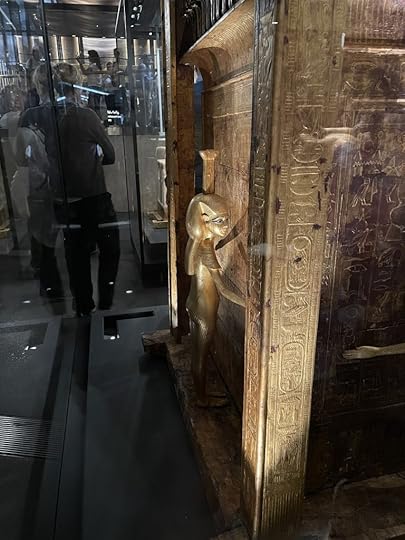
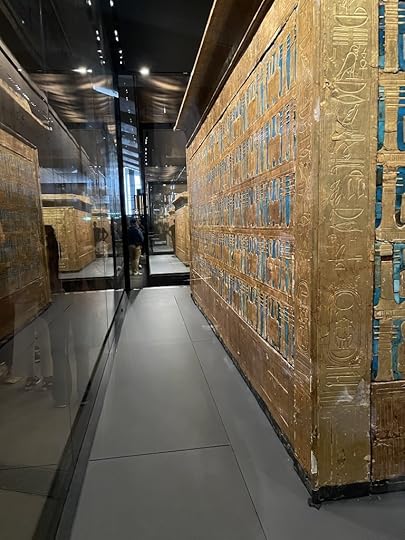
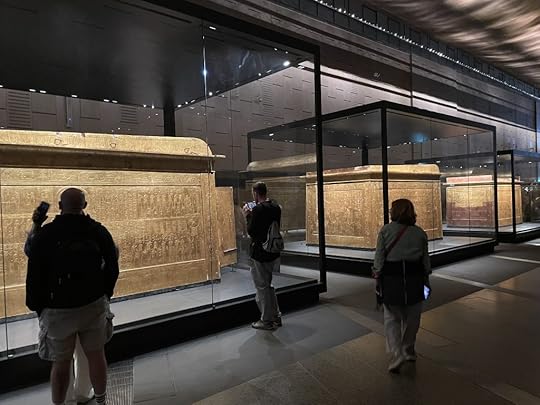
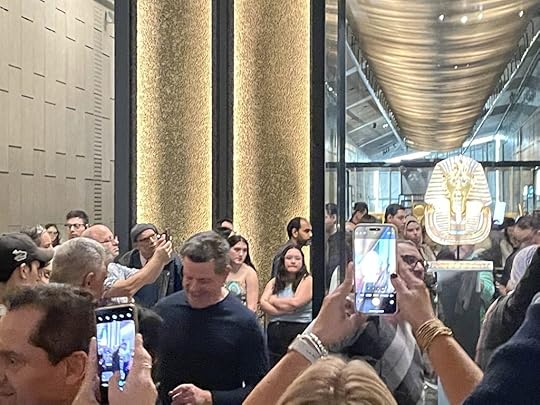
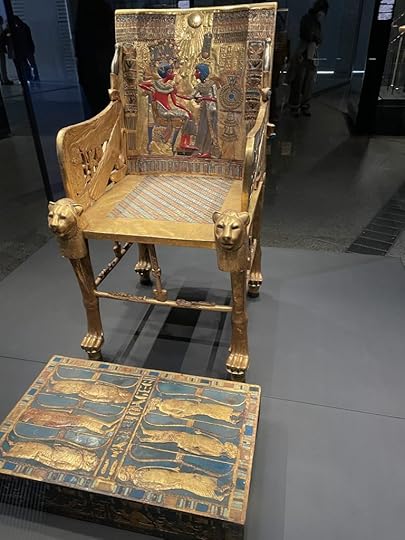
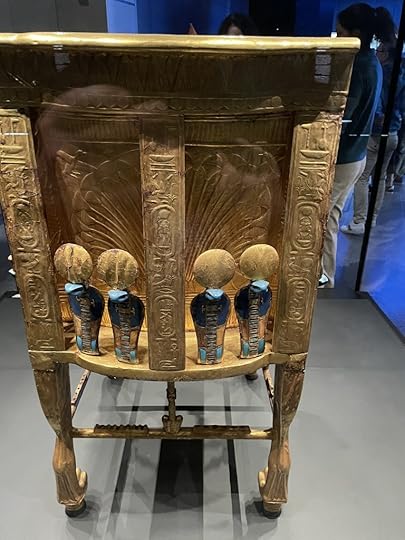
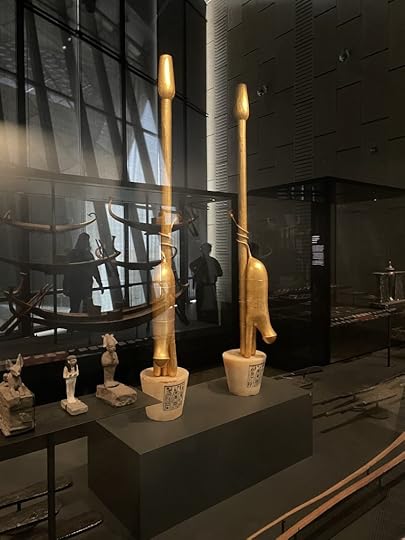
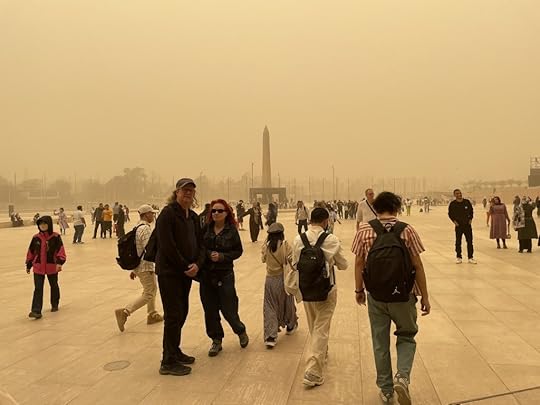
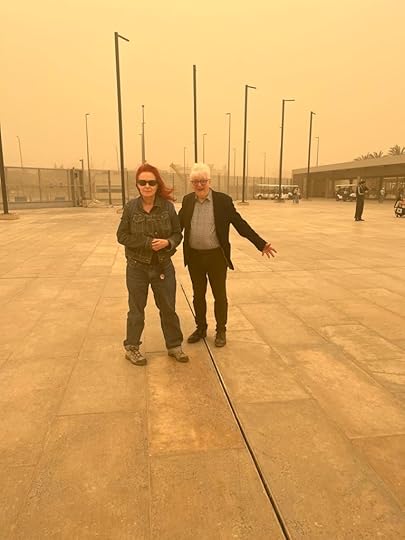
There are over 1000 objects from his tomb on display, some of them truly extraordinary such as his throne. There are chariots, slippers, toys, all manner of jars and vessels. It takes a day just to see this section of the museum. It had been misty all morning, but when we left the museum, a full-scale sandstorm had evolved and you couldn’t even see the pyramids, which are only 2 k away and are normally easily visible from Cairo 18 k away. In fact, it was already becoming hard to see clearly across the giant central atrium, which is open to the elements in the museum (another future conservation problem?). We left in a hurry, and I had a bad cough for days.
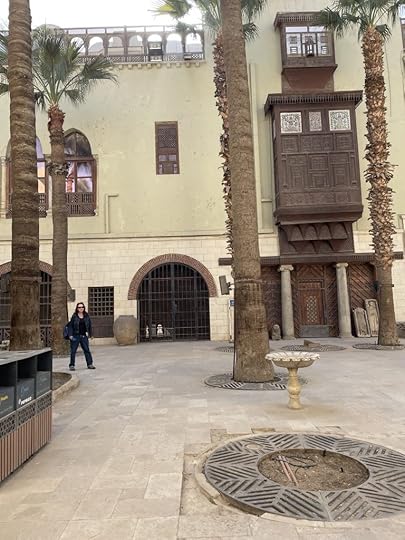
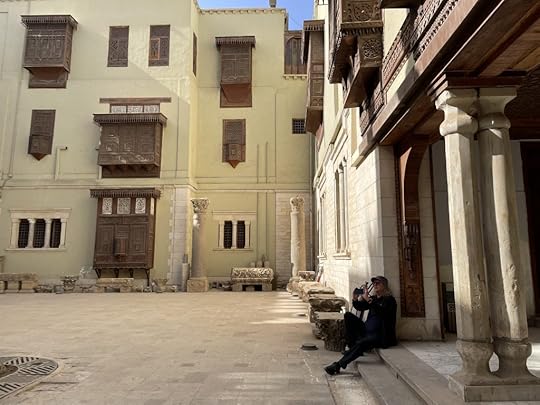
It was still a bit misty the next day, Valentine’s Day, so we explored Cairo instead of continuing our visit to the Giza plateau. I have never been a fan of the Copts, or of any of the Judaeo-Christian religions for that matter, but I dutifully walked through the Coptic Museum which only confirmed to me how much art and culture declined after Christianity destroyed the old Classical culture. The museum has a collection of rather nice Ottoman windows.
Back in Cairo we met my friend Mira for an early meal at Café Riche. The café is a great place or coffee, beer or wine but the food is pretty bad. In fact it is hard to get any at all. It turned out that they had run out of both the rabbit and the quail that we ordered, to the delight of the smirking young waiter. Mira is Palestinian, but from her looks they assumed she was a European. She grew up in Cairo and had a few words; they soon found some quail, which they proceeded to grill to a crisp.
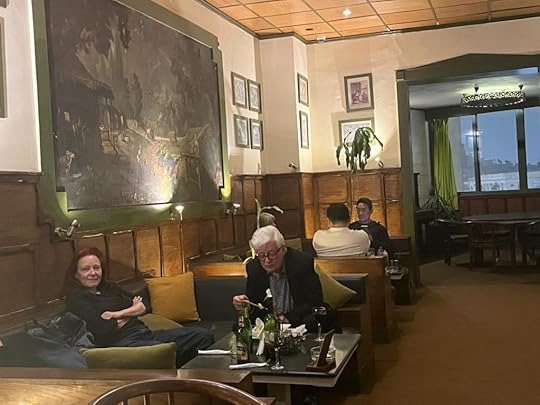
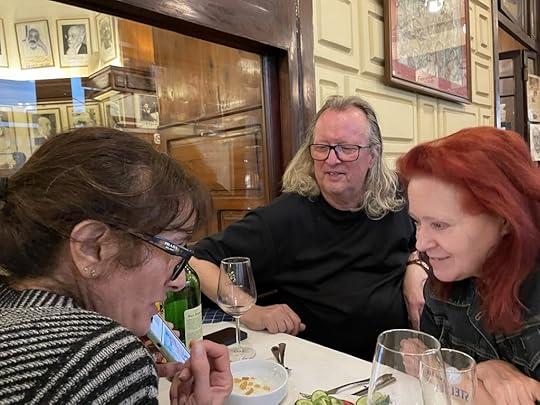
I still love Café Riche because it is in the tradition of the great Parisian cafes where writers and politicians gather. Gamel Abdel Nasser planned the overthrow of King Farouk here, Naguib Mahfouz mentions it in a number of his novels and it would close on Fridays for him to hold meetings with his fellow intellectuals. It served as a refuge for injured protesters from nearby Tahrir Square during the 2011 revolution. Here’s Mira showing some of her paintings to Richard and Suzy at the café.
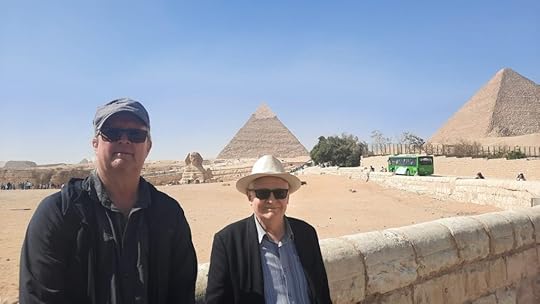
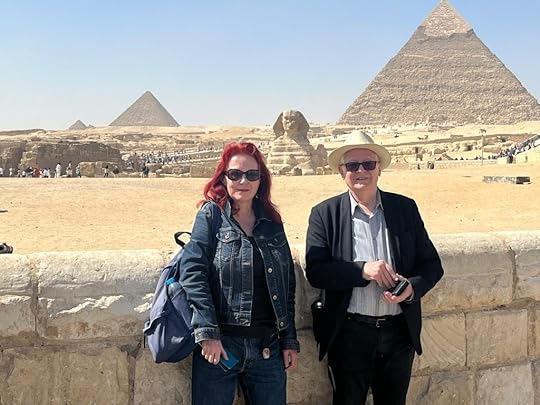
The next day the air was clear so off we went to see the rest of the Great Egyptian Museum and the Pyramids. It is quite a long drive, through some of the most horrific slums I have ever seen. The plan is to have a dedicated Metro stop at GEM, but I’ll never see that in my lifetime. It was rewarding to have a second look because even those objects you had looked at before seemed to have new qualities, inscriptions or traces of colour. Our driver, Muhammed, was waiting and when we were through we were soon at the Pyramids. There were none of the crowds that Theo and I had to fight through the year before and suddenly, there we were walking past the Sphinx on our way to the Great Pyramid.
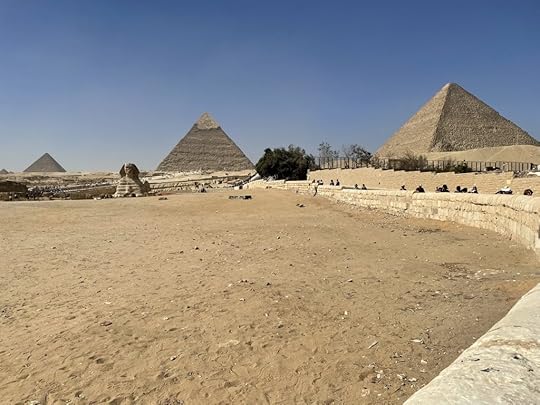
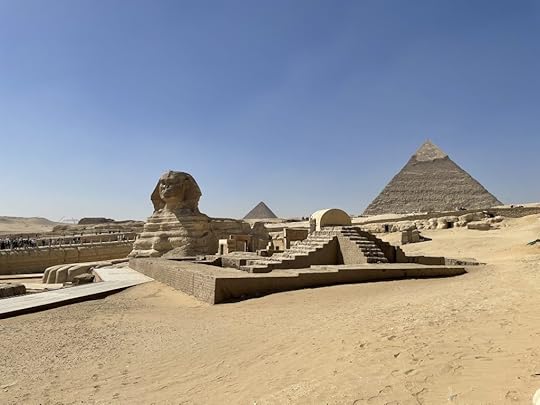
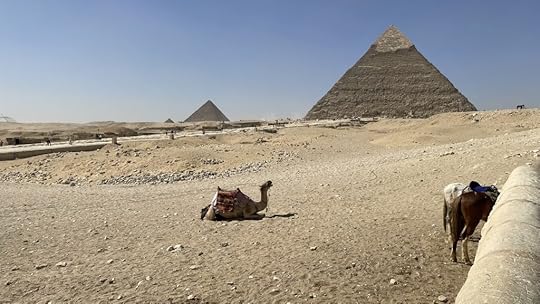
It was already quite hot, and as I am now 83 I felt the need for a little sit down so I suggested Suzy and Richard explore on their own and I would rest and contemplate the Great Pyramid for a bit. There was no-one around this corner of the building so for about quarter of an hour I had Khufu’s tomb all to myself. The more you look at it, the more details emerge. There are different strata, corresponding to the layers of rock quarried to build it, each block dug out, shaped, shipped to the site and placed so that each layer of rock in the quarry is disenable in the final structure.
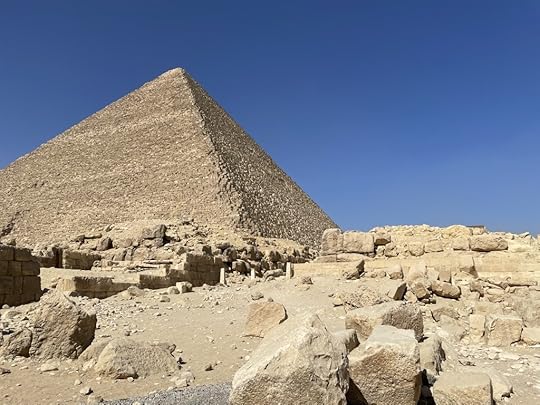
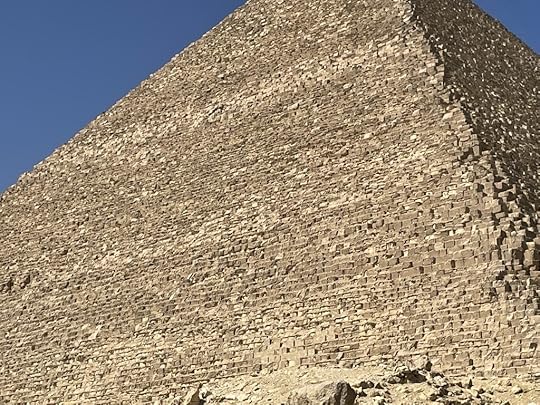
Then a young Egyptian family arrived, looking for shade. They each said ‘Hello’ politely as they passed, and in each case I replied. They settled in a little distance from me, then the man held up a plastic bag of food and pointed to his mouth. He was very kindly asking if I would like to join them. It is in their religion and culture to welcome and feed strangers, so I was honoured to be included, but none-the-less I declined, not having a word of Egyptian, and not wanting to spoil their picnic. They finished and left, each saying goodbye in turn – the two teenage daughters giggling a bit. Then they turned and came back. They took a photograph of each of them standing next to me, smiling, we each said goodbye again, and they were gone. It was a delightful experience. Then Suzy and Richard returned having walked right round the pyramid and experienced its massive bulk and after a rest we walked back to the gate.
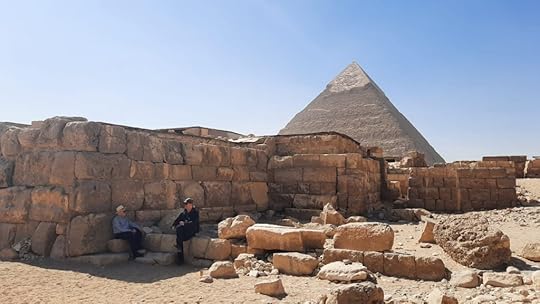
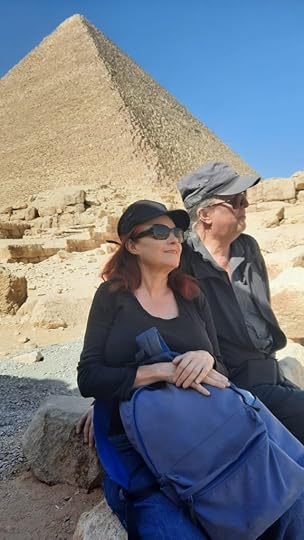
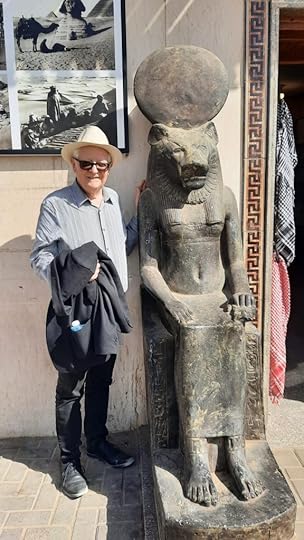
Outside one of the shops at the entrance to the complex was a copy of my favourite goddess Sehkmet. She was just about my size. What a pussycat! There would be plenty more of her where we were going.
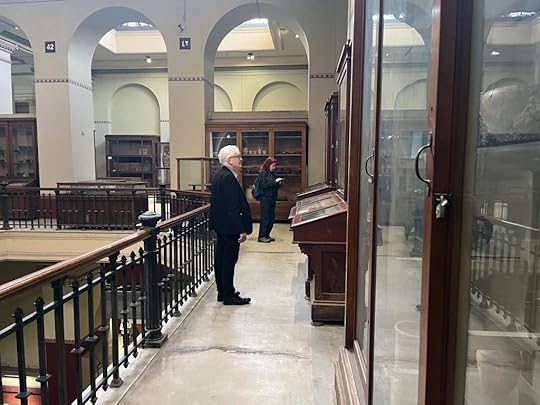
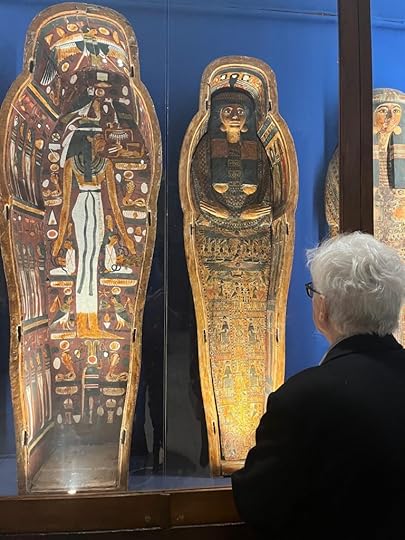
On the 16th we finished off the Egyptian Museum in Tahrir Square, as we had only managed to see the ground floor, where all the larger objects are located, on our first visit. Now we poked around in the upper galleries which, in many ways, are more rewarding. How long the museum will stay in this intermediary state is hard to tell but it is magical.
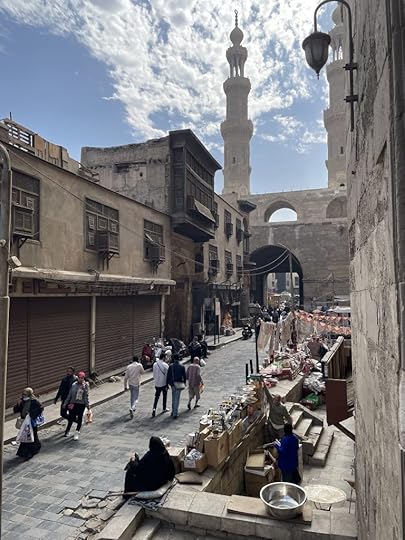
Our last day in Cairo (we were to return in a week) was spent in the medieval section. Richard and Suzy explored the Mosque of Sultan al-Muayyad Shaykh, but I chose to stay outside the door and just people-watch. Not much had changed on the street for centuries and I loved it, just observing la vie quotidienne: the old lady dressed in black who arrived, set down her cushion, arranged her few vegetables, and sat, immobile as she must have done for years. The Ottoman windows overlooking the street and the mosque at the end; it was a timeless scene.


Barry Miles's Blog
- Barry Miles's profile
- 152 followers

