Ann Talbot's Blog - Posts Tagged "philosophy"
A wicked Company
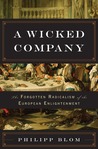 A Wicked Company: The Forgotten Radicalism of the European Enlightenment by Philipp Blom
My rating: 4 of 5 stars
Books about the Baron d’Holbach are a rarity. Why this should be the case is the subject of Philipp Blom’s book. Blom believes that Holbach has been unjustly neglected and relegated to the footnotes of history because his materialism and atheism are rejected today.
A Wicked Company is an attempt to portray Holbach and the circle that gathered around him. The title comes from a remark by the actor David Garrick who was a frequent visitor to Holbach’s house. Blom sets out the problem at the beginning of the book.
“Holbach was not only host to some of the most brilliant minds of the century but also an important philosophical writer in his own right, author of the first uncompromisingly atheist books published since antiquity. His work is ignored … His own philosophy – so fresh, so humane, so liberating – does not even appear in many histories of philosophy. His message was too disquieting, too anarchic, too dangerous to be released into the world at large.”
In attempting to trace the development of materialist ideas in the eighteenth century Blom is performing a useful service to the reading public. Materialism is supported by more scientific evidence than ever but it is widely disparaged and regarded as a dangerous doctrine. His well written and accessible book will bring Holbach’s circle to life for many readers.
Holbach was born Paul Heinrich Dietrich, in the town of Edesheim in the Rhenish Palatinate in 1723, the son of a wine-grower. He was adopted by a wealthy uncle who had bought his title of baron from the imperial court of Vienna. His uncle provided him with his name and the best education money could buy. Holbach enrolled at the University of Leiden in 1744 where he became a friend of John Wilkes, who went on to become a notorious English radical. The two remained friends until Holbach’s death in 1789. Holbach married and settled in Paris, holding his salons from 1750 to the late 1770s. Apart from a brief stay in England and a tour of the South of France after his first wife died, this was where he remained, except for the summers, which he spent at Château Grandval at Sucy en Brie, now in the south eastern suburbs of Paris. Many of Diderot’s letters were written from this summer retreat.
Diderot got to know Holbach after he was released from prison for writing his Letter on the Blind. Rousseau, who frequently visited Diderot while he was in prison, may already have known Holbach. Diderot was about to bring out the first volume of the Encyclopédie when he was arrested. Its publication in 1751 made the previously obscure writer widely known. The second volume in 1752 contains a number of articles by Holbach, he would eventually write more than 300, and the title page pays tribute to an unnamed person who is almost certainly Holbach.
“We particularly are indebted to one person,” the editors wrote, “whose mother tongue is German, and who is very well versed in the matters of mineralogy, metallurgy and physics; he has given us a prodigious amount of articles on different subjects, of which already a considerable number is included in this volume.”
The Encyclopédie was originally planned as a translation of Chambers’s Cyclopaedia, but in Diderot’s hands it evolved into a far more ambitious work which would be lavishly illustrated and would aim to do nothing less than systematise all available knowledge. Even the form of the book would be revolutionary since its entries were arranged alphabetically giving no precedence to subjects such as theology, church history or social ranks. The Encyclopédie was in itself a testament to the principle of equality.
The Dictionnaire of Pierre Bayle provided a model for Diderot’s project and a method of defeating the censors by seeming to present simple, straightforward, strictly factual information while allowing the readers to draw their own conclusions from the material that was presented to them. Bayle’s Dictionnaire was the main conduit through which the ideas of modern materialists like Spinoza and Hobbes and ancient materialists such as Epicurus reached the reading public of eighteenth century France.
Diderot would spend most of his working life editing the Encyclopédie and it would become, as Blum writes, “a battering ram, shaking the foundations of the age.” By 1765 it would run to 17 volumes containing 20 million words and 1,900 illustrations. In 1759 the government revoked its license, but the book continued to be produced illegally. Some 4,000 complete sets were sold despite the fact that it cost the equivalent of a year’s wages for a master craftsman.
Blom connects the Encyclopédie to the discussions that went on at Holbach’s house. “At its very best,” writes Blom, “it afforded the reader a seat at Holbach’s table, allowing him to listen to the flow of argument and the sheer exhilaration of ideas out of the mouths of some of the greatest intellects of the age.” The house became a magnet for foreign visitors, but they were often startled by the range of subjects that could be discussed there and the openness with which ideas that would normally be forbidden were openly expressed.
While the encyclopedists remained a diverse group, not all of them attended Holbach’s salons and nor were they all atheists or materialists, the influence of Holbach and the protection his house offered was certainly important in maintaining the Encyclopédie’s production. His salon had a distinct collective identity and Holbach’s guests often spoke of themselves as a group. Diderot referred to Holbach’s house as the boulangerie partly in reference to the pseudonym that Holbach adopted – Boulanger – and partly, no doubt because of the work that went on there. The word conjured up the image of a busy workshop, Blom writes, “constantly mixing and kneading, and pulling dangerous books out of the oven as if they were so many hot baguettes.”
Behind the respectable façade that Holbach himself maintained, Blom writes, he “funded and ran a clandestine publishing operation from his own house, a center of intellectual resistance.” His house served as “a meeting place as well as an unofficial translation agency and publishing house of subversive ideas.”
Those subversive ideas were central to the Enlightenment and Blom shows that Holbach and the group that gathered around him played a critical role in this movement. “Nowhere was the Enlightenment battle cry ‘Sapere aude!’ [dare to know] taken more seriously and acted upon more decisively than by Diderot and Holbach, and their friends, who published, translated, wrote, and transcribed a library of intellectually audacious books while at the same time pushing forward the Encyclopédie, the most distinguished and most significant encyclopedia project in history.”
Blom is conscious that the influence of postmodernism and the various forms of poststructuralism have played a part in devaluing the Enlightenment and Holbach’s role in it. “In an academic world in the thrall of postmodern and poststructuralist literary theory,” he writes, “there was no room for the works of a plainspoken philosopher whose greatest goal had been to make himself absolutely clear.”
This is an important point, but, in his eagerness to defend Holbach, Blom makes a hefty concession to the very intellectual tendencies he is trying to resist. He distinguishes between a moderate deist Enlightenment and a radical Enlightenment. This is very much in line with the work of Professor Jonathan Israel, who has done much to revive interest in the materialist and atheistic currents of thought in the Enlightenment. Blom argues that the moderate deist Enlightenment had a tendency to “dehumanize” and to create “a world dominated by the inexorable progress of the clock and the needs of machines and factories, stock markets and corporations – the nightmare factory world of Charlie Chaplin’s Modern Times.” But he wants to rescue the radical Enlightenment of Diderot and Holbach from that charge.
Rousseau was a deist who rejected materialism and atheism. For Blom this puts him squarely in the moderate Enlightenment camp. What is more he was the favourite philosopher of Maximilien Robespierre and this, for Blom, ties him to the revolutionary terror and to all forms of totalitarianism in the twentieth century. “Rousseau,” Blom writes, “was a direct inspiration not only for Robespierre but also for Lenin and Pol Pot.”
Blom is not alone in this estimation of Rousseau. Portraying Rousseau as a totalitarian has a long history. The philosopher Bertrand Russell went so far as to proclaim “Hitler is a consequence of Rousseau.” The identification of Rousseau with tyranny can be traced back to Hippolyte Taine in the later nineteenth century when France rejected its revolutionary past. It became more prevalent in liberal circles following the Russian Revolution when Rousseau was seen as an inspiration for Bolshevism. Karl Popper includes Rousseau among the enemies of the open society and in the post-war period both Hannah Arendt and Herbert Marcuse were to expand on this theme. Arendt maintained that Rousseau’s concept of the general will allowed the plurality of views that exist within society to be collapsed into one will - that of a dictator. Jacob Talmon identified Rousseau’s concept of the general will; as “the driving force of totalitarian democracy” [J.L. Talmon, The Origins of Totalitarian Democracy, New York: Norton, 1970, p. 6] of which Marxism was one variant and fascism another. The general will, Talmon maintained, was a “blank cheque to act on behalf of the people, without reference to the people’s actual will” [Talmon, 1970, p. 48].
The view that Rousseau was the originator of totalitarianism is entirely unhistorical. His ideas have to be set in the context of his writings as a whole and of the times in which he lived. In the context of ancien regime Europe Rousseau’s concept of the general will had an entirely revolutionary significance. The absolute monarchies of early modern Europe were legitimised by the Church but the general will was a secular concept that ran entirely counter to official politics. Rousseau systematically dismantled the theological framework that had been built up over centuries to maintain the power of kings and the sanctity of property.
Rousseau was not, like Diderot and Holbach, an atheist or materialist, but that did not save him from condemnation. His books were burned and banned because he was the philosopher of social equality in an epoch of gross inequality. That alone would qualify him as a revolutionary thinker. He opened his Social Contract with the words “Man is born free; and everywhere he is in chains.” As Ernst Cassirer observed “a truly revolutionary impetus emanated from him” because he sought no compromise with the existing society [Ernst Cassirer, The Question of Jean-Jacques Rousseau, Bloomington: Indiana University Press, 1963, p. 69]. The tragedy of Rousseau, and ultimately of the French Revolution, was that the most advanced thinkers which the Enlightenment produced could not, by sheer force of intellect, discover a means of ensuring equality among the citizens of the First Republic.
View all my reviews


Revolutionary Ideas
 Revolutionary Ideas: An Intellectual History of the French Revolution from the Rights of Man to Robespierre by Jonathan Israel
My rating: 4 of 5 stars
Revolutionary Ideas is the latest in an ambitious series of books in which historian Professor Jonathan Israel has traced the Enlightenment from its beginnings in the seventeenth century to the French Revolution of the late eighteenth century. The series began with Radical Enlightenment (2001) continued with Enlightenment Contested (2006) which was followed by A Revolution of the Mind (2010) and Democratic Enlightenment (2011).
A single thesis runs through the entire series. It is that a set of ideas emerged in the late seventeenth century which Professor Israel identifies as belonging to the Radical Enlightenment as distinct from a more conservative, Moderate Enlightenment. The Radical Enlightenment originated, Israel argues, in the work of the philosopher Benedict Spinoza and can be traced in the works of Pierre Bayle to Denis Diderot and the Holbach circle in eighteenth century France. Now in this latest volume he examines the role of the ideas of the Radical Enlightenment in the French Revolution.
The book covers the period from the beginning of the revolution in 1789 to Thermidor and the fall of Robespierre in 1794 and ends with the rise of Napoleon in 1799. Israel concludes that “Radical Enlightenment was incontrovertibly the one ‘big’ cause of the French Revolution.” His search for causes is out of step with a strong tendency among historians to dismiss causation as a valid category of analysis. The French Revolution is now more often seen as a purely accidental event which scarcely does justice to a phenomenon that altered European and, arguably, global history. Whether one agrees with Israel’s identification of ideas as the fundamental cause of the French Revolution or not it is positive that he has brought the question to the attention of readers and students once more.
For Israel the French Revolution is a ‘revolution of ideas’ which paved the way for a ‘revolution of events’. The revolution of ideas was, he argues, under way even before the Estates General convened in April 1789. The cafés, publishing presses and meeting places of the Palais Royal were at the centre of this revolution of ideas and he traces the part that those who congregated there played in the early phases of the revolution. Essentially the group he has in mind are the followers of Jacques Pierre Brissot, or the Girondins, as they are often known. They shared, Israel argues, a coherent philosophical and political programme based on materialism, atheism, republicanism and a belief in the equality of humanity. It was they, in his view, who established the revolution’s core values - human rights, black emancipation, women’s rights and representative democracy. They were the real leaders of the revolution and sought to achieve change by constitutional, non-violent means. It was only later that the revolution took a violent turn.
He attributes the turn to violence to what he describes as Robespierre’s putsch in June 1793. Robespierre did not share the values of the true revolutionaries, according to Israel, because he was not a materialist or an atheist and came only belatedly to republicanism. He was, Israel argues, an obsessive, puritanical disciple of Rousseau rather than a follower of the Holbach circle like the Girondins. He rejected their internationalism and adopted a narrowly nationalistic view of the revolution and its objectives.
Robespierre is usually regarded as a central figure in the revolution, one of its most left wing leaders, but Israel rejects this conception. He regards Robespierre as the gravedigger of the revolution, rather than its leader and a conservative rather than a radical. He argues that Robespierre played little part in the early stages of the revolution and only came to power by murdering its real leaders and imposing a system of Terror that overthrew the core values of the revolution.
The Terror was the means by which Robespierre maintained his hold on power because he had so little support in the country at large. His political ideology was in essence a form of ‘authoritarian populism’, according to Israel, with which he manipulated the “militant but erratic sans culottes” who were an “anarchic, inconsistent, ebbing and flowing element with little cognizance of the general scenario”. Even among the sans culottes “only some of the most illiterate” were drawn to Robespierre.
Rather than being the inevitable consequence of the revolution, as many have argued, the Terror now becomes the antithesis of the revolution. Rather than leading to the Terror the revolution was ended by it. The question is how does Israel’s theory stack up against the evidence?
In the first place it must be pointed out that Robespierre was not alone in his admiration for Rousseau. Brissot himself was influenced by Rousseau and so were many of those associated with him. Robespierre was to a great extent drawing on a common stock of ideas from which they developed political initiatives over time. It would not be correct to present either Brissot or Robespierre as emerging with a fully formed ideology or political programme at the beginning of the revolution.
The conflict between Robespierre and the Girondins began over the question of war. Robespierre opposed waging a European war because he thought that it would strengthen the army and increase the chances of a military dictator coming to power. His concerns proved to be well founded. Napoleon Bonaparte was not the first general to consider the possibility of a military coup. Lafayette, Dumouriez and Joubert were all generals who in their turn eyed political power. Robespierre seems to have had some political foresight on this matter.
Later socio-economic issues divided them. By 1793 the war was going disastrously badly and armed counter-revolution had broken out in several parts of France including major provincial cities. The economy deteriorated under the strain. The food supply, always vulnerable even before the revolution, now became extremely precarious.
For artisans and labourers who relied on wages, for small property owners such as shopkeepers and master craftsmen the situation was desperate. Those already in poverty faced starvation and even the more prosperous were forced into poverty. These were the sans culottes - the people who wore the cheaper and more practical trousers rather than the elegant knee breeches of the upper layers of society. They repeatedly petitioned the Convention for price controls on essential commodities such as food and soap.
For the Girondins the free market was a matter of principle. To interfere with the operation of the market was to infringe property rights. They believed that the free market would eventually bring prices to an affordable level if it was allowed to operate without government interference. To begin with Robespierre shared their faith in the market. After all the regulations of the ancien regime had not prevented famine. But gradually he came to a different view and in doing so widened his conception of what equality meant.
“The first social law,” Robespierre insisted, “is therefore that which guarantees the means of existence to all the members of society; all other [laws] are subordinate to this one; property is only instituted or guaranteed to affirm it ... It is not true that property can ever be held in opposition to man’s subsistence.” [Ruth Scurr, Fatal Purity: Robespierre and the French Revolution, London: Vintage Books, 2007, p. 245]
It was speeches like this that won Robespierre support among the sans culottes and came to characterise a group known as the Mountain because they occupied the highest benches in the Convention hall. The group included Robespierre, Danton, Desmoulins and Marat. When Marat published the slogan “Tax the rich to subsidize the poor” the Girondins condemned him. They put him on trial in front of the Revolutionary Tribunal, but he was acquitted and carried from the room in triumph.
It was in this crisis for the revolution that one of the Girondins deputies made a speech in the Convention threatening to annihilate Paris and the sans culottes. The response came on June 2 1793 when thousands of sans culottes and the National Guard surrounded the Convention. They demanded that the Girondins deputies be put on trial. It is this insurrection that Israel regards as a putsch. But that is misleading. The term implies that Robespierre had some form of military power, which he did not. The National Guard was working with the Paris Commune, a body in which Robespierre had influence but no overwhelming authority. It also implies that the Girondins were a government, which they were not. France did not have an effective government in the summer of 1793. Power was shared between the ministers, the committees of the Convention and increasingly the Commune of Paris. The events of June 1793 might just as easily be described as a failed bid for power by Brissot and the Girondins. Had they succeeded in defeating Robespierre and the Mountain the outcome might have been even bloodier if they had carried out the threat to wage war on Paris and the sans culottes.
The Mountain never had a majority in the Convention and Robespierre did not hold dictatorial authority even after June 1793. Power was gradually centralised in the Committee of Public Safety, which acted as a kind of war cabinet, but Robespierre never controlled it and always had to argue his case with the other deputies. Such power as he had depended on his relationship with the sans culottes. It was his support among the sans culottes that made Robespierre one of the most radical of the revolutionary leaders. To regard him as a conservative is to miss the point. He was a radical because he took social equality seriously.
The Terror has left the most enduring image of the French Revolution. It was born out of the military crisis when Toulon fell to the British in September 1793. A counter-attack had to be organised but conscripts refused to leave for the front unless they could be sure that their families and the revolution would be safe in their absence. An uncontrolled massacre of prisoners and suspects threatened to break out as it had done in the September Massacres of 1792 when the Prussian army was advancing on Paris. The sans culottes feared that an aristocratic plot would break out and counter-revolutionaries would take power in Paris in advance of the invading armies. The Terror was an attempt to prevent a repeat of that spontaneous violence.
It lasted approximately nine months during which some 30,000 people died. Most of the executions took place in cities that had rebelled against Paris. Almost 2,000 people were executed when Lyons was retaken by revolutionary forces. It is thought that 3,500 died at Nantes, some 1,800 of them in the noyades, when victims were tied together and set adrift in leaking boats. Horrific though these events were, they were not exceptional by the standards of the time. Almost as many people - approximately 20,000 - died in the space of one day when the Russians captured Warsaw in 1794.
The largest death toll was not in the Terror but in the war to defeat the royalist uprising in La Vendée. A quarter of a million people may have died in this campaign. Exact figures are not known but the population of the region did not return to its pre-revolutionary levels until the 1820s. It could be argued that France experienced its revolutionary war and its civil war at the same time. A similar process took a century to complete in the USA.
Robespierre had very little control over the Terror. Outside Paris he had no direct control. Members of the Convention operated on their own authority and without reference to any central body. It was an anarchic process. Once it had begun it became very difficult to halt. To suggest that the Terror should end was to risk becoming its victim. Ironically it was as Robespierre attempted to curtail the Terror outside Paris that he fell from power. The reason Robespierre’s opponents gave for executing him in July 1794 was not his extremism but his moderation. Those who led the Thermidor plot against him were members of the Convention recalled from the areas in revolt who knew that they would have to account for their actions. Among them was Joseph Fouché who had been prominent in the de-christianization campaign and had carried out massacres in Lyon. He would go on to become chief of police under Napoleon and the restored Bourbons.
For Fouché and others like him Robespierre became a convenient scapegoat. They could shrug off their part in the Terror and blame Robespierre alone. It was a convenient fiction and one that has influenced historians ever since. Robespierre has become the bloody handed dictator prefiguring twentieth century dictators such as Stalin and Hitler. As an historical analysis it lacks precision and is entirely unsupported by the evidence.
The immediate result of Thermidor was an economic catastrophe as the free market was restored. Inflation increased dramatically. Famine spread as peasants hoarded their grain. The universal adult male franchise was abolished. Only those with property had the right to vote. Even so elections were repeatedly annulled by the two Directory governments. Private contractors made vast profits out of supplying the army while the poor starved. This was government by the rich, for the rich.
When the sans culottes attempted another insurrection in May 1795 they were defeated. For the first time since the beginning of the revolution the army was used against the population of Paris. Troops surrounded the Faubourg Saint-Antoine and forced a surrender. A Military Commission executed the leaders of the insurrection leaving the sans culottes broken as a political force. By the time Babeuf tried to organise an uprising the following year it was impossible to revive the revolutionary movement of the earlier period.
Many of the Girondins gradually re-emerged into public life after the fall of Robespierre. Israel regards this as a resurgence of the core values of the revolution. But it was they who engineered Napoleon Bonaparte’s coup d’etat.
Siéyes was the author of the pamphlet What is the Third Estate? which was one of the seminal statements of the early days of the revolution. He had voted for the execution of Louis XVI and had helped to draft the Girondins’ constitution. But he also drafted the Constitution of the Year VIII which brought himself and Napoleon to power as consuls. No doubt Siéyes imagined that he would wield real political power but he underestimated his colleague who soon dispensed with all democratic processes and declared himself emperor. France now had a genuine dictator with far more power than Robespierre had ever possessed.
In the end Israel’s determination to portray Robespierre as the villain of the piece compromises his own thesis that the ideas of the Enlightenment were progressive and have contributed to the development of a more democratic society. What emerged from Thermidor was by no means democratic. It entrenched the power of the wealthy. The ideas of the Enlightenment certainly were progressive and they are undoubtedly worth defending today but it cannot be done by excising Robespierre from the revolution. At a time when social inequality is approaching levels not seen for a century, Marat’s call to “Tax the rich to subsidize the poor” has a definite resonance. Whilst the issues today may be access to housing, education and health care rather than bread, the rights of private property are being placed in opposition to human life just as surely as they were in Robespierre’s day.
View all my reviews
Democratic Revolution
 Democratic Enlightenment: Philosophy, Revolution, and Human Rights 1750-1790 by Jonathan Israel
My rating: 4 of 5 stars
Scattered in the crypt of the church of Saint-Roch in Paris lie the remains of the Baron d’Holbach and Denis Diderot: one the patron of the Encyclopédie française, the other its indefatigable editor. It was the book which defined a century and would shape progressive thought for generations to come. Despite their importance, the remains of neither man were transferred to the Pantheon during the Revolution. They lacked the celebrity of Voltaire and the popular appeal of Rousseau and, largely because of their materialist philosophy, have slipped even further out of the limelight since then. No plaque records the resting place of their mortal remains and their philosophical legacy has suffered hardly less neglect. Many of Diderot’s writings did not appear in authoritative editions until the twentieth century and the Encyclopédie has long remained untranslated; it is only now beginning to appear in an comprehensive internet edition. Jonathan Israel’s latest book, Democratic Enlightenment: Philosophy, Revolution, and Human Rights 1750-1790, the third volume in his survey of the Enlightenment, is therefore very welcome in that it focuses on the Encyclopedists and sets them in their international context.
Almost all the leading intellectual figures of the day sat at Holbach’s table at some point: Adam Smith, Benjamin Franklin, Jean-Jacques Rousseau, Jean le Rond d’Alembert, Nicolas de Caritat de Condorcet, Etienne Bonnot de Condillac, David Hume, Joseph Priestley, David Garrick, and Laurence Sterne; philosophers, scientists and mathematicians, historians, actors and novelists were all made welcome. Not all of them were materialists, and not all them contributed to the Encyclopedia, but the discussions that went on at Holbach’s house must be seen as playing a key role in defining the character of this remarkable work and creating the intellectual climate of the time. The d’Holbach circle and the Encyclopedia can, with some justification, be said to represent one of the high-points of the Enlightenment.
Having reached this third volume, Professor Israel recognizes that it is necessary to set out a summary or overview of the argument that has run through all the books both to refresh his readers’ memories and to counter the spate of criticism that has recently been aimed at his work. Writing in the Nation, Professor Samuel Moyn described Israel’s work as having “the dogmatic ring of a profession of faith” and preaching “the story of a renegade Jew―the philosopher Benedict Spinoza.” If it is strange to hear one academic describe another in these terms it is even stranger to hear one of the leading philosophers of the early modern period described as ‘a renegade Jew.’ Spinoza was expelled from the Jewish community of Amsterdam because of his philosophical views. To call him a ‘renegade’ puts him in an extremely negative light and suggests that he set out to harm his former co-religionists in some way or abandoned his religion for disreputable reasons. Nothing could have been further from the truth. Were we to apply this approach to all the philosophers who moved towards religious toleration, deism, atheism or secularism the Enlightenment would offer us a very long list of ‘renegades’ from various religious groups.
This kind of criticism reflects the current postmodern hostility to the Enlightenment. Israel makes it clear that his intention throughout the series has been to counter postmodernism. “Postmodernist thinkers,” Israel writes, “have argued that its [the Enlightenment’s] abstract universalism was ultimately destructive, that the relentless rationalism, concern with perfecting humanity, and universalism of what they often disparagingly called ‘the Enlightenment project’ was responsible for the organized mass violence of the later French Revolution and the still greater horrors perpetrated by imperialism, Communism, Fascism, and Nazism in the late nineteenth and twentieth centuries.”
He rejects the now prevalent idea that the Enlightenment contributed to the ideology of various forms of totalitarianism in the twentieth century and Michel Foucault’s contention that the Enlightenment’s insistence on the primacy of reason “was just a mask for the exercise of power.” A new ‘project’ has replaced that of the Enlightenment, Israel argues, “framing a postmodern world built on multiculturalism, moral relativism, and indeterminacy of truth.”
Israel unashamedly identifies the Enlightenment with the now unfashionable notion of social amelioration, human betterment, or, in other words, social progress which is anathema to postmodernism. His is a comprehensive definition that embraces many distinct intellectual currents within what can broadly be defined as Enlightenment thought. Rather than following the current vogue of identifying national Enlightenments, Israel insists on its universal character. For Israel, the Enlightenment cannot be cut down to fit into the confines of national borders.
“Enlightenment, then, is defined here as a partly unitary phenomenon operative on both sides of the Atlantic,” writes Israel, “and eventually everywhere, consciously committed to the notion of bettering humanity in this world through a fundamental, revolutionary transformation, discarding the ideas, the habits, and traditions of the past either wholly or partially, this last point being bitterly contested among enlighteners; Enlightenment operated usually by revolutionizing ideas and constitutional principles, first, and society afterwards, but sometimes by proceeding in reverse order, uncovering and making better known the principles of a great ‘revolution’ that had already happened. All Enlightenment by definition is closely linked to revolution.”
He traces the political impact of the Enlightenment in Europe, North America, Spanish America, India, Japan and Russia. Above all, he makes a necessary connection between the French Revolution and the Enlightenment. The leaders of the Revolution expressed themselves in the language of the Enlightenment and were denounced by their opponents for living in the world of the philosophes and daring to believe that humanity was not irredeemably corrupt and condemned to live in subjection to their divinely appointed rulers. The Enlightenment produced “a new kind of reading public that finally assumed the role of a collective tribunal of opinion judging kings and ministers.”
The Encyclopédie was crucial to this transformation of consciousness since it brought together all the sciences and technology in a single compilation providing the basis for a public discussion of politics, government and state finances. Enlightenment philosophy established the essential principle of social equality thus cutting through the centuries old legalities of privilege, deference and birth. The Enlightenment would shape the debates of the National Assembly and if the people at large seldom read the philosophes themselves they certainly read their ideas when they were reproduced in cheap, popular editions by countless revolutionary journalists, particularly after 1788 when freedom of the press was achieved.
Many of the philosophes suffered imprisonment for their writings. They were well aware that a great revolution must take place in the not too distant future. At every point the ideas of the Enlightenment ran counter to the interests of the French church and state. From the 1750s and 1760s the ideas of the philosophes increasingly met up with discontent among artisans, especially in Paris. It was a financial crisis that forced the king to call the Estates General in 1789, but it was the Enlightenment and the experience of the American Revolution that informed the Third Estate’s demands for equality, their rejection of privilege and their decision to form a National Assembly.
There is much to admire in this book and much to defend. But there is a problem too. Israel argues that the Enlightenment can be divided into a radical, progressive Enlightenment which was based on a materialist philosophy derived from Benedict Spinoza and a conservative Enlightenment which tended more toward deism than materialism and was to a certain extent acceptable to the authorities. There are always difficulties in dividing up the Enlightenment whether one chooses to do it on national lines, on religious lines or on the basis of chronology. Even a chronological division, which is perhaps the most common device available to the historian, inevitably has a certain arbitrary character, since history in general cannot be cut up neatly into centuries or any other periods and intellectual history is less easily divisible than usual. Writing of distinct national Enlightenments, while common, offers even more pitfalls, since the Enlightenment has an inherently international character and confining a David Hume or an Adam Smith to a Scottish Enlightenment necessarily downplays the influence of the French intellectual milieu on their work in a period when Paris became the centre of progressive intellectual life. Israel’s conservative/radical distinction is an attempt to overcome these pitfalls, but in many respects it opens up just as many of its own.
One of those pitfalls has become an elephant trap in this book. The question of Rousseau and how his work should be characterized is problematic for Israel’s radical/conservative distinction because the complex figure of Rousseau will not fit comfortably into either category. He is at once more radical and more conservative than his contemporaries. Israel characterizes Rousseau as a prophet of the counter-Enlightenment who was fatally associated with Maximilien Robespierre and the Revolutionary Terror. Rousseau’s theory of the general will, according to Israel, provided the ideological basis for repression and a counter-revolution which rode roughshod over human rights and the liberties of the individual citizen after 1793. He draws a fundamental distinction between Rousseau’s early writings, completed under the influence of Diderot, and his later writings, such as the Social Contract, where these dangerous tendencies were fully developed.
In fact, it is by no means a simple matter to make such a distinction between the early Rousseau, and the later Rousseau, since there is a marked continuity between his early and his later writings. Many of the features which Israel criticizes in the Social Contract are already evident in an article that Rousseau wrote for the fifth volume of the Encyclopédie published in 1755. There is the same conception of the general will, the same appeal to patriotism and the same use of examples from the history of Greece and Rome. Yet this early article was subject to Diderot’s editorship and must have passed his scrutiny as everything that went into the Encyclopédie did. Rousseau and Diderot were divided by a bitter quarrel in 1758 but the similarities in their work remained apparent. Quarrels between philosophers are not necessarily philosophical quarrels.
In the Encyclopédie article Rousseau advocates a public education system in which children are “trained early enough to consider their individual selves only in relation to the body of the state, and to see their own existence, so to speak, only as a part of its existence,” which is a statement sufficient to arouse all the concerns that the Social Contract has provoked in relation to civil liberties if taken out of context.
It should be pointed out that neither Rousseau, nor Diderot, nor indeed any other writer of the period, ever meant what we mean when they referred to the state. We have come to characterize the state as a specialised body standing apart from and controlling the rest of society, representing the interests of property owners and capable of exercising a police function. Rousseau did not understand it in that way. When he writes of the state, both in the Encyclopédie article and in the Social Contract he means the whole of a political society, with all its institutions, the people who make it up and the territory they occupy.
Historical context is all important. In the Social Contract Rousseau wrote that men must be forced to be free. “If any one refuses to obey the general will he will be compelled to do so by the whole body”. This statement is often taken to mean that he wished the individual to be relentlessly subordinated to a totalitarian state. But we find the same insistence on the general will in the early Encyclopédie article: Rousseau wrote “the most general will is also the most just, and that the voice of the people is truly the voice of God.”
The general will was a concept used by all natural law theorists. Its implication was that no one should be above the law or exempt from the law. Rather than being a repressive principle it expressed the equality of all members of society. France was a society in which an aristocrat could have a writer beaten up – as Voltaire was – with impunity, where the king’s arbitrary will could imprison a man indefinitely – as Diderot was – and in which burdens such as taxation and labour services fell entirely on the poorest members of society. To state under these circumstances that the law should be an expression of the general will and that all members of society should be bound by that law had a profoundly revolutionary and democratic character. It was a concept shared by both Diderot and Rousseau and, for that matter, by Spinoza. Set in this context Rousseau’s now notorious phrase can be seen to be no more than a statement of the principle that all members of a political society should obey the law and that the law should conform to the general will of the whole society rather than the will of particular individuals or classes within it.
Rousseau was aware of the problem of political oppression but the form of oppression which he and his contemporaries experienced was at the hands of princes and powerful elites. His response to it was direct and widely shared – if the prince began to rule in a way that was not consistent with the general will and asserted his particular will and employed force to impose his will then the social union “would evaporate instantly and the body politic would be dissolved.” In other words the people would have the right of revolution in those circumstances. That right was what the French people would exercise in 1789.
Diderot and Rousseau remained intellectually close even as the row between them rumbled on and others took sides. Their closeness is most evident in those writings that Diderot did not publish. He had learned when he was imprisoned for publishing his Letter on the Blind that he needed to be careful if he was to protect the Encyclopédie from the authorities and as a result many of his most innovative ideas were only circulated in manuscript form among friends. It is in these that we see that both Rousseau and Diderot had come up against the inherent limitations of the materialism of their day and were attempting to develop a form of philosophy that would overcome them and allow progress to be made in the natural and social sciences.
Rousseau, without the responsibility of the Encyclopédié, was able to explore these philosophical possibilities, particularly in relation to society, more freely even if he risked persecution. Israel dismisses the personal danger to Rousseau, but his books were burned in Paris and Geneva as repression, always arbitrary and unpredictable, increased during the 1760s. The decades of the later eighteenth century were the period when Voltaire engaged in a series of celebrated human rights cases on behalf of victims of religious and state oppression. But he too was cautious and was always ready to slip across the border. Rousseau’s fears were by no means exaggerated.
In D’Alembert’s Dream Diderot explored questions such as biological evolution and the nature of human consciousness by contrasting a dialogue with his friend d’Alembert the mathematician with what he imagined d’Alembert saying in a feverish dream. His ideas in this unpublished work have the same paradoxical character that can be found in Rousseau’s writings. Rousseau’s paradoxes, such as the phrase that men must be forced to be free, are an indication that he was grappling with the contradictions of social life just as Diderot was trying to come to grips with the complexity of human thought.
Israel’s desire to sort his philosophers into radicals and conservatives was never sustainable but in this book his categories begin to look merely wilful and fail to give the reader a sense of the rich complexity of thought in the period. The history of social thought necessarily works through a process of conflict and debate, even within the mind of one person. A conservative/radical split is too rigid and does violence to the organic nature of the development of thought through many contradictory channels and eddies.
Nonetheless, it must be said that at a time when materialism, the concept of social progress and the Enlightenment are all under sustained attack Israel’s books are an important contribution to the debate. As Israel writes, “Given the overriding importance and vast scope of this global cultural-philosophical clash today any scholar discussing Enlightenment in broad terms has a clear responsibility to to render as accurate, carefully delineated, and complete a picture of the phenomenon as possible. Except for those willing to yield to Postmodernism and concede the death of reason and moral universalism, it remains an ongoing, live, and vital issue.”
View all my reviews