Democratic Revolution
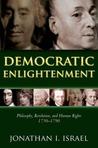 Democratic Enlightenment: Philosophy, Revolution, and Human Rights 1750-1790 by Jonathan Israel
My rating: 4 of 5 stars
Scattered in the crypt of the church of Saint-Roch in Paris lie the remains of the Baron d’Holbach and Denis Diderot: one the patron of the Encyclopédie française, the other its indefatigable editor. It was the book which defined a century and would shape progressive thought for generations to come. Despite their importance, the remains of neither man were transferred to the Pantheon during the Revolution. They lacked the celebrity of Voltaire and the popular appeal of Rousseau and, largely because of their materialist philosophy, have slipped even further out of the limelight since then. No plaque records the resting place of their mortal remains and their philosophical legacy has suffered hardly less neglect. Many of Diderot’s writings did not appear in authoritative editions until the twentieth century and the Encyclopédie has long remained untranslated; it is only now beginning to appear in an comprehensive internet edition. Jonathan Israel’s latest book, Democratic Enlightenment: Philosophy, Revolution, and Human Rights 1750-1790, the third volume in his survey of the Enlightenment, is therefore very welcome in that it focuses on the Encyclopedists and sets them in their international context.
Almost all the leading intellectual figures of the day sat at Holbach’s table at some point: Adam Smith, Benjamin Franklin, Jean-Jacques Rousseau, Jean le Rond d’Alembert, Nicolas de Caritat de Condorcet, Etienne Bonnot de Condillac, David Hume, Joseph Priestley, David Garrick, and Laurence Sterne; philosophers, scientists and mathematicians, historians, actors and novelists were all made welcome. Not all of them were materialists, and not all them contributed to the Encyclopedia, but the discussions that went on at Holbach’s house must be seen as playing a key role in defining the character of this remarkable work and creating the intellectual climate of the time. The d’Holbach circle and the Encyclopedia can, with some justification, be said to represent one of the high-points of the Enlightenment.
Having reached this third volume, Professor Israel recognizes that it is necessary to set out a summary or overview of the argument that has run through all the books both to refresh his readers’ memories and to counter the spate of criticism that has recently been aimed at his work. Writing in the Nation, Professor Samuel Moyn described Israel’s work as having “the dogmatic ring of a profession of faith” and preaching “the story of a renegade Jew―the philosopher Benedict Spinoza.” If it is strange to hear one academic describe another in these terms it is even stranger to hear one of the leading philosophers of the early modern period described as ‘a renegade Jew.’ Spinoza was expelled from the Jewish community of Amsterdam because of his philosophical views. To call him a ‘renegade’ puts him in an extremely negative light and suggests that he set out to harm his former co-religionists in some way or abandoned his religion for disreputable reasons. Nothing could have been further from the truth. Were we to apply this approach to all the philosophers who moved towards religious toleration, deism, atheism or secularism the Enlightenment would offer us a very long list of ‘renegades’ from various religious groups.
This kind of criticism reflects the current postmodern hostility to the Enlightenment. Israel makes it clear that his intention throughout the series has been to counter postmodernism. “Postmodernist thinkers,” Israel writes, “have argued that its [the Enlightenment’s] abstract universalism was ultimately destructive, that the relentless rationalism, concern with perfecting humanity, and universalism of what they often disparagingly called ‘the Enlightenment project’ was responsible for the organized mass violence of the later French Revolution and the still greater horrors perpetrated by imperialism, Communism, Fascism, and Nazism in the late nineteenth and twentieth centuries.”
He rejects the now prevalent idea that the Enlightenment contributed to the ideology of various forms of totalitarianism in the twentieth century and Michel Foucault’s contention that the Enlightenment’s insistence on the primacy of reason “was just a mask for the exercise of power.” A new ‘project’ has replaced that of the Enlightenment, Israel argues, “framing a postmodern world built on multiculturalism, moral relativism, and indeterminacy of truth.”
Israel unashamedly identifies the Enlightenment with the now unfashionable notion of social amelioration, human betterment, or, in other words, social progress which is anathema to postmodernism. His is a comprehensive definition that embraces many distinct intellectual currents within what can broadly be defined as Enlightenment thought. Rather than following the current vogue of identifying national Enlightenments, Israel insists on its universal character. For Israel, the Enlightenment cannot be cut down to fit into the confines of national borders.
“Enlightenment, then, is defined here as a partly unitary phenomenon operative on both sides of the Atlantic,” writes Israel, “and eventually everywhere, consciously committed to the notion of bettering humanity in this world through a fundamental, revolutionary transformation, discarding the ideas, the habits, and traditions of the past either wholly or partially, this last point being bitterly contested among enlighteners; Enlightenment operated usually by revolutionizing ideas and constitutional principles, first, and society afterwards, but sometimes by proceeding in reverse order, uncovering and making better known the principles of a great ‘revolution’ that had already happened. All Enlightenment by definition is closely linked to revolution.”
He traces the political impact of the Enlightenment in Europe, North America, Spanish America, India, Japan and Russia. Above all, he makes a necessary connection between the French Revolution and the Enlightenment. The leaders of the Revolution expressed themselves in the language of the Enlightenment and were denounced by their opponents for living in the world of the philosophes and daring to believe that humanity was not irredeemably corrupt and condemned to live in subjection to their divinely appointed rulers. The Enlightenment produced “a new kind of reading public that finally assumed the role of a collective tribunal of opinion judging kings and ministers.”
The Encyclopédie was crucial to this transformation of consciousness since it brought together all the sciences and technology in a single compilation providing the basis for a public discussion of politics, government and state finances. Enlightenment philosophy established the essential principle of social equality thus cutting through the centuries old legalities of privilege, deference and birth. The Enlightenment would shape the debates of the National Assembly and if the people at large seldom read the philosophes themselves they certainly read their ideas when they were reproduced in cheap, popular editions by countless revolutionary journalists, particularly after 1788 when freedom of the press was achieved.
Many of the philosophes suffered imprisonment for their writings. They were well aware that a great revolution must take place in the not too distant future. At every point the ideas of the Enlightenment ran counter to the interests of the French church and state. From the 1750s and 1760s the ideas of the philosophes increasingly met up with discontent among artisans, especially in Paris. It was a financial crisis that forced the king to call the Estates General in 1789, but it was the Enlightenment and the experience of the American Revolution that informed the Third Estate’s demands for equality, their rejection of privilege and their decision to form a National Assembly.
There is much to admire in this book and much to defend. But there is a problem too. Israel argues that the Enlightenment can be divided into a radical, progressive Enlightenment which was based on a materialist philosophy derived from Benedict Spinoza and a conservative Enlightenment which tended more toward deism than materialism and was to a certain extent acceptable to the authorities. There are always difficulties in dividing up the Enlightenment whether one chooses to do it on national lines, on religious lines or on the basis of chronology. Even a chronological division, which is perhaps the most common device available to the historian, inevitably has a certain arbitrary character, since history in general cannot be cut up neatly into centuries or any other periods and intellectual history is less easily divisible than usual. Writing of distinct national Enlightenments, while common, offers even more pitfalls, since the Enlightenment has an inherently international character and confining a David Hume or an Adam Smith to a Scottish Enlightenment necessarily downplays the influence of the French intellectual milieu on their work in a period when Paris became the centre of progressive intellectual life. Israel’s conservative/radical distinction is an attempt to overcome these pitfalls, but in many respects it opens up just as many of its own.
One of those pitfalls has become an elephant trap in this book. The question of Rousseau and how his work should be characterized is problematic for Israel’s radical/conservative distinction because the complex figure of Rousseau will not fit comfortably into either category. He is at once more radical and more conservative than his contemporaries. Israel characterizes Rousseau as a prophet of the counter-Enlightenment who was fatally associated with Maximilien Robespierre and the Revolutionary Terror. Rousseau’s theory of the general will, according to Israel, provided the ideological basis for repression and a counter-revolution which rode roughshod over human rights and the liberties of the individual citizen after 1793. He draws a fundamental distinction between Rousseau’s early writings, completed under the influence of Diderot, and his later writings, such as the Social Contract, where these dangerous tendencies were fully developed.
In fact, it is by no means a simple matter to make such a distinction between the early Rousseau, and the later Rousseau, since there is a marked continuity between his early and his later writings. Many of the features which Israel criticizes in the Social Contract are already evident in an article that Rousseau wrote for the fifth volume of the Encyclopédie published in 1755. There is the same conception of the general will, the same appeal to patriotism and the same use of examples from the history of Greece and Rome. Yet this early article was subject to Diderot’s editorship and must have passed his scrutiny as everything that went into the Encyclopédie did. Rousseau and Diderot were divided by a bitter quarrel in 1758 but the similarities in their work remained apparent. Quarrels between philosophers are not necessarily philosophical quarrels.
In the Encyclopédie article Rousseau advocates a public education system in which children are “trained early enough to consider their individual selves only in relation to the body of the state, and to see their own existence, so to speak, only as a part of its existence,” which is a statement sufficient to arouse all the concerns that the Social Contract has provoked in relation to civil liberties if taken out of context.
It should be pointed out that neither Rousseau, nor Diderot, nor indeed any other writer of the period, ever meant what we mean when they referred to the state. We have come to characterize the state as a specialised body standing apart from and controlling the rest of society, representing the interests of property owners and capable of exercising a police function. Rousseau did not understand it in that way. When he writes of the state, both in the Encyclopédie article and in the Social Contract he means the whole of a political society, with all its institutions, the people who make it up and the territory they occupy.
Historical context is all important. In the Social Contract Rousseau wrote that men must be forced to be free. “If any one refuses to obey the general will he will be compelled to do so by the whole body”. This statement is often taken to mean that he wished the individual to be relentlessly subordinated to a totalitarian state. But we find the same insistence on the general will in the early Encyclopédie article: Rousseau wrote “the most general will is also the most just, and that the voice of the people is truly the voice of God.”
The general will was a concept used by all natural law theorists. Its implication was that no one should be above the law or exempt from the law. Rather than being a repressive principle it expressed the equality of all members of society. France was a society in which an aristocrat could have a writer beaten up – as Voltaire was – with impunity, where the king’s arbitrary will could imprison a man indefinitely – as Diderot was – and in which burdens such as taxation and labour services fell entirely on the poorest members of society. To state under these circumstances that the law should be an expression of the general will and that all members of society should be bound by that law had a profoundly revolutionary and democratic character. It was a concept shared by both Diderot and Rousseau and, for that matter, by Spinoza. Set in this context Rousseau’s now notorious phrase can be seen to be no more than a statement of the principle that all members of a political society should obey the law and that the law should conform to the general will of the whole society rather than the will of particular individuals or classes within it.
Rousseau was aware of the problem of political oppression but the form of oppression which he and his contemporaries experienced was at the hands of princes and powerful elites. His response to it was direct and widely shared – if the prince began to rule in a way that was not consistent with the general will and asserted his particular will and employed force to impose his will then the social union “would evaporate instantly and the body politic would be dissolved.” In other words the people would have the right of revolution in those circumstances. That right was what the French people would exercise in 1789.
Diderot and Rousseau remained intellectually close even as the row between them rumbled on and others took sides. Their closeness is most evident in those writings that Diderot did not publish. He had learned when he was imprisoned for publishing his Letter on the Blind that he needed to be careful if he was to protect the Encyclopédie from the authorities and as a result many of his most innovative ideas were only circulated in manuscript form among friends. It is in these that we see that both Rousseau and Diderot had come up against the inherent limitations of the materialism of their day and were attempting to develop a form of philosophy that would overcome them and allow progress to be made in the natural and social sciences.
Rousseau, without the responsibility of the Encyclopédié, was able to explore these philosophical possibilities, particularly in relation to society, more freely even if he risked persecution. Israel dismisses the personal danger to Rousseau, but his books were burned in Paris and Geneva as repression, always arbitrary and unpredictable, increased during the 1760s. The decades of the later eighteenth century were the period when Voltaire engaged in a series of celebrated human rights cases on behalf of victims of religious and state oppression. But he too was cautious and was always ready to slip across the border. Rousseau’s fears were by no means exaggerated.
In D’Alembert’s Dream Diderot explored questions such as biological evolution and the nature of human consciousness by contrasting a dialogue with his friend d’Alembert the mathematician with what he imagined d’Alembert saying in a feverish dream. His ideas in this unpublished work have the same paradoxical character that can be found in Rousseau’s writings. Rousseau’s paradoxes, such as the phrase that men must be forced to be free, are an indication that he was grappling with the contradictions of social life just as Diderot was trying to come to grips with the complexity of human thought.
Israel’s desire to sort his philosophers into radicals and conservatives was never sustainable but in this book his categories begin to look merely wilful and fail to give the reader a sense of the rich complexity of thought in the period. The history of social thought necessarily works through a process of conflict and debate, even within the mind of one person. A conservative/radical split is too rigid and does violence to the organic nature of the development of thought through many contradictory channels and eddies.
Nonetheless, it must be said that at a time when materialism, the concept of social progress and the Enlightenment are all under sustained attack Israel’s books are an important contribution to the debate. As Israel writes, “Given the overriding importance and vast scope of this global cultural-philosophical clash today any scholar discussing Enlightenment in broad terms has a clear responsibility to to render as accurate, carefully delineated, and complete a picture of the phenomenon as possible. Except for those willing to yield to Postmodernism and concede the death of reason and moral universalism, it remains an ongoing, live, and vital issue.”
View all my reviews


No comments have been added yet.