Marlene Chism's Blog
September 21, 2026
Six Problems Leaders Misdiagnose as Fear of Conflict
When a leader avoids a difficult conversation, it’s easy to assume the problem is fear, or a lack of leadership courage.
Sometimes yes, but after more than 20 years of consulting and coaching leaders, I’ve learned that conversation avoidance happens for various reasons. For example, avoidance may be an orientation problem, an accountability problem, or a legitimate business risk.
These distinctions matter because different problems require different interventions.
An orientation problem can’t be solved with accountability, and a legitimate business risk shouldn’t be dismissed as fear.
To identify the real problem, start by listening to what the leader says.
1. The Orientation ProblemWhat the leader says: “I don’t know where to start.”
The leader knows something needs to be addressed but cannot find the entry point.
They may be unclear about the real issue. They may have too many examples and too much history. Or they may be trying to address attitude, motivation, personality, and performance all at once.
When leaders lack orientation, they often delay the conversation while waiting for greater confidence. But confidence is unlikely to arrive through delay or avoidance.
Orientation starts with understanding the situation, the desired result, the business impact, and the purpose of the conversation. Without this grounding, leaders can easily get pulled into emotion, history, and irrelevant distractions. Orientation provides the leadership clarity needed to begin the conversation and maintain its direction.
2. The Anticipation ProblemWhat the leader says: “I already know what they’ll say.”
The leader has conducted the entire conversation privately, playing both roles.
They anticipate that the employee will deny the behavior, blame someone else, become emotional, point out an exception, or bring up everything that has happened since the invention of fire.
The leader may be correct about the likely response, but anticipating their response, and then delaying the conversation is what I call “resisting their resistance” in my book, From Conflict to Courage.
The leader’s responsibility isn’t to control the employee’s reaction. It’s to remain clear, listen, and redirect the conversation when it gets off track.
3. The Accountability ProblemWhat the leader says: “We’ve had the conversation, but nothing changed.”
Leaders sometimes assume that because a subject was discussed, accountability was established.
But talking about a problem is not the same as creating accountability.
The previous conversation may have included hints, suggestions, feedback, or expressions of concern. What it may not have included was a clear expectation, an agreement, a follow-up date, and the consequences of continued behavior.
4. The Alignment ProblemWhat the leader says: “My boss won’t support my decision.”
Sometimes the reluctance to act comes from past experience. A manager may have been told to hold people accountable while watching the senior leaders reverse decisions, tolerate exceptions, or protect certain employees.
This puts the manager in an impossible position. They’re expected to create accountability without the authority or support to maintain it.
Before meeting with the employee, the manager may need a conversation with their own leader to ask:
What authority do I have?What decisions can I make?What will happen if the employee refuses to change?Can I count on your support?Leadership clarity must exist at the top before accountability can be established in a department.
5. The Constraint ProblemWhat the leader says: “They have tenure, so there’s nothing I can do.”
Organizations have real constraints. Policies, contracts, reporting structures, labor agreements, longstanding relationships, and legal considerations can limit a leader’s options, but a constraint isn’t always a complete barrier.
The leader may not be able to terminate the employee, but that doesn’t mean they can’t clarify expectations, address specific behavior, document patterns, establish boundaries, or explain business impact.
The useful question is, “Given the constraints, what conversation is still available to me?”
Constraints define the playing field, but they don’t eliminate the leader’s responsibility to play.
6. The Business-Risk ProblemWhat the leader says: “They’re a top performer, and I can’t afford to lose them.”
This isn’t an imaginary concern. A top performer may hold critical knowledge, manage valuable client relationships, produce significant revenue, or possess expertise that would be difficult to replace.
Addressing the behavior may create a legitimate risk, but avoidance also creates risk.
A leader must consider both sides:
What would it cost us if this person leaves?What’s it costing us to tolerate the behavior?How is the behavior affecting trust, retention, collaboration, and execution?Are we becoming dependent on someone who won’t accept responsibility?The goal isn’t to disregard the person’s value. It is to stop measuring value only by individual output. Someone can produce excellent results while quietly making it harder for everyone else to produce theirs.
Diagnose Before You InterveneWhen every avoided conversation is labeled a courage problem, leaders receive simplistic advice: Be brave. Address it. Stop avoiding.
Courage matters, but courage without diagnosis can produce the wrong conversation. Before deciding what should be said, identify the real problem:
Once the problem is accurately diagnosed, the leader can choose the appropriate next move. Sometimes that means preparing more thoroughly. Sometimes it means aligning with senior leadership, working within organizational constraints, or accepting a legitimate business risk.
The goal isn’t simply to make leaders more courageous. It is to help them accurately diagnose what’s preventing the conversation and choose an intervention that matches the problem. Otherwise, unresolved issues travel downstream, where they eventually become accountability, culture, and execution problems.
This article was first published on SmartBrief.
The post Six Problems Leaders Misdiagnose as Fear of Conflict appeared first on Marlene Chism.


September 7, 2026
Valid Reasons Leaders Avoid Difficult Conversations
When leaders avoid difficult conversations, we often assume they lack courage or fear conflict.
After more than 20 years of consulting and training leaders, I’ve discovered that avoidance is not always a character flaw. Sometimes it is a reasonable response to feeling unprepared, unsupported, or uncertain about what happens next.
Here are six statements I hear repeatedly:
“I don’t know where to start.”“I already know what they’ll say.”“We’ve had the conversation, but nothing changed.”“My boss won’t support my decision.”“They have tenure, so there’s nothing I can do.”“They’re a top performer, and I can’t afford to lose them.”These may sound like excuses. But each one contains useful diagnostic information.
“I don’t know where to start.”This is an orientation problem.
The leader may recognize that something needs to be addressed but cannot clearly define the issue, the desired outcome, or the opening statement. Without that clarity, the conversation feels bigger and riskier than it is.
The first move is not to become more courageous. It is to clarify the intention and identify the observable behavior that needs to be discussed.
“I already know what they’ll say.”This is an anticipation problem.
The leader is mentally conducting both sides of the conversation before it ever occurs. They anticipate defensiveness, denial, blame, or a lengthy explanation and conclude that the conversation will go nowhere.
But predicting someone’s response is not the same as hearing it. A leader needs the ability to listen without surrendering the direction of the conversation.
“We’ve had the conversation, but nothing changed.”This is often an accountability problem disguised as a communication problem.
Talking about an issue is not the same as creating accountability. Was the expectation clearly stated? Was there agreement about what would change? Was a follow-up date established? Were consequences or next steps discussed?
If nothing changed, the answer may not be another version of the same conversation. The next move may be a clear accountability conversation.
“My boss won’t support my decision.”This is a leadership alignment problem.
A manager cannot confidently establish accountability when senior leaders routinely reverse decisions, make exceptions, or refuse to support reasonable consequences.
Before addressing the employee, the manager may need clarity from above. What authority does the manager actually have? What will senior leadership support when resistance appears?
“They have tenure, so there’s nothing I can do.”This is a perceived constraint problem.
Tenure, history, relationships, and organizational politics may limit certain options. They do not eliminate the leader’s responsibility to clarify expectations and address behavior.
The leader may not control every consequence, but there is usually a conversation available that has not yet occurred.
“They’re a top performer, and I can’t afford to lose them.”This is a business-risk problem.
The leader is weighing short-term performance against the long-term cost of tolerated behavior. That calculation deserves serious consideration.
But top performance does not neutralize the effects of disrespect, disruption, or damaged trust. The question is not simply, “Can we afford to lose this person?” It is also, “What is it costing us to avoid addressing the behavior?”
Avoidance is often a lack of architectureSome leaders genuinely fear conflict. But underneath much of that fear is a lack of orientation.
They don’t know how to begin. They don’t know how to respond when the conversation takes an unexpected turn. They don’t know how to move from listening to clarity and from clarity to accountability.
Without a structure, leaders lose confidence, get off track, repeat themselves, overexplain, or avoid the conversation altogether.
Courage matters. But asking leaders to “be more courageous” without giving them a reliable structure is like asking someone to drive confidently without teaching them how to steer.
Leaders need more than a script. They need to understand the architecture of the conversation so they can diagnose where it is breaking down and choose the right next move.
On September 23, I’m hosting a live webinar, The Architecture of Difficult Conversations.
You’ll learn how to:
Recognize where conversations break downUnderstand the four-part conversation architectureDiagnose what is missing so you can choose your next moveDistinguish accountability problems from leadership clarity problems
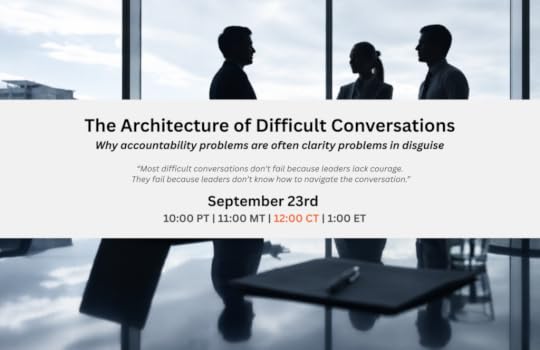
If you lead others, coach managers, or find yourself circling the same unresolved issue, I’d love to have you join me.
The post Valid Reasons Leaders Avoid Difficult Conversations appeared first on Marlene Chism.
August 24, 2026
Why Clarity Comes Before Accountability
When organizations face legal risk, they often assume the problem was poor documentation or ineffective leadership. In reality, those issues are usually symptoms of a deeper failure: a lack of clarity. Inconsistent leadership and weak documentation rarely occur in isolation; they emerge when expectations are unclear, conversations are avoided and performance standards are inconsistently reinforced.
Documentation, in these cases, becomes a checklist exercise, something completed to satisfy a process rather than to reflect real accountability. When leaders are clear about the root cause of performance issues and have a consistent system for coaching employees to success, documentation serves a very different purpose. It becomes a record of clarity, accountability and intent. Leaders cannot document, or hold people accountable for, expectations they never clearly defined, aligned to or reinforced.
The recent SHRM lawsuit offers a sobering example of what happens when clarity breaks down, even among respected and reputable organizations. As the year begins, it’s worth examining why clarity isn’t just a value, it’s a leadership requirement.
Clarity First, Accountability SecondIf leaders aren’t clear about the situation, the desired outcome or the obstacles, accountability is impossible. Most leaders I work with struggle to articulate what’s really happening. And even when they can, they often view the issue through a narrow or reactive lens, reaching for quick fixes, outside coaching or policy enforcement to solve a problem that may not even exist.
This lack of clarity is frequently the result of inadequate training. Leaders are promoted for technical competence, not for their ability to think critically, communicate clearly or coach performance. Poor documentation often reflects this reality. If employees don’t know what success looks like, documentation won’t resolve the issue, and may not protect the organization when conflict escalates.
Bottom Line: There is no accountability without clarity.
Clarity Is a Prerequisite for AlignmentIn the corporate world, “alignment” is a popular but misunderstood word. Alignment to what? A goal? A metric? A policy? A value?
Too often, organizations claim alignment to mission and values while behaving in ways that contradict them. Leaders may align to documentation practices or legal defense strategies rather than aligning to leadership development, competence and trust. The result is performative alignment, polished language without consistent behavior.
True alignment requires intention and investment. It means allocating time and budget to train leaders how to think strategically, coach for competency and promote accountability without fear. When that alignment exists, documentation becomes a record of progress and expectations, not a paper shield designed to avoid the courthouse.
Bottom Line: Alignment without clarity is cosmetic. It looks good on the outside.
Clarity Comes Before CourageWhen leaders avoid performance conversations, the behavior is often labeled as a lack of courage. In reality, the issue is more fundamental: they lack clarity. Clarity is what gives courage its direction.
Managers consistently report that difficult conversations become easier once they are clear about what’s happening, what’s not happening, why it matters and how to communicate it. Without clarity, courage becomes impulsive, and impulsive conversations create confusion instead of collaboration.
This lack of clarity shows up when senior leaders pressure managers to “just go have the conversation” without providing a framework or skill set. Fear becomes the motivator, fear of consequences rather than confidence in competence. Leaders need structure, not ultimatums. Courage grounded in clarity builds capability; courage fueled by fear creates damage.
Bottom Line: Courage without clarity can become reckless.
Clarity Dissolves DramaWhenever you see a supervisor withholding feedback because the feedback will be perceived as bias, you’re witnessing leadership driven by fear rather than truth. When HR edits documentation to cover uncertainty or inconsistency, clarity is being replaced with concealment. Gossip, incivility, assumptions and legal threats are not isolated problems, but symptoms of unclear expectations and unspoken realities.
Drama thrives where clarity is absent. It feeds on storytelling, interpretation and silence. Clarity forces reality into the room. It stops speculation. It creates peace by naming what is actually happening — without heat or hostility.
As I’ve said since writing Stop Workplace Drama: clarity can change any experience. It cuts through confusion and replaces it with shared understanding.
Bottom Line: In all workplace drama there’s always a lack of clarity.
ConclusionClarity is not an idea or a soft skill. It is a principle, a value and a leadership discipline. When expectations are clear, alignment follows, accountability becomes fair and courage becomes purposeful. When clarity is absent, even the best organizations are left managing consequences instead of performance.
The real leadership risk isn’t saying the wrong thing. It’s leaving the most important things unsaid.
This article first appeared on SmartBrief for Leadership.
The post Why Clarity Comes Before Accountability appeared first on Marlene Chism.
August 10, 2026
When Friction Isn’t Growth: A Leadership Distinction That Changes Everything
For years, I believed something that served me well, until it no longer worked.
The belief was: If something feels uncomfortable, I should lean into it. That mindset helped me to speak up when it would have been easier to stay quiet. It also allowed me to work with strong personalities, or even difficult people as some would say. As a result, I built resilience, and I expanded my conflict capacity.
Then at some point, that same mindset started working against me, because I treated all friction as a signal to withstand, to endure, or to push forward. I even built a whole body of work about how to “release resistance.” The philosophy built on the idea that we just have to be willing to be uncomfortable in order to grow. I still embrace this idea that when it comes to growth comfort isn’t a requirement, but I’ve since come to believe that while comfort isn’t a requirement for growth, neither is misery.
Here’s how it’s shifted for me.
Not long ago, I was considering re-engaging with a leader I had worked with in the past. He was successful, powerful and direct. I might even categorize him as authoritarian, or a bit difficult to work with low level of awareness, and plenty of blame to go around.
A decade ago, I would have described the experience as “challenging,” but in a way that I felt proud to navigate. It’s as if I needed to prove something to myself.
As I thought about re-engaging, I noticed something subtle, and it wasn’t fear or nervousness. Instead, there was a distinct knowing that I had grown past working with this type of leader.
I was asking a very different question.
Instead of asking: What can I learn from this kind of friction and how can I grow? I was asking, “Is this growth or misalignment?” That’s when I realized that not all friction is created equal. Friction can stall you or can sharpen you.
Not All Friction Is Created EqualIn leadership, and in life, there are at least two very different kinds of friction: Growth Friction and Misalignment Friction.
Growth Friction is an acquired taste, the kind of friction that you need to embrace when you’re seeking personal or leadership growth. It feels like vulnerability, risking rejection, and navigating uncertainty. This kind of friction expands you. There’s nothing like the emotional high of feeling things you didn’t want to feel and doing things you were too scared to do. This is called progress, and even when we dread it, something whispers to us that it’s our work to do.
This kind of friction shows up when you’re raising your standards, reinventing your life, entering a bigger conversation, and making change that matters. If you want to grow, you learn how to build the skill of staying with it. You toughen up, become thick-skinned, more forgiving, and quietly effective. If you get a taste for that which is difficult, you start to confuse misalignment friction with growth friction.
Misalignment Friction is the kind of friction most of us misinterpret. It feels like pushing uphill with a person, overriding a system, managing someone else’s ego, over-explaining your value, subtle dread before the conversation even starts. Misalignment Friction has you compromising your standards and over-compensating for someone else’s disagreeableness. Misalignment Friction doesn’t expand you. It drains you.
And here’s the trap:
If you’ve trained yourself to “push through discomfort,” you might override this signal… and stay too long. You’ll be living from the old story that you need to push through, make exceptions, and tolerate the intolerable.
How to Tell the DifferenceThe distinction between Growth Friction and Misalignment Friction isn’t always obvious in the moment. Both feel uncomfortable. Both can involve strong personalities, ambiguity, and pressure.
So how do you know?
Growth Friction asks you to rise.
Misalignment Friction asks you to contort.
Let’s make that practical:
Growth Friction says: “This is hard, and I’m becoming more clear, more capable, more grounded.”Misalignment Friction says: “This is hard, and I’m becoming more confused, more depleted, or less myself.”Growth Friction sharpens your thinking.Misalignment Friction has you over-explaining and second-guessing.Growth Friction builds capacity.Misalignment Friction burns capacity.One expands your leadership.
The other erodes your standards.
The cost of getting it wrong matters more than it seems.
When leaders misinterpret misalignment as growth, they don’t just drain themselves—they create execution risk.
They:
tolerate unclear expectationsdelay necessary conversationsover-accommodate difficult behaviorand normalize dysfunction in the name of “being adaptable”And slowly, almost invisibly, standards drift.
Not because leaders don’t care.
But because they’ve mistaken endurance for leadership.
The Question That Changes Everything
So instead of asking:
“How do I push through this?”
Try asking:
“What is this friction asking of me—growth or alignment?”
That single question can save you months of wasted energy, compromised standards, and conversations that should never have been negotiated in the first place.
The post When Friction Isn’t Growth: A Leadership Distinction That Changes Everything appeared first on Marlene Chism.
July 27, 2026
When Workplace Loyalty Undermines Accountability
An employee is sent home for repeated reliability issues. Instead of working through the leader who made the decision, the employee calls the founder.
The founder knows the employee’s history and remembers the early years. He understands the pressures of work, fatigue, and family responsibilities. His first instinct isn’t structure. It’s sympathy.
Then comes the sentence that explains almost everything: “We’re like family.”
The pride behind the phraseIn more than 20 years as a consultant, I’ve noticed a pattern in certain types of businesses, especially family-owned, founder-led, and franchise organizations: many strongly identify with “being like family.”
This identity holds a lot of pride. It suggests care, flexibility, trust, loyalty, and a willingness to go the extra mile. At its best, this culture is a strength. People help each other. Leaders know their employees’ stories. There’s warmth, history, and belonging that often large organizations struggle to maintain. Trouble emerges when family values conflict with business reality.
When care blurs authorityWithout clarity, the “we’re like family” operating system creates conflict. For example, a founder builds a successful business over many years and eventually a new leader emerges in the succession plan. Sometimes that person is a relative or next-generation partner. On paper, the authority structure looks clear, but in daily practice, the old relationships still carry more weight than the new roles.
An employee with a long history in the company starts having reliability, behavior, or performance issues. The current leader addresses the issue. The employee doesn’t like the decision, so instead of working through the leader, the employee goes back to the founder.
The founder’s first instinct is compassion. But when compassion allows employees to bypass their manager, clarity erodes, authority weakens, and accountability breaks down.
The drama triangle at workIn that moment, the Karpman Drama Triangle emerges. The founder unintentionally steps into the rescuer role. The employee is positioned as the victim. The current leader is positioned as the persecutor. Suddenly, what should have been a clear performance coaching conversation becomes workplace drama.
The presenting problem looks like employee accountability, but the root problem is leadership clarity: Who’s really in charge? Who has decision rights? What happens when an employee bypasses their manager? Are top leaders aligned before they respond? Is compassion being used to support accountability, or to avoid it?
These questions matter because employees are always watching.
Employees are always watchingWhen one employee bypasses a leader and gets rescued, the precedent is set. Others learn that the leadership structure is optional. They discover that history matters more than performance. They see that accountability depends on who you know. They come to understand that if you don’t like an answer, you can simply appeal to someone with more emotional history.
That’s not family. That’s workplace drama.
The problem with “we’re like family” is not the caring. Caring is human. The problem is when caring becomes a substitute for clarity. In healthy families, love may be unconditional. In healthy businesses, employment is based on agreements: reliability, behavior, performance, trust, and the health of the business.
A better agreement: care, clarity and standardsA healthier culture does not require leaders to care less; it requires them to clarify more. Clarity has to start at the top, because accountability doesn’t survive without it.
Top leaders in any type of organization need to define decision rights before a crisis, not during and not after. They need to agree on how performance issues will be handled. They need to decide what happens when an employee goes around a manager. They need to speak with one voice, especially when emotions are high.
A lack of clarity is the first breakdown in accountability. The current leader wonders, “Do I really have authority?” The founder wonders, “Am I being too hard or too soft?” The employee wonders, “Who do I need to persuade?” The team wonders, “Why are we expected to follow standards that others can negotiate?”
The better path is to replace vague family language with clear leadership agreements that include a both-and mindset: Both family values and business priorities.
For example: “We care about you, and we also have standards.”
“We want to understand what is happening, and we will work through the proper leadership channel.”
“We are willing to support you, and we will not bypass the person responsible for managing this issue.”
Businesses that operate from family values have a real opportunity. They can keep the best parts of family culture: loyalty, care, history, generosity, and belonging. But they must pair those values with structure, role clarity, and accountability.
“We’re like family” feels warm. But “we lead with care, clarity, and standards” builds a lasting business.
This article was first published on SmartBrief for Leaders.
The post When Workplace Loyalty Undermines Accountability appeared first on Marlene Chism.
June 19, 2026
What a 50-Year Reunion Reveals
I recently attended my 50-year high school reunion.
Like many people, I approached it with mixed emotions. There was curiosity, nostalgia, anticipation, and perhaps a quiet awareness that reunions are never really about the event itself. They are about time. Identity. Memory. Aging. Loss. Perspective.
Out of more than 300 classmates, nearly 60 have already passed away. That realization alone changes the atmosphere of a 50-year reunion.
At some point, the event stops being about popularity, accomplishment, appearance, or status and becomes something much more profound: the simple awareness that the horizon is shorter than it once was, and that everyone present is fortunate to still be here.
Many people dread reunions beforehand. They wonder:
Do I even have anything in common with these people anymore?
I haven’t seen most of them in five decades.
And in some ways, the answer is no.
Some people are still carrying old identities.
Some have not grown very much.
Some have achieved remarkable levels of success but very little depth.
Some are still trying to prove something.
Some are still trapped in old stories about who they are supposed to be.
But underneath all of that is a deeper truth.
As Eckhart Tolle once suggested, whether in seven years or seventy, all of us eventually become dust.
Oddly enough, that reality gives people far more in common than their careers, accomplishments, politics, wealth, appearance, or social standing ever could.
At a 50-year reunion, people begin to recognize that life has humbled everyone in some way.
No one escapes loss.
No one escapes disappointment.
No one escapes aging.
No one escapes uncertainty.
Some people lost spouses.
Some lost dreams.
Some lost health.
Some lost confidence.
Some quietly rebuilt themselves after life fell apart.
And suddenly, the old labels begin to matter less.
The athlete.
The outsider.
The beauty queen.
The rebel.
The brain.
The shy one.
The popular one.
Time has a way of softening those identities, even when people still cling to them.
What becomes more visible over time is character.
Wisdom.
Kindness.
Humor.
Resilience.
Self-awareness.
Presence.
Ironically, by this stage of life, perfection becomes far less impressive than humanity.
Maybe that’s the hidden gift of a 50-year reunion.
Not reliving the past.
Not measuring who won or lost.
Not proving who became successful.
But recognizing, perhaps for the first time, that beneath all the stories and identities, people are far more alike than different.
Human beings, briefly here, doing their best with a complicated life.
The post What a 50-Year Reunion Reveals appeared first on Marlene Chism.
June 8, 2026
Why Learning to Lead is Like Learning to Dance
Learning to lead feels difficult for the same reason learning to dance does; you’re trying to perform before you’ve mastered the basics.
As a dancer, I’ve taken lessons in Tap, Ballroom, Latin, Lindy Hop, and West Coast Swing—and I see the same patterns in every beginner class.
Most beginners walk in carrying some level of insecurity.
They worry about being judged.
They feel clumsy.
They wonder if they’re holding others back.
And then there are a few who think they’re better than they are.
Leadership is no different. Every leader comes in with a different mix of ability—learning speed, coordination, confidence, and self-awareness. And they also bring different levels of desire and purpose, regardless of natural talent.
But here’s the distinction: Dancers understand something most leaders don’t.
1. The Basics Are the FoundationIn every dance class I’ve ever taken, we start with the basics, and not just once.
Over and over again.
At the time, it can feel repetitive—even unnecessary. Really great dancers keep returning to beginner classes to refine their fundamentals. Mediocre dancers avoid them—they think they’re above it.
I remember while taking a tap class, listening to the instructor walk us through the same foundational steps for what felt like the twentieth time. I was impatient. I wanted to get to the routines—the fun part, the impressive part. I remember thinking, “This is a waste of time.”
But then something shifted.
When we finally moved into a more complex sequence, the dancers who had dialed in the basics flowed. They stayed on beat. They adapted quickly.
The rest of us? We were a half-step behind, thinking too hard, missing cues, trying to keep up. That’s when it clicked: The basics weren’t slowing us down. The basics were the only thing making progress possible.
Leadership works the same way.
When leaders struggle, it’s often not because they lack intelligence, aptitude, or drive. It’s because they’ve skipped over the fundamentals:
Setting clear expectations (Carity)Addressing issues directly (Difficult Conversations)Managing conflict without reactivity (Capacity)Holding people accountable to agreed-upon standards (Measurement)Coaching for improvement and follow-through (Development)Without these basics and a few others, everything else becomes harder than it needs to be.
2. Dancing and Leading are Not Checklist ActivitiesNo dancer ever takes one class and says, “I’ve got it.” But leaders do this all the time. They attend a workshop. They read a book. They take one curated LinkedIn course. They get a certificate. They check the box, and then they move on—assuming the learning is complete.
Even senior leaders fall into this trap. They send their managers to complete a course, and assume the skill is handled, after all, there’s a “certificate” to prove learning took place. So, they continue to invest in one-and-done solutions, only to wonder why months later, there’s an execution problem.
Dancing isn’t a one-class event, or a six-week workshop, and neither is Leadership. it’s a practice. Over and over. Whether it’s dancing or leading, the moment you think you’ve “learned it” is often the moment your effectiveness starts to plateau.
3. Mastery Requires Practice—Especially When It’s UncomfortableOne of the most difficult dances I’ve learned is Samba. (While I took the leap to compete in Argentina, the truth is, I’m just at the very beginning and continue to take lessons.) What I’ve since learned from staying with it, is you don’t improve by watching. Watching can give you awareness, but not skill or confidence. In dance and in leadership, awareness without practice is just intellectual entertainment.
You improve by doing—awkwardly at first. You miss a few steps. You get off beat. You feel exposed. And then, slowly, things start to click. All the hard work and expanding your comfort zone start to pay off. You feel confident and proud of yourself for overcoming your barriers.
Leadership follows the same path. You don’t get better at difficult conversations by avoiding them. You don’t build clarity by hinting or hoping people “just get it.” You don’t develop presence by staying in your comfort zone.
You get better by practicing—especially when it feels uncomfortable.
The Bottom LineThere was a moment a few weeks ago on the dance floor when everything felt easy. The music, the connection, and the rhythm felt like magic. It all clicked. I remembered a time when this particular dance would have been uncomfortable if not difficult. I said to my dance partner. “Wow, for all the work we do and all the difficulties we overcome in class, when we dance like this, it’s a reminder of why we do it.”
If leadership feels harder than it should… if conversations feel awkward… if things feel out of sync…It doesn’t mean you’re bad at leadership. It means you’ve skipped the fundamentals and the practice that make leadership work.
Leadership, like dance, isn’t about knowing more. It’s about practicing what matters—until it becomes second nature.
And once it does? That’s when everything starts to flow.
The post Why Learning to Lead is Like Learning to Dance appeared first on Marlene Chism.
May 11, 2026
Why Some Leadership Can’t Be Delegated
You’ve probably heard the idea: “Ask who can do this instead of how can I do this.”
This concept was life-changing for me as it has been for others. As an entrepreneur, founder, or leader, it’s the right frame when you find yourself micromanaging, feeling stuck, or striving to scale. It’s a powerful shift when you stop trying to figure everything out yourself and instead, find the right people so you can move faster.
But I’ve also seen this idea misapplied in a way that quietly undermines execution.
Because in certain cases … “How > Who.”
The Problem with Always Skipping “How”Entrepreneurs especially love leverage. So, they jump quickly to “who,” because it frees them to do what they do best. They hire someone to run the system, organize the work, or build the process.
But if they haven’t taken the time to understand the basics themselves, they don’t understand what good looks like, what questions to ask, or what’s not working. When results fall short, they assume they don’t have the right person, but that’s not always the problem. The problem is that they outsourced clarity.
I would venture to say that “Who not How” works best when you’ve already done the “How” over and over, and you’re wasting precious time on something someone else could do better and faster, or you understand the “How” but you aren’t necessarily quick or good at it.
Let me offer two possibilities, where skipping some of the “how” creates unnecessary damage and execution risk.
You don’t become a leader by delegating everything you don’t know how to do, and you certainly can’t delegate character building or learning how to become a better decision maker. In fact, you become an effective leader by developing the judgment to know what matters, what good looks like, and where execution breaks down.
That requires understanding and at least a little bit of “how to.”
If you skip “how” too early, you don’t build leadership identity—you build dependence.
2. Having Difficult ConversationsThis is where the lack of knowing how causes multiple problems, most of them invisible before they become visible. (This is exactly why I developed The Performance Coaching Model: To teach leaders a framework for having these hard conversations.)
When leaders avoid learning how to have difficult conversations about behavior and performance, they go straight to the “who.” That who is generally Human Resources. I can’t tell you how many times I’ve seen an HR person write up the PIP or do the “dirty work” that the manager wouldn’t do or didn’t know how to do. This is an example of abdicating responsibility and outsourcing real accountability.
Why should the employee be disciplined when his own manager didn’t have the capacity to have a conversation? Execution broke down at the conversation that should have happened, but instead got delegated to HR. And over time, HR becomes responsible for work that belongs to the manager, the director, and the senior executive.
The Real EquationWhat’s the real distinction between who versus how?
“How” creates discernment.
“Who” creates scale.
Without discernment, scale just multiplies problems.
The Leadership ShiftThe real issue isn’t whether you choose “how” or “who.” It’s whether you have the discernment to know the difference.
Discernment comes from understanding:
What good looks likeWhat’s requiredWhere things break downAnd that doesn’t come from delegation. It comes from development. You can outsource and delegate almost anything. But you can’t outsource your own development.
The Bottom Line“Who not How” creates leverage. You can outsource someone to pay your bills, clean your office, and manage your calendar. But you can’t outsource your inner game—your clarity, your judgment, your discernment.
There are some things you have to learn “how to” do. Not to master them. But to recognize what good looks like. Because if you don’t understand the basics, you won’t build something better. You’ll accept something that reflects your confusion—not your goals.
And if you avoid learning how to lead conversations, you don’t build accountability. You outsource it.
Execution doesn’t break at accountability. It breaks at clarity—and at conversation.
The post Why Some Leadership Can’t Be Delegated appeared first on Marlene Chism.
April 27, 2026
How to Create More Clarity Now
For many executives, nothing is technically “wrong.” The business is running. The team is capable, and the results are acceptable, yet decisions feel heavier than they should.
Important conversations get postponed. Energy is being spent, but traction feels uneven. This isn’t usually a confidence problem or uncertainty about the future. More often, it’s a lack of clarity in the present moment.
I need to make an important distinction here. We often use the word “clarity” when we really mean “certainty.” We will never have certainty, but we always have enough clarity to take the first step. Sometimes clarity shows up like a lit candle instead of a floodlight.
Clarity doesn’t mean knowing how everything will turn out. It means knowing what you stand for, what matters now, and what you’re responsible for next.
The good news?
Clarity isn’t something you wait for. It’s something you create. Here’s how.
1. Know What You WantHave you noticed that most people can easily articulate what they don’t want far more easily than what they want? Ask anyone the question: “What do you want?” and listen. What you’ll hear is “I don’t want…” and “Here’s why I can’t have what I want.” Knowing what you want, whether or not you think you can have it, is the first step to clarity. Knowing what you want doesn’t require certainty about the outcome. It requires honesty about direction.
2. State Your ValuesValues aren’t inspirational phrases; they’re decision filters. If your values aren’t stated, it’s easier to get off course. I’ll never forget when I said my mission was “to improve communication and relationships everywhere.” It sounded so good on paper. What came to my attention was the need to curb sarcasm and eyerolling, as these behaviors didn’t align with improving communication and relationships everywhere. Stated values serve as a north star, not only guiding decisions. But exposing misalignment.
3. Understand What Truly MattersWhen everything’s a priority, nothing gets sustained attention. Clarity requires making trade-offs explicit. Progress often doesn’t come from doing more—it comes from deciding what will no longer receive your time, attention, or resources. If you notice that things aren’t getting done in your organization, I guarantee execution isn’t breaking at accountability. It’s breaking at either clarity or conversation. The moment a leader notices that priorities are out of order, it may be that there are too many priorities and you aren’t setting up your team for success. Once you have the clarity about what’s going on, the next step is a conversation. Execution almost always breaks at conversation.
4. Choose a DirectionClarity requires commitment—even provisional commitment. A direction isn’t a life sentence. It’s a working hypothesis; one step at a time, in a chosen direction. But this is where many leaders get stuck: they build a plan before establishing direction. Here’s why: Plans can create a sense of productivity. There’s comfort in checking things off a list. But a plan without direction is just organized activity.
Direction comes first. The plan follows. The purpose of a plan isn’t certainty—it’s alignment. It helps you stay on course, not predict every outcome.
A plan is a guide, not a god.
Choosing a direction reduces mental noise and gives you somewhere to aim.
5. Tell Yourself the TruthTelling yourself the truth is the hardest step—and the most powerful. It means acknowledging what you already know but haven’t fully named. Telling yourself the truth requires answering some difficult questions: What are you willing to do to get what you want? What’s required? Are you willing to move forward even in the face of uncertainty? Clarity stabilizes when you stop fantasizing about what you wish could be, and you face reality as it is, then make a decision to do what’s required.
ConclusionClarity doesn’t eliminate risk. It eliminates confusion. When leaders recognize a lack of clarity, they act—by defining what matters, choosing direction, and telling the truth. In complex environments, clarity is not a luxury. It’s a leadership responsibility.
The post How to Create More Clarity Now appeared first on Marlene Chism.
April 13, 2026
The Three Tragedies of Change
Organizations talk a lot about transformation. There are planning sessions, strategy decks, and ambitious initiatives designed to move the business forward. Yet many of these efforts stall long before meaningful change occurs.
In my work with leaders, I’ve noticed a pattern. Before real change happens, organizations often pass through what I call the three tragedies of change. What I’ve discovered recently is that the personal journey of reinvention is parallel to organizational change.
(You can watch a recent podcast where I share it in simple language.)
Something is off, but you can’t really name it.
Leaders say they want change. They talk about improvement. But wanting something isn’t the same as being willing to confront the realities that must change. The same happens personally when you know you want something more but don’t know what it is.
We know what’s wrong, but don’t believe it’s fixable.
Teams analyze the situation, hold meetings, and explore options. The conversation feels productive, but no one has actually crossed the line into commitment. The parallel in your personal life: you know what you want, but don’t believe it’s possible.
We want the change and believe it’s possible, but we don’t want the risk. This is characteristic of the mindset of resistance. Wanting something but not being willing to do what’s required. Many leaders want guarantees before they move forward. But certainty is a feeling based on prediction. Leadership requires something different—clarity about what must be done next. The parallel personally: You want something more, you know what it is, you believe it is possible, but now you have to take the leap into the unknown.
Real transformation, whether it’s personally or organizationally, begins when at the fulcrum point of change—the moment willingness replaces hesitation.
That’s when conversations become decisions, and decisions become movement.
In a recent SmartBrief article, I explore how leaders can recognize this turning point and why so many transformations stall before it ever arrives.
The post The Three Tragedies of Change appeared first on Marlene Chism.