Karen Pickell's Blog
November 12, 2025
Catholic Culpability in Adoption
Let me begin by admitting that it’s taken me two months to write this.
In early September, I read The Price of Children: Stolen Lives in a Land Without Choice by Maria Laurino, an Italian American journalist whose cousin adopted a child from Italy in 1959. This child, now an adult, calls Laurino for travel tips as he’s on his way back to Italy where he hopes to find information about his birth mother; he’s learned via a Facebook group for Italian adoptees that the official story of his birth and adoption may be a lie, that the Roman Catholic Church may have falsified documents in order to expediate the removal of Italian children for adoption in the United States. Laurino’s interest is piqued, and so her investigation begins.
The book does an excellent job of showing how Italian children were stolen from their parents—most often from single mothers—and made to appear as orphans so that they could be marketed to American Catholic couples hoping to adopt. Laurino shows the effect this scheme had on the lives of the Italian mothers themselves and also on the children who became Italian American adoptees. She includes research on the history of the adoptee rights movement and details the experience of several adoptees she spoke with multiple times at length.
Laurino’s research also includes an exploration of the origins of Catholic attitudes towards women, purity, and sin, which she traces to early Christian writers from the fourth century. She explains how virginity became a Christian virtue and how sexual behavior became the measure of Christian life, leading to the widespread abandonment of children born outside of marriage. By denying her child, the unmarried mother could reenter good Italian society; the relinquished child became a ward of the state and faced an often hostile future, if the child survived at all.
After World War II, Pope Pius XII used the existence of unwed mothers as an example of evil taking hold of Italy in the form of atheist communism. To counter this threat during the 1950s, he launched a campaign to position the Virgin Mary at the center of Catholic devotion. No woman could live up to such a standard, but women who became pregnant out of wedlock suffered the worst persecution, the culmination of which was losing their children. Shipping many of those children off to America eased the governments’ financial burden for their care.
When I was a young adult slowly emerging from the Catholicism I’d been raised in, I wasn’t yet aware that my adoption was part of an historical event similar to the Italian situation Laurino describes called the Baby Scoop Era, a period of nearly three decades during which approximately four million unmarried girls and women surrendered babies for adoption. I knew that I had been born in a maternity hospital and I knew that I had spent some months in a Catholic home for babies before my adoption, but I didn’t know any details. I didn’t yet know the story of my own birth and relinquishment, or the stories of other adoptees or of the mothers who’d lost their children. But even without this knowledge, by my late twenties I realized that my growing uneasiness with Catholicism stemmed from my being adopted.
Reading The Price of Children reinforced the conclusion I reached after learning about the Baby Scoop Era during my forties as I was reuniting with my birth families: my mother and I were victimized by the Catholic church. We were pawns in a coordinated effort to control the Catholic population via weaponized shame.
***
I understand how Catholicism works because I was raised by Catholic parents and attended Catholic schools. I attended Mass several times a week during the school year and at least once a week when school was out. “Religion” was a subject for me in school, just as math and English were subjects. Some of my teachers were nuns, and priests often came into class during grade school and junior high to teach us what we needed to know about being Catholic.
In second grade when I made my first confession, I felt holy. I took to heart the suggestion to think about dedicating one’s life to God. I took seriously our prayer requirements and the command to follow those ten rules for life handed down to Moses. Thou shall not lie. Thou shall obey.
I knew I was adopted and that my adoption was Catholic—it had been facilitated by Catholic Charities—which meant my mother had been Catholic. I knew my mother hadn’t been able to keep me because she was only a teenager when I was born. I accepted this as a reasonable explanation for why I had to be adopted, because I was being indoctrinated in the Catholic lifestyle. Sex before marriage was a sin. Sex during marriage was for procreation, therefore birth control was never allowed. Abortion was murder, a mortal sin. One had to confess sins to a priest, be sincerely sorry for them, commit in one’s heart to not sin again, and do penance in order to be forgiven by God, in order to begin again with a clean slate.
Once I became a teenager myself, though, my understanding of what it meant to be Catholic began to change. I understood why sex was a temptation; I had a boyfriend. I was required to make a yearly confession in order to receive communion at Mass, but now I walked out of the confessional fully intending to sin again. I sympathized with my nameless, faceless teenage mother. A high school classmate was expelled from our Catholic school when she became pregnant, and I knew without being told that the boy with whom she had sex would continue at his school regardless.
***
The Catholic church has long used shame as a means of control. For a child, this aspect of shame is enforced mainly by parents, but also by teachers and nuns and priests, and by neighbors and extended family if they are also Catholic. Catholicism breeds a cycle of shame in which its adherents help keep each other in line via various forms of punishment.
Particularly in my teenage years, there was an emphasis on proper sexual behavior for Catholics that was communicated to me via my schooling, via homilies at Mass, and via my parents. A good Catholic teenager does not engage in sexual behavior. I had a single day of sex education in sixth grade to cover the basic biology, but not much good information from my educators after that. Sex was such a taboo topic that when I got my first period, my mom handed me a book to read rather than talking to me about menstruation. I learned most of what I knew about sex as a teenager via word of mouth from friends.
The only formal education I received about birth control was that it was not permitted even once I was married. Via friends and TV shows, I knew about condoms and I knew about The Pill. But, of course, my mom was never going to take me to a doctor to get a prescription for a birth control pill when I was not supposed to be having sex. And buying condoms was out of the question for many Catholic kids, because the store clerk checking you out might be a fellow parishioner who knew your parents.
So, the likelihood of a Catholic teenaged girl getting pregnant, even during the 1980s when I was coming of age, was relatively high. We were undereducated about anything having to do with sex, unlikely to use birth control, yet experiencing the same natural, biological urges as every other teenager without having any supportive adult to talk with about our feelings.
It was even worse for Catholic girls back in the 1950s and ‘60s. Just as unwed pregnant Italian girls were forced to leave their homes until they rid themselves of the evidence of their sin, so too were many pregnant American teenagers forced by their own parents into maternity homes where they could be hidden away, shielding the family from shame in their community. Catholic parents, trained to enforce the rules of moral society in which they themselves had been indoctrinated, harshly punished their own daughters, instilling a deep sense of shame from which many of those girls never recovered. Those parents themselves were so deeply indoctrinated that they exiled their own grandchildren, who typically grew up in closed adoptions under new names with their previous identities hidden from them to prevent reconnection with their original families, exactly as was done with the children adopted from Italy. Because if original mothers and their lost children ever found each other, the truth of how those children came to be adopted might come out, and the culpability of the Catholic church would be known.
We are meant to obey, though the church lies.
***
I no longer attend Mass or receive the sacraments. I did not have my own children baptized, and I intentionally raised them outside of any organized religion. But religion is all around us. Christianity is front and center at this moment in American history. It’s easier to recognize indoctrination in other sects than in the one you’re raised in, and that, of course, is by design. The continued existence and relevance of the church relies upon children being taught from birth how to live within the church’s rules so that, as they grow into adulthood, anything that contradicts the church feels unnatural. It took me more than two decades to fully extract myself from Catholicism, and yet sometimes I still find myself reluctant to openly confront what I was taught by the church.
What I understand now is that I was raised in a Catholic bubble. And that my mother was likely raised in that bubble as well, a bubble created and reinforced for her by her parents and her parish.
Let me tell you, it’s a complete mind fuck to become aware of the fact that the tradition you were raised in rejects your very existence due to the fact of how you were conceived, that your church deliberately separated you from your family to enforce the misogynistic ideal of a virginal woman, which exists for the purpose of controlling a population of people.
In the eyes of the church, I had to be removed from my family and raised by strangers to uphold the Catholic contract. My mother had to lose her first child and to pretend forever that she had never been pregnant so that her parents could continue to be perceived as good Catholics.
It took a while for me to write this post because reading The Price of Children reignited the anger I have toward the Catholic church. So many words formed so fast in my brain, I could not easily wrangle them in a concise, coherent way. What was done to the people Laurino interviewed was wrong. What was done to me and to my mother was wrong. There is no explanation the Catholic church can give, no good work the church can do, that will ever make it right.
And the worst part about all this is that it continues today. The Catholic church’s teaching has not changed. Girls and women are still losing their children because of weaponized shame. Children’s lives are being forever altered unnecessarily because of weaponized shame. The church continues to be a cause of needless suffering. And yet, we are supposed to accept Catholicism, and more broadly Christianity, as good and necessary, and to view those who declare themselves to be Christians as righteous. I never again wish to live under the control of the church. I fervently hope that others will likewise awaken and shake off the chains of indoctrination.


September 22, 2025
Worry Must Lead To Action
Worrying is a part of me. I have been a worrier all my life. I wish I was not a worrier—life seems to be easier for those who don’t worry so much—but I’m in my late fifties now and resigned to the fact that I will likely worry for the rest of my days. I worry about big things and not-so-big things, or what others think of as “little things.” I’ve been told, repeatedly, by numerous people, not to worry so much. I try not to worry about their admonishments.
All of this is to say that I cannot not worry about the state of the world at this moment, and particularly the state of this country I live in, not to mention the state I live in within this country. I’m not planning to leave either the state or the country any time soon, so I can’t just ignore all that’s going on. I’m not a head-in-the-sand kind of person. Actually, I’ve long been confrontational.
The latest cause for worry has to do with Jimmy Kimmel’s show being put on indefinite hiatus, which, of course, is not about Jimmy Kimmel at all, just as my state government removing rainbow crosswalks is not about safety. In both cases, the government wants to control what citizens are permitted to express, whether the form of expression is telling a joke on TV or painting colors on a street. The government wants to dictate what can be said in order to dictate how citizens should think, what we should believe, who we should care about, or not. Of course, there’s no way for the government to know exactly what a citizen thinks if she does not express her thoughts, so a silent person may, in fact, vehemently disagree with the government, but that’s ok with them so long as she remains silent. And compliant.
These actions taken by our government are about power, about control. Both our federal government as well as many of our state governments are now dominated by people whose only goal is to amass power for themselves. To make things the way they want them to be. To take whatever they desire and to do with it whatever they please.
They intend to achieve this by instilling fear in all of us, and by removing anyone who is an impediment to their goals, laws be damned. The more afraid we are, the easier we will be to control. This is the playbook of every bully everywhere, and the bullies are now in charge of our government. They have begun kidnapping people off the streets. They have begun militarizing our cities. They have even begun destroying boats in international waters without authority. They will seize control by force, they want us to know.
Whether or not we will be able to hold a free election for a new president in 2028 is now a question rather than a fact we can rely on.
Yes, I’m a lifelong worrier, so I understand why my words here may not have the impact I’d like them to. What I ask is that you take a good look around, pay attention to what’s changing, pay attention to who is allowed to speak and who is being silenced. Not so that you join me in worrying, but so that you can determine what action you’re willing to take and when. So that you’ll be prepared rather than caught off guard.
I am not ok with living under a dictatorship. Are you?
Because I do think that’s where all this is headed. That’s a strong word, I know. And it’s difficult to believe that we—America!—would allow that to happen. We, who pride ourselves on our freedoms! Well, I believe in being direct and in using the best word possible to describe a thing. Look it up: Dictator, a person with unlimited government power; Fascism, severe societal regimentation with forcible suppression of opposition. No, we’re not there yet, but when I look at everything that’s happening, I see people in government positions trying to force rapid change onto our society in a way that grants them power and control without regard to existing laws or conventions and without regard to how these changes will negatively impact those of us who are just trying to live our lives without any delusions of grandeur.
I believe it matters that everyone who suspects we’re headed toward fascism speaks up. I do not believe that the vast majority of us want what those now in power have planned for us. I don’t think we want to have to watch what we say or how we say it everywhere we go. I don’t think we want militarized forces on our streets apprehending people without due process. I don’t think we want to start unnecessary wars—wars that our children may potentially lose their lives fighting.
I believe that each of us can find a way, even if it’s a small thing, to fight against this turn towards fascism and to fight for the kind of society we want to live in and want our children and grandchildren to experience going forward. For me, that means fighting for free speech, fighting for due process, fighting for peaceful solutions to problems wherever possible. All the worry in the world won’t fix things. Only action will.
photo by The unnamed via Flickr
September 18, 2025
A Time To Speak
Everything changes, all the time. How we cope with change defines who we are, outlines our lives.
I often feel as if I’m starting over again, again, again. But actually this feeling stems from my adjusting to changed circumstances, which I—which all of us—must do over and over and over.
I feel like writing, I want to write, I write. I don’t write, I don’t want to write, I don’t feel like writing.
When big changes happen in my life, I tend to go quiet, to retreat into myself. Wandering around lost for a while appears to be how I cope. And so I’ve been quiet here, despite my best intentions of a year ago, when I thought I’d try to resume posting on a regular basis.
And now I’m itching again, wanting to say things, so many things.
Censorship is in the news. Authoritarianism has taken hold, and I’m reminded of how much of my life already has been dictated by what someone in power does or does not want and by all the things that cannot be said for fear of repercussions.
I follow all that’s happening to a certain extent. I’m very ordinary with a small life, but even small lives—perhaps, especially, small lives—are political. What is politics if not a means of affecting the lives of a country’s citizens in a positive way? Well, I suppose to some, the goal is not to help the smallest thrive but rather to grab as much as possible for those who already have too much yet want more, more, more.
This is why I’m always called back to speaking truth, to being loud about it, to shaking off my inclination to run and hide. Does it matter? Maybe not if I’m the only one talking, from over here in my tiny corner of the internet. But what if we all spoke, concurrently, frequently, refusing to stop so long as anyone continues to try to censor us? What if every corner of the internet started talking about all the things those who crave power don’t want said? What if we all refuse to shut up or go away?
Let’s counter the forces that aim to punish, denigrate, and deprive with our millions of voices in favor of love and light and acceptance. We should not make it easy for those who are trying to make our lives hard. We should not allow them to forget that there are many, many more of us.
photo by Carolyn Langton via Flickr
February 4, 2025
Protect Yourself from the Tech Bro Coup
Hello, Friends.
This is not what I want to be writing about, but I feel compelled to share some thoughts about current events in the hopes of helping others navigate this storm.
Here’s what is known: Multiple federal government systems have been compromised by a group that I’ll refer to here as the Tech Bros. They have access to the personal data of millions of American citizens via these systems, and it’s been reported that they are downloading data to unsecure repositories for purposes yet to be determined.
I’m writing this post today because it is highly likely that these Tech Bros have my data and your data. If you have ever had any kind of interaction with the federal government, assume they have your data. In particular, we know they have the data of every federal employee and retiree and their dependents, as well as anyone who has received a payment of any kind from the US Treasury. This would include Social Security, Medicare, VA benefits, and federal student financial aid.
What do they know about me (and you)? They have our social security numbers; email addresses; bank account numbers, if we receive direct deposits; and the passwords we’ve used to access federal government systems. They know our addresses and phone numbers. They know the structure of our families, because in many cases we’ve had to tell the federal government who our dependents are in order for them to receive benefits. For some of us, they may know our personal health history. If it’s required on any sort of application for federal benefits, I assume they now know it.
Reports in the media have been focused on how this Tech Bro Coup may impact funding for various big projects or institutions. But what’s on my mind right now is how this data might be used to scam or steal from regular citizens like me and you. Since these Tech Bros obviously don’t care about legality or standards or norms, I’m making the assumption that our data is or will soon be for sale to criminals, same as how it goes when hackers get into the customer database of any company.
With that in mind, here’s what I’m thinking about this morning:
Moving money out of the bank account where federal direct deposits go, in case that account is compromised.Freezing my credit at the three credit bureaus—Experian, TransUnion, and Equifax—so that no one can open a fraudulent account using my social security number.Reviewing my passwords for federal websites to see if I’m using those same passwords at other non-government sites, and changing them at those other sites.Here’s my reasoning on each of these points.
First, assuming the Tech Bros now have my bank account number, I want to move my money to someplace they don’t know about. I’ll leave the account open for now because I do want to continue to receive those federal direct deposits, but I’ll also continue to move money out of that account on a regular basis. In other words, I plan to not leave money sitting in that account where it might be vulnerable. I won’t give the federal government a new account for direct deposits because government systems are compromised and I don’t want to give the Tech Bros any new information they don’t already have.
Second, my understanding is that freezing my credit at the three credit bureaus makes it much less likely that a criminal will be able to impersonate me by opening a new account using my social security number along with all the other identifying information they have on me which was stolen from the federal government systems. It’s a hassle, because if I want to open a new account myself, I’ll need to unfreeze my credit first, but it’s protection that should be considered.
Third, when criminals learn one of your passwords, they often try to use that password to access other systems or websites because they know that many people use the same password at lots of places. So if you’re using the same password on a federal government site and on any other site, change the password on that the other site. Why not change it on the federal government site, you may ask. Because, again, the federal government sites are currently under the control of the Tech Bros, so any information you enter there will go to them. Don’t give them yet another one of your passwords! For now, it’s not going to do any good to change your sign in information on the federal government sites.
The three items above are things we can all do now to try to limit any forthcoming damage from the ongoing Tech Bro Coup. But there are other things on my mind, too. No one knows where all this will lead or how bad it might get. It’s possible that all those payments I listed above—Social Security, VA benefits, student financial aid, even Medicare payments—may be cut off. Not because of any law being passed, but because the Tech Bros have been given access that allows them to reprogram federal government systems if they so choose. So, I’m thinking about how my family will potentially cope if money we were expecting from the federal government suddenly stops coming. I hope for all our sakes this does not happen. But I think we’d be wise to start preparing for the possibility. We are living through something that has never before happened in this country. It would be naïve to believe it won’t get worse.
In closing, here are some outlets outside of mainstream media I’ve found useful for keeping up with our rapidly changing federal government situation:
Wired (good for the tech aspect of all this)Talking Points MemoPopular InformationPaul Krugman (economist)Rolling Stone (link to their politics page)I also recommend following Alt National Park Service (a coalition of federal government employees) on social media for real time updates and Indivisible for calls to action.
I’ll note here that, yes, I’m aware that there are many other terrible things going on in our federal government right now that may have devastating, far reaching, long lasting effects on numerous vulnerable communities. My not mentioning them here in this post does not mean I’m unaware of or that I don’t care about those actions or communities.
I welcome your thoughts and constructive ideas in the comments. Let’s get through this together.
January 22, 2025
Much-Needed Alternatives to Meta
Five months ago I wrote about losing access to my personal Facebook account and to my professional Facebook pages due to a scam initiated on Instagram (an update for those interested: it appears that Facebook has deleted my former personal account as well as the business page in my name; my other two business pages are still up, but I have no way to access them).
Well, folks, things in social media land have not improved. In fact, they’ve gotten worse. But perhaps there’s hope.
Here’s the bad news. Meta has dropped fact-checking on its platforms and loosened moderation to allow for all kinds of hateful language. This applies to Facebook, Instagram, and Threads equally. These platforms are sure to become, once again, cesspools of misinformation due to Meta’s revised policies. (Just yesterday it was reported that Instagram was hiding posts including the word “democrat”.)
There may be something good to come of all this, though.
In the three weeks since this Meta news broke, a good number of people have either left their Meta accounts behind or have begun to limit their use of Meta accounts. After watching the decline of Twitter into X, social media users are more wise now to how these types of policy changes can impact their experience on a platform. And, as I pointed out in my previous post on this topic, since many businesses promote themselves via Meta’s platforms, it’s become imperative to establish a presence on one or more alternative social networks as a safeguard.
What are the alternatives?
For those seeking a Twitter-like experience, Bluesky has emerged as the top choice. I joined Blusky myself two months ago (find me at karenpickell@bsky.social) after seeing a lot of chatter about it, and I’m glad I did. As a former Twitter junkie, I found it easy to understand how to take off running on the platform, as its interface is nearly identical to old-school Twitter in many ways. So far, my experience there has been mostly good. I’ve been able to quickly find my communities via starter packs; a starter pack is a list of people with common interests curated by a member of that community. Unfortunately, starter packs also make it easy for bots and other nefarious accounts to find you, and I’ve had to block a whole bunch of these. (I’ll note that I regularly need to block these types of accounts on Instagram as well.)
Bluesky utilizes hashtags as well as a feature called Feeds, which can be created by anyone with the technical know-how. The main feed at Bluesky is chronological and so far there is no advertising. It’s refreshing to be on a platform that’s not ruled by algorithms trying to steer you toward making a purchase or toward a particular social or political viewpoint. However, it remains to be seen if Bluesky will continue to be so independent. Currently, Bluesky is privately owned and operates as a social benefit corporation, however there have been questions about motivations behind who has provided funding for the company, and there are concerns that funding going forward may run out and that allowing advertising may become a financial necessity.
I’m still also on a Mastodon instance (another Twitter-like platform), and I plan to maintain my presence there as well. Recently the founder of Mastodon announced that it is transitioning into a European-based nonprofit organization so that it will, hopefully, remain user-focused and independent of any single person’s whims. I’m optimistic about this approach. I acknowledge, though, that Mastodon still has a problem attracting regular, non-techy people. It is somewhat more difficult on Mastodon to connect with your communities due to its decentralized structure. I hope that in the future someone will figure out a way to make Mastodon easier for the average person to navigate. Rather than continue to argue that Mastodon is better because of its decentralization, I’d like to see its developers respond to all the complaints about its ease of use by creating a way for people to communicate on the platform without having to think so much about how its structured.
You’ll note that I’ve mentioned that both Bluesky and Mastodon have a Twitter-like interface and feel. I think when we’re talking about alternatives to Meta products, Bluesky and Mastodon can be considered alternatives to Threads, but not so much to Facebook or Instagram. It’s worthwhile to consider why each product attracts the users it does.
The reason I loved old Twitter and why I prefer Bluesky or Mastodon is that I like communicating primarily via text rather than via images. I’m a writer. I’m most in my element when sharing my thoughts via writing, and I also prefer to get information via reading rather than, for example, by watching videos.
Other people want images and videos primarily, which is why Instagram became so popular. So far, the only Instagram alternative that seems to have any traction is Pixelfed. I’ve just joined myself, so I can’t yet fairly evaluate the platform, but my understanding is that its display and usability is similar to Instagram although it is a federated service similar to Mastodon. This means that, just as with Mastodon, you have options regarding on which server you choose to establish an account. (Technically, this is true of Bluesky as well, but Bluesky uses a different protocol and is not as open, so in practice the majority of Bluesky accounts are, in fact, on the same server.)
I know, I know, here we go again talking about servers, and who cares? Well, it seems that this is the direction all social media is headed. Why does the server matter? Because whoever owns and controls the server controls your data. Simple as that. In the Meta universe, your data is controlled by that one guy who once upon a time wanted a way for college dudes to be able to rank girls on their looks. Never forget that that’s how we got here!
I should point out that all of the alternative platforms I’ve mentioned so far stress their lack of advertising, their chronological feeds, and their commitment to privacy and safety. I don’t know about you, but I am worn out trying to find the information I want to see on Facebook amidst all the trash the app insists on inserting into my feed, none of which I asked for and much of which I’ve told Facebook over and over again that I DO NOT want to see. There is currently no way to create a feed on Facebook or Instagram including only the people I’ve chosen to follow. I can do this on Bluesky, Mastodon, and Pixelfed.
What I can’t do on any of these alternative platforms is post paragraphs upon paragraphs of text. This is one way that Facebook (and Instagram, too, actually) is different, and for some, this may be why they don’t want to leave Facebook. They don’t want to be constricted by a character count. They’re using Facebook not so much as a microblogging platform, but more like an actual blog, making very long posts, posting entire essays even.
Speaking of long text, another newish platform that’s gained popularity is Substack. Substack is primarily a newsletter generator but with a website component and a limited social media feed. People who formerly maintained their own blog sites use Substack. People who formerly wrote for newspapers or magazines use Substack. Everything is about subscriptions on Substack, and a significant number of people have been able to generate good income by writing a newsletter there. On the app, there is a social media feed that I thought at first would function similar to the reader app for WordPress and then thought might be trying to be Twitter-ish, but which has devolved into yet another algorithmic mess, though without all the advertising because the newsletters themselves are the advertisement. So, while Substack allows for writing long diatribes, it’s not really a social network the way Facebook is and could not really be considered an equivalent replacement.
As far as I know, there is not yet a viable alternative to Facebook itself. We desperately need one.
Besides the ability to post unlimited paragraphs of text, I think the appeal of Facebook is that it does so much. You can share photos and even create photo albums, which has long been appealing to family and friend groups, particularly those that are spread across many miles, states, and even countries. You can schedule events and invite people to events, or track the events you’d like to attend. And—the biggie—you can join groups. There are stand alone services for photos and events, but there really is nothing equivalent to the functionality of Facebook groups. I’ve seen other services mentioned, but none that includes every aspect of what Facebook groups do. All these features, as well as others I haven’t even touched on here, are probably why Facebook is the most difficult social media app to migrate away from. No one wants to manage three or four different accounts at different places when they can do all the things with one account on Facebook. And Meta knows this. The fact of there being no good alternative keeps people there, captive to all that algorithmic yuck.
A lot of us are on the lookout now for an equally functional platform with ethical ownership, where our privacy and data preferences are respected. In the meantime, we’ll need to be more careful than ever of how we navigate Meta-owned spaces.
Photo by Hugh Llewelyn via Flickr
November 7, 2024
Just Breathe
Where I’m at: Tuesday night I slept fitfully after staying up until all hope was just about gone. My mind began playing a loop of worst-case scenarios for the future. I slow-walked through Wednesday in a fog because, while I knew this outcome was a possibility, I had never allowed myself to imagine it as reality. Now I have no choice.
The first step to easing anxiety is acceptance, difficult as it may be. I’ve been here before. I’ve had to accept unimaginably hard things. I remind myself that I know how to do this.
All of us are shaking our heads, wanting an explanation for how this could have happened. But that’s analyzing the past. There’s a time for this analysis, but first we need to be in a state of calm.
I’m not there yet. I’m working on it.
My mind is still looping because of fear. Fear of the unknown to come is probably the hardest emotion to wrangle, but it must be contained so that I don’t spiral out of control and make myself sick with worry. I know many people are struggling with this right now. I see you. I am you.
We will need to make plans for how to deal with what is coming, but first we need to be in a state of calm.
I’m not there yet. I’m working on it.
I remind myself that I am one ordinary person with limited resources, limited power. There is only so much I alone can do. There is more that we can do together. In time.
For now, my task is to breathe. To just breathe. In and out.
When the looping in my brain begins, I must stop and breathe. In and out. I must go outside, notice the sky, notice the trees, and breathe. I must tend to the necessary tasks of the day, and breathe.
Those of us with quick-firing trauma-induced danger response systems are having a very bad week. We cannot dissect the past or turn toward the future without first taking a break from it all and restoring a calm nervous system. I cannot watch the news right now. I must limit the noise I take in from the world. I must retreat for a while in order to calm down. To breathe.
Just breathe.
That’s all that’s required right now. Just breathe.
August 27, 2024
Foundling Wheels, the Italian Baby Boxes
Previously I wrote about the fact that adoptees can’t be certain future generations will understand their biological origins unless they take action to ensure this information is preserved. I began to think about this issue due to a discovery I made while trying to determine whether my husband descends from one or the other of two branches of the same surname in the Basilicata region of Italy.
Building out the family tree of one of the lines led to a man I’ll call Antonio B. who was born in 1884. I first found Antonio B.’s 1902 marriage record via Family Search, which states that he was “figlio di padre ignoto . . . e di madre ignota” (son of father unknown . . . and of mother unknown). After his marriage, though, he had emigrated to New York, and I’d found an alleged birth date for him, so I decided to pursue his Italian birth record.
His civil birth record was also available on Family Search. At this point in my experience as an amateur genealogist, I had only recently learned how to search and begin to interpret Italian records. The birth record I found was entirely handwritten, and it was difficult to make out some of the Italian words. I did know by then how to look for important dates, names, and locations, but this record seemed to have significantly more verbiage than I’d seen on similar records. Thanks to my (rusty) knowledge of Spanish and to Google translate, I could make out some of the Italian well enough to begin to get an idea of what it might say, but I couldn’t figure out enough of the handwritten words to get a clear sense of what the document was trying to tell me.
Thankfully, the wonderful Genealogical Translations group on Facebook came to my aid and provided a full translation (minus a few words where the handwriting couldn’t be deciphered):
Mariarcangela . . . the receiver of foundlings, presented a male baby, about 7 hours old, found . . . at 3:30 this morning in the foundling wheel at her house . . . lying on its back with both hands covering his face. The infant was assigned the name Antonio and surname [withheld here for privacy] and the informant was instructed to assign the baby to a wet nurse who would be accountable to the authorities for his care.
Though I’d never before heard of a “foundling wheel,” I knew based on personal experience that I’d reached a dead end. Foundling wheels, it turns out, were the original baby boxes—a means by which women could abandon newborns (and sometimes older infants) anonymously. Here’s a vivid description from the genealogy website of an unrelated Italian family:
The wheel was a kind of “lazy Susan” that had a small platform on which a baby could be placed, then rotated into the building, without anyone on the inside seeing the person abandoning the child. That person then pulled a cord on the outside of the building, causing an internal bell or chimes to ring, alerting those inside that an infant had been deposited. In the larger towns, foundlings were baptized, then kept in a foundling home with others, and fed by wet-nurses in the employ of the home. There they may have stayed for several years until they were taken by townspeople as menial servants or laborers, or placed with a foster family. Or, sadly but more likely, they never left the institution, having died from malnutrition or from diseases passed on by the wet-nurses.
In smaller towns, the foundling wheel may have been in the wall of the residence of a local midwife. She would have received the child, possibly suckled it immediately to keep it alive, or arranged for a wet-nurse to do so, then taken it to the church to be baptized and to the town hall to be registered. She then consigned a wet-nurse living in or near the town to take the child and provide sustenance, for a monthly stipend paid by the town. If the child was near death when found, many midwives were authorized by the church to baptize the infant, “so that its soul would not be lost.“

That website offers a ton of other information the author learned about children deemed illegitimate in Italy, as does the Family Search Wiki:
From about the thirteenth century through the end of the nineteenth century, throughout the areas that in 1860 became unified Italy, a pregnant single woman, faced with the loss of her own and her family’s honor, would leave her residence to give birth elsewhere and after having the baby baptized, would give (or have the midwife give) the newborn baby to a foundling home (ospizio) to be cared for by others.
[…]
The Italian infant-abandonment system generally but not always included the assignment of a surname to the infant upon arrival at the ospizio. Thus while in the ospizio and later when placed with a family in the countryside, the child bore a surname different from its unknown family of origin and different from the family with which it was placed. . . .it would be assigned a surname used locally for foundlings . . . For the most part the new surname was used by the child throughout the remainder of its life . . .
Antonio B.’s assigned surname is an Italian word that may be a descriptor of his father’s appearance, but we’ll never know for sure. The Family Search Wiki article goes on to list many examples of known surnames that were routinely assigned to Italian foundlings. Some of these turn out to be common Italian American surnames, and I spot several that I recognize from elsewhere in my husband’s family tree. According to one study, there were 1,200 foundling wheels in Italy by the mid 1800s.
Why the need for so many foundling wheels? Why were so many babies being abandoned? The reasons then were similar to the reasons now, the primary reasons being poverty and the shame of childbirth outside of wedlock as imposed by religion, in this case Roman Catholicism. Consider this excerpt, purportedly from the “original Catholic Encyclopedia, published between 1907 and 1912”:
Illegitimate offspring are designated by various names in canon law, according to the circumstances attending their procreation: they are called natural (naturales) children, if born of unmarried persons between whom there could have been a legitimate marriage at the time either of the conception or the birth of their offspring; if born of a prostitute, illegitimate children are called manzeres; if of a woman who is neither a prostitute nor a concubine, they are designated bastardi; those who are sprung from parents, who either at the time of conception or of birth could not have entered into matrimony, are termed spurii; if, however, valid marriage would be impossible both at the time of the conception and of the birth of the children, the latter are said to be born ex damnato coitus: when one parent is married, the illegitimate children are called nothi; if both are wedded, adulterini; if the parents were related by collateral consanguinity or affinity, incestuosi; if related in the direct line of ascent or descent, nefarii.
The specificity of this terminology blows my mind, despite my thirteen years of Catholic school. What purpose does it serve to ostracize people this way? I wish it were true that humanity was more enlightened in the year 2024, but unfortunately there are still factions that cling to so-called moral categorizations of people in order to maintain hierarchies of power.
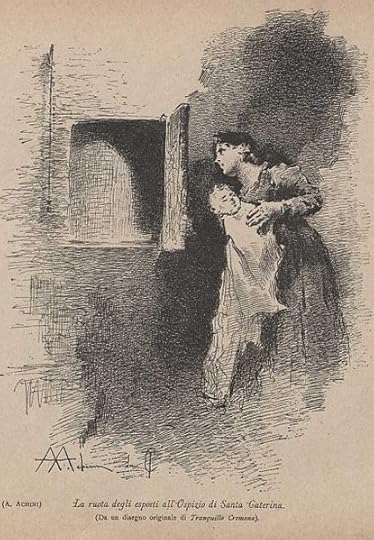
Although foundling wheels were outlawed in Italy in the early twentieth century, they have made a return there, just as baby boxes have proliferated here in recent years. Those who oppose abortion are especially prone to encouraging unexpectantly pregnant women to use these devices, though they’re not so supportive of providing these women with the resources they need to be able to parent their own children.
Antonio B. is not on my husband’s ancestral line after all, yet he is the forefather of an Italian American family that will likely never be able to learn their extended history beyond him, all because of a system that deliberately cut him off from his rightful family because of the circumstances of his birth. As a society, we don’t have to accept this type of system going forward, but will we ever have the collective fortitude to reject it once and for all?
I long for a world in which all people can truly live and let live without judgment.
Image 1: Ruota – Chiostro di San Gregorio Armeno (Napoli); photo taken 24 July 2018 by Ruthven (via Wikimedia Commons)
Image 2: Ruota degli Esposti; photo taken 28 March 2015 by Peppe Guida (via Wikimedia Commons)
Image 3: La ruota degli esposti all’Ospizio di Santa Caterina tratto da l naviglio : strenna del Pio Istituto dei Rachitici di Milano; 1886 (via Wikimedia Commons)
August 4, 2024
Preserving Your Life Story as an Adoptee
In recent years as I’ve become more proficient in doing genealogical research and documentation, I’ve thought more and more about what my own descendants will be able to unearth about my life fifty or one hundred or even two hundred years after my passing. Once we get to a certain age, most of us consider what we’ll leave to the important people in our lives, but often people overlook the value of preserving those documents that help tell their own story.
When I research an ancestor, at minimum I want to find their birth, marriage, and death records. I also look for census records, military records, school yearbooks, and any other records that can tell me about their life—things such as city directories, professional licenses, and newspaper articles. Finding a photograph of an ancestor gives me great joy. I want to build a collection of documents that together reveal the story of my ancestor’s life; the more I’m able to find, the better I feel I know them, and knowing my ancestor gives me additional insight into myself and my own life.
But how much information will my descendants be able to find about me, an adoptee from a closed adoption?
As things stand today, a genealogist searching my legal name will find that I was born to my adoptive parents. They will find that my current surname is from my husband, dig up my marriage certificate showing my legal maiden name, and trace this name back to find my previous addresses, my school yearbooks, and eventually my amended birth certificate.
Based on this information alone, there is little chance of them learning that I was ever adopted, discovering my original name at birth, or linking me to the correct family tree based on biology. If a descendant takes a DNA test without knowledge of my adoption, their results will be wildly confusing, having a mysterious mix of Scottish, French, German, and Croatian surnames.
Thankfully, my children do know the facts of my adoption and the names of their biological grandparents, but how will this information be passed along to their children, grandchildren, great-grandchildren, etc.? I fear that if I’m not proactive about documenting and preserving my own biological heritage, this information that I’ve worked so hard to trace and collect could become once again lost.
I’ve decided to digitize important documents related to my birth and adoption in order to create a file of these that can be backed up, stored on various mediums, and shared amongst my descendants. The documents I’ll save include:
Both my original and amended birth certificates, clearly labelled as suchCopies of my baptismal certificate (I currently have two, each showing different information)The non-identifying report I obtained from my adoption agency when I began to search for my birth parentsThe adoption decree from my adoptive parents’ fileThe notes I took when my search angel first told me my name at birth and found information on my birth motherCopies of the first letters I sent to my birth parents introducing myselfCopies of early correspondence with each of my birth parents in which we exchanged various facts about ourselves and our livesDNA test results (I have two kinds: paternity test results from two different men and match results from a commercial test I did to help trace genealogy)A copy of the birth card a nurse gave to my biological mother after I was bornA copy of the surrender document by which my birth mother transferred custody of me to the adoption agencyIn addition, there are some historical documents I’ll include in my virtual file:
Information on the hospital where I was born, no longer existing, which was a maternity hospital for girls and women giving birth out of wedlockInformation on the baby home (i.e., orphanage) where I lived for the first three and a half months of my life, which also no longer existsI’ll add photos to the file as well, including photos of my children visiting with relatives from all sides of my family, with everyone clearly labelled in the photos’ metadata.
All of this information is in addition to what I’ll save regarding my childhood with my adoptive parents and the significant events and experiences of my adult life. I’ll label all my physical photos so that future generations will know where and when they were taken as well as who is pictured, and I’ll organize all my physical photos, documents, and artifacts in appropriate storage containers to maximize their longevity. Yes, this will take many hours of my time, but I feel it’s time well spent.
Because I’ve been researching my biological genealogy for several years now, I have amassed a lot of information about my ancestry beyond my parents that I likewise don’t want to become lost over the next hundred years or more. I’m committed to documenting these connections in accordance with accepted genealogical standards, and I hope to one day create a book of my ancestry that can be passed down through generations and used as a basis of further research as the decades pass. I’ve already begun backing up all my digital genealogy files to both an external hard drive and to cloud storage. In addition, I deliberately post my confirmed research to my public online family trees in the hopes that it will be discovered there by future generations, or at least as long as those platforms exist.
I plan to leave instructions for my children on where to find all my documentation, including passwords to the many genealogical platforms I use. I’ll also leave instructions for specific information I want to be included in my obituary that will connect me to all of my families. And I’ll ask them to do one final thing for me: on my death certificate, I’d like the names of my biological parents listed as my father and mother—a vital signal to my future relatives that I hope will guide them to the full story of my life.
It’s a sad truth that as an adopted person, I can’t rely on extended family members to include me in their family history, and even if I am included, I can’t rely on their documentation to be fully accurate, whether because they simply don’t know all the details of my familial connections or because they may choose to exclude what doesn’t suit their perception of family. It’s up to me to do what I can to ensure that my descendants will know the truth of their own history.