Ila France Porcher's Blog
November 21, 2023
Announcing a Special Issue on Elasmobranch Behaviour!
When I discovered sharks in the turquoise Tahitian lagoons, I was fascinated by their complex and clearly intelligent responses in different situations. Based on what I saw myself, I figured they were more intelligent than dogs. But later, when I got an internet connection, I was shocked to learn that science had not noticed!
By then the community I had watched for years was being slaughtered for shark fin soup, so I wrote down the story of my beloved thoughtful sharks in my first book, The Shark Sessions.

Since then I have been trying to publish my findings scientifically, which has been a real challenge for an isolated wildlife artist. However, two years ago, an editor of the journal Behaviour was taken with my writing and invited me to organize a Special Issue on my favourite subject: Elasmobranch behaviour and cognition. It was a real learning experience for me and I was lucky that shark Ethologist Professor A. Pete Klimley offered to help. Not only did his advice serve as a valuable guide in a variety of ways, but his writings have wonderfully enhanced the issue.
Anyway, I am thrilled, today, to be able to tell you that this Special Issue has finally been published! It is organized into three main themes—Historical Articles,Behaviour, and Cognition—each contributing to a deeperunderstanding of elasmobranchs’ lives and challenging prevailingmisconceptions.
Historical ArticlesThe issue opens with a groundbreaking review by Guest Editor A.Peter Klimley et al.: a comprehensive ethogram for chimaeras, sharks,and rays. Ethograms are essential for describing animal actions intheir natural habitats and this work was done to aid researchers tocharacterize future sightings as well as to standardize terminologyfor future research. Klimley is an ethologist in the line of NikolaasTinbergen, Konrad Lorenz, and Arthur A. Myrberg Jr., his formerprofessor, who worked for several years with Lorenz in Europe.Klimley carries their legacy forward by creating an ethogram for theentire group of chondrichthyan fishes, and challenging the notion ofsharks as simple feeding machines.
Two historical studies, also by Klimley, follow. The first divesinto the social interactions of hammerhead sharks, revealing acomplex world of social competition and mating behaviours. Femalescalloped hammerheads, for instance, engage in a Cork Screw displayto establish dominance, while males use Torso Thrust to compete formating opportunities. Klimley's study on white sharks unveilsagonistic displays and ritualized behaviours, challenging traditionalstereotypes of sharks as mindless predators.

It is followed by a critical commentary by myself, which questions the validity of the study that claimed tohave found dominance-subordination hierarchies in the smooth dogfish.It thus challenges prevailing notions about shark social dynamics.
“The Mistaken Identity Hypothesis for shark bites on humansis an anthropomorphic fallacy” by Eric Emile Germain CluaPh.D., DVM, delves into the reasons behind the widely acceptedhypothesis that sharks mistake swimmers for prey items. Clua proposesa “Natural Exploration Hypothesis,” suggesting thatobserved shark behaviour, including bites on humans, is a response tothe sharks’ natural tendency to strike moving objects at thesurface, rather than a case of mistaken identity.
BehaviourThe Behaviour section is introduced by my own ethogramfor Blacktip Reef Sharks, which describes 35context-specific behaviour sequences. It not only highlights theflexibility in the behaviour of these sharks but also reveals their largeindividual differences. The behavioural repertoire offers intriguingclues as to the complexity of the sharks' cognitive functions.

The study is, however, disrupted by the arrival of the shark finindustry, which underlines the devastating impact on sharkpopulations of this largely criminal trade.
“Insight into manta ray behaviour using animal-borneCrittercams” by Nicole Pelletier et al. sheds light on thebehaviour of manta rays in their natural habitats. The study revealsthe importance of social behaviour for these filter-feedingelasmobranchs, with the reef manta ray exhibiting more pronouncedsocial interactions than the giant oceanic manta ray. The studydocuments new inter-specific interactions between these two speciesas well as courtship events.
The article “Could convulsive body shuddering of a whiteshark near a shark cage be an element of a threat display?” by Pete Klimley and Mauricio Hoyos-Padilla challenges commonstereotypes by examining the agonistic displays of a male white sharknear a shark cage. The study emphasizes that even these formidablemarine predators display ordinary animal behaviours in response toperceived threats, debunking the sensationalized portrayals inpopular media.
CognitionThe Cognition section challenges the historical dismissal ofelasmobranch mental capacities. Vera Schluessel et al.’s paper,“When the penny drops: sharks outsmart cichlids in serialreversal learning” sets the tone by testing two species—eightcichlids and seven bamboo sharks—in a reversal learning task. Theresults showcase the sharks’ capacity for learning and behaviouralflexibility, challenging the perception of elasmobranchs asinstinct-driven creatures.
“Examining individual behavioural variation in wild adultbull sharks (Carcharhinus leucas) suggests divergent personalities”by Thomas Matthieu Vignaud et al., takes an ethological approach toanalysing boldness-shyness and aggressiveness-placidity in adult bullsharks. The study not only characterizes individual sharkpersonalities but also quantifies the differences in behaviour overtime, emphasizing the variation among individuals.
The article “Long-lasting memory of a free-ranging topmarine predator, the Bull shark Carcharhinus leucas” byClémentine J. M. Séguigne et al. explores the memory capabilitiesof sharks. Given their long lifespans, sharks are expected to havegood long-term memories, and this study provides evidence supportingthis hypothesis. The sharks quickly resumed their attendance whenfeedings resumed following interruption of shark feedings due to theCOVID-19 pandemic.
The Special Issue concludes on a note of mystery with “Sharkevacuation from Mo’orea Island in 2002” by Ila FrancePorcher. The article recounts a unique event where all Blacktip Reefsharks and likely other species left their lagoon and ocean rangesfor two weeks, thus evading human view without any apparentexplanation. The mystery underscores the gaps in our understanding ofelasmobranchs' lives and behaviours.
 In summary, this Special Issue not only unveils the behaviouralcomplexity of elasmobranchs but challenges prevailing stereotypes,emphasizing the need for their conservation. The revelations in thiscollection are poised to inspire further studies and advocate forrobust measures to try to safeguard these ancient underwaterinhabitants from the current intensive ongoing exploitation.
h3 { margin-top: 0.25cm; margin-bottom: 0.21cm; background: transparent; page-break-after: avoid }h3.western { font-family: "Liberation Serif", serif; font-size: 14pt; font-weight: bold }h3.cjk { font-family: "Songti SC"; font-size: 14pt; font-weight: bold }h3.ctl { font-family: "Arial Unicode MS"; font-size: 14pt; font-weight: bold }p { line-height: 115%; margin-bottom: 0.25cm; background: transparent }em { font-style: italic }strong { font-weight: bold }a:link { color: #000080; so-language: zxx; text-decoration: underline }


November 15, 2023
Cognitive Dissonance and the Bias Against Sharks
Somethingstrange in society that is never mentioned is how the reality we faceas adults does not correspond in important ways to the one we learnedabout growing up. Since this discrepancy remains unacknowledged, eachof us discovers and must investigate its length and breadth alone.
Theirrational nature of the bias held against sharks in Western societybecame evident to me during discussions on theInternet discussion list, Shark-L from 2002 to 2008. Beingfamiliar with the behaviour of several species of wild sharks,I found that the members seemed to be talking about a differentanimal. While a large proportion of those posting on the list wereapparently in thrall to the great white shark (Carcharodoncarcharias),a variety of shark scientists and shark fishermen from many countrieswere also members; membership at that time was between 450 to 500people. The subject of shark attacks commonly generated aviddiscussion, and during the year that Discovery Channel presented itsShark Week feature, Oceanof Fear(Discovery2007) itwas energetically discussed for much of that week.
Oceanof Fear: The Worst Shark Attack Ever presentsthe story of the crew of the American war ship, the USSIndianapolis. About 900 crewmembers were left floating after the ship was torpedoed by a Japanesesubmarine on July 30, 1945, in the Philippine Sea. Thoughsurviving crew members stated during an interview that most of thesurvivors died of exhaustion, exposure, or drinking ocean water, theshow presents sharks as being man-eating monsters responsible forunimaginable horror and mayhem. The passionate discussion of the showthat followed on Shark-L reflected this stance. No one, including theshark scientists who participated in reviewing the morbid details,questioned its presentation. However, stepping back to take a widerlook, one wonders what the men were doing, bleeding in the ocean. Itwas because their ship had been bombed. And what werethey doing in the middle of the Philippine Sea? They had justdelivered vital parts for the atomic bomb that would soon be droppedon Hiroshima, arguably the most murderous act ever perpetrated byhomo sapiens.
Thecontrast between what the men in the USS Indianapolis did—massmurder—and what the sharks did—eat—was not once mentioned by amember of Shark-L. Though as the scientists in the discussion weredoubtless aware, while fighting among men is common, no incidentof sharks fighting had ever been reported.
SharkAggression
Thelack of intra-specific aggression in sharks is an attribute that hasbeen systematically mentioned by shark ethologists since Allee andDickinson (1954) placed 16 sharks in small containers and were unableto illicit conflict among them in spite of overcrowding andstarvation (Allee and Dickinson 1954). The subject was coveredin detail by shark ethologists Myrberg and Gruber (1974) in theirstudy of bonnethead sharks. When asked whether theyhad ever seen sharks fighting, Professor Arthur A. Myrberg replied:
“Duringmy many observations over about 25 years or so in the field, I’venever seen a shark acting aggressively toward another shark otherthan males pushing or biting females during what appeared asreproductive tactics. I’ve observed lemons, tigers, bonnetheads,silkies, oceanic whitetips, and blacknoses for reasonably longperiods and nurses and blacktips for very short periods of time.”
ProfessorSamuel H. Gruber wrote:
“Afteryears and years of observing sharks in competitive feeding situationsI have become impressed by how little aggression is shown by theseanimals. I often read in books when I was young that sharks can gointo a frenzy and will attack and kill one another. I find this to beexactly opposite of what occurs. What I see is that whencompetitively feeding, sharks are almost gentle and balletic. If twosharks rush at a piece of bait and one clamps on the other’s headthey will carefully unclamp, back up and move off. They do not biteor hurt one another.”
ChrisFallows, who studies the great white shark in South Africa, wrote ina personal communication (2022) that in more than thirty years he hasnever seen them fight. Neither has he seen them bite each other whilefeeding together on a whale carcass. Nor have they reacted by bitingwhen they have been lured to baits at cage diving boats and havemistakenly collided when swimming from one side of the boat to theother when they could not see each other.
Klimleyet al. (1996) described how the great white shark ritualizes conflictwhen a seal that one of them has killed comes under dispute. Eachslaps the water at an angle with its tail, and the shark who raisesthe most water, and blasts it farthest, wins the prey. Klimleyconfirmed this by taking video sequences of many such encounters.Thus he was able to accurately measure the sharks involved, and thedistances that they propelled the water (Klimley et al. 1996). Forthis ritual to be effective, each shark must understand it, and theloser must acknowledge the winner to avoid a physical battle for theseal, which would badly damage both sharks. Would human fighters beso cooperative? Personal experience with violent men suggests to thisauthor that such is unlikely.
Evenamong great white sharks, it appears that conflictual biting andfighting, so common among vertebrates of our own phylogenetic line(the osteichthyanline), is not seen. Yet, this fact remains generally unacknowledged.
HumanAggressionNotcounting animals that kill indirectly by spreading disease, homosapiens is the species most dangerous to its conspecifics. Interms of its murderous behaviour, there is no counterpart in othervertebrates. A study by the United Nations (2019) determined thatabout 437,000 people annually are homicide victims, and 90% of theperpetrators are men; their victims are often conspecific females.
Incontrast, only five people were killed by sharks in 2022(International Shark Attack File 2022).
Thoughwar kills fewer people than homicide, human history is an account ofsuccessive wars (Keeley 1996). Evidence shows that tribal warfare wason average 20 times more deadly than modern warfare, calculated aseither a percentage of total deaths from war, or as average wardeaths each year as a percentage of the population (Keeley 1996).These numbers are echoed by deaths in modern tribal societies inwhich death rates from war are between four and six times the highestdeath rates in 20th century Germany or Russia (Keeley1996). These findings suggest that war is instinctive in homosapiens, and not cultural (Lorenz 1963). The popularity of warand violence in media entertainment supports this. Further, insteadof arguing against this irrational and instinctive danger, scienceworks to serve it (e.g. see Pearce andDenkenberger 2018). Currently, not only destructive weapons are usedto kill others, but chemical and bio-weapons have been intensivelystudied for eventual use. There is evidence that the COVID 19pandemic was created in a lab (Bruttel et al. 2022); whether it wasspread intentionally to wreak havoc globally or not, is notofficially known as of this writing.
Homosapiens is one of the two species in the biosphere that kills notto eat but for fun (Ghiglieri 1999); chimpanzees share the warringinstinct (Aureli et al. 2006; de Waal and de Waal 2007). Humansexcitedly seek fights, target conspecifics with the intention tokill, and enjoy doing so (Torres 2018). They will deliberatelyinflict pain, torture, and subjugation on conspecifics. One of homosapiens’ distinctive traits is its capacity for innovation, andinnovation is used to devise new techniques and new forms of killing(Baron-Cohen 2011).
Lorenz(1963) provided a possible explanation for the extreme cruelty of ourspecies. He hypothesized that it is due to the lack of inhibitionsthat evolved to control intra-specific aggression in other socialanimals. Like sharks, animals that have evolved dangerous weaponswill also have evolved behavioural strategies to keep them frommortally injuring conspecifics (Lorenz 1963, Klimley et al 1996).But, when the animal has not evolved big teeth and jaws, a sharp,strong beak, or a powerful, clawed stroke, there has been noselection pressure to develop inhibitions against killingconspecifics. Animals of such species can kill another slowly andcruelly in situations in which the victim cannot get away. Theweapons crafted by human societies are, in almost every case, theirgreatest achievement, and homosapiens lacks theability to refrain from using them against his fellow man. Though nodog will bite another who makes the gesture of submission, gunmen donot hesitate to shoot people who are begging for mercy. And only inhuman wars is the mass killing of conspecifics perpetrated.
BobAltemeyer, formerly of the University of Manitoba, described anexperiment that he carried out with a friend at the University ofMoscow during the cold war. The two researchers found that studentsin the United States and Russia shared the same view of the opposingsuper power, each viewing the other country as having identical evilcharacteristics (Altemyer 2006). He also found, through decades ofexperimentation with human subjects, that your enemy would only haveto ask three or four people before finding someone who would bewilling to hold you down and electrocute you to death on the requestof the most minor authority (Altemyer 2006). This and other studieshave revealed the ready willingness of people in general to blindlyfollow authority.
Throughreflection, Lorenz (1963) presented the possibility that theChristian story about Jesus Christ’s admonition to “turnthe other cheek”did not mean that one should submit more to violence, but that oneshould present the other cheek so that the aggressor could notstrikeagain. He cited this admonition, along with the ritual of the ‘peacepipe’(in which a pipe is communally smoked before peace talks), aspossibly being two efforts by modern humans to control the instinctfor violence.
HumanBiasAnaspect of human cognitive behaviour is the tendency to defend beliefsagainst the facts (Kahan et al. 2017). This pattern is seen inscientists as well as the general public (Kahan et al. 2017), and islikely behind much of the divisiveness among many of the religiousdogmas, as well as between religion and science. Beliefs are held andany facts that contradict them are explained away—they don’tmatter. For example, many people today continue to believe that theearth is flat in spite of photographic and other evidence that it isa globe. Similarly, others believe that the earth is just 10,000years old, dismissing the fossil record and the biological evidenceof evolution. Both these beliefs spring from ancient texts—theKoran and the Bible.
Anotherrobust finding in social psychology is that there is a deep humantendency to regard those in aperceived ‘out-group’ as being inferior to the ‘home group’based on arbitrary criteria, including beliefs (Hamilton 1964, Byrne1969). This tendency has also been identified as being instinctive(Lorenz 1963); it presents as an aspectof the territorial instinct. The classification of ‘others,’ inwhich one group looks down on or fears another, results in prejudicesand stereotypes, which throughout history has regularly led tocruelty, violence, war, slavery, and genocide. This tendency has alsobeen found to be an aspect of the human attitude to animals(Plous 2003, Bastain et al. 2011, Hodson and Costello 2012). Humansconsider themselves exceptional so that any and all human projectsare good, no matter how destructive they may be to other species.Recreational shark fishing and the shark fin trade are good examples(Shiffman and Hammerschlagg 2014, Gehan 2019, Porcher and Darvell,2022).
Acommonly used excuse for treating animals cruelly is to claim thatthough the animals act as if they are in pain, that does not meanthat they really are (Rose 2002), which is the common argument usedby fishermen to defend their ‘sporting’ practices. Though thisargument requires that the alleged automaton imitate consciousness oncue, the “facts don’t matter tendency” has allowed fishermen tocontinue to argue that fish don’t feel pain in spite of a vast andrapidly accumulating store of scientific findings that they do(Sneddon et al. 2018). Indeed, some shark scientists continue topromote the shark fin trade as if elasmobranchs lack intrinsicecological value (e.g. Shiffman and Hueter 2018), and claim thatsharks should be treated as a commercial resource rather than aswildlife with the right to protection (Shiffman et al. 2021). Manyscientific papers associated with fisheries refer to elasmobranchs(as well as teleosts) in anthropocentric terms.
Thereis also the phenomenon of psychological projection, in whichin-groups project their own qualities on out-groups(Newmanet al. 1997, Robbins and Krueger 2005). A similar phenomenon isanthropomorphism in which the perceived traits of other life formsare considered in terms of the knowledge of the way conspecificsbehave. Given their dentition, if sharks behaved as aggressively ashumans, human swimmers would indeed be in danger. This type of humantendency may help explain why such a violent species might be indenial of the peaceful nature of another species, especially one thatthey already want to kill.
Sharkshave been used to portray the monsters of the human imagination eversince the blockbuster movie JAWS launched hate killings of sharks allalong American coasts (Drumm 1996). The initiative was taken up byDiscovery with Shark Week which claims to be portrayingnon-fiction—JAWS, on the other hand, was fictional. Shark Week hastraditionally highlighted and showcased shark attacks, and refers tothe animals with terms such as “man-eatingmonsters”—thedemons of the human imagination. These and othersuch productions have exerted enormous influence on publicattitudes to sharks (Muter 2013; Neff 2015; Le Busque &Litchfield 2021, Pellot 2023) and continue to do so.During a meeting with Shark Week’s producers, Paul Gasek, JeffHasler, and others, in 2010, my colleagues were told: “People watchbecause sharks are scary and dangerous.” Shark Week’s producerscalled this sharkpornography,and since a scary and dangerous Shark Week had made a fortuneamounting to billions of American dollars for the Network, the trendcontinued. At the same time, conservation was considered to beunpopular, so it was scarcely mentioned (pers. comm Gasek and Hasler2010). As a result, many members of the generation who grew upwatching Shark Week will tell you that they are afraid to even put a foot in the sea, orany deep water including mountain lakes. The fact that divers swimwith sharks each day in many places around the planet, and are almostnever bitten, is ignored. In contrast, there are about 4.5 milliondog bites yearly (World Animal Foundation 2021), with 30,000fatalities (Statista 2022) yet society holds a positive attitude todogs.
Thisphenomenon has launched a barrier to shark conservation that haslikely delayed effective action being taken to protect them and now,elasmobranchs are in worse shape than any other vertebrate line(Porcher and Darvell 2022).
ConclusionsDue to the long evolutionary history of sharks and their relatives, (Coates et al. 2018, Andreev et al. 2020, Kriwetand Benton 2004, Kriwet et al. 2009 their influenceis felt throughout the intricate aquatic ecosystemsaround the planet. The wayhumanity has specifically targeted them and swept them from the seasis not something that could have happened naturally and theecological results of doing so are unknown. Sharks, rays, andchimaeras were once common and are estimated now to be less than 6%of their former numbers at most. They no longer fulfil their formerecological roles, which is a recognized pre-cursor of extinction (foran in-depths analysis see Porcher and Darvell 2022).Giventhat very little is known about elasmobranchs, it iscounter-intuitive that shark scientists would find their massslaughter in all oceans to be acceptable, and the situation presentsas an example of the way modern civilization devalues life. But givencurrent knowledge of the size and nature of the universe, themysteries concerning the presence of life and of consciousness, andthe failure to locate any other lifeforms within hundreds ofthousands of light years around us, there is every reason to considerlife to be precious, andthat its appearance on our planet in this solar system is remarkable.The claim of human exceptionalism, made to excuse any and all humanprojects, no matter how destructive,doesnot stand, because it ignores the fact that humans are only onespecies among the trillions that have evolved in harmony to supportlife, in a vast network covering the planet.
Thereis evidence that the acknowledgement of how little humans know aboutthe lives and subjective states of other life forms can result inthem questioning the basis of their speciesism and treating otherlife forms with more wisdom (Voelkel et al. 2018). Humans pridethemselves as acting through reasoning, and the only reasonableresponse to reality is to consider and try to understand it. Indeed,we may be the only animal that has evolved enough intelligence tounderstand the difference between reasoned thought and instinct. Onlythrough putting that knowledge to good use across the scale of humanactions, will we begin to solve the problems facing humanity as ofthis writing.
ReferencesAllee,D.G. and Dickenson, J.C. (1954) Dominance and subordination in thesmooth dogfish, Mustelus canis (Mitchell). Physiol. Zool., 27:356–364.
Altemeyer,B. (2006) TheAuthoritarians Winnipeg:University of Manitoba. Canada.
Andreev,P.S.,Zhao,W.,Wang,N.Z.,Smith,M.M.,Li,Q.,Cui,X.,Zhu,M.,Sansom,I.J.(2020) EarlySilurianchondrichthyansfromtheTarimBasin(Xinjiang,China).PLoSONE.,15,e0228589.https://doi.org/10.1371/journal.pone.....
Aureli,F., Scaffner, C.M., Verpooten, J., Slater, K., & Ramos‐Fernandez,G. (2006) Raiding parties of male spider monkeys: Insights into humanwarfare? American Journal of Physical Anthropology, 131 (4), 486-497
Baron-Cohen,S. (2011) Zero degrees of empathy: A new theory of human cruelty(vol. 30). UK:
Penguin
Bastain,B., Costello, K., Loughnan, S., & Hodson, G. (2011). When closingthe human-animal divide expands moral concern: The importance offraming. Social Psychological and Personality Science, 1(9): 1-9.
Bruttel,V., Washburne, A., VanDongen, A. (2022) Endonuclease fingerprintindicates a synthetic origin of SARS-CoV-2 bioRxiv2022.10.18.512756; doi: https://doi.org/10.1101/2022.10.18.51...
Byrne,D. (1969). Attitudes and attraction. Advances in Experimental SocialPsychology, 4, 35–89.
Coates,M.I.; Finarelli, J.A.; Sansom, I.J.; Andreev, P.S.; Criswell, K.E.;Tietjen, K.; Rivers, M.L.; La Riviere, P.J. An early chondrichthyanand the evolutionary assembly of a shark body plan. Proc. R. Soc. B.2018,285, 20172418. https://doi.org/10.1098/rspb.2017.2418.
DeWaal, F., & Waal, F.B. (2007) Chimpanzee politics: Power andsex among apes. JHU Press
DiscoveryChannel (2007) Ocean of fear: The Worst Shark Attack Ever.SharkWeek 2007-07-18.https://www.discovery.com/shows/ocean-of-fear-worst-shark-attack-everAccessed on February 7 2023.
Drumm,R.In the Slick of the Cricket;BookSurge:Charleston, SC,USA,1996.
Fallows,C., Gallagher, A.J., Hammerschlag, N. (2013) White Sharks(Carcharodoncarcharias)Scavenging on Whales and Its Potential Role in Further Shaping theEcology of an Apex Predator. PLOS ONE 8(4): e60797.https://doi.org/10.1371/journal.pone.0060797
Gehan,S.M. (2019) Testimony of the Sustainable Shark Alliance Before theHouse Subcommittee on Water, Oceans, and Wildlife. 26 March 2019.Available online:naturalresources.house.gov/imo/media/...%
Ghiglieri,M.P. (1999) The dark side of man: Tracing the origins of maleviolence. New York: Perseus Publishing.
Hamilton,W. D. (1964). The genetical evolution of social behavior, I and II.Journal of Theoretical Biology, 7, 1–52.
Hodson,G., & Costello, K. (2012). The human cost of devaluing animals.New Scientist, 2895, 34-35.
Kahan,D., Peters, E., Dawson, E., & Slovic, P. (2017). Motivatednumeracy and enlightened self-government. Behavioural PublicPolicy, 1(1), 54-86. doi:10.1017/bpp.2016.2
KeeleyL.H. (1996) War Before Civilization: The Myth of the PeacefulSavage Oxford University Press,1996.
KlimleyA. P. &AinleyD.G. (1996) GreatWhite Sharks: The Biology of Carcharodon carcharias.Nature 517 pages.
Klimley,A.P., Pyle, P., &AndersonS.D. (1996) Tail slap and breach: Agonistic displays among whitesharks? In: Klimley AP, Ainley DG, editors. Great White Shark: TheBiology of Carcharodon carcharias. San Diego, CA: Academic Press, p241-55.
KriwetJ, Benton MJ (2004) Neoselachian (chondrichthyes, Elasmobranchii)diversity across the cretaceous-tertiary boundary. Palaeogeogr.Palaeoclimatol. Palaeoecol. 214:181–194
KriwetJ, Kiessling W, Klug S (2009) Diversification trajectories andevolutionary life-history traits in early sharks and batoids. Proc.R. Soc. B 276 945–951
Lorenz,K. (1963) Das Sogenannte Böse, Zur Naturgeschichte der Aggression byVerlag Dr Borotha-Schoeler, Vienna, Austria.
Newman,Leonard S.; Duff, Kimberley J.; Baumeister, Roy F. (1997). “A newlook at defensive projection: Thought suppression, accessibility, andbiased person perception.” Journal of Personality and SocialPsychology. 72(5): 980–1001. doi:10.1037/0022-3514.72.5.980.PMID 9150580.
Pearce,J.M., Denkenberger, D.C. (2018) A National Pragmatic Safety Limit forNuclear Weapon Quantities. Safety2018,4,25. https://doi.org/10.3390/safety4020025
PellotE. (2023) Tiger shark lurks extremely close to oblivious swimmer inshocking drone footage: 'Most of us have had encounters and had noidea' Available online:
Plous,S. (2003). Is there such a thing as prejudice toward animals? In S.Plous (Ed.),
Understanding Prejudice and Discrimination (pp.509-528). New York: McGraw-Hill.
Porcher,I.F.; Darvell, B.W. Shark Fishing vs.Conservation: Analysis and Synthesis. Sustainability2022,14,9548. https://doi.org/10.3390/su14159548
Robbins,J.M. and Krueger, J.I. (2005). Social Projection to Ingroups andOutgroups: A Review and Meta-Analysis. Personality and SocialPsychology Review. 9 (1): 32–47. doi:10.1207/s15327957pspr0901_3.ISSN1088-8683. PMID 15745863. S2CID 10229838.
Rose,J. D. (2002) The Neurobehavioral Nature of Fishes and the question ofAwareness and Pain. Fisheries Science Taylor & Francis 1064-1262doi: 10.1080/200264910516689
SharkAttack File (2022) Yearly Worldwide Shark Attack Summary. FloridaMuseum. Available online:https://www.floridamuseum.ufl.edu/shark-attacks/yearly-worldwide-summary
Shiffman,D.S. and Hammerschlag, N. (2014) An Assessment of the Scale,Practices, and Conservation Implications of Florida’s CharterBoat–Based Recreational Shark Fishery. Fisheries, 39: 395-407.doi.org/10.1080/03632415.2014.941439
Shiffman,D.S.andHueter,R.E.(2017)AUnitedStatessharkfinbanwouldunderminesustainablesharkfisheries.Mar. Pol.85, 138–140.
Shiffman,D.S., Macdonald, C.C., Wallace, S.S., Dulvy, N.K. (2021) The role andvalue of science in shark conservation advocacy. Sci. Rep. 2021, 11,16626. doi.org/10.1038/s41598-021-96020-4
Sneddon,L.U.; Lopez-Luna, J.; Wolfenden, C.C., Leach, M. C., Valentim, A.M.,Steenbergen, P. J., Bardine, N., Currie, A.D.; Broom, D.M., andBrown, C. (2018) Fishsentience denial: Muddying the waters. AnimalSentience21(1)
Statista(2022) Deadliest animals worldwide by annual number of human deathsas of 2022. Available online:www.statista.com/statistics/448169/deadliest-creatures-in-the-world-by-number-of-human-deathsAccessed 11 February 2023
Torres,P. (2018) Who would destroy the world? Omnicidal agents and relatedphenomena.
Aggression and Violent Behavior, 39, 129-138
UnitedNations Office on Drugs and Crime (2019) Global Study on Homicide.Available online: https://www.unodc.org/unodc/en/data-and-analysis/global-study-on-homicide.htmlAccessed on 7 February 2023.
Voelkel,J.G., Brandt, M.J. & Colombo, M. (2018) I know that I knownothing: Can puncturing the illusion of explanatory depth overcomethe relationship between attitudinal dissimilarity and prejudice?Comprehensive Results in Social Psychology, 3:1, 56-78, DOI:10.1080/23743603.2018.1464881
Wikipedia(2007) Ocean of Fear. en.wikipedia.org/wiki/Ocean_of_Fear#cite_note-3Accessed on 7 February 2023.
WorldAnimal Foundation (2021) Dog Bite Statistics You Need To Know in2023! Available online:https://worldanimalfoundation.org/advocate/dog-bite-statisticsAccessed on 11 February 2023.
h2 { color: #000000; line-height: 200%; orphans: 2; widows: 2; margin-top: 0.35cm; margin-bottom: 0.21cm; direction: ltr; background: transparent; page-break-after: avoid }h2.western { font-family: "Times", "Times New Roman", serif; font-size: 12pt; so-language: en-GB; font-weight: bold }h2.cjk { font-family: "PingFang SC"; font-size: 12pt; so-language: zh-CN; font-weight: bold }h2.ctl { font-family: "Times", "Times New Roman", serif; font-size: 16pt; so-language: hi-IN; font-weight: bold }p { color: #000000; line-height: 200%; text-align: justify; orphans: 0; widows: 0; margin-bottom: 0.25cm; direction: ltr; background: transparent }p.western { font-family: "Times", "Times New Roman", serif; font-size: 11pt; so-language: en-GB }p.cjk { font-family: "Songti SC"; font-size: 11pt; so-language: zh-CN }p.ctl { font-family: "Times", "Times New Roman", serif; font-size: 12pt; so-language: hi-IN }strong { font-weight: bold }em { font-style: italic }a:visited { color: #800000; so-language: zxx; text-decoration: underline }cite { font-style: italic }a:link { color: #000080; so-language: zxx; text-decoration: underline }
August 6, 2022
Shark Fishing vs Conservation: Analysis and Synthesis

The review of the status of sharks that I wrote with Professor Brian W. Darvell, Shark Fishing vs. Conservation: Analysis and Synthesis has been published Open Access in the journal Sustainability.
With traditional fish stocks 90% overfished, sharks (along with tuna) have become the most lucrative prey for fisheries due to the value of their fins. So, with fishing scarcely profitable any more, fishing fleets around the world have joined in the hunt for them. The meat is pushed onto consumers using other names, so it is largely the shark fin trade that drives the so-called market for shark meat.
As a result, those species of sharks and rays accessible to fishing fleets are approaching extinction.
Further, the removal of these top and middle predators has resulted in drastic, long-term changes in oceanic and coastal ecosystems—a complete rebalancing. Yet most ecosystem changes remain unknown and are not taken into account by Regional Fisheries Management Organizations.
The shark fin trade is driven by high prices and rich customers who have little interest in either sustainability or legality. This rising demand, contrasted against the catastrophic loss of the large animals supplying it, makes it evident that shark fishing is not sustainable. What has been going on in the North Atlantic Ocean, in the heart of the 'civilized' western world, is analysed in detail to make this clear.
However, due to the uncertainties involved in assessing how many sharks are being fished and how many remain, it is easy for shark hunting nations, and shark fishing industry spokesmen, to argue against sharks and rays receiving effective protection.
Fisheries take a territorial attitude to marine resources and consider themselves to have the right to continue to take them, irregardless of the disastrous losses they have already suffered and the profits that fisheries have already realised.
We show that the sustainable shark fishing lobby is defending sustainable shark fishing, not against unsustainable shark fishing, but against effective protection for sharks. Pro-sustainable shark fishing 'scientists' recommend sustainable shark fishing but do not state when the use of the "resource" would become unsustainable. Since it is virtually impossible to assess the true losses sharks have suffered, their arguments are easy to make for they cannot be disproven. But it is estimated that shark mortality is at least four times what is recorded by fisheries' organizations, and may be much greater than that, given the secretive nature of the shark fin trade, as well as prolific illegal, unreported, and unregulated fishing.
The point that fishermen are in the same position as any other predator that is eliminating its prey, is made. The human species is overpopulated and we have known for decades that the moment would come when no wild prey could sustain us.
The domination by industry must end if the planet’s aquatic ecosystems are to be saved from ecological collapse, specifically as a result of fishing. If history has taught us anything, no wild animal can withstand targeted industrial-scale hunting long term—not whales, not sea turtles, not fish, and certainly not sharks.
ConclusionsIn conclusion the paper recommends that all sharks, manta rays, devil rays, rhino rays, and chimaeras be protected from international trade through a CITES Appendix I listing. This would keep markets for sharks local, thus favouring small scale fishing. It would also simplify customs' work at border crossings by removing the problem of identifying all the different look-alike species.
Fishing effort must be drastically diminished to permit the damaged ecosystems of oceans, coral reefs, lagoons, mangroves, estuaries, rivers, lakes, and coastlines to recover.
Fishing subsidies must end. The money should be used instead to help fishermen switch to other occupations, including planting food crops.
Thirty percent of the oceans should be set aside as Marine Protected Areas in which there would be no fishing.
There must be a change in fishing methods away from today's unselective gear--including trawling, purse-seining, gill-netting, and long-lining--to methods that avoid by-catch including sharks, completely.
A change in attitude concerning eating wild fish as protein is needed, so that people pay a reasonable price for such high-quality food and fishers will be able to make enough money from their sustainable catches to live on.
The pervasive problem of illegal, unreported, and unregulated fishing should be addressed globally, through all means available.
Regional Fishing Management Organizations should be required to respect human rights, and to address slavery, as well as unsafe and inhumane working conditions. At their own expense, they should be required to keep track of stocks through stock assessments by species and geographic region, update them regularly, and mandate catch limits. Landings should be monitored, and species-specific records kept.
But what is needed most is a binding international treaty to protect biodiversity in general.
January 17, 2022
Debunking Shiffman's Latest: "The role and value of science in shark conservation advocacy”
Although written in an authoritative style, Shiffman et al .’s paper “ The role and value of science in shark conservation advocacy ” (2021) contains a number of lethal flaws which invalidate it. In particular, it claims that the survey on which it is based shows that conservationists favour bans over sustainable shark fishing more than scientists. But in fact, the survey of scientists cited (Shiffman & Hammerschlag 2016 b) showed that 63% of scientis ts favour bans while this paper states that only 41% of conservationists do. This mismatch between the findings of the two sur v eys and the claims of these authors invalidates much of what they state. The ir survey also establishes that conservationists do in fact base their published information on scientific papers, rather than public belief or moral considerations, so the authors’ conclusion is seriously in error .
Leaving aside for the moment the reason why alleged “shark scientists” would spend the time it took to write this attack on people who value biodiversity and are concerned about the current status of sharks, this paper is based on a mickey mouse questionnaire which fails to take into account the nuances in a complex subject, and telescopes it into two political positions. It would have been tossed in the bin if submitted in any philosophy class in a learning institute. That it could have been published at all strongly supports our conviction that 'sustainable shark fishing' is not being defended against unsustainable shark fishing, but against effective shark protection from the forces that are driving them to extinction.
The authors focus only on the conservationists’ attitude to the subjects of the two bills now being considered as future legislation in the USA, revealing an essentially political stance.The Sustainable Shark Fisheries and Trade Act of 2018is the shark fishing industry’s supposed solution to shark depletion (Gehan 2016), while The Shark Fin Sales Elimination Act of 2017, which would effectively remove the USA from the shark fin trade, is the choice of those who want effective protection for sharks. The article’s slanted presentation suggests, therefore, that it is political in nature, and written to grant scientific credibility to the erroneous idea that the shark fin trade is sustainable (see their Fig. 5). Indeed, Shiffman’s rhetorical arguments tend to echo, often almost word for word, those of the shark fishing industry spokesmen from the Sustainable Shark Alliance (Shiffman & Hueter 2017, Gehan 2016).
The only evidence offered to establish the existence of sustainable commercial shark fisheries is Simpfendorfer and Dulvy’s 2017 paper “Bright spots of sustainable shark fishing,” a work that was already in error two years after it was published. It claimed, for example, that the mako shark fisheries in the North and South Atlantic serving the shark fin trade could be sustainable with management. But at the same time, scientists from the International Commission for the Conservation of Atlantic Tunas (ICCAT) found that the status of the mako shark was so dire that even if all fishing was stopped immediately, its numbers would continue to decline for the next fifteen years. With a population collapse imminent, there was a probability of only about 50% that the stock would be rebuilt by 2045, and the probability that it would be rebuilt would not exceed 70% until 2070, 50 years from now (ICCAT 2019).
Commercial fishing of the blue shark was also promoted by Simpfendorfer and Dulvy as being potentially sustainable in spite of a paucity of data. They used MSY to make their claim, but MSY is based on actual landings so it is completelyinapplicable to a species which is mostly discarded (Campana 2016). The blue shark is alsoconsidered to be overfished in the North Atlantic (ICCAT 2020).
The sharks in the North Atlantic are managed by ICCAT, which represents 48 contracting nations and groups, including the European Union. Member nations provide data of highly variable quality for their fisheries, and there are several major fishing nations working the North Atlantic that provide no shark catch data to anyone, and are not party to ICCAT. It is estimated that only a quarter of the sharks killed there are reported, and that illegal finning is rampant (Campana 2016). No scientific paper brings any evidence as to how shark fishing could be managed sustainably under such circumstances. Indeed, i t has been scientifically established that it is impossible to manage the commons ( Agrawal 2001 ) , especially the high seas. These authors should be aware of that.
The North Atlantic, right in the heart of the “civilized” world, should be the very epitome of excellent fishing management and sustainable shark fishing. The truth clearly is far from that, and the situation is even worse in the Pacific and Indian oceans. Yet Shiffman et al. write:
“Results show that in general, the environmental advocates who most strongly supported bans on fisheries and trade were the least familiar with the current state of scientific knowledge on sustainable shark fisheries.”
On the contrary, it appears to be Shiffman et al.who are out of touch with the current state of scientific knowledge on sustainable shark fisheries. They also cite Walker (1998) as evidence of their existence, but hispaper actually questions whether sustainability in commercial shark fishing can be realized and focuses on the difficulties of accomplishing it. Further, it was written before the shocking results of the shark fin trade became evident so is completely irrelevant here. The only other paper which the authors cite as evidence that sustainable shark fisheries exist is Shiffman’s own paper (Shiffman & Hueter 2017), which claimed that they exist all over the world, but provided no evidence that they actually do. It was indeed thoroughly rebutted (Porcher et al. 2019).
Contrary to what the authors state, there is much evidence which throws into question the idea that long-term sustainable commercial shark fisheries are possible, particularly in the face of the secretive and largely criminal shark fin trade (Porcher & Darvell 2021 submitted). Traditionally, the shark and skate fisheries that have been managed sustainably were those few, mostly in the USA and Australia, that took the animals for meat (Dent & Clarke 2015). But this present paper fails to differentiate between those and the current hunt to supply the shark fin trade, which now involves industrial fisheries from nations around the globe.
That is all the scientific evidence that theseauthors can find to support their statement,made about four times throughout the paper, that there is no scientific doubt that sustainable shark fisheries exist.However, there are plenty of papers that document the loss of sharks as a result of seven decades of industrial fishing, and with the added scourge of the shark fin trade, increasing numbers are listed by IUCN as being threatened with extinction. This makes it clear that whoever is saying that sharks are being sustainably fished is claiming that black is white. That this claim can seriously be made and published indicates a monumental level ofcognitive dissonance not only in shark fisheries, but in ‘shark science.’
This paper’s theme of promoting shark fishing while belittling conservationists is a common one in Shiffman’s writings (Shiffman & Hammerschlag 2014, 2016 a, b). The claim that the public is concerned about sharks because they “can be ecologically important” implies that sharks may or may not be of much ecological importance, and minimizes an important concern with regards to the current and ongoing extent of shark depletion.
All relevant ecological studies have found that, as top and middle predators, sharks are among the most strongly interacting animals in the food chain, with the result that the extreme disruption wrought by more than seven decades of industrial shark removal has caused major, cascading biodiversity shifts throughout the originally complex and diverse aquatic ecosystems which evolved during the previous 500 million years (e.g. Okey et al. 2004; Ward & Myers 2005; Myers et al.2007; Heithaus et al.2007, 2008; Ferretti et al. 2010).
There is also the claim that the public is concerned about sharks because they “are a popular encounter for scuba divers and other marine tourists.” Terming divers “marine tourists” disparages a major force behind shark conservation efforts. A large proportion of divers dive locally and regularly, knowing their area well. They have personally witnessed the disappearance of sharks from the oceans and coasts the way the buffalo vanished from the plains of North America during the 1800s. Therefore, they have always been at the forefront of shark conservation efforts. This statement wholly misrepresents the reasons why so many members of the public are concerned about sharks.
The results of the survey on which this paper is based show that two thirds of NGO employees read scientific papers regularly and more than half have published scientific papers. This was found even though the authors deliberately excluded scientific researchers working in conservation from the survey, which is an altogether startling bias. The data show that NGOs use scientific and not moral reasons for their arguments for shark protection, so the conclusion should have been that NGO employees working on shark conservation are, with few exceptions, scientifically informed, rather than the contrary.
To anyone who is aware of the actual state of shark depletion, it is extremely worrying to see this sort of pseudo-philosophical, pro-shark fishing propaganda neglecting biological facts, yet being published as if it were science.
References
Agrawal A (2001) Common Property Institutions and Sustainable Governance of
Resources. World Development 10(29): 1649-1672.
Campana S. E. (2016) Transboundary movements, unmonitored fishing mortality, and ineffective international fisheries management pose risks for pelagic sharks in the Northwest Atlantic. Can. J. Fish. Aquat. Sci. 73:1599–1607.
Dent F, Clarke SC (2015) State of the Global Market for Shark Products. United Nations Food and Agriculture Organization Fisheries and Aquaculture. (Technical Paper 590)
Ferretti F, Worm B, Britten GL, Heithaus MR, Lotze HK (2010) Patterns and ecosystem consequences of shark declines in the ocean. Ecology Letters. 13(8):1055–1071 doi.org/0.1111/j.1461-0248.2010.01489.x
Gehan, S. M. (2019) Testimony of the Sustainable Shark Alliance Before the House Subcommittee on Water, Oceans, and Wildlife March 26, 2019 naturalresources.house.gov/imo/media/... Accessed 14 April 2020
Heithaus MR, Frid A, Wirsing AJ, Dill LM, Fourqurean JW, Burkholder D, Thomson J, Bejder, L (2007) State-dependent risk-taking by green sea turtles mediates top-down effects of tiger shark intimidation in a marine ecosystem. Journal of Animal Ecology 6:837-844 doi.org/10.1111/j.1365-2656.2007.01260.x
Heithaus MR, Frid A, Wirsing AJ, Worm B (2008) Predicting ecological consequences of marine top predator declines. Trends in Ecology & Evolution. 23(4):202-210.
ICCAT (2019) International Commission for the Conservation of Atlantic Tunas Report of the Standing Committee on Research and Statistics (SCRS) Madrid, Spain, 30 September to 4 October 2019 www.iccat.int/Documents/Meetings/Docs... Accessed 22 April 2020
ICCAT SCRS (2020) Advice to the Commission, English version Madrid, Spain 2020 https://www.iccat.int/Documents/SCRS/SCRS_2020_Advice_ENG.pdfAccessed 18 September 2021
Myers RA, Baum JK, Shepherd TD, Powers SP, Peterson CH (2007) Cascading Effects of the Loss of Apex Predatory Sharks from a Coastal Ocean Science. 423(6937):280-3 doi.org/10.1126/science.1138657
Okey TA, Banks S, Born AF, Bustamante RH, Calvopiña M, Edgar GJ, Espinoza E José MiguelFariña J, Garske LE, Reck GK Salazar S, Shepherd S, Toral-Granda V, Wallem P (2004) A trophic model of a Galápagos subtidal rocky reef for evaluating fisheries and conservation strategies. Ecol. Model.172:383–401
Porcher I. F., Darvell B. W., Cuny G (2019) Response to “A United States shark fin ban would undermine sustainable shark fisheries” D.S. Shiffman & R.E. Hueter, Marine Policy 85 (2017) 138-140. Marine Policy. 104:85-89 doi.org/10.1016/j.marpol.2019.02.058
Porcher, I. F. & Darvell B. W. (2021) Shark Conservation – Analysis and Synthesis. Preprints2021, 2021020145 doi: 10.20944/preprints202102.0145.v3
Simpfendorfer, C. A. & Dulvy, N. K. Bright spots of sustainable shark fishing. Curr. Biol.27(3), R97–R98 (2017).
Shiffman D. S. & Hammerschlag N. (2014) An Assessment of the Scale, Practices, and Conservation Implications of Florida's Charter Boat–Based Recreational Shark Fishery, Fisheries, 39:9, 395-407, DOI: 10.1080/03632415.2014.941439
Shiffman, D. S. & Hammerschlag, N. Shark conservation and management policy: A review and primer for non-specialists. Anim. Conserv.19(5), 401–412 (2016).
Shiffman, D. S. & Hammerschlag, N. Preferred conservation policies of shark researchers. Conserv. Biol.30(4), 805–815 (2016).
Shiffman D. S., Hueter R.E. (2017) A United States shark fin ban would undermine sustainable shark fisheries. Mar. Pol. 85:138–140.
Shiffman D. S., Macdonald C. C., Wallace S. S., & Dulvy N. K. The role and value of science in shark conservation advocacy 1Vol.:(0123456789)Scientific Reports | (2021) 11:16626 | https://doi.org/10.1038/s41598-021-96020-4www.nature.com/scientificreports
Ward P, Myers RA (2005) Shifts in open-ocean fish communities coinciding with the commencement of commercial fishing. Ecology 86:835–847.
p { color: #000000; line-height: 115%; text-align: justify; orphans: 2; widows: 2; margin-bottom: 0.25cm; direction: ltr; background: transparent }p.western { font-family: "Times New Roman", serif; font-size: 12pt; so-language: en-GB }p.cjk { font-family: "WenQuanYi Micro Hei"; font-size: 12pt; so-language: zh-CN }p.ctl { font-family: "FreeSerif", "Times New Roman", serif; font-size: 12pt; so-language: hi-IN }em { font-style: italic }a:link { color: #000080; text-decoration: underline }a.western:link { so-language: zxx }a.ctl:link { so-language: zxx }p { color: #000000; line-height: 115%; text-align: justify; orphans: 2; widows: 2; margin-bottom: 0.25cm; direction: ltr; background: transparent }p.western { font-family: "FreeSerif", "Times New Roman", serif; font-size: 12pt; so-language: en-GB }p.cjk { font-family: "WenQuanYi Micro Hei"; font-size: 12pt; so-language: zh-CN }p.ctl { font-family: "FreeSerif", "Times New Roman", serif; font-size: 12pt; so-language: hi-IN }em { font-style: italic }a:link { color: #000080; text-decoration: underline }a.western:link { so-language: zxx }a.ctl:link { so-language: zxx }
March 12, 2021
Randall Arauz on CITES Loopholes

It is well known that in spite of all of the work concerned people are investing, decade after decade, in an effort to save sharks from extinction, they are being depleted faster and faster, with fisheries around the world in a frenzy to profit from the value of their fins.
Randall Arauz has more experience in fighting for sharks than anyone I know, so I asked him why CITES listings have not been working. Because getting sharks listed on CITES is the only way of protecting sharks that we currently have.
This is what he told me:
“There is a reason why Appendix II listings DO NOT WORK. CITES is a Wildlife Conservation Convention, and as such, its domestic implementation is held by the Ministries of Environment, which have Wildlife and Biodiversity Conservation Laws for the implementation of such conventions. This is true for the Convention on the Conservation of Migratory Species of Wild Animals (CMS) and the Convention on Biological Diversity (CBD).
“However, at least in the case of CITES, in order to get as many countries as possible to sign, they have to leave little “escape hatches”, so that countries that do not want to abide by the agreements can get away. One such “escape hatch” for instance, is the possibility of doing a second plenary vote on the last day of the meeting, when many delegates have left. Or countries can file for “exceptions” if they do so during a certain time-frame after the agreement was reached, I think it’s three months.
“The biggest loophole of them all, is the allowance by the Convention for a country to have two different CITES administrative and scientific authorities. So, what countries all over the world have been doing, is that once CITES implementation time comes, is claim that sharks are not wildlife but species of fisheries interest, and they promulgate that CITES authority for endangered species of sharks is the Ministry of Agriculture, or Ministry of Production, of Fisheries Department, for the implementation of Fisheries legislation and agreements with Regional Fisheries Management Organizations and CITES alike. Its a major water down.
“For CITES to work, we need endangered species of sharks to be acknowledged as wildlife, and countries must use their domestic wildlife conservation laws to protect them. Allowing fisheries, production, and agriculture ministries to dictate conservation policy for endangered shark species is condemning them to extinction.
“Colombia just a few days ago removed shark and ray species from the commercial species list.
“Next March 17 I have the final hearing of a trial in a case we filed against the Ministry of Environment and Ministry of Agriculture for promulgating that sharks aren’t wildlife in 2017, and which stripped the Ministry of Environment of any authority over endangered shark species. We want the authority returned to the Ministry of Environment, and we want the full implementation of the Wildlife Conservation Law.
We have important jurisprudence on our side in this case. In 1999, I filed a suit against the Costa Rican Fisheries Institute for allowing the catch and slaughtering of 1800 green turtles per year from July to September for human consumption along our Caribbean coast. INCOPESCA’s defence was that green turtles were commercial species that had been consumed along the Caribbean coast for hundreds of years, and that it was better to regulate this activity which otherwise would be held illegally. The Constitutional Court ruled in our favor, saying that the commercialization of an endangered species is a violation of the Precautionary Principle and thus of the Constitution itself, and the wildlife and biodiversity conservation conventions that the country has signed and ratified.”
----------------------------------------------------------------------------------------------------------------------------------------
Thank you, Randall, for revealing how things really work out when we think we are getting sharks protected. It is appalling to realize that human beings will actually do such things, knowing that they are sending large animals towards extinction.
What is the world coming to?
And what is really ironic, is that we call sharks monsters.
p { margin-bottom: 0.25cm; line-height: 115%; }
September 23, 2020
Misinformation Spread by the Shark Fishing Industry
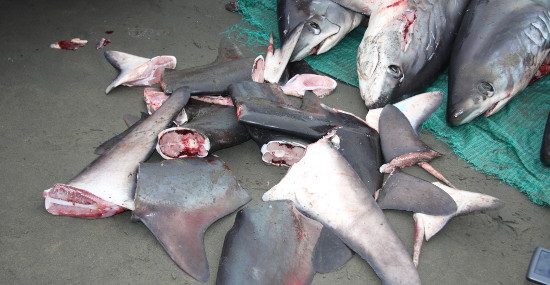
Misinformation is being spread around by the shark fishing industry in an effort to take the focus off the dangers of the shark fin trade and see that The Shark Fin Trade Elimination Act is not passed. This Act would make the fin trade illegal in the USA, and conservationists consider it to be an important step towards weakening the lethal trade and working towards lessening shark mortality worldwide.
But the shark fishingindustry intends to continue to sell its fins, and is promoting The Sustainable Shark Fisheries and Trade Act, in the form of the Sustainable Shark Alliance,which isan alliance of shark fishermen, processors and dealers.They argue that it will solve the problem of shark depletion and render the complete ban on shark fins unnecessary.
But though the catch word “sustainable” makes it sound attractive, it would be impossible to supply the demand for shark fins from sustainable fisheries, if you actually look at the numbers. For many reasons, this Act would be impossible to put into practice. However, if enough misinformation is spread around, their persuasive propaganda could block the Shark Fin Trade Elimination Act, to the detriment of sharks.
One of the most voluble spokesmen for the shark fishing industry is David Shiffman, a shark fisheries scientist, who argued in 2017 that the shark fin trade is “good for sharks.” He and his partner, Robert Hueter, are promoting H.R. 788, The Sustainable Shark Fisheries and Trade Act, while claiming to be shark conservationists. But they are not. They are pro-shark fishing. Shiffman, especially, has a long history of papers promoting shark fishing while suggesting that conservationists don’t know what they are talking about.
Word for word, the ideas expressed by the Sustainable Shark Alliance, (SAS) are almost identical to the points that David Shiffman and Robert Hueter make in their articles.
For example:
Point one: Law abiding American shark fishermen need to continue to make the same amount of money from their catch:
SAS:
"[The Sustainable Shark Fisheries and Trade Act] ensures that our domestic fishermen can continue to realize the full value of their strictly regulated catch."
S&H:
"The proposed fin ban would therefore eliminate about 23% of the ex-vessel value of legally caught sharks, causing economic harm to rule-following fishermen and undermining decades of progress towards sustainable shark fisheries management in the United States."
(In other words, American shark fishermen should profit from the shark fin trade, in spite of how depleted sharks have become.)
Point two: American fisheries losing out to unregulated or illegal fisheries from other nations:
SAS:
“...the net fins exported from sustainable American fisheries represented by SAS will be replaced by those from unmanaged and unsustainable fisheries,”
“Barring possession, domestic sales, exports, and imports of shark fins has no extraterritorial impact other than ceding the global fin market to nations with cruel and unsustainable fishing practices.”
“Sustainably-sourced fins from our well-managed fishery will be replaced by those from bad actors. Only American fishermen, abiding by the world’s strictest shark conservation laws, and sharks in unmanaged waters will suffer.”
S&H:
“...the elimination of United States-supplied fins in world markets would open the door to increased market share for IUU (illegal, unreported, and unregulated fishing) nations not practicing sustainable shark fishing.”
(But the fin trade is so huge and sustainable shark fisheries are so few, if they still exist at all, that it would be impossible to supply the fin trade from sustainable fisheries.)
Point three: more sharks will be killed if the shark fin trade is banned:
SSA:
“In fact, limiting fin sales will make it more difficult for other nations to effectively manage their shark, skate, and ray fisheries because more of these fish will have to be caught to obtain the same level of income.”
S&H
“...the probability that a reduced value per shark may also cause fishermen to simply catch more sharks to obtain the same income as prior to a ban.”
(But American shark fishermen are supposed to be “rule following”.)
Point four: focusing on shark fins ignores the demand for meat.
SSA:
“Notably, however, it is demand for shark meat, which has sharply increased over the past couple of decades, and not the declining demand for fins, that is prompting the need for stepped-up conservation efforts in other parts of the world.”
S&H
“... a United States shark fin ban would likely not significantly and directly reduce shark mortality and would ignore the growing global trade in shark meat.”
(But it is the shark fin industry that has loaded toxic shark meat onto local markets as a result of fins attached regulations, where vendors have tried to sell it under other names.
Shiffman and Hueter, through publishing their recent papers arguing in favour of the shark fin trade, have managed to give these ideas, and others along the same lines, the ring of scientific credibility, though they are not scientific—they are nothing but industry propaganda. But, once they are published in a scientific journal—even if it is a fisheries journal—they gain the same status as the results of pure scientific research, and become part of scientific truth.
Thus industry propaganda is laundered the way criminals launder money.
In my response to Shiffman & Hueter 2017, I systematically debunked each of their points using top scientific articles published on the status of sharks. This was not hard, because they all agreed; not one scientific paper supported their false, rhetorical claims. The figures they used were incorrect, and grossly misrepresented the facts to claim that the USA is scarcely involved in the shark fin trade, when, in fact, it is heavily involved.
The claim that it is the demand for meat that is threatening sharks is simply a lie. It twists the fact that the shark is killed for the value of its fins. But then what do you do with the shark? The meat has been proven to have high levels of mercury and other toxins so is likely dangerous to human health. No worries. The shark fishing industry loads the meat onto local markets, relying on the use of other names to sell it. This has been found to be true in countries around the world.
Another angle Shiffman uses to muddy the waters is to claim that there is a lot of disagreement among conservationists about what to do about shark depletion.
But that is not true. The disagreement is between the shark fishing industry, which wants to go on profiting from the shark fin trade, and conservationists (Shiffman is not a conservationist) who are raising the alarm because the expanding demand for shark fin soup, driven by high prices and profits, contrasted against the continuous depletion of the animals supplying the trade, is driving sharks to extinction.
Another way shark fishing propaganda is trying to confuse the facts is by saying that we need to be concerned about treating each species properly, so need more data. However, the shark fin trade is not at all concerned about what species the shark is, as long as it has fins. Every shark which is accessible to commercial fishing fleets is therefore in danger. This is reflected by the way one shark species after another is being listed on the IUCN redlist of threatened species. Some have been more resilient than others, but around the world, studies of shark catches reflect the same situation. Catches consist of mostly immature sharks—caught before reproducing, they will not be sustained.
More data on the status of many shark species is difficult and in many cases almost impossible to get. And while much money and time is spent trying to get more information, shark fishermen go on killing.
Sharks have become the only profitable prey, along with tuna, because the shark fin trade has made their fins valuable. It is daunting to see the effect on sharks around the world, just because of one recipe for one bowl of soup in just one of the world’s cultures. That national fishing fleets from around the world, including the industrialized western nations, are willing to profit from this trade is a telling comment on the ethics of shark fisheries.
Indeed, means must be found to end the domination of industry.
Please share this article to spread the word about the misinformation being broadcast by shark fisheries.
Ila France Porcher
to subscribe to my newsletter, click HERE
p { margin-bottom: 0.25cm; line-height: 115%; text-align: justify; page-break-before: auto; }p.western { font-family: "FreeSerif", serif; }p.cjk { font-size: 10pt; }a:link { }
December 31, 2019
The Year of the Shark 2019 is Ending
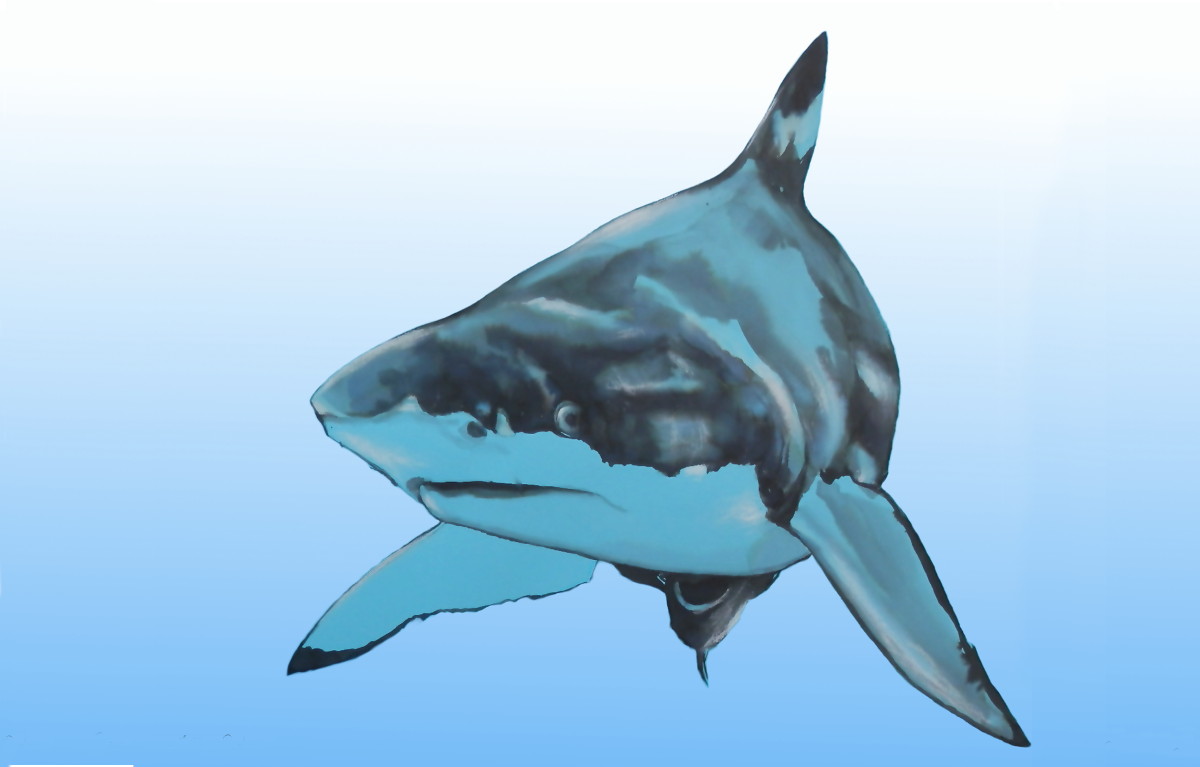 As The Year of the Shark 2019 draws to a close, we look out across the planetary oceans to learn the plight of sharks, after a year of spreading the word about their desperately needed protection.
 What we see is that sharks are being targeted by international factory fleets around the world who trail millions upon millions of baited hooks through their realm, trawl the sea floors for rays, skates and other bottom dwellers to 4000 metres, and slaughter them by the millions. Sharks are the only profitable prey remaining, now that ninety percent of the original (fish) fisheries are fished out. Thanks to the shark fin trade, the shark has become one of the most valued animals, with the result that these top predators are being targeted even by fleets that used to toss them out as trash. Their meat is thrust onto the markets and sold by different names; there is such a surplus that it is being used in everything from dog food to make-up.
Further, the meat of sharks is toxic. As top predators, they accumulate high levels of mercury, lead, and other poisons during their lives and they should not be taken for food. Even hunters would not recommend that we turn to eating wolves and cats instead of chickens and cows.
An ecological catastrophe has resulted from the shark fin market. Sharks are the worst off of all vertebrate animals while having high ecological importance as top and middle predators.
And in spite of all of our efforts, and those of shark conservationists around the world, shark killing continues to escalate and there is less hope for them now than ever.
If history has taught us anything, it is that no animals can withstand targeted, mechanized, industrial hunting—not whales, not turtles, not fish and not sharks.The Fisheries industry spins tales about this robbery of Nature being ‘sustainable,’ even while one shark species after another reaches the point of critical endangerment.
Yet Fisheries management, apparently afflicted by some territorial idea that sharks belong to them, continue to claim that they retain the right to fish sharks, even though they have already caused the loss of an estimated ninety percent of sharks globally. Their talk is bombastic and rhetorical; they sound as if they are addressing their buddies over beers in a bar, and they never mention what happened to all of the fish. Or explain why we, the people, should now let them kill all of the sharks.
These are the same people, who, just years ago, were killing sharks and throwing them away, declaring that they were nothing but “trash.” Now they want to profit from the shark fin trade and recreational shark fishermen are on the same wagon.
But according to the biggest global studies of shark depletion, Fisheries’ management has failed this entire line of animals. The shark biomass of all species required to support the documented shark fin trade was estimated to have exceeded the catch Fisheries reported to FAO, (the only organization that keeps track of the figures globally) by three to four times.
The suffering of fish was established nearly twenty years ago; they may actually suffer more intensely than we do. Yet, Fisheries, as a multi-billion dollar industry, has managed to take control of the public’s perception of these animals, as well as the animals themselves. As a result, in spite of the facts, fish have not been protected by the anti-cruelty laws that have protected mammals, birds and reptiles. In Florida, for example, you are guilty of a felony if you are caught fighting dogs or birds, but it is legal and considered culturally admirable to hook sharks through their mouths or guts and fight them to death. The recreational shark fishery in the USA is the largest in the world.
And the conclusions and recommendations of the fishing industry and its spokesmen are always in favour of fishermen—not fish, and not sharks.
However, sharks are not owned by shark fisheries, but by the ecological systems that evolved them. They are the children of the eternity that has passed since our planet filled with life, and we have an over-riding responsibility to protect sharks, marine animals, and wildlife in general, and keep their ecosystems in good health—in trust—so that future generations will enjoy the continuation of our bountiful planetary biosphere.
The priorities now should be to remove increasingly large areas from Fisheries access through the establishment of Marine Protected Areas, and at the very least to have sharks protected from international trade, which is the protection given to sea turtles. Since the protection afforded by CITES listings is opposed by shark hunting nations, given one species at a time, and fails to protect the animal from death, it is not working. There is no reason why the decision could not be made to protect all sharks. A ninety percent depletion of their numbers is already too much.
The effort to weaken the shark fin trade is vital, through the banning of commercialization of fins and encouraging consumers to change the recipe of the fatal soup and stop buying shark fins.
The World Bank published a study entitled “Sunken Billions” in 2009, and an update in 2017. It found that unsustainable Fisheries management practices have led to globally depleted fish stocks that produce $83 billion less in annual net benefits than would otherwise be the case—ninety percent of fisheries are over-exploited. To address this global crisis, the main requirement is that fishing effort is diminished, while at the same time, fish stocks must be rebuilt, and coastal ecosystems returned to a state of health.
This study specifies that little is known about the actual carrying capacity of most fish stocks that are subject to commercial exploitation, and in spite of what it claims, Fisheries’ data are often highly uncertain.
Sunken Billions predicts that social unrest will result from the necessary reduction of fishing effort that must come, because some fishermen will have to turn to other occupations.
So the current outcry from the shark fishing industry in the face of shark conservation efforts has been predicted, and is understandable, but indefensible. The World Bank recommends that the fishing subsidies that have facilitated over-fishing in the past be used to ease this social transition.
Priority should be given to local fishers who depend on the sea for their protein. Western consumers, who are already eating too much protein, would just choose something else if fish were not on the menu. These are wild animals, and with the human population already so bloated, and growing fast, no wild animal should be expected to support us.
The international trade in shark fins has wasted billions of animals for a bowl of luxury soup prized in just one of the world’s cultures. This fact is an illuminating example of just how wasteful and arrogant human demands can be on planetary resources.
(c) Ila France Porcher December 31, 2019
December 14, 2019
The Sustainable Shark Fisheries and Trade Act
 A Fisherman’s Farce
If you think that the shark fin trade is confined to Asia and a few dingy warehouses along the coast that are “somewhere else,” the fact is that all of the shark fisheries in the United States of America are part of the deadly trade. With The Sustainable Shark Fisheries and Trade Act, shark fishermen are pushing hard to make sure that they will continue to be able to profit from it and disseminating a large amount of propaganda about it that does not reflect the true facts.
A Fisherman’s Farce
If you think that the shark fin trade is confined to Asia and a few dingy warehouses along the coast that are “somewhere else,” the fact is that all of the shark fisheries in the United States of America are part of the deadly trade. With The Sustainable Shark Fisheries and Trade Act, shark fishermen are pushing hard to make sure that they will continue to be able to profit from it and disseminating a large amount of propaganda about it that does not reflect the true facts.They claim that they fish sharks sustainably, so should not have to give up their lucrative profits. But the fact is that sustainable shark fishing is nothing but a fishermen’s farce.
If history has taught us anything, it is that no animals can stand up to sustained, targeted, commercial killing—not whales, not turtles, not fish, and not sharks.
Sharks have become so valuable due to the rising demand for their fins that intensive shark fishing spans all oceans and it is associated with much illegal activity, including murder. No record is kept of most shark kills, so the idea that the entire shark fin trade is going to be made sustainable, under the guidance of the USA, is ridiculous. In fact just the documented shark fin trade, which is a tiny fraction of the true numbers, proves that shark Fisheries have underestimated the numbers of sharks killed by at least 400%.
It is the Sustainable Shark Alliance (SSA), which represents shark fishermen, dealers, and processors, and those who advocate their views (shark fisheries scientists, lawyers, and lobbyists), who promote H.R. 788, The Sustainable Shark Fisheries and Trade Act of 2019. They actually admit that without the profit from shark fins, shark fisheries in the USA will be shut down. The only profitable part of the shark is its fins. (However, all shark fishermen in countries where sharks were protected, had to give up the profit from the fins.)
They reason that American shark fishermen fish sustainably, so they should be able to sell their shark fins on the lucrative shark fin market. They promote the idea that if only shark fins from sustainable fisheries are used for shark fin soup, this will put an end to shark finning worldwide, and those countries who continue to practice it will suffer.
However the numbers reveal that the large market for shark fins in the USA could never be filled by fins from sustainable shark fisheries, for only a few of them may temporarily exist.
The USA is the seventh largest shark fishing nation in the world. It imports several hundred tons of shark fins annually and this amount is rising yearly, in spite of bans in such major centers as California and New York. Scientific studies have shown that the alleged markets for shark meat have resulted from the fins attached policies. The fins are taken and a vast surplus of toxic shark meat is thrust on the market. As a result it is being used in everything including make-up and dogfood.
Sharks are so valuable that they are always killed for the money for their fins--such profits rival those of the drug trade.
Fisheries advocates claim that:If the shark fin trade is banned, more sharks will be killed, because fishermen will have to catch more sharks to make the same amount of money.The fins should be used because of the general principle that the whole shark should be used.Sharks are really being killed for meat, not for their fins.If American fishermen don’t kill the sharks and supply the shark fin trade, “bad actors” will kill them.But these arguments are not based on science, facts, or logic, and rely on political bias and rhetoric. While it sounds like a good idea to import, export, and sell products that only come from ‘sustainable’ fisheries, The Sustainable Shark Fisheries and Trade Act of 2019 is completely unrealistic to put into practice.
Fisheries governance regimes are very expensive to set up and operate, and the cost varies depending on the type of measures implemented, ranging from scientific advice and management to monitoring, control, surveillance, and enforcement. Every country in the world with a shark fishery would need to be lobbied to pass sustainable shark fisheries management legislation. When laws are in place and enough data has been collected to determine what the sustainable catch rates might be for each species caught in every shark fishery, development and funding of management plans would need to be put in place, including staffing, training, purchase of equipment, and so on. Then, enforcement plans would need to be developed, implemented, and funded.
The problems of who would set the standard, who would lobby other countries to accept the USA’s evaluation of what is sustainable, who would monitor the program, research, and pay for it, are all unaddressed. Whether the American public would be willing to finance it through their tax dollars has not been mentioned.
These costs tend to fall on the public sector while the benefits are enjoyed by fishermen.
All that is involved in the Sustainable Shark Fisheries and Trade Act —putting American practices into play on a global scale—would need to be maintained long-term, while somehow requiring every country to keep politics, financial self-interest, and corruption, to say nothing of criminality, out of the process.
There is no international body that can force sovereign countries to do anything on this scale. Some countries, especially those with large fisheries, have consistently been resistant to controls on fishing based on scientific data.
Europol reported in 2018 that illegal fishing of tuna was twice that of legal fishing in the Atlantic. If it is not possible to effectively manage a species for which there is probably more data than any other, the idea that the USA will create sustainably managed fisheries for all 500 shark species (and all fish species) throughout the entire world is absurd.
Further, World Trade Organization agreements require that no country can favour the imports of one nation over another, nor ban imports of a product while still locally producing and exporting the product. The Sustainable Shark Fisheries and Trade Act would appear to be in direct violation of those agreements, and Fisheries advocates have not stated how the USA will get around this.
A World Bank study, Sunken Billions 2009, and Sunken Billions Revisited , 2017, has found that unsustainable Fisheries management practices have led to globally depleted fish stocks that produce $83 billion less in annual net benefits than would otherwise be the case. Ninety percent of fisheries are over-exploited. To address this global crisis, the main requirement is that fishing effort is diminished, while at the same time, fish stocks must be rebuilt, and coastal ecosystems returned to a state of health.
This study specifies that little is known about the actual carrying capacity of most fish stocks that are subject to commercial exploitation, and that Fisheries’ data are often highly uncertain.
Sunken Billions predicts that social unrest will result from the necessary reduction of fishing effort that must come, because some fishermen will have to turn to other occupations. So the current outcry from the shark fishing industry has been predicted, and is understandable, but indefensible.
The World Bank recommends that the fishing subsidies that have facilitated over-fishing in the past, be used to ease this social transition.
(c) Ila France Porcher, 2019
See also:Porcher, I.F., Darvell, B.W. and Cuny, G., 2019. Response to “A United States shark fin ban would undermine sustainable shark fisheries” D.S. Shiffman & R.E. Hueter, Marine Policy 85 (2017) 138-140. Marine Policy, 104, pp. 85-89. https://doi.org/10.1016/j.marpol.2019.02.058

December 3, 2019
Shark Killer David Shiffman
Shiffman presents himself as an authority with important information on conservation for the enlightenment of others, but he is not a conservationist. His writings promote the killing of sharks. During the past two years he has done all he could to block the the elimination of the shark fin trade in the USA, even advertising the idea that the shark fin trade is “good for sharks.”
What other scientist calls openly and repeatedly for the painful deaths of the animal he or she studies? Anyone bragging about studying dogs who advocated killing them for money would be considered a psychopathic idiot. Shiffman will advise, if you criticize his crazy views, that he “has a PhD” and I guess you have to have a PhD in shark fishing to think that the shark fin trade is good for sharks! If you have ever read a serious scientific publication you will realize that Shiffman's PhD is the sort that you get out of a box of Rice Krispies.
Try to find real science in Shiffman's articles and you will come up empty handed. Ironically he calls one of his columns, “Science Stop” which is funny because when he starts writing, science stops.
The short and vacuous paper Shiffman wrote to block The Shark Fin Trade Elimination Act (with Robert Hueter, another shark fishing advocate looking for ways of taking advantage of the high value of shark fins), gave only three reasons for promoting the shark fin trade, all of which concerned the welfare of shark fishermen, not sharks. American fishermen should be able to go on making good money, Shiffman and Hueter declared, even though they have fished out everything else. Why should they work on building up the fish stocks they have overfished, when they can kill sharks instead?
It turns out that American shark fisheries depend on the shark fin trade to make money, and instead of rebuilding the fish stocks fishermen have devastated, and bringing coastal habitats back to health as they should, they have turned to slaughtering the top predators to replace cod and the other lost fish species.
Now Shiffman is promoting “sustainable shark fishing” but the idea is nothing but a fisherman’s farce. Sharks have become so valuable, due to the demand for their fins, that intensive shark fishing spans all oceans. No record is kept of most shark kills, so the idea that the entire shark fin trade is going to be made sustainable under the guidance of the USA is ridiculous. There should be a worldwide authority to enforce sustainable shark fishing on the high seas, away from national regulations, but there is not, and that is where the farce lies. Further, the American public have not been asked if they want to fund this global effort with their tax dollars, either.
If history has taught us anything, it is that no species can stand up to sustained, targeted, commercial hunting—not whales, not turtles, not fish, and not sharks. The only way to get rid of the shark fin trade, and its effect on shark populations globally, is to stamp it out wherever it rears its ugly head. Then eventually, the fins will have no special value and the shark massacre will end.
One of the fisheries Shiffman has used as proof that many sustainable shark fisheries exist around the world, has just been proven to be another fisherman’s pipe dream: the shortfin mako fishery of the North Atlantic. Fisheries' management in the USA claims to be the best in the world, but it allowed this species to go from ‘Lower Risk’ to ‘Vulnerable’ to ‘Endangered’ in less than 20 years with no conservation action. Then, at the annual meeting of the International Commission for the Conservation of Atlantic Tunas (ICCAT), the USA and the European Union blocked the mako protections that were proposed by other countries.
This demonstrates the hollowness of American claims, which Shiffman has exaggerated in his promotional writings. Typically, he is now pretending to be an authority on the subject by writing about this fishery, without mentioning that he was arguing that it was a sustainable shark fishery during the past two years, and that he has been using it as a reason to try to block The Shark Fin Trade Elimination Act in the USA.
Shiffman has published a series of papers to give the scientific ring of authority to shark fishing and the fin trade. In an article in the journal “Fisheries” in 2014 he promoted recreational shark fishing in Florida as a way for the state to make money, based on the idea that shark diving is lucrative. This paper showed that Shiffman had no idea what evidence actually is, and was clueless, too, about mathematics.
If you try to profit from fighting birds or dogs in the state of Florida, you are guilty of a felony. Now that it has been established that fish suffer equally, there is no difference in terms of animal suffering among these blood sports, yet to Shiffman, fishing sharks for fun and profit (in their millions) was a good idea!
For one shark to earn two million dollars for Florida as he suggested it could, it would have to be fished 4000 times. The possible effects on the lives and biology of the sharks living there as a result of being repeatedly “fought” nearly to death at this intensity, was not a subject that concerned Shiffman. When questioned about it, he could not produce any argument to back up his position.
The evidence of the success of diving enterprises in the shark sanctuary of French Polynesia points, instead, to the conclusion that shark diving should replace shark fishing in Florida, and that the beleaguered animals should be left in peace.
One of the most famous American shark-fishing charter boat captains, Frank Mundus, was quoted by Russell Drumm in his book “In the Slick of the Cricket” as stating:
“Feeling good about tagging and releasing sharks was folly. The cheaper hooks bought by the weekend warriors were more often than not swallowed by the sharks, which then fought their final battle gut-hooked. After being released, most sank to the bottom, dead. Maybe two out of twelve are hooked in the mouth. Add it up along the coast.”
According to the National Oceanic and Atmospheric Administration of the U.S. Department of Commerce (NOAA), two million, seven hundred thousand sharks were caught by sports fishermen in the U.S.A. in 2011. Since those were the killings that were reported, only, this figure could be low compared with the true numbers killed if the toll from private boats, that were not reported, were added in.
Shiffman has written other similarly flawed fisheries papers. One tried to put forth evidence that most shark researchers are in favour of fishing sharks sustainably, when the actual results of the survey he reported did not suggest this conclusion. Subsequently he cited it, misrepresenting what it actually showed, as a reason to oppose bans on the shark fin trade.
Another paper criticized conservationists, while a recent one advises fishermen on how to use the social media to promote their ideas. Shiffman is not a shark scientist—he has not published one paper revealing something new about sharks.
Shiffman has admitted to being financed by everything from Sharknado2 to a variety of fishing interests. It is now a matter of record that industry will deliberately support a political platform for favoured, and often paid researchers, to influence public opinion. This was done, for example, by the tobacco industry and the oil industry.
Paying for ‘science’ provides the fishing industry with a way to launder biased, non-scientific ideas into a form that will have the same credibility as pure research, just as criminals launder money. The practice is used openly by the fishing industry, which is a multi-billion dollar power that has taken control of wild fish and sharks and how these animals are viewed by the public. Irregardless of available facts, the conclusions of the fishing industry are always in favour of fishermen, and not fish.
Another example is the idea that fish don’t feel pain, which only fishermen promote, yet they have managed to muddy the waters enough to prevent fish (and sharks) from receiving the protections given to mammals, birds, and reptiles.
Shiffman’s statements in his papers repeat almost word for word the propaganda produced by the Sustainable Shark Alliance (SSA), which represents shark fishermen, dealers, and processors. They both promote H.R. 788, The Sustainable Shark Fisheries and Trade Act of 2019, and actually admit that without the profit from shark fins, shark fisheries in the USA will be shut down.
However the numbers reveal that the large market for shark fins in the USA could never be filled by fins from sustainable shark fisheries, for only a few of them temporarily exist.
In the USA and elsewhere too, students of shark science are encouraged to work with fishermen. This allows them access to shark cadavers to dissect, and provides the possibility of finding some new anatomical detail. Their camaraderie with fishermen brings access to fishing boats for tagging sharks, and if a tag is returned from a distant place, it will bring them instant recognition, though they have done nothing but put a tag on a shark. Piggybacking on shark fishing can, at any moment, provide some obscure detail on which to publish a paper for the enhancement of their résumés.
By the time these students graduate, the years of focusing on dead sharks have effectively brainwashed them in their approach to the animals. Approaching sharks through fishing and fisheries denies any appreciation of the true nature of these intelligent animals pursuing complex lives in their natural environment.
A World Bank study, Sunken Billions, 2009, and Sunken Billions Revisited, 2017, has found that unsustainable Fisheries management practices have led to globally depleted fish stocks that produce $83 billion less in annual net benefits than would otherwise be the case. Ninety percent of fisheries are over-exploited.
To address this global crisis, the main requirement is that fishing effort must be diminished, while at the same time, fish stocks must be rebuilt, and coastal ecosystems returned to a state of health.
Sunken Billions predicts that social unrest will result from the necessary reduction of fishing effort that must come, because some fishermen will have to turn to other occupations. So the current demands of shark fishermen to continue to profit from the shark fin trade have been predicted, and are understandable, but are scientifically indefensible.
The World Bank recommends that the fishing subsidies that have facilitated over-fishing in the past, be used to ease this social transition.
It is important to make the distinction between those who are trying to actually protect sharks from the global slaughter currently underway, and those who are deliberately muddying the waters in order to promote a twisted program of shark killing. Sharks need protection, seriously!
(c) Ila France PorcherTo subscribe to my newsletter, click HERE
October 19, 2019
Shark Fishermen Lobbying Hard to Profit from the Shark Fin Trade

With the loss of at least 90% of sharks worldwide, it would seem to be urgent to protect the ones that remain. Every global study of their status has reported a more dire situation than the last, and that the targeted hunt for the shark fin trade is responsible for their catastrophic depletion. Only one third of shark species are considered safe, and the most threatened are those accessible to fishing—those within about 1000 metres of the surface, or, for seafloor dwellers, 3000 metres in depth.
Shark fins are among the most expensive seafood products. The total declared value of the world trade in shark products is close to US$1 billion per year and it is associated with much illegal activity, including murder. To supply it, intense shark fishing spans all oceans. Yet, as top predators, sharks have incalculable ecological importance and their removal has grave effects on the ecosystems where they live, as failures cascade down through the inter-tangled networks.
Yet, shark fisheries scientists, advocates, and coalitions such as the Sustainable Shark Alliance (SSA), which represents shark fishermen, dealers, and processors—those who profit from the shark fin trade—continue to promote shark fishing, claiming that it is already sustainable, and will be more so.
But is this true, or just political promotion by industrial interests?
Sustainable Shark FishingA close examination of the best global scientific studies reveals that no shark fishery serving the shark fin market is sustainable. The markets for shark fins and shark meat have always been separate, and involve different species. Those currently considered sustainable are only a few that have targeted sharks for meat, in Australia and the USA. However, they are now being propped up by the value of the sharks’ fins and their long-term viability is questionable.
For example, the spiny dogfish fishery, on the Atlantic coast of the United States of America, is currently considered one of the most notable sustainable shark fisheries. The meat is sent to Europe and the fins to Asia. This fishery markets shark meat as a replacement for cod, the once plentiful fish from that region which is now gone. Since there is little market for shark meat in the country, the meat is sold under different names, such as “rock salmon.” But the stock of spiny dogfish in the western Atlantic shows wide fluctuations. It collapsed in the 1990s, and the American National Oceanic and Atmospheric Administration, Department of Commerce (NOAA), declared it to be rebuilt in 2010. However, globally, the species is listed by the International Union for Conservation of Nature (IUCN) as being vulnerable to overfishing, and it is critically endangered just across the Atlantic Ocean. Therefore, the population off the eastern coast of the USA is unlikely to be stable, either.
Dogfishes, like other species in the deep, cold waters of the northern continental slopes, have relatively low productivity. They produce fewer young per pregnancy and are longer lived than many other shark species. The bio-accumulation of mercury in their body tissues is greater, too, making this shark highly questionable as a choice to offer on the market as food.
Global analyses have shown that the level of threat to sharks through overfishing is usually greater than what is predicted by fisheries assessments. Such local assessments can underestimate the risk of collapse of global stocks of any given species, and have often caused such a collapse.
Sharks are already extinct at St. Paul’s Rocks, for example, where no carcharhinid reef sharks have been seen in past decades though they were formerly plentiful. Such local extinctions are the warning signs of fisheries management failure and are the first steps on the road to global extinctions.
Then there is the problem of by-catch. The quantities of most shark species taken as by-catch are not recorded, so some species can be at high risk of depletion without this being recognized.
A World Bank study, Sunken Billions, 2009, and Sunken Billions Revisited, 2017, has found that unsustainable fisheries management practices have led to globally depleted fish stocks that produce $83 billion less in annual net benefits than would otherwise be the case. Ninety percent of fisheries are over-exploited. To address this global crisis, the main requirement is that fishing effort is diminished, while at the same time, fish stocks must be rebuilt, and coastal ecosystems returned to a state of health. This study specifies that little is known about the actual carrying capacity of most fish stocks that are subject to commercial exploitation, and that fisheries’ data are often highly uncertain.
What becomes evident in the current political situation in the USA, in which shark fishing advocates are lobbying hard for the perpetuation of the shark fin trade, is that American fisheries are focusing on sharks with the intention of profiting from their fins, while the over-abundance of shark meat is being used in everything possible from make-up to dogfood.
However, the fisheries’ current plan to take the top predators, now that they have depleted the fish, is ecological folly. Shark production is much lower than fish production, and if these fishermen have their way, sharks will soon go the way of the cod and the many other species that they have fished out.
Sunken Billions predicts that social unrest will result from the necessary reduction of fishing effort that must come, because some fishermen will have to turn to other occupations. So the current outcry from the shark fishing industry has been predicted, and is understandable. The World Bank recommends that the fishing subsidies that have facilitated over-fishing in the past, be used to ease this social transition.
Problems with sustainabilityWhile the idea of sustainability sounds good, the facts as found by the best science simply do not support the notion that sustainable shark fishing is possible to put into practice long-term. The scientific studies done to research the matter have revealed how few such fisheries are.
To begin with, pirate fishing takes one fifth of the total fishing revenue. Twenty-six million tons of catch are thought to be taken illegally each year by pirate industrial-scale fishing, and there is no effective authority to police international waters. The documented shark fin trade shows that fisheries have underestimated the numbers of sharks being killed by at least 400 percent, which shows just how unreliable fisheries’ data are. Further, only a small fraction of the shark fin trade is documented. Most fins are imported from Asia where they have been sourced from many shark hunting nations, most of which do not keep species-specific catch statistics, so are impossible to trace.
When only the fins of the shark are valuable, when you apply the wise adage to use the whole animal, the question becomes, not “What do you do with the fins,” but “What do you do with the rest of the shark?”
Texas recently passed a law that required that all dead sharks shipped through the state have their fins naturally attached, so that the fishermen lost the profit from the sale of the fins. This income loss effectively closed down the Western Gulf of Mexico shark fishery in 2019. This shows the degree to which the shark fin market drives shark fisheries.
Similarly, in Costa Rica and other South and Central American countries, sharks were considered undesirable and were not used for food prior to the 1980s. Then the inflated price of shark fins resulted in sharks from a wide variety of habitats being targeted for their fins alone. The ‘fins attached’ policies obligated fishermen to land fins attached to the bodies. So the shark fin industry’s surplus meat was put on the market for domestic consumption, resulting in merchants pushing the meat on local consumers and relying on the use of various other names to sell it. Now Costa Ricans alone are consuming about 2000 tons of shark meat a year and the situation is similar in many other countries.
This is a problem with mandating a ‘fins attached’ policy: it does not properly address overfishing. Worldwide, the tendency now is less discarding of the body of the shark, but without a lessening of mortality.
Toxic meatThe problem with loading shark meat into the local markets is that it is poisonous. For example, the Florida Fish and Wildlife Conservation Commission’s fishing rules specify a minimum size limit of 54 inches for about half of the shark species caught. At the same time, the Florida Advisory on Fish Consumption advises that no species of coastal shark longer than 43 inches should ever be eaten by anyone. Thus fishermen are specifically advised to catch large sharks, which are breeding females, and are too toxic to eat.
This makes it clear that large species such as lemon and tiger sharks are being killed only for the value of their fins.
Thus fisheries interests lobbying for the perpetuation of the shark fin trade are targeting an animal that is too toxic to eat, and is globally threatened, for the benefit of relatively few industry employees.
The inherent uncertaintiesFor a fishery to be sustainable, shark fishing mortality must be equal to, or lower than, the number of dead sharks that make up the ‘maximum sustainable yield.’ But in the case of sharks, those reference points are often not known or are very uncertain. The global studies done on shark depletion have emphasized the problems inherent in assessing the true situation, providing detailed descriptions of the difficulties on every level. For example, in 2015 the International Scientific Committee for Tuna and Tuna-like Species in the North Pacific Ocean analysed shortfin mako stocks using the most complete data available but it found that due to missing information, untested indicators, and conflicts in the available data, the assessment was impossible to make at all. This species was assessed on the IUCN Red List in 2000 as being ‘Lower risk/Near Threatened,’ and in 2009, it was reclassified as ‘Vulnerable.’ Then, in 2017, the shortfin mako fishery in the North Atlantic Ocean was reported by a fisheries study to be potentially sustainable. However, that same year, the stock assessment on the NOAA Fisheries website showed that this shark was overfished and that overfishing was occurring. IUCN subsequently re-classified the shortfin mako from ‘Vulnerable’ to ‘Endangered’ worldwide, with a decreasing population trend. So in 2019 USA fisheries began working on a management plan and urged fishermen to reduce catches voluntarily in the meantime.
Thus, fishery management in the USA, which claims to be the best in the world, allowed this species to go from ‘Lower Risk’ to ‘Vulnerable’ to ‘Endangered’ in less than 20 years, with no conservation action. Only now, in 2019, are they working on a plan. It is clear that the ‘sustainable fishery’ management approach is not working to maintain populations at healthy levels.
CITES protection Listings by the Convention on International Trade in Endangered Species (CITES) are currently the only protection available for sharks. But in practice, such a listing only protects the animal from exportation, not from being fished in the first place. Protecting an animal with high market value is extremely difficult and such listings are opposed by shark hunting nations due to the high commercial value of the fins, so increasing effort is required to obtain them. Protection must be gained one species at a time, and only a few species are currently listed, while the shark fin market demands fins from all species.
Once separated from the shark, it is difficult to determine from which species any given fin has been taken, so enforcement is weak. Further, the only protection granted by a CITES listing is the need for a ‘Non-detrimental’ finding before the fins can be exported. This often undermines the protection originally intended for the species by the CITES listing.
Fisheries’ arguments Whenever shark fishermen are threatened with the loss of their shark fin profits, they protest. Usually this involves claiming that if they don’t continue to kill the sharks, the animals will soon be out on the beaches eating people’s babies, and this is currently the case in the USA. The strong movement to block the shark fin trade there, has resulted in The Shark Fin Trade Elimination Act of 2019, which is now before Congress.
But shark fisheries are fighting back, arguing that the shark fin trade should continue for the profit of American fishermen. It is fired by coalitions of shark fishermen, dealers, and processors, such as Sustainable Shark Alliance, and the shark fisheries scientists, lawyers, and lobbyists, who advocate their wishes. They promote H.R. 788, The Sustainable Shark Fisheries and Trade Act of 2019, and actually admit that without the profit from shark fins, shark fisheries in the USA will be shut down.
They reason that American shark fishermen fish sustainably, so they should be able to sell their shark fins on the lucrative shark fin market. They promote the idea that if only shark fins from sustainable fisheries are used for shark fin soup, this will put an end to shark finning worldwide, and those countries who continue to practice it will suffer. However the numbers reveal that the market for shark fins in the USA could never be filled by fins from sustainable shark fisheries, few as they are. Further, to support a trade responsible for such shark losses worldwide, is considered by many to be an ethical issue, on which the USA should be careful to remain on the good side.
Fisheries spokesmen claim that:If the shark fin trade is banned, more sharks will be killed, because fishermen will have to catch more sharks to make the same amount of money.The fins should be used because of the general principle that the whole shark should be used. Sharks are really being killed for meat, not for their fins.If American fishermen don’t kill the sharks and supply the shark fin trade, “bad actors” will kill them.
However, these arguments are not based on science, facts, or logic, and rely on political bias and rhetoric. While it sounds like a good idea to import, export, and sell products that only come from ‘sustainable’ fisheries, the The Sustainable Shark Fisheries and Trade Act of 2019 is completely unrealistic to put into practice. The problems of who would set the standard, who would lobby other countries to accept the USA’s evaluation of what is sustainable, who would monitor the program, research, and pay for it, are all unaddressed. Whether the American public would be willing to finance it through their tax dollars has not been mentioned.
Fisheries governance regimes are very expensive to set up and operate, and the cost varies depending on the type of measures implemented, ranging from scientific advice and management to monitoring, control, surveillance, and enforcement. Every country in the world with a shark fishery would need to be lobbied to pass sustainable shark fisheries management legislation. When laws are in place and enough data has been collected to determine what the sustainable catch rates might be for each species caught in every shark fishery, development and funding of management plans would need to be put in place, including staffing, training, purchase of equipment, and so on. Then, enforcement plans would need to be developed, implemented, and funded.
These costs tend to fall on the public sector while the benefits are enjoyed by fishermen.
All that is involved in the Sustainable Shark Fisheries and Trade Act—putting American practices into play on a global scale—would need to be maintained long-term, while somehow requiring every country to keep politics, financial self-interest, and corruption, to say nothing of criminality, out of the process. There is no international body that can force sovereign countries to do anything on this scale. Some countries, especially those with large fisheries, have consistently been resistant to controls on fishing based on scientific data. Europol reported in 2018 that illegal fishing of tuna was twice that of legal fishing in the Atlantic. If it is not possible to effectively manage a species for which there is probably more data than any other, the idea that the USA will create sustainably managed fisheries for all 500 shark species (and all fish species) throughout the entire world is absurd. Further, World Trade Organization agreements require that no country can favour the imports of one nation over another, nor ban imports of a product while still locally producing and exporting the product. The Sustainable Shark Fisheries and Trade Act would appear to be in direct violation of those agreements, and fisheries advocates have not stated how the USA will get around this.
To complicate matters, the USA itself obfuscates its records of its involvement with the shark fin trade. It records trade in dried shark fins only, under just one commodity code, while its exports of raw, frozen shark fins are classified as meat. Thus its official records are very misleading, so that fisheries’ advocates can easily make the case that the country scarcely contributes to the shark fin trade. However, other countries have reported exporting large amounts of shark fins to the country. In 2007, for example, other countries reported exporting 1,012 metric tons of shark fins to the USA, thirty-five times the figure of 28.8 metric tons reported by NOAA. At least several hundred tons of shark fins are consumed annually in the USA, and imports have been rising each year, in spite of the bans in such major centres as California and New York. Ninety-three percent of imports enter through the Los Angeles customs district, and in 2017 one-third of species traded in the Hong Kong shark fin market, (the central Asian market for fins), were found to be threatened with extinction. Conclusions Sharks reproduce far more slowly than fish. While fish lay thousands of eggs, sharks are more like mammals. Female sharks take many years to reach reproductive age, then give birth to just a small number of offspring every one or two years. When fish stocks are commercially exploited, the most valuable stocks and larger individuals are targeted first. With this pattern applied over decades, global marine catches over time have comprised an increasing proportion of juvenile sharks, while the breeding adults are vanishing.
Sharks have high importance ecologically due to radial evolution into new vacant niches in the aftermath of several planet-wide extinctions. As a result, they are woven throughout the world’s aquatic ecosystems. As large animals at the top of the food chain, their removal is causing whole ecosystems to collapse. Further, due to the continuously increasing human population, the pressure upon them is likely to grow more intense as the years pass. A variety of indicators show an accumulation of extinction risk throughout the oceans as a result of many decades of overfishing. These are complicated by the effects of climate change—the melting icecaps, the changes in major oceanic current systems, ocean acidification, coral death, warming waters, and rising sea levels. Along with industrial and plastic pollution, these changes pose serious threats to marine life, including sharks. The World Bank’s recommendation that fishing effort be reduced to a point that allows the healthy recovery of coastal ecosystems, including their top predators, should be adopted until, with careful management and the allocation of many more Marine Protected Areas, the oceans regain a state of ecological stability. Priority should be given to local fishers who depend on the sea for their protein. Western consumers who are already eating too much protein, would just choose something else if fish were not on the menu. These are wild animals, and with the human population already so bloated, and growing fast, it is self-evident that no wild animal should be expected to support us.
For these reasons, no large-scale shark fishery is going to prove sustainable in the long-term. If history has taught us anything, it is that no species can stand up to sustained, targeted, commercial killing—not whales, not turtles, not fish, and not sharks. At the very least, sharks should be given the same protection now granted to sea turtles—complete protection from international trade.
Ila France Porcher (c) 2019 p { margin-bottom: 0.25cm; line-height: 115%; text-align: justify; }p.western { font-family: "FreeSerif", serif; }p.cjk { font-size: 10pt; }h2.western { font-family: "FreeSans", sans-serif; font-size: 12pt; font-weight: normal; }h2.cjk { font-family: "WenQuanYi Micro Hei"; font-size: 16pt; }h2.ctl { font-family: "Lohit Devanagari"; font-size: 16pt; }p { margin-bottom: 0.25cm; line-height: 115%; text-align: justify; }p.western { font-family: "FreeSerif", serif; }p.cjk { font-size: 10pt; }