Ian Conway's Blog - Posts Tagged "cricket"
Letter from an English Village: Sounds of Summer
All the trees in the village are now in full leaf and the sounds of summer have begun. It is strange how sounds carry further on a still summer evening, or is that just fanciful nonsense? The dominant summer sound is lawnmowers, which I find very relaxing, even the demented whine of a hovermower seems to go quite well with a glass of wine taken in the garden. Mind you, most things seem to go well with a nice glass of wine.
Our garden has three terraces. The estate agent described them as the house level 'japanese' garden, then ascending through an arch and up a brick staicase to the box hedged 'clerestory' garden - finally up another staircase to the 'fruit garden'. I expected to find at least half an acre of horticultural wonder but, although they were well planted and laid out, each level is only about 15 ft. deep by the width of the house. However, it's very nice and I can sit amongst the apple trees in the top level and look over the slate roofs to see the village wake up in the morning and go to bed at night. A cup of tea in the morning and a mug of coffee in the late evening.
A short distance above our garden is the village cricket club. I played a season in the apologists team about 6 years ago in an attempt to impress my now son-in-law - an opening batsman in a very good club. My own game was rugby, in which I had some reasonable success, but I found that the robust skills of rugby do not easily transfer to cricket. The fact that I had last played the game some 40 years ago also hampered me a little - do you detect some rationalisation here?
Notwithstanding my limitations at the crease, one of the best summer sounds I hear in the garden is the whack of a cricket bat's willow on the leather ball - and the impassioned cries of 'howzat?' (For American readers 'howzat? translates to the question 'how is that?' - posed to the umpire and inviting him to give the batsman out. An inscrutable Olympian stare means he stays in, or a discreetly raised right first digit sends him off the field to Hades. All very genteel and understated.)
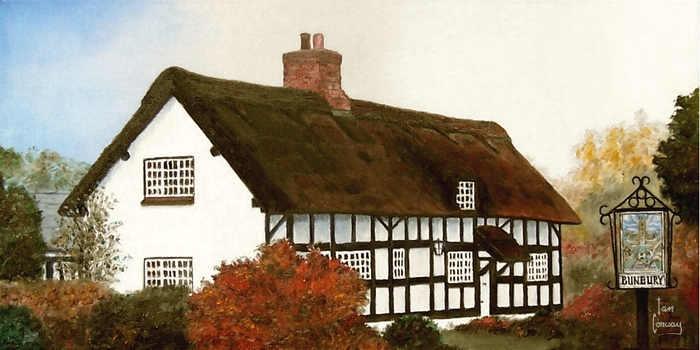
I painted a picture of a village match, which was bought by a man who took it off to Barbados. He wanted some paintings which would remind him of England and he also bought my painting of a thatched cottage in the village centre, which should appear below.
( from my online gallery at http://ianconway.biz )
The Cottage is a fantastic centre-piece to the village. A living monument to many eras. It wears its age with a mellow dignity and grace. How many generations of families has it sheltered, through wars, feast times and famines? How many lives and futures have been formed within its walls? What history breathes gently through its rooms when the world has gone to sleep? The Cottage seems to generate a wonderfully optimistic atmosphere and I really enjoyed painting this picture.
The other summer sound is children at play - running around in a demented aimless fashion, racing bikes, falling over, laughing, bickering … You either hate or love that sound. In general we appreciate hearing vital young life rushing about and we chose the house partially because of the number of families in the close. Our children are all grown up (though we have two grandchildren nearby) but I believe the presence of children helps to remind one about the wonder of life - helps to keep perspective on things. And it can bring back memories of the wonderland which most people experienced in their own childhood.
Thanks for reading my journal. More next week.
Ian Conway
(Goodreads Author)
Our garden has three terraces. The estate agent described them as the house level 'japanese' garden, then ascending through an arch and up a brick staicase to the box hedged 'clerestory' garden - finally up another staircase to the 'fruit garden'. I expected to find at least half an acre of horticultural wonder but, although they were well planted and laid out, each level is only about 15 ft. deep by the width of the house. However, it's very nice and I can sit amongst the apple trees in the top level and look over the slate roofs to see the village wake up in the morning and go to bed at night. A cup of tea in the morning and a mug of coffee in the late evening.
A short distance above our garden is the village cricket club. I played a season in the apologists team about 6 years ago in an attempt to impress my now son-in-law - an opening batsman in a very good club. My own game was rugby, in which I had some reasonable success, but I found that the robust skills of rugby do not easily transfer to cricket. The fact that I had last played the game some 40 years ago also hampered me a little - do you detect some rationalisation here?
Notwithstanding my limitations at the crease, one of the best summer sounds I hear in the garden is the whack of a cricket bat's willow on the leather ball - and the impassioned cries of 'howzat?' (For American readers 'howzat? translates to the question 'how is that?' - posed to the umpire and inviting him to give the batsman out. An inscrutable Olympian stare means he stays in, or a discreetly raised right first digit sends him off the field to Hades. All very genteel and understated.)
I painted a picture of a village match, which was bought by a man who took it off to Barbados. He wanted some paintings which would remind him of England and he also bought my painting of a thatched cottage in the village centre, which should appear below.
( from my online gallery at http://ianconway.biz )
The Cottage is a fantastic centre-piece to the village. A living monument to many eras. It wears its age with a mellow dignity and grace. How many generations of families has it sheltered, through wars, feast times and famines? How many lives and futures have been formed within its walls? What history breathes gently through its rooms when the world has gone to sleep? The Cottage seems to generate a wonderfully optimistic atmosphere and I really enjoyed painting this picture.
The other summer sound is children at play - running around in a demented aimless fashion, racing bikes, falling over, laughing, bickering … You either hate or love that sound. In general we appreciate hearing vital young life rushing about and we chose the house partially because of the number of families in the close. Our children are all grown up (though we have two grandchildren nearby) but I believe the presence of children helps to remind one about the wonder of life - helps to keep perspective on things. And it can bring back memories of the wonderland which most people experienced in their own childhood.
Thanks for reading my journal. More next week.
Ian Conway
(Goodreads Author)


Letter from an English Village: The Village Pub
How to describe the significance of an English village pub to people who do not live in the countryside? Townies may compare it to their local, but it is not really a valid comparison. Suburbanites have even less chance of understanding. And whilst the traditions outside the UK are just as good, they are not the same.
A lot of village business is transacted in the pub. Deals are made and liaisons formed. There is generally an unspoken rule that what happens in the pub, stays in the pub. People are conscious that this is one of the pivots around which a village spins and they must never allow a situation to develop where they may become persona non grata.
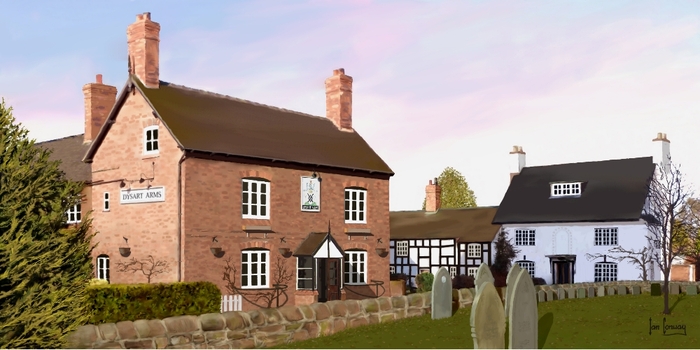
This makes for a very agreeable atmosphere - typified in my local by log fires in winter, low beams, walls full of pictures, old tables and chairs, muted lighting and quiet conversation punctuated by laughter. No baseball caps, mobiles, game machines or music. Outside there are stepped gardens with the churchyard to one side, an old half-timbered farmhouse to another and, on the third side, a range of hills with two castles visible on the ridge-line before the foliage grows in summer.
My pub is opposite the Parish Church. There is usually a pub next to the church in an English village and I have often wondered why - perhaps the eternal balance between the spiritual and temporal? In fact I learned from a recent BBC programme why it is so - apparently many of the pubs were actually built by the Church itself in the late Middle Ages.
In those days the village church was the centre of life and a great deal of village business was carried out in the church porch - such as minor courts, laying out of bodies for identification, making of contracts, taking of legal oaths etc. It was also a place for festivals to be celebrated and inevitably these spilled over into the church. In time it became clear that some secular accommodation would be a good idea for such activities and the church authorities began building 'church houses' on the edge of the consecrated ground. Here villagers could make merry and pay into church coffers for the opportunity - in effect the forerunner of the Parish Hall, or modern community centre.
It soon occurred to the church that a further revenue could be earned by taking in travellers and the houses became church owned inns. As time went by they were sold off, and most that remained went into private ownership at the time of the Reformation.
I painted the Village Pub from the churchyard in early spring, before the scene became obstructed by foliage. It should appear below here.
( from my online gallery at http://ianconway.biz )
I have lots more to mention about the pub - and the other two pubs in the village, each with it's own particular features. That will have to wait for future blog posts though. This one is too long already.
I believe that there is something quite magical about the atmosphere in a good village pub, particularly at 'early doors' on a Friday evening or just before roast beef on a Sunday lunchtime. Is it just the alcohol? I don't think so, but that helps. I think it is actually the deep need in all of us to periodically be in warm and sympathetic company, where people know your name and will make reasonable allowance for your foibles. Quite like the school playground really - which is the learning place for almost all our life skills I guess.
More next week.
Ian Conway
(Goodreads Author)
A lot of village business is transacted in the pub. Deals are made and liaisons formed. There is generally an unspoken rule that what happens in the pub, stays in the pub. People are conscious that this is one of the pivots around which a village spins and they must never allow a situation to develop where they may become persona non grata.
This makes for a very agreeable atmosphere - typified in my local by log fires in winter, low beams, walls full of pictures, old tables and chairs, muted lighting and quiet conversation punctuated by laughter. No baseball caps, mobiles, game machines or music. Outside there are stepped gardens with the churchyard to one side, an old half-timbered farmhouse to another and, on the third side, a range of hills with two castles visible on the ridge-line before the foliage grows in summer.
My pub is opposite the Parish Church. There is usually a pub next to the church in an English village and I have often wondered why - perhaps the eternal balance between the spiritual and temporal? In fact I learned from a recent BBC programme why it is so - apparently many of the pubs were actually built by the Church itself in the late Middle Ages.
In those days the village church was the centre of life and a great deal of village business was carried out in the church porch - such as minor courts, laying out of bodies for identification, making of contracts, taking of legal oaths etc. It was also a place for festivals to be celebrated and inevitably these spilled over into the church. In time it became clear that some secular accommodation would be a good idea for such activities and the church authorities began building 'church houses' on the edge of the consecrated ground. Here villagers could make merry and pay into church coffers for the opportunity - in effect the forerunner of the Parish Hall, or modern community centre.
It soon occurred to the church that a further revenue could be earned by taking in travellers and the houses became church owned inns. As time went by they were sold off, and most that remained went into private ownership at the time of the Reformation.
I painted the Village Pub from the churchyard in early spring, before the scene became obstructed by foliage. It should appear below here.
( from my online gallery at http://ianconway.biz )
I have lots more to mention about the pub - and the other two pubs in the village, each with it's own particular features. That will have to wait for future blog posts though. This one is too long already.
I believe that there is something quite magical about the atmosphere in a good village pub, particularly at 'early doors' on a Friday evening or just before roast beef on a Sunday lunchtime. Is it just the alcohol? I don't think so, but that helps. I think it is actually the deep need in all of us to periodically be in warm and sympathetic company, where people know your name and will make reasonable allowance for your foibles. Quite like the school playground really - which is the learning place for almost all our life skills I guess.
More next week.
Ian Conway
(Goodreads Author)
Letter from an English Village: Castles
My county is quite flat, with hilly land rising on the eastern edge. The land on the western side is particularly flat, with fertile soil and lush green pastures, where the farming has always mainly been dairy.
The western plain is interrupted by a ridge of small hills on the line of a geological fault, which threw up a mass of rock in some long ago time. The rock was hard and did not succumb to the eroding winds and rain. Now the tree covered slopes of the ridge seem incongruous in an otherwise flat landscape. The ridge is only a couple of miles from the village and we often walk up the woodland trails and along an overgrown coach road to a very popular pub on the western ridge. Most of the land is now owned and maintained by the National Trust and the views over the plain are fantastic.
These uninterrupted views from the top, together with the steep approaches, also made the ridge ideal for siting defensive settlements and we have a stone age fort about five miles from us along the ridge, with parts of the reinforced earthworks still identifiable. The next defended place is termed a castle, although it is really a country house built over many generations and sited over castle remains. A Lady of hereditary title lives there and it is also opened for charitable causes, such as a summer evening of orchestral music each year.
The next one on the ridge is also a great house built on old foundations, again termed a 'castle.' Here I performed for a Christmas Charity Show and acted as MC for the evening. The next castle along actually looks like a castle. It was rebuilt on original foundations as a romantic folly in the mid 19th century by the noble family who had owned the land since the Norman Conquest. It is more like a castle than the original, I should imagine. Perfect buttressing, a romantic tower and 19th century plumbing. Now a hotel, it was used for the Kevin Costner Robin Hood film. Many of the villagers acted as extras and even now they still compare their 'performances' in the village pub.
That brings us to the last castle on this stretch of the ridge. The crag on which it stands was a Bronze Age metal-working site and later an Iron Age hillfort. The stone castle was built In the 1220's and it was garrisoned for centuries. Its last use as a defended stronghold was by the Royalists during the Civil War, who surrendered it to the Parliamentary forces in 1645 after a long siege. The winners then 'slighted' the castle on government orders. The term to 'slight' has lost most of its currency from the meaning in the 17th century. In those days to 'slight a castle' was to blow up key parts so that it could not be used again by the enemy.
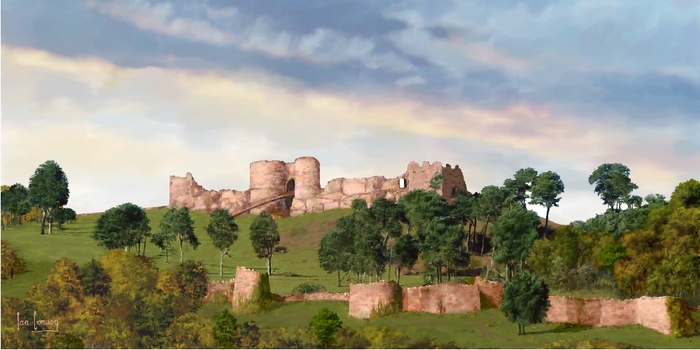
I painted the castle in early autumn, the painting should show below.
( from my online gallery at http://ianconway.biz )
In the painting I have tried to portray the stark strength of the castle and suggest the dramatic events which have taken place within its walls. Since then nature has been reclaiming the crag. Vegetation now grows over the ruined walls of the outer bailey but the imposing gatehouse and the inner bailey still stand strong.
I find it remarkable that a building or a location can somehow retain a memory of things that have happened there. No matter how sunny the day or upbeat one's disposition, there is something about the castle which makes one feel serious. Yet it is also magnificent and there is a sense of protection, a place to which the people could ultimately retreat and be in safety. Perhaps it is a reflection of the strong place we all need within ourselves when times get tough - and the need to keep that place in good repair when times are easy.
More next week.
Ian Conway
(Goodreads Author)
The western plain is interrupted by a ridge of small hills on the line of a geological fault, which threw up a mass of rock in some long ago time. The rock was hard and did not succumb to the eroding winds and rain. Now the tree covered slopes of the ridge seem incongruous in an otherwise flat landscape. The ridge is only a couple of miles from the village and we often walk up the woodland trails and along an overgrown coach road to a very popular pub on the western ridge. Most of the land is now owned and maintained by the National Trust and the views over the plain are fantastic.
These uninterrupted views from the top, together with the steep approaches, also made the ridge ideal for siting defensive settlements and we have a stone age fort about five miles from us along the ridge, with parts of the reinforced earthworks still identifiable. The next defended place is termed a castle, although it is really a country house built over many generations and sited over castle remains. A Lady of hereditary title lives there and it is also opened for charitable causes, such as a summer evening of orchestral music each year.
The next one on the ridge is also a great house built on old foundations, again termed a 'castle.' Here I performed for a Christmas Charity Show and acted as MC for the evening. The next castle along actually looks like a castle. It was rebuilt on original foundations as a romantic folly in the mid 19th century by the noble family who had owned the land since the Norman Conquest. It is more like a castle than the original, I should imagine. Perfect buttressing, a romantic tower and 19th century plumbing. Now a hotel, it was used for the Kevin Costner Robin Hood film. Many of the villagers acted as extras and even now they still compare their 'performances' in the village pub.
That brings us to the last castle on this stretch of the ridge. The crag on which it stands was a Bronze Age metal-working site and later an Iron Age hillfort. The stone castle was built In the 1220's and it was garrisoned for centuries. Its last use as a defended stronghold was by the Royalists during the Civil War, who surrendered it to the Parliamentary forces in 1645 after a long siege. The winners then 'slighted' the castle on government orders. The term to 'slight' has lost most of its currency from the meaning in the 17th century. In those days to 'slight a castle' was to blow up key parts so that it could not be used again by the enemy.
I painted the castle in early autumn, the painting should show below.
( from my online gallery at http://ianconway.biz )
In the painting I have tried to portray the stark strength of the castle and suggest the dramatic events which have taken place within its walls. Since then nature has been reclaiming the crag. Vegetation now grows over the ruined walls of the outer bailey but the imposing gatehouse and the inner bailey still stand strong.
I find it remarkable that a building or a location can somehow retain a memory of things that have happened there. No matter how sunny the day or upbeat one's disposition, there is something about the castle which makes one feel serious. Yet it is also magnificent and there is a sense of protection, a place to which the people could ultimately retreat and be in safety. Perhaps it is a reflection of the strong place we all need within ourselves when times get tough - and the need to keep that place in good repair when times are easy.
More next week.
Ian Conway
(Goodreads Author)
Letter from an English Village: the Coast
We English are an island race and, although my village is some distance from the coast, like most Englishmen I feel quite an affinity for the sea - probably enhanced by having served for a short time on a tramp ship as a young man.
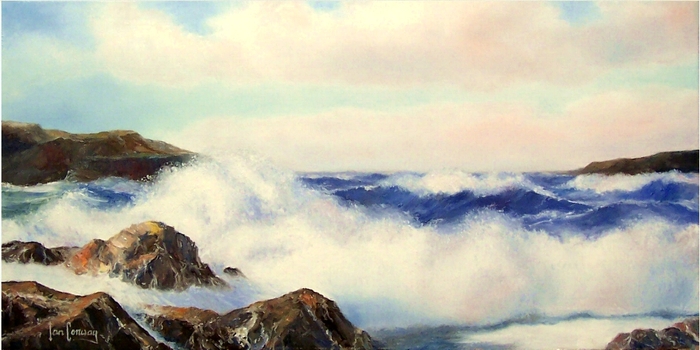
I regularly feel a need to get out to the coast and when I do I often come back with some sketches and ideas which can be worked up into a painting. The painting below is one of them. It is not so much an actual place but a combination of impressions from a wild peninsula that juts out into the sea on the western side of the UK, about 2 hours drive from the village.
The painting is set in Spring and I tried to capture something of the crisp chill of that season in an early morning, with a low sun setting up a brittle illusion of warmth above the restless pounding of breakers over scoured rocks on a flood tide.
( from my online gallery at http://ianconway.biz )
As I recall the scene, it was magnificent and bracing but very chill - and I certainly was ready for the mug of tea and bacon sandwich in the beach café after finishing sketching.
The gallery told me that the man who bought the painting took it back with him to his native South Africa. Strange to think of the painting probably spending the rest of its life out there. No doubt it will be thrown away one day, or put into a loft in storage and some day brought out again. Perhaps the person who takes it out of the loft will say something like, "Those seas are rather small for the African coast?" And he would probably never guess the painting's origin, would he? - because one bit of sea is very like another.
In any case, in all my sea paintings I try to create scenes that are timeless. I show no clues to say what era a painting depicts. There is no evidence of the presence or the influence of man. This painting could be a scene from a million years ago - or just yesterday. As we stress, strain and worry our way through life, get older and finally disappear, the sea just keeps on pounding the beach, day in day out - completely oblivious to our human struggles. I find that worth bearing in mind - puts life into a sort of perspective.
More soon.
Ian Conway
(Goodreads Author)
I regularly feel a need to get out to the coast and when I do I often come back with some sketches and ideas which can be worked up into a painting. The painting below is one of them. It is not so much an actual place but a combination of impressions from a wild peninsula that juts out into the sea on the western side of the UK, about 2 hours drive from the village.
The painting is set in Spring and I tried to capture something of the crisp chill of that season in an early morning, with a low sun setting up a brittle illusion of warmth above the restless pounding of breakers over scoured rocks on a flood tide.
( from my online gallery at http://ianconway.biz )
As I recall the scene, it was magnificent and bracing but very chill - and I certainly was ready for the mug of tea and bacon sandwich in the beach café after finishing sketching.
The gallery told me that the man who bought the painting took it back with him to his native South Africa. Strange to think of the painting probably spending the rest of its life out there. No doubt it will be thrown away one day, or put into a loft in storage and some day brought out again. Perhaps the person who takes it out of the loft will say something like, "Those seas are rather small for the African coast?" And he would probably never guess the painting's origin, would he? - because one bit of sea is very like another.
In any case, in all my sea paintings I try to create scenes that are timeless. I show no clues to say what era a painting depicts. There is no evidence of the presence or the influence of man. This painting could be a scene from a million years ago - or just yesterday. As we stress, strain and worry our way through life, get older and finally disappear, the sea just keeps on pounding the beach, day in day out - completely oblivious to our human struggles. I find that worth bearing in mind - puts life into a sort of perspective.
More soon.
Ian Conway
(Goodreads Author)