Grady Hendrix's Blog
October 21, 2013
Thank you, FCC, for posting this disturbingly detailed Simpsons complaint.

“In this episode, the students of Springfield Elementary have revolted against the teachers and administrators, taking ‘control’ of the school. The students eventually catch Principal Skinner in the gym. As they begin to overtake and subdue Principal Skinner, one of the students empties out a large, brown-colored drawstring bag that is filled with various sports balls (soccerballs/basketballs/voleyballs etc). Mr Skinner is then placed inside the empty sack and the drawstring was pulled snug around his neck, leaving only his neck and head outside of the bag. My concern, and the basis for this complaint, is in the manner of how the image of Principal Skinner was depicted after he had been placed into this bag and the drawstring pulled. The image of the large drawstring bag very clearly, and undeniably, resembled a non-circumcised penis (flaccid state). Mr Skinner’s height was the reason for the length of the brown sack, depicted the ‘shaft’ and where the sack tapered from Mr Skinner’s shoulders up to his neck where the drawstring had been pulled into a ‘pucker’ depicted the foreskin.; Principal Skinner appears in this depiction several more times during the episode: Toward the end of the episode, Principal Skinner has managed to hop around while still inside this sack and escape from the gym. Alone in the schoolyard he encounters a squirrel who just happened to be holding a knife or scissors (some type of cutting device). Principal Skinner, still inside of a sack drawn to resemble an intact penis, then said to the squirrel:; ‘Mr. Nibbles, would you please come here and cut my ball sack:’; The secondary intention of Principal Skinner’s statement should be obvious, but since description is key to an effective complaint, I will briefly elaborate…; – Principal Skinner’s use of the word ‘cut’ was an inferred reference to the procedure of circumcision, whereas a circumcised penis is commonly referred to as being ‘cut’ and a non-circumcised penis is commonly referred to as being ‘uncut’. ; -Principal Skinner’s use of the term “ball sack” would have been a ‘double entendre intended to refer to the male anatomical part of ‘scrotum’, which is commonly referred to as ‘ball sac’…I hope I have provided sufficient information to assist you in reviewing this complaint. I look forward to your response.”
- The best complaint about The Simpsons ever filed
with the FCC (there are a lot more at this link)


October 8, 2013
The Tenant
Filmed in 1976 by Roman Polanski, and a product of the Panic Movement (named after Pan, not the emotional state) that the author founded with Alejandro Jodorowsky, French artist Roland Topor’s The Tenant is a cruel, funny horror novel that arrives bleeding surrealism from all the glass embedded in its face. This kind of absurdist Euro-horror is a special genre blend that is often avoided by horror fans, but this book is so sharp it’s guaranteed to please all palates. It’s just too fast-moving, too funny, and too sick to be relegated to the top shelf of Lord Sniffypants’s private library.
 This is a great edition of the book.
Trelkovsky sucks. He’s a meek, simpering clerk looking for an apartment in Paris where real estate is rare. He manages to land a place for well below market because the previous tenant, Simone Choule, killed herself by jumping out the window and crashing through the glass greenhouse in the courtyard. Only she’s not dead yet. Trelkovsky visits her in the hospital, finding a mummy wrapped in bandages that emits one, soul-shattering, endless howl of pain from the horror hole that was her mouth. That’s cool, though, because he gets the apartment and moves in. Almost immediately, he finds himself engaged in a battle of wits with his neighbors.
 Roland Topor looks like the kind of guy
who hung out with Jodorowsky.
They complain about his noise constantly, even when he’s not making any. They try to force him to sign petitions, they stand motionless in the toilet across the courtyard and stare at him, they make bizarre noises outside his door. And, slowly, successfully, they try to drive Trelkovsky insane. Although the guy wasn’t in great shape to start with. Here he is responding to a knock at the door:
“So he was going to have to justify himself again, to explain everything he did, to ask forgiveness for the mere fact that he was alive! He was going to have to say something like: look at me, I’m not worthy of your anger, I’m nothing but a dumb animal who can’t prevent the noisy symptoms of his decay, so don’t waste your time with me, don’t dirty your hands by hitting me, just try to put up with the fact that I exist, I’m not asking you to like me, I know that that’s impossible, because I’m not likable, but at least do me the kindness of despising me enough to ignore me.”
All they did was knock.
Trelkovsky isn’t a total waste of space, however, and he tries to fight back against his neighbors as best a dehumanized, spineless automaton who has been ground beneath the iron heel of late 20th century capitalism can. It’s this fighting that keeps Trelkovsky interesting, and makes his story more readable than a lot of stories about people being gaslit and going quietly berserk. The humor is found both in his hopeless situation and in the methods the neighbors use in their campaign to eradicate his personality, ranging from tying a glove to a long stick and poking it in his window, to performing an absurdist happening in the courtyard.

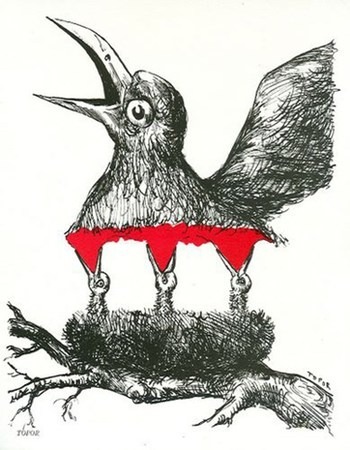 Some of Topor’s art. The man doesn’t like birds.
But at heart, The Tenant is a horror novel, and the horror is like a lobster dropped down your pants: strange and clammy. Trelkovsky wakes up to find himself made-up to look like a woman, he finds teeth hidden in a hole in the wall of his apartment, he finds himself followed, framed, stalked, and manipulated. All the guy wanted was a cheap apartment to call home, and instead what he got was a bunch of neighbors from hell, a soul shattered by existential angst, and a nightmare curse born in a spasm of blood and terror. It’s how close this is to most apartment-dweller’s actual experiences that make it so horrific.
 Yeah, Topor is that kind of artist.

Amazing film fest poster drawn by Topor.
October 7, 2013
Jack Chick wishes you a Very Satanic Halloween
There are comics, and then there are Jack Chick comics. Tiny religious tracts written by madmen, illustrated by violent prisoners on death row, and distributed by glassy-eyed zealots sweating buckets and mumbling to themselves in the subway, Jack Chick comics always start with an innocent sin (listening to rock music, being Jewish, having fun) and end with the sinner burning in Hell for all eternity while a demon points at them and guffaws “Haw Haw!”
And there is nothing Jack Chick hates more than Halloween. Or as he likes to call it…
 This is a comic where three little children dressed up as a devil, a witch, and a prophylactic (three of Jack Chick’s least favorite things) discover that trick or treating is a one-way ticket to Hell when…well, let Jack explain it.
 Everything in this fallen world begins with a Satanic cult meeting. Drug pushing, gay pride parades, Hollywood movies…
 Honey, don’t cover up with your cowl when you’ve spent so long on your totally sweet 80′s New Wave make-up.
 Dig those helpful footnotes.
 Ladies and gentlemen, our first Haw Haw. Welcome to Planet Chick!
 WHAT HAPPENED TO BOBBY LAST YEAR?????????????????????
 Okay, a ghost is, like, pretty much the easiest Halloween costume to draw. Seriously. I don’t expect a lot from Jack Chick’s artists, most of whom are drawing their comics with needles made of human bone and ink sucked out of ballpoint pens in their case worker’s offices then secreted in their cheeks until they arrive back at their halfway house, but come on. It’s a ghost.That’s basically a kid with a sheet over their head and two holes cut in the front for eyes. I don’t expect a lot but really?
 The earlier mention of candied apples filled with broken glass, and then the screaming child in the previous panel may have led you to believe that we were about to turn the page and get a HorrorCloseUp of a small child, mouth full of blood and shredded gums, staring out at the reader and screaming, but Jack Chick isn’t here to gratify your sick urges.
 Is that an oversized, lumpy iPad she’s watching TV on, or a melting mirror, or just a fucked up TV?
 Boom! The second Haw Haw, and this one’s a the dreaded, hard-to-execute Triple Haw. Chick is firing on all cylinders here.
 On Planet Chick, these are big problems. I mean, seriously, what child doesn’t normally love going to Sunday School? The ONLY possible answer is Satanic influence.
 Fucking druids. There’s only one thing Jack Chick hates more than witches, satanists, rock and roll bands, gay people, alcoholics, Jews, Muslims, Hindus, and Catholics and that’s druids. Seriously. Those guys suck.
 BUT WHAT HAPPENED TO BOBBY?????????????????????????
 I know it’s beside the point, but a jack-o-lantern with a candle made of human fat actually sounds pretty awesome.
 On Planet Chick there are two kinds of people: Jack Chick and suckers. Suckers are the people who fall for Satan’s endless, infinitely multiplying tricks and deceptions. You think a public school education is a cornerstone of democracy? Sucker! That’s what Satan wants you to think. Halloween is a harmless holiday? Sucker! You’re celebrating Christmas correctly? Sucker! You can’t get VD from a chair cushion, having a drink after work is harmless, watching horror movies is fun? Sucker, sucker, sucker!
 Sucker.
 Again: fucking druids.
 This is getting scary. And, incidentally, it’s also getting misspelled.
 And with a final @#*?#!! the minion of Satan is sent packing. Jack Chick, you are a genius. Tune in later this week for THE LITTLE PRINCESS, another fun-filled romp into a world where Halloween is spelled YOU’RE ALL GOING TO DIE AND BURN IN HELL FOREVER AND EVER AND EVER AND EVER!
October 5, 2013
House Rules
This illustration from EatYourLipstick on Family Rules is pretty great, but it covers the rules of a very small minority of families in America. These are the far more common rules from the house where I grew up:
- Don’t shotgun murder your parents!
- No meth!
- Evidence goes in the neighbor’s trash cans.
- When strangers call, we’re never home.
- 9-1-1 is a luxury, not a right.
- No dark rituals in the back or side yards. Basement only!
- And remember, above all: they’re not pets, they’re dinner.
When you’re a guest in someone else’s home:
- Always wipe your fingerprints!
- Refill any booze you drink with water or tea.
- Saying “Please” and “Thank you” ensures your victim’s cooperation.
 Useless.
October 4, 2013
Werewolf Erotica Should be Free!
Peter Orner, literary fiction novelist, has also become a court-recognized expert on werewolf erotica after testifying to the literary merits of same in a case involving an inmate in Pelican Bay whose chosen reading material, The Silver Crown, was confiscated by guards and deemed obscene. The judge ultimately found in favor of the inmate. I actually know Peter and I’m disturbed that he didn’t immediately get t-shirts printed up saying, “I am an expert on werewolf erotica. Ask me anything.” Although he offsets that failure by the fact that he did deliver the following understatement nugget in an interview, “Pelican Bay is one of the most violent prisons in California. . . . They’ve got some extraordinarily serious problems. My humble thought, speaking as a writer, is that an inmate reading a book about werewolves having sex is the least of their problems.” Hard to fit on a t-shirt, though.
 “T-shiiiirtssss???”
I’ve had to settle for reading the judge’s opinion and you can tell that writing this opinion was party time at the Justice’s house. But more than that, book reviewers could learn a lot from Justice James Richman’s style:
“We have reviewed the book. As will be described more fully below, the plot involves werewolves, witches, a ghost, and magic spells. It is 262 pages long with 44 chapters. There is a fair amount of violence in it, but that is not dwelt upon and is not
shocking or gory. There are also a great number of graphic sexual encounters, one per chapter through most of the book, including detailed descriptions of intercourse, sodomy,
oral genital contact, oral anal contact, voyeurism, exhibitionism, and ménage à trois.
Semen is mentioned. Crude slang is used to describe various body parts and the sex act
itself. The sex is sometimes rough but always consensual. Women are portrayed as
frequently aggressive, always willing, and seemingly insatiable. Men are portrayed as
frequently demanding, always ready, and seemingly inexhaustible. The sex occurs
between humans and werewolves, as well as intraspecies.
On the other hand, the sex appears to be between consenting adults. No minors
are involved. No bestiality is portrayed (unless werewolves count). And there is no
sadomasochism.”
Simple, dry, just the facts, but you get a good idea if this book is for you. Semen is mentioned – okay, it’s not a good present for grandma. The sex is sometimes rough but always consensual – maybe my boss would like it. I wish all book reviews were written this way.
The prosecution seems to have lost its cased based in part on the numerous spelling errors in its filings which Justice Richman delights in pointing out. However, part of the defense’s case also rests on the fact that there are three similar books available in the prison library (Kissing Sin and Full Moon Rising, Keri Arthur; Inner City Hoodlum, Donald Goines – and I’m eager to see prisoners looking for a quick wank to werewolf erotica trying to find meat-beating material in Goines’s hard-bitten African-American crime fiction). The third leg of their defense is Peter Orner‘s testimony.
 Page 17 of the opinion is where the good stuff starts, beginning with a serious description of the book’s complicated urban fantasy world-building that is a lesson in deadpan. Then, Justice Richman drops the genre history bomb with:
“To begin with, we cannot simply dismiss the work as nonserious literature because
it deals with werewolves and other paranormal creatures and activities. For better or
worse, some segment of the population is fascinated by werewolves and other mythical
beings, as most recently shown by the Twilight (Summit Entertainment 2008) movies. Werewolves, in fact, have played a role in popular fiction for centuries and became a
popular subject of the cinema, including the early films, Werewolf of London (Universal
Pictures 1935) and The Wolfman (Universal Pictures 1941).
“Whether contemporary readers drawn to this genre actually believe in werewolves, whether they see in such works a metaphor for some kind of human transformation, or whether they simply read werewolf literature as escapist fantasy, the fact remains that werewolf literature retains a place in modern American and European society.”
Then, Justice Richman pretty much schools everyone who has ever reviewed a book or engaged in a debate on the merits of reviewing books:
“Personally, we would be hard pressed to say The Silver Crown has ‘significant’ literary value and is a work ‘of great import.’ The majority opinion in Stevens, however, merely recited as a fact of record the jury instructions ascribing to the phrase the meaning ‘significant and of great import.’ It did not purport to establish a definition of the word ‘serious.’ And we do not read it as a mandate equating “serious” with “significant” and “of great import” in the obscenity context.
“Indeed, we question whether we should judge the superior or inferior literary merit of the book at all. We suspect it is the nature of the work rather than its quality that lends it ‘serious literary value.’ In other words, we attempt to determine whether the book is serious literature, not whether it is good literature.”
Boom! You can judge if a book is a serious attempt to be literature, but not whether or not it actually is good literature. Then, The Silver Crown is subjected to the kind of literary analysis from Orner that author Mathilde Madden has probably never received in her career:
“It’s not pornographic, it’s erotic fiction that centers around a relationship that consists of yes, a lot of sex but also love too. The book has a plot, a theme. Freedom, I would say is the main theme, a woman freeing herself from the confines of her set life―Alfie represents a kind of freedom she never had with her husband Blake. The complication, of course, is that he is a werewolf and a relationship with him interferes with her professional responsibility. This involves a universal problem: you have a certain responsibility to be one person, but life comes along and changes you.
“Further, the characters have a certain depth, personalities that make [them] distinct. The book has what I would call forward momentum, including plot twists, surprises, and a sense of resolution at the end, which leaves the door open to further adventures.
“The Silver Crown is a fantasy story, one that transports us into other worlds. Again, the characters have sex but the book is about more than sex. As I said above, it seems to me that the book is an exploration of the confines of a certain society, one that is in some ways similar to our own but that also contains magical elements. It’s about freeing oneself from one’s greatest fears, and in this way this is clearly a work of literature. It’s not Tolstoy, fine, but this author knows how to move story, carry out a plot, with a theme, and how to give her characters a certain depth characteristic of literary fiction.”
Finally, Justice Richman renders his own damned-with-faint-praise-but-still-not-pornography assessment:
“The characters are developed to a degree, with distinctive personalities, though deep introspection is lacking. Dialogue is employed to move the plot forward. There is frequent retrospective reference so as to fill the reader in on past events, most of which presumably were explored more fully in the first book of the trilogy. And though perhaps less than Shakespearean, a ghost of Iris’s dead brother appears in various scenes, especially to provide guidance to Iris in times of strife.”
And what’s his biggest gripe? The same gripe of urban fantasy series readers everywhere:
“The Silver Crown ends on an uncertain note, with the promise ‘To be continued’ as the final words of the book. This undoubtedly was intended to build suspense and whet the reader’s appetite for the third book of the trilogy.”
Boo! A sequel! That’s the real crime that was committed here today.
October 2, 2013
Ramsey Campbell’s THE FACE THAT MUST DIE
Ramsey Campbell started off as that lower than low lifeform, the Lovecraft imitator, but after a few years of derivative short story scribbling he busted wide open like a zit with two novels, The Doll Who Ate His Mother (1976) and, three years later, The Face That Must Die (1979) probably the only book ever written by a son trying to understand his mother’s schizophrenia which features razor killers, homicidal homophobia, and some of the most hallucinogenic prose this side of a King Crimson album. It was ripped raw from a deep place, technically precise, and deeply perverted, the kind of book that fit the times perfectly. The kind of book that is to be read while listening to the Sex Pistols’s 1979 The Great Rock n’Roll Swindle.

The recent reissue from Centipede (previously Millipede) Press.
Campbell is dedicated to transmuting the ordinary into the surreal through sheer technical prowess. He’s like a more goth David Lynch, or the David Cronenberg of Naked Lunch. As Too Much Horror Fiction has documented, he was a mainstay of Tor’s paperback line in the 80′s but his covers promising TERROR and BLOODY CHILDREN do a deep disservice to the industrial strength unease within.

She seems like a nice little girl…
 …OMG! she’s burning in HELL!!!
Campbell doesn’t write stories that are uneasy in their plotting or character development. His books are usually pretty straightforward when stripped of their style. Stories unfold in banal, middle-class settings: boarding houses, rundown seaside towns, anonymous suburbs, brutalist housing estates. His characters are usually a married couple experiencing tensions, a child at risk, a deeply obsessive neurotic coward. And his horrors are pretty rote – possession, ghosts, serial killers, blah blah blah. But it’s in the writing that he shines.
Campbell’s prose pulls off dazzling technical tricks, one after the other, making him a horror writer’s horror writer (who sometimes has a hard time finding a mass audience – as evidenced by the fact that in 2002 he started working in a chain bookstore). He’s strongest in his short stories where his heady, atmospheric writing goes down like horror acid and causes skulls to melt, but his earlier novels are still strong stuff, and nothing compares to the DMT madness of The Face That Must Die.
Face is the story of yet another miserable young couple (Cathy and Peter – yawn) who are having problems with their marriage. Meanwhile, in a more interesting part of the book shambles John Horridge, a middle-aged man who is terrified of gay people and obsessed with hunting down a razor killer who is slashing gay men. It’s not long before he himself become the razor killer (and maybe was all along) and after that it’s a quick collision with Cathy and Peter followed by a disappointingly action-based ending, which is redeemed with a spooky, oblique coda that seems to suggest that our “heroes” are about to find their faces hanging in tatters.
 The Centipede reissue unfortunately contains this photo
art that was part of the 80′s version of Face. It kind of
made me sad.
Campbell has talked before (and in this edition he talks again) about how this book was his attempt to inhabit his mother’s schizophrenia. Terrorized by her as he grew up, he wanted to get inside her head and John Horridge serves as a posthumous ventriloquist’s dummy, a psychic mouthpiece for her more vile racism and homophobia. If it all sounds a bit like a thesis paper, in practice it’s pretty thrilling. Campbell is a page magician, able to make innocent details throb with menace, misdirecting your attention to some grotesque curlicue while the real terror slips up on you from the other direction.
Horridge’s violence is downright banal. “He opened his eyes minutely, to see exactly where her head was. Then he struck until his arm was tired. He could tell he’d done enough by a change in the quality of the blows. That dismayed him, but it was easy not to think about.” Whoops, there’s someone’s head bashed in. How dismaying. But the everyday shimmers and pulsates like something surreal. In one of the book’s sweaty-palmed setpieces, Horridge buys a ticket to see The Rocky Horror Picture Show, is repulsed by how flamboyantly gay it is, and runs from the cinema, convinced the razor killer is right behind him. He’s not, but that doesn’t stop Campbell from pulling out all the stops:
“Revulsion surged through him, sweat burst out of his skin, gluing his clothes to him. The dim face that was bearing down on him was the face of the sketch in all the papers. An expression was emerging onto the face. It seems slow as corruption. Before it could reveal itself, he hurled open the double doors. Beyond them was another airlock. It was full of people, almost immobile beneath a stagnant spread of tobacco smoke. The hot thick cloth that blocked his way hardly yielded; people turned slowly to stare at him. He was panting, and deafened by his heartbeats.”
Later, he sits in his flat, but even that is tinged with horror:
“On Sunday, the children were intolerable. Horridge felt as though he were locked in a zoo. Did the neighbors let them out of their cages in shifts, to make sure there wouldn’t be a moment’s silence? Cries and squeals surrounded him until long after dark. A football pounded the wall of the flats, oppressive as a pulse, dismaying in its unpredictability. Just let them break his window – he thought of the razor in his coat pocket. He must control himself.”
Inanimate objects acquire malign life, bodies become stone, plastic, mold, and bark. Human activity is insectoid and nonsentient, while architecture plays with Horridge’s senses and plots his destruction. All in all, it’s incredibly insane and by the time one character actually drops acid you feel like it’s gilding the lily: how do you hallucinate in a book that’s nothing but hallucinations?
Most people first encountered Ramsey Campbell in Stephen King’s nonfiction Danse Macabre in which he spends a chunk of time with Campbell, describing his writing as the “…shifting perceptual haze of an LSD trip that’s just ending.” He reprints this passage from Campbell’s The Parasite and it’s what captured my attention as a kid:
“A group of toddlers watched her pass, their eyes painted into their sockets. On the ground floor, red and pink and yellow hands on stalks reached for her from the glove counter. Blind mauve faces craned on necks as long as arms; wigs roosted on their heads.”

Ooo…demon face in her hair…
 …demon parasite baby in her belly!
If you want to take on some straight Campbell, check out his chunky short story collection, Alone with the Horrors. His “In the Bag” about a haunted plastic bag (Ramsey Campbell is the H.P. Lovecraft of plastics), gives you a taste, and “The Chimney” is one of the most disgusting, and true, stories ever written about Santa Claus. Either of these will serve as the gateway drug to let you know if your mind is strong enough for the channeled schizoid madness of The Face That Must Die, a title that trembles with self-loathing, an invitation to mutilate the self.
September 25, 2013
World’s Best/Worst Bar
What would you call a bar that has an African theme, and by “African theme” I mean zebra skin seats, pictures of “natives”, Zulu spears and shields mounted on the walls, and a whole Colonial Rwandan vibe going on? Well, if you live in Barcelona, there’s only one name possible:

Maybe that’s a mistake? Maybe they didn’t mean Obama, the President of the United States?
 Nope.
Nope.
And it wasn’t just the life-sized statue of President Obama by the front door that was problematic, it was the life-sized statue of President Obama by the front door of this place.


So what did I do, confronted with this display of enormous disrespect and unpleasant racial stereotypes? Well, my brain kind of short circuited and I ordered their signature drink, The Obama.
 It tasted like everything I hate about Europe. With gin.
August 5, 2013
Missing until September
This blog is not dead, it’s only resting. I’m on a deadline for a novel, and so I won’t be updating until it’s turned in on September 16th.
In the meantime, have an American Apocalypse!!!!
July 11, 2013
Wizard?
Have a wizard…

No, make that…

July 8, 2013
25 Cold Weather Netflix Movies To Watch While Your Brain Melts
We are in the middle of a hideous heat wave that is going to kill us all. Our only hope is to keep watching movies that feature people lounging around in their bulky winter gear the way Victoria’s Secret models lounge around in their underwear. Below are 25 movies on Netflix Instant that you can stare at longingly as you try to bring your body core temperature down. For more Netflix Streaming suggestions, check out my Netflix Streaming Safari.
 ARCTIC BLAST – Australian exploitation legend, Brian Trenchard-Smith (BMX Bandits, Dead End Drive-In), turns in a hilariously awful horror movie about killer cold weather.
 ANTARCTIC JOURNAL – several South Koreans slowly freeze to death in the Antarctic. Sounds like the best trip ever.
 ATM – shot in the middle of a Manitoba winter, a bunch of under-dressed people get trapped in an ATM and stalked by a guy in a heavy winter parka. Have you ever heard a phrase sexier than “in the middle of a Manitoba winter”?
 APRIL SNOW – this Korean romance is about people moodily watching snow fall outside their windows, which gives them sadness boners and makes them both depressed and horny.
 BREAKHEART PASS – Charles Bronson is on a train to cowboy country because there are…oh, who cares. It’s snowing!
 CANNIBAL THE MUSICAL – the South Park guys make a musical about the Donner Party. As we all know, the Donner Party were so excited to be snowed in one week that they ate each other.
 THE CORRIDOR – an indie-thriller-horror movie about some friends who get together for a bonding weekend at a snowy cabin in the woods. You won’t be able to follow the plot because you’ll be drooling over the snowy forest scenery.
 DEAD SNOW – zombie Nazis are dumb as dirt, but when they’re in Norway they are just cute little frozen ice cubes of race hate.
 GOON – a movie about ice hockey. They had me at “ice.”
 THE GREY – there is so much wonderful ice and snow in this film about Liam Neeson and some wolves romping in a winter wonderland that I can almost forgive them for spelling “gray” like pretentious Europeans.
 HYPOTHERMIA – it may or may not be very good, but when Michael Rooker goes ice fishing you’ll want to rest your feverish face against the TV screen.
 A HORRIBLE WAY TO DIE – it may be a horrible way to die, but at least it happens in the winter and everyone bundles up tight in a sassy selection of parkas, sweaters, and down jackets.
 IT’S A PLEASURE – this Sonja Henie musical from the 40′s features a nightclub with a solid ice dance floor. Sold!
 JINGLE ALL THE WAY – the only thing colder than the winter scenery in this film are Sinbad’s fashion choices…which are super-cool.
 LET THE RIGHT ONE IN – a little vampire girl gallivants through the snow with her pre-pubescent boyfriend. Bulky Sweater Watch: high.
 MIDNIGHT EAGLE – Japanese movie about a plane where are the passengers get so hot that they crash it into the snow-covered Hida mountains. Then everyone runs outside and makes snow angels.
 NORTH FACE – people get so outrageously overheated that they climb a freezing cold mountain and die.
 RARE EXPORTS – any movie about a killer Santa Claus in Finland is bound to feature lots of scenes set in the snow, and on the winter precipitation front this flick doesn’t disappoint.
 TRADING PLACES – the ultimate Christmas movie. Also, it takes place in Philadelphia which looks bleak and wintry even in Spring.
 TOKYO GODFATHERS – so many scenes of animated snow. Sooo many. Also, it takes place on Christmas Eve and features a bunch of homeless people who are always cold and shivering, so it’s like watching temperature porn.
 VIBRATOR – Japanese movie about sex that takes place in the middle of winter when everyone dresses in layers. Also, the sex is sort of cold and inhuman, so that helps keep the temperature low.
 THE THING – given the amount of Arctic scenery on view, and the way Kurt Russell’s beard keeps freezing solid, you can finally masturbate to John Carpenter’s holiday film and not feel like a total pervert.
 TROLLHUNTER – it takes place in Norway. In the Winter. Outdoors. ‘Nuff said.
 YOUNG SHERLOCK HOLMES – little known fact: YOUNG SHERLOCK HOLMES takes place in the middle of winter and the bad guy dies by falling into the frozen River Thames. Which sounds heavenly.
 UNITED RED ARMY – Japanese socialists torture each other to death, mostly in the freezing cold, and mostly in remote mountain locations. The ending is like an orgasm made of ice.