Anna Stepanova's Blog
December 17, 2013


August 21, 2013
How wonderful the world is!
I’m grateful to God for giving me strength and opportunity to fulfil the dream of my life: comprehend the past of my motherland, express my view on it and write a book devoted to my father. As a contrast to the horrors of war and repressions my daughter and I want to convey the message of how wonderful the world is, how great the human abilities are, how precious the human life is and how fragile...
Я благодарна Богу за то, что он дал мне возможность и силы осуществить мечту моей жизни – осознать прошлое моей родины, выразить свой взгляд на него и написать книгу, посвященную моему отцу. Контрастом к ужасам репрессий и войны я и моя дочь хотим представить тему как прекрасен этот мир, как неисчерпаемы возможности человека, как ценна человеческая жизнь и как хрупка.
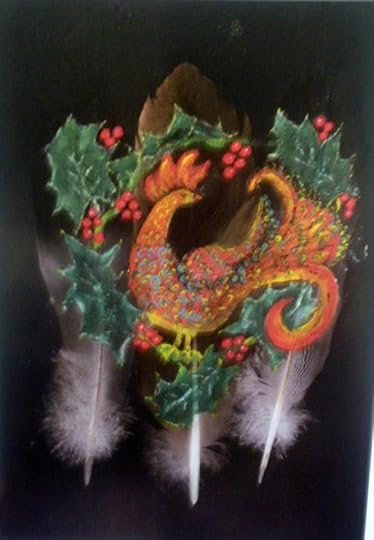
This is my interpretation of the Russian folk motif “The bird of happiness”. Happiness is often compared with a bird, probably because it’s flitting. May the deep joy of life and love be with us always, even when we’re facing trouble.
Это моя вариация на тему русского мотива «Птица счастья». Счастье часто сравнивают с птицей, наверное из-за его мимолётности. Пусть же глубокая радость жизни и любви будет с нами всегда, даже когда мы сталкиваемся с проблемами.
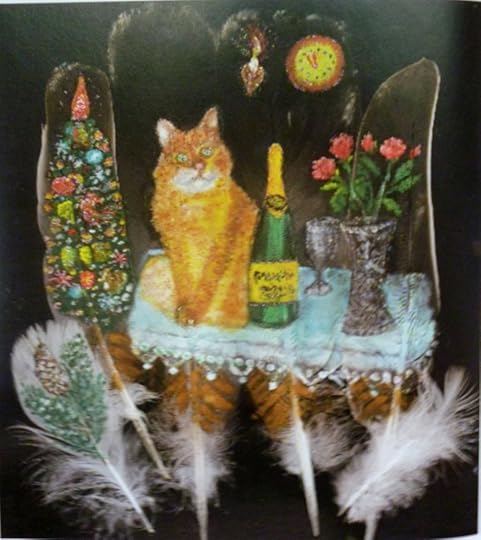
I’m sure if we brought our cat John to England with us he would have taken an active part in my writing project. Always curious, he was an active participator in everything we did. When I was washing the windows, he helped me from the other side. Once we were painting the walls, he jumped on my back and for about 15 minutes I worked under his direct supervision. He was a superb supervisor, I must say: when plumbers came, he would examine all their tools very carefully and watch what they did, when we had our piano tuned, John showed a lot of interest in the process and even managed to climb inside it. He was a great helper to Irina. As a host he met her students at the door, saw them to the table, lay on it himself and watched the teacher and students intently. He sat on Irina’s lap during the long sleepless nights, when she wrote her book “Hello, England”. When guests came he would pay attention to everybody: sit near them on the chair, rub against their back and move on to the next one. Once the guests had left, but the bottle remained. He sat near it proudly as if giving a verdict: the party went well.
Представляя картину с нашим любимым котом Джоником, я очень явно представила его всёпонимающий любопытный взгляд и обязательное участие во всём, что бы я ни делала. Я мою окно, он с другой стороны помогает. Как-то мы белили стены, он выскочил мне на спину, и какое-то время мы работали вдвоём. Придёт ли сантехник, Джоник обследует весь инструмент, настройщик пианино – он и там поучаствует, умудрился внутрь залезть. Он был просто неповторимым помощником Ирины. Как хозяин встречал у дверей учеников, провожал их к столу, вольготно устраивался и внимательно следил за студентами и преподавателем, периодически лапкой подвигая к себе тетрадки. Он долгими ночами сидел у Ирины на коленях, когда она на компьютере печатала свою книгу «Как много в слове Англия слилось». Когда приходили гости, он каждому уделял внимание: запрыгнет на стул, погреет спинку, и к следующему. Но вот гости ушли, а бутылка осталась. Он с гордым видом сел рядом и констатировал: «Вечер прошёл хорошо»!
I am a child of nature in mind and body. I can feel every bush, every tree. I remember when I was going through hard times back in Almaty I always went to the Botanical garden or to the mountains. I felt the power of life of the forest, the majesty of the mountains and all the problems melted away. My heart filled with joy: “The world is beautiful, and I am part of it”. It made me want to sing: “Thank, my soul, thank the Lord!”
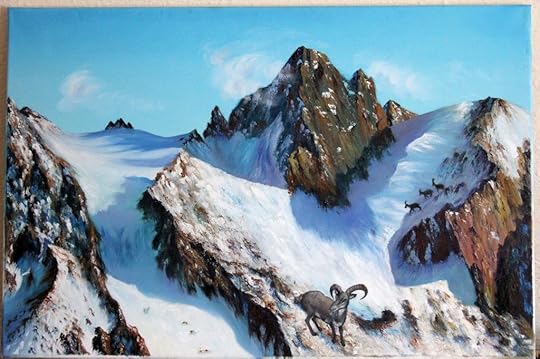
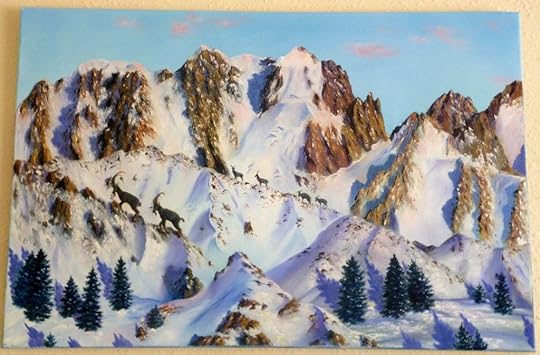
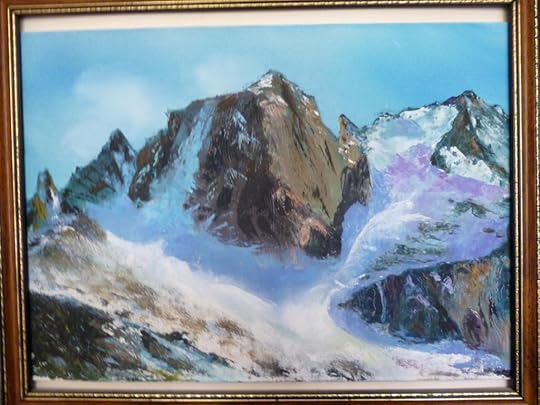
My daughter Irina likes to paint nature, particularly mountains. These are Irina’s pictures of the mountains around the famous ski resort Chimbulak near Almaty. When I look at these pictures I remember the words of a famous Soviet bard Vladimir Visotsky: “There can be only one thing better than the mountains, and that’s the mountains where you haven’t been yet”. I look at her mountain landscapes and physically sense the grandeur of the mountains, the tranquillity of mountain air and unusual spiritual uplifting they exert. The mountains are where you feel close to space, to God. I close my eyes and imagine that I fly to the creator of this incredible beauty with gratitude and amazement, and he hears me.
Душой и телом я дитя природы, я глубоко чувствую каждый кустик, каждое дерево. Когда мы жили в Алмате, в минуты тяжкие я всегда шла или в ботанический сад или в горы пусть даже одна. Я чувствую силу жизни леса, величие гор, и все проблемы растворяются. Душа ликует: «Мир прекрасен. А я - частица его.» Так хочется жить! Так хочется петь. И я часто пою: «Благодари душа моя, благодари Господа! Всем сердцем всей душой своею –благодари!»
Моя дочь Ирина любит рисовать природу, и особенно горы. Это картины Ирины - горы в районе всемирно знаменитой горнолыжной базы Чимбулак. Когда смотришь на эти картины, на ум сразу приходят известные слова Владимира Высоцкого «Лучше гор быть могут только горы, на которых ещё не бывал». Всем, кто побывал в горах, знакомо чувство необычайного притяжения. Ни тяжесть испытаниний, ни опасность сложных восхождений не остановят истинного любителя гор. Я смотрю на Иринины картины гор и просто физически ощущаю их величие, прозрачность горного воздуха и с ностальгией вспоминаю небычайное состояние духа. Именно в горах ощущаешь близость к космосу, к Богу. Закроешь глаза, и кажется ты летишь с благодарностью и восхищением к Создателю этой поистине фантастической красоты, и Он тебя тебя слышит.
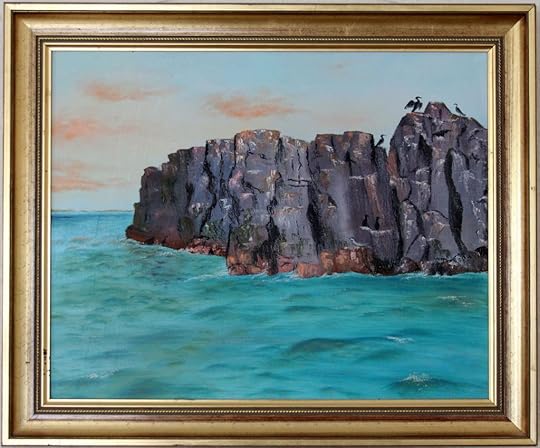
I have never been to the Farn Islands, but I share Irina’s fascination with the combination of dramatic rocks and calm azure sea. The number of beautiful combinations our Earth has produced is indeed endless!
Я не была на границе Англии с Шотландией, но глядя на картину Ирины, где она изобразила Farn Islands, я в восторге. Сказочные скалы окружены спокойнодышащим лазурным морем. Как много на нашей планете разных потрясающих по красоте уголков природы!
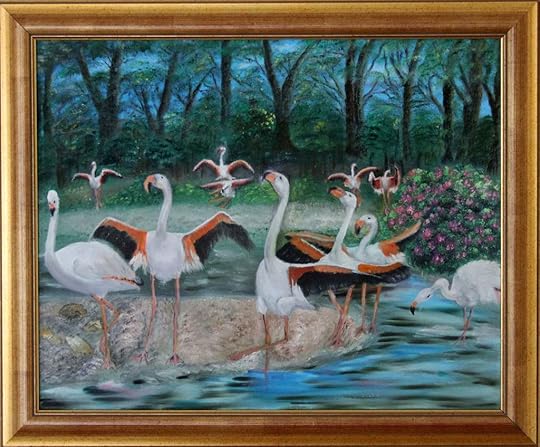
I also find inspiration for my pictures in nature. When we visited the Slimbridge nature reserve, I was absolutely breath taken by the spectacle of flamingo ballet. The flamingo in the centre of the picture flipped his wings like a conductor and the whole flock was set into motion. We were amazed by their graceful and expressive movements. Like in a real ballet all performers moved simultaneously; only some individuals for an inexplicable reason remained indifferent...
Я тоже нахожу вдохновление для своих картин в природе. Когда мы посещали природный парк Слимбридж, я была в полном восторге от балета фламинго. Фламинго в центре как балетмейстер взмахивал крыльями, и всё приходило в движение. Мы наблюдали сцену настоящего балета с изящными характерными движениями и выразительными позами. Все исполнители, как полагается, двигались одновременно, только некоторые особы по необъяснимым причинам оставались равнодушными...
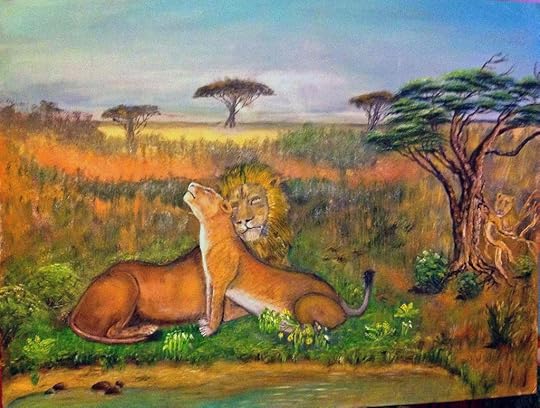
This picture is called “The royal love”. Folklore calls the lion the king of animals. When we visited the Safari park near Bewdley where the animals roam around freely we watched some curious scenes of behaviour of these majestic animals. The handsome lion was sitting gracefully as if on a throne some distance away from the lionesses, who were watching him closely. One of them went up to him with a purely feminine coquetry and leaned on him, walked around hum and the snuggled up to him again. The lion ignored her. The lioness continued tempting him, until he at last showed interest. He was ready for action, but the lioness unexpectedly for us turned round and walked away. The lion looked at his harem and assumed the same royal posture of an observer. In a little while the lioness returned and lay on her back near the lion, showing off her tempting belly. But the King remained indifferent. The second time we watched interesting lion behaviour in Dudley zoo. There were two lionesses there and the lion like a real king occupied the pedestal. One of the lionesses flirted with his majesty. She nestled up to him so tenderly, that the sternness of the predator turned into the expression of relish and touching love. I painted this moving scene not from a photograph, but from my own imagination. All living creatures can enjoy the divine feeling of love. I wanted to paint “the royal love”.
Эта картина называется «Царская любовь». Лев прозван в народном творчестве Царь зверей. Посещая сафари-парк, где хищиники находятся не в клетках, а на открытом пространстве, мы из окна машины наблюдали любопытные сцены поведения этих «царских особ». Красавиц лев несколько отделившись от львиц восседал как на троне. Неподалёку за ним наблюдали по меньшей мере десяток Львиц. Одна, осмелев, с истинно женским кокетством подошла к нему, прислонилась, обошла вокруг, снова крепко прижалась. Лев - ноль внимания. Львица продолжала соблазнять, наконец он не выдержал и проявил готовность к действию. Но Львица совершенно неожиданно для нас повернулась и ушла прочь. Лев, посмотрев на свой гарем, принял прежнюю царственную позу наблюдателя. Через какое-то время Львица вернулась, легла рядом со Львом на спинку, демонстрируя свой соблазнительный животик. Но Царь оставался невозмутимым. Второй раз мы наблюдали интересное поведение львов в зоопарке Дадли. Здесь было две львицы и лев как настоящий царь восседал на помосте. Одна из львиц подошла, пококетничала перед властелином, прижалась к нему с такой нежностью, что суровость хищиника в одночас приняла выражение наслаждения и любви. Эта трогательная сцена получилась не по фотографии, а по моему воображению. Столь божественное чувство, любовь, характерно для всех живых существ. Мне захотелось изобразить «царскую любовь».
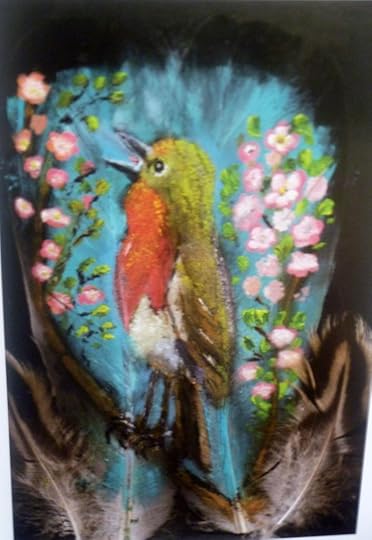
The bird choir never disappoints; we try to recognize who the soloists are, which can be quite a challenge. I’m especially moved by the songs of a robin, which I first heard in England. I will never forget my birthday in 2006 – my first year here. Robin sat on the top of the cypress opposite my window and sang almost all day. It produced such incredible warbles, variations and play of sounds that I felt as if I was in heaven. At sunset its breast was lit up with sun rays. I gasped in amazement: “So that’s what the robin is like – its breast is like the sun at dawn or sunset and in singing it matches the nightingale”! Since we moved to a house I can often sense somebody’s intent gaze when I work in the garden. I turn round and see robin looking at me with her big expressive eyes. I devoted my first painting on feathers to robin. Now I know that robin is the favourite bird in England. Its voice stands out among all other voices in the bird choir.
Птичий хор всегда поражает. Теперь мы пытаемся узнать кто солирует в хоре - непростая задача. В 2006 году 3 июня я первый раз приехала в Англию и была поражена красотой природы. Мы жили тогда в многоквартирном доме. Напротив моего окна росла высокая туя. Часто на самой верхушке маленькая серенькая птичка пела звонким голосом удивительные разнообразные мелодии. Моё сердце просто замирало. Но в июле и августе она прилетала редко, и я очень скучала. 26 сентября в день моего дня рождения я получила незабываемый подарок. Птичка почти весь день заливалась такими трелями, переливами, что я ощутила себя словно в раю. На закате её грудка осветилась лучами солнца. Я ахнула от удивления: оказывается у неё оранжевая грудка, как солнце на закате или на рассвете. «А, так это и есть зарянка, - подумала я – действительно достойный соперник соловья». Но в Алмате я никогда её не видела и не слышала. А здесь познакомилась совсем близко. Когда мы переехали в свой дом, часто работая в саду, я ощущала на себе чей-то внимательный взгляд. Поворачиваюсь, а это Робин смотрит своими круглыми глазками. Первый мой рисунок маслом на перьях я посвятила Робину. Теперь я знаю, Робин - самая любимая птичка англичан. Её голос очень ярко выделяется даже в большом лесном птичьем хоре.
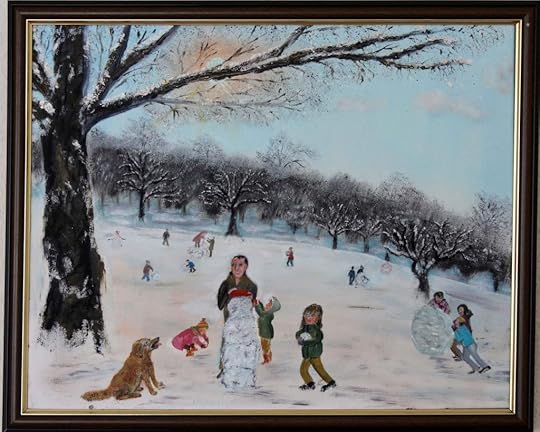
Snow is quite a rare event in England. In 2010 the first snow in Coventry was in February. The walk in the Memorial Park plunged us into a winter festivity. The school-children had a day-off, children and parents were enthusiastically making snow-men, all were enjoying the winter fairy-tale. That’s what I wanted to convey in this picture.
Снег в Англии – явление редкое. В 2010 году первый раз снег выпал в Ковентри в феврале. В парке царила атмосфера зимнего праздника. Школьникам был дан выходной, дети, родители и молодёжь в едином порыве строили снеговиков. Все были в атмосфере волшебной зимней сказки.

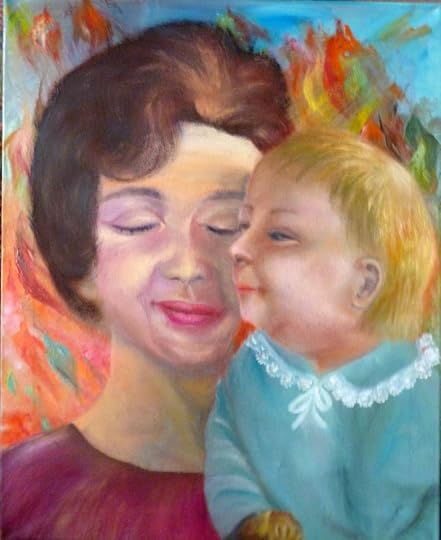
Love from the first sight and forever - this is the these of the picture Irina painted of me and herself.
Я благодарна Богу за то, что он дал мне возможность и силы осуществить мечту моей жизни – осознать прошлое моей родины, выразить свой взгляд на него и написать книгу, посвященную моему отцу. Контрастом к ужасам репрессий и войны я и моя дочь хотим представить тему как прекрасен этот мир, как неисчерпаемы возможности человека, как ценна человеческая жизнь и как хрупка.
This is my interpretation of the Russian folk motif “The bird of happiness”. Happiness is often compared with a bird, probably because it’s flitting. May the deep joy of life and love be with us always, even when we’re facing trouble.
Это моя вариация на тему русского мотива «Птица счастья». Счастье часто сравнивают с птицей, наверное из-за его мимолётности. Пусть же глубокая радость жизни и любви будет с нами всегда, даже когда мы сталкиваемся с проблемами.

I’m sure if we brought our cat John to England with us he would have taken an active part in my writing project. Always curious, he was an active participator in everything we did. When I was washing the windows, he helped me from the other side. Once we were painting the walls, he jumped on my back and for about 15 minutes I worked under his direct supervision. He was a superb supervisor, I must say: when plumbers came, he would examine all their tools very carefully and watch what they did, when we had our piano tuned, John showed a lot of interest in the process and even managed to climb inside it. He was a great helper to Irina. As a host he met her students at the door, saw them to the table, lay on it himself and watched the teacher and students intently. He sat on Irina’s lap during the long sleepless nights, when she wrote her book “Hello, England”. When guests came he would pay attention to everybody: sit near them on the chair, rub against their back and move on to the next one. Once the guests had left, but the bottle remained. He sat near it proudly as if giving a verdict: the party went well.
Представляя картину с нашим любимым котом Джоником, я очень явно представила его всёпонимающий любопытный взгляд и обязательное участие во всём, что бы я ни делала. Я мою окно, он с другой стороны помогает. Как-то мы белили стены, он выскочил мне на спину, и какое-то время мы работали вдвоём. Придёт ли сантехник, Джоник обследует весь инструмент, настройщик пианино – он и там поучаствует, умудрился внутрь залезть. Он был просто неповторимым помощником Ирины. Как хозяин встречал у дверей учеников, провожал их к столу, вольготно устраивался и внимательно следил за студентами и преподавателем, периодически лапкой подвигая к себе тетрадки. Он долгими ночами сидел у Ирины на коленях, когда она на компьютере печатала свою книгу «Как много в слове Англия слилось». Когда приходили гости, он каждому уделял внимание: запрыгнет на стул, погреет спинку, и к следующему. Но вот гости ушли, а бутылка осталась. Он с гордым видом сел рядом и констатировал: «Вечер прошёл хорошо»!

I am a child of nature in mind and body. I can feel every bush, every tree. I remember when I was going through hard times back in Almaty I always went to the Botanical garden or to the mountains. I felt the power of life of the forest, the majesty of the mountains and all the problems melted away. My heart filled with joy: “The world is beautiful, and I am part of it”. It made me want to sing: “Thank, my soul, thank the Lord!”
My daughter Irina likes to paint nature, particularly mountains. These are Irina’s pictures of the mountains around the famous ski resort Chimbulak near Almaty. When I look at these pictures I remember the words of a famous Soviet bard Vladimir Visotsky: “There can be only one thing better than the mountains, and that’s the mountains where you haven’t been yet”. I look at her mountain landscapes and physically sense the grandeur of the mountains, the tranquillity of mountain air and unusual spiritual uplifting they exert. The mountains are where you feel close to space, to God. I close my eyes and imagine that I fly to the creator of this incredible beauty with gratitude and amazement, and he hears me.
Душой и телом я дитя природы, я глубоко чувствую каждый кустик, каждое дерево. Когда мы жили в Алмате, в минуты тяжкие я всегда шла или в ботанический сад или в горы пусть даже одна. Я чувствую силу жизни леса, величие гор, и все проблемы растворяются. Душа ликует: «Мир прекрасен. А я - частица его.» Так хочется жить! Так хочется петь. И я часто пою: «Благодари душа моя, благодари Господа! Всем сердцем всей душой своею –благодари!»
Моя дочь Ирина любит рисовать природу, и особенно горы. Это картины Ирины - горы в районе всемирно знаменитой горнолыжной базы Чимбулак. Когда смотришь на эти картины, на ум сразу приходят известные слова Владимира Высоцкого «Лучше гор быть могут только горы, на которых ещё не бывал». Всем, кто побывал в горах, знакомо чувство необычайного притяжения. Ни тяжесть испытаниний, ни опасность сложных восхождений не остановят истинного любителя гор. Я смотрю на Иринины картины гор и просто физически ощущаю их величие, прозрачность горного воздуха и с ностальгией вспоминаю небычайное состояние духа. Именно в горах ощущаешь близость к космосу, к Богу. Закроешь глаза, и кажется ты летишь с благодарностью и восхищением к Создателю этой поистине фантастической красоты, и Он тебя тебя слышит.


I have never been to the Farn Islands, but I share Irina’s fascination with the combination of dramatic rocks and calm azure sea. The number of beautiful combinations our Earth has produced is indeed endless!
Я не была на границе Англии с Шотландией, но глядя на картину Ирины, где она изобразила Farn Islands, я в восторге. Сказочные скалы окружены спокойнодышащим лазурным морем. Как много на нашей планете разных потрясающих по красоте уголков природы!

I also find inspiration for my pictures in nature. When we visited the Slimbridge nature reserve, I was absolutely breath taken by the spectacle of flamingo ballet. The flamingo in the centre of the picture flipped his wings like a conductor and the whole flock was set into motion. We were amazed by their graceful and expressive movements. Like in a real ballet all performers moved simultaneously; only some individuals for an inexplicable reason remained indifferent...
Я тоже нахожу вдохновление для своих картин в природе. Когда мы посещали природный парк Слимбридж, я была в полном восторге от балета фламинго. Фламинго в центре как балетмейстер взмахивал крыльями, и всё приходило в движение. Мы наблюдали сцену настоящего балета с изящными характерными движениями и выразительными позами. Все исполнители, как полагается, двигались одновременно, только некоторые особы по необъяснимым причинам оставались равнодушными...

This picture is called “The royal love”. Folklore calls the lion the king of animals. When we visited the Safari park near Bewdley where the animals roam around freely we watched some curious scenes of behaviour of these majestic animals. The handsome lion was sitting gracefully as if on a throne some distance away from the lionesses, who were watching him closely. One of them went up to him with a purely feminine coquetry and leaned on him, walked around hum and the snuggled up to him again. The lion ignored her. The lioness continued tempting him, until he at last showed interest. He was ready for action, but the lioness unexpectedly for us turned round and walked away. The lion looked at his harem and assumed the same royal posture of an observer. In a little while the lioness returned and lay on her back near the lion, showing off her tempting belly. But the King remained indifferent. The second time we watched interesting lion behaviour in Dudley zoo. There were two lionesses there and the lion like a real king occupied the pedestal. One of the lionesses flirted with his majesty. She nestled up to him so tenderly, that the sternness of the predator turned into the expression of relish and touching love. I painted this moving scene not from a photograph, but from my own imagination. All living creatures can enjoy the divine feeling of love. I wanted to paint “the royal love”.
Эта картина называется «Царская любовь». Лев прозван в народном творчестве Царь зверей. Посещая сафари-парк, где хищиники находятся не в клетках, а на открытом пространстве, мы из окна машины наблюдали любопытные сцены поведения этих «царских особ». Красавиц лев несколько отделившись от львиц восседал как на троне. Неподалёку за ним наблюдали по меньшей мере десяток Львиц. Одна, осмелев, с истинно женским кокетством подошла к нему, прислонилась, обошла вокруг, снова крепко прижалась. Лев - ноль внимания. Львица продолжала соблазнять, наконец он не выдержал и проявил готовность к действию. Но Львица совершенно неожиданно для нас повернулась и ушла прочь. Лев, посмотрев на свой гарем, принял прежнюю царственную позу наблюдателя. Через какое-то время Львица вернулась, легла рядом со Львом на спинку, демонстрируя свой соблазнительный животик. Но Царь оставался невозмутимым. Второй раз мы наблюдали интересное поведение львов в зоопарке Дадли. Здесь было две львицы и лев как настоящий царь восседал на помосте. Одна из львиц подошла, пококетничала перед властелином, прижалась к нему с такой нежностью, что суровость хищиника в одночас приняла выражение наслаждения и любви. Эта трогательная сцена получилась не по фотографии, а по моему воображению. Столь божественное чувство, любовь, характерно для всех живых существ. Мне захотелось изобразить «царскую любовь».

The bird choir never disappoints; we try to recognize who the soloists are, which can be quite a challenge. I’m especially moved by the songs of a robin, which I first heard in England. I will never forget my birthday in 2006 – my first year here. Robin sat on the top of the cypress opposite my window and sang almost all day. It produced such incredible warbles, variations and play of sounds that I felt as if I was in heaven. At sunset its breast was lit up with sun rays. I gasped in amazement: “So that’s what the robin is like – its breast is like the sun at dawn or sunset and in singing it matches the nightingale”! Since we moved to a house I can often sense somebody’s intent gaze when I work in the garden. I turn round and see robin looking at me with her big expressive eyes. I devoted my first painting on feathers to robin. Now I know that robin is the favourite bird in England. Its voice stands out among all other voices in the bird choir.
Птичий хор всегда поражает. Теперь мы пытаемся узнать кто солирует в хоре - непростая задача. В 2006 году 3 июня я первый раз приехала в Англию и была поражена красотой природы. Мы жили тогда в многоквартирном доме. Напротив моего окна росла высокая туя. Часто на самой верхушке маленькая серенькая птичка пела звонким голосом удивительные разнообразные мелодии. Моё сердце просто замирало. Но в июле и августе она прилетала редко, и я очень скучала. 26 сентября в день моего дня рождения я получила незабываемый подарок. Птичка почти весь день заливалась такими трелями, переливами, что я ощутила себя словно в раю. На закате её грудка осветилась лучами солнца. Я ахнула от удивления: оказывается у неё оранжевая грудка, как солнце на закате или на рассвете. «А, так это и есть зарянка, - подумала я – действительно достойный соперник соловья». Но в Алмате я никогда её не видела и не слышала. А здесь познакомилась совсем близко. Когда мы переехали в свой дом, часто работая в саду, я ощущала на себе чей-то внимательный взгляд. Поворачиваюсь, а это Робин смотрит своими круглыми глазками. Первый мой рисунок маслом на перьях я посвятила Робину. Теперь я знаю, Робин - самая любимая птичка англичан. Её голос очень ярко выделяется даже в большом лесном птичьем хоре.

Snow is quite a rare event in England. In 2010 the first snow in Coventry was in February. The walk in the Memorial Park plunged us into a winter festivity. The school-children had a day-off, children and parents were enthusiastically making snow-men, all were enjoying the winter fairy-tale. That’s what I wanted to convey in this picture.
Снег в Англии – явление редкое. В 2010 году первый раз снег выпал в Ковентри в феврале. В парке царила атмосфера зимнего праздника. Школьникам был дан выходной, дети, родители и молодёжь в едином порыве строили снеговиков. Все были в атмосфере волшебной зимней сказки.


Love from the first sight and forever - this is the these of the picture Irina painted of me and herself.
August 15, 2013
Charity
By helping somebody else we always enrich ourselves and our lives, we make our lives more meaningful. Do you agree? Do you have any experience of this kind? Let me tell you about my experience.
In my book “Love and tears” I showed some bright examples of devilish, cruel actions and really honourable ones, lit with divine inspiration. Both my daughter and I try to fulfil the philosophy of valuing the human life and nature through our lives. Getting to know the Karachevi family is really the blessing of God both for us and for this large family living in unimaginably poor conditions. Nina and Andrei (the parents) prayed fervently and God heard their prayer. When we saw the program on the Russian TV, which showed a family of 7 children and their parents living in a shed without many basic things such as an iron, a fridge, and so on, our hearts were touched with a flash from God.
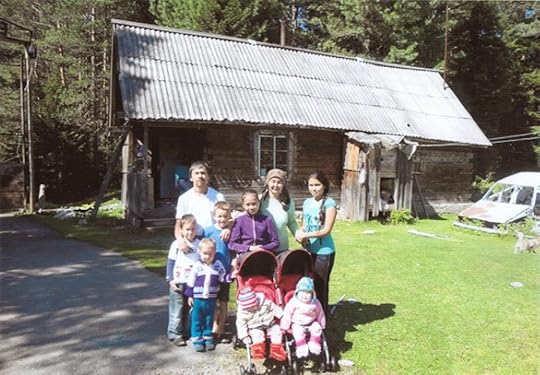
We couldn’t remain calm since then and together with other people of Russia we helped them to buy a computer, a camera and some other necessary things. Now we communicate with them very closely. Irina teaches English to the elder daughter Annushka on Skype, and we are going to invite her to visit us next year. I communicate with the parents and children. The children are like angels, all raised in great love. “It’s just a sin not to help this family build a house” – we thought.
Here is a recent picture painted by Anna Karacheva "The Inspiration of spring".
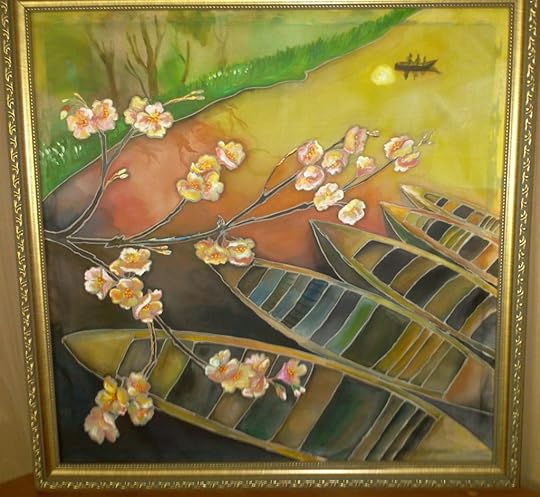
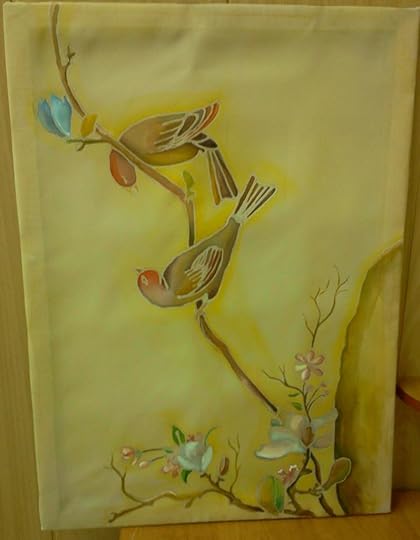
She is a very talented painter, we are amazed how she managed to develop her talent in such conditions. Here is one more of her pictures.
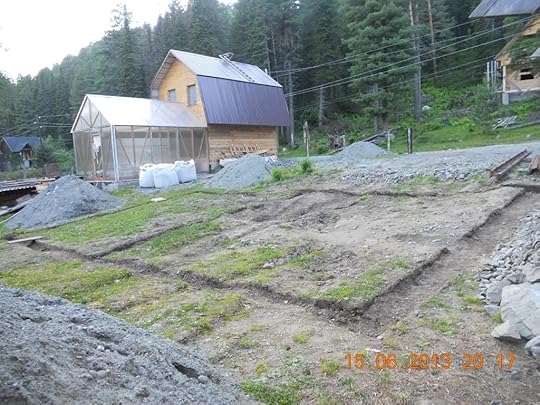
I wrote to the President, the government and local administration, different political parties, businessmen and so on. In 2011 the local administration allocated £10 000 for this project, but nobody else expressed desire to help. It was not enough to build a house. Last year we sent them £10 000 and this year another £6 000. The construction is underway. Last year they prepared the site for construction, built a sauna and a green-house, this year they laid the foundation for the house. In this picture you can see the greenhouse, the sauna and the layout for the foundation, which has now been set.
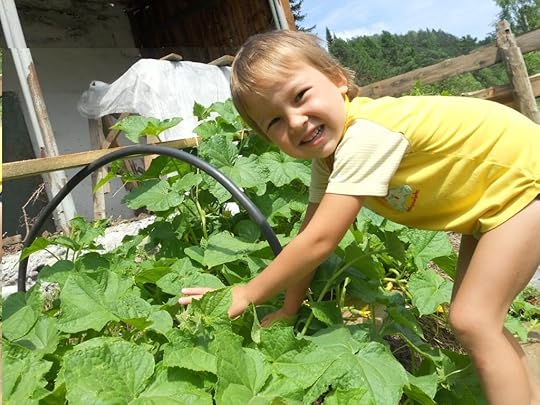
In June 2013 they had the eighth baby – Maxim. Now the family has a real hope that everything will be sorted out according to God’s will. All the family is working hard together to improve their life, to make their dream a reality. With our inspiration they've started growing vegetables and fruit. What a joy it is for all the family to get their own harvest!
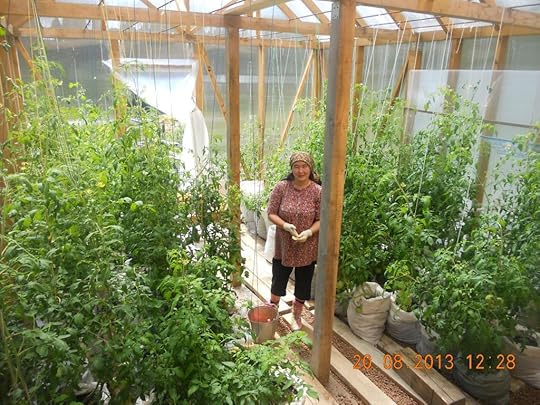
Nina tries to use hear greenhouse to its full capacity.
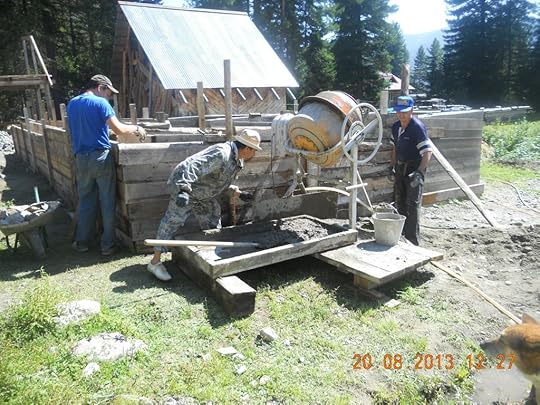
The father carries the brunt of responsibility. He is a good carpenter and a handyman in DIY jobs.
Here we can see him checking on the concrete mixer and working together with the builders.
In winter he has to buy more wood, saw it and finish the construction next year. It requires more financial help. We enjoy helping them, because we see how we are giving them an opportunity to become self sustainable, to use and develop their talents and create a solid foundation for their children. We exchange ideas on marriage, bringing up children, philosophical ideas on the importance of love, understanding, empathy, religion and practical things such as growing fruit and vegetables. We learn from each other. Following their steady progress in building the house and improving their lives, the achievements of their children gives us something to look forward to all the time. We see our mission in helping this family help themselves. We have an opportunity to go to the restaurant, travel and so on, but nothing can compare with the feeling of joy from knowing that we help the family to advance themselves. As James said in chapter 1 verse 17 “ Every good and perfect gift is from above, coming down from the Father of the heavenly lights, who does not change like shifting shadows”.
We want, however, our experience to go further, because there are very many families, which need such help in Russia and indeed everywhere in the world, and our experience, we believe, is useful in organizing it on a large scale. That’s why I wrote to President Putin: “Even living far away from the Motherland, I can’t remain calm seeing the immorality, cruelty and greed, which like the plague engulf the Russian society. You, Vliadimir Vladimirovich, talked about these features with pain and real concern in your New Year address. The reason is clear – replacing true human values with the aspiration to accumulate wealth. That’s what has fostered so many dangerous vices. What do we do? How do we turn our aspirations to honourable deeds, charity and compassion? Historically the Russian intellectuals have always tried to do their best to help the poor. Bright examples are Leo Tolstoy, Anton Chekhov Fyodor Dostoyevsky and others. Tolstoy, being the person of a big heart, foresaw the hard consequences of the revolution and bequeathed all his capital to charity. These actions are relevant nowadays too. I understand that there are a lot of expensive projects in Russia and the state can’t provide for the needs of the poor families, especially families with many children, like the family of Karachevi, where 8 children and their parents are living in a shed. But there is a way out. There are a lot of rich people in Russia. Wealth is not always good, it can be evil as well. Often the heart of these people becomes hard: greed, cruelty, lack of sensitivity make life meaningless. How can we involve them in charity, restore the generosity of the Russian soul? It’s a huge problem for modern Russia. I’ll cite here the words of our bishop Kirill. “The person can’t live without good deeds. Good deeds are like oxygen. Without good deeds the person isn’t a human being. It’s like living in a pack of wolves”. This is very true. What the family of Karachevi faced was the attitude of a pack of wolves. The only way, which will help to reduce social tension, change the understanding of the values and meaning of life is for those with considerable means to share their savings voluntarily and use them to help poor families. If this help is provided individually to the families without harmful habits, which fulfil their parental duties responsibly, it can encourage the parents in troubled families to give up their harmful habits and get serious help. It can become one of the means to fight alcoholism. A lot of organizing work is needed here, and the generosity of the Russian soul will help to cope with the imminent danger.
In Russia many oligarchs invest money into big projects like building Olympic facilities in Sochi and so on. But as for investing in poor families – this approach is not promoted, although these are your words, Vladimir Vladimirovich: “There is nothing more precious than children”. If the process of helping poor families is led by an organization, which would study the conditions of such families, evaluate their needs, attract sponsors and people, who can provide different kind of help, monitor the results and promote success stories, it will make the process of poverty eradication more dedicated and effective. There are numerous organizations in Russia which are well-positioned to take up this role: the Orthodox church, the party “United Russia”, the social movement “the Russian People’s front” and so on. If they head the charity movement, apply to other parties, business people, intellectuals, this movement will become large-scale, and a lot can be achieved in solving the problem of poverty in Russia in a relatively short time. It will also be a real step in social unification and moral recovery of the society. Recently the oligarch Potanin invested a big sum of money in charity and sighed with relief saying “We have to pay back our debt to society”. Helping the families like Karachevi family is really investing in the future, because even now, when they are living in hard conditions, they are giving everything to the children and bringing them up with wonderful moral values. Broad promotion of their progress will help to attract people to the movement of helping poor families individually. This problem can be solved only with the joint efforts of society.
What do you think, dear readers, about this kind of charity? Do you share our opinion that it will contribute to creating better moral values and healthier society?
Помогая кому-то, мы всегда обогащаем себя и свою жизнь, придаём ей новый смысл. Согласны ли Вы с этим? Есть ли у Вас подобный опыт? Позвольте мне поделиться своим опытом.
В своей книге «Любовь и слёзы» я показала очень яркие примеры дьявольского, жестокого и благородного, освящённого божественным светом. Я и моя дочь стараемся всей своей жизнью воплощать философию ценности человеческой жизни и всей окружающей природы. Встреча с Карачёвыми - это истинно божий промысел как для нас, так и для многодетной семьи живущей в невообразимых условиях нищеты. Мать Нина и отец Андрей очень усердно молились и Господь услышал их молитву, и когда мы посмотрели по ТВ передачу о том, что семья из 7 детей и родители живут в сторожке и не имеют самого необходимого: ни утюга, ни холодильника, божья искра пронзила наши сердца. Мы потеряли душевный покой. Вместе с другими россиянами мы помогли им приобрести необходимые вещи, в том числе компьютер и фотоаппарат. Теперь мы имеем с ними тесное общение. Ирина занимается со старшей дочерью Аннушкой английским. На следующий год мы пригласим её в Англию. Я общаюсь по скайпу с родителями и детьми. Ребятишки - просто ангелочки. Грех не помочь этой семье построить дом. Я писала во многие инстанции: Президенту, Правительству, депутатам и бизнесменам. Местная администрация в 2011 г выделила на дом 10 000 фунтов. И это всё, больше никто не отвечает. Но для строительства дома это слишком мало. Мы в прошлом году выслали 10 000 фунтов и в этом 6 000 фунтов. Процесс строительства продолжается. В прошлом году они построили баню и теплицу, в этом заложили фундамент под будущий дом. В июне 2013 года у них родился восьмой ребёнок - Максимка. У семьи появилась реальная надежда, что всё будет устроено по воле божьей... Все работают дружно. Особая ответственность на отце. Он - мастер дела по дереву, зимой закупит брёвна, их нужно распилить и в следующем году закончить строительство дома. Для этого нужна наша большая финансовая помощь. Мы с радостью помогаем им, потому что мы видим, как даём им возможность стать самодостаточными, использовать и развивать свои таланты и создать прочную основу для своих детей. Мы обмениваемся идеями о браке, воспитании детей, философскими идеями о важности любви, взаимопонимания, религии и практическим опытом, таким как выращивание овощей и фруктов. Мы учимся друг у друга. Следить за их прогрессом в строительстве дома и улучшении своей жизни, за достижениями их детей – это для нас постоянный источник радости. Мы видим своё предназначение в том, чтобы помогать этой семье помочь самим себе. У нас есть возможность ходить в рестораны, путешествовать и т.д., но ничто не может сравниться с ощущением счастья от того, что с нашей помощью поднимается семья. Как пишется в Библии Послание от Иакова глава 1 «Всякое даяние доброе и всякий дар совершенный нисходит свыше, от Отца светов».
Мы хотим, однако, чтобы наш опыт пошёл дальше, потому что семей, которым нужна такая помощь в России, да и в других странах, много, и мы думаем, что наш опыт полезен в масштабной организации такой помощи. Поэтому я написала Президенту Путину: «Даже вдали от Родины невозможно спокойно наблюдать ту безнравственность, жестокость, алчность, которые как эпидемия чумы поражают российское общество. С болью и озабоченностью Вы, Владимир Владимирович, отметили эти характеристики в своём предновогоднем послании. Причина ясна - подмена истинных человеческих ценностей стремлением к накоплению богатств, денежных капиталов. Именно это породило множество чрезвычайно опасных пороков. Что делать? Как повернуть вектор стремлений в сторону благородных поступков и милосердия? Исторически русская интеллигенция всегда стремилась оказывать посильную помощь бедным.
Яркие примеры: Лев Толстой, А.П.Чехов и другие. Лев Николаевич, как человек большой души, предвидел тяжкие последствия революции и завещал всё своё имущество на благотворительность. Это актуально и в наши дни. Я понимаю, в России огромное количество дорогостоящих проектов и в данный момент государство не в состоянии удовлетворить в полной мере бедное население, особенно многодетные семьи. Речь идёт конкретно о семье Карачевых, где 8 детей и родители живут в сторожке. Но выход есть. В России огромное количество богатых людей. Богатство - это для них не только благо, но и зло. Произошло растление душ: жадность, жестокость, бесчувственность делают жизнь бессмысленной. Как привлечь к доброму делу, возродить щедрость русской души? Это огромная проблема совремённой России. Я приведу слова нашего Патриарха Кирилла: «Без доброго дела человек жить не может. Доброе дело как кислород. Без доброго дела человек перестаёт быть человеком, это как волчья стая». Какие точные слова. Именно с таким отношением столкнулась семья Карачёвых. Реальный путь, который поможет уменьшить социальную напряженность, изменить понятие о ценности жизни в сторону высокой нравственности - добровольно поделиться своими сбережениями и применить эти средства для оказания помощи бедным семьям. А если давать помощь за заслуги семьям без вредных привычек, добросовестно выполняющим свои родительские обязанности, это может стать стимулом в неблагополучных семьях отказаться от вредных привычек и в перспективе расчитывать на серьёзную помощь. Возможно это станет действенным средством борьбы с пьянством. Для этого нужна большая организационная работа, и щедрость русской души поможет в короткое время справиться с нависшей над Россией опасностью. В России многие олигархи вкладыват свои средства в крупные проекты, такие как строительство олимпийских объектов в Сочи.ит.д. А чтобы помочь бедным семьям, такой подход не пропагандируется, хотя это Ваши слова Владимир Владимирович: «нет ничего ценнее, чем дети». Если процесс помощи бедным семьям будет возглавляться организацией, которая будет изучать условия в каждой семье, оценивать их потребности, привлекать спонсоров и людей, которые могут предоставить различную помощь, контролировать результаты и пропагандировать успех, это сделает процесс борьбы с бедностью более целенаправленным и эффективным. В России достаточно много организаций, которые могут взять на себя эту роль: Православная церковь, многочисленная партия «Единая Россия», мощное общественное движение ОНФ. Если они возглавят движение благотворительной помощи, обратятся к другим партиям, к бизнесменам, работникам сферы культуры, процесс благотворительности примет масштабный характер, и тогда можно многого достичь в решении проблемы бедности в России за достаточно короткое время. Это реальный шаг к социальному объедининию и нравственному оздоровлению общества. Недавно олигарх В.Потанин пожертвовал большую сумму на благотворительность и вздохнул с облегчением, сказав: «Нам надо отдавать долги обществу». Адресная помощь таким семьям, как семья Карачевых – это действительно инвестиция в будущее, потому что они уже сейчас в тяжёлых условиях всё отдают детям и закладывают в них прекрасные нравственные идеалы. Широкая огласка этого процесса поможет привлечь людей к движению адресной благотворительной помощи бедным семьям. Эту проблему можно решить только совместными усилиями общества».
А что вы, дорогие читатели, думаете о такой благотворительности? Разделяете ли вы наше мнение, что это будет способствовать повышению морали и нравственному оздоровлению общества?
Love and Tears: Suffering and Survival in Wartime Russia
In my book “Love and tears” I showed some bright examples of devilish, cruel actions and really honourable ones, lit with divine inspiration. Both my daughter and I try to fulfil the philosophy of valuing the human life and nature through our lives. Getting to know the Karachevi family is really the blessing of God both for us and for this large family living in unimaginably poor conditions. Nina and Andrei (the parents) prayed fervently and God heard their prayer. When we saw the program on the Russian TV, which showed a family of 7 children and their parents living in a shed without many basic things such as an iron, a fridge, and so on, our hearts were touched with a flash from God.

We couldn’t remain calm since then and together with other people of Russia we helped them to buy a computer, a camera and some other necessary things. Now we communicate with them very closely. Irina teaches English to the elder daughter Annushka on Skype, and we are going to invite her to visit us next year. I communicate with the parents and children. The children are like angels, all raised in great love. “It’s just a sin not to help this family build a house” – we thought.
Here is a recent picture painted by Anna Karacheva "The Inspiration of spring".

She is a very talented painter, we are amazed how she managed to develop her talent in such conditions. Here is one more of her pictures.

I wrote to the President, the government and local administration, different political parties, businessmen and so on. In 2011 the local administration allocated £10 000 for this project, but nobody else expressed desire to help. It was not enough to build a house. Last year we sent them £10 000 and this year another £6 000. The construction is underway. Last year they prepared the site for construction, built a sauna and a green-house, this year they laid the foundation for the house. In this picture you can see the greenhouse, the sauna and the layout for the foundation, which has now been set.

In June 2013 they had the eighth baby – Maxim. Now the family has a real hope that everything will be sorted out according to God’s will. All the family is working hard together to improve their life, to make their dream a reality. With our inspiration they've started growing vegetables and fruit. What a joy it is for all the family to get their own harvest!

Nina tries to use hear greenhouse to its full capacity.

The father carries the brunt of responsibility. He is a good carpenter and a handyman in DIY jobs.
Here we can see him checking on the concrete mixer and working together with the builders.

In winter he has to buy more wood, saw it and finish the construction next year. It requires more financial help. We enjoy helping them, because we see how we are giving them an opportunity to become self sustainable, to use and develop their talents and create a solid foundation for their children. We exchange ideas on marriage, bringing up children, philosophical ideas on the importance of love, understanding, empathy, religion and practical things such as growing fruit and vegetables. We learn from each other. Following their steady progress in building the house and improving their lives, the achievements of their children gives us something to look forward to all the time. We see our mission in helping this family help themselves. We have an opportunity to go to the restaurant, travel and so on, but nothing can compare with the feeling of joy from knowing that we help the family to advance themselves. As James said in chapter 1 verse 17 “ Every good and perfect gift is from above, coming down from the Father of the heavenly lights, who does not change like shifting shadows”.
We want, however, our experience to go further, because there are very many families, which need such help in Russia and indeed everywhere in the world, and our experience, we believe, is useful in organizing it on a large scale. That’s why I wrote to President Putin: “Even living far away from the Motherland, I can’t remain calm seeing the immorality, cruelty and greed, which like the plague engulf the Russian society. You, Vliadimir Vladimirovich, talked about these features with pain and real concern in your New Year address. The reason is clear – replacing true human values with the aspiration to accumulate wealth. That’s what has fostered so many dangerous vices. What do we do? How do we turn our aspirations to honourable deeds, charity and compassion? Historically the Russian intellectuals have always tried to do their best to help the poor. Bright examples are Leo Tolstoy, Anton Chekhov Fyodor Dostoyevsky and others. Tolstoy, being the person of a big heart, foresaw the hard consequences of the revolution and bequeathed all his capital to charity. These actions are relevant nowadays too. I understand that there are a lot of expensive projects in Russia and the state can’t provide for the needs of the poor families, especially families with many children, like the family of Karachevi, where 8 children and their parents are living in a shed. But there is a way out. There are a lot of rich people in Russia. Wealth is not always good, it can be evil as well. Often the heart of these people becomes hard: greed, cruelty, lack of sensitivity make life meaningless. How can we involve them in charity, restore the generosity of the Russian soul? It’s a huge problem for modern Russia. I’ll cite here the words of our bishop Kirill. “The person can’t live without good deeds. Good deeds are like oxygen. Without good deeds the person isn’t a human being. It’s like living in a pack of wolves”. This is very true. What the family of Karachevi faced was the attitude of a pack of wolves. The only way, which will help to reduce social tension, change the understanding of the values and meaning of life is for those with considerable means to share their savings voluntarily and use them to help poor families. If this help is provided individually to the families without harmful habits, which fulfil their parental duties responsibly, it can encourage the parents in troubled families to give up their harmful habits and get serious help. It can become one of the means to fight alcoholism. A lot of organizing work is needed here, and the generosity of the Russian soul will help to cope with the imminent danger.
In Russia many oligarchs invest money into big projects like building Olympic facilities in Sochi and so on. But as for investing in poor families – this approach is not promoted, although these are your words, Vladimir Vladimirovich: “There is nothing more precious than children”. If the process of helping poor families is led by an organization, which would study the conditions of such families, evaluate their needs, attract sponsors and people, who can provide different kind of help, monitor the results and promote success stories, it will make the process of poverty eradication more dedicated and effective. There are numerous organizations in Russia which are well-positioned to take up this role: the Orthodox church, the party “United Russia”, the social movement “the Russian People’s front” and so on. If they head the charity movement, apply to other parties, business people, intellectuals, this movement will become large-scale, and a lot can be achieved in solving the problem of poverty in Russia in a relatively short time. It will also be a real step in social unification and moral recovery of the society. Recently the oligarch Potanin invested a big sum of money in charity and sighed with relief saying “We have to pay back our debt to society”. Helping the families like Karachevi family is really investing in the future, because even now, when they are living in hard conditions, they are giving everything to the children and bringing them up with wonderful moral values. Broad promotion of their progress will help to attract people to the movement of helping poor families individually. This problem can be solved only with the joint efforts of society.
What do you think, dear readers, about this kind of charity? Do you share our opinion that it will contribute to creating better moral values and healthier society?
Помогая кому-то, мы всегда обогащаем себя и свою жизнь, придаём ей новый смысл. Согласны ли Вы с этим? Есть ли у Вас подобный опыт? Позвольте мне поделиться своим опытом.
В своей книге «Любовь и слёзы» я показала очень яркие примеры дьявольского, жестокого и благородного, освящённого божественным светом. Я и моя дочь стараемся всей своей жизнью воплощать философию ценности человеческой жизни и всей окружающей природы. Встреча с Карачёвыми - это истинно божий промысел как для нас, так и для многодетной семьи живущей в невообразимых условиях нищеты. Мать Нина и отец Андрей очень усердно молились и Господь услышал их молитву, и когда мы посмотрели по ТВ передачу о том, что семья из 7 детей и родители живут в сторожке и не имеют самого необходимого: ни утюга, ни холодильника, божья искра пронзила наши сердца. Мы потеряли душевный покой. Вместе с другими россиянами мы помогли им приобрести необходимые вещи, в том числе компьютер и фотоаппарат. Теперь мы имеем с ними тесное общение. Ирина занимается со старшей дочерью Аннушкой английским. На следующий год мы пригласим её в Англию. Я общаюсь по скайпу с родителями и детьми. Ребятишки - просто ангелочки. Грех не помочь этой семье построить дом. Я писала во многие инстанции: Президенту, Правительству, депутатам и бизнесменам. Местная администрация в 2011 г выделила на дом 10 000 фунтов. И это всё, больше никто не отвечает. Но для строительства дома это слишком мало. Мы в прошлом году выслали 10 000 фунтов и в этом 6 000 фунтов. Процесс строительства продолжается. В прошлом году они построили баню и теплицу, в этом заложили фундамент под будущий дом. В июне 2013 года у них родился восьмой ребёнок - Максимка. У семьи появилась реальная надежда, что всё будет устроено по воле божьей... Все работают дружно. Особая ответственность на отце. Он - мастер дела по дереву, зимой закупит брёвна, их нужно распилить и в следующем году закончить строительство дома. Для этого нужна наша большая финансовая помощь. Мы с радостью помогаем им, потому что мы видим, как даём им возможность стать самодостаточными, использовать и развивать свои таланты и создать прочную основу для своих детей. Мы обмениваемся идеями о браке, воспитании детей, философскими идеями о важности любви, взаимопонимания, религии и практическим опытом, таким как выращивание овощей и фруктов. Мы учимся друг у друга. Следить за их прогрессом в строительстве дома и улучшении своей жизни, за достижениями их детей – это для нас постоянный источник радости. Мы видим своё предназначение в том, чтобы помогать этой семье помочь самим себе. У нас есть возможность ходить в рестораны, путешествовать и т.д., но ничто не может сравниться с ощущением счастья от того, что с нашей помощью поднимается семья. Как пишется в Библии Послание от Иакова глава 1 «Всякое даяние доброе и всякий дар совершенный нисходит свыше, от Отца светов».
Мы хотим, однако, чтобы наш опыт пошёл дальше, потому что семей, которым нужна такая помощь в России, да и в других странах, много, и мы думаем, что наш опыт полезен в масштабной организации такой помощи. Поэтому я написала Президенту Путину: «Даже вдали от Родины невозможно спокойно наблюдать ту безнравственность, жестокость, алчность, которые как эпидемия чумы поражают российское общество. С болью и озабоченностью Вы, Владимир Владимирович, отметили эти характеристики в своём предновогоднем послании. Причина ясна - подмена истинных человеческих ценностей стремлением к накоплению богатств, денежных капиталов. Именно это породило множество чрезвычайно опасных пороков. Что делать? Как повернуть вектор стремлений в сторону благородных поступков и милосердия? Исторически русская интеллигенция всегда стремилась оказывать посильную помощь бедным.
Яркие примеры: Лев Толстой, А.П.Чехов и другие. Лев Николаевич, как человек большой души, предвидел тяжкие последствия революции и завещал всё своё имущество на благотворительность. Это актуально и в наши дни. Я понимаю, в России огромное количество дорогостоящих проектов и в данный момент государство не в состоянии удовлетворить в полной мере бедное население, особенно многодетные семьи. Речь идёт конкретно о семье Карачевых, где 8 детей и родители живут в сторожке. Но выход есть. В России огромное количество богатых людей. Богатство - это для них не только благо, но и зло. Произошло растление душ: жадность, жестокость, бесчувственность делают жизнь бессмысленной. Как привлечь к доброму делу, возродить щедрость русской души? Это огромная проблема совремённой России. Я приведу слова нашего Патриарха Кирилла: «Без доброго дела человек жить не может. Доброе дело как кислород. Без доброго дела человек перестаёт быть человеком, это как волчья стая». Какие точные слова. Именно с таким отношением столкнулась семья Карачёвых. Реальный путь, который поможет уменьшить социальную напряженность, изменить понятие о ценности жизни в сторону высокой нравственности - добровольно поделиться своими сбережениями и применить эти средства для оказания помощи бедным семьям. А если давать помощь за заслуги семьям без вредных привычек, добросовестно выполняющим свои родительские обязанности, это может стать стимулом в неблагополучных семьях отказаться от вредных привычек и в перспективе расчитывать на серьёзную помощь. Возможно это станет действенным средством борьбы с пьянством. Для этого нужна большая организационная работа, и щедрость русской души поможет в короткое время справиться с нависшей над Россией опасностью. В России многие олигархи вкладыват свои средства в крупные проекты, такие как строительство олимпийских объектов в Сочи.ит.д. А чтобы помочь бедным семьям, такой подход не пропагандируется, хотя это Ваши слова Владимир Владимирович: «нет ничего ценнее, чем дети». Если процесс помощи бедным семьям будет возглавляться организацией, которая будет изучать условия в каждой семье, оценивать их потребности, привлекать спонсоров и людей, которые могут предоставить различную помощь, контролировать результаты и пропагандировать успех, это сделает процесс борьбы с бедностью более целенаправленным и эффективным. В России достаточно много организаций, которые могут взять на себя эту роль: Православная церковь, многочисленная партия «Единая Россия», мощное общественное движение ОНФ. Если они возглавят движение благотворительной помощи, обратятся к другим партиям, к бизнесменам, работникам сферы культуры, процесс благотворительности примет масштабный характер, и тогда можно многого достичь в решении проблемы бедности в России за достаточно короткое время. Это реальный шаг к социальному объедининию и нравственному оздоровлению общества. Недавно олигарх В.Потанин пожертвовал большую сумму на благотворительность и вздохнул с облегчением, сказав: «Нам надо отдавать долги обществу». Адресная помощь таким семьям, как семья Карачевых – это действительно инвестиция в будущее, потому что они уже сейчас в тяжёлых условиях всё отдают детям и закладывают в них прекрасные нравственные идеалы. Широкая огласка этого процесса поможет привлечь людей к движению адресной благотворительной помощи бедным семьям. Эту проблему можно решить только совместными усилиями общества».
А что вы, дорогие читатели, думаете о такой благотворительности? Разделяете ли вы наше мнение, что это будет способствовать повышению морали и нравственному оздоровлению общества?
Love and Tears: Suffering and Survival in Wartime Russia
August 13, 2013
About my book
The first hour of war and our whole journey across the great country during the Great Patriotic war stuck into my memory so deeply, that I always wanted to find out why the Soviet Union was so helpless at the beginning of the war. I wrote the poem “Mother’s heart” back in 1980. In 2007 before the Victory day celebration on 9 May I shared it with our neighbour Michael. He was very impressed and showed it to all his friends, even promoted it at the library. He read very much, and his opinion and emotions were certainly sincere. He was the one, who blessed me to write the book. Unfortunately he didn’t live to see it published – on 8 January 2010 he died of cancer.
Since May 2007 I plunged into the ocean of information – the Internet. Here you can find everything – documents from the archive, statistics, biography references, recollections of witnesses, opinions, descriptions of events and people and so on. If we take into consideration, that history both at University and at school was taught to us one-sidedly, which meant that we were always right and fair, and “they” weren’t, you can understand the vigour, with which I was trying to find out the truth. Starting from the events before the revolution, during the First World War and the Civil war, I read all I could find about the Tsar generals Kornilov, Denikin, Kolchak, Yudenich, Vrangel and others. Many of them inspired me with genuine respect, and I tried to understand the motive of their actions. To understand the political and social atmosphere at that time I read about the rule of Nicolas II, Stolipin’s reforms and so on. Only then I gave a short outline of the pre-revolutionary events, the First World War and the Civil war.
We often see history repeated, and it’s very important to study and analyze history to help us avoid making the same mistakes. When I was studying the biographies of the fervent revolutionaries, I was surprised by the heroic service of F.E. Dzerzhinsky. We didn’t know anything about his administrative activity. Moreover, in my book-case in Almaty I had a book about Dzerzhinsky, but I didn’t even open it, because I didn’t expect to learn anything new about him, apart from the fact that he was the head of the Cheka. But if his economic policy was followed, the Soviet Union would have been quite different. Many of his suggestions on how to combine the planned and market economy are relevant to us now and can be applied to any country. Unfortunately now the tendency in Russia is opposite – to tarnish everything, which is connected with our revolutionary past. The project “Historical chronicles” on the Russian TV hosted by Nicolay Svanidze presented Dzerzhinsky as the cruel “iron” head of the Cheka and nothing else. Even the monuments to him in Moscow and other cities of the former USSR have been knocked down.
The description of Stalin’s repressions was one of the most challenging parts of the book for me to write. Not only the economy in the Soviet Union was planned, but also the repressions were planned for each region. The procedure of arrests, executions, tortures and forced labour was developed, systematised and implemented everywhere. I rewrote this chapter many times. Eventually I decided to show it through the lives of 3 very bright historically significant personalities – N.I. Vavilov, M.N. Tukhachevsky and K.K. Rokossovsky. Their stories are very interesting and touching. Dear book-lovers, I’m sure many of you are familiar with the books by V.Suvorov. I also read all 8 of his books and used a lot of the information from them in my book. But there are parts I disagree with. First of all it’s his portrayal of repressions – light-hearted and even approving. I also don’t think he did justice to M.N. Tukhachevsky, who is presented very superficially, with clear disdain. In fact he was a versatile, certainly talented personality, passionate about the military career, with huge ambitions. It’s important to understand why he joined Trotsky. If we put on the scales how much good and how much evil he did, I think the good will prevail. He didn’t really manage to do much harm to the Soviet Union, but the foundation of the Rocket Weapons Research Institute was undoubtedly very useful.
As the author I have to say, that my book is in parts quite a challenge to read. For the people not involved in the military sphere to read about the different kinds of planes, tanks, artillery and so on is brain-wrecking. I opened all the sources I could find, compared and analysed them. I understand how hard it is to digest such information, but without it, it’s impossible to understand and make conclusions: was the Great Patriotic war with its tens of millions of victims inevitability or the result of the government’s blunders. At that time Stalin’s word was crucial. A lot of books are written about him in different languages. The Russian writer A.A. Prohanov, a keen fan of Stalin, wrote: “The monument to Stalin is the monument to victory”. The facts, which I managed to gather, show that Stalin played a big role in contributing to the great length of the war and the fact that it claimed so many victims. To develop the military industry Stalin sacrificed the people of the Soviet Union. The collectivization plan was conceived to improve industry at the expense of agriculture. The grain was sent abroad to buy different samples of weapons, while millions of people around the country were starving. What was it done for? - Of course, to defend the only socialist country in the world. But how was the Soviet Union defended? We should put all the facts together because that’s the key to understanding Stalin’s role. 42000 military commanders were shot after the trial of Tuhachevsky. This purge consumed some of the “gold stock of the country” – talented inventors from the Rocket Research Institute. G. Langeman and I. Klemenko were shot, S. Korolev and V. Glushko were sent to forced labour camps. For this reason the mightiest rocket-launching weaponry at the time Katyusha which was almost ready in 1937 was supplied to the army only in the middle of the war. If the old defence line from the Baltic to the Black sea was equipped with powerful artillery weapons, the fascists would have quickly turned back. But this defence line was blown up in February 1941 under Stalin’s order. Stalin didn’t learn anything from the Finish war. How the little country Finland was preparing to repel the attacks of its mighty neighbour the Soviet Union and how the Mannerheim line helped them to give the Red Army a really tough time – these lessons were still fresh at that time, but they were very quickly forgotten. So, did Stalin provoke Hitler to wage war? The ruthless tyrant was sucking up to Hitler fulfilling every letter of the Molotov-Ribentrop treaty, supplying Germany with fuel and corn, forbidding the border troops to fire at the German planes crossing the USSR border. The enemy is at the border and has already attacked, but Stalin even at this moment forbids making the troops fully operational! How can we evaluate this? When will the time come to publically analyse these irrefutable facts? I watched many discussion programs, where Stalinists were arguing with anti-Stalinists, and none of the acclaimed historians has managed to give strong arguments and prove their point of view. That’s why the Russian Communist Party marches across the country with the portraits of Stalin, and A.Prohanov thinks, that the Stalinists will win in Russia. I equally can’t accept the reverent praising of another famous historic personality – “the marshal of Victory” Zhukov. He is being worshipped like a saint: a medal named after him has been introduced, a monument to him has been erected near the Red Square, streets are named after him. The skill to position oneself has always been important. Zhukov succeeded in it, presenting himself as almost the only talented military commander of the USSR. He believed that he was the author of the plans, which brought the most important victories in the war. In fact it was far from the truth. Starting from the first days of the war, a great number of soldiers and weaponry was destroyed under his command. But in his memoirs Zhukov blamed the cowardice of the soldiers and the feather-bedded commanders from the intelligentsia for the retreats at the beginning of the war, not even mentioning the conditions they were put in. His command of the battle near Rzhev is evaluated by the military historian D.A. Volkogonov as “one of the greatest cock-ups of the Soviet military command during the Second World war”. Zhukov often demonstrated his zeal through cruelty to the extent of shooting his subordinates. “The Trophy Case” against Zhukov is the evidence of his desire to get rich due to the circumstances of war. Stalin was more cunning, always showed off his modesty. In fact while thousands were dying in the besieged Leningrad, the country was on fire, he secretly built bunkers, which rather resembled underground castles in Saratov, Gorky and near Stalingrad. One of the brightest WWII commanders, who really proved to be a man dignity and decency was K.K. Rokossovsky. His tactical plans and most importantly the results of their implementation surprised and bewildered all. But he never bragged about it. Respect for soldiers, care for their life defined his decision-making. It’s really a good example to follow. Unfortunately now he has been almost forgotten.
There is a lot of cruelty and indecency in the world today, and I think it’s partly to do with the moral principles. The guiding star for my daughter Irina and me is the super sensitive soul of my father. This book is devoted to him. The main idea of the book is the value of human life and our environment. To underline this idea I started from the chapter “How wonderful the world is”. The cruelty of Stalin’s repressions and the horrors of war are an unnatural distortion of these values. The book contains a lot of information, philosophical thoughts and references to modern events. The message is: if there is an opportunity to avoid human casualties, the military action should be stopped as soon as the situation allows. This is what I naively dared to suggest to Putin in August 2008. Some would consider it brave, others would say it’s a cheek to bother the President with my thoughts – he would know better. I had only one concern – even one extra day of war will bring new human losses.
Now I'm rereading my book in English. The scenes from my childhood are described so vividly, that I relive it all again: the unimaginable evacuation across the whole country on freight trains even on fuel cisterns in the coal box on the locomotive itself. God forbid anybody to experience it.
My dear readers, I realize that I’m a low ranker making conclusions about some big historic personalities. Due to the tough ordeals of my childhood and indeed my whole life I have developed special sensitivity of the heart, and irrefutable facts prompted me to make conclusions about the historic role of Stalin and Zhukov. It’s very important to give a truthful evaluation of their actions during the Great Patriotic war. It’s vital that the guiding lights for our conscience in the present and future are the commanders who valued human life, were an example of generous soul and honourable actions. That will contribute to developing high morality. And there were such commanders, but they are very rarely remembered. These are the conclusions from my book, where I analyzed the Great Patriotic war and the preceding events. There are a lot of decent people around us, whose example is worth following. We can make an even broader conclusion here: for every person, no matter what faith he has or what language he speaks the most important thing is what guiding principles he chooses: cruelty, evil, craftiness, hair-splitting or honour, gentleness, compassion and love. If you devote yourself to serving the ideals of light, that’s what you should teach your children from an early age, and then the world will be kinder.
Первый час войны да и все путешествия по просторам великой страны в те военные годы так глубоко врезалось в мою память, что я всегда хотела узнать почему Советский Союз был так беспомощен в начале войны. Ещё в 1980г я написала поэму «Сердце матери». В 2007 накануне 9 мая я показала её нашему соседу Майклу. Он был очень впечатлён, показывал всем своим знакомым и даже в библиотеке рекламировал. Он очень много читал, мнение и эмоции его безусловно искренние. Он, собственно, и благословил меня на написание книги. Но, к сожалению, сам не дождался её выпуска. 8 января 2010 года умер от рака пищевода.
С мая 2007 года я погрузилась в океан информации - интернет. Здесь и архивные документы, биографические справки, художественные повествования и т.д. Если учесть, что в школе и институте нам преподавали историю в монохронном цвете, т.е. мы всегда правы, справедливы, а они всегда наоборот, то понятно, с какой неуёмной страстью я пыталась узнать истину. Начиная с первой мировой войны, а то и раньше, перечитала всё, что только можно о царских генералах Корнилове, Деникине, Колчаке, Юдениче, Врангиле. Я прониклась ко многим искренним уважением и старалась понять мотив их поступков. Чтобы понять социально политическую атмосферу того времени читала о правлении Николая 2, о Реформах Столыпина и т.д. И тогда только пунктирной линией описала предреволюционные события.
Ошибки истории повторяются, очень важно изучать и анализировать историю, чтобы по возможности избегать повторения ошибок. Изучая биографии истинных революционеров, я была удивлена жизненным подвигом Ф.Э.Дзержинского. О его хозяйственной деятельности мы ничего не знали. Более того, в моём книжном шкафу в Алмате была книга о Дзержинском, но я её даже не открыла, ибо не предполагала узнать о нём что-то другое, кроме Председатель ВЧК. А ведь если бы его экономическая политика продолжалась, Советский Союз был бы совсем другим. Многие его предложения как соединить плановую и рыночную экономику современны и универсальны для всех. К сожалению, в России теперь другая тенденция - окрашивать всё, что связано с революционным прошлым в чёрный свет. В проекте Николая Сванидзе «Исторические хроники» Дзержинский представлен как жестокий, железный председатель ВЧК и ничего более. Даже памятники Дзержинскому в Москве и в других городах бывшего Советского Союза были снесены.
Нелегко мне далось описание сталинских репрессий. В Советском Союзе была не только плановая экономика, но и репрессии планировались по каждому региону. Сама практика арестов, расстрелов, пыток, каторжных работ была разработана, систематизирована и внедрена повсеместно. Я переписывала эту главу много раз. Решила остановиться на описании 3 ярких исторических личностей - Н.И.Вавилова, М.Н.Тухачевского и К.К.Рокоссовского. Это чрезвычайно интересные, трогательные истории. Уважаемые любители чтения, уверена, что все вы знакомы с книгами В.Суворова. Я тоже прочитала все 8 книг и многое взяла у него. Но есть моменты, с которыми я не согласна. Во-первых это его лёгкий и в какой-то степени одобрительный взгляд на сами репрессии и трактовкой личности М.Н.Тухачевского, который представлен поверхностно, с явным презрением. На самом деле он – многогранная, безусловно талантливая личность, страстно увлечённая военной профессией, с большими амбициями. Важно понять, почему он примкнул к Троцкому. Если положить на весы сколько он принёс пользы и сколько вреда, окажется, что вреда он не успел совершить, а вот создание РНИИ - это огромная польза.
Как автор я должна признать, что моя книга не из разряда лёгкого развлекательного чтива. Читать о разных типах самолётов, танков, артиллерии и т.д. штатскому человеку - это насилие над своими мозгами. Я открывала все абсолютно источники, сравнивала, анализировала. Понимаю, как это трудно, но без этого невозможно понять и сделать выводы: Великая Отечественная война и десятки миллионов жертв – это неизбежность или результат ошибок руководства. В то время решающим было мнение Сталина. О нём написано десятки книг на разных языках. Русский писатель А.А.Проханов, страстный поклонник Сталина, пишет «Памятник Сталину - это Памятник Победе». Факты, которые мне удалось собрать, свидетельствуют о том, что велика роль персонально Сталина в том, что была эта война столь продолжительна и с огромными человеческими жертвами. Во имя развития военной промышленности Сталин жертвовал народом Советского Союза. План коллективизации созрел для того, чтобы за счёт сельского хозяйства поднять промышленность. Зерно отправлялось за границу для закупки различных образцов вооружений, а десятки миллионов людей по всей стране гибли от голода. Во имя чего это делалось!? Естественно для защиты единственной в мире страны социализма. Но как защищали Советский Союз!? Нужно всё свести к общему знаменателю, ибо здесь кроется ключ к пониманию роли Сталина. После процесса над М.Н.Тухачевским было расстреляно 42000 командного состава. В этот поток попали и «золотой фонд страны» талантливые изобретатели РНИИ - Г Лангеман , И. Клеменко расстреляны, С Королёв, В.Глушко сосланы на каторгу. Поэтому наиболее грозное по тем временам реактивное оружие, «Катюша», почти готовое в 1937, поступило на вооружение только в середине войны. Если бы старая линия укрепления от Балтийского до Черного моря была оснащена мощным реактивным артиллерийским оружием, фашисты быстро бы повернули назад. Но эта линия укрепления по приказу Сталина в феврале 41г. была взорвана. Никаких уроков из финской войны Сталин не вынес. Как готовилась маленькая страны Финляндия к нападения своего могучего соседа Советского Союза и как помогала линия укрепления Маннергейма отражать войска Красной Армии были события тогда совсем свежи. Но они почему то были быстро забыты. Получается Сталин провоцировал Гитлера на войну. Жестокий тиран ведёт себя перед Гитлером заискивающе, выполняя каждую букву Договора Молотова-Рибентропа, снабжает Германию топливом, зерном, запрещает пограничным войскам сбивать германские самолёты над территорией СССР. Враг у границы и уже напал, а Сталин даже в этот момент запрещает привести войска в боевую готовность!!! Как это расценить?! Когда же наступит время публичного осознания этих неопровержимых фактов?! Я смотрела много дискуссионных передач между сталинистами и антисталинистами, и никто из выдающихся историков не переубедил сталинистов. Поэтому КПРФ маршами с портретами Сталина шагают по России, а А.Проханов вообще считает, что в России победят сталинисты!
Вторая известная историческая личность - «Маршал Победы» Г.К.Жуков у меня вызывает внутренний протест. Ему поклоняются как святому. Учреждён орден «Жукова». В центре Москвы сооружён памятник. Его именем названы улицы. Умение себя поставить много значило во все времена. Жуков в этом преуспел, выставляя себя чуть ли не единственным талантливым военачальником СССР. Он уверовал, что именно его руке принадлежат планы, принесшие все главные победы в войне. На деле далеко не так. Начиная с первых дней войны, на Юго-Западном фронте под его командованием было загублено огромное количество живой силы и техники. Но в своих мемуарах Жуков не раз винил трусость солдат и изнеженных интеллигентов командиров за отступление в начальный период войны, не упоминая об ужасных условиях, в которые они были поставлены. А его руководство битвой под Ржевом оценивается военным историком Д.А.Волкогоновым как «одной из самых крупных неудач советского военного руководства в ВОВ». Жуков демонстрировал свою особо активную деятельность через жестокость вплоть до расстрелов своих подчиненных. «Трофейное дело» против Жукова свидетельствует о его стремлении обогатиться за счет обстоятельств войны. Сталин - более хитрый, всегда демонстрировал скромность. На самом деле в то время, когда в блокадном Ленинграде тысячи умирали с голоду, страна пылала в огне, он тайно строил бункера в виде огромных подземных замков в Саратове, Горьком и вблизи Сталинграда.
Ярким светом благородства, порядочности зарекомендовал себя К.К.Рокоссовский. Его тактические планы, а главное, результаты их реализации удивляли и поражали всех. Но он никогда не хвастался этим. Уважительное отношение к солдатам, забота об их жизни определяли целесообразность его действий. Это - настоящий пример для подражания. К сожалению, о нём почти забыли.
В мире сейчас много жестокости, подлости может отчасти и потому, что моральные ориентиры не те. Путеводная звезда моя и моей дочери Ирины - особой чуткости душа моего отца. Именно ему посвящена эта книга. Главный лейтмотив книги - ценность человеческой жизни и окружающей природы. Чтобы подчеркнуть эту мысль, я начала с главы «Как прекрасен этот мир». Противоестественно этому смотрятся жестокость сталинских репрессий и ужасы войны. В книге много информации, философских размышлений, обращений к современным событиям. Цель одна - если есть возможность избежать человеческих жертв, нужно прекращать боевые действия как только позволяет ситуация. Это я наивно осмелилась предложить Путину в августе 2008г. Одни расценят это как смелось, другие как наглость беспокоить Президента. Ему, мол, виднее. А меня волновало одно - ведь даже один день войны унесёт десятки человеческих жизней.
Сейчас я перечитываю свою книгу на английском языке. Картины моего детства описаны так детально и ярко, что я всё переживаю заново: невообразимую эвакуацию через всю страну в товарняках, даже на цистернах с горючим, в бункере с углём на самом паровозе. Не дай Бог кому-нибудь это пережить.
Дорогие мои читатели, я прекрасно осознаю, что я маленький человек, чтобы выносить свой вердикт крупным историческим личностям. Жестокие испытания моего детства да и всей жизни развили особую чувствительность сердца, а неопровержимые факты побудили меня сделать выводы об исторической роли Сталина и Г.К. Жукова. Чрезвычайно важно дать правдивую оценку их действиям именно в ВОВ. Очень важно, чтобы маяками сознания в настоящем и будущем были Полководцы, ценившие человеческую жизнь, щедрой душой и благородными поступками служили примером для подражания, и это послужит воспитанию высокой нравственности. И такие Полководцы были. Но о них очень редко вспоминают. Это выводы из моей книги, в которой я анализировала события военного и предвоенного времени. В жизни много порядочных людей, с которых стоит брать пример. Можно сделать и более масштабный вывод: для каждого человека, какой бы веры он ни придерживался, на каком бы языке ни говорил, самое важное - какие нравственные ориентиры ты ставишь для себя: жестокость, злобу, коварство, крохоборство или благородство, милосердие, любовь к ближнему. Если ты посвятил себя служению светлым идеалам, то этому нужно учить своих детей с самого раннего возраста и тогда мир станет добрее.
Since May 2007 I plunged into the ocean of information – the Internet. Here you can find everything – documents from the archive, statistics, biography references, recollections of witnesses, opinions, descriptions of events and people and so on. If we take into consideration, that history both at University and at school was taught to us one-sidedly, which meant that we were always right and fair, and “they” weren’t, you can understand the vigour, with which I was trying to find out the truth. Starting from the events before the revolution, during the First World War and the Civil war, I read all I could find about the Tsar generals Kornilov, Denikin, Kolchak, Yudenich, Vrangel and others. Many of them inspired me with genuine respect, and I tried to understand the motive of their actions. To understand the political and social atmosphere at that time I read about the rule of Nicolas II, Stolipin’s reforms and so on. Only then I gave a short outline of the pre-revolutionary events, the First World War and the Civil war.
We often see history repeated, and it’s very important to study and analyze history to help us avoid making the same mistakes. When I was studying the biographies of the fervent revolutionaries, I was surprised by the heroic service of F.E. Dzerzhinsky. We didn’t know anything about his administrative activity. Moreover, in my book-case in Almaty I had a book about Dzerzhinsky, but I didn’t even open it, because I didn’t expect to learn anything new about him, apart from the fact that he was the head of the Cheka. But if his economic policy was followed, the Soviet Union would have been quite different. Many of his suggestions on how to combine the planned and market economy are relevant to us now and can be applied to any country. Unfortunately now the tendency in Russia is opposite – to tarnish everything, which is connected with our revolutionary past. The project “Historical chronicles” on the Russian TV hosted by Nicolay Svanidze presented Dzerzhinsky as the cruel “iron” head of the Cheka and nothing else. Even the monuments to him in Moscow and other cities of the former USSR have been knocked down.
The description of Stalin’s repressions was one of the most challenging parts of the book for me to write. Not only the economy in the Soviet Union was planned, but also the repressions were planned for each region. The procedure of arrests, executions, tortures and forced labour was developed, systematised and implemented everywhere. I rewrote this chapter many times. Eventually I decided to show it through the lives of 3 very bright historically significant personalities – N.I. Vavilov, M.N. Tukhachevsky and K.K. Rokossovsky. Their stories are very interesting and touching. Dear book-lovers, I’m sure many of you are familiar with the books by V.Suvorov. I also read all 8 of his books and used a lot of the information from them in my book. But there are parts I disagree with. First of all it’s his portrayal of repressions – light-hearted and even approving. I also don’t think he did justice to M.N. Tukhachevsky, who is presented very superficially, with clear disdain. In fact he was a versatile, certainly talented personality, passionate about the military career, with huge ambitions. It’s important to understand why he joined Trotsky. If we put on the scales how much good and how much evil he did, I think the good will prevail. He didn’t really manage to do much harm to the Soviet Union, but the foundation of the Rocket Weapons Research Institute was undoubtedly very useful.
As the author I have to say, that my book is in parts quite a challenge to read. For the people not involved in the military sphere to read about the different kinds of planes, tanks, artillery and so on is brain-wrecking. I opened all the sources I could find, compared and analysed them. I understand how hard it is to digest such information, but without it, it’s impossible to understand and make conclusions: was the Great Patriotic war with its tens of millions of victims inevitability or the result of the government’s blunders. At that time Stalin’s word was crucial. A lot of books are written about him in different languages. The Russian writer A.A. Prohanov, a keen fan of Stalin, wrote: “The monument to Stalin is the monument to victory”. The facts, which I managed to gather, show that Stalin played a big role in contributing to the great length of the war and the fact that it claimed so many victims. To develop the military industry Stalin sacrificed the people of the Soviet Union. The collectivization plan was conceived to improve industry at the expense of agriculture. The grain was sent abroad to buy different samples of weapons, while millions of people around the country were starving. What was it done for? - Of course, to defend the only socialist country in the world. But how was the Soviet Union defended? We should put all the facts together because that’s the key to understanding Stalin’s role. 42000 military commanders were shot after the trial of Tuhachevsky. This purge consumed some of the “gold stock of the country” – talented inventors from the Rocket Research Institute. G. Langeman and I. Klemenko were shot, S. Korolev and V. Glushko were sent to forced labour camps. For this reason the mightiest rocket-launching weaponry at the time Katyusha which was almost ready in 1937 was supplied to the army only in the middle of the war. If the old defence line from the Baltic to the Black sea was equipped with powerful artillery weapons, the fascists would have quickly turned back. But this defence line was blown up in February 1941 under Stalin’s order. Stalin didn’t learn anything from the Finish war. How the little country Finland was preparing to repel the attacks of its mighty neighbour the Soviet Union and how the Mannerheim line helped them to give the Red Army a really tough time – these lessons were still fresh at that time, but they were very quickly forgotten. So, did Stalin provoke Hitler to wage war? The ruthless tyrant was sucking up to Hitler fulfilling every letter of the Molotov-Ribentrop treaty, supplying Germany with fuel and corn, forbidding the border troops to fire at the German planes crossing the USSR border. The enemy is at the border and has already attacked, but Stalin even at this moment forbids making the troops fully operational! How can we evaluate this? When will the time come to publically analyse these irrefutable facts? I watched many discussion programs, where Stalinists were arguing with anti-Stalinists, and none of the acclaimed historians has managed to give strong arguments and prove their point of view. That’s why the Russian Communist Party marches across the country with the portraits of Stalin, and A.Prohanov thinks, that the Stalinists will win in Russia. I equally can’t accept the reverent praising of another famous historic personality – “the marshal of Victory” Zhukov. He is being worshipped like a saint: a medal named after him has been introduced, a monument to him has been erected near the Red Square, streets are named after him. The skill to position oneself has always been important. Zhukov succeeded in it, presenting himself as almost the only talented military commander of the USSR. He believed that he was the author of the plans, which brought the most important victories in the war. In fact it was far from the truth. Starting from the first days of the war, a great number of soldiers and weaponry was destroyed under his command. But in his memoirs Zhukov blamed the cowardice of the soldiers and the feather-bedded commanders from the intelligentsia for the retreats at the beginning of the war, not even mentioning the conditions they were put in. His command of the battle near Rzhev is evaluated by the military historian D.A. Volkogonov as “one of the greatest cock-ups of the Soviet military command during the Second World war”. Zhukov often demonstrated his zeal through cruelty to the extent of shooting his subordinates. “The Trophy Case” against Zhukov is the evidence of his desire to get rich due to the circumstances of war. Stalin was more cunning, always showed off his modesty. In fact while thousands were dying in the besieged Leningrad, the country was on fire, he secretly built bunkers, which rather resembled underground castles in Saratov, Gorky and near Stalingrad. One of the brightest WWII commanders, who really proved to be a man dignity and decency was K.K. Rokossovsky. His tactical plans and most importantly the results of their implementation surprised and bewildered all. But he never bragged about it. Respect for soldiers, care for their life defined his decision-making. It’s really a good example to follow. Unfortunately now he has been almost forgotten.
There is a lot of cruelty and indecency in the world today, and I think it’s partly to do with the moral principles. The guiding star for my daughter Irina and me is the super sensitive soul of my father. This book is devoted to him. The main idea of the book is the value of human life and our environment. To underline this idea I started from the chapter “How wonderful the world is”. The cruelty of Stalin’s repressions and the horrors of war are an unnatural distortion of these values. The book contains a lot of information, philosophical thoughts and references to modern events. The message is: if there is an opportunity to avoid human casualties, the military action should be stopped as soon as the situation allows. This is what I naively dared to suggest to Putin in August 2008. Some would consider it brave, others would say it’s a cheek to bother the President with my thoughts – he would know better. I had only one concern – even one extra day of war will bring new human losses.
Now I'm rereading my book in English. The scenes from my childhood are described so vividly, that I relive it all again: the unimaginable evacuation across the whole country on freight trains even on fuel cisterns in the coal box on the locomotive itself. God forbid anybody to experience it.
My dear readers, I realize that I’m a low ranker making conclusions about some big historic personalities. Due to the tough ordeals of my childhood and indeed my whole life I have developed special sensitivity of the heart, and irrefutable facts prompted me to make conclusions about the historic role of Stalin and Zhukov. It’s very important to give a truthful evaluation of their actions during the Great Patriotic war. It’s vital that the guiding lights for our conscience in the present and future are the commanders who valued human life, were an example of generous soul and honourable actions. That will contribute to developing high morality. And there were such commanders, but they are very rarely remembered. These are the conclusions from my book, where I analyzed the Great Patriotic war and the preceding events. There are a lot of decent people around us, whose example is worth following. We can make an even broader conclusion here: for every person, no matter what faith he has or what language he speaks the most important thing is what guiding principles he chooses: cruelty, evil, craftiness, hair-splitting or honour, gentleness, compassion and love. If you devote yourself to serving the ideals of light, that’s what you should teach your children from an early age, and then the world will be kinder.
Первый час войны да и все путешествия по просторам великой страны в те военные годы так глубоко врезалось в мою память, что я всегда хотела узнать почему Советский Союз был так беспомощен в начале войны. Ещё в 1980г я написала поэму «Сердце матери». В 2007 накануне 9 мая я показала её нашему соседу Майклу. Он был очень впечатлён, показывал всем своим знакомым и даже в библиотеке рекламировал. Он очень много читал, мнение и эмоции его безусловно искренние. Он, собственно, и благословил меня на написание книги. Но, к сожалению, сам не дождался её выпуска. 8 января 2010 года умер от рака пищевода.
С мая 2007 года я погрузилась в океан информации - интернет. Здесь и архивные документы, биографические справки, художественные повествования и т.д. Если учесть, что в школе и институте нам преподавали историю в монохронном цвете, т.е. мы всегда правы, справедливы, а они всегда наоборот, то понятно, с какой неуёмной страстью я пыталась узнать истину. Начиная с первой мировой войны, а то и раньше, перечитала всё, что только можно о царских генералах Корнилове, Деникине, Колчаке, Юдениче, Врангиле. Я прониклась ко многим искренним уважением и старалась понять мотив их поступков. Чтобы понять социально политическую атмосферу того времени читала о правлении Николая 2, о Реформах Столыпина и т.д. И тогда только пунктирной линией описала предреволюционные события.
Ошибки истории повторяются, очень важно изучать и анализировать историю, чтобы по возможности избегать повторения ошибок. Изучая биографии истинных революционеров, я была удивлена жизненным подвигом Ф.Э.Дзержинского. О его хозяйственной деятельности мы ничего не знали. Более того, в моём книжном шкафу в Алмате была книга о Дзержинском, но я её даже не открыла, ибо не предполагала узнать о нём что-то другое, кроме Председатель ВЧК. А ведь если бы его экономическая политика продолжалась, Советский Союз был бы совсем другим. Многие его предложения как соединить плановую и рыночную экономику современны и универсальны для всех. К сожалению, в России теперь другая тенденция - окрашивать всё, что связано с революционным прошлым в чёрный свет. В проекте Николая Сванидзе «Исторические хроники» Дзержинский представлен как жестокий, железный председатель ВЧК и ничего более. Даже памятники Дзержинскому в Москве и в других городах бывшего Советского Союза были снесены.
Нелегко мне далось описание сталинских репрессий. В Советском Союзе была не только плановая экономика, но и репрессии планировались по каждому региону. Сама практика арестов, расстрелов, пыток, каторжных работ была разработана, систематизирована и внедрена повсеместно. Я переписывала эту главу много раз. Решила остановиться на описании 3 ярких исторических личностей - Н.И.Вавилова, М.Н.Тухачевского и К.К.Рокоссовского. Это чрезвычайно интересные, трогательные истории. Уважаемые любители чтения, уверена, что все вы знакомы с книгами В.Суворова. Я тоже прочитала все 8 книг и многое взяла у него. Но есть моменты, с которыми я не согласна. Во-первых это его лёгкий и в какой-то степени одобрительный взгляд на сами репрессии и трактовкой личности М.Н.Тухачевского, который представлен поверхностно, с явным презрением. На самом деле он – многогранная, безусловно талантливая личность, страстно увлечённая военной профессией, с большими амбициями. Важно понять, почему он примкнул к Троцкому. Если положить на весы сколько он принёс пользы и сколько вреда, окажется, что вреда он не успел совершить, а вот создание РНИИ - это огромная польза.
Как автор я должна признать, что моя книга не из разряда лёгкого развлекательного чтива. Читать о разных типах самолётов, танков, артиллерии и т.д. штатскому человеку - это насилие над своими мозгами. Я открывала все абсолютно источники, сравнивала, анализировала. Понимаю, как это трудно, но без этого невозможно понять и сделать выводы: Великая Отечественная война и десятки миллионов жертв – это неизбежность или результат ошибок руководства. В то время решающим было мнение Сталина. О нём написано десятки книг на разных языках. Русский писатель А.А.Проханов, страстный поклонник Сталина, пишет «Памятник Сталину - это Памятник Победе». Факты, которые мне удалось собрать, свидетельствуют о том, что велика роль персонально Сталина в том, что была эта война столь продолжительна и с огромными человеческими жертвами. Во имя развития военной промышленности Сталин жертвовал народом Советского Союза. План коллективизации созрел для того, чтобы за счёт сельского хозяйства поднять промышленность. Зерно отправлялось за границу для закупки различных образцов вооружений, а десятки миллионов людей по всей стране гибли от голода. Во имя чего это делалось!? Естественно для защиты единственной в мире страны социализма. Но как защищали Советский Союз!? Нужно всё свести к общему знаменателю, ибо здесь кроется ключ к пониманию роли Сталина. После процесса над М.Н.Тухачевским было расстреляно 42000 командного состава. В этот поток попали и «золотой фонд страны» талантливые изобретатели РНИИ - Г Лангеман , И. Клеменко расстреляны, С Королёв, В.Глушко сосланы на каторгу. Поэтому наиболее грозное по тем временам реактивное оружие, «Катюша», почти готовое в 1937, поступило на вооружение только в середине войны. Если бы старая линия укрепления от Балтийского до Черного моря была оснащена мощным реактивным артиллерийским оружием, фашисты быстро бы повернули назад. Но эта линия укрепления по приказу Сталина в феврале 41г. была взорвана. Никаких уроков из финской войны Сталин не вынес. Как готовилась маленькая страны Финляндия к нападения своего могучего соседа Советского Союза и как помогала линия укрепления Маннергейма отражать войска Красной Армии были события тогда совсем свежи. Но они почему то были быстро забыты. Получается Сталин провоцировал Гитлера на войну. Жестокий тиран ведёт себя перед Гитлером заискивающе, выполняя каждую букву Договора Молотова-Рибентропа, снабжает Германию топливом, зерном, запрещает пограничным войскам сбивать германские самолёты над территорией СССР. Враг у границы и уже напал, а Сталин даже в этот момент запрещает привести войска в боевую готовность!!! Как это расценить?! Когда же наступит время публичного осознания этих неопровержимых фактов?! Я смотрела много дискуссионных передач между сталинистами и антисталинистами, и никто из выдающихся историков не переубедил сталинистов. Поэтому КПРФ маршами с портретами Сталина шагают по России, а А.Проханов вообще считает, что в России победят сталинисты!
Вторая известная историческая личность - «Маршал Победы» Г.К.Жуков у меня вызывает внутренний протест. Ему поклоняются как святому. Учреждён орден «Жукова». В центре Москвы сооружён памятник. Его именем названы улицы. Умение себя поставить много значило во все времена. Жуков в этом преуспел, выставляя себя чуть ли не единственным талантливым военачальником СССР. Он уверовал, что именно его руке принадлежат планы, принесшие все главные победы в войне. На деле далеко не так. Начиная с первых дней войны, на Юго-Западном фронте под его командованием было загублено огромное количество живой силы и техники. Но в своих мемуарах Жуков не раз винил трусость солдат и изнеженных интеллигентов командиров за отступление в начальный период войны, не упоминая об ужасных условиях, в которые они были поставлены. А его руководство битвой под Ржевом оценивается военным историком Д.А.Волкогоновым как «одной из самых крупных неудач советского военного руководства в ВОВ». Жуков демонстрировал свою особо активную деятельность через жестокость вплоть до расстрелов своих подчиненных. «Трофейное дело» против Жукова свидетельствует о его стремлении обогатиться за счет обстоятельств войны. Сталин - более хитрый, всегда демонстрировал скромность. На самом деле в то время, когда в блокадном Ленинграде тысячи умирали с голоду, страна пылала в огне, он тайно строил бункера в виде огромных подземных замков в Саратове, Горьком и вблизи Сталинграда.
Ярким светом благородства, порядочности зарекомендовал себя К.К.Рокоссовский. Его тактические планы, а главное, результаты их реализации удивляли и поражали всех. Но он никогда не хвастался этим. Уважительное отношение к солдатам, забота об их жизни определяли целесообразность его действий. Это - настоящий пример для подражания. К сожалению, о нём почти забыли.
В мире сейчас много жестокости, подлости может отчасти и потому, что моральные ориентиры не те. Путеводная звезда моя и моей дочери Ирины - особой чуткости душа моего отца. Именно ему посвящена эта книга. Главный лейтмотив книги - ценность человеческой жизни и окружающей природы. Чтобы подчеркнуть эту мысль, я начала с главы «Как прекрасен этот мир». Противоестественно этому смотрятся жестокость сталинских репрессий и ужасы войны. В книге много информации, философских размышлений, обращений к современным событиям. Цель одна - если есть возможность избежать человеческих жертв, нужно прекращать боевые действия как только позволяет ситуация. Это я наивно осмелилась предложить Путину в августе 2008г. Одни расценят это как смелось, другие как наглость беспокоить Президента. Ему, мол, виднее. А меня волновало одно - ведь даже один день войны унесёт десятки человеческих жизней.
Сейчас я перечитываю свою книгу на английском языке. Картины моего детства описаны так детально и ярко, что я всё переживаю заново: невообразимую эвакуацию через всю страну в товарняках, даже на цистернах с горючим, в бункере с углём на самом паровозе. Не дай Бог кому-нибудь это пережить.
Дорогие мои читатели, я прекрасно осознаю, что я маленький человек, чтобы выносить свой вердикт крупным историческим личностям. Жестокие испытания моего детства да и всей жизни развили особую чувствительность сердца, а неопровержимые факты побудили меня сделать выводы об исторической роли Сталина и Г.К. Жукова. Чрезвычайно важно дать правдивую оценку их действиям именно в ВОВ. Очень важно, чтобы маяками сознания в настоящем и будущем были Полководцы, ценившие человеческую жизнь, щедрой душой и благородными поступками служили примером для подражания, и это послужит воспитанию высокой нравственности. И такие Полководцы были. Но о них очень редко вспоминают. Это выводы из моей книги, в которой я анализировала события военного и предвоенного времени. В жизни много порядочных людей, с которых стоит брать пример. Можно сделать и более масштабный вывод: для каждого человека, какой бы веры он ни придерживался, на каком бы языке ни говорил, самое важное - какие нравственные ориентиры ты ставишь для себя: жестокость, злобу, коварство, крохоборство или благородство, милосердие, любовь к ближнему. Если ты посвятил себя служению светлым идеалам, то этому нужно учить своих детей с самого раннего возраста и тогда мир станет добрее.