
Carole Wilkinson's Blog
September 1, 2020
Readers’ Art
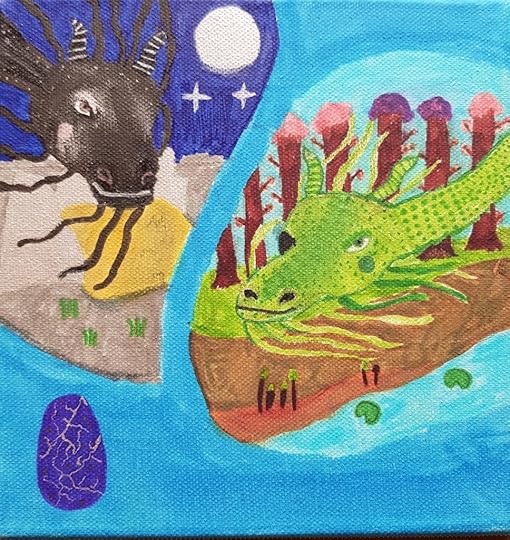
It’s been a while since I received any artwork from readers, so I was delighted to get this beautiful picture from Nadia, who is using her time in lockdown to illustrate some of her favourite books.
It shows Hei Lei flying over the yellow pool in Dragon Moon, and Danzi flying through a forest from Dragonkeeper. Such lovely colours, and I like the contrast between the two, with one at night and one during the day. And in the bottom corner is the dragon stone. Thanks Nadia. That has brightened up my time in lockdown!


August 4, 2020
Accidental trilogy about sailing to Australia
It wasn’t until I was doing last minute edits to Matthew Flinders: Adventures on Leaky Ships that I realised my three most recent non-fiction books have all been about sailing to Australia – an accidental trilogy!
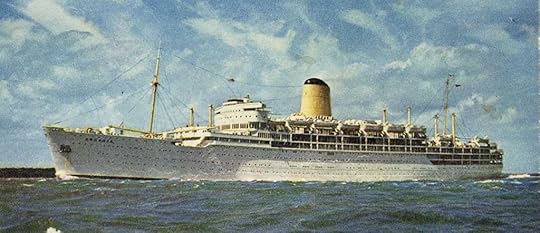 SS Arcadia
Ten Pound Pom
The first was my own story. I was only 12 years old when, in 1963, I sailed half-way around the world (about 20,000 kilometres) from England to Australia. My family made the journey on a 30,000 tonne passenger ship called the SS Arcadia.
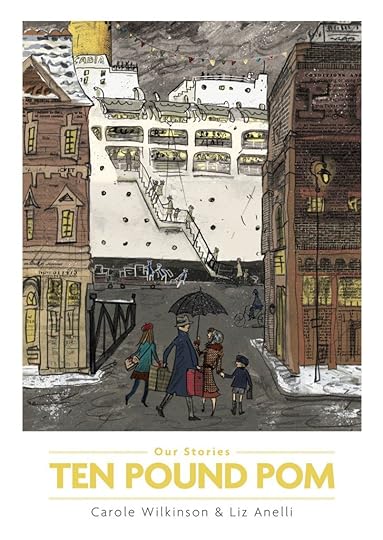
The book is called Ten Pound Pom because we travelled under a government scheme to encourage migrants to come to Australia. It was very cheap. The fare was £10 ($20) each for my parents. My brother and I travelled for free. Like all good voyagers, I kept a diary.
We sailed through the Mediterranean Sea, down the Suez Canal, through the Red Sea, on to Ceylon (modern-day Sri Lanka) and finally across the Indian Ocean to Australia. It was an exciting journey for a kid who, before that, had never travelled more than 200 kilometres for a week at the seaside. But there was no danger. We weren’t escaping war or racism. In fact, the journey was a fun holiday. Even so, it was a big step for my family, leaving family and friends behind. In our own small way, my family and I were part of Australian history.
Putting Australia on the Map
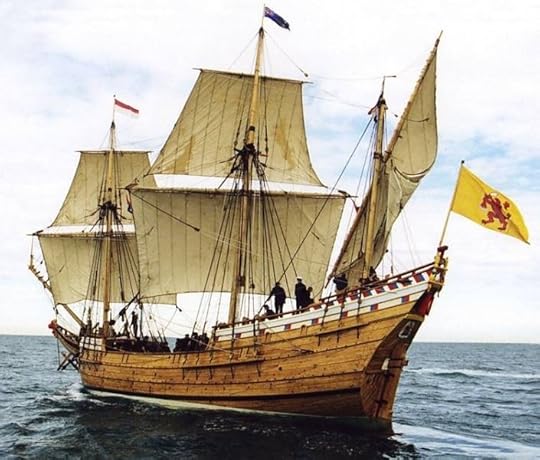 Replica of the Dutch ship Duyfken which was the first recorded ship to reach Australian shores in 1606, captained by Willem Janzoon.
We’re so familiar with the shape of Australia and its place on the map of the world, it’s hard to imagine there was a time when no one knew the huge continent of Australia existed. (Apart from Aboriginal people who have lived here for at least 60,000 years, of course.)
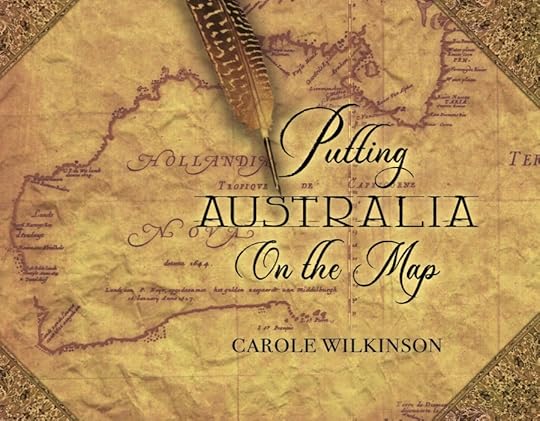
I never studied Australian history. I vaguely knew that Captain Cook “discovered” Australia in 1770. Then I saw an amazing 1664 map of Australia in an exhibition. It was joined on to New Guinea. The whole Eastern coast was missing. Someone had definitely sailed to Australia before Cook. But who were they?
I discovered that more than 50 intrepid men – traders, explorers, naval officers – had sailed to our shores (quite a few of them accidentally) over a period of 200 years before Cook arrived. They were Dutch, Spanish and English. I wanted to tell some of their stories and document how the map of Australia was slowly put together, bit by bit. That’s what inspired me to write Putting Australia on the Map.
Matthew Flinders: Adventures on Leaky Ships
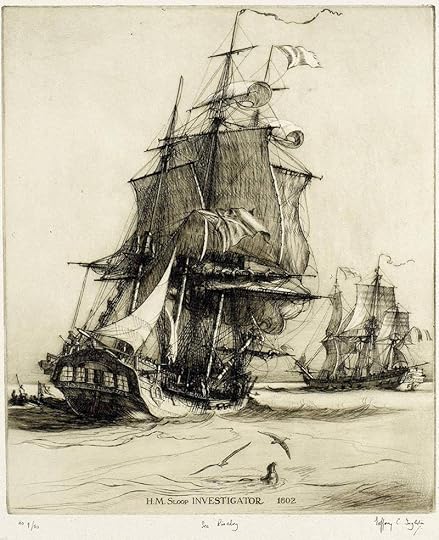 Artist’s impression of the Investigator
The final book in my accidentally trilogy, Matthew Flinders: Adventures on Leaky Ships, has just been published. It’s about one intrepid sailor– Matthew Flinders–who sailed to Australia. He had an amazing life, a lot of it spent at sea in the service of the British Navy. He sailed to Australia in the wake of Captain Cook, not once, but three times.
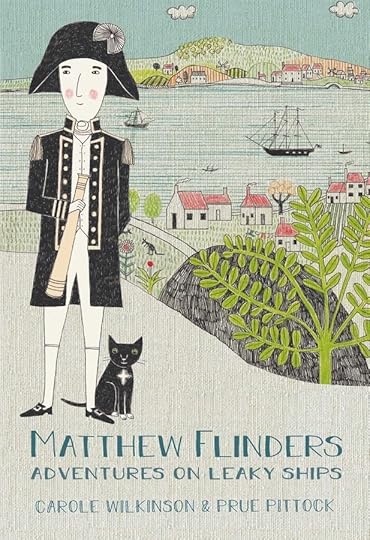
On his first voyage, aged just 17, Matthew passed through Torres Strait and perhaps glimpsed Cape York as he sailed to Tahiti with Captain Bligh (1791) to bring back breadfruit trees.
A few years later he served on HMS Reliance on a voyage to Port Jackson to deliver stores and a new Governor to the young colony. He did some exploring of his own in his free time, including circumnavigating Van Diemen’s Land (Tasmania). On the way home, he adopted a black and white cat called Trim.
On his third voyage to Australia, Matthew was the commander of his own ship, the HMS Investigator. In it, he was the first to sail around Australia, he completed the map, and gave Australia its name.
May 20, 2020
My Superpower
I have a super power. It’s not superhuman strength or x-ray vision. I can’t shapeshift. But, I can find the long-lost remains of dead historical personages. I do that by writing a book about them.
Ned Kelly
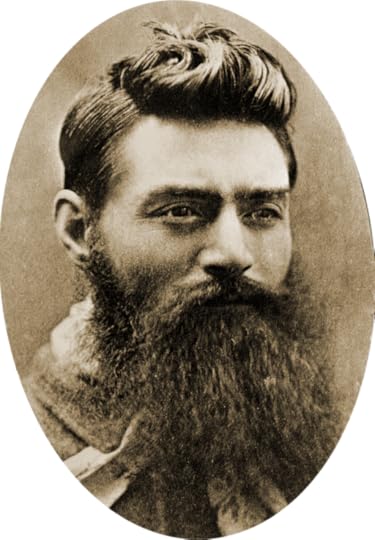
My powers were slow to develop, Black Snake: The Daring of Ned Kelly was published back in 2002. It wasn’t until five years later that Ned’s jumbled bones were discovered in the grounds of Pentridge Prison in the Melbourne suburb of Coburg, while they were converting the prison into apartments. The reassembled skeleton was missing most of its skull. In 2007, forensic scientists were able to confirm that they were Ned’s remains by matching DNA from the bones with the DNA of a great-grand nephew. More than 130 years after his death, he was reburied with his mother and other family members. I included this new information in a reprint.
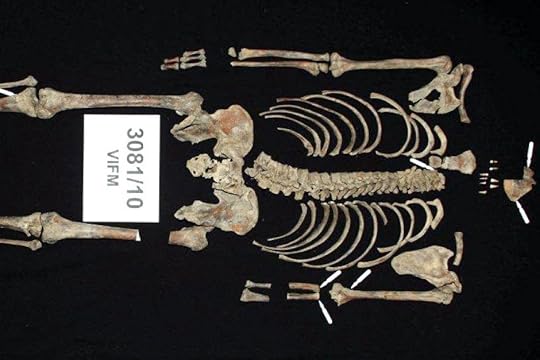 Ned kelly’s skeleton. The arrows show where there were bullet holes.
King Richard III
My very first book was Stagefright, published way back in 1996. It’s not a historical novel. It’s one of only two books I’ve set in current times, and it’s about school kids putting on a rock music version of Shakespeare’s play Richard III.
I’ve been fascinated by this king of England since I studied the play in high school. King Richard isn’t a character in my book, but one of the students plays Richard III on stage. Another becomes quite obsessed by him, and doesn’t think he’s the bad guy portrayed by Shakespeare.
The real Richard III was hastily buried after he died in a battle in 1485. At the time I wrote the book, no one knew where Richard’s remains were.
By 2012, Stagefright was a bit outdated (no mobile phones!), so I rewrote it extensively and it was republished. While I was working on that, Richard III’s grave was rediscovered. His skeleton, missing for around 500 years, was found under a carpark in Leicester. It made headlines around the world. Not the least because there was a dramatic curve in his spine which proved that he did, as Shakespeare had said, have a hunched back.
Richard was reburied in 2015 with all the pomp and ceremony befitting a king.
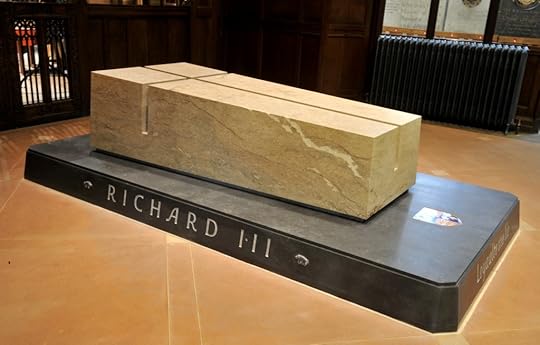 Richard III’s new tomb in Leicester Cathedral
Matthew Flinders
Two could be a coincidence, I hear you say. But there’s a third. Matthew Flinders, is well-known as the man who circumnavigated Australia, and drew up the first complete map of the continent.
Famous as he was, his gravesite had also gone missing. He was buried in St James Cemetery, London, but over time the graveyard itself ended up underground – beneath Euston Station. The building of a new high-speed rail line involved digging up part of the existing station. This was an opportunity for archaeologists to excavate the cemetery. It was a huge job. There were tens of thousands of graves. They wanted to move all of the remains to a place where they could examine them at leisure. And they had limited time. The chances of finding and identifying Matthew were slim.
On 25 Jan 2019, I was deep into writing a book about Matthew. I was listening to the ABC News, as always, while I made my lunch, when it was announced that they had found Matthew Flinders. They knew it was him because his skeleton had a lead plaque lying on it. On it was engraved Capt. Matthew Flinders R.N. Died July 1814 Aged 40 Years. No need for complicated DNA evidence!
Matthew’s remains (and 25,000 other skeletons unearthed before the project ended in December last year) will be minutely examined, before they are reburied. It all sounds a bit gruesome, but archaeologists and scientists can learn a great deal from the remains. What will they learn about Matthew Flinders?
My book, Matthew Flinders: Adventures on Leaky Ships will be published in July 2020.
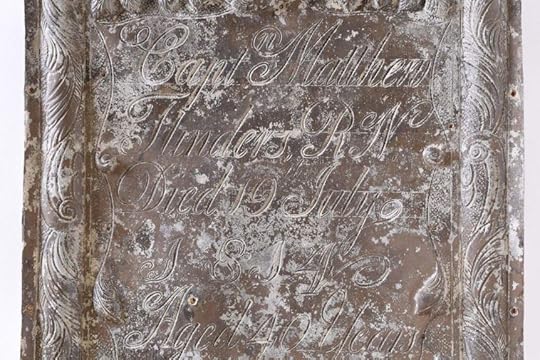 Matthew Flinder’s identification plate. Did he have a premonition his body would be lost?
It’s obvious that my superpower is getting stronger. My advice to historians yearning to find the final resting place of a long lost historical figure is simple. Engage me to write about them!
April 28, 2020
Black Snake Download Now Working
Fingers crossed the download of the Black Snake audiobook is now working properly. If you are still having issues, please let me know. Email me: mail@carolewilkinson.com.au
To those who have had to download it via Dropbox and deal with other issues, thank you for your patience and your ongoing support of this book.
April 23, 2020
Black Snake Audiobook Update
The download facility on my website is still broken. Overloaded AustPost and education departments that ban schools from using Dropbox (Yes, you Education Queensland!) are conspiring to make it even more difficult for me to get the audio files of Black Snake to the schools that need them immediately.
I can send invitations for people to share the files from my Dropbox. So if your school would like to buy the files (or have already bought them but have not been able to download them), I need a non-EQ email address to send the link to.
If anyone has other ideas of how to deliver approx. 167 Mb of data please let me know!
April 21, 2020
Problem with Black Snake Audiobook Download
Unfortunately there is an ongoing issue with downloading the audiobook version of Black Snake: The Daring of Ned Kelly.
I have come up with a work-around until I can find someone to help me fix the problem. The call centre for Netregisty (who host my website) has closed down because of the pandemic. And with increasing reliance on on-line everything, tech support people are all flat-out helping people.
So here is what you have to do if you want to purchase an audiobook version of Black Snake.
Purchase the audiobook from carolewilkinson.com.au/downloads.Although you will not get an email containing a link to allow you to download the book, I will get an email telling me you’ve made the purchase.I will send you an email with a link to a copy of the audio files in my Dropbox. This will allow you to download the files (one for each chapter) onto your computer.Save them to the application that plays your music.You can listen to them from there or transfer them to a phone or tablet.
I’m very sorry for this inconvenience.
Thank you for your support of my work.
April 15, 2020
Looking for home schooling ideas for kids?
2020 was going to be a big year of celebrations marking the 250th anniversary of Captain James Cook’s first sighting of Australia, but thanks to the coronavirus most of the events (including a circumnavigation of the country by a replica of Cook’s ship the Endeavour) have been cancelled. Perhaps they’ll be postponed till later. Who knows? In the meantime, it’s a great subject to explore with kids aged about 8–14, who are being home-schooled.
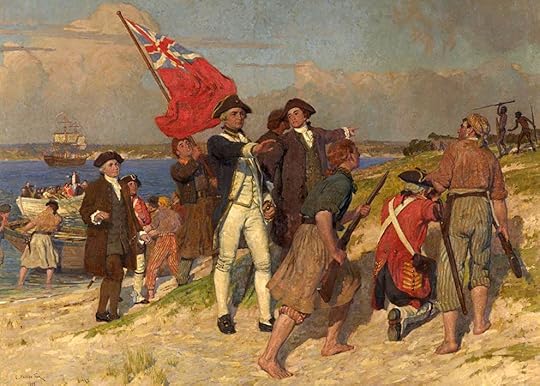 Landing of Captain Cook at Botany Bay, 1770, painted by E. Phillips Fox in 1902.
Although Cook was the first European to lay eyes on the East Coast of our continent, he didn’t discover Australia. In fact he had a map of Australia on board the Endeavour. It was relatively accurate – except for the east coast. Cook never described himself as the discoverer of Australia. He knew that other navigators had been sailing along (sometimes crashing into) its western, northern and southern coasts for nearly 200 years.
My latest book is called Putting Australia on the Map, and it tells the story of how the map that Captain Cook had with him was put together, piece by piece like a puzzle, by many intrepid sailors – most of them from the Netherlands (Holland).
Cook got his first glimpse of Australia about 6am on the morning of 20th April 1770. But although he was the first European to lay eyes on the East Coast of our continent, Cook didn’t discover Australia. In fact he had a map of the country on board the Endeavour. It didn’t look like the map we know today. Tasmania and New Guinea were joined on to the mainland, and the east coast was just guesswork. Other navigators had been getting to know the western, northern and southern coasts for nearly 200 years.
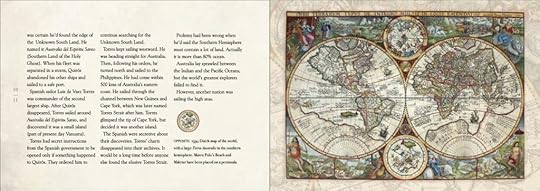 Lovely Dutch illustrated map of the world from 1594. There is no sign of Australia.
 Putting Australia on the Map is illustrated with full colour pictures of gorgeous maps of the world over the centuries. It also includes the map that Cook himself charted as he sailed up the East Coast.
There are teachers notes for Putting Australia on the Map, if you would like some guidance on how to engage your students at home.
If you want more visuals, you can find videos about the Endeavour and its most famous voyage on the Australian National Maritime Museum website.
What I really love to do when I’m researching a historical event, is to see if I can find original sources of information – things that were written or drawn at the time of the event. It’s like time travel! You can do that with Cook’s voyage. You can see every page of his journal online. The actual words he wrote. Check out how he altered the wording. Compare his record of these events with those of Sir Joseph Banks and others on board the Endeavour.
You can also read the secret instructions that the Royal Navy gave to Cook, which he wasn’t allowed to open until he’d finished the Endeavour’s main mission (observing the transit of the planet Venus across the face of the Sun). Did these instructions say “chart the East Coast of Australia”? No they did not.
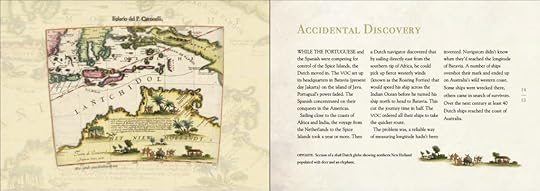 Early map makers didn’t like blank spaces! If they didn’t know what the vegetation or wildlife was like, they used their imagination. They populated this map of northern New Holland (an early Dutch name for Australia) with palm trees, deer and an elephant!
Cook officially took possession of what he called New South Wales (ie the east coast of Australia, not the whole country) for the British Government on 22nd August 1770. It was a simple affair, but over the years, artists decided to make it more of an event. You can compare how Cook described this important event in his journal to the picture in an Australian magazine 100 years later. (See illustration Putting Australia on the Map p. 28.)
If you would like to buy a copy of Putting Australia on the Map, first check if your local bookshop can deliver it to you. (They need your support!). If not, an Australian online bookshop such as Booktopia or Readings or Dymocks will be able to help you.
Schools and public libraries can order an ebook.
April 1, 2020
Accessing Black Snake for Schools
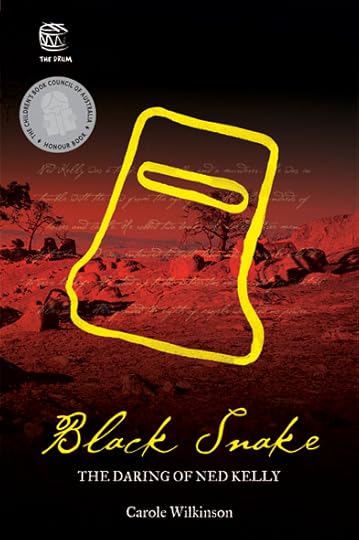
A number of schools (particularly in Queensland) have been great supporters of my book about Ned Kelly, Black Snake. And I’ve heard from some of them lately as they try to source copies of the book to arrange online classes.
Hard Copy Books
Firstly, there are plenty of copies in stock for those students who just want to buy a book. If your local bookshop is doing deliveries in your area, they should be able to bring a copy to your door. They desperately need your support at this time! Otherwise, an Australian online bookshop such as Booktopia will be able to deliver them to you.
Ebooks
If you are looking for an ebook version, they are available from Kobo, Amazon AU, Ebooks.com and iBooks (via the Apple Books app on your Apple device). They are also available from public libraries via Overdrive.
Audiobooks
You can purchase an audiobook edition from me via my website. School libraries can purchase a library licence for multiple borrowings. Email me for details at mail@carolewilkinson.com.au
If your school has come up with a solution for this problem, let me know and I can share the knowledge!
March 6, 2020
Putting Australia on the Map
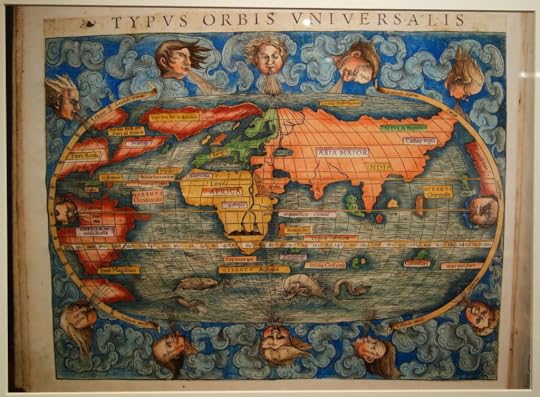 1540 map of the world showing sea monsters in the southern oceans, but no sign of Australia
I’ve been so busy getting my next book ready to go to the printers, I forgot to celebrate the “book birthday” of my latest book which has been in the shops since 1 March.
It’s a non-fiction book called Putting Australia on the Map. Australia is the 6th largest country in the world, but no one but our First Nations People new it existed until 1606. That was when Dutch mariner Willem Janzoon sailing a small ship called the Duyfken mapped about 300 kms of a coast he thought was part of New Guinea. Actually it was the western coast of Cape York.
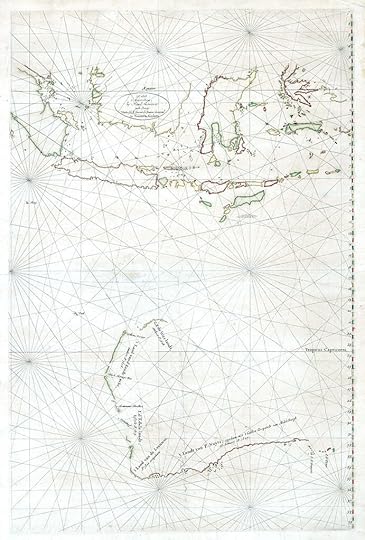 Chart of Australia consisting of pieces of the western and southern coasts mapped by eight Dutch sailors between 1616 and 1828
It was another 200 years before the map of Australia was put together piece by piece, like a puzzle, by many mariners.
Putting Australia on the Map tells the story of accidental discoveries, shipwreck and never-ending desire to find the world’s riches that led to the completion of the map of Australia. It is illustrated by some of the gorgeous old maps of the world that people hung on their walls, as well as historic sea charts drawn by the intrepid sailors who risked their lives to put Australia on the map.
February 27, 2020
A Dragonkeeper movie!
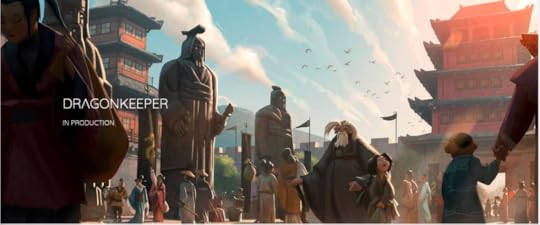
The question I am asked most (after “can you write another Dragonkeeper book!”) is “Why don’t you make a Dragonkeeper movie?”. I always used to say, I’m not a movie producer. It’s a very complicated job making a movie. But fortunately, an actual movie producer contacted me and he (and a million other people) are making a Dragonkeeper movie right now!
 Bill Nighy, Bill Baxter, Naomi Yang
It’s an animation, and from the few pictures I’ve seen, it’s going to be lovely. Also late last year, it was announced that British actor Bill Nighy and comedian Bill Bailey, along with Chinese actress Naomi Yang are going to be the voices of Danzi, Wang Cao and Ping! That is really exciting and I think they are perfect choices.
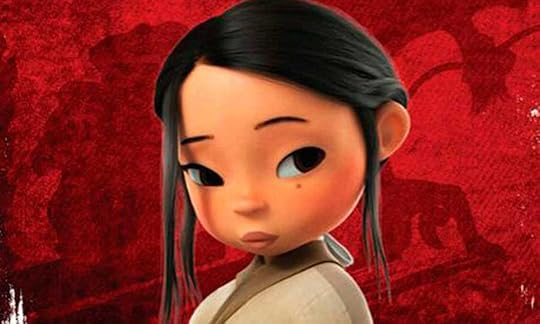 Ping
PingI’ve been told that the movie will be out in the middle of next year. I can’t wait to see it!
Carole Wilkinson's Blog

- Carole Wilkinson's profile
- 291 followers

