John Abrams's Blog
November 12, 2025
Book Travels in the U.S.A.
November 12, 2025 – John Abrams

It’s November 5th, 2025, the morning after a heartening slam-dunk election night across the nation. Basking in that glow, it feels like a good moment to reflect on a recent journey, having recovered from the Covid I managed to catch somewhere along the way.
During the last three weeks of October, I traveled to New York City, Portland OR, Ann Arbor, Cincinnati, Asheville, Boulder, Denver, Jackson Hole, Brunswick ME, and Boston.
Ten towns in 23 days. The trip was built around a variety of events and interviews to spread the message of my new book From Founder to Future. But it was way more than a book tour. I saw old friends and made new ones, toured amazing projects, and met with great companies.
The result: I learned more than I taught, and I was inspired by others more than I inspired them. No false modesty here, just the plain truth. I was lucky to engage with some of the best of today’s America. I’ll tell just a few of the highlights and try not to make this a travelogue.
The trip began in New York City where I saw dear old friends, ate way too much, walked it off traipsing for miles around lower Manhattan and Brooklyn, saw an extraordinary off-Broadway play produced by my cousin Rick Lazes, and spoke at The Ownership Economy Summit. In her article about that gathering, new friend Rachel Merfalen said, “I spent two days with people redesigning capitalism from inside out.” The scope of the conversations was breathtaking. I left fully jazzed (and ready for the road).
In Portland, my friends at New Energy Works produced a fine event, and interviewer Peter Koehler of Stronghold Ownership asked me compelling questions. The next day, I met for the first time with the full staff of an Oregon design/build firm for whom I am guiding a worker co-op conversion.
In Ann Arbor, two radically different events in one day: at 8:00 in the morning, 100 members of Rob Pasik’s Leadership Circle gathered at Zingerman’s Roadhouse restaurant, where Zingerman’s co-founder Ari Weinzweig interviewed me. Later in the day, at the University of Michigan’s Center for Entrepreneurship, I spoke to 70 engaged grad students in Brian Hayden’s “Finding Your Venture” class.
In Cincinnati, Co-op Cincy produced the high-energy Union Co-op Symposium, which synergistically merges unions and worker co-ops. On No Kings day, I stopped and marched in Florence KY on the way to meet my partner Kim in Asheville. Along with enjoying that great city together and a speaking event sponsored by the North Carolina Employee Ownership Center, we were treated to two unforgettable tours.
Tour Number One was The Industrial Commons (TIC). I wrote about TIC in my book, after interviewing its founders, Molly Hemstreet and Sara Chester, and former employee Aaron Dawson (an old pal who was my interviewer in Asheville). Since then, I’ve been craving a visit. Got one.
Before industrial offshoring began savaging U.S. manufacturing in the 1990s, the small city of Morganton, an hour east of Asheville, was at the heart of the North Carolina textile and furniture industries. After growing up in town and leaving to pursue other interests, Molly and Sarah returned independently and resolved to do something constructive for local people and the local economy. TIC is reinventing industry by making an ecosystem of worker co-op manufacturing companies and support co-ops. Although just 10 years old, this impactful experiment is already providing a compelling model for the whole country.
Molly and Sara were both away when we were there, but Jenna Rae Grayson took us on an inspirational tour followed by a great lunch at a local restaurant called Little Guatemala. Jenna loves her work, and she introduced us to exceptional people at TIC. It was easy to feel their deep devotion to the cause. What a thrill to have the opportunity to examine the internal workings of this remarkable experiment that springs from and cultivates partnerships with local people, local business, and local government.
Tour Number Two was Poder Emma (PE). A sister organization to TIC, PE is turning a neighborhood right side up. The Emma area of Asheville is made up mostly of mobile home parks occupied by Latinx people. PE’s mission is to prevent displacement in Emma by promoting community ownership and preserving mobile home parks as affordable housing.
But that’s not all. Like TIC, they are creating an infrastructure of co-ops to provide essential community development services to the residents and to build a vibrant social ecosystem where the residents and future generations can thrive. The enterprises are owned and run by the residents themselves.
Poder Emma’s founder, Andrea Golden, is a true force of nature—a passionate advocate and leader who infected us with her enthusiasm. Everyone we met seemed to share Andrea’s calm and good-natured fire and fervor.
After looking under the hoods of these two unique community-owned ecosystems, we headed for Colorado. (Oh, well, this is getting to be like a travelogue.)
In Boulder, Nathan Schneider and Julia Rodriquez produced an event with Andrea Steffes-Tuttle, who interviewed me at the University of Colorado business school. These three long-time employee ownership advocates and scholars are excited about creating an employee ownership institute within the university.
In Denver, Executive Director Jinsun Mi invited me to join and speak at the annual meeting of the Rocky Mountain Employee Ownership Center. Multiple members of both Driver’s Cooperative Colorado (2,000 drivers own it, and are showing Uber and Lyft how it should be done) and a new home health care cooperative (with branches all over the state) told how these two co-ops are changing lives. I was bowled over by the heart and soul of these people; it was another inspiring exposure to community ownership and activism at its best.
After a sweet time in Jackson Hole, visiting Kim’s son Nik and girlfriend Meg (Nik got us up before dawn for the drive to Yellowstone to see the awesome sunrise above), Kim headed home and I turned north to Brunswick, Maine for two days of all-on-the-table hunkering down with the Building Energy Bottom Lines group of companies I’ve been working with for more than a decade. Then, down the Maine Turnpike to Boston for the enlivening Authors and Innovators Book Festival.
Fully worn out, I drove to Woods Hole, got on the boat, arrived home, and promptly got sick with Covid. I felt a bit like I was “rode hard and put away wet.” But I was tremendously gratified as well.
In three short weeks, I experienced glimpses of all the good that is happening in this country during a time that sometimes appears to be consumed with all the bad. The good works endure; ultimately, we are bound to transform government to uplift and support these activities rather than corrupt and destroy.
Starting with New York City, where I began my trip. We watched with wonder from home as Zohran Mamdani was elected. The promise is palpable.


September 29, 2025
Chop Wood, Carry Water
September 29, 2025 – John Abrams

Jessica Craven writes a daily newsletter called Chop Wood, Carry Water. She’s an astute no-holds-barred political commentator who consistently speaks truth to power. But on Sundays, she does something different. After spending the week reporting on troubles and travesties, she celebrates all the positive things she has found that have happened during the week. Good news! Salve for our wounds.
It's worth subscribing. As an example, here's her report from Sunday, September 21st:
Celebrate This! 🎉
After Trump administration cuts forced the popular climate.gov website to shut down, experts re-launched it independently to help boost climate literacy.
Four U.S. states issued their own vaccination guidelines for three common seasonal vaccines, the flu, COVID-19, and RSV.
A new report found that the Global Fund partnership has saved 70 million lives since 2002, reducing the combined death rate from AIDS, tuberculosis, and malaria by 63%.
Six schools in Tennessee joined in nationwide school walkouts that called on state and federal lawmakers to take action for gun violence prevention.
A judge blocked the Trump administration from deporting Guatemalan migrant children.
Kash Patel absolutely bombed while testifying in the House and Senate.
Thousands of protestors filled London’s streets to protest Trump’s visit.
Maurene Comey, the prosecutor in Epstein case, sued the Trump Justice Department over her abrupt firing.
An appeals court rejected Trump’s bid to fire Federal Reserve governor Lisa Cook—just in time for the rate cut meeting!
A new nature preserve in Ohio will protect 3,000 acres of Appalachian foothills.
Teachers in New Jersey are receiving student loan relief through a program created to tackle teacher shortages.
AOC has joined forces with GOP Rep. Nicole Malliotakis on a bill to fund Healthy Start—which provides healthcare and birthing assistance to mothers and families with young children in 39 states, Puerto Rico, and DC.
EU lawmakers have given a final green light to a law that aims to slash the mountains of food wasted in Europe each year, and curb the environmental impact of fast fashion.
California became the first state to ban most law enforcement officers, including federal immigration agents, from covering their faces while conducting official business. Sweet!
The Yes on Prop 50 campaign has received over $20 million in small dollar contributions from all 50 states as well as large scale contributions.
An Iowa teacher who was fired after posting on social media in the wake of Charlie Kirk's shooting death is suing the school district and its superintendent.
Chippewa Valley Indivisible hit their six-month anniversary of weekly protests in Eau Claire, Wisconsin! Over 300 of them celebrated with a Wizard-of-Oz themed protest.
A judge has temporarily blocked the Trump administration's unlawful restrictions on certain federal housing funds. This means providers won’t be barred from competing for lifesaving resources simply because they are in jurisdictions that don’t adopt the administration's ideological agenda.
EV Realty, a San Francisco-based charging site developer, broke ground on what will be one of California’s biggest fully grid-powered, fast-charging depots for electric trucks so far.
Tax the Greedy Billionaires released new polling that found strong majorities of voters in congressional battlegrounds and key states want to raise taxes on the very rich.
Delaware is providing free school breakfast to every public school studentthis year due to new legislation signed into law on July 30.
Pope Leo is using his platform to condemn gross wealth inequality.
Lawmakers in California are working on a $23 billion plan to restore funding for scientific research. They want to create a state-level equivalent of the National Institutes of Health, but the plan would need to be approved by other state lawmakers and voters.
Trump’s approval is plummeting with Latino voters.
A municipal grocery store will soon open in downtown Atlanta, aiming to provide nutritional assistance to one of the city’s many food deserts.
Channel 4 welcomed Donald Trump to the U.K. with a special program: an unbroken catalogue of over 100 falsehoods, distortions and inaccuracies he’s come up with since taking office in January.
Former President of Brazil Jair Bolsonaro was convicted and sentenced to decades in prison for attempting a coup, following his loss in the 2022 election.
The Chicago River is about to welcome swimmers back for the first time in over a hundred years.
For the first month on record, wind and solar power generated more than a third of Brazil’s electricity in August, accounting for 34% of the country’s electricity generation.
A federal judge threw out Trump’s lawsuit against the New York Times, ruling that the lawsuit “lacked any legitimate legal claims.”
The United Nations confirmed that the ozone layer is on track to make a full recovery by mid-century, crediting swift action and international agreements for sharply reducing the use of ozone-depleting chemicals and slowing the annual growth of the Antarctic ozone hole.
Democrat Xp Lee won a special election for a seat previously held by the late Minnesota state Rep. Melissa Hortman, who was assassinated in June, and in the process restored a tie in the Minnesota House.
A new report from advocacy group E2 finds the clean energy sector added nearly 100,000 jobs in 2024, outpacing job growth in the rest of the U.S. economy despite a slowdown from previous years.
The Iowa Utilities Commission approved a settlement that authorizes the largest utility-scale solar project in the state’s history.
California officials and industry insiders say the state is sticking with its goal of developing 25 gigawatts of floating offshore wind energy by 2045 despite expiring federal tax credits and Trump administration hostility.
In the first six months of this year, the world built 64% more new solar energy capacity than it did in the first half of 2024.
Missourians fighting the gerrymandered congressional map passed last week by Republican state lawmakers are laying the groundwork for a ballot referendum that could give voters the power to block the map from going into effect.
A giant photo of Trump and Jeffrey Epstein was put on display outside of UK's Windsor Castle ahead of Trump’s state visit.
Minnesota Gov. Tim Walz said he will seek a third term in the 2026 elections
A coalition of labor groups sued the Trump administration over what they called the use of civil rights laws as a “coercive cudgel” to attack the University of California system and the rights of union members.
The Oklahoma Supreme Court temporarily put on hold proposed new social studies standards for K-12 public school students that include conspiracy theories about the 2020 election.
LGBTQ+ nominees made a strong showing at Sunday night’s 77th Annual Emmy Awards, with queer performers taking home four of the evening’s 12 acting trophies.
In August, global electric vehicle sales increased 5% month-over-month and 15% year-over-year.
A Boston church unveiled a monument to the more than 200 slaves once held by members of the congregation. The historic King’s Chapel is located along the city’s Freedom Trail, a red-brick path through the city that visits key sites in America’s revolutionary history.
Disney streaming services users are cancelling their subscriptions in drovesover the suspension of the Jimmy Kimmel Live! show.
Sir Keir Starmer has announced the UK's recognition of a Palestinian state, in what represents a significant change in government policy.
A landmark legal settlement will require a plastics facility in Pennsylvania to clean up the tiny plastic pellets — known as “nurdles” — that were found to be spewing out of its stormwater and wastewater pipes.
Texas has had a record-breaking year for solar development, in spite of federal policy shifts.
The High Seas Treaty has officially been ratified! For the first time, nations can establish marine protected areas in international waters - a critical step toward the global goal of safeguarding 30% of the ocean by 2030. HUGE!
September 16, 2025
Book Conversations (and Joe Rogan)
September 16, 2025 – John Abrams
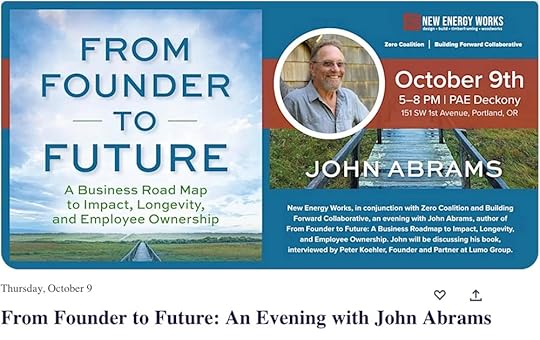
Since the publication of From Founder to Future, I have been honored to discuss the message of this book at several live events and on many podcasts. (This 21 Hats podcast may be my favorite!) Later this month and during most of October, I will travel for the same purpose. I also plan to visit a few of the organizations I profiled in my book, as well as a few companies I am currently guiding through worker co-op conversions. Here’s the schedule for the public events:
September 18-19: Peabody, MA (Fine Homebuilding Summit)
October 7: New York City (Ownership Economy Summit)
October 9: Portland, OR (New Energy Works)
October 16: Ann Arbor, MI
October 17: Cincinnati, OH
October 21: Asheville, NC (NC Employee Ownership Center)
October 23: Boulder, CO
October 23: Denver, CO
October 30: Watertown, MA (Authors and Innovators)
The above events will all be conversations and interviews, not presentations. If you live in any of these cities, or will be there on the date listed, please come. I’d love to see you. If you need information about particulars, please feel free to contact me.
I am grateful to those who are making these opportunities possible— Aaron Dawson, Andrea Steffes-Tuttle, Ari Weinzwig, Ben Bogie, Brian Hayden, Brian Pontillo, Deanna Varble, Ellen Vera, Jahed Momand, Jenna Grayson, Jonathan Orpin, Julia Rodriques, Kristen Barker, Lawrence Gennari, Nathan Schneider, Peter Koehler, Rob Pasick, and Rob Yagid. (My apologies if I inadvertently left anyone out.)
I hope to see you somewhere along this trail! And if any of you have ideas for other conferences, events, business schools, small business associations, or podcasts that might be a good fit, please be in touch. Thanks!
Speaking of podcasts, but switching gears, I have a question: Do any of you ever listen to or watch Joe Rogan? If you do, you share something with more than 10 million people. Nobody has more listeners. I was not one of them, until recently.
I watched Rogan’s two-hour interview with Bernie Sanders, one of my longtime personal political heroes. The first thing Rogan says as he welcomes Bernie is, “It’s a good time for you to be here, as the world’s gone haywire. What are your thoughts about this?”
Bernie had a thing or two to say.
During the conversation, they discovered that they share significant agreement. In fact, they found little about which they disagreed.
What I liked most about the conversation was the number of times each of them answered questions from the other by saying, “I don’t really know” or “I don’t know enough about that to give you an informed opinion.” It was an honest, authentic conversation, in which Joe Rogan said that one of the things he most admires about Bernie is something I share—that over 50 years Bernie’s message has been honed and refined but he has remained fundamentally consistent and has never changed to suit the moment or circumstance. I don’t know if you can say that about other politicians.
One of their recurring topics was: How do people find meaning in their lives as technology dominates their work more and more? Neither of them had many answers until, more than 90 minutes into the interview, Bernie started to talk about work done in Vermont to help workers own their own companies. He said that when workers share ownership and have a greater stake and voice, they gain a sense of purpose, absenteeism declines, and productivity goes up.
Rogan liked the idea.
Me too, obviously.
August 16, 2025
Lucky About Work
August 16, 2025 – John Abrams

freeimages.com
From the time I was 12 years old, I loved work. Not all work. I didn’t like to clean up my room, rake leaves, or take out the garbage. But the thing that made me love work was my paper route.
I lived in an unincorporated part of San Mateo County, in the town of Menlo Park CA, in the heart of what has become the Silicon Valley. The area, known as Menlo Oaks, includes about 300 homes and the Peninsula School, a private day school housed in the old Coleman Mansion, built in 1882, when California was still young. The school opened in 1925 to bring progressive educational philosophies—grounded in the work of John Dewey, Maria Montessori, and Francis Parker—to the Bay Area.
In the 66 years since I moved to Menlo Oaks at age 10, the area has changed little. Although many of the cottages have expanded into houses, the school is still there, thriving, and the streets are still semi-rural. It’s a throwback neighborhood hidden amidst this hyper-suburban area.
The daily newspaper that served the area, from 1893 to 1993, was the Palo Alto Times. I delivered it on my bicycle after school for a few years. My papers were brought to me every day, six days a week, in a station wagon driven by a friendly middle-aged guy whose face I remember but whose name I forget. When he arrived, I met him, got the papers, and brought them into our garage. I folded them in the prescribed manner, which made them hold together when they were tossed and hit the ground. I’d load them into the two pockets of the canvas bag that the Times had provided.
Once loaded, I’d sling the bag over my shoulder, hop on my three-speed Schwinn, and head out. At each house, without stopping, I’d pick out a paper and throw it into the front yard—sometimes on the lawn, sometimes on the driveway, sometimes on the porch (known as porching it). I loved holding onto one handlebar with my left hand and grabbing and tossing a paper with my right, either forehand or backhand, depending if it was going left or right. It felt like a dance, choreographed and balanced.
What I liked about this job, and the thing that made me love work, was its multi-faceted nature: it took skill and dexterity, it was social, and it was never boring. I liked riding along, developing my skills, and saying Hi to neighborhood people I’d encounter. Once a year, just before Christmas, I had to go to every house, knock on the door, and collect subscription fees. I did this on a Sunday. I walked, because it was easier than getting on and off my bike and I could cut across lawns and through yards to shorten the route.
The Times provided small, printed invoices that said, “PA Times subscription one year” and the cost, $18.00 ($1.50 a month). People paid me in cash or check, they usually gave me a tip, and I checked them off the list. If they weren’t home, I’d come back later or the next day until I’d rounded up all of them. I put the money in a bag and gave it (and the checked-off list) to the driver next time he came. I kept the tips (my pay) and mostly bought baseball cards.
My paper route was not all honey and sunshine. On rainy days, I had to put each paper in a plastic bag secured by a rubber band. My raincoat was uncomfortable. It’s hard to grab a paper and throw it when you’re riding in the rain in a stiff yellow slicker. The matching hat had a brim front and back. I folded the front brim up, which defeated its purpose and made the water run down my face instead of shedding. But style ruled, even at that young age. I remember one very stormy day when my Mom drove me in her white 1960 Pontiac Bonneville station wagon.
I don’t know how long I did that paper route. I never thought to ask my parents before they both died in their nineties. There would have been no point. My beloved Dad would probably have said, “What paper route?” My doting Mom would have given a definite but wrong answer. My paper route had kind of a Peanuts-like quality—mostly no parent involvement. Little league was like that, too. These days, there are more adults at a little league game than kids, but my folks never came to games. My friends and I would get on our bikes, ride downtown, get a hamburger, fries, and a Coke at Jiffy Burger for 25 cents, and then go to the field and play.
I doubt my parents understood the importance of that paper route. But for me, it came to define my grade school years. And it taught me that hard work and happy play could be the same thing. That stuck with me, and that sense entirely endures today.
I wonder what kids growing up today—like my grandkids—can do in their youth that will impart that lovely sense of work as play.
Come to think of it, my two middle grandsons—Silas, 21, and Axel, 19—have been lucky enough to get that. During high school, Silas worked at the Chilmark Community Center and learned to play tennis with Eddie Stahl. Soon he was teaching. Now, in the summers while Silas goes to UMass, he teaches both kids and adults. He loves to play and he loves to teach. He’s got it.
Axel learned, at a young age, to love food and cooking. He did culinary work in high school and started working at the Homeport a few years ago. Now, during the season, he is part of a small team cheffing in the kitchen. He works about 65 hours a week and seems to love it. He has gained a truly portable skill that he can take on the road as he figures out his next steps in life. He’s got it too.
They’re lucky about work. I was lucky about work. I hope you’re lucky about work, and I hope your kids and grandkids (if you’re old like me) will be lucky, too.
July 29, 2025
Two Conversations
July 29, 2025 – John Abrams

I’d like to invite you to two conversations.
The first is my appearance at the Martha’s Vineyard Book Festival. Since its quiet origins in 2005, the MV Book Festival has grown into a major literary event that occurs every two years in the small town of Chilmark.
If you’re on the Vineyard this weekend, please drop in. The theme this year is The Power of Perspective. Here’s the whole schedule.
On Sunday, August 3rd, at 3:30 PM, Mitch Kapor will interview me about my book, From Founder to Future. The festival is free, the environment is relaxed, and the weather is looking good. I hope to see you there!
The second conversation is an interview I had with Loren Feldman, the founder and editor-in-chief of 21 HATS, a particularly informative website about the trials and tribulations of small business.
I got a kick out of engaging in this conversation with two thoughtful business owners, Jay Goltz and Melvin Gravely, both of whom considered employee ownership and then discarded the idea (at least for now!). You can access the recording and the transcript here.
If you are able to sit in on one or both of these conversations, I’d be glad to hear what you think in the comments below. Thanks!
PS – Some of my other recent podcast appearances are available here.
July 20, 2025
Hussey Seating
July 20, 2025 – John Abrams
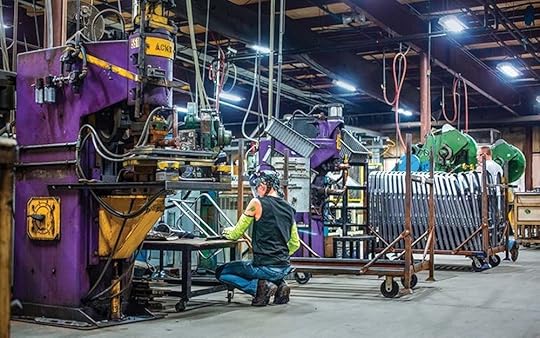
Among the many stories I had to leave out of my recent book due to space considerations, one of my favorites is about the Hussey Seating company. In 1835, William Hussey, a farmer in the small southern Maine town of North Berwick, designed a more efficient plow blade. The Hussey Plow Company was born, and the blade became internationally recognized for effectiveness and durability. The company would prove to be equally durable. After a fire in 1895 reduced the plant to rubble, Hussey’s grandsons rebuilt and redefined the company as a producer of steel products like fire escapes and bridge supports.
In 1931, Philip Hussey conceived of portable outdoor bleachers and started to produce them. When the baby boom of the fifties escalated the construction of new schools and gymnasiums, he adapted them to indoors and the company became the Hussey Seating Company. Many innovations later, the company’s 310 employees have made Hussey, still headquartered in little North Berwick, a world leader in the design and construction of seating for auditoriums, stadiums, performances spaces, and arenas. After 188 years in business and seven consecutive generations of Husseys, in 2023 the company was recognized by Maine’s Best Companies Group as one of the Best Places to Work in Maine for the fourth time.
Seven generations. Now 190 years. Why did the little plow company prosper, grow, and endure? Their website says, “Here's our secret: We're not a manufacturing center. We're an innovation center. While today we produce the highest quality spectator and audience seating in the world, our real business is listening to, understanding, and solving our customers’ biggest problems. From our time-honored craftsmanship to our cutting-edge manufacturing, we stand behind every seat, prepared for the roar of the crowd and the test of time.”
When you’re in it for the long haul, and listening all the time, innovation becomes part of the culture of doing business. It becomes your gravity. The solution-based mentality is baked into the company DNA.
Over two centuries, Hussey’s goals have not changed: a family business operating with honesty and integrity and caring about employees as much as profits and growth.
Rich Hussey is Vice President of Human Resources. After graduating from Colby College, Rich taught school in Boston, met his wife there, had kids, decided to move back to his hometown, and went to work at the family business. Not so easy to do. Family members have no inside track; they must apply for jobs in a competitive process, and they must earn their way. At the time, his older brother was CEO. Rich worked there for nine years and said to me with a wry grin, “It was not the best thing to endure performance reviews year-after-year from my older brother.” He left in 2006 to pursue a successful career in HR with other companies and returned in 2019 to the same role. Before that, he served on the board of directors for four years.
Until Rich’s brother’s tragic death at a young age, only family members had been CEO for six generations. After his death, the clear choice for CEO was then-CFO Gary Merrill; he became the first non-Hussey CEO. They are now on their second.
The Hussey family remains involved in the company in many ways, including ownership. They have created a complex decision-making system with five parts that has evolved over many years and includes: the family assembly, the family council, Class A shareholders, the board of directors, and management. Their decision matrix details types of decisions, who makes these decisions, who has input, and who is informed. The family assembly meets once a year and includes 35 people from the sixth and seventh generations, a few from the fifth, and spouses. The youngest member is 18. There is significant family education and engagement.
Rich chairs the family council, which has a legacy committee (the keeper of both the company and family histories), an education committee (responsible for educating new generations of Husseys), and an event planning committee. There are 10 Class A stockholders, all family members. The board chair is a sixth-generation non-employee woman named Leticia (Hussey) Beauregard and the seven-person board includes five non-family members. Rich is the only family member currently in senior management.

Hussey practices open-book management, sharing financials with employees on a quarterly basis and educating them about ways they can help the bottom line. Gross annual revenues are consistently above $130 million. For a time, they awarded Class B (non-voting) shares to employees, but the value of the shares fluctuated so wildly that they bought them all back and instituted a profit-sharing program instead, which rewards all employees and provides greater security. Profit sharing goes to employees before dividends go to shareholders. The Class B experiment was their only attempt at employee ownership to date.
The company has a history of remarkable employee longevity. As of the end of 2023, their 310 employees included 117 who had been there longer than 10 years, 67 longer than 25 years, and nine who had been there more than 40 years. The two longest-tenured employees recently retired after 46 years. The longest beat the second-longest (who held the door when the two friends went in to apply for jobs at the same time in 1977) by a few seconds.
Good wages and benefits, a family-friendly employee-oriented culture, and internal growth opportunities keep people there. Hussey has an Employee Value Proposition that continually examines what makes Hussey a good place to work and what could make it better, and, as Rich says, “what differentiates us from other employers.”
During the pandemic, the company carried more staff than they needed to operate. This impacted short-term profitability, but all the stakeholders (family owners, management, board) agreed to the approach. Rich related that their CEO said to employees when providing reassurance, “Hey, we can get through this—it isn’t even our first pandemic.” When the market came back strong, they were rewarded for their long-term thinking, as valuable team members were still in place.
The company does extensive local charitable giving, employees’ personal donations are matched by the company, and there is extra paid time off time for civic participation. Employees are educated about this so that, as Rich says, “when someone thanks them in the grocery store, they know what they’re talking about.”
Hussey makes the best, most lasting jobs in the area. If you are working for a company which cares about its employees’ and its community’s well-being, and provides opportunities for growth and change, why would you want to leave?
Although Hussey is not employee-owned, in many ways it behaves like the best of employee-owned companies. Their story is chock full of lessons about long-term business thinking, innovation, and community.
Given the history, it’s highly likely the story will not end anytime soon.
June 23, 2025
Books Are Like Buildings
June 23, 2025 – John Abrams

Many know the challenges and joys of bringing a book from initial idea to publication. My new book, From Founder to Future, is now launched. Upon reflection, the journey was similar to that of my first book, nearly 20 years ago. Both adventures were like building a house, going from the idea (conceptual design) to the message (completed design) to outline (foundation) to manuscript (enclosure) to editing and book design (furnishing) to the book in print (occupancy).
The cover is the front door.
Holding my book for the first time and reading it in print was like quietly wandering through a completed house, something I’ve done hundreds of times in my design/build career.
When the dust has fully settled, and you see this thing you’ve been curled up with in a new revealing light, new sentiments surface. As I read through the physical book, I found elements—in both design and content—that I already wish I could change and improve. Likewise, never in my life have I walked through a completed building and not found aspects I wish I could change.
Fortunately, buildings do change over time, as occupants’ needs evolve, new ideas emerge, and parts wear and are replaced. Books change, too, as we elevate and refine the message post-publication or produce a second edition (as I did with my first book) to correct deficiencies, expand the content, and explore new terrain.
At the same time, both experiences—reading through a new book and inspecting a new house—engender a feeling of calm completion and a sense that something new has come to life. It’s a particular kind of full-circle pleasure, despite the inevitable minor regrets.
I’m deeply grateful to everyone who has supported my author journey and shared their stories, wisdom, criticisms, and encouragement along the way. You gave this book life. You were the crew that built this building.
Now it’s all about spreading the message. I’m in learning and listening mode about that—if you have any direct connections to small business associations or business schools, for example, or other ideas, let me know, or let your connections know about the book. My friend Ben Southworth had an idea, and he distributed 235 copies of the book—one to every New Hampshire public library. He used the state’s Interlibrary Loan System to get them around. The libraries have been very appreciative. Me too!
The message I hope to spread is the conviction that widespread implementation of a fundamentally different way of doing business may—in some modest way—change the chemistry of our culture by helping small businesses lead a new era of shared prosperity, social impact, and better lives on a healing planet. Helping people to thrive and become their best selves through their work and service. Living in their workplace like an extension of home.
If this book has that impact, it will be because it inspires readers, at a certain moment in their life and career, to remodel their business practice. There will be rewards as they (or you) take their (or your) company from what it is to what it can be—business as the front door to our common good.

May 13, 2025
Launch Party
May 13, 2025 – John Abrams
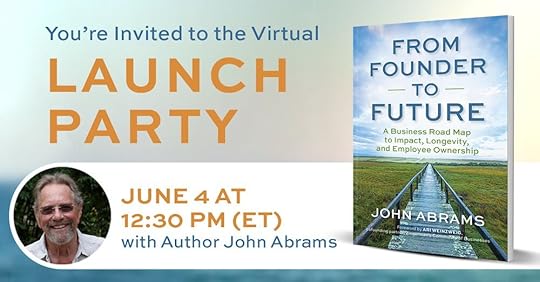
My new book From Founder to Future will launch on June 3rd. Come join me for a one-hour virtual launch party the following day to briefly celebrate the book and all those who contributed to its making. Please RSVP now. I look forward to seeing you.
It’s exciting to see the book in print! When I wrote it, I had no idea what would be happening at the time of its release. It now feels to me like the book is, in some modest way, an antidote to the current American spirit—the cruelty, cynicism, and cowardice that seem to have replaced, for the moment, the generosity, optimism, and courage to which we are predisposed.
This unfortunate spirit has bedeviled us at times in our history, but it has always been overcome by our better hearts and minds as we continue the long and arduous journey toward liberty and justice for all. Resistance and reversal appear to be picking up steam, even as the atrocities and chaos of the Trump regime continue.
What may be unprecedented is the degree to which wealth inequality has spiked in recent decades. When it comes to the pursuit of happiness and well-being, working people have been left behind by Democrats and Republicans alike.
We can change that.
This book is about business that enhances life through cooperation, collaboration, and shared ownership. It is an ode to the America to come, the America where all share the bounty. That’s the message. That’s the story. That’s the hope. And the book is full of compelling stories about emblematic businesses that you may enjoy.
Come join the party! There will be talk, special guests, and an opportunity for questions. Meanwhile, I invite you to enjoy a chapter, which you can download from my website. You can also place your order there if you wish. Here’s a recent podcast of me talking about the book with Vincent Lanci on “Writing with Authors.”
And, here’s my friend Jonathan Orpin, buried in the book!!
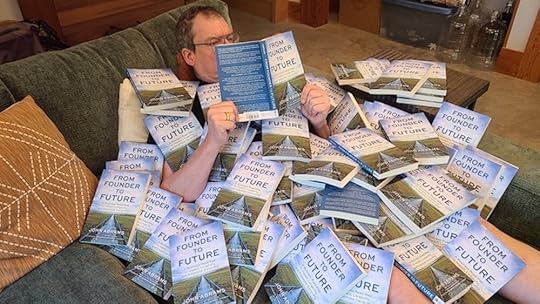
P.S. If you’re not able to join the virtual celebration, but would like to receive a video recording, please RSVP. I’ll send you the recording after the event.
Thank you for your part in this.
April 3, 2025
Byggmeister Stands Up
April 3, 2025 – John Abrams

How are businesses responding to the destructive and illegal actions of our current federal government and to all the subsequent uncertainties? Reactions vary tremendously—they seem to be all over the map—but one thing is clear: if you are in business right now, whatever your views, it’s likely you’re consumed by this topic.
Byggmeister is a design/build remodeling company in Newton, MA, founded in 1983 by Paul Eldrenkamp. He and the group of friends who joined him had limited building skills and no business experience. All that has changed, and today Byggmeister is a sophisticated and successful worker cooperative. Paul retired in 2021 after the employees bought out his interest. The company is still, after all these years, dedicated to the thoughtful, careful stewardship of greater Boston's existing homes. My friend Rachel White is the current CEO.
Now, she and her colleagues are taking action. They have crafted the following statement and have sent it to their entire mailing list—clients, trade partners, and others—and to the local chamber of commerce (whose president invited her to join a small group sit-down with Governor Maura Healy during a recent visit). She also plans to send it to local municipal officials.
Read on—you’ll probably be as impressed as I am.

Five years ago this month we suspended remodeling work due to the COVID pandemic. For 10 weeks our carpenters were furloughed while our designers did whatever billable work they could from home. Essential staff also worked from home for 50% pay to keep the business afloat on our cash reserves until it would be safe to start building again.
Although it’s hard to put myself back in that frightening time, I do remember that the decision to suspend remodeling work was agonizing. There was no precedent we could turn to, no guide for navigating a viral pandemic. We could rely only on our sense of what was right and faith that we would get through it.
We now find ourselves in a similarly frightening time without precedent or guide for how to respond. Again, we must rely on our sense of what's right and our faith that we'll get through it.
We are horrified by the actions of the administration. This isn’t solely or even primarily about policy differences, although many of the administration’s actions — from tariffs to gutting federal agencies — directly threaten our business and conflict with our mission to serve as exemplary stewards of existing homes and to help build a more equitable and sustainable future.
Like all businesses and institutions of civil society, we rely on a stable, functional federal government. We rely on the government to serve the public good. We rely on the government to uphold the rule of law. We rely on safety for everyone in our community. And we rely on the freedom to live our values and express our opinions without fear of retribution.
It’s hard to believe that we can no longer rely on these things, but this is our new reality — incompetence, cruelty, chaos and corruption on a massive scale.
While there may be little that a small business like ours can do on the national stage, there is a lot we can do closer to home.
We can continue to publicly champion justice, equity, diversity and inclusion in our company and industry.
We can make red cards available on our job sites so that our crew and subcontractors are aware of their rights if an immigration agent shows up.
We can direct our charitable donations to those who have been harmed by the administration’s actions.
We can join with other businesses to let our elected officials know where we stand and what we need to flourish.
Finally, we can redouble our efforts to decarbonize existing homes — doing whatever we can to help Massachusetts achieve our climate goals.
We have agency. And we intend to use it.

Rachel White, CEO

They are using their agency.
It’s a bold statement, isn’t it? And clear as the ringing of a bell. This kind of action matters. Fearlessly stepping up, standing out, leading the way.
Political strategist Anat Shenker-Osorio calls this social proofing—ordinary people (and businesses) speaking up and showing that they disagree, so others with a similar perspective will know that their feelings are shared and might feel a sense of permission to publicly do the same.
She says “Moments of extraordinary rupture are moments of extraordinary possibility. What I’m trying to say is that in the unknowing, in the what-the-fuck-is-going-to-come-next, is actually where invention comes. And it requires us recognizing that.”
And it requires us to take action, like Byggmeister has.
February 24, 2025
Economic Blackout
February 24, 2025 – John Abrams
MadPufferStickers
As I struggle with the uncertainty of what to do in the face of the crushing assault on democracy, it has occurred to me that an economic response to Trump and his broligarchy could be valuable. I’m not alone, because I have received news, as you may have, about an upcoming “economic blackout”—reducing or stopping spending that further enriches the Musk-Bezos-et al. cartel. Apparently, it originated with an organization called The People’s Union, about which I know little. But I like their idea. I am going to participate, and I urge you to join me and spread the word to others.
Here’s the deal:
The 24 Hour Economic Blackout
As the initial act (hopefully the first of many), we turn off spending for one day by not doing certain things.
When
For 24 hours on February 28th, this Friday, from midnight to midnight.
What Not To Do
Do not shop online or in-store at Amazon, Walmart, and all major retailers.
Do not spend money on fast food, restaurant chains, or gas.
Do not make discretionary purchases.
And DEFINITELY don’t buy a Tesla (on Feb 28th or any other day, for that matter), something I have been guilty of in the past.
What To Do
Only buy essentials (food, medicine, emergency supplies), and only if necessary.
If you must spend, only support small local businesses.
Spread The Message
Talk about it, post about it, and document your actions that day!
Why This Matters
If we disrupt the economy (somewhat) for just one day, it may begin something that becomes powerful over time.
If they don't respond (they won’t), we make the next action longer and keep building the effort.
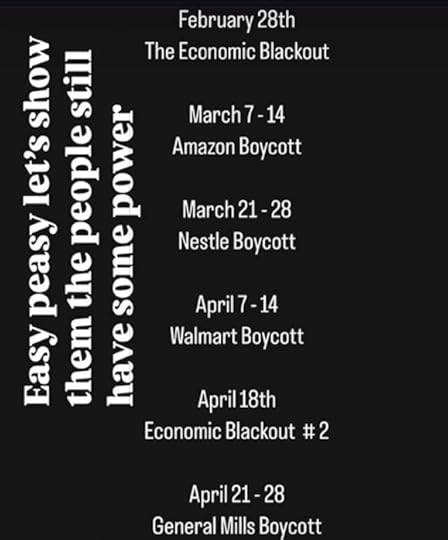
Already there is an Amazon blackout scheduled for March 7-14 (please join that one too).
What We Want
To build resistance to the destructive and unconstitutional actions of the Trump administration, Elon Musk, and the broligarchy of billionaires.
We all have a voice, we all make spending choices, and our collective pocketbooks may have impact.
In addition, there is a movement slowly building towards a general strike, with a goal of 11+ million participants, which may become important if we come to a full constitutional crisis. Historically, around the world, general strikes have been effective at catalyzing change. Have a look!
Protests against the administration’s cruelty and law-breaking are beginning to mount, although they are barely reported in the legacy media. See this article.
This week’s one-day economic blackout is just a toe in the water, but it’s an easy entry—the sand is soft and the water’s warm.
Can it get traction and make a difference? We will only find out by jumping in.

MadPufferStickers