J. Arthur Moore's Blog
July 10, 2016
Letters from the Home Front (Part I)
 Children grew up fast during the American Civil War as they were forced to endure hardships and take on adult responsibilities. Under pressure from the war, some children joined the army to become drummer boys. Some decided to become powder monkeys in the navy. And some decided to stay home and take care of their families after their fathers and brothers went to join the army.
The following extracts are taken from the diary of Carrie Berry, a 10 year old girl from Atlanta.
We can hear the canons and muskets very plane, but the shells we dread. One has busted under the dining room which frightened us very much. One passed through the smokehouse and a piece hit the top of the house and fell through…. We stay very close to the cellar when they are shelling.
Aug, 4 The shells have been flying all day and we have stayed in the cellar. Mama put me [to work] on some stockings this morning and I will try to finish them before school commences.
Aug 5. I know all the morning. In the evening we had to run to Auntie’s to get in the cellar. We did not feel safe in our cellar, they fell so thick and fast.
Aug. 6. We have been in the cellar all day….
Aug. 9. We have had to stay in the cellar all day the shells have been falling so thick around the house. Two have fallen in the garden, but none of us were hurt….
Aug. 11. Mama has ben very busy to day and I have been trying to help her all I could. We had to go to the cellar often out of the shells. How I wish the federals would quit shelling us so we could get out and get some fresh air.
Aug. 14. We had shells in abundance last night. We expected every one would come through and hurt some of us but to our joy nothing on the lot was hurt…. I dislike to stay in the cellar so close but our soldiers have to stay in ditches.
Aug. 22. I got up this morning and helped Mama pack up to move. We were glad to get our of our small cellar. We have a nice large cellar here where we can run as much as we please and enjoy it. Mama says that we make so much noise that she can’t here the shells.
Aug. 23. We feel very comfortable since we have moved but Mama is fretted to death all the time for fear of fire. There is a fire in town nearly every day. I get so tired of being housed up all the time. The shells get worse and worse every day. O that something would stop them!
[September 2, 1864] Everyone has been trying to get all they could before the Federals came in the morning. They have been running with saques of meat, salt and tobacco. They did act rediculous breaking open stores and robbing them. About twelve o’clock there were a few Federals came…. In about an hour the cavalry came…. We were all frightened. We were afraid they were going to treat us badly. It was not long till the Infantry came in. They were orderly and behaved very well. I think I shall like the Yankees very well.
[Sept 10] Everyone I see seems sad. The citizens all think it is the most cruel thing to drive us from our home, but I think it would be so funny to move. Mama seems so troubled and she can’t do any thing. Papa says he don’t know where on earth to go.
[Nov. 16] Oh what a night we had. They came burning the store house and about night it looked like the whole town was on fire. We all set up all night. If we had not sat up our house would have been burnt for the fire was very near and the soldiers were going around setting houses on fire where they were not watched. They behaved very badly. They all left town about one o’clock this evening and we were glad when they left for nobody knows what we have suffered since they came in.
[August 1864] I was ten-years-old today. I did not have a cake. Times are too hard…. I hope that by my next birthday, we will have peace in our land.
Source
http://hsionline.org/cases/civil/documents_home.html#doc1
The post Letters from the Home Front (Part I) appeared first on Journey into Darkness by J. Arthur Moore.


July 3, 2016
Letters from the Front Line (Part II)
 A depiction of Andersonville Prison by John L. Ransom
Children grew up fast during the American Civil War as they were forced to endure hardships and take on adult responsibilities. Under pressure from the war, some children joined the army to become drummer boys. Some decided to become powder monkeys in the navy. And some decided to stay home and take care of their families after their fathers and brothers went to join the army.
Below are journal entries and letters written by John McElroy, Theodore Upson, and Charles Bardeen, describing their time in the army.
Card playing had sufficed to pass the hours away at first, but our cards soon wore out…. My chum Andrews and I constructed a set of chessmen…. We found a soft white root in the swamp. A boy near us had a tolerably sharp pocket knife for the use of which a couple hours each day we gave a few spoonful of meal. The shapes that we made for pieces and pawns were crude, but sufficiently distinct for identification. We blackened one set with pitch-pine soot, found a piece of plank for a board… and so were fitted out with what served until our release to distract our attention from much of the surrounding misery.
-John McElroy, age 17, October 1863, at Andersonville, Confederate prison camp
We have been having a Christmas Jubilee. The boys raised some money and I went down into the City to get some stuff. We have a Darky cook, and he said “You alls get the greginces [ingredients] and I will get you alls up a fine dinner sure.” I got some chickens, canned goods, condensed milk and a dozen eggs…. Some of the officers had a banquet – [so] they called it. I don’t know if they had egg nog. If they did, their eggs must have been better than ours, but I know they must have had some sort of nog for the Provost Guard had to help some of them to their Quarters.
-Theodore Upson, 14, Indiana
[December 14, 1861] Dear Mother:
My first battle is over and I saw nearly all of it….. Saturday the hardest fighting was done. I saw the Irish Brigade make three charges. They started with full ranks, and I saw them, in less time than it takes to write this, exposed to a galling fire of shot and shell and almost deciminated…. I saw wounded men brought in by the hundred and dead men lying stark on the field, and then I saw our army retreat to the very place they started from, a loss incalculable in men, horses, cannon, small arms, knapsacks, and all the implements of war, and I am discouraged. I came out here sanguine as any one, but I have seen enough, and I am satisfied that we never can whip the South…. Let any one go into the Hospital where I was and see the scenes that I saw….
-Charles Bardeen, 15, drummer boy, Massachusetts
Some of the boys who joined the war were not so lucky. Below is a letter addressed to the father of a boy name Langdon Leslie Rumph, who died due to diseases at the age of 16.
My dear sir: It is with deep regret that I am compelled to inform you of the death of your son, Langdon… which occurred at the hospital yesterday morning…. He died a brave boy, and although his life was not given up in the tempest of battle, yet, he & his other deceased comrades truly deserve as much glory as those brave Southerners who fell on the bloody field of Manassas. They died in the service of their Country…. Langdon, as I presume you are aware, had been in feeble health for four or five weeks, and had just gotten over a spell of Measles when he was attacked, as his physician said, with Typhoid Fever, but I think it was a relapse from the Measles, and [he] died in five days… I have always thought that the prime causes were… the manner in which we are so crowded at this particular camp.
Sources:
http://hsionline.org/cases/civil/documents_front.html#doc1
The post Letters from the Front Line (Part II) appeared first on Journey into Darkness by J. Arthur Moore.
June 26, 2016
Letters from the Front Line (Part I)
 Children grew up fast during the American Civil War as they were forced to endure hardships and take on adult responsibilities. Under pressure from the war, some children joined the army to become drummer boys. Some decided to become powder monkeys in the navy. And some decided to stay home and take care of their families after their fathers and brothers went to join the army.
Below is a letter written by William Bircher, a fifteen year old boy who joined the army with his father.
The happiest day of my life was when I put on my blue uniform for the first time and received my drum.
During the months of August and September, we did post duty at Fort Snelling and drilled a great deal. In October we received orders to proceed to Washington to join the army on the Potomac. October 14, we embarked on steamboats and proceeded down the river to St. Paul, where… we marched through the city. Here we found the streets crowded with people waving their handkerchiefs. The band played, the flag waived, and the boys cheered back… As we marched down the river, the sidewalks everywhere were crowded with… boy who wore red, white and blue neckties and fatigue caps [and] with girls who carried flags and flowers…. Drawn up in line there was scarcely a man, woman, or child in the great crowd around us but had to pass up for a last good-bye and last “God bless you, boys!” And so amid cheering and handshaking and flag-waving, the steamboat came floating down the stream, and we were off, with the band playing the “Star-Spangled Banner.”
How firmly some had grasped their guns, with high, defiant look, and how calm were the countenances of others in their last solemn sleep. I sickened of the dreadful sight…. It was too awful to look at any more. Even the rudest and roughest of us were forced to think of… the sorrow and tears that would be shed among the mountains of the North and the rice-fields of the far-off South.
We lost poor Henry Simmers, the drummer of Company G during the night. The poor fellow, being unable to keep up, lay down somewhere along the road, and was captured by the cavalry that was following us. I took his blanket and drum to relieve him, but he was too fatigued to follow, saying, “Oh, let me rest. Let me sleep a short time. Then I will follow on.” I tried to keep him under my eye, but he finally eluded me, and when we again stopped for a short rest he was not to be found…. I pitied the poor fellow. I was afraid he would never live to return home.
I came to a very fine plantation, where the white folks had all run off, leaving nobody at home, but an old negro couple. I was the first Union soldier they had seen. After I told them that they were now free and could go where they wished, and that I was one of “Massa Lincum’s” soldiers, their joy knew no bounds. Nothing was too good for me…. The old darky proceeded to the garden and dug about a peck of yams, and the old lady went to the barn and got me about two dozen eggs. She also gave me a piece of bacon.
It was hard to be homeless at this merry season when folks up North were having such happy times. But it was wonderful how elastic the spirits of our soldiers were, and how jolly they could be under the most adverse circumstances…. We began to drop off to sleep, some rolling themselves up in their blankets and overcoats and lying down, Indian fashion, feet to the fire, while others crept off to their cold shelter tents under the snow-laden pine trees for what poor rest they could find… wishing each other a “Merry Christmas.”
Sources:
http://hsionline.org/cases/civil/documents_front.html#doc1
The post Letters from the Front Line (Part I) appeared first on Journey into Darkness by J. Arthur Moore.
June 20, 2016
Jimmie Johnston: Child Soldier of the Civil War
 “Powder Boy” James V. Johnston
* James “Jimmie” Vincent Johnston was born September 23, 1857, and “was the youngest person who rendered effective service in battle” during the Civil War at age 6 ½.
* His father, Captain John V. Johnston, was executive officer on Admiral Andrew Hull Foote’s flagship during the attack on Fort Donelson.
* On February 13, 1864, his wife and their son, Jimmie, were aboard the USS Forest Rose gunboat with him when they were unexpectedly attacked by a force of five thousand Confederates who were trying to cross the Mississippi to reinforce General Joseph E. Johnston, who was confronting General Sherman in Georgia.
* From February 13 to 15, the USS Forest Rose resisted their attempts to cross the river. Captain Johnston attempted to keep his son below deck with his wife, but the boy escaped to be with the gunners several times.
* Finally, when the regular powder boy was shot and killed, Jimmie took on his role.
* When his father discovered him, he asked where he had gotten the load of powder. Jimmie replied, “Why, Tommy [the powder boy] had his head shotted off over there, an’ I’m a-carrying’ his powder.”
* Thanks to little Jimmie’s help, the Forest Rose repelled the Confederate force successfully.
* After the battle, in appreciation of the boy’s heroics the sailors nicknamed him “Admiral Jimmie” and made him a miniature sailor’s
uniform.
Resources
Websites
http://www.civilwarmo.org/educators/r...
http://www.dailymail.co.uk/news/artic...
http://www.old-picture.com/1860s-inde...
http://www.civilwarmo.org/educators/r...
Books
A History of Missouri 1860-1875 by William E. Parrish
Children of the Civil War by Candice Ransom
Civil War for Kids by Janis Herbert
Civil War in Missouri Day by Day by Carolyn Bartels
Civil War on the Western Border by Jay Monaghan
Civil War’s First Blood by James Denny, John F. Bradbury
General Sterling Price and the Confederacy by Thomas C. Reynolds
I’ll Pass For Your Comrade: Women Soldiers in the Civil War by Anita Silvey
Kids During the American Civil War by Lisa A. Wroble Missouri Brothers in Gray by William Jeffery Bull Missouri Slave Narratives by Federal Writers’ Project Nobody’s Boy by Jennifer Fleischner
Sterling Price: Portrait of a Southerner by Robert Shalhope
The post Jimmie Johnston: Child Soldier of the Civil War appeared first on Journey into Darkness by J. Arthur Moore.
June 15, 2016
Robert Henry Hendershot: The Drummer Boy of the Rappahannock
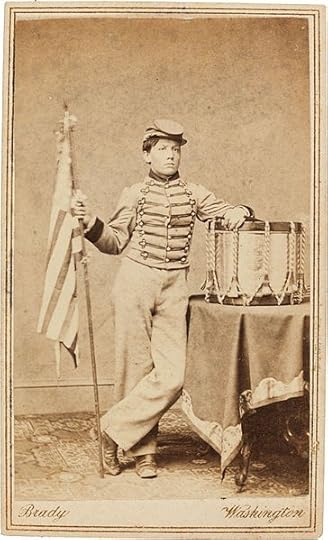
After the fall of Fort Sumter on April 14, 1861, many in Jackson, Michigan longed for the glory of battle. One of those who wanted to enlist was Robert Henry Hendershot, who would famously became “the Drummer Boy of the Rappahannock.” At first, Hendershot did not enlist. He, however, accompanied Company C of the Ninth Michigan Infantry to Fort Wayne, and then to the regiment’s first encampment at West Point, Kentucky. It is believed that he was either a stowaway or he acted as a servant to Captain Charles V. DeLand, the company commander. Hendershot remained with the company until he enlisted in Company B, 9th Michigan Infantry in March 1862, as a drummer boy.
Hendershot was with Company B during the First Battle of Murfreesboro on July 13, 1862, in Rutherford County, Tennessee, and he was taken prisoner. Hendershot was paroled along with the enlisted men, and he was discharged for disability as he suffered frequent and severe epileptic seizures. This did not stop Hendershot as he enlisted in the 8th Michigan Infantry in September 1862. Because of his parole, he signed on with an alias, “Robert Henry Henderson.” Hendershot suffered more seizures during his time with the 8th Michigan Infantry that the acting regimental commander, Captain Ralph Ely, had to order him off duty and apply for his discharge.
While awaiting discharge, he explored the Union encampment that contained the Army of the Potomac. Hendershot claimed to have helped push off the first boat then clung to the gunwale as the 7th Michigan Infantry crossed the Rappahannock River to Fredericksburg under heavy fire on Dec. 11, 1862.
A dispatch from the scene describes “a drummer boy, only 13 years old, who volunteered and went over in the first boat, and returned laden with curiosities picked up while there.” Reports appeared in the press, and the drummer boy remained nameless until late December, when Hendershot visited the offices of the Detroit Free Press and Detroit Advertiser and Tribune, claiming to be the “Drummer Boy of the Rappahannock.” The story was repeated in national papers. For the next eight weeks, Hendershot performed at the P. T. Barnum museum, then spent a few weeks more in Poughkeepsie, New York at Eastman Business College. His heroism was rewarded with a scholarship.
Hendershot was discharged from the Eight Michigan Infantry for epilepsy on December 27, 1862. In April 1864, he enlisted as a first class boy aboard the U.S.S. Fort Jackson at Hampton Roads, Virginia. While Hendershot claimed to be discharged from the Navy on June 26, 1864, the ship’s log listed him as a deserter.
By the end of the war, Hendershot had collected a portfolio of endorsements from Generals Burnside, Meade, Logan, Parkhurst, and President Lincoln, among others, recommending him for an appointment to West Point. Hendershot never went to West Point. He claimed he was denied admission to the academy because of his wounds or his inability to pass the entrance exams. However, no application exists for him in the academy’s records.
After a life full of controversy (mostly concerning the legitimacy of his claims of being “Drummer Boy of the Rappahannock”), Hendershot died of pneumonia on December 26, 1925.
http://www.historynet.com/americas-civil-war-drummer-boy-of-the-rappahannock.htm
http://histclo.com/bio/h/bio-hender.html
https://en.wikipedia.org/wiki/Robert_Henry_Hendershot
Photo Credits:
Photo taken from Wikimedia commons
Save
The post Robert Henry Hendershot: The Drummer Boy of the Rappahannock appeared first on Journey into Darkness by J. Arthur Moore.
June 7, 2016
The Importance of Drummer Boys during the Civil War

It is often difficult to hear commands with all the noise and confusion in a battle. So in order for commands to reach the soldiers, signals that can cut through the roar of fighting became necessary. That’s how drums became such an important part of warfare with its role in the battlefield communications system. Orders were soon given series of drumbeats to represent them, and the playing of each call would tell soldiers what was required of them.
During the American Civil War, many boys who were too young to become soldiers decided to become drummer boys. Many ran away from home and they would usually lie about their age if they were under 18, or use fake names, so that they could enlist.
Unlike the drummers in today’s modern army, Civil War drummer boys were an integral part of the army. Besides their primary job (beating the drums), drummer boys also acted as stretcher bearers and assistant surgeons. They would walk around the battlefields to look for the wounded, so they can be treated. They also bury the dead.
While drummer boys were not supposed to be involved in actual combat, there were times when they were involved in situations that put their lives in danger. Drummers where generally moved to the rear when fighting begins, however, the battlefield is still a dangerous place even if you are far away from the frontlines. Many drummers died in skirmishes. A stray bullet can easily kill even if they are hiding in the rear.
Some drummers even became famous. John Clem was perhaps the most famous drummer boy during the Civil War. He ran away from home to enlist when he was 9, and he became the youngest boy to fight in the war. People were fascinated by stories of him and he became a celebrity of sorts.
When you think about it, drummer boys are quite possibly the most important members in an army. Can you imagine being a commander in the heat of battle? How would you give orders if your soldiers can’t even hear them? Much is written about the generals and heroes of the Civil War, but little is said about the importance of the drummer boys. Without a drummer to establish communications with, everything would fall apart. The Civil War drummer boys were not mascots. There were actually quite useful and its time people get to know more about them.
Sources:
http://history1800s.about.com/od/civilwar/ss/Civil-War-Drummer-Boys.htm
The post The Importance of Drummer Boys during the Civil War appeared first on Journey into Darkness by J. Arthur Moore.
May 26, 2016
The Boys of the American Civil War
After the start of the war at Fort Sumter, people were lining up to enlist and join the army. The soldiers had multiple motivations for volunteering. Some did it to defend their land. Some did it for glory. And some joined because they want adventure.
While the recruiting age was 18 and above, many boys enlisted their names on both sides of the conflict. The official age limit was often ignored since both the Union and the Confederates need soldiers. Boys as young as 10 or 11 can be seen enlisting to become drummer boys. For them, the life of a drummer boy appeared rather glamorous.
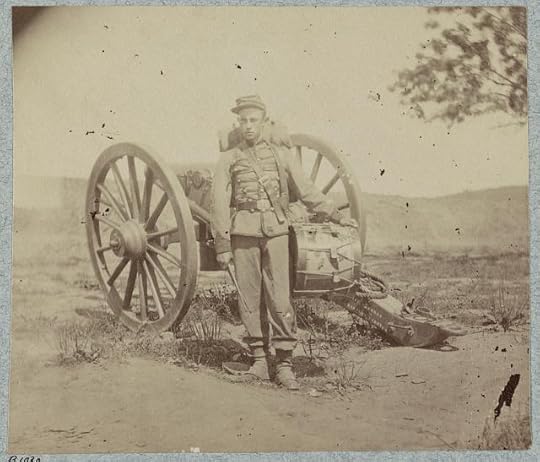
While he isn’t one of the youngest to enlist, Gilbert J. Marbury was only 17 years old when he enrolled on May 28, 1862, in the 22nd. New York, State Militia, Company H. Serving for only three months, he was assigned under the command of Colonel James Monroe. Company H., was under the command of Captain Richard S. Grant.
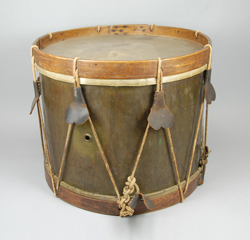
Silas Taylor used this drum while attached to the 3rd Wisconsin Infantry Regimental Band. Taylor left military service in July 1862, after the Army eliminated the unit’s band. His pencil inscriptions on the drum include his signature and a drawing of Old Abe, made during a GAR Encampment in 1890.
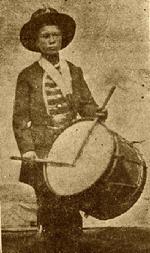
Frank Pettis was only 11 when he enlisted in the army as a drummer boy during the Civil War. At the age of 12, he began military service with his teacher, Captain A. P. Ellinwood, in the 19th Infantry, Company A. He served from February 22, 1862 to August 9, 1865.
Pettis was with Captain Ellinwood in every battle in which their unit was engaged, from Suffolk, VA. and New Bern, N.C., to the Siege of Petersburg and on to Richmond, VA., where the colors of his regiment were the first to float from the Confederate capital building.
After the Civil War, Pettis returned to Reedsburg. First he helped in his father’s tailor shop, but at the age of 20 learned the miller’s trade. He was a member of the Grand Army of the Republic and the Reedsburg Drum Corps until his death on Aug. 15, 1918. At his funeral, the Reedsburg Drum Corps with muffled drums preceded the hearse to the Greenwood Cemetery where he was buried near Captain Ellinwood.
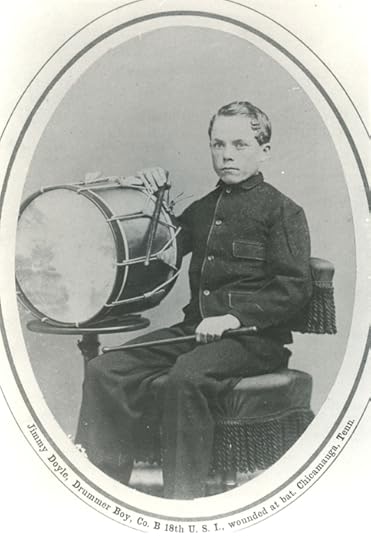
A young drummer named Jimmy Doyle of the 18th U.S. Infantry Regiment poses with his drum during the Civil War. Doyle was wounded at the battle of Chickamauga, Tenn., in September 1863.
(Photo courtesy of the U.S. Army Heritage and Education Center)
“Little Oirish,” a Kentucky boy of about 11, joined the Confederacy’s “Orphan Brigade.” At Shiloh, he was credited with stemming a rout by grabbing the colors and rallying elements of the brigade, which were in danger of breaking under a Federal assault.
Another noted drummer boy was Louis Edward Rafield of the 21st Alabama Infantry, Co. K, known as the “Mobile Cadets”. He had enlisted at age 11 and while 12 at the Battle of Shiloh he somehow lost his drum; he then obtained an enemy drum and kept on going, thus earning the title of “The Drummer Boy of Shiloh”.
Sources:
http://www.loc.gov/pictures/item/2013648445/resource/
http://www.wisvetsmuseum.com/collections/featured/artifact/?ID=366
http://www.saukcountyhistory.org/rbgdrummerboy.html
http://www.murfreesboropost.com/are-you-familiar-with-the-story-of-johnny-shiloh-cms-16143
http://civilwarrx.blogspot.com/2015/04/the-youngest-wounded-drummer-boys.html
The post The Boys of the American Civil War appeared first on Journey into Darkness by J. Arthur Moore.
May 16, 2016
Alexander H. Johnson: “The Original Drummer Boy”

Many believed that Alexander H. Johnson was the first black musician to enlist in the army during the Civil War, however, he was not really the first. Technically, at least three others have enlisted before he did.
A sailor with a passion for percussion, Johnson grew up in New Bedford, Massachusetts. For unknown reasons he was separated from his parents before his fifth birthday, and he was adopted by William Henry Johnson, the second black lawyer in the United States. Johnson’s original surname was Howard and his mother was a Perry.
It is believed that William Henry Johnson’s pro-military attitude most likely influenced Alexander’s decision to enlist as a drummer boy in the 54th Massachusetts Infantry at the age of 16. Robert Gould Shaw, the colonel and commander of the 54th, referred to Johnson as the “original drummer boy.”
Johnson was with the 54th when it left Boston for James Island, South Carolina, where it fought its first battle. Colonel Shaw fell in battle, and he was one of the 272 killed, wounded and missing out of the 600 who participated in the charge.
Johnson remained in the 54th until the end of the war. He mustered out with the survivors in the summer of 1865 and returned to Massachusetts. He brought the drum that he carried at Fort Wagner with him.
Four years later he married, settled in Worcester, Massachusetts, and organized “Johnson’s Drum Corps.” He led the band as drum major, and styled himself “The Major.”
In 1897, a memorial to the 54th sculpted by the artist Augustus Saint-Gaudens was unveiled in Boston. The bronze relief depicts Colonel Shaw and his men leaving Boston for the South with a young drummer in the lead — a scene reminiscent of the July day in 1863 when Shaw and Johnson marched at the head of the 54th to its destiny at Fort Wagner.
After the war, Alex Johnson was a member of both the Grand Army of the Republic General George H. Ward Post #10 and of the Sons of Union Veterans of the Civil War in Worcester, Massachusetts. He is frequently mentioned in the book We All Got History by Nick Salvatore.
The drum carried by Johnson at Wagner remained in his possession as late as 1907, and he undoubtedly still owned it upon his death on March 19, 1930 at age 82, just a few weeks after the 67th anniversary of his enlistment in the 54th.
Written by: Henry Madison
Sources:
http://thecivilwarparlor.tumblr.com/post/76118594339/private-alexander-h-johnson-musician-of-the
http://battleofolustee.org/pics/alexander_johnson.html
http://opinionator.blogs.nytimes.com/2013/03/05/colonel-shaws-drummer-boy/?_r=0
http://kentakepage.com/alexander-h-johnson-the-first-drummer-boy/
The post Alexander H. Johnson: “The Original Drummer Boy” appeared first on Journey into Darkness by J. Arthur Moore.
May 5, 2016
Letters from the Civil War: Henry Lawson Bert (April 30 & May 14, 1865)
 Flags of the 47th Indiana Volunteer Infantry
Indiana University Department of History.
Henry Lawson Bert was born at Jimstown, Ohio, on August 15, 1845, the son of Peter Bert and of Mary Frazier Bert. Henry was little more than sixteen years of age when he left his home at Tipton to enlist for the Civil War. He was not at once accepted—he was small for his age—but followed the Forty-Seventh Regiment of Indiana Volunteers from Indianapolis to Louisville, before he was finally enrolled as a drummer in Captain William M. Henley’s Company I on December 21, 1861. He is described as four feet, ten inches in height, of dark complexion, with black eyes, whose occupation at the time of enrollment was that of a printer.
After the Civil War, Bert, became a merchant tailor, first in Indianapolis, and later in Edinburgh, Marion and Huntington. He died at Marion, Indiana, on December 8, 1910.
Below are the letters written by Bert.
———————————————————————————————————————
Camp Spring Hill, Ala.,
April 30th, 1865
Dear Sister Anna:
Once more I have the pleasure of writing you a few lines as it has been several weeks since I have written and I believe the first time since the capture of Mobile. I dont suppose that I can give you any news but will tell that I am still in the land of the living and one among the heartyest of them.
This is another Sabbath morning, a beautiful day, and a day of Thanksgiving and Prayer which was set apart by Major General Canby
in this department to be kept holy, no work of any kind to be done, but as our company is all out on picket but me and is a very lonesome time for me, I thought it my duty to write a few lines to my beloved sister and I thought it was as good a way as I could do to wile [while] away an hour or so of this weary camp life, but Sister I think this thing of “war” is about done in this once hapy country.
Soon we shall have peace once more restored to our hapy land, all will be united again, Slavery crushed from out the land and then “we” poor soldiers shall come home and enjoy the sweet comforts of home; and friends. This I hope will come this summer, which every soldier expects.
We have been getting good news for some time about the capture of so many prisoners and old Lee and his whole army, Mobile and vicinity. Yesterday old Rebel Dick Taylor came into Mobile and surrendered up his army. Had about 5,000 men, they say. I have saw them. Yet everything has been cheering but among all the good news we received some bad news about the death of Abe Lincoln, but at least the Rebs has not gained anything by that. I think that Andrew Johnson will kill every leader of the confederacy which ought to be done. The rebles has no army on the East side of the Mississippi but the reble General Johnson and he has but a small force, nothing to compare with his opposition, but there is a few rebles west of the river but they can do no harm where they are. A few days ago there was a reble gunboat came out of the mouth of red river with our collors [colors] floating at half mast in honor of the president’s death and all her crue [crew] on deck dressed in blue. Playing the opossum on us, run down the Miss, river almost like lightening. Went down just below the city of New Orleans and then hoisted their reble collors. Thought she was away from all the Yankees but awfully mistaken. She was captured somewhere close to the mouth of the Miss, river. Didn’t get away at all.20
Well for something else, this morning we mustered for one year’s pay. Just 12 months’ pay due us today but not getting it. The talk is now that we are to get 10 months’ pay on Tuesday but I dont know whether we will or not, but the paymaster is in the city sure now with plenty of money. We have almost forgotten what pay is for we have not got any for some time. Well I will close for the present. Well as usual. Write soon. Excuse this paper Anna for I have but little and must be saving till the pay comes.
From your affectionate brother.21
Henry L.
20 Apparently the gunboat referred to was the Webb, of which Admiral Mahan wrote that “the ram Webb, which had heretofore escaped capture, ran out of the Red River in April with a load of cotton and made a bold dash for the sea. She succeeded in getting by several vessels before suspected, and even passed New Orleans; but the telegraph was faster than she, and before reaching the forts she was headed off by the Richmond, run ashore, and burned.” Alfred T. Mahan, The Gulf and Inland Waters (New York, 1883), 217.
21 Written in a very fine hand on a half-sheet, cut lengthwise, or ruled paper The last six lines are crowded into about an inch of space.
———————————————————————————————————————
Camp Spring Hill, Ala.,
May 14th, 1865
Sister Anna:
Once more I have the pleasure of writing you a few lines in answer
to yours I received yesterday evening and I now sit down to answer it. We i have been payed off about a week ago yesterday and I have already told some of the folks that I have sent home 175 dollars and will probably send 25 dollars more in the course of two weeks. …
We got orders a day or two ago to draw an extra pair of shoes to each man and one suit of other cloths. Some of the boys thinks we are going to Texas but I dont think we will now for I think the rebles will surrender before we get there and so ends the war. There is nothing for us to do on this side of the river now. I think we will be at home before the first of September at least I hope so—
Well, Anna: Something else. I cannot write much this time but will give you what I have to say.
We have a beautiful camp here on the top of a nice hill and the beautifulest springs here that I ever saw, more springs than can be counted and some of them the largest that I ever saw. They roll out as large as a quart cup in streams and we have got shades put up all over camp and the pretiest camp we ever had and if it would close the war by staying here I would love to stay here till the war is over.
Well, now I have given you a good description of our camp and I have nothing more of Importance to write this time. Mr. Paul and Benton is well and so is Mr. Cope and I would ask you and Mary to say more about Mr. Cope’s folks for he comes to me everytime the mail comes and ask me if I got a letter from home and how his folks is. I always tell him or let him read the letters when you say anything about them.
So no more at present. Excuse this short letter. I will try and do better next time. Write soon as possible.
From your Brother
Henry L.
———————————————————————————————————————
https://scholarworks.iu.edu/journals/index.php/imh/article/view/7071/7855
The post Letters from the Civil War: Henry Lawson Bert (April 30 & May 14, 1865) appeared first on Journey into Darkness by J. Arthur Moore.
Civil War: The Impact of Family Situations on Enlistment

While many enlisted because they want to experience some adventure, a large number of boys hint at, or outright admit to having, difficulties of some kind at home. Whether economic or relational, these home problems made the army an attractive option for them, and a reasonable one in the eyes of their parents.
14-year-old Charles William Bardeen was one such youth. He enlisted because of difficulties at home, especially with his mother who has remarried. Raised in an abolitionist family, Bardeen believed that he should fight for what he believed in and that he should head south and join the war. He decided to enlist in the 1st Massachusetts Infantry, and his mother supported his decision to do so because she was looking forward to enjoying her second marriage without an unruly teenager in the house, all the while knowing that her son was “under authority that could control me”.
Owen Bradford, on the other hand, enlisted so he can get away from his father, who was an alcoholic and was difficult to live with. Most of what we know about Owen comes from his brother Peleg’s letters. It was clear in the letters that Peleg never wanted Owen to enlist, as he tried to discourage Owen from joining many times. Unfortunately, the situation at home apparently become untenable, and Owen joined the army in December 1863.
At home in Maine, Peleg Bradford, Sr. was moved to take a temperance pledge, and later letters from Peleg to his father discuss the brothers’ offers of money to help fund the purchase of a farm for the family. Sadly, the family’s newfound happiness was cut short when their father died in April 1864, followed by Owen’s death a few months later when he was hit by an exploding shell at the Battle of Petersburg. Owen was just 16 years old.

Another boy with a difficult home situation was Delavan Miller. He ran away to joined the army in order to keep his family together. In his memoirs, he explained that his father was his only surviving family member and had left Delavan behind when he enlisted in the fall of 1861. He was still mourning his mother’s death when the war arrived, and his father enlisted. Like many boys at the time, Delavan lied about his age when he enlisted in order to avoid asking his stepmother to sign enlistment papers. His father Sgt. Loten Miller was surprise when he saw his son in the army. In his memoir, Delavan said that, “The father was a man of few words… so he brushed two or three tear drops away and went back to the command of his gun squad…”

The need to help support his family financially probably had a lot to do with Rashio Crane’s decision to join the army and with his mother Mary’s decision to allow him to go. He enlisted in the 7th Wisconsin as a drummer, alongside two older brothers, early in 1864. Rashio was in the army for only about five months before he was captured at the Battle of the Wilderness while serving as a stretcher bearer. On July 23rd, 1864, he died in Andersonville Prison.
Sources:
http://www.civildiscourse-historyblog.com/blog/2015/6/8/young-soldiers-part-ii
The post Civil War: The Impact of Family Situations on Enlistment appeared first on Journey into Darkness by J. Arthur Moore.