Sarah Miller Beebe's Blog
May 7, 2013
Review of Cases in Intelligence Analysis
There is a new review of Cases in Intelligence Analysis: Structured Analytic Techniques in Action in the CIA journal Studies in Intelligence. The reviewer called the book "a welcome addition." Here's an excerpt:
Sarah Beebe and Randolph Pherson provide a welcome addition to the work on structured analytic techniques in Cases in Intelligence Analysis. Beebe and Pherson both had careers with CIA and have a good sense of intelligence analysis and the pitfalls new analysts are likely to encounter. Cases is aimed at new analysts and strives to teach tools for tackling different kinds of problems. Their book goes beyond similar works focused on structured analytic techniques (SATs) by providing case studies to demonstrate how and when to use different kinds of analytic methods for evaluating information and approaching intelligence problems.
Beebe and Pherson's book is straightforward. Each case provides step-by-step instructions on how to execute one or more SATs relevant to each case. The authors also give an overview of each case's policy context, hammering home the purpose of analysis. Their book will be of most value to those teaching new analysts and analysts wanting to brush up on methods used in the Intelligence Community (IC). Each of the 12 case studies is self-contained, and the examples range across recent domestic and international events. This should appeal to analysts from across the IC, especially those working in agencies with substantial analytical components specifically, CIA, DIA, the Department of Homeland Security, and the FBI.
Some of the names the authors assign to the SATs are over the top, however. For example, starbursting is nothing more than asking basic questions such as who, what, where, when, how, and why. Beebe and Pherson provide a useful chart at the beginning of the book that lists the cases along with the applicable SATs so one can quickly focus on a specific technique. They also provide helpful cross-references to earlier work by Pherson and Richards Heuer, which provides additional information on the various SATs. Many of the chapters, e.g., Who Poisoned Karinna Moskalenko? Is Wen Ho Lee a Spy? Who Murdered Jonathan Luna? The Assassination of Benazir Bhutto, The Atlanta Olympic Bombing, and The DC Sniper seem geared toward political analysts and have a bit of a whodunit feel. Techniques and case studies appealing to economic and leadership analysts would be a welcome addition.
I hear that there are other reviews in the works as well.


Kindle Version of Cases in Intelligence Analysis!
A Kindle version of Cases in Intelligence Analysis is now available on the Amazon website!
Also, see what readers are saying about Cases in Intelligence Analysis on Shelfari and Goodreads:
"If you are going to buy only 1 book on analytic techniques and tools, THIS is the book to buy. It is well-written, exceptionally well organized and presented, and extremely useful both for teaching and for doing analysis. In a greatly over-crowded and over-hyped field, this is the stand out book."
--Mark Lowenthal, author of Intelligence: From Secrets to Policy
January 15, 2013
Breaking New Ground in Analytic Research
Did you ever wonder why intelligence analysts are so vulnerable to surprise? In Understanding the Non-Linear Event: A Framework for Complex Systems Analysis (International Journal of Intelligence and CounterIntelligence), Sarah Miller Beebe and George S. Beebe explore how the dynamics of complex international systems are often at the heart of intelligence surprise. Many discontinuities, such as the recent events in the Middle East and North Africa that have become known as the “Arab Spring,” are the products of what are termed Complex Adaptive Systems. To minimize their vulnerability to surprise, analysts need a new conceptual framework for identifying and understanding such complex systems. This paper offers a new framework for producing such analyses of complex systems, avoiding the perils of linear projections, and helping policymakers understand the potential for discontinuous change.
December 9, 2011
Cases in Intelligence Analysis Instructor Materials
Cases in Intelligence Analysis: Structured Analytic Techniques in Action and its companion text, Cases in Intelligence Analysis: Instructor Materials (pictured below) have published. The book-length Instructor Materials is available as a free downloadable PDF at the CQ Press web site for all. It includes case conclusions, notional solutions to all of the exercises, full teaching notes, and extensive graphics for use in the classroom.
[image error]
September 3, 2011
Ascendant Trailer
How will you rise to your organization's challenges? Maybe the Ascendant Trailer will spark some ideas!
August 18, 2011
Hard Problem Workshop
In July and August, Sarah Miller Beebe conducted a three-part Hard Problems Workshop in Washington, DC. Analysts developed and refined the key analytic question, developed and applied an indicators framework, and created a plan to visualize the data for the most powerful product. The fourth part in the series will help analysts troubleshoot their analysis prior to publication of their findings. To learn more about the Workshop, view our flyer.
August 5, 2011
IC Centers of Academic Excellence Workshop
In late July, Sarah Miller Beebe traveled to the University of Nebraska Lincoln to serve as an instructor and mentor for Intelligence Community (IC) scholars at a week-long workshop hosted by the Great Plains National Security Consortium (GP NSEC). The program is funded by the Office of the Director of National Intelligence-sponsored Centers of Academic Excellence (CAE) program, which helps academic institutions implement curricula that focuses on critical IC skill sets.

July 22, 2011
Ascendant Joins Facebook!
[image error]Ascendant has joined Facebook! Check out the Ascendant Analytics FB page and post a comment. Help us grow our FB fan base by liking our website and our FB page.
July 15, 2011
Cases in Intelligence Analysis
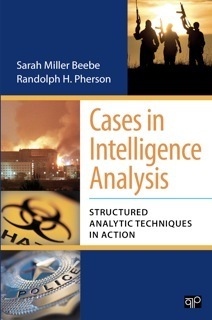 Sarah Miller Beebe's new book, Cases in Intelligence Analysis: Structured Analytic Techniques in Action has been scheduled for publication on 11 October 2011 and is now available for pre-orders on amazon.com and the CQ Press website. Academic and government institutions can contact Makenzie Verbout, mverbout@cqpress.com, at CQ Press to request examination copies and make inquires about bulk sales.
From the Publisher...
Accomplished instructors and intelligence practitioners Beebe and Pherson have created a set of twelve robust, class-tested cases on events in foreign intelligence, counterintelligence, terrorism, homeland security, law enforcement, and decision-making support. The case studies are designed to give analysts-in-training a hands-on opportunity to apply structured analytic techniques to tackle real-life problems. Each case delivers a compelling narrative and a set of step-by-step instructions that make teaching and learning as effective and efficient as possible.
To make the teaching of the cases as turn-key as possible, Beebe and Pherson have created a case-by-case guide, Cases in Intelligence Analysis: Instructor’s Materials, that is free to all users as a downloadable PDF. Instructor’s Materials includes solutions to all of the exercises, teaching tips, conclusions for each of the cases, and key takeaways that can be used to guide classroom discussion. Graphics from the case book and the Instructor’s Materials are also available, free, as downloadable JPEG and Power- Point slides.
For more information about contents and feature, view the Cases Flyer.
June 28, 2011
Intelligence Educators Conference
Sarah Miller Beebe attended the annual International Association for Intelligence Education Conference held in Washington, DC in June. She presented her forthcoming book, Cases in Intelligence Analysis: Structured Analytic Techniques in Action, at the authors' roundtable and served as moderator and speaker for a panel on Critical Infrastructure Protection. For more information about IAFIE and its resources, visit the website at www.iafie.org.
[image error]