
Barbara Wallace's Blog
March 20, 2025
Of Pollyanna and Marcus Aurelius
Talk about a rabbit hole.
This post began as a celebration of spring and how watching nature wake up reminds me that no matter how cold the winter might be, it doesn’t last forever. I thought it a fitting metaphor for life and the world today.
Then I started thinking about how some people would read my happy, optimistic post and think me a Pollyanna. That, of course, led to my thinking deeper about Pollyanna’s sunny attitude, and I realized something: Pollyanna has a lot in common with the Stoics.
Compare these two quotes:
When you look for the bad, expecting it, you will get it. When you know you will find the good—you will get that….”
―Eleanor H. Porter, Pollyanna
Pollyanna believed that when confronted with an obstacle or hardship, one should play “the Glad Game” and look for the good in the situation. Your aunt makes you live in the attic? Focus on what a lovely view you have. In other words, rather than spend her time bemoaning what she doesn’t have, she appreciates what gifts she does possess.
“Nothing either good nor bad but thinking makes it so.”
―Marcus Aurelius, Meditations
Stoic philosophy emphasizes living a virtuous life by emphasizing wisdom, justice, courage, and temperance, focusing on what you can control, and accepting that which you cannot. They believed happiness came not from external sources, but from how a person reacts to those sources.
Isn’t that a lot like looking on the bright side?
Pollyanna and the Stoics share something else in common. They understood the effect our behavior has on humanity. kindness
Psychology calls this the ripple effect. Much like when you toss a pebble into the water, behavior, be it positive or negative, can create a chain reaction that spreads and influences others. (Don’t believe me? Google the Rule of Reciprocity.)
Pollyanna changed an entire town by spreading kindness. Stoics believed we are all parts of a larger whole, and therefore, we should work for the well-being of humanity through generosity and kindness toward everyone, even those who oppose us.
See the similarities?
Which brings me back to my celebration of spring. Why not look on the bright side and see spring for the season of rebirth that it is? If it’s good enough for Pollyanna and the Stoics, it’s good enough for me.


March 10, 2025
Protect the Muse

The creative soul is a fragile creature. If you take it for granted, if you feed it a steady diet of anger and sadness, if you fail to treat it with kindness, your muse will wither and die.
I know that in this crazy sh*tshow of a world, caring for your creative selves is harder than ever. Consider this post your permission slip to care for your creative self. Build a temporary bubble around yourself and escape. Unplug. Turn off your phone. Nap. Walk on the beach. Whatever your soul calls for you to do.
Your soul will thank you.
Facebook Messenger LinkedinMarch 2, 2025
Nancy Brown Sanford
Since March is Women’s History Month, I thought I’d participate in the Ancestral Woman Challenge by sharing some stories about my female relatives. Most of them are unknown women, but they are the reason I exist, and for that reason alone, deserve celebrating.
NANCY BROWN1842-1929
My older brother and I both make our living as writers. Given that, we’ve often wondered how it came to be that two people from a small town in Massachusetts inherited such strong creative genes.
Did we inherit our creativity from our mother, who could predict the plot of a tv show within five minutes of the theme song? Or maybe it was Grandma Viola, she of the wild family stories? Lord knows, she had an imagination. Or was it even in our family tree? After all, if we’re related to John and Priscilla Alden then Henry Wadsworth Longfellow is a (very) distant cousin.
As it turns out, the answer lay in an old Army trunk my parents kept in the basement. There, among the scrapbooks and old photos, I found a small, handmade booklet entitled The Poems of Nancy A. Sanford.
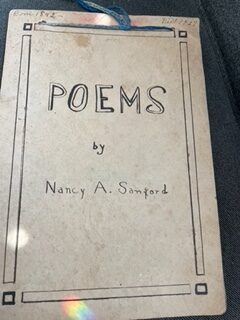
My great, great, grandmother, Nancy Brown Sanford was born to Harvey and Lucina Brown in 1842 on the Old Brown Farm in Whitingham, Vermont. She was a true New Englander, with both her father’s and mother’s family trees stretching back to the Puritan migration. (Lucina was a Mayflower descendant, while Harvey’s family arrived a decade later.)
She died in 1929 at the age of 87 from pneumonia, which she developed 36 hours after attending the Stamford, VT grange meeting . Her obituary called her a “woman of kindly instincts, always ready to assist in time of trouble,” whose “place in the community will be difficult to fill.”
The book of poems I discovered provides a fascinating look into life in Whitingham, VT. She wrote poems for people’s birthdays, anniversaries, and church socials. She wrote verse about Temperance for the Deerfield Valley Times, and recited a poem of Thanksgiving at Sunday service. She even wrote a cheeky history of Stamford, VT incorporating the names of the founding families.
My favorite of all of them is the poem she wrote for herself on her 50th birthday which includes the verse:
A husband and five children have been mine
Given by love’s hand divine
The first I’ve often failed to please
And been to him a drag and tease
But if he understood me better
He’d take the spirit, not the letter.
The poem continues with references to babies who died young and relatives who fought in the Civil War.
I have a photograph of Nancy hanging in my house. I discovered it at an antique store in Ohio, of all places. I like to think this wasn’t an accident, but that Nancy was letting me know she’s glad to see the writing gene carried on.
She’s my muse.
February 28, 2025
One Last Historical Fiction for Black History Month
Since today is the last day of Black History Month, I thought I’d wrap up with one more historical fiction recommendation.

I’ve always said that the mark of a great historical fiction novel is if, after reading it, you head online to learn more about the characters. HARLEM RHAPSODY not only had me Googling for info, but inspired my husband and me to add a book to my TBR. (PASSING by Nella Larsen*).
I’d heard about the Harlem Renaissance, but only in passing. I knew very little about the writers of the time beyond Langston Hughes and Zora Neal Hurston. Therefore, I’m grateful to Victoria Christopher Murray for bringing this period to life and educating me about the many talented writers who should have – but weren’t – taught in school. I’m even more grateful for her introducing me to Jessie Redmond Fauset, the author and literary mentor who taught these writers and introduced them to the world.
Unlike so many historical biographies that insist on spanning a person’s entire life, Murray wisely focuses on the years 1919-1926, the years Fauset worked as the literary editor at The Crisis, the magazine published by W.E.B. Du Bois and the NAACP. Not coincidentally, these are also the year’s Fauset was rumored to be having an affair with Du Bois. By concentrating on a narrow segment of Fauset’s life, Murray is able to take what could have been an episodic novel and turn it into a story with tension and character growth. Readers witness Fauset’s growth from smart and talented (but starry-eyed) acolyte to a woman of influence. Maybe it’s because I didn’t know much about Fauset’s history, but I found myself eager to learn where her ambitions would take her.
What impressed me the most, however, is how Murray avoided the trap that affects so many historical biographers, and that is she didn’t shy away from painting Fauset and W.E.B. Du Bois as flawed human beings. I could see where it would be tempting to gloss over their failings – especially with someone like Du Bois, who accomplished so much and did so much for the Black community, but Murray doesn’t. Her Du Bois is simultaneously brilliant and arrogant. She also does a great job of showing the misogyny of the era as the patriarchy often thwarted Fauset’s ambition.
If you like strong female protagonists and want to learn more about the Harlem Renaissance, you should read this book.
*After reading Nella Larsen’s sad life story, I hope Murray uses her talents to tell her tale next.
February 24, 2025
Monday Pep Talk

Dear Writer:
I want you to know that I see you. I support you. I believe in you.
If you’re struggling, I understand. Writing is a hard job, and the publishing world isn’t always fair. Heck, the world isn’t always fair. The rejects, the bad reviews, the criticism – it all sucks.
Still, you matter, and your work matters. Consider this your validation.
Even if we never cross paths, I have your back.
February 17, 2025
Barb’s Book Reviews

AMERICAN DAUGHTERS by Piper Huguley. Portia Washington and Alice Roosevelt couldn’t be two more different people, and yet they had much more in common than people realize. It makes sense that they would become friends in real life. While their friendship is the book’s hook, AMERICAN DAUGHTERS is really a story about two women discovering who they are as individuals.
THE YELLOW WIFE by Sadeqa Johnson. This story of a young female slave’s struggle to survive imprisonment in Virginia’s infamous Hell’s Half Acre remains one of my favorite reads of all time. Everyone talks about Johnson’s HOUSE OF EVE but to me THE YELLOW WIFE was even better.
ISLAND QUEEN by Vanessa Riley. A fabulous book that everyone needs to read. Vanessa Riley did a brilliant job telling the story of Dorothy Kirwan Thomas, an 18th century slave who controlled her own destiny and made a fortune. Dorothy is a role model for all women.
THINGS PAST TELLING by Sheila Williams. This book chronicles the life of Maryam Grace, a West African girl who is captured by slave traders in the late 18th century. Over the next 100 plus years she lives a life filled with heartache, love, and adventure. Maryam is a strong, resilient woman who faces untold trials over her life. William has created such a wonderfully three-dimensional character that you can’t help but fall in love with Maryam and root for her to find happiness and freedom. The themes of motherhood, family, love and time will tug at your heart strings.
THE SECRET KEEPER OF MAIN STREET by Trisha R. Thomas. Bailey, a black dressmaker with the gift of second sight, finds herself drawn into local scandal and mystery when she agrees to help a Elsa Grimes, the local oil heiress with a terrible secret. So many secrets; so many plot twists. Thomas takes everything great about nighttime soaps and puts them in book form while simultaneously painting a vivid picture of 1950s Black America.
THE TRIAL OF MRS. RHINELANDER by Denny S. Bryce. Bryce brings this true story to life and gives us a complex portrait of a woman who suffered public humiliation when her rich – but weak – white husband decides to divorce her. In Bryce’s deft hands, this story about classism, racism, and the traumas of passing for white soars.
Facebook Messenger Linkedin Reddit BloggerFebruary 12, 2025
Here a Witch, There a Witch
 Source: Connecticutghosthunter.com
 In researching my family history, I was greatly relieved to discover a small typographical error in the family tree. Somewhere along the line, someone changed Frances R. Gould to Francis Gould.
Why was I relieved? Because Francis Gould was the son of Zaccheus Gould, whose family played a key role in the accusation of Sarah Wildes during the Salem Witch Trials. My ancestor, Frances R. Gould lived in the same town – Topsfield – but she married Peter Shumway and apparently minded her own business.
That doesn’t mean my family escaped the witch hysteria though….
The Hartford Witch TrialsThirty-years before the Salem Witch Trials, Connecticut had it’s own witch hysteria. In 1662, a young girl named Elizabeth Kelly fell sick and died shortly after sharing a meal with her neighbor Goodwife Ayers. Historians today theorize that young Elizabeth suffered from a virulent strain of either influenza or pneumonia, but back then, the extremely Puritan community blamed her death on the supernatural. More specifically, because their feverish daughter had cried out during her hallucinations that Goodwife Ayers was hurting her, Elizabeth’s parents claimed that Goodwife Ayers bewitched their daughter and killed her with black magic.
Over the next year, ten more people would be accused of witchcraft. Among them was Rebecca Greensmith who went on to accuse her husband Nathaniel, and several neighbors, including Andrew and Mary Sanford (my 8th Great Grandfather and Mother) who were accused of “public meetings other than those prescribed by the elders” and “dealings with Satan.”
Andrew and Mary SanfordAndrew Sanford emigrated to the New World with his uncle Andrew Warner around 1634 and settled near Hartford, where he became a blacksmith. He married Mary Sanford shortly later and they had five children, one of whom is my 7th great grandfather, Andrew Jr.
Andrew was arrested on June 6, 1662. Mary was arrested a week later. According to John Taylor’s Witchcraft Delusion in Colonial Connecticut, Rebecca Greensmith implicated Mary Sanford in her confession, saying:
“I also testify that I being in ye wood at a meeting there was wth me Goody Seager Goodwife Sanford & Goodwife Ayres; and at another time there was a meeting under a tree in ye green by or house & there was there James Walkely, Peter Grants wife Goodwife Aires & Henry Palmers wife of Wethersfield, & Goody Seager, & there we danced, & had a bottle of sack: it was in ye night & something like a catt cald me out to ye meeting & I was in Mr. Varlets orcherd wth Mrs. Judeth Varlett & shee tould me that shee was much troubled wth ye Marshall Jonath: Gilbert & cried, & she sayd if it lay in her power she would doe him a mischief, or what hurt shee could.”
Andrew’s trial resulted in a hung jury. Mary, on the other hand, was found guilty. While there’s no record of her actual execution, she must have died of something, because Andrew moved to Milford, CT and remarried shortly after.
Mary was officially exonerated in 2023 thanks to the work by the Connecticut With Trial Exoneration Project.
Most of the above information has been parsed from Internet sources. I’m still hoping to do a deeper investigation into the trials.
February 10, 2025
Monday Pep Talk
Dear Writer:
A word of advice from someone who has been riding the writing roller coaster for thirty years.
Life, at its simplest, is a series of time blocks. One second, one minute, one hour, one day. Thousands of finite segments with beginnings and ends, which means thousands of fresh starts. With every sweep of the clock hand, you have the opportunity to begin again, and again, and again.
The Japanese have a saying, “Nana korobi ya oki,” meaning “Fall down seven times, get up eight.” The truth is, however, that you have a lot more than eight chances. So if you stumble today, don’t quit. Throw out that rejection letter, forget yesterday’s writer’s block, ignore your internal critic, and get up again. You WILL succeed.
Facebook Twitter Linkedin EmailFebruary 7, 2025
A Realization and a Recommendation
You may – or may not – have noticed I didn’t post anything the last two days. I was neckdeep in my WIP and time got away from me.
Last night at around 3AM, when I was pinned down under the covers by ALL THE CATS IN THE HOUSE, I came to two realizations.
Posting daily isn’t going to work. When I came up with my grand plan of posting five days a week, I forgot one very important thing and that is you have to have something interesting say five days a week. To do this requires time and effort. The effort I’m willing to put in. However, I lack the time. I have a book deadline looming at the end of March, and that is taking most of my attention.It’s okay to admit defeat. There was a time when I would beat myself up for falling short of a goal, but the truth is not every idea is going to work out. Sometimes, you try and you fall short. Maybe the idea wasn’t as great as you thought, or the timing wasn’t right, or whatever.
My point is the failure is in the idea, not in you.
Therefore, for the time, I’ll be posting regularly, but not daily. That way I can write longer pieces that have some meat to them.
Weekend Book Recomendation

If you’re are into WW2 history, then you have to read Matthew Goodman’s PARIS UNDERCOVER. It’s the real-life story of Etta Shiber and Kitty Bonnefaus, two women in their fifties who ran an escape line out of the Paris apartment during the early days of the Nazi occupation. The story of how Kitty – who was the brains of the operation – established the network is fascinating, as is the story of their arrest and imprisonment.
But that’s only the beginning. When Etta returns to the United States, she writes a memoir about their adventures. I don’t want to spoil anything else, so let’s just say that her decision to publish hers and Kitty’s story kicks off an incredible tale of betrayal, unscrupulous behavior, and painful repercussions.
If PARIS UNDERCOVER had been a novel, I’d call out the author for having too many unbelievable twists and turns. The fact that all of what Goodman wrote actually happened, blows my mind. I couldn’t wait to find out what happened next.
PARIS UNDERCOVER is available from Penguin Random House Publishing.
February 4, 2025
MFA Goals: I Need Your Help
I realized this morning that, when it comes to this whole DIYMFA project, I need a more definable goal. Originally, I said I wanted to take my writing to the next level. But what does that mean, and how do I know when I’ve achieved it?
Here’s what I do know:
First of all, I’m not looking to write An Important Book or Great Literature. I’m a storyteller. I like commercial fiction. What I want to do is to write the kind of upmarket fiction that Beatriz Williams and Ariel Lawhon write.
Second, I have a very strong, established voice. I write tight – scarily so as my friend says. My work isn’t prone to navel gazing or long paragraphs of vivid description. I like my voice. I want to improve it, but I don’t want to water it down. (Tight worked for Hemingway, so why not me?)
Third, I’m a girl who likes guideposts and instructions. I wander around in the mist enough when I’m writing, I like my learning to have some kind of direction.
Knowing the above, I’ll return to my original point. What am I actually trying to achieve by all this studying, and how will I know if I’ve improved? I’m turning to you all with hopes you have suggestions.
Facebook Twitter Linkedin Email

