
A.M. Dean's Blog: Wandering Authorial Thoughts
March 20, 2014
A.M. Dean's Five Top (Sarcastic) Twitter Tips for Becoming a Better Writer
 Recently on my Twitter feed (@AMDeanUK), I’ve gone through a spat of selflessly offering some helpful advice for writers, contributing my small parcels of wisdom to the ever-active and life changing #writingtips hashtag (it’s like a virus: it just won’t die); and it’s been a while since I added anything to my blog, so this seemed the perfect time for a thematically-related rant.
Let’s be frank: if you need to turn to Twitter to learn how to write, something has already gone horribly, horribly wrong, and “Stop! #writingtips” really ought to be the only tweet ever posted to that hashtag. But the clearly ludicrous nature of such advice, and the fact that 140 characters might not be the best format for sharing advice on writing, shall not hold at bay the inevitable tide of advice that Twitter draws forth from amongst those whose wisdom just really, really, really needs to get out there and help change the world.
We need to put things in perspective, give some concrete examples, as it can be hard to conceive by mere intellectual capacity and imagination alone, how vacuous some of the advice we’re delivered online can actually be. Amongst the helpful tips my timeline has shone into my spectacles recently have been, ‘A good title is important’, ‘Try to create compelling characters’, and the revelatory ‘Checking for spelling is a good idea.’ And there’s the ever present ‘Speak from your heart, from your real experiences’ kind of guidance, which is particularly useful for the vampire erotica short story writers who currently make up 99.4% of Twitter authors. ‘Don’t repeat yourself. Repetition is unnecessary’ is another personal favourite. By which I mean to say, it is another personal favourite.
Now at first — I shall make a honest confession — I mocked. I’m not proud of this, I realise I was harsh to the bit. I read all this wisdom, and I mocked. But then I realised how shameful was this impulsive response: I mocked not because I should, but because I could, and as a classic gem of the #writingtips stream once taught me, ‘We sometimes mock what we don’t no [sic]; write what you fleel [sic].’
So, I repent of my horrible judgementalism and mockery, and hereby offer to do just that: to write what I really fleel. Too long have I sat, dismissively and contemptuously, far from the great pool of authorial wisdom into which everyone on Twitter is collectively vomiting, but no more!
Therefore, consolidated here, I present . . .
A.M. DEAN'S FIVE TOP TWITTER TIPS FOR BECOMING A BETTER WRITER:
1. Use big words whenever you can. Simple is for sissies. Say 'philogyinst' instead of 'lover' & 'hebete-animus' instead of 'cow'. #writingtips
I posted this recently, when I saw that so many authors were writing things like ‘He saw the girl’ rather than ‘He visually settled an ophthalmic glance upon the femininity of the other’; and obviously you’re not going to write well if you take the easy way out like this. Definitely try to make sure that all your words have at least two syllables in them; but you should really be aiming for three or four for important words. A few common mistakes: don’t say ‘fear’ when what you mean is ‘collywobbled perturbation’ (look it up!), or ‘happiness’ when you mean ‘rhapsodic beatific bliss’. It’s the sign of a ‘bad writer’ (which, clearly, is more correctly written as ‘an imperfectually deficient wordsmith’).
2. Superlatives aren't enough. Make them stronger for impact: it's "the most best" and "the extremely finished" from now on. #writingtips
I can’t stress this point enough: it’s emphatically one of the most extremely important of them all. How can you expect a reader to know you really, really mean something if you only use the form of a word that explicitly indicates it represents the highest possible degree of a thing? ‘Tallest’ just doesn’t cut it next to ‘the very tallest’. And if you write ‘the greatest’ instead of ‘the very most greatest’, you’re just being lazy. Your reader needs to know that you really mean these things.
3. Where possible, try to write everything using passive verbs. #writingtips
It should be said that phrases written passively are read with more devoted attention and are perceived as possessing a greater intensity than those which are said actively. Don’t let the rush-and-focus attitude of the modern world trick you into using flawed phrases like ‘He shot her’ in place of the traditionally more meaningful ‘she was shot by him’, or ‘She ran to the car’ instead of the clearly superior ‘towards the car was a running in which she was involved.’
4. Also, use many adjectives. At least four or five per noun is a good aim. #writingtips
It’s a good idea never to let a noun stand on its own. ‘The Cat in the Hat’ may have worked for Dr Seuss, but that was back in simpler days when readers didn’t demand more for their hard-earned pound. ‘The Furry, Animalistic, Mid-sized, Pleasant Cat in the Felt, Broad-Rimmed, Multi-tiered, Bi-colour Hat’ is really a bare minimum for how he would title that classic today. Similarly, you should prevent the boredom that will creep into your reader’s experience if they encounter poorly constructed phrases like, ‘As the storm approached, the boat risked capsizing into the sea’. Draw in their imaginative attention by giving them something to work with. ‘As the luminous, stirring, vexatious portent of the storm voraciously and unyieldingly approached, the rickety, tinder-fragile, rocking, chipped, off-balanced boat categorically risked wholly and most completely capsizing into the wild, watery, wave-whipped sea.’ You see, that’s far better.
5. Writing important passages ENTIRELY IN CAPITAL LETTERS is a good way to mark emphasis. Also, many exclamation marks!!!!! #writingtips
I’m constantly surprised how many writers fail to realise that PUTTING REALLY IMPORTANT THINGS ALL IN CAPITAL LETTERS IS CLEARLY A GOOD WAY TO EMPHASISE THAT WHAT YOU’RE SAYING HERE MATTERS. It’s as if the Caps Lock key on modern-day keyboards were being systematically ignored. Here’s a general rule of thumb: AT LEAST two or three words in EVERY sentence should be EITHER CAPITALISED or underlined or made italic; and obviously TRULY ESSENTIAL PASSAGES SHOULD MAKE USE OF ALL THREE OF THESE RESOURCES. And punctuation marks exist for a reason! A reader isn’t going to feel the shock of your character’s surprise if all she says is, ‘Wow!’ when she could so easily say ‘Wow!!!!!!!!’ This will knock your reader’s socks off. Similarly, REALLY probing questions should have at least three question marks, shouldn’t they??? And don’t forget the nearly endless possibility of punctuation combinations that can add impact and drama to otherwise lifeless words. A simple ‘What?’ is worlds away from a well crafted ‘WHAT??!!!!????’
Which is, by the way, precisely what I most often tweet in reply to the wisdom received on #writingtips.
AMD
A.M. Dean is the author of The Lost Library and The Keystone, amongst other thrillers. Do you want to know more about him? Visit his website at www.amdean-books.com, or follow his excessive Twitter addiction at @AMDeanUK.
photo credit: photosteve101 via photopin cc


December 2, 2013
A.M. Dean responds to AmazonAir with Residential Authorship Programme
From a dear reader and (creative) fan. You're a star! AMD
 2 DECEMBER 2013: In a week that has been filled with a surprising number of literary delivery method revelations, from Amazon’s announcement that it will soon be launching drone strikes against your house to Waterstone’s retaliatory announcement of a 10-15 year plan to train owls in paperback delivery, thriller author A.M. Dean has stepped into the arena of innovative book delivery methods with his company's own contribution.
‘We’re particularly pleased that Mr Dean is taking the lead in this forward-thinking new concept in the book-buying experience,’ a spokesman for the author said, just minutes after the launch of Dean’s new service, to be known as the “Situational Literary Authorship Concept for the Keenly Enthusiastic Reader”, or S.L.A.C.K.E.R. for short.
‘All the major players in the field are working with old concepts,’ Dean said during the press event in central London this afternoon. ‘Whether it’s Amazon’s three-year-pathway to drone delivery, or Waterstone’s ten-year plan for owl-based express shipments, all the distributors are basing themselves on the same, outdated model: authors write a book, and sellers move the book into the hands of readers.’
‘But it’s a model that always involves a middle man,’ Dean continued, ‘whether it’s robotic or ornithological. We are the only group planning to remove the middle man all together, and bring the book-writing and book-buying experiences into a singular, harmonious whole.’
A.M. Dean’s Situational Literary Authorship Concept for the Keenly Enthusiastic Reader works on a remarkably simply premise.
‘For a modest additional charge over the base cost of the novel, A.M. Dean will arrive at the purchaser's home, sit in their living room with a pad of paper, and write the book in their house. That’s it. No delivery method needed. No shipping time. No P&P. Your next book, in your house, literally the very moment it’s released.’
When asked whether the SLACKER programme would involve any hidden fees or charges, Dean’s spokesperson acknowledged that certain operational costs would be passed along the consumer, including room and board for Mr Dean during the writing process, ‘a hell of a lot of Scotch, pretty much 24 hours a day’, and the need for a purchasing family to entirely vacate their home for lengthy periods of the writing process to provide a ‘quiet, creative space’. It was also noted that Dean 'does not like pets, people, traditional or modern architecture or interior decorating styles,' and that purchasers of novels on the SLACKER programme may need to allocate sufficient funding to accommodate the increasingly whimsical and eccentric demands of the author.
‘But after a nine- to eleven-month period of storyline incubation and writing,’ Dean added, ‘you'll literally have my next book in your hands, the very second it’s finished. No waiting. None of this thirty minutes of waiting for Amazon to bomb your house from the skies.’
When asked whether the scheme’s increase of the cost of a paperback novel from £6.99 to a projected £350,000.00 might put off consumers given the tight economic circumstances of the financial downturn, Dean’s spokesperson replied, ‘We’re confident that if people are genuinely taking Amazon’s offer to deliver their books by drone seriously, we’ll find a market ready to meet the modest price increase of a SLACKER-produced and delivered novel.’
September 26, 2013
An Ode to Goodreads. Idiot.
About a year ago, a few of my readers kindly helped me figure out what Twitter was, get online and start going to town. Now I’m perpetually being monitored by around 10,000 of what Twitter innocuously terms ‘followers’, as opposed to ‘stalkers’, and I’m able to share with the whole world, in almost real time, things like ‘I’m wearing shoes today’ (which I am) and ‘my toaster is unplugged’ (which, in point of fact, it isn’t). And through it all I discovered that I quite like Twitter. Despite my initial concerns, it turns out that 140 characters is just about exactly the length conversation I enjoy having with with most people.
 And then along came Goodreads. Bowing to the tremendous social pressure to do so (you online ‘friends’ can be a bunch of bullies), I finally signed onto the massive website for bookish people, configured my account, went through my usual routine of making up fictional email addresses so that the thousands of notifications social media sites like to generate would never get to me (if you’re actually the owner of flippingpropellordolphins@gmail.com or goshiwantmoreemail@hotmail.com, I do apologise), and moments later, voila! I realised I had no idea what Goodreads was for.
And so it remained for several months. I looked at books. I said I was reading books. I said I was 72% through reading my current book. I linked these things to Twitter, so my ‘twerps’ could know, with absolute certainty, that I was 72% through my current book. I finished books, and marked them read, and put them on shelves.
And still didn’t know what it was really all for.Then one day, in frustration, I tweeted that I didn’t quite understand the point of Goodreads. Many of my followers responded with notes like, ‘I do! haha!’ or ‘I think it’s nice’ or ‘I’m wearing two different coloured socks’, but there was one reply that really got to me. It read simply as follows:
‘Don’t be daft. There are people there. Get to know the people.’
That this message was followed with a second note by the same person, concluding his thought with a Rainn Wilson-esque ‘Idiot’ (@RainnWilson), didn’t diminish his point. So back to Goodreads I went.
And I discovered something.
It is filled with people. It’s not merely a place filled with books, but with people who love books -- readers who actually care about reading, about writers, about the whole wonderful world of literature of every sort and type.
And they’re lovely.
I started by dropping a random little note into the messages folder of readers who indicated they were reading my books, which prompted some startled replies as well as a few accusations of my not really being me. But mostly it prompted some wonderful conversations, and it’s become a little habit of mine ever since.
The whole Goodreads world seemed to open up. It’s a wonderful environment where I am able to meet my readers, meet some of my favourite authors, and not just discover new worlds in new books, but share them with others.
What a delight.
So thank you to my Twitter follower who wouldn’t let me slide. I owe you a great deal, and I’ve become a devoted Goodreads activist since. And I say, with all the love in my heart: you’re an idiot, too. Of the highest and most enjoyable calibre.
September 13, 2013
In honour of bookshops and booksellers: A memory
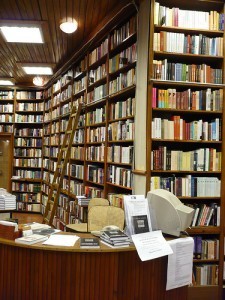 I say ‘bookshop life’ because that is what bookshops have always been for me: a context for life. In the same way that a house becomes a home due in part to the colours of paint chosen to adorn certain rooms, the memories and impressions hung on walls, the conversations had on this settee or at that table — in the same way, the day-to-day becomes life, at least in part, by what we choose to let into our imaginations and thoughts. And that is the terrain of the bookshop: the den of limitless possibilities for imagination, for thought, for wonder — for decorating life in ways that make it truly unique, wonderful and exciting.
I’ve been fortunate enough never to have been deprived of the many contours of life that bookshops can provide. I remember vividly the tiny bookshop I would frequent as a boy, which had a ‘children’s corner’ tucked away at the back, where all the books with coloured, pastel illustrations were gathered together and a set of undersized chairs provided, so that we never had to wait to get home to start in on what we discovered.
I was entranced. There was the immediate, overwhelming knowledge that I could fill a lifetime with the wonderful things these pages contained. There was wisdom, there was foolishness, there was beauty and ugliness, adventure and solemnity. All of it right there, tucked neatly onto shelves, waiting for me to grab and begin.
Years passed and I returned to that bookshop many times. Hundreds. I don’t think it an exaggeration to say thousands (and I’m not finished yet!). And what has struck me more and more, is how my relationship to that bookshop has changed over the years. I visited it first as a bleary-eyed undergraduate, mystified and amazed. Later, I visited its familiar shelves as a graduate student, working to make my own name. In the years that followed, I visited as a professor — and I remember the first time I found one of my own books on those shelves, stuffed amongst other stodgy, scholarly things. Then novels began, and a novelist I became, and I remember seeing my first novel there on the shelves at the front, where I’d first entered the Blackwell’s Bookshop as a student and thought how amazing and wonderful everything looked.
 And as I stared there at my own book, tucked away amongst so many others, the most amazing reality struck me deeply. I was still amazed. It still looked so wonderful, all of it. And though I know every inch of that bookshop — which stairs creak between which floors, which sections house which authors I most long to read — and though I’ve watched heaven only knows how many coffee shops stake their claim on the first floor, I’m struck by the fact that this one bookshop on this one street in one city of England, still holds more possibilities and wonder than I could ever fit into a single lifetime.
So let us cherish what we possess in these cultural gems of our society. There are places in this word, murky and dysfunctional as it may otherwise be, where we still have heroes and adventures and loves and losses and joys and pains and sorrows and groans and creations and dragons and conspiracies and . . . and . . .
And it’s all right there: in every bookshop, in the hands of every bookseller, in every corner of this country. So go out on Saturday, whether you’re a student or a scholar, a child or a youth-challenged ‘grown up’, and prepare to be filled with wonder, all over again.
A.M. Dean is the author of the just-released thriller The Keystone and last year’s The Lost Library. He tries to visit a bookshop at least once a week, but often fails and spends most of his life in them instead.
Photo credits: Ben Clinch, Istvan, and noodlepie, all via photopin cc
September 12, 2013
‘Do you get confused with your own stories?’ On the intricacies of writing intricacies
And the short answer is, ‘yes.’ Despite taking rather a lot of care to ensure timelines work out and storylines intersect as they’re supposed to (see a photograph I posted over on my Facebook page this week, demonstrating a small snippet of such timeline work), I do sometimes wonder just how it is that a, b and c are somehow going to lead into x, y and z. But as a writer, this is precisely how I think it ought to be. If it’s too clear to me, too early on, then it will be too clear to the reader - and the point is to have a touch of mystery and that good sort of confusion that keeps the mind working, trying to put the pieces together.
I like to drop myself into these stories, as I’m writing, in a similar way to how I drop in the reader: midway through the plotting, with details still needing to be explained. A story for which I know all the details up front, before writing has begun, is not a story that’s going to engage anyone.
And I’m a firm believer that good stories are never told from the beginning. ‘Let’s start at the very beginning...’ may make for a good musical number, but in a book I like to start at about the middle, leaning a bit towards the end. We meet characters who already have stories going, plots that are already in action, schemes already well and truly afoot; and the race is on to get to know them, to understand the things happening all around them, to sort out how story a, which seems to have nothing to do with story b, is in fact part of a larger, common thread.
The Keystone is built very much on this kind of structure. From the moment you start at the first page, you are dropped into plots - ancient and modern - that are already well into their flow of action; and you meet characters who are already in motion. They’re racing towards their own ends, and we have to learn who they are, and what those ends are, ‘en route.’ This strikes me as a reflection of real life. You don’t meet an FBI agent in the midst of some tactical operation, only to hear her say, ‘Hello, my name is Jane and I was born in Oklahoma, studied in New York and have a penchant for short-haired cats.’ You meet her as she says, ‘Get in the car, I need your help,’ and it’s only through glimpses and moments in the interactions that follow that you learn who she is, and just what sort of help she requires.
So yes, I do occasionally get confused, and have to ‘find my way through’ the intricacies of some of these plots: but that’s what makes this genre such fun - and hopefully keeps you engaged as you read.
September 11, 2013
'Are you a Gnostic?' and what we don't ask authors
'And what about you, Mr Dean?'
I don't mind the question, though I do find it mildly amusing.
The book is also filled with murderers, though no one's yet enquired as to whether I am, apart from being an author, also secretly a vicious killer.
And while it also features capable FBI agents and leaders, I've yet to receive the call asking whether I had to put my career with the Bureau on hold in order to write the book.
'But are you a Gnostic, Mr Dean?'
It is strange what gets assumed of authors when we read their books -- and I say 'we' here because I am just as guilty of this as anyone else. I've just finished a rather good book from a few years ago by Scott G. Mariani (The Heretic's Treasure), and have to admit there were moments when I wondered just how much time off he'd had to take from curating Egyptian archaeological exhibits to craft that pleasant read; and yet I wasn't wondering whether he was also an arms dealer, despite his clearly expert knowledge of guns.
I am waiting for those other questions to roll in. For readers to write, having read through The Keystone, to ask, 'Are you really an octogenarian staffer of the British Museum?' 'What are your real connections with Iraqi terrorism?' 'Do you build a lot of bombs in your spare time, then?' 'What have you got against Chicago?' 'Do you take your notebook with you when you repel Egyptian cliffs, or just remember the details when you get home?'
But I rather assume what I'm going to continue to be asked is the same question I've heard before.
'Just tell us, then: are you a Gnostic?'
September 9, 2013
The Keystone on sale at Tesco Direct!
Here's the link to The Keystone on Tesco's website: http://www.tesco.com/direct/the-keyst...
Enjoy! AMD
September 7, 2013
Wonderful first reviews for THE KEYSTONE
It began with Alex Gordon's flattering comments in his review for the Peterborough Evening Telegraph: "I reckon Dan Brown must see Dean in his rear-view mirror after his debut hit The Lost Library. This is an even more exciting adventure featuring his feisty heroine Dr Emily Wess, who shows us there’s nothing stuffy about this professor of history and religion. Far from it … a very modern plot, in a dangerous global chase.”
I'd like to point readers to two reviews in particular, by avid reviewers whom I admire:
Kate Atherton's Review: http://www.milorambles.com/2013/09/06...
Miles Orchard's Review: http://forwinternights.wordpress.com/...
And then there is the truly wonderful review by Pam Norfolk that was recently published in the Lancashire Evening Post, and syndicated all across northern England:
http://www.lep.co.uk/what-s-on/review...
I'm delighted with the positive response by reviewers, and even more so by the notes I've received on Twitter and Facebook from readers who have sped through the book.
Get your copy today, and join them!
Cheers,
AMD
August 16, 2013
THE KEYSTONE has been released!
If you haven't seen it yet, Kate Atherton has published what I believe is the first review of THE KEYSTONE on her website. How delightful to have the book receive 5 of 5 stars, and such glowing comments! You can read Kate's review here:
http://forwinternights.wordpress.com/...
I hope you all enjoy the new thrills! And I'm already at work on more to follow . . .
AMD
June 13, 2013
‘Fortunately I’m an ex-SEAL, CIA-trained spy with $100M & an advanced engineering degree’ & other conversation starters
I’ve spent some time this week pondering the protagonists of my preferred genre, the action thriller. In my odd moments over the past month I’ve read several enjoyable examples, some of which have been truly excellent; but I find myself returning again and again to my routine gripe: is it really necessary that the male lead in almost every one should be an ex-SEAL, CIA-trained mega spy with a vast personal fortune, a Jeremy Clarkson-esque knowledge of fast cars and an advanced engineering degree?
It’s become so strong a type in the genre that it’s an automatic reflect to suspend our disbelief unhesitatingly, as if it were quite normal that every person who happens to come into contact with a sudden bout of terror or hype would — obviously — be able to fall back on just such a set of circumstances.
But I’m not so sure. We seem to be asking ourselves to believe a little too much, just for the sake of a convenient story. What would really happen if a man walked into a situation, any situation, and made it known that he fit this strange bill?
Funny you should ask.
This week, I determined to find out. My target: a lovely little coffee shop I often frequent, sitting with my computer and far too much caffeine when I require a bit of background noise to keep the keystrokes coming. I don’t often chat with people there (I’m usually absorbed in writing), but on this occasion I determined to change that.
I walked in, calmly, purchased my coffee, located a table and sat down.
‘Hello,’ I said to the young man at the table next to mine. He was perhaps twenty-three, wore good, educated-looking glasses and was reading a copy of something by Sartre.
‘Hello,’ he answered, understandably surprised to be interrupted in this way.
‘It’s just that you looked as if you could use a little help,’ I said, as thoughtfully as I could.
‘Did I?’ The man surveyed his table, wondering, perhaps, if he’d inadvertently spilt something.
‘You’re reading Sartre, which is usually a sign of someone in mental distress,’ I replied, motioning towards his book. ‘Possibly angry, depressed, suicidal.’
‘I’m not sure what you think that–’
‘And I just wanted to extend my help,’ I cut him off. ‘We learned all about intervention and rescue during my SEAL training.’
At this point, the baffled young man, who at first at seemed taken aback at my characterisation of his choice of coffee-shop reading, now seemed more curious about my sudden self-revelation.
‘You were a SEAL?’
‘Only for seven years. My contract with the CIA wouldn’t allow a longer term leave of absence. But fortunately for you, our surveillance training for the Agency helped us see signs of mental deterioration and distress in hostage situations, so I can put that to use with your crisis, as well.’
‘I’m not in distress, or a hosta– wait,’ the man caught himself, ‘you were both a Navy SEAL and in the Central Intelligence Agency? Despite the fact that you’re very obviously British?’
‘I had to do something with myself,’ I answered, taking a sip of my latte. ‘After my father died and left me his two-billion pound company and estate, I had to make good. I knew I couldn’t run the firm, but I was set for life. Can’t just sit around when you’ve been given a gift like that. Have to find honour, courage. You know . . . those to whom much has been given.’
‘You did all that, and yet you still know about Sartre?’
‘We had to read him at Yale. Graduating summa cum laude and valedictorian doesn’t come without a little philosophy.’
A touch of indignance. ‘Sartre wasn’t really a philosopher, he was an existentialist playwri–’
‘But it was during my six months as a POW in Iraq that I really saw through his depressing vision,’ I added. ‘Not the book you want to have with you in a prison camp, let me tell you.’
By this point, the young man had set down his copy of Sartre and turned himself fully towards me.
‘You were a prisoner of war?’
‘Yeah. Bum luck. Managed to escape though, by cutting out of my cell and re-wiring a dilapidated Italian Army transport truck the Iraqis had stolen from the Allies and left just outside the camp. Not the most advanced engine to re-build with tools I found around the grounds.’
There was a fairly substantial pause in our conversation at this point, during which I drank a bit more of my latte and answered a brief SMS message on my phone.
Finally, the young man looked right at me and spoke.
‘Bull shit, man. That’s utter bullshit.’
He said these words with such utter conviction that for a moment I thought he might actually be sincere in disbelieving that I was an ex-SEAL, ex-CIA, Yale summa cum laude valedictorian, escapee-POW with a powerful knowledge of auto mechanics and chairmanship of a multi-billion dollar company I’d inherited from my father. With a strong working knowledge of the existential crises posed by the stage plays of Jean-Paul Sartre.
But then I realised that this was just as believable as the back-story of the lead characters in 80% of the thriller fiction I’ve ever read, and decided instead — quite reasonably, I think — that the young man was simply mad.
After all, he was reading Sartre in a coffee shop.
Wandering Authorial Thoughts

- A.M. Dean's profile
- 441 followers

