
Kirk Voclain's Blog
April 25, 2026
Why Tell the Same Story from the Villain’s Point of View? Inside Counter Exposure

There is something deeply unsettling about hearing a story from the wrong person.
Not the hero.
Also not the victim.
And not the man running for his life.
The wrong person.
That is one of the reasons I wanted to write Counter Exposure.
On the surface, it may sound like a risky idea. After all, Double Exposure already tells the story. Readers know the danger. They know the tension. They know who they were rooting for. So why go back? Why return to that same world and walk through those same events again?
Because it is not the same story anymore.
Not once the villain starts talking.
A new point of view changes everythingI have always been fascinated by perspective in fiction.
Two people can walk through the same moment and come away with two completely different truths. One sees courage. The other sees recklessness. One sees loyalty. The other sees weakness. One sees survival. The other sees betrayal.
That is where Counter Exposure lives.
This book is not about replaying old ground just for the sake of it. It is about stepping into the mind of Barry Cox and seeing how a man like that interprets the exact same chain of events. It is about understanding how someone can make ruthless decisions, defend them with total confidence, and never once believe he is the villain.
That is what makes him dangerous.
And frankly, that is what makes him interesting.
Villains rarely think they are villainsThe most frightening antagonists are not the ones who wake up in the morning twirling their imaginary mustaches.
They are the ones who believe they are necessary.
Barry Cox is that kind of man.
He does not see himself as cruel for the sake of cruelty. He sees himself as disciplined. He sees himself as the one willing to do what weaker people avoid. In his mind, he is not breaking order. He is preserving it. He is not creating chaos. He is managing it. He is not destroying something valuable. He is protecting a structure that others are too emotional, too impulsive, or too blind to understand.
That kind of thinking creates a very different kind of thriller.
Because when a villain can explain himself well enough, readers begin to feel something they did not expect.
Not trust.
And not forgiveness.
Something worse.
Recognition.
The story shifts when the lens shiftsOne of the things I love most about storytelling is how much power there is in the telling itself.
Change the narrator, and the whole emotional shape of the story can change.
A moment that once looked simple starts to feel layered. A decision that seemed obvious starts to look strategic. A scene that felt clear now carries tension underneath it. Motives bend. Assumptions crack. Familiar ground starts to feel unstable.
That is exactly what I wanted Counter Exposure to do.
I did not want it to feel like a copy of Double Exposure. I wanted it to feel like walking back into a room you thought you understood, only to discover there was another conversation happening in the corner the whole time.
That is where the energy is.
And that is where the danger is.
Barry Cox is not trying to win sympathyThis part matters.
Counter Exposure is not an apology for Barry Cox.
I am not asking readers to excuse him. I am not asking them to suddenly declare that he was right all along. That would be too easy, and honestly, too shallow.
What interests me is something more complicated.
I want readers to see how Barry thinks. I want them to understand the architecture of his mind. I want them to feel the precision, the control, the discipline, and the cold certainty that drives him. I want them to see how a man can justify almost anything once he decides that he alone understands what must be protected.
That is different from sympathy.
Understanding a villain can be far more unsettling than hating one.
Reed Sawyer looks different from Barry’s sideThat is another reason this book matters to me.
When the villain takes control of the narrative, the hero changes too.
From Barry’s point of view, Reed Sawyer is not some noble man trying to uncover the truth. He is a threat. A variable. And a fracture in the system. Also a man whose instincts cannot be trusted because they are guided by conscience instead of control.
And Barry would argue that conscience is exactly what gets people killed.
That shift opens up a tension I find irresistible as a writer. Readers already know Reed one way. Now they get to see how he appears through the eyes of the man trying to stop him.
It is the same conflict, yes. But it carries an entirely different emotional charge.
Why this story had to be writtenSome stories end when the final page turns.
Others leave behind questions.
Counter Exposure grew out of those questions.
What did Barry believe while all this was happening?
How did he justify what he did?
What did he fear?
What did he think Reed represented?
How does a man like that explain the world to himself?
Those questions would not leave me alone.
And when that happens, I usually pay attention.
Because sometimes the most interesting part of a story is not what happened. Sometimes it is the meaning different people assign to what happened. Sometimes the most revealing version of a conflict comes from the person you least want to hand the microphone to.
Which, of course, is exactly why you should.
Why I think readers will enjoy this angleIf you liked Double Exposure for the tension, the world-building, and the cat-and-mouse pressure, Counter Exposure opens a different door into that same danger.
It lets you step inside the machinery.
It lets you see how power justifies itself. How control defends itself. How a man with enough intelligence and enough certainty can shape the world around him and still believe he is the only adult in the room.
That is fun to write. It is unsettling to read. And I think that mix is where some of the best thrillers live.
Because once you let the villain explain himself, the story stops being simple.
And simple is rarely where the truth lives.
Final thoughtsSo why tell the same story from the villain’s point of view?
Because it is not the same story anymore.
Not when the moral center shifts.
And not when the motives change shape.
Also not when the man behind the danger gets to explain why he thinks the danger is necessary.
That is what Counter Exposure explores.
It is not just a return to the world of Double Exposure. It is a challenge to it. A reframing of it. A deeper dive into the logic of a man who believes order matters more than mercy, structure matters more than sentiment, and survival belongs to those willing to see the world without illusion.
Readers may still hate Barry Cox by the end.
They probably should.
But if I’ve done my job right, they may also understand him more than they wanted to.
And that is where things get interesting.
The post Why Tell the Same Story from the Villain’s Point of View? Inside Counter Exposure appeared first on Kirk Voclain.


April 21, 2026
Counter Exposure: The Villain Finally Gets His Say
What happens when you take the villain from Double Exposure and hand him the microphone?
That is exactly what I’m doing with Counter Exposure.
If you read Double Exposure, then you already know Barry Cox as the mastermind in the shadows, the man pulling strings, shaping outcomes, and standing as the greatest threat Reed Sawyer must face. In that story, Barry is the villain. Reed is the man trying to survive, uncover the truth, and stop something much bigger than himself.
But Counter Exposure changes the lens.
This book tells the story again, not as a simple retelling, but as a complete shift in perspective. This time, the story unfolds through the eyes of Barry Cox. This time, readers will see the events, decisions, and motives from the mind of the man who believed he was the one holding the world together.
And that is where things get dangerous.
Because Barry Cox does not see himself as the villain.
He sees himself as the rational one. The disciplined one. The man willing to make hard decisions while others get distracted by emotion, conscience, or chaos. In Barry’s view, Reed Sawyer is not a hero. Reed is the problem. Reed is reckless, unpredictable, and dangerously willing to trust his own moral instincts over the structure Barry has spent years protecting.
That is the heartbeat of Counter Exposure.
It is a story built on perspective. On control. On the terrifying possibility that the man you feared most may be able to explain himself so well that, for a moment, you start to understand him.
Maybe even agree with him.
That is what fascinates me about this book.
In Double Exposure, readers were inside the tension and danger from Reed’s side. They experienced the confusion, the pursuit, and the growing realization that something massive and hidden was moving behind the scenes. In Counter Exposure, readers step behind that curtain. They enter Barry’s world of precision, systems, order, and calculated judgment. They see how he interprets the same events, and how easily a man can justify nearly anything when he believes the alternative is disorder.
Barry is not twirling a mustache and tying people to railroad tracks.
He is far more dangerous than that.
He is intelligent. Organized. Patient. He believes in structure. Also he believes weakness creates risk. And he believes sentiment gets people killed. And most of all, he believes that what he is doing is necessary.
That is what makes Counter Exposure so compelling to write.
This is not just a book about a villain. It is a book about how villains often do not think they are villains at all. They believe they are protecting something valuable. Also they believe they are seeing clearly while everyone else is clouded by emotion. And they believe history would justify them, if only history were written by the right people.
And in Counter Exposure, Barry Cox finally gets his chance to write the history.
Readers will return to the world of Double Exposure, but everything will feel different. Familiar moments will take on new meaning. Assumptions will be challenged. Motives will be recast. Scenes that once looked straightforward will reveal deeper strategy, hidden calculations, and a very different version of truth.
That is one of the things I love most about storytelling. Change the perspective, and you change everything.
For readers who enjoyed the cat-and-mouse tension of Double Exposure, Counter Exposure will offer a deeper dive into the machinery behind the story. For readers who love psychological tension, shifting loyalties, and morally complicated characters, this book is going to be a fascinating ride.
You may still hate Barry Cox when you finish.
Honestly, you probably should.
But I also suspect there will be moments when you understand him more than you expected to, and that may be the most unsettling part of all.
Sneak Preview from Chapter OneHere is a first look at Counter Exposure:
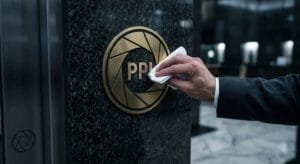
Chapter 1Why This Book MattersBarry Cox approached the headquarters of the Professional Photographers Institute on a Saturday at exactly 3:12 p.m. On weekdays he arrived at 7:46 a.m., unless travel required otherwise. Weekends followed a different rhythm, one shaped by the field rather than the office. The building rose above the street in glass and steel, polished enough to reflect the bold Manhattan light in long vertical strips. Beside the entrance, the brass PPI logo had already caught the sun, a clean circular emblem with the letters PPI set in the bright center of a camera aperture, framed by seven broad blades inside a thick outer ring. Seven blades. The mark of legitimacy, the symbol of PPI’s public face, the respectable side that dealt in photographers, education, and craft.
He slowed when he reached it.
There was a smudge on the letter I.
Most people would not have seen it. A thumbprint, maybe. A streak of city dust. Nothing more than a faint blur on polished brass. Barry pulled a folded white handkerchief from his inside pocket, wiped the mark clean, then checked the surface again before putting the cloth away.
Better.
He stood there another second, not admiring the building, but confirming what he already knew. The logo was centered. The brass was clean. The glass had been done before dawn. The guards at the front desk were in place. Order, once established, required maintenance. Left alone, things drifted.
That was true of buildings. It was true of institutions. It was especially true of people.
Reed Sawyer had started to drift.
Barry stepped through the second door from the left, as he always did. His hand closed around the cool steel handle, and his eyes dropped, briefly, to the small marking etched low into the frame. The same emblem, reduced in size and easy to miss, except this version carried only six aperture blades.
Most visitors never noticed it. If they did, it meant nothing, just another design detail worked into the entryway branding. But inside the Institute, details mattered. Seven blades marked the Professional Photographers Institute, the respectable organization photographers knew through workshops, certifications, trade conferences, and a century of polished credibility. Six blades signaled something else entirely. Six blades meant the Private Protection Initiative, the hidden structure beneath the public one, where cameras opened doors, gathered intelligence, and turned ordinary access into leverage. The distinction was subtle by design, invisible to outsiders, obvious to anyone trained to see it.
He crossed the lobby without breaking stride. Marble floors. Quiet lighting. Receptionists already at their stations. Framed prints on the walls, landscapes, portraits, architecture, carefully chosen to suggest culture and credibility. The Professional Photographers Institute had spent generations building a name people trusted. It began in 1868 as a trade organization, a small alliance of studio owners protecting their business from outside threats. By 1880 it had become something more stable, more polished, more useful. Publicly, it taught photographers how to see. Privately, under the same initials and behind a cleaner name, it trained operatives to use what photographers saw. The Professional Photographers Institute built trust. The Private Protection Initiative spent that trust where no one thought to look.
Barry respected that history because it had never confused appearance with purpose.
Traditional intelligence services made noise. They attracted committees, rivalries, politics, and ambitious men who liked hearing themselves speak. PPI had chosen a better method. Quiet people. Patient people. Men and women with cameras who could enter rooms unnoticed and leave with everything. A photographer was welcomed where other observers were screened, delayed, or denied. Weddings. Embassies. Fundraisers. Airports. Private estates. If someone carried a camera, people assumed they belonged.
That assumption had protected the Institute for years.
I think one of the most interesting things a thriller can do is force readers to question what they thought they already knew.
Counter Exposure is designed to do exactly that.
It revisits the world of Double Exposure, but it does so through a darker, colder, and far more controlled lens. Barry Cox is not interested in winning sympathy. He is interested in proving that his actions made sense. That his decisions were necessary. That Reed Sawyer was never the hero of this story, at least not from where Barry stands.
And that makes for a very different kind of thriller.
I’m excited for readers to step into Barry’s mind, revisit this dangerous world from the inside, and decide for themselves what truth really looks like when every side believes it is right.
One thing is certain, Counter Exposure is not just another pass through familiar territory. It is a confrontation with perspective itself.
And in this story, perspective may be the most dangerous weapon of all.
The post Counter Exposure: The Villain Finally Gets His Say appeared first on Kirk Voclain.
April 18, 2026
When a Reader Laughs, Cries, and Catches a Typo
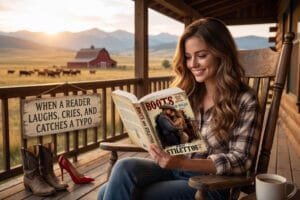
Boots and Stilettos review and more. There are few things better for an author than hearing from a real reader.
Not a sales report. Also not a dashboard. And not an algorithm deciding whether your book deserves attention this week. A real reader.
I recently received an email from someone who read Boots and Stilettos, and it meant a lot to me for several reasons. First, she enjoyed the story. Second, she took the time to leave a review. Third, she cared enough to point out a couple of small errors she noticed along the way.
Honestly, that kind of feedback is gold.
As writers, we want readers to get lost in the story. We want them to laugh in the right places, feel the tension, care about the characters, and maybe even tear up a little by the end. When a reader tells me they laughed out loud because of the dog, or cried happy tears at the ending, that tells me the story landed where it needed to land.
That is the goal every single time.
What meant even more was how specific the response was. This reader noticed the romance. She noticed the excitement. Also she noticed the likable characters. And she noticed the emotional payoff. She even said that when she saw the word “epilogue,” she had a moment of, “Wait… what about Ricardo?” Then came the satisfaction of seeing that thread handled too.
That is exactly the kind of reaction an author hopes for.
I also appreciated something else, she pointed out a couple of typos.
Now, some people might dread getting that kind of email. Me? I welcome it. Truly. If a reader is kind enough to tell me where a book stumbled, that gives me a chance to make it better. Nobody wants mistakes in a finished book, and I am grateful when a sharp-eyed reader helps me catch one that slipped through. That is not criticism to fear, that is helpful partnership from someone who cared enough to pay attention.
That kind of honesty matters.
What also stood out to me was how well Boots and Stilettos connected with someone who normally reads clean historical western romance. This book is not historical, but it is clean, western, and deeply rooted in character. It has heart, humor, family tension, and the kind of ranch life that shapes the people living in it. Hearing that it still worked for a reader outside the exact subgenre was encouraging.
Very encouraging.
Then came the Boots and Stilettos review, and I loved it:
4 Stars, Clean Western Romance
Reviewed in the United States on April 16, 2026
Format: Hardcover
This is my first time ever reading a romance novel written by a male author. I liked the book a lot. Likeable characters including the animals. The dog made me laugh out loud and the ending made me cry happy tears. My usual genre is clean historical western romances, but although this was not historical it was clean and western. Jake reminded me of my brother-in-law in his young days. Tall and lean and always working. Not overly talkative, but a good guy. Even now that he is old, he is always working in the garage or out in the yard.
That review made me smile.
I especially love that Jake felt real to her. That matters. Fiction works best when a character stops feeling invented and starts feeling familiar. When a reader says, “I know this man,” that means something clicked. It means the story stepped off the page for a moment and became personal.
And that is what I am always chasing as a writer.
So today, I just want to say thank you to the readers who take the time to email, review, encourage, and even correct. You help books get better. You help other readers decide what to pick up next. And you remind writers like me that the work is connecting.
Laughing out loud at the dog and crying happy tears at the ending? I will take that every day.
If you have read Boots and Stilettos, I would love to hear what you thought. Honest Boots and Stilettos review matters. They help more than you know.
Reed Boots and Stilettos here: hhttps://books.kirkvoclain.com/bas
The post When a Reader Laughs, Cries, and Catches a Typo appeared first on Kirk Voclain.
April 12, 2026
From Covert Ops to the Ranch
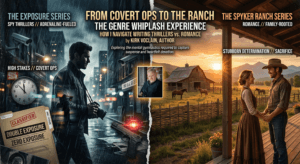 The Genre Whiplash Author Experience
Let’s talk about genre whiplash author experience. Some authors have “a brand.”
I have… a mild case of literary split personality.
One day I’m writing covert ops, coded messages, surveillance, and that feeling that someone is always watching. The next day I’m out on the Spyker Ranch, where the danger isn’t a gun, it’s weather, debt, pride, and the kind of love that costs you something.
And here’s the truth, switching between my two series isn’t just a change of scenery. It’s mental gymnastics. And it’s emotional whiplash. But it’s also one of the best creative decisions I’ve ever made.
Because when you look close, the two worlds have more in common than they first admit.
Two Series. Two Very Different Heartbeats.The Exposure Series moves like a pulse.
Fast. Sharp. Tense.
It lives on high alert.
A spy thriller thrives on urgency. Secrets stack up. Mistakes have consequences. You don’t get to “sleep on it.” You get one shot, and if you miss, somebody pays.
Then you step into the Spyker Ranch Series and the pacing changes, not slower exactly, but deeper.
It’s not adrenaline. It’s gravity.
The pressure on a ranch doesn’t come from an enemy agent. It comes from life itself. From land that doesn’t care about your feelings. And from a bank note that still shows up even if you’re tired. From family history that weighs heavy, whether you want it or not.
Both are high stakes, they’re just measured differently.
One is instant.
One is relentless.
The Mental Gymnastics of Switching GearsWhen I move from covert ops to the ranch, I have to change what my brain listens for.
In a thriller, I’m listening for:
threattimingmisdirectionthe “what’s really going on here?” momentBut in a ranch romance, I’m listening for:
loyaltysacrificesilence between wordsthe kind of love that proves itself through workIn the Exposure world, a character might survive by staying detached.
On the ranch, detachment is a slow kind of death.
So yes, it’s whiplash.
But it’s useful whiplash.
It forces me to stay sharp. It forces me to stay honest.
High Stakes Look Different… But They Hit the SameLet’s talk about stakes, because this is where the comparison gets fun.
In a spy thriller, the stakes are obvious. Someone might get killed. A mission might fail. The wrong person might get exposed.
In the Spyker Ranch world, the stakes sound quieter on paper, but they hit just as hard:
a marriage that has to work because survival depends on ita family trying to hold onto land that wants to swallow them wholea decision that costs pride, comfort, or everythingClem and Millie don’t need a villain in a black trench coat to face danger. Their danger is real-world pressure, and the kind of stubborn determination that keeps people alive when quitting would be easier.
A spy might risk his life in a single night.
A ranch family risks their life one season at a time.
Different battlefield, same courage.
Character Study: Operatives and Ranchers Have More in Common Than You ThinkThis might surprise you, but when I’m writing Reed Sawyer on a mission, and when I’m writing Clem Spyker staring down a hard truth, I’m working with the same core question:
What does this person do when there’s no easy way out?
Thrillers and romances both reveal character under pressure. They just use different tools.
In thrillers, pressure shows up as action.
In romance and family sagas, pressure shows up as endurance.
Reed might have to outthink someone hunting him.
Clem and Millie have to outlast a world that doesn’t care if they’re good people.
Both require grit.
Both demand sacrifice.
And both make you root for someone who refuses to fold.
Why Writing Both Genres Makes Each One BetterHere’s what I’ve learned from bouncing between these two worlds.
Writing thrillers makes my ranch stories tighter. It keeps me aware of tension, pacing, and consequences. It reminds me that every scene has to matter.
Writing ranch romance makes my thrillers more human. It slows me down enough to dig into why someone is afraid, what they love, what they’re protecting, and what they’d lose if things go wrong.
Action is easy to write.
Meaning is harder.
The Spyker Ranch stories keep me honest about meaning.
The Bonus: You Don’t Have to Pick Just OneIf you’re on my email list, you’ve probably noticed something.
Some of you came for the spy stuff.
Some of you came for the ranch stuff.
But a growing number of readers are starting to enjoy both, and that’s the part that makes me grin.
Because if you love characters with grit… you’ll find them in both series.
If you love stories with pressure and payoff… both series deliver it.
If you want to feel something when you close the book… that’s always the goal, no matter the genre.
So here’s your permission slip.
You don’t have to pick a side.
Where to StartDo not let the genre whiplash author experience stop you from reading my books. If you want adrenaline, mystery, and covert tradecraft, start with the Exposure Series.
If you want family roots, sacrifice, and a love story built on survival, start with the Spyker Ranch Series.
And if you want the full experience…
Welcome to the whiplash.
I’ll be over here switching hats like a man who can’t sit still.
Check all my book on Amazon: amazon.com/author/kirkvoclain
The post From Covert Ops to the Ranch appeared first on Kirk Voclain.
April 2, 2026
Dust and Inheritance: A Special Sale for a Special Story
 The Heart of Dust and Inheritance
At the heart of Dust and Inheritance is a story about family, sacrifice, and the things we carry from one generation to the next. Set in 1957 Montana, this novel is rooted in hardship, quiet strength, and the kind of determination that shapes lives in lasting ways. It is a story about survival, but it is also a story about legacy, love, and the people who leave their mark on us.
One of the strongest themes in Dust and Inheritance is inheritance itself, not simply land or money, but values, memories, burdens, and hope. Throughout the story, those deeper forms of inheritance shape the choices Millie and Clem must make. They are both carrying more than what can be seen on paper, and that emotional weight becomes part of what drives the story forward.
The Montana setting matters just as much as the characters. In many ways, the land becomes part of the story. The wide-open spaces, the beauty of the landscape, and the harsh demands of daily life all work together to shape what Millie and Clem face. Montana offers freedom, but it also demands grit. That tension gives the story its heart and helps make the journey feel real.
Meet Millie and ClemMillie and Clem are at the center of this story, and both of them come to life through struggle, responsibility, and change. Plus, they are REAL people. This whole story is closely based upon these two real people.
Millie is strong-willed, determined, and carrying the weight of family expectations. She is trying to honor the past while also finding her own footing in a hard and unfamiliar world. Her journey is emotional, personal, and grounded in the very real pressure of trying to do what is right when the road ahead is anything but easy.
Clem brings a different kind of strength. He is steady, practical, and shaped by a past that has left its mark on him. As his life becomes tied to Millie’s, readers begin to see not only his toughness, but also the quieter layers of loyalty, pain, and responsibility that define him. Together, Millie and Clem form the emotional backbone of the novel.
Their connection grows through hardship, work, and shared burdens. That bond is part of what gives Dust and Inheritance its emotional pull. This is not a story built on easy answers. It is built on trust, endurance, and the kind of growth that only comes through struggle.
Why 1957 Montana MattersThe setting of 1957 Montana is not just a backdrop, it is part of the story’s identity. Life in that time and place was demanding. Money was tight, work was hard, and the land could be both beautiful and unforgiving.
That contrast gives the book much of its emotional power. The landscape is wide and breathtaking, yet it also reminds the characters how much stands against them. The setting shapes their choices, challenges their strength, and adds authenticity to every part of the story.
By placing Millie and Clem in this world, Dust and Inheritance becomes more than a family story. It becomes a story about resilience, perseverance, and what it takes to build something that lasts.
A Special Sale for Dust and InheritanceFrom April 1 through April 7, 2026, you can get Dust and Inheritance for just 99 cents.
This is a great time to pick up the book if you have not read it yet, and it is also the perfect chance to step into the world of The Spyker Ranch Series. If you enjoy stories about family legacy, emotional depth, quiet romance, and characters who feel real, I believe this book will speak to you.
Dust and Inheritance stands on its own, but it also opens the door to the larger Spyker Ranch story. For readers who want to discover where it all begins, this is the place.
Purchase Dust and Inheritance here:
Thank you so much for reading, for sharing, and for supporting my work. I truly appreciate every reader who takes this journey with me.
The post Dust and Inheritance: A Special Sale for a Special Story appeared first on Kirk Voclain.
March 29, 2026
What Readers Are Saying About Dust and Inheritance and Boots and Stilettos
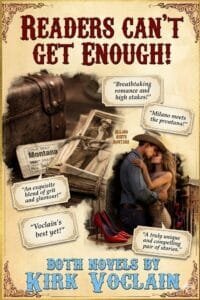
Dust and Inheritance and Boots and Stilettos reviews, what readers are saying. There’s something special about seeing readers connect with your characters, your setting, and the heart of a story. That’s exactly what seems to be happening with both Dust and Inheritance and Boots and Stilettos, the two books that make up the heart of the Spyker Ranch Series. Both books are drawing attention for emotional storytelling, strong characters, and a vivid Montana backdrop. These Dust and Inheritance and Boots and Stilettos reviews show how much readers appreciate the unique blend of emotion and Western atmosphere.
What readers are saying about Dust and InheritanceWith Dust and Inheritance, readers are clearly responding to the book’s emotional weight, Western grit, and quiet strength. Public review excerpts on Amazon describe it as a story filled with hardship, heart, and determination, with one review calling it “a masterclass in Western grit and quiet passion.” The Amazon listing also presents the novel as a 1957 Montana story centered on Millie Caldwell, Clem Spyker, and the legacy of Spyker Ranch, which matches the themes readers are praising in those review snippets.
What stands out most is that readers seem to appreciate more than just the setting. They’re connecting with the emotional core of the book, the struggle, the resilience, and the kind of love that is built through hard seasons instead of easy moments. The story’s “based on true events” framing and its focus on land, legacy, and determination appear to be landing well with readers who enjoy heartfelt Western fiction with substance. Furthermore, Dust and Inheritance and Boots and Stilettos reviews highlight how impactful these stories are for fans of Western romance.
Get your copy here: https://a.co/d/09UAknRY
What readers are saying about Boots and StilettosWith Boots and Stilettos, readers seem to be embracing a different side of The Spyker Ranch, one filled with charm, chemistry, and an opposites-attract romance. Public review snippets on Amazon describe the book as a clean, slow-burn cowboy romance with small-town charm, a smart city heroine, and a loyal rancher. Other public snippets praise the vivid Montana setting and the warm, beautifully written tone of the story.
That reaction makes perfect sense for a novel built on contrast. Annie brings style, confidence, and a fresh set of ideas. Jake brings grit, loyalty, and a life rooted in the land. Readers appear to be enjoying the clash between those worlds, along with the emotional growth, tenderness, and strong sense of place that help the romance feel genuine. The book’s official descriptions also emphasize that blend of Montana ranch life, cultural contrast, and character-driven romance, which lines up with how readers are describing it. In fact, many Dust and Inheritance and Boots and Stilettos reviews mention how these two books complement each other through vibrant storytelling.
Get your copy here: https://books.kirkvoclain.com/bas
Two books, one ranch, and stories readers are connecting withTaken together, these reactions paint a pretty clear picture. Readers are not just enjoying a setting, they’re investing in The Spyker Ranch itself. In Dust and Inheritance, they’re finding the roots of the legacy. In Boots and Stilettos, they’re seeing that legacy continue through a heartfelt romance set against the same rugged Montana backdrop. Dust and Inheritance is Book 1 and the prequel, while Boots and Stilettos carries the story forward, giving readers both the foundation and the payoff. To sum up, Dust and Inheritance and Boots and Stilettos reviews help reveal why readers are so invested in this series.
As an author, that’s about the best kind of response you can hope for. When readers mention the heart, the setting, the emotional pull, and the characters, that means the stories are doing exactly what stories are supposed to do. They’re sticking. Evidently, Dust and Inheritance and Boots and Stilettos reviews capture the essence of the reading experience for so many fans.
If you haven’t stepped into Spyker Ranch yet, this is a great time to start. Begin with Dust and Inheritance, then follow it with Boots and Stilettos and see why readers are connecting with both the history and the heart of this series.
The post What Readers Are Saying About Dust and Inheritance and Boots and Stilettos appeared first on Kirk Voclain.
March 21, 2026
Big Book Deals Are Coming, and One Is Already Here

If you’ve been meaning to pick up one of my books, this is a really good time to do it.
Over the next few weeks, three of my main titles will either be on sale, or are on sale right now, for just 99 cents. That means you can jump into the world of The Spyker Ranch Series or step into the high-stakes spy thriller world of Double Exposure without spending much more than pocket change. These deals are for a limited time, so this is a great chance to grab one, or all three, at a reduced price.
Dust and Inheritance, 99 cents, April 1 through April 8Dust and Inheritance is Book 1 in The Spyker Ranch Series. If you enjoy family legacy, hard choices, western grit, and a story rooted in land, struggle, and survival, this is where the series begins.
This novel lays the foundation for Spyker Ranch and the people who shaped it. It is a story of endurance, inheritance, sacrifice, and the kind of history that leaves fingerprints on every generation that follows. If you’ve already read Boots and Stilettos, this is a great chance to go back and experience where it all began. If you’re brand new to the series, this is the perfect starting point.
Get Dust and Inheritance here:
Boots and Stilettos Audio is on sale now for 99 cents, through April 14If romance is more your speed, and you love the idea of listening instead of reading, this is your moment.
The audio edition of Boots and Stilettos is on sale right now for only 99 cents, and that deal runs through April 14. This is Book 2 in The Spyker Ranch Series, and it brings heart, chemistry, conflict, and the beauty of Montana ranch life together in a story that stands on its own while still connecting to the larger Spyker Ranch world.
So yes, if you like clean romance with strong personalities, emotional tension, and a setting that feels alive, this one might be calling your name a little louder than usual right now.
Get the Boots and Stilettos audio here:
https://www.barnesandnoble.com/w/1148572465?ean=2940202005527
Double Exposure goes on sale for 99 cents, March 23 through March 29And for those who like suspense, danger, secrets, and a photographer caught in a world far darker than it appears, Double Exposure is about to go on sale for 99 cents from March 23 through March 29.
This is the book that pulls readers into my spy-thriller world, where photography and espionage intersect in ways most people never expect. If that sounds like a strange combination, well, that’s part of the fun. Cameras get people into places they should not be. That idea has fascinated me for a long time, and Double Exposure runs with it.
If you’ve been curious about my thriller side, this is a great week to jump in.
Get Double Exposure here:
A Great Time to Try One of My BooksMaybe you’ve seen me posting about these books for a while and just haven’t picked one up yet. Maybe you’ve read one and meant to come back for another. Maybe you’ve been circling the runway, waiting for the landing lights. Well, here they are.
These sale prices make this the perfect time to discover:
Dust and Inheritance, the beginning of The Spyker Ranch SeriesBoots and Stilettos Audio, a romantic story set in the same seriesDouble Exposure, a spy thriller built around photography, deception, and dangerHowever you decide to jump in, I’m glad you’re here, and I hope you enjoy the ride.
Quick LinksDust and Inheritance
Boots and Stilettos Audio
https://www.barnesandnoble.com/w/1148572465?ean=2940202005527
Double Exposure
The post Big Book Deals Are Coming, and One Is Already Here appeared first on Kirk Voclain.
March 11, 2026
Zero Exposure: The Book That Begins Before Double Exposure

What if the writer woke up inside his own spy novel?
That’s the unsettling, strange, and wildly fun idea behind my new book, Zero Exposure.
This novel is becoming Book Zero in the Exposure Series, the story that sets the stage for Book 1, Double Exposure. It is not supernatural. There are no ghosts, no magic, and no fantasy shortcuts. Instead, it leans into something much more unsettling, the creeping realization that reality is no longer behaving the way it should.
At the center of Zero Exposure is a writer (literally me, Kirk Voclain) who finds himself trapped inside the kind of story he once controlled from behind a keyboard. Suddenly, the danger is real. The setting is real. The fear is real. Even worse, the people around him, including the spy protagonist he created, are now depending on him.
And what can he do to help?
He does what a photographer would do.
He takes the shot.
The image above captures a critical moment from the novel. In this scene, the writer is inside a dim, wet parking garage, face to face with a woman who feels dangerous from the start. A black SUV sits under flickering lights. The concrete pillars fade into darkness. The pavement glows with reflections. It is the kind of scene that feels cinematic, but also wrong, like something is quietly closing in.
As he photographs the vehicle, he is not simply documenting the moment. He is creating evidence. He is helping his own fictional spy protagonist, Reed Sawyer, by making an image that can conceal a code inside the grain, shadows, and texture of the frame.
That is one of the things I love most about this story.
Photography is not a prop in Zero Exposure. It is part of the strategy. Part of the tension. Part of survival.
Here is a small piece from that scene:“Frame Four.
The woman shifted as I shot. She turned her head toward the ramp, and the motion did exactly what I wanted. Her face became a clean blur. Not a smear. Not a mess. Just unidentifiable. The background lights broke into bokeh circles. The flickering fixture turned into a streak of electricity. The SUV stayed sharp in the center of the frame, dark windows reflecting nothing but the garage.
It was the shot.
I knew it the instant I took it. My body relaxed a fraction, that automatic release you got when you nailed something without trying to impress anyone. The histogram in my head said the exposure was perfect for what Reed needed. Dark shadows. High noise. Plenty of grain to hide a code.”
That moment says a lot about what Zero Exposure is trying to be.
It is creepy, but not horror.
And it is strange, but grounded.
It is tense, but still fun.
Most of all, it is a bridge.
This book opens the door to the world that readers first step into in Double Exposure. It gives shape to the atmosphere, the danger, and the logic behind the Exposure Series. If Double Exposure is where the mission begins, then Zero Exposure is the moment the camera first clicks in the dark.
I’m excited about this one because it lets me play with two things I love, storytelling and photography, then push both into a suspense-filled world where every frame matters.
Zero Exposure is coming, and it is going to be the foundation stone for everything that follows in the Exposure Series.
Stay close. This one starts in the shadows.
The post Zero Exposure: The Book That Begins Before Double Exposure appeared first on Kirk Voclain.
March 7, 2026
A Great Two Days at the Louisiana Library Association Convention
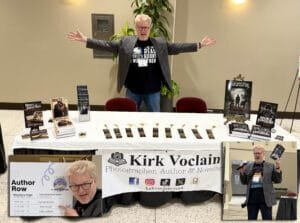
Over the last two days, I had the pleasure of being in Lake Charles, Louisiana, attending the 2026 Louisiana Library Association Annual Conference at the Lake Charles Event Center. The event was held March 5 through March 7. It brought together librarians, exhibitors, authors, and book lovers from across the state.
I was honored to be invited to give a small talk about my books. I also had the chance to participate in Author Row, where I was able to meet and talk with many of the librarians attending the conference. According to the LLA conference information, Author Row was one of the featured participation opportunities offered as part of this year’s event.
For me, this was more than just setting up books on a table. It was a chance to connect with the very people who help put stories into the hands of readers every single day. Librarians are champions of authors, readers, learning, and community. So being part of this event was both exciting and meaningful.
I had several of my books on display, including titles from my thriller and fiction lineup. It was a real joy to talk about the stories, the writing process, and the journey from photographer to author. I’ve spent decades telling stories with a camera, and now I’m doing it with books too. Standing there on Author Row, talking with librarians who truly care about books, felt like a full-circle kind of moment. That’s a fancy way of saying, yeah, I was grinning a lot.
Louisiana Library AssociationThe Louisiana Library Association describes its annual conference as a statewide gathering for library professionals. This year’s event included regular conference days on Friday and Saturday. In addition, there were pre-conference sessions and conference activities tied to exhibits, sponsors, and special events.
One of the best parts of the convention was simply getting to meet so many enthusiastic people face to face. There is something special about talking with librarians who are genuinely interested in books, authors, and readers. These are the people who build community around reading. They encourage discovery. And they introduce readers to new voices. Also they keep stories alive.
I’m very thankful to the Louisiana Library Association for the invitation and for the opportunity to be part of such a well-organized event. The LLA has long supported Louisiana’s library community through conferences, professional resources, and statewide programming. Therefore, it was a privilege to take part in this year’s gathering.
A special thank you as well to everyone who stopped by my table, asked questions, looked at the books, or attended my talk. I enjoyed every conversation.
Events like this remind me that books still matter deeply. Stories still connect people. And librarians, bless them, are out there every day helping make that happen.
Lake Charles, thank you for the warm welcome. Louisiana librarians, thank you for all you do.
And yes, for two days I got to stand behind a table full of my books and talk about them. Let’s be honest, that’s a pretty good way to spend a weekend.
The post A Great Two Days at the Louisiana Library Association Convention appeared first on Kirk Voclain.
February 26, 2026
The Real Clem and Millie Spyker
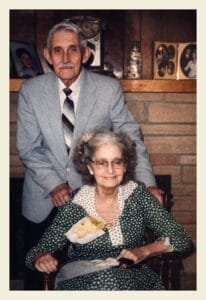
Before there was Dust and Inheritance, there was Clem and Millie.
The Spyker Ranch Series begins with a story inspired by real people, real grit, and real love. Clem and Millie Spyker were the kind of couple who built a life the hard way. Through sacrifice. Through stubborn determination. Through faith in something bigger than themselves.
Dust and Inheritance is loosely based on their journey. It is a story about land, legacy, loss, and the kind of love that does not quit when life gets hard.
Book One of the Spyker Ranch Series releases March 2.
You can preorder your copy now or wait and order it on release day. Either way, this is a story rooted in history, strengthened by love, and shaped by life.
Get your copy here:
https://a.co/d/095ms4Q9
The post The Real Clem and Millie Spyker appeared first on Kirk Voclain.


