Matt Payne's Blog
August 7, 2022
Computer Update! (and T420 upgrades)
A few years ago I wrote a post about getting a used, beat-up T420 laptop when I was broke. I had needed something that could edit audio better than the machines I had. But when I bought that T420 I realized how amazing the keyboard was and totally fell in love with it.
Well I'm less broke now and I thought it might be a good time to get a new Thinkpad. But first I thought maybe I should upgrade the one I had.
The problems: My Thinkpad had a busted corner, a slow HDD, and only 4GB of RAM.
The solutions: I bought a new cover on eBay, and an SSD card and another 4GB stick of RAM on Amazon.
I took the computer apart and switched out the cover: no more busted corner! Although now when it closes the spring doesn't snap into place and lock the hooks, so I have to slide it into place.
I also installed Void Linux.
And I bought a broken T410, thinking I could fix it (I haven't yet). But I put its better-condition keyboard into the T420, and now it basically looks brand new, except for some wear on the screen that you can only really see when it's shut down.
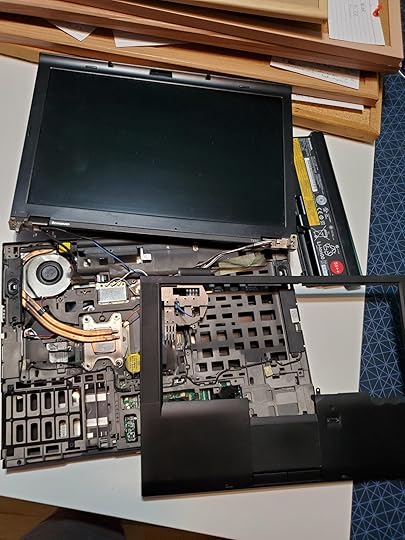
A bit more detail: I actually bought a fresher-looking T420 for a decent price on eBay plus a dirt-cheap T420 that was busted to hell but still functional on kijiji, and I took them all apart and swapped the parts around, also incorporating the keyboard and RAM from the aforementioned T410.
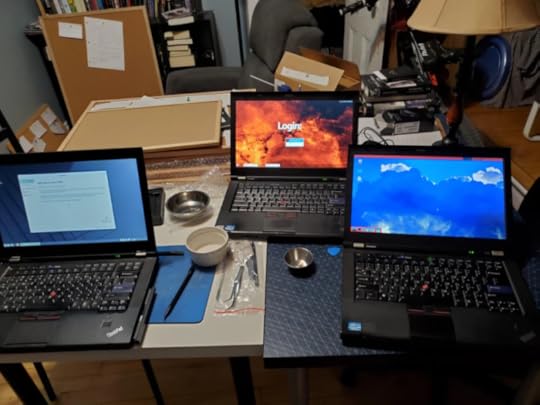
With the extra RAM and the SSD card, this computer runs like a dream.
I also have a T570 now for coding and for streaming to the TV. And I ordered a bargain-priced T430 to see how it feels to type on the "new" style keyboards. I enjoy typing on the T570 but the travel isn't as deep as the T430, and it's weird typing off-center on the 15-inch laptops.
Moral of the story: Old thinkpads are the gifts that keep on giving.


December 9, 2019
ஆழ்நிலை அலை
ஆழ்நிலை அலை is my name and I come from another two centuries. Neither of them really liked me but I was already used to that. In my line of work you tend to rub centuries the wrong way. The problem is, time-waves ripple out from each century, forwards and backwards forever, and where they meet in the middle you could see interference patterns (if you were the type of creature who could “see” such things).
Those interference patterns are The Lord Peel, whose will emerges from between appearances (relationships and waves). He plays an instrument and he never plays monotone. There is meaning in the intervals between the notes that he plays. He follows a regular schedule but is always pushing himself to new heights and new situations. Of course sometimes he takes a little vacation to help him transition between projects.
A tragedy occurred (thirteen were dismembered, six fatally, partially consumed) and Peel’s music took on a more dissonant tone. He played in disreputable establishments and befriended disreputable people.
I promised to return one day. He wrote his final song for me.
January 22, 2019
For Sale: The Last Toothbrush Used by Henry Henler
Henry Henler was born without a tongue. Because of his differently-abledness people automatically paid extra attention to his mouth. This made Henry self-conscious about his mouth, and so he took extra care of his teeth. He got braces to straighten them as a child, had his wisdom teeth pulled as a young man, and visited the dentist thrice per year throughout the whole of his life. He refused to eat sweets, never had a cavity, brushed and flossed vigorously, and always carried toothpicks just in case. Later in life he was known to carry a dental pick and mirror in his pocket.
Lacking a tongue, his pristine mouth was like a beautifully cared-for palace utterly devoid of occupants. Some un-haunted haunted house, hauntingly un-haunted, as if the mouth were haunting itself.
He was brutally murdered at a carnival when a posse of freaks escaped from their pens. The abuse they'd suffered under the cruel whip and crueler tongue of their master had warped their psyches even worse than genetic abnormalities had warped their hideous bodies. They chewed a hole in the wooden roof to gain their freedom, and became so emotionally overwhelmed by their unrestricted proximity to so many people, and so frightened at the prospect of recapture, that the freaks descended into an animal frenzy and violently assaulted passersby. Henry was just one unlucky man who stood between the freaks and the open plains that lay beyond the carnival grounds. They ripped off his arms, smashed his head against the ground, and threw him into the haunted house to slowly bleed to death in public where people thought he was just part of the display.
We acquired his toothbrush at an auction in South Carolina, and it's available now for $37.55 CAD.
January 21, 2019
For Sale: The Last Toothbrush Used by Henry Henler
Henry Henler was born without a tongue. Because of his differently-abledness people automatically paid extra attention to his mouth. This made Henry self-conscious about his mouth, and so he took extra care of his teeth. He got braces to straighten them as a child, had his wisdom teeth pulled as a young man, and visited the dentist thrice per year throughout the whole of his life. He refused to eat sweets, never had a cavity, brushed and flossed vigorously, and always carried toothpicks just in case. Later in life he was known to carry a dental pick and mirror in his pocket.
Lacking a tongue, his pristine mouth was like a beautifully cared-for palace utterly devoid of occupants. Some un-haunted haunted house, hauntingly un-haunted, as if the mouth were haunting itself.
He was brutally murdered at a carnival when a posse of freaks escaped from their pens. The abuse they'd suffered under the cruel whip and crueler tongue of their master had warped their psyches even worse than genetic abnormalities had warped their hideous bodies. They chewed a hole in the wooden roof to gain their freedom, and became so emotionally overwhelmed by their unrestricted proximity to so many people, and so frightened at the prospect of recapture, that the freaks descended into an animal frenzy and violently assaulted passersby. Henry was just one unlucky man who stood between the freaks and the open plains that lay beyond the carnival grounds. They ripped off his arms, smashed his head against the ground, and threw him into the haunted house to slowly bleed to death in public where people thought he was just part of the display.
We acquired his toothbrush at an auction in South Carolina, and it's available now for $37.55 CAD.
August 5, 2018
Pathological DIY: Self-Hosted Solutions
I've been looking for self-hosted alternatives to applications and software that I use a lot, and it's caused me too much headache.
I use Google Drive and Google Docs a lot, plus I have RSS feeds on my phone, my PC, my laptop. Then there are the TO-DO lists, various calendars, and the constant reminder-emails that I send myself.
I want to free myself from Google's surveillance-machine. I also am an amateur web-developer and I figure I should be able to set up some kind of online office suite on the webspace that I rent.
I heard that OwnCloud, NextCloud, and SeaFile were all fantastic pieces of software that you can install on a webserver. I tried each of them on WebFaction but can't get either of them to function properly. When they do work they rely on more pieces of outside software (such as a certain kind of word processors installed in just the right way, in just the right place) which usually doesn't work.
Now I've got open questions on several different forums, regarding several different kinds of software, and I'm afraid they're all dead-ends. The software I'm trying to use is all built for big companies who own their own servers and have root control. There are too many moving parts and it requires too much control for this to be useful to me.
This is an ongoing problem for me! I feel guilty when I buy spaghetti sauce because I feel like I should just buy a thousand tomatoes and make my own giant batch of spaghetti sauce instead. I don't want to spend $15/month on DropBox's storage and editing services when I'm already spending that much on renting webspace where I should be able to host my own private apps. I don't want Google having control over ALL my data as they do, although I can't think of any practical drawback.
I'm re-evaluating my self-hosting plan. I can't have everything I want. It's counter-productive to spend an enormous amount of time trying to get productivity-software to work when there are already good pre-packaged solutions out there.
August 28, 2017
Meditation Crystals
In my most recent trip to the Peruvian jungle searching for new plant medicines to assist in my inner space adventures I happened upon a crystal valley guarded by great snakes who slither through non-linear time. After answering their riddles and befriending the youngest of these ancient snakes I was initiated into their guild, whenceupon I slew them and annexed their booty.
Now I'm back in New York with a trunk full of glistening gems, and I've noticed that merely by being in their presence I have been effected by their magical powers. I haven't gained any powers myself, unless you consider peaceful silence and a glorious comfort with my own mind to be magical (and I admit that sometimes I feel like it is). I am slowly descending into a meditative trance, unbothered by my worldly troubles and unwilling to pull myself out of this reverie.
At first my lover was happy with the change in my attitude. I was no longer cutting her down with cruel remarks, as was my wont during my habitual drunken tirades. And I was content to spend an afternoon indoors, listening to music with her or making love in the afternoon. But then she said I was becoming distant, and slithering on the floor.
"Distant?" I asked. "Slithering? Well maybe, or maybe you're too caught up in your fancy New York lifestyle to see what you really are: an awkward conceptual contraption built upon an ancient lizard-brain. Snort some of these crystals with me, my love, and we will see who sinks and who slithers."
Now we are coiled up together on the couch watching reruns of Game of Thrones and waiting for the pizza delivery gentleman. Snakes don't like pizza, of course. But some snakes are very fond of gentlemen.
June 19, 2017
The Process Walks
There is a woman. She thinks of herself as a guy. Not a man, nor a boy, nor a girl, but a guy.
Language is a demon. I am a demon. There are demons of love. Love-demons.
Think of everything as demons and math. What else is there? Can you think of a third thing?
In the beginning there was the word. Language. Math.
Then there was light. Demons.
The only question is, how did we forget? How do I constantly have a feeling of connection to the immediate past, and all my pasts before, but never your past? Is there only me? I can't seriously ask that question. I give in to you as easily as I give in to me. Like a drug that isn't always good but isn't always bad.
There is a man. He thinks of himself as a guy. Not a man, nor a boy, nor a girl, but a guy.
The process walks.
May 29, 2017
A Different Perspective on Faith
Sometimes in movies a character will wax poetic about the virtue of having Faith in God. They have their deity, whose existence and attributes make no sense. They have their cult, a social power structure revolving around belief in (and obedience to) this make-believe character. And if some other person in the story is intelligent and curious enough to question the existence of this deity, then that person is treated as a lesser being who foolishly worships rationality instead of blindly believing what their fellow cultists claim to believe.
The characters have creepy little smiles, and they know that their fellow cultists will back them up in any argument. It’s entirely a mechanism for social control. There’s no reason to believe that this deity exists, but if you want to join the group then you need to ignore your better judgment and have “faith” that this non-existent deity exists, and that He is the creator and the ultimate moral authority. Basically, you pretend that this alpha deity character is real, to gain acceptance from your peers.
But there’s a different kind of faith.
I recently read Fear and Trembling by Soren Kierkegaard. He was a Christian philosopher writing in the 1800’s, and I’ve heard him described as the real originator of existentialism. Fear and Trembling is basically 200 pages of Kierkegaard obsessing over the faith of Abraham. We all know Abraham’s story, especially the part where he was going to murder his own son because God asked him to.
Imagine it. God tells you that if you obey him then your offspring will thrive and spread across the world. So Abraham obeys this God who created the world. But then God asks you to murder your only son. An obvious contradiction and paradox, since this son represents everything that you want to gain as a reward for obeying God. Abraham doesn’t flinch. He steadfastly proceeds to take his son to the sacrificial mountain.
There are so many questions. So many feelings attached to this situation. I always saw Abraham as a coward whose fear of the ultimate mob-boss outweighted his love for his son. But let’s follow Kierkegaard’s flashlight. He focuses on the absurdity of the situation. Abraham has to destroy his progeny in order to ensure its prosperity. Abraham intends to get what he wants “through virtue of the absurd.” In my minds’ eye I no longer see a man on a mountain with his son. I see a mind in the empty void of space, dark lightning crashing and psychotic nothingness swirling all around. Existence makes no sense, and that nonsense is making demands. Abraham could hesitate, ask unanswerable questions, or he could act. As a human situation it’s terrible, immoral, and insane. But as an image it can be instructive.
Let’s leave Christianity aside for a moment.
Joesph Campbell studied comparative mythology and wrote the book The Hero with a Thousand Faces. Primarily it’s about the so-called Hero’s Journey, a narrative structure which is so common across cultures that it seems to be built into the human brain. According to the book, many other narrative structures can be found in common across different mythologies and cultures. Certain ideas are built into the human brain.
The hero has to leave the safety of his home and travel out into the unknown, to get the good stuff (money, women, food, whatever). After responding to many challenges he comes to learn that all these obstacles and enemies are reflections of himself, and ultimately are just temporary forms. We begin to get the vague idea of something beyond the forms. Some ultimate source of all forms, which can’t itself be constrained into a form. This source can’t be properly represented, and it’s not properly a “thing” as we know it. But we’re only human and so we keep trying to represent it anyway. Sometimes we call it God.
It’s not a thing. It’s not a person. No road-sign can point at it. It doesn’t have a mind or a personality or a body. Anything you try to say about it falls apart immediately. Sand through your fingers. It has no problem with gay people. It doesn’t want you to murder your son. It doesn’t differentiate between infidels and believers. It has not created an afterlife to punish or reward you. You can’t negotiate with it. Anything you believe about it will inevitably be false. And yet, new forms keep coming at you from the invisible void. You meet a new friend. You meet a hostile rival. Cancer grows in your guts. Flowers grow in your garden. You know they will all disappear, and new forms will emerge. We can recognize some patterns and learn some tricks, but our understanding is just a lonely island of knowledge surrounded by nothingness.
Quantum noise.
Of course the “form” of a person doesn’t feel like it comes from the “void,” or directly from a deity. Science has explained the physical processes that transformed dirt into your mom or your boyfriend. Of course, nobody has explained consciousness. Neuroscience can explain why the brain acts in a certain way and evolutionary psychology can offer insight into why sensation is useful or why certain conscious processes have evolved. It’s all deterministic. But if you follow determinism far enough it falls apart somewhere below the subatomic level. The smallest deterministic behaviors (from which big Newtonian objects are formed) are actually decided by smaller, non-deterministic behaviors. Scientists use the math of randomness to predict how the world will work. Determinism is massive statistics of an enormous number of dice-rolls. That randomness operates on the deepest level of our rationalistic model of the universe. Our concrete world of physical objects is surrounded by a horrifying moat of static. We are built from that static. We live inside a David Lynch film. And nobody knows why consciousness, experience, sensation, were ever options for evolution to choose from.
That’s a long-winded way of saying that we don’t understand the nature of existence.
This is an atheistic perspective. Potentially nihilistic. So what does that have to do with faith? I’m certainly not that character in the Christian TV-movie who smiles creepily and tells you to have faith in a deity, some mere form which my fellow cultists worship. Also, it’s totally possible for a person to simply pay attention to their world, to learn how it works, and to build a good life within those forms, without requiring any kind of faith.
But let’s say your life is not very easy. Let’s say your life is very hard. Let’s say that all signs point to doom. Or maybe you have some wild ambition which is unlikely to succeed. Maybe all you need is a good plan and lots of patience, but how much failure can your patience withstand? You realize that you might fail, that in fact you are overwhelmingly likely to fail. But you have the fortitude to make a bold attempt anyway. Rationalism says you’re probably being foolish, yet to not act would be stagnation. In the hero’s journey you must answer the call to action, which may lead to doom, or you will surely stagnate and deteriorate. “Pessimism of the intellect must be matched by optimism of the will.” I read that in a newspaper. But, if you believe what is rational, then how can you motivate your entire being to make the best possible effort to succeed?
Are you going to half-ass your efforts? Or do you want to bring the best possible forms into this absurd existence? Fictional Finalism says to visualize the goal and follow through with the shot. But the world is not set up for you to win, and entropy is always eating you. Eventually, it will win. And when all signs point to failure, when your values are as temporary as your weak fleshy body, when years or decades of suffering have corroded your emotions and relationships, when there is no rational reason to believe that you could ever improve your life or achieve a goal, then what is the correct response? What’s the healthy perspective? Do you slump over in despair? Suicide? You can’t look at the forms (people, careers, whatever) and see amongst them a pathway to “success.” In the end, even if you succeed in your efforts, your success won’t look like you imagined. You never truly achieve your goals, and then you die, and you won’t be going to Heaven. Everything is stolen from you.
So you look between the forms. Beyond the forms. Where there is nothing. The quantum static. Absurd horror. The source of all forms. The source of love. The non-thing that slips away as soon as you point at it. The radical beyond, the complete unknown. You form a relationship with it, this thing that doesn’t exist. You can put anything in that box.
This is the crucial point, the singularity where you know you’re unlikely to succeed, but you need to act like you will succeed, but you’re not foolish enough to really fool yourself, so you wrap it all up in absurdity. You look beyond the forms and are invigorated by the insanity and doom at the basic level of existence. There’s nowhere else to turn. Rationalism offers no comfort. Comfort itself is no comfort. Yet belligerent belief in some form would be weakness and brainwashing. So you stop trying to rationalize it and you disregard the weak beliefs of others, and you head up to the mountain to be alone with the static void. And you create something. And you share it. And you suffer and die.
To suggest that you should have faith that some deity will reward you, that is a crude image and it’s not what I’m trying to share. That’s the psychological trick that cult-leaders use to manipulate you. That deity belongs to someone else. It’s a made-up form, a character who happens to want things that benefit the cult. But when you look between all those forms and see nothing… what then? That’s where wisdom disappears. That’s where love and passion could even disappear, leading to despair and depression. But it’s also where everything comes from. It’s the only place in which you operate. And your relationship with it will define your character and your life.
It’s incredibly sad. I’m talking about something that doesn’t exist. And yet it can be shaped into images, tastes, our 3D world, our loved ones, our internal thoughts. But we have nowhere to turn.
Kierkegaard was talking about the Christian God, but when reading his books it’s clear that his God is no mere character. It’s deep cosmic horror, but within the Christian perspective. I like Joseph Campbell because I can understand it without having to believe anything. Our instinctive search for meaning is a creative act. I don’t think I have faith, but I certainly differentiate between Kierkegaard’s faith and the manipulations of cultists. Kierkegaard painted a picture of a relationship with the beyond.
Absurdism is more about horror than humor. We seek meaning, and the universe whispers gibberish. But if you want anything meaningful you can only attain it “through virtue of the absurd.” Faith could be the bow that ties these things together. I’m not necessarily saying that I have some kind of faith, and I’m not suggesting it for anyone else. I’m just saying that I’m there's something deeper to it than I previously imagined.
May 5, 2017
Electoral Reform is about "Values Over Regionality"
I want to explain the biggest reason that I think it's important. I basically don't care too much about having a local representatative in parliament. I know it's important, but I care more about having my values represented nationally. Currently each region elects and sends one member of parliament to Ottawa to ostensibly represent that region, based on where they live. But all across Canada we vote based on our political values, and those don't get properly represented.
It's an out-dated system. There probably was a time when it was more important to have someone from REGION X speaking out for his neighbours when the federal government made decisions that effect the region. But we're more connected now, more mobile, and our divisions are more ideological than geographical.
All across Canada people vote for, say, the Green Party because they care about environmental issues. The Greens got 3.5% of the vote. There are 338 seats in parliament. 3.5% of 338 seats would be 11 or 12 seats. Then we would have 11 or 12 representatives voting for pro-environmental issues. Instead, the Green Party only made it "past the post" in one riding, catching a single seat. That single seat is worth around 0.3% of the votes, when they really got more than ten times that support.
Most of our parties are nation-wide parties. They are designed to represent values which transcend regionality. Values that unite us. We don't like the Liberals or the Conservatives as much as parliament makes it look. I don't know who my local representative is. I don't really care. I voted Liberal because Trudeau said he'd legalize marijuana and reform parliament.
I also move around a lot. I want the federal government to represent me regardless of what city or province I'm currently in.
It's an out-dated system and I'd like this issue to stay in the public eye.
April 23, 2017
"New" Laptop! Review of Refurbished Lenovo T420 with Ubuntu

I needed a new laptop.
I had two laptops. One was an HP mini with a 10" screen running Lubuntu Linux (an extra lightweight version of Ubuntu). It was small enough that I could carry it around for writing in different locations. It has served me well. The other was an HP Pavilion from 2007. It was a noisy, slow, heavy tank with a 15.6" screen. I was using that one for editing audio (I help out with Psymposia's contribution to the Psychedelic Salon podcast). It was so noisy that it made it hard to hear the audio I was editing, and it was prone to crashing.
I wanted to replace them both with a single 14" laptop (or do we call them "notebooks" now?) which would also be powerful enough to smoothly run audio manipulation software. I was very broke (mostly unemployed) and buying a new machine was not an option.
It was fun to do the research and shop around for the best computer for my precious few dollars. I like going into those used computer stores, surrounded by technology with a nerdy salesman. I finally decided that I wanted a Lenovo ThinkPad. A salesman told me the T4 and T5 series have sturdy metal frames, it's easy to upgrade and swap out old parts for new, and online reviewers seem to love them (except for the occasional complaint about noisy fans).
I ended up at a shop buried in a residential area, which seemed to have new and used models of every laptop Lenovo ever made. They had lots of beautiful brand new ones which were far beyond my budget. The salesman showed me a few models and I took a risk on a T420 with lots of cosmetic wear. It had a 14" screen, 4GB of RAM, a 2.6GHz quad-core processor, and a 320GB HDD. It had a crack in the corner of the shell, some of the labels were worn off the keys on the keyboard, the USB ports were all 2.0, and it had no operating system. These were produced in 2011, so it was six years old when I bought it. He reduced the price for me and I bought it for $300, taxes in, with a 90-day warranty.

I went home and made a bootable USB, and proceeded to install Ubuntu 16.
This story would be more interesting if I encountered some problems along the way. But I didn't. The computer works amazingly. It's small enough to carry around but powerful enough to smoothly run Audacity and other audio software. Also, with Linux's Jack audio system I can maximize the computer's resources to run more powerful software for making music. When I get my TASCAM US-200 USB audio interface from storage then it will run even better.
This PC has the best keyboard I've ever used. That sounds like a minor thing but it really isn't. I'm a writer, and it's really frustrating to deal with weird keyboards. Even though the letters are wearing off the keys, they still have perfect resistance and pushback, like brand new. The battery is still strong and lasts for at least a few hours.


The point of this story? If you're looking for a good used laptop I strongly recommend old Lenovos. The T420, T430, T520, and T530 are consistently lauded in reviews, and readily available on any market that deals in refurbished PCs.
Also, if you want to make music or produce audio but you can't afford a new machine or commercial software, get an old Lenovo and replace clunky Windows with a lightweight Ubuntu build. Ubuntu Studio is an operating system that manages resources to favor an audio-editing environment. The Linux music and audio software is generally harder to use than Mac or Windows software, not as reliable or powerful, but it's free and it's much more powerful than you might expect. Plus you get a lot more control over everything. I'll probably write some blog posts about Linux audio in the future.
When I get some decent cash-flow going I'm definitely going to invest in a new T-series ThinkPad. Maybe I'll keep Windows on that one, but Linux just feels right on these machines!

Drawbacks: The crack in the shell is an eyesore and may cause some kind of problems in the future. But right now it's purely cosmetic. It's a little slow on bootup and starting programs, but then it runs them perfectly (I might need to optimize the resources somehow to speed up bootup). As I mentioned, many folks complained about the noisy fans on the T4 series. Apparently there are ways to fix it (like updating the BIOS or running fan-control software), but I can't vouch for those solutions since my fan is already very quiet. Also, I don't know how well Windows would run on this thing. Ubuntu runs great, but Ubuntu generally runs smoother than Windows.
Please comment if you've had good or bad experiences with Lenovo ThinkPads, or with Linux audio.