Anthony Addis's Blog
September 1, 2026
Work in Progress Update: The Killing Kind
 Update: The Killing Kind
Initially, I took a major false turn with The Killing Kind: Angel of the South Book Three. Basically, for various reasons, I didn’t have time to plan it as thoroughly as I would have liked. The result was an opening setup of about 14,000 words that felt inauthentic to the Britgrit vigilante thriller and crime fiction series brand.
So I started again, from scratch. The first draft is now finished, and is very much on brand for Angel of the South: funny in places, gritty, and Billie remains an utterly mesmerising character. As she says at one point:
‘Don’t look for a conscience. I’m still me.’
I’ve shelved the book for a couple of months now, partly because I need to get Good Deeds and Charity: Angel of the South Book 2 ready for publication, and partly because I’m still mulling over one aspect of the ending.
Blurb: Good Deeds and CharityNo reveals about The Killing Kind for now because it’s still in the development stage, but here’s the blurb for Good Deeds and Charity:
Billie Brindley is back. And she’s open for business.
Funded by MI5 in exchange for favours Billie can’t refuse, Angel of the South is a vigilante service designed to help the little fish. She’ll make the sharks pay her fees.
When a violent street gang attacks a community hero, Billie takes the case. She thinks it’s local. She’s wrong. The gang answers to someone far more dangerous.
Billie’s ex-husband Tom has settled down with Katie, his new girlfriend. But when Billie asks for his help, the bond between them pulls him back to a world he swore to leave.
And this time, the violence doesn’t stop with Tom or Billie. It’s coming for Katie.
Further ReadingLinksNo Way To Live (Angel of the South Book 1)
The post Work in Progress Update: The Killing Kind appeared first on anthonyaddis.co.uk.


August 23, 2026
The Board as the Battlefield: Why Go is the Ultimate Metaphor in “Do Not Keep Silent”
 The Search for Authentic Go in Fiction
It’s hard to find authentic depictions of Go in fiction. In Do Not Keep Silent, I attempted to remedy that. By weaving the game’s mechanics—liberties, snaking dragons, and sacrifice stones—into the narrative’s tactical backbone, I attempted to caopture the suffocating tension of the PolyU siege and the wider political struggle for existence.
“Chess is a Battle, Go is War”
The novel draws a sharp distinction between Western and Eastern strategic philosophies. While Chess is a singular “battle” to kill a king, Go is a complex “war” for territory and survival. This mirrors the occupations of Admiralty and PolyU; it is a struggle over who occupies the space. Mae, the movement’s leader, understands that her role is territorial, not individualistic:
‘And you’re a queen sacrifice,’ Pete said.
Mae shrugged. ‘I wouldn’t go that far. More like a sacrifice stone. Learn Go and you’ll understand.’
The Strategy of the Sacrifice StoneThe “sacrifice stone” serves as a key distinction between characters. William, the devious lawyer, utilizes stones as “enticing bait” to spring traps on his opponents. Mae, however, views the concept through the lens of a strategist’s ultimate duty: the survival of the group. She accepts her role as a sacrifice stone played for the preservation of the “organisation,” ensuring the larger entity remains on the board even if she is removed.
Visualizing the Siege: Dragons and Liberties
Image from Sensei.ix.net
The Go board’s geometry symbolises in the barricaded streets of Hong Kong. When Mae’s father faces an online opponent, he encounters a “long, snaking dragon with so many liberties it would be hard to contain.” This dragon is like “Tent City” and the “Great Wall of Hong Kong” – the massive barricade of bamboo, metal, and highway cones – built during Mae’s protest.
In Go, “liberties” are breathing spaces; without them, a group is suffocated and removed. Mae realises the movement faltered when the students allowed themselves to be “bottled up” and trapped in the university, losing the liberties required for a group to survive.
The Long GameIn Go, as in revolution, a lost battle is merely one move in a war that continues toward the 2047 deadline and beyond. The siege at PolyU was a move in a struggle for long-term existence.
Final Thought: If you were a piece in a game of life and liberty, would you play to win the battle, or are you prepared to be the sacrifice stone that wins the war?
FURTHER READING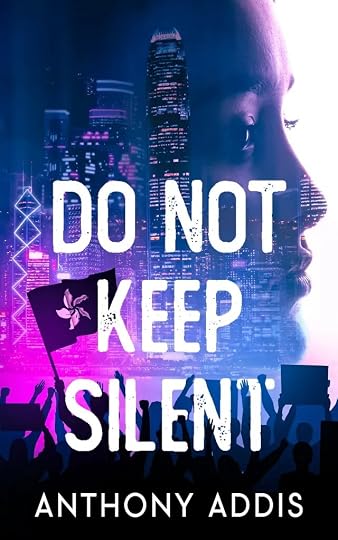
Do Not Keep Silent is available on Amazon and Kindle Unlimited.
10 Great Books set in Hong Kong
The post The Board as the Battlefield: Why Go is the Ultimate Metaphor in “Do Not Keep Silent” appeared first on anthonyaddis.co.uk.
August 21, 2026
Shad Thames: A London Location Made for Thrillers
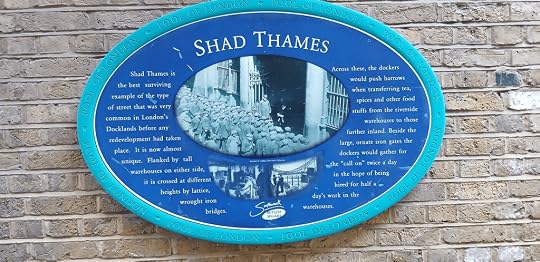
For a research trip for my thriller series Angel of the South, I visited Shad Thames, which runs east along the south bank of the Thames from Tower Bridge. It’s a fascinating area, and tightly compressed. In a rush, you could see it all in an hour and a half. These were my highlights:
Metal Walkways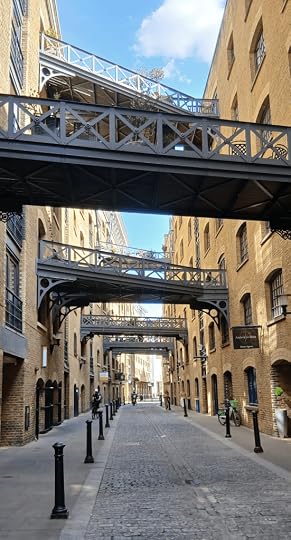
The first thing that strikes you are the black metal walkways high overhead. Labourers used them to move crates from one warehouse to another, so they wouldn’t be obstructed by the crowds below. Because the buildings all along the narrow street have retained their period authenticity, the street feels incredibly Victorian.
Horsleydown Stairs
At the start of the walk, Horseleydown Stairs lead down to a little pebble beach on the Thames, beneath Tower Bridge. There are all sorts of theories about where that name comes from. My favourite includes a charming one written on the statue of Jacob the dray horse (featured later). It states that dray horses were told to take a rest and lie down before crossing Tower Bridge (“horse-lie-down”).
If you’re lucky, the tide will be out so you can walk on the beach. If not, by walking around the full Shad Thames circuit takes about an hour. By the time you’re back to the start, the tide might be out, so it could be worth trying again.
A sculpture of exotic fruit (a reminder of the days when such fruit was brought into England via the docks here) stands on St. Saviour’s Dock.
But best of all is Neckinger Inlet, a name derived from Neckerchief, London slang for the hangman’s noose. The authorities hung pirates who tried to rob the berthing ships there. I visited the Neckinger twice, an hour and a half apart. The first time, it was full of water. The second, the tide had receded leaving only wet, muddy sand and confused-sounding seagulls like they couldn’t understand where the water had gone. The old, well-preserved wharves on either side of the inlet have names redolent of their importing history: Cinammon, Java and Saffron.
Jacob the Dray Horse
The statue of Jacob the dray horse stands in the centre of the surrounding, cobalt-blue, modernist Circle flats. The statue was helicoptered over London in 1987. I had a coffee outside a little cafe on the corner here, overlooking Jacob, made by a Moroccan man who was listening to the news in Arabic. Somehow, it seemed fitting considering how central this whole area was to trade in the Nineteenth century.
The Flag Store and Pyramid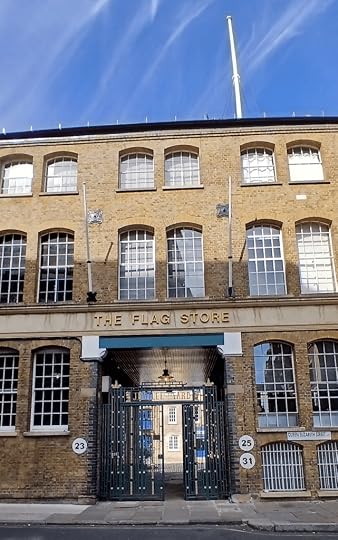
Built in 1899, the Flag Store building itself is imposing enough. Add the gate into Jubilee Yard, and you’ve got something worthy of a film. And if you go through the gate, into the yard, you’ll see something that looks very out of place: a modernist, glass-fronted pyramid. It looks to have no real purpose, but apparently, there’s enough space inside for offices.
What Makes Shad Thames a Good Location for Thrillers?My thriller series Angel of the South is set mainly in South London. I’m keen to use London as cinematically as I can in the books. Locations that have come up so far include Deptford Railway Arches, the Meridian Line at Canary Wharf and Crystal Palace Park. Unusual settings, in other words that are often off the touristy beaten track.
The first hundred yards or so of Shad Thames is certainly quite touristy, but with its great history, and those walkways criss-crossing overhead, it would make a great location for a scene in one of the books. But interestingly, the area I can most see cropping up is The Circle, with Jacob the dray horse. Somehow, it seems like the sort of place where Billie, the main character, would rent a flat…
Links and Further ReadingThe post Shad Thames: A London Location Made for Thrillers appeared first on anthonyaddis.co.uk.
August 15, 2026
Sir Richard Burton’s Tomb: The Victorian Explorer’s Mausoleum in London
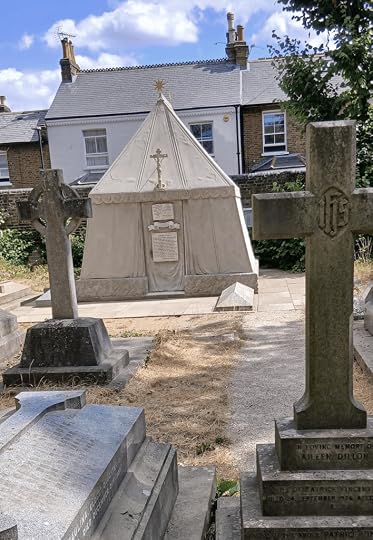
In a small, quiet church graveyard in Mortlake, South London, lies the extraordinary tomb of Sir Richard Burton, the Victorian explorer, translator and adventurer.
A REMARKABLE LIFE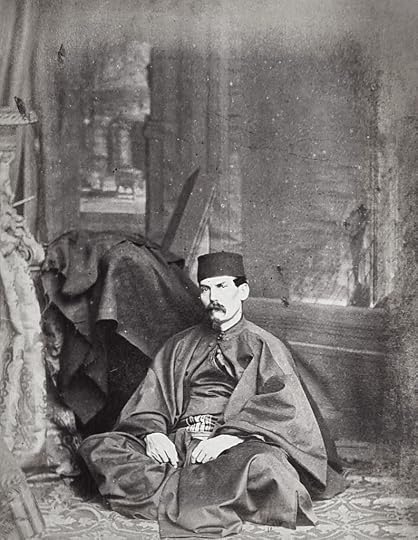
Sir Richard Burton led a remarkable life. He translated the Karma Sutra and the Arabian Nights into English and was one of the first Europeans to enter Mecca (disguised) and Lake Tanganyika. He also explored North and South America.
BEHIND EVERY GREAT MAN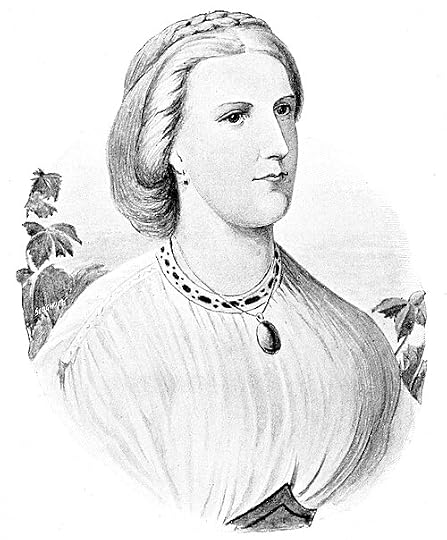
After he died in 1890, his wife, Isabel, commissioned his tomb to look like a stone version of a Bedouin tent. The stonework even has undulating ripples as though from a desert wind. One of London’s most extraordinary mausoleums, it is even more remarkable for its quiet setting.

The poem on the front is surprisingly moving. The details that have been included on the tomb’s exterior are intricate and rather lovely, from the crucifix and the stars to the crescent moons.
WALK ROUND TO THE BACK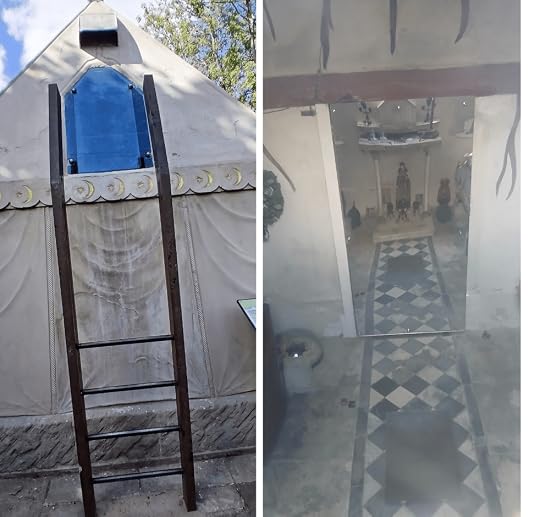
But it’s at the rear of the tomb that the greatest surprise lurks. If you ever go to see it, make sure you walk round to the back, because there is a short ladder. A quick climb up three rungs gives a view inside the tomb through a window. There are two coffins in there, Burton’s and Isabel’s, and all manner of lamps and trinkets from their travels. The ceiling continues the tent theme brilliantly, and looks authentic and colourful.
NO WAY TO LIVE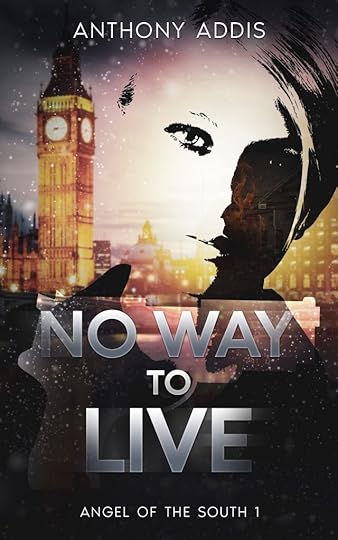
I went to see the tomb during a location-finding trip for various scenes in my Angel of the South thriller series. The books are set mainly in London, I always include interesting settings to make the scenes come alive.
In No Way To Live, Tom remembers a trip that the enforcer Solly took him and Billie on to see the tomb. Even Billie was impressed by it, and fell uncharacteristically silent.
This was probably the moment her belief that death can be celebrated and not just mourned was born, a theme later explored in Book Two, Good Deeds and Charity.
LINKSThe post Sir Richard Burton’s Tomb: The Victorian Explorer’s Mausoleum in London appeared first on anthonyaddis.co.uk.
August 13, 2026
Book Review: Katabasis (A Journey into Hell)
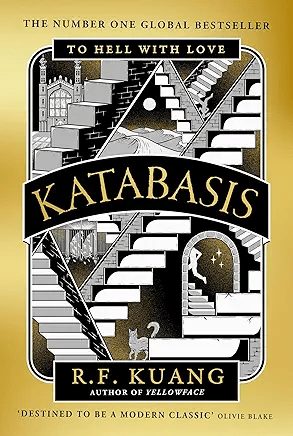
I had a hard time finishing Katabasis. This could be partly my fault, because I thought it would be similar to Susanne Collins’ sublime Piranesi. It isn’t, and if not for a long delay in Manchester Airport’s hellish Terminal Three, I might never have finished it.
Katabasis is about two magic-studies students who journey through Hell to find their arrogant university lecturer/magician, whose death they may or may not be responsible for. The book has the tagline “To hell with love” because in a dramatic irony way, the reader knows the students love each other, but the students don’t.
A Brilliant Opening HookThe opening hook is as good as they get, starting as it does with the immediate aftermath of the professor’s death. It’s visceral and eye-catching, and promises great things for the novel.
It’s not Location, Location, Location, it’s Character, Character, CharacterStrangely for a book set in Hell, Katabasis becomes dull very quickly. Previously, I’ve read Babel by the same author, and also struggled with that, so it could be that her style is too literary for me. For example, the Escher-style artwork on the front cover hints at a repetitive loop the characters find themselves in. It’s clever, but the problem with anything of a repetitive nature is that it become tedious.
In all honesty, though, I don’t like the characters she creates. In Katabasis, I didn’t care about either of the two students. For me, character is key. If I don’t gel with the main ones in some way, I will always struggle with the book – or TV show, or film, for that matter.
RatingAt heart, Katabasis is a concept novel. The characters are really neither here nor there…in Limbo, rather than Hell. And hell is just miles and miles of endless walking, a river, a fortified town and, bizarrely, a university library.
It’s a shame because the author clearly did a lot of research into different beliefs about Hell, from Dante and Virgil to Chinese folklore.
To be honest, she could have saved herself the trouble and booked a flight leaving from Manchester Airport’s Terminal Three.
Rating: 2/5
Other Book Reviews10 facts I learned from reading Ian Fleming’s 007 books
Rereading the Belgariad – the Good, the Bad and the Ugly Truth
Five Thrillers with an Opposites Attract Trope
The post Book Review: Katabasis (A Journey into Hell) appeared first on anthonyaddis.co.uk.
August 11, 2026
Why I Learned Go for my thriller set in Hong Kong

Go is one of the most difficult board games to master, especially without proper teaching. Yet I taught myself to play it as part of my research for Do Not Keep Silent. Here’s why.
A Hong Kong Protest LeaderDo Not Keep Silent is about a young protest leader who is prepared to sacrifice everything for her cause. But at exactly the wrong moment, she meets an English tourist. Unwillingly, they fall for each other. Pete, the Englishman, is a computer games designer. He went through a long dissolute phase, but to show his potential, he had a childhood history of being an excellent chess player.
IDENTITY CLASH IN GAMES AND IRL
During their first meeting, Mae identifies a core difference between herself and Pete. She is very secure in her own identity while Pete is still struggling to find his. This is because Pete is essentially frozen in time. His identity is based on the past: who he used to be, what he used to be good at. Mae looks forward, Pete is stuck.
This class of identities is further shown by the fact that Mae is the best in her family at Go. When Pete tells her he used to play chess, she is unimpressed:
“You should learn Go. Chess is a battle, Go is war.”
REVOLUTION DEMANDS SACRIFICEIn Go, there are many new concepts to learn, among them liberties and eyes, ko and atari. Liberties, of course, fit into the whole theme of Do Not Keep Silent, and so did one other concept.
At one point, Pete compares Mae to a queen sacrifice, because of the way she is willing to accept imprisonment or an early grave for her cause. ‘More like a sacrifice stone,’ Mae corrects, comparing herself to a relatively minor piece rather than the all-important queen in chess.
QUICK GO FACTSHere’s some wider information about Go that I learnt during my research.
At over 2,500 years old, Go is one of the oldest known board games.There are more possible Go games than there are atoms in the known universe.In Game 2 of the AlphaGo v Lee Sedol match, AlphaGo’s move 37 was so profound that at first human experts thought it must be a mistake. Subsequent analysis showed it was almost impossibly creative.HOW I LEARNT TO PLAY GONow I’d established the fact that Mae was a Go player, and that the game matched Do Not Keep Silent’s themes and story , I needed to learn to play the game.
At first, it seems very easy. Players take turns to place white or black stones on a 19 x 19 board, attempting to secure territory rather than take pieces (although that can happen). That first impression of Go is wrong. Go is difficult. Here’s how I went about learning it:
Watched a film called AlphaGo, about the Google DeepMind team as they tried to do for Go what Deep Blue did for chess, by defeating world champion Lee Sedol. Bought a Go board and played out positions from YouTube videos and an instruction book. Downloaded the BadukPop app on my phone and iPad and played obsessively for months.Frustratingly, I reached a certain level and flatlined, I think because there are no Go clubs anywhere near where I live so I can’t play human opponents and learn from them. If you have any useful tips about them, I’d love to hear them.
LINKS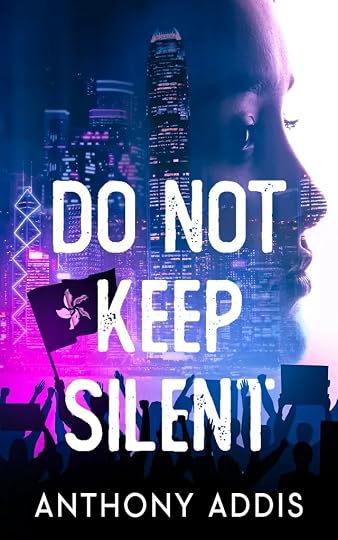
The post Why I Learned Go for my thriller set in Hong Kong appeared first on anthonyaddis.co.uk.
August 9, 2026
HOW A ROCK CLIMBER INSPIRED MY HONG KONG PROTEST NOVEL

I never intended to write a Hong Kong protest novel. Here’s how it happened.
Hong Kong HolidayIn the school Easter holiday of 2019, we went as a family to Hong Kong. Jane, my wife had lived there in the Nineties and was keen to show us around. We visited all the usual suspects: the Big Buddah on Lantau Island, Mong Kok market, Admiralty.
And of course, we visited the Peak, including the T-shaped monstrosity of a tourist trap. While we walked down Lugard Road towards Mid-Levels, a young woman climbed up some rocks that towered above us. At the top, she sat, alone, on a rocky outcrop looking over the famous bay.
Who was she? Why was she doing that?
She was the initial spark for Do Not Keep Silent. Later on, as a family, we walked down Lugard Road. The lady was still up there, contemplating the view. A student in front of us turned around, taking a panoramic selfie. Later, I also used that image in the novel.
Home AgainBack home, the holiday burned brightly in my mind. I’d enjoyed it so much I wanted to extend it in the only way I could reasonably afford, by writing about it. I had the idea for a fairly light-hearted, romantic, finding yourself type novel about a British no-hoper who met someone up on the Peak, someone driven and intense while he was…not. I wanted that friction between the British (read colonialism) and Hong Kong characters.
THE PROTESTSBut then the protests against the 2019 Extradition Bill started. They quickly evolved into a much broader push back against the Chinese government’s infringements on Hong Kong’s civil liberties. The Umbrella Revolution, all over again. Tear gas, batons and non-lethal shotguns. Millions out on the streets. Graffitti art and hope.
THE PROTEST LEADERThe protests, and then what happened in the inevitable round ups, inspired me to write a very different novel. The lady on the Peak, who I’d seen rock climbing months earlier, took centre stage. Mae Yang was still driven and intense, but now for a purpose – because she was the leader of a new protest movement. In the wake of the government round-ups of the 2019, she was the person who’d stepped in to fill the void, to lead the new movement.
My British no-hoper became someone with a past connection to Hong Kong. He was also someone I’d first met almost twenty years earlier, a character I’d created in a short story called Sound. In that story, he realised he’d had enough of leading a wastrel, stoner sort of life. I always wondered how smoothly his integration into the world of work would go. Now I could find out.
More importantly, I could find out how well he and Mae would get along. Mae, it turned out, was about to meet the right man just as she was prepared to sacrifice everything for her cause. The problem was, he could very well be exactly the wrong man.
RESEARCH
Do Not Keep Silent took two years to research and write (well, twenty, if you think of the genesis as being the short story Sound). Here’s some of what and how I researched:
The Umbrella Movement The Siege of PolyULearning Go (because everyone in Mae’s family play it) Tear gas and non-lethal shotgunsCountless YouTube videos about Hong KongGene Sharp’s 198 Methods of Non-Violent ActionReading twenty different books Pounding Google Earth’s Hong Kong streets for hours.All that research was very much a labour of love, but also one of duty and respect, for all those millions of protesters in 2014 and 2019 whose dreams died.
The resulting book, Do Not Keep Silent, is my tribute to those who had the courage to stand up for their beliefs. They might have known they would lose, but they did not keep silent.
Links and Further ReadingBuy: Do Not Keep Silent on Amazon
Blog: Why I changed Do Not Keep Silent’s Cover
Blog: Five Great Thrillers set in Hong Kong
The post HOW A ROCK CLIMBER INSPIRED MY HONG KONG PROTEST NOVEL appeared first on anthonyaddis.co.uk.
August 7, 2026
How my standalone novel became a thriller series
I never intended to write a thriller series. No Way To Live was written as a standalone thriller. A Christmas thriller, at that. Here’s how it happened.
Daphne du Maurier’s RebeccaNo Way To Live’s main character is Tom, who flees his South London criminal syndicate. But the novel, and every other character, including Tom, actually revolves around his ex-wife, Billie. For the first eleven chapters, we hear about her from other characters, but she’s always in the background, or Tom’s wondering how she would react to a situation. She’s like Daphne du Maurier’s Rebecca, everywhere, in everyone’s minds, yet never seen.
Then we meet her, at first from Tom’s point of view, when we find out about their childhoods growing up together, the son and daughter of two of South London’s most ruthless criminals. In that chapter, Tom reflects that Billie was always streetwise, tough, and had a tendency towards cruelty.
We Meet At Last…
And then, almost a third of the way through the book, we get a chapter from her point of view. She punishes a long-standing member of the gang for trying to kill Tom. We see that everything Tom thought about her was correct. And yet – although he’s betrayed her, fled, she’s punishing someone who hurt him.
There’s a scene at the end of that chapter, when she throws a Christmas decoration Tom once gave her off the balcony of her penthouse flat.
Why did she do that? I had no idea, but I needed to find out.
The Star of the ShowAnd so Billie Brindley became the star of the show, enough to warrant a series that explores the relationship between her and Tom.
And so No Way To Live, my supposed standalone novel became the first book in a thriller series called Angel of the South. Book Two, Good Deeds and Charity, is out in September 2026. And a good thing too, because one reviewer wrote:
“Can’t wait for the sequel and the return of the totally fascinating Billie.”
Further ReadingLinks
The post How my standalone novel became a thriller series appeared first on anthonyaddis.co.uk.
August 5, 2026
BOOK REVIEW: THE COLLABORATORS

First off, I’m not going to keep you in suspense about my verdict. Michael Idov, the author of The Collaborators, the first book in a new thriller series, worked on a TV show that I watched and loved about ten years ago – Deutschland 83.
The Collaborators is his debut spy novel, and it’s just as good.
The StoryIn short, a Russian blogger tries to flee, but his plane is diverted. While waiting in a Belarusan prison, he witnesses an execution before being released. The blogger doesn’t realise that one of his key sources is Ari Falk, a CIA operative. In the USA, Maya Chou discovers that her billionaire father has committed suicide. In separate, and then interweaving threads, Ari and Maya stumble into a global conspiracy that centres around a very serious theme: how did post-Soviet Russia go so wrong?
Well-Drawn CharactersThe fact Ari and Maya characters are so well-drawn ensured I enjoyed the book. If it had been entirely plot-based (and there is a lot of plot), I might have struggled more, because although I love thrillers, I prefer them to be character-focused. Ari and Maya very much fall into the opposites attract trope, but Idov convincingly and very entertainingly follows their relationship-arc through.
The support cast are also well-sketched, although, perhaps because of the fast-paced nature of the plot and the relatively short nature of the book (approximately 270 pages), they are slightly thinner.
First in a SeriesThe Collaborators is the first in a series called The Cormorant Trilogy. I’ve read Book 2, and it continues the plot arc, and Ari Falk’s story, very well, and also introduces some great new characters.
RatingIn The Collaborators, Michael Idov has blended a range of espionage novels to form something new and very exciting, from Slow Horses to Robert Ludlum’s Bourne trilogy to Tinker, Tailor, Soldier, Spy.
The Collaborators is a terrific book: quick to read, thought-provoking, and at times very funny.
5/5
LinksFor another first book in a thriller series, you could try Book 1 of my own Angel of the South.
Billie Brindley’s criminal empire is crumbling. Tom, the only man she trusts, has fled to the Isle of Man, of all places. If he knew the full story, he might have stuck around…
 Book Reviews
10 facts I learned from reading Ian Fleming’s 007 books
Rereading the Belgariad – the Good, the Bad and the Ugly Truth
Five Thrillers with an Opposites Attract Trope
The post BOOK REVIEW: THE COLLABORATORS appeared first on anthonyaddis.co.uk.
August 3, 2026
Why I changed my Political Thriller’s cover
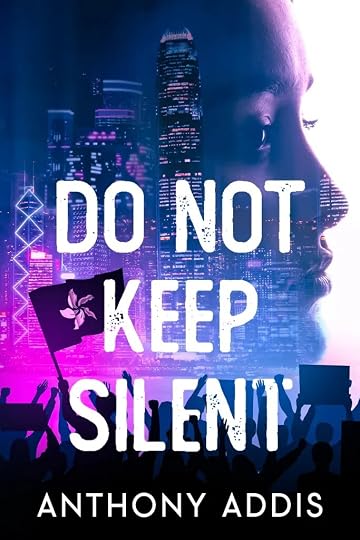 Choosing a political thriller book cover
Do Not Keep Silent has been out for about fifteen months. It’s a political thriller that has elements of romantic suspense and protest fiction, as well as a healthy dose of espionage.
Some of the scenes are visceral and violent and put characters you genuinely care about in horrendous danger. One reviewer said, “I was up and down with tension.”
The Original Cover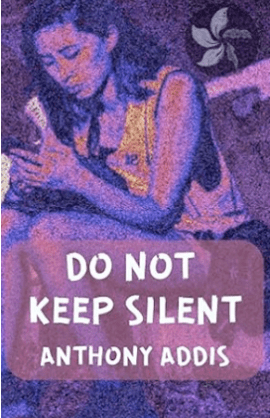
But the original cover did not reflect that danger. In many ways, I’m still proud of it. It was calm, and clever, even if I do say so myself. After all, I was the designer. I’d contacted a superb photographer called Jonathan Van Smit, who gave me permission to use one of his images from the 2019 Hong Kong protests.
I zoomed in on one section of his original photograph – a young protester looking down at her phone, and then slightly pixellated it to symbolise the perils of state surveillance. The image represented the main character, Mae Yang in a quiet moment of the protest she organises in Do Not Keep Silent. The problem is, for a political thriller book cover it was too quiet.
The Design BriefDo Not Keep Silent needed a cover that better represented the nature of the novel. So I turned to Get Covers, a Ukranian book cover design agency. You can see the result at the top of this post.
As its title suggests, Do Not Keep Silent is not a quiet book. It’s loud, with heart-rending action scenes that put the reader right in the middle of a protest just as it turns violent. Even in Chapter One, sirens wail, helicopter rotor blades whump overhead and police non-lethal rifles are fired.
But the very heart of Do Not Keep Silent is its two central characters, protest leader Mae and the drifting Pete, who meet on the Peak and against all odds fall in love. Through their relationship, the impact of Mae’s protest and what is happening across Hong Kong in real life is explored in microcosm.
The New Cover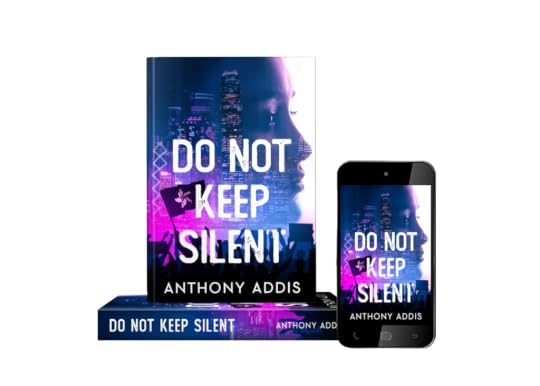
After a couple of false starts, Get Covers came up trumps. I love the way the new cover captures Mae’s essence as she looks to the future with a mixture of resignation and hope. Hong Kong’s skyline is clearly shown and the idea of the protest is literally front and centre. The new design actually looks like a political thriller book cover. Now I just have the same old puzzling question I always have: should I go for a matt or gloss finish?
Blurb for Do Not Keep Silent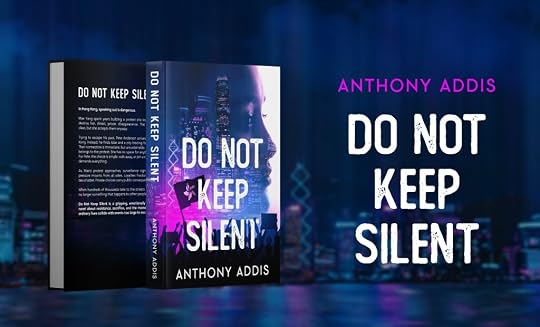
In Hong Kong, speaking out is dangerous.
Mae Yang spent years building a protest she knows may destroy her. Arrest, prison, disappearance. The risks are clear, but she accepts them anyway.
Trying to escape his past, Pete Anderson arrives in Hong Kong. Instead, he finds Mae and a city bracing for impact. Their connection is immediate, but unsustainable. Mae’s life belongs to the protest. She has no space for anything else. For Pete, the choice is simple: walk away, or join a cause that demands everything.
As Mae’s protest approaches, surveillance tightens and pressure mounts from all sides. Loyalties fracture. Family ties shatter. Private choices carry public consequences.
When hundreds of thousands take to the streets, history is no longer something that happens to other people.
Do Not Keep Silent is a gripping, emotionally charged novel about resistance, sacrifice, and the moment when ordinary lives collide with events too large to escape.
LinksDo Not Keep Silent is available on Amazon and Kindle Unlimited.
Ten great books set in Hong Kong
The post Why I changed my Political Thriller’s cover appeared first on anthonyaddis.co.uk.