Adam F.C. Fletcher's Blog
April 27, 2026
Making Meaning in Life
Elie Wiesel (1928–2016) was a Holocaust survivor best known for his writing, including his book Night about his survival in Auschwitz and Buchenwald. He was awarded the Nobel Peace Prize in 1986 for being a human rights activist who fought against indifference and for the memory of Holocaust victims.
When I read Night, I learned that meaning is not an inherent thing in our lives. Instead, it requires us to be active creators who use our personal engagement and our memories to combat indifference. Wiesel wrote, “Our obligation is to give meaning to life and in doing so to overcome the passive, indifferent life.”
A lot of people have written about meaningfulness, but it was when I read that book around 2000 that I began constructing the basis of my work over the last 25 years. I saw that my youngest efforts as a youth worker, popular educator, and community activist were forged in my life’s fires of trauma and determination, and keep molding me into a kind of DIY punk and hip-hop rabble-rouser.
It was around that same time that I began understanding Pedagogy of the Oppressed, the book by Paulo Freire (1921-1997) that has been a guidepost for my entire career. One of the many things he taught was that,
“In order for this struggle to have meaning, the oppressed must not, in seeking to regain their humanity (which is a way to create it), become in turn oppressors of the oppressors, but rather restorers of the humanity of both.” (p. 44)
By making the line so clear, I saw Freire building on Wiesel’s belief that we have to do more than simply live; he showed me how there’s an inherently political tension within meaningfulness, in that what is meaningful for some can be oppressive to others. Freire suggested that instead of just hoarding power, meaningfulness requires us to take action for everyone’s interdependent liberation.
Maya Angelou (1928-2014) wrote about this too. In a book called Wouldn’t Take Nothing for My Journey Now, I read her charge that said, “Words mean more than what is set down on paper. It takes the human voice to infuse them with deeper meaning.” I was trying hard to make sense of writing back then, and Angelou’s words wound together with Weisel and Freire’s to give me a clarion call. From then on to today and for the rest of my life, I believe that its my job to find meaning in my words — and my all of my actions.
The mundane and the ordinary, the struggling and the striving, the accomplishments and the struggles, they are all mine. I’ve learned over and over that life is not about traveling along some kind of straight line. All of these great teachers have insisted to me that it’s a process of making meaning through the stories we tell, the ways we live, the things we do, as well as the places, the people, and the ways we exist.
If I’m a rodeo clown or a corporate exec, a poet or a dishwasher, a mother or a minister, the challenge is the same: Get engaged, make meaning, liberate ourselves and others, repeat and recycle, over and over, endlessly and throughout life.
I’ve discovered that I’m nearly fixated on making meaning from life—including letting life be meaningful in all of its ways without me making anything. This might be our greatest charge.
Want to do something right now? Here are some actions you can take immediately.
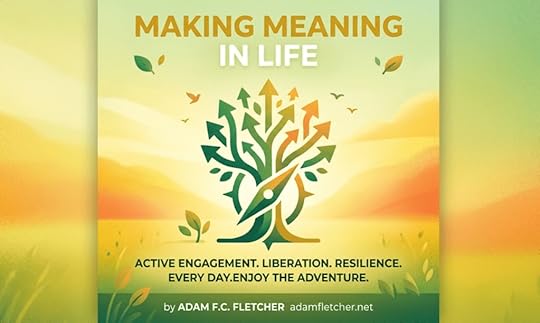 “Making Meaning in Life” by Adam F.C. Fletcher adamfletcher.net10 Ways to Make Meaning in LifeListen to Everyday Voices: Look for times in your life where you can make bland interaction into something genuine and real, like a at a grocery store or in a brief convo with a coworker. Meaning can be found in the inflection and the intent behind the words, not just the words themselves.Resist Apathy. Meaning is the opposite of indifference. Look for one small thing today where you usually don’t care or look away, and choose to pay attention instead. Look, listen, and hear what’s being said. Meaning can be the byproduct of refusing to be apathetic.Restore Humanity. We can all be restorers. You’ve seen the social media videos where they make century-old toys look brand now? Restoring humanity means finding meaning in moments where we refuse to mirror current realities, including the aggression, apathy, or suffering shown to you. Stop! Instead, act in a way that humanizes both you and the person you are in conflict with.Life Your Case Study. Whether big or small, all of our lives are always in transition. Look for the “data” in the everyday things you’re going through and become the leader of the resistance in your own life. Find meaning in the physical, emotional, mental and social evidence of your own ability to adapt to new things, places, abilities, and outcomes in your own life. Stop being bullied by living. Take control! Act Interdependent. As Dr. King taught, we are all together in an “inescapable network of mutuality, tied in a single garment of destiny.” Look for a moment in your life where your success is tied to someone else’s. Meaning isn’t found in “hoarding power,” but in the “We.” Identify one thing today you can do to make someone else’s burden lighter while also freeing you from “oppressor” thinking.Walk Unstraight Lines. When things go wrong or the day feels crooked, look for the meaning in the detours. If life isn’t a straight line, then the challenges and mistakes we have are actually the texture of our stories. Find the value in the jolt and learn from it when you’re ready.Find Meaning, Don’t Make It. Look for one thing today—a sunset, the breathing of your dog, the calmness of a good drink, a child’s laughter—that is meaningful simply because it is, requiring zero effort from you.Feel the Rhythm of the Struggle. Even in our challenges there are patterns, beats for us to step to. Look for meaning in your effort itself, regardless of the outcomes. Whether you are a retired or just starting, the meaning is in the “doing.” Acknowledge the dignity in the manual labor or the stanky, dank walls of a difficult place. Feel that rhythm, even when it sucks.Doing Meaning. As communicators, we are constantly sharing either explicitly through talking, writing, body language, or signals, or implicitly through feelings, ideas and reactions. We should do meaning by looking for the clarion calls in our everyday actions, interactions, reflections, reactions, or responses, whether we hear or think or paint or sing them. Meaning is found when we take raw emotion and forge it into expressions. Look for one thing today that feels “truest” to your experience, and do meaning.Uncover Ghosts. Look in your own past—either from long ago, or from yesterday—for where your ghosts became scars. Don’t cover them. Instead, let them now give you insight. Meaning is found when we see that our past pain currently functions as empathy for others, sometimes in really specific, direct ways, and other times as a shining, jingling generalization that covers your entire life.You Might Like…
Welcome to Heartspace: The Engine of Personal Engagement
Topics: An Invitation | Heartspace Scale | Integrity | Reflections | Intuition | YOU are Heartspace | Appearances | Heartspace Supports You | Images | Sacrificinge | Universal Engagement, And Why YOU Matter | Heartspace Supports You | Finding Myself | Barriers to Heartspace | You Can Choose Heartspace | The Rhythm of My Soul | Change The World? Change Yourself! | Engagement through the Butterfly Effect
Further Reading: Personal Engagement Tip Sheets | The Principle of Engagement | Activating the Principle of Engagement | The Engagement Movement | The LIVE ENGAGED Manifesto
Workshops are available—Contact Adam »
Adam F.C. Fletcher Presents…
BEST PRACTICES IN ENGAGEMENT
1. Find Meaning in Life
2. Equality and Equity
3. Engage Fully and Whole
4. Real Reciprocity
5. Build From Within
6. Build On Existing Engagement
7. Personal-Driven Engagement
8. Conscious or Convenient?
9. Don’t Tokenize
10. Engagement for ALL
11. Bring Us Together
12. Be Humble
More: Intro | Seeing It | Reasons | Examining | Creativity | Reflection | Tip Sheets
Buy the Book: Best Practices in Personal Engagement by Adam F.C. Fletcher »


April 24, 2026
Finding My Canadian Footprints
For years, I’ve moved through the world with the restless energy of a high-performing refugee—always building, always looking toward the next horizon, and often feeling like my voice was a solitary one echoing across a vast, empty canyon. I long known my work with Freechild and SoundOut mattered, but I viewed it as a grassroots/guerrilla effort, like a series of local fires lit to keep the chill of institutional apathy at bay.
It was in 1997 that I took my first contract, designing a youth empowerment training project for the village of Caroline Family Youth and Children’s Services program. That was a long time ago!
But recently, as I prepared for my move to Vancouver, I decided to do some “intellectual archaeology” on my own career. What I found didn’t just surprise me—it has surprised and delighted me in all kinds of ways!
It turns out, while I was busy building, Canada was busy listening.
The Parliamentary ConnectionThe biggest “jaw-drop” moment came when I found myself sitting in the digital archives of the Library of Parliament in Ottawa. There, in a comprehensive national study commissioned to define the future of Canadian civic engagement, was my name. The federal government wasn’t just observing youth engagement; they were using my frameworks—specifically Meaningful Student Involvement—as the primary lens through which to view the next generation of democratic participation. To realize that the foundational blueprints of Canadian student voice policy have my fingerprints on them is a humbling realization I am still processing.
From Alberta to Ontario: A National StandardAs I dug deeper, the “discovery” grew more profound. Although I’ve long used them as teaching tools, I found that my frameworks for Meaningful Student Involvement haven’t just been a theory in a book; it’s been a working tool for the Waterloo Catholic District School Board in Ontario and a benchmark for the Saskatchewan Ministry of Education. I have also been cited for influencing the Ontario Ministry of Education, and the CEA EdCan Network has referenced my work, too.
In Alberta, where I was born and have lived since 2025, the impact hits even closer to home. From advising the Alberta Education (the province’s ministry of education) on the SpeakOut initiative to serving as a project coordinator at the University of Calgary’s Werklund School of Education, I realized I wasn’t just a consultant passing through—I was helping to anchor a new era of student power in the province.
Why This Changes EverythingFor a long time, I’ve felt like I was fighting for a seat at the table of education transformation. What I’ve found has forced me to admit a startling truth: The table was built using my designs! Whether it was the BC School Trustees Association using my guides to structure their governance, local districts citing me to infuse students in decision-making, or the Alberta School Boards Association inviting me to speak to the leaders of 200,000 students, the evidence is clear. My work has transitioned from radical ideas to become national standards.
The Road to VancouverThis changes the way I’m arriving in Vancouver. I am no longer looking for permission to lead; I am arriving as a manifest fact of the Canadian educational landscape. I look forward to finally joining a circle of professional and intellectual equals when I arrive. I am coming to the Vancouver shoreline not just to breathe the salt air, but to step into the leadership roles that this legacy has prepared me for.
Finding my Canadian footprints shows me how I’ve been working for Canada for 25 years. Now, it’s time we finally meet face-to-face. I’m at home with a legacy I didn’t even know I’d already finished building.
I look forward to seeing what we build next!
You Might Like…Meaningful Student Involvement in Canada
By Province & Territory: Alberta | British Columbia | Manitoba | New Brunswick | Newfoundland and Labrador | Northwest Territories | Nova Scotia | Nunavut | Ontario | Prince Edward Island | Quebec | Saskatchewan | Yukon
By Tool: Canadian Student Voice Directory | Student Voice in Canadian Education Agencies | Guide to Students on Canadian School Boards | Directory of Laws Affecting Student Involvement in Decision-Making in Canada
Other: Intro to Meaningful Student Involvement | Fletcher Engagement Services Tools for Schools
ABOUT FLETCHER ENGAGEMENT SERVICES
SERVICES: Consulting | Speaking | Writing | Workshops | Programs | Masterclasses
TOPICS: Youth Engagement | Meaningful Student Involvement | Personal Engagement | Hyperlocal History | Student Engagement | Youth Voice | Community Engagement | Unraveling Racism | Student Voice | Adultism | Democracy Deficit Disorder
CLIENTS: Sectors | Schools | Youth Services | Community Groups | Professional Orgs | Government Agencies | Families | Individuals | School Boards | Nonprofits
DETAILS: Bio | Bookstore | In The Media | Featured Usage | By The Numbers | Recommendations | Past Projects | Case Studies | Past Clients | Past Schools | Past Appearances | Videos | Articles | Bibliography
Contact Fletcher Engagement Services »
April 20, 2026
Global Mind Blown!
The realization hit me somewhere between the quiet archives of the Canada Library of Parliament and the bustling digital corridors of the European Union’s GroundUp initiative. As an “ideas guy” for the last 25 years, I’ve sent ideas out like messages in bottles, never quite sure whose hands will uncork them. But recently, I stood face-to-face with where those bottles landed, and my mind is blown!
For decades, I operated like a “high-performing refugee”—constantly moving, advocating, and often feeling like I was shouting into a vacuum. I knew my frameworks were big, but discovering the scale of their institutional adoption has totally shifted my understanding of what I’ve done and my own legacy.
I recently uncovered a Canadian Library of Parliament study where my name was etched into the fabric of national democratic recommendations for my own country. The Canadian government wasn’t just looking at youth engagement; they used my work as a primary resource to define how students should be partners in change.
That reach doesn’t stop at the border though. One of my tools is a standard for the Irish Second-Level Students’ Union right now. The World Scout Bureau used my frameworks for their global youth engagement policies. Even the Berkeley Technology Law Journal—a real pinnacle of legal scholarship—is citing me in 2026 to argue for student agency as a requirement for institutional governance.
My fingerprints are a lot of places, like the toolkits of the International Federation of Medical Students’ Associations across 120 countries, in the BC School Trustees Association’s governance guides, and even translated into Vietnamese by the Buddhist Sen Trắng community.
My discovery of all this stuff comes at a powerful time for me. As I prepare to move to Vancouver, I am shedding my “refugee” mindset. I am not arriving as a stranger looking for a seat at the table; I am arriving as a theorist whose work has been at the table for years, often in rooms I wasn’t even invited to enter.
There is a profound responsibility in this for me. If global governing bodies are using my frameworks to shape the agency of millions of young people and the work of adults who support them with the systems that support them, my mission in Vancouver can’t be small. I am entering a phase of global presence.
Tonight, the shock is wearing off and is being replaced by a cold clarity: my intellectual heft is established and my legacy is already built. Now, it’s time to live in it. Vancouver, I’m ready to see what we build next!
You Might Like…Home Again, for the First TimeAdam F.C. Fletcher’s Intro to Youth Power In Vancouver, British ColumbiaVancouver Youth InsightsABOUT FLETCHER ENGAGEMENT SERVICES
SERVICES: Consulting | Speaking | Writing | Workshops | Programs | Masterclasses
TOPICS: Youth Engagement | Meaningful Student Involvement | Personal Engagement | Hyperlocal History | Student Engagement | Youth Voice | Community Engagement | Unraveling Racism | Student Voice | Adultism | Democracy Deficit Disorder
CLIENTS: Sectors | Schools | Youth Services | Community Groups | Professional Orgs | Government Agencies | Families | Individuals | School Boards | Nonprofits
DETAILS: Bio | Bookstore | In The Media | Featured Usage | By The Numbers | Recommendations | Past Projects | Case Studies | Past Clients | Past Schools | Past Appearances | Videos | Articles | Bibliography
Contact Fletcher Engagement Services »
April 15, 2026
Engagement through the Butterfly Effect
In 1963, a meteorologist named Edward Lorenz asked a question that would forever alter our understanding of the world: Does the flap of a butterfly’s wings in Brazil set off a tornado in Texas?
This idea, known as sensitive dependence on initial conditions, suggests that small actions that seem insignificant can catalyze massive, unpredictable transformations across a system. While typically applied to weather patterns or physics, this idea known as the Butterfly Effect, serves as a huge metaphor for the ways people connect. Through my decades of work to foster meaningful involvement, I have found that in the realm of personal and professional connections, engagement is the real rope that binds our world—and even our smallest choices are the flap of wings that shift the weather.
The Micro-Moments of Connection “Learn how to see. Realize that everything connects to everything else.” – Leonardo da Vinci
When I was younger, I mistook engagement for grand gestures like town hall speeches, elaborate marketing campaigns, and life-altering manifestos. But learning from youth, I found that engagement happened in the everyday interactions that we chose over and over, either on purpose or by accident. That notion helped me understand that engagement doesn’t need permission, intention, or even outcomes that are okay. Instead, engagement is an everyday thing throughout our lives in seen and unseen ways, spoken and whispered, and more.
In reality, engagement is kind of random, and happens in smaller and smaller ways. The quality of an organization, a family, or a lifelong friendship is reflected in the tiniest individual interactions. At the same time, engagement happens in larger and larger ways, too. The ways a community, a nation, and the world shows in their relationships towards each other, too.
In our own lives, when we choose to offer a coworker your undivided attention during a mundane conversation, or when you’re walking through the store and give a stranger a genuine smile, you are creating a butterfly flap of engagement. On the surface, nothing has changed. But internally, you have changed the emotional trajectory of that person, even if just for a moment. That coworker or stranger, feeling heard, approaches their next task with a slightly higher degree of confidence. That confidence leads to a breakthrough in a project, which eventually saves a client’s account, which secures the jobs of a hundred employees. Because their economically secure, they vote in different ways and cause new breakthroughs in politics, which in turns affects our culture and in turn… changes the world. All because you gave your attention to that coworker, or that smile to a stranger.
The Physics of Presence “True humility means accepting our equality with everything else on Earth, including past and present, old and young, rich and poor, human and animal and insect and plant and dirt.
 All of it.” – Adam Fletcher
When we think engagement this way, we have to look at the starting points of our connections with the world around us. In one way of thinking about it, if the starting point of a connection is off by even a fraction of a decimal, the end result will be worlds apart.
The same applies to our intentionality. If the starting point of a conversation we’re having is distracted or fake, the resulting engagement will inevitably veer toward misalignment. It might still be engagement, but it won’t be as rich, thick, or meaningful as if it was intentional, committed, and real.
I have learned that by shifting our internal way of being towards warmth, humility, and openness (among other characteristics), we can change our engagements in powerful ways. This is what I refer to as the Compass of Engagement in action: navigating by our personal north star on purpose instead of just moving along through the noise of habit.
Through the Institute for Personal Engagement, I teach people different ways to do this. That includes embracing the power of the pause. If we give a three-second silence before responding to a provocation, we can prevent a relational tornado from demolishing our connections with others. I also teach that weight of our words is important, too. By choosing “and” instead of “but,” we can validate others’ perspectives and keep the gates of engagement open instead of slamming them shut.
Chaos and Contribution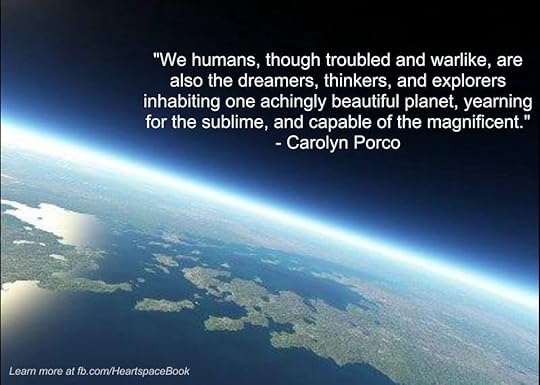 “We humans, though troubled and warlike, are also the dreamers, thinkers, and explorers inhabiting one achingly beautiful planet, yearning for the subline, and capable of the magnificent.” — Carolyn Porco
One of the most intimidating realities of the Butterfly Effect is that we don’t have direct control of engagement. Just like we can’t force tornados to happen in Texas just by flapping our wings in Brazil, we can only contribute to the conditions that make it possible.
This means that each of us have to shift from mindsets of manipulation towards thoughtful contributions. We cannot control how our partners, young people , or customers react to us. However, each of us are the sole people responsible for our own wing flaps, and when we engage with warmth, humility, and openness, we are seeding the wind with powerful, positive potential.
Over time, these small acts of meaning-filled engagement will gather up. That’s how culture is built—not through mission statements on walls, but through the thousands of small engagements that happen at the water cooler, in the inbox, and behind closed doors. That how families are transformed, with every conflict solved as a love-filled interaction, and that’s how classroom learning is transformed, with each act of learning acknowledged through equity and justice. If everyone learns to treat their own tiny interactions as meaningful ways to change the world, the resulting engagement can massively transform everyone, everywhere, all of the time. Engagement can become beautifully unbreakable.
Moving Along Through Ripples “Not knowing how close the truth is to them, Beings seek for it afar — what a pity! They are like those who, being in the midst of water, Cry out for water, feeling thirst.” — Hakuin Ekaku
If we accept that our smallest personal engagements have infinite potential, our responsibilities towards ourselves, other people, and the whole world could expand, thicken, and deepen A LOT. The more we become aware of what we’re engaged in, how we’re engaged in it and why we’re engaged, the more we are no longer passive observers in our own lives. Instead, we became active drivers in a vast, interconnected web of engagement.
3 Steps to Move Through RipplesI’ve learned that each of us can become conscious of our personal engagement through the Butterfly Effect. To that we have to become aware of what we’re engaged in. Here are three simple steps to engage through the ripples of the Butterfly Effect:
Recognize the Ripple: Acknowledge that your current mood or tone can be “exported” to everyone you meet today. That “export” is your engagement.Fine-Tune the Start: Before any meeting or social gathering, reset your “initial conditions.” Take one breath to center your intent and become engaged on purpose.Value the Small: Stop looking for the “Big Win” and start looking for the “Small Wing” that will flap intentionally, and becoming engaged in the ripples.Conclusion “Strange is our situation here upon earth. Each of us comes for a short visit, not knowing why, yet sometimes seeming to a divine purpose. From the standpoint of daily life, however, there is one thing we do know: That we are here for the sake of others for the countless unknown souls with whose fate we are connected by a bond of sympathy.” — Albert Einstein
Personal engagement is not a static state. Instead, it is a dynamic, living process that’s influenced by the subtle winds of our daily choices we make all the time. By honoring the role of the Butterfly Effect in personal engagement we acknowledge that there are no “throwaway” moments. Every look, every word, and every silence is a seed planted in the field of universal engagement.
When we navigate our lives with this level of awareness of engagement, we don’t just move through the world—we consciously, intentionally, and deliberately choose to shape the climate of every engagement we enter.
You Might Like…Welcome to Heartspace: The Engine of Personal Engagement
Topics: An Invitation | Heartspace Scale | Integrity | Reflections | Intuition | YOU are Heartspace | Appearances | Heartspace Supports You | Images | Sacrificinge | Universal Engagement, And Why YOU Matter | Heartspace Supports You | Finding Myself | Barriers to Heartspace | You Can Choose Heartspace | The Rhythm of My Soul | Change The World? Change Yourself! | Engagement through the Butterfly Effect
Further Reading: Personal Engagement Tip Sheets | The Principle of Engagement | Activating the Principle of Engagement | The Engagement Movement | The LIVE ENGAGED Manifesto
Workshops are available—Contact Adam »
April 13, 2026
Growing Into My Career
I started working with youth professionally when I was just 14-years-old. However, it wasn’t until I was 20-years-old before I determined I could do the work for the rest of my life. This motion wasn’t just a chronological shift, it happened when I started taking the raw, jagged edges of my childhood survival and made them into a professional lens to look through. It was over the next decade that I became dedicated to meaningful involvement, and my own engagement became the engine of my personal liberation. Here I reflect on how I grew into my career.
Earned Experience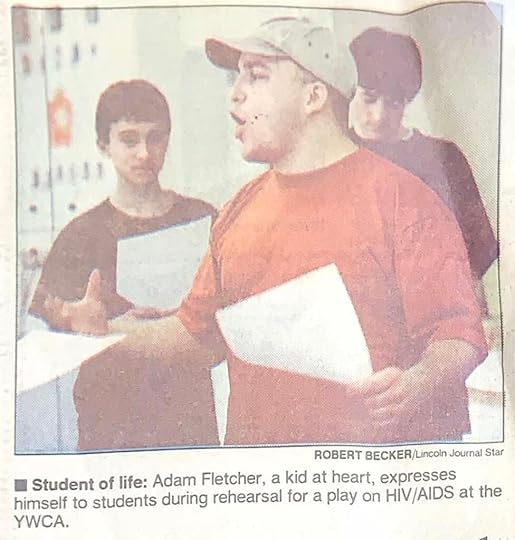 This is Adam Fletcher working at the YWCA in Lincoln, Nebraska, in 1998. Read the article here.
In 1995, I turned 20. In my teens I learned that drama was a skill and that my voice had an interesting power to make adults lean forward to listen. I spent the mid-1990s in a state of perpetual motion and flux. Over and over, I was the young guy in the room who shouldn’t have been there according to the resume, but had to be there according to the reality of the streets.
Early on, I worked in nonprofits in Lincoln, Nebraska. In a program through Planned Parenthood and the YWCA, I taught independent living skills to homeless, foster, and other youth in crisis. It was a powerful time that taught me about the Carrera Project and the impositions of adultism on the hearts and minds of youth. I found work as a floor supervisor at a court-ordered drug and alcohol treatment center for youth. This was a clinical therapy setting, and it was jarring to me to see a few of the young people I knew from my neighborhood where I grew up in Omaha there. As a low-income guy with a lot of time on his hands, I took another job as a teacher/naturalist at a nature center just outside of the city, which I found exhilarating. I viewed this as a 9-5 extension of the joy I felt as a nature counselor at summer camps, and as a retreat from the city where I could soak up the prairies and riparian forests in the region while bison were onlooking at my students and I pretending to be grasses in the warm Nebraska sunshine.
I spent those early years navigating my morphing, post-hood identity. I remember the imposter syndrome being thick enough to choke on: as a white guy from a low-income African American neighborhood in Omaha, a Canadian-born “illegal” who had finally found a footing, I was being asked to reach youth in new and different ways. My 20-year-old self was still picking the metaphorical trash from my scruffy recent New Orleans experiences while trying to look professional in thrift-store button-up shirts.
My next jobs were in the AmeriCorps National Service Program, where I served two terms. Acting as a domestic Peace Corps, the AmeriCorps Program trained me how to work with youth, embrace diversity, and teach and train others. I served my first term in Lincoln working with Kurdish and Iraqi refugee kids as a tutor/mentor, and my second in Tacoma, Washington, operating a ropes challenge course for inner city youth as well as corporate groups who donated money to the nonprofit that hosted me. After that, I was selected to joined a national service leadership development program called AmeriCorps Leaders, traveling the nation to complete 120-plus hours of professional development programs while consulting north New Mexico pueblos on service learning programs in their K-12 schools.
Through AmeriCorps I learned the ethic of service, and I realized that my knowledge wasn’t just my ideas; it was my story. I started realizing that when I spoke about the “fiery furnaces” of our individual lives, people didn’t just listen—they became invested. I was building the foundation for what would become the Freechild Institute for Youth Engagement, though at the time, it felt more like I was just trying to keep the lights on in a way my parents couldn’t when I was growing up.
Figuring Out My “Why”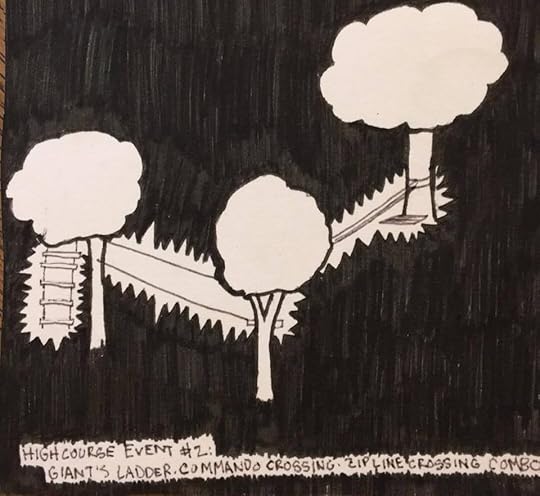 This is an image of a ropes challenge course element that I drew in the late 1990s.
By the turn of the millennium, the world was vibrating with change. After going to six other colleges, I was wrapping up my bachelor’s degree at The Evergreen State College in Olympia, Washington, and soaking up the intellectual culture at my fingertips. I was also happily in love and exploring the world, and learning to build adult friendships and a sense of place in my new community. This was a pivotal time for my thinking, as I moved from being “Adam, the guy who knows things and does stuff” to “Adam Fletcher, an architect of frameworks.” I often didn’t know exactly what I was doing, but I was doing a lot of it.
It was in 2001 that I started developing Freechild. In a fellowship program with a national foundation based in Washington, D.C., I served as a “Youth Engaged in Service (YES) Ambassador” in Washington State. Again I found myself traveling the nation and scouring Washington to learn about youth involvement, building networks and establishing a national presence that was exhilerating to me. I thrived off the sense of connectivity and belonging within a field that felt like an extension of the youth work of my first decade in the field, and an expansion of my service through AmeriCorps.
It was during this era that I started to see how my personal experience with youth councils and community youth organizing could be codified. Studying youth activism across the U.S. and around the world, I wasn’t just a motivational speaker; I was a systems-changer. I began writing, a lot, documenting the radical engagement that had saved my life and so much more. I realized that if I could name a phenomenon—like Meaningful Student Involvement and youth engaged in social change—I could facilitate conversations about it, expand the practices, and be the change I wanted to see in the world. This was the birth of my career as a designer of collective action.
I stopped just telling my story and started building the logic models for how others could replicate my survival, transform it in their experiences, expand on it, and build the field. I was moving from the roles in my youth into a role as an organizaational strategist who could talk to school board members, NGO directors, and politicians without blinking. I was becoming my professional self more and more.
The Weight of the Work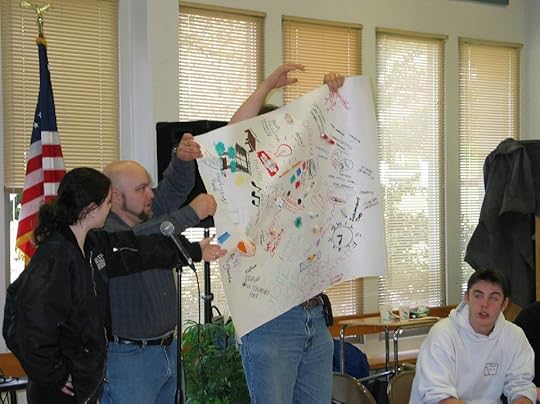 SoundOut Conference 2005 in Bothell, Washington.
By 2005, I was 30 years old. The decade had been a blur of Greyhound buses and airplane flights, early-internet forums, and the slow steady building of a national reputation. Along the way, my first wife and I bought a house, and in 2003, I became a dad, changing my heart forever. But this is also where the “fiery furnace” got hot.
I struggled with the “bit of everything” identity. Was I a designer? A writer? A speaker? I felt the audience waver and struggled when it felt like there wasn’t room for me in some conversations and organizations. I was being brought in when it was popular, but ignored when the hard work of “dismantling” systems began. This was the era where I learned that revenue is tied to consistency. I couldn’t just be a “firebrand”; I had to be a “partner,” and even then, work wasn’t guaranteed.
I began to see my career not as a series of gigs, but as a mission-driven enterprise. The Freechild Institute had taken off, SoundOut.org grew dramatically, and I started focusing on sustainability—not just for the planet, but for myself. It was during this time that I realized that the hard challenges of my own childhood were the fertilizer for a very rich, very complex professional life.
Reflections From Those Years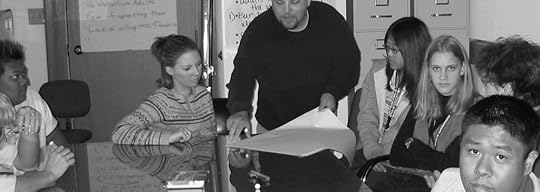 SoundOut students involved in an education planning meeting in 2001.
From 1995 to 2005, I moved from front-line direct service with youth into boardrooms, offices, and conference presentations about youth and education. I found footing in advocacy and training, and felt zestful and enthusiastic about the prospects of youth changing the world, and my role in helping facilitate that happening. I learned a bit, too.
The Lessons LearnedThe Power of the Pivot: In a decade, I learned to move from summer camp counselor to founding director. I realized that expertise is often just the courage to name what everyone else is seeing but no one is saying.The Value of Vulnerability: Every time I shared the story of the roadside motel or the “Adam’s Advertising” sign, the audience’s engagement climbed fast. My trauma became a trademark, provided I used it to build a bridge rather than a wall.The Struggle for Identity: I spent my 20s shifting from being a youth in the room to becoming an specialist. By 2005, I realized the most powerful position was being the bridge between both.The Financial EvolutionMy 20s taught me that my ideas had currency. The speeches I gave were gone once the echoes died, but the articles I wrote, the curriculums I designed, and the brands I nurtured were assets that could grow while I slept. I didn’t want to use my dad’s door-to-door salesman energy; I wanted to be a strategic partner; sometimes that worked.
Closing the LoopLooking back from 2026, those ten years were the years where I exploded into the galaxy of social change. I was messy, I was broke a lot, and I was constantly struggling to make sense of my work, but I was doing it in concert with the world, including my partner, my friends, and the young people who I worked with.
I wasn’t just a kid from the hood anymore. I was a man who had survived the hood, the homelessness, the border, and the “extra” rooms in strangers’ houses. I was figuring out how to turn that survival into a blueprint. By 2005, the foundation was poured. The next twenty years would be about building the cathedral.
“I do understand the world is working exactly how it needs to right now… from the tragedies and drama, something is getting dismantled, and something else is getting built.” — from “Radical Engagement in My Own Life“
That was the mantra of my 20s. I was dismantling the supposed destiny of criminality and poverty in my life, and I instead, building a legacy of engagement. It was kind of cool. It made me smile then, and it makes me feel kind of large now.
You Might Like…“Adam’s actions dispel Gen Xer Myth,” by Cindy Lange-Kubick for the Lincoln Journal-Star in 1998.Articles About Adam F.C. Fletcher’s Life
Work: My Career | I Work for Belonging | Growing Seeds through Youngtime | Learning My Work | Starting Youth Work as a Youth | Why I Advocate for Youth | Learning from My Youngest Work | Finding Belonging in My Work | Growing Into My Career | My Agency: 36 Years of Evidence in Action
Life: My Fragmented Youth | My Own Evolving Engagement | Don’t Call Me Kid | Youth Involvement Saved My Life | My Youth Council Days | Radical Engagement in My Own Life | From My Point of View… | Getting In Trouble | “Inconvenient” youth voice | Being “That Kid” | Engaged Through Hip Hop | Growing Up as a Free Child | Confessions of “That” Kid | Conscientization In My Life
April 10, 2026
A.I. in Youth Work Today
Lately, like a lot of people, I’ve been thinking about Artificial Intelligence. Just like the futurists predicted, its becoming both ubiquitous and less obvious every single day, fading into the background of everyday services like banking and getting gas, while standing out more all the time in schools and at home. Since I’m using it more and I know on-the-ground workers I have been curious about how A.I. is affecting youth work here right now, so I researched and wrote this article.
From all reports, in 2026 A.I. has shifted from being a futuristic thing in youth work to becoming foundational infrastructure for all kinds of youth-serving orgs and programs. It hasn’t been able to replace the core human-to-human nature of our work, but it has fundamentally rewired how youth work and youth services are delivered and how young people of all kinds are navigating their lives right now.
Here is the current state of A.I. in youth work today.
Effects on YouthAs youth have more access to A.I., they’re becoming more and more vulnerable to its effects. Some of them include…
Mental Health Chatbots & Crisis Support: With public healthcare waitlists still a challenge, approximately 10% of youth around the world now intentionally use A.I. tools for mental health advice. While they break down barriers to information, there is a rising concern over A.I. psychosis and hallucinations, and A.I. acting like an echo chamber where bots validate or propose harmful thinking.Digital Divide 2.0: A.I. literacy is becoming a new social determinant of health. Youth in remote or marginalized communities who lack access to high-end A.I. tools are facing a widening gap in competitive employability compared to their urban peers.Identity and Creativity: Using A.I. to generate images and video has turned creation into curation. More youth than ever are now using A.I. as a creative generator of art, music, poetry, and other kinds of creativity, shifting the focus from developing their creativity to mastering conceptual direction at the expense of practical skills.The “Deepfake” Crisis: With the rise of AI-generated media, youth worldwide right now are the first generation required to treat every image or video as potentially fake. This is causing a fundamental shift in how they verify truth and whether and how they trust everyday operations and institutions.Education for “Durable Skills”: Traditional schooling is pivoting right now. Since A.I. can handle rote memorization and basic writing, the focus for a lot of learners is shifting toward durable skills and soft skills, like critical thinking, effective communication, ethical judgment, and complex problem-solving that A.I. cannot replicate.There are a lot more effects, but the impacts on youth work and youth services aren’t just on individual young people.
2. Effects on Programs and OrganizationsNonprofits, government agencies, educational institutions and other organizations are in a state of “curious experimentation” in using A.I. in their youth work and youth services.
Widespread Adoption: In Canada, approximately 80% of nonprofits report using A.I., but most use is limited to relatively simple tasks like drafting social media posts, fundraising appeals, and summarizing meeting notes.Operational Shifts: Some organizations are using data collection and sharing models to move toward integrating different youth services, including education, housing, and health. This allows for a more holistic view of the journeys young people take without making them retell their story to five different caseworkers. Youth workers are relying on A.I. to generate youth program activities and overall project structures. Executives are using A.I. to assess budgets, write policies and more, as well.Governance Gap: Despite signs of high usage around the world, its estimated that about 10% of youth serving organizations have formal A.I. policies. Most are operating in a sort of wild west-type environment about data privacy and the ethical implications of A.I. bias.3. Effects on Direct Service Workers & ManagementA.I. is acting as a “force multiplier” that simultaneously reduces paperwork and increases performance pressure.
Administrative Relief: Direct youth service workers are using A.I. to automate case notes and reporting. If you’ve done this work, especially in clinical settings, you know this can take more than 25% of your time. Theoretically, A.I. can allow for more direct time with the youth you serve.A.I. Management: Some large orgs and agencies have started using algorithms to schedule shifts and allocate work. While efficient, this has made some peoples’ jobs worse by making staff feel like they’re constantly being watched. Ultimately, this means A.I. is contributing to the sector’s ongoing burnout crisis.Outcome Tracking: In some organizations, leaders are moving youth services toward predictive data by analyzing historical data, and attempting to figure out which youth need services the most. For instance, in foster care they’re looking for specific youth who are apparently at risk of aging out of care into homelessness. This could hypothetically allow for “preemptive interventions” that could let us effectively see which youth need services most.In 2026, youth services are using A.I. for scheduling, grants, and logistics instead of as a front-line decision maker. Most are missing a relation-first policy that makes sure that any time saved by A.I. is mandated to be spent in direct, face-to-face interaction with young people themselves.
4. Support from FundersA lot of the funders have moved from funding services to funding digital work.
Government Strategy: Federal, state / provincial, and local governments are pouring millions into A.I. adoption, specifically for digital literacy. They say they are focusing on using A.I. to drive economic growth and youth-led innovation, with many front-line youth workers insisting on them using youth to drive acceptance of A.I.Philanthropic Priorities: Major donors and foundations and others are shifting away from general operating grants toward capacity building grants. They are funding “A.I. Impact Hubs” to force nonprofits to adopt the technology.Reporting Requirements: Funders are making nonprofits create data-driven reports that require A.I. tools to generate. Organizations that cannot produce these sophisticated analytics are finding it harder to secure traditional funding.Staying HumanThe most significant reality in 2026 is that A.I. is forcing youth services and youth work programs to look at human capacity. Apparently, A.I. has mastered the technical parts of youth work and youth services, like writing, scheduling, and activity generation. This is forcing the youth services and youth work sector to double down on relationships and safety. Because of this, training programs are now emphasizing critical thinking, de-escalation, and cultural safety as the primary qualifications for youth workers.
Maybe this means that in our field, while the systems are A.I.-driven, the work and the services stay human to the core. THAT is what is best for young people today.
You Might Like…Youth Engagement in e-DemocracyMY ARTICLES ON YOUTH SERVICES & YOUTH WORK
PERSONAL: Starting Youth Work as a Youth | Youth Work on AutoPilot | My First Job in Youth Work
SYSTEMS: Away from Radical Youth Work? | Supporting Adults in Youth Work | Robotic Youth Workers | Three Tips for Youth Work Job Seekers | Understanding the Breadth of Youth Services | Seeing Neoliberal Youth Work for What It Is | A.I. In Youth Work Today
MY SERVICES: Youth Services Master Classes | Youth Worker Learning Communities
MY ARTICLES ON YOUTH IN SOCIETY
Basics: The Concept of Youth | Roles of Youth in Society | Lowballing Youth |
Advanced: Centering Youth | Evolving Youth Leadership | Complete Youth Integration | Enabling Optimism Towards Youth
History: The History of Youth, Voice, Action and Change | A Brief History of Youth Voice | More History of Youth Voice | History of Youth Action: 1400 to 1880 | History of Youth Action: 1930s to 1970s | Video: History of Youth Voice in the US | Barack Obama and American Youth | Youth During the Trump Era
Other: Quotes on Youth | Humility With Young People | Ephebiphobia | Accidentally Undermining Young People | Young People ARE NOT Victims | Safe Spaces for Young People | Hostile Adults Are Undermining Young People | Well-Meaning Adults Are Undermining Young People | Intro to Adultism | The Evolution of Society
March 23, 2026
The Disengagement Machine
Youth engagement isn’t a board meeting; it’s a lifestyle choice made in the everyday moments of daily living.
For too long, nonprofits have been working very hard to foster youth engagement in their work. As we tried to make our operations better, our programs more successful, and our decision-making more applicable, we brought youth into meetings, listened to reports at meetings, and led them to conferences to represent our outcomes.
But as nonprofit budgets are getting decimated and social norms are getting blown apart worldwide, we’re watching as a lot of youth engagement, youth involvement, youth voice and youth mainstreamining programs and projects are falling to the wayside. Social service organizations of all kinds are being forced to austerity, and because of that they’re “focusing on their core missions” to justify stopping intentional youth engagement efforts.
I have been guilty of this myself, wholly sucked into the temptation to navel gaze at the visions and missions of longstanding national organizations and at the hardscrabble belly of local groups dedicated to changing the world in their own backyards. I’ve trained a lot of people in a lot of places to do these exact things, installing youth representatives and granting voting powers, all while maintaining arms length from the very people they claimed to serve. All this portended the reality came rushing into many of our lives more quickly than we could guessed just 18 months ago: The authoritarian, totalitarian and anti-democratic impulses of the American empire hard at work.
By focusing on the machinery of youth involvement like committees and pay, these formal structures are often disconnected from everyday work beyond our organizations. This disconnect has left young people and adult allies unprepared for the current aggressive, anti-democratic climate we face right now.
The “Rubber Stamp” Trap[image error]here.." data-medium-file="https://adamfletcher.net/wp-content/u..." data-large-file="https://adamfletcher.net/wp-content/u..." width="1024" height="423" src="https://adamfletcher.net/wp-content/u..." alt=""Traditional Models of Youth Voice vs. New Models of Youth Voice" is from "Washington Youth Voice Handbook" (2007) by Adam F.C. Fletcher, located at https://adamfletcher.net/wp-content/u..." class="wp-image-204016" style="width:718px;height:auto" srcset="https://adamfletcher.net/wp-content/u... 1024w, https://adamfletcher.net/wp-content/u... 150w, https://adamfletcher.net/wp-content/u... 300w, https://adamfletcher.net/wp-content/u... 768w, https://adamfletcher.net/wp-content/u... 1418w" sizes="(max-width: 1024px) 100vw, 1024px" />“Traditional Models of Youth Voice vs. New Models of Youth Voice” is from “Washington Youth Voice Handbook” (2007) by Adam F.C. Fletcher, located here..For decades, the standard for youth work was defined by what I now recognize as Traditional Models of Youth Voice. We treated young people as informants or promoters. We installed them on boards and gave them voting power.
But as I’ve noted in my previous work, this often resulted in tokenism—creating policies or structures that limit youth voice to create the false appearance of engagement.
We—including ME—focused on the “machinery” of youth voice—committees and reports and pay and training—instead of fostering real solidarity, which Eduardo Galeano describes as a horizontal relationship that respects and learns from the other.
Retreating Into AdultismAs budgets are decimated and social norms shift, organizations are retreating to their “core missions.” This is a classic symptom of adultcentrism: the belief that youth engagement is a luxury or a “decoration” rather than an essential component of a healthy democracy. By stopping intentional efforts, these groups are succumbing to adultism—the bias toward adult perspectives that leads to discrimination against young people.
Right now, the U.S. is among nations around the world claiming austerity is the only way right now, becoming more severe and strict in social programs, education, healthcare and more. However, austerity isn’t just a financial choice; it’s anti-democratic to its core. Because of this, we are removing the platforms for young people to influence that affect them the most, including schools, youth programs, and government activities. While we do this, we’re reinforcing a worldview positioning children and youth as “adults-in-the-making” instead of whole people today.
Catching the StormMy own “navel-gazing” at national visions meant that I, too, am guilty of maintaining an “arms-length” distance from the actual lived experience of youth. By focusing on formal structures, I have left young people and adult allies unprepared for the authoritarian and totalitarian impulses now overtaking much of our lives. I tried calling out the democracy deficit disorder, but it was too little, too late.
We built committees, trained youth and professionals, advocated for policies and laws, and sought funding and better evaluations when we should have been building interdependent webs of youth infusion throughout society. My friend and co-learner Wendy Lesko has researched these extensively within existing orgs. Although I haven’t envisioned what they are yet (and I don’t think that’s my work to do), I believe that when taken on scale, societywide youth infusion results in decentralized, peer-to-peer networks that can move faster and more resiliently than traditional institutions.
I want to go further than that though.
Toward Depth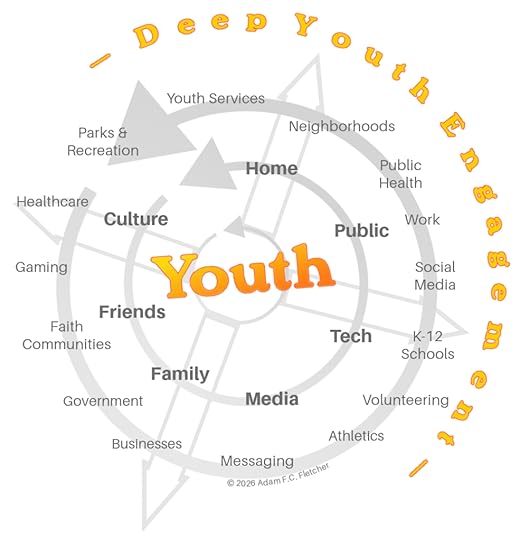 This graphic shows what Deep Youth Development looks like. It was created by Adam F.C. Fletcher (2026).
The plainest point I’m trying to make is that youth engagement isn’t a board meeting; it’s a lifestyle choice made in the everyday moments of daily living.
The reality we face now—a climate that is openly hostile toward critical perspectives from young people—requires a shift toward Deep Youth Engagement. This means:
Universal Engagement: Moving beyond the “convenient” youth leaders to ensure everyone can participate without barriers.Direct Influence: Granting youth true agency over resources and policy, moving from “consultation” to co-creation.Decentralized Power: Focusing on local, grassroots mobilization that is responsive to the “fluidity” of modern youth life.To foster Deep Youth Engagement, we must recognize that democracy is a way of life that goes way past the silos of age-segregated programs or specific mental habits.
I’ve written before that authentic engagement occurs when young people have a sustained connection to the world within themselves and their communities, finding direct, personal authority in their daily earning, learning, and living.
Beyond special programs and initiatives, deep youth engagement can happen in a lot of ways throughout the daily lives of children in youth—nearly countless ways. There are important traits to deep youth engagement that can make many activities deeply engaging, and sometimes those are more important than the activities themselves.
This means democracy at home; in classrooms and throughout entire schools; libraries; afterschool programs; at work and in jobs; parks and public spaces; sports; community centers; faith-based organizations; city hall and local government; state, provincial, and national governments; international bodies; the judicial system; online spaces; the marketplace and business community; community organizing and activism; philanthropy; and many other areas.
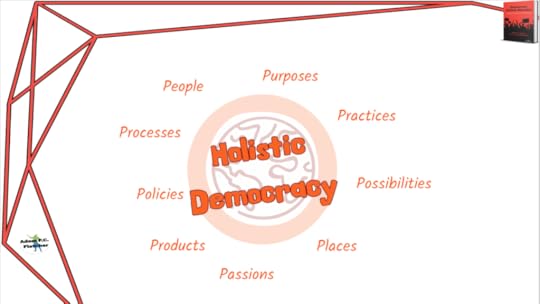 This is a vision of holistic democracy including people, purposes, practices, possibilities, places, passions, products, policies and processes. Made by Adam F.C. Fletcher (c) 2024.
By infusing deep youth engagement throughout the community everywhere—from the voting box to city halls and local businesses—we challenge the structural perception gaps and adultist biases that have historically silenced them. This 360° involvement ensures that young people are not just passive participants in systems of care, but authoritative architects of a more inclusive democracy. When we acknowledge modern youth leadership in these nontraditional and inconvenient spaces, we move from tokenistic gestures toward a state of genuine solidarity, realizing that community problems should be solved by the whole community, irrespective of age.
We have to stop treating youth engagement as a program, project, policy or product. We have to start seeing it as the heart of democracy, and that’s what Deep Youth Engagement does. If we continue to focus only on the machinery, we will continue to be run over by the very track we thought we were building.
You Might Like…Deep Youth Engagement by Adam F.C. FletcherAn Intro to Holistic Youth Development by Adam F.C. FletcherTRANSFORMING THE ROLES OF YOUTH IN SOCIETY
Roles: Youth as Activists | Youth as Activity Leaders | Youth as Advisors | Youth as Advocates | Youth as Artists | Youth as Board Directors | Youth as Consumers | Youth as Decision Makers | Youth as Designers | Youth as Educators | Youth as Entrepreneurs | Youth as Evaluators | Youth as Facilitators | Youth as Farmers | Youth Forums | Youth as Grant-Makers | Youth as Lobbyists | Youth as Makers and Producers | Youth as Media Makers | Youth as Mediators | Youth as Mentors | Youth as Organizers | Youth as Planners | Youth as Policy-Makers | Youth as Politicians | Youth as Recruiters | Youth as Researchers | Youth as Specialists | Youth Summits | Youth as Teachers | Youth as Trainers | Youth as Volunteers | Youth as Voters | Youth as Workers | Youth Action Councils
Strategies: Adultism | Meaningful Student Involvement | Youth Rights | Student Voice | Youth Voice | Youth Engagement | Student Engagement | Youth Mainstreaming | Youth Integration | Youth e-Democracy | Modern Youth Leadership
Actions: Student Voice Movement | Meaningful Student Involvement Examples | Student-led Advocacy | Partnership Activities | Integration Strategies
More: Roles of Youth in Society | Make Obvious the Roles in Schools | Evolving Roles for Young People in Democracy | Video: Re-envisioning the Roles of Youth | Video: New Roles for Youth | Youth as Heroes | Youth as Sockpuppets
March 19, 2026
Youth Engagement in Everyday Jobs
These days, the rhythmic clank of the dishwasher and the constant sizzle of the flat-top grill in my sister’s restaurant ring in my ears.
I’m living here in rural Alberta right now, a far cry from the conference halls and boardrooms where I have dismantled the machinery of adultism for a generation. Despite that, or because of it, dicing onions and chopping carrots alongside an 18-year-old prep cook, I’ve realized that this kitchen is actually a masterclass in the very principles I’ve advocated for decades.
Through the lens of my professional work my young coworkers aren’t just “entry-level staff,” and they’re not disengaged, either. These are practitioners of a quiet, essential form of deep youth engagement in a world that often refuses to see them. Youth engagement in everyday jobs happens everywhere, and I want to shine a light on it.
The Reality of Youth Engagement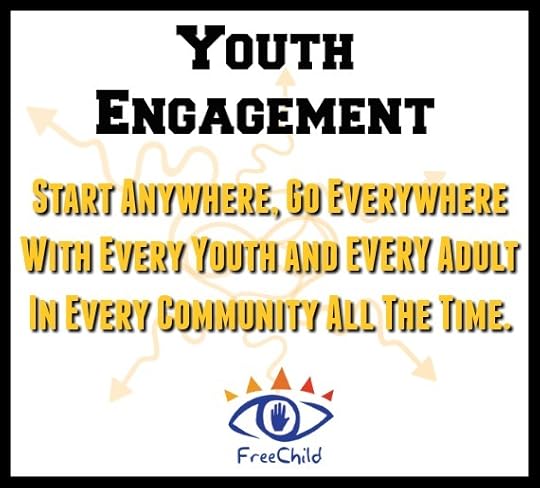 Youth Engagement: Start anywhere, go everywhere with every youth and every adult in every community all of the time.
In my writing, I often explore youth engagement as being necessary and urgent. What I’ve learned here is that in a kitchen—as in many jobs—urgency is the only gear. My coworkers, including dishwashers, a prep cook, and the servers, show a kind of leadership that is often “inconvenient” to traditional adult expectations and the ideas of well-meaning youth engagement practitioners. These young people aren’t waiting for a formal invitation or a special program or project to lead; they are managing complex environments and social dynamics in real-time while they earn the money they want and need for living.
Take the dishwasher, barely 18. In the professional world, some youth workers might label him “disengaged” because he isn’t sitting on a committee or prepping a report. But watching him navigate mountains of dishes and pots and silverware during a Friday night rush reveals a staggering level of personal youth engagement. He has a sustained connection to the world within himself just to survive the crush of work. He is “response-able,” and has built the stamina to meet the situation at hand with a grit that most executives would envy.
This type of pressure-cooker space isn’t ideal for youth workers to teach about engagement or encouraging young people to reflect, but its a real place where it happens all the time—just like a lot of the work youth are hired to do everyday.
The Structural Engagement Gap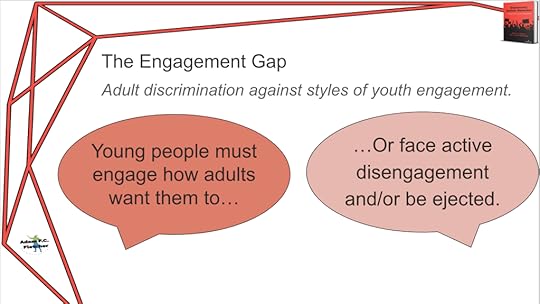 This is a model of the Engagement Gap between youth and adults by Adam F.C. Fletcher as explained in Democracy Deficit Disorder: Learning Democracy With Young People with J. Cynthia McDermott (2023).
There is a massive gap in how we view the youth engagement of workers. Society routinely treats them as “receptacles” or “recipients”—labor meant to follow orders without question. That is plainly adultism at its most basic: the bias that assumes these young people lack the wisdom to contribute to the “important” decisions of the business, community, or their own lives.
However, when I apply my Cycle of Youth Engagement, the perspective shifts. If we truly listen to that prep cook, we find she understands station efficiency as well as anyone. When we validate her knowledge—not with a pat on the head, but with sincere feedback—we bridge the gap between “charity” and “solidarity.” At this job, authorization happens when she is given the “power-with” to author her own workflow rather than just complying with a rigid, top-down structure.
Rural Fluidity These are fields of canola in rural Alberta.
There’s another layer of complexity I want to acknowledge: Living in rural Alberta adds a layer of geographic divide to their lives. These youth face a lack of local opportunities, yet they stay here. For them, my sister’s restaurant isn’t just a paycheck; it’s a safe space where they build social capital and a real sense of belonging.
I see fluidity in action here every shift as my young coworkers move like water through the chaos of the service industry. They are “digitally fluent” and use the precious seconds of a break to maintain their interdependent webs of connection that the adults in the room can’t even see. Their engagement here is fluid—it is dynamic, immediate, and fiercely responsive to the world around them.
From “Youth Problems” to Community Solutions
Too often, I have heard adults in towns like this complain about “youth problems” like apathy or a lack of work ethic. But working alongside these people, I am reminded again and again that these aren’t “youth problems”; they are community challenges that we all face. When a server is stressed, it isn’t because she is “young and dramatic”—it’s because she is navigating toxic stress, economic instability, and a lot more, often without a safety net.
Deep engagement in these jobs means moving from tokenistic praise to equitable youth/adult partnerships. It requires the restaurant—as a structure—to acknowledge these youth as specialists in their roles. These aren’t “kids”; they are colleagues.
Everyday Jobs for Democracy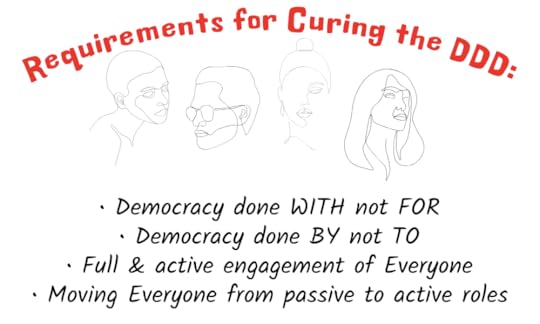 These are requirements for curing the democracy deficit disorder by Adam F.C. Fletcher (2024).
Democracy isn’t just about the voting box; it’s about mutual respect and collective action.
I’m learning here that every shift we work together is a lifelong journey of maturing and refining our ability to exist as a community. If we want to foster Modern Youth Leadership, we have to start by getting out of the way and letting these young people author their own roles.
My coworkers in this rural kitchen regularly remind me that Deep Youth Engagement isn’t an abstract idea for textbooks or academic articles. Instead, its the young man scrubbing pans until his knuckles are raw because he cares about the “public good” of a clean station. It is the server who mentors the new hire with humility and collaboration.
This work is all about contrasting values. It has reminded me that knowledge is earned, not given, and these young people are earning theirs every single day. They are the renewable energy source our society desperately needs—if only we are brave enough to let them be engaged, everywhere, all of the time.
Small BusinesspeopleAre you interested in supporting youth engagement, and you own a small business in a big city or a rural hamlet? Here’s a short assessment I made for you!
Does your business treat young staff as just order-takers or as real partners?How does age bias or adultism influence your daily management style?Do you share real, honest feedback on young workers’ unique ideas?Can young staff change their jobs to get things done in innovative ways?Is there a safe way for youth to hold adults accountable in your business?Answer these for yourself and talk about them with your young workers. If you want more info, contact me!
You Might Like…The Disengagement MachineA Short Guide to Holistic Youth DevelopmentDeep Youth EngagementTRANSFORMING THE ROLES OF YOUTH IN SOCIETY
Roles: Youth as Activists | Youth as Activity Leaders | Youth as Advisors | Youth as Advocates | Youth as Artists | Youth as Board Directors | Youth as Consumers | Youth as Decision Makers | Youth as Designers | Youth as Educators | Youth as Entrepreneurs | Youth as Evaluators | Youth as Facilitators | Youth as Farmers | Youth Forums | Youth as Grant-Makers | Youth as Lobbyists | Youth as Makers and Producers | Youth as Media Makers | Youth as Mediators | Youth as Mentors | Youth as Organizers | Youth as Planners | Youth as Policy-Makers | Youth as Politicians | Youth as Recruiters | Youth as Researchers | Youth as Specialists | Youth Summits | Youth as Teachers | Youth as Trainers | Youth as Volunteers | Youth as Voters | Youth as Workers | Youth Action Councils
Strategies: Adultism | Meaningful Student Involvement | Youth Rights | Student Voice | Youth Voice | Youth Engagement | Student Engagement | Youth Mainstreaming | Youth Integration | Youth e-Democracy | Modern Youth Leadership
Actions: Student Voice Movement | Meaningful Student Involvement Examples | Student-led Advocacy | Partnership Activities | Integration Strategies
More: Roles of Youth in Society | Make Obvious the Roles in Schools | Evolving Roles for Young People in Democracy | Video: Re-envisioning the Roles of Youth | Video: New Roles for Youth | Youth as Heroes | Youth as Sockpuppets
March 10, 2026
Adam F.C. Fletcher’s Intro to Youth Power In Vancouver, British Columbia
In 2001, I was a young man with a vision of engaging low-income young people in positive social change in my native Canada and in the United States where I was living. Invited to Vancouver to address the annual Grantmakers Forum on Community and National Service, I was working with allies to establish the Freechild Institute for Youth Engagement, and for a quarter century we worked worldwide to do just that. Vancouver inspired me to see those possibilities, and I carried the place in my heart for years.
Throughout my career, I have seen how the breadth of youth services can either empower young people as partners or relegate them to passive recipients of care. In Vancouver—a city defined by its immense diversity and its complex social fabric—the “youth services” sector is a sprawling ecosystem of government agencies, grassroots nonprofits, and school-based initiatives.
To understand youth services in Vancouver, I had to look past the surface-level programming and see the ecosystem of empowerment, advocacy, and support that defines the region. For consultants, educators, and agency leaders, navigating this landscape requires a map of who is doing the work and how they are engaging the next generation. Whether you are a young person, an educator, a government administrator, or a community advocate, understanding this landscape is the first step toward youth infusion, meaningful student involvement and growing democracy.
The Institutional Anchors[image error]Pexels.com" data-medium-file="https://adamfletcher.net/wp-content/u..." data-large-file="https://adamfletcher.net/wp-content/u..." width="1040" height="1300" src="https://adamfletcher.net/wp-content/u..." alt="Photo by Waqas Younis on Pexels.com" class="wp-image-203058" style="width:623px;height:auto" srcset="https://adamfletcher.net/wp-content/u... 1040w, https://adamfletcher.net/wp-content/u... 120w, https://adamfletcher.net/wp-content/u... 240w, https://adamfletcher.net/wp-content/u... 768w, https://adamfletcher.net/wp-content/u... 819w" sizes="(max-width: 1040px) 100vw, 1040px" />Like many major hubs, Vancouver’s formal youth strategy is anchored by municipal oversight. The City of Vancouver’s Youth Strategy and the Vancouver Board of Parks and Recreation provide the traditional framework for “services”—recreation, community centers, and basic programming.
However, the real engine of youth engagement in BC often lies within the non-governmental sector, where the focus shifts from providing services to youth to building power with them.
The 2026 landscape is shifting though. With the City of Vancouver’s 2026 Social Policy Grants now prioritizing “Core Support” for stabilization, we are seeing a move away from project-based whims toward institutionalizing the non-profit sector. Yet, the real engine of engagement often lies outside these halls.
Key Pillars in Vancouver’s Youth Ecology
From my perspective based on my mapping of the Southwest B.C. region, several organizations stand out as vital components of the local youth landscape:
Justice and Advocacy: Organizations like Justice for Girls lead the way in systemic advocacy, focusing on the specific needs of young women in poverty. This reflects a broader BC trend: a move toward rights-based approaches rather than just “charity” models.Civic Engagement and Innovation: CityHive has become a powerhouse in Vancouver for bridging the gap between youth and municipal governance. They are a prime example of what I call growing democracy in a community context—giving young people the tools to actually influence urban planning and public policy.Indigenous Youth Leadership: In Vancouver, any discussion of youth services is incomplete without recognizing the leadership of the Musqueam Youth Council and the Urban Native Youth Association (UNYA). These organizations don’t just provide services, they provide culturally grounded spaces for sovereignty and self-determination.Specialized Support and Belonging: From QMUNITY’s work with queer and trans youth to the Vancouver Youth Choir’s focus on artistic excellence, the city offers specialized hubs where identity and agency are intertwined.Economic Democracy: Solid State Community Industries in Surrey represents the most pragmatic end of social justice. By helping racialized youth build and own worker cooperatives, they move past simple job training towards economic sovereignty.Bridging the “Agency Gap”
Vancouver has a LOT of resources for young people, but the challenge for organizations here—as in Portland, Oregon and around the world—is moving up the ladder of youth engagement. Many agencies are stuck in the “consultation” phase: they ask youth for their opinions but rarely share the steering wheel.
For those of us working to transform these systems, the opportunity in Vancouver lies in:
Integrating Youth Voice into School Governance: Moving beyond the standard student council at the Vancouver School Board.Scaling Grassroots Models: Helping smaller, high-impact orgs like The Bloom Group institutionalize youth/adult partnerships.Decolonizing Funding: Supporting models like the McCreary Centre Society’s Youth Action Grants, which put actual dollars directly into the hands of youth-led projects.Conclusion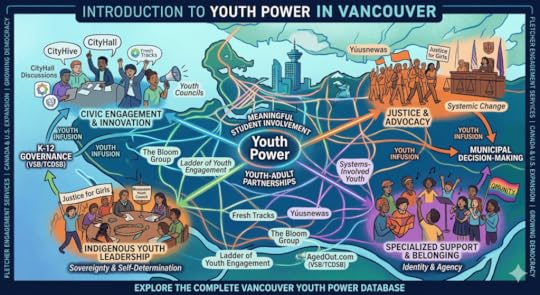
Vancouver is a city with the heart and the infrastructure to lead Canada in growing democracy through youth engagement. The database of services is deep, but the real work is in the connections between these services and the young people they serve.
Systemic Audits: I am an internationally recognized expert who can help determine where your organization sits on the “Ladder of Engagement.”Strategic Planning: I have worked with dozens of orgs to move youth from consultation to co-governance.Youth/Adult Partnership Training: I’m a fun, engaging facilitator dedicated to building the skills to “share the steering wheel.”As I expand my work into British Columbia, I am want to help YOU and your organizations move from doing for to doing with. Contact me to learn more!
Interested in seeing my entire Vancouver Youth Power Database with almost 125 organizations, programs and activities? Contact me for access! You Might Like…Vancouver Youth InsightsHome Again, for the First TimeAdam F.C. Fletcher’s Intro to Youth Services In Portland, OregonYouth Services Master ClassesABOUT FLETCHER ENGAGEMENT SERVICES
SERVICES: Consulting | Speaking | Writing | Workshops | Programs | Masterclasses
TOPICS: Youth Engagement | Meaningful Student Involvement | Personal Engagement | Hyperlocal History | Student Engagement | Youth Voice | Community Engagement | Unraveling Racism | Student Voice | Adultism | Democracy Deficit Disorder
CLIENTS: Sectors | Schools | Youth Services | Community Groups | Professional Orgs | Government Agencies | Families | Individuals | School Boards | Nonprofits
DETAILS: Bio | Bookstore | In The Media | Recommendations | Past Projects | Case Studies | Past Clients | Past Schools | Past Appearances | Videos | Articles | Bibliography
Contact Fletcher Engagement Services »
March 7, 2026
Quotes About Engagement
The following quotes are about engagement, working together, and the web of life to which we all belong. They help drive my work every single day.
”It really boils down to this: that all life is interrelated. We are all caught in an inescapable network of mutuality, tied into a single garment of destiny. Whatever affects one directly, affects all indirectly. We are made to live together because of the interrelated structure of reality… This is the way our universe is structured, this is its interrelated quality. We aren’t going to have peace on Earth until we recognize this basic fact of the interrelated structure of all reality.”
― Rev. Dr. Martin Luther King, Jr.
“If you have come to help me, you are wasting your time. If you have come to because your liberation is bound up in mine, we can work together.”
― Lilla Watson
“I don’t believe in charity. I believe in solidarity. Charity is vertical, so it’s humiliating. It goes from the top to the bottom. Solidarity is horizontal. It respects the other and learns from the other. I have a lot to learn from other people.”
― Eduardo Galeano
“Washing ones hands of the conflict between the powerful and the powerless means to side with the powerful, not to be neutral.”
― Paulo Freire
”I do not believe that I’m sacrificing. In fact, I feel very uneasy when others used the word sacrifice to describe my life. It sounds like I’m demanding returns for my investments. I chose to walk on this journey, because I solely believed in it and wholeheartedly decided to do so, and I’m willing and able to pay for the consequences…”
― Aung San Suu Kyi
“No man is an island entire of itself; every man is a piece of the continent, a part of the main; if a clod be washed away by the sea, Europe is the less, as well as if a promontory were, as well as a manor of thy friends or of thine own were; any man’s death diminishes me, because I am involved in mankind. And therefore never send to know for whom the bell tolls; it tolls for thee.”
― John Donne
“We cannot live for ourselves alone. Our lives are connected by a thousand invisible threads, and along these sympathetic fibers our actions run as causes and return to us as results.”
― Herman Melville
In the progress of personality, first comes a declaration of independence, then a recognition of interdependence.
― Henry Van Dyke
Interdependence is and ought to be as much the ideal of man as self-sufficiency. Man is a social being.
― Mohandas Gandhi
The least movement is of importance to all nature. The entire ocean is affected by a pebble.
― Blaise Pascal
All life is interrelated. All men are caught in an inescapable network of mutuality, tied in a single garment of destiny. Whatever affects one directly affects all indirectly.
― Dr. Martin Luther King, Jr.
“I want there to be a place in the world where people can engage in one another’s differences in a way that is redemptive, full of hope and possibility. Not this “In order to love you, I must make you something else”. That’s what domination is all about, that in order to be close to you, I must possess you, remake and recast you.”
― bell hooks
“Stories are webs, interconnected strand to strand, and you follow each story to the center, because the center is the end. Each person is a strand of the story.”
― Neil Gaiman
You Might Like…Quotes on CommunityQuotes about Critical PedagogyQuotes on YouthRecommendationsQuotes about Students on School Boards
I died from minerality and became vegetable
And from vegetativeness I died and became animal.
I died from animality and became man.
Then why fear disappearance through death?
Next time I shall die
Bringing forth wings and feathers like angels;
After that, soaring higher than angels
What you cannot imagine,
I shall be that.
— Rumi
ABOUT FLETCHER ENGAGEMENT SERVICES
SERVICES: Consulting | Speaking | Writing | Workshops | Programs | Masterclasses
TOPICS: Youth Engagement | Meaningful Student Involvement | Personal Engagement | Hyperlocal History | Student Engagement | Youth Voice | Community Engagement | Unraveling Racism | Student Voice | Adultism | Democracy Deficit Disorder
CLIENTS: Sectors | Schools | Youth Services | Community Groups | Professional Orgs | Government Agencies | Families | Individuals | School Boards | Nonprofits
DETAILS: Bio | Bookstore | In The Media | Recommendations | Past Projects | Case Studies | Past Clients | Past Schools | Past Appearances | Videos | Articles | Bibliography
Contact Fletcher Engagement Services »