Roger Whitson's Blog
March 22, 2024
Proposal for ASAP ’15: Media are Time Machines
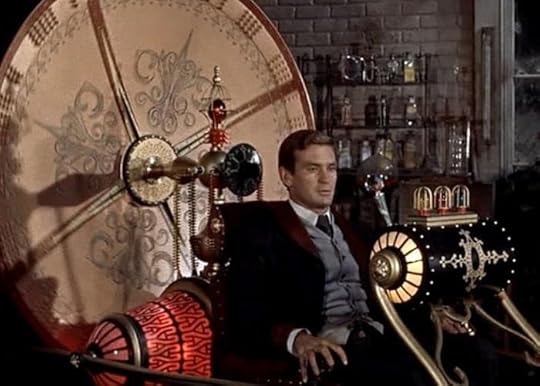
In his history of the time-travel genre as a “narratological laboratory,” David Wittenberg curiously argues that H.G. Wells’s The Time Machine articulates time by referencing the cinema: “the mere press of a lever accomplishes the task of advancing, reversing, or modulating temporal movement, as it would, for instance, in a kinetoscope, a protocinematic device with which Wells was very familiar” (86). The parallel between media and time machine is invoked in the field of media archaeolog...


October 26, 2023
SLSA 2023, Presentation 2 of 2
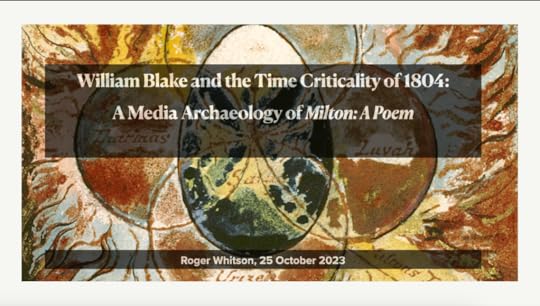
During their move to Felpham in 1800, the Blakes noted that among their luggage were “Sixteen heavy boxes & portfolios full of prints.” Biographer G.E. Bentley provides an expanded inventory of the “worldly goods” they brought with them:
Blake’s library; his notebooks, sketches, manuscripts such as An Island on the Moon, Tiriel, and Vala; watercolors; the proof copy of The French Revolution and the remaining copies of Poetical Sketches (at least fifteen); his copperplates and copies of h...
October 22, 2023
SLSA 2023, Presentation 1 of 2
[Slide 1] Much of this talk is a preliminary reflection on a project I’m currently in the process of conceptualizing. I caused a bit of a stir in 2013 at the National Association for the Study of Romanticism (NASSR) when I admitted that I had never gazed upon one of Blake’s original works. It felt like a scandal. I signed up for the “Blake printing workshop” put on for NASSR 2023 by William Brewer, Alexander Reiger, and Thora Brylowe at Rice University’s Fondren Library in order to gain a more t...
August 19, 2023
AI / ChatGPT policy – First Draft
The use of artificial intelligence in writing is dramatically changing higher education. As someone who studies the impact of computing on literature, I am particularly aware that the writing process — as we’ve known it since at least the invention of the printing press — is changing forever. Many of my colleagues are concerned about the possibility for cheating among students, but it’s worth recognizing that these concerns are part of larger historical transformations that won’t go away any tim...
August 14, 2023
Fall 2023 English Department Capstone: Time and Time Travel in Science Fiction
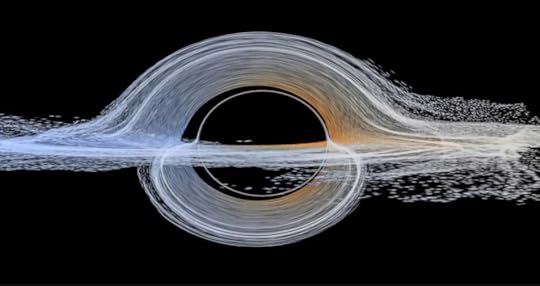
Kip Thorne’s 2015 illustration of the effects of quantum gravity.
Catalog Description[CAPS] [M] Advanced Topics in Literature 3 May be repeated for credit; cumulative maximum 6 hours. Course Prerequisite: Certified major in English; junior standing. Seminar with term paper project; focused studies in American, British, or global literatures.
Course DescriptionLewis Mumford argues in Technics and Civilization that “[t]he clock, not the steam engine, is the key machine of the mod...
April 7, 2023
2023 ASAP-14 Proposal: “Is the future already dated? Streaming and Fugitive Temporalities in William Gibson’s The Peripheral”
This is my abstract proposal for the 2023 conference of The Association for the Study of the Arts of the Present, titled “Arts of Fugitivity,” occurring in Seattle WA on 4-7 October 2023.
A 2019 New Yorker profile William Gibson acknowledged that he had to rewrite the ending of his novel Agency several times due to the outcome of the 2016 election and Trump’s nuclear standoff with North Korea. Gibson’s attempt to forecast a dystopian future had been superseded by our own present dystopia that...
January 7, 2023
ENGL/DTC 561: Media Archaeologies,Operative Images, and Extractive Ecologies
Course Description
ENGL 561 Studies in Technology and Culture: Examination of key concepts, tools, and possibilities afforded by engaging with technology through a critical cultural lens. (Crosslisted course offered as DTC 561, ENGLISH 561).
This course will act as an introduction to the multidisciplinary field of media archaeology, which studies the residual forms and practices of media as a critique of contemporary media culture. Focusing particularly on quirks, accidents and haphazard inven...
October 12, 2022
Graduate Course Proposal for 2023-2024: Science Fiction and Time-Critical Media
Lewis Mumford argues in Technics and Civilization that “[t]he clock, not the steam engine, is the key machine of the modern industrial age.” From deep time to time synchronization, computer timing to urban acceleration — the history of modernity is characterized by a multiplication of what Axel Volmar and Kyle Stine call temporal infrastructures. Temporal infrastructures are assemblages of practices, technologies, institutions, and ecologies that manage, capitalize, and operationalize time. ...
Spring 2023 Graduate Course on Media Archaeology
ENGL 561: Studies in Technology and Culture: Media Archaeology
This course will act as an introduction to the multidisciplinary field of media archaeology, which studies the residual forms and practices of media as a critique of contemporary media culture. Focusing particularly on quirks, accidents, and haphazard inventions, media archaeology imagines alternate histories and futures of technology. Additionally, it combines these cultural histories of technology with a focus on the media opera...
June 18, 2021
Review: Phil Wegner, Invoking Hope: Theory and Utopia in Dark Times
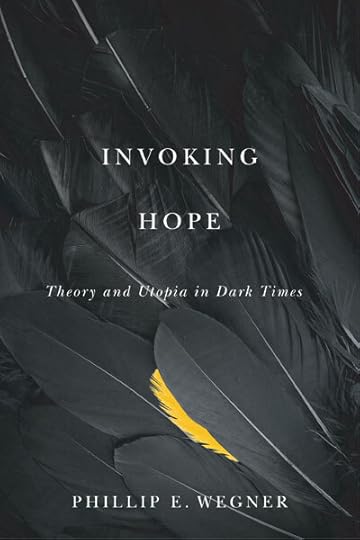 Cover of Philip E. Wegner’s
 Invoking Hope: Theory and Utopia in Dark Times
(U Minnesota Press, 2020)
As I was finishing my reading of Phil Wegner’s Invoking Hope: Theory and Utopia in Dark Times, I watched Thomas Vinterberg’s film Druk (2020). The Danish title literally refers to “binge drinking” but, due to the moralistic context of the phrase in English, is translated for American audiences as Another Round. Druk features Mads Mikkelsen as a middle-aged history teacher named Martin who once...