
Shuvom Ghose's Blog
June 14, 2014
The moment every budding author dreams of- their book in their hands!
The coolest thing happened Friday.
For the last few weeks, my wife has been involved in a secret endeavor, behind my back, and when I came home early, I discovered this on my dining room table:
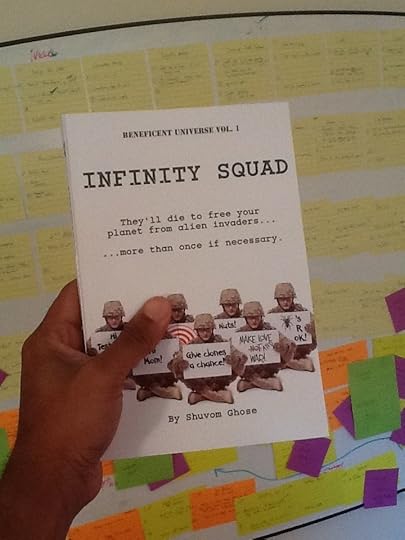
She had edited, formatted, and had 5 copies of my ebook printed without me knowing it!
On my bucket list was to see a copy of something I wrote on my bookshelf, and she made it happen!
All you aspiring authors out there, thing about having the same exhilarating moment yourself, and then get back to writing!
For the last few weeks, my wife has been involved in a secret endeavor, behind my back, and when I came home early, I discovered this on my dining room table:
She had edited, formatted, and had 5 copies of my ebook printed without me knowing it!
On my bucket list was to see a copy of something I wrote on my bookshelf, and she made it happen!
All you aspiring authors out there, thing about having the same exhilarating moment yourself, and then get back to writing!


May 11, 2014
Infinity Squad 2 has a cover!
After many rejected ideas and much research on http://lousybookcovers.tumblr.com/, I've finally managed to create a cover for Infinity Squad 2:
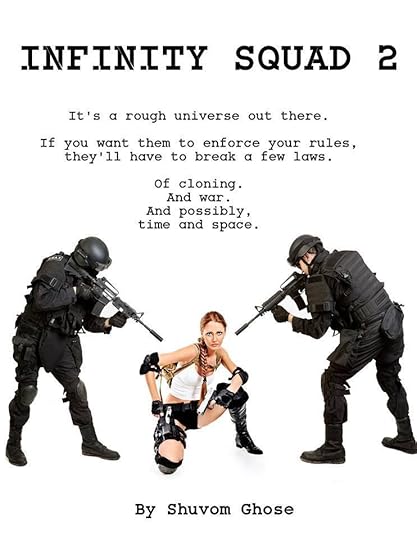
Or something like that.
The second draft is finished, but there is a lot more work to do, making sure the story is as tight as possible and worthy, because this is the only sequel I will ever EVER write. (Of any series. My comments on why all book and movie sequels are not worth writing later.)
Still track for a July 2014 release, hoping I can move it up to June 2014!
Or something like that.
The second draft is finished, but there is a lot more work to do, making sure the story is as tight as possible and worthy, because this is the only sequel I will ever EVER write. (Of any series. My comments on why all book and movie sequels are not worth writing later.)
Still track for a July 2014 release, hoping I can move it up to June 2014!
December 31, 2013
Blame NanoWrimo for Infinity Squad 2
Thank you for everyone who's been reading, reviewing and telling their friends about Infinity Squad these last few months.
I haven't forgotten about my pledge and over this year I've been slowly carving "Infinity Squad 2: The Quest for More Squad" out of the rock. But I needed something to get me over the hump, some sort of deadline, even an artificial one.
My wife and writers group were doing National Novel Writing Month, or NanoWrimo, a nation-wide quest somewhat like National Breast Cancer Awareness month, except the goal is to write all of a 50,000 word novel in just November. (The amount of breast awareness is about the same in both activities.)
With the NanoWrimo deadlines looming, I put butt in chair and finally finished the first draft of Infinity Squad 2!
Which was 180,000 words long.
For reference, Infinity Squad 1 was 100,000 words long. Which is a normal, light, fun fast novel length.
So for the last few weeks I've been editing and trying to decide: do I break it into two parts and leave you folks on a cliffhanger at the end of 2, or do I cut the heart out of the work so it can be the length everyone loved the first time around? Or do I release two versions, a short "Studio Cut" and a longer "Director's Cut"? It's an ebook, there's no production cost to making two versions beyond my time.
Just like Lieutenant Forrest, I choose none of the available options. You guys are getting all of the storylines and all of the action, probably edited down to 150,000 words when I'm done, but I'm not going to cliffhang you or leave half the book out.
Look for Infinity Squad 2 to come out around July 4th of 2014! At which point Infinity Squad 1 will go free on Amazon to promote it! (Unless the Baen slush pile readers I met at DragonCon this year pull IF1 from purgatory and make me an offer I can't refuse.)
Stay frosty my friends,
Shuvom
I haven't forgotten about my pledge and over this year I've been slowly carving "Infinity Squad 2: The Quest for More Squad" out of the rock. But I needed something to get me over the hump, some sort of deadline, even an artificial one.
My wife and writers group were doing National Novel Writing Month, or NanoWrimo, a nation-wide quest somewhat like National Breast Cancer Awareness month, except the goal is to write all of a 50,000 word novel in just November. (The amount of breast awareness is about the same in both activities.)
With the NanoWrimo deadlines looming, I put butt in chair and finally finished the first draft of Infinity Squad 2!
Which was 180,000 words long.
For reference, Infinity Squad 1 was 100,000 words long. Which is a normal, light, fun fast novel length.
So for the last few weeks I've been editing and trying to decide: do I break it into two parts and leave you folks on a cliffhanger at the end of 2, or do I cut the heart out of the work so it can be the length everyone loved the first time around? Or do I release two versions, a short "Studio Cut" and a longer "Director's Cut"? It's an ebook, there's no production cost to making two versions beyond my time.
Just like Lieutenant Forrest, I choose none of the available options. You guys are getting all of the storylines and all of the action, probably edited down to 150,000 words when I'm done, but I'm not going to cliffhang you or leave half the book out.
Look for Infinity Squad 2 to come out around July 4th of 2014! At which point Infinity Squad 1 will go free on Amazon to promote it! (Unless the Baen slush pile readers I met at DragonCon this year pull IF1 from purgatory and make me an offer I can't refuse.)
Stay frosty my friends,
Shuvom
March 3, 2013
Finish writing your novel- three times!
So as I'm writing the sequel to Infinity Squad (still due out July 4th, 2013!) I'm listening to a lot of writing and movie podcasts to improve my craft. One thing I'm recognizing as a common theme is how many drafts great work takes to complete.
Not good work. That can have a first draft, then a second to catch errors and tighten things up, and then fly out the door. And be an okay story.
But great books and movies seem to have this in common: many more revision drafts than you would expect. "Wreck-It Ralph", an animated movie with defined characters, good pacing and in which EVERYTHING introduced pays off, went through 7 drafts at Disney.
Not 7 re-writings of the paper script, but 7 complete writings, filmings, editings, and audience screening cycles. And it's animated, so the famous voice actors had to come back many, many times. And the co-writers were saying how some of the most important story elements (the main villain, for ex.) didn't find their voice until the 5-6th revision.
Compare that to "Skyfall", a horrible blotch on the James Bond reboot franchise, with pointless and flip-flopping characters, a stupid plot, and in which NOTHING pays off. I don't even think the director watched the movie a second time, because he would have said "Oh crap- that doesn't work!"
One of the best first fantasy novels in decades, "The Name of the Wind" took Patrick Rothfuss 10 years to write. Not be cause he's slow. But because he wanted to make sure every thread carried weight, arced, and paid off. And it did. And even though people are beating down his door for the last book in that trilogy, he's taking his time, like a master BBQ chef slow-cooking ribs.
Finally, I read an advice book with a chapter titled "Why does the printer always break the night before the big presentation?" Spoiler Alert: because you're trying to print out your handout for the first time at 10 PM the night before your presentation. The advice book says, instead of that, why not budget time to finish your handout three times, printing it out each time. Then you can get feedback, think of ways to improve it, and F$%$#ing NOTICE THAT XAVIER BARDEM COULD HAVE KILLED M AT ANY TIME, HE DIDN'T NEED THE MOST POINTLESS PLOT IN ANY BOND MOVIE TO DO IT.
Ahem. And anyway, if the printer DOES break down the night before the presentation, you've still got revision 2 of your handout, which is better than showing up with revision 0 because you were out of ink.
This parallels what we teach our engineering design customers (when I take off the writing cape and become 9-5 Clark Kent) designing new products: First revision, then one entire design cycle to improve manufacturability, then another whole cycle to reduce costs, etc. That way, when you're suddenly reassigned to a new project or slammed against a new deadline (as you always are), every part in the model has been looked at not just once, but many times, by many different eyes.
Anyway, time to go write. But think about this as you're completing your OWN novels: budget time to go through it at least 3 times, and look to improve a different story angle each time. You'll make better work. And maybe not have SKYFALL BE JUST THE NAME OF HIS STUPID HOUSE THAT HE DOESN'T LIVE AT, DOESN'T LIKE, AND THAT HE BURNS DOWN WITHOUT BATTING AN EYELASH ANYWAY.
Oh, did I just spoil that movie? No. The writers spoiled it. The writers spoiled it.
Not good work. That can have a first draft, then a second to catch errors and tighten things up, and then fly out the door. And be an okay story.
But great books and movies seem to have this in common: many more revision drafts than you would expect. "Wreck-It Ralph", an animated movie with defined characters, good pacing and in which EVERYTHING introduced pays off, went through 7 drafts at Disney.
Not 7 re-writings of the paper script, but 7 complete writings, filmings, editings, and audience screening cycles. And it's animated, so the famous voice actors had to come back many, many times. And the co-writers were saying how some of the most important story elements (the main villain, for ex.) didn't find their voice until the 5-6th revision.
Compare that to "Skyfall", a horrible blotch on the James Bond reboot franchise, with pointless and flip-flopping characters, a stupid plot, and in which NOTHING pays off. I don't even think the director watched the movie a second time, because he would have said "Oh crap- that doesn't work!"
One of the best first fantasy novels in decades, "The Name of the Wind" took Patrick Rothfuss 10 years to write. Not be cause he's slow. But because he wanted to make sure every thread carried weight, arced, and paid off. And it did. And even though people are beating down his door for the last book in that trilogy, he's taking his time, like a master BBQ chef slow-cooking ribs.
Finally, I read an advice book with a chapter titled "Why does the printer always break the night before the big presentation?" Spoiler Alert: because you're trying to print out your handout for the first time at 10 PM the night before your presentation. The advice book says, instead of that, why not budget time to finish your handout three times, printing it out each time. Then you can get feedback, think of ways to improve it, and F$%$#ing NOTICE THAT XAVIER BARDEM COULD HAVE KILLED M AT ANY TIME, HE DIDN'T NEED THE MOST POINTLESS PLOT IN ANY BOND MOVIE TO DO IT.
Ahem. And anyway, if the printer DOES break down the night before the presentation, you've still got revision 2 of your handout, which is better than showing up with revision 0 because you were out of ink.
This parallels what we teach our engineering design customers (when I take off the writing cape and become 9-5 Clark Kent) designing new products: First revision, then one entire design cycle to improve manufacturability, then another whole cycle to reduce costs, etc. That way, when you're suddenly reassigned to a new project or slammed against a new deadline (as you always are), every part in the model has been looked at not just once, but many times, by many different eyes.
Anyway, time to go write. But think about this as you're completing your OWN novels: budget time to go through it at least 3 times, and look to improve a different story angle each time. You'll make better work. And maybe not have SKYFALL BE JUST THE NAME OF HIS STUPID HOUSE THAT HE DOESN'T LIVE AT, DOESN'T LIKE, AND THAT HE BURNS DOWN WITHOUT BATTING AN EYELASH ANYWAY.
Oh, did I just spoil that movie? No. The writers spoiled it. The writers spoiled it.
January 27, 2013
Come see an indie author get booed - LIVE!
For anyone in the Boston area who wants to see an indie author embarrass himself by reading the first chapter of his book to a crowd that will hate it- you're in luck!
"Infinity Squad" is a military science fiction book with lots of innuendo, swearing, wisecracking, and action.
The author event I just got invited to might possibly be an older, wine-and-books, NPR-guns-are-evil, type of crowd. If that's true, they, besides Catholic nuns, might be the farthest from my target demographic as humanly possible. But I'm still going to read my first chapter to them with the same enthusiasm and energy as if I was addressing a crowd of rapt 14-30 year old sci-fi nerds.
It might be a wonderful train wreck. And you can come and watch.
It's on Sunday Feb 10th, (one week after Superbowl Sunday), starting at 3 PM at the Moska restaurant in Cambridge MA:
http://www.moksarestaurant.com/
I'll be there signing printouts of my cover since indie authors can't afford print books and enduring the hate from people who came expecting poetry about flowers and got me instead.
Come say hello if you dare!
EDIT- okay, so the 8 feet of snow we got has delayed this event for now. Watch this space for updates.
DOUBLE EDIT- okay, so this was REscheduled for Sunday Feb. 24th, but since we're expecting a snowpocalyspe AGAIN, this has been rescheduled by the book club to INFINITY PLUS ONE days away. That's okay, when this finally does happen, I'll have the sequel ready to promote!
"Infinity Squad" is a military science fiction book with lots of innuendo, swearing, wisecracking, and action.
The author event I just got invited to might possibly be an older, wine-and-books, NPR-guns-are-evil, type of crowd. If that's true, they, besides Catholic nuns, might be the farthest from my target demographic as humanly possible. But I'm still going to read my first chapter to them with the same enthusiasm and energy as if I was addressing a crowd of rapt 14-30 year old sci-fi nerds.
It might be a wonderful train wreck. And you can come and watch.
It's on Sunday Feb 10th, (one week after Superbowl Sunday), starting at 3 PM at the Moska restaurant in Cambridge MA:
http://www.moksarestaurant.com/
I'll be there signing printouts of my cover since indie authors can't afford print books and enduring the hate from people who came expecting poetry about flowers and got me instead.
Come say hello if you dare!
EDIT- okay, so the 8 feet of snow we got has delayed this event for now. Watch this space for updates.
DOUBLE EDIT- okay, so this was REscheduled for Sunday Feb. 24th, but since we're expecting a snowpocalyspe AGAIN, this has been rescheduled by the book club to INFINITY PLUS ONE days away. That's okay, when this finally does happen, I'll have the sequel ready to promote!
December 28, 2012
"Use humor!" he said!
So as I'm diligently writing the sequel to Infinity Squad, I'm struck again and again how powerful humor is versus other story elements.
Most "Doctor Who" episodes contain ridiculous plot holes and the most flimsy scenarios, but my wife and I keep watching, as long as the Doctor's antics and quips keep coming. I wasn't going to watch the movie "Lockout", but the first 30 seconds captured the wry humor of the main character so perfectly, I was hooked. And the book "John Dies at the End" is completely full of puzzling horror mash-ups and pacing problems, but the prologue is SO DAMN FUNNY, I had to keep going. (The end was pretty darn funny too. As were parts of the middles.)
My point is, humor lets you get away with a lot. It covers up a lot of defects in writing, like the love child of duct tape and super drywall putty. (Try to unpicture THAT conception now.) It makes ads or movies seem 'cool', it makes people think the author is smart, it almost instantly makes your characters likeable (see: Guy Pearce in "Lockout") and it's a crutch and spice for your story almost second to none.
So why don't more authors use it?
To be sure, humor clashes with the theme of some works. Would have probably been out of place in "Schindler's List". But even a little bit of it would have saved so many doomed sci-fi shows and books. "Revolution", that Fox show about time- travelling back to dinosaur times, "Green Lantern"... any of these things could have been the next "Firefly". They definitely had WAY more budget. Why didn't they use humor like "Firefly" did and make audiences LOVE their characters and into rabid fans?
Because humor is hard.
It's harder than finding sexy actors to play your leading roles, it's harder than making special effects, and when you're writing a book, unless you've got a good, honest, writer's group reviewing your work and giving detailed feedback, it's the absolute hardest thing to write that there is.
There's almost no formula for it, there are damn few public theories on how it works, and it is more of a 'sense' than a skill you can learn. Now I'm going to spend the rest of this article disproving that last sentence.
Someone once said: "Humor is when something bad happens to someone else." I don't know who said that. I'm not your damn Google machine. But this pain+distance formula has been used in every Bugs Bunny cartoon, Three Stooges episode and nut-shot video I can remember. Yes, it's the lowest form of humor, but keep that in mind as we go higher.
Dilbert creator Scott Adams, in his book "The Joy of Work" (of all things) gave me my first scientific blueprint for humor that worked. Scott, if I can call him Scott, said that a joke works if you can combine at least two of the following elements: Cuteness, Meanness, Bizarreness, Recognizability, Naughtiness or Cleverness. (I remember this by saying: C-M-B, R-N-C.)
So a strong guy punching a tied down, captured guy in the mouth is just Mean. Not funny. But if the tied down guy, after the first punch, spits out blood and says "You just slammed me as hard as I slammed your wife in bed last night", that gets a little chuckle. Slamming another guy's wife is a little Naughty. Second element.
If the interrogator punches the captive again, and then the captive spits out a tooth and says, "Wait! Wait! I'll tell you what you want to know about the CIA microfish! Speaking of fish... how's your wife doing-" PUNCH! That's a little Clever. Third element. And by this point, 10 seconds into the movie "Lockout", I was rolling in laughter.
(The fish joke I just made up because I can't be bothered to Netflix the first minute of the movie again, but the actual line was a lot funnier, and delivered perfectly by Guy Pearce in between brutal punches. Seriously, check it out.)
But the C-M-B, R-N-C framework gives us at least SOMEWAY to judge if a written joke will work. Scott Adams says the reason half the mean stuff Dogbert does is funny because Dogbert is a cute little dog with glasses. Cute plus Mean. Two elements. And if the Meanness is some stupid Recognizable ISO process from your work too, that's three elements. Half the jokes on "South Park" work because they're being delivered by 4th graders. Cute. If they're Naughty poop or sex jokes, or Recognizable satire, there you go. All the jokes in "The Onion" work because the articles are written in Recognizable newspaper format and have Bizarre premises. Some use Naughty swear words. But you get the point.
I was going to talk about the other overpowerful element of writing, Dialogue, but I've actually got to go write now, so we'll leave that for later. But for now, pick up a copy of "Joy of Work" just for the humor theory in the middle of it (the only one I've ever seen), and if you're having trouble getting readers to like your main characters, why not try giving them a hot ass then making them a smart ass or a dumb ass and see if your beta-readers don't start laughing their butts off!
Oh shit. I should have said 'ass' instead of 'butts'. Ah well, too late to change it now.
Laterz.
Most "Doctor Who" episodes contain ridiculous plot holes and the most flimsy scenarios, but my wife and I keep watching, as long as the Doctor's antics and quips keep coming. I wasn't going to watch the movie "Lockout", but the first 30 seconds captured the wry humor of the main character so perfectly, I was hooked. And the book "John Dies at the End" is completely full of puzzling horror mash-ups and pacing problems, but the prologue is SO DAMN FUNNY, I had to keep going. (The end was pretty darn funny too. As were parts of the middles.)
My point is, humor lets you get away with a lot. It covers up a lot of defects in writing, like the love child of duct tape and super drywall putty. (Try to unpicture THAT conception now.) It makes ads or movies seem 'cool', it makes people think the author is smart, it almost instantly makes your characters likeable (see: Guy Pearce in "Lockout") and it's a crutch and spice for your story almost second to none.
So why don't more authors use it?
To be sure, humor clashes with the theme of some works. Would have probably been out of place in "Schindler's List". But even a little bit of it would have saved so many doomed sci-fi shows and books. "Revolution", that Fox show about time- travelling back to dinosaur times, "Green Lantern"... any of these things could have been the next "Firefly". They definitely had WAY more budget. Why didn't they use humor like "Firefly" did and make audiences LOVE their characters and into rabid fans?
Because humor is hard.
It's harder than finding sexy actors to play your leading roles, it's harder than making special effects, and when you're writing a book, unless you've got a good, honest, writer's group reviewing your work and giving detailed feedback, it's the absolute hardest thing to write that there is.
There's almost no formula for it, there are damn few public theories on how it works, and it is more of a 'sense' than a skill you can learn. Now I'm going to spend the rest of this article disproving that last sentence.
Someone once said: "Humor is when something bad happens to someone else." I don't know who said that. I'm not your damn Google machine. But this pain+distance formula has been used in every Bugs Bunny cartoon, Three Stooges episode and nut-shot video I can remember. Yes, it's the lowest form of humor, but keep that in mind as we go higher.
Dilbert creator Scott Adams, in his book "The Joy of Work" (of all things) gave me my first scientific blueprint for humor that worked. Scott, if I can call him Scott, said that a joke works if you can combine at least two of the following elements: Cuteness, Meanness, Bizarreness, Recognizability, Naughtiness or Cleverness. (I remember this by saying: C-M-B, R-N-C.)
So a strong guy punching a tied down, captured guy in the mouth is just Mean. Not funny. But if the tied down guy, after the first punch, spits out blood and says "You just slammed me as hard as I slammed your wife in bed last night", that gets a little chuckle. Slamming another guy's wife is a little Naughty. Second element.
If the interrogator punches the captive again, and then the captive spits out a tooth and says, "Wait! Wait! I'll tell you what you want to know about the CIA microfish! Speaking of fish... how's your wife doing-" PUNCH! That's a little Clever. Third element. And by this point, 10 seconds into the movie "Lockout", I was rolling in laughter.
(The fish joke I just made up because I can't be bothered to Netflix the first minute of the movie again, but the actual line was a lot funnier, and delivered perfectly by Guy Pearce in between brutal punches. Seriously, check it out.)
But the C-M-B, R-N-C framework gives us at least SOMEWAY to judge if a written joke will work. Scott Adams says the reason half the mean stuff Dogbert does is funny because Dogbert is a cute little dog with glasses. Cute plus Mean. Two elements. And if the Meanness is some stupid Recognizable ISO process from your work too, that's three elements. Half the jokes on "South Park" work because they're being delivered by 4th graders. Cute. If they're Naughty poop or sex jokes, or Recognizable satire, there you go. All the jokes in "The Onion" work because the articles are written in Recognizable newspaper format and have Bizarre premises. Some use Naughty swear words. But you get the point.
I was going to talk about the other overpowerful element of writing, Dialogue, but I've actually got to go write now, so we'll leave that for later. But for now, pick up a copy of "Joy of Work" just for the humor theory in the middle of it (the only one I've ever seen), and if you're having trouble getting readers to like your main characters, why not try giving them a hot ass then making them a smart ass or a dumb ass and see if your beta-readers don't start laughing their butts off!
Oh shit. I should have said 'ass' instead of 'butts'. Ah well, too late to change it now.
Laterz.
November 23, 2012
What is a sequel?
So I like listening to podcasts about bad movies while I'm moving my wood (not a euphemism, we have an actual woodstove and it needs to feed in the winter). Bad movie podcasts, because I think we learn more about the craft of storytelling listening to fans trying to comprehend why something went horribly wrong than when it went right.
This was a podcast about Men in Black II, and the reviewers spun into a debate about the "purpose" of a sequel. There were two schools of thought, which I'll go into here because I've got a few minutes before the next episode of Dexter. (And because I care. Awwwww.)
First school: sequels exist to further the story started in the first installment. The main characters go further down the path they already were, discover new things about themselves, change in meaningful ways, and experience very different things than they did in the first adventure. This school of thought is called: "How to piss off fanboys and receive hate on the internet."
Second school: sequels exist to put the main characters in exactly the same situation as the original adventure, only with the names and circumstances changed just enough to make it not a carbon copy. This school is called: "How to make scads of money in Hollywood."
Because, come on. If James Bond X+1 didn't feature him defeating another hammy supervillan using another ridiculous gadget somehow perfectly suited to the situation that no one could see coming and then sleep with model X+1 which has different hair color but same body type as model X, we'd burn the studio down. If we really wanted Bond to grow and change, by movie four he'd be giving up on the whole agent thing and exploring other life choices like helping inner-city kids win a dance competition and then we'd REALLY burn the studio down. On the internet. And I'm a Bond fan.
Same for each new X-Men movie, or sequel to that long-running detective series you really love, or police procedural your parents enjoy watching on CBS. Fans want to spend more time with the characters they love in the exact type of situations they first loved them in.
But that nagging pain you and I are getting in the back of our heads right now isn't a hangover (well, not for one of us, anyway) but our Artistic Conscience trying to tell us something.
Putting the exact same characters in the exact same situation as your last hit with just the names slightly changed feels hacky. It feels lazy. It's bad art. It's bad for you.
This is the debate the podcast was having about Men In Black II. Once again, (and AGAIN in MIB III, which had just come out) the Will Smith character was a new-comer in shock at the crazy antics the MIB group got in to, and once again the Tommy Lee Jones character was the wise, grizzled veteran who had seen it all, even though he had his memory completely wiped in the previous installment.
Why couldn't Will Smith be the wise one, paired with an equally wise partner and go on a different type of adventure which didn't involve being stunned by the 'crazy' alien hi-jinks around him? BECAUSE THAT WASN'T WHAT MADE THE FIRST MOVIE SUCCESSFUL AND IT SCARES MOVIE EXECUTIVES TO DEVIATE.
This is the debate I'm having WITH MYSELF while writing the sequel to Infinity Squad. The first book featured lots of small-scale infantry missions against vicious but dumb alien animals of increasing ferocity in different climates of an alien planet. The second book seems like it will feature mainly fleet-level ship-to-ship action against plotting, sentient opponents in the unchanging vacuum of space. Because it would be crazy for the Squad to somehow get dropped on ANOTHER untamed alien planet to battle ANOTHER set of increasingly ferocious monsters while they question how their resurrection technology works, again. That'd just be silly.
But that also means the second book will have almost none of the set pieces that were the enjoyable "action bits" of the first book. And that makes me pause.
The characters remember what happened in the first book; they're now interacting with each other in different ways. They've changed. Their universe has changed. But I'm the same. Basically. And so are all thirteen fans of the first book. (Except you, Steve. Mazel Tov!)
So, should I find ways to shoe-horn in adventures like old? Should I have the characters fall back into the same comfortable patterns of interaction? Same adventures, with the names changed?
Probably not. As before, I'm going to write a book that I'd want to read, and if the second book turns out to be a completely different type of book than the original, I guess that's just what a sequel is.
Oh, crap- Dexter's on! I wonder what villian which says-"We're so alike you and I, Dexter" he'll defeat this season while almost-but-not-quite getting caught by his sister and the police while questioning if he really is a Monster!
Over and out,
Shuvom
This was a podcast about Men in Black II, and the reviewers spun into a debate about the "purpose" of a sequel. There were two schools of thought, which I'll go into here because I've got a few minutes before the next episode of Dexter. (And because I care. Awwwww.)
First school: sequels exist to further the story started in the first installment. The main characters go further down the path they already were, discover new things about themselves, change in meaningful ways, and experience very different things than they did in the first adventure. This school of thought is called: "How to piss off fanboys and receive hate on the internet."
Second school: sequels exist to put the main characters in exactly the same situation as the original adventure, only with the names and circumstances changed just enough to make it not a carbon copy. This school is called: "How to make scads of money in Hollywood."
Because, come on. If James Bond X+1 didn't feature him defeating another hammy supervillan using another ridiculous gadget somehow perfectly suited to the situation that no one could see coming and then sleep with model X+1 which has different hair color but same body type as model X, we'd burn the studio down. If we really wanted Bond to grow and change, by movie four he'd be giving up on the whole agent thing and exploring other life choices like helping inner-city kids win a dance competition and then we'd REALLY burn the studio down. On the internet. And I'm a Bond fan.
Same for each new X-Men movie, or sequel to that long-running detective series you really love, or police procedural your parents enjoy watching on CBS. Fans want to spend more time with the characters they love in the exact type of situations they first loved them in.
But that nagging pain you and I are getting in the back of our heads right now isn't a hangover (well, not for one of us, anyway) but our Artistic Conscience trying to tell us something.
Putting the exact same characters in the exact same situation as your last hit with just the names slightly changed feels hacky. It feels lazy. It's bad art. It's bad for you.
This is the debate the podcast was having about Men In Black II. Once again, (and AGAIN in MIB III, which had just come out) the Will Smith character was a new-comer in shock at the crazy antics the MIB group got in to, and once again the Tommy Lee Jones character was the wise, grizzled veteran who had seen it all, even though he had his memory completely wiped in the previous installment.
Why couldn't Will Smith be the wise one, paired with an equally wise partner and go on a different type of adventure which didn't involve being stunned by the 'crazy' alien hi-jinks around him? BECAUSE THAT WASN'T WHAT MADE THE FIRST MOVIE SUCCESSFUL AND IT SCARES MOVIE EXECUTIVES TO DEVIATE.
This is the debate I'm having WITH MYSELF while writing the sequel to Infinity Squad. The first book featured lots of small-scale infantry missions against vicious but dumb alien animals of increasing ferocity in different climates of an alien planet. The second book seems like it will feature mainly fleet-level ship-to-ship action against plotting, sentient opponents in the unchanging vacuum of space. Because it would be crazy for the Squad to somehow get dropped on ANOTHER untamed alien planet to battle ANOTHER set of increasingly ferocious monsters while they question how their resurrection technology works, again. That'd just be silly.
But that also means the second book will have almost none of the set pieces that were the enjoyable "action bits" of the first book. And that makes me pause.
The characters remember what happened in the first book; they're now interacting with each other in different ways. They've changed. Their universe has changed. But I'm the same. Basically. And so are all thirteen fans of the first book. (Except you, Steve. Mazel Tov!)
So, should I find ways to shoe-horn in adventures like old? Should I have the characters fall back into the same comfortable patterns of interaction? Same adventures, with the names changed?
Probably not. As before, I'm going to write a book that I'd want to read, and if the second book turns out to be a completely different type of book than the original, I guess that's just what a sequel is.
Oh, crap- Dexter's on! I wonder what villian which says-"We're so alike you and I, Dexter" he'll defeat this season while almost-but-not-quite getting caught by his sister and the police while questioning if he really is a Monster!
Over and out,
Shuvom
November 22, 2012
Attention All Military Sci Fi Writers:
ATTENTION ALL MILITARY SCIENCE FICTION WRITERS:
I don't care how gritty your hero is, how 'rocking' your action set pieces are or how eeeeeevil your one-dimensional alien baddies can be until you STOP EXPOSITING ALL OVER MY FACE IN THE FIRST CHAPTER.
"But I'm trying to set the scene!" this horrible author I just made up says. Yes, some exposition is needed. But we don't need to drown in it. We shouldn't even need a towel to wipe our face afterwards. Here's an example:
"Dirk McTuff gazed up at the millions of stars in the night sky, each blazing like the campfire at his feet. Somewhere up there, he knew, the BabyKiller Fleet was waiting for him. To make his first mistake."
Okay, that's a good first paragraph. It sets the scene; we know a little about the conflict in the main character's head. But unfortunately, in the 'published' military sci-fi books I've tried to read this week, that first paragraph is usually followed by this:
"The weight of his command was so heavy it hurt, and Dirk was not a man who liked to hurt. He was tough and resourceful, with a square jaw and dark black hair and had been in command of the fleet for 5 years, starting from a lowly Ion Cannon scrubber and working his way up to Captain. It had been tough, but he had done it, using the grit he had learned growing up on the mean streets of Gamma, the capital planet of the Human alliance.
Sitting next to him, the tall, willowy, big breasted Clara knew that Dirk was not a man who liked to hurt. She was smart and quick-witted without being sassy, and she knew Dirk was trying to hide his hurt with a clench of his square jaw and she loved him so much, it hurt her Vorpan heart.
Dirk knew Clara loved him, but he could not help but hurt her. He knew she was sexy and smart and quick-witted, but she was a Vorpan and he was a Gamman, and the Vorpans and Gammas had been enemies for the last fifteen Solar cycles, ever since the Fifth Booger War..."
AHHHHH!
STOP THAT! (And I couldn't even force myself to write as badly as some of the first chapters of 'mainstream' military sci-fi books with great reviews.)
You know what other genre has such lazy, runaway exposition to describe EVERYTHING the main characters are thinking without showing us through action?
Romance novels.
Cheesy ones with Fabio or his non-union equivalent on the cover.
Don't write bad romance novels pretending to be military sci-fi. Don't violate your readers' faces with pulsating jets of exposition, no matter how cool the backstory is. It's lazy.
Show, don't tell. More on this later, but that is all for now. Over and out.
Shuvom
I don't care how gritty your hero is, how 'rocking' your action set pieces are or how eeeeeevil your one-dimensional alien baddies can be until you STOP EXPOSITING ALL OVER MY FACE IN THE FIRST CHAPTER.
"But I'm trying to set the scene!" this horrible author I just made up says. Yes, some exposition is needed. But we don't need to drown in it. We shouldn't even need a towel to wipe our face afterwards. Here's an example:
"Dirk McTuff gazed up at the millions of stars in the night sky, each blazing like the campfire at his feet. Somewhere up there, he knew, the BabyKiller Fleet was waiting for him. To make his first mistake."
Okay, that's a good first paragraph. It sets the scene; we know a little about the conflict in the main character's head. But unfortunately, in the 'published' military sci-fi books I've tried to read this week, that first paragraph is usually followed by this:
"The weight of his command was so heavy it hurt, and Dirk was not a man who liked to hurt. He was tough and resourceful, with a square jaw and dark black hair and had been in command of the fleet for 5 years, starting from a lowly Ion Cannon scrubber and working his way up to Captain. It had been tough, but he had done it, using the grit he had learned growing up on the mean streets of Gamma, the capital planet of the Human alliance.
Sitting next to him, the tall, willowy, big breasted Clara knew that Dirk was not a man who liked to hurt. She was smart and quick-witted without being sassy, and she knew Dirk was trying to hide his hurt with a clench of his square jaw and she loved him so much, it hurt her Vorpan heart.
Dirk knew Clara loved him, but he could not help but hurt her. He knew she was sexy and smart and quick-witted, but she was a Vorpan and he was a Gamman, and the Vorpans and Gammas had been enemies for the last fifteen Solar cycles, ever since the Fifth Booger War..."
AHHHHH!
STOP THAT! (And I couldn't even force myself to write as badly as some of the first chapters of 'mainstream' military sci-fi books with great reviews.)
You know what other genre has such lazy, runaway exposition to describe EVERYTHING the main characters are thinking without showing us through action?
Romance novels.
Cheesy ones with Fabio or his non-union equivalent on the cover.
Don't write bad romance novels pretending to be military sci-fi. Don't violate your readers' faces with pulsating jets of exposition, no matter how cool the backstory is. It's lazy.
Show, don't tell. More on this later, but that is all for now. Over and out.
Shuvom
November 10, 2012
Is this how you blog?
Whoo! Infinity Squad got featured on a military sci-fi blog today! http://militaryscifi.com/


