Galen Watson's Blog: The Psalter - Posts Tagged "saint-malachy"
St. Malachy and the Prophesy of the Last Pope
 The media is abuzz after the announcement of Pope Benedict’s pending retirement. Not just the usual speculation about possible candidates, what country they’re from, or whether they’ll be Italian, but also a medieval Irish saint’s prophecy about the last pope and the Biblical end of days.
Saint Malachy was a 12th century Archbishop of Armagh, Ireland who traveled to Rome to give an accounting of his diocese. When he arrived, he fell into a trance and had a vision of the life of every pope right up to the last one. He wrote his vision down in a list called the Prophecy of the Popes. Malachy didn’t give the popes names; rather, he called them by arcane titles like religio depopulata (religion depopulated) or fides intrepida (intrepid faith).
At first, no one understood what the designations meant. Over time, they began to see that the descriptions referred to the popes’ lives or a significant event in their reign. Saint Malachy called Pope John Paul I from the half moon. His papacy began at the half moon and he died during a half moon. He named John Paul II from the eclipse of the sun. John Paul II was born during an eclipse and died during one, as well. However, the last pope, who will usher in the Bible's end of days, is the only one named: petrus romanus or Peter the Roman.
Church theologians and many historians claim the Prophecy of the Popes is a 16th-century forgery, and cite its accuracy before publication versus its inaccuracy subsequently as the rationale. But what makes Malachy’s prophecy compelling is that it follows similar themes in other prophecies about the last pope and the last days; or rather, later prophecies follow Malachy’s clairvoyance.

In the 19th century, Pope Pius X predicted that The Pope will leave Rome and, in leaving the Vatican, he will pass over the dead bodies of his priests! In 1917, Ten-year-old Lucia de Santos was visited by the Virgin Mother—Our Lady of Fatima--and given three prophecies. She kept the last vision a secret, sealed in an envelope, saying the Virgin had given instructions that it not be opened until 1960. When the time came, Pope John XXIII read her vision and fainted. Why? Because Lucia repeated the same visions as earlier popes and Malachy:
…the Holy Father passed through a big city half in ruins and half trembling with halting step, afflicted with pain and sorrow, he prayed for the souls of the corpses he met on his way; having reached the top of the mountain, on his knees at the foot of the big Cross he was killed by a group of soldiers who fired bullets and arrows at him…

According to Saint Malachy, the next pontiff will be petrus romanus, the last pope, and he will usher in the Biblical last days. But so far, the world is still here despite other predictions, including the Mayan calendar. Nevertheless, you can read about Saint Malachy and the last pope's destiny in The Psalter.


The Pope--A Medieval Invention
 With Pope Francis’ speedy election by the College of Cardinals, Catholics are holding their collective breath to see which way the newest pontiff steers the church. Papal Conclaves are an old tradition, but not as old, or as traditional, as you might think. In fact, the papacy--with the pope as titular head of all Catholics—only dates to early medieval times, to the mid-ninth century. And the Vatican’s authority comes, not from earliest Catholic tradition, but from a collection medieval documents penned in the Picardy region of northern France.
 Nestled in the Somme river valley, at the confluence of the Ancre river, lies the town of Corbie. The historic town surrounds Corbie Abbey, founded in the seventh century by Saint Balthild, Queen of the Franks. But it wasn’t always an abbey. In the ninth century, Corbie was one of the most powerful monasteries in the Holy Roman Empire—more powerful even than Saint Denis in Paris.
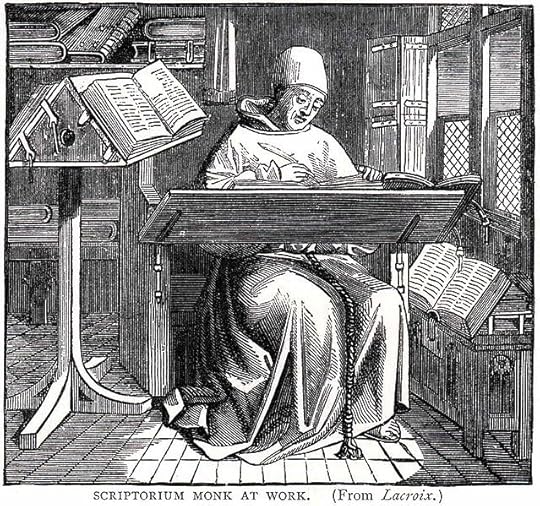 So what was so important about the goings on in ninth-century Corbie Monastery that made it so powerful? Those industrious monks were hard at work in the scriptorium manipulating the world, but more on that later. First, a bit about the monastery. It was founded around 660 A.D. and by the ninth century, Corbie had become one of the largest monasteries in France. As it grew in size, so, too, did its influence. Corbie Abbots were granted the same rank as counts, and were exempted from the authority of the bishop of the diocese. The monastery was even given the right to mint its own currency!
But Corbie’s real importance was its extensive library, scriptorium and, most importantly, its scholars. Under the watchful eyes of theological geniuses, like Hadoard and Ratramnum, scribes produced mountains of philosophical, historical and theological treatises. But that’s not all they manufactured. Abbot Paschasius Radbertus and the scribes in his charge created the world’s greatest forgery: the Decretals of Isidore Mercator, a fake that changed western Christianity forever. In fact, it wasn’t until Mussolini that a portion of Corbie’s blatant power grab was made right.
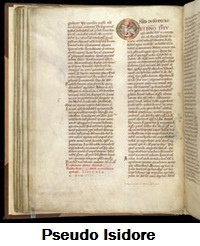 As experts in monastic script studied the anthology of letters that comprised the Decretals of Isidore Mercator, it became obvious by the handwriting that they were forged. And while medieval theologians universally agreed that the Decretal’s one hundred letters--supposedly authored by popes and bishops during the first three centuries after Christ--gave the papacy absolute power, it was just as certain that none of the letters were written then. Each and every one had been penned in the last few years, and all of them at Corbie monastery. Curiously, many of the passages resembled the writing style of the brilliant author and theologian, Abbot Paschasius Radbertus.
 Tucked away in the collection of blatant forgeries was perhaps the most brazen of the church’s fakes: the Donation of Constantine. The Donation conveyed colossal power to the papacy proclaiming, among other things, that the Bishop of Rome was Christ’s representative on earth, and giving him dominion over all the churches of God in the whole world!
Pope Leo IV relied on the Donation to command that the title Pope would be reserved exclusively for the Bishop of Rome. Bishops the world over were confused, since they were already called pope--which simply meant father--by their congregations. Even priests were affectionately called pope. The Patriarchs of Alexandria and Africa and the Patriarchs of Antioch and Constantinople, also popes, protested the effrontery.

So what does it all mean? Before the ninth century, there was no pope, at least not as we know the papacy today. The Pope was nothing more than the Bishop of Rome, and had no authority outside the Roman diocese. Nor did the Bishop of Rome have any authority over any other bishop or even priest outside his bishopric. That all changed with the Isidore fake. And based on the Donation of Constantine forgery, the church seized land that became the Papal States. Mussolini took back most of the land in 1929, but the church still retains land that it claimed based on the forgery—land that today is its own country: The Vatican.