Kate Vale's Blog
January 26, 2015
Cross-Cultural Mixes
I have always been intrigued by the differences ( as well as the similarities between and across cultures.) For example, in so many cultures, breads are important additions to many meals. How many cultures can you think of that use a flat bread, often in a circular or oval shape?
This past holiday season, I was treated to two more examples of the mixing of cultures via dress. One might even call them icons, inasmuch as the elements served as representatives of different cultures. The picture to the right is one example: a delightful pre-schooler wearing Minnie Mouse socks and Indian anklets with tiny bells (called jhanjara). It was easy to hear her coming as she joyfully tripped from one room to the other, those little bells around her ankles tinkling with each step.
Yet another example was an East Asian woman wearing a beautiful red Salwar Kameez outfit. Because the outside temperature was much colder than she preferred, she had topped her traditional Indian dress with a gorgeous wool Norwegian sweater perfect for protection against the chill!
In considering how poorly the representatives of different nations sometimes communicate with each other, I was struck with how “right” it seems to see the above combinations of different cultural dress. I suspect the attitudes of the wearers also reflects the acceptance and melding of different cultures as well.
Here’s to every individual embracing the wide variety of cultures and their values in our world, irrespective of national boundaries and languages!
This past holiday season, I was treated to two more examples of the mixing of cultures via dress. One might even call them icons, inasmuch as the elements served as representatives of different cultures. The picture to the right is one example: a delightful pre-schooler wearing Minnie Mouse socks and Indian anklets with tiny bells (called jhanjara). It was easy to hear her coming as she joyfully tripped from one room to the other, those little bells around her ankles tinkling with each step.
Yet another example was an East Asian woman wearing a beautiful red Salwar Kameez outfit. Because the outside temperature was much colder than she preferred, she had topped her traditional Indian dress with a gorgeous wool Norwegian sweater perfect for protection against the chill!
In considering how poorly the representatives of different nations sometimes communicate with each other, I was struck with how “right” it seems to see the above combinations of different cultural dress. I suspect the attitudes of the wearers also reflects the acceptance and melding of different cultures as well.
Here’s to every individual embracing the wide variety of cultures and their values in our world, irrespective of national boundaries and languages!


January 22, 2015
Fairweather Fandom

 In 2012, the Seattle Seahawks had a good season that captured my imagination when they almost-but-not-quite made it through the playoffs. As a result, I paid much closer attention to their games through the 2013 season. I was thrilled when they won the Super Bowl.
Throughout the 2014 season, I have made a point of watching as many of their games as possible. In one case, I was at an airport one Sunday and when a huge cheer went up from a nearby sports bar, I was compelled to ask another passenger scheduled for the same flight what the noise was all about. He beamed and reported that the Seahawks had just scored a touchdown. He also knew the score at that point, so I wended my way onto the plane anticipating that my team was on its way to winning that game, too. (Which they did.)
I approached the playoff games this season keeping my fingers and toes crossed that the Seahawks would again make the playoffs. (My fear was that this formerly fair-weather fan’s wishes would become the “kiss of death.” Thus, I have not mentioned the Superbowl to my friends and acquaintances who have another favorite team.)
In the interests of full disclosure, I admit to having been a nearly-rabid Cornhuskers fan when I lived in Nebraska. But how could I not, when they were winners in the day and everyone in our neighborhood sported team flags and other paraphernalia. While my son couldn’t be bothered, I usually repaired to the garden and listened to the games on a portable radio, cheering loudly after each touchdown. My cheers usually blended with those floating out the open windows of my neighbors until cold winter winds chased us all indoors to watch the game on TV with the sound muted, the better to hear our favorite radio guys calling the game.
Now I find we are going to the Superbowl, after a playoff game no one could have predicted. Perhaps that last 5-minute reprieve was the result of receipt of a late-Christmas present to me: a much-coveted Seahawks jersey with my favorite kicker’s number (4) on it. Hey Hauschie! Regardless of why they won or how much luck and prayers had to do with it, it was trilling to join others in that Woodinville lounge screaming our lungs out when we made it to the end of the game tied and then won in overtime.
You can bet I’ll be glued to the telly watching the Superbowl this year, too!
Go, Hawks!
January 12, 2015
A Find I Never Expected - Bisbee, AZ
[caption id="attachment_1082" align="alignright" width="300"]
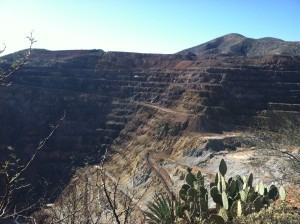 One view of the Lavender Open Pit Mine[/caption][caption id="attachment_1081" align="alignleft" width="300"]
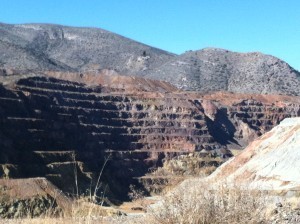 Another view of the Lavender Open Pit Mine[/caption]Bisbee, AZ is at a much higher elevation than Phoenix, and located very near the Mexican border. When we arrived, one step outside the car rewarded us with far colder breezes than anticipated. After all, we figured that the farther south we went, the warmer it would be. However, I recall that it was 25 degrees F that day. Thank goodness I had my parka with the fur-lined hood!
We explored the Queen Mine that began mining copper in the 1800s. Inside the mine, the temperature and was an almost-balmy 46 degrees. Although this mine stopped being worked in the mid 1940s, the nearby Lavender open pit mine remained active until the mid 1970s; its depths were spectacular in the bright sun.
I also discovered a terrific vegan restaurant in Bisbee and a store that sells hundreds of different flavors of olive oil, in addition to jars with the label, “Frog Balls.” In actuality, those jars contained delicious pickled brussels sprouts. Yes, I sampled them, and would have taken some jars home had I not been flying.
This little town, previously housing more than 10,000 souls when the mines were working, is much smaller now, and caters primarily to tourists who wander south from the big city, as well as those less inclined to stop in touristy Tombstone with the cowboys who re-enact the “fight at the OK corral.” That violence actually took place in a bar, according to one of the actors we spoke with.
Never been to southern Arizona? Go and explore. There are many things to see there, including the caverns we didn’t get a chance to explore, and the stargazing opportunities at the Kitts Peak Observatory. Those are just two of the places I plan to visit on my next trip to warmer climes—which means planning my visit when the temps are above freezing, preferably in the 70s!
 One view of the Lavender Open Pit Mine[/caption][caption id="attachment_1081" align="alignleft" width="300"]
 Another view of the Lavender Open Pit Mine[/caption]Bisbee, AZ is at a much higher elevation than Phoenix, and located very near the Mexican border. When we arrived, one step outside the car rewarded us with far colder breezes than anticipated. After all, we figured that the farther south we went, the warmer it would be. However, I recall that it was 25 degrees F that day. Thank goodness I had my parka with the fur-lined hood!
We explored the Queen Mine that began mining copper in the 1800s. Inside the mine, the temperature and was an almost-balmy 46 degrees. Although this mine stopped being worked in the mid 1940s, the nearby Lavender open pit mine remained active until the mid 1970s; its depths were spectacular in the bright sun.
I also discovered a terrific vegan restaurant in Bisbee and a store that sells hundreds of different flavors of olive oil, in addition to jars with the label, “Frog Balls.” In actuality, those jars contained delicious pickled brussels sprouts. Yes, I sampled them, and would have taken some jars home had I not been flying.
This little town, previously housing more than 10,000 souls when the mines were working, is much smaller now, and caters primarily to tourists who wander south from the big city, as well as those less inclined to stop in touristy Tombstone with the cowboys who re-enact the “fight at the OK corral.” That violence actually took place in a bar, according to one of the actors we spoke with.
Never been to southern Arizona? Go and explore. There are many things to see there, including the caverns we didn’t get a chance to explore, and the stargazing opportunities at the Kitts Peak Observatory. Those are just two of the places I plan to visit on my next trip to warmer climes—which means planning my visit when the temps are above freezing, preferably in the 70s!
January 7, 2015
Arizona flora
A recent trip to the Desert Botanical Gardens in Scottsdale, Arizona, yielded a plethora of unique shapes--in spite of the unseasonably cold weather that had me thankful to have worn a parka.
Ironwood shapes were an added set of sculptures that commemorated the contributions of Phil Hebets who, in 1980, “originated a tree boxing methodology that enabled over one million native plants to be salvaged rather than bulldozed.” One result of his technology is the municipal ordinances in places like Tucson that require that native plants be saved and replanted in developments. Nothing looks more out of place in a desert landscape than a green lawn more appropriately found in northern climes.
Additionally, although not yet the season for them, I found some blossoms that portend how colorful a desert landscape can be in the warmer spring months when butterflies and hummingbirds visit the area.
If you’ve never been to the botanical gardens in Scottsdale, I recommend them. The entire facility (not counting the gift shops) can be found outside. You can walk the trails, even climb a high hill that overlooks the gardens. Although located very near major thoroughfares with whizzing cars, I found myself imagining having been transported far from civilization as I wandered among the saguaros (so tall and stately) and the barrel cacti (resembling plump circles as they squatted on the ground). Even the more recent contributions of Chihuly took on a desert-like persona as they welcome visitors near the entrance.
[caption id="attachment_1066" align="alignleft" width="143"] Welcome to the Desert Botanical Gardens[/caption]
Ironwood shapes were an added set of sculptures that commemorated the contributions of Phil Hebets who, in 1980, “originated a tree boxing methodology that enabled over one million native plants to be salvaged rather than bulldozed.” One result of his technology is the municipal ordinances in places like Tucson that require that native plants be saved and replanted in developments. Nothing looks more out of place in a desert landscape than a green lawn more appropriately found in northern climes.
Additionally, although not yet the season for them, I found some blossoms that portend how colorful a desert landscape can be in the warmer spring months when butterflies and hummingbirds visit the area.
If you’ve never been to the botanical gardens in Scottsdale, I recommend them. The entire facility (not counting the gift shops) can be found outside. You can walk the trails, even climb a high hill that overlooks the gardens. Although located very near major thoroughfares with whizzing cars, I found myself imagining having been transported far from civilization as I wandered among the saguaros (so tall and stately) and the barrel cacti (resembling plump circles as they squatted on the ground). Even the more recent contributions of Chihuly took on a desert-like persona as they welcome visitors near the entrance.
[caption id="attachment_1066" align="alignleft" width="143"]
 Welcome to the Desert Botanical Gardens[/caption]
December 22, 2014
Feathered Friends and Frenemies
My bird feeders have generated hordes of new visitors this year. In the spring, I was pleasantly surprised by yellow finches who seemed to have realized that my finch feeder was full and waiting for them to partake—which they did, sometimes four and five at a time! The brilliant yellow of the males made for a delight of bright colors against the more drab coloration of the females, who tend to prefer solitary dining.
Then this fall, after lots of rain that refilled the usually-muddy pond behind my house so that it now resembles a small lake, I suddenly was bombarded by an aggressive blue jay, who expressed his frustration by dive-bombing me when I dared to venture onto the back deck. He tried numerous times to partake of the largesse at the wooden feeder, but it swung too vigorously when he attempted to land on either side. The only time he remained on it was when he realized he could cling to the roof, but that meant he was too far away from the food and whenever he leaned toward it, the feeder nearly tossed him on his head! The other feeder is set up for small birds and is spring-loaded to close whenever a larger bird or a squirrel attempts to steal the food. After several such attempts, the local squirrel population has learned to leap wildly for the little wooden feeder and then to hang from the roof and scoop up the food, scattering lots of it on the ground for later gathering forays. But the blue jay just couldn’t keep trying to get at the seed from the tray.
More amazing was the willingness of the red-winged blackbirds, males and females alike, to gather on the smaller feeder, sharing what it held, flying off, alerting more of their kind and then coming back for more. I’m having to refill it at least once a week, and we’ve yet to have snow. Perhaps the cold weather is just enough to have limited their usual foraging so that they now depend more on what I put out than what they would otherwise have to search for.
Regardless of their reasons for seeking out my feeders, it is fun to watch them, including the ferocious blue jay, who squawked irritably at me until I set out a small bowl of food in the now-empty flower container. So there, Mr. Jay! Now be nice and stop dive-bombing me!
Then this fall, after lots of rain that refilled the usually-muddy pond behind my house so that it now resembles a small lake, I suddenly was bombarded by an aggressive blue jay, who expressed his frustration by dive-bombing me when I dared to venture onto the back deck. He tried numerous times to partake of the largesse at the wooden feeder, but it swung too vigorously when he attempted to land on either side. The only time he remained on it was when he realized he could cling to the roof, but that meant he was too far away from the food and whenever he leaned toward it, the feeder nearly tossed him on his head! The other feeder is set up for small birds and is spring-loaded to close whenever a larger bird or a squirrel attempts to steal the food. After several such attempts, the local squirrel population has learned to leap wildly for the little wooden feeder and then to hang from the roof and scoop up the food, scattering lots of it on the ground for later gathering forays. But the blue jay just couldn’t keep trying to get at the seed from the tray.
More amazing was the willingness of the red-winged blackbirds, males and females alike, to gather on the smaller feeder, sharing what it held, flying off, alerting more of their kind and then coming back for more. I’m having to refill it at least once a week, and we’ve yet to have snow. Perhaps the cold weather is just enough to have limited their usual foraging so that they now depend more on what I put out than what they would otherwise have to search for.
Regardless of their reasons for seeking out my feeders, it is fun to watch them, including the ferocious blue jay, who squawked irritably at me until I set out a small bowl of food in the now-empty flower container. So there, Mr. Jay! Now be nice and stop dive-bombing me!
December 15, 2014
Real Estate and My Novels
One of my several careers over the years has involved real estate sales and service. It’s hard to believe but sixteen years ago, I considered myself an original “April fool” for jumping into the real estate game—one reason related to my love of reviewing open houses when I was a teenager dreaming of what my house would look like. That dream probably related to the fact that my dad was in the service and we moved around a lot—always renting since we were rarely in any one place more than two years. In one case, his duty station lasted a mere nine months. I think that was the year I was in one school for 13 days!
Back to the realty gig: like most totally green realtors, I knew nothing when I began, even though I’d taken the requisite pre-licensure course and passed the state-administered test. Each transation thereafter became a learning experience, one that ensured I would seek, and eventually obtain, several advanced designations, the better to know what I was doing and to serve my clients. As important as that advanced training was, remaining open to the needs of each client—seller or buyer—informed my work.
The stories of other realtors and their experiences with their clients also added to what I knew. And all these encounters—the good, bad, ugly, funny, gruesome, dangerous, and just plain stupid—all became grist for the particular mill in Granddad's House. Some of the realtors who appear in that story are also found in Just Friends, and in another book called Choices, which won the Grand Prize (http://chantireviews.com/2014/09/23/t...) in the Chanticleer Book Reviews and Media Contest for 2013. It remains to be seen if those same realtors show up again in as-yet-unwritten stories in the series taking place in the fictional town of Evergreen, Washington.
People often ask if I miss my work as a realtor since I retired from that role. Yes and no. I still remain open to answering questions my friends ask, usually for their relatives or acquaintances. But, I don’t miss the often-frustrating actions of banks since the 2007-2010 Recession, whose decisions buyers and sellers still hang on with often too-long bated breath. Requiring that buyers prove they have the money to buy a home has always been wise, something some lenders forgot in the craziness of the period 2002 through 2008. But triple-checking bank accounts and demanding to know about every little thing is going way too far in the direction of total mistrust. Would that the happy medium is soon achieved.
Back to the realty gig: like most totally green realtors, I knew nothing when I began, even though I’d taken the requisite pre-licensure course and passed the state-administered test. Each transation thereafter became a learning experience, one that ensured I would seek, and eventually obtain, several advanced designations, the better to know what I was doing and to serve my clients. As important as that advanced training was, remaining open to the needs of each client—seller or buyer—informed my work.
The stories of other realtors and their experiences with their clients also added to what I knew. And all these encounters—the good, bad, ugly, funny, gruesome, dangerous, and just plain stupid—all became grist for the particular mill in Granddad's House. Some of the realtors who appear in that story are also found in Just Friends, and in another book called Choices, which won the Grand Prize (http://chantireviews.com/2014/09/23/t...) in the Chanticleer Book Reviews and Media Contest for 2013. It remains to be seen if those same realtors show up again in as-yet-unwritten stories in the series taking place in the fictional town of Evergreen, Washington.
People often ask if I miss my work as a realtor since I retired from that role. Yes and no. I still remain open to answering questions my friends ask, usually for their relatives or acquaintances. But, I don’t miss the often-frustrating actions of banks since the 2007-2010 Recession, whose decisions buyers and sellers still hang on with often too-long bated breath. Requiring that buyers prove they have the money to buy a home has always been wise, something some lenders forgot in the craziness of the period 2002 through 2008. But triple-checking bank accounts and demanding to know about every little thing is going way too far in the direction of total mistrust. Would that the happy medium is soon achieved.
December 8, 2014
Where is Abingdon?
One of my first loves is choral singing. My friends know they’ll find me raising my voice in different venues throughout the year, such as my local church choir, the annual Handel’s Messiah community sing, the Skagit Symphony Orchestra at least once a year, and various cities around the country. Two such special experiences included singing at Carnegie Hall, a truly unexpected opportunity, I never expected. More recently, I've discovered Road Scholar Choral Participation programs that involve singing. (To check them out, go to http://www.roadscholar.org/Programs/s....
This past year was my first attendance in tiny Abingdon, VA, population, approximately 8,200, and home to the wonderful Barter Theatre (www.bartertheatre.com). If you live within range and haven’t enjoyed its offerings, do yourself a favor and take in a show there. You won’t regret it. Do these names—Gregory Peck, Kevin Spacey, Ernest Borgnine, Patricia Neal, Larry Linville—ring a bell? They’ve all played there. Their pictures are on a wall near the gift shop.
Back to Abingdon. This particular musical experience included learning songs in Spanish, Latin, and Quetzal, as well as English, and included tunes from the sixteenth century as well as more modern pieces, including a special arrangement of “They Dance Alone,” by Sting. The singers, many of whom return year after year, were especially welcoming when I finally wandered in after three flights and a small shuttle ride across the Tennessee-Virginia line.
The director, Andrew Walker, was a fabulous find, knowledgeable, skilled at bringing out our best efforts, and appreciative of even the most off-the-wall comments during rehearsals. We probably laughed almost as much as we sang. As one who’s always believed that laughter is one of the most healing of medicines, I have to say that my time in Abingdon was a delightful way to improve my mental health.
We sang 5-6 hours/day. Non-singers might think that’s too much, but singers love to sing and our rehearsals did include breaks.
What made Abingdon even more special was the celebration of one couple’s first wedding anniversary. They exchanged wedding vows last year at this same venue with many of the same singers in attendance. I don’t know how many other Road Scholar events have included a wedding, but that this one did speaks to how special this group is for its participants, at least half of whom include new people each year. I count myself among those who have recently discovered this group and who intend to return.
If you’re interested in this and other groups, look us up in the Road Scholar offerings for the month of November. Even if you have to come from more than 2,5000 miles away, as I did, you won’t regret it.
This past year was my first attendance in tiny Abingdon, VA, population, approximately 8,200, and home to the wonderful Barter Theatre (www.bartertheatre.com). If you live within range and haven’t enjoyed its offerings, do yourself a favor and take in a show there. You won’t regret it. Do these names—Gregory Peck, Kevin Spacey, Ernest Borgnine, Patricia Neal, Larry Linville—ring a bell? They’ve all played there. Their pictures are on a wall near the gift shop.
Back to Abingdon. This particular musical experience included learning songs in Spanish, Latin, and Quetzal, as well as English, and included tunes from the sixteenth century as well as more modern pieces, including a special arrangement of “They Dance Alone,” by Sting. The singers, many of whom return year after year, were especially welcoming when I finally wandered in after three flights and a small shuttle ride across the Tennessee-Virginia line.
The director, Andrew Walker, was a fabulous find, knowledgeable, skilled at bringing out our best efforts, and appreciative of even the most off-the-wall comments during rehearsals. We probably laughed almost as much as we sang. As one who’s always believed that laughter is one of the most healing of medicines, I have to say that my time in Abingdon was a delightful way to improve my mental health.
We sang 5-6 hours/day. Non-singers might think that’s too much, but singers love to sing and our rehearsals did include breaks.
What made Abingdon even more special was the celebration of one couple’s first wedding anniversary. They exchanged wedding vows last year at this same venue with many of the same singers in attendance. I don’t know how many other Road Scholar events have included a wedding, but that this one did speaks to how special this group is for its participants, at least half of whom include new people each year. I count myself among those who have recently discovered this group and who intend to return.
If you’re interested in this and other groups, look us up in the Road Scholar offerings for the month of November. Even if you have to come from more than 2,5000 miles away, as I did, you won’t regret it.
December 1, 2014
Thanksgiving: Moroccan-style
Thanks can be given any number of ways and celebrated with all manner of great company (small groups or large) and fabulous foods. I’ve had traditional meals including turkey and all the trimmings. But this year, we set the turkey aside when my son and daughter-in-law opted to use recipes with a Moroccan flavor. The result was an unforgettable feast.
The main disk was tagine chicken, cooked in a special pot of the same name. The chicken was garnished with slices of lemon, olives, garlic, cilantro, onions, paprika, cumin, and saffron, as well as lemon zest. The sauce created in the pot was as flavorful as the chicken.
The tagine pot was used in the oven to bake the chicken. When removed from the oven, the pot continues to cook the food within. A tiny hole about halfway up the side of the top which resembles a hat (see it in the picture) allows the steam to escape while retaining the heat. Any liquids surrounding the meat are retained and become a delicious sauce that soaks up nicely with pieces of bread.
A raw carrot salad included carrots slivered thinly with fresh lemon juice, parsley, cinnamon, cumin, paparika and some agave nectar (honey could as easily be used instead). My son added raisins for a dash of additional color. The cool carrots next to the hot chicken made for variety that tickled my taste buds.
In addition, we had fresh-baked bread still warm from the oven. We garnished the bread with sesame seeds in keeping with the Moroccan theme. Each of us received an individual round of bread, even though the recipe I used for the bread was one I’ve made for more than three decades. The only change I made was to punch down the dough for a second rising and then roll each section (in this case, three) into a round before flattening it again to about one-half inch high and approximately three-four times the diameter of the round prior to flattening. We then covered the bread with a cloth before baking in the oven for about 20 minutes instead of the usual 35 for a regular loaf at 375⁰.
According to my son, the piecé de resistance was date-almond truffles, which paste was rolled in coconut. White wine for me and red wine for them completed the meal before we ended it with our favorite teas.
The three Moroccan dishes can be found online. A favorite source is http://cookingwithalia.com. Her presentations are cheery and fun and the food spoke for itself—delicious, out-of-the-ordinary, and a perfect alternative to the typical turkey dinner, although turkey could have been used instead in the tagine pot. The big difference would be the combination of spices used. I, for one, really like the lemony hints in both the carrot salad and the main dish. And limiting the fare to those two dishes and the bread meant we weren’t so stuffed that we couldn’t enjoy ourselves the rest of the day.
(PS Pictures shown at http://katevale.com/2014/festivities-...)
The main disk was tagine chicken, cooked in a special pot of the same name. The chicken was garnished with slices of lemon, olives, garlic, cilantro, onions, paprika, cumin, and saffron, as well as lemon zest. The sauce created in the pot was as flavorful as the chicken.
The tagine pot was used in the oven to bake the chicken. When removed from the oven, the pot continues to cook the food within. A tiny hole about halfway up the side of the top which resembles a hat (see it in the picture) allows the steam to escape while retaining the heat. Any liquids surrounding the meat are retained and become a delicious sauce that soaks up nicely with pieces of bread.
A raw carrot salad included carrots slivered thinly with fresh lemon juice, parsley, cinnamon, cumin, paparika and some agave nectar (honey could as easily be used instead). My son added raisins for a dash of additional color. The cool carrots next to the hot chicken made for variety that tickled my taste buds.
In addition, we had fresh-baked bread still warm from the oven. We garnished the bread with sesame seeds in keeping with the Moroccan theme. Each of us received an individual round of bread, even though the recipe I used for the bread was one I’ve made for more than three decades. The only change I made was to punch down the dough for a second rising and then roll each section (in this case, three) into a round before flattening it again to about one-half inch high and approximately three-four times the diameter of the round prior to flattening. We then covered the bread with a cloth before baking in the oven for about 20 minutes instead of the usual 35 for a regular loaf at 375⁰.
According to my son, the piecé de resistance was date-almond truffles, which paste was rolled in coconut. White wine for me and red wine for them completed the meal before we ended it with our favorite teas.
The three Moroccan dishes can be found online. A favorite source is http://cookingwithalia.com. Her presentations are cheery and fun and the food spoke for itself—delicious, out-of-the-ordinary, and a perfect alternative to the typical turkey dinner, although turkey could have been used instead in the tagine pot. The big difference would be the combination of spices used. I, for one, really like the lemony hints in both the carrot salad and the main dish. And limiting the fare to those two dishes and the bread meant we weren’t so stuffed that we couldn’t enjoy ourselves the rest of the day.
(PS Pictures shown at http://katevale.com/2014/festivities-...)
March 17, 2014
An Author Interview of Kate Vale
An Interview with Kate Vale
What kind of books do you write?
The short answer is contemporary women’s fiction with strong romantic elements. More particularly, I am drawn to issues that women today often face. Some of those issues can be difficult to read about, but I hope that within my stories, the readers will see that the characters come alive when they confront, and overcome, the dilemmas they encounter. I’ve always loved a happily-ever-after ending. Thus, they figure in my stories, too.
When I first began writing, however, I didn’t think in terms of a particular genre. Rather, I wanted to share the stories that circled in my brain and floated to the surface at odd times—when I was making dinner, watching the birds at the feeders on my back deck, in the midst of watching a television show, while listening to music, driving down to see my son and his wife… Those stories included characters that had captured my imagination and I wanted to learn more about them, too. So, I let them tell me their stories. The words seemed aimless at first, mostly just scenes that weren’t connected, but which seemed to illustrate something about the character in question. Soon, as if ordered by the characters themselves, I had a story with a beginning, middle and end.
When I finished the first draft of my first novel, Dream Chaser, I realized I’d written a romance that was couched in a contemporary woman’s struggle to find herself. That surprised me. I’d never thought of myself as a romance writer, but there it was, within the confines of that more general category of women’s fiction. I should have guessed I would include a happily-ever-after ending before I finished it, for the wedding of Suzannah’s son and the ending scene between Suzannah and Jonathan, were both written long before I finished the story. I laughed at myself and figured, “why not?” So I went with the notion of creating stories about real people with real problems, who also ended up happily-ever-after.
Where do you draw your characters from?
My characters are drawn from my imagination, but each of them reflects people I’ve known or situations I’ve experienced or observed. My friends probably wouldn’t be able to say with certainty, “oh, that’s me!” because I don’t write that way. However, if my readers have found themselves in similar situations, I hope that they also recognize the reality of those situations and that they appreciate how the characters deal with those experiences.
In one case, meeting a foster child captured my imagination so completely that I had to explore foster child experiences (the good and the not-so-good) in a story, which became the basis for Her Daughter’s Father. And because my mother was herself adopted, I chose to focus on the many relationships that adoption creates in a new story, scheduled for publication later in 2014.
What age are your main characters?
My primary characters represent three different age groups: Jane and Chet in Family Bonds, and Dannilynne and Ben in Concealed Attractions are in their early- to mid-twenties, because those two titles are New Adult Novels.
Olivia and Beau (in Granddad’s House) are in their early thirties, as are Sally and Paul (in Just Friends), Amanda and Marcus (in Package Deal), Carrie and Brian (in Safe Beside You). Melanie and Sam (in Choices), and Gretchen and Craig (in Her Daughter’s Father) are in their mid-thirties. Joel and Angela (in Heartstrings) are in their thirties when we first meet them (in Concealed Attractions) and in their mid-forties in the sequel (Heartstrings). Suzanna and Jonathan (Dream Chaser) and Gillian and Matt (in Gillian’s Do-Over) are in their mid- to late-forties.
Someone told me once that readers wouldn't find stories about couples older than their thirties very appealing, particularly if romance was involved, but that's not been my experience. Most all of the readers of Dream Chaser and Gillian’s Do-Over, for example, have appreciated reading about older couples, perhaps because they, too, were older than the characters in my other stories.
How much has your own life experience influenced your writing?
None of my stories are autobiographical, but each of them include details that I could claim as my own. Something as unimportant as the color of a particular car or the way a character describes something, using word phrases I’m familiar with. In Gillian’s Do-Over, the main character has a white-water adventure that paralleled my own except for one important detail. I loved going white-water rafting. Poor Gillian’s experience is less positive, but enabled me to show her in a humorous situation. In Choices, my personal experience with divorce was very different from Melanie’s, but her concerns about making enough money as a struggling real estate agent mirrored my own in the early years of my career. Places I’ve visited also figure in several of my novels. For example, I've taken road trips much like that enjoyed by Suzanna in Dream Chaser, and I worked on Mt. Rainier several summers while I was in college. That made it easy for me to describe the visit Olivia and Beau make to Paradise Inn in Granddad’s House.
I have had several careers, among them, real estate broker/sales person, mother, college professor and have travelled widely throughout North America and elsewhere. Thus, Olivia (in Granddad’s House) and later, Melanie (in Choices), were easy characters to understand as they went about the business of helping clients buy or sell homes. Although I never served as an English professor, Amanda reflected some of my experiences with other professors in Package Deal.
Do you have any special favorites among your characters?
Usually, while I’m writing a story, the characters whose lives I am creating are my favorite characters. But overall, I have to admit that I really liked Gillian (in Gillian’s Do-Over). She will probably remain a favorite, no matter how many more books I write.
What do your fans mean to you?
My readers and fans are important to me. I love to hear from them and take seriously all of their comments about my books.
When I hear that a reader liked a particular story, I feel like we've had a friendly conversation over cups of tea and cookie snacks. Because of some readers' suggestions, some of my stories focused on, or included, a particular issue. Two that come to mind are breast cancer (which features in Just Friends) and child abuse (which appears in both Package Deal and Her Daughter’s Father).
What kind of books do you write?
The short answer is contemporary women’s fiction with strong romantic elements. More particularly, I am drawn to issues that women today often face. Some of those issues can be difficult to read about, but I hope that within my stories, the readers will see that the characters come alive when they confront, and overcome, the dilemmas they encounter. I’ve always loved a happily-ever-after ending. Thus, they figure in my stories, too.
When I first began writing, however, I didn’t think in terms of a particular genre. Rather, I wanted to share the stories that circled in my brain and floated to the surface at odd times—when I was making dinner, watching the birds at the feeders on my back deck, in the midst of watching a television show, while listening to music, driving down to see my son and his wife… Those stories included characters that had captured my imagination and I wanted to learn more about them, too. So, I let them tell me their stories. The words seemed aimless at first, mostly just scenes that weren’t connected, but which seemed to illustrate something about the character in question. Soon, as if ordered by the characters themselves, I had a story with a beginning, middle and end.
When I finished the first draft of my first novel, Dream Chaser, I realized I’d written a romance that was couched in a contemporary woman’s struggle to find herself. That surprised me. I’d never thought of myself as a romance writer, but there it was, within the confines of that more general category of women’s fiction. I should have guessed I would include a happily-ever-after ending before I finished it, for the wedding of Suzannah’s son and the ending scene between Suzannah and Jonathan, were both written long before I finished the story. I laughed at myself and figured, “why not?” So I went with the notion of creating stories about real people with real problems, who also ended up happily-ever-after.
Where do you draw your characters from?
My characters are drawn from my imagination, but each of them reflects people I’ve known or situations I’ve experienced or observed. My friends probably wouldn’t be able to say with certainty, “oh, that’s me!” because I don’t write that way. However, if my readers have found themselves in similar situations, I hope that they also recognize the reality of those situations and that they appreciate how the characters deal with those experiences.
In one case, meeting a foster child captured my imagination so completely that I had to explore foster child experiences (the good and the not-so-good) in a story, which became the basis for Her Daughter’s Father. And because my mother was herself adopted, I chose to focus on the many relationships that adoption creates in a new story, scheduled for publication later in 2014.
What age are your main characters?
My primary characters represent three different age groups: Jane and Chet in Family Bonds, and Dannilynne and Ben in Concealed Attractions are in their early- to mid-twenties, because those two titles are New Adult Novels.
Olivia and Beau (in Granddad’s House) are in their early thirties, as are Sally and Paul (in Just Friends), Amanda and Marcus (in Package Deal), Carrie and Brian (in Safe Beside You). Melanie and Sam (in Choices), and Gretchen and Craig (in Her Daughter’s Father) are in their mid-thirties. Joel and Angela (in Heartstrings) are in their thirties when we first meet them (in Concealed Attractions) and in their mid-forties in the sequel (Heartstrings). Suzanna and Jonathan (Dream Chaser) and Gillian and Matt (in Gillian’s Do-Over) are in their mid- to late-forties.
Someone told me once that readers wouldn't find stories about couples older than their thirties very appealing, particularly if romance was involved, but that's not been my experience. Most all of the readers of Dream Chaser and Gillian’s Do-Over, for example, have appreciated reading about older couples, perhaps because they, too, were older than the characters in my other stories.
How much has your own life experience influenced your writing?
None of my stories are autobiographical, but each of them include details that I could claim as my own. Something as unimportant as the color of a particular car or the way a character describes something, using word phrases I’m familiar with. In Gillian’s Do-Over, the main character has a white-water adventure that paralleled my own except for one important detail. I loved going white-water rafting. Poor Gillian’s experience is less positive, but enabled me to show her in a humorous situation. In Choices, my personal experience with divorce was very different from Melanie’s, but her concerns about making enough money as a struggling real estate agent mirrored my own in the early years of my career. Places I’ve visited also figure in several of my novels. For example, I've taken road trips much like that enjoyed by Suzanna in Dream Chaser, and I worked on Mt. Rainier several summers while I was in college. That made it easy for me to describe the visit Olivia and Beau make to Paradise Inn in Granddad’s House.
I have had several careers, among them, real estate broker/sales person, mother, college professor and have travelled widely throughout North America and elsewhere. Thus, Olivia (in Granddad’s House) and later, Melanie (in Choices), were easy characters to understand as they went about the business of helping clients buy or sell homes. Although I never served as an English professor, Amanda reflected some of my experiences with other professors in Package Deal.
Do you have any special favorites among your characters?
Usually, while I’m writing a story, the characters whose lives I am creating are my favorite characters. But overall, I have to admit that I really liked Gillian (in Gillian’s Do-Over). She will probably remain a favorite, no matter how many more books I write.
What do your fans mean to you?
My readers and fans are important to me. I love to hear from them and take seriously all of their comments about my books.
When I hear that a reader liked a particular story, I feel like we've had a friendly conversation over cups of tea and cookie snacks. Because of some readers' suggestions, some of my stories focused on, or included, a particular issue. Two that come to mind are breast cancer (which features in Just Friends) and child abuse (which appears in both Package Deal and Her Daughter’s Father).
November 23, 2013
To-Do Lists
I’m in shock! I prepared a “to-do” list yesterday, the better to organize both my thoughts and my writing work schedule. That list now exceeds four pages!
Have I been laying back lately, playing instead of working? Or am I simply anticipating what I want to accomplish before the holidays and family obligations intervene?
In checking over that list—which may become longer before items can be crossed off with a satisfying “so there!”—I discovered that numerous items are not in themselves big jobs. It’s just that there are so many. Thus, the entirety of the list is off-putting.
My garden calls, the bulbs need planting, and the sun is out. But although I yearn to grab my spade and head outside, that dratted “to-do” list glowers. Get to it, it repeats, a litany that threatens to overwhelm my desire to take a break.
A friend just called and I admitted my schizophrenic urgings to be two places at once—outside and inside, planting my bulbs, completing and then shortening the everlasting list.
Oh, joy! What I couldn’t do for myself has been provided by another.
I now have permission to take a break in favor of the bulbs, knowing the inside chores will get done later today or perhaps even tomorrow and throughout the week. The garden needs my attention before I can put it to bed for the season under a warm pile of mulch.
Bye-bye, list! I’ll see you later.
Have I been laying back lately, playing instead of working? Or am I simply anticipating what I want to accomplish before the holidays and family obligations intervene?
In checking over that list—which may become longer before items can be crossed off with a satisfying “so there!”—I discovered that numerous items are not in themselves big jobs. It’s just that there are so many. Thus, the entirety of the list is off-putting.
My garden calls, the bulbs need planting, and the sun is out. But although I yearn to grab my spade and head outside, that dratted “to-do” list glowers. Get to it, it repeats, a litany that threatens to overwhelm my desire to take a break.
A friend just called and I admitted my schizophrenic urgings to be two places at once—outside and inside, planting my bulbs, completing and then shortening the everlasting list.
Oh, joy! What I couldn’t do for myself has been provided by another.
I now have permission to take a break in favor of the bulbs, knowing the inside chores will get done later today or perhaps even tomorrow and throughout the week. The garden needs my attention before I can put it to bed for the season under a warm pile of mulch.
Bye-bye, list! I’ll see you later.