Summer Kinard's Blog
September 12, 2025
Supporting Low-Verbal Nonspeaking Students at Church


There’s LOTS more to come on this FREE curriculum sponsored by a Hellenic Foundation Grant to St. John the Baptist Greek Orthodox Church in Des Plaines, but I wanted to share this activity now, at the start of Sunday School for so many, because we have discovered there are not a lot of curriculum opportunities for nonspeaking students with lower emerging expressive and receptive language skills. This lesson requires a sensory bin with filler, 6 recordable speech output devices, 12 AAA batteries, and the 18 micro icons listed in the instructions from Legacy Icons. You’ll also need to be able to print 6 full color pages. I’ve posted the images above for ease of sharing/saving online, and here is the PDF:
sensory box icon placematsDownloadThe post Supporting Low-Verbal Nonspeaking Students at Church appeared first on Summer Kinard.


July 28, 2025
Summertime Sensory Tool Kit

LOTS of you email me each week asking which sensory tools I recommend for home, church services, work, and classrooms. Since my whole household is autistic, we have tried hundreds of tools, and I love to share resources with you! Below is a curated list of my favorite kinds of sensory tools. Where there are Amazon affiliate links available for tools I love, I have included those. (Affiliate links give me a small referral commission but do not charge you anything extra.) I will also list links to non-affiliate sites where relevant.
SENSORY NEEDS: FOR THE USER, FOR THEIR COMPANIONS
I am especially going to focus here on sensory tools that are not loud, too bright, painful, or distracting for the other people in the room. There are some additional fun stim toys out there, but I am favoring the ones that don’t cost too much and that aren’t loud/bright.
AGED-UP SENSORY FIDGETS
If you want some quick-start options for teens and adults in a group setting like a classroom or cafe, try these tools. Make sure to make them available for everyone in the space, with plenty to go around.
Large Squishy Toys: Search Kawai sites and squishy vendors for “jumbo” sized squishy fidgets. These provide enough input for adults and have more pleasing aesthetics for adults and teens.
Jumbo Fruit Squishies (amazon aff. link) This is a relatively inexpensive variety pack that can be placed in a basket on a table. The similarity to fruit baskets when so displayed makes these fit in more with a room, normalizing the fidgets.
Jumbo Mango Squishy (amazon aff. link) This extra-large mango squishy goes well with the other jumbo fruits.
Slow-Rising Stress Balls (amazon aff. link) These are brigthly colored and provide a lot of feedback, but they can break under some circumstances. They’re not a good option for people who mouth their sensory tools because the liner can be burst with puncturing. They’re a cost-effective option for making a lot of sensory tools available to a group.
Magnetic People (amazon aff. link) These use strong magnets on the feet and hands of little silicone people to connect and build. They’re a lot of fun and scale well for groups. They’re not safe for people who might put the magnets in their mouths, so these are only for teens and adults who will not put them in their mouths. You can make crowns or towers and other shapes with these.
Travel Magna-Tiles (amazon aff. link) These smaller sized sets make them great for use at shared tables or desks, and they double as a visual stim due to their bright, transparent colors. Because of the magnets, these are also not good for people who will put them in their mouths.
Silicone Magnetic Balls (amazon aff. link) These are heavy and satisfying to twirl in hands or stack and sort on tables. Each ball is larger than a large grape. They come in several colors which look nice when mixed and matched.
Metallic Fidget Spinners (amazon aff. link) These are heavier than most fidget spinners and spin longer. They provide more sensory feedback for larger persons, and you can stack them as they spin. The link is for a multi-pack, but you can search for fancier single spinners if you have a larger budget. Providing a lot of these during gatherings or classes gives people a quiet way to maintain focus.
SENSORY SOOTHING PRIORITIES: DEEP PRESSURE, MOVEMENT, FEELING SAFE
Sensory needs fall into several main categories. Lots of people know about the “main” five senses, but not everyone realizes that the vestibular and proprioceptive senses are at least as and usually even more important to feeling calm and in control of your body. Deep joint pressure and gross motor movements (especially those that cross the midline of the front of your body and those that give rocking back and forward motions) are some of the most important sensory needs. You can make a room smell nice and put on some white or brown noise, lower lights, add a variety of textured surfaces for touching with hands or feet, and offer salty or sweet snacks. But if you don’t offer safe sheltering feelings through deep pressure movements or seating and safe movement feelings through gross motor moving and seating/activities, your autistic loved one (or you) will not be able to give attention to your present.
Use these tools WHILE learning to help with focus and coordination of bodies and attention. If you can piggyback learning onto motor neurons or music (or both) you will find that people can self-regulate much better, because the middle of your brain is where music and movement are processed. They hold everything together. There’s a saying in the autism world, “Neurons that fire together wire together,” and when you’re dealing with developmental delays or differences that are due to difficulties with forming long-chain synapses, building on the stronger, longer synapses of gross motor movements and music will make other forms of function and thinking and attention stronger. If you teach with attention in mind rather than behavior modification, you will find that people are able to self-regulate and learn much better and faster. That’s because movement and music and using tools are all fun, and it’s also because setting people at ease allows them to pay attention. Don’t use these tools as rewards for behavior. Rather, think of them as necessary accommodations for disabilities, the way you would make sure that a wheelchair user has access to their wheelchair or a person who is hard of hearing has access to their hearing aids. Give these tools as a default; make them normal. Use them all the time and everywhere (as appropriate for each thing, so no putty in the swimming pool or bath, but you can use sensory strings in water if you’d like, and balance boards in the dining room or while doing homework).
The Tools: Whole Body OptionsSensory Canoe seat Large (80″ for teens and adults) and Small (60″ for up to middle school or petite adults)
Camp rocking chair (portable) Versions of these are available at Costco and Walmart during warmer months for much lower cost (Costco has them for $49.99 currently.) These hammock chairs provide deep pressure as well as vestibular movement. The rocking motion soothes the limbic system, and they have a higher weight limit than most chairs, which allows for the option of rocking with a child for many people.
Heavy duty platform swing. If you have a swing set or tree branch or decking that allows for a swing to be added, these platform swings are great. They hold up to 700lbs, which means they work well for larger persons as well as groups of smaller persons. In our experience, with several children using them daily and having the swing exposed to extreme heat, we would replace ours about once a year. When we lived in a milder climate, they lasted 2 years.
Bucket chairs that spin. You can find these through online retailers by searching for “swivel barrel chair.” We have purchased bucket spinning chairs from Home Depot, where we often find them on sale in sets of two.
Desk chairs that spin: Search for these in any store. Inexpensive ones can be found from IKEA.
Modular couches for making cubbies. Walmart and Amazon carry modular toddler couches (amazon aff. link) that can be made into a variety of designs. For easy castle building, try a castle add-on set (amazon aff. link). We have two of these in our bookshop for acting out stories set in castles during our weekly preschool class, and older children build with them when they stop by the Cloud Room. If you have a larger budget and want something quite sturdy, look up the Nugget brand of modular couches. For heavy-duty needs, look into Library (amazon aff. link to a heavy-duty set) and Classroom furniture options.
Memory Foam bean bags (amazon aff. link) for sitting, placing on feet while resting, squishing between to read or play. We have had several of these in a sensory room before, where they were used for stacking, crashing, for lying in between, and fort building. We keep a few on hand at home and in our bookshop for sensory regulating. The larger sized ones are good for sleeping, too.
Balance boards I’m linking to an inexpensive one, but they have nice balance boards of different designs in Walmart and at various online retailers. These are great options for kids with ADHD and dyslexia, too, for helping their brains cross hemispheres. Whenever you can piggyback on motor neurons with learning and focus, do so.
Peanut Balls These are great for rolling, leaning over them while sitting on the floor, bouncing, and sitting. Link is for a set of two, of different heights to faciliate different uses.
Floor pads Padding the floor in a whole room or a larger area allows for easier sensory regulation on the floor. You can find smaller area sets in the gym padding area of larger hardware stores like Lowes and Home Depot.
I’m putting the sound and HEARING tools here because of the connection with balance and the way you feel sounds throughout your body.
Noise-blocking earmuffs. The ones we use most frequently are these 28dB blocking version, which come in a variety of colors. You can also find less expensive sets by searching for bulk noise blocking earmuffs, but they are not quite as hardy as the ones linked.
Youtube playlists of ocean/nature noises with dark screens for sleeping. This one has 12 full hours of waves with a darker screen.
The Tools: Handheld optionsElectric toothbrushes (for daily strong sensory input) I have linked a mid-range model that I like personally, but the inexpensive disposable ones in the toothbrush sections of grocery stores work, too. Be aware that if you use a disposable model, there might be button batteries inside the screw-on compartment. If you have a child who throws things, you might not want those in your home.
Face massagers (portable for emergency strong sensory input) The first link is for a set with detachable textured options. You can also try all in one face massagers, which are easier to keep together in my experience. We used to carry these in our diaper bags and church bags.
Sensory strings (great for classroom and group settings):
Thicker strings (30 pack) for best use. These are my go-to sensory strings. Make sure you order the ones between half an inch and 3/4 and inch wide. These are fun and quiet, and you can use them in any setting. Since they’re relatively inexpensive, give out two or three for each person in a classroom to use as they please. They can braid them, twist, pull, squish, and so on to self-regulate.
Thinner strings (100 pack) very inexpensive, but they do not give as much input and can break. When we used these for our younger children, I would tie them in gentle knots for them to untie in church. We also had a towel bar under an icon of the Holy Mother of God, so we could tie on our troubles and ask her help to untie them, as St. Irenaeus (c. 125) said, Mary untied the knot of Eve’s sin, thus giving us the ancient custom of honoring Our Lady as the Undoer of Knots.
Alpaca sensory strings (30 pack) great for group flicking games (they don’t hurt when they hit). Our family has a tradition of buying these when we know we will be stuck inside. Everyone gets a dozen or so alpaca strings, and we flick them at each other across the room. They make for great alpaca wars. They can be picked up, reflicked, and if you are across the room or at least a couple of feet away, they don’t hurt when they hit. Makes for a funny interlude and about a ten minute game, where everyone gets lots of sensory input from pulling and releasing the alpacas at each other.
Bulk Kinetic Sand This is a large (24lb) set that is great for filling a sensory table or several shoebox sized sensory boxes for lots of students to use at their seats. I like this version (the National Geographic Moon Sand) because it’s softer than classic Kinetic sand and costs a bit less. In my bookshop, I have one dry sink filled with this moon sand and one with the coarser classic Kinetic Sand. They are both heavy play sands that cling together and clean up easily, and the variance in texture between them makes them great for people to regulate. Kids and adults love to play with this with cookie cutters and smoothers like flat spatulas or play eggs.
Fidget spinners. There are LOTS of fidget spinner options. For people working on motor control and building fine motor coordination, we use a lot of these popper fidget spinners. Metallic ones for older people are linked above.
Sketchbooks with pens. We buy bulk 8.5×11 blank sketchbooks from Michaels and purchase pens at Walmart or grocery stores during back to school sales. We use them for drawing, painting, worldbuilding, map making, and writing.
Crochet or knitting. You will do best by buying yarn, crochet hooks, and/or Knitting needles at a local arts and crafts store or Walmart, then find someone to teach you basic stitches. If you don’t have a local guide, look up beginning videos on YouTube, where a lot of people have produced excellent teaching guides. Don’t start with kits to make creatures; those are not actually good for beginners. For crochet, you will want to look up how to single crochet and double crochet. Those are the basic stitches that will help you make scarves and blankets, and you can build everything else on top of that. For knitting, find out how to “cast on,” “knit,” and “purl.” Your local library might have some yarn circles where people can guide you further. Crochet and knitting are great because they’re portable and can be light weight. You can usually knit or crochet in church services and even in theaters if needed, as they are silent and contained on the lap.
Model Magic Classpacks (great for group settings) These are great for lots of uses, as they do not stick to clothes or hair or surfaces (as long as you don’t get them wet). You can use this in conjunction with the Clay Quiet Book (link to Park End Books listing; I own Park End Books).
Scratch and sniff stickers. These can be placed on school book covers or notebooks for a quick sensory experience.
The Tools: LightingFluorescent bulb replacement LED tubes. Get rid of all of your fluorescent lights. Don’t dim them. Get rid of them or cover them. Measure your current fluorescent tubes, and then search for “LED replacement for fluorescent tubes” at amazon or your favorite online retailer.
Fluorescent light covers (magnetic) The linked set is for standard rectangular fluorescent lights usually found in schools or offices. They come in trees, stars, and clouds, and you can find more unusual patterns by searching.
Warm LED bulbs You can find these at most big box stores and online. We favor the vintage style 40w bulbs because we tend to use lamps where the bulbs are visible at some angles.
Natural light is great, but lamps and twinkle lights and uplights on shelves to give indirect light are also great options. If you have a blank wall and want to add sensory input and gentle lighting, these warm LED curtain lights are excellent. You can also place them behind stages or in music areas. In general, most people find warm white LEDs more soothing. If you have a room that needs bright blue white, make sure to aim it upward so that the bluish light is only experienced indirectly.
BONUS: SLIDES ON SENSORY ACCESSIBILITY FOR ADULTS
I recently spoke with a wonderful education group that works with autistic adults living in group settings, and I made these slides to help shift mindsets about how to make sensory tools a normal part of their program. You’ll find links to many of the options I list here above.
normalize sensoryDownloadWhat are your favorite sensory-regulation tools for around the house and in your group spaces?
The post Summertime Sensory Tool Kit appeared first on Summer Kinard.
April 25, 2025
Visual Lord’s Prayer
 our father new (1)Download
You are welcome to download and print these for use in your home and church! This visual “Our Father” allows people with complex communication challenges to pray along by pointing or eye tracking. Use it in combination with a recordable speech output button to facilitate prayer time in your classroom or home.
The post Visual Lord’s Prayer appeared first on Summer Kinard.
March 24, 2025
9 Ways to Include Women Saints in Sunday School
 9 Ways to Include Women Saints in Sunday School
One of the fun parts of having an Accessible Church School classroom in my bookshop (Park End Books) as well as at our church is that we get to introduce so many children to the lives of saints in simple, accessible ways that include everyone. When you regularly include the stories of women saints in your lessons, girls learn that they are sacred, too, and boys and girls get to see the way the Holy Spirit has always called, worked with, energized, empowered, and transformed both men and women, boys and girls. Yet recently I have had several conversations with mature Christian women from Orthodox, Catholic, and Protestant backgrounds who knew very little about the lives of women saints. Today I want to equip you a little more to share the joy of women saints’ lives with 9 ways to teach their lives. I have included sources and noted which women saints are included in some of the books that I reference. Please add your favorite ways to teach women saints’ lives in the comments, and share this post so other people can discover these saints!
I have included Amazon affiliate links where appropriate to make sourcing easier for some items. You can also email me at summer@parkendbooks.com to order any of the books from our bookshop. Let me know the titles, and I will send you a price list and an invoice if you choose to purchase them.
Act The StoriesAct out the stories, even if you focus on just one part. For instance, make the Cross with your finger in clay the way that St. Barbara marked the marble of her bath. Weave a Cross like St. Nino’s (which was tied with the hair of the Holy Mother of God) using grape vines and raffia. Hold up a cloth to represent St. Agatha’s pall to stop the lava from ruining the city. Make explosion sounds as a girl dressed as Great Martyr Irene walks away from the explosion. If you have a cracked clay jar, bring it in and let the girl dressed as St. Perpetua point at it and say, “That jar cannot be anything but a clay jar. I am a Christian and cannot be anything but what I am.”
Dress UpOften classrooms have child sized vestments, but it’s easy to add the elements of icons of women saints, too! Add a “Living Icons” dress up area with long silk scarves to represent clothes, round crowns (aff link), silks, tiny buildings to represent towers or monasteries, abbess staffs, palm leaves, scrolls, stuffed animals if they had animal stories like St. Melangell (hares) and St. Mildred (a deer). Use these props to help girls act out the stories and learn about how the saint is portrayed in holy icons.
Spin the Wheel: Saints’ lives of womenYou can use a spinner wheel (aff link) to write on names of women saints (or stick them on the wheel with sticky notes) and have children spin it to tell one story per month (or week).
You can list gifts and fruits of the Holy Spirit as well as virtues on the sections. Whichever good characteristic you land on, help the children find that characteristic in the saints’ stories.
The act of spinning gives a lot of motor input to students to help them regulate their attention; the randomness also makes it easier for them to pay attention.
Find the Saints’ LivesTo prepare for lessons, you’ll need to find and read saints’ lives ahead of time. While there are some stories on daily reading phone apps, more extensive and detailed versions of saint stories are available in books and on church websites. Below I will list some books that have collections of saints’ lives, starting with picture books, then teen and adult books, then websites.
Books:Picture BooksWomen of Faith (aff link) written by Calee M. Lee, Illustrated by Lisa Graves
Includes: St. Genevieve, St. Agnes, St. Brigid, St. Apollonia, St. Isadora, St. Dymphna, St. Sunniva, St. Margaret of Antioch, St. Paraskevi of Rome, St. Hermione, St. Ursula, St. Barbara, St. Lucy
Holy Queens and Princesses by Dionysios & Egle-Ekaterine Potamitis, Illustrated by Egle-Ekaterine
Includes: Saint Alexandria, Saint Drosis, Saint Olga, Righteous Esther, Saint Theodora, Saint Helen, Saint Ludmila, Saint Barbara, Saint Melangell, Saint Tamara, Saint Bathilda, and Saint Hypomone
Saints and Animals by Dionysios & Egle-Ekaterine Potamitis, Illustrated by Egle-Ekaterine Potamitis
Includes: Saint Helen and the cats, Saint Kerkyra and the bear, Saint Brigid and the wolf, Saint Abigail and the bees
101 Orthodox Saints and 102 Orthodox Saints from Ancient Faith Publishing: many saints in illustrated Encyclopedia format
(Catholic) Princesses of Heaven: The Flowers (aff link) Illustrations and Stories by Fabiola Garza
Includes: St. Joan of Arc, St. Josephine Bakhita, St. Kateri Tekakwitha, St. Narcisa de Jesus, St. Lucy Yi Zhenmei, St. Therese of Lisieux
Brigid’s Cloak: An Ancient Irish Story (aff link) by Bryce Milligan, Illustrated by Helen Cann
Brigid and the Butter: A Legend about Saint Brigid of Ireland (aff link) Retold by Pamela Love, Illustrated by Apryl Stott
Seven Holy Women: Conversations with Saints and Friends (aff link) Edited by Melinda Johnson, Co-authored by Georgia Briggs, Katherine Bolder Hyde, Laura S. Jansson, Summer Kinard (Me!), Melissa Elizabeth Naasko, Anna Neill, and Molly Sabourin
Includes: Saint Morwenna, Saint Kassiani, Saint Ia, Saint Nino, Saint Piama, Saint Margaret, Saint Casilda de Toledo
Islands of the Ocean: Stories from the Lives of Celtic Saints by Constantine Ganotis and Katerina Kormali, Illustrated by Eva Karantinou
Includes: Saint Melangell, Saint Gobnait (Abigail), mentions Saint Winifred but doesn’t include her story
The Golden Legend (aff link) by Jacobus de Voragine, translated by William Granger Ryan
These lives of saints were widely told throughout Latin-speaking Christian areas up until the Protestant Reformation and were a primary way that the faith spread; they were often read aloud in lieu of homilies and were often read to households. There are too many women saints to list here, but don’t miss: St. Martha of Bethany, St. Agatha
Old English Lives of Saints (aff link to one of the volumes) by Dunbarton Oaks
If your ancestors came from England, you will want to see these saints’ lives, which are presented with the Old English (think Beowulf, not Shakespeare) text on the left and modern English translations on the right. They were read aloud to households by educated women clerics and traveling clerics, as well as serving as homilies in churches. The faith spread through England with the help of these lives of saints as well as hymns and teaching by the wide range of ordained women and men in the first 1200 years of the faith.
St. Bede’s Ecclesiastical History of the English People (aff link)
This book includes lots of details of English Christian history, including the fact that All Saints was first kept as a feast in England, before it was celebrated in Rome and the Eastern Church. You’ll want to read about the powerful abbess, spiritual mother to bishops, and great teacher Saint Hilda of Whitby in this book. (Read a little about St. Hilda on Whitby’s tourism site.)
Celtic Spirituality (Classics of Western Spirituality) (aff link) details more of St. Hilda’s influence and shows how she influenced other saints in her work at Whitby.
Church Website sourcesLife of St. Macrina by her brother St. Gregory of Nyssa. Easier translations can be found in books, but they are relatively expensive.
The Martyrdom of Sts. Perpetua and Felicity
The Acts of Sts. Paul and Thekla
St. Hilda of Whitby another source. If you read Bede, you’ll see a fuller story.
OCA Saints’ LivesWhen you are looking for Orthodox Christian saints’ lives, often the OCA website has more comprehensive versions of saints’ stories. Read ahead of time and summarize. Make sure that children ages 9 and up hear the memorable miracles such as the Great Martyr Irene bursting out of a brazen oxen surrounded by flames. Here are three to make sure not to miss!
St. Nino Equal of the Apostles, Enlightener of Georgia
Build the SceneWant to really set the stage for understanding the saints’ lives? Build their stories with soft blocks or modular couch cusions (like Nuggets or Toddler modular couches [aff link to an example set]). Towers, mountains, tombs, volcanoes, monastic cells, council chambers, thronerooms, can all be built to set a scene and help students imagine the story.
Adapt GamesTake big group games and patterns that work like scavenger hunts, relays, and seek and finds, and apply them to the story. One way to talk about St. Brigid’s monastery keeping an eternal flame, for instance, is to spread fire wood around the hall or room and have the students gather it together. After you talk about what would have been important to keep a flame going for 1,000 years, switch to talking about how monasteries often have lamp watchers who keep lampadas burning day and night. Then take a field trip to see the light in the altar (from outside the doors) where the priest usually keeps a flame going to show that Christ is present in the consecrated Holy Gifts.
Draw it!Draw the story progression on a whiteboard or large paper taped to the wall as you tell it. You can add timelines and background contexts this way. If you’re stuck in a classroom that’s centered on a conference table, you can even cover the table with large craft or white paper (from a roll) and allow students to help you draw the sequence of the saints’ lives along the center of the table, with notes and ideas about details of the story along the sides as needed.
If you would like for everyone to work on a picture of the saint, have students color one large image together rather than coloring sheets. Working alongside each other on a large image builds groups, helps to regulate the students’ nervous systems by crossing the midline of their bodies when they color back and forth across large spaces, and allows teachers to direct attention easily to the parts of the icons, like crowns or crosses. Use a large printed banner of the outline (Banners on the Cheap has great sales on banner printing! [not affiliated]) or with a projector project a line drawing of the icon onto a large piece of paper ahead of time and trace it out for the group to use. Search online sites for free printable icon coloring pages, or look into images in an app like Canva.
Connect to God’s CharacterConnect their stories to the virtues and gifts and fruits of the Holy Spirit. How did this saint show the spiritual gifts of prophecy, teaching, bearing the good news, healing, etc? How were they brave, chaste (showing self control), wise, and just? How were they faithful, hopeful, and loving? How were they steadfast and stable in the ways they built up their communities in the love of God? How did they show generosity?
Connect with the GospelsMany women saints’ lives connect to the Gospels either because they are in the Gospels or because they followed Christ’s teaching or imitated Him. The myrrh-bearing women and other women disciples, St. Photini, St. Veronica (healed of the issue of blood), the saints listed in the Epistles like St. Phoebe and St. Tabitha and St. Priscilla the Apostle and St. Junia the Apostle and St. Philip’s prophesying daughters including St. Hermione the Deaconess, and saints we remember as equals to the Apostles like St. Mariamne the Deaconess (sister of St. Philip), Equal to the Apostles and St. Thekla the protomartyr of women, Equal to the Apostles, fulfilled Christ’s instruction to go and teach all people. When you are planning ahead, check your liturgical calendar to see how the saints of the month or week connect to the Sunday Gospels. You can find saints’ days on daily reading apps as well as by searching archdiocesan websites.
What would you add?Comment below to join the conversation!
The post 9 Ways to Include Women Saints in Sunday School appeared first on Summer Kinard.
February 2, 2025
Simple Accessible Church School Sample Lesson Aids

As I’m putting together starter kits for Accessible prayer, Divine Liturgy, and Church/Sunday school (or home Christian education), I have decided to print up a few of the lesson aids that I have used in the past with different age groups. This one is for younger kids. As I have mentioned before, usually when I do story sequences, I print some of the readily available free or low cost Bible art from one of the great online illustration projects like those on Free Bible Images (not affiliated, but I have found some of their sequences useful). If you want to add sequencing to your Sunday school routine, just print out the images of that week’s story and have the children put them in order as you tell it. For this sample lesson aid, I have included a sequence set made in Boardmaker and shared freely with their permission.
sequence feed 5kDownloadThe Pictoral Language in This Set
The particular set I’m sharing here uses the language symbols in speech output devices in order to form a bridge for children who are learning visual language in the rest of their lives. This sequence activity looks more like regular school or therapy sequences, so it helps for generalizing early skills.
The Cut Out Activity in This Set
The second part of the activity helps children to remember that the women disciples of the Lord whom we hear about during Holy Week and the Paschal/Easter season were His disciples all along. When Jesus fed the 5,000 and had the disciples help distribute the loaves and fishes, the women disciples helped to feed the women and children, as the men disciples fed the men. Children can work on gluing or taping loaves and fishes into the hands of the men and women disciples as take-home activities.
What Else Would You Need for a Full Lesson?
Use This Universal Accessible Church School Group Plan for a Pattern
Color class group plansDownloadIn addition to visual aids for story sequencing (especially helpful when some of the students have short working memory challenges) and the craft that could be used at the next part of class or as a take-home, the best practice would be to ACT OUT THE STORY in class. When you use a visual sequence, it’s a very short precursor to acting out the story. You will therefore be reading and hearing the Gospel at least two to three times in class, once with the sequencing (or twice, depending on abilities) and once as you act it out along with references to saints’ lives and church customs and prayers. The acting out could be done by children sitting as the 5,000 men plus women and children, acting out Jesus’ thanksgiving, breaking, and distributing the food, standing with Jesus to receive bread and fishes (made out of felt, for instance), and gathering scraps into baskets. Use cloth pieces or play silks to dress up as the disciples or Jesus or the people being fed. As you act out the story, point out/help the children notice that this food was already cooked! It’s not like just making plants grow, which God also does. God can miraculously make more of what is already provided. You can remind the children of the Artoklasia service (the Blessing of the Five Loaves) if your parish celebrates it, and how we keep this tradition in gratitude for God’s kindness when we experience abundance. It’s also a good time to bring up related saints’ lives of generous saints, like Saint Brigid of Ireland. Saint Brigid (February 1st) was known for her devotion to God and her generosity even when she was a child. When the poor would beg for butter from her mother’s dairy, Brigid would give it away freely, and God would miraculously replace whatever butter Brigid gave away. If you do this lesson during a penitential season, you can make sure that as the children act out the story that you tell them that this is why we also give from whatever we have, even if it’s one meal, because God will increase whatever we give freely to help people.
End your lesson time by being the bee!
Be the Bee quote (3)DownloadWhat other needs do your Sunday school students need accommodating? Let me know, and I will answer with more resources! Thank you!
The post Simple Accessible Church School Sample Lesson Aids appeared first on Summer Kinard.
January 17, 2025
Accommodations are not a problem
They’re solutions to accessibility and inclusion.
Every week in our bookshop we have children stop by to play with the Chelsea dolls in our shop dollhouse. We set the dolls up to show them as a mixture of half dolls with disabilities and half with no visibly accommodated disabilities. Two of the dolls have speech output devices, three wear earmuffs, one has a brace around her middle, and one is in a wheelchair. Like clockwork, little able bodied kids remove the brace, the wheelchair, the talkers, and the earmuffs. They knock the doll visual schedules on the ground, tip over the doll sensory sand onto the floor, remove the inclusive seating arrangements, and crowd the furniture into impassable arrangements. They “fix” the dolls by removing all of the accommodations for disabilities.
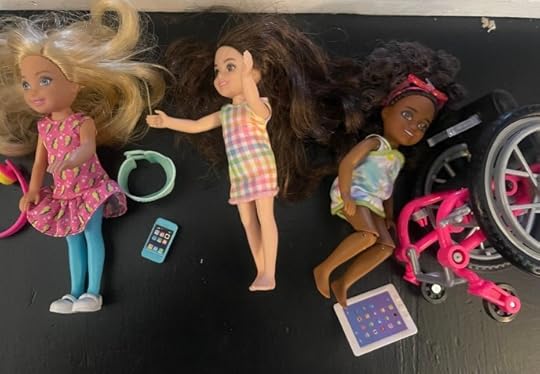 Dolls alongside accommodations that were removed (talkers, headphones, brace, wheelchair).
I sigh when I go to reset the dollhouse. Not because it’s weird for kids to rearrange or knock things over; I expect and honor creative child chaos. It’s because we live in a world where we daily fail to teach children empathy for people with disabilities, and that shows in how they play with dolls.
My own children, equally chaotic in their play, always make sure not to leave the autistic and cerebral palsy dolls without their speech output devices. They never take off the back brace for the Chelsea that needs it, and they always make sure to keep a clear path to move the wheelchair doll between rooms downstairs. (They still knock things over sometimes because it’s hard not to; they still move the sand sometimes.) The only other children who leave the doll accommodations in place are those with family members with disabilities, or a few whose moms are teachers.
I know this is not scientific data, but I am noting a pattern among generally thoughtful children who can play gently enough to not injure themselves with dollhouse furniture. These really kind, thoughtful, obviously well-meaning children see the accommodations as problems to be fixed rather than the solutions that they are in real life (for people, not dolls).
Maybe I notice this pattern so much because of how often it shows up as an obstacle in churches to the inclusion of people with disabilities. How often do you think of healing and imagine a “faith healer” telling someone to throw off their crutches or rise from their wheelchair? As I recounted in my book, Of Such is the Kingdom: A Practical Theology of Disability, the wheelchair is often the answer to prayer!
I think the disabled doll accommodations problem and the desire to force conformity to standard abilities as an expression of care are both rooted in a misunderstanding of what healing and wholeness are. When Jesus was teaching the sermon on the plain in the Gospel of Luke (parallel to the sermon on the mount in Matthew), He first healed everyone who came to Him. Then when Ge is about to start the teachings on the Beatitudes (Blessed are’s), St. Luke tells us that Jesus “lifted up His eyes on His disciples.” Y’all. The biggest takeaway for disability ministry is right there: not whether or not the people we serve are healed of all their disabilities, but that Jesus has placed Himself below His students so that He (God) is looking up to them when He teaches them. That means that He was healing alongside the people, too, not above them, but with them.
I wonder what would be different if we heard and taught about faith like that, about God humbling Himself to be below us like a servant, about God with us to heal us and to make our now and here holy and filled with the grace of His presence? Faith with disabilities means that we accommodate our weaknesses and needs the way God did by knowing us in His own flesh. Accommodating the needs of disabled bodies is how we get to each other’s level, to create a sacred environment to meet face to face (where God is; among us), and we who need a different light or a chair or headphones or talkers or Braille or captions or sign language or soft clothing or an explicit invitation to join in, can lift our eyes up to teach our abled community when we are treated with this dignity of welcome.
I have mentioned this before, and it bears repeating: the eyes of saints in sacred art are always looking up at you. The irises are painted touching the upper eyelid, so that no matter how exalted their location in a church or temple or shrine or wall, they look at you as Christ did, as humble, as one who is not here to patronize or condescend or figure you out on their own terms, but someone who already knows God and therefore already looks up to you in love.
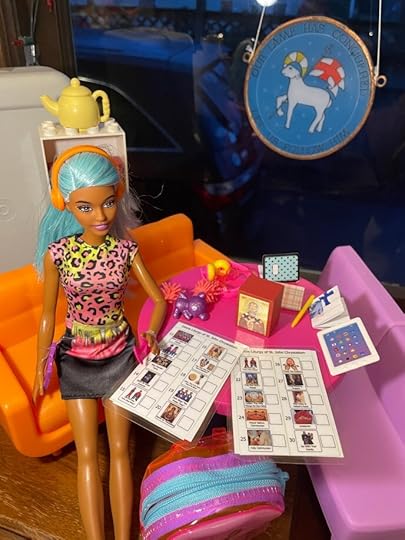
The little children who remove accommodations are welcome in our shop; I mention their patterns without resentment or offense. I hope that when they return and see the accommodations back in place over and over again that they will wonder why they are there. It’s easier to explain the accessibility aids with dolls than with people, after all. If I can show them the goodness of those dolls alongside holy imagery that shows disabled people as holy, too, even better.
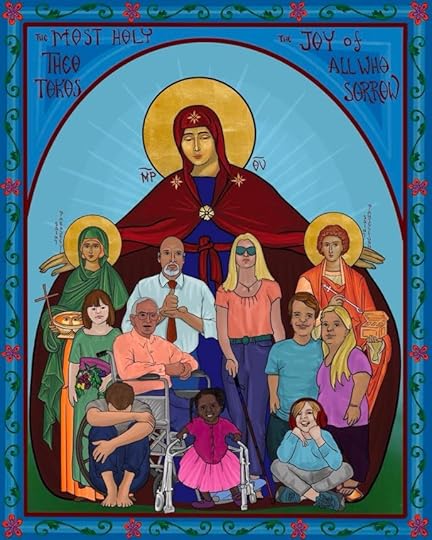 Digital icon of The Most Holy Theotokos the Joy of All Who Sorrow drawn with disabled people and saintly healers under Her protective cloak by Elina Pelikan.
I’m sharing this image I commissioned again so you can keep it with you. You can print it on a home printer for non commercial use. May our Holy Theotokos the Joy of All Who Sorrow help us to humbly approach one another with the love of her Son.
The post Accommodations are not a problem appeared first on Summer Kinard.
January 9, 2025
Talk Like an Autistic: Accessible Best Practices at Home & Church

Worlds collide
As an author and editor, I am always on the lookout for exposition. Exposition is when you list a bunch of information rather than revealing it through story. It’s also called “info dumping.” In movies or books, exposition is frowned upon because it’s boring, drags the story to a standstill, loses the audience. Even nonfiction books work hard to find a narrative pace to convey information, because humans are made for stories. We remember them because they connect us to our world and to others. As a parent to autistic children, I have always been wary of the tendency to info dump at children. Though well-intended, many interventions are largely ineffective for the same reasons that they would be ignored by the general population: They’re boring, lack empathy, and rely on info dumping. That made me think of one of the most often requested resources I have resisted making: social stories.
I recently realized why I don’t like social stories. It’s because they’re exposition, not narrative. My children never related to them. They DID love video modeling when they were trying to prepare for a new experience, though. Unlike social stories, which are basically lists of things to do with a loose framework saying that “I will do ___,” video modeling relies on the context of and empathy with another child talking about and demonstrating their experiences. To the extent that social stories work at all, they work off label, because of the way that empathetic teachers and parents modify them to explain them in narrative format. If I take my classroom into the empty church at the end of class in order to walk them through the process of kissing the Gospel, they’re going to watch me and each other in the context. They will understand because they’re living it. They will also understand because by modeling for them and telling them a story, I acknowledge the child’s humanity. It’s personal in the theological sense.
Narrative treats people as persons capable of knowing God. Exposition has the tendency to devolve into treating people like things (tasklists, checklists, objects rather than subjects in their own stories). The most basic difference in how I applied early interventions for my children was that I refused to dehumanize them into behaviors; I refused to act as though their job as humans was to make requests and behave; I refused to start with analysis rather than empathy; I told them stories and made everything a part of stories. Our best therapists were amazing because they used enhanced books and storytelling and songs to engage the kids in building language and modeling in person or on videos to help them build skills. Actual narrative, actual empathic engagement and story-telling, especially if you’re acting it out (facial expressions, mimicry, accents, gestures, dressup, skits, songs), builds up personhood.
What This Looks Like At Home
We are storytellers. We read books aloud. We describe the world in literal ways to make each other laugh. We personify inanimate objects and anthropomorphize animals so we can narrate them. We spend hours every day pausing shows to make quips and point out inconsistencies. We crave narrative, so we “unmask” by giving it to each other. We accommodate our need for stories by telling them, watching them, reading them, listening to them. We sing to each other with and without words. Half of our inside jokes are musical sound effects in everyday contexts.
I’ll turn on the Kiera Knightly Pride and Prejudice movie, lean towards my daughter, and whisper, “Why is she finishing a book at dawn? How was she reading in the dark before that? I think Lizzie might be a fey. She can see in the dark and walks throughout the night to read.” We call this movie “Literate Lizzie” or “Literature Elizabeth” for short to distinguish it from the other film versions of Pride and Prejudice. We mash up the characters with other fandom worlds, figuring out which Middle Earth characters would play Darcy and Bingley and Mrs. Bennet. If you’re thinking, that sounds fun, you are corrrect. It’s very fun. And this fun-having story-telling joy is the primary “intervention” for building language, motor planning, social thinking, and gestalt language processing in my children. We look like we are laughing and telling stories (true), and we are checking all the intervention boxes and meeting learning goals (also true).
I have a particular medieval version of “Verbum Caro” (The Word Became Flesh) that I call my “hold music.” Every now and then perimenopause brain or executive function overwhelm or apraxia or just radical changes of subject leave me with a few seconds of reaching for a word. When that happens, I look at the kids and start humming the tune. Everyone sings along. Sometimes when we’re all tired and goofy, we stand up and do contra dance moves to my mental hold music.
I want you to know this, to see how humanizing, how kind, how fun it can be to treat autistic each others as persons. We have so much fun and joy because we don’t treat one another as things (not even problems, burdens, or tasklists). When you start with radical acceptance, there’s a path for narrative, for joy, for growing to know God and each other. God sings to us, after all, and God is the one in whom we live and move and have our being.
What This Looks Like At Church
Narrative and empathy and personhood have always gone together in the church. In Ephesians we find the men and women Christians speaking to one another in psalms and hymns and spiritual songs. They sang one another into the story of God, showing each other their personhood. St. Romanos the Melodist/Hymnographer wrote hymns for women to sing; when the women of the city took up the songs and sang them throughout their daily lives at wells and in markets and in their fields and at their looms and over the stewpots, the converted the whole world back to the faith. There is nothing so good as singing to remember who and Whose we are.
Next to singing, the patterns we receive from the early church are embodied: those who could would go to the places where Christ walked. Those who were too far away would tell the stories as they walked or as they worked. Extended families and workers gathered in firelit medieval halls to hear not only epic poems but also the lives of saints. Women read the saints’ lives to their households. Men spoke of the lives in their fields. Some saints sang the calendar of saints before them and filled the year and the days with sung stories of God’s love, like St. Caedmon the cowherd who was given the gift of hymns by God and equipped with learning by the guidance St. Hilda; the people were converted through the catchy tunes and insightful words that opened their hearts to know God right where they were.
When we teach about God and the saints, we always act out the stories. We might use a few props like crowns or playsilks, or we might build the setting using modular foam couches. We always go through the actions, the way our forebears used inflection and accents and gestures and movement to tell the story that we also have received.
This approach also overcomes the tendency to treat Bible and saint stories like exposition, like social stories: unrelatable, something to get through, a checklist. So often Sunday school devolves into a task to read a story, color a picture, and maybe answer questions. But what if we treat the stories as living and our students as persons who are part of this living story? What if we sing and act out the stories and narrate our world with the elements we learn from the stories? What if we pattern spot and mix fandoms? This is how we read and reason theologically: to know ourselves and everything in the world in the context of the story of salvation.
How This Works in Sunday School
While social stories don’t help with the narrative, setting a pattern for classes does help. A visual schedule showing the class pattern is like a script’s stage directions, showing you where you will go and what you will do in order to participate in the story you are about to tell together. The story of salvation shows up like fractals in every tiny and minute part of our lives and also on the giant universal scale that boggles the mind; we access it by living it; we access it by telling it and acting it out. We follow a pattern because the choreography of the class time shows us who we are.
I’ve shared lots of class templates before (see the Disability Resources tab), but here’s one that works for ALL ages, any ages and abilities. Print it or put it on your tablet and use it as a class pattern to guide you in storytelling through the actions in your classes.

You can also download the PDF here:
class group plansDownloadFor the line about working on icons together, you can work as a class on making a large scale icon on the wall or a banner on a table, explaining and discussing the elements of the image as you work. It’s important that this be a side-along discussion and task, so that the class members are doing something together as they learn. If they’re learning to mix their own pigments or to smoothly apply paint on a separate paper, they should be with each other at one space. The group element teaches people that they are part of the group whose story this is.

Playing with a sensory anchor can mean using large scale props like play couches to build a setting, or it can mean scooping several pounds of mustard seeds in a bin to help you see how productive the one seed of faith can be when it begins to grow, or it can mean playing with a tray of sand and peg dolls to act out a story setting, or it can mean placing waterproof LED candles into a bin of water to talk about the light of the world in Christ’s baptism and our receiving the light in our baptism. The main goal here is that you are touching the faith somehow to make it known.
For the Be the Bee ending, you follow the advice of St. Paisios (free print available HERE) to be like the honeybee that seeks out the good. Use a bee finger puppet or a little bee toy (or one for each person) to go around the room and allow each person to say (using AAC like a speech output device if needed) or point to something good they experienced that day or that week. You can end by taking the bees to the prayer corner, showing that we bring everything back to God.
But This Works for EVERYONE, Not Only Autistics
Yes, exactly. Accessibility means best practices to include EVERYONE in faith, life, and learning. Autistics can’t do without best practices, but everyone thrives with them.
Want to learn more about accessible practices in life and faith? Follow and share, and let me know your ideas and questions in the comments.
The post Talk Like an Autistic: Accessible Best Practices at Home & Church appeared first on Summer Kinard.
October 21, 2024
Accessibility Book Club for Of Such is the Kingdom: A Practical Theology of Disability

In gratitude for 5 years since Of Such is the Kingdom: A Practical Theology of Disability was published, and in honor of its second print run, I am hosting a zoom book club each month at 8PM Eastern time (New York/Detroit) on the 3rd Monday of the month, starting on November 18, 2024. We will go through the book one or two chapters at a time, with discussion and time for participants to ask questions and share stories of how they are living their faith with disabilities and with loved ones who have disabilities. I’ll send updates for each month as the group develops, but I have in my heart those kind instructions from St. Paul as a pattern for our interactions. We can deep dive into theological ideas, too, but mostly we are going to experience God who loves us.
Take Courage!Be watchful, stand firm in your faith, be courageous, be strong. Let all that you do be done in love.
I Corinthians 16: 13-14
Since 2019, I have had the honor of speaking at many national conferences about accessibility and practical ways to welcome, accommodate, and include people with disabilities in the fullness of faith life. What began with my own journey of faith as an autistic woman with autistic children expanded through the many connections I made through writing this book, and I have had the joy of expanding a great deal on the educational and theological parts of the book. Lately I have found myself marveling at the ways that we get to know the joy and love of God more when we practice accessibility. Truly these sessions will be about encouragement, helping one another discern the courage-giving, joy-bringing, consoling presence of God with each of us.
Be VigilantYou already know how to do this if you’re living the disability life. We are not going to preach to the choir and tell you how to keep vigil. But let’s spend some time considering how we can keep watch for God no matter our circumstances. How will we see joy? It is good to love each other in our broken bodies. Let’s be myrrhbearers to one another, and let’s be oil-bringers, too, revealing the goodness of God in each other.
Stand FirmEven if you cannot stand and if you suffer infirmities, we are going to fan the flames of the fortitude given to us through life with the Holy Spirit. We are going to listen to each other and look at resources so that when we face the hardest times, we don’t give up. We’ll look at ways to stabilize prayer in your daily life even with the challenges that your family faces with disabilities. We’ll look at boundaries and how they need adjusting and how our anger can tell us when we need to make changes. We’ll talk about ways to deepen our faith that might not be typical but are part of the rich treasury of God’s life with us.
Let All That You Do Be Done in LoveWe are going to keep it real. A lot of “theology” suffers from abstraction, but we are going to stick with what we can do 1) TODAY and 2) With our ACTUAL NEIGHBORS, people in our real lives now. In this way we follow the teachings of our Lord to ask for help TODAY and, when we seek to love God, to also love our neighbors as ourselves. Disability life is not the place for perfectionism and scruples, but it is a way that can make us perfect in mercy and rich in virtues.
Thank you so much for reading Of Such is the Kingdom: A Practical Theology of Disability! I look forward to learning more with you.
The post Accessibility Book Club for Of Such is the Kingdom: A Practical Theology of Disability appeared first on Summer Kinard.
October 2, 2024
Unbearable: Freeing Holiday Traditions from “Trad” Tyranny

If you’re disabled, you are likely bracing yourself for the season of being treated as though your accommodations are lazy and your holy moderation is slacking. Welcome to pumpkin spice, baking, brightly dyed food, exhausting and time-consuming and inaccessible food producing season! Now with socially manipulative GUILT and EXCLUSION from community! Whether this is your first year with a diagnosis in your family or another round in the long haul, you probably face the stigmas of using accessible foods (cooking nuggets and pizza from the freezer; ordering out; meal prep services; eating very simple foods every day rather than as stop-gaps) and not being able to participate in illness-spreading, loud, chaotic, allergy-rich food-centered events. This post is to give a little perspective to my fellow families with disabilities as well as to those who love you. Your accommodated, accessible, quieter, simpler ways of approaching life are holy and beautiful and good, too. You are not less loved, lovable, or sacred for needing to modify celebrations. You were never called by God to be like the influencers; you were called to be like Christ and His men and women disciples and saints.
Nearly a decade ago, I wrote about the cult of domesticity, the nearly religious practices of keeping home that have the power to hold and heal. But like all good things, domesticity can be twisted into an attempt to gain power over others or to hold oneself in higher esteem than one’s neighbors. There are depths of beauty in the basin when we take up the towel to love others. But when we use our domestic practices as means of control rather than kindness, the twisted towel snaps you, spiraling out to harm the people it was meant to heal.
Perfectionism hisses from the dust-free shadows, “Wouldn’t you be happier if you got rid of everything that allows you to function this well?” It writhes through posts extolling daily elaborate family meals as a sign of spiritual strength and accessible foods as a symptom of spiritual laziness. When the inevitable boasting posts and arrogant presumptions that only certain types of feeding are good (usually applauding elaborate homecooked meals made from scratch by a woman who is described as having a calling to only cook, clean, and rear children in an overfunctioning manner that would have required a retinue of relatives or staff for anyone not trying to live up to this unasked-for, unholy, unneeded ideal), please, please do not take them personally or believe their claims. People who cook AT you or who market lifestyles AT you are not offering gifts FOR you (even and especially if they’re clergy or religious persons pretending like their promotion of “trad” perfectionism is for your own good rather than to ensnare you in a labyrinth of social controls that make you feel bad enough to buy their products). Y’all. Y’ALL. Perfectionism is not what Jesus had in mind when He told us to be perfect as our Father in heaven is perfect. He glossed this for us Himself by saying also, be MERCIFUL as your Father is MERCIFUL. Mercy feeds people; it doesn’t require showiness.
Look, the LORD Almighty God fed people bug spit for forty years in the wilderness. Bug. Spit. And heat-stricken birds. Then when the Son became Incarnate, He fed people fish and bread and wine, most of which He multiplied but only some of which He actually cooked. So like ancient lunchables. Sometimes He and His disciples snapped wheat grains out of the field, and we all know He was fond of foraging figs. There’s nothing in the scriptures to suggest that elaborate, inaccessible meals are better than plain, available, simple foods. The discipline was rather to not take more than one needed.
St. Gregory of Nyssa was explicit about how making a show of housekeeping with expensive bowls and implements is as foolish as trying to eat stones instead of bread. You cannot eat your silver platters, he warned us, but since you spent so much on inedible ornaments rather than feeding the poor, you are eating stones instead of bread. Our actions even at table are not for show but for mercy.
Tidy houses do show up in scripture, but not in a straightforward way. We see the woman sweeping only after she lost a coin, Martha chastised for mistaking housework for the highest virtue, and the swept clean house appealing to the demons. God argues with His people for centuries about how He doesn’t even want a house, and then He assigns men (not women) to do the housekeeping.
There’s a lot of pagan nonsense layered over the keeping of houses in the name of being “traditional.” Who does the chores, and more importantly, are they doing chores out of solidarity for a political vision? According to the logic of the trad movement, if I am washing dishes in my kitchen and handing them to my husband to dry, we are only doing it right if we pretend that my husband’s housework is optional and that we are doing chores for the sake of showing off someone’s political vision. This trad vision has nothing to do with what is actually going on: the mutual love and submission to one another that keeps Christ as the head of our household.
A political vision that hides Christ is not a vision at all, but rather like the narcissist who extols the “depths” of a shallow mud puddle because he can see his own shadow on the surface and looks no further. This year as we head into the winter months that have both religious and secular great feasts of domesticity—Thanksgiving, Nicholasfest, St. Lucy’s Day, the Nativity of Christ, St. Basil’s Day, Candlemas—don’t forget that it is not how elaborate your feast, but the love with which you feed that will sanctify your table. Rich or poor, disabled or abled, elaborate or simple, the act of loving another human face and feeding another human person is how we fulfill the greatest commandments.
The post Unbearable: Freeing Holiday Traditions from “Trad” Tyranny appeared first on Summer Kinard.
July 15, 2024
The Lord Sent the Word; Great Was the Company of the Women Evangelists
Women are made for Theosis! We have a calling shown in our scriptures, prayers, saints’ lives and tradition to teach and evangelize. The talks on Saturday brought to light some buried truths about women and God, and I hope you found them encouraging.
Thank you for joining me at the OCW Retreat last Saturday! Below you will find the slides, handouts, and some sources from the talk.
Did you know that the Myrrhbearing Women were fulfilling prophecy when they were the first to bear the glad tidings of the Resurrection? Many English translations of Psalm 68 (67LXX) obscure this fact, but our Paschal Stichera remember it! Want to know more? Contact me at summerkinard at gmail dot com to have me come speak to your retreat!
OCW-TALKSDownloadWe also talked about St. Veronica (follow this blog for an interactive lesson on her story in the Gospel of Luke 8, coming soon!), St. Irene, and St. Agatha. Other well known women saints known for their evangelism include Protomartyr and Equal to the Apostles St. Thekla and St. Nino Equal to the Apostles and Enlightener of Georgia.
In the second talk, “Great Was the Company of the Women Who Bore the Glad Tidings,” we learned that evangelism is bearing witness to what you know of God, to your personal experience of God with you. After looking at the lives of saints to see how we might share them as though they are real and examples of virtues, we participated in exercises to help us see our relationships with God more clearly.
Women-saint-interactive-flyer-DownloadFor further reading:
Peter Brown, The Body and Society gives an overview of the pagan view of women that still persists to a degree in our culture. (amazon affiliate link)
Never settle for a vision of women less than Theosis. We are made in God’s image in order to grow into God’s likeness. That is reason for women: Salvation.
The post The Lord Sent the Word; Great Was the Company of the Women Evangelists appeared first on Summer Kinard.