Jake Darst's Blog - Posts Tagged "quantum-physics"
The Lie That Passed Every Security Test
An off-the-books counterterrorism unit is in position. The meet has been confirmed, their target identified.
Then a data transmission is received—secure and encrypted. The target is on the move.
That’s unexpected, but no plan survives first contact with the enemy, so the team adapts. Confident in the intel sent from task force HQ, they move up their planned interdiction and mobilize.
Right into an ambush.
The message was encrypted.
It was authenticated.
It was trusted.
It was also a lie.

Stories like this make for great thrillers.
They’re also becoming a real concern for nations and their militaries.
The team trusted the message because every security check passed.
They believed it came from their task force’s secure command bunker in Pennsylvania.
It didn’t.
Even perfect encryption has a blind spot: it protects the contents of a message, but it doesn’t necessarily confirm its point of origin.
So how can you prove a message really came from where it says it did?
What if location itself became part of the security check?
That’s the idea behind Quantum Position Verification, or QPV.
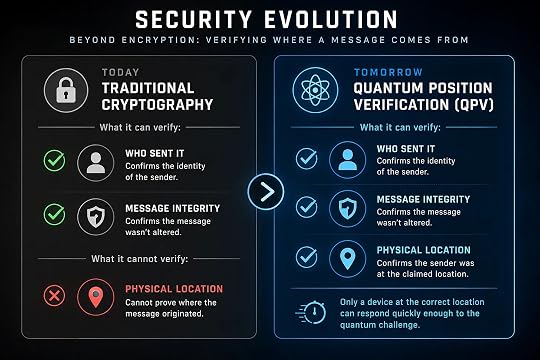
The physics gets complicated. The basic idea doesn’t.
Rule #1: Quantum information can’t simply be copied.
Imagine someone intercepts your message.
Normally, they could make a perfect copy, keep one, and send the other on its way.
Quantum information doesn’t let you do that. Trying to measure an unknown quantum state changes it. And because unknown quantum states can’t be perfectly copied, an attacker can’t simply duplicate the message and replay it later.
Rule #2: The speed of light has no exceptions.
You can thank Einstein for this one: Nothing travels faster than light.
Suppose a response is expected to come from a bunker in Pennsylvania. Physics tells you the earliest possible moment it could arrive.
If it comes from somewhere else—even a few miles away—it arrives a tiny fraction of a second too late because the signal has farther to travel. That delay becomes evidence that the sender wasn’t where they claimed to be.
This isn’t just a thought experiment.
While QPV remains an active area of research, the problem it addresses is very real. Governments are already hardening their communications against future quantum threats through post-quantum cryptography and other quantum technologies.
Once again, fiction is being chased by reality.
Then a data transmission is received—secure and encrypted. The target is on the move.
That’s unexpected, but no plan survives first contact with the enemy, so the team adapts. Confident in the intel sent from task force HQ, they move up their planned interdiction and mobilize.
Right into an ambush.
The message was encrypted.
It was authenticated.
It was trusted.
It was also a lie.
Stories like this make for great thrillers.
They’re also becoming a real concern for nations and their militaries.
The team trusted the message because every security check passed.
They believed it came from their task force’s secure command bunker in Pennsylvania.
It didn’t.
Even perfect encryption has a blind spot: it protects the contents of a message, but it doesn’t necessarily confirm its point of origin.
So how can you prove a message really came from where it says it did?
What if location itself became part of the security check?
That’s the idea behind Quantum Position Verification, or QPV.
The physics gets complicated. The basic idea doesn’t.
Rule #1: Quantum information can’t simply be copied.
Imagine someone intercepts your message.
Normally, they could make a perfect copy, keep one, and send the other on its way.
Quantum information doesn’t let you do that. Trying to measure an unknown quantum state changes it. And because unknown quantum states can’t be perfectly copied, an attacker can’t simply duplicate the message and replay it later.
Rule #2: The speed of light has no exceptions.
You can thank Einstein for this one: Nothing travels faster than light.
Suppose a response is expected to come from a bunker in Pennsylvania. Physics tells you the earliest possible moment it could arrive.
If it comes from somewhere else—even a few miles away—it arrives a tiny fraction of a second too late because the signal has farther to travel. That delay becomes evidence that the sender wasn’t where they claimed to be.
This isn’t just a thought experiment.
While QPV remains an active area of research, the problem it addresses is very real. Governments are already hardening their communications against future quantum threats through post-quantum cryptography and other quantum technologies.
Once again, fiction is being chased by reality.