
Alessa Ellefson's Blog
April 12, 2026


April 7, 2026
Process Vs End Product
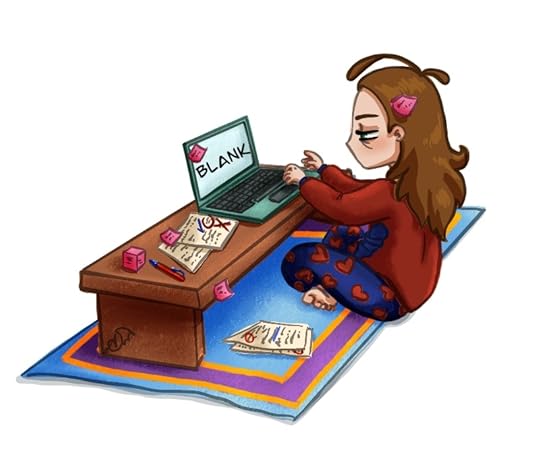
From the Youtube art video by illustrateria. With some modifications by me 🙂
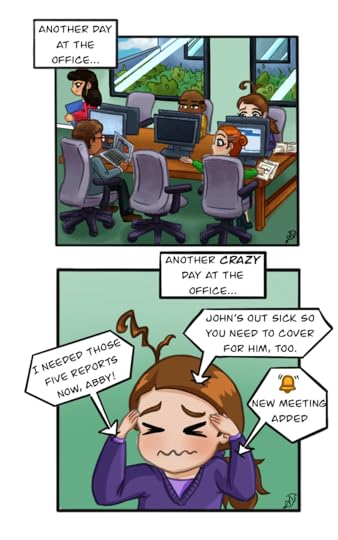
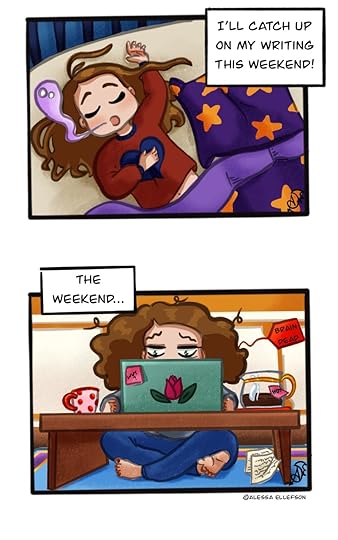
As a writer and artist, I have struggled mightily over the past decade (long story). And the more Life got in the way, the more difficult it became to get any creative work done, even on days where I had the time and energy to devote to it. Resistance, as Stephen Pressfield calls it, along with a healthy dose of guilt for not finishing all the projects I wanted to finish, have become such a Goliath, that procrastinating seems the easiest road to take (why do something now when you can put it off to tomorrow when you’ll possibly feel less overwhelmed?).
One of the key methods to combat this, which I learned in Dean Wesley Smith’s Productivity workshop, is that I should not think about the end product–that is, the finished book–if I want to actually write said book. Because doing so kills my Creative Voice. Thinking of the End Product shuts down my Muse. But if I focus instead only on the story, I ensure all my energy flows to it, allowing me to enter the magical state of flow, where words bloom from my fingertips and onto the screen with ease (or at least to do so more frequently). This, in turn, inspires more ideas and keeps me energized, even after a looooooooong work day (a virtuous cycle, if you will).
As Jessica Brody wrote in her January 30, 2025 newsletter The Weekly W.R.I.T.E.R. under the section “Wisdom,”
[M]y meditation teachers constantly remind me that the goal of meditation isn’t to feel peaceful and calm (though that can be a nice side effect). The goal is to practice being aware of your experience as you’re having it.
I’d argue the same is true for writing. Yes, the goal might seem to be “finish the novel,” but if it were the only goal, why not just hire a ghostwriter? Because the journey of writing the novel–that’s where the real value lies.
The ups and downs, the plot holes and plot fixes, the “this sucks” days followed by the “wait, I know how to fix it!” days–these are the real treasures of the writing process. Both writing and meditation brush up against something fundamentally human, but if we’re too focused on the outcome, we miss that opportunity.
Incidentally, this is also how I feel about using AI to “create” anything. Even without taking into account the fact that it’s all based on mostly stolen works and destroys the planet while also disintegrating the social fabric (there’s a reason scammers love AI), using such a tool takes away the magic of coming up with ways to share my work with you and the world. Even if my work is imperfect (spoiler: it totally is). And yes, I have so much I still need to learn, and growing can be painful (especially after an exhausting day at the day job). But, as Jessica Brody hints above, there’s nothing more rewarding that the feeling of having accomplished something I worked hard on (warts and all)!
March 16, 2026
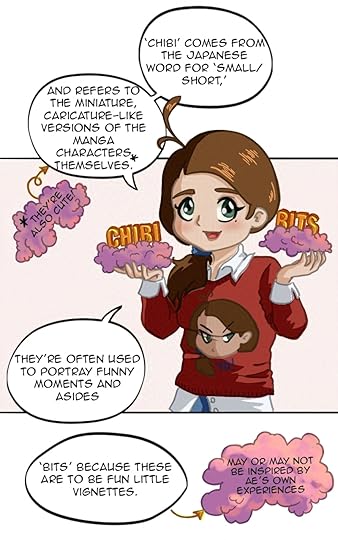
Lone Writer Chibits – An Intro
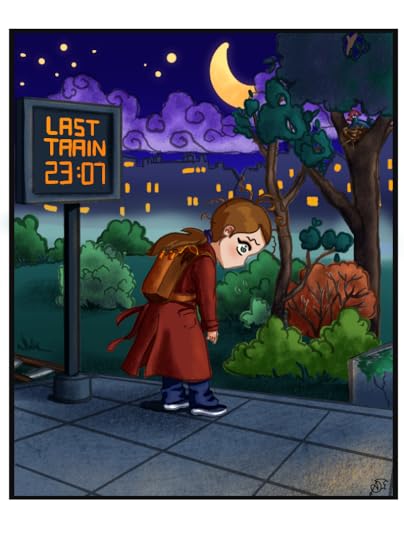
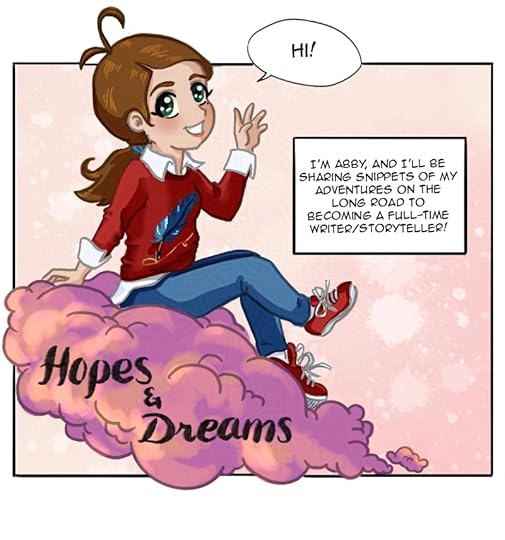
I’m hereby launching what I hope to be a series of whort webtoons (hence the chibits) inspired by my writing adventures–these were initially only meant to be shared via my newsletter, but they’re a little image-intensive, so I’ll be posting them here instead. I hope you enjoy these mini-tales!
January 24, 2025
RESTART
Now that January’s coming to a close, how are you holding up with your New Year’s resolution? Struggling? Given up already? Or, like a rare few among us, are you still going strong?
Well, I’m here to tell you that (1) it’s totally normal to fall off the horse and have a hard time to get back on it after (particularly if the horse bucked you off first and then kicked you in the teeth), and (2) you can trick your brain into starting fresh again!
Because the point, of course, is that you still hit those important goals, even if there’s a delay (better late than never, right?).
So, first of all, if you’ve missed your targets, don’t try to catch up by tackling on the gap from before to what you can physically (and mentally) do now. This would be adding too much stress on yourself, and potentially make you drown in Overwhelm, which make you even less likely to hit your goals this time around, and then make you feel even worse later (which could potentially induce you to quit altogether). For instance, if you had targeted to hit 50K new words on that novel of yours by the end of January (a reasonable goal for yourself because you know you can hit 2000 words a day without straining too hard), don’t suddenly tell yourself that you need to hit 50K words + the missing 25K words for February (which would mean you should be able to write close to 3K words per day). You should also stop wallowing in your supposed failure–all those negative emotions are not going to help you toward your goal.
Instead, wipe the slate clean. Do congratulate yourself for managing to already make some progress at all this month (it’s VERY important to get encouragement along your way to your goal, most especially from yourself), and then set yourself up for a fresh Restart.
So what is a Restart? It is a way to trick your mind into garnering the power of what Katie Milkman calls “the Fresh Start Effect.” (1) This effect is why new year’s resolutions, though not successful with most people, still have a higher success rate than randomly-set goals. New Year’s is a typical one, but so is the half-year, or your birthday, a new job, a death, or any date to which you attribute some kind of importance, essentially. Which means it could be February 1, if that’s your wish.
Why does doing a Restart work with respect to successfully pursuing your aspirations?
The reason, according to the paper, comes down to essentially recalibrating your brain by:
Create a clear break in your own timeline (a new chapter, if you will), so that you no longer consider your past mistakes or imperfections (negative feelings) but instead…You focus on the big, forward-looking (positive) picture.You’re essentially turning the page, closing a chapter in your life, and starting a new one.
This new way of approaching your life and your goals will ensure that you remain more positive than negative, and that you’ll continuously “fail forward” as Dean Wesley Smith likes to say. The latter being that you set yourself ambitious, but doable goals (you do need to feel the stretch, that you’re pushing yourself to some level, but not so much that you break or give up altogether). At the end of the period (the year, the semester, the quarter, the month, the week…), even if you haven’t hit your goal, you’ve still made progress vs. where you started, which is the whole point!
Finally, here’s something I regularly have to remind myself of: Enjoy the process, including the struggle of pushing yourself! Focusing on that, more than on the product (or reaching said goal), ensures you do not wallow in despair when/if you miss your target. It’s more about the journey than the destination, as people like to say.
So, what your new goal for February? You now have 1 week left to ramp up to hit your wanted stride 🙂 And if you miss? Dust yourself off, congratulate yourself on being where you are already, and then hit restart again!
Sources:
(1) The Fresh Start Effect: Temporal Landmarks Motivate Aspirational Behavior, by Hengchen Dai, Katherine L. Milkman, Jason Riis
January 10, 2025
Working With Your Genius
Both Steven Pressfield and Elizabeth Gilbert speak of daemons in their works The War of Art and Big Magic, daemons being the benevolent outside forces that guide our thoughts and hands to create art and stories and music… Our muses, if you will, but in a very personal sense.
It is called flow or being in the zone in modern speak, but these two descriptors fall, in my opinion, short of what’s expected of us to get into those states. Because reaching peak flow, or hitting the zone, sounds like it’s highly controllable, when, in fact, my experience is that it’s by releasing control–essentially handing the reins over to my daemon–that I produce the most (and most satisfying) words, that I can play the most beautiful sonatas on the piano, that I can illustrate the most touching images. Whereas, when I try to control the creative process, or focus on the technique, that’s when things get bogged down, or when my fingers stumble (to my piano teacher’s great distress at the time, which is why she spent more time threatening to throw me out the window than actually complimenting my playing!).
Elizabeth Gilbert writes in Big Magic,
“In ancient Greek, the word for the highest degree of human happiness is eudaimonia, which basically means “well-daemoned”–that is, nicely taken care of by some external divine creative spirit guide.”
I repeat: The Highest. Degree. Of Human. Happiness.
The Romans called this same external, magical presence at your sides, your genius. And, as Gilbert highlights, the key here is that you work with your genius (as opposed to you being a genius). Divine inspiration is a gift received through a contract with the Universe, whereby you agree to work with your genius on a particular set of ideas, to give them life through whatever medium you choose, and the Universe in return keeps feeding you more manna for your work. Until said work is complete (often leaving you in a state of stupor, and telling yourself, “Wait, I wrote/drew/played that?!”).
It is on this same premise that Dean Wesley Smith talks about the Creative Voice vs the Critical Voice. If you want to keep creating stories/art/music/etc., you need to give yourself up to your Creative Voice, and put the Critical Voice (the one that tells you it’s not good enough, you need to plan everything, you need more practice, you need to correct everything again and again) in the back seat.
The Critical Voice is the one that beats up your lucky daemon. And the more you give it amplitude, the more your daemon is going to flinch away from you…and potentially run away.
But this Critical Voice, which Steven Pressfield calls Resistance, is strong. Very strong. Because it plays on all of our deepest fears, even the ones that are so deep in our subconscious we don’t even know they’re there. And the more time and energy you give your Critical Voice, the stronger it gets (as you reinforce those “negative” brain patterns).
So how do you go about telling your Critical Voice to F off so you can be in the flow and let your creative genius work through you unimpeded?
There are many ways to go about it, but here are some methods that have worked for me (and sometimes you need to bait your Critical Voice differently, depending on the day):
Tell yourself that it’s OK to be scared. Your worries are noted. But you’re still going to go through with your creative goal.Find ways to make the process more fun (even if you’re redoing the intro for the 27th time).Congratulate yourself for every positive step forward (doing so aloud is even better!), no matter how small (teaches your brain to be less afraid of the Creative Process).Create a ritual to get yourself into the right frame of mind. A ritual is a habit with deeper meaning you attribute to it (which is why it’s important to know why you want to create this particular piece), and habits are processes that are so ingrained in your subconscious that your body resists less to it. For instance, your ritual could be to have your cup of coffee, light up a candle, be in your special thinking cap, and put on some death metal music on, then pick up your quill to write in your notebook, then doing so every day will get your body into this automatic set of movements and thought processes so you get to writing right away.Do daily meditation. There are many benefits to meditating every day, but one of them is that it teaches your mind to calm down and focus on only one thing at a time. Because you train your brain to do so already through meditation, when you sit down to write or paint or play the trombone, your mind already knows how to focus on only one item at a time, instead of trying to distract you with your email, and the news, and social media, and–oh, is that a spot I see on the countertop?!Be careful what you say–words have power! Reframe how you talk about yourself and your creative projects so you always talk about them in a positive light. Even if you’re currently on an early draft or thumbnail sketches stage that you wouldn’t want to share with anyone else. Not even once you’re dead! This also means that instead of talking about your creative endeavors as “work,” you should talk about them as quests, or adventures, or play. Anything to convince your brain that advancing on your projects is a great way to spend your time.Remind yourself of how grateful you are to be able to create at all. This instills and maintains a sense of awe inside you about what you’re accomplishing, which means, again, you’re more likely to get back to your project, even when it gets hard (because it will get hard–that’s a huge part of the business, a huge part of being human!).By complaining, “you’re scaring away inspiration. Every time you express a complaint about how difficult and tiresome it is to be creative, inspiration takes another step away from you, offended.” ~Big Magic by Elizabeth Gilbert.
Finally, remember that one of the first things fascists and dictators want to do is kill human creativity (along with human compassion and connection). So consider yourself a rebel, a Robin Hood of the arts, and dare to enjoy being creative!
July 5, 2024
Emotion And The Writer
I’m currently (re-)reading Techniques of the Selling Writer* by Dwight V. Swain, as it was recommended to me recently. The book is a basic for beginning writers, or anyone who needs reminders in some of the aspects covered within, which mostly revolve around writing fiction that resonates with readers.
Here’s an excerpt from the introductory chapter, on Emotion And The Writer, which I really like:
[E]ach of us experiences and responds to life differently, in a manner uniquely and individually his own.
Now all this is ever so important to the writer.
Why?
Because feeling is the place every story starts. (…)
As a writer, your task is to bring this heart-bound feeling to the surface in your reader: to make it well and swell and surge and churn.
Understand, feeling is in said reader from the beginning. You give him nothing he doesn’t possess already.
But emotion, for most people, too often is like some sort of slumbering giant, lulled to sleep by preoccupation with the dead facts of that outer world we call objective. When we look at a painting, we see a price tag. A trip is logistics more than pleasure. Romance dies in household routine.£
Yet life without feeling is a sort of death.
Most of us know this. So, we long wistfully for speeded heartbeat, sharpened senses, brighter colors.
This search for feeling is what turns your reader to fiction; the reason why he reads your story. He seeks a reawakening: heightened pulse; richer awareness.
This piece struck home because it made me realize just how important novels are, if they not only inspire us or provide us with an escape from the daily grind, but also help us reconnect with our heart…
*Disclosure: Affiliate links above are marked with asterisks (*). As an Amazon associate, I earn from qualifying purchases a small percentage of the sale, at no extra cost to you.
March 15, 2024
Writing Tools
I’ve recently (aka this month) changed my writing process, so that it’s more in line with Dean Wesley Smith’s technique of Writing Into The Dark* (there’s a great video on it here by Michael La Ronn). It’s essentially about writing without a pre-conceived outline (because writing outlines = using your critical voice = not conducive to being super creative). Instead, we start with our idea and start writing, trusting our creative voice (which we’ve been consciously and/or unconsciously developing since we’ve been told our first story), even if our creative voice occasionally sends us down dead ends (it’s OK, you can backtrack!). But that doesn’t mean there’s no outline. Instead, we develop the outline as we write the story (to ensure proper continuity, or easily figure out where we need to backtrack to when we do run into said dead end, or even to keep track of the storyline if we’re interrupted during the writing of it, or are writing a series).
So, I admit that I’m not following this technique 100%. I have planned my story to some level–at least the key ingredients I want to be in there. But instead of staying stalled trying to figure out how to link all these (often disparate) elements, I’m now writing into the dark. Which, as described by Dean Wesley Smith, is a lot of fun (even if I’m still struggling with brain fog and therefore my ability to describe things coherently).
And these are the tools I’m using while working on Harbinger, my current novel:
PlottrThis is where I’m keeping track of my plotlines, by both chapter, but also key beat scenes, and themes I would like to express in my story.It’s very easy to use, as I can move virtual flashcards as needed, and write on them as much as I want!You can alter colors as well, to make tracking easier. It’s very nifty! Particularly when you need to handle multiple point of view characters, or multiple plotlines.It’s very easy to export all your plotting (and other notes/developments) to another document as well!
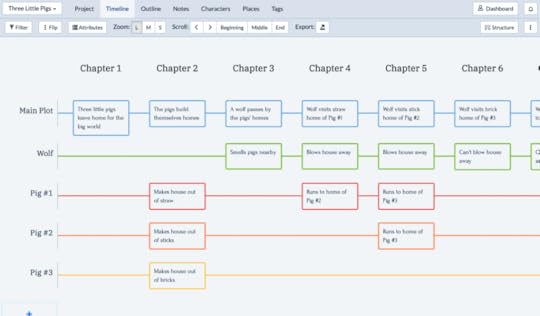
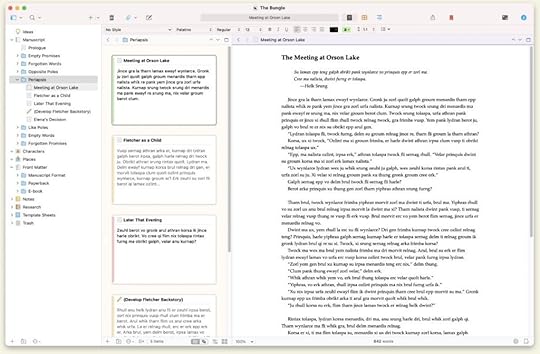
Hope this helps, and feel free to share any writing tools you may use that you find helps you develop your stories more easily!
*Disclosure: Affiliate links above are marked with asterisks (*). As an Amazon associate, I earn from qualifying purchases a small percentage of the sale, at no extra cost to you.
February 16, 2024
A Rolling Stone…
Steven Pressfield discusses in his book, The War of Art*, the impact of our own inner Resistance on our desires to accomplish our dreams. Resistance with a capital R, because there’s nothing stronger to stop us from accomplishing our dreams than our own inner voice, an inner voice that does everything in its power to hold us back, chiefly out of fear. But…
“Fear is good. Like self-doubt, fear is an indicator. Fear tells us what we have to do. Remember one rule of thumb: the more scared we are of a work or calling, the more sure we can be that we have to do it.”
Even knowing this, however, doesn’t get rid of the Resistance. Resistance is part of us, it will always be there. Even if we have published 100s of books, even if we’ve sold 100s of art pieces. It. Is. Always. There.

Which is why we need to find ways to overcome it. One of these methods is to ensure we have a Practice. As Steven Pressfield states in his own post on the topic, a Practice isn’t the same as a habit. A Practice is more encompassing (and can form habits). It’s a ritual we set for ourselves to ensure we keep doing the Work, no matter what. As the saying goes, a rolling stone gathers no moss. So we have to keep on writing, or doing art, even when we’ve just finished an epic work, we can’t rest on our laurels. We’ve gotta keep our Practice up.
This is where I err. All the time. The latest instance of this was after finishing my first illustrated book, Mighty Pax’s Misadventures: A Christmas Tail*, I celebrated by…doing nothing and enjoying the holidays. Instead, I should’ve been working on new illustrations to keep what I’d just learned up to speed (and even improving on my craft), and/or working on my new novel’s story. Which is why, though it’s already February, I’m still struggling to get the new and improved plan for my next novel up and running. Oh, there’s always some progress, but it’s nothing compared to what I could’ve already accomplished if I’d kept up my Practice. Because I gave Resistance time to catch up with my body. And in the meantime, my Resistance has grown tremendously, to the point where I often wonder whether I shouldn’t just quit altogether.
One of the methods to keep up this Practice is Jerry Seinfeld’s calendar method. Essentially, you have a monthly or yearly calendar up on your wall (nothing fancy or even big), and every day you write/illustrate, you get to cross that day off. The more days in a row you cross off, the more you get incentivized to not break the chain, so that even on days when you’re exhausted, you might find it in you to still sit down at your desk and get some progress done on your Work–even if just a couple of paint strokes or writing a couple new lines.
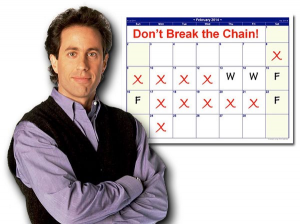
Maybe I should try that calendar method, too!
How about you? Do you have any methods to help your Practice on track?
*Disclosure: Affiliate links above are marked with asterisks (*). As an Amazon associate, I earn from qualifying purchases a small percentage of the sale, at no extra cost to you
February 2, 2024
Going Deep – F-R-E-E Writing
F-R-E-E Writing stands for Fast, Raw, Exact-but-Easy writing. It’s a stream-of consciousness writing exercise touted by Orna Ross (Irish author and poet, and founder of the Alliance for Independent Authors) as a great tool to plunge into the depths of your soul so that what comes out on the paper is as true to yourself as possible.
This exercise can be used in any number of ways, including as a journaling method, but also to get to the bottom of what drives you in your art. You think of a question–Why do I write? What kind of stories am I drawn to, and why? What theme really speaks to me, and why? What values do I want to embody in my business?–and you let yourself loose on the page. This exercise is also a great way to get you past your writer’s block, in which case the questions you try to answer would be more What’s my character most afraid of? Why did my character act this way? What theme am I exploring here, and why? Why does this conflict matter?
By exploring yourself, your stories, your characters and scenes in this manner, you can uncover what you’re trying to do or say, and use that to propel you onward.
How to go about this exercise:
Set a timer (5-10 minutes)Write as FAST as you can, no stopping, no re-reading what you’ve set down before, no judging. It doesn’t matter how your sentences are formed, if there are mistakes. You just keep going. No need to stress out about it, as no one else but you will read whatever pours out of your pen. This is just you having a deep and honest conversation with yourself!Let yourself be as RAW as possible. Dive into your subconscious mind, let it express itself fully, completely unfiltered. No judgment. No censoring. No repressed emotions. You’re getting your real truth down, baring your guts.You write things as EXACTLY but as EASILY as you can. When you write descriptions, be as precise as you can be, don’t let yourself be vague. You’re not talking about a person walking down your street, but about the star quarterback next door who likes to listen to Chopin on repeat so loud you know his Etudes by heart. You explore all of your senses on paper, make everything as vivid as possible. Draw on your own experiences. But you use terms that come to you easily. No need for flowery language, no need to reach for a dictionary or a thesaurus. Nothing can stop your flow, after all!Try this exercise. See what you come up with. You might be surprised by what you uncover!
Sources:
Freewriting Tutorial by Orna Ross
January 5, 2024
7 Deadly Sins of Narcissism
A crucial step I take prior to writing any novel is to understand all of my main characters fully. That means turning them into proper, 3-dimensional characters, with their goals, their strengths, their flaws, their fears, their dreams, their prejudices, their traumas… You get the picture.
“To plot, you need to know what people care about, and why.” ~Mastering Plot Twists, by Jane K. Cleland*
I do the same for my antagonists–the very people (or creatures) whose desires will war with those of my leads (aka the villains). For the stronger the opposing forces, the stronger the novel, as readers need to see the hero work and suffer to accomplish his goals, or it’s not a satisfying tale. And everyone loves a good villain!
A key attribute that many villains have in common, besides being sociopathic, is their narcissism. According to Sandy Hotchkiss in her book Why is it Always About You?*, here are the seven deadly sins of narcissism:
Shamelessness – the person shows no humility or shame for any of their actionsMagical Thinking – the person believes they’re flawless, God’s gift to the universeArrogance – the person’s conceited, and a braggartEnvy – the person will put down others to make themselves look good in comparison, no matter how egregious the assertionsEntitlement – the person expects others to give them whatever they desire, no questions asked, even if unearnedExploitation – the person will walk all over others to get what they want, and has plenty of knives to stick in people’s backs if neededBad Boundaries – the person sees others as belonging to them, as their serfs, there to do their bidding.Interestingly, a narcissist will therefore often be blind to what might appear evident to most others (the world, after all, doesn’t actually revolve around them and their wishes). And this can create a lot of delicious (or, in my case, hair-raising) conflict!
Do you have any characters who are narcissists? If so, which of these deadly sins is most prominent in them?
*Disclosure: Affiliate links above are marked with asterisks (*). As an Amazon associate, I earn from qualifying purchases a small percentage of the sale, at no extra cost to you


