Greg Marcus's Blog
October 30, 2025
How Much Space Should I Take Up? A Mussar Reflection on Humility
 How Much Space Do We Take Up?
Lately, I’ve been thinking a lot about the space we take up in the world.
Not just physical space, but emotional and spiritual space, too — in relationships, in community, and especially in leadership. I’ve stepped into a role where people tend to look to me for direction, and that’s a gift. But it’s also a responsibility.
Because leadership isn’t about talking the loudest. It’s about knowing when to speak… and when to step back so others can rise.
The Question: How Much Space Should I Take Up?This question sits at the heart of the Mussar practice of Anavah — humility. Alan Morinis captures it beautifully:
“No more than my space, not less than my place.”
I am in a new leadership position, a position that naturally invites me to take up more space. Some of it is appropriate. I am the spiritual leader in the community. However, there are many other leaders, including the Board and my clergy partner. My job is not to override them, nor is it to dictate to congregants what they should or should not think about politics or Israel. I view my position as rabbi as I view my position in the American Mussar community – guide and empower others on their spiritual journeys.
The running of the synagogue is a partnership. In fact, I try to be very careful about what I do and do not ask for, because congregants and volunteers will want to do what they can to meet my requests. I’ve experienced too many leaders who take up too much space, sending people running left and right to meet a flurry of requests. In fact, I’ve been that leader.
I’ve taken up too much space before. And I’ve also held back when my voice or presence was needed. Getting it right is a practice — a lifelong one.
Mussar Reflection: Where Do You Stand?So I’m asking myself daily:
Where is it mine to act — and where is it mine to step back?
Some days the practice is stepping forward.
Other days it’s creating space for someone else to shine.
How about you?
Where in your life could you take up more space — or less?
Let this be a gentle invitation to notice the size of your presence. Not to shrink, and not to dominate — but to stand in the right-sized space that’s truly yours.
Your TurnWhere are you practicing this balance in your life?
Please share below. I try to answer every comment.
And if you’d like more Mussar reflections like this one, subscribe to the American Mussar newsletter
The post How Much Space Should I Take Up? A Mussar Reflection on Humility first appeared on American Mussar.


September 11, 2025
When 9/11 and Elul Collide: A Mussar Reflection on Life and Death
 Photo by Richard Fullbrook on UnsplashWhen 9/11 and the 18th of Elul Fall on the Same Day
This morning, during my daily Psalm 27 meditation, I was struck by something unusual: September 11th coincides this year with the 18th of Elul.
Elul is the Jewish month of contemplation and reflection before the High Holidays. The 18th, meanwhile, corresponds to Chai, the Hebrew word for life. And of course, September 11th is the anniversary of the attack on the Twin Towers in New York and the Pentagon.
Contemplation. Life. Death. All on one day.
Sometimes my writing leans toward clarity. Today, it feels more like poetry. Because this year, the convergence of these two dates stopped me in my tracks: 18 for life, 9/11 for loss.
Holding Life and Death TogetherIt has already been a difficult week. Just yesterday, a teenager in Evergreen, Colorado, shot two classmates and himself. On the same day, conservative podcaster Charlie Kirk was assassinated while speaking on a college campus, his killing broadcast across TikTok.
And yet, on the other side of the ledger, there is life: Elizabeth Tsurkov was released from captivity in Iraq.
We are grateful that more people were not hurt in Evergreen, and still devastated knowing how many were traumatized. We grieve violence in our politics and feel the danger of what may come next.
Contemplating life and death is unavoidable. But Mussar teaches us not to immerse so deeply in sorrow that we lose sight of blessing.
Mussar Soul Traits for Days Like ThisWhen I looked at the Mussar Center’s list of middot (soul traits), two spoke to me:
Self-Control (Perishut) – not giving in to despair, rage, or hopelessness.
Strength (Gevurah) – the courage to hold grief, while also making space for gratitude.
These traits remind me that even in dark times, we are not powerless. Mussar offers a path to respond with balance—feeling the weight of loss while still reaching for life.
Your TurnWhich traits speak to you today? When the world feels heavy, what inner qualities do you lean on to steady yourself?
I’d love to hear your reflections in the comments below.
—Rabbi Greg
The post When 9/11 and Elul Collide: A Mussar Reflection on Life and Death first appeared on American Mussar.
August 28, 2025
July 10, 2025
Finding Awe During Life Transitions: A Mussar Perspective
 Photo by Andrew Ly on Unsplash
I have a lot of change in my life right now.
Change is inherently stressful. Even good change—like moving to something exciting or meaningful—can stir up anxiety, disorientation, and overwhelm. It turns out that moving is consistently ranked among the top of life’s most stressful experiences. And right now, I’m deep in it.
In the middle of these changes, I came across a teaching by Rabbi Tali Adler on this week’s Torah portion that helped me shift my perspective. It reminded me of the importance of Awe—Yirah—as a spiritual anchor during times of change.
Two Prophets, Two ResponsesRabbi Adler compares Moses and Balaam—both prophets, both people who could perceive the Divine directly. And yet, when faced with something unexpected, they responded in very different ways.
Moses sees a bush that burns but is not consumed. He turns aside with curiosity. He listens. That moment of awe-filled attention changes the entire course of his life—and ours.
Balaam, on the other hand, encounters a talking donkey (which, yes, is objectively wild), and responds with anger and violence. He can’t make space for the possibility that the world is different from how he expected it to be. He misses the miracle right in front of him.
Rabbi Adler’s insight? Balaam couldn’t access awe—because he was too attached to his expectations. His certainty closed him off to the sacred in the moment.
Mussar and the Middah of Awe (Yirah)In Mussar, Yirah isn’t just awe in the sense of standing before a sunset or a mountain. It’s a soul-trait, a way of orienting ourselves to the mystery and grandeur embedded in everyday life. It’s what allows us to see that there might be more going on than we can immediately understand.
Right now, as boxes pile up and my routines unravel, I’m trying to remember that. That beneath the stress of moving, there’s a sacred opportunity—if I’m willing to notice it.
It’s not easy. Yirah doesn’t mean pretending things aren’t stressful. It means approaching the stress with a spiritual posture of curiosity rather than judgment. And it begins with a small but powerful shift: the intention to be open to wonder, even here.
An Invitation to YouI know these are stressful times for many of you as well. We all have moments—big and small—where life veers off the expected path. The middah of Yirah invites us to ask:
What might be sacred about this moment, exactly as it is?
So let me ask you:
Have you ever had a moment of unexpected awe or possibility when you chose curiosity over frustration?
I’d love to hear your story. Feel free to reply or leave a comment. Maybe together we can help each other recognize the burning bushes hidden in plain sight.
The post Finding Awe During Life Transitions: A Mussar Perspective first appeared on American Mussar.
June 25, 2025
Five Mussar Traits to Help You Move
[image error] “I love packing and moving!”
Said no one, ever.
After 22 years in the home where we raised our children, Rachel and I are preparing to move to the Denver area, where I’ll be starting as the new rabbi at B’nai Torah in Westminster. It is a huge transition, that impacts the body, mind, and spirit. I’ve noticed a lot of soul traits in play helping me along the way.
Moving is also a metaphor for getting unstuck, which is very much in the Mussar wheelhouse. When we are stuck, it is hard to find a path forward, and sometimes we don’t even know where to start. Maybe one of these five soul traits can help you “get moving” as well.
Mussar Trait 1: Enthusiasm / AlacrityAs a reminder, the trait of enthusiasm is not about the rah-rah—it’s more about taking action. Another translation is alacrity, which means to be prompt and cheerful in taking action.
I can’t say that I was always cheerful, but when we were in Denver looking for a house to rent, we needed to make decisions quickly. We decided to proactively keep checking Zillow for new listings. The house we rented was one that became available the day we arrived, and we were the first to see it the next morning. We applied immediately—on a phone while eating sandwiches at a local deli.
Where can you apply alacrity to help you get moving?
Mussar Trait 2: OrderPlanning, planning, planning. We have several spreadsheets and lists to break down this monumental task into doable chunks. We also bought a big pack of red, green, and yellow stickers to label furniture and other things around the house so we can immediately see what we want to bring, and what we want to get rid of.
How might a list help you get moving?
Mussar Trait 3: SilenceThis trait governs when we should speak and when to remain quiet. Moving is one of the most stressful things people go through, and there have been several times when I’ve had to hang in there and listen during a stressful moment with my partner. I’ve also tried to ask for what I need and ask for clarity if I’m not sure what my partner needs.
How might better communication help you get moving?
Mussar Trait 4: PatienceIt doesn’t matter how much I wish I could just skip this part and get to the end. That is not the way the world works. There is a lot of “grind it out” work that needs to be done in a move. It’s not necessarily fun, although there is a satisfaction in getting rid of things that no longer “spark joy,” as Marie Kondo would say.
Patience is about enduring an uncomfortable situation that we have little control over. Yes, I made the choice to move—but that set off a chain of events that I can only ride and not control. As the mantra reminds us:
“This too shall pass, and I have the strength to get by until it does.”
How might patience help you reduce your suffering as you work to get moving?
Mussar Trait 5: TrustTrusting in the Divine. Many of us are uncomfortable bringing God into everyday life, and don’t really believe in Divine intervention. You don’t need to in order to benefit from trust.
“Trust in God but tie your camel” is the mantra. It reminds us that there is only so much we can do. It is easy to get caught up in worry about the future.
“What if my new congregation doesn’t like my ideas? What if I don’t make any new friends? What if the plane gets delayed and the cats wake up and start yowling?”
Trust helps us combat worry by reminding us that we do our best to prepare, and at some point we need to let go of the outcome. In the end, I really do trust in the Divine / the Universe / myself that everything will be okay.
How might trust help you worry less and get moving?
Bonus Mussar Trait: GratitudeRecognizing the good—the essence of gratitude—is a never-ending font of energy.
And as always, I am super grateful for this community. I look forward to resuming our weekly gatherings on Zoom August 28th.
Which of these traits can help you get moving?
Please reply or leave a comment and let me know. I’ll do my best to answer.
The post Five Mussar Traits to Help You Move first appeared on American Mussar.
January 17, 2025
Finding Trust in a Troubled World: A Mussar Perspective on Worry
 Trust in God but tie your camelDo We Really Stop Worrying When We Trust?
Rabbi Bachya ibn Pakuda, in his 11th-century Mussar classic Duties of the Heart, taught:
“One who trusts in the Divine neither worries nor laments.”
Do you buy it?
Not all of us are sure about the Divine. And I don’t know about you, but I’m doing a lot of worrying and lamenting these days. Worry is fear for the future, and lament is sadness for the present or past. I don’t need to list all the reasons to worry or grieve in the world right now—you already know them.
The Promise of TrustIt sure would be nice to let go of the worry, to spend more of my mental bandwidth in the present. Whether you take ibn Pakuda’s teaching literally or metaphorically, Trust is a cure for worry because it is an exercise in hope. Whatever we believe about Divinity, we can hold on to hope—for a better future and for the power of community to make things better.
What About Grief?But what about lament? Should we let go of that too?
Yesterday, I attended a funeral for someone special. I also have many friends impacted by the fires in LA, including members of our community who lost people close to them. It would not be appropriate to “spiritually bypass” grief in the name of Trusting in the Divine. And I don’t think that’s what our tradition asks of us either.
Rather, we might look toward the Divine—or toward something greater than ourselves—as a source of comfort in difficult times.
Trusting… But Also Tying Our CamelsFinally, a reminder: Trust, like all Mussar traits, should be practiced in balance. We still have work to do. As I put it in my book The Spiritual Practice of Good Actions:
“Trust in God, but tie your camel.”
A camel will run off if you don’t do your part to take care of it. And we need to do our part to create the world we want to live in. Worry and lament can lead to paralysis—but these times call for action.
How does this idea of Trust land with you? Comment below—I’d love to hear your thoughts.
Want more on Trust? Check out the recording of the American Mussar weekly gathering that was inspired by this blog post.
The post Finding Trust in a Troubled World: A Mussar Perspective on Worry first appeared on American Mussar.
July 25, 2024
Mussar Chesed Story of Comforting a Mourner
 Comforting the mourner is one of the most important things we can do
I am delighted to share an inspiring Mussar Chesed story. As a reminder, Chesed means going above and beyond to support another person without expecting anything in return.
A while ago a Rabbi’s mother died. She was in her 90s, and he had been the Rabbi at a medium sized synagogue for several decades. She zoomed into every service, and he would say “hi mom” in a very loving and affectionate way each time. Everyone in the service felt a connection to his mom.
The Rabbi stayed home for a week for shiva (the traditional seven days of mourning after the burial). Each night there was a memorial service in his home, when 50 plus people showed up to support him. When he returned to work after a week, he asked the community to come to the synagogue for a 30 minute afternoon service each day at 5:00, to let him say the Mourner’s Kaddish, with the traditional minimum of ten people. He was vulnerable and transparent that he wanted and needed to be uplifted by the community.
I had never been to the afternoon service in my life, but I wanted to be there for him. And I was not alone. Both times I went there were dozens of people, some of whom were not even members of the synagogue any longer.
When we lose a loving parent, the level of loss can’t be described. Our tradition prizes “comforting the mourner” as one of the most important things we can do. It was heartwarming to see someone who had given so much of himself over the years be supported in his time of need. We can’t fix their pain, but we can give comfort by showing up.
As it says in the Talmud, “Just as the Divine comforts the mourner, so should you comfort the mourner.” Whatever you may think of the Divinity, I hope you can relate to this idea of having a model and inspiration to help you show up for someone in need. In this case, we have hundreds of people to inspire us to practice Mussar Chesed.
Photo by Lyyfe Williams on Unsplash
The post Mussar Chesed Story of Comforting a Mourner first appeared on American Mussar.
July 14, 2024
Mussar Chesed As a Focused Practice
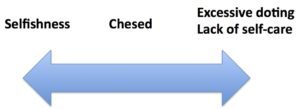 Spectrum of Chesed from too little to too much
One of the foundational principles of American Mussar is “No Hebrew except for the word Mussar.” This is a critically important plank that helps make Mussar accessible, because Hebrew is a barrier, sometimes causing shame in people when they don’t know what a word means. (And I’m speaking from personal experience.)
However, I need to make a second exception to also use the Hebrew word Chesed instead of LovingKindness. Chesed doesn’t really translate well to English. The closest I can come is going beyond the minimum for someone else without expecting anything in return.
I wrote my thesis about Team Chesed, a voice in Jewish text that puts Chesed on an equal or greater footing than the legal commandments in the Torah. next Mussar cycle will focus on Chesed. Our eighth Mussar cycle starts with Chesed instead of Humility. Then as we move on to each new soul trait, we’ll spend some time exploring how it relates to Chesed. These are free weekly drop in groups that meet on Thursdays at 4 Pacific on Zoom. Sign up for the email list here to get the zoom link. This focused Mussar Chesed practice should be fun and illuminating.
Like all soul traits, too much Chesed causes as many issues for us as too little Chesed. Too much Chesed can lead to a lack of self care while too little Chesed can lead to being self centered, or even selfish. By understanding where we sit on the spectrum, we can focus our practice on things to bring us towards balance.
Where do you fall on the spectrum of Chesed? As always, I’ll reply to every comment.
The post Mussar Chesed As a Focused Practice first appeared on American Mussar.
July 3, 2024
Mussar Hitlamdut This Fourth of July
 Mussar Hitlamdut on the 4th of July sparks inspiration
I’m thinking about how to approach this fourth of July, the great American holiday of our independence. Recently in Paris, I became inspired to read a biography of the Marquis de Lafayette, who was a hero of the American and French Revolutions. He was a true idealist, who worked hard to live his values even when inconvenient or at personal cost. For example, when the Revolution outlawed the Catholic Church, he believed so strongly in the freedom of religion that he continued to support his wife working with a Catholic priest, even though it undermined his position as Commander of the National Guard.
At the same time, Lafayette had his blind spots, especially when it came to King Louis’ loyalty to the Revolution and creation of a constitutional monarchy. Lafayette was completely blindsided when the royal family fled, and left behind a note denouncing the Revolution.
To me this represents the challenge of a Mussar practice. How do we live up to our values while living in the real world? It is one thing to knowingly take an unpopular stand, or to make a values-driven decision that can have consequences. It is quite another to face consequences for the actions of someone we trust.
One important practice to help us on our journey is Mussar Hitlamdut. Rabbi David Jaffe teaches that, “Hitlamdut is the practice of cultivating a stance of non-judgmental curiosity towards our experiences, and making what we learn deeply impact our lives.”
This 4th of July, I’ll take some time reflecting. What do the American values of liberty and equality mean to me? Are they expressed in how I show up in the world? What is my truth for the state of the country, and how does that truth differ from other viewpoints? How do I show up with people with whom I differ? Am I putting my trust in the right people, both in my life and more globally? What is in my control, and what isn’t?
And more importantly, how am I showing up in my own life? Am I taking anyone for granted? Am I trusting anyone blindly? Am I living up to my values in my relationships big and small.
Some big questions on the birthday of a big country is a lot of fuel for my Mussar Hitlamdut. Wishing you a joyous and reflective fourth of July.
I have a favor to ask. With the audiobook version of “The Spiritual Practice of Good Actions” due out in a few weeks, it would be helpful to have some fresh reviews on Amazon and Goodreads. If you’ve read the book, could you please take a moment to leave a review? If you are interested, you can hear a preview of the audiobook here.
Photo by Spenser Sembrat on Unsplash
The post Mussar Hitlamdut This Fourth of July first appeared on American Mussar.
June 2, 2024
Mussar Reflections On Becoming a Rabbi
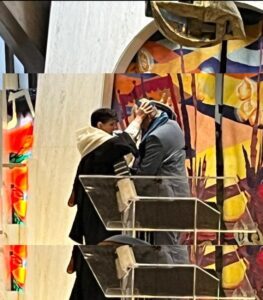 Even though my wife and I lived together for over a year, things felt different after we were married. I felt more settled, and in hindsight maybe a bit more whole. I felt a bit of that after my ordination becoming a rabbi.
When I finished my Ph.D, I felt a great sense of accomplishment. I remember clearly thinking, “No matter what happens, no one can take this away from me.” I put a lot of work in, and earned that degree. I felt the same way the evening of my ordination.
But the next morning, something amazing emerged. While my Ph.D. was an individual accomplishment, becoming a rabbi was a group accomplishment, a community accomplishment. I wrote the following when I first woke up, which has only slightly been edited.
I feel like a tree, with roots deeply embedded with my wife Rachel. But not just roots – vines, vein and arteries, and too many capillaries to count. She supported me through the day with such deep love. The toast she gave about me was special. She described someone who loves family and community; someone who is dedicated to their well being and also is dedicated to making the world a better place. And that someone was me. And I felt it and believed it. And my kids and cousins and friends who traveled to be there – the cheer everyone gave me was so filled with love. It felt wonderful, and I felt a great peace in my body taking it in. Not an ounce of discomfort. And I feel deeply embedded with them. Roots and rhizobium going back and forth. It was what Martin Buber would agree was a true “I Thou” moment – there was not an ounce of individuality – we were all in the moment, just souls together.
And I shared the ordination with twelve other people, three of whom I am particularly close with. It was a group accomplishment. We went through this together. The classes, the thesis and the ordination. We were in the here with each other and for each other. And when we went back to our seats after the Beit Din conferred ordination on all of us, we laughted and danced and cheered right along with the hundreds of people who were there to support us. It was a true moment of communitas.
I feel floated and sustained by our Jewish community, and I sense the neshamas, the souls, of the disconnected among us. Each one has a life beacon, calling for help and yearning to plug into the network. It is like the tiny people of Whoville, all crying loudly together – we’re here we’re hear we’re here…
At breakfast after I wrote the above paragraphs, I could literally feel lines of connections to the people around me. Alas like all experiences of I-Thou or communitas, it was transitory. By the end of the day, my normal perceptions of the world returned. Yet the memory of that connection is strong. Such experiences are rare and a gift.
The great 20th Century Mussar Master Rabbi Shlomo Wolbe taught that Hitlamdut was the most important Mussar practice. Hitlamdut means self reflective learning. He taught that every day we should learn something based on what we are experiencing and the demands of the moment. This is a time of incredible transformation that goes beyond a new career. I can’t wait to see where it goes.
Have you had major transformations or transitions in your life? What were they like? Please comment below – I’d love to know and promise to reply to every comment.
The post Mussar Reflections On Becoming a Rabbi first appeared on American Mussar.