C.J. Stone's Blog
November 24, 2025
Free Party Chronicles: CJ Stone in Mixmag
Mixmag : 1996-1998
 Strange Revelries
I was in the pub Sunday evening. A couple of my friends run a chill-out session down there, playing a few choice American house tunes, chucking back a few cold lagers, a bit of a chat, a bit of a dance: generally gentling down the ravaged psyche after the delirium and mayhem of the weekend.
Someone I hardly knew came up to me. “I know what you’re up to, ” he said belligerently: “it’s all bullshit. Politics and dancing don’t mix.”
Well he’s the son of an ex Labour councillor, which kind of explains his bitterness. He’s probably been subjected to years of abuse at the hands of political bores: years of leaflets and canvass returns and those infinitely dreary debates on the Gothic intricacies of political in-fighting. You can’t help sympathising with the man.
But it set me thinking. Do politics and dancing mix? Well no: obviously not. Try leaning over to your loved one on the dance floor and whispering sweetly: “excuse me, but do you happen to think that the balance of payments represents a true measure of wealth creation, huh?” I’m not all that sure that it would work as a chat-up line. And we all know the classical Anarchist slogan: “Whichever party you vote for, the government always gets in.” I don’t blame anyone for considering the whole sorry business a Class A con from beginning to end.
But you can’t deny that politics affects you. The cursory refusal to grant a license to the Tribal Gathering event recently shows that – whether politics and dancing mix or not – politics can have an influence on your leisure time and therefore on your dancing: in this case it can stop you enjoying your leisure time altogether. So its not so much a question of whether politics and dancing mix, as of how far the political establishment will go in order to have a say in the ordinary choices you make in your daily life. Political forces can cut across the dance floor, can muscle in on your personal space as it were, in such a way that in the end you have no choice but to address them.
New Home Office guidelines recommend a variety of measures that will certainly affect the way you dance in future. The guidelines set out to “encourage local authorities to exercise their licensing responsibilities in such a way as to safeguard the health and safety of young people at clubs and dance events, and to reduce the supply of drugs.” Measures include the availability of drinking water, the provision of rest facilities, the monitoring of temperature and air quality. So far, so sensible. But it goes on to state that “the government is opposed to information or facilities which suggest that drug-misuse is tolerated or which understate the legal or health risks.” In other words, there will be no leaflets on harm reduction, no advise available, and – certainly! – no drug testing facilities, such as those available on the continent, to make sure that the drug you’ve bought is what it says it is. So next time you find yourself with a massive dose of toxic MDA in your system, instead of the gentle promise of MDMA: remember, it’s government guidelines which have determined this.
Other recommendations in the circular are as follows:
“… the organisation of legal dance events be encouraged by local authorities exercising maximum discretion in the granting of licenses and by involving responsible organisers in the process.” In other words, it will be the same bunch of slick club owners – fellow Freemasons all – who get the right to organise club events, as they have always done. Maximise profit, minimise enjoyment. And – most of all – keep the free party-organisers – the enthusiastic amateurs who really love the music and who know how to throw a good party – out of the picture for good.“… liaise with the police to consider what steps might be taken to assist with surveillance. This might include video surveillance equipment to monitor activity.” By “activity” they mean what you and I get up to in the course of our ordinary lives. In other words: “Big Brother is watching you!”Safety measures will include “… preventing access to potentially dangerous dance sites (such as on top of speakers or on balconies).” There’ll be a few poseurs and happy show-offs upset by that one. Personally I think that if anyone wants to get up in front of a few hundred tuned-in revellers just to show us how well they dance, then they deserve to break a leg or two. It’s a free choice, mate.And finally “… at all night events, long events and during hot weather ensure that there are several adequate breaks with no music…”Are they serious? Is this what we can expect in the future: ten minute breaks in the music so that we can all re-orientate ourselves? Imagine the mayhem. I can imagine riots breaking out all over the place if they take that one to its logical conclusion. I can just see all the lights going on, and the management breaking up the huddles on the dance floor. “OK, everybody: time for your breathing exercises! Deep breaths. In – Out – In – Out. Now we want you to all lie down on the floor and relax. That’s it. Feel your body floating… You are feeling calm and relaxed, all the muscles in your body are relaxing. Relax, relax. Let your mind drift with the silence…etc. etc…” Ten minutes of enforced silence at the government’s behest. Whatever next?
No: politics and dancing don’t mix. But there are times when you have to take time out to reflect, or you may wake up one day to find that there’s no music left to dance to, and that dancing has suddenly become a crime. You have been warned!
 Brighton Direct Action Conference
I was in Brighton for the “Direct Action” conference. It was being organised By Justice? who I’ve written about before. I never quite know how to say the name. That obviously critical question mark leaves you in some doubt whether to say it as a question, with a rising tone at the end.
Justice? are the organisation – or loose collective of individuals, rather – who write the wonderful SchNEWS free sheet every week. If you want to know where the party is, where the protest is, where the demonstration or the action is, then get SchNEWS. All of this and the “crap arrest of the week”. It’s a joy to read, full of news, information, unexpected details, reports on various kinds of fun-and-games and a wry, intelligent humour. You won’t find a better read in any shop.
The conference was organised exactly like a free party. The venue was not announced until the day, and there was a number to ring for the directions. So at – what? – seven thirty in the morning, there I was at a Motorway service station just off the M23, trying to take note of the complex instructions being passed on to me by an impersonal answering machine. About the most I managed to keep track on is that I had to find my way to St. Peter’s Church. Where’s St. Peter’s Church, for Christ’s sake. How was I to find my way there?
In the end it was easy. St. Peter’s Church is huge, and right on the main drag. I parked up and asked directions from the first person I met. He had nose rings and dreadlocks and a dog on a string and he told me he was the one who had cracked the squat.
“So you’re a member of Justice?” I asked.
“No. I just like cracking squats.”
The conference was taking place in a huge 14 storey office block. It was as near derelict as you can get. Only two of the floors were in the slightest bit habitable. It was also very, very cold: like the cold-store in a butcher’s shop, or like a dank cave deep underground. But the organisers had done their best. They’d swept it clean and draped banners everywhere. And there were two mobile cafes serving vegetarian food, tea and coffee and – later in the afternoon – mulled cider. I was envious of the people serving the food. Theirs was the warmest place in the building. I kept waiting in the queue for more mulled cider, not so much for the taste – though it was delicious – more to stand near the Calor Gas burners.
This was not the first choice of venues. A few days earlier they’d tried to squat the Old Court House in Brighton. This would have been a symbolic setting for the conference. Two years earlier Justice? had squatted the building in protest at the Criminal Justice Bill, fixed the roof, the plumbing, the electrics, the toilets and had occupied it for a total of 51 days before finally being evicted. So now they’re back in, exhilarated at their achievement. The exhilaration doesn’t last. By 8.30 the following morning the police are ready to move in; this despite the huge Section 6 banner draped from the building claiming squatter’s rights. Fifteen Police with dogs and a battering ram, smashing their way in. There’s a certain irony about this. The Police want to arrest people for allegedly committing Criminal Damage, and here they are with a battering ram. A solicitor is telling one of the occupiers on the mobile that the police can’t evict, they need a court order. “But they are evicting us now!” she yells down the phone.
Three people manage to scramble onto the window ledges, remaining perched there for a total of seven hours in the freezing cold, until the rest of the crew can cause as much fuss as possible. By the afternoon there’s a crowd of people, a band playing, a mobile café, TV cameras and reporters, a solicitor and the local Green party councillor Pete West, telling the press: “It’s a pity police don’t take as much action when there’s a burglary.”
There’s some wonderful footage from the local TV news. The solicitor is trying to talk to the police officers, who are stuck behind the security bars on the building. They are stoney-faced and obviously uncomfortable. The fact is, they’ve broken the Law. Later, Colin – one of the Justice? activists – is talking to one of the policemen. “Do you know the difference between a Democracy and a Police State?” he says: “In a Democracy the police uphold the Law. In a Police State, they are the Law. Are you proud of what you have done? What are you going to tell your kids when you get home tonight?”
Well, that was three days ago. It was seven o’clock on the day of the conference before another venue was found, this huge, crumbling, dangerous, dank, freezing office block. But we were doing our best. There were opening speeches from activists around the country, and then a discussion. Someone said, “we have to de-people-ize the debate.” What? I think he meant that we should not attack personalities, that the Capitalist System is a structure which uses people not the other way round. Other’s countered this argument, quoting from Bertholt Brecht: “Injustice is not an abstract principle: it has a name, and an address.” The argument went on and on.
After the opening speeches we all went off into little rooms for the workshops. These covered such issues as green parenting, squatting, media studies, self-defence, genetics, prisoner support and the increasing powers of the police. I went to the one about squatting: which was a practical kind of a workshop, given that we were squatting on the cold floor most of the time. I think the self-defence workshop would have been warmer, involving at least a degree of bodily movement. Later I was standing in the café queue once more, when I overheard a couple talking. “I was going to do genetics,” one of them was saying, “but it was too cold. I opted for green parenting instead.”
After a while the police arrived. They were blocking the entrance to the building with a meat wagon. Various people went to talk to them, and in the end there was a stand-off. The police were more concerned that there shouldn’t be a party in the evening: which nobody wanted anyway, this being an entirely unsuitable building. Later in the afternoon some of the activists and some of the police were playing football in the yard. The score was one-all. One to the police for stopping the Courthouse squat: one to Justice? for getting the conference off the ground despite that.
I guessed that there were around four to five hundred people at the conference, from all over the country. By the evening there were candles lit all over the building, and everyone was gathered in one room for the closing speeches. The huddle of bodies made it warmer, and the twinkle of the flickering candle light temporarily transformed the ugly sixties office block into a fairy-tale castle. Hard-headed political activists in a fairy-tale castle: whatever next?
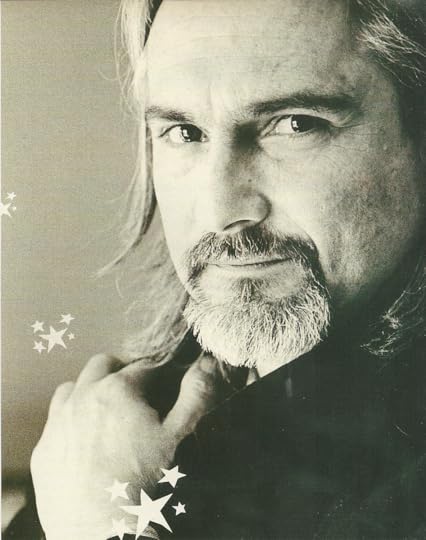 My portrait from Mixmag. Photograph by Dave HendleyThe Alleycat Bookshop, Newcastle-upon-Tyne
I was in Newcastle-upon-Tyne at the invitation of the Alleycat bookshop. Alleycat is a radical and co-operative bookshop carrying Anarchist, Socialist, Green, Lesbian and Gay, and Vegetarian literature, amongst other subjects. They also carry my book, which is none of these things. I was met from the train by Jon. I wasn’t sure how I would recognise him. In the end it was easy: leather jacket, German Paratroop boots, dyed blonde hair and earrings. He took me to the bookshop, where I was introduced to other co-op members, and then back to his place to eat.
I had a good feeling about Newcastle immediately. It seems spacious somehow: leisurely. The streets are very wide and the buildings very large. It felt fresh. You could smell the breezes brushing in off the estuary, sweeping away all of that stale city air.
At the bus stop Jon said, “I should show you the Cathedral.” I looked up and he was indicating the arc of the football stadium looming over the city like a theological argument. And if this is the Cathedral, then Alan Shearer is the Pope.
At home Jon cooked Dhal and Basmati rice with stir fried vegetables. He told me he was a vegan.
“A vegan who wears a leather jacket and leather boots,” I observed.
“Everyone says that,” he said. “Shall I tell you the story of the jacket? I bought it when I was 16 and had a Mo-ped. My Mom said, ‘you’re not riding a dangerous motorcycle without protective clothing.’ Later I gave the jacket away, but the bloke I gave it to gave it back to me as a Christmas present one year. So it was second hand when I bought it, and I’ve owned it twice. I’m not exactly contributing to the live-meat trade am I?”
That still didn’t explain the boots though. His whole house was filled with boots, mainly Doc Martin’s and Paratroop boots: painted orange, stuck on walls, acting as book-ends and flowerpots, or maybe just simply lying around. I said, “there’s a lot of boots about.”
“You don’t want to throw them away when you’ve been wearing them so long,” he explained. Which makes him a boot as well as a leather fetishist. What sort of a dangerous character had I fallen in with? That whole vegan story was a sham, a cover up for all his strange, leather-boot inspired, perverted activities. Clearly I was going to have to keep my shoes on all weekend. Luckily I was wearing sandals.
In the evening we walked to the pub, passed dreaming fields of cows, to meet some of the other co-op members. It seemed strange to be in a city and to be walking passed fields. Jon said, “the fields belong to the Freemen of Newcastle. They have the right to graze their cattle in them.”
We met Joe at the Tap and Spile, who told me that he’d had his arm broken at some demonstration by a deranged copper, and had got £15,000 compensation for it. “Where’s it all gone?” I asked. “I drank it, it was the best six months I ever had.” After that Tanya came in. Jon had mentioned Tanya several times. He said that she and her partner had just had a new baby. “Harry’s away with the baby for the weekend,” he told me. I naturally thought that Harry was a bloke, only it soon became clear that he wasn’t. Harry was the child’s Mother, and Harry and Tanya were bringing her up as a couple. I took to Tanya immediately. Her eyes were sparkling as she talked with relish about the baby. She called it a miracle.
Afterwards we walked through the Bigg Market, where the young Geordies hang out on a Friday night. I kept mishearing it as ‘the Meat Market’. Jon said, “I like that. That’s exactly what it is.” It’s a place where the mating customs of the locals can be observed. The women wear the shortest skirts, the lowest necklines, and the highest stilettos. The men wear tee-shirts with a packet of fags rolled into the sleeve. They wear this even through the blistering Geordie winter, when the winds scythe in off the North Sea like shards of ice. Chat up lines include such renowned classics as: “Get ’em off,” “Show us yer tits,” and “I could give you one.” The men clutch bottles of Newcastle Brown Ale, the women drink alcoholic lemonade, and they shout to each other across the street. Everyone is huge. The bouncers are like men-mountains with bow-ties. You have to walk with your eyes firmly wedded to the pavement for fear of causing an incident. I loved it. I want to do an Anthropological field-study there one day.
Tanya decided to take me to Viva, a night club on Riverside. She introduced me to the promoter, Geoff. “He can get you a mention in Mixmag,” she said.
“I’m not interested,” he told us. “But I’ll let you in because I like Tanya. Who else do you write for?”
“The Big Issue,” I told him.
“Ah right! I was homeless for about two years. Homeless, and now I’m an Underground promoter. So there you go.”
Joe blagged twenty quid and bought us all a drink. He got me a Newquay Brown, so that I could have the full Newcastle experience. Everyone was dancing, as you’d expect, and the atmosphere was friendly. It was the first time I’d felt entirely safe all evening. There was one short, muscly bloke, with a neck like a side of beef, chugging round like a train. He was weaving in and out of the crowd pumping his arms like pistons, sweating profusely, with his eyes at half-mast, E-d off his brain. He was the sort of bloke that, had you met him in the Meat Market, you would have had to have looked away. As it was, he was in his own little world, blissfully deranged.
There was one very interesting innovation in the club. The chill-out room was down a long corridor behind the decks. It was an alcohol-free zone. A bouncer stood there looking after your drinks for you. Consequently the chill-out room had a wholly different atmosphere than the rest of the club. All the E-heads could sit in there and feel relaxed. I know how annoying drunks can be. This seemed like the perfect compromise.
I can’t describe the music to you. I’m hopeless at those intricate definitions clubbers use. I can’t tell my trip-hop from my arse-hole. So I asked Jon. “What sort of music is this?”
“I dunno,” he said. “When I got in I thought, ‘now that’s the music I want to hear.’ Sometimes I go to clubs and they describe themselves as trance-techno or deep house or whatever, and I think, ‘that sounds interesting.’ Only when I get there it isn’t interesting at all. But tonight it is: it’s exactly the music I want to hear.”
So maybe we should have another definition of music to match all those other terms. Not so much trance or garage or underground house as, “yes, that’s the music I want to hear…”
Three Mixmag Stories Featuring Steve Andrews, the Bard of Ely
 https://www.eldaddruks.studio/
Read more of CJ Stone’s work here and here.
Like what you read? Please donate as little as £1 to help to keep this site – and independent journalism – alive.


The Big Issue: What Are Insurance Companies For?
Big Issue Cymru December 1998
Hitch-hiker
If you’ve been following this column, you’ll know that I used to live in a van. That was last year. I was researching for my book, which is about hippies, and I thought I should look the part. So I bought a van and lived in it. It was a Ford Transit Disability Transport Vehicle converted to a camper van. I went all over in that van, chasing hippies.
One day I stopped to pick up a hitch-hiker. It was on the A27 just outside Lewes, heading towards Brighton. I indicated and pulled over and then sat back to wait. And then it happened – some 15 to 20 seconds later – CRUNCH! Someone had hit me in the rear. Well you know the feeling. You pause to take a breath. Sigh. And then you get out resignedly to inspect the damage.
He’d bent the back panel and mashed my back lights, while his own bonnet was a crumpled mess. It looked like a geriatric bull dog who’d had his face kicked in. I took compensation from the fact that he’d damaged his own car far more than he’d damaged mine. I didn’t want to start an argument, however. The other guy was visibly shaken. We exchanged Insurance details, and then I was on my way.
The hitch-hiker was only going a mile up the road. He said, “I bet you wish you hadn’t stopped to pick me up now.” But at least he could act as a witness.
That was only the beginning of my troubles. I was 3rd Party, Fire and Theft. I hadn’t got Fully Comprehensive Insurance because I couldn’t afford it.
I got home and contacted my Insurance company, who sent me an accident claim form, which I duly filled in and returned. After that I had to get estimates on the repairs. Every garage I took my van to said the same thing. “Tut, tut,” they said. And then they made a “ssssssss” noise: the sound of air being sucked through the teeth. All mechanics say this. It’s part of their private language. Normally it means, “how much can I do you for?” In my case it meant, “sorry mate, can’t do anything.” Not one garage would give me an estimate. It had something to do with the type of vehicle, you see. Mine was coach-built. Most garages didn’t have the facilities to deal with it. I contacted my Insurance company again and they told me that we would have to proceed without the estimate.
After that it was a question of waiting. I waited. I waited for days and I waited for weeks. Still nothing was happening. I contacted my Insurance company again. It appeared that the other guy wasn’t answering letters or returning calls. When they did eventually contact the driver, he had another story prepared. Apparently I’d swerved out, which is what had made him hit me in the rear. Which still begged the question, really, of why he wasn’t watching what was happening in front of him.
The waiting continued. It was over a month and a half later. The other Insurance company were supposed to be sending out an Inspector to assess the damages. I contacted my Insurance company again, and they gave me the other Insurance company’s telephone number. I rang them up.
A woman came on the line. She had that school-ma’am guardedness that petty officials wear in lieu of sympathy. She was talking to me as if it was all my fault. “I’m sorry,” she said, after about a quarter of an hour, “we can’t proceed without an estimate.” At which point I lost my temper.
“I can’t get an estimate,” I told her. “I’ve already told you that. No one will give me an estimate. I’ve been waiting around for over a month on the assumption that we can proceed without an estimate.”
“It’s normal procedure,” she said, “we can’t proceed without an estimate.
“I was told that you would send an Inspector out to assess the damages, and then make a cash settlement.”
“Who told you this?” she asked.
“My Insurance company.”
“Well your Insurance company can’t tell us how we should manage our procedures,” she said. “We don’t accept liability.” And then she added, like some mantra of the bureaucratically insane, “we can’t proceed without an estimate.”
The law requires itI managed to get an estimate in the end. I rang my Insurance company, who rang the other guy’s Insurance company, who rang one of their own engineers, who rang their Inspector, who rang me. He’d managed to find the one garage in the whole of Britain which was actually capable of doing the work.
In the end, as was inevitable given the circumstances, the other guy admitted liability, and the work got done. I got a new set of rear doors and a new set of lights, and I was back on the road again. The whole process took about three months. Maybe I should have sued them for loss of earnings, given that I wasn’t able to work in all that time. But, finally, I was just relieved that the work was done.
You take out Insurance – don’t you? – not only because the Law requires it, but also because you think it might cover you in the event of an accident. What you don’t realise at the time is that it is in the interests of all Insurance companies to keep you waiting and to not accept liability. That’s their job. They take the money, but they don’t like giving it back again. And meanwhile they hide behind bureaucratic repetition and a finicky attachment to detailed procedures to try and stave off the inevitable. Insurance companies are the ultimate in anally-retentive organisations, ripe for Psychoanalytic investigation. It’s about time someone did a case-study.
As for hitch-hikers: it hasn’t stopped me from picking them up. Not unless they look like Insurance Salesmen, that is. In which case, I might well just run them down instead.
 https://www.eldaddruks.studio/
Read more of CJ Stone’s work here and here.
Like what you read? Please donate as little as £1 to help to keep this site – and independent journalism – alive.
Money Burning
Originally published in Kindred Spirit: Issue 152 Summer 2017
“A sacrifice is meant to be a loss, so that one may be sure that the egoistic claim no longer exists. Therefore the gift should be given as if it were being destroyed. But since the gift represents myself, I have in that case destroyed myself, given myself away without expectation of return. Yet, looked at in another way, this intentional loss is also a gain, for if you can give yourself it proves that you possess yourself. Nobody can give what he has not got.”
— CG Jung — Transformation Symbolism in the Mass
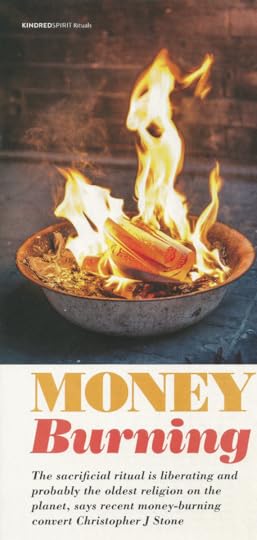 Sacrificial ritual
Look at the ancient texts – the Old and New Testaments, the I Ching, the Vedas – they are all shot through with the idea of sacrificial ritual.
Usually it is blood sacrifice: the sacrifice of an animal. Occasionally it is something more dark and sinister: a human sacrifice. But whatever the form, the basic idea is there, universally proclaimed. You sacrifice something of value to you, in order to propitiate the gods – the powers of nature – in order to influence future events.
But that was in the past, wasn’t it? We’ve grown beyond all that now. We’re much too sophisticated to take any of that stuff seriously any more.
And yet… and yet…. Don’t you still feel something stirring inside of you? Doesn’t something still beckon from the depths? Not the gods any more: something else, something deeply subsumed into the very flesh of your heart?
A human being is a complex creature. We are made up of many parts. And while we strut about in our urban haunts thinking we have everything under control, it’s clear from the state of the world that there are unseen forces at work, and that the human race as a whole is completely out of control.
In other words, there are still gods to propitiate. Not external powers, internal ones. The powers of the hidden drives and instincts, beautiful and monstrous at the same time, that are even now pushing the world to the edge of extinction.
How to harness and control those forces? How to propitiate the gods of our own internal being: that is the question that lies at the crux of our time, at this decisive moment, when our very survival as a species is at stake.
Rites of SacrificeIn fact we do still practice rites of sacrifice, it’s just that we’ve been cut off from their meaning and their origins. The Easter story is one such act, the sacrifice by a Father of his Son; and in honour of this primal sacrifice we substitute a lamb. Except we don’t do the actual sacrificing any more, we allow the butcher to do it for us. And the lamb was never ours: we picked it up, pre-packaged, from the supermarket shelf.
So is there anything we can sacrifice now, something truly our own, that might satisfy these obscure urges?
There is.
It is something so close to us, so close to our very being, that we’ve almost forgotten it is there.
It is money.
Money is, to use the jargon, “a general equivalent value form”.
In other words, money can be anything you want it to be. It can be new shoes, new clothes, a new car. It can be a holiday in the sun, a meal with the family, an evening with friends. It can be a conspicuous display of generosity, the hidden hand of kindness, or a secret urge to hoard. It can be anything or everything, depending on your imagination.
There is nothing in our current world-system that money doesn’t touch. The copy of Kindred Spirit you are holding in your hands right now will have cost you money. No matter how spiritual you are, money will still insert its presence into your life through the mechanism of exchange.
Money pervades our lives at every level. It structures the way we think. The way we deal with each other as human beings is on the basis of value and exchange. If we perform a good deed, even in secret, we still feel the world owes us for it. Hidden away in the personal account book of your life, let me assure you – unless you are a very exceptional person – you have a secret list of debts going back to your childhood, that you still feel the world owes to you.
Jonathan Harris, “the Money Burning Guy”, describes money as “an aspect of being”; which is why, he says, it makes the perfect sacrifice.
 Introduction to Money Burning
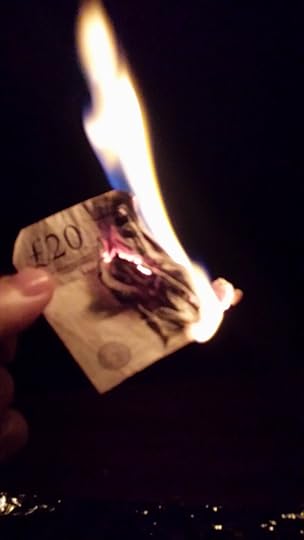
I undertook my own ritual sacrifice on the 23rd October 2016, at the Cockpit Theatre in London, where I set light to a £20 note. It was the first money I had ever burned.
I did it in the company of Jon Harris and two other people, around a small table in the centre of the theatre, watched over by an audience of perhaps 50-70.
Jon, looking cool and distinguished in a bowler hat, and holding a crooked staff, said a few words of invocation; the four of us then put our money to the flame, holding it for as long as possible as the notes burned blue and yellow, before the heat seared our finger tips, and we dropped it into a bowl, watching as the notes disappeared in a flicker of golden embers; at which point Jon raised his staff, pointed it at the ashes, and said, with just the right amount of dramatic emphasis: “money returns to money!”
I can’t say that anything particularly profound happened to me that night, but in the days following something did, indeed, begin to take shape in my mind.
I began to feel that the mysterious something-or-other that lies behind money – call it “value” – is eternal.
It was a feeling that crept up upon me in various small but surprising ways.
I sensed that the burning of my £20 note didn’t remove the value that lay entangled in the note, it released it; that the value remained, even though the note was gone. I could still feel it in my presence somewhere, like a dream that lingered into the day. I felt that the specific quantity of monetary value that the note represented linked in some indefinable way to a more general quality of value that lay out there, somewhere in the vast and unknowable universe.
It was like a little chink opening up in my brain, allowing me to look through to the meaning of money.
What is value? How do we create it? What makes us value one thing over another? It comes from inside of us, not from the piece of paper. It is us, our imagination, that gives value to money.
Afterwards, if people accused me of wasting the money, I could tell them, quite confidently, that I hadn’t wasted it at all: that the value was still there. It had merely changed its form.
Burning MoneyJon Harris has always been interested in money, he tells me.
As a child he had a coin collection. He’d spent many a happy hour with a favourite coin clenched in his hands, imagining where it had been. Later, as an adult, he’d expended much energy in the pursuit of money. He’d been an entrepreneur, made a lot of dosh, then lost it again. He’d been a market trader, at the raw front line of cash exchange. He’d studied the history of money at the London School of Economics.
And then, in 2005, an idea came to him. He was feeling frustrated with his life, and, brought to a sudden halt at the junction of two roads, at the confluence of two rivers, he thought, if you really want to understand the reality of money, then you should burn it. In this he was influenced by the KLF*, the pop band of the early nineties, who had burned a million pounds. He thought you could define your freedom by your ability to burn money.
It took two more years before he got round to actually doing the deed. That took place on the 23rd October 2007. It was a much more modest amount than the KLF had ventured, only £10, but considering he was flat broke at the time, it might as well have been a million.
Properly speaking it wasn’t even his money. He was bankrupt, so the note was owed to his creditors. The way he got round this was to carry it around with him for a month beforehand, till it really felt like it was his own. He refused to spend it, would take it out every so often and ponder it, imagining where it had been, just as he had with his coin collection as a child.
He lit a candle and held the note to the flame, watching as the fire took hold. He had the urge to say something, and found himself muttering the words: “release all.”
After that it became an annual event. On the 23rd of October every year, all by himself, he would burn money: £20 usually. It takes a marked level of inner focus to do that. Burning money is one thing: burning it year in, year out, without any recognition or result, knowing that other people would consider him crazy, that was something else. Something must have been driving him on.
He says he was aware from the first it was sacrificial ritual he was engaged in, but that over the years his understanding of what that means has deepened.
Sacrificial ritual is sovereign, he says. It is the first thing. It is what defines us as human beings. Before there was anything else, there was sacrificial ritual.
This is what gives money burning its potency. It involves sacrificing something very dear to you, the hidden element of desire that the money represents. It is a sacrifice without a victim. The victim is yourself. You are both priest and offering, sacrificer and sacrificed, giving and taking at the same time.
So that’s new, isn’t it? New and yet incredibly ancient. Sacrificial ritual, the oldest religion on the planet, with a brand new sacrifice to offer.
It is a ritual of pure forgiveness, he says. That is what lies at the very heart of the money burning ritual.
Money is a promise, a debt owed by its creators to us, the people who hold it. It is a “promise to pay the bearer.” When you burn it, you forgive that debt. You say to the Bank of England, “I absolve you of your promise. You no longer have to pay.”
The burning of money turns something that once existed into something that no longer exists. What was once a store of value is now a heap of ashes. The earthly note, with its earthly promise, becomes transformed – transmuted, transmogrified, transubstantiated – into something else, something that can no longer be quantified. Pure value, without ownership.
This is why you have to burn it, why you can’t just give it to charity. If you give it away the money still exists, the debt is still there, and the sacred act of forgiveness hasn’t taken place.
This is the truth behind the line in the Lord’s Prayer: ‘forgive us our trespasses as we forgive those who trespass against us.’
It’s a mistranslation of the original Greek. What it should read is: ‘forgive us our debts as we forgive those who are indebted to us.’
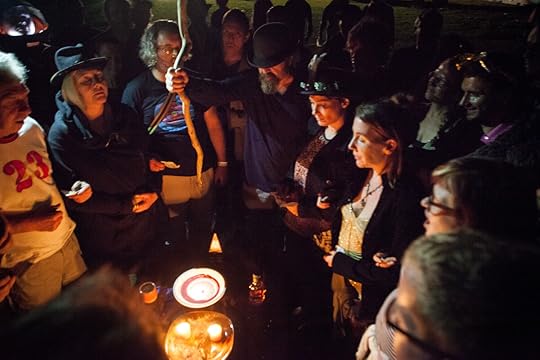 F23 money burning ritual with Jon Harris (in bowler hat). Photo Dan Sumption danshotme.comPublic Performance
Which brings us up to date.
Jon continued his personal sacrifice every year on the 23rd October for a number of years, without any fanfare or interference from the outside world, until the 23rd October 2015, when, for the first time, he shared the experience with someone else.
It was in a clearing in a wood on a platform meant for observing badgers. Jon and a friend, Angela, burnt £40 between them. As he says in his Money Burner’s Manual, “The burnings took their most ritualised form yet. I found it a deeply moving and potent experience. The ritual was a whirlpool, manifesting a perfect energised stillness – a nothing-ness – around which time flowed. Being within it was wonderful.”
It was after this that money burning as a concept reached out into the world. From a secret indulgence, something practised on his own, in private, it became, firstly, a public performance, and then, a shared ritual: one in which the whole world could partake.
He met John Higgs, the author of the book* on the KLF, and through him a number of people crazy enough to think that he wasn’t crazy.
He wrote his Money Burner’s Manual, a sometimes dense, occasionally incomprehensible, convoluted but compelling exploration of the meaning of money.
He produced a magazine for the money burning community, called the Burning Issue, even though no such community existed at the time, and by that process, created the very community it was meant to serve.
He does not encourage people to burn their money. Indeed, he says explicitly “never ask or tell anyone to burn money”.
The Burning Issue opens with a warning not to read the magazine.
Which is what we have to tell you here dear reader: burning money is a profound and magical act and you should only undertake if you understand its implications.
Burning MoneyThe first thing you have to do is to pick the amount. Not too much, but not too little either. It’s a contradiction to want a cut-price money-burning experience. It has to be the right amount so it will hurt a little: enough so you will feel its loss. Jon recommends £20, as the figure you would spend on an impulse buy, but how you determine it is up to you.Next, pick a date. Any date will do, as long as it is significant to you. Good Friday or Christmas Day. Summer or Winter Solstice. Your birthday. Your Mum’s birthday. The Full Moon or the New Moon. Any day you choose.Pick a note. Separate it from the other notes in your possession. Take note of its serial number. Make sure it is your own money and not somebody else’s. This is really important. The pain has to be entirely your own.Get to know the note personally. Carry it around with you. Get it out and ponder it occasionally. Where has it been? Whose hands has it passed through? What has it bought? What might you have bought with it?Be clean and spruced up on the day, in your best clothes. It is the Being of Money you will be encountering here, so put as much effort into it as you would into meeting a friend or a lover.Light a candle, and have a bowl in front of you to receive the ashes. Then, when you are ready, fully focussed and in the moment, put the note to the flame. Try to be totally present as you do this. Totally aware. Totally you.Watch as the flame consumes the note. Hold it for as long as possible, at the right angle. It will burn more slowly at certain angles than others and you will want to make the most of it. After all, it is your money you are burning.Finally, when the flame gets too close to your fingers, drop it into the bowl and watch as the embers eat away the last remnants of the paper.Say some words if you like, or stay silent. It is up to you.Remember, it is a ritual of pure forgiveness. Your purpose is to forgive the debts you feel are still owed to you. Don’t expect too much from it, and don’t do it too often. Don’t turn it into a routine. It is something rare and sacred, and its value will come to you in its own time.Go back to your ordinary life afterwards, and spend your ordinary money however you see fit. Dispose of the ashes in your garden or in a plant pot. Your ordinary life still awaits you, but with a new value attached.The KLF: Chaos, Magic and the Band who Burned a Million Pounds by John Higgs* The KLF were a hugely successful band from the early 90s. They had a string of hits, including: “What Time Is Love?”, “3am Eternal”, “Last Train to Trancentral” and “Justified and Ancient”, featuring country music legend Tammy Wynette.
What makes the KLF peculiar, and John Higgs’ biography* of them so compulsive, is something they did after their pop career was finished.
They burned a million pounds.
In “the wee small hours” of the 23rd August 1994 the two members of the band, Jimmy Cauty and Bill Drummond, went to an abandoned boathouse on the remote Scottish island of Jura and there, witnessed by their tour manager and a journalist friend, they systematically burned a million pounds in crisp, clean, brand-new, government-issued £50 notes.
And as if this wasn’t strange enough, afterwards they were entirely unable to explain why it was they had done it.
In the KLF: Chaos, Magic and the Band who Burned a Million Pounds John Higgs takes us on a hugely entertaining journey through the history of 20th century culture, in search of an explanation for this unprecedented act.
Find out more:Burn Your MoneyFor copies of the Money Burner’s Manual and for other information about Jon Harris, ‘The Money Burning Guy’.
 https://www.eldaddruks.studio/
Read more of CJ Stone’s work here and here.
Like what you read? Please donate as little as £1 to help to keep this site – and independent journalism – alive.
From The Big Issue: No Home, No Job, No Worries
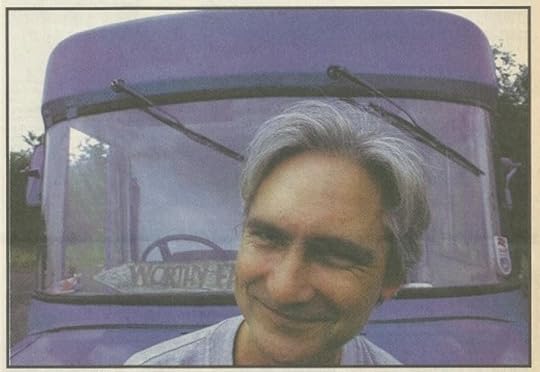 What’s it like living in a van?
I’m not a New Age Traveller. For a start, I don’t have dreadlocks. I don’t have nose rings or a baggy jumper. I don’t even have a dog on a piece of string. But I do live in a van.
I can’t say that I made the decision consciously or deliberately. It wasn’t a political statement. I lost my flat at the same time that my car needed its MOT, at the same time that I discovered that I needed a new engine. It would have cost me the best part of a thousand pounds to get it back on the road. I needed a vehicle and somewhere to live. Then I saw the advert: “Converted Ambulance for sale, £1600.” It was just around the corner from my Mom and Dad’s house. I fell in love with it immediately. I bargained him down to £1300, and two days later, I was the proud owner of a 2-Litre Ford Transit Disability Transport Vehicle converted into a camper van.
It has a bed and a table and a cooker and a sink and storage space and shelves and curtains and lights. My Mom made the curtains while my Dad fixed the lights. It even has a toilet: a nasty little chemical loo in a wooden cubby hole, which I only use on the rarest of occasions. I soon learned not to travel when there was anything in it. Half a nauseous day washing the stinking blue stains off the walls and floor and door of the toilet space after a ride down a particularly bumpy track was enough to score this lesson on my consciousness forever.
Logistics on the RoadAt first I was nervous. I wasn’t at all sure I could handle it. Where would I park? How would I bathe? What would I do in the evenings? I’m the sort of person who genuinely needs people around me. How would I cope with life on the road? But, actually, it’s nowhere near as difficult as you would imagine.
Parking up can be the most difficult. So far, I’ve slept in several car-parks, several lay-bys, one or two festival sites, and—once or twice—just by the roadside. I haven’t yet found the perfect place. But everywhere I go, I’m always on the lookout. It’s like everything else: when you have a need, your brain automatically goes into problem-solving mode. I spend a lot of time pouring over maps for ideal sites; I’m asking around amongst the travellers, and I’m registering places in my memory for future exploration.
And I’ve no doubt I will find a site. Despite the appearance that the whole world has been parcelled and packaged into neat little plots for the profit and pleasure of the moneyed classes, the fact is that there are still nooks and crannies out there for the intrepid traveller to nestle into. I’m an optimist. I’ve always believed I have a place in the world.
One solution which always comes in handy is the pub car park. That way, you kill two birds with one stone: something to do in the evening and somewhere to sleep that night. All you have to do is to ask the manager. I haven’t been refused yet.
The beauty of it is that you never know where you’re going to end up. I’ve been having a certain feeling I’ve not had since I was a child. You know, you wake up in the morning, and for the first few seconds, you just don’t know where you are. It’s exciting. And then you look out of the window, and some new sight greets you: some tree you’ve never seen before, rustling in the breeze, or the vast stretches of some dreamy English scenery that makes your heart leap in appreciation. One day, I woke up in the car park at Avebury in Wiltshire and thought, “Bloody hell, I’m on a racetrack!” It was the morning after the Summer Solstice. It must have had something to do with what I was up to the night before.
I mentioned bathing. Actually, that’s the easiest part. My Mom came up with the solution. She pointed out that in the old days, people didn’t have baths, but they still kept themselves clean. She told me to get a bowl of water and a flannel. And then she quoted an old saying of my grandfather’s: “You wash up as far as possible. You wash down as far as possible. And then you wash Possible.”
One problem I had, being a writer on the road, was where to plug in my computer. I have a mains hook-up system. I used to have to stay at campsites whenever I wanted to do some work. This had two disadvantages. Firstly, it costs money. Secondly, I was constantly being distracted by jovial holiday-makers laughing and playing bat and ball on the manicured lawns. I wanted to kill them for their impudence. And then I found the solution: solar panels. Now I can work wherever I want. So I’m not only a travelling writer, I’m ecologically sound too.
Of course, it’s easier for me than for a lot of travellers. Being a known writer, I carry an NUJ card. I also have an income. If the police ever stop me—though they haven’t so far—then I’m fairly certain they’ll leave me alone. I plan to offer my services to other travellers. Having a witness on site should come in handy. At the same time, I can maybe learn a little more about the travelling lifestyle from the more seasoned veterans.
Hierarchy Amongst TravellersThere’s definitely a hierarchy among travellers. Bottom of the pile would be someone like me: naive, untutored, unlearned, unable to fix my own van even, living in a camper van rather than a truck. Even the toilet lets me down. Real travellers don’t have toilets. They dig a hole and do business under the stars.
Next up would be the ones who took the lifestyle up during the rave era: people like Spiral Tribe, who are even now travelling in Europe. Above them are the convoy people, of course: the ones who went through the battle of the Beanfield in 1985 and who can say, “I was at Stonehenge in ’75, man,” and then regale you with some implausible tale of how many drugs they took in one out-of-this-world session.
Finally there’s Del. He lives on Dragon Hill near Glastonbury, which is now a permanent travellers site. Del is not only a New Age Traveller: he’s also a full-blooded Gypsy, and he can cite travellers lore going back at least six hundred years. From the thirteenth century to the eighteenth, he told me, it was illegal to be a Gypsy. You could be hung for it. His father told him that the only way they survived was by fighting and cursing. Del keeps up the tradition, only now he directs the curses at Security Guards on road protest sites. The Gypsy curse is still illegal, he tells me.
And now I begin to appreciate what the travellers, New Age and traditional alike, have been telling us all these years. Living in a van is cheap. No mortgage, no rent. No obligations. If you use a vehicle anyway, then your expenses are no more than you would expect in normal circumstances. And on top of that, there is the sense of freedom and the exhilaration that brings. Freedom can be addictive. To go where you want, when you want. To feel the whole world as your personal domain. It’s no wonder successive governments over the centuries have tried to clamp down on the travelling lifestyle. It’s far too good, and being good it is also dangerous.
Top 10 Travelling TipsWatch out for the law. The Criminal Justice Act affects every aspect of the travelling lifestyle. Section 60 means the police can search a vehicle at any time. Sections 61, 62, 77, 78 and 80 removed local authorities’ duties to accommodate travellers, meaning an increasing number of evictions. However …Try to stay on land owned by a local authority. They still have duties to provide land in some circumstances, and they’re not likely to shoot at you with a double-barrelled shotgun. Yet. If you can’t find any, then choose derelict or undeveloped land to minimise the risk of upsetting the people who live there all the time.Use a canvas tarpaulin. Use plastic, and you’ll regret it. Canvas breathes, but plastic just gets covered in nasty condensation. The first rule of being a traveller: look after your tarp. If you lose everything, then you’ll still have a home.Take a bow saw. This is a standard wood-cutting saw, usually 30 inches in length and carried by all travellers in the know. It’s ideal for cutting wood, although to be environmentally friendly only use dry wood. A bow saw means (a) travellers can have the equivalent of Sunday morning B&Q-type conversations about home maintenance and (b) fuel for their…Wood stove. Environmentally friendly and homely too.Clean up your rubbish.Do not block rights of way, and be nice. It’s no good protesting against roads if you deny others the chance to enjoy the countryside. The general rule of travelling is: be civil to people, and they’ll be civil to you. Well, they might not be, but that’s their problem.Walk your dog. If you must have a dog (and for lone travellers and women, it’s often a necessity), walk it often and keep it under control.Take a spade. If you want to be a real traveller, you just have to get used to recycling your own personal, biodegradable waste the only way nature knows how.Happy travelling. Enjoy yourself.https://www.eldaddruks.studio/Read more of CJ Stone’s work here and here.
Like what you read? Please donate as little as £1 to help to keep this site – and independent journalism – alive.
Prediction Magazine: Elvis Has Left the Haunted Building
Prediction Magazine , October 2003
When people ask me about my belief system, I always say that I am a sceptic. By which I mean: I neither believe nor disbelieve, but rather choose to reserve my judgement on most things.
Take the subject of ghosts, for instance. I’ve never seen one myself, but other people say they have. So I can’t believe in ghosts, but I can’t disbelieve either. I guess it depends on who is telling you the story and what you think they might be getting out of it.
My friend Jude, who lives in Glastonbury, quite often has ghostly experiences. She told me that one day, walking along Chilkwell Street, she was greeted by an old lady on a doorstep.
“Hello,” the old lady said, brightly.
“Hello,” said Jude, and then walked on, not thinking any more about it. It was only later that she heard that the old lady had died the day before she met her.
It’s the sheer mundaneness of the encounter that makes this particular story at least plausible. There’s no histrionics here, no ghoulish ghastliness, just a little old lady hanging around in the world a little longer than is normally expected of dead people, saying hello to any passing person with the extra-sensory equipment to notice her.
You may wonder why she was hanging around. Who knows? Maybe it was a nice day, and she didn’t feel up to the journey just yet. Maybe she liked saying hello to people. (She was probably a nice person in life, why not in death too?) Maybe Charon was on strike, and the heavenly ferry hadn’t arrived. Maybe she was just whiling away the time of day, being far too interested in the local comings and goings to let a little thing like death distract her.
Anyway, she did her small bit of polite domestic haunting for a day or two, and was on her way, never to be seen again.
Another friend of mine, Steve, stayed in a haunted house once. This was in Gabalfa in Cardiff, a few years back. The story of the haunted house had been in the local papers, which were offering a challenge for people to stay in it overnight. So Steve and a friend took up the challenge, got the keys, and spent the night there.
There was some dispute over who, exactly, this ghost was supposed to be. Some said a headless soldier, others the spirit of Elvis Presley (although quite why Elvis Presley would want to visit Gabalfa in Cardiff escapes me: perhaps he’d been recommended it by the spirit of Richard Burton, who might, at least, have heard of the place). Anyway, whoever it was, Steve and his friend nabbed a couple of bottles of wine, and let themselves in.
It was a quite ordinary house, still furnished. Nothing unusual at all. Except that, at certain times, the room would go deadly cold, and there would be this strange smell, like lavender. This is known in the profession as a cold spot, and is quite common, apparently.
Steve is the sensitive type. He knows about these things. Me, I’m far too worldly for that. I probably wouldn’t even have noticed the cold spot, being far more likely to be interested in the wine.
Well I’m sorry. My ghost stories seem to lack punch. Steve went to bed, and had a really nice night’s sleep. And that’s all there is. He says he had a better night’s sleep than he normally does.
There was a bit of a kafuffle the following day, however. Steve went out to the nearby shop to get some stuff in for breakfast, and was instantly surrounded by the local kids, wittering on enthusiastically about the house and its haunted status. Later the previous tenants turned up (these were the ones who had declared the house to be haunted) and then the tenants before them. It was this last family who had been the source of all the rumours. The grandmother was reputed as a medium, and used to dabble in the occult occasionally. It was she who would channel the spirit of Elvis and who claimed to see the headless soldier.
So maybe now we know what this was all about. A dispute between tenants. The previous tenants and the ones before them hated each other, and there was a good deal of taunting between the two families, the former calling the latter “evil”.
Later again the press turned up, and Steve invited the reporter in, but he refused. He stood on the doorstep and asked Steve some questions. Had Steve noticed anything?
“A little bit of astral disturbance,” said Steve, and he saw the reporter write it down – “astral disturbance” – very carefully, in his notebook. And what was it like to sleep there?
“Very nice,” said Steve. “I had my best sleep ever.”
https://www.eldaddruks.studio/Read more of CJ Stone’s work here and here.
Like what you read? Please donate as little as £1 to help to keep this site – and independent journalism – alive.
Paganism Is Not a Religion
First appeared in Kindred Spirit issue 145 Summer edition 2016
Towards a new pagan manifesto…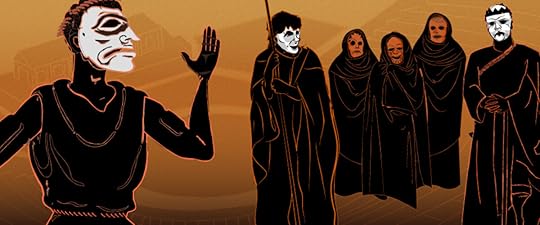 From City Dionysia: the ancient roots of modern theatrePaganism is not a religion.
Paganism is not a religion. Paganism is to religion as anarchism is to politics. It is anti-religion, the opposite of religion. Not religion’s friend: its enemy.
There is no such thing as a pagan priest. The words “pagan” and “priest” are a contradiction in terms. Paganism is what the people get up to when the priest’s not looking.
You probably already know the derivation of the word: from the Latin, paganus, meaning “villager”; from pagus, “province” or “rural district.”
It is an insult, the equivalent of calling someone a yokel.
It was also an army word. A paganus was a civilian or an incompetent soldier, a derogatory term applied by the professional soldier to conscripted peasants during times of emergency.
There were pagans long before there was Christianity. Probably it applied to villagers and their peculiar rustic practices when the city-dwellers were worshiping state-sponsered gods like Jupiter and Mars in the official temples of Rome.
There were a number of archaic practices which survived into Classical times, and the country gods were a dissolute lot: Faunus, a nature god, similar to Pan, often depicted with an enormous phallus, and Bacchus, the equivalent of Dionysus in the Greek world, the god of agriculture and wine, of ecstasy and sensory disruption.
Were these gods “worshipped” in the way the state gods were?
No. There were rites. There were festivities. There were sacrifices. There were celebrations. There was plenty of drinking and dancing, and no doubt any number of secret trysts in the woods and groves, but you didn’t need a priesthood to intervene on your behalf. You just got on with it. The pagan gods were understood as the presence and personification of nature and its powers and anyone could get in touch with them in the spirit of wildness and ecstasy.
SpiritualityAs a catch-all term for the various expressions of modern alternative spirituality, the word is so vague as to be almost meaningless.
Does it apply to crystal healing or Angel healing? What about Wicca? Or Druidry? All of these are recent additions to the shopping-list of religious products in the spiritual supermarket. Both Wicca and Druidry, while they claim antecedents in the remotest corners of history, are modern inventions. Druidry has its roots in the romantic movement of the late 18th and early 19th centuries, while Wicca is only a little over half a century old.
That’s not to say that they’re not valid as ways of engaging with the world, but, we have to be clear: we’re also not hearing some ancient revelation from the dim and distant past. These are modern people’s interpretations of what an earlier people might have thought. What we know of ancient Druidry, for example, is filtered through two sets of prejudices: those of the original Classical writers with their sense of moral superiority over the quaint or barbaric practices of a rival culture; and the fantasies of the modern antiquarians who have interpreted these scanty texts through the filter of their own Romantic imagination.
None of it is “true”. All of it is fiction. You can call it religion if you like. Really it’s a form of poetry.
Modern paganism is only the most recent convulsion of the protestant reformation. It stems from Martin Luther standing up against the Universal Catholic Church back in the 16th Century. Since then we’ve been inventing and re-inventing our religion in a thousand different ways. Some of us have divested ourselves of religion altogether. We’ve come to understand, as that great English Sage, William Blake, put it, that “All deities reside in the human breast.”
The idea that I have to go to Druid camp to learn Druidry from someone born in the same century as me is absurd and not a little annoying. The idea that someone can stand in the centre circle of Stonehenge and chant material he got from reading Crowley, is likewise aggravating. Maybe we need facilitators on these occasions. Standing in circle and opening the four quarters is a nice ritual touch as it orients us in our world; but it also reminds us that we are all created equal in the great circle of life. Anyone can enter the circle. Anyone can preach. Anyone can say a prayer. Anyone can let their voice be heard.
The idea that one man should speak for everyone is an insult.
So this is what paganism is to me. It is we the people burying our own dead in rites we fashion ourselves. It is we the people marking the great changes in our lives, from birth, to marriage, to death. It is we the people making our own peace with the Universe, creating our own gods, singing our own hymns. It is we the people seeking the mystery within ourselves.
And we don’t need priests to tell us what to do.
https://www.eldaddruks.studio/Read more of CJ Stone’s work here and here.
Like what you read? Please donate as little as £1 to help to keep this site – and independent journalism – alive.
November 23, 2025
CJ Stone in the Independent
1997-2003
Going HomeI wanted to be a writer. I wanted to be a citizen of the world. I wanted to be sophisticated, urbane, intelligent. Anything, in fact, but a Brummie
 Sparkbrook, Stratford Road, 1960
My first article in the Independent appeared in the Saturday Magazine, on Saturday 22nd March 1997.
It was the first of a series a columns collectively entitled “Going Home“, about my return to my home city, Birmingham, in early 1997.
The story is called “Back to Brummagem“, Brummagem being the local name for the city.
It’s not, as it sounds, just a nickname. The name “Brom” or “Brum” appears as a prefix for a number of places in the area: West Bromwich and Bromsgrove, to name but two. So Brummagem is probably the original name, and “Birmingham” the tarted up version.
People from Birmingham call themselves “Brummies.”
The reason I was going back there was that I was in need of a place to stay, having lost my council flat in Whitstable.
It was the Whitstable flat that was the setting for my previous collection of columns in the Guardian, Housing Benefit Hill.
After I was forced to move out of there, I lost both my home, and my source of income.
Housing Benefit Hill was a very successful and durable column, lasting from September 1993 to September 1996. That was followed by CJ Stone’s Britain, which I was still writing at this point, but it was nowhere near as popular or so enjoyable to write as Housing Benefit Hill. Quite soon it petered out, and that was the end of my relationship with the Guardian.
At the time of these columns, however, things were going very well for me. I had columns in the Big Issue, Mixmag and the Guardian, as well as in the Independent.
These were very difficult columns to write, mainly because the editor insisted on making constant changes. He wouldn’t let a single column through without drastic alterations in the text. It was very hard work.
I’d made all the changes he wanted in all the stories, but the last one he rejected altogether. I’ll include that below, so you can decide for yourself if it was worthy of being read or not. It’s called “A Long Walk Down The Stratford Road.”
I rang the paper one last time. The editor was away, so I spoke to one of his assistants. He was worried because the deadline was due and there wasn’t a story in place. I told him my problem. He said, “just send me a story and I’ll publish it.”
Which is what I did. Something for nothing was the last in the series.
Back to BrummagemFirst appeared in the Independent magazine Saturday 22 March 1997

The question has to be, why? Why Birmingham of all places?
The question repeated itself as I groaned my way up the M40 in my Morris Minor, all of my life wrapped up and packed away in battered cardboard boxes, piled up high on the back seat, rammed into the spaces between the seats, and almost falling out of the boot. Well, it’s a measure of my life that I can shove the whole of it into cardboard boxes and fit it into a Morris Minor. Not much to show for my 43 years on this planet. A few books. Two sacks of clothes. A computer. And all of these crumbling notebooks in out-of-date diaries and sheathes of paper in stained and tattered folders chronicling the story of my life over the 25 years since I last spent any time in this town.
I left Birmingham in 1971, with a carload of stuff, vowing never to come back. And here I am again, with a carload of stuff. Back.
Birmingham has a certain reputation. The very act of writing about it as a native puts you on the defensive. As Jane Austen said (Emma, 1816): “One has no great hopes from Birmingham. I always say there is something direful in the sound.” Actually, I think there is something comical in the sound. “Birmingham,” you say, and you expect a joke. Like: “Birmingham, Europe’s meeting place” (the current corporate slogan), which implies a romantic assignation under Spaghetti Junction. Or: “Birmingham, Venice of the Midlands.” Of course, there’s nothing more unromantic (or less like Venice) than Birmingham. It’s like the opening of a comedy sketch, and not a particularly good one. The truth is, when I left the city all those years ago, I was embarrassed by it. But then again – like Jane Austen – I was an insufferable little prig. I’d read too many books. I’d seen too many films. I wanted to be a writer. I wanted to be a citizen of the world. I wanted to be sophisticated, urbane, intelligent. Anything, in fact, but a Brummie.
I remember sharing a flat with a couple of Londoners, the summer after I’d moved. They were talking about food in an urbane manner, comparing the merits of various national culinary traditions. One of them favoured Italian and the other French. I said, “I like curries”. The first one turned round to me. “I’ve never been that enamoured of Indian cookery,” he told me. “It seems like the Oriental equivalent of meat pie and chips to me, the sort of thing you drink lager with.” I said, “What’s wrong with meat pie and chips?” They gave me a look of complete contempt. Later on, I became a vegetarian.
So what has brought me back? Serendipity. Circumstance has led me here. I was homeless and someone offered me a room. At first I thought, “No, no, I can’t, I can’t go back.” It seemed like a defeat somehow. I was looking for flats in London, Brighton and Kent. I was staying with my sister near Greenwich, but she needed the space. But then this, too, seemed like a stepping stone. My sister is just like me, a Brummie wherever she lives, and now I was hearing my own, native accent day-in and day-out, despite the fact I was living in London. And, bit by bit, the idea began to grow on me. It had a vague sort of appeal somehow. Maybe there was something I could learn by living there. Sort of return of the native son. One day, I was um-ing and ah-ing about the decision, and a few days later, there I was, finalising the arrangements. Suddenly, all those things which had embarrassed me in the past – Birmingham the comical, Birmingham the working class, most of all, Birmingham the unpretentious – had become the very things I was thirsting for. The day my sister needed me to move was the day my room in Birmingham became available. Serendipity, as I say.
And then came the final confirmation. I still had my doubts, but I was down in Whitstable in Kent for a few days. It was New Year’s Eve, in the back room of a pub. “Where are you living now?” someone asked. “I’d heard you’d moved.”
“I’m moving to Birmingham,” I told them.
“Birmingham?” someone piped up, in the way you always expect to hear. “Why Birmingham?”
“I’m living in Birmingham these days,” someone else said.
“Whereabouts?”
“Moseley,” she said.
“I’m living in Moseley, too,” I said. “Where in Moseley?”
“Opposite the most notorious pub in Birmingham.” And she told me the name of the pub. It’s about five minutes from where I live.
“It sounds like my kind of pub,” I said.
“Oh no,” she said, rolling her eyes, “you’re not going to start writing about everyone and pissing them off again are you?”
“Of course,” I said. “It’s my job. I like pissing people off.”
You can’t argue with fate, can you? A couple of months later, here I am, in Moseley, eating curry and drinking lager, in a flat opposite the most notorious pub in Birmingham, with a bunch of people from Whitstable, taking mental notes so that I can write about them. And they’re guests in my town this time, not the other way around.
I’ve come home…
Story appeared here.
The family StoneFirst appeared in the Independent Saturday Magazine, 29th March 1997.
 Mary and Eddy Stone at the door of their house in Marston Green, Birmingham. Photograph courtesy of Helen Stone. | Source
My Brother lived in Birmingham till he was nearly thirty years old, just down the road from my Mom and Dad. And in all that time my Mother always did his washing for him. When she heard I was moving back here she rubbed her hands in glee. “Oo good,” she said. “I can do your washing.” Well I wasn’t going to allow myself such an indignity, but we agreed on a compromise. I’d come over for Sunday lunch, maybe. One day.
The following Saturday my Dad rang me up. “Your Mom wants to know if you’re coming over tomorrow. Only we’re just going shopping. She wants to know whether to get extra vegetables or not.”
So that was that. In the game of Happy Families, Mothers hold the trumps.
“What time should I be there?” I asked.
“Come at 12,” he said. “We can go for a pint.”
When I arrived the following day my Mom said, “Dad can’t go for that drink after all. He’s got a funny tummy.” We drank Spanish Brandy instead and a bottle of my Dad’s home made Elderberry wine. So much for his bad stomach. I guessed that Mom had played another of her trump cards. She wasn’t going to allow him to have me all to himself.
We were talking about old times, sitting around in their comfortable sitting room, with the gas fire blazing. “Remember that friend of mine, Joe?”
“The clever one, with the auburn hair? The one who was offered a place in a Grammar School but turned it down?”
“That’s the one,” I said. “Well I went to see him a few months ago. He lives in Weston-super-Mare now. He told me he used to fancy you.”
“Is he an oldest child?” she said, trying to be modest. “The oldest child always fancies older women.”
“No, no,” I said, “he meant it. He said all my friends used to fancy you.”
“That’s nice,” she said. “Tell him I’ve been looking for a Toy Boy.”
“He’s not exactly a Toy Boy,” I said. “He’s got three kids. One of them is at University.”
“Well he’s a Toy Boy to me,” she said. “Younger than him anyhow,” she added, indicating my Dad, who was just coming in from the kitchen.
“Why do I always get the feeling you’re laughing at me,” my Dad said.
“So what’s he doing now?” Mom asked.
“I dunno. Something in waste management, I think.”
“You mean, he’s a dustman?”
“A bit more posh than that,” I said. “He’s middle class these days. He writes books on the subject. He still supports the Villa though. He’s a member of an Aston Villa supporters club on the Internet. Spends his time doing reports on Villa matches to fans in Norway and Australia. The funniest thing is that he wears a baseball cap while he’s on there, with ‘Internet Villans’ written on it. He wears it at matches too, so that all the ‘Internet Villans’ can recognise each other. Don’t you think that’s sad? And there’s something else too,” I added. “It was really strange. I was walking down the stairs one night and I suddenly thought: ‘it’s just like being in Mom and Dad’s house.’ When I pointed it out to him he agreed. He told me that when he first visited here he thought, ‘now that’s a proper family home.’ I get the feeling he models himself on our Dad. He even looks like him. Same shape.”
“Bay windows,” my Mom said.
“What?”
“Bay windows. People who are brought up in council houses always want to own a house with bay windows.”
But I couldn’t remember if my friend had bay windows or not. She was right in one respect though. Both my friend and my father have stomachs specially constructed to look like bay windows.
Later, at the dinner table, they were telling me about their holiday in Tenerife. They’d gone to see a show, a display of what was described as “Spanish Ballet.”
“Dad didn’t want to go. He thought it meant ordinary ballet. But I told him. ‘Spanish Ballet is just Spanish dancing, that’s all. Like flamenco.'”
“We quite enjoyed it actually, didn’t we Mary? The costumes were great. And the women were real women, and the men were real men. Not like ordinary ballet, the men all prancing around in tights with their legs wide apart showing their thingies.”
“It’s all padding anyway,” my Mom said.
Mom had cooked far too much. We had roast potatoes by the bucketful, a whole cabbage, peas, carrots, the lot. Mom said, “I don’t know how much to cook for three. I’m only used to cooking for the two of us.”
I couldn’t finish my dinner. (That’s what we call lunch in Birmingham: dinner). Dad said, “What I like about having your brother to dinner is that he’s got such a good appetite.” He said it like an accusation. I’m obviously deficient in the eating department.
We spent the rest of the afternoon in pleasant remembrance, talking about this and that, about the family, and what my brother and sisters were up to. They were pressing tea on me all the time, and my Mother kept trying to feed me. It was like I was a little boy, as if she was trying to feed me up. Eventually I had to go. They wanted to watch a film on the telly. They both came out to see me off, and waited while I backed out of the drive. I felt strangely incompetent. I was driving really badly, as if I had no right to be in charge of a motor vehicle.
So what is it about going to see your parents? No matter how old you get, you always seem to revert to some previous age. There’s a kind of withering look my Mom gives me that still makes me cringe, guiltily, as if I was nine years old again.That’s why I was having so much difficulty with the car. Nine year olds can’t drive.
A Modern City at a Knockdown PriceFirst published in the Independent Saturday Magazine , 5th April 1997.
 The Swan, Yardley. “The building looked like a box of Swan Vesta matches: a flat package of yellow brick”
The dog had the look of all Boxers, like an ill-bred aristocrat paying a token visit to his smelly serf’s cottage: a combination of disgust and snotty superiority. But you could tell straight away that he was old. A certain grizzled aloofness. The way he trotted rather than ran. And an anus so protruding it looked ready to spurt out its contents like a spray of machine-gun fire any second. The man said, “don’t worry about him, he’s harmless.” I guess I must have hopped back a step or two. Not from his teeth. From his behind. His behind was far more dangerous than his teeth. And then the man (who looked almost as old as the dog, but with trousers, thank God) added: “are you a Brummie?”
We were in the park. I was taking my flatmate’s dog for a walk. She was scattering about in the bushes pretending to be a kangaroo, leaping up to catch the squirrels, and darting about with her tail in the air. She was paying no attention at all to the grizzled Boxer’s sly advances. But the question surprised me. In London, maybe, it makes sense to ask a person’s origins (not that anyone in London ever talks to strangers): but who else but a Brummie would want to live in Birmingham?
“I was born here,” I told him, “but I’ve not lived here for the last 25 years.”
“I knew you was a Brummie,” he said mysteriously. I wanted to look in a mirror to see what it was about me that looked Brummie. Maybe it was the fact I had “I am a Brummie” tattooed across my face. Actually, there is a characteristic Brummie look. It’s a cross between a smile and a sneer, a lip-curl of amused disbelief, like a cynic who doesn’t even believe in his own cynicism. But I don’t think I was practising it myself that minute. I was still trying to keep the Boxer dog’s muzzle between me and his other end.
“Whereabouts did you live?” the man asked.
“Sparkbrook,” I told him, “then South Yardley.”
“Ah, Yardley,” he said. “Do you remember that pub by the roundabout? The – er – the…”
“The Swan,” I said.
“Yes, that’s it, the Swan. Used to go dancing there, in the sixties. People used to come from all over Birmingham. There was a ballroom upstairs. ‘Course it’s gone now, knocked down to make way for some new roundabout.”
“Someone told me it was the biggest pub in Britain in it’s day. Is that true?”
“Well it was certainly big. Huge. Had wood panelling all up the stairs and beautiful carpets. Like a palace, it was. Loved that place.”
“That’s the trouble with Birmingham,” I said. “Always knocking itself down to start again.”
“To make way for those bloody domes and things,” he said, and laughed. And then he added – though it really needed no explanation – “and those towers where they do all their yodelling first thing in the morning.”
Well this just disappointed me. He seemed such a kindly old man. His racism was arbitrary, somehow, as if it was expected of him. It was just something to say, that’s all, like talking about the weather, rather than anything deeply meant. But it was enough to stop me wanting to talk to him. I called Patsy to me, said my goodbyes, and left the park.
Later I drove past Yardley on my way to see my Mom and Dad. They’d moved out of there years ago. I saw the place where the Swan used to be. These days it’s nest of under- and over- and every-other-way-passes, with a grubby shopping centre nearby. I remembered when the shopping centre was brand-spanking new, and we were all so proud of how modern Birmingham was becoming. I used to go to the library just around the corner, where I’d sneak about in a dark little corner looking for books on psychic phenomena. I had a thing about ectoplasm. It must have had something to do with my age. They knocked the library down at the same time they got rid of the pub.
It was never a very pretty pub, despite the old man’s praises: at least not on the outside. It had a picture of a Swan on one of the walls, which looked exactly like the Swan symbol on a box of Swan Vesta matches. Which is apt in a way, since the building itself looked exactly like a box of Swan Vesta matches: a flat package of yellow brick. Nevertheless, if the old man’s descriptions of the interior had been right, it would have made a great venue. It was built in 1967 and had eight bars and a staff of ninety.
That last fact I have from one of my flatmate’s books. It’s called Birmingham Old and New, and dates from the seventies. It’s a joke really. It consists of a series of photographs in pairs, showing the scene in – say – 1870, and then again in 1975. It purports to illustrate the state of modern Birmingham, so fast moving, so dynamic. But the funniest thing of all is, even the 70s photographs are completely out of date now. Most of the buildings from that era are gone too, including the Swan.
It’s like I said to the old man in the park: it’s the Birmingham disease, constantly knocking itself down to start again. Which leaves the native Brummie’s psyche in an equally uncertain state. Always knocking down bits of personality to make way for something new. Which is what I’m doing here, really. Make way for the bulldozers, there’s a by-pass coming through. A brain by-pass.
A Long Walk Down The Stratford RoadUnpublished
 Birmingham schoolchildren, ’50s
Just the barest of memories. There’s a bridge under which we pass. The other side of that bridge signifies something familiar, like home. And then there’s a turning onto a small road with a school at the end. Out on the main road, seemingly miles away, traffic rumbles by in a haze of fumes and danger. But this little side street is my realm. I’m safe here, left to my own devices.
The house is dark, the electric light is permanently switched on, which only tends to emphasise the gloom. The kitchen is under the stairs. I remember my Mom, out there in the kitchen, while I sit at the table. There’s a bowl of cornflakes in front of me, which I’m stirring round with my spoon. I used to like them to go soggy. Or maybe it was that I preferred them crispy, and wouldn’t eat them once they were soggy.
The road is called Main Street, and it’s in Sparkbrook, Birmingham. It’s where I spent the first years of my life. I looked it up in the A-Z. It’s still there. I decided I should go and pay a visit.
I dropped the car in Sparkhill and took a walk down the Stratford Road. It was an overcast day, grey but mild. I felt like an explorer. I had a copy of Eric Newby‘s A Short Walk In The Hindu Kush in my pocket. Well it was natural wasn’t it? My journey became A Long Walk Down The Stratford Road. It seemed just as exotic, in a banal, Brummie sort of way. The area is predominantly Asian, but despite the Balti houses and the shops selling rolls of brightly coloured cloth sparkling with sequins, the scene is still essentially Birmingham. Indeed, what can be more Brummie than a Balti? But there’s an air of decay about the area. Many shops are boarded up, and the flats above are universally in a state of disrepair. Broken windows, grimy with the traffic fumes, glare down at you from the gloomy heights.
“Sparkbrook“. The name gives an image of a jolly little stream sparkling in the sunlight. Instead of which you have a view of grubby motorcycle workshops and shops selling car parts. The bridge is still there though, an arch of red brick tip-toeing across the road like some prissy giantess raising her skirts to step over a puddle. And there, on the left, is Main Street.
All the old houses are gone, replaced with 60s council housing with gardens. But the view from the top end of the street is the same. I was walking up and down trying to position myself from my memories. The further away from the Stratford Road I got, the more “right” it seemed. And then there was the school, still there, but a school no longer. These days it’s a health centre. This is where I’d lived, right opposite the school.
Afterwards I rang my Mom up. “Tell me about Main Street,” I said.
“Oooo, I don’t remember. It was a long time ago.”
“Was the house back-to-back?” I was remembering that dark view into the kitchen.
“That’s right,” she said. “There were shared toilets out the back. It was very old fashioned.”
“And was the kitchen under the stairs?”
It was, she told me, surprised that I was remembering so much.
“So how old was I when we lived there?”
“From about 9 months till you were three. Then we went to Malta. When we got back you’d’ve been about four, I think. We stayed with our Mom for a while, and then we went back to live there for about six months before we moved to Yardley.”
“We were right opposite the school weren’t we?”
“That’s right,” she said. “You used to get dressed up in your work clothes and go and help the workmen while they were building it. It was your job. I don’t know what you were doing. Helping them out in your own little way. I don’t suppose they’d allow that now. It would be too dangerous. I can’t have been a very good Mother,” she chuckled. “I just used to let you get on with it. And there was a shop about half way down the road. I would send you down there to get a few bits of things, you know. Fags, probably. That was what it was like in those days.”
“I can remember going across the road to someone’s house.”
“That’s right. May. I was working, you see. May used to look after you. She had a little girl you used to play with. And there was another little boy you used play with too, across the road.”
I was remembering jam sandwiches for tea. That’s what they ate in the house across the road: jam sandwiches for tea.
“I can remember going across to the school. I remember you in bed, saying ‘five more minutes.’”
“That was what I always used to say, ‘five more minutes’. I said it to your sisters too, and your brother.”
“Tell me about cornflakes,” I said. “How did I like my cornflakes?”
“I can’t remember. Your brother used to like cornflakes. He was mad about them. Used to eat them instead of sweets.”
“But did I like my cornflakes crispy or soggy?”
“I honestly have no idea.”
“I have to know,” I said. “It’s important.”
“Crispy, I think. Or it might have been soggy. What’s the difference? I can’t even remember you eating cornflakes.”
“That’s the kind of journalist I am,” I told her. “I can’t let go till I know all the answers.”
Which is where I am now: still trying to settle the cornflakes question.
Something for nothingFirst appeared in the Independent Saturday magazine 12 April 1997
 The Rag Market
In my role as intrepid researcher, I went to the Birmingham markets this morning. This is something I have taken to doing on a regular basis. It’s here that I feel most at home. I don’t buy anything: I just hang around, drinking tea at 10p a cup and watching the passers-by. It’s where the real Brummies go, to buy their tat. There’s the indoor market, the outdoor market, the rag market and the wholesale market. They bustle about the foot of the Bullring centre and around St Martin’s Church like figures in an Impressionist painting. They nestle under the Bullring, and spill out across the road into a giant hangar. This is the rag market. To me it is the spiritual heart of the city.
I was watching one of the traders giving his spiel. You’ll have to imagine the accent: a cross between Mandarin Chinese and an out-of-tune violin.
“Who’ll buy one of these lovely towels? A hundred per cent cotton with satin embroidery, £6.99 in the shops. Well I’m not asking £5, I’m not asking pounds £4, no, not even £3. Not £2.75, £2.50, £2.25, no, not even £2. Not £l.50, not even a pound. Not 90p, 80p, 70p. Not 50p, not 25p, not 20p, not even 10p.” (All of the while he’s laying the towels out on the table, folding and re-folding them, brushing them with his hand.) “Who wants one of these lovely cotton towels for nothing. You madam? And you? That’s 1, 2, 3, 4, 5, 6, 7, 8, 9, 10. Ten people who want one of these towels for nothing. You didn’t really expect to get something for nothing did you? I said you could have one for nothing.
“Unfortunately I only sell them by the pair.
“I’ll be honest with you, these are slight seconds. See this little black mark here? So you’ll be doing me a favour by taking them off my hands. Come on now, I’m very tired, I want to go home. They’re made especially for a leading department store. I can’t mention the name of the store because Debenhams wouldn’t like it. They go for £6.99 each. So for a pair you’re looking at the better part of fourteen quid. Well I’m not charging fourteen quid, not ten quid, not £7.50 even. Who’ll buy a pair of these genuine cotton towels with satin embroidery for five pounds? Just five pounds the pair. You madam? And you? Come on now, take them for a fiver and I might even knock a little bit more off. I’m feeling generous. Just a fiver a pair, fourteen quid in the shops. You madam, and you? I’ll guarantee to knock a little bit more off, if you agree to take them for a fiver.”
And he starts handing them out to the people who’ve put up their hands. People are waving their hands all around him. Eventually he’s given out 20 pairs of towels, for which he takes £100.
“Look, I’m feeling a bit mad. I feel like giving this hundred quid away. I’ll give it away to the first woman who raises her hands at the count of three who is a good girl.”
All the hands rise.
“At the count of three, I said. OK then, one, two, three. You madam. Are you a good girl?”
“Yes,” she says.
“Well, say I am a good girl.”
“I am a good girl,” she says.
“Louder, so all the people can hear.”
“I am a good girl,” she says nervously.
“No, louder, louder, so everyone can hear.”
“I am a good girl,” she screeches, almost bursting her neighbour’s eardrums.
“Well you can’t be a good girl. Didn’t you know, good girls don’t take money from strangers. So I promised to knock a little more off, didn’t I? I’m a man of my word. You can have them for £4.99. Unfortunately, I haven’t got any change. So I’ll tell you what I’ll do, I’ll let you have a free gift instead. Here you are, a genuine plastic bag.”
In the middle of this a voice chimed below my ear.
“It’s for prostitutes,” the voice said.
“What?” And I turned round to see this diminutive old man grinning at me. He was about four foot ten, with blinking eyes behind his milk-bottle bottom glasses, with a ripped old anorak and grubby shoes.
“Prostitutes,” he said. “To make them smell nice. You don’t need perfume, do you? See what I mean? It’s not for us. It’s for…”
“Yes, I see what you mean. But they’re towels,” I said.
“Oh towels. Towels are they? I thought it was perfume. It was perfume last week. I can’t see over the crowd, you see. What do you want towels for?”
“I don’t want any towels. I’m just listening to the guys doing the selling.”
“It’s called patter,” he said. “That’s what the market traders call it: patter. Pitter-patter, pitter-patter, like the sound the rain makes.” And he shuffled off cackling to himself.
By now several of the people were coming away muttering, carrying their nice pink plastic bags full of satin embroidered cotton towels. Some of them had even managed to end up with two pairs, each with an individual plastic bag. “I should have known,” an Irish woman said.
“You fell for it though didn’t you?” I said, laughing. “You have to admit he knows how to sell you something. At least you’ve got your plastic bag.”
Which is what I’ve been doing these last four weeks. Selling you something, minus the plastic bag. I hope you liked it.
Story appeared here .
I thought I’d messed up his life, but Joe still talks to meCJ Stone split up from his wife, lived in a commune and went off the rails. Yet somehow his son grew up unscathedSaturday 22 May 1999Joseph was born some time in the early hours of 15 September 1980. It was 1.30 in the morning. Or at least I think it was. I have a clear visual recollection of the clock on the delivery room wall – one of those standard, circular hospital clocks with clean black figures and hands – and it reads just after 1.30am. I can even see the slim, red second-hand ticking round. It’s just that I can’t be sure whether it’s a real clock or not. I may have made it up.
Read more here.
The biker dadsMiddle-aged men in Britain are intent on kick-starting old love affairs – with a certain Harley-Davidson. By CJ STONESaturday 31 July 1999Driving used to be a pleasure. Right now I’m inching forward in first gear, watching the tail lights of the car in front flicker on and off, tasting the traffic fumes like bitter porridge, steaming in this damp, heavy heat, seeing yet another red light up ahead, yet another set of road works, waiting, waiting – moving – waiting. Where’s the pleasure now?
Read more here.
Style: Whitstable – the new Chelsea?Not if the town can help it. CJ STONE on the spirited fight against DFLs (Down From Londoners)Sunday 12 December 1999Jarvis Cocker is definitely one. Ulrika Jonsson was thinking of buying a house here, so she’s one too. The place is Whitstable in Kent, and both Jarvis and Ulrika are DFLs. That’s the term Whitstable people use to describe visitors – Down From London.
Read more here.
Arthur Pendragon: The once and future kingDisruption. Dissent. Getting arrested. These are all part of the prerogative of Arthur Pendragon, eco-warrior and King of Britain. C J Stone met him at the park-and-ride for a spot of trouser-burningSaturday 18 October 2003“There’s a pre-Roman Arthur, and a post-Roman Arthur,” he says, “and a post-Thatcher Arthur. And that’s me.” In other words, if there is a spirit of Arthur dedicated to the protection of these isles, then he is the Arthur who represents it right now.
Read more here.
https://www.eldaddruks.studio/Read more of CJ Stone’s work here and here.
Like what you read? Please donate as little as £1 to help to keep this site – and independent journalism – alive.
The Nazification of Israel: reflections on the 2014 Israel–Gaza conflict
8th June 2014.
The Merchant of VeniceAbove all things let us never forget that mankind constitutes one great brotherhood; all born to encounter suffering and sorrow, and therefore bound to sympathize with each other.” – Albert Pike

My relationship with Israel started sometime in the late 60s: 1967 or 1968. It happened unexpectedly.
We were reading the Merchant of Venice at school. In case you don’t know it, the Merchant of Venice is a deeply racist play. It is considered a “comedy” because it has a happy ending: happy that is, for everyone but the villain. The villain is Shylock, a Jew. The play exposes Shylock’s greed, his resentment, his inhumanity, his viciousness, his barbarity, but in the end right is restored, the good Christians get their just rewards and Shylock exits the stage utterly defeated, utterly destroyed, utterly alone. Even his own daughter turns against him.
Nevertheless, despite the racist overtones, it is a measure of Shakespeare’s greatness that he cannot help but give the most moving lines to his villain.
Here they are:
Hath not a Jew eyes? Hath not a Jew hands, organs, dimensions, senses, affections, passions; fed with the same food, hurt with the same weapons, subject to the same diseases, healed by the same means, warmed and cooled by the same winter and summer as a Christian is? If you prick us do we not bleed? If you tickle us do we not laugh? If you poison us do we not die? And if you wrong us shall we not revenge? If we are like you in the rest, we will resemble you in that. If a Jew wrong a Christian, what is his humility? Revenge. If a Christian wrong a Jew, what should his sufferance be by Christian example? Why, revenge. The villainy you teach me I will execute, and it shall go hard but I will better the instruction.
Act 3, scene 1, The Merchant of Venice by William Shakespeare.
The words are a call to recognise someone’s essential humanity, to see through their tribal alliances, and to identify with them, even in the midst of their crimes. Change the word “Jew” for “Palestinian” and the word “Christian” for “Israeli” and you have a good summation of what is happening in Israel and Palestine right now.
The words could be said by a member of Hamas. They could be said by an Israeli too.
HolocaustAfter reading the play the subject of anti-Semitism came up.
Our teacher, Mr Frost, talked about the situation in Israel.
This was around the time of the Six Day War.
He said that he understood why Palestinians would be upset at the loss of their homeland. He asked what our response would be here in the UK if another people had annexed Wales? He also talked of the holocaust and of the Jewish people’s need for a safe haven. He weighed one position against the other and gave no definitive answers. I remember Mr Frost as a good, a fair, a diligent and an inspiring teacher.
I’m not sure now if he was referring to Israeli claims to the whole territory of Israel going back to 1948, or whether he was referring to the recent occupation of the Gaza strip and the West Bank, still fresh in everyone’s memory. I also can’t remember how the discussion in the classroom went. I was usually quite vociferous in debates, and would certainly have played an active part.
Later that day I repeated some of the discussion in front of my Dad.
Dads and sons are often rivals. It is one of the laws of nature.
So I recounted the discussion in the classroom and the next thing I knew I was in a blazing row with my Dad; a violent row, in which I ended up with a black eye and a split lip.
Now I have to admit my part in all of this.
I was an annoying little know-it-all. I was 16 years old and full up of my own opinions, which, on reflection, I realise to have been other people’s opinions dressed up as my own. I was an argumentative little sod, and probably quite boring.
Nevertheless it was odd – not to say disturbing – to find myself at the receiving end of such a violent onslaught.
I’ve seen a number of times since that my usually passive father has some turbulent hidden emotions.
He grows very angry, very red-in-the-face, when challenged about any of his fixed ideas.
But the quality of the anger on this day was of a different order altogether. It was like I had touched something raw and hidden in his psyche: like I had accidentally ripped off a scab which had unleashed some secret pain.
Mr Frost was my favourite teacher and I was trying to repeat his position. My Dad called him all sorts of names that I barely recognised.
I think he called him a communist. He threw a variety of supposed facts at me which I was unable to deny. When I tried to explain that Mr Frost had given us both sides of the story, he became even more enraged. I think it might have been at this point that he lashed out and hit me across the face.
That was the day I learned that my father was Jewish. My mum explained it to me afterwards.
Actually he is half-Jewish and half Christian. He attended synagogue on a Saturday and church on a Sunday. It was a secret which, at my mum’s request, he had kept hidden from us all those years.
My mum didn’t like religion and she didn’t like politics, and talk of either was banned from the house: this despite the fact that religion and politics were fundamental to an understanding of my dad. Thus he suppressed something that was deeply meaningful to him, which then re-emerged in this unexpected and violent way when he felt he was being challenged by his mouthy son about something that was dear to his heart.
So you might say that my relationship with Israel is tied up with my relationship with my father.
Horror Gaza 2014
These last few weeks have been terrible. Horrific.
Ever since the story of the killing of the Israeli settler kids in June, it has been a relentless cascade of increasingly bad news coming out of Israel and the occupied territories.
The bad news has mainly been for the Palestinians. At the time of writing the death toll in Gaza is in excess of 1,800, 300 of those children. By the time you read this it will no doubt be worse. 9,000 have been injured, with a large part of the population being driven from their homes. 10,000 houses have been destroyed. It has been a tale of devastation and murder, of the destruction of a people and a way of life; of houses, factories, mosques, schools, power plants, offices turned to rubble; of an endless succession of images, of traumatised children, of traumatised parents, of blood-spattered faces, of blood soaked clothing, of people’s features contorted with grief and with horror, of piles of corpses , eerily frozen, like discarded shop-window dummies. And these are only the images we are allowed to see. Behind these, we know, there are even worse images, which we make a point of not trying to find: of torn flesh and torn limbs, of people with their insides hanging out, or their faces blown off, of rotting corpses and mangled torsos, and worse.
How can we face such horror and live?
I’ve been obsessing about it. I can’t stop thinking about it. I’ve been unable to work or to do almost anything else. I get up in the morning and I go on facebook and I read all of the latest reports. I read every one, one after the other. Those that I find relevant, I share. Some of the ones from the Israeli side I read and rage at. You can tell the Israeli ones at a glance. They usually blame Hamas, attempting to dehumanise them by accusing them of using their neighbours as human shields: as if the Palestinian people would put up with that.
The stories that are coming out of Israel are, if anything, more horrific than the ones coming out of Gaza. In Gaza we only have the bloodshed to contend with. In Israel we have the cold-blooded justification for it, the racism, the vile chants, the horrible spectre of a new Nazism on the rise.
Nazi state An Israeli shell in Gaza.
You are not supposed to say that. You are not supposed to compare Israel to the Nazis. That is considered inflammatory and anti-Semitic. And it’s true that the Palestinians are not being led off to the death camps yet. They are, however, being bombed in their homes, bombed in the streets, bombed in the market places, and in the work places, bombed, even, when taking shelter in schools and hospitals under the protection of the United Nations or Medecin sans Frontiere.
Gaza is like the Warsaw ghetto. It is a prison camp. There is nowhere to run. Anyone who dares call this a “war” is either self-deluded or a fanatic. A war is between two armies of at least comparable power. There is only one army in Gaza: the Israeli army. All the rest are victims, whether those victims are defenceless victims without weapons, or desperate victims attempting to fight with the most rudimentary of weapons: home made rockets, booby-trapped tunnels and suicide vests.
You cannot compare Israel’s massive, 21st century army – one of the most advanced armies in the world – with its high-tech weaponry, its powerful ordnance, its laser guided missiles, its command and control structures, its drones and its satellites, with the crude, inaccurate, glorified fireworks which constitute almost the entire strength of the other side.
People talk of Israel’s right to defend itself. What about the Palestinians right to defend themselves? And if Hamas’s use of indiscriminate rocket fire constitutes a war crime, given that those rockets are incapable of guidance, then how much more of a war crime is it to use such massively powerful weaponry as the Israelis have at their disposal, weapons designed for use in the battlefield, in what is effectively a residential space?
The spectre of a 21st century nation, supposedly a democracy, using extreme violence on a captive population, killing women, children and old people as well as young men and Hamas fighters, is horrifying to watch; but the spectre of a nation apparently cheering the slaughter on, sitting on the hillsides overlooking Gaza on deckchairs and settees dragged there for the occasion, drinking wine and cheering as the bombs explode like fireworks in the population centres below (these are the people supposedly most in fear of those deadly Hamas rockets), or running riot through the streets of Tel Aviv shouting “Death to Arabs” and “Death to Leftists” (the “leftists” being the minority of people willing to come out in opposition to the war) or chanting, football style, “There’s no school in Gaza, there are no more kids left!”: all of this cannot help but remind us of Germany in the 30s, when the same violence towards a minority, the same bullying, the same isolationism, the same collective brutality, gripped a nation, egged on by the racist fearmongering of the Nazi elite.
So, yes, I will say it. Israel is becoming like a Nazi state.
As to how it got there: that’s another question.
Racism“The Israeli desire to live in peace is a desire to maintain its supremacy – a Jewish state founded on the basis of expelling its previous inhabitants – unchallenged by Palestinian violence. It is a desire for Palestinians simply to accept an eternity as stateless refugees, as an occupied people or as non-Jews in a Jewish state that sees their very existence as a ‘demographic threat’. To paraphrase Netanyahu, what other people but the Palestinians would be expected to endure that?”
Something very strange is going on in the Israeli psyche. It is a nation extreme in its defensiveness. Read Israeli propaganda, and it’s mainly about this small, plucky little state surrounded by enemies, defending itself against massed Arab aggression: this despite the fact that there hasn’t been a major war which Israel hasn’t started for over 40 years.
To quote Benjamin Netanyahu: “The truth is that if Israel were to put down its arms there would be no more Israel. If the Arabs were to put down their arms there would be no more war.”
He said this with reference to Hezbollah, after Israel had invaded Lebanon, and Hezbollah had defended itself.
It is this same rhetoric which is being applied to Hamas, as if this little tin-pot organisation represents the concerted aggression of the whole Arab world.
Take a look at the timeline of recent events on any mainstream media site, and it will start with the deaths of three Israeli teenagers in the West Bank on June 12th.
The murder of two Palestinian boys by Israeli sniper fire a month before is conveniently ignored. That is so routine it doesn’t even count as news. The deaths were caught on camera. The Israeli’s response to this? They got rid of the camera.
After the last upsurge in violence in 2012, I took note of Israeli breaches of the ceasefire. They began within days of the signing of the peace agreement.
But even assuming that the first move was the kidnapping of the Israeli teenagers, one thing is conveniently forgotten in this narrative: the teenagers were the children of settlers in the West Bank, that is they were there illegally under international law. The viability of a future Palestinian state is being mugged on a daily basis by the non stop building of Israeli settlements in Palestinian territory. This is not to speak of the brutal siege of Gaza, now in its seventh year, the checkpoints, the separation wall, the regular incursions by the Israeli military, the bulldozing of homes, the control of water supplies, the destruction of farmland, the separation of families, the daily humiliation of life under occupation.
OccupationThe ongoing brutality of the occupation is a daily, weekly, monthly, yearly thing. On and on and on, day in, day out. Gaza is a walled ghetto. The Gazans do not control their borders, their coast, their airspace, their imports or exports. The Israelis only allow a limited amount in, even down to the amount of calories they allow to keep the population alive but barely functioning. In the West Bank Palestinians are subject to arbitrary arrest and detention.
The laws that rule Palestinians, whether as Israeli citizens, or as people under occupation, are discriminatory and racist. Before the three Israeli teenagers were abducted and shot, two Palestinian teenagers had been killed by Israeli forces. This was in May. You can read about that here. They were no threat.
It is almost certain that the three Israelis were killed in retaliation, but we only have Israel’s word for it that Hamas were the culprits. The Israelis knew that the boys were dead but pretended to the world that they could still be alive and used their supposed capture as a pretext to attack Hamas. That was the start of it. This happened before Hamas started firing rockets. The Israelis do this all the time. I detailed all of that from 2009 in my hub which I would ask you to read. It is all verifiable. They provoke, murder, attack, break the cease fire, then, when Hamas fires rockets say, “see we have the right to defend ourselves.”
Are Hamas right to fire rockets indiscriminately? No. It is a war crime. But it pales into insignificance compared to the degree of mayhem and violence that the Israelis are capable of with their high tech weaponry. You only have to look at a photograph of the kind of damage an Israeli missile does compared to a Hamas one.
Now I’m not defending Hamas here. It is stupid to provoke the Israelis. But one side is weak and the other side is strong, militarily speaking, and just because you have bigger weapons that doesn’t mean it is right for you to use them. I think people don’t know just how inherently racist the Israelis are becoming – not Jews as a whole, just large segments of Israeli society. Many Jews throughout the world are just as appalled as I am at the criminal behaviour of the Zionist state and wish it would end. Many Jews, like Jews For Justice for Palestinians, are anti-Zionist too.
It seems to me that the media blames the victims in this conflict. It’s like an abusive relationship. The abuser beats up his partner and then blames her for it. “It’s your fault, you made me do it.” That’s what the Israelis are doing and it needs to be stopped, right now. The Palestinians can’t stop it. They have no power. It is up to the Israelis to stop it, and it’s up to people like you and me to look at the situation and to see where the real fault lies: with the abuser, not the abused.
Now take a look at some pictures of dead Palestinian children. There are plenty of them all over the internet right now. If that was your child, wouldn’t you go a little crazy? Wouldn’t you want revenge? Wouldn’t you want to lob a missile to kill the perpetrators of that heinous crime against your family and against humanity? 1500 dead Palestinian children since 2000 (448 more since the current conflict began). How many crazy fathers, mothers, brothers, sisters, uncles, aunts, friends, grandparents does that make?
And you wonder why they lob their stupid rockets over, even though it does them no good.
RogueSo the Israeli government lied, concealing the teenager’s deaths from the media, blaming Hamas when it was actually a rogue cell, and using it as an excuse to rampage through the West Bank arresting Hamas supporters, dismantling its infrastructure and killing 6 people in the process, and you can perhaps begin to see that the Israeli narrative is a convenient fiction, and that something else is going on behind the rhetoric.
The whole episode was used to stoke up Israeli racism, falsely claiming the teenagers were alive when it was known they were already dead in order to ramp up the emotion, thus setting the scene for the violence that has followed.
Where we can blame Hamas, perhaps, is in stepping into this narrative and playing its inevitable part by firing those rockets; just as the Israeli government hoped they would.
So what’s the point of this story? I know that in writing it I won’t have changed any minds. In the first few weeks of the crisis I attempted to engage a pro-Israeli supporter in debate. I was wasting my time. No matter how much evidence I piled up to support my side, the response was just a noisy and irrational “no!” You can read the entire exchange in the comments on the hub here.
No evidence was needed to counteract my argument. It was enough to simply insult my sources as irrelevant and to assert the opposite case without reference to any actual data.
So maybe this is just a continuation of that argument I had with my dad all those years ago.
Maybe there’s nothing rational in it at all.
I touched something raw in him that day and he lashed out. I know from talking to him since that to him the State of Israel is a bastion against the cruelty which had been inflicted upon the Jewish people by the holocaust.
I continue to disagree with him. Israel has become the very thing it set out to defend against. My view is that the only proper way to remember the holocaust is by ensuring that it never happens again: not to any people, of any race or religion.
https://www.eldaddruks.studio/Read more of CJ Stone’s work here and here.
Like what you read? Please donate as little as £1 to help to keep this site – and independent journalism – alive.
The Nazification of Israel
Published 8th June 2014 during the 2014 Israel–Gaza conflict.
The Merchant of VeniceAbove all things let us never forget that mankind constitutes one great brotherhood; all born to encounter suffering and sorrow, and therefore bound to sympathize with each other.” – Albert Pike
My relationship with Israel started sometime in the late 60s: 1967 or 1968. It happened unexpectedly.
We were reading the Merchant of Venice at school. In case you don’t know it, the Merchant of Venice is a deeply racist play. It is considered a “comedy” because it has a happy ending: happy that is, for everyone but the villain. The villain is Shylock, a Jew. The play exposes Shylock’s greed, his resentment, his inhumanity, his viciousness, his barbarity, but in the end right is restored, the good Christians get their just rewards and Shylock exits the stage utterly defeated, utterly destroyed, utterly alone. Even his own daughter turns against him.
Nevertheless, despite the racist overtones, it is a measure of Shakespeare’s greatness that he cannot help but give the most moving lines to his villain.
Here they are:
Hath not a Jew eyes? Hath not a Jew hands, organs, dimensions, senses, affections, passions; fed with the same food, hurt with the same weapons, subject to the same diseases, healed by the same means, warmed and cooled by the same winter and summer as a Christian is? If you prick us do we not bleed? If you tickle us do we not laugh? If you poison us do we not die? And if you wrong us shall we not revenge? If we are like you in the rest, we will resemble you in that. If a Jew wrong a Christian, what is his humility? Revenge. If a Christian wrong a Jew, what should his sufferance be by Christian example? Why, revenge. The villainy you teach me I will execute, and it shall go hard but I will better the instruction.
Act 3, scene 1, The Merchant of Venice by William Shakespeare.
The words are a call to recognise someone’s essential humanity, to see through their tribal alliances, and to identify with them, even in the midst of their crimes. Change the word “Jew” for “Palestinian” and the word “Christian” for “Israeli” and you have a good summation of what is happening in Israel and Palestine right now.
The words could be said by a member of Hamas. They could be said by an Israeli too.
HolocaustAfter reading the play the subject of anti-Semitism came up.
Our teacher, Mr Frost, talked about the situation in Israel.
This was around the time of the Six Day War.
He said that he understood why Palestinians would be upset at the loss of their homeland. He asked what our response would be here in the UK if another people had annexed Wales? He also talked of the holocaust and of the Jewish people’s need for a safe haven. He weighed one position against the other and gave no definitive answers. I remember Mr Frost as a good, a fair, a diligent and an inspiring teacher.
I’m not sure now if he was referring to Israeli claims to the whole territory of Israel going back to 1948, or whether he was referring to the recent occupation of the Gaza strip and the West Bank, still fresh in everyone’s memory. I also can’t remember how the discussion in the classroom went. I was usually quite vociferous in debates, and would certainly have played an active part.
Later that day I repeated some of the discussion in front of my Dad.
Dads and sons are often rivals. It is one of the laws of nature.
So I recounted the discussion in the classroom and the next thing I knew I was in a blazing row with my Dad; a violent row, in which I ended up with a black eye and a split lip.
Now I have to admit my part in all of this.
I was an annoying little know-it-all. I was 16 years old and full up of my own opinions, which, on reflection, I realise to have been other people’s opinions dressed up as my own. I was an argumentative little sod, and probably quite boring.
Nevertheless it was odd – not to say disturbing – to find myself at the receiving end of such a violent onslaught.
I’ve seen a number of times since that my usually passive father has some turbulent hidden emotions.
He grows very angry, very red-in-the-face, when challenged about any of his fixed ideas.
But the quality of the anger on this day was of a different order altogether. It was like I had touched something raw and hidden in his psyche: like I had accidentally ripped off a scab which had unleashed some secret pain.
Mr Frost was my favourite teacher and I was trying to repeat his position. My Dad called him all sorts of names that I barely recognised.
I think he called him a communist. He threw a variety of supposed facts at me which I was unable to deny. When I tried to explain that Mr Frost had given us both sides of the story, he became even more enraged. I think it might have been at this point that he lashed out and hit me across the face.
That was the day I learned that my father was Jewish. My mum explained it to me afterwards.
Actually he is half-Jewish and half Christian. He attended synagogue on a Saturday and church on a Sunday. It was a secret which, at my mum’s request, he had kept hidden from us all those years.
My mum didn’t like religion and she didn’t like politics, and talk of either was banned from the house: this despite the fact that religion and politics were fundamental to an understanding of my dad. Thus he suppressed something that was deeply meaningful to him, which then re-emerged in this unexpected and violent way when he felt he was being challenged by his mouthy son about something that was dear to his heart.
So you might say that my relationship with Israel is tied up with my relationship with my father.
HorrorGaza 2014These last few weeks have been terrible. Horrific.
Ever since the story of the killing of the Israeli settler kids in June, it has been a relentless cascade of increasingly bad news coming out of Israel and the occupied territories.
The bad news has mainly been for the Palestinians. At the time of writing the death toll in Gaza is in excess of 1,800, 300 of those children. By the time you read this it will no doubt be worse. 9,000 have been injured, with a large part of the population being driven from their homes. 10,000 houses have been destroyed. It has been a tale of devastation and murder, of the destruction of a people and a way of life; of houses, factories, mosques, schools, power plants, offices turned to rubble; of an endless succession of images, of traumatised children, of traumatised parents, of blood-spattered faces, of blood soaked clothing, of people’s features contorted with grief and with horror, of piles of corpses , eerily frozen, like discarded shop-window dummies. And these are only the images we are allowed to see. Behind these, we know, there are even worse images, which we make a point of not trying to find: of torn flesh and torn limbs, of people with their insides hanging out, or their faces blown off, of rotting corpses and mangled torsos, and worse.
How can we face such horror and live?
I’ve been obsessing about it. I can’t stop thinking about it. I’ve been unable to work or to do almost anything else. I get up in the morning and I go on facebook and I read all of the latest reports. I read every one, one after the other. Those that I find relevant, I share. Some of the ones from the Israeli side I read and rage at. You can tell the Israeli ones at a glance. They usually blame Hamas, attempting to dehumanise them by accusing them of using their neighbours as human shields: as if the Palestinian people would put up with that.
The stories that are coming out of Israel are, if anything, more horrific than the ones coming out of Gaza. In Gaza we only have the bloodshed to contend with. In Israel we have the cold-blooded justification for it, the racism, the vile chants, the horrible spectre of a new Nazism on the rise.
Nazi stateAn Israeli shell in Gaza.You are not supposed to say that. You are not supposed to compare Israel to the Nazis. That is considered inflammatory and anti-Semitic. And it’s true that the Palestinians are not being led off to the death camps yet. They are, however, being bombed in their homes, bombed in the streets, bombed in the market places, and in the work places, bombed, even, when taking shelter in schools and hospitals under the protection of the United Nations or Medecin sans Frontiere.
Gaza is like the Warsaw ghetto. It is a prison camp. There is nowhere to run. Anyone who dares call this a “war” is either self-deluded or a fanatic. A war is between two armies of at least comparable power. There is only one army in Gaza: the Israeli army. All the rest are victims, whether those victims are defenceless victims without weapons, or desperate victims attempting to fight with the most rudimentary of weapons: home made rockets, booby-trapped tunnels and suicide vests.
You cannot compare Israel’s massive, 21st century army – one of the most advanced armies in the world – with its high-tech weaponry, its powerful ordnance, its laser guided missiles, its command and control structures, its drones and its satellites, with the crude, inaccurate, glorified fireworks which constitute almost the entire strength of the other side.
People talk of Israel’s right to defend itself. What about the Palestinians right to defend themselves? And if Hamas’s use of indiscriminate rocket fire constitutes a war crime, given that those rockets are incapable of guidance, then how much more of a war crime is it to use such massively powerful weaponry as the Israelis have at their disposal, weapons designed for use in the battlefield, in what is effectively a residential space?
The spectre of a 21st century nation, supposedly a democracy, using extreme violence on a captive population, killing women, children and old people as well as young men and Hamas fighters, is horrifying to watch; but the spectre of a nation apparently cheering the slaughter on, sitting on the hillsides overlooking Gaza on deckchairs and settees dragged there for the occasion, drinking wine and cheering as the bombs explode like fireworks in the population centres below (these are the people supposedly most in fear of those deadly Hamas rockets), or running riot through the streets of Tel Aviv shouting “Death to Arabs” and “Death to Leftists” (the “leftists” being the minority of people willing to come out in opposition to the war) or chanting, football style, “There’s no school in Gaza, there are no more kids left!”: all of this cannot help but remind us of Germany in the 30s, when the same violence towards a minority, the same bullying, the same isolationism, the same collective brutality, gripped a nation, egged on by the racist fearmongering of the Nazi elite.
So, yes, I will say it. Israel is becoming like a Nazi state.
As to how it got there: that’s another question.
Racism“The Israeli desire to live in peace is a desire to maintain its supremacy – a Jewish state founded on the basis of expelling its previous inhabitants – unchallenged by Palestinian violence. It is a desire for Palestinians simply to accept an eternity as stateless refugees, as an occupied people or as non-Jews in a Jewish state that sees their very existence as a ‘demographic threat’. To paraphrase Netanyahu, what other people but the Palestinians would be expected to endure that?”
Something very strange is going on in the Israeli psyche. It is a nation extreme in its defensiveness. Read Israeli propaganda, and it’s mainly about this small, plucky little state surrounded by enemies, defending itself against massed Arab aggression: this despite the fact that there hasn’t been a major war which Israel hasn’t started for over 40 years.
To quote Benjamin Netanyahu: “The truth is that if Israel were to put down its arms there would be no more Israel. If the Arabs were to put down their arms there would be no more war.”
He said this with reference to Hezbollah, after Israel had invaded Lebanon, and Hezbollah had defended itself.
It is this same rhetoric which is being applied to Hamas, as if this little tin-pot organisation represents the concerted aggression of the whole Arab world.
Take a look at the timeline of recent events on any mainstream media site, and it will start with the deaths of three Israeli teenagers in the West Bank on June 12th.
The murder of two Palestinian boys by Israeli sniper fire a month before is conveniently ignored. That is so routine it doesn’t even count as news. The deaths were caught on camera. The Israeli’s response to this? They got rid of the camera.
After the last upsurge in violence in 2012, I took note of Israeli breaches of the ceasefire. They began within days of the signing of the peace agreement.
But even assuming that the first move was the kidnapping of the Israeli teenagers, one thing is conveniently forgotten in this narrative: the teenagers were the children of settlers in the West Bank, that is they were there illegally under international law. The viability of a future Palestinian state is being mugged on a daily basis by the non stop building of Israeli settlements in Palestinian territory. This is not to speak of the brutal siege of Gaza, now in its seventh year, the checkpoints, the separation wall, the regular incursions by the Israeli military, the bulldozing of homes, the control of water supplies, the destruction of farmland, the separation of families, the daily humiliation of life under occupation.
OccupationThe ongoing brutality of the occupation is a daily, weekly, monthly, yearly thing. On and on and on, day in, day out. Gaza is a walled ghetto. The Gazans do not control their borders, their coast, their airspace, their imports or exports. The Israelis only allow a limited amount in, even down to the amount of calories they allow to keep the population alive but barely functioning. In the West Bank Palestinians are subject to arbitrary arrest and detention.
The laws that rule Palestinians, whether as Israeli citizens, or as people under occupation, are discriminatory and racist. Before the three Israeli teenagers were abducted and shot, two Palestinian teenagers had been killed by Israeli forces. This was in May. You can read about that here. They were no threat.
It is almost certain that the three Israelis were killed in retaliation, but we only have Israel’s word for it that Hamas were the culprits. The Israelis knew that the boys were dead but pretended to the world that they could still be alive and used their supposed capture as a pretext to attack Hamas. That was the start of it. This happened before Hamas started firing rockets. The Israelis do this all the time. I detailed all of that from 2009 in my hub which I would ask you to read. It is all verifiable. They provoke, murder, attack, break the cease fire, then, when Hamas fires rockets say, “see we have the right to defend ourselves.”
Are Hamas right to fire rockets indiscriminately? No. It is a war crime. But it pales into insignificance compared to the degree of mayhem and violence that the Israelis are capable of with their high tech weaponry. You only have to look at a photograph of the kind of damage an Israeli missile does compared to a Hamas one.
Now I’m not defending Hamas here. It is stupid to provoke the Israelis. But one side is weak and the other side is strong, militarily speaking, and just because you have bigger weapons that doesn’t mean it is right for you to use them. I think people don’t know just how inherently racist the Israelis are becoming – not Jews as a whole, just large segments of Israeli society. Many Jews throughout the world are just as appalled as I am at the criminal behaviour of the Zionist state and wish it would end. Many Jews, like Jews For Justice for Palestinians, are anti-Zionist too.
It seems to me that the media blames the victims in this conflict. It’s like an abusive relationship. The abuser beats up his partner and then blames her for it. “It’s your fault, you made me do it.” That’s what the Israelis are doing and it needs to be stopped, right now. The Palestinians can’t stop it. They have no power. It is up to the Israelis to stop it, and it’s up to people like you and me to look at the situation and to see where the real fault lies: with the abuser, not the abused.
Now take a look at some pictures of dead Palestinian children. There are plenty of them all over the internet right now. If that was your child, wouldn’t you go a little crazy? Wouldn’t you want revenge? Wouldn’t you want to lob a missile to kill the perpetrators of that heinous crime against your family and against humanity? 1500 dead Palestinian children since 2000 (448 more since the current conflict began). How many crazy fathers, mothers, brothers, sisters, uncles, aunts, friends, grandparents does that make?
And you wonder why they lob their stupid rockets over, even though it does them no good.
RogueSo the Israeli government lied, concealing the teenager’s deaths from the media, blaming Hamas when it was actually a rogue cell, and using it as an excuse to rampage through the West Bank arresting Hamas supporters, dismantling its infrastructure and killing 6 people in the process, and you can perhaps begin to see that the Israeli narrative is a convenient fiction, and that something else is going on behind the rhetoric.
The whole episode was used to stoke up Israeli racism, falsely claiming the teenagers were alive when it was known they were already dead in order to ramp up the emotion, thus setting the scene for the violence that has followed.
Where we can blame Hamas, perhaps, is in stepping into this narrative and playing its inevitable part by firing those rockets; just as the Israeli government hoped they would.
So what’s the point of this story? I know that in writing it I won’t have changed any minds. In the first few weeks of the crisis I attempted to engage a pro-Israeli supporter in debate. I was wasting my time. No matter how much evidence I piled up to support my side, the response was just a noisy and irrational “no!” You can read the entire exchange in the comments on the hub here.
No evidence was needed to counteract my argument. It was enough to simply insult my sources as irrelevant and to assert the opposite case without reference to any actual data.
So maybe this is just a continuation of that argument I had with my dad all those years ago.
Maybe there’s nothing rational in it at all.
I touched something raw in him that day and he lashed out. I know from talking to him since that to him the State of Israel is a bastion against the cruelty which had been inflicted upon the Jewish people by the holocaust.
I continue to disagree with him. Israel has become the very thing it set out to defend against. My view is that the only proper way to remember the holocaust is by ensuring that it never happens again: not to any people, of any race or religion.
https://www.eldaddruks.studio/Read more of CJ Stone’s work here and here.
Like what you read? Please donate as little as £1 to help to keep this site – and independent journalism – alive.
We Are Wiser Than the Angels: In Memory of Mary Stone 16/11/1930 – 20/04/2013
 Mary Stone 16/11/1930 – 20/05/2013 RIP
It’s been over a year since our Mum died. She passed away at 6pm on the evening of the 20th of April 2013.
I say “our Mum” rather than “my Mum” for a number of reasons. Firstly that she wasn’t only my Mum. She was my sister, Julia’s Mum, she was my sister, Helen’s, Mum, and she was my brother, Robert’s Mum too. She was all of our Mums.
“Mums”, plural, because she was a different person to each of us.
She was also “our Mum” because that’s what we say in Birmingham. We always use the first person plural to describe those we love. So it’s “our Dad”, “our kid”, “our house” and “our family”. It’s a very inclusive way of speaking since it offers the listener a share in our intimacy. We are including the listener in the relationship. She’s not just my Mum, she’s our Mum; that means she’s your Mum too.
But there is another reason why she is “our Mum”, and that’s because Mums themselves are universal. Everyone has a Mum. Every mammal has a Mum. Indeed, that’s where the word comes from. Mam, Mum, Mom, Ma, Mama, Mammary, Mammal. It’s from the organ that gives us sustenance at our birth and that maintains us through those early months and years. Our focus is fixed to exactly the length between breast and eye for the first several weeks, so our sustenance is spiritual as well as physical. We drink from our Mother’s eyes as well as from her breast. We drink from her heart.
Our first word is usually “Mum” and it is generally our last too.
Thus Mums are everywhere. They are the universal experience of all warm-blooded creatures upon this earth, the first and the last. She is the being who maintains us in our solitude, when we float in blissful meditation in the womb, unaware of anything but ourselves. She is the heartbeat that surrounds us and which we take as our own. When she moves, we move. We’ve been moved by her ever since.
I don’t normally do euphemisms but I like the expression “passed away”. It exactly describes how our Mum left this planet. She sort of floated off, like a boat on a rising tide being dislodged from the shore, while I made frantic phone calls to the emergency services and Dad held her hand. Her breathing just got shallower and shallower until it ended in a sigh. I was frantically and absurdly trying to keep her alive by feeding her vitamin enriched milkshake in the hope that the swallowing mechanism would drag her back from the brink. She would drink briefly and then stop, resuming her ever more distant breathing. In the end a little curl of chocolate-coloured liquid dribbled from the corner of her mouth. She stopped drinking and she stopped breathing. That’s when I knew she was gone.
Grief Queen of Pentacles
The emergency services were magnificent. They were there within minutes of me ringing, while the person on the other end of the phone kept me talking. We heard the wailing of the siren as the ambulance pulled up outside and I rushed to open the door. It was a woman with cropped hair followed by a bloke. They were dragging some equipment with them. Or maybe the equipment came later, I’m not sure. I remember the woman more clearly than I remember the man. She was both tender and efficient at the same time. She was muscular and wiry. She spoke to me and our Dad with care and attention, while applying whatever measures she needed to revive Mum. But it was too late. She was already gone by then. She had already passed away.
After that Julia turned up, with my brother-in-law, Matthew. They had been rushing in from the airport where Julia had not long since arrived from Tenerife. She’d missed the moment by a matter of minutes. Matthew rang Helen, who arrived shortly after, while I rang my brother in America. When I told Rob he let out a piercing cry. It was an involuntary shriek of pain, as if he’d just been stabbed in the heart. Which he had, I suppose. That was the moment when all my pain was unleashed too, when I heard my younger brother’s wail of grief at the end of the phone and I knew that I wasn’t strong enough protect him any longer. After that I broke down and was sobbing too.
All I can say about this time is that it was real. It was real in the sense that nothing mediated the grief for us. It was raw and human. At certain points in the evening the police were there, the emergency services were there, the undertakers were there, various hospital personnel were there. Many people passed through our hall. They entered the house, moving into the space in a steady stream making demands upon our time, but they didn’t intrude. Not in the slightest. It was like they were flowing around us, around the rock of our mutual grief. We were like a single entity united in our grief. Nothing could touch us.
Later we got out the whisky and with Mum in the hospital bed where she’d spent her last days, in the dining room, under the lampshade, we sat around and reminisced. We drank toasts and chatted, laughed and cried, while she lay there in our midst like a statue or a painting, still and serene. That seemed like the right thing to do, to spend time with her in these last moments, to celebrate her passing, to toast her journey, to wish her Godspeed on her way.
At the end of the evening we said our personal goodbyes, each of us individually going into the room to be alone with her before the body was taken away.
As to what I said to her, you’ll never know. This is between me and her.
It is at this point where I think I part company from the rest of my family. In the weeks and months that followed I realised that my reaction to her passing was different to theirs. Yes I grieved at first, because grieving is natural and proper and we cannot do anything else. The body cries with grief as surely as it cries with pain. It’s like an involuntary reaction, an autonomic response, from deep within the nervous system. But grief itself is a cleansing thing. It washes through our system like a burst of clear water from an underground spring. It comes from the heart and reminds us that we are human.
It is grief that washes the sadness away. With me the sadness didn’t last.
TarotI was consulting the tarot cards a lot in these first few weeks. There was something consoling in the simplicity of the images. The cards were translating my own raw, human feelings into a universal folk-tale, a picture book story I could tell to my wounded heart.
 Mary Stone
I got the Queen of Pentacles, which depicts a woman sitting in a garden full of flowers, framed by trees, holding a golden coin. I understood it straight away. That was our Mum. Nurturing. Down to earth. Practical. She loved her garden. She loved the simple pleasures: her family, her children and grandchildren. She knew everyone’s birthdays. She paid attention to everyone. She loved the finer things in life and had refined tastes. She only ever bought the best.
 Grief
GriefAfter that I got the Tower. This shows a tall tower struck by lighting, so that its cap or crown is broken off and its two residents, a man and a woman, are thrown, tumbling, to earth. I thought: that’s our family in it’s current crisis. The lightning was the tragedy that had happened to us, the broken tower our current grief.
 The Soul’s Journey
I got the Fool, which shows a jester figure stepping blithely off a cliff, with a dog yapping at his heels. I thought: that’s our Mum’s soul on its journey, stepping off the cliff of life, ignoring all our attempts to dog her escape.
 The Ferryman
I got the six of swords, which shows a raft with a man on the stern punting away from us, with a woman passenger, cloak covering her lowered head and shoulders, with six swords surrounding her. I thought, that’s the ferryman guiding Mum over the River Styx, the river that divides death from life. The child that accompanies her is her immortal soul, due to be born in another body.
The pictures spoke to me in a direct and simple way. They gave me consolation in my grief. In an odd way, I began to think of Mum’s death as beautiful. She was being released. It was like a prison-break. She was escaping from the pain.
AngelsOne day my Dad asked me if I missed her, and I was annoyed. I said, “What do you think?”
But then I thought about it. Did I miss her, really? There were mixed feelings there. Yes I missed the healthy person she used to be, the shrewd, determined, alternatively clever and occasionally naïve person who used to make me wince and then laugh.
But that’s not the person she was in the end.
In the end she was badly crippled, bed-bound and desperately unhappy. She was fitted with a colostomy bag which she loathed. Mum was very prim on one level, with a heightened sense of decorum. She would never have got used to having a bag full of shit dangling around her waist.
Did I miss that person? Of course not. She made her decision and moved on. It was a good decision. I was glad she was free of the humiliation and the anguish of her last few months in the grip of that terrible illness. She had left the mangled wreck of her body behind and moved on to other things.
It’s not the dead who suffer, it’s the living. When we mourn, we are mourning for ourselves.
What was it we were holding onto exactly? We were holding on to her pain.
Me, I think that life is a mystery and I’m impatient with people who think they have all the answers: the terminally religious and the terminally materialistic alike.
Is there life after death? Yes, of course there is. Life goes on whether we’re around to witness it or not.
The birds will still sing, the trees will still blossom, the sun will still shine, the earth will still turn, and there will still be joy in the world as long as there are living creatures around to enjoy it.
Our first duty to the dead is to go on being alive. Our next is to find joy and consolation despite the loss.
I have one last thing to say.
I had this revelation a few years ago after a friend of mine died. It was one of those strange and wonderful thoughts that appeared to come out of nowhere.
I was thinking about death, just as I am doing today.
I decided that it is our mortality which defines our love. It is the certainty of loss that gives our relationships their special meaning. If there are immortal beings in the universe, I thought, then they would know less than we do; they would be less wise, because they would never know the loss of someone they cared about.
Thus we are wiser than the angels because we know the sorrow of loss.
That’s when that wonderful thought came to me. It kind of floated in on the breeze and settled in my heart. Maybe we are angels, I thought, made mortal in order to learn the secrets of love.
More stories about Mary StoneCJ Stone’s Columns: The Home FrontAccommodationally challenged after a disastrous foreign trip in 2007, CJ Stone was forced to take refuge with his parents. It was the first time he’d lived with them since his teens, and he was surprised to find himself in a war zone.The Great Life | www.splicetoday.com
People ask me if I believe in life after death. I reply: of course I do. And I can prove it too.In Memory of my Dad: Eddy StoneThe Secret Life of Waves; Fierce Writing
Somewhere between science and mysticism the quantum universe does not forget such spiritsIn Memory of my Dad: Eddy Stone
I don’t want any solemnity at this time. I want you to celebrate Dad’s life, rather than mourn his passing
https://www.eldaddruks.studio/Read more of CJ Stone’s work here and here.
Like what you read? Please donate as little as £1 to help to keep this site – and independent journalism – alive.