
Vedat Milor's Blog
November 21, 2025
From Coutanceau To Roellinger To Couillon: A Trip Defined By La Marine
This trip along the Atlantic and Breton coast had a clear gastronomic purpose: to visit three well-established names of coastal cuisine, Hugo Roellinger in Mont-Saint-Michel Bay, Christophe Coutanceau in La Rochelle, and Alexandre Couillon in Noirmoutier.
All three chefs interpret the sea through their own lens. Only La Marine offered an experience powerful enough to leave a profound and lasting impression.
Christophe Coutanceau delivered technique and consistency, but the overall experience lacked the emotional and gustatory impact one expects at this level.
Hugo Roellinger, despite the reputation and family heritage, felt less compelling than expected, especially when compared to his father’s emblematic dishes such as the iconic agneau aux épices, a dish that Vedat Milor still recalls with admiration. In fact, at Roellinger’s, we enjoyed more their bistrot Le Cancale, not the gastronomic restaurant.
Alexandre Couillon, however, stood apart. His restaurant La Marine was above the rest, because it offered something neither Coutanceau nor Roellinger achieved on this trip: a complete, coherent, place rooted culinary identity from start to finish.
The Experience Begins Before The MealOne of La Marine’s many strengths is that experience begins before entering the dining room. We were led to a projection space, where a short film immersed us in Noirmoutirer’s tidal life, algae fields, fishermen, violence of storms, quite of dawn and beauty of coastal ecosystems.
For a chef so deeply rooted in Noirmoutier, this introduction is not theatrical, it is contextual. A way of telling: listen first, then taste.
The dining room, recently renovated with taste and elegance extends the same philosophy. And at the heart of the room is Mme Céline Couillon whose master of service is integral to the experience. She leads with precision and warmth, just perfectly aligned with the spirit of the cuisine. Her presence is one of the restaurant’s great strengths.
The Menu Biodiversite MarineThe menu traces a path through Noirmoutier’s maritime ecosystem, moving from delicate coastal flavors to deeper, more intense marine notes before returning to softly to land. A cuisine of precision, purity and place.

Amuses bouches
The amuses set the stage for what will unfold later. Delicate but full of flavor, plenty without being excessive and well thought out. Instead of “tisane” we are served a bouillon of shrimps with fresh verbena. We were also served various crustaceans in little paper thin tarts and seaweed (algues) dressed with pinenut vinegar encased in bucket shaped mini biscuits. Next, came young fennel from the garden with spider crab and burnt lemon cream. Finally, we were served sunchokes with cacao, mushrooms and hazelnut.

Saint-Jacques, Lait D’amende Et Encornets
The Saint-Jacques is handled with precision, warmed on the outside and the center raw. The texture is firm and sweet. The almond milk is well calibrated, light, discreetly nutty, and not over reduced. The squid strips give the dish the necessary marine contrats. The only strong element is the black acidic condiment, which is correctly dosed and prevents the dish from falling into blandness. A technically sound opening course with clean flavors.

Maquereau, Betterave Et Lait De Persil
The maquereau is impeccably fresh and cooked skinside to achieve crispness without drying the flesh. The parsley emulsion brings lift and a subtle acidity, and the beetroot sorbet, cold, sweet and earthy works better than expected with the grilled fish. The balance between fat, acidity and earthiness is well thought out. A dish that demonstrates Couillon’s ability to work with so-called “humble” fish without masking their character.

Homard, Caviar, Un Flan Au Bouillon De Crabe Vert, Halophytes
The cooking of the homard is exact, firm but tender texture. The flan underneath is extremely soft and serves as a structural link rather than aromatic element. The green crab broth is intense, saline, and iodine driven. It gives the dish its identity. Julien Dumas (Zostera in Paris) loves also using that sauce. The caviar integrates seamlessly into the sauce and acts more a seasoning amplifier than as a luxurious topping. A complete and expressive dish, one of the most flavorful in the menu.

Laitue, Braise Et Un Crème D’herbes Potagères Et Jus D’oignons
This is a simple dish on paper, but very well executed. The grilling brings slight bitterness and depth. The herb cream adds freshness, and the onion jus gives a discreet sweetness that rounds the dish. The addition of seaweed and small herbs add aroma without cluttering the plate. A successful vegetable course that remains flavorful and structured.

Huître Grille, En Paquet De Feuilles De Choux
Grilling alters the oyster’s texture and dims the raw iodine intensity. The cabbage leaf gives softness and a vegetal element. The foam is light and neutral. The dish is intentionally restrained and offers a gentler expression of oyster. Technically correct, though less expressive than other courses.

Lieu Jaune, Courge Et Poire, Un Petit Lait Au Vinaigre De Sureau
The cuisson of the Lieu jaune is excellent: moist, firm, and uniform. Serving the skin separately as a crisp roll is a clever way to preserve texture without compromising the fish. The whey sauce brings light acidity, while the darker reduction provides the depth often mission from lean white fish. The grilled coastal green adds salinity and structure. A clean, precise dish built around product quality rather than complexity.

Barbe, Blettes Ligotées, Un Jus De Tête Et Œufs De Poissons
A more assertive dish. The fish-head reduction gives a gelatinous, strongly marine sauce. The chard contributes a slight bitterness and vegetal length. The roe adds salinity. This is the most intense fish preparation of the menu, and one that shows Couillon’s confidence in working with concentrated marine flavors.

Laitue De Mer, Sorbet, Fouet Des Sorcières Et Sarrasin
The sorbet is cold, saline and discreetly bitter. The buckwheat underneath provides warmth and crunch. It resets the palate effectively without sweetness and prepares the diner for the shift toward dessert. Very functional and well executed.

Pomme De Terre, Un Crème Onctueuse Et Noissette
A smooth potato cream shaped into a sphere, lightly sweetened. The texture is extremely soft, almost mousse-like. The hazelnut adds arome and a bit of contrast. A warm and quite dessert that avoids excessive sugar.
 Our Wine Choices
The wine at La Marine is handled with competence and a clear understanding of the restaurant’s culinary philosophy. With the pairing, we aimed to respect the purity and salinity of the dishes by avoiding oxidative or heavily oaked wines that would overpower.
Frederic Savart – Le Mont Des Chrétiens 2019
This champagne was an appropriate choice for the opening sequence. Its acidity and restrainted soage supported the amuse bouche and first dishes. Compared with Savart’s Eceuil-Trépail cuvée, this bottle shows more structure and less aromatic charm, but the precision of its profils matched the minimalistic direction of the first dishes.

Les Vignes Oubliées – Saint-Jean De Bébian 2017 (Languedoc Blanc)
This wine offered more width and texture, which worked well with the lobster and the green crab broth. The dish has strong iodine depth, and this wine’s balance of bitterness and mediterranean herbs held up to it.

Albert Boxler – Pinot Gris, Grand Cru Brand
The most convincing pairing of the evening. Dry but expressive, with ripe fruit and smoky mineral notes, it aligned naturally with the grilled lettuce, the cabbage wrapped oyster, and even the pollack. The slight richness of Pinot Gris gave enough volume to withstand the fish reductions without masking the fish itself.

Macallan 25 (Anniversary Edition)
A separate note is necessary here. Céline Couillon, who manages the restaurant, with professionalism and warmth, kindly allowed us to open and taste our own bottle of Macallan 25. This is a thoughtful gesture and not something to be taken for granted in a three star environment. I would like to thank her again for her kind gesture.
The whisky sherry-drive concentration paired will with the darker notes of mignardises and offered a richer, more complex conclusion to the evening.
 Conclusion
The visit to La Marine confirmed the confirmed the consistency and maturity of Alexandre Couillon’s cuisine. The technical precision, the restraint in seasoning, and the clarity of flavors are the foundation of his work. The recent renovation and the restaurant management under Céline Couillon give the restaurant an even more coherent identity.
The experience is controlled from start to finish, without unnecessary gestures and without the noise that too often surrounds fine dining.
The menu we tasted showed no weak link. Some dishes stood out for their depts, the homard, the pollack, the rockfish and the others impressed with their simplicity executed at a very high level. The wine menu was aligned with the kitchen, and the openness shown by all La Marine’s team was a gesture of genuine hospitality.
We left La Marine with the clear intention to return next year, and to extend the experience by trying La Table d’Elise, their bistrot next door. Few restaurants manage to create such a sense of confidence and continuity. Couillon’s cuisine is not demonstrative – it is assured, precise and grounded in a true understanding of product and place.
La Marine in Comparative PerspectiveAs far as gastronomic seafood is concerned, there are two kinds of restaurants: Purists and Enhancers (we made up this term, but our intention will be clear soon).
Purists view themselves as “intermediaries” between the ocean and the final dish. Much like natural winemakers, they want minimal intervention, focusing primarily on perfecting cooking time (or lack of it) and method to bring out the maximum sweetness and other inherent qualities of a particular piece of seafood.
Enhancers, on the other hand, seek to imprint their own signature, or style, on seafood and other dishes. Various combinations, contrasting textures, use of spices, etc. are the tools to enhance the flavor of the fish according to the chef’s vision and preferences.
We are not building this dichotomy on the so-called Product versus Sophisticated restaurants because, at the high end, product quality is first and foremost for both the Purists and Enhancers. The purists differ from the Enhancers in philosophy, but their cooking can be very sophisticated. Nobody with a right mind and palate will characterize Etxebarri of the Basque region in Spain as a “simple” restaurant. Perfecting how to cook with fire takes as much skill (but a different sort) as Couillon’s mindful and labor -intensive creations.
In our opinion, considering only Europe and North America, Spain excels in Purist seafood. We have never seen the level of D’Berto, Etxebarri, Bar FM, Los Marinos Jose, Elkano elsewhere. Conversely, we have been disappointed with the Enhancers in Spain.
France, on the other hand, is the kingdom of Enhancers. True, there are excellent Purists restaurants, but they fail in comparison with Spain in terms of variety and exquisity! (Partially thanks to the relative low income, there are more fishermen in Galicia than Brittany who are willing to take risks to fish the rarest species.) The best French Enhancers are amply rewarded by the Michelin guide, and we tried most of them.
In our October trip we tried three of them, on consecutive days. (see the introduction of this article). La Marine is without any doubt at the top of the list. If there is one that can equal it, we have not discovered it yet!


November 14, 2025
France at Its Best: Three Consecutive Years of the Game Menu at Le Gabriel
Since I started dining out in the mid-80s until now, I witnessed the gradual disappearance of the classical French cuisine. Meat and fish cooked on the bone for two and finished at tableside by a skilled server and carefully prepared and long cooked sauces almost disappeared from high end dining. A la carte menus mostly disappeared from gastronomic restaurants. Tasting menus consisting of several dishes replaced them, and the content and style of presentation of multiple course menus gradually became all alike and the search for originality and creativity turned into its opposite, that of sameness and conformity over time. It is now the “plant based” cuisine that is a la mode, and it seems to me that there is a correlation between size, quantity, and impracticality on the one hand, and recognition together with the number of stars on the other. That is, if a restaurant composes a menu with multiple courses and very small portions and presents them in non-traditional vessels (ranging from flower pots, various forms of shellfish, specifically designed strange shaped plates, etc.; which make eating impractical and messy) at least one Michelin star is in their pocket.
This is basically why I frequent Michelin three star restaurants less and less. The experience gets tiring and repetitive after visiting one or two. In this regard I fully agree with David Katz who also published excellent articles here and expressed similar views.
This said, I have been visiting Le Gabriel restaurant located in the hotel La Reserve in Paris for three years in a row in the Fall to taste chef Jerome Banctel’s “Gibier” game meat menu. So after three visits, I can make some generalizations (November 21 2023, November 18 2024, and this time on October 27 2025 along with my friend Julien Mallol). Most importantly, it is an excellent restaurant, combining care and precision in the kitchen with great service and wine selection — the coefficients are a little high but not exorbitant — led by Director Alexandre Augé and the sommelier Gaëtan Lacoste. Secondly, the consistency in both regards is noteworthy as I have not seen any “faux pas” in service or a serious flaw in cuisine in all of the three meals over the years. Finally the chef likes to make some fine adjustments to dishes and substitutes one instead of another. For example, in October we had chevreuil (venison) instead of palombe (wood pigeon). But overall I can see that his style and vision remains unchanged over time. This is truly a chef’s cuisine that I associate with with the greats of the past, including his mentor Bernard Pacaud of L’Ambroisie.
The meal always starts with a trio of amuses: a tartlet with boudin and caviar, a gougere or pommes souffle, and a warm shellfish, such as a clam, oyster, or crab. Julien whose passion for wine needs no introduction, recently tasted the Champagnes of Frédéric Savart. Among them, the Ecueil Trépail cuvée (N.M.) stood out with particular brillance. I found myself enjoying this cuvée even more than the 1er cru “Le mont des Chrétiens 2019”, which I had previously tasted.
Still, I can’t help but I found myself longing for the warm ormeaux (abalone) salad with lentilles, caviar, algue and salicornia. Attesting to the chef’s Breton origins and revealing tremendous complexity and harmony around the marine-sea plants theme, this was a masterpiece.
It is replaced by “game terrine and fine gelee”, with colvert duck, veal, pork, and foie gras with pickled vegetables. The chef also added some pickled wild berries this year which worked extremely well. This is a very good terrine and certainly appropriate as the first course, but honestly it fails to titillate my taste buds (a like terrines with more “gras”, so maybe wild duck is not the best vehicle).


Steamed pheasant hen (poule faisane) with truffled chard, and foie gras is a light dish which is nuanced and aromatic, thanks to Alba truffles, and also texturally complex. Texture-wise it reminds me of something in between a savory parfait and a souffle. It is light, airy and delicious. The quality of the very young and crunchy chard almost steals from the truffle! Unfortunately in this year’s visit the Alba truffles had not become mature and croquant-crisp, and they did not bring the truffle box.
Instead they served the dish with shaved truffles on top. The amount of truffle was certainly less than they served in 2023 and 2024, but, on the other hand, the spongy pheasant hen was even lighter than the earlier versions which used a ravioli from hard durum wheat and added a clear bouillon with the dish. I have a slight preference for the earlier version, but this remains an excellent dish.
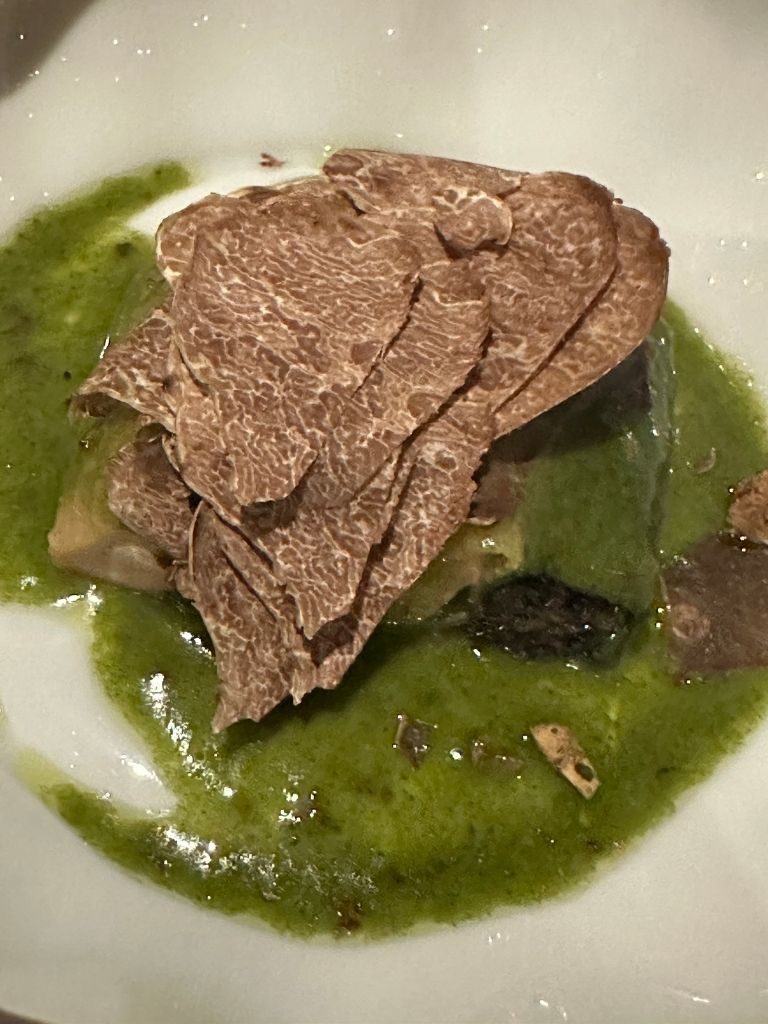 2023 version
 2025 version
Next comes the colvert or mallard duck. The wild duck is wrapped in green cabbage with foie gras and is served with two sauces: foie gras cream and duck jus. I normally prefer duck cooked whole and carved tableside, but this duck is outstanding. The chef uses all the parts — leg and breast — judiciously, he seasons well, and he achieves an optimum ratio between duck jus and foie cream. I can attest that that this modern version of a classic dish was nearly perfect in earlier versions, and it is now perfect without any caveats. To accompagny that dish, we chose a German Pinot Noir – Friedrich Becker’s Spätburgunder Kammerberg GG 2010, a wine that still shows remarkable complexity, yet delivers an effortless elegance.
 2023 Version
 2025 Version
For those who like game meat, the great partridge is not as prized as “becasse” (woodcock) or “grouse” (Scottish partridge), but it is highly valued. It is not easy to cook game, as the meat tends to be low in fat. So many chefs send to the dining room overly dry meats. I don’t also like too gamey or too chewy versions as I often see in Italy. I believe chef Banctel is a master in faisandage-aging the carcass to optimum marination and seasoning. His “perdreau gris, lait ribot and King Ha Farz” with sauce salmis is a consistently a masterpiece. The lait ribot translation is buttermilk, but the one found in the US has nothing in common with fresh lait ribo. Sauce salmis and buttermilk balance each other, while “king ha farz”– an earthy and crisp powdery dumpling of buckwheat flour enriched by eggs, long simmered meat, raisin and spices — adds a wonderful dimension both in terms of textural contrast and depth in taste. In 2025, they made the partridge dish even more exciting by serving its heart and liver in a brioche on a separate plate.


This year they served chevreuil (venison) loin with exemplary sauce grand veneur and salsify in two forms and textures: fermented and braised like a stick and crisp like angel hair potato fries. The sauce was very good and thick, but my number one slot for the “grand veneur”, which is a sauce poivrade with the addition of cream and sweet jelly, still goes to the Relais de la Poste in Magescq.

On the other hand, one hits the jackpot if they serve “Palombe barbajuan des cuisses, betterave facon “Bortsch”. It is a portion composed of three components. The main part is the rich and optimally gamey breast of wild pigeon which has been roasted under a salt crust and served with an incredibly flavorful sweet (blueberries) and sour (two kinds of beets) sauce with tarragon. The pulled thigh of the pigeon is used to stuff a crisp and fried somoza-like pastry called barbajuan. Finally, in a bowl, they serve the jus of sweetened beetroot and a little cream under which one discovers a “ravioli” of the meat. One eats them all together, and each bite invites one to stop and think and admire its complexity and harmony before continuing to eat.
 21 November 2023, all three together
The feast ends with “lievre de Beauce a la royale, spatzle au sarrasin”. Simply put, if one loves the long cooked hare in a very rich and thick sauce with foie gras, Banctel’s version is one of the very best I have tried. I love this dish and tried many versions. It can be dry or too gamey. But when it is good, it is a very deep dish which to me represents the zenith of gourmandise that I associate with the heyday of French cuisine. Served alongside with buckwheat spatzle, hare jus, and puffed rice, this last savory course makes an imprint in gustatory memory. The Amontillado, a sherry variety, from Bodegas Poniente was a perfect pairing with that dish. I was delighted to see that sherry on the wine list. A small nod to head sommelier Gaëtan Lacoste, who shares the same affection for sherry and has even gone on to create his own label.


The dessert course is always “limestone kiwi, green Chartreuse, shiso and sabayon”. This is a nice and modern dessert which is very appealing and appropriate after the journey into game territory.
November 7, 2025
Steirereck am Pogusch: An Excellent Austrian Country Inn
We enjoyed too many places in the recent trip through Austria to review them all. But if I am asked which I’d be most eager to return to, one stands at the top of the list: the country inn Steirereck am Pogusch. We spent two nights there and it wasn’t nearly enough.
I’ll get around to discussing the food but, let me first describe the environment the Reitbauer family has created there. The heart of the property is the Wirtshaus.
In the English language, there are inns and innkeepers. In German, Wirt means not the building but its host. So Wirtshaus means the host’s house. Emphasis is given to the person, not the structure. This is abundantly apparent throughout the entire Pogusch property. Every detail reflects the taste of this family, refined yet lighthearted.
The Austrian country charm of the original building has been lovingly maintained, but when they wanted more space, they attached a modern wing that makes the statement, we appreciate equally the architecture of the 21st century and the homey comfort of the 19th.

We were lucky to find a room here. It had been booked solid for several months before we wanted to come. When we had lunch in the family’s Vienna city restaurant, Steirereck am Stadtpark, I mentioned to our server that we were sad not to be able to visit their country place. “Let me see what I can do,” she replied. A few minutes later, she came back to report that she had managed to get us a room. I happily put it down in my calendar. More about that “room” later…
You enter the Wirtshaus through this inviting entryway:

The happy coexistence of old and new continues throughout the dining rooms:


The property is first and foremost a farm. In addition to the cows, sheep, goats, pigs and chickens, they raise over 500 varieties of fruits, vegetables and herbs. This produce becomes the heart of the menu both here at Pogusch and at their more formal restaurant in Vienna. “Farm to table” and “sustainable” have become clichés, but here both are entirely genuine.
Throughout the property are clusters of dwelling units, each with a unique personality. They all manage to be homey, quirky, and elegant, displaying the family’s distinctive taste.
We stayed in one of the four Vogelhäuser (bird houses). Each is named for a kind of bird. Ours was called Kuckuck, or cuckoo. I have to describe a few of its features to give you a glimpse of what makes the whole place so special. The bird houses sit on a hill with a view that stretches for miles across the green Styrian countryside. Entering the birdhouse hill, you’re greeted by this sign:

Only for Nesthocker. What are Nesthockers? It’s a play on words, meaning nest-sitters. It means baby birds that stay for a long time in the nest and also means stay-at-home people. Any people lucky enough to stay in these bird houses are going to want to stay there as long as they can.
Wrap-around decks look out over endless hay meadows cut into the forested mountainsides.


When you enter the front door, a quiet recording of bird and insect songs plays. After a moment, you hear the call of a cuckoo. Inside, the juxtaposition of old and new continues, exemplified by this stainless steel woodburning stove.


The bathroom includes a sauna and both indoor and outdoor showers.

On a wall of the toilet enclosure is this depiction of nursery rhymes about cuckoos. The cuckoo theme extends even to bath towels embossed with a cuckoo.

The bird houses are just one group of accommodations. Each group is unique. The Baumhäuser, or tree houses are clustered in a wooded grove.

In the Glasshaus, guests have suites within the farm’s greenhouses.

One of the old barns has been converted to guest rooms, called Schlaffen im Stall (sleep in the stable.)

Within the woods and among the farm buildings are the Jagdhütte, Rehleinhütte and other guest accommodations, each utterly charming, and each possessing understated luxury.
Two of the Reitbauer’s young adult children were managing the dining room during our stay. They clearly regarded their time there as not merely a job, but something more akin to a party that they loved hosting. I told the son how much we were enjoying the Kuckuck house. “Well, you can thank my grandparents for that. Every stick of it was theirs.” He shared an honest openness about how he saw his future. “My parents told me I could do anything I want, be a doctor or anything I liked. But I love it right here. In this business, your work is your life. You’re giving your guests not just food but an experience that you hope will touch them deeply. In what other job could I do that?”
I turned out to be one of the guests who was touched deeply. During my time at Pogusch, I thought a lot about why I care about restaurant meals. The young Reitbauer’s statement about sharing not just food but meaningful experiences captured what makes me spend ridiculous amounts of time and money roaming around looking for places to eat. The food has to be good, of course. But there’s much more to it. My favorite chefs are trying to share something that transcends the food: fond childhood memories, cultural traditions they fear may vanish, or surprising sensory nuances. There’s an intimacy in this process that moves me.
The Reitbauers have come upon a formula that combines features of traditional a la carte dining with the modern multicourse menu. They serve breakfast, lunch and dinner seven days a week. Most of the guests are here for a stay of several days, and the Wirt needs to provide them different experiences each meal. Here’s how they do it.
The main dining room serves completely different a la carte offerings each day, Wednesday to Saturday.
Wednesday’s menu is titled “Garden—field—woods.” It’s not entirely plant-based, but it gives vegetables first place. Here’s an excerpt from Wednesday’s menu:
Vegetables are incredibly diverse. They smell and taste green or fruity,
from sweet to sour, from bitter to savory.
They can be crunchy or velvety, juicy or creamy,
they can be cooling, stinging, or sweetly indulgent.
Vegetables are a delight for all the senses.
Grilled leek hearts with salted carrots, pickled mushrooms,
crispy linseed & herb salad.Baby Carrots
Glazed carrot variety with marinated herbs from our kitchen garden.Fennel
Braised with Pogusch citrus, Pernod & coriander seeds & fennel greens.Eggplant
Braised & spicy glazed eggplant with brook cress & Meyer lemon.Sweet Potatoes
Oven-baked in their skins with spicy paprika-chupetinho chutney.Chickpeas
Baked chickpea pastry with mountain cheese.Vegetable Salad & Buddha’s Hand
Marinated & pickled vegetable variety with Pogusch Buddha’s Hand citrus.
All sorts of things from Styrian gardens
Then, as on each of the four days of menus, there are two other pages of choices, one called Authentic, Trusted, and the other Refined, Simple. They list traditional Styrian specialties updated with the kitchen’s unique insights, and the chef’s selected preparations of lamb, veal, chicken and pork from the farm and fish from nearby mountain lakes.
Not to overwhelm you with the rest of the menus, I’ll just say that Thursday features “Inner Values,” snout to tail items from their lamb, pork and veal, Friday is “Freshwater fish day,” with whatever was just caught in the nearby lakes and streams, and Saturday is devoted to Styrian veal.
On Sunday, Monday and Tuesday, lunch and dinner are set four-course menus based on the best the farm has provided those days.
Here was our dinner on Monday:

As an amuse bouche, they brought this board of Pogusch pork, pointed peppers and horseradish, each of which they grew.

Each of the four courses was simple and perfect. Vegetables in Aspic contained rungia klossi, a green with a pronounced mushroom flavor. We could see from our walks in the nearby woods that mushrooms were nearing the end of their season. No doubt that was why the mushrooms in the dish were marinated rather than fresh.

The kitchen makes great use of the tremendous variety of mushrooms that grow in their property and the surrounding forest. Have a look at this display in the breakfast room, each jar containing a different species of locally foraged mushroom. The letters spell out “a remembrance of the diversity”

Styrian sour cream soup with marinated and smoked salmon was a delight.

Pogusch pork was from one of their own pigs, accompanied by kohlrabi, green beans and braised romaine, each of which they grew. The terrific sauce was flavored with herbs they also grew.


Nasturtiums, both as flowers and leaves, were a nice piquant accompaniment to the perfectly roasted potatoes.

The Steirereck Pogusch team cultivates dozens of varieties of potatoes, looking for the best for each method of cooking. I don’t know which one they chose for roasting in this dish, but they were delicious.
This potato plot was just beside the drive leading to our bird house. Each sign marks a row of a different variety of potato.

Poppy seeds and cheese curds inside a delicate beignet accompanied marinated and braised apricots from their orchard, vanilla ice cream and lemon verbena. I could eat this dessert every day and never grow tired of it. Come to think of it, I wish I had it right now.

Espresso came with candied citrus rind and sugared roasted pumpkin seeds. These seeds are an indispensable ingredient in Styrian cooking. They can flavor eggs at breakfast, mignardise like this one, and everything in between.

Tuesday’s dinner was entirely different and no less enjoyable.

I neglected to photograph the first dish, kohlrabi, veal tartar with wild herbs.
The rustic potato vegetable soup was everything you could hope such a dish would be: warming, comforting, rich and flavorful. Grandma would have highly approved.

Schneebergland duck came with cabbage, celeriac polenta and lettuce. Schneeberg is a nearby small mountain. The duck combined all the qualities one hopes to experience in duck but most often doesn’t: crispy skin, tender meat, satisfying duck flavor. The rich sauce was excellent with both the duck and the tasty celriac polenta. The lettuce doesn’t look like much, but it was outstanding.

Before I remembered to photograph it, we gobbled up half of the tasty peach and semolina kaiserschmarrn, the classic Austrian countryside dessert, named for Emperor Franz Joseph I who supposedly loved it.

There’s also the option of eating at the bar in the kitchen. There you can order from an ever-changing a la carte menu, or else opt to “let it flow,” meaning trusting the chefs to give you a succession of courses of their choosing. Here’s how they describe the kitchen bar:
The most fun is always to be had at the bar! This is true of our Schankkuchl too. At the heart of the action you sit at the long bar in a cozy and convivial atmosphere with your fellow guests and observe as the chefs prepare your dishes over the open fire or steam them in front of you. In the show kitchen the bounty of our farm and the region receives a contemporary and delicate interpretation.
We didn’t get to experience the kitchen bar but would love to when we return. Here are some tempting excerpts from the bar menu. The coexistence of old and new is in full force here:
Devil’s roll winter editionSourdough, stracciatella, wild broccoli, bacon, mushroom, kimchi.Kissed by fire
Pogusch lamb, viennese garnish, pogusch heurige.Bear strong
Bear & fruits, sorrel, salted caramel.Loafing around
Liwanzen (yeast pancakes), wild fruits, apple plum, soured creamThe best of both worlds
Sour vegetable salad, short rib, coriander, mustard.Bikini figure snack board
Autumn vegetables, sheep’s milk cheese, barberry, nettle.Chick stickx
Hen, romanesco, mountain pine cones, curry leaf, lemon balmKing or beggar
Carp, pumpkin, sea buckthorn, spinach, basil.Overflyer
Young pogusch chicken, roasted onions, chanterelle mushrooms, meyer lemon.Valhalla
Catfish, kohlrabi, horseradish, variety of beets, vanilla.Pearls before swine
Jerusalem artichoke, quinoa, farmers’ caviar, chives.
LET IT FLOW__________________________________ min–max _110-155

 The open fire bar kitchen
We came to Pogusch in search of alternatives to the tasting menu format that Michelin seems to consider the only thing worthy of multiple stars. I was feeling tired of dozens of tiny complicated dishes, each with a sip of a different wine. I was tired of those pock-marked white plates with the tiny depression in the center for two bites of food. I had no more patience for kitchens whose most commonly used implement is the tweezers.
Michelin reviewers, if you’re reading this, ask yourself: how soon and how often would you like to return for dinner to any particular one of your three-star places? For me, the answer in almost all cases would be not for at least a month and maybe two or three times a year. After you enjoyed a dinner in such a place, would you like to come back the next day? For me, the answer would almost always be no.
For Steirereck Pogusch, in contrast, my answer would be that I’d like to come back not only the next day but every day for the next week. Isn’t that worth some stars?
As Robert Brown so cogently pointed out in his article Form Swallows Function, the tasting menu is to the advantage of the restaurant and the detriment of its guests. It allows the kitchen to crank out the appearance of variety with assembly-line monotony. It allows them to reduce waste by knowing that every customer is going to eat the same thing. Almost every restaurant that has or aspires to Michelin stars has fallen into line with this format.
At Pogusch, the Reitbauers have evolved an excellent alternative that I hope will inspire others to emulate it. The pendulum of gastronomic fashion has swung as far as it can toward tasting menus. I’d like to propose Steirereck am Pogusch as a model of what it can swing back to: a dining experience that combines best features of the past and the present. I’m eagerly looking forward to another visit there and hope it will be soon.
October 30, 2025
Disfrutar Barcelona: The Amaranth Coral and the Spirit of Avant-Garde Cuisine
In mid-July 2025 we visited Disfrutar in Barcelona. Ranked as number one in the world by 50 Best and with Michelin three stars, this is a highly regarded restaurant. The cook/owners and some of the staff spent years at El Bulli, and as you would expect, there are important continuities in terms of overall vision, menu design, and cooking techniques. Playful, irreverent, a little theatrical and at times amusing, Disfrutar is certainly a must to visit for those interested in the history and the current state of avant-garde gastronomy. But unlike the Scandinavian school with its predilection for conveying puritanical and moral messages to the client and the patronizing attitude accompanying that “mission”, Disfrutar, like El Bulli and Enigma, encourages reflection and reciprocity. That is, the attitude of the staff and menu design encourages dialogue between the kitchen and the client, joking and having a good time, while feasting on some exquisite dishes. Although I have not spoken with any of the three owners, I sensed that they are not too pretentious and do not take themselves too seriously. Rather they seem to want people in their restaurant to have a wonderful “sobremesa” by spending four hours relaxing, conversing, laughing and enjoying each other’s company.
However the food is very serious, clearly rehearsed many times and perfected. It is well thought out in terms of portion size, the sequence of dishes, and overall balance. Fortunately, unlike many “top 50” or Michelin three star restaurants, dishes are actually delicious and not merely conceptually intriquing. We also appreciated the fact that when we left we felt satisfied but not uncomfortable due to over-eating and indigestion. Consequently we slept well.
Four months have passed after our visit to Disfrutar. When we look behind and evaluate the meal, what stricks me and my wife the most is not the existence of some brillant dishes. Such unforgettable “anthological” dishes are rare, but I have seen them at Alain Chapel, Jamin-Robuchon, Freddy Girardet-Hotel de Ville, Bernard Pacaud-L’Ambroisie, and Fernan Adria-El Bulli. Rather it is the overall harmony, consistency, and the flow at Disfrutar that impressed us.
Once ushered to your table, a kind of palate cleanser is served: frozen pina colada, that is the molecular version with pineapple in contrasting textures and temperatures. Then one toasts with “forest floor”, a low alcohol distillate from water, dried herbs, and moss. Obviously this aperitive is a vehicle to toast (serving this in a copper cup was a neat idea), but its true intention is to alert the plate for the first taste experiment. That is, an oval plate is served containing eleven sprouts. One is supposed to discover flavors after smelling and tasting the sprouts one at a time. For instance persinette is parsley. Scarlet is beet. Borage is cucumber.

I liked this challenging game, not only because it is a tribute to mostly forgotten earthy-natural aromas and flavors, but the intended discovery of the hidden world of green sprouts sharpens and broadens the palate. It is a proper beginning to a long meal containing a multitude of flavors.
What kind of dishes or aromas-flavor combinations should follow the “sprouts” test game?
Well, it is followed by “polvoron” and liquid salad, both served in a metal ice cream container, like a glass. Honestly I have never eaten Polvoron which google describes as “a type of heavy, soft very crumbly Spanish shortbread made of milk, sugar, flour and nuts.” This version is powdery, but not sweet. It contains tomato and arbequina olive oil. Neither this and nor the pink liquid salad made an impression on me. Perhaps they were intended as harmless amuses to keep the taste buds fresh before the onset of savory dishes.
While we were trying to figure out the secrets of the “liquid salad”, they serve truffle scented vodka in a cognac glass.


Truffled vodka raised our expectations, and we were not disappointed. The next three dishes all featured fresh oscietra caviar from China. The first dish was a fluffy, weightless fried bun filled with caviar. It is basically made from unfermented dough, and the idea is to show the temperature contrast between the exterior and interior of the fritter. It tastes very good, and since the technique is to fry a siphoned foam, the so-called “Chinese bread” is very light and non-oily for a fritter.

The middle course was reminiscent of crisp bruschetta topped by a generous dollop of caviar and solidified bubbles of smoked butter. (They must be using a technique similar to previous dish.) The bruschetta or thin waffle was inky black, and it is like a crisp version of the well known mole sauce. At any rate, this dish is delicious. The rich creamy-sweetness of oscietra caviar was exponentially augmented by condensed butter, but it was also tempered by the piquant mole. Both paired well with the truffled vodka.

The last of the trio featuring caviar was the most complex and profound: amaranth coral with caviar, oyster, and codium emulsion. The coral tart is made from amaranth grain and is topped with sturgeon (oscietra), as well as trout eggs, oysters, and codium (seaweed). These flavors highlighted the saline-iodized component of the caviar, but the overall harmony and depth of the dish rendered it perfect. This is one of the best caviar dishes, on par with Thomas Keller’s “oysters and pearls”. The anatomy and history of this dish is explained with painstaking detail and precision by gastronomy expert Carola Sitges who is also a good client of Disfrutar. I URGE ONE TO READ IT CAREFULLY HERE as it will provide an in depth understanding of Disfrutar’s philosophy.

I should add that the presentation of this “Amaranth coral” is accompanied by a little ceremony or optical illusion, a la Disfrutar. I have mixed feelings about its relevance, but it can be better understood by reading Carola’s article.
When we were reveling in the intense and deep maritime aroma and flavors, the next course was presented: a kind of “gazpacho with pistachios, green olives, various oils.” I could not quite concentrate on it, but noticed that they used an Adria style spherification method to the fullest. I recall fresh, bright, and balanced summer flavors. It was well conceived, following three consecutive rich courses.

But it is impossible not to remember the next taste explosion: flourless ‘coca’ bread with “escalivada” and anchovy. At home and in summer-fall, I love to eat grilled sourdough bread with caramelized red pepper, onions, eggplant, and Cantabrian anchovy. The often used cliché, “umami”, may be appropriate here as the overall taste combination is very rich and savory. Here they both lightened the Catalan traditional escalivada (smoky grilled vegetables brightened by sherry vinegar) and they concentrated the umami impression. The traditional coca flatbread was very light but crisp. When I asked, they said that they made the dough from potato starch-pliant kokko oblate to make it light. Yet its topping was true gourmandise.


After this very strong taste, what should come next? Well, they followed this with a display of an overly technical dish: crunchy mushroom leaf served alongside crispy egg yolk with warm mushroom gelatin and a fried egg ball sitting on egg shell with mushroom consomme. These visually beautiful two dishes did not make a strong palate impression. The latter showcased an interesting technique where the egg yolk was fried very fast (they said it was microwaved) and looked like a fried Chinese bun.


Next two dishes made a good impression. Oyster escabeche was served with four different kinds of fermented mushrooms, toasted pinenuts, and ice plant. This was an excellent example of mar y muntanya style dish which are very popular in Catalan cuisine. The sake they served paired very well with the fermented umami component of this dish.

The smoked eel, pesto (in spherical form), pine nuts, pistachio nuts, and pancetta combination was delicious. The parmesan cream sauce brought together the different components of this course.

Then it was the turn of my favorite Catalan green calcots (a sort of wild green onion). The season is very short, mid-April to mid-May. Normally they grill it and serve it on paper with sauce romesco. Since they served calcots in mid-July, they were freeze dried. They used the stem of the calcots to make a dashi. This was presented in a cognac glass. They also made a version of romesco sauce with miso. The result was quite good but by no means is a substitute for freshly grilled calcots which we have had on several occassions. (Somehow our server did not seem to believe that we knew what calcots were!).


I am not a fan of suquet fish stew as the fish tends to get overcooked, but the hake suquet was excellent. The hake was fresh and most likely it was not cooked in a stew. The fish stew was presented in a separate coffee cup and called “cappuccino of suguet”. On the plate, potato foam, potato gnocchi, and saffron aioli accompanied the fish nicely. I noted the quality of the saffron as another positive point.

The most perplexing dish was the next: “the hen of the golden eggs: crustacean fried egg”. They first leave on the table a deep plate simulating a nest, with a straw and five eggs with a barcode and a sixth egg painted gold in the center of the nest. Then they serve the dish that we are going to eat and recommend breaking the golden yolk and combining all the ingredients. The egg white is very well fried and a langostinos prawn tail is cut into three pieces and placed on top of the heavily toasted tips of the egg whites. According to Carola, whom I asked to explain this dish, the golden egg yolk was a spherification of a red sauce that looked like srirasha and was golden on the outside. Overall the dish looked like “fried egg white shrimp tortilla”. In personal correspondance Carola writes: “It is a deconstructed fried egg something in between a tortilla de camarones and some traditional Thai recipe, perhaps a kind of deconstructed Pad Thai.”


The final savory course was excellent: squab. When I asked its provenance, they said it was semi-hunted and came from Madrid. I did not quite grasp what they meant by “semi-hunted”, but it was a great squab, tender but also with a gamey edge that made the meat more flavorfull. (Most likely the squab was strangled.) They served it with two sauces: liquid manchego (fonduta texture) and a demi-glazed flavored by beet juice. These two were separated by bow shaped spaghetti made from agar agar. (See the photo.) A beet merinque on the plate was a nice extra touch. The excellent 1952 Rioja Gran Reserva they served by glass elevated the experience to a higher plane. My only wish is that they should also present the liver, internal organs, and the thigh of the pigeon alongside the breast as these are often the most flavorful parts.


Like almost all Michelin three star restaurants with degustation menus, there are too many desserts. I think it would be more satisfactory to offer a cheese course and only one dessert, but I know that inexperienced diners seldom frequent these type of restaurants and when they go they only remember desserts. I rarely remember a dessert unless it is exceptional. Disfrutar served one exceptional dessert: cucumber sorbet, black sesame, ginger granita, hoisin sauce, and chicharron (deep fried porc rind). This was not solely original and well conceived but also delicious. It was multi-dimensional and at the same time complemantary and contrasting elements hung well together.

We also loved the final gesture. They present engagement rings in a jewelry box. There are a total of 25 rings and one selects as many as one intends to get get engaged in the course of life 
One doesn’t also leave Disfrutar thirsty. As I have written above, they offer a ‘forest floor’ coctail, truffle infused vodka, and sake. Besides the glass of old Rioja Gran Reserva, we ordered an excellent champagne, Dehours, Les Genevraux. Made from pinot meunier with the Solera method, this is a deep and fresh tasting champagne. The white wine, a non-fortified Palomino, 2022 M. Ant De La Riva Macharnudo is an excellent wine from Jerez that I had three times. I was equally impressed each time.


I left the restaurant happy that I got engaged only once and married the right woman. Nonethless I should have eaten more than one engagement ring!
EVALUATION: 9/10
Part II – The Amaranth Coral: In Depth Analysis by Carola Sitjas i BoschI’m often told that my write ups are so long that, if I published only what I say about a single dish, it would already be an article that within a single chronicle there are several articles and that I write books rather than restaurant pieces.
What’s more, I complain that press releases don’t go deep; when they explain the latest menu at, for example, Mugaritz; a restaurant that invites you to write, think, and rethink. They simply transcribe the names of the dishes as they appear on the reminder card and pad them with generic adjectives like “a must try,” “the iconic,” “the delicious”; connectors like “followed by,” “next,” and “to finish”; and they transcribe quotes from the chef without offering any opinion beyond a bit of praise. In other words, a flat EEG.
When I posted photos of the latest menu I ate at Disfrutar this past Tuesday, October 7, 2025, I was surprised by how many people told me their favorite dish was the “Amaranth Coral.”
One of the dishes considered iconic at Disfrutar is the “Chinese bread stuffed with caviar and sour cream” from 2016, and I had no idea there was such (probably skewed) unanimity around the coral. Personally, I like the “Chinese bread,” but it’s not one of the dishes I’d highlight at the restaurant. Technically yes, because the idea of frying a siphoned foam alone thrills me, and I think the unfermented dough is very well achieved; but in terms of flavor, even though I value the two temperatures (the interior and exterior of the “fritter”), a taste of frying predominates that I associate with cuisines far less aesthetic, sensitive, refined, and intellectual. That’s why I liked seeing a different dish so clearly singled out.
I’ve said many times that Disfrutar is one of those restaurants I could talk about for hours and hours; I think their cuisine allows for that and much more.
I often read and hear the comment “not much left to say,” not only from enthusiasts but also from chefs and journalists. It seems to me you can talk about restaurants by going a little further than assessing product quality, doneness, and whether the dishes suited our personal tastes.
For all these reasons I’ve decided to publish just some thoughts on Disfrutar’s “Amaranth Coral.”
If I hadn’t previously published an article exclusively about one dish, it’s because, in a way, isolating one and discussing it without the broader context of the menu, the restaurant, and its trajectory can lead to misinterpretations and seems risky to me, since we’re talking about only two or three bites from a menu that, in this case at Disfrutar, consisted of 32 items (26 plus 6 petits fours), just as some journalists decontextualize a quote from an interview to craft a click bait, tendentious headline.
EXPLANATION OF THE DISHOn the one hand, the base is a crunchy amaranth that’s somewhat similar to a “cookie” of puffed rice.
First, they “soufflé” the amaranth. Technically, I understand that to “inflate” and to “soufflé” are the same and achieved similarly to how potatoes are made into pommes soufflées, how rice is puffed, or how corn pops to make popcorn that is, it bursts thanks to the moisture in the endosperm, where the starch is. That said, even if the terms inflate and soufflé are used interchangeably, I’d say they’re different processes and, physically speaking, inflating is different from bursting. Perhaps English makes this clearer, since “puffed rice” (which preserves the grain’s shape but is much larger) is different from “popped rice” (which has an irregular shape like popcorn).
Then they grind the souffléed amaranth, mix it with a green and a red coloring, add vodka, and fry this mass. Because it contains vodka (alcohol), when it comes into contact with the oil, the vodka evaporates very quickly and expands what’s inside (the mass), thus achieving the coral shape. I understand they add vodka to create more internal moisture. Technically, I don’t fully understand why they add an alcohol (wouldn’t water work?), and I imagine they use vodka rather than gin, white rum, or another clear spirit to contribute as little aroma as possible.

On the other hand, on top of this crisp and much easier to grasp go salmon roe (we’ve also been told trout roe at times), beluga caviar, a codium mayonnaise and pieces of codium, and finally two pieces of oyster. Even so, whether due to the season or because it was the first version, back in January 2023 they served it with sea urchins and the two codium textures, but without caviar, oysters, or salmon/trout roe.

The presentation of this dish also comes with a whole little ceremony and explanation. It’s served inside a black box with a pane of glass standing vertically in the middle. They ask us to take the coral, but we can’t find it. Then they remove the glass pane from the box and we “discover” the coral. The idea is to create an optical effect that confuses the diner, to prompt reflection on the plate (the tableware), on whether we’re supposed to eat the decoration and accompaniments or not, whether it’s necessary to have the decoration on the plate or simply to see it, and on garnishes and ways of serving food an idea very much in the elBulli vein that they’ve been developing for years. It really is a magic trick!
A dish that carries a message, a reflection but I understand it’s a game that could be adapted to other aperitifs, like Parmesan crisps, for example and that there’s no inherent connection between the optical effect and the coral.
ASSESSMENT OF THE DISH – Organoleptic analysisAppearance: It’s very beautiful, delicate, and fragile, very Disfrutar and the mirror effect achieved with the black box makes it shine even more.
Aroma: Scent is not what I’d highlight in this dish; amaranth isn’t exactly an intense ingredient. But of course, the seafood is at the right temperature and gives off some aroma.
On the palate.
Temperature: It’s very pleasant to feel the faux “toast” contrasted with the freshness of the seafood.
Texture: I really like the unctuousness/moistness that the codium emulsion lends to the crisp, without sogging it, yet giving it “juiciness,” and the crisp itself is “soft” in the sense that it’s easy to chew. That is, you have the fragility of the crisp and the density of the seafood, perfectly combined.
Taste: I remember that the first time I found the crispy component a bit disproportionate to the sea urchin and would have liked to taste more sea urchin and less “fried bread,” but as they serve it now (with oyster, salmon roe, and caviar, together with the codium emulsion and whole codium) the “coral” is more generously filled with seafood, and the bite conveys more marine freshness and that intense, deep maritime “punch.”
Even so, and this is a bit contradictory, i really liked the version with sea urchins. They source sea urchins of a caliber that’s a joy to behold, served impeccably clean, whole, without a flaw… they’re so good and I eat them so rarely that, frankly, I might have added a couple more.
I won’t give any auditory assessment, because beyond the pleasant sound of anything crunchy, there’s no need to act like such “snobs” (to put it politely).
ASSESSMENT OF THE DISH – Evolutionary and stylistic analysisIf I’m not mistaken, I’d say it’s a 2023 dish. At least, the first time I ate it was January 2023.
Over these nearly three years, I’ve eaten it three times, and in that period it’s been versioned based on products available in different seasons of the year. It has also moved around in the menu, going from dish number 14 to number 5, something they often do and which I find very sensible, whether for taste and service reasons, or because when they introduce a new technique they tend to present it alone, as bare as possible to give it full protagonism and on future visits it appears within a dish as a garnish or as one element among others, or, as with the coral, relegated to an aperitif and “de emphasized,” since they are constantly introducing novelties.
On the reminder cards, the dish appears as “Amaranth coral with sea urchin” (2023) and as “Amaranth coral with caviar, oyster, and codium emulsion” (2024 and 2025).
I also think it’s worth noting that, although at Disfrutar they don’t break the reminder card into “snacks,” “starters,” “first course,” “second course,” and “desserts”, a breakdown that became obsolete decades ago at many high end restaurants with long, narrow menus, we’re talking about a dish that would be the equivalent of an hors d’oeuvre (I’ve always eaten it at the start of the meal, between dish 14 and 5) and not a main course. And for some reason, it seems people don’t demand the same level of rigor from an aperitif or a petit four as from the central courses of the menu.
It’s a tartlet/canapé format so typical of the “fine dining” circuit of “gourmets voyageurs” who follow rankings and lists Jordnær, Sézanne, Hiša Franko, Coda, Mirazur, Trèsind, Victor’s Fine Dining at Christian Bau, etc.
But I’ll stress again that, in Disfrutar’s case, it’s an aperitif and not a course; therefore I don’t find the format at all objectionable. That said, as an aside, one of the things I liked about this last visit was that the second aperitif “Centrifuged macadamia fat with milk skin, caviar, and mango” was in plate format and meant to be eaten with cutlery (in this case, with two spoons, which I love, as spoons are the great forgotten tool).
Technically, physically, and chemically, I find it magical, just as I find it magical that a corn kernel turns into popcorn, even if cereals had already been puffed before.
Stylistically, it doesn’t seem among the most representative of Disfrutar, as it brings together two creative lines followed by quite a few other chefs who work precisely at this junction of “elBulli style + seafood cuisine”: Aponiente, Quique Dacosta, Miramar, La Madonnina del Pescatore, Uliassi, Mirazur, Gérald Passedat’s Le Petit Nice, etc. I even think it could be a dish from Dos Palillos or other Japanese influenced restaurants inspired by elBulli, understood as a kind of crunchy “sunomono.” In fact, if I ate it blind in 2025, I might not say it was from Disfrutar, even if in 2023 puffing amaranth was a novelty. That said, if we look closely at how these other restaurants carry out the fusion of elBulli style with seafood cuisine, we see that Disfrutar is the only one developing techniques substantial enough to be considered new.
As for the product, I’d say the dish doesn’t introduce any new ingredients for them: codium seaweed, oysters, sea urchins, caviar, and salmon roe were all worked with at elBulli; perhaps amaranth is the “newest,” appearing as a novelty in elBulli’s 2005 menu, twenty years ago now.
Also regarding the product, the sea urchin version allows you to enjoy them in their entirety and doesn’t require chopping them as in the oyster version, where you lose the sense of fullness and the meaty quality of oysters eaten whole. As always, there are examples that could sway us for or against cutting, mincing, or heavily manipulating an oyster, but I still remember what felt like sacrilege conceptually when, perhaps twenty years ago now, Nandu Jubany made an oyster tartare.
As for the product once more, perhaps the only point to criticize is the coloring, since to the uninitiated it sounds like a “bad” ingredient. I’m sure there are quality colorings and many natural colorants (like the seaweeds themselves) and many ways to “dye” food, but it brings to mind those dyes used to tint jeans and used in some countries outside the EU to color that aberration of “wasabi” in a tube that looks like toothpaste. Maybe I’d avoid presenting the dish by saying the word “coloring,” so as not to trigger the pro natural zealots afraid of being poisoned by the infinitesimal dose of sulfites in a bottle of wine, for example, and I’d explain that they achieve the green with seaweed, or whatever it is they use to tint it.
AMARANTHA parenthesis to talk about amaranth, since it’s a food that’s fairly foreign to me and that I associate with an Aztec origin from Mesoamerica.
It’s an ingredient I’ve practically never cooked with, except for a few bags from the Catalan company Biográ that I bought about four years ago, with dried amaranth seeds from India that I simply cooked to get to know the taste and ended up using only in salads and other dishes as if it were a legume. It took some effort to finish the bag and, in the end, I had to fry part of it and put the rest in the oven to use like sesame, seeds, or croutons as a crunchy element in some dishes.
I find it an inexpensive ingredient (I was buying it at €4.50/kg raw), and I associate it with South American countries, where I imagine it grows in poor soils and is consumed regularly to avoid malnutrition.
When I bought it for Ca La Carola, I took a bit more interest in the product and discovered that, botanically speaking, it’s considered a pseudo cereal that is, it doesn’t belong to the grass/poaceae family (where cereals are), but rather to the amaranth family, like quinoa, chard, spinach, and beet. Even so, due to its high starch content, in the kitchen it’s used like a cereal and has the “virtue” of not containing gluten.
My references for amaranth are scarce. I tried to jog my memory and look through my archive of reminder cards and found that in April 2005 I had it at elBulli in the dish “Sole with souffléed amaranth and amaranth air with coriander.” I’d say it’s dish 1176 | sole with puffed amaranth, Córdoba air, coriander amaranth/popcorn, Chinese chive blossom, and lemon.
That same 2005, elBulli also did “Little snails in court bouillon with pickled velvet crab and fennel amaranth” (dish 1170).
Another restaurant where I remembered eating amaranth was Mugaritz, and I found that in December 2009 I ate sea cucumbers sprinkled with amaranth seeds like crunchy crumbs. From the same restaurant, I also have a vague memory of a fish dish with “acidic amaranth sprouts” and a salsify nixtamalized or “fossilized” with the lime technique, accompanied by amaranth crumbs mixed with some fish roe so that they were visually confusable, since both were granular. And in 2025 Andoni is doing the dish “amaranth seeds with chile miso,” which I haven’t eaten, but it truly looks like a micro plantation of sprouts. I also found that in 2006, for Mas Pau’s 30th anniversary, Andoni cooked “A modo de una pasta, amaranto guisado con un caldo de sardinas guarnecido con colas de cigala y hojas tiernas del huerto como una bleda vermella” and a recipe of his based on scallops and tubers “roasted” covered with amaranth, slices of sweet acorn, and winter purslane, dressed with clay and truffle.
On 08/31/2020, Andreu Genestra (Mallorca) served “Potato, olive, oyster, and cockles.” A very typical Andreu dish, since it was three dishes in one, or in which he plated the accompaniments on separate plates.
On one plate there was a potato parmentier with an oyster on top and a green olive gel.
On a separate plate he served an almond “crêpe” with a stew of pochas (white beans) inside, potato sauce, and amaranth.
On a third plate, a crisp cookie made of potato with a base of fresh herbs, finished with three dots of black licorice and three cockles on top.
In Italy in recent years I’ve had it at AlpiNN (Bruneck/Brunico) with Norbert Niederkofler, where on 09/22/2021 he served the aperitif “Cabbage with puffed amaranth”; at Lido 84 (Gardone Riviera) with Riccardo Camanini, where on 03/31/2023 he served “Amaranth crisp, smoked eel cream, and black kale powder”; and at Clandestino (Portonovo) with Moreno Cedroni, where on 08/19/2023 he served “Ricciola con porro e lemongrass, viola del pensiero, basilico amaranto,” a 2010 dish raw greater amberjack accompanied by a leek and lemongrass sauce and, on top, fried amaranth (as crumbs), basil, and pansies. Very thin slices of a very tasty amberjack with a delicate dressing.
In short, amaranth strikes me as an uncommon ingredient in haute cuisine, with lots of possibilities even as a flour for bread and other doughs, or as a beverage, making a kind of “amaranth milk,” as is done with rice and other grains.
Closing the amaranth parenthesis: simply by racking my brain about where I’d eaten it, I was surprised to find more examples than I’d have thought at first. But in any case, I find it curious that all the dishes combine amaranth with products from the sea fish, crustaceans, fish roe, or seaweeds except for Andreu Genestra, who used it in a sauce with potato that accompanied an almond crêpe stuffed with a bean stew (legumes).
THE CORALLastly, to close the evolutionary and stylistic analysis of Disfrutar’s “Amaranth Coral,” I think that, in terms of embodying an idea based on a non culinary element, the dish is very well achieved.
Even though we also call the red part of scallops, zamburiñas, lobsters, and brown crabs “coral,” we all understand that Disfrutar’s coral refers to the marine invertebrate which, though some consider it a plant and others an animal, I’d say is not eaten besides being highly protected and considered a prized object. This double meaning could also serve as a wordplay to stuff the amaranth coral with lobster coral, for example making a “coral of coral.”
I think of chefs who have tried to “cook” marine coral and, right now, the only thing that comes to mind is elBulli’s 2005 “morphing,” the “chocolate coral” (dish 1212), but that wasn’t a dish that intended to transmit the taste of the sea; it was simply a chocolate in the skeletal, branched shape of a reddish coral.
It’s a dish that can call to mind, aesthetically and in its marine profile, Disfrutar’s “aerated sea rock” from 2024 (dish no. 10 on the October 2024 menu).

It was a “rock” they made from a béarnaise with some mussels; they put this sauce in a siphon to make a foam and vacuum sealed it, so that all the air in the foam expanded, achieving a very light, delicate texture. Then they put it in the blast chiller to cool it very quickly and so it would retain the spongy form.
On top, they added blue spirulina for color, some fried shrimp (“camarón”), Kalix roe, tobiko (flying fish roe), some seaweeds like sea lettuce and sea grapes, and an emulsion that I’d say was codium. At the base of the plate, under the rock, there were small pieces of oyster.
I take Kalix roe to be the Swedish “caviar,” the roe of the European vendace (Coregonus albula), a freshwater salmonid; specifically from the Swedish city of Kalix, on the Swedish side of the Bay of Bothnia, where there’s an archipelago famous for producing this “caviar” with a distinctive taste due to the large influx of fresh water that the Bay of Bothnia receives from the rivers of Swedish Lapland.
The idea was to take the spoons and eat away.
A dish I remember as very aromatic, it smelled like Cala Montjoi! The taste of béarnaise was gentle, but I liked it combined with the seaweed and marine flavors. I found the rock a touch too cold; I always struggle with things that are too cold, although in this case the coldness dissipated quickly. The rock, despite looking like a sponge, crumbled; it wasn’t elastic like elBulli’s “sponges,” which is why I think they called it an “aerated rock” and not a “sponge.” Sea grapes, even if they add little flavor, are curious and fun for their texture. Discovering the delicious tender pieces of oyster beneath the rock was fantastic.
I found it curious to combine a béarnaise with seaweed, fish roe, and oyster, since it’s always been served with meats like Chateaubriand or beef fillets, though it has also been used with fish and vegetables. It also surprised me to eat it cold and in the form of an “aerated rock.”
Even so, the similarity between this “sea rock” and the “amaranth coral” is debatable. It’s like saying a black shirt dress and an LBD are the same. Yes, they’re both black dresses, but they have nothing to do with each other, one informal and daytime, the other a cocktail party dress. I mean they are two dishes with marine flavors, but technically they have nothing in common, apart from the fact that the “aerated sea rock” was a colder bite than the “amaranth coral.” Simply put, since I ate them in the same menu in October 2024 and only a few courses apart, it was easy to link and compare them because of their marine theme and aesthetics.
The “amaranth coral” is also a dish that more than one chef has liked and, even if they don’t copy the puffed amaranth technique for the base, we do find canapés that resemble Disfrutar’s coral quite a bit. We don’t have to go far to find a copy (or “homage” or “inspiration,” if you prefer to soften it), like the “Corali” I ate in May 2024 at Paco Pérez’s Miramar, the fourth of the nine aperitifs served.

I assume they call it “Corali” because, visually, it evokes the calcareous skeleton of marine coral.
There were spaghetti like or filamentous strands of various seaweeds on the shell of a zamburiña; the seaweeds remained rigid and were crunchy.
On top, salmon roe and tobiko (flying fish roe), although they didn’t specify, saying simply “different caviars.”
Also on top and again they didn’t mention it, there was a freeze dried codium foam (white, even though codium is green; who knows what they blend it with so it loses color). In any case, I take it they make a foam with freeze dried codium, not that they freeze dry the foam.
Over that foam, a bit of what looked like fresh wasabi and a little purple flower.
Over the seaweed base there was also a gelatin made of three seaweeds (the light yellow dots): laurencia, sea lettuce, and gracilaria.
There was also a gelatin with huitlacoche that doesn’t show in the photo.
Finally, “mareperla” (the succulent plant, not mother of pearl) which, honestly, I have no idea where it was or in what state (solid, liquid, or gas) they served it.
It was also meant to be eaten by hand like a canapé and, if you were capable, in a single bite; otherwise, half the ingredients fell off, crumbled, came apart, and dribbled everywhere, making a mess of yourself and the tablecloth.
Flavor wise, a citrusy mayonnaise and the salmon roe dominated. Texture wise, it combined the crunch of the dehydrated seaweed, the different crisp pops of the roes, and the creaminess of the gelatin, the foam, and the salmon roe when they burst, very pleasant creaminesses of different densities. A delicious canapé I would have enjoyed much more had I been able to manage it in a single bite.
At Miramar, in the same menu and also served as an aperitif, the ninth canapé was a dish titled “Marine Salad,” which also revolved around the same theme.
Even though they write Marine with a capital M, I understand it doesn’t refer to a proper name but to the sea.
They describe it as a “cupcake” of a transparent gelatin made from lemon peel and filled with brown crab and halophyte plants. Even though they didn’t announce it, it also had salmon roe (they said trout), orange tobiko (orange flying fish roe), yellow tobiko (yellow flying fish roe), and some “sea peas” that were spherifications based on a seaweed juice grilled over embers (the smallest spheres).

I don’t find it very serious to call it a “cupcake”; I don’t quite like that give me tartlet or a more classic name; we’re not in a café in the Sant Antoni neighborhood, for goodness’ sake!
An aperitif quite similar to the fifth canapé, the “Corali,” but without the crunch of dehydrated seaweed and, once again, with fish roes from very far from Cap de Creus.
All nine Miramar aperitifs were served and explained at once, resulting in a touch of saturation with so much information received in one go; I’d prefer they serve them one by one (with an allegro vivace tempo like at elBulli) or in two rounds. Besides, the three or four minutes of explanations alter the temperature, texture, flavor everything of each bite. An endemic ailment of fine dining; nothing new to say there. Just as I repeat myself by saying that, once again, the aperitifs were rather wishy washy something that doesn’t happen at Disfrutar. Fortunately, however, at Miramar they also had the marine intensity I expect from that restaurant, and that made me happy. I love starting with that fresh, pure maritime power so characteristic of Miramar at its best!
In short, aesthetically, the base of Disfrutar’s “Amaranth Coral” reproduces very well the idea of calcium carbonate forming the hard skeleton. The green color with red touches also seems very appropriate to me, since coral lives in symbiosis with microalgae that lend it those colors and, moreover, given that amaranth is white and they give it green and red hues with seaweed (codium).
Also, some corals can trap plankton and fish, so I find it very fitting to serve, on top, roes, seaweeds, and bivalves, in addition to boosting the marine flavor.
Therefore, I think it’s magnificently represented, it’s very good, and Disfrutar has made it possible for us to eat marine coral. I’d never have imagined it would be so delicious. A gemstone worthy of the finest jewelers. You could happily eat the whole reef!
October 11, 2025
Huset: The Northernmost Restaurant on Earth
We’re in Longyearbyen on Spitzbergen Island of Svalbard, above the 78th parallel. That’s as far north as the northernmost tip of Greenland. To get there, we sailed in the Hurtigruten ship Trollfjord for two days north across the Arctic Ocean from North Cape, Norway, which is the farthest north point of land in continental Europe. When you dock in Svalbard, you’re greeted by a sign warning of the dangers of polar bears.

This wouldn’t seem to be promising territory for fine dining! But Longyearbyen is home to Huset, the northernmost restaurant on Earth. Amazingly, it holds one of the biggest and most extensive wine cellars in Scandinavia.

Huset, which means house, was built in the 1940’s as a community hall for the coal miners and their families who were the only residents of this remote island. By the 1970’s, the building came to house a restaurant to serve the growing population of what was still a one-company mining town. The menu then featured polar bear meat.

In the 1980’s tourists began to visit Svalbard, drawn by its bleak arctic beauty. Hroar Holm, Huset’s manager, came up with the idea of offering fine dining and began to collect wine. He insulated the basement set in the permafrost to provide ideal stable year-round temperature for a cellar. The concept is the same as the Svalbard Global Seed Bank which relies on the permanent cold to preserve samples of all the world’s agricultural seeds.
The collection grew to over 20,000 bottles. Today the list has more than 1000 different wines. I don’t think Michelin has visited Svalbard, but Wine Spectator did recently and awarded Huset their Best of Award of Excellence.
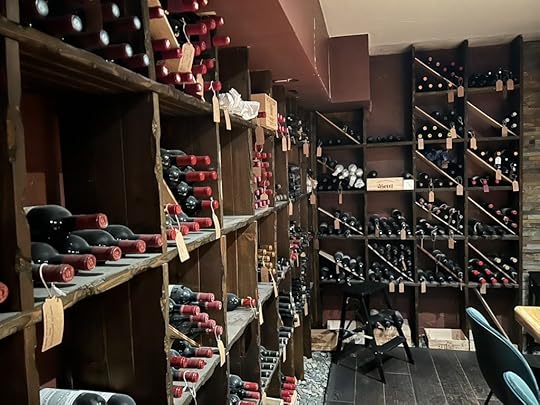


Over the years, Huset’s commitment to serious fine dining grew. Chef Alberto Lozano was recruited by Hurtigruten Svalbard to helm the restaurant. He’s from Albacete, Spain and brings some Spanish elements into his cuisine, but his palette has become first and foremost Arctic. He showcases not just Arctic ingredients, but local methods of preservation and preparation.
 Chef Alberto Lozano

We sometimes talk about going to the ends of the earth to dine, but Svalbard is truly the end of the earth. It’s the furthest north land mass on the planet.

More than half of the archipelago is covered with glaciers. Here’s a shot I took on the fjord in which Huset’s town Longyearbyen sits.

The near complete absence of fertile soil and the extreme climate make growing anything here—except for a few herbs in a greenhouse—impossible. But there is much to hunt and forage.
Reindeer, seal, ptarmigan, mushrooms, various kinds of seaweed some herbs and berries—cloudberry, bilberry, mountain sorrel—head the list of indigenous Svalbard foods.
Fish are abundant. I asked one local about the fishing here. “It’s pretty good. We went out last week and I got about four or five hundred.” “What do you mean?” I asked. “Four or five hundred kilos,” she explained. On rod and reel. In a couple of hours.
Our dinner at Huset was a fourteen-course tasting menu. We were brought glasses of a California sparkling wine as soon as we sat down. I generally choose standard rather than prestige wine pairings, but interested to see what their famous cellar held, I went for their top-level pairing. I was somewhat disappointed to see that only about half of the selection came from their cellar collection and half were recent acquisitions. But nevertheless, there were a good number of wines in the pairing that I especially enjoyed.
The amuse bouches began with Svalbard Cold Cuts and Bread.
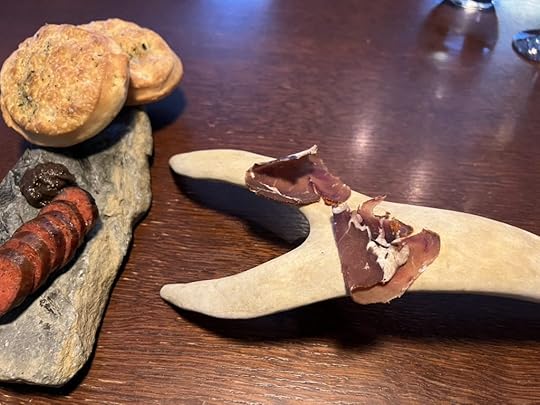
Reindeer heart, smoked and dried, and reindeer chorizo were served with a black shallot paste and a Pan de Aceite, showing the chef’s Spanish roots.
 Dry aged reindeer neck

Local beer sourdough bread came with butter cut in the shape of a ptarmigan and infused with that bird’s dried and finely ground meat. I loved the bread but found the butter an unsuccessful attempt to combine a local ingredient with a foreign one. Ptarmigan are native to Svalbard but butter, of course, is not.
The reindeer chorizo, on the other hand, used Spanish paprika that the chef brought from a trip to his home to make an exceptionally flavorful and enjoyable local/foreign sausage.
I’d like to include here the chef’s description of the care they take to use every part of the reindeer they get from a local hunter and trapper:
Once the reindeer arrives in our kitchen, we hang the meat for an additional two weeks, building on the time it spent in the trapper station. We then carefully separate each muscle to ensure the highest quality throughout the process.
The finest cuts are vacuum-sealed and frozen, while some legs undergo a traditional Spanish ham curing method, which takes at least nine months. This involves curing the meat in salt for 14 days before hanging it, covered in Spanish paprika, to develop rich flavours.
We transform the neck into cold cuts, and with the leftovers, we create chorizo, pâté from the liver, smoked heart, and brined air-dried tongue—delicious when fried.
Finally, we roast the whole carcass to produce a rich demi-glace. Any leftover fat is repurposed in our kitchen or shared with our friends at Green Dog [a Svalbard dog sledding service company.]
This meticulous process allows us to honour every part of the reindeer while bringing the authentic taste of Svalbard to the table.
Next among the starters came Rype (the local name for ptarmigan) served two ways: pralines of ptarmigan leg meat prepared confit-style with black currant compote, and “anchovies,” crafted from breast muscle rillettes, preserved in Røros butter, and served with a lacto-fermented tomato sauce on toasted seed bread, replicating the classic anchovy experience. On top of the “anchovies” were seeds found in the bird’s crop, a local traditional practice.
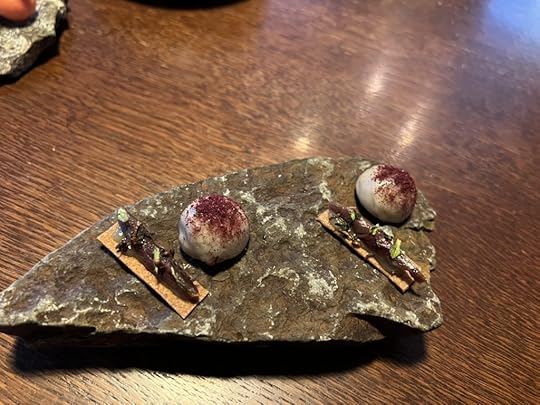
The amuse bouches concluded with Svalbard ingredients in three examples of preservation:
Svalbard cod marinated in escabeche and topped with its foamLocal pickled fjellridderhatt mushrooms, hand-picked by the kitchen teamLacto- fermented radish.All three preparations were fascinating and tasty.
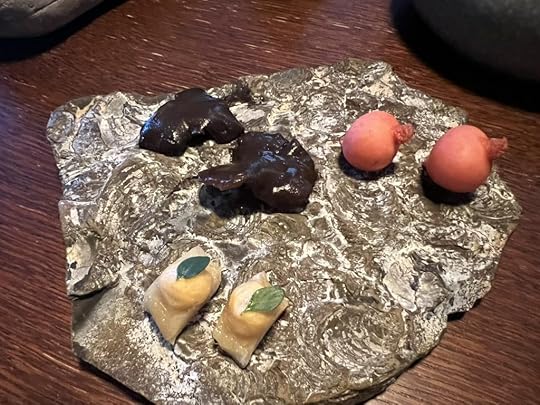
These opening dishes did a fine job of introducing us to local ingredients and preparation methods, increasing our curiosity of what the rest of the menu held in store.
To conclude the amuse bouches, we were served this “umami shot,” a dill and sea buckthorn cocktail with cloudberry foam in a miniature guksi, the traditional Sami drinking cup.
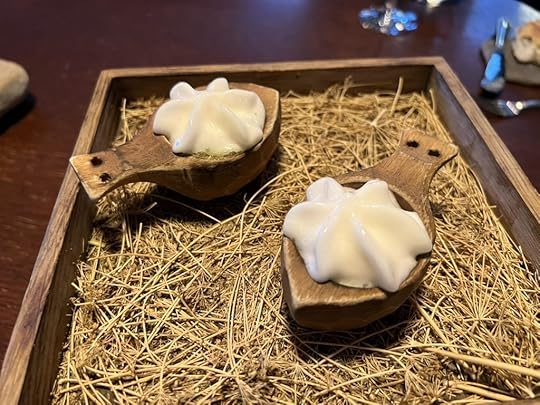
Then our server ushered us from the lounge where we were first seated to the downstairs dining room.
The first of the main courses was Seal Mojama in ajobianco with fermented tomato water, almond and parsley oil.
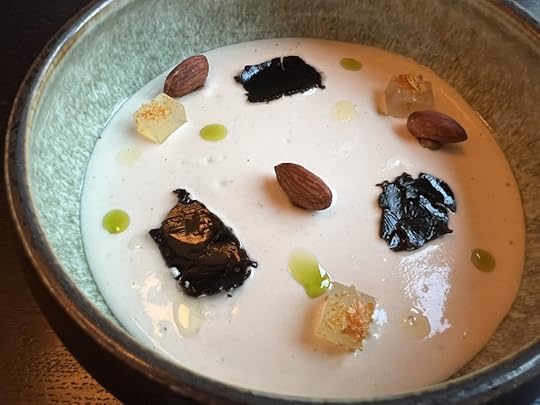
I found this dish to be a hodge-podge of ingredients that, while enjoyable individually, didn’t enhance one another. Mojama is the Spanish technique of preserving meat or fish by salting, pressing, soaking and drying. It makes tuna into “ham of the sea.” Our Spanish-born chef used this method to cure the seal meat. The seal was tender and had a pleasant saltiness. On its own, it would have been interesting, but why was it floating on the ajobianco, and what were the almonds doing there?
As an aside here, I want to note that I am holding Chef Alberto Lozano to the same standard that I would a top restaurant in mainland Europe. I recognize that he faces challenges that a chef in Paris would never dream of having to deal with. Almost everything has to come across the Arctic Ocean, often ordered weeks in advance. The pool of competent help is tiny or nonexistent on Svalbard. The availability of locally foraged ingredients is subject to the unpredictability that the extreme arctic environment imposes. And the arrival of customers is far harder to forecast than on the mainland. But he aspires to world-class excellence, and I hope that my critiques will be taken for what they are: suggestions that a well-wisher hopes will be helpful.
To accompany the seal – there’s a phrase I’ve never used before! – the sommelier brought a Louis Michel Chablis Vaudesir 2004. A promising start to the journey ahead of us.
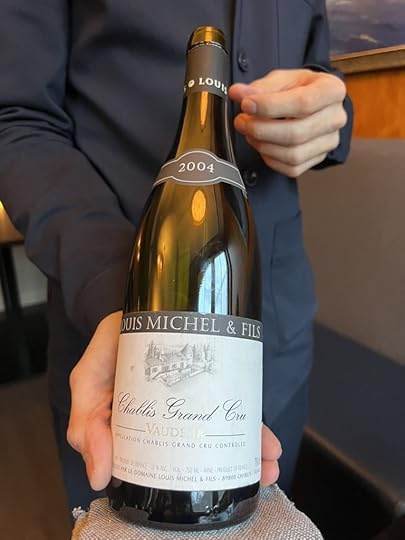
Next came a dish called King Crab Art.
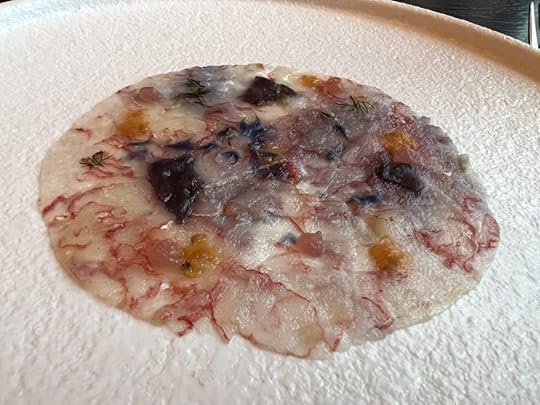
Finely sliced Norwegian king crab was combined with local flowers, fermented red cabbage, pickled cloudberries and dill to make an abstract impressionistic painting on the plate. I found this combination of ingredients somewhat more successful than the previous dish. The fine slicing of the crab meat gave it a pleasingly delicate texture, and the fermented cabbage and pickled berries enhanced it in an interesting way. But honestly, I found the attempt at artwork off-putting and would have preferred a more straightforward presentation of these ingredients.
With the crab, we were brought a Marcel Diess Engelgarten 2020, a simple and pleasant wine, but surely there were more interesting single-grape Alsace wines in their thousand-bottle collection that would have done a better job.
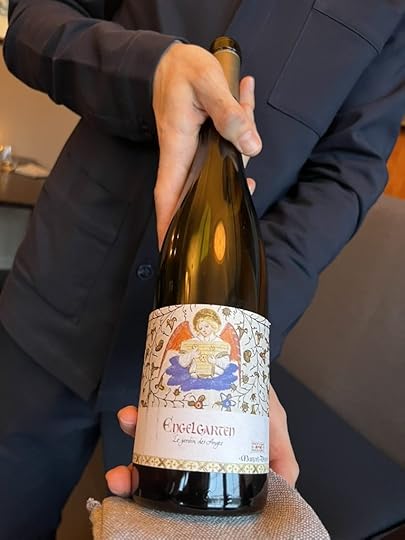
The next dish was the best so far: Scallop and Sea Urchin. It’s hard to go too far wrong with those two ingredients, but here the creativity of the chef shone through, enhancing them both in surprising ways. The scallop was cured with amazake, a sweet thick sake in which the rice starch is fermented into sugar instead of alcohol. This gave the already excellent local scallop a unique creamy texture and sweetness. But where is the urchin, I asked? The urchin is the sauce, I learned. It was emulsified with black apple into a thick sauce that combined the deliciousness of the roe of local urchins with the concentrated flavor of apples fermented at controlled high temperature. Atsina, an anise-flavored green grown in Huset’s greenhouse, added just a subtle additional flavor. This was an excellent dish.
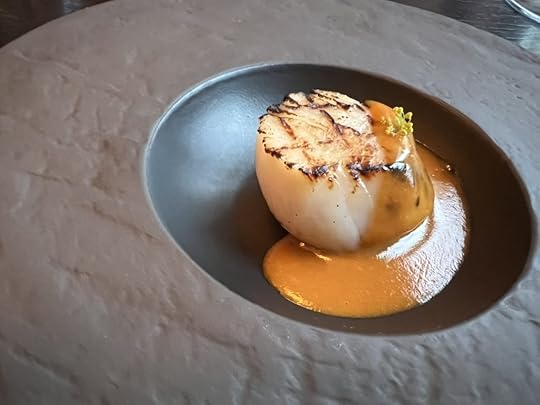
Accompanying the scallop/urchin dish was a 2009 Reichgraff von Kesselstatt Nies’chen GG, a creamy and floral Riesling, just off-dry. It complemented the dish well, but again I wondered if this is the best that Huset’s storied cellar has to offer.
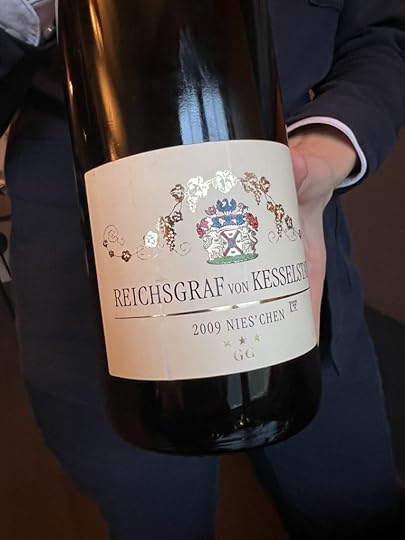
Next came Arctic seafood rice with langoustine tempura.


The rice was cooked with squid ink, giving it a sweetness, and topped with dabs of mayonnaise, some seasoned with piquillo peppers (no doubt from the chef’s native Spain) and some with locally harvested plankton.
The chef came over to our table to tell us about this dish. The Norwegian langoustine was not cooked in the usual tempura method, he explained. The shell of the langoustine was dried and ground into a fine powder. This powder, instead of conventional tempura batter, coated pieces of langoustine tail before it was fried. He wants this to give the experience of the entire shellfish in each bite.
Alberto was charming. His enthusiastic sincerity made it clear he is on a mission that he cares deeply about. He loves the extremes of Svalbard and passionately wants to share the flavors this environment produces.
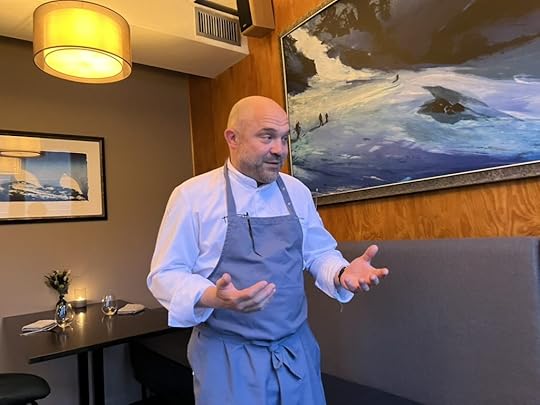
To accompany the seafood rice dish, the sommelier brought an Anne Amie Prisme 2008 from Oregon, a pinot noir blanc.
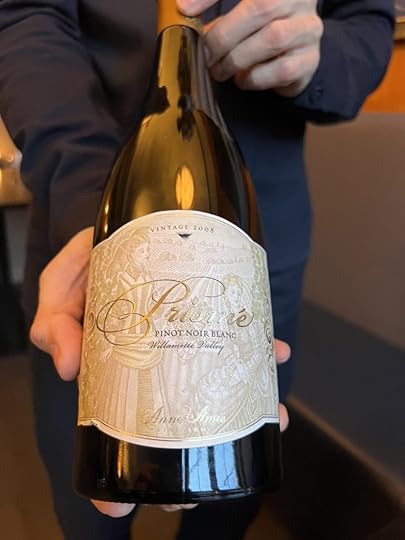
Chef Lozano introduced the next dish, cod kokotxas with ramps pil pil. Cod is one of the only ingredients that is common in both Norway and Spain, he explained. I was eager to try this Norwegian version of kokotxas, but it fell short of expectations. These cod cheeks should be gelatinously tender, but they were not. They were quite tough, probably because while the chef was chatting with us, his sous chef cooked them at too high a temperature. This was an avoidable mistake and made me sympathize with the chef, whose enthusiasm was undiminished in the face of the challenges of running a world-class restaurant near the North Pole. The pil pil sauce was excellent but it couldn’t make up for the toughness of the kokotxas.
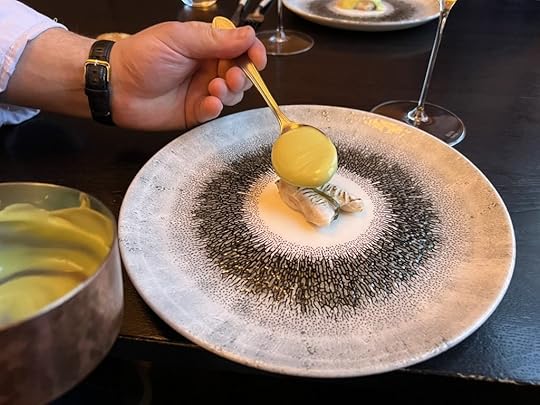
What did ease my disappointment at the texture of the cod was the 1996 Savennieres Becherelle from Nicholas Joly, the first wine that seemed likely to be from their cellar collection rather than a new acquisition. This was a serious wine with complexity of taste and aroma and a unique personality.
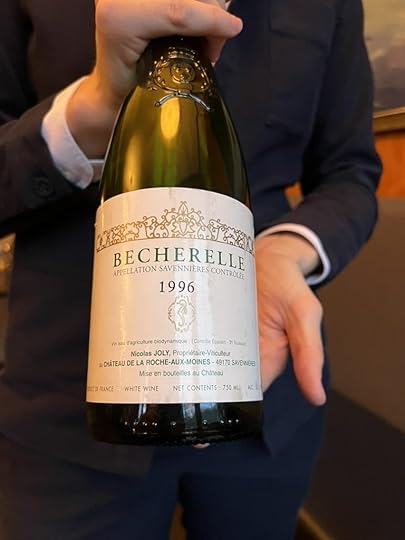
We were served next a palate cleanser, an ice of fermented yellow beetroot with locally foraged mountain sorrel. It was excellent. Fermentation is a necessary method of preservation on Svalbard, and it also gave a zing to the beet.
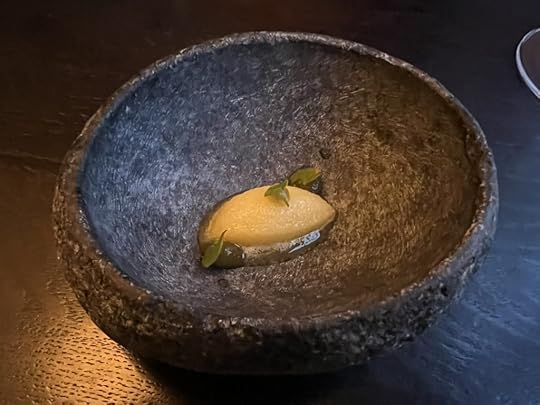
The next dish was an unqualified success: Rype and sea buckthorn. Rype is the Norwegian name for ptarmigan, the only fowl that overwinters on Svalbard. Its winter coat is white, letting it camouflage in the snow. It tastes much like the pheasants I used to hunt when I lived in the Midwest. Rype breast came with a sea buckthorn sauce and a fermented chanterelle.
What pleased me most about this dish is that it combined local ingredients prepared simply and in familiar and necessary ways for the arctic. Without trying to be overly fancy, it shared some true Svalbard taste experiences.
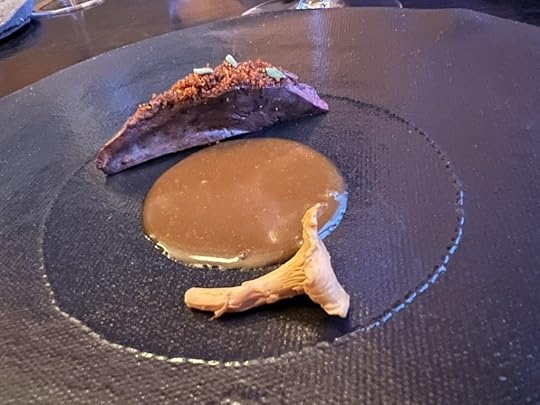
Sea buckthorn is a common plant along the arctic coasts, where its salt tolerance allows it to thrive. It is an important source of vitamin C in the local diet. Its orange berries have a distinctive bright and sharp flavor.
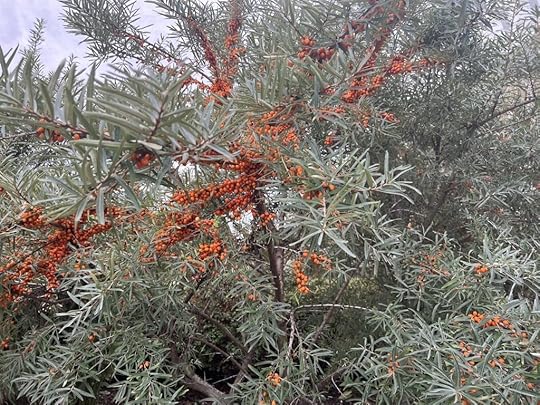
A 2014 François Mitjaville Roc de Cambes accompanied the rype dish, probably another recent addition to the cellar but nonetheless an enjoyable Bordeaux, predominantly merlot, with a complex and lingering finish.
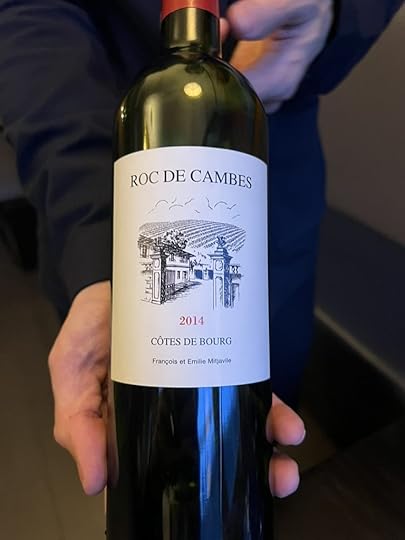
We were then served these lovely house-made brioches with smoked butter, black garlic and local seaweed. The server pointed out that the rock on which she presented them was found locally by the chef and contained fossilized tropical plants, showing that Svalbard was once located much closer to the equator. The tropical forest that grew here gave rise to the coal that was the reason for the island’s being settled and for Huset originally having been built.
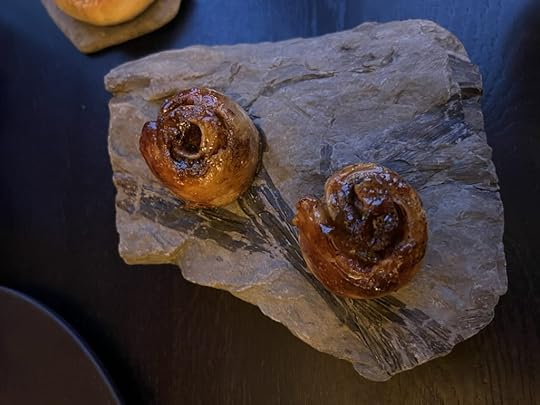
Next came an entirely mushroom-based dish. We were there in peak mushroom season, mid-September. Since all of Svalbard is above the tree line, mushrooms that grow in association with tree roots—and that includes most of the mushrooms we eat in temperate climates—cannot grow there. But there are a number of varieties that thrive there, and people avidly forage them.
Common finds include Agaricus aristocratus (known as the polar mushroom or aristocratic agaric), which is large, fleshy, and thrives in areas with coal residue in the soil. Another favorite is Lepista multiformis (fjellridderhatt or clustered bonnet), which had been served to us in the amuse bouches.
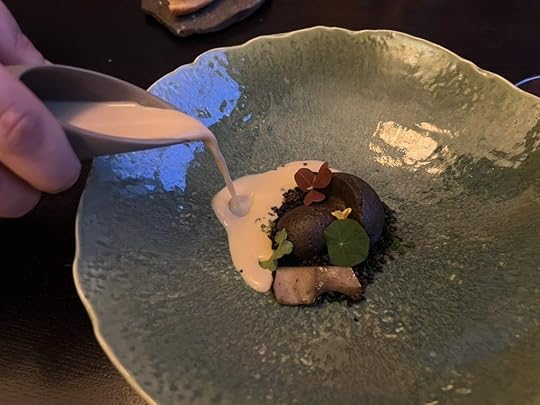
I don’t know which species we were served in this dish, but they were tasty. The centerpiece was a mushroom “fiskboller,” or fish ball, a common Norwegian dish, accompanied by a pickled mushroom over rye bread “soil” and herbs from Huset’s little greenhouse. The server poured a mushroom broth and garum sauce around the composition. Garum, or fermented fish sauce, brought depth and umami to the dish.
To accompany the mushrooms, the sommelier brought a Barolo, Anselma Vignarionda Riserva 2011. Its tar and smoked meat bouquet worked well with the dish.
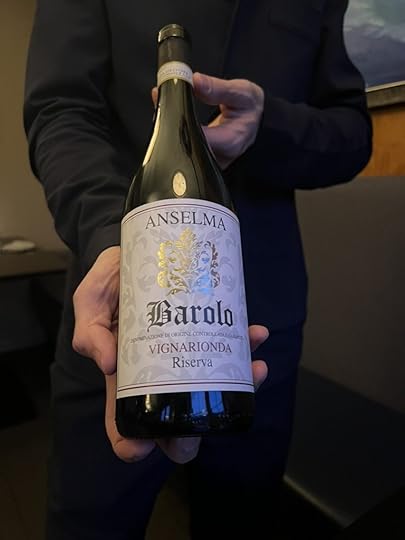
The next dish was one of my favorites: reindeer with a cherry glaze and a Jerusalem artichoke. The reindeer loin was tender and gamey, but in a good way. I suspect it was dry aged for a good long time. The cherry glaze was darkly sweet and perfectly made. It enhanced the meat nicely. The Jerusalem artichoke held a surprise: when I cut into it, out came a Jerusalem artichoke puree.


A 2000 Jaboulet Hermitage La Chapelle accompanied the reindeer. Its age had mellowed its intensity but not its complexity. It was a fine match for the dish.
We were next served popsicles of fermented honey with sea buckthorn heart and flowers, and a glass of Mark Angeli Bonnezeaux Coteau du Houet 2004, sweet and floral.


Chef Alberto came out to serve the dessert, a beetroot filled with beet and rhubarb cream and a sorbet of Norwegian strawberries. Pickled rhubarb was fashioned into a stem for the beet. He explained that nothing could be more Norwegian than these three ingredients. I thought it was delicious–tart/sweet and refreshing.
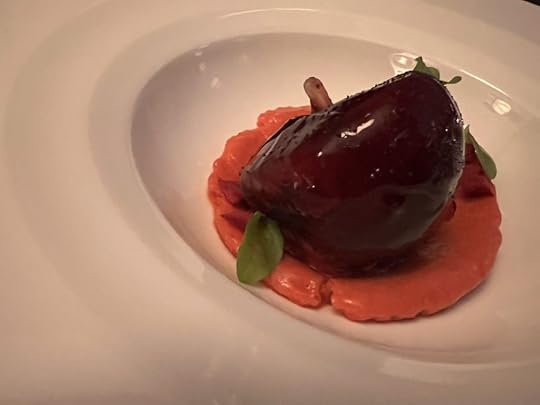
With the dessert came a glass of Niepoort vintage port, 2003.
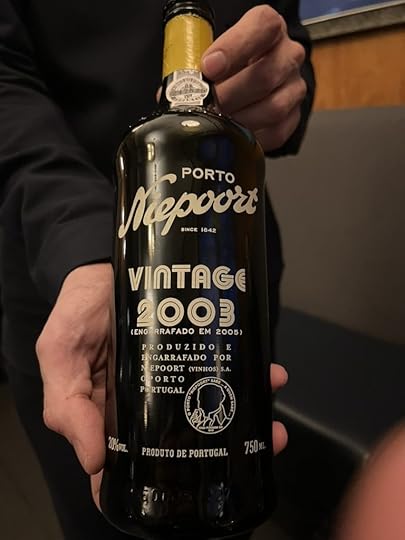
Petit fours were polar bear gummies of black koji and elderflower, and in the whale’s mouth, pralines of plankton, cloudberries and lavender. The swirling colors of the pralines were said to represent the northern lights that we saw that night.


The refined setting amid the harsh arctic landscape, the warmth of each of the staff and the passionate commitment of the chef to honor Svalbard’s environment and flavors all combined to make our dinner at Huset an unforgettable experience. I’ve pointed out a few shortcomings, but my overall impression was extremely positive. Is it worth going to remote Svalbard for? Absolutely, but don’t go only for that meal. Chef Alberto Lozano would be the first to agree that Svalbard itself is a fascinating destination, worthy of a once-in-a-lifetime trip.
October 3, 2025
Taubenkobel: Michelin Star Dining with Local Ingredients
In addition to Amador and Steirereck am Stadtpark, while in Vienna we also had a dinner at Sacher Hotel’s Rote Bar, which specializes in traditional Austrian dishes. All three were memorable meals—see my reviews of the first two—but after all that urban sophistication, we were yearning for something more country. We found that at two places, Taubenkobel and Steirereck am Pogusch. We spent two nights at each and loved every minute of our times there. I’ll review Taubenkobel here and then Steirereck am Pogusch separately.
Taubenkobel means dovecote or, more prosaically, pigeon coop. Its name modestly understates how charming the place is.
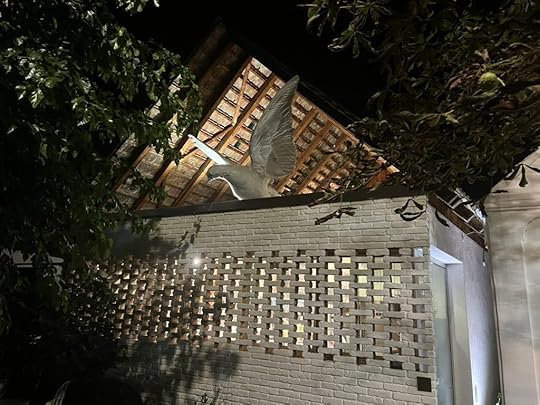
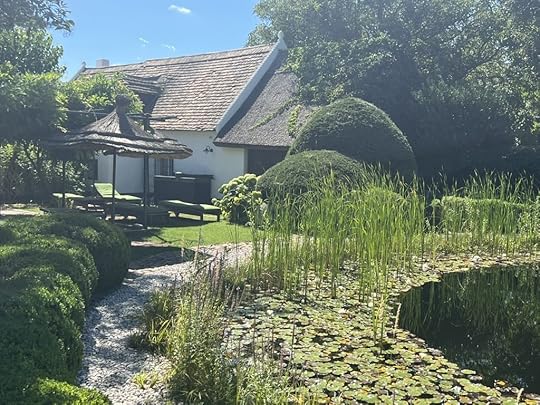
Taubenkobel is owned and run by its chef, Alain Weissgerber and his wife Barbara, daughter of the original founders, Walter and Eveline Eselböck. Under Alain’s leadership, Taubenkobel won two Michelin stars. He was named Gault&Millau’s chef of the year in 2024, an impressive honor for the tiny town of Schützen am Gebirge.
Chef Weissgerber’s menu focuses on cuisine of Austria’s Burgenland, with seasonal and foraged ingredients from the local meadows, hills, and Lake Neusiedl. Originally from Alsace, Weissgerber’s evolution as a chef included stints at Steirereck (under Heinz Reitbauer) in Vienna, Arzak (with Elena Arzak) in San Sebastian, L’Atelier de Joël Robuchon in Paris, Tantris in Munich, and Wolfgang Puck’s Spago in Los Angeles. This diverse background brought him to his focused style and strong preference for ingredients from the immediate local surroundings.
We planned to have his full tasting menu the second night of our stay, so we asked if we could have some a la carte items for our first dinner. We were especially interested in the wood-grilled whole turbot, for which the chef was apparently willing to make an exception to his locally sourced ingredients policy. They said it’s wild-caught in a Croatian bay in the Adriatic.
The size, placement and unique design of the oven/grill led me to believe it was at the heart of Alain’s cooking. They seated us at a wooden table right next to it so we could watch the show. It took only a few minutes watching him work with the wood fire to realize that he is a real master of its uses.
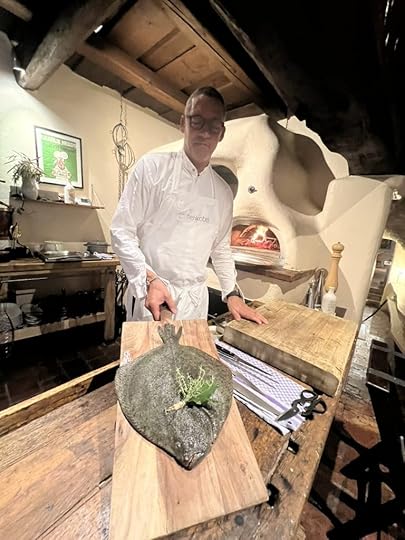
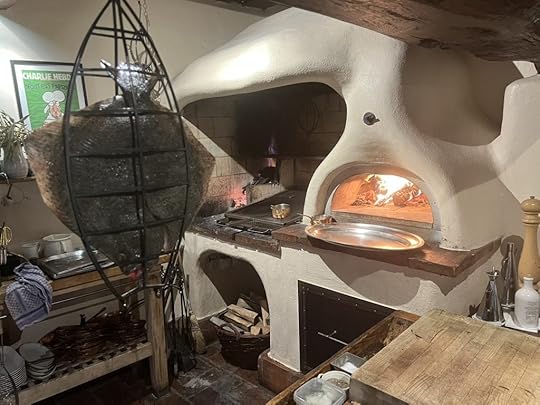
He came back and forth from the kitchen, where he was preparing a whole menu for a room full of guests, to grill the turbot for us. He also used the wood fire to make a butter caper sauce and a plateful of young artichokes. This all combined to make the tastiest turbot dish I’ve ever had.
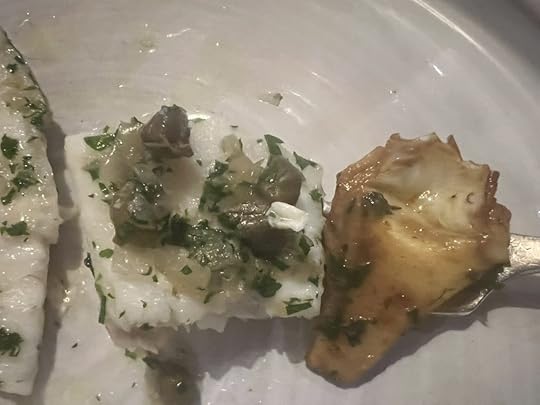
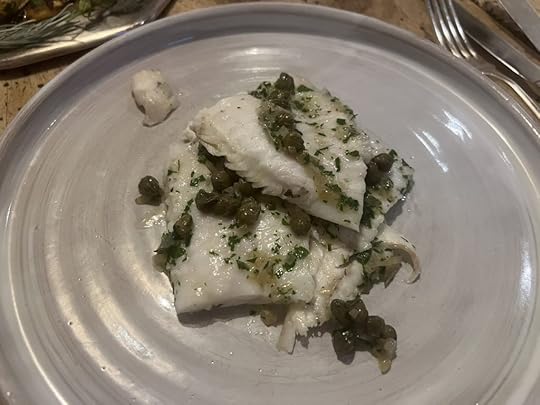
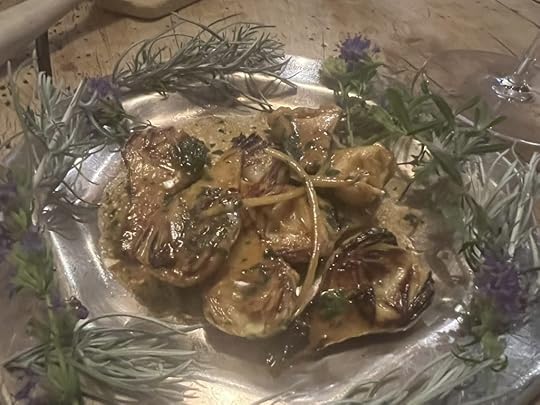 Young artichokes to accompany the turbot
That night he also made a dessert for us on the wood fire simply called apple tart with hand-whipped vanilla ice cream. Do you like tarte tatin? Doesn’t everyone? Every bite of this tart is the very essence of the caramelized apple goodness that makes tarte tatin so delicious. The ice cream was spectacular. Neither the tart nor the ice cream look impressive in a photo, but if I ever find myself on death row and am asked what I want for my last meal, I will ask if it includes dessert. If so, I will order this tart of Chef Weissgerber.
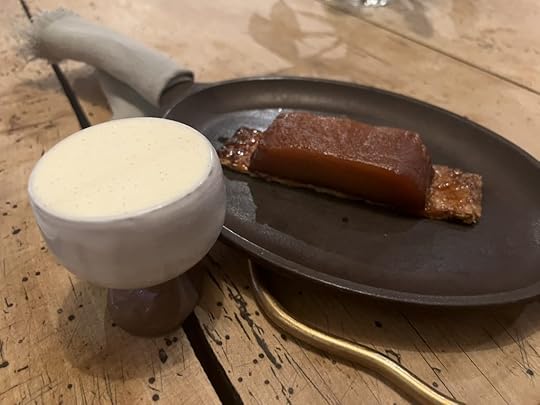
Forgive me if I’m describing dishes out of sequence. I’m carried away by my enthusiasm for Weissgerber’s food. None of it will look like anything special on Instagram. That’s because he is aiming for one thing to the exclusion of all others: deliciousness. As another example, take this a la carte starter: smoked egg with Ruster almonds and Perigord truffles. Yes, I know. It doesn’t look good. Trust me, it was incredibly tasty. The uncooked egg was smoked for a long time in the wood oven. Ruster almonds are a traditional treat of sweet smoked almonds from the nearby town of Rust. The truffles were incorporated in abundance and not shaved conspicuously on top.
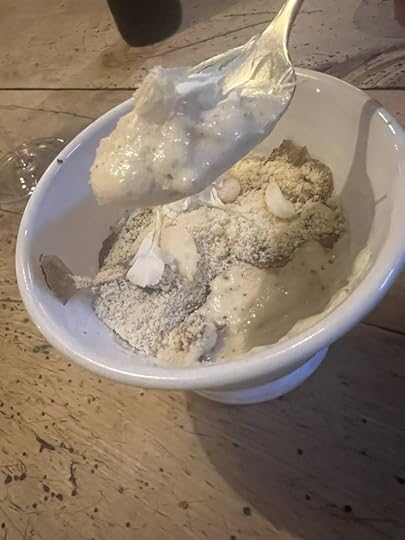
On the back of Taubekobel’s a la carte menu is a story. A little digging revealed that it’s the work of Alexander Rabl, one of Austria’s most renowned culinary writers, frequent evaluator for Gault&Millau, editor-in-chief of several food Austrian food magazines, etc., etc. His story treats fire as a character. Fire had become angry with humans for largely abandoning wood fires for cooking. It planned its revenge on humanity, but then discovered the oven of Alain Weissgerber at Taubenkobel. It happily took up residence there, feeling that it had finally found its purpose.
Our a la carte meal finished with a selection of cheeses from nearby farmers, each one full of character and perfectly ripe.
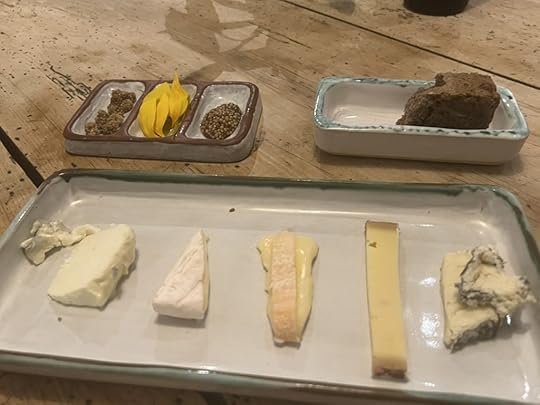
For our second evening at Taubenkobel, we had Alain’s full menu:
I’ll review some of the highlights:
Heart cherries (herzkirschen) are a local variety, especially big and sweet. They are topped with finely grated goose liver and acacia blossoms. Each of the three elements contrasts distinctly with the others—piquancy, earthiness and sweet fruit—a pleasing combination in this first of the amuse bouches.
Our server suggested we fold up the pepper leaf around the lightly marinated carabineiro and its condiments and eat it like a taco. Pepper leaf (Pfefferblatt, foraged locally) imparted a subtle spicy, herbal, and slightly anise-like flavor to the excellent prawn.
In the next amuse, thinly sliced radish and foraged clover leaves, drizzled with lovage oil, topped a goat cheese mouse in a delicate tartlet, a taste-awakening combination.
The next was the least visually appealing but, as it turned out, my favorite taste experience of the four amuse bouches. Little roasted potatoes of a deeply yellow-fleshed and flavorful Styrian variety were coated with edible clay and finished in the wood-fired oven. They were to be dipped in a green almond cream. The contrast between the crunchy clay and the fluffy hot potato was interesting. Cooking potatoes in clay like this is an ancient practice dating back to the first domestication of the potato in the Bolivian Altiplano near Lake Titicaca.
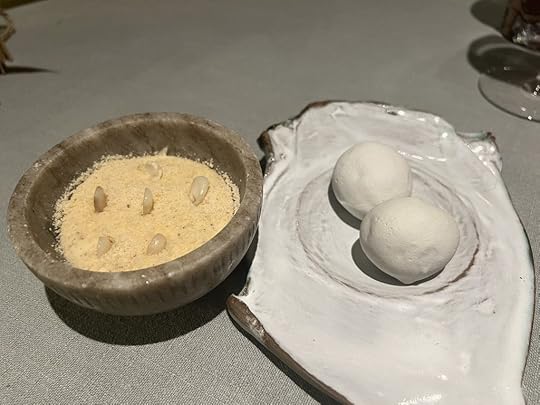
Sometimes I find that amuse bouches at top restaurants are so complex that it is hard to tell what you are eating–often a little one-bite tart of many ingredients that become indistinguishable in the mouth. This was not the case at Taubenkobel. Each amuse was distinctive, focused and comprehensible. I thought this bode well for the rest of the meal.
The first actual starter was described as marchfeld artichoke, raisins and iced foie gras. Tender young artichoke leaves were individually arranged into a bouquet. Some barely raisinified grapes hid inside. The server dusted the arrangement with finely grated shavings of iced foie gras. The three ingredients went so naturally together it made me wonder why I’d never had this combination before.
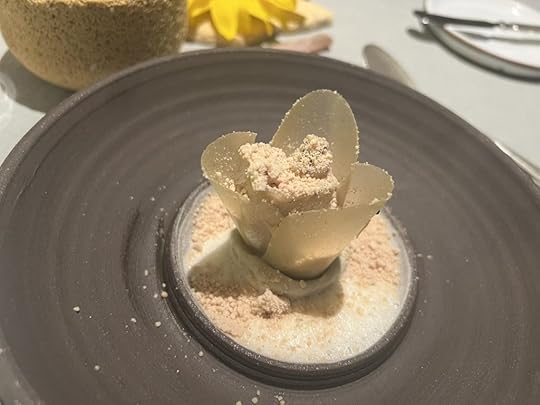
A small serving of caviar accompanied the artichoke dish.
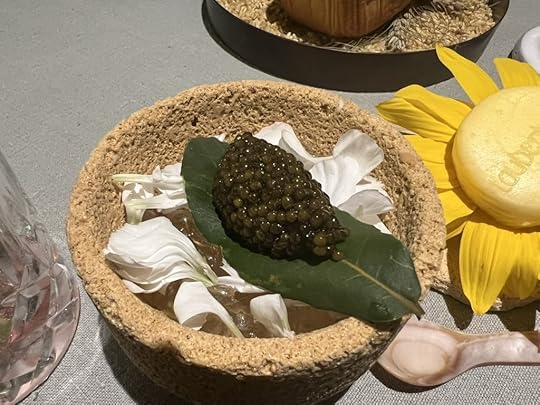
Next came a cup of consommé of lion’s mane mushroom, reduced to an extreme concentration level of mushroomy essence. Along with it was a black pearl king oyster mushroom filled with hazelnut cream. Both the lion’s mane and the black pearl are exceptionally flavorful mushrooms. The combination highlighted their different tastes and made a statement about how varied and delicious mushrooms can be.
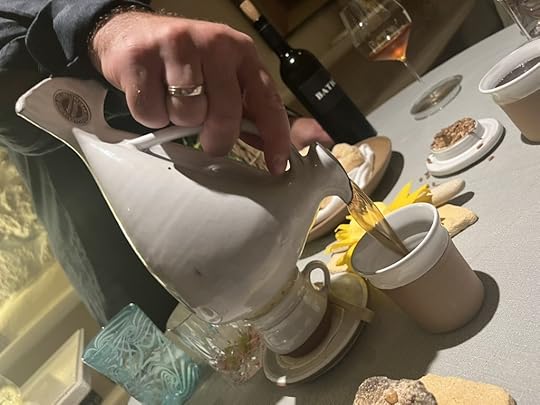
Note the dove-shaped pitcher, a cute reference to the name Taubenkobel.
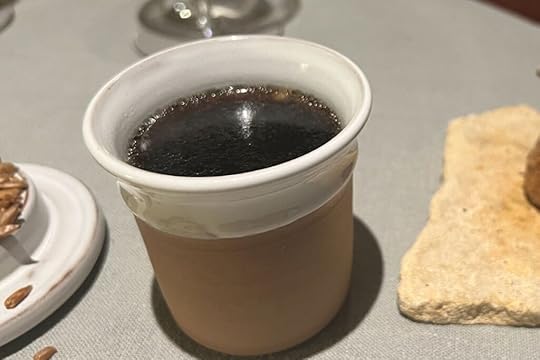
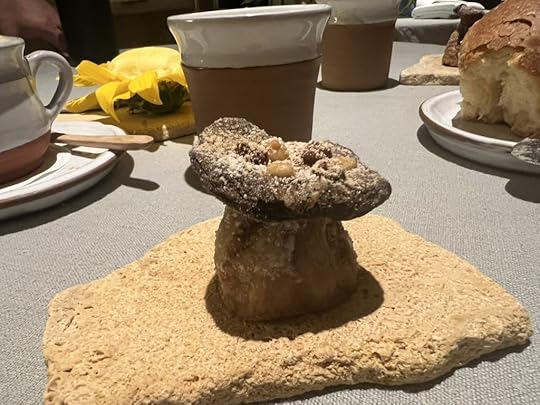
The next dish was pike-perch (zander) with zucchini blossom, chanterelles and fig leaf oil. The fish is caught by local fishermen in the Neusidlersee, just a few miles away, and delivered same-day to the restaurant. It looked raw but I think it was lightly marinated, giving it a nice texture but not hiding the ultrafreshness. I don’t understand fig leaf oil. I’ve been seeing it used by a number of chefs. It has an intense green color, beautiful on the plate, but not much of a distinctive taste.
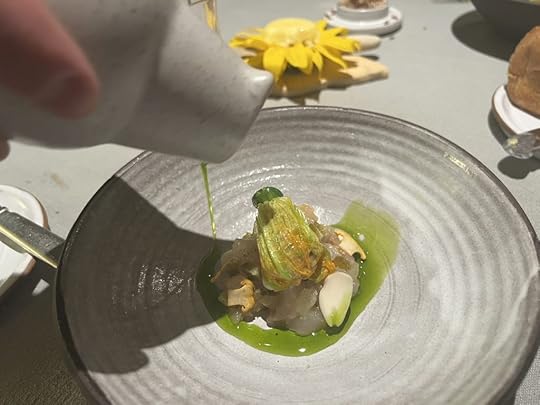
Pigeon from southern Burgenland with summer spinach and coriander was excellent. The pigeons are dry aged in a little room right next to the wood-fired oven and grill where they were cooked. This was to me the best dish of the meal, not counting the previous day’s turbot, which was in a class by itself. I attribute the excellence of the pigeon to Alain’s delicate skill with wood fire cooking. Like he did with the turbot, he used the different effects of the wood grill and the oven to bring out the best in the pigeon, giving a nice crust while maintaining the tenderness of the meat. The freshness of the spinach and coriander and the richness of the demiglace-like pigeon sauce added to the perfection of the dish.
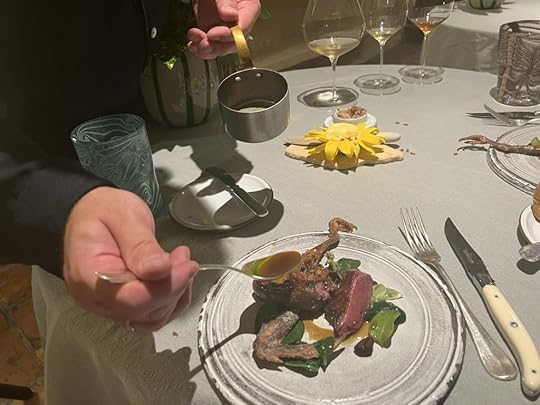
As a bridge to dessert, we were served an alpin cheese and pickled apricot dish. Apricots are celebrated in Burgenland and the cheese was from a nearby farm. Both were delicious.
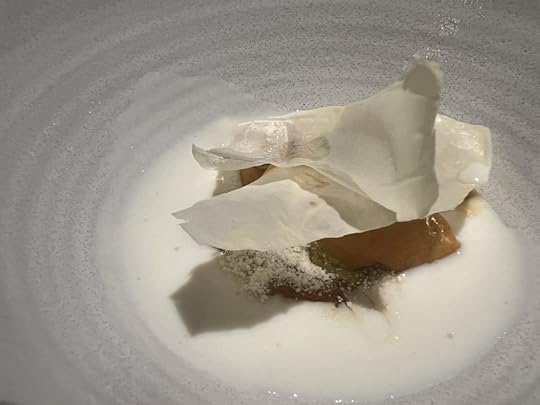
The dessert was described as Seewinkler Mieze Schindler, champagne granita, begonias. Mieze Schindler are a treasured variety of strawberry grown by the nearby Seewinkler group of small farmers. They have that intense flavor of wild alpine strawberries that is sadly lacking in commercially available berries. They are so beloved in Burgenland that it was thought unnecessary to mention on the menu that they are strawberries. Alain Weissgerber featured local ingredients in every dish of this menu, and it’s fitting that he concluded it with a local delight that is so fragile that it doesn’t travel beyond the area.
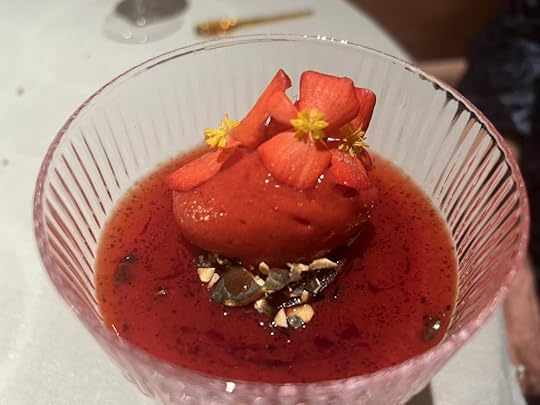
I recommend Taubenkobel wholeheartedly. Its regional focus, the care taken in selecting ingredients, the chef’s skill with wood fire cooking, and the exceptional charm of the inn all make it a one-of-a-kind experience.
October 2, 2025
Costa Brava: Five Restaurants That Shaped Our Week
Last summer we visited Costa Brava for one week and had some memorable meals. Here is a quick summary of the restaurants.
1. ESPERIT ROCA
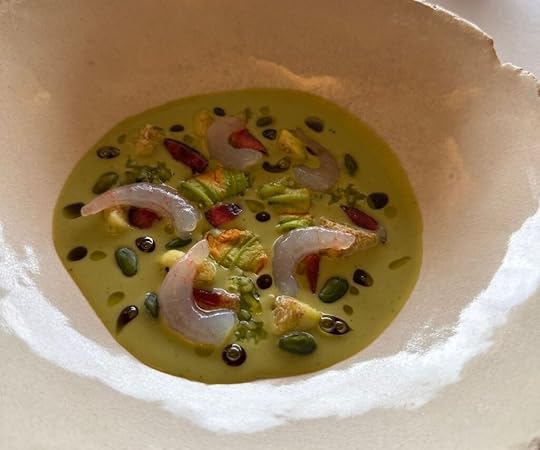
The Roca brothers cook some of the traditional dishes that put them on the world gastronomic map in this new hotel-restaurant complex not far from Girona. Our experience, save for a very awkward five minutes when entering the complex and waiting – with many others – for somebody to usher us to the dining room, was top notch. Enjoyable one bites inspired by the Roca brothers’ voyages around the globe set the feisty tone. The excellent apple and foie timbale and the cold zucchini cream with pistachios and quisquillas shrimp (at least as good) are faultless, multi-dimensional and harmonious entrees. The charcoal grilled Mediterranean sole is not noteworthy (despite the five sauces), but both the suckling pig with pig trotters and espardenyes (sea cucumber) and grilled breast of pigeon with stuffed pigeon thigh are outstanding. The pig-espardenyes combination is my candidate for the best land and sea-type dish. If you feel like smoking after the meal, you can take a “trip to Habana”, a very classical dessert of Jordi. I also salute Josep Roca for the excellent and fairly priced wine list.
EVALUATION: 8.5/10
2. VICUS
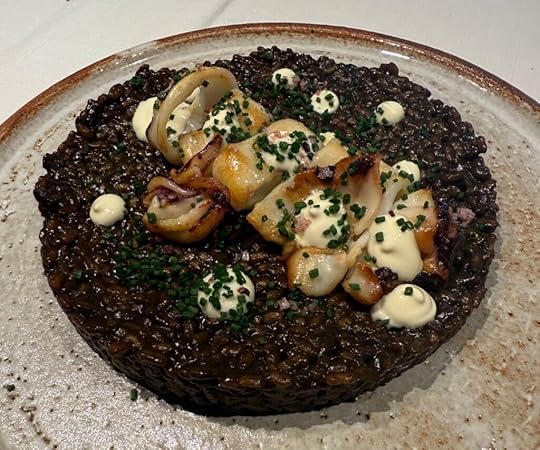
We visited Vicus, which is in Pals, twice in a week as I always look forward to a visit there. The cooking is contemporary, colorful, with absolutely top notch ingredients and intelligent but not self-consciously creative combinations. The dishes are at the very least good, but often excellent. In our two visits we found the following top notch: Zucchini flower tempura stuffed with brandade of bacalao; Bonito in carrot escabeche; cigalas (escamarla) plancha which was the best of the trip; the freshest possible gambas XL of Palamos plancha; black rice with squid and pear aioli; crunchy lemon custard. The wine list is also very good featuring some natural gems with reasonable prices.
The only problem with Vicus is that it is not in my neighborhood.
EVALUATION: 8/10
3. ELS TINARS
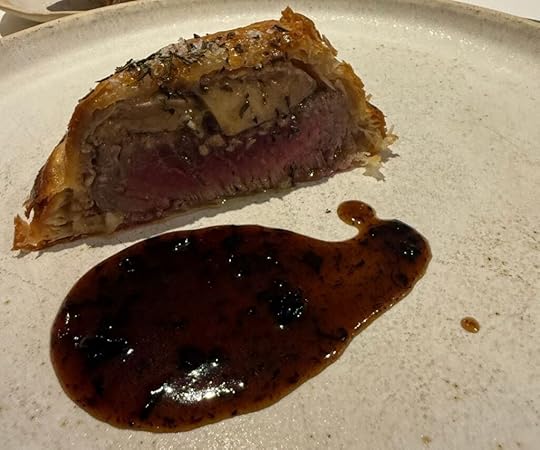
This is one of our favorites in Costa Brava with one drawbeck: the wine list is outdated and too pricey with very scant choices to please the connoisseurs. But the cooking is very good, and the selections are almost all exciting. Hence we visited twice. The ajo blanco soup with tomato granita that the chef credits to El Bulli was so tasty and right for summer nights that we ordered it twice. Jamon bellota was also high quality. Besides both the arroz with pork feet and cigalas and the patates tinars (crisp potato chips topped by the most gelatinous parts of butifarra sausage like ear, feet and nose) are most satisfying dishes for gourmands. Their version of beef wellington was also quite good, although not as memorable as the other dishes I mentioned. In the second visit we repeated some dishes, but we enjoyed a fresh and expertly cooked besugo a la brasa, rather than red meat. We also indulged in a rich gnocchi of creamy potato, butter and imperial caviar. Also don’t miss the torrija with a caramelized and crisp top, lavender ice cream and lemon curd.
EVALUATION: 8/10
4. VILLA MAS
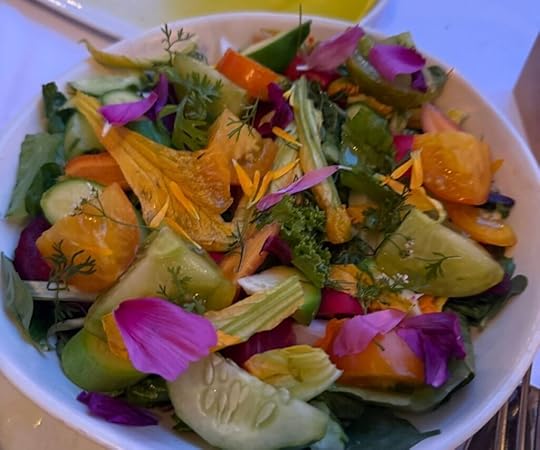
The cuising is fresh, bright and plant based. These are the words that come to my mind when I think of the two consecutive meals at this special spot for summer meals. Perhaps the two dishes that exemplify Villa Mas the best are the “tomato salad from our garden, spring onions and basil”, and the “calamar de potera de Palamos, acqua pazza”. Both are seasonal, simple but delicious and well executed dishes with local products. The chef here seems to value simplicity and authenticity over sophisticated and daring creations. Clearly they also buy top notch products as our Cantabrian anchovies and 3 different Jura comte cheese with varying maturation-combined with 2015 Vin Jaune “Les Bruyeres” from B&S Tissot”- were excellent. You will be very pleased if you don’t expect culinary fireworks. But expect to see an amazing number of some of the most interesting wines, esp. French Burgundies, for fair prices. The problem for a wine lover is that, since you have to choose 1 or 2 bottles at most, you will depart regretting the gems you left behind!
EVALUATION: 7/10
5. TOC AL MAR
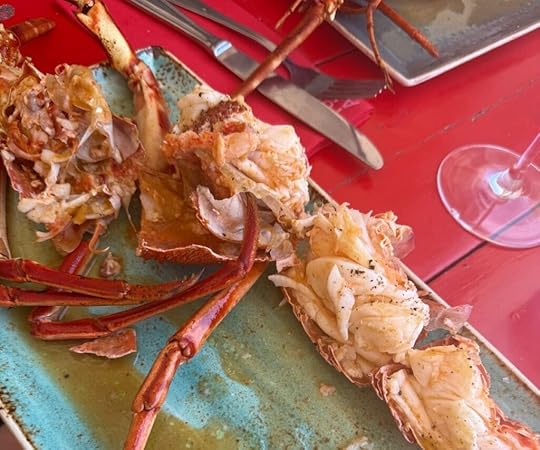
Too bad that the owners over-expanded and let the quality slip in this popular restaurant at the Aiguablava beach in Begur. But given that the only other restaurant was a disaster we ate there 5 consecutive days. We tried almost everything on the menu, including the rice dishes. Almost everything was consistently mediocre with 2 exceptions. The Cantabrian anchovies priced the same with Villa Mas, were of very low quality, extremely salty and hardly cleaned (that is, still full of small bones). The only satisfactory dish was grilled langouste or spiny lobster (llagosta) from Cap Begur, but even this was not perfect as the presentation seemed perfunctory and it grilling technique was sub-par (too fast and too high temperature) compared to other Spanish restaurants. It seems like they are the victim of overcrowding and overextending (catering business).
The wine list is pretty good. Wine mark-ups are normal.
EVALUATION: 5/10
At Es:senz, Chef Edip Sigl Distills the Essence of Flavor
My dinner at Es:senz was one of my all-time favorite meals. As we go through the dishes, I’ll try to explain why this was.
Chef Edip Sigl was born in Hatay, Turkey, a UNESCO City of Gastronomy. It’s known as a crossroads of Mediterranean, Middle Eastern and Anatolian culinary cultures. Hatay is said to be home to over 600 dishes. Sigl moved to Cologne, Germany, where his love of meze—small bites of distinct traditional ingredients—fused with western ideals of high-end cooking. In my conversation with him, he said while he cares about how food looks on the plate, he cares even more about clearly defined and perceptible tastes of each ingredient. This certainly came through in his food.
Es:senz is in southern Bavaria at Das Achental resort in Grassau. Bavaria treasures gemütlichkeit, an untranslatable virtue that means something like cozy comfortable hominess. Es:senz takes gemütlichkeit to a higher level. The warmth of the surroundings and the genuine friendliness of the whole staff are the platform for a dining experience of exceptional refinement.
The meal began with four or five pre-amuse bouches that Sigl calls apero. The first is called The Cloud. It’s staggering to think of the effort that goes into making this little bite. The foam is somehow made of emulsified vinegar. Inside it, finely shredded smoky bacon and lightly crunchy breadcrumbs combine to give three distinct and surprising sensory experiences. To add to this, the stick itself is unexpectedly tasty.
The next aperos displayed rather than hid their complexity.
“Rossini,” a play on tournedos Rossini, combined wagyu tartare, foie gras and Périgord truffle, topped with a dab of caviar.
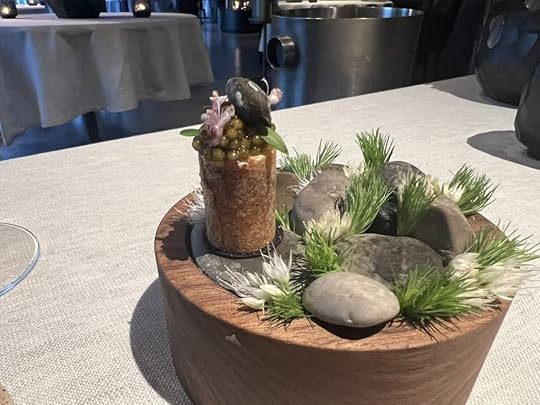
The tartlette was described simply as Breton lobster, lettuce, orange. While a few piquant flowers and leaves added subtle taste and visual notes, the textures and flavors of the main ingredients came through distinctly in the mouth.
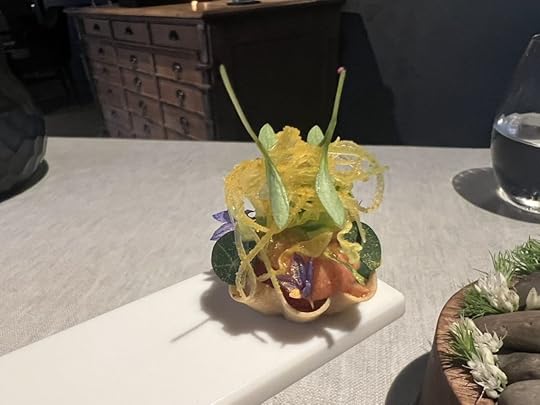
In the macaron, a meringue shell held tartare of local Chiemgau trout topped with an herbal bouquet modestly called mustard pickle. Perfect ingredients perfectly composed, as was the case with each apero.
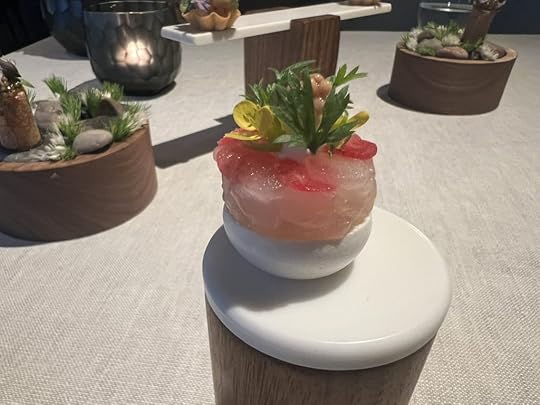
Bread and brioche was listed on the menu as a course of its own, and deservedly so. The house-made breads were truly superlative.
After a few bites I said I would enjoy the bread course as an entire meal. “We take our bread seriously,” the server replied. She then proceeded to drizzle an herbal mustard sauce on the butter plate to enhance the alpine salted butter.
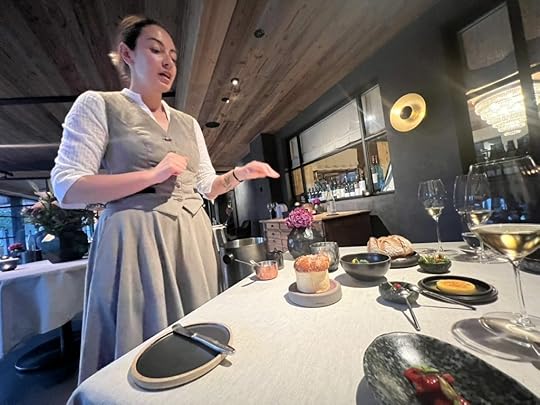
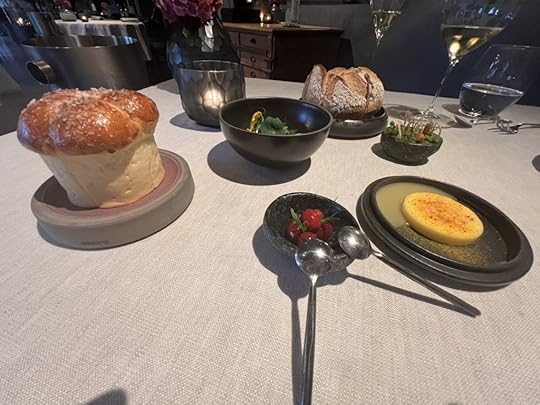
Two other dishes held butter spreads decorated and infused with a “Chiemgau herb garden.”
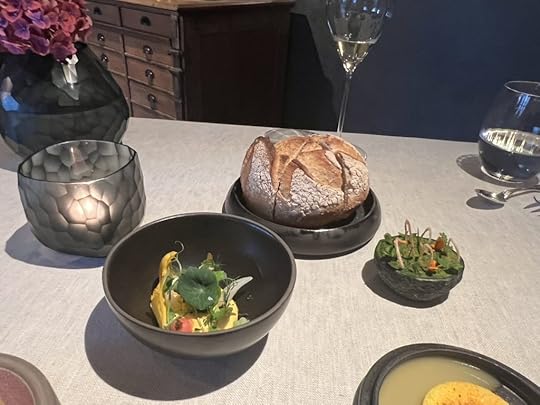
The bread and butter course sets a very high bar for bread servings in any other top restaurant.
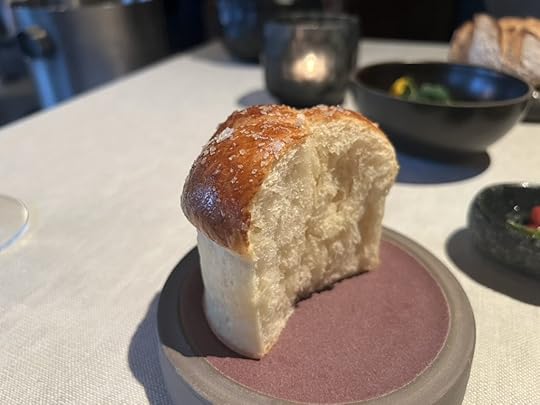
As a further accompaniment for the bread, they served a dish of pointed peppers with wild garlic bud, homemade cream cheese and chardonnay vinegar.
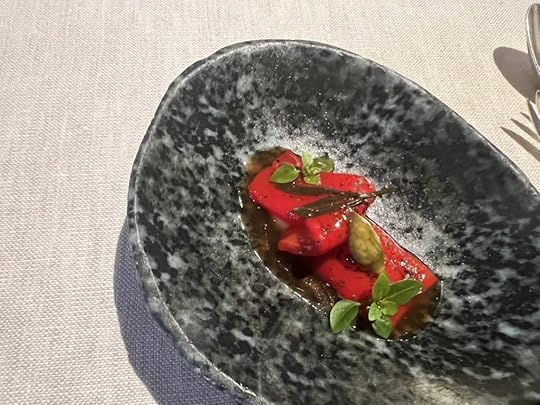
After all this, we hadn’t even had the amuse bouches yet. The two actual amuse bouches came next, one of pike perch and the other called fried chicken. The Chiemsee pike perch (zander), lightly marinated, sat in an herbal broth of elderflower, rhubarb and radish oil.
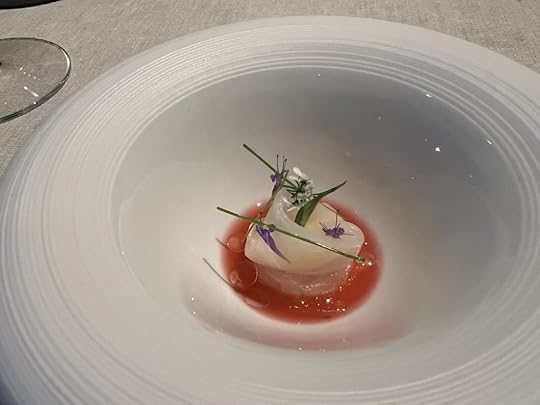
The “fried chicken” amuse was a little masterpiece. Topped with Périgord truffle and N25 caviar, a crispy moist morsel of fried chicken came with a miniature bowl of perfectly reduced chicken broth.
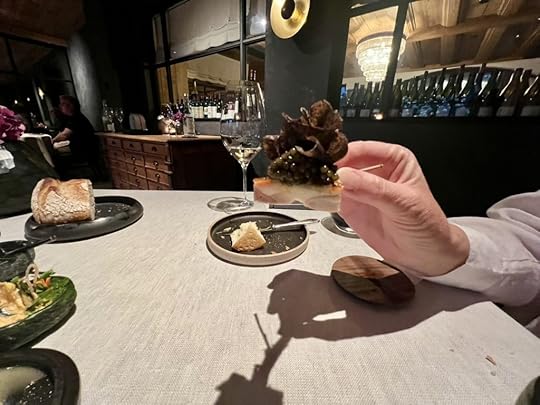
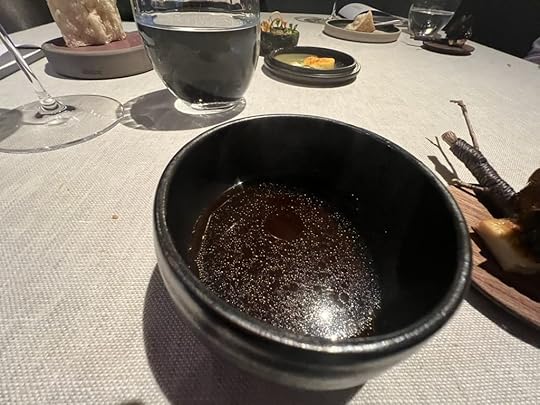
We were then invited to choose between two menus, the six-course Chiemgau Pur, consisting of only ingredients from the immediate local area around Chiemsee, and Chiemgau Goes Around the World, eight courses inspired by Chef Sigl’s travels. I picked the Around the World and Jenna picked the Chiemgau Pur. I thought that would facilitate this review, but we each liked our dishes so much that we were reluctant or downright unwilling to share them!
Around the World began with Hamachi / N25 caviar / leek oil / eggplant / lemon grass. It was an opening statement from the chef that he embraces ingredients that were truly from “around the world.” Unctuous Japanese hamachi topped with Chinese-raised caviar (N25 has become the go-to caviar in many top restaurants) was a decadently delicious combination.
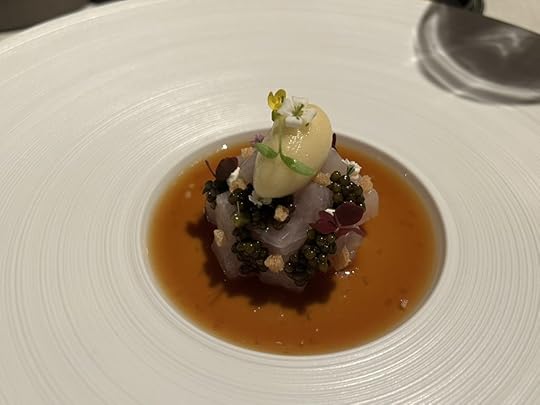
Chiemgau Pur’s first dish was Chiemsee whitefish / anise / dill vinaigrette / cucumber / celery. Every ingredient seemed chosen to emphasize the bright, clean freshness of the fish with bracing notes. Whitefish is a small fish caught in the nearby Chiemsee, the biggest lake in Bavaria. It is a regional favorite for its sweet flaky white flesh.
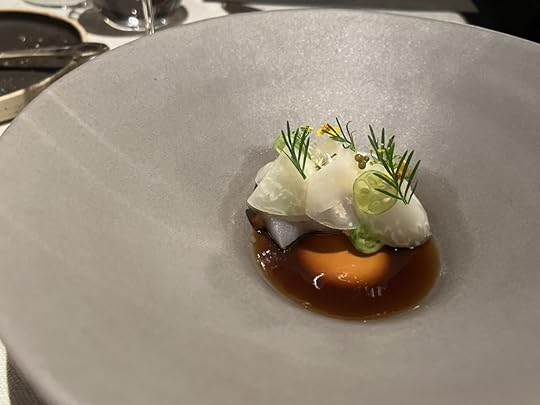
Next on the Around the World menu came Langostino / lettuce / green almonds / piment d’espellette / bisque. It came in three portions:
The tail of the langostino sat in its excellent piment d’espellette sauce. If better langoustines exist, I have yet to taste one.As was the case with many of the dishes, the server left an extra little container of the sauce on the table. And as was the case with many dishes, we used a lot of it. In texture and flavor, each was a textbook example of the ideal of that sauce.
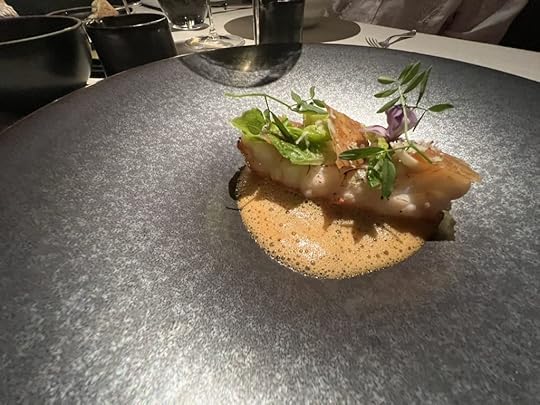
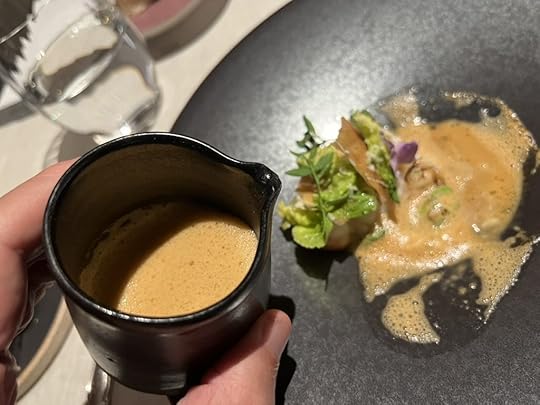 The superb langostino bisque—velvety smooth and deeply flavorful—was enhanced with trout roe and droplets of a concentrated herbal oil (I think it was dill.)The claw, clearly from a very large langoustine, had a sweet and smoky glaze that underscored the tenderness of the meat.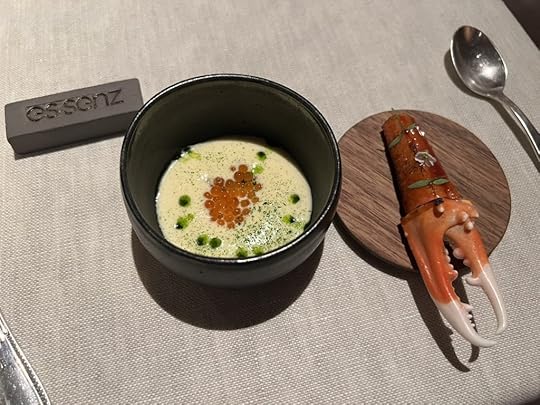
Next on Chiemgau Pur was Crayfish /beans / chanterelles / tomato / sherry. I can’t comment on it because after one taste, my companion, swooning with a smile of satisfaction, refused to share it.
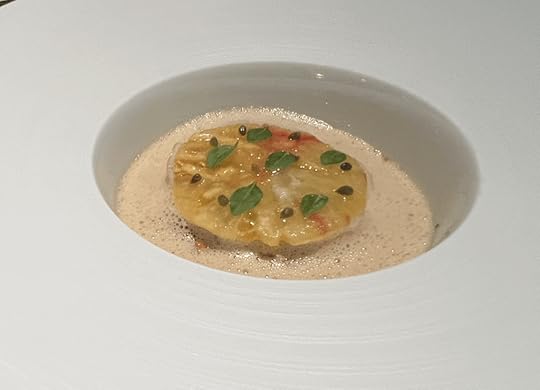
Around the World featured next “Cataplana” / plaice / cuttlefish / tomato / Tagglasca olive. It aimed to raise cataplana, a humble Portuguese seafood stew, to a higher level and succeeded elegantly. It would be repetitive to say that each ingredient was the best of its kind and perfectly cooked, as that was true of every item of every dish.
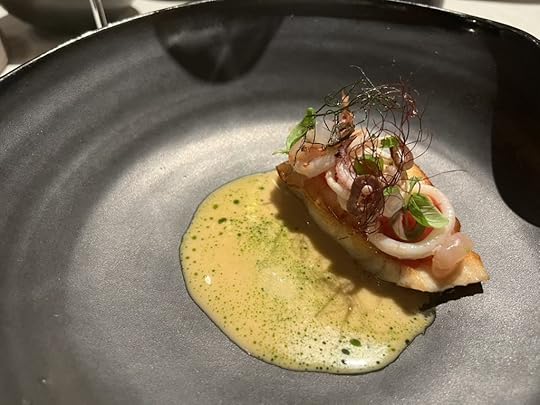
Chiemgau Pur’s next offering was Char by Thalhammer Mühle / sorrel / bacon / white pepper. Each of these three added a sublimely appropriate nuance to the excellent piece of char caught that day in Chiemsee.
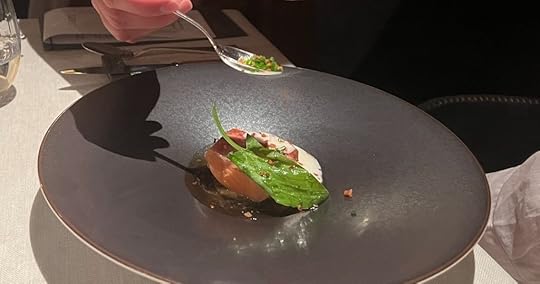
A Bresse pigeon came next on Around the World, beautifully presented on a bed of aromatic leaves and flowers.
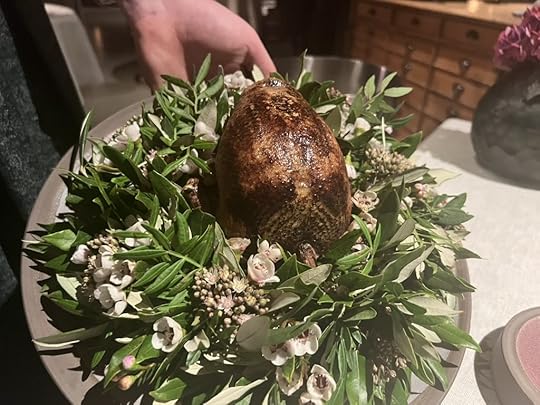
Then the breast and leg were individually served, each separately cooked and differently seasoned, sauced and glazed, accompanied by beetroot, porcini, herb hollandaise and Périgord truffle.
Bresse pigeons, like their chickens, are first raised free-range for a few months, feeding on local plants and insects, and then finished on a diet of grain and milk. The resulting birds are both more flavorful and more tender than others. This was evident in the inherent quality of Es:senz’s pigeon.
On top of that, the loving care given to its cooking is clear to see in these pictures. The glaze of the leg was smokier and more barbecue-like than that of the breast. In both pieces, the flavor and texture of the exterior contrasted beautifully with the tenderness and gaminess of the meat. I have never enjoyed a pigeon dish more than this one.
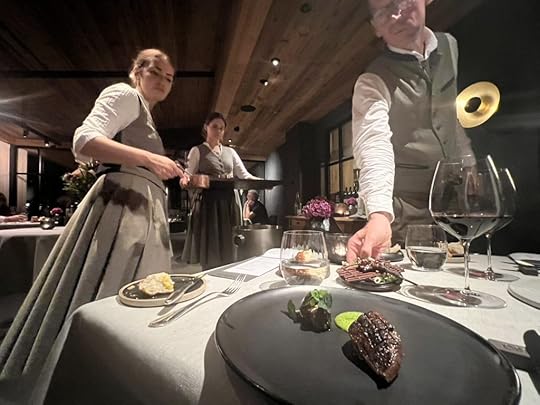
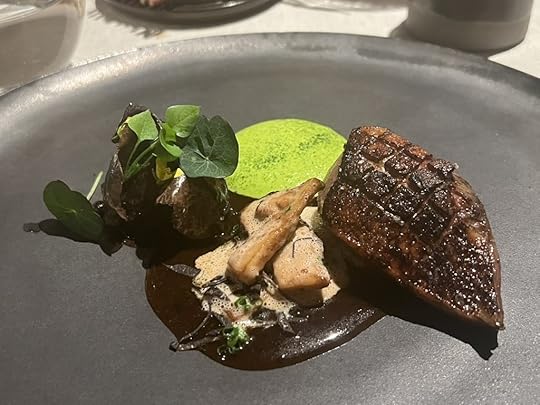
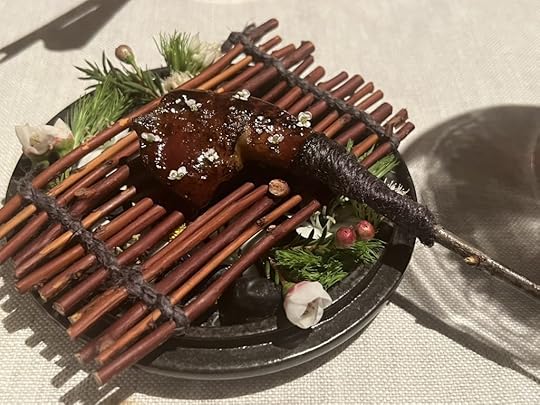
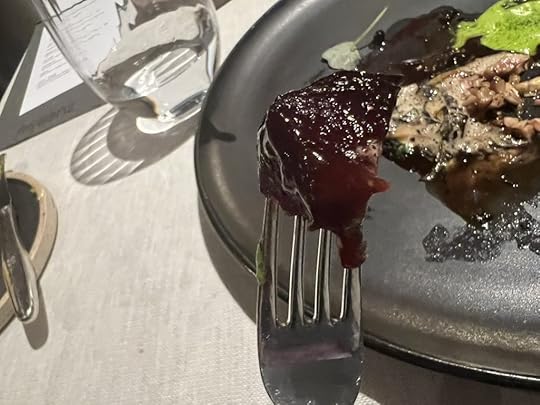
While I was enjoying the pigeon, my companion’s Chiemgau Pur gave her Szegediner: Achental wagyu / pointed pepper / sauerkraut. Just as the cataplana dish raised a humble and distinctively seasoned stew to a higher level, the szegediner dish appeared to similarly elevate that paprika-based Hungarian stew.
However much I went on about how good the pigeon was, she said she did not feel a bit jealous. While I didn’t get to taste it, I was struck by how each ingredient of the szegediner dish was positioned on the plate to be eaten for maximum enjoyment while simultaneously making a beautiful visual composition. As with every dish that Chef Sigl prepared, no ingredient was just for show, yet all were visually striking.
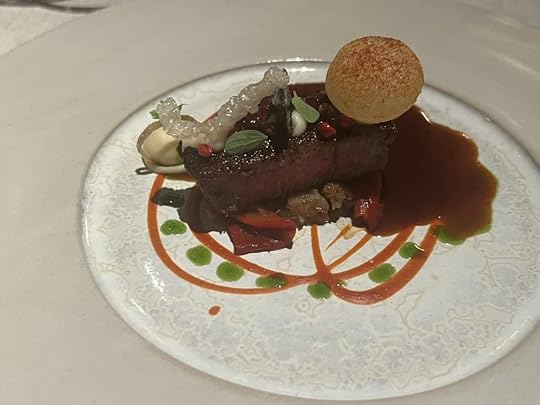
My next dish was a cheese course: Epoisses / pineapple / garlic bread / 20 year old balsamic vinegar. It was excellent for what it was, but I found its flavors too intense to fully enjoy after the delicateness of the pigeon.
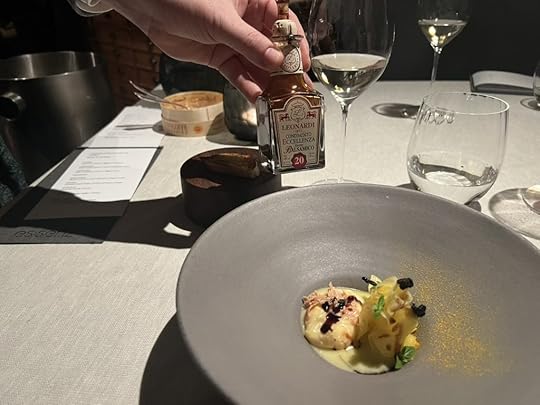
It was time for dessert. Chiemgau Pur transitioned into the sweet courses with Beetroot: goat cheese / yogurt / hazelnut. I didn’t taste it, but Jenna loved it.
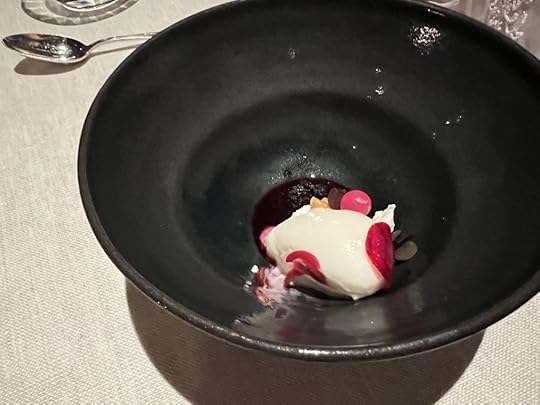
Around the World’s first sweet course was Saffron Ice / fermented rose hips /pumpkin seed oil. Why have I never had saffron ice cream before? Clearly because it takes a lot of expensive saffron to give the intensity of flavor that this one has. But if it weren’t for the cost, saffron would be right up there with pistaccio as a classic ice cream flavor. And this one was– unsurprisingly after the perfection of each of the savory courses– superbly made. The fermented rose hips gave just a hint of a contrasting flavor.
Pumpkin seed oil is an indespensible ingredient in Bavaria and Austria’s Styria. It is one of the essential flavors of the region, used in everything from scrambled eggs to salads to desserts. A local might have found it comfortingly familiar with the exoticness of saffron. Crowned by the finely crafted sugar spiral, this was a masterful dessert.
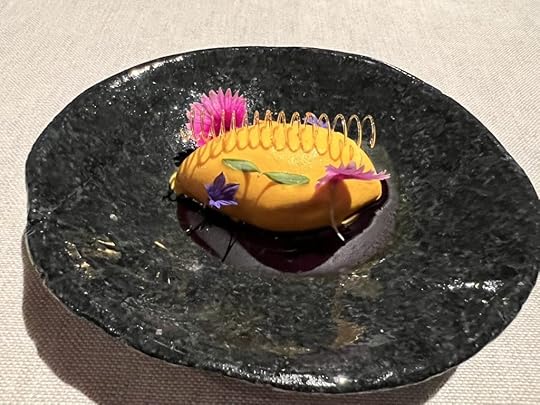
I didn’t get to taste Chiemgau Pur’s next dessert, Apricot / milk / nut butter / amaretto / pumpkin seed oil. It was certainly beautiful on the plate. Apricots are well loved in the Chiemgau region and the nearby Wachau valley. They are grown to give the pleasure that this fruit can provide but never does in commercially available varieties. There are even apricot festivals in the area. Together with the pumpkin seed oil, this combined two local classic flavors into a lovely looking dessert.
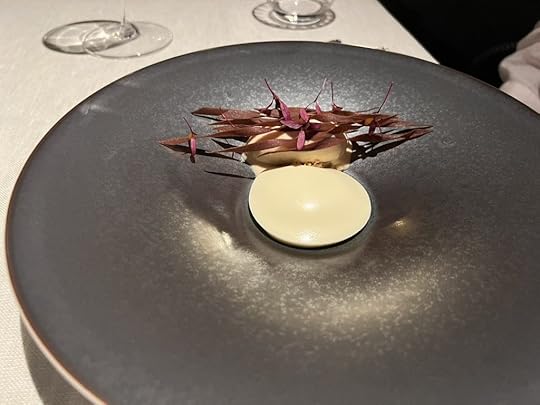
Around the World’s final dessert was Exotic / passionfruit / mango / ginger / coconut. All those things are exotic to Bavarians. To us residents of Kauai, they’re as familiar as pumpkin seed oil is to them. It was yet another beautiful and delicious composition.
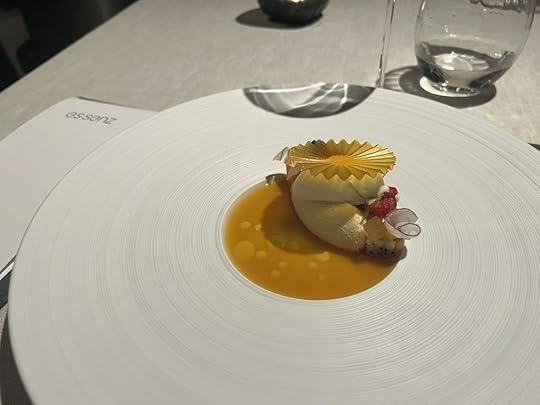
The two menus converged with the petit fours. They were much more than the mere afterthoughts that such little after-dinner treats often are. Each combined the same excellence of ingredients, preparation and presentation as the rest of the meal. And as was the case with the rest of the dishes, each was modestly under-described on the menu:
Homemade pralines, lemon, apple pie, nut acorn, Aperol spicy ginger, toffifee.
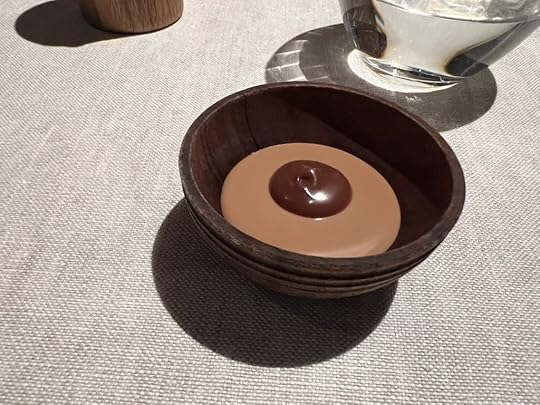
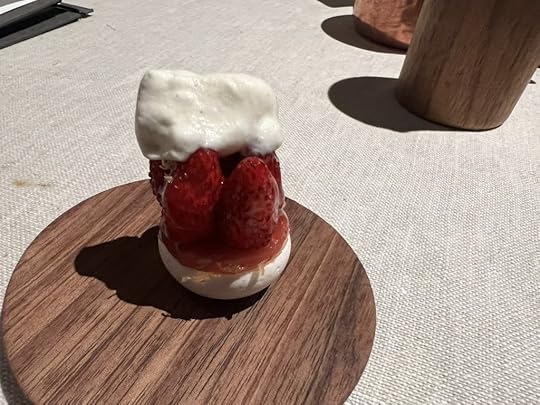
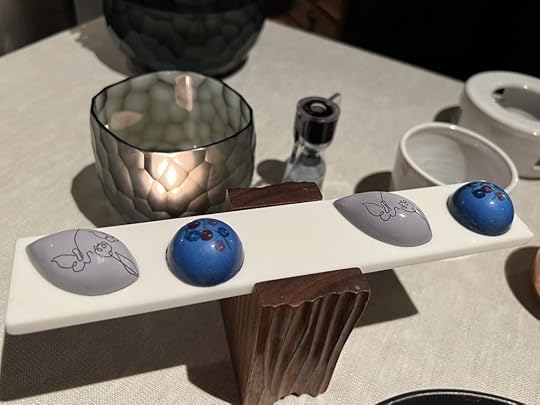
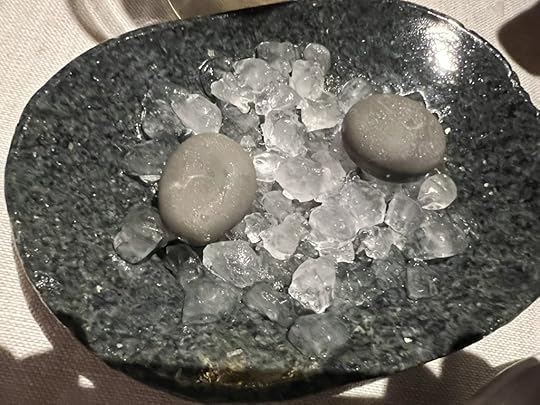
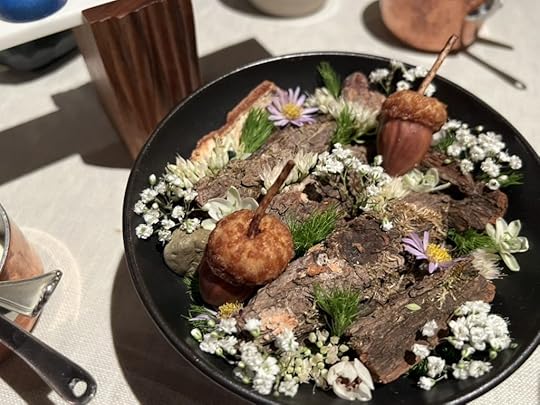
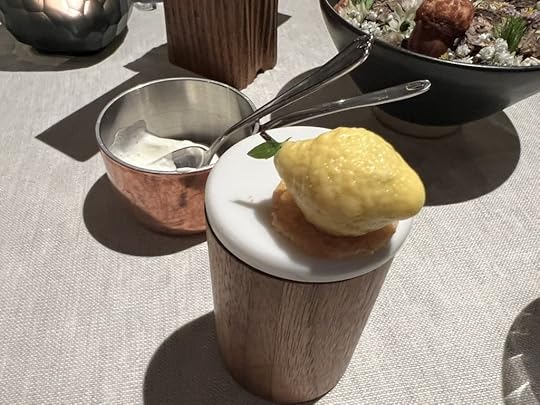
I’ll talk a little now about the wine. I really enjoyed Es:senz’s sommelier. Many in his profession are knowledgeable, but sometimes they slip into a rehearsed spiel about each wine. Es:senze’s sommelier was, in contrast, conversational, personal, and sincerely interactive. “How would you compare this Alsace pinot gris with Zind Humbrecht’s?” I’d ask, for example. “Oh, I like Zind Humbrecht too,” he’d say. “I think this one is just as nuanced but perhaps a bit more elegant,” We then might have a little conversation about one or two under-rated but interesting wines. He seemed to enjoy it as if he were talking with a friend.
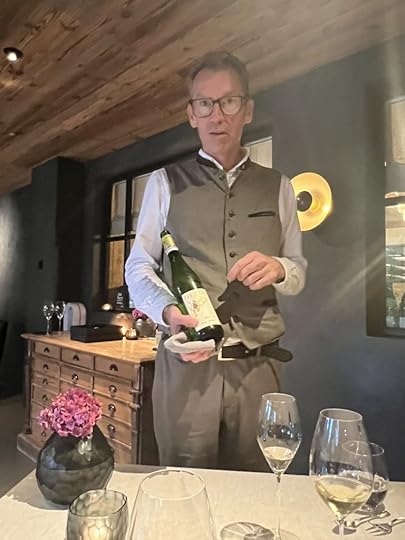
There was of course a pre-planned list of wines for the pairing, but he sometimes deviated from this based on our interests and preferences. Uncommon and much appreciated!
Here are a few of the more interesting wines that he shared for the two different menus we had.
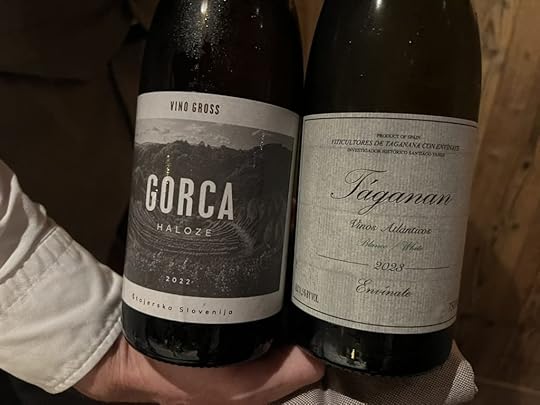
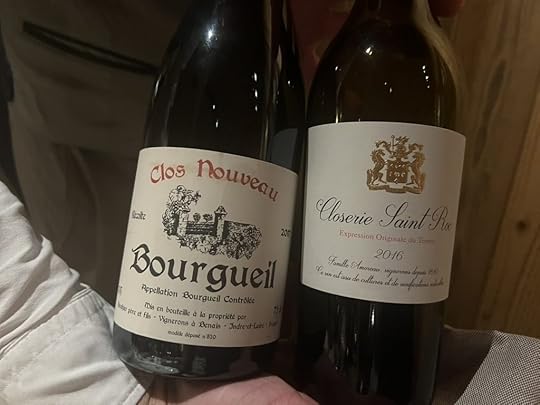
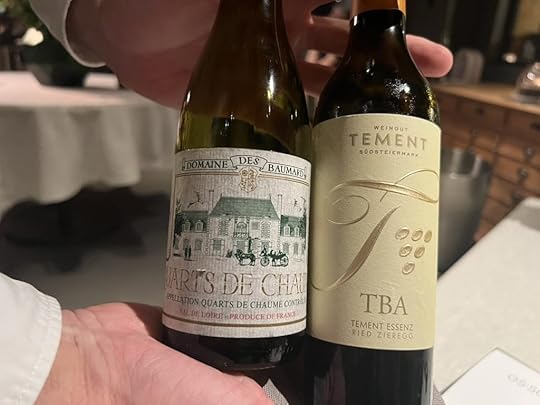
By the way, the name Es:senz is as carefully crafted as its dishes. I chatted with chef Edip Sigl after dinner and he explained it. E and S are his initials, so the name means Edip Sigl’s sense. Essenz also implies getting to the essence of each ingredient. And essen, of course, means to eat in German.
To achieve the goal of getting to the essence of each ingredient, Edip insists on using no extraneous components. Every dish contains the minimum number of ingredients, with each of them serving a clear role and each providing a clearly discernible taste experience. This is in marked contrast to many of even the most highly regarded restaurants which tend to overcomplicate dishes. For me, this rigorous simplicity was the key to the pleasure that each of Edip’s courses gave.
I’d also mention that Edip prepares all this with a surprisingly small kitchen staff. “Your saucier is a maestro,” I said. “Actually, I make all the sauces by myself. I love doing it too much to share that job with anyone else,” he said.
It takes a lot to stand out among Michelin three-star restaurants. Es:senz definitely does. Three stars is supposed to mean worth a journey. This one absolutely is.
September 23, 2025
Amador: Austria’s First Three-Star Michelin Restaurant
Am I ungrateful, I wonder, to write anything but an unqualified rave review of Juan Amador’s Vienna restaurant? It was, after all, the first restaurant in all of Austria to receive three Michelin stars, and it held them alone for over a decade until Steirereck came along.
Michelin stars are indispensable to the financial success of a high-quality restaurant, so it is understandable that a savvy chef must try to create what the Michelin reviewers want to see. Social media too plays a role in the viability of top restaurants, so it is likewise understandable that chefs aiming to draw in affluent and discerning diners must pay attention to what works there.
Both of these things are, sadly for me, at odds with what makes a restaurant enjoyable. The thing I value most is simple: the food has to be delicious. Instagram cannot depict how the food tastes. It can only show what it looks like. Michelin seems to value the cleverness of a chef in crafting unique and original compositions of ingredients more than it cares about how pleasurable it is to eat the food.
Juan Amador is a chef of the highest level of skill and creativity. You can almost hear how the gears turn in his mind when you are presented with one of his dishes. They are clever. Original. Ingenious. So much so that how they taste seems to come second in importance. It’s not that they aren’t enjoyable. Most of them certainly are. But I am left with the impression that he is hoping diners will say, “Oh, that’s so clever,” rather than, “That was delicious.”
Amador sits in a brick lined former wine cellar that was originally a part of Vienna’s underground water infrastructure.
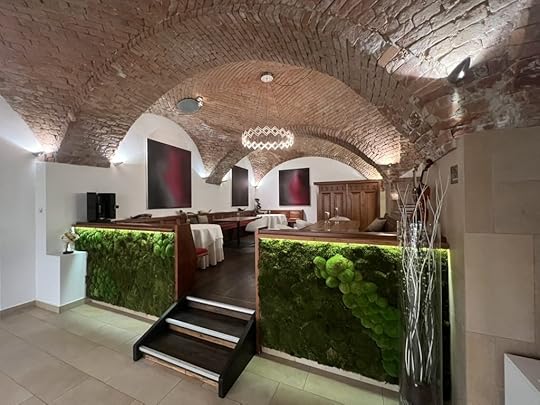
The sole dinner option is the tasting menu. Here it is:
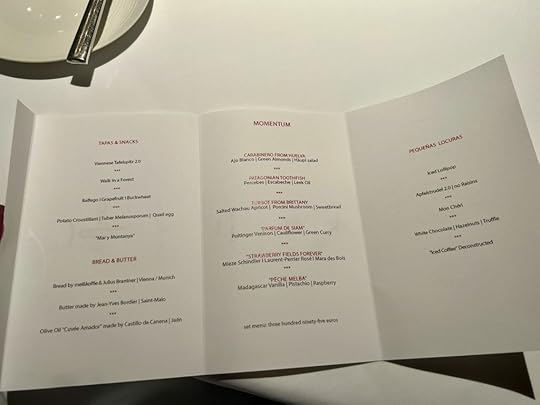
The first snacks are good examples of what I mean by prioritizing cleverness over taste.
The Viennese Tafelspitz 2.0 is meant to convey the essence of that dish in two mouthfuls. The spoon, shown for scale, is miniature, maybe a centimeter across. The soup is a very reduced beef broth over one star-shaped wafer each of carrot and potato. The roule is filled with beef tartare and topped with horseradish. Is the dish perfectly crafted? Yes. Is it better in any way than tafelspitz? Not really.
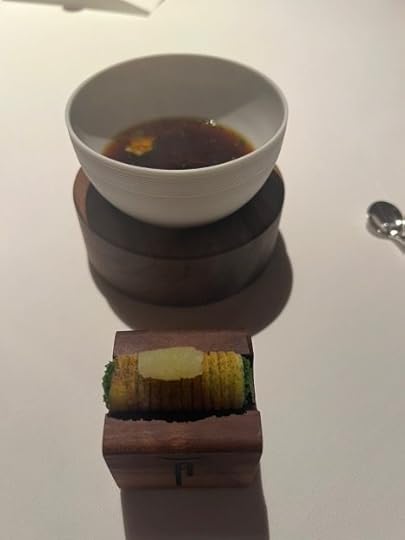
The next bite is called Walk in a Forest. I’ve had similarly titled dishes elsewhere, for example at Manresa, that were enjoyable compositions of vegetables, each carefully selected for excellence, individually prepared and combined into a composition in which each bite gave a distinct pleasure. This was nothing of that sort. The whole thing is one small mouthful, apparently sculpted with tweezers and a magnifying glass: an impressive miniature, but not especially enjoyable to eat.
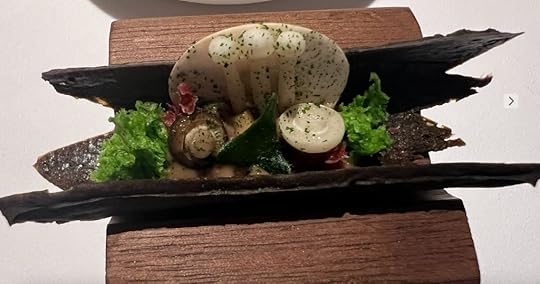
I could go on in a similar vein about the rest of the snacks, but in fairness to chef Amador, each was masterfully prepared. Here are pictures of each:
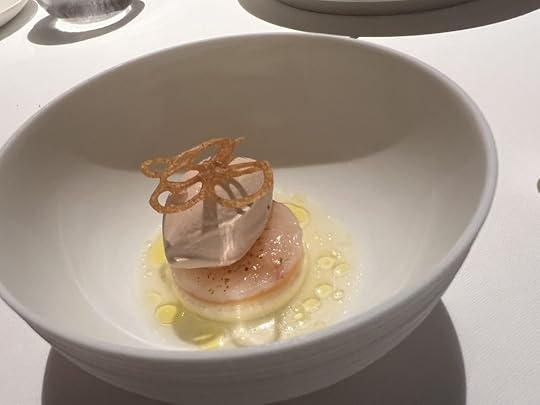 Mar y muntanya
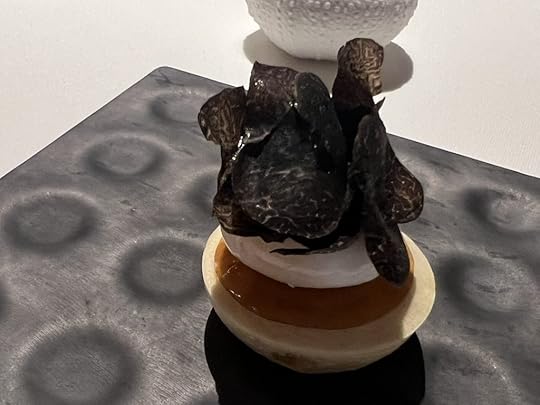 Potato crustillant, tuber melanosporum, quail egg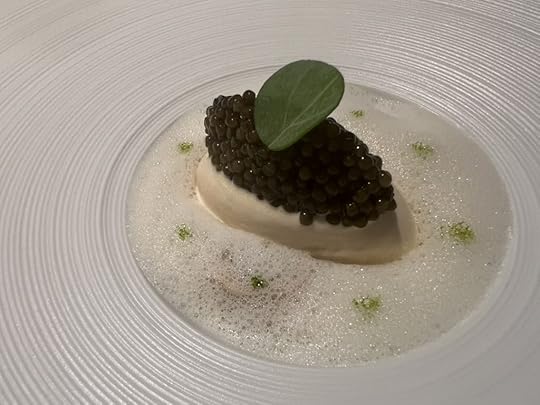
As an add-on, I ordered this composition, highly recommended by the server: oysters, caviar, beurre blanc ice cream, almond milk foam, tamarind oil. Each component was perfect. The idea of making ice cream out of beurre blanc is original, but did I enjoy it more than I would have a mouthful of excellent vanilla ice cream? Not really.
The bread and butter were delicious and, frankly a relief from the preciousness of the starters. The olive oil is a special cuvee made exclusively for Amador, and truly outstanding. The spread is made from buffalo milk with lovage oil. It was excellent.
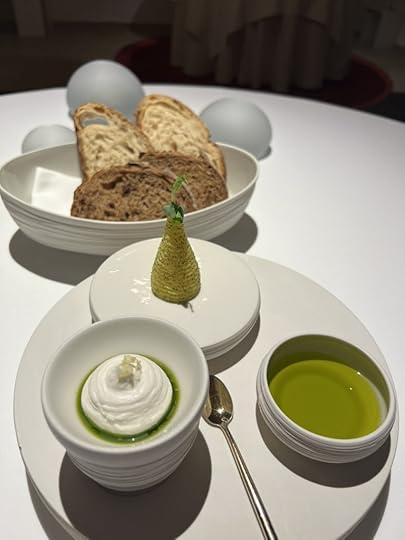
Was I unfair in my criticism of the first dishes? Each showed the highest levels of craftmanship and creativity. But thinking it over, I stand by what I said. The chef prioritizes cleverness over pleasure. This was foreshadowed by the architectural style sketches of some dishes that are displayed in the entrance way. Here are a couple of them:
A server noticed me looking at them and came over to discuss them. “Yes,” he said proudly, “Chef has a clever and original concept for each dish he creates.”
Moving onto the main dishes, presented in a sequence Amador calls Momentum, I will try to be more balanced in my critiques.
The carabineiro with ajo blanco (a cold Andalusian soup that predates gazpacho) was an unqualified success. The prawn was an outstanding example of its species—exquisitely fresh and flavorful and cooked the exact right amount. The soup and the slight crunch of the green almonds complimented it nicely.

The Patagonian toothfish was flaky and sublimely tender, and the “escabeche,” really just a single ingredient (perhaps a slice of summer squash) stand-in for that complex preparation, the leek oil and the hazelnut foam underscored the fish beautifully. The percebes, however, did not do justice to how delicious those barnacles can be. In an attempt to pare them down to a simple bite, the flavor and texture that makes them so sought-after were mostly lost. Again, the tendency to favor cleverness over taste showed itself.
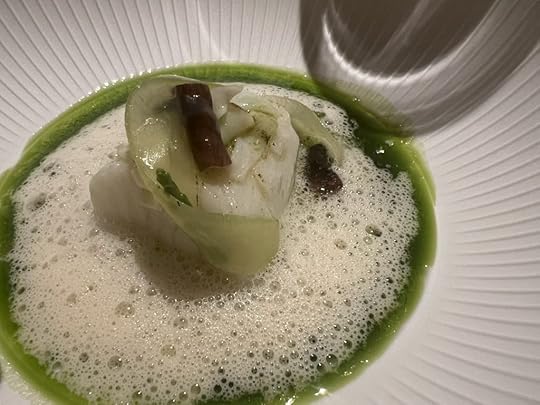
The turbot from Brittany, salted Wachau apricot, porcini and sweetbread was excellent. The sauce, which was a surprising Jerusalem artichoke foam, provided a subtle nuttiness that unified the perfection of each of the ingredients. I found no fault with this delicious dish.
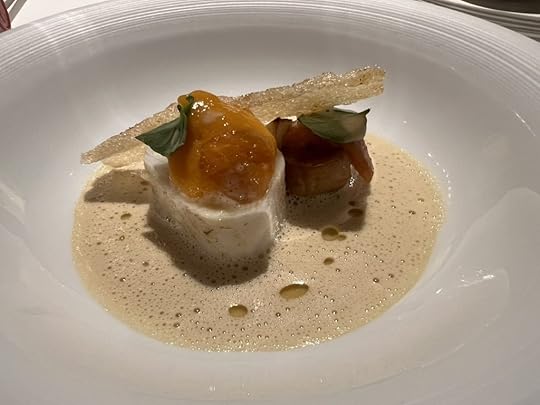
Parfum de Siam was an excellent venison dish, so titled for the green Thai curry flavored sauce. The cauliflower foam, puree and wafer were masterful. Altogether a great composition.
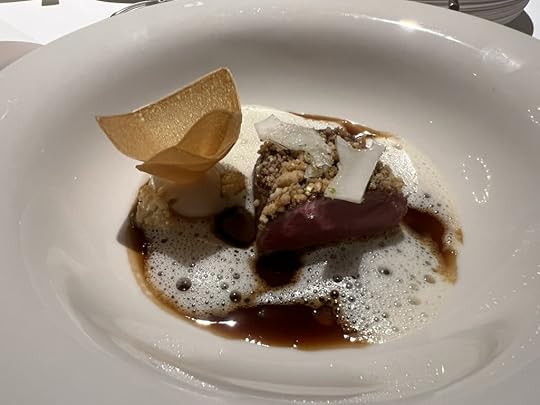
The first dessert, Strawberry Fields Forever, is described as containing two varieties of strawberry, Mieze Schindler and Mara des Bois. Both are famed as exceptionally flavorful and delicate. I would guess the former were used in the rosé champagne ice while the latter were served whole.
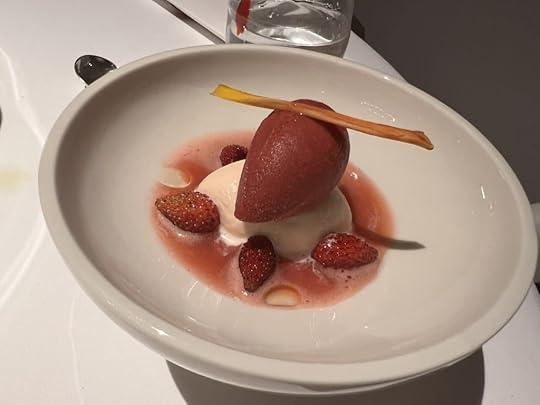
The second dessert, pêche melba, was a deconstructed version of Escoffier’s classic. It was certainly enjoyable, but I didn’t think it improved upon the original.
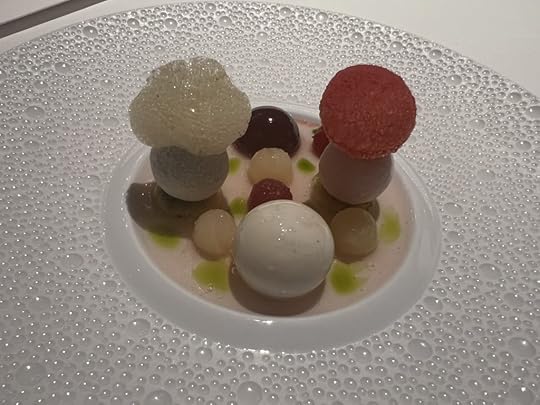
We were now more than four hours into this odyssey and I was happy to see that the mignardises, which Amador calls pequenas loquras, arrived all together rather than one after another. They were tasty and, though I hesitate to reuse the word, clever.
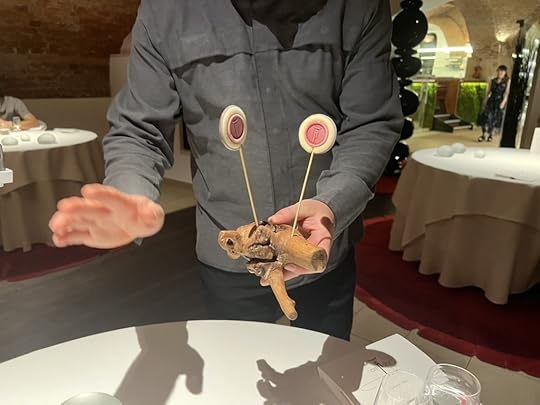
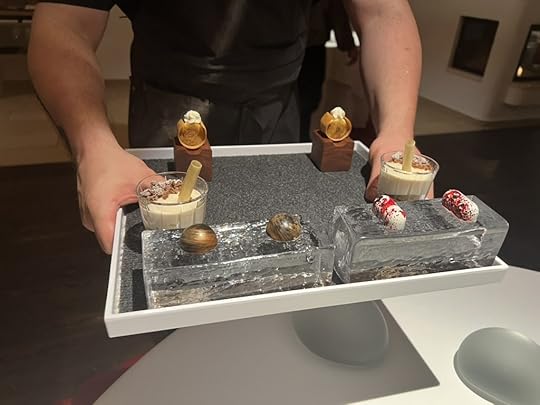
My experience at Amador left me mildly exasperated and craving the excellence of simplicity. Is there any place these days that provides that? Happily, our journey took us next to two places that did: Taubenkobel in the tiny Styrian village of Schützen am Gebirge, and Steirereck am Pogusch, the country outpost of the owners of Steirereck am Stadtpark, which I previously described as a strong candidate for the best restaurant in Austria. My meal at Amador, Austria’s only other Michelin three star, made me feel more certain that Steirereck deserves that title. I will review Taubenkobel and Pogusch soon.
September 10, 2025
Steirereck: Vienna’s Three-Star Culinary Revelation
Austria is not generally known for culinary innovation. Its best-loved dishes are judged not for creativity, but for perfect adherence to traditional standards. Tafelspitz—boiled beef and root vegetables—and wienerschnitzel have not varied in a very long time. In the whole country there was just one Michelin three starred restaurant until this year when Steirereck was awarded its own. We had lunch there and found it to be miraculously original in Austria’s tradition-bound gastronomic landscape.
Steirereck means the Styrian corner. Styria, the region known as Austria’s green heart, is the home of many of the country’s iconic and ancient traditional dishes. The restaurant began over fifty years ago as a small local place owned by the Reitbauer family. Nothing about its origins, and certainly not its name, led anyone to envision the temple of originality it would become.
In the late 1990’s the family’s son Hans Reitbauer Jr joined the company with ambitions to transform Steirereck entirely. His efforts were met with skepticism and a fair amount of hostility from the public, fearing the loss of a well-liked homey traditional place. But with the backing of his family, he and his wife Birgit persevered and created something truly special.
The architectural marvel they built to house their vision alerts visitors that they’re about to enter something refined and entirely modern. Visually, it is a shocking surprise among the classical monuments of imperial Vienna.

Floor to ceiling mirrored glass panels bring the lovely green Stadtpark right into the interior. The design breaks up the space into a number of nooks that give diners the feeling of being in small intimate rooms.
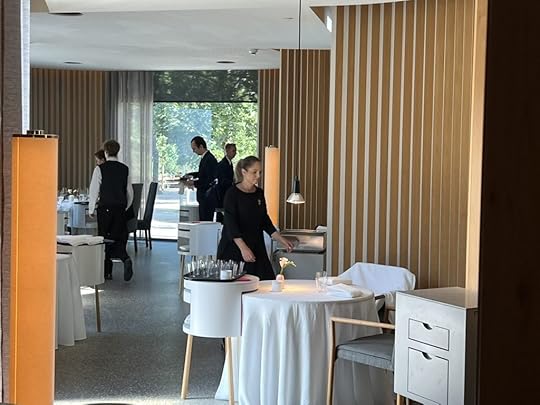
Styria is Austria’s principal wine region and the sommelier was impressively knowlegable of the best Austrian wines, of course in addition to those of the rest of Europe as well. He brought us glasses of a Thomas Schwarz bubbly to begin the meal.

Before the amuse bouches, a gentleman whose sole job seemed to be bread sommelier wheeled the bread cart to our table. Did he visit each of Vienna’s best bakeries that morning and select their best? I suspect so. The cart held an astonishing variety of excellent breads.
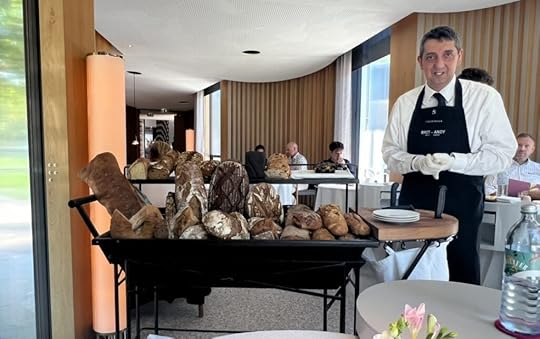
A succession of amuse bouches foreshadowed the philosophy of the meal to come: complexity and originality not for their own sake, but to give pleasure. Many of the components came from Steirereck’s own farm at Pogusch and a rooftop herb garden.

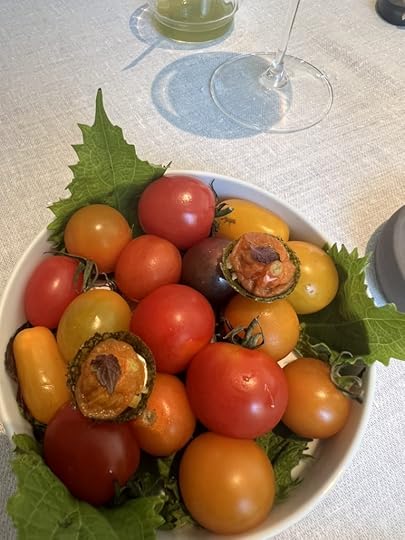
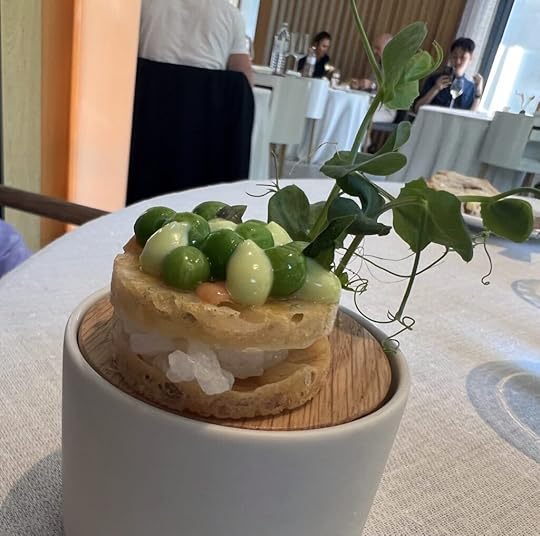
We chose the seven-course tasting menu. Each course had two dishes to choose from. We usually each picked a different one.
The two first courses were:
Tomato Diversity with Citrus, Lavendar and ChamomileEach little grilled tomato was prepared separately and then combined into a lovely composition. Some were marinated with citrus, bergamot and lemon balm, others pickled with lavender, verjus and lemon verbena, and others marinated in mushroom tea. A couple pieces of confit kohlrabi and some red onion pickled in chamomile blossom fond completed the composition. It sat in a soup of jellied tomato water and chamomile blossom oil. Each tomato vied for the title of best tomato I’ve ever tasted.
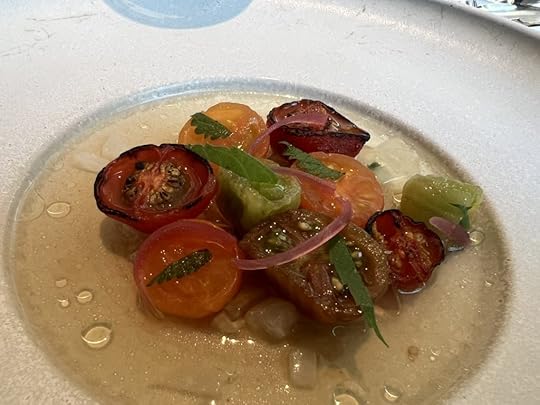 Young Carrots with Enoki, Apricot and Marigold
The carrots were glazed with cardamom butter, accompanied by steamed enoki mushrooms braised in carrot mushroom jus. The apricots were preserved in spiced verjus. Yarrow, amaranth and anise hyssop were marinated in ginger and lemongrass. Orange marigold oil brought the vegetable mixture together.
These first courses raised a question. Was it really worthwhile to combine so many ingredients? I’m not entirely sure, but each bite hit with an initial pleasure and then asked us to decipher its component flavors, an enjoyable exercise.
To accompany the first course dishes, we were brought a Nikolaihof Riesling and a Krutzler Gemischter Satz from Austria’s Südburgenland. Rather than blending wines from different vinyards, the gemischter satz approach grows several varieties in a single small plot, harvests and vinifies the grapes together.
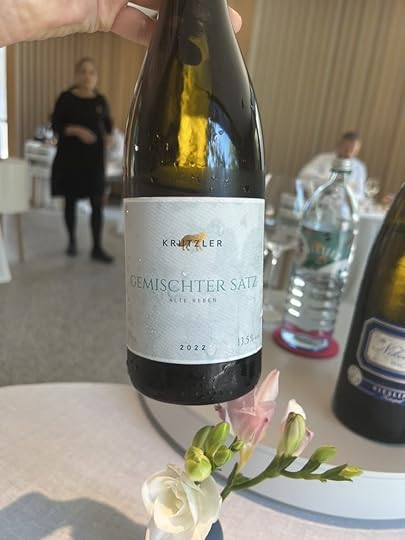
Second courses were also entirely plant-based:
Sunflower with Chanterelles, Tomato and Field Cucumber
The grilled and glazed heart of a sunflower sat atop roasted chanterelles with preserved sunflower stems, dried field cucumber and tomato, in a pool of roasted sunflower and pumpkin seed sauce spiced with coriander, lime and perilla oil, an extract of the seeds of the shiso plant.
Young Artichokes with Melon Cucumber, Groundcherries and Poppy.
A young artichoke was split lengthwise, one half braised with madeira and thistle oil, the other steamed and glazed with poppy miso. Grilled and marinated melon cucumber and groundcherry slices sat on top of sauteed baby spinach, young coconut, and dried groundcherry, all in a pool of artichoke braising jus, coconut water, lime and poppy seed oil.
The chef makes so much use of groundcherries—they must be in season—that I thought I ought to mention what they are. They’re the fruit of the physalis plant. They grow encased in a paper-like skin and have a pleasantly tart flavor. They’re also known as cape gooseberries or Chinese lanterns.
With the second courses we were served a French Anjou Noir from Domaine Belargus, and a Polz sauvignon blanc from South Styria.
Next came two fish dishes:
Catfish with String Beans, Plum and Lemon Savory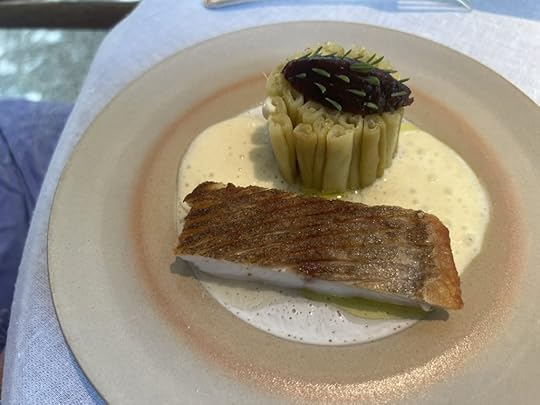
Crisp grilled catfish and steamed yellow string beans, topped with a scoop of greengage plum jam studded with lemon savory leaves from the Steirereck garden all sat in a foamed string bean butter sauce.
Eel with pointed cabbage, spruce tips and pepperoncini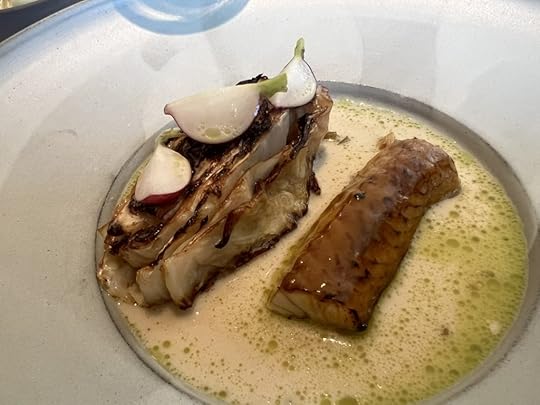
Flamed Bodensee eel, glazed with groundcherry and spruce tips sat next to braised and roasted pointed cabbage (spitzkohl) with little radishes in pickled cabbage butter sauce with pepperoncini and smoked eel oil.
The fourth course, which we both chose, was Kid Goat Ribs with Pointed Pepper, Elderberries and Grapefruit. It was accompanied by a Envínate Migan Tinto from the Canary Islands, vibrant, fruity and minerally.

Charcoal grilled kid goat ribs were deboned and glazed with elderberries. They sat on top of a delightful salad of sugar snaps, watermelon, grapefruit, shiso and lemon verbena in a pointed pepper watermelon sauce with lemon verbena oil.
Next came a dish I hesitated to try: Fawn with Summer Squash and Lemon Balm. Did I want to eat Bambi? Well, we think nothing of eating young lambs, I reasoned. The fawn was exceptionally tender and flavorful.
Along with it we were served Pranzegg from Italy’s Bolzano Valley basin, made from old vines of indigenous varieties and biodynamically grown.
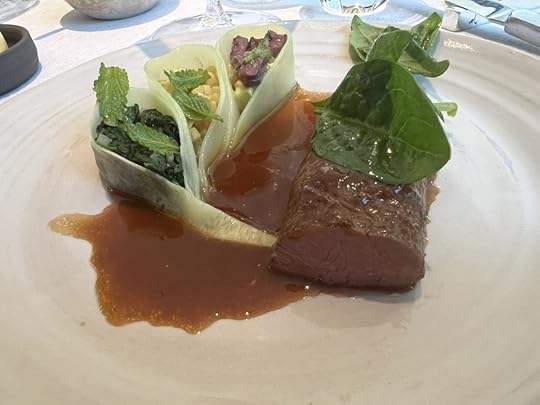
The meat was roasted and glazed with red currant, fennel and Szechuan pepper, accompanied by lemon balm marinated spinach and summer squash with preserved salted lemon, sauced with an exquisite fawn velouté.
It was time for the cheese course, and one cart wasn’t sufficient to hold them all. The cheese sommelier brought two carts with a wonderful variety of soft, hard, strong, mild and blue cheeses. We took his recommendations for the best local cheeses. Each was perfectly ripe and excellent.
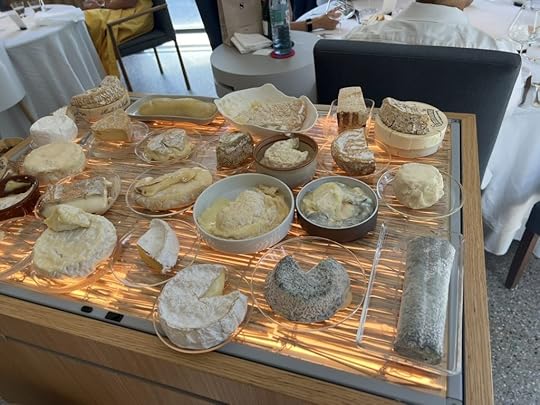
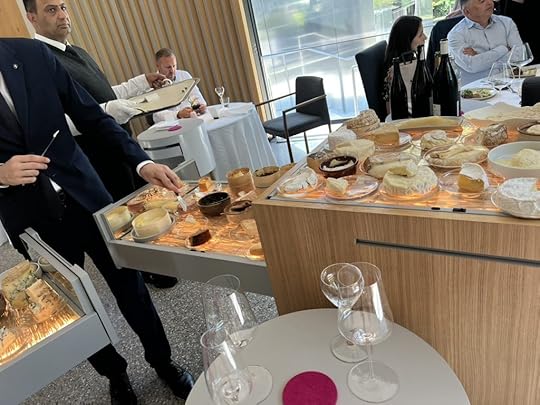
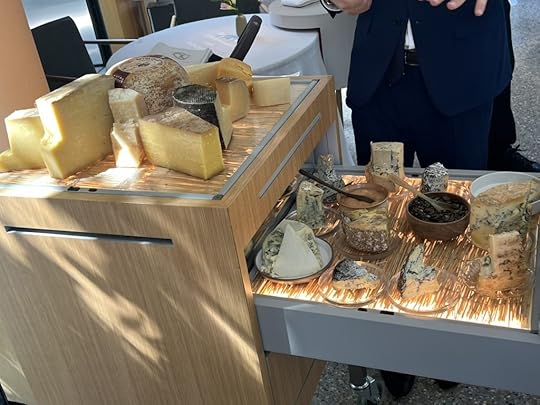
To go with the cheese, our principal server offered some bread varieties we had thus far neglected to try.


The desserts were in all respects up to the quality of the meal.
Bitterorange of Schönbrunn Palace with Buttermilk, Comb Honey and Bee Polen.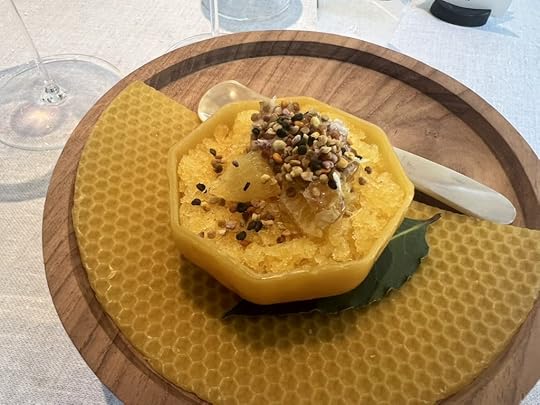
A granita of a variety of bitterorange once favored by the emperor was topped with honey and pollen from Steirereck’s hives and a delightful bitterorange cream.
Our server brought the honeycombs in a specially designed cart that hummed with the recorded sound of the bees. The sound effect was so convincing that I wondered if they were going to fly out into the room.
Viennese Mangomelon with Fennel Pollen, Passionfruit and Rice.
Mangomelon is a cucurbit that produces orange colored mango-flavored fruit. They were candied, dried, and made into an ice cream.
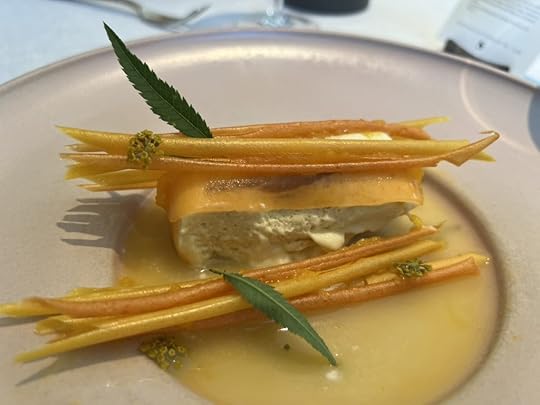 Mirabelle Plums with Coconut, Fig Leaf and Groundcherries.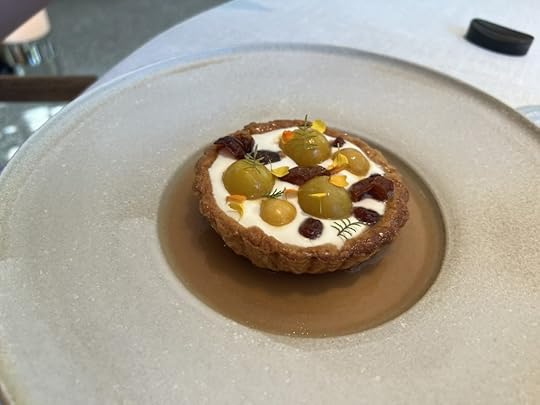
A caramelized puff pastry shell held marinated Mirabelle plums, coconut, pecan praline, groundcherries, rummed raisins and roasted coconut ice cream in a whisky Mirabelle sauce with fig leaf oil.
With the desserts, we were served a 2019 Stadlman Auslese, and Nolandes Gut Warth Honigwein, essentially a mead.
The mignardise were each created in honor of specific pieces by Strauss, whose two hundredth birthday is now being celebrated.

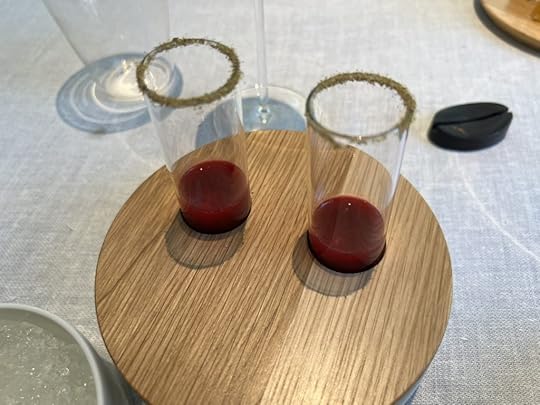

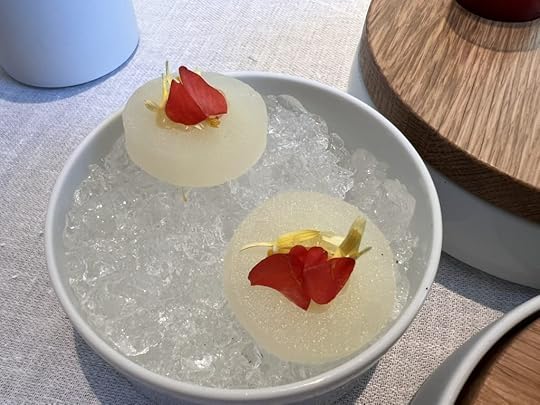
Would we care for some herbal tea to go with the petits fours? Our server brought a cart of growing herbs and snipped some to make a concoction for us.
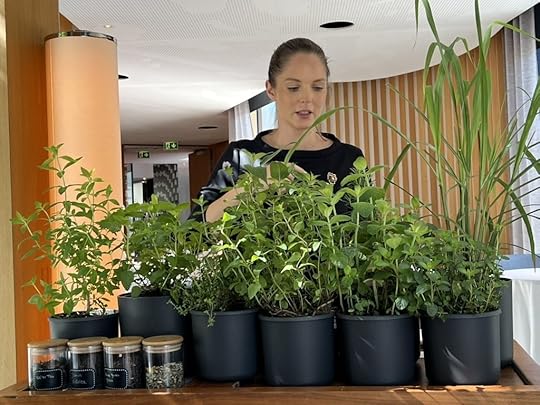
Not one but two other carts, wheeled in by their expert, brought a great variety of after dinner drinks, one cart full of local schnapps and the other of imported ones.
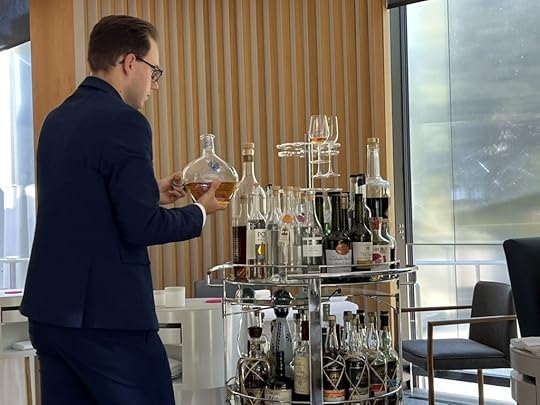
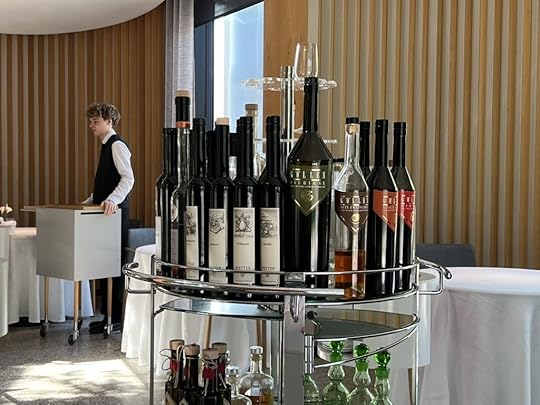
Espresso came accompanied by a couple of delicate little treats.
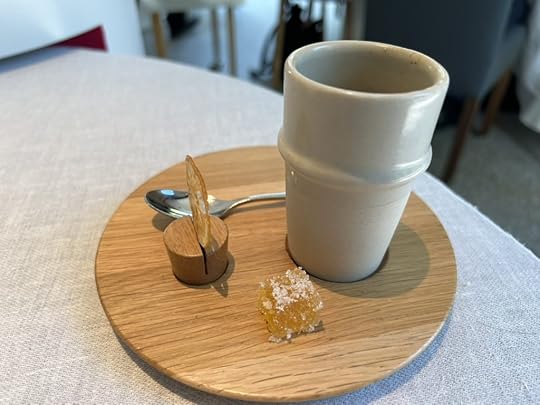
Steirereck is in my opinion one of the best restaurants in the world and a strong candidate for the best in Austria. If you visit Vienna, it would be a mistake to miss it.
Vedat Milor's Blog

- Vedat Milor's profile
- 23 followers


