Alastair Gunn's Blog
November 16, 2017
Who Was Ghost Story Writer "Mary E. Penn"?
The identity of Mary E. Penn, a late-Victorian author of ghosts stories and crime and mystery tales, is a complete enigma. Scholars of the macabre have been unable to discern any details of her person, origin or character (assuming she was indeed female). We only know that from the 1870s to the 1890s this author published a number of stories in periodicals, most commonly in The Argosy (Ellen Wood’s monthly publication). Some of her early contributions were anonymous (later attributed to Penn in The Wellesley Index to Victorian Periodicals) and her name only appears from 1878 onwards. Her first story, At Ravenholme Junction, was published anonymously in The Argosy in December 1876, but was later ascribed to Penn on stylistic grounds by eminent supernatural fiction scholar Richard Dalby. Her other ghostly tales were Snatched from the Brink (The Argosy, June 1878), How Georgette Kept Tryst (The Argosy, October 1879), Desmond’s Model (The Argosy, December 1879), Old Vanderhaven’s Will (The Argosy, December 1880), The Tenant of the Cedars(The Argosy, September 1883), In the Dark (The Argosy, June 1885), and The Strange Story of Our Villa (The Argosy, January 1893). The Tenant of the Cedars also appeared in two instalments in Philadelphia’s Saturday Evening Post in August 1885.
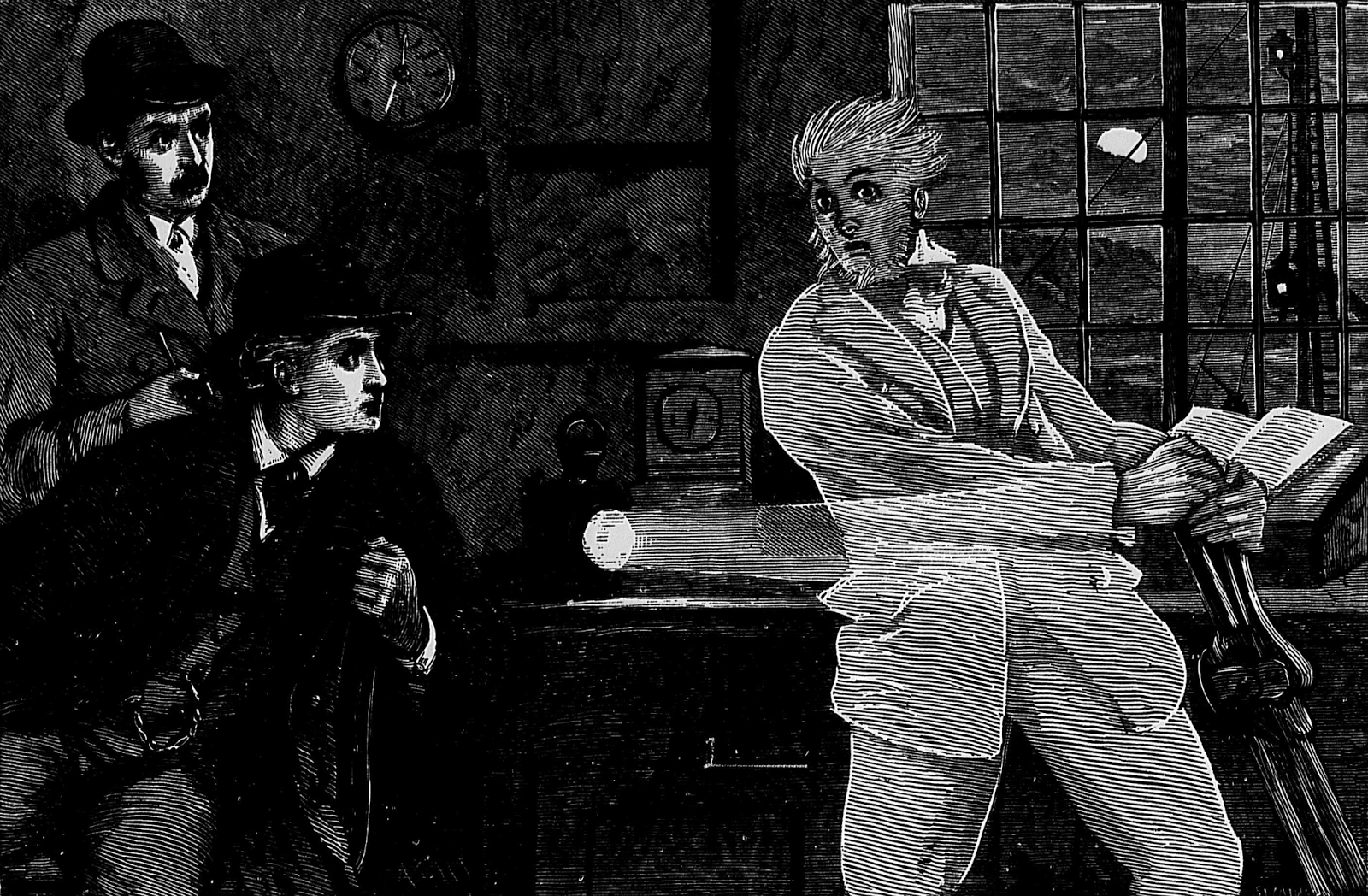 Illustration from "At Ravenholme Junction", The Argosy, 22 (December 1876).
Penn’s eight ghost stories were not collected together until the print-only publication titled In the Dark and Other Ghost Stories by Sarob Press in 1999, the second volume of the late Richard Dalby’s Mistresses of the Macabre series. Sarob’s limited-edition volume (only 250 copies were produced) is now almost impossible to find.Mary E. Penn wrote more than just a few ghost stories. She also wrote nineteen other short stories (see bibliography below), mainly in the crime thriller and mystery genre, all of them for The Argosy, except the two tales that appeared anonymously in Temple Bar in 1878 and 1879. She also appeared with a couple of small fiction pieces in the Saturday Evening Postin late 1884. Penn’s last known story was The Secret of Lyston Hall which appeared in The Argosy in August 1897. After this Mary E. Penn disappeared from the literary world completely, as mysteriously as she had first appeared. Tellingly, between January 1893 and March 1894, the author apparently changed her name from “Mary E. Penn” to “M. E. Stanley Penn” (the two surnames are hyphenated in one occurrence), perhaps signifying a marriage, or the inclusion of a maiden name. However, I have been unable to identify her from these scant details alone. There are no marriages listed in the British Civil Registration indexes that would suggest “Penn” or “Stanley” as a maiden or married name for Mary. Neither are there any births or deaths listed after civil registration began (in 1837) that can be easily identified with the mysterious Mary E. Penn, at least not without some wild speculation. There is, of course, the possibility that Penn was born abroad. Another possibility, of course, is that the name was a pseudonym. In this case I would make the tentative suggestion that Mary E. Penn was actually author Ellen Wood (1814-1887), more commonly known as Mrs. Henry Wood, the editor of The Argosy. Ellen Wood (née Price) was born in Worcester in 1814 and until the age of seven was brought up by her paternal grandparents. In 1836 she married Henry Wood, the proprietor of a banking and shipping firm in France and it was whilst living in Dauphiné that Ellen began to publish sporadically in the New Monthly Magazine and Bentley’s Miscellany (although she had written from a young age). After her husband’s business failed around 1856, the family returned to live in Upper Norwood, near London. Short of money, Ellen stepped up her writing career by winning a competition for a ‘temperance novel’ called Danesbury House (1860), which she had written in only a few weeks. Her next novel, East Lynne (1861), became hugely successful after a favourable review in The Times. Her career took off and she published a further twelve novels in the next four years, chief amongst them being A Life’s Secret (1862), Oswald Cray (1864), Mrs. Halliburton’s Troubles (1862), The Channings (1862), Lord Oakburn’s Daughters (1864) and The Shadow of Ashlydyat (1863).
Ellen’s husband died in 1866. That same year, after suffering a severe backlash by publishing a scandalous tale of bigamy, the owner of The Argosymagazine, Alexander Strahan, sold the publication to Ellen. She remained its editor (and chief contributor) until her death in 1887, serialising most of her novels within its pages. Her later works include Anne Hereford (1868), Within the Maze (1872), Adam Grainger (1876) and The House of Halliwell(published posthumously in 1890). Ellen Wood was also a prolific short-story writer and wrote some excellent supernatural tales. These are known to extend to three novellas, nine short stories and several stand-alone chapters in novels. Some of her best short ghostly fiction includes The Parson’s Oath, A Mysterious Visitor, Seen In the Moonlight, Reality, or Delusion? and A Curious Experience. Why should we suppose that Mary E. Penn was actually Ellen Wood? Firstly, all except two of Mary’s tales were published in Ellen Wood’s magazine The Argosy, and she is known to have penned most of its content. Secondly, the only American periodical in which Ellen Wood published was Philadelphia’s Saturday Evening Post (its editor Charles Jacobs Peterson was the brother of Ellen’s American publisher, Theophilus B. Peterson); and this was also the only place Mary E. Penn published in America. Thirdly, Ellen Wood is known to have had several pseudonyms. Her most successful was ‘Johnny Ludlow’, the narrator of a long series of short stories published from 1868 until after her death in 1887. Ludlow (whose real identity remained a secret for much of Ellen’s life) recounted many varied tales, some of them supernatural, concerning his adventures in Ellen’s county of origin, Worcestershire. In fact, Ellen was known to be a shrewd user of different literary identities and changed her appellation throughout her career, usually for sound economic or societal purposes. As well as ‘Johnny Ludlow’, Ellen also used the male pseudonym ‘Ensign Pepper’. It isn’t beyond the realms of possibility then that Ellen would later choose another pseudonym, her only female one, in Mary E. Penn.Now, although Ellen spent twenty years in France prior to becoming a successful author, her fiction rarely contained much reference to this period of her life. In fact, only ten pieces refer to France in some way, and all of those were written while Ellen was domiciled in France (she published a further twenty-five pieces during this period which did not relate to France at all). Other stories are also set in Switzerland, near to Ellen’s place of residence, near Grenoble. After Ellen’s return to England in 1856 she wrote nothing more concerning France except for brief passages in the novels East Lynn(1861) and Oswald Cray (1864). It seems odd that the influence of those years should completely disappear from Ellen’s writing after 1856. Now, of the twenty-seven stories attributed to Penn, ten are set in France; a further three are set in Tuscany, two in Belgium and one in Switzerland. The author, then, appears to have an intimate knowledge of continental Europe, and France and the French in particular. There is a substantial gap, of course, between Ellen’s last ‘French story’ (1856) and Penn’s first (1878). However, the Penn stories could represent the re-unearthing of previously-written stories from Ellen’s earlier days, published under a pseudonym (perhaps she was not as proud as she should be of her earlier writing), following her huge success after returning to England. One problem with this assertion is that Penn was publishing up to 1897, whereas Ellen Wood died in February 1887. However, Ellen’s son, Charles Wood, who took over editorship of The Argosy after her death, continued to publish the works of his mother right up to 1899, two years before The Argosyceased publication. So, it isn’t unreasonable to suppose that, faced with a series of completed but unpublished manuscripts of his mother, under the “Penn” pseudonym, Charles would chose to include them in The Argosy over a number of years. The large gap in Penn’s publications from 1888 to 1893, starting shortly after Ellen’s death, may not be coincidental. But are there any indications in the style of the writings themselves which may indicate that Ellen Wood and Mary E. Penn were one and the same? I believe there are. Firstly, both authors have a similar habit of using very short location-setting, time-setting or time-progression sentences as section openers. So, for example, Penn writes “Three weeks had passed away” (Desmond’s Model) compared to Wood’s “A week or ten days had passed away” (East Lynne); Penn writes “the days passed on” (The Strange Story of Our Villa) compared to Wood’s “Three or four days passed on” (Sanker’s Visit). These are not isolated examples, and the use of the terms ‘passed away’ and ‘passed on’ are common in both author’s works. Compare also Penn’s “A chill September afternoon” (How Georgette Kept Tryst) to Wood’s “It was a gusty night in spring” (Robert Hunter’s Ghost) – both extremely short sentences that place the action both in time, season and within the prevailing weather conditions. Again, this is not an isolated example; regular use of various, though typical, scene-setting short sentences occur again and again in both authors’ works. Compare Penn’s short sentence “A golden summer evening some fifteen years ago” (Old Vanderhaven’s Will) to Wood’s “A sunny country rectory” (The Prebendary's Daughter). Comparing both these authors to the norms of the time, one is struck by the frequent use of sentence fragments, certainly not a common form for the late nineteenth century. There is another similarity that may indicate these two authors were one. It is known from Ellen’s son’s biography of his mother that Ellen found the climate in France extremely oppressive; he wrote “in the extreme heat of summer, she could only sit or recline, clad in thin gauze or muslin” (Memorials of Mrs. Henry Wood, Charles Wood, 1894). This fact is revealed in her writing, where she describes the heat as “overpowering in the extreme” (Seven Years in the Life of a Wedded Roman Catholic). In Penn’s writing there is a similar, almost unhealthy obsession with the heat of the continent; as in “sultry June afternoon” (Desmond’s Model), “sultry September afternoon” (Snatched from the Brink) and “sultry August evening” (The Innkeeper’s Daughter).Although this evidence is somewhat circumstantial, I think there are enough indications to warrant further investigation into the possibility that Ellen Wood and Mary E. Penn were one and the same. Unfortunately, there is no existing archive of Ellen Wood’s correspondence or manuscripts, which will make the task of verifying this claim extremely difficult. But, whoever Mary E. Penn was, she left a legacy of eight extremely commendable tales that stand up well in the huge canon of Victorian traditional ghost stories.
Bibliography:
This is a complete bibliography of the works of Mary E. Penn.
At Ravenholme Junction, Anonymous (attributed by Dalby), The Argosy, 22 (December 1876), pp. 462-468.Snatched from the Brink, Mary E. Penn, The Argosy, 25 (June 1878), pp. 436-449Primrose, Anonymous (attributed in The Wellesley Index), Temple Bar, 53 (June 1878), pp. 193-208.One Autumn Night, M. E. Penn, The Argosy, 27 (March 1879), pp. 226-239.Vautreau the Vampire, Anonymous (attributed in The Wellesley Index), Temple Bar, 56 (July 1879), pp. 413-432.A Singular Accusation, M. E. Penn, The Argosy, 28 (July 1879), pp. 27-41.How Georgette Kept Tryst, M. E. Penn, The Argosy, 28 (October 1879), pp. 293-304.Desmond’s Model, Mary E. Penn, The Argosy, 28 (December 1879), pp. 476-490.A Night in a Balloon, Mary E. Penn, The Argosy, 29 (January 1880), pp. 56-63.Old Vanderhaven’s Will, Mary E. Penn, The Argosy, 30 (December 1880), pp. 475-494.Forrester’s Lodger, Mary E. Penn,The Argosy, 31 (March 1881), pp. 186-200.In the Mist, Mary E. Penn,The Argosy, 32 (October 1881), pp. 306-320.On the Night of the Storm, Mary E. Penn, The Argosy, 33 (June 1882), pp. 427-445.A Dramatic Critique, and What Came of It, Mary E. Penn, The Argosy, 34 (November 1882), pp. 373-385.A Painter’s Vengeance, Mary E. Penn, The Argosy, 35 (May 1883), pp. 396-400.The Tenant of the Cedars, Mary E. Penn, The Argosy, 36 (September 1883), pp. 196-212.At the Mill, Mary E. Penn, Saturday Evening Post, 64 (30th August 1884), p. 12.Out of the Way, Mary E. Penn, Saturday Evening Post, 64 (6th September 1884), p. 12. In the Dark, Mary E. Penn,The Argosy, 39 (June 1885), pp. 471-479.Monsieur Silvain’s Secret, Mary E. Penn, The Argosy, 44 (June 1887), pp. 15-29.In a Dangerous Strait, Mary E. Penn, The Argosy, 44 (November 1887), pp. 363-378.The Inn-keeper’s Daughter, Mary E. Penn, The Argosy, 45 (June 1888), pp. 471-491.The Strange Story of Our Villa, M. E. Penn, The Argosy, 55 (January 1893), pp. 18-27.An Innocent Thief, M. E. Stanley Penn, The Argosy, 57 (March 1894), pp. 256-263.Under a Spell, M. E. Stanley-Penn, The Argosy, 59 (February 1895), pp. 161-175.A Violinist’s Adventure, M. E. Stanley Penn, The Argosy, 59 (April 1895), pp. 474-480.The Mystery of Miss Carew, M. E. Stanley Penn, The Argosy, 60 (September 1895), pp. 349-357.Freda, M. E. Stanley Penn, The Argosy, 61 (June 1896), pp. 760-767.The Secret of Lyston Hall, M. E. Stanley Penn, The Argosy, 64 (August 1897), pp. 230-242.
The Ghost Stories of Mary E. Penn is available on Amazon Kindle, Nook and Kobo here;
Amazon (US)
Amazon (UK) Kobo


December 21, 2016
Victorian Christmas Ghost Stories
 An engraving by R. Graves entitled 'The Ghost Story', circa 1870.In his first full-length novel, The Pickwick Papers (1936-1937), Charles Dickens gave us a peculiarly Victorian view of the Christmas tradition. The host of a Yuletide gathering, Mr. Wardle of Dingley Dell, informs his guests that “Everybody sits down with us on Christmas Eve, as you see them now — servants and all; and here we wait, until the clock strikes twelve, to usher Christmas in, and beguile the time with forfeits and old stories”. So begins a long association of the traditional ghost story with Christmas-time; a tradition that has largely died out, but one that should be revived.
Of course, the tradition of telling spooky stories at Christmas is much older than Dickens. It was already well-established in the early nineteenth century. In Old Christmas (from The Sketch Book of Geoffrey Crayon, Gent., 1819), Washington Irving describes a busy Yuletide fireside with the parson “dealing forth strange accounts of popular superstitions and legends of the surrounding country”. The tradition may be even older than this. Shakespeare wrote in 1611 “a sad tale’s best for winter: I have one. Of sprites and goblins”, while his contemporary Christopher Marlowe wrote in his play The Jew of Malta (1589);
Now I remember those old women’s words,
Who in my wealth would tell me winter’s tales,
And speak of spirits and ghosts that glide by night.
Now, even though contemporary scholars have not unearthed any conclusive link between the ghost story and Christmas festivities prior to the Victorian era (or indeed prior to Dickens), there clearly is (and has been) a link between the dark and dismal days of winter and tales of superstition and fantasy. Hence, Marlowe’s term ‘winter’s tale’; also used by Joseph Glanvill in his Saducismus Triumphatis (1681); a treatise on witchcraft in which he warns the reader not to dismiss the existence of supernatural powers as “meer Winter Tales, or Old Wives fables”.
This should be expected; winter is a time of death, when traditionally the bridge between the real world and that of the ancestors is shortest. It is not surprising that festivals of death, rebirth and superstition (Hallowe’en, Walpurgisnacht, Beltane etc.) occur during late autumn, winter or early spring. And it takes no stretch of the imagination to suppose that stories of uncertainty, fear, the spirit-world, evil apparitions and so on could have evolved in natural association with darkness and wintertime in the psyche of the human animal. Chilling tales for chilling times. So, as ‘Jack Frost nibbles at your nose’, the lands are blanketed by a white peril, the fruits of the land are scarce, and nights are cold and long, we naturally turn to each other, regaling each other with frightening tales, as we huddle around the fireside. Is it such a leap to associate a specific winter festival, that of Christmas, with those chilling discourses?
Of course, there is already a connection between Christmas and the ancient pagan celebration of the Winter Solstice or Midwinter (the shortest day of the year). There is no documentary evidence that Christmas was celebrated on 25th December before 336 AD and it is widely held that this tradition arose simply because it is nine months after the Annunciation, which by tradition was held to be 25th March by early Christians. It may have been convenient that 25th December was close to the dates of the Winter Solstice and the ancient pagan Roman midwinter festivals called ‘Saturnalia’ or ‘Dies Natalis Solis Invicti’. The word ‘yule’ comes from a Germanic word originally referring to the midwinter celebrations, not to Christmas itself. So, again, there is a good case for drawing associations between ‘winter tales’ and ‘winter festivals’; and by extension, between ‘ghost stories’ and ‘Christmas’.
But, it is probably true to say that Charles Dickens himself was responsible for formalising this loose association in the mind of the Victorian reader. Dickens’s allusion to his idea of a traditional Christmas in The Pickwick Papers is encapsulated in only two short chapters. But, the chapter entitled The Story of the Goblins Who Stole a Sexton, told by the host Mr. Wardle, is a perfect
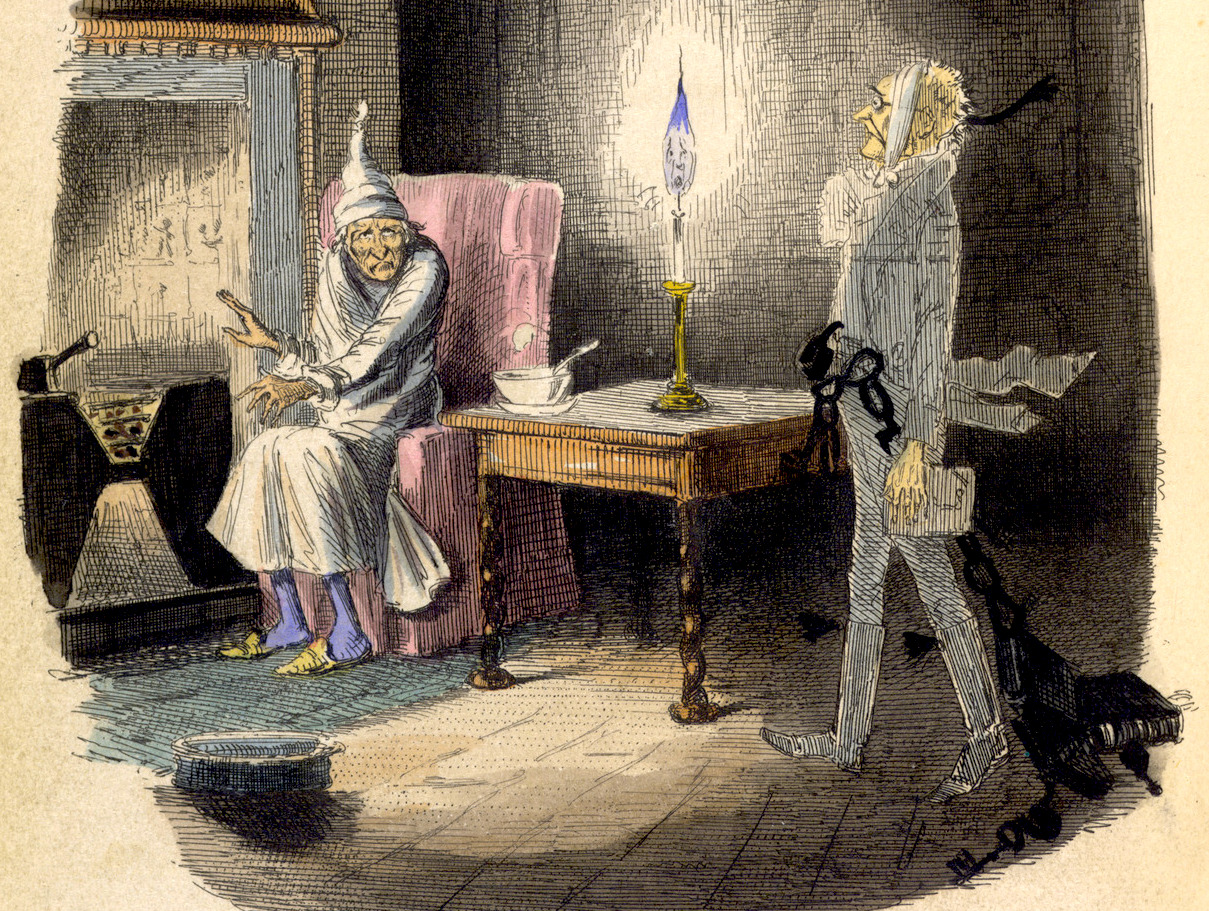 An illustration by John Leech for Charles Dickens's A Christmas Carol, 1843.example of how Dickens began to meld together the traditions of Christmas with the traditions of story-telling, particularly the telling of spooky or gruesome tales of the macabre. In fact, it is often said that this chapter of The Pickwick Papers is actually the embryo of Dickens’s much more popular (and widely known) tale A Christmas Carol (1843). In ‘Goblins’ the gravedigger (a prototype of Scrooge) is kidnapped (by goblins instead of the ghost of Marley and his friends), but with the same result; a positive change in his disposition to himself and others.
The connection forged by Dickens has never since been broken. A Christmas Carol was an instant bestseller, and remains so to this day, having been adapted many times for film, TV, stage and opera. The story was not only a spooky yarn, it was allegorical, nostalgic and yet full of contemporary themes such as poverty, social injustice and redemption, exploring many of the prevalent social and philosophical ideologies of the early 1840s. It presented to the Victorian palate a sense of community, a great humanitarian yarn, with some ghosts thrown in for good measure. It was extraordinarily timely – and the Victorians lapped it up.
A Christmas Carol was inspired by Dickens’s own childhood and his own longing for a lost Christmas tradition, which may never have existed, except in his own imagination and prose. Three years before the novella was published, Queen Victoria had married Prince Albert. A German style of celebrating Christmas, which Albert had brought to the family home, was immediately popular – the sending of Christmas cards, the giving of gifts (which had hitherto been associated with Epiphany in January) and the decorating of Christmas trees. Dickens himself seems to be responsible for our association of snow-covered landscapes with Yuletide celebrations. Even though the UK, for example, only saw seven white Christmases in the 20th century, our Christmas cards often depict a snowy Christmas scene. Admittedly, it may be that Dickens had lived his own childhood through some particularly harsh winters (six of his first nine Christmas’s had been white) and he had carried this association with him through adulthood – and into his writing. In both The Pickwick Papers and the earlier Sketches by Boz (1833), Dickens had already alluded to this idealised Christmas tradition, a secular tradition, full of song, snow and candles, which was later to be born fully-formed in A Christmas Carol.
It is important to remember that, prior to Dickens, the traditions of Christmas were essentially dying out in England. In the mid-17th century, Oliver Cromwell, Lord Protector of England, attempted to abolish the celebration of Christmas, since, he argued, the Bible did not instruct Christians to do so. This had a long-lasting effect and although Christmas continued to be observed by the pious, its traditions had largely succumbed by Dickens’s time. It can therefore be argued that Dickens not only established the connection between ghostly tales and Christmas, but also helped in the establishment of many of our modern Christmas traditions, with a bit of help from Victoria and Albert and others.
Dickens would continue to bolster the claim that Christmas was a time for telling ghost stories. Many of the greatest spooky tales of the Victorian era are to be found in the Christmas editions of popular periodicals; including but not limited to Dickens’s All The Year Round and Household Words. A more cynical view of this fact is that it was simply a form of commercialisation. These seasonal narratives were often created specifically for the Christmas market which was dominated by books and periodicals designed for giving as gifts. So, Dickens actually helped turn a secular tradition, or the even older oral tradition, into a commercial product. Cynicism aside, it is clear that the continuing popularity of the ghost story genre was a direct result of this rise in consumerism (something perhaps even more relevant today than then) and the publication of periodical literature. In fact, the abolition of Britain’s press taxation laws from 1849 onwards is sometimes cited as a reason for the increase in literacy levels in the late nineteenth century. It certainly made the popular press, and periodicals in particular, more affordable (and therefore more profitable) and hence more available.
Following the success of A Christmas Carol, Dickens published four more ghostly books specifically aimed at the Christmas market; The Chimes (1844), The Cricket on the Hearth (1845), The Battle of Life (1846) and The Haunted Man (1848). In the decade following these, the anti-gothic flavour of the Victorian ghost story reached its pinnacle. Although periodicals published macabre tales throughout the year, their Christmas numbers were incomplete without a ghost story. Dickens himself published nine Christmas editions of his journal Household Words from 1850 to 1858. Eventually other periodicals followed suit, such as The Argosy, Belgravia, The Cornhill Magazine, Temple Bar and St James’s Magazine among many others. The huge popularity of these seasonal issues bolstered and propagated this ‘new tradition’ of the Christmas ghost story. In Dickens’s 1850 Christmas number of Household Words he clearly states his position to the reader. In that issue, which also included the famous Christmas ghost story The Old Nurse’s Story by Elizabeth Gaskell, Dickens contributes the prose piece entitled A Christmas Tree; a nostalgic, whimsical (and probably half-invented) rendition of Dickens’s own concept (and longing) for a Christmas tradition. In that piece Dickens tellingly writes, “There is probably a smell of roasted chestnuts and other good comfortable things all the time, for we are telling Winter Stories — Ghost Stories, or more shame for us — round the Christmas fire”, before explaining precisely what should happen in our Christmas spooky tale. A Christmas Tree, and the part often reproduced under the title Telling Winter Stories, is a relevant and crucial statement of where our association of ghosts with Christmas originates.
 The cover of James Hain Friswell's 'Ghost Stories' (1856)The ‘invented’ Dickensian tradition eventually became accepted as widespread and normal. Jerome K. Jerome says, in his introduction to his 1891 collection of stories, Told After Supper; “Whenever five or six English-speaking people meet round a fire on Christmas Eve, they start telling each other ghost stories”. In 1898, Henry James wrote in his story The Turn of the Screw, “The story had held us, round the fire, sufficiently breathless, but except the obvious remark that it was gruesome, as, on Christmas Eve in an old house, a strange tale should essentially be…”.
 Of course, the Christmas ghost story genre did not end with the death of Queen Victoria in 1901. M. R. James, the recognised master of the modern ghost story, prefaced his 1904 collection, Ghost Stories of an Antiquary, with the words “I wrote these stories at long intervals, and most of them were read to patient friends, usually at the seasons of Christmas”. James certainly increased the popularity of the ghost story and in so doing merely added weight to the belief that Christmas was the time to tell them. Ever since, throughout the twentieth century, ghost stories have appeared with a Christmas theme. Although it’s relevance has changed over time, and has largely died out, there are still vestiges of this tradition today. In Andy Williams’s 1963 recording, It’s the Most Wonderful Time of Year, he sings “There’ll be scary ghost stories, And tales of the glories, of Christmas long, long ago”. And who can deny the importance of the essential winter-theme in Stephen King’s The Shining.
If you want to revive the Victorian passion for Christmas Ghosts, you can read a selection of thirty traditional Victorian ghost stories, all set at or around Christmas, in The Wimbourne Book of Victorian Ghost Stories (Volume 2). Wait until the dark of the snowy night (preferably on Christmas Eve), lock the doors, shutter the windows, light the fire, sit with your back to the wall and bury yourself in the Victorian macabre. Try not to let the creaking floorboards, the distant howl of a dog, the chill breeze that caresses the candle, the shadows in the far recesses of your room, disturb your concentration.
August 15, 2016
Cosmic Journey
Click here for the accompanying video for Cosmic Journey.
Many years ago I was commissioned to give a series of astronomy lectures. One of these was called "Cosmic Journey" and was intended to give the uninitiated an overview of the entire cosmos. For this I produced a 40-minute video (with music) to which I provided the narration. In this blog post I have reproduced the narration in written form and provide a link to the video posted on YouTube.
The video takes uson a journey – a journey from planet Earth to the farthest depths of space, to the very edge of the visible Universe. Along the way we will find many fascinating objects, learn about how they formed, how they work and how they die. We'll meet some strange and beautiful ideas and see how the powerful method of science explains what we encounter.
Gazing at the night sky from Earth, it is easy to picture the Universe as static and peaceful. The same stars cross the sky every night and only the occasional shooting star or solar eclipse reminds us that the heavens are busy. However, on our journey we will find that the Universe is changing all the time. It evolves on timescales that dwarf our human lifetimes. At times the Universe can be violent, at other times serene or perplexing, destructive or creative. But it never ceases to inspire and intrigue us. It is a truly beautiful and remarkable place.
What you will see in this video is a simulation of the Universe, but one that uses the latest astronomical imagery and data. This voyage is as close to the reality of what you would see if you were actually making the journey, but as we will find, there are limits to how real we can make it.
Before we leave, it should be pointed out that this is an impossible journey. In order to reach the farthest depths of space in the few minutes at our disposal, we would have to travel at many billions of times the speed of light. This is impossible because the speed of light is the ultimate speed limit in the Universe.
As we make our journey, we will soon realize that the Universe is a very big place. Familiar units, like miles or kilometers, are useless when measuring the vast distances that we will encounter.
We will be using several units of measurement as we proceed on our journey. The first is convenient for measuring distances within our own neighbourhood, the Solar System. It is called the Astronomical Unit, abbreviated AU, and is defined as the average distance between the Earth and the Sun. An AU is equal to about 93 million miles or 150 million kilometers.
Most people have heard of the second unit. It is the light year, abbreviated LY, and is equal to the distance traveled by light in one year. It is about 6 trillion miles or 10 trillion kilometers.
The final unit of distance we will be using is called the Mega-parsec, abbreviated Mpc, and is convenient for distances outside our own Galaxy. The nearest large galaxy to our own, the Andromeda Galaxy, is about 1 Mpc away. Be warned; the distances of astronomical objects are extremely difficult to measure. There are several methods. For example, it is possible for some objects to know exactly how bright they are intrinsically. Comparing this to how bright they appear to us on Earth reveals their distances. But all these methods have some uncertainty which means the distances quoted are not that precise. The overall scale of the Universe is pretty well established, but the distances to many objects are not that accurate.
As we journey outwards the timing numbers (minutes: seconds) give an indication of where in the video the text refers.So, let's begin...
00:41: As we pull away at greater and greater speed we begin to see planet Earth beneath us. This is our home. Earth is the third planet from the Sun and the largest of the ‘terrestrial’ planets – those that have rocky surfaces. The Earth is a slightly squashed sphere with a radius of about 6,371 kilometers. It spins on its axis in just under 24 hours and revolves around the Sun in 365.25 days, or thereabouts.
We know a great deal about the Earth, simply because it’s under our feet and therefore easy to study. The Earth is believed to be 4.55 billion years old. 71% of the Earth's surface is covered with water. Earth is the only planet in the Solar System on which water can exist in liquid form on the surface. The Earth's atmosphere is about 77% nitrogen, 21% oxygen, with traces of argon, carbon dioxide and water. The carbon dioxide is in fact an important part of the atmosphere. The natural ‘greenhouse effect’, which you have all heard about, is responsible for maintaining the Earth’s temperature at about 35 degrees above what it would normally be. Without it, the Earth would be frozen and life would not be able to survive here.
And of course, the fact that life exists here, is what’s important to us. This Blue Marble, a tiny speck in the vastness of space, contains everything we know and love. It is a precious place.
In a moment we will be leaving this precious place behind and heading off into space. We will have to attain some pretty monumental speeds on our journey so we will accelerate away from Earth extremely quickly.
03:15: The first object we will encounter of course is the Moon, our nearest celestial neighbour. The Moon is a sparse, cold and dusty place. But it is distinguished by being the only other celestial body that humankind has visited, although some people seem not to be convinced of that. Astronomers now believe the Moon was formed from debris made by the impact of the primordial Earth with another planet, perhaps the size of Mars.
03:40: We are now heading towards the inner planets, those closer to the Sun than us. The first planet we come across is Venus, which incidentally is now visible just before sunrise low in the East. Venus is a very hot planet due to its closeness to the Sun and because it has an extremely dense, cloudy atmosphere of carbon dioxide and sulphuric acid. The surface temperatures reach 460 degrees C.
04:02: We’re now heading in to the closest planet to the Sun – Mercury. Mercury is similar in appearance to the Moon. It is heavily cratered, has no atmosphere and no natural moons. It rotates on its axis very slowly so that the Mercurian day is very long, about 59 Earth days. This means that there is a huge difference between the daytime and nighttime temperatures. Daytime averages are about 420 degrees C and nighttime temperatures about -170 degrees C.
04:30: Now we are turning away from the Sun again and flying back out past the Earth’s orbit towards Mars, the red planet. Mars is perhaps the planet most resembling Earth. It is slightly smaller, has a thin atmosphere and shows surface features like impact craters, valleys and mountains, volcanoes, deserts and polar ice caps.
04:50: The geology of Mars is spectacular. Valles Marinerisis a vast canyon system that runs along the Martian equator. At more than 4,000 km long, 200 km wide and up to 7 km deep, the Valles Marineris rift system is the largest canyon anywhere in the Solar System. It is actually a huge crack in Mars’ surface formed as the young planet was cooling. There is evidence that parts of this vast valley have been flooded by water in Mars’ past. In fact, it appears the primitive Mars may well have had significant quantities of liquid water on the surface, prompting suggestions that life may have developed there, but now any water still on Mars is locked up in the permafrost and the polar ice caps.
05:45: We are now flying towards Olympus Mons, the largest volcano anywhere in the Solar System. Olympus Mons is a shield volcano 624 km in diameter and 25 km high, three times as high as Mount Everest.
06:00: Leaving Mars behind, we’re heading towards the planet Jupiter, but before we get there we will encounter the main Asteroid Belt of the Solar System. Asteroids are rocky bodies, representing material left over from the formation of the Solar System. The Asteroid Belt is actually mostly empty. You could quite easily pass through the Asteroid Belt with little risk of a chance collision. Deep space probes do this all the time.
Asteroids vary greatly in size, from a diameter of 975 kilometers for Ceresand over 500 kilometers for Pallasand Vesta down to rocks just tens of meters across. A few of the largest are roughly spherical and are very much like miniature planets – in fact they are now called ‘dwarf planets’ rather than asteroids. The vast majority, however, are much smaller and are irregularly shaped.
07:00: We’re now arriving at the planet Jupiter. This is the largest planet of the Solar System – in fact it has two and a half times the mass of all the other planets put together. Jupiter is a ‘gas giant’ composed mainly of hydrogen gas with a sprinkling of helium and other elements. Jupiter has a total of 63 moons.
07:30: Saturn, the sixth planet from the Sun, and another gas giant, is second only to Jupiter in size. Again it consists mainly of hydrogen. The surface of Saturn is pretty featureless, unlike Jupiter, but it makes up for it with its beautiful ring system. Saturn is of course what school kids draw when they draw a planet.
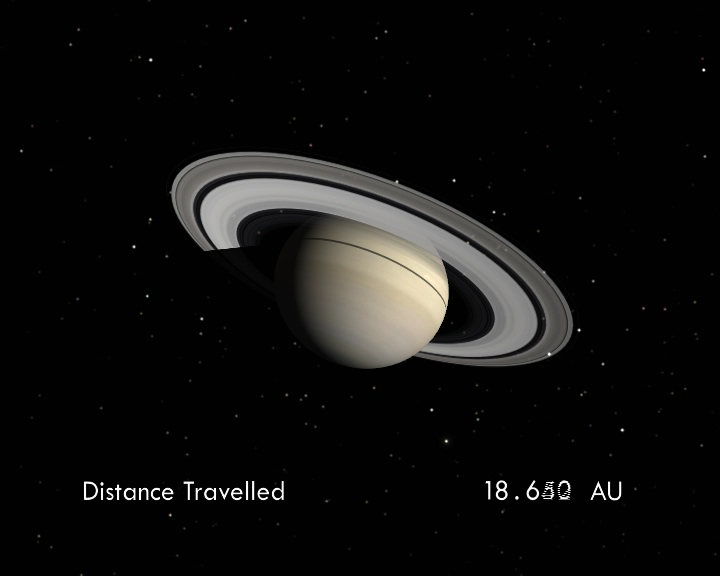
07:45: The rings of Saturn are composed mainly of water ice particles. These range in size from dust-sized grains to large car-sized objects. Although the rings extend some 120,000 km out from their mother planet, they average only about 20 meters in thickness. The rings have a very complex structure, consisting of thousands of rings with different average densities, interspersed with dark gaps. This structure is the result of the gravitational perturbations of Saturn, but also because a large number of tiny moons clear out areas of debris or shepherd the icy material into tight rings.
It should be pointed out that all four gas giant planets, Jupiter, Saturn, Uranus and Neptune, have ring systems, but the Saturnian one is by far the most spectacular. All of them can be seen from Earth, but Saturn’s rings are the only ones you’ll be able to spot with a modest-sized telescope.
09:05: We now come to the planet Uranus. Uranus is a pale blue-green colour. It has a system of 27 moons, although the largest, Titania, is less than half the size of the Earth’s Moon. The most unusual thing about Uranus is that it is tipped on its side – the rotation axis is almost in the same plane as its orbit. This gives Uranus a very strange seasonal pattern. Each pole gets about 42 years of night followed by 42 years of day.
09:30: We are now visiting the eighth planet from the Sun, Neptune. Neptune is about 17 times the mass of the Earth and has a radius about four times the Earth’s. Its distinctly blue colour shown here is real. The small amount of methane in the atmosphere, which again is chiefly hydrogen and helium gas, absorbs red light, resulting in a beautiful azure planet. Its interior contains water, ammonia and methane ices. At a depth of 7000 km, the conditions are just right for methane to decompose into diamonds, which then rain down on the rocky core below.
10:00: We are now heading out towards the most distance parts of the Solar System. As we journey out we may just possibly come across a lone comet. The nucleus of a comet is a small object consisting of rock, dust, ice and frozen carbon dioxide, methane and ammonia. When close enough to the Sun, the solar radiation evaporates large quantities of these volatile materials forming a tail. The nucleus of a comet can be a few hundred meters across up to perhaps 40 km wide, but the tail can extend to one astronomical unit. Most comets have very elongated orbits around the Sun so that they spend most of their time in the cold depths of the outer Solar System. Far beyond the orbit of Pluto, a quarter of the way to the nearest star, there is a vast ocean of comet-like objects known as the Oort Cloud.
11:00: We are now approaching the final planetary object we will encounter in the Solar System. Until recently, Pluto was a planet, but with the discovery of many objects similar to Pluto in the outer Solar System, notably the object called Eris, which is bigger than Pluto, astronomers have re-designated it as a ‘dwarf planet’. Pluto is no longer considered a planet for the same reason the asteroids are not.
11:25: We have now come to the edge of the Solar System, our little corner of the Universe. We will now begin to pick up speed, and as we do so, we will see the Sun and its faint retinue of planets receding and dimming in the distance. But before we leave the Solar System behind, we should talk briefly about perhaps its most important member; the Sun.
11:35: The Sun, that vital source of energy that in fact allows our very existence, is a star like any other. It is a pretty average sort of star – totally unremarkable – just like the many billions of other stars we can see in the sky. Stars are luminous balls of plasma. There is so much material in a star that the pressure at the centre creates enormous temperatures, tens of millions of degrees. Under these conditions, atoms undergo a process called ‘thermonuclear fusion’ – that is, small atoms like hydrogen are forced together to form heavier elements, releasing energy as they do so. It is exactly the same process of energy release as in a hydrogen bomb. This process of ‘nucleosynthesis’ builds up heavier and heavier elements in a series of different nuclear reactions. In fact, apart from the hydrogen in your bodies, all the heavy elements which are part of you must have been formed in the heart of a burning star.
12:25: We are now beginning to increase our speed enormously. We are now light years from Earth and as our speed increases we will begin to see the individual stars of our part of the Milky Way Galaxy begin to move. There are many kinds of stars. Massive ones, small ones, hot ones, cold ones, old ones, young ones, single ones, binary ones, multiple ones, new-born ones, dying ones. Their range of properties, like mass, temperature, age, give rise to a zoo of exotic and interesting objects. We don’t have time to look closely at all the different types of stars, but they include objects called red giants, white dwarfs, blue supergiants, brown dwarfs, black holes, microquasars, proto-stars, neutron stars, X-ray binaries, cataclysmic binaries and so on.
12:50: Stars form out of a compressed cloud of gas. There are many processes that can trigger a cloud of gas in space to begin collapsing in on itself. One way is a nearby supernova, or exploding star, which can send shockwaves through the interstellar medium, disturbing the precarious equilibrium. If enough matter coalesces at the centre of the cloud, a new star will be born. The pressure and temperature at the heart of the proto-star rise until thermonuclear reactions begin and the star sparks into life. The leftovers of this process, a tiny fraction of the original mass of the cloud, can form a planetary system like our own, containing planets, asteroids and comets, all the bits and pieces we’ve just seen in our own Solar System. As the new star begins to shine, the radiation it creates blows away the remaining material.
13:45: We’re still heading away from the Sun on our journey. We’ve moved so far now that the typical patterns of stars we’re used to seeing in the sky have completely changed.
Astronomers can deduce a lot about the stars by analyzing the light they radiate. All atoms absorb or emit radiation at specific wavelengths (or colours) of light, and each of the chemical elements, such as hydrogen or oxygen, has its own signature of absorption or emission lines. Nature has provided us with a convenient fingerprint of a star’s constituent elements in the spectrum of its light. By splitting starlight into its component colours, with something as simple as a prism, the astronomer can identify the absorption or emission lines in the star’s spectrum and deduce its composition. What’s more, it is also possible to determine things like temperature, density, pressure, luminosity, size, age, magnetic field, rotation rate, speed and the mass of stars simply by analyzing their spectra.
14:35: We have talked about how stars form. Let’s now look at wherethey form. To make a star we need clouds of hydrogen gas. Such regions of space are known as ‘nebulae’, which is Latin for ‘mist’. Nebulae come in many shapes and sizes and have many processes going on inside them. Some nebulae shine simply by reflecting the light from nearby bright stars while some give off their own light when the radiation from hot stars excites the hydrogen atoms inside the nebula. Some nebulae are totally dark and we only know they’re there because they block out the light of objects behind them.
Many of these nebulae are the birth places of stars. Astronomers call them ‘stellar nurseries’. These regions of space can be quite stunning in their complexity and beauty. In them we can see the clouds of gas themselves and faintly glowing within these, the first rays of light from infant stars. Once stars have formed within a complex cloud of gas, they can have a significant effect on their environment. The intense radiation they give off begins to mould and shape the clouds of hydrogen gas. The radiation also ‘ionizes’ the nebular gas, causing it to glow in different colours – red, blue and green. We have also seen proto-planetary disks inside nebulae. These are rotating disks of material orbiting very young stars and which will presumably form planetary systems.
16:10: How a star lives its life depends on how much mass it has. Massive stars live fast and die young. Smaller stars live longer and just fade away. A young star has plenty of hydrogen to fire its furnace. The thermonuclear reactions result in hydrogen being converted slowly into helium and the energy generated balances the gravitational contraction exactly.
Eventually the star’s hydrogen fuel is all used up and the energy source is switched off. What happens then depends on the mass of the star. Low mass stars will expand to become Red Giant stars. Massive stars will contract and attain a core temperature high enough to start fusing helium atoms instead of hydrogen. Really massive stars can also synthesize much heavier elements in their cores such as aluminium and silicon. However, no star can synthesize elements heavier than iron because those nuclear reactions require energy rather than produce it.
17:00: Let’s take a look at some exotic objects as we travel through the Galaxy. Here is an example of a really massive star. It is called Eta Carinae, and it lies within the Carina Nebula. Eta Carinae is believed to have a mass more than 100 times the Sun’s. It is so massive, and has therefore evolved so quickly, that it is almost certainly about to die. Such a star would end its life in a massive explosion called a Supernova, which we’ve already mentioned. Eta Carinae seems to be getting ready to blow itself apart. Recently, in 1841, it brightened considerably and threw off two lobes of material which form the ‘Homunculus Nebula’. It may not blast itself to pieces during our lifetimes, but there are lots of astronomers hoping it will!
17:55: This object is called V838 Monocerotis. In 2002, a previously un-catalogued star started brightening and produced this strange expanding nebula. It may be a massive star preparing to die or it may be that the star concerned has swallowed up several large planets as it expanded.
18:08: Occasionally, stars cannibalize each other. In this example we see a black hole slowly devouring its companion. Blowtorch-like jets, shown in blue, are streaming away from the black-hole system at 90% of the speed of light.
18:25: This object is called the Cat’s Eye Nebula and is an example of a ‘planetary nebula’. Planetary nebulae have nothing to do with planets – it’s just that when they were first discovered, their round shape led many to confuse them with planets. A planetary nebula is the radiant afterglow for most stars in the Universe, including our own Sun. Before dying, most stars gently eject their outer gaseous layers and thereby produce bright nebulae with amazing shapes.
18:50: We are still traveling at colossal speed through the Milky Way Galaxy. The patterns of stars, or constellations, are now completely unrecognizable. There are something like 200 billion stars in our Galaxy, although the human eye can see at best about 2000 on a clear, dark night. The brightest star in the sky is called Sirius. The nearest star beyond the Sun is called Proxima Centauri and is 4.25 light years from Earth. The star furthest from Earth that can be seen without a telescope is probably the star called Deneb at 3,200 light years.
19:30: Now, all stars must eventually die. We have already mentioned several things that can happen to them on their death beds. One eventuality is a supernova explosion, like this one. Supernovae are responsible for creating the chemical elements heavier than iron. If you’re wearing some silver or gold today, take a look at it – the atoms in what you’re wearing were made inside a supernova. In fact, all the elements in the Universe, except hydrogen and helium, have been cooked up in stars or supernovae since the Universe began.
Supernovae are responsible for returning the material that makes stars back into space – a kind of stellar recycling. Not only that, but as we’ve heard, the shock waves from supernovae can trigger the formation of new stars. It is an endless cycle of death and rebirth.
20:05: Here we see a Red Giant star being cannibalized by a companion star. The Red Giant explodes as a supernova to leave a neutron star or possibly even a black hole.
20:25: In this example, we see a White Dwarf star sucking material off its massive companion. The hydrogen gas builds up on the tiny White Dwarf until its mass reaches a critical limit when it explodes as a titanic fusion bomb, throwing its companion off into space.
20:45: Some massive stars can give rise to pulsars. These tiny stars, perhaps only a few tens of kilometers across, often reside in the hearts of supernova remnants. They are essentially the leftover, highly dense cores of stars that blow themselves apart. Pulsars are rapidly rotating, magnetized stars which emit radio waves along the magnetic axes. When one of these beams crosses the earth, we hear a radio pulse, hence the name pulsar.
21:15: Finally, really massive stars can produce black holes when they destroy themselves. Far from being science fiction, black holes are a reality. Although they can’t be seen directly, astronomers can infer their presence
21:30: We are now approaching the edge of our own galaxy, the Milky Way. The Milky Way is a flattened disk in shape. We have been moving almost straight up out of the plane of the Galaxy, which means we will leave the Milky Way after traveling only a few thousand light years or so. The Sun is located about two-thirds of the way out from the centre of the Galaxy, which lies about 25,000 light years away.
22:05: As our speed continues to increase and we pull away from the Milky Way, we will see that we begin to loose sight of the individual stars in the Galaxy. Only the very brightest stars still stand out. Instead, we begin to perceive all those billions of stars as just a hazy patch of light.
22:30: Our Galaxy, like our Sun, is just like any other. There is nothing especially unique about it. The Milky Way is what we call a barred spiral galaxy. You have seen images of the spiral shape of galaxies. We name the spiral arms of the Milky Way after the constellations in which they appear in the sky. The Sun is not actually within one of the main spiral arms of the Milky Way – it is in a small offshoot of the Perseus Arm which we call the Orion Spur.
22:45: We can now see the entire Milky Way galaxy receding from us. Immediately, we notice that our Galaxy is not entirely isolated in space. There are numerous small, irregularly-shaped galaxies close by. These galaxies, which total around 50 or so, form a small clustering within space which we call the Local Group. The diameter of the Local Group is about 10 million light years.
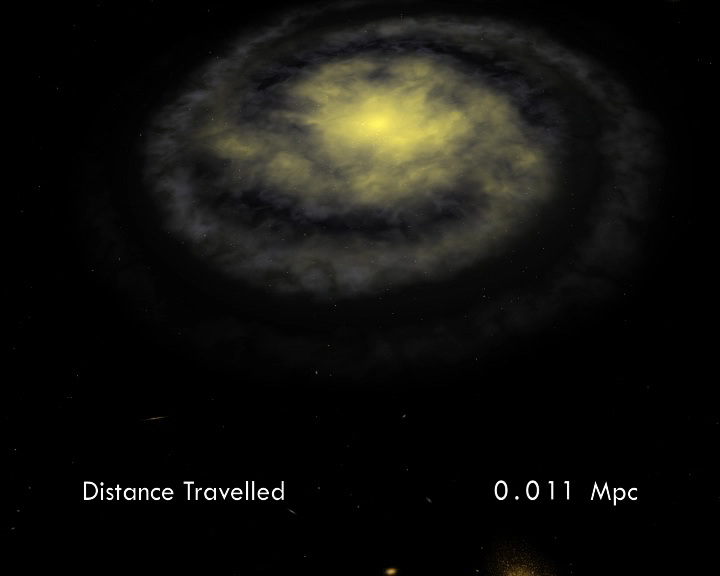
23:15: We are about to pass the nearest large galaxy to our own, in fact, the largest galaxy in the Local Group. It is called the Andromeda Galaxy and is actually the furthest object that the human eye can see, at a distance of about 2.5 million light years. You need a really dark and clear sky, and good eyesight, but it is quite easy to see if you know where to look. You will see that the Andromeda Galaxy also has a number of small companion galaxies. We can now see the entire Local Group of galaxies, our backyard in terms of extragalactic space.
23:50: Wherever we look in the sky we see galaxies – billions of them. But for all their beauty and diversity, they are made mostly of empty space. The distances between the stars in a galaxy are huge compared to the size of the stars. This means that two galaxies in a head-on collision would essentially pass right through each other without a single star having collided with another. However, this doesn’t mean they get away unscathed. The gravitational interaction of the galaxies can easily disrupt the stars within, so that the entire galaxy undergoes a dramatic shift in its structure. It can also make galaxies undergo periods of accelerated star formation. Such galaxies are known as ‘Starburst Galaxies’. Interacting galaxies are surprisingly common in the Universe. In some cases entire galaxies end up merging together.
24:15: Here we can see some simulations of how galaxies interact, comparing them to actual images of such galaxies. These galaxy collisions take place over many millions or even billions of years. Incidentally, our Milky Way Galaxy is actually devouring its closest companion, a small galaxy called the Sagittarius Dwarf Elliptical Galaxy. There is also good evidence that the Milky Way is cannibalizing its two largest galactic neighbours, the Small and Large Magellanic Clouds. Astronomers have detected streams of hydrogen gas being sucked towards us by the pull of the Milky Way.
25:00: We are now beginning to leave the Local Group of galaxies behind us. We can just about see the Andromeda Galaxy and our own Milky Way Galaxy off in the distance. Astronomers have found that the galaxies in the Universe are not distributed randomly through space - they clump together in clusters. Our Local Group of galaxies is a small part of a huge grouping known as the Virgo Supercluster.
25:40: We are now passing through the densest part of the Virgo Supercluster, known as the Virgo North Cluster. This is a dense grouping of several thousand galaxies at a distance of about 59 million light years. It is centered on a huge elliptical galaxy called M87. From Earth, the entire cluster subtends an angle of about 8 degrees on the sky – that’s about 16 times the size of the full moon! This huge grouping of galaxies dominates this part of the Universe and the Local Group is just an outlying, minor part of the larger structure. What better evidence is there that we occupy an insignificant position in the Universe?
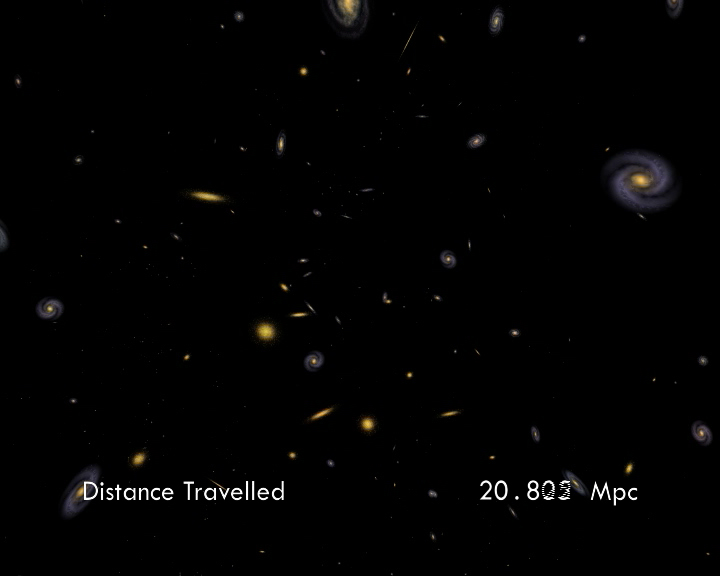
26:10: Now, there is an interesting kind of object in space which isn’t really an object at all – it’s an optical illusion. These objects were first predicted by Albert Einstein when he realized that matter actually warps the space around it. Einstein postulated that a very massive object would warp space so much that light from more distant objects would be bent around it, effectively acting like an enormous lens. They are called ‘gravitational lenses’. In these objects the light from incredibly remote galaxies is bent to make multiple images of the same distant object.
26:40: We can now see the Virgo North cluster receding into the distance. We’re now running into a bit of a problem with our simulation of the Universe. The problem is that the galaxies are not very bright. This is actually what we’d see out there in intergalactic space – almost nothing – because all the distant galaxies are so faint. So, for us to get an idea of the large-scale structure of the Universe, we need to change from a simulation to a visualization. We are now going to turn up the brightness of all the galaxies in the Universe so you can see pretty much all of them. We’re also going to make them just simple dots so things don’t look too complicated. We’re looking at the same thing as we change over, but we can suddenly see a whole lot more than was visible before.
27:00: We can also see that there is some kind of structure to the distribution of galaxies in the Universe. The galaxies form clusters and superclusters; and between them lie almost empty ‘voids’. Looking even closer, astronomers have found that the structure of the Universe is more like a mesh of bubbles, the voids, connected with these huge sheets or filaments of galaxies. The Universe in fact looks like the inside of an Aero chocolate bar.
27:50: We are now starting to accelerate again in our outward motion. As we do so, we can see more and more galaxies, clusters, superclusters, voids and filaments coming into view.
The data you are looking at is real astronomical data. Astronomers have catalogued the positions and the distances to many millions of galaxies. This visualization uses that data to give you a 3-dimensional view of the distribution of the galaxies throughout space. The view we have here is using the data from just a single catalogue of galaxies, but as we shall see, there are many more catalogued galaxies. So, what you see here is still missing a lot of objects, but it still gives you a good idea of the large-scale structure.
28:55: We have now stopped our motion out into the Universe, so we can pause and get a better look at the structures we can see. Our view is next rotated, as if we were orbiting around the Earth. The Virgo Supercluster is still very prominent towards the centre of our view.
29:10: Look out for a particular area as it rotates past us. Here, you will see an area in which there appears to be few, if any, galaxies. The reason is that we must observe the sky from here on Earth and the disk of our own Galaxy obscures our view. So, it is difficult to see any galaxies along the plane of the Milky Way. This is why the Universe appears to be empty in this gap, known as the ‘zone of avoidance’.
So, perhaps you’re thinking that we have moved sufficiently distant from Earth to see most of the Universe, and that we are nearing the end of our journey. Well, in fact, we have an awful lot further to go than this. The volume of space we’re currently looking at is only about one 10 millionth of the total volume of the Universe. The Universe really is a terribly big place!
So, we’re going to start moving out again in a moment. When we do, we’ll be moving at our greatest speed yet. We will also add more and more of the galaxy catalogues, to fill up the empty space through which we’re moving. It isn’t long before our view will be almost completely covered with galaxies. As we move out this gives you an idea of just how many galaxies are out there. Astronomers estimate that there may be 500 billion galaxies in the Universe. Obviously, there are not 500 billion galaxies in our visualization. In fact, there are only about 2 million galaxies shown here.
30:15: You will notice as we move out that the galaxies are often concentrated in sheets or cones. The reason for this is simply the method used to find them. The sky is actually very big and the galaxies themselves are very small on the sky. So, to survey them takes a long time. Most studies choose a small patch or strip of sky to concentrate on. So, when we include these catalogues, you are seeing just a small sample of the galaxies in the sky and it is obvious where the astronomers have been pointing their telescopes. You need to imagine of course, that the entire Universe is filled with galaxies, rather than just the bit we’ve had time to survey with our instruments.
30:22: A black hole is an object so dense that its escape velocity is greater than the speed of light. Nothing can ever escape from black holes, though we know they are there because of their effect on their environment. Astronomers believe that at the centre of most galaxies, maybe even all galaxies, there are supermassive black holes, millions of times the mass of the Sun. These objects are devouring huge quantities of material. The energy created by this galactic cannibalism generates beams or jets of energy that race out of the galactic centre at incredible speeds. If one of these is pointed towards Earth, we see a very bright, very distant point of light of incredible energy. We call these objects ‘quasars’. They are the brightest, most energetic and most distant objects in the Universe.
31:15: Now, astronomers have discovered that the Universe is in fact expanding. This means that the distant galaxies are actually receding from us. The further away they are, the faster they recede. But perhaps the astute amongst you will realise that this leads to a problem in our visualisation. Because it takes time for the light from distant objects to reach us here on Earth, we are in fact looking backwards in time as we look out into the Cosmos. In fact, we see the most distant objects in the Universe as they were even before the Earth and Sun came into existence. If we are seeing them in the distant past, and the Universe is expanding, then right now they are no longer where they were when the light we see was emitted. So, in a sense, we have had to travel backwards in time on our journey in order for it to be correct.
Let’s briefly mention a couple of the current mysteries of the Universe. Astronomers have found that perhaps 99% of the matter in the Universe is invisible. We call this ‘dark matter’, and although we can’t see it, we know it must exist because otherwise galaxies and clusters, or in fact the whole structure of the Universe, would not be able to hold themselves together. Some of the dark matter may be contained in just very dim and therefore invisible objects, but most of it must be some weird form of matter that has not yet been detected. Even weirder is something called ‘dark energy’ which has to be the most abundant stuff in the Universe and yet we have almost no idea what it is. Again, we know it exists because it is actually making the expansion of the Universe speed up, counteracting the force of gravity which would naturally make the expansion slow down. Finding out what ‘dark matter’ and ‘dark energy’ actually are, are high on the astronomer’s to-do list.
32:45: We have now added the final object on our journey outward into the Cosmos. This coloured wall surrounding the galaxies is known as the Cosmic Microwave Background. This is an incredibly faint glow which is the left over radiation from the formation of the Universe. This relic radiation appears to be at a distance of about 46 billion light years and represents the edge of the visible Universe.
In order to see the whole Cosmos of course, we have had to step outside it - we have actually overshot the wall of the Cosmic Microwave Background and moved outside the visible Universe.
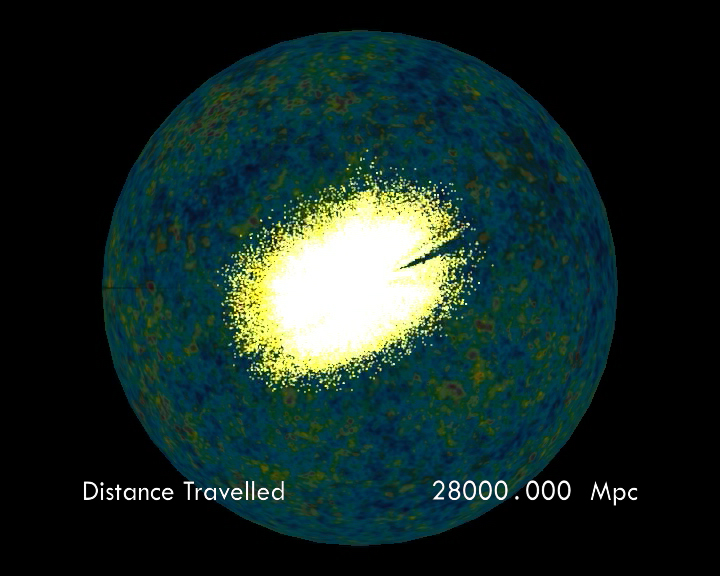
33:10: We are now rotating the entire Universe so we can see its overall structure. Obviously, the galaxies we see do not actually stop about two-thirds of the way out. It’s just that we astronomers are waiting to build even bigger telescopes which will reveal what lies in those uncharted, distant regions.
33:45: The expansion of the Universe that we mentioned implies that the Universe began in a titanic explosion called the Big Bang, about 13.7 billion years ago. The Big Bang represents the moment that the Universe came into being and at that moment all of the matter and energy of the Universe was concentrated into a single point.
Just after the Big Bang, before the formation of stars and galaxies, the distribution of matter was fairly smooth. After time, gravity started exerting its influence and slowly small clumps of matter began forming. Where the density of the clumps became higher, even more matter was attracted and a competition between gravity and the expansion of space took place. Where gravity won regions stopped expanding and started to collapse in on themselves. The first stars and galaxies were born. Where the matter density was highest, at the intersections between the large web-like structures of matter, the largest structures we know were formed – clusters of galaxies. Finding out exactly how these structures we see in the Universe first formed and evolved is another important subject in modern astronomy.
35:00: We have now completed our journey to the furthest depths of space, to the edge of the visible Universe, in fact, beyond it. It only remains for us to return to planet Earth.
35:25: We are now reversing our motion back towards the Earth. Again, we will move at incredible, in fact impossible, speeds. As we begin the journey back our speed will in fact be 24 million billion times the speed of light. We will turn off the galaxy catalogues as we proceed and eventually change back from visualization to simulation. We will decelerate significantly as we head in towards our local bit of the Universe, plunge into the Milky Way Galaxy to find our own star, the Sun, and home planet, Earth. Enjoy the ride home!
May 15, 2015
Does Today's Music All Sound The Same?
 What's wrong Simon? Is this music too interesting?Recently, whilst out shopping, my young son asked "why is all the music in these shops exactly the same?" He had a point. Every neon-illuminated consumer-hovel of fashion we visited was pumping out the same insidious four-to-the-floor musical effluent. There was no variation in rhythm, tempo, timbre or anything else. Absolute tedium.
You've heard it said over and over again: "all today's music sounds the same!" It's something that your parents probably say about the music you listen to. Or you say about the music other people listen to. It was probably also something your grandparents said about the music your parents were into. But who is right? Are any of them right? Does today's music really all sound the same? Or is it just generational crankiness?
If you're on the ball, you'll already know that the music industry doesn't have your best interests at heart when deciding which music to allow you to listen to. Unfortunately, they are cynically aware that the emotional centers of the human brain respond better to familiarity, even when unfamiliarity better suits your personal tastes. So, they analyze what sells and what doesn't, predict which tracks will make them and their shareholders a tidy sum of cash, and spoon-feed the public accordingly. Then they 'incentivize' (i.e. pay) people to make sure the media drums the track into your head, time and time again, until it becomes 'popular'. But a track isn't played everywhere because it's popular; it's popular because it's played everywhere. It's a well-studied psychological process called the mere exposure effect. It's a form of brainwashing.
So, it's clear that the music industry has a vested interest in breeding familiarity. As competition increases and revenues fall due to a shift towards streaming and away from digital download, the business model becomes less and less speculative. This is why the (non-independent, i.e. major label) music industry no longer supports artistry, experimentation and minor genre music. It's not about the creativity, it's only about the money.
Having established a motive, can we also establish any evidence? Does today's music actually all sound the same? Or, are we just out-of-touch crusties? Well, a person's reaction to music is a personal thing, even if they are preconditioned by the music industry itself. Their judgment depends on their environment, their upbringing, the music they were exposed to throughout their lives, even their socio-economic and political background. We can't generalize it with a set of parameters which 'define' how music sounds to the human ear. It's just not that simple.
But we can analyze popular music itself and see, on average, what the major characteristics are. We can limit ourselves to those characteristics which are universal to all popular music; tempo, time signature, key signature, length and (for recorded music) loudness. We can then ask whether these change with time? Is there a period where music was simpler? Faster? Louder? It might only give us a subjective answer, but it might be interesting.
The Billboard experiment was just such an analysis of the basic characteristics of all songs that have been ranked on the Billboard Hot 100 at some point in time since the 1940s. It reveals some interesting facts about popular music. The average popular music track (during the current decade) is 4:26 long, in the key of C Major, with a time signature of 4/4 and has 122.33 beats per minute. If you're a musician you'll probably agree that these characteristics couldn't be any more standard. That's the first nail in the coffin of creativity, right there!
The Billboard results also reveal that the length of popular music tracks has been increasing steadily since the 1940s and their loudness has increased decade on decade too. This last point isn't a surprise, but it's also another worrying aspect of the music industry destroying creativity and fidelity known as the loudness war. The results also show that the average song tempo has hovered around 120 beats per minute for the last six decades. There is some evidence that this tempo is the one which the human brain finds most natural or is the human's 'spontaneous tempo of locomotion'. Jog up and down and you'll be doing it at 120 beats per minute! Finally, the Billboard results show that artist familiarity is now more important than ever before in making a track successful and that this factor jumped significantly at the start of the new millennium. Again, this is no surprise. As digital download and then streaming took off around this time the music industry underwent a paradigm shift too. Genre music declined and investment in the 'safe-bet' ensued. Now that the music industry is more about the 'industry' than the 'music', it makes sense that resources are pumped into established products.
The Billboard analysis of course doesn't take into account the other things which make music distinctive; and those things are probably more important for a definition of whether two tracks are similar. Here we are talking about (among other things) song structure, arrangement, instrumentation, rhythm, timbre and production. We can't quantify these nor easily come up with a process to judge 'sameness' based on them. But a recent study did manage to partly quantify the 'variety', 'uniformity' and 'complexity' of half-a-million popular music albums and compared these to popularity measured by sales.
The study concluded that all musical genres become more homogeneous with time. As genres become more popular, they become less complex. The reverse is also true. Musical genres which have increased in complexity over time such as alternative rock, experimental and hip-hop music have seen a corresponding fall in popularity. Musical genres which have retained a level of complexity over time, such as 'folk', are the least popular. But the overriding conclusion is that music of any genre starts to become generic and similar sounding given enough time. So, everything eventually condenses to the least common denominator. The simplest beat, the obvious tempo, the easiest key signature, the standard time signature. Uniformity and dullness, in other words. That's why those cathedrals of consumerism were all pumping out the same monotonous garbage.
So, does today's music all sound the same? It's a bit more complicated than this, but in a word, yes. At least for the most 'popular' genres.
Of course, there's two ways of interpreting this fact. First, we can suggest that humans are more comfortable with familiarity and uniformity and this naturally makes generic music more popular and successful. Or we can suggest that the manipulative music industry itself, once it recognizes the financial potential of a style or genre, regurgitates it, promotes it and capitalizes on it, thus forcing it into predictability and mediocrity. I know which argument I'd favor.
For those of us who enjoy listening to music, and even making it, the greatest dividend lies in the unexpected, the original and innovative. Although it will always remain a fringe, it's worth cannot be measured in dollars or downloads.
April 10, 2015
Furthest, Largest, Brightest...
We all love superlatives. In fact, 90% of the internet seems to be articles about the best, the biggest, the fastest and so on. So, not to be outdone, in this post I will be looking at some of the Universe’s superlatives. What’s the furthest, largest, brightest, hottest, coldest, fastest and loudest thing in the Universe?
What’s the furthest thing in the Universe?
 The CMB
It is uncertain whether the Universe is finite or infinite in volume. Some very distant parts of the Universe may simply be too far away for light to have traveled to us on Earth since the Universe came into existence. This fact defines what astronomers call the ‘observable Universe’, that is, the parts of the Universe we can actually see. We can never discover anything about the Universe beyond this limit. There is no reason to suspect this limit is an actual ‘boundary’ to the Universe or that what lies beyond this has a ‘boundary’ at all. However, the edge of the ‘observable’ Universe lies about 46 billion light-years away in every direction. It is thus a sphere with a diameter of about 92 billion light-years and a volume of about 410 nonillion (410 thousand billion billion billion) cubic light-years!
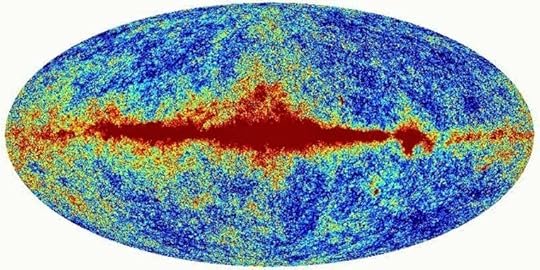
However, the furthest ‘thing’ that the astronomer can actually detect in the Universe is the ‘Cosmic Microwave Background’ (or ‘CMB’), the background radiation left over from the Big Bang. The CMB is a snapshot of the oldest light in the Universe, imprinted on the sky when the Universe was just 380,000 years old as it first became transparent to light. The CMB, which is observed in the microwave region of the spectrum, shows tiny temperature fluctuations that correspond to regions of slightly different densities, representing the seeds of all future structure: the stars and galaxies of today.
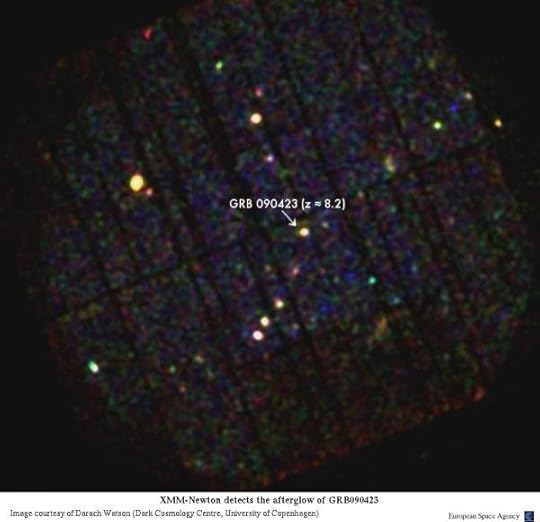 GRB 090423
The furthest (and hence oldest) actual object known to man is a gamma-ray burst called GRB 090423. Gamma-ray bursts (GRBs) are extremely energetic flashes of radiation apparently caused by the collapse of massive stars to form neutron stars or black holes. They are the most energetic events in the Universe but are extremely rare. GRB 090423 was detected in April 2009 by NASA’s Swift satellite. With a redshift of 8.2, GRB 090423 emitted its light when the Universe was only 630 million years old and shows that even in the very early days of the Cosmos, massive stars were being born and then dying in catastrophic fashion.
Currently, the most distant galaxy known to astronomers is called z8_GND_5296. It was discovered in 2013 using a combination of data from the Hubble Space Telescope and the W. M. Keck Observatory in Hawaii. With the highest redshift yet discovered (7.51), astronomers estimate its distance at 13.1 billion light years. This means we are seeing z8_GND_5296 as it was only 700 million years after the Big Bang. Since the Universe has expanded significantly in that time, z8_GND_5296 will now lie 30 billion light years from Earth. Not only is z8_GND_5296 a record holder, it is also an oddity. While normal galaxies like our own Milky Way may produce a couple of new stars each year, z8_GND_5296 has a star-formation rate 150 times greater. The observations of z8_GND_5296 have suggested that even more distant galaxies may be hidden in the fog of neutral hydrogen gas prevalent in the early Universe.
There are other objects that may be further away than GRB 090423 and z8_GND_5296. In fact, there is a list of more than 50 objects that may have higher redshifts. Unfortunately, due to difficulties in accurately measuring these dim objects, none of these have yet been confirmed.
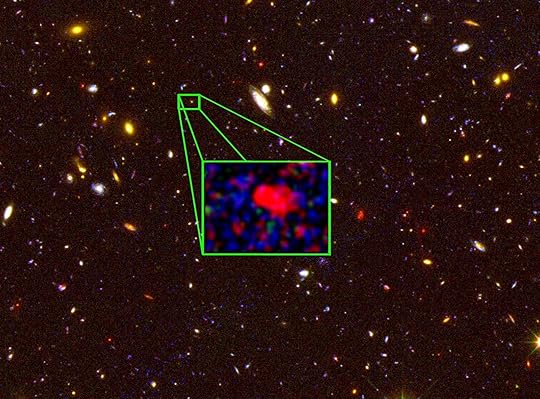 z8_GND_5296
What’s the largest thing in the Universe?
The largest known structure within the Universe is called the ‘Hercules-Corona Borealis Great Wall’, discovered in November 2013. This object is a galactic filament, a vast group of galaxies bound together by gravity, about 10 billion light-years away. This cluster of galaxies appears to be about 10 billion light-years across; more than double the previous record holder! In fact, this object is so big it’s a bit of an inconvenience for astronomers. Modern cosmology hinges on the principle that matter should appear to be distributed uniformly if viewed at a large enough scale. Astronomers can’t agree on exactly what that scale is but it is certainly much less than the size of the Hercules-Corona Borealis Great Wall. Its huge distance also implies this object was in existence only 4 billion years after the Big Bang. How such an immense object came into existence, and so quickly, challenges our current cosmological theories.
Astronomers cannot be absolutely sure which of the known stars are the biggest or most massive. The largest known star by radius is generally accepted as UY Scuti, a red hypergiant star about 9,500 light years from Earth. Its radius is probably 1,708 times the Sun’s (over a billion kilometres). The most massive star (rather than the largest) is probably RMC 136a1, a Wolf-Rayet star about 165,000 light years from Earth. It is believed the mass of RMC 136a1 is about 256 times the Sun’s mass.
What’s the brightest thing in the Universe?
The current record for the most energetic object yet discovered is another GRB. GRB 130427A, which, as its name indicates, occurred on 27 April 2013, was detected by many telescopes, on Earth and in space, and appears to have occurred in a small galaxy in the constellation of Leo, about 3.8 billion light years away. This is relatively nearby for a GRB which explains why it was so bright. In fact, GRB 130427A was more than five times brighter than the previous record holder. It was the biggest explosion astronomers know about, after the Big Bang itself. If it had occurred nearby, in our own arm of the Milky Way, it would have destroyed all life on Earth!
GRBs are rare and transitory events. The brightest steadily-emitting objects in the universe are quasars. These objects are the cores of distant galaxies in which a massive black hole feeds on a copious supply of stars and gas. As this doomed material spirals inwards it becomes white hot, and can shine with the light of more than thirty trillion Suns. The brightest known quasar, and also the most distant, is called ULAS J1120+0641. This quasar is powered by a black hole about two billion times more massive than our own Sun and was formed when the universe was just 770 million years old.
Some stars can burn brighter than quasars during the cataclysmic explosions that tear them apart known as ‘supernovae’. The brightest recorded supernova, equivalent to about 100 billion Suns, was called SN 2005ap, detected in a galaxy 4.7 billion light years away (called SDSS J130114+2743) in 2005. Since the brightness (or in fact ‘luminosity’) of a normal star generally increases with its mass, it is no surprise to find that RMC 136a1 is not only the most massive star known to man, but the brightest too.
What’s the hottest thing in the Universe?
Surprisingly, the hottest place in the Universe occurs right here on Earth. These humongous temperatures occur when sub-atomic particles are smashed together in the Large Hadron Collider. These temperatures, of the order of several trillion degrees are, however, insignificant compared to the temperature of the entire Universe just moments after the Big Bang. There, you can add as many zeros as you like to the temperature, only limited by the complete breakdown of physics during the first moments of creation.
Since GRBs are some of the brightest known events it isn’t surprising to find that they are also amongst the hottest. Temperatures generated in the cataclysmic interactions that create the fireball of relativistic particles in GRBs are likely to be in the region of a trillion degrees.
Other objects also produce very high temperatures. Neutrinos detected from a supernova that exploded in 1987 in the Large Magellanic Cloud (a nearby galactic neighbour to the Milky Way) showed that its core region reached a temperature of about 200 billion degrees. Normal stars can have surface temperatures up to about 50,000 degrees (blue supergiants). White dwarfs (the compact remnants of stars that have burnt out and contracted) have even higher surface temperatures. One white dwarf, called HD62166, measures a scorching 200,000 degrees and lights up a vast nebula with its painfully bright atmosphere. The interiors of stars are much hotter. The largest supergiant stars can have central temperatures up to about 6 billion degrees.
What’s the coldest thing in the Universe?
Physicists have determined that there is a lower limit to the temperature scale called ‘absolute zero’. It occurs at -273.15°C. No matter how much you cool something, it can never achieve absolute zero (though you can get pretty close). Strictly speaking, the coldest place in the Universe is also to be found on Earth. In a laboratory in Finland in 2000 a temperature only 100 trillionths of a degree above absolute zero was artificially created. However, the coldest naturally-occurring temperature in the Universe was discovered inside the Boomerang Nebula in 1995. This cloud of gas and dust, in the constellation of Centaurus, was thrown off by a star nearing the end of its life. Its temperature, a result of the slow expansion of the gas cloud, is only 1°C above absolute zero. Even the Big Bang’s relic radiation, the CMB, is warmer than the Boomerang Nebula at -270.42°C.
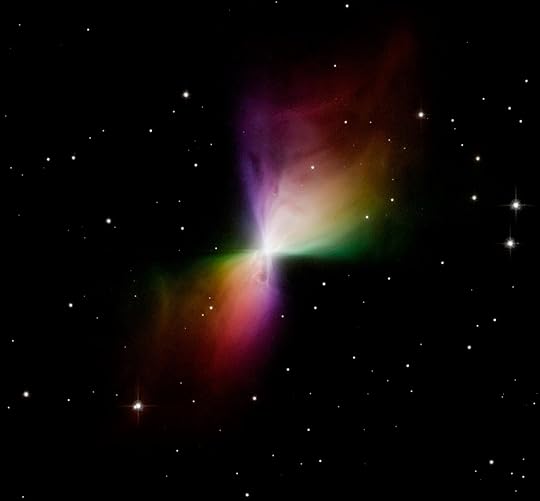 The Boomerang Nebula
The coldest free-floating objects known to astronomers are ‘brown dwarfs’. But these are really ‘failed’ stars – they cannot be classed as planets but do not undergo hydrogen fusion which provides normal stars with their energy source. The latest research has shown that the coldest brown dwarfs have surface temperatures of between 125°C and 175°C. The boundary between these brown dwarfs and the coolest hydrogen burning stars (‘red dwarfs’) occurs at a mass of about 0.07 solar masses. Objects heavier than this are likely to be stars, those below will likely be brown dwarfs. However, this boundary is not well defined since other factors, such as the amount of heavy elements in the object, also determine whether or not hydrogen burning occurs. So, although red dwarfs are the coldest ‘real’ stars, with temperatures as low as 1800°C, brown dwarfs are the coldest ‘star-like’ bodies.
Space itself, being nothing, doesn’t have a temperature! However, astronomers often refer to the ‘temperature’ of a region of space to indicate the kinetic energy of matter in that region. Clouds of molecular hydrogen gas are generally cold at about -263°C, whilst some regions between galaxy clusters can reach temperatures of 10 million degrees. Generally, there isn’t enough matter in space to transfer this heat (or coldness) to other objects. So if you place an object in space the temperature it attains depends on how much radiation it receives and how good it is at absorbing and emitting that radiation. Put it near a star and it will generally heat up, for example. Its temperature, however, is just a measure of the heat balance between the object and its surroundings, and is not the temperature of ‘space’ itself.
What’s the fastest thing in the Universe?
Of course, the Universe has a self-imposed top speed limit - the speed of light at 299,792.458 km/s. Nothing moves faster than this. In fact, it’s not just light that travels at light speed. All mass-less particles do, as do the force fields such as the weak and strong nuclear forces and the gravitational force. So do ‘gravitational waves’, the ripples in the fabric of ‘space-time’ created by moving mass.
But let’s restrict ourselves to ordinary matter traveling at high speed. The record is held by ‘cosmic rays’. These aren’t ‘rays’ at all – they’re subatomic particles created in the most powerful events in the Universe such as galaxy mergers and ‘hypernovae’. The fastest cosmic ray yet detected was traveling so close to the speed of light that it had the same amount of energy as a medium-paced cricket ball, even though it was a fraction of the size of a single atom! It had a thousand billion billion times the energy of protons that the Large Hadron Collider can produce at maximum energy!
For large chunks of matter (as opposed to subatomic particles) the speed record is held by the ‘jets’ seen in ‘blazars’. Cannibalistic black holes at the heart of these active galaxies release huge amounts of energy which is funnelled into jets by a dense, highly-magnetic accretion disk. The jets in some blazars have been observed to move at about 99.9% the speed of light! These blobs of material are at least the size of the solar system!
What about the things we can see without the aid of a telescope, like stars? Well, to date, the fastest known star is an interesting Helium star called US 708. This star is one of a class of objects called hyper-velocity stars (or HSVs) which are characterised by being unbound to the Milky Way’s gravitational field, i.e. they move fast enough to one day leave our galaxy. Most HSVs are thought to be formed by the close encounters of stars with the Milky Way’s central black hole which sling shots them out of the galaxy. However, the trajectory of US 708 shows that this cannot be the case for this star. It is thought US 708 was formed in a binary star system as a companion white dwarf stripped material from US 708 as it became a red giant. The white dwarf then exploded as a supernova and ejected its companion at huge speed.
Stars also spin of course. At present, the fastest spinning star known to astronomers is called VFTS 102. This is a hot blue star, 25 times the mass of the Sun, residing within the Tarantula Nebula. At its surface, VFTS 102 is rotating at about 600 km/s (more than 1 million mph!) – so fast that it is almost, but not quite, flinging itself apart. The origins of this fast rotation are not yet clear, but it seems likely VFTS 102 was once part of a binary star system and was ‘spun up’ due to mass transfer from its now dead companion. Although VFTS 102 is the fastest rotating ‘normal’ star, ‘pulsars’ actually spin much quicker. Pulsars are the collapsed cores of stars that became supernovae. The fastest spinning pulsar yet discovered is known as Ter5AD. It rotates 716 times every second! That means the rotation speed at its equator is 70,000 km/s (about 158 million mph!), about 24% of the speed of light!
What’s the loudest thing in the Universe?
Sound is the movement of a pressure wave through matter. Since space is almost (but not quite) a complete vacuum, sound does not propagate easily through space. However, where matter is denser, such as in the atmospheres of planets, within stars, in gas clouds or in the environments surrounding black holes, sound waves are thought to be common. The ‘loudest’ sounds in the Universe are the ones carrying most energy.
Although there were no humans around to hear it, the Big Bang did in fact create sound. We can deduce the scale of these sound waves by observing the tiny temperature variations in the relic radiation from the Big Bang, the CMB. Their wavelength is measured in hundreds of thousands of light years, so the ‘notes’ are actually far too low to be heard by humans. The details are rather complicated but as a rough estimate we can calculate the loudness of these waves to be between 100dB and 120dB. Although this is near the human ear’s pain threshold (similar to standing next to a chainsaw or about 100m from a jet engine), it is by no means the loudest thing you could experience.
It is thought that the eruption of Krakatoa produced sound waves at about 180dB, whilst blue whales ‘talk’ at up to 188dB. It is estimated that the loudest thing on Earth was probably the explosion of the Tunguska Meteor (1908) at about 300dB. But somewhere in the Universe, perhaps where planets or black holes collide, or where supernovae explode, there may be sounds much more powerful than this.
What’s the furthest thing in the Universe?
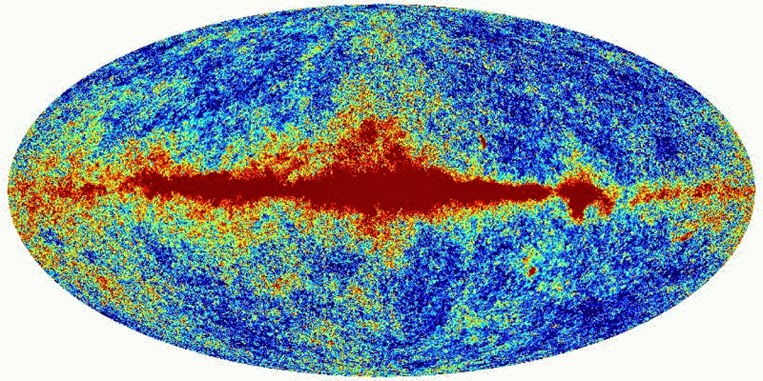 The CMB
It is uncertain whether the Universe is finite or infinite in volume. Some very distant parts of the Universe may simply be too far away for light to have traveled to us on Earth since the Universe came into existence. This fact defines what astronomers call the ‘observable Universe’, that is, the parts of the Universe we can actually see. We can never discover anything about the Universe beyond this limit. There is no reason to suspect this limit is an actual ‘boundary’ to the Universe or that what lies beyond this has a ‘boundary’ at all. However, the edge of the ‘observable’ Universe lies about 46 billion light-years away in every direction. It is thus a sphere with a diameter of about 92 billion light-years and a volume of about 410 nonillion (410 thousand billion billion billion) cubic light-years!
However, the furthest ‘thing’ that the astronomer can actually detect in the Universe is the ‘Cosmic Microwave Background’ (or ‘CMB’), the background radiation left over from the Big Bang. The CMB is a snapshot of the oldest light in the Universe, imprinted on the sky when the Universe was just 380,000 years old as it first became transparent to light. The CMB, which is observed in the microwave region of the spectrum, shows tiny temperature fluctuations that correspond to regions of slightly different densities, representing the seeds of all future structure: the stars and galaxies of today.
 GRB 090423
The furthest (and hence oldest) actual object known to man is a gamma-ray burst called GRB 090423. Gamma-ray bursts (GRBs) are extremely energetic flashes of radiation apparently caused by the collapse of massive stars to form neutron stars or black holes. They are the most energetic events in the Universe but are extremely rare. GRB 090423 was detected in April 2009 by NASA’s Swift satellite. With a redshift of 8.2, GRB 090423 emitted its light when the Universe was only 630 million years old and shows that even in the very early days of the Cosmos, massive stars were being born and then dying in catastrophic fashion.
Currently, the most distant galaxy known to astronomers is called z8_GND_5296. It was discovered in 2013 using a combination of data from the Hubble Space Telescope and the W. M. Keck Observatory in Hawaii. With the highest redshift yet discovered (7.51), astronomers estimate its distance at 13.1 billion light years. This means we are seeing z8_GND_5296 as it was only 700 million years after the Big Bang. Since the Universe has expanded significantly in that time, z8_GND_5296 will now lie 30 billion light years from Earth. Not only is z8_GND_5296 a record holder, it is also an oddity. While normal galaxies like our own Milky Way may produce a couple of new stars each year, z8_GND_5296 has a star-formation rate 150 times greater. The observations of z8_GND_5296 have suggested that even more distant galaxies may be hidden in the fog of neutral hydrogen gas prevalent in the early Universe.
There are other objects that may be further away than GRB 090423 and z8_GND_5296. In fact, there is a list of more than 50 objects that may have higher redshifts. Unfortunately, due to difficulties in accurately measuring these dim objects, none of these have yet been confirmed.
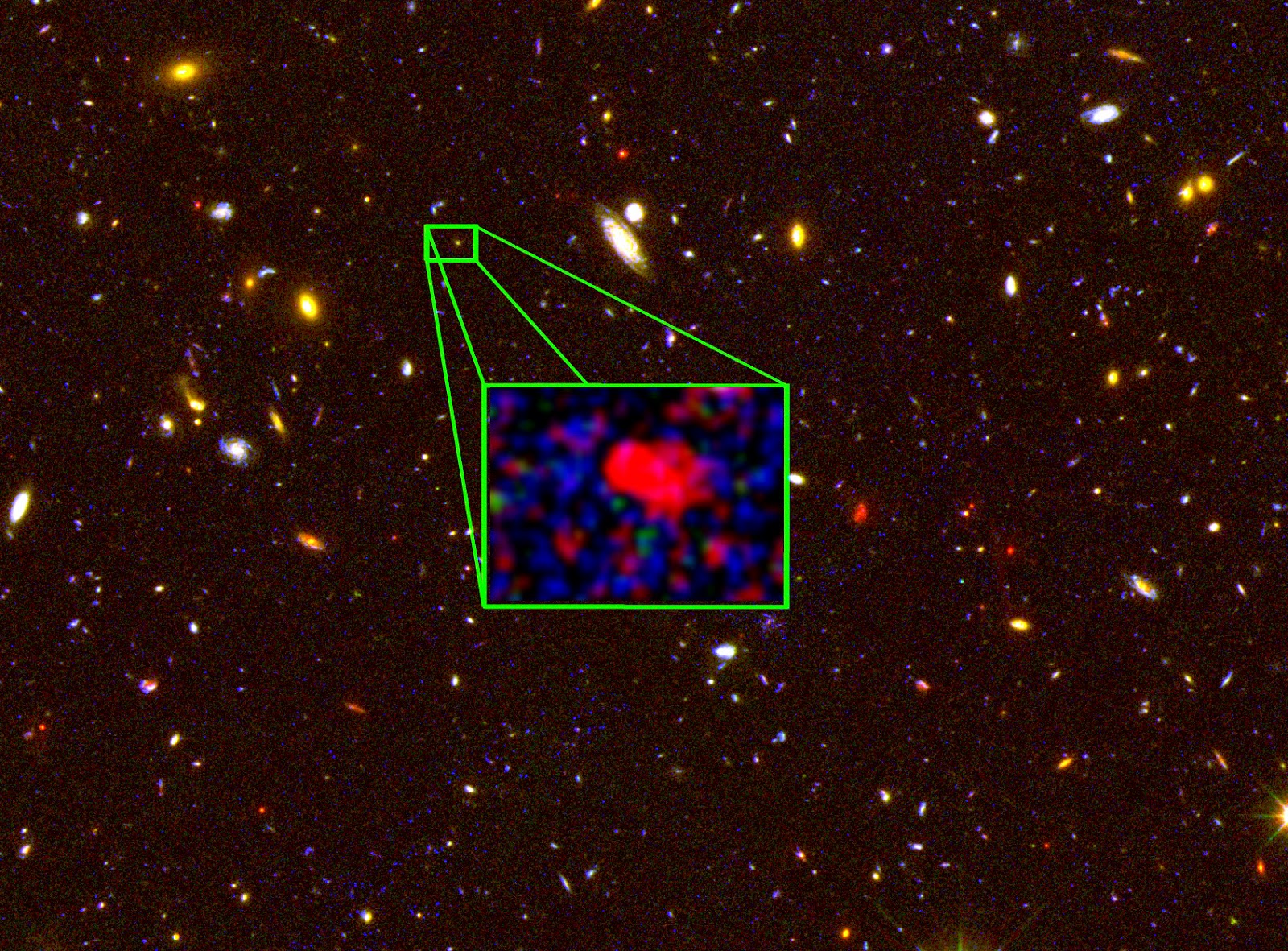 z8_GND_5296
What’s the largest thing in the Universe?
The largest known structure within the Universe is called the ‘Hercules-Corona Borealis Great Wall’, discovered in November 2013. This object is a galactic filament, a vast group of galaxies bound together by gravity, about 10 billion light-years away. This cluster of galaxies appears to be about 10 billion light-years across; more than double the previous record holder! In fact, this object is so big it’s a bit of an inconvenience for astronomers. Modern cosmology hinges on the principle that matter should appear to be distributed uniformly if viewed at a large enough scale. Astronomers can’t agree on exactly what that scale is but it is certainly much less than the size of the Hercules-Corona Borealis Great Wall. Its huge distance also implies this object was in existence only 4 billion years after the Big Bang. How such an immense object came into existence, and so quickly, challenges our current cosmological theories.
Astronomers cannot be absolutely sure which of the known stars are the biggest or most massive. The largest known star by radius is generally accepted as UY Scuti, a red hypergiant star about 9,500 light years from Earth. Its radius is probably 1,708 times the Sun’s (over a billion kilometres). The most massive star (rather than the largest) is probably RMC 136a1, a Wolf-Rayet star about 165,000 light years from Earth. It is believed the mass of RMC 136a1 is about 256 times the Sun’s mass.
What’s the brightest thing in the Universe?
The current record for the most energetic object yet discovered is another GRB. GRB 130427A, which, as its name indicates, occurred on 27 April 2013, was detected by many telescopes, on Earth and in space, and appears to have occurred in a small galaxy in the constellation of Leo, about 3.8 billion light years away. This is relatively nearby for a GRB which explains why it was so bright. In fact, GRB 130427A was more than five times brighter than the previous record holder. It was the biggest explosion astronomers know about, after the Big Bang itself. If it had occurred nearby, in our own arm of the Milky Way, it would have destroyed all life on Earth!
GRBs are rare and transitory events. The brightest steadily-emitting objects in the universe are quasars. These objects are the cores of distant galaxies in which a massive black hole feeds on a copious supply of stars and gas. As this doomed material spirals inwards it becomes white hot, and can shine with the light of more than thirty trillion Suns. The brightest known quasar, and also the most distant, is called ULAS J1120+0641. This quasar is powered by a black hole about two billion times more massive than our own Sun and was formed when the universe was just 770 million years old.
Some stars can burn brighter than quasars during the cataclysmic explosions that tear them apart known as ‘supernovae’. The brightest recorded supernova, equivalent to about 100 billion Suns, was called SN 2005ap, detected in a galaxy 4.7 billion light years away (called SDSS J130114+2743) in 2005. Since the brightness (or in fact ‘luminosity’) of a normal star generally increases with its mass, it is no surprise to find that RMC 136a1 is not only the most massive star known to man, but the brightest too.
What’s the hottest thing in the Universe?
Surprisingly, the hottest place in the Universe occurs right here on Earth. These humongous temperatures occur when sub-atomic particles are smashed together in the Large Hadron Collider. These temperatures, of the order of several trillion degrees are, however, insignificant compared to the temperature of the entire Universe just moments after the Big Bang. There, you can add as many zeros as you like to the temperature, only limited by the complete breakdown of physics during the first moments of creation.
Since GRBs are some of the brightest known events it isn’t surprising to find that they are also amongst the hottest. Temperatures generated in the cataclysmic interactions that create the fireball of relativistic particles in GRBs are likely to be in the region of a trillion degrees.
Other objects also produce very high temperatures. Neutrinos detected from a supernova that exploded in 1987 in the Large Magellanic Cloud (a nearby galactic neighbour to the Milky Way) showed that its core region reached a temperature of about 200 billion degrees. Normal stars can have surface temperatures up to about 50,000 degrees (blue supergiants). White dwarfs (the compact remnants of stars that have burnt out and contracted) have even higher surface temperatures. One white dwarf, called HD62166, measures a scorching 200,000 degrees and lights up a vast nebula with its painfully bright atmosphere. The interiors of stars are much hotter. The largest supergiant stars can have central temperatures up to about 6 billion degrees.
What’s the coldest thing in the Universe?
Physicists have determined that there is a lower limit to the temperature scale called ‘absolute zero’. It occurs at -273.15°C. No matter how much you cool something, it can never achieve absolute zero (though you can get pretty close). Strictly speaking, the coldest place in the Universe is also to be found on Earth. In a laboratory in Finland in 2000 a temperature only 100 trillionths of a degree above absolute zero was artificially created. However, the coldest naturally-occurring temperature in the Universe was discovered inside the Boomerang Nebula in 1995. This cloud of gas and dust, in the constellation of Centaurus, was thrown off by a star nearing the end of its life. Its temperature, a result of the slow expansion of the gas cloud, is only 1°C above absolute zero. Even the Big Bang’s relic radiation, the CMB, is warmer than the Boomerang Nebula at -270.42°C.
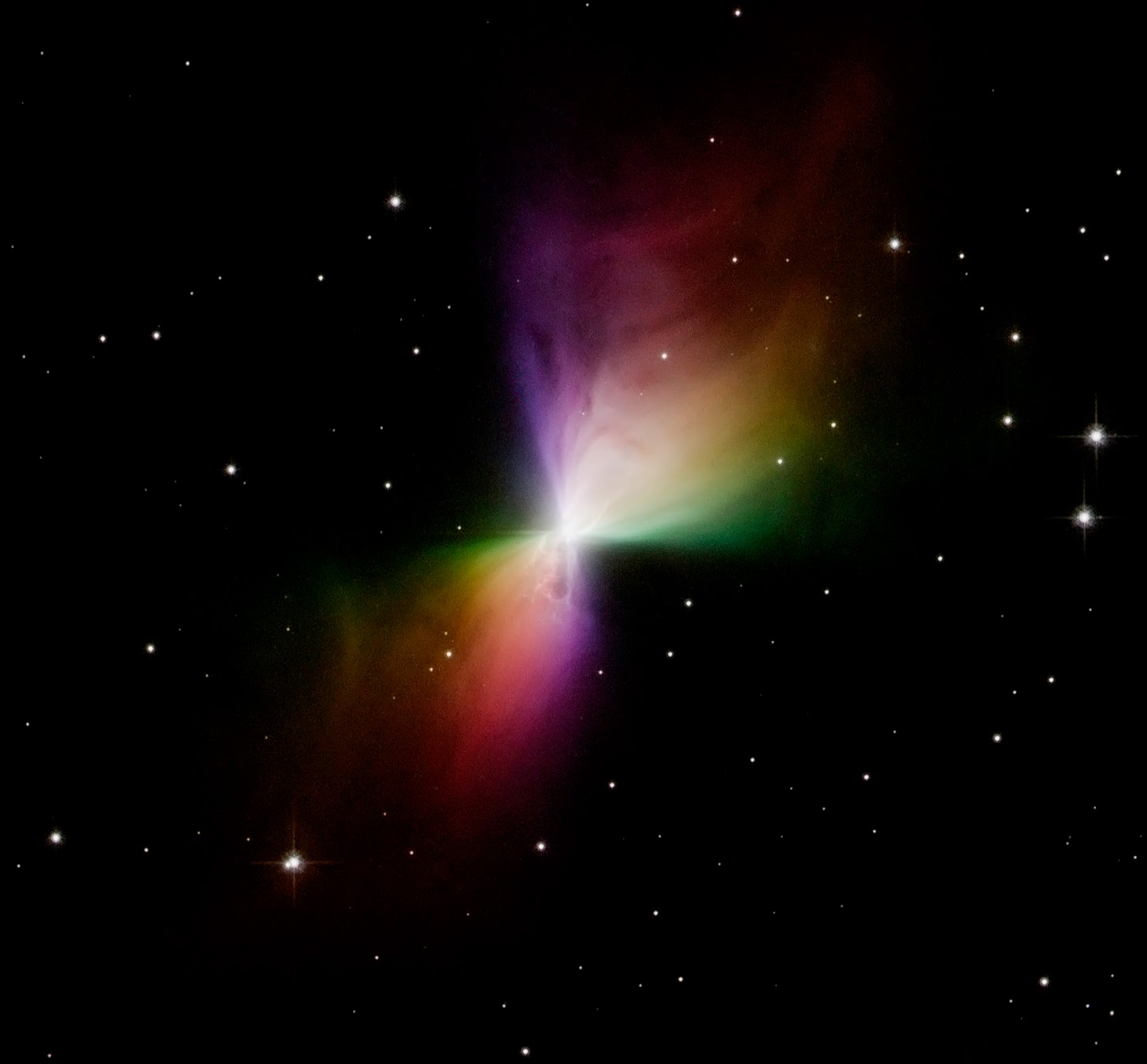 The Boomerang Nebula
The coldest free-floating objects known to astronomers are ‘brown dwarfs’. But these are really ‘failed’ stars – they cannot be classed as planets but do not undergo hydrogen fusion which provides normal stars with their energy source. The latest research has shown that the coldest brown dwarfs have surface temperatures of between 125°C and 175°C. The boundary between these brown dwarfs and the coolest hydrogen burning stars (‘red dwarfs’) occurs at a mass of about 0.07 solar masses. Objects heavier than this are likely to be stars, those below will likely be brown dwarfs. However, this boundary is not well defined since other factors, such as the amount of heavy elements in the object, also determine whether or not hydrogen burning occurs. So, although red dwarfs are the coldest ‘real’ stars, with temperatures as low as 1800°C, brown dwarfs are the coldest ‘star-like’ bodies.
Space itself, being nothing, doesn’t have a temperature! However, astronomers often refer to the ‘temperature’ of a region of space to indicate the kinetic energy of matter in that region. Clouds of molecular hydrogen gas are generally cold at about -263°C, whilst some regions between galaxy clusters can reach temperatures of 10 million degrees. Generally, there isn’t enough matter in space to transfer this heat (or coldness) to other objects. So if you place an object in space the temperature it attains depends on how much radiation it receives and how good it is at absorbing and emitting that radiation. Put it near a star and it will generally heat up, for example. Its temperature, however, is just a measure of the heat balance between the object and its surroundings, and is not the temperature of ‘space’ itself.
What’s the fastest thing in the Universe?
Of course, the Universe has a self-imposed top speed limit - the speed of light at 299,792.458 km/s. Nothing moves faster than this. In fact, it’s not just light that travels at light speed. All mass-less particles do, as do the force fields such as the weak and strong nuclear forces and the gravitational force. So do ‘gravitational waves’, the ripples in the fabric of ‘space-time’ created by moving mass.
But let’s restrict ourselves to ordinary matter traveling at high speed. The record is held by ‘cosmic rays’. These aren’t ‘rays’ at all – they’re subatomic particles created in the most powerful events in the Universe such as galaxy mergers and ‘hypernovae’. The fastest cosmic ray yet detected was traveling so close to the speed of light that it had the same amount of energy as a medium-paced cricket ball, even though it was a fraction of the size of a single atom! It had a thousand billion billion times the energy of protons that the Large Hadron Collider can produce at maximum energy!
For large chunks of matter (as opposed to subatomic particles) the speed record is held by the ‘jets’ seen in ‘blazars’. Cannibalistic black holes at the heart of these active galaxies release huge amounts of energy which is funnelled into jets by a dense, highly-magnetic accretion disk. The jets in some blazars have been observed to move at about 99.9% the speed of light! These blobs of material are at least the size of the solar system!
What about the things we can see without the aid of a telescope, like stars? Well, to date, the fastest known star is an interesting Helium star called US 708. This star is one of a class of objects called hyper-velocity stars (or HSVs) which are characterised by being unbound to the Milky Way’s gravitational field, i.e. they move fast enough to one day leave our galaxy. Most HSVs are thought to be formed by the close encounters of stars with the Milky Way’s central black hole which sling shots them out of the galaxy. However, the trajectory of US 708 shows that this cannot be the case for this star. It is thought US 708 was formed in a binary star system as a companion white dwarf stripped material from US 708 as it became a red giant. The white dwarf then exploded as a supernova and ejected its companion at huge speed.
Stars also spin of course. At present, the fastest spinning star known to astronomers is called VFTS 102. This is a hot blue star, 25 times the mass of the Sun, residing within the Tarantula Nebula. At its surface, VFTS 102 is rotating at about 600 km/s (more than 1 million mph!) – so fast that it is almost, but not quite, flinging itself apart. The origins of this fast rotation are not yet clear, but it seems likely VFTS 102 was once part of a binary star system and was ‘spun up’ due to mass transfer from its now dead companion. Although VFTS 102 is the fastest rotating ‘normal’ star, ‘pulsars’ actually spin much quicker. Pulsars are the collapsed cores of stars that became supernovae. The fastest spinning pulsar yet discovered is known as Ter5AD. It rotates 716 times every second! That means the rotation speed at its equator is 70,000 km/s (about 158 million mph!), about 24% of the speed of light!
What’s the loudest thing in the Universe?
Sound is the movement of a pressure wave through matter. Since space is almost (but not quite) a complete vacuum, sound does not propagate easily through space. However, where matter is denser, such as in the atmospheres of planets, within stars, in gas clouds or in the environments surrounding black holes, sound waves are thought to be common. The ‘loudest’ sounds in the Universe are the ones carrying most energy.
Although there were no humans around to hear it, the Big Bang did in fact create sound. We can deduce the scale of these sound waves by observing the tiny temperature variations in the relic radiation from the Big Bang, the CMB. Their wavelength is measured in hundreds of thousands of light years, so the ‘notes’ are actually far too low to be heard by humans. The details are rather complicated but as a rough estimate we can calculate the loudness of these waves to be between 100dB and 120dB. Although this is near the human ear’s pain threshold (similar to standing next to a chainsaw or about 100m from a jet engine), it is by no means the loudest thing you could experience.
It is thought that the eruption of Krakatoa produced sound waves at about 180dB, whilst blue whales ‘talk’ at up to 188dB. It is estimated that the loudest thing on Earth was probably the explosion of the Tunguska Meteor (1908) at about 300dB. But somewhere in the Universe, perhaps where planets or black holes collide, or where supernovae explode, there may be sounds much more powerful than this.
April 1, 2015
April Fools Day To Be Moved To 2nd April
 Change your calendarsThis year, in the UK, April Fool's Day has been moved to 2nd April. This woefully unpublicised decision is set to catch many of the country's pranksters off guard and, perhaps more worryingly, prolong the suffering of prankstees for a further 24 hours.
 The decision is tied up with proposed changes to the Bank Holiday system in the UK. Bank Holidays were first introduced in the Bank Holidays Act of 1871. Authored by Sir John Lubbock, a banker with a passion for cricket, he designated official holidays throughout the year based on his home county's village match calendar. In England and Wales these were Easter Monday, Whit Monday, and the 1st Monday in August. In Ireland (still under UK rule at the time), St Stephen's Day was added and in England and Wales, Boxing Day. In Scotland the bank holidays were New Year's Day, Good Friday, 1st Monday in May, 1st Monday in August and Christmas Day. In England, Wales and Ireland, Good Friday and Christmas Day were considered traditional holidays and were therefore not included in the official Bank Holiday list.
Although the Act was repealed in 1971, it was replaced with the Banking & Financial Dealings Act, in which the tradition of bank holidays was continued though some changes were made. The date of the August Bank Holiday was changed from the 1st Monday in August to the last Monday in August, and Whit Monday was replaced by the Late Spring Bank Holiday, fixed as the last Monday in May. In January 2007, the St Andrew's Day Bank Holiday (Scotland) Act 2007 was given royal assent, making 30 November (or the nearest Monday if a weekend) a Bank Holiday in Scotland.
There has since been many campaigns to overhaul the Bank Holiday system in the UK, including plans to establish more public holidays in line with other European countries. In a widely unreported move, and a precursor to further reforms, the Tory government last year approved the scrapping of the May Day Bank Holiday. It will be replaced with two Bank Holidays, one on 1st April and, in England, one on 23rd April (St George's Day) and, in Wales, one on 1st March (St David's Day). An amendment to the Banking & Financial Dealings Act was passed through parliament in September 2014, allowing for the official change to be phased in by 2018, although exactly what "phased in" means is unfortunately unspecified.
The choice of 1st April for the additional Bank Holiday has been chosen due to the moving festival of Easter. The date of Easter, decided by the Council of Nicea in 325 AD, is traditionally taken as the first Sunday after the full moon that occurs on or soonest after 21 March each year, although there are complications with this simple definition. The result is that Easter Sunday can vary by almost a month. In the 21st century, for example, the earliest Easter Sunday is on 23rd March (2008) and the latest on 25th April (2038). In order to give a reasonable spread of Bank Holidays throughout the year (with other anticipated additions), the 1st April was chosen to be near to the median date of Easter and to establish an unmovable date during April.
 April Fool's Day has been celebrated for possibly an entire milleniumGovernment ministers were of course aware of the traditional significance of that date in the UK calendar, and indeed in many other parts of the world. Although there is no official regulation of traditional 'days' such as April Fool's Day (the same is true of Valentine's Day for example), UK authorities have further decided to officially "recognise" April Fool's Day. And in a highly controversial move, and in anticipation of the Bank Holiday change which will become official during 2018, the traditional celebration of April Fool's Day on 1st April has now been shifted to 2nd April as of 2015.
This unpopular and frankly ridiculous decision has been deliberately played down by the government and lost amongst the usual pre-election rhetoric with which the media are now replete. But 1st April pranksters all over the UK are being made to look like fools themselves and are unwittingly performing their stunningly inventive and hilarious japes a whole day too early!
February 17, 2015
The Fastest Things In The Universe
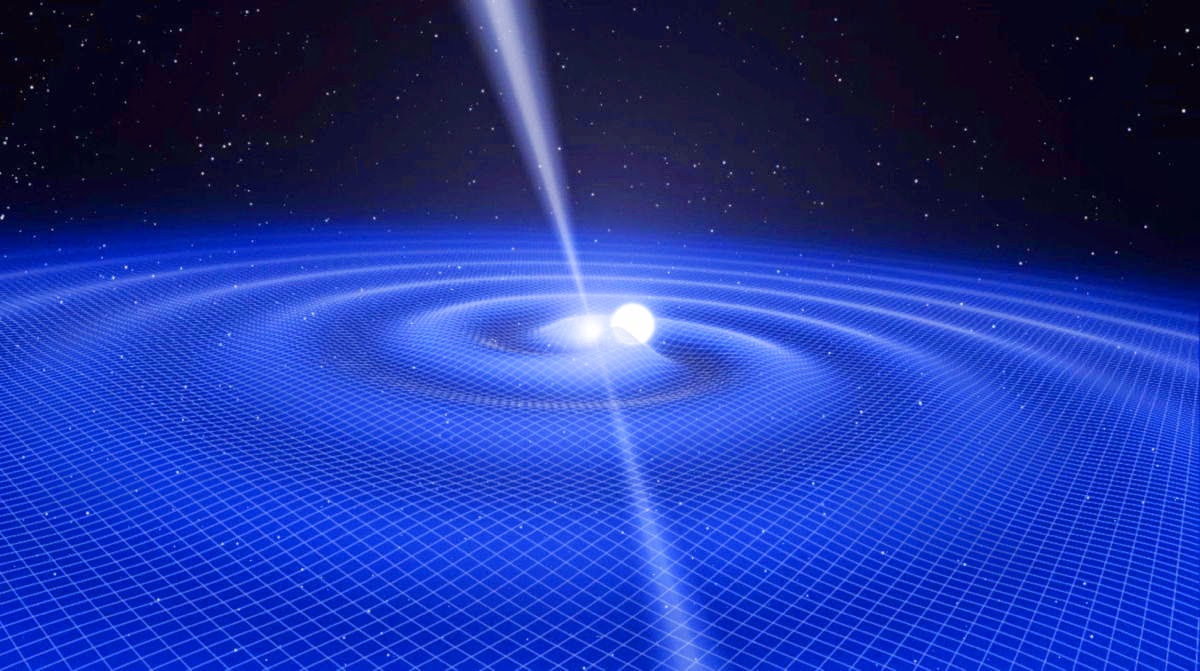 Gravitational waves can't actually be seen as in this simulation.When gazing at the night sky from here on Earth, it’s easy to picture the Universe as calm and unhurried. But in reality, out there in space, things move fast – really fast. Putting aside particle accelerators and the like, the fastest-moving man-made object was the Helios 2 spacecraft launched in the 1970s. It reached a top speed of 68.75 km/s (153,800 mph) on its mission to the Sun. But this was just a leisurely stroll compared to the fastest things in the Cosmos. So, where do we find the real speed freaks of the Universe? Here’s a run-down of the top five.
 1. Expansion of the Universe
Speed: Greater than the speed of light!
The Universe is expanding. But the Universe isn’t filling up ‘empty space’ as it expands because it is ‘space’ itself which is expanding. Although the laws of physics say that two objects can’t move faster than light speed with respect to each other, there is no such restriction on the actual expansion of the space through which they move.
In principle, the furthest we can see in the Universe is called the ‘cosmological horizon’, beyond which light cannot yet have reached us during the lifetime of the Universe. Although we can never see it, the Universe still exists beyond this limit, and those invisible parts of the Universe are receding from us at greater than the speed of light. Unfortunately, because we can never observe those parts of the Universe, we cannot be sure how fast they are receding from us. However, the entire Cosmos may be a trillion trillion times as big as our ‘observable’ Universe, so that its most distant parts could be moving away from us at many millions of times the speed of light!
2. Light
Speed: 299,792.458 km per second
Claiming that the expansion of empty space is the fastest thing in the Universe is cheating a bit. It’s more honest to say that the fastest ‘physical’ thing in the Universe is simply light itself (or in fact the whole electromagnetic spectrum).
Of course, the Universe has a self-imposed top speed limit - the speed of light at 299,792.458 km/s. Nothing moves faster than this. Why? Well, objects that have mass require energy to accelerate them and the laws of physics say that to accelerate a mass up to light speed would require infinite energy. More confusingly, objects traveling faster than light would have to be traveling backwards in time!
3. Gravitational Waves
Speed: 299,792.458 km per second
In fact, it’s not just light that travels at light speed. All mass-less particles do, as do the force fields such as the weak and strong nuclear forces and the gravitational force. So do ‘gravitational waves’, the ripples in the fabric of ‘space-time’ created by moving mass. Although we haven’t yet built instruments powerful enough to detect these gravitational waves, their existence has been proven by looking closely at the orbital decay of a binary pulsar system called PSR B1913+16.
4. Cosmic Rays
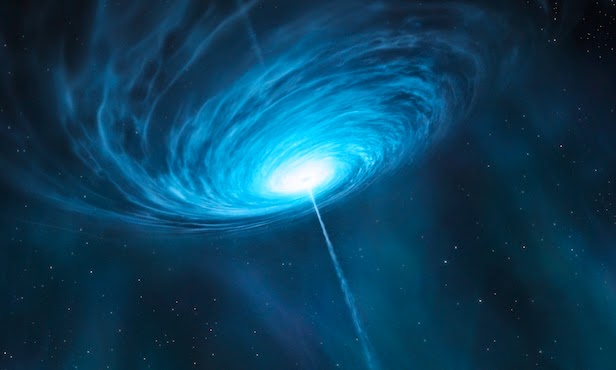 Artist's impression of a blazar.
Speed: 299,792.4579999 km per second
What about ordinary matter traveling at high speed? The record is held by cosmic rays. These aren’t ‘rays’ at all – they’re subatomic particles created in the most powerful events in the Universe such as galaxy mergers and ‘hypernovae’. The fastest cosmic ray yet detected was traveling so close to the speed of light that it had the same amount of energy as a medium-paced cricket ball, although it was a fraction of the size of a single atom! It had a thousand billion billion times the energy of protons that the Large Hadron Collider (LHC) can produce at maximum energy!
5. Blazar Jets
Speed: 299,492.666 km per second
For large chunks of matter (as opposed to subatomic particles) the speed record is held by the ‘jets’ seen in ‘blazars’. Cannibalistic black holes at the heart of these active galaxies release huge amounts of energy which is funneled into jets by a dense, highly-magnetic accretion disk. The jets in some blazars have been observed to move at about 99.9% the speed of light! These blobs of material are at least the size of the solar system!
January 26, 2015
A Quick Guide To Twitter For Newby Authors
 Independent authors are generally on their own when it comes to promoting their book. It's time-consuming work setting up on various social media, getting a presence on book-club or reader websites, trying to get people to like a Facebook author/book page, connecting with people and groups on Google+, developing your own website and possibly a blog too, and so on. In fact, the amount of work involved can seem very daunting, especially when it might only result in one or two extra fans or book sales. But persistence and patience are both required to make a success of your marketing plan. Hopefully, with a carefully thought-out campaign, and the ability to do all the right things whilst online, you should begin to build a following, increase your visibility and begin to shift a few more 'units' of your 'product'. Daunting as it is, there are many things you can do to make it easier to reach people. And one of those is using Twitter effectively. So, here's a few tips for using Twitter as an author for those who haven't yet taken the leap and for those who are still wondering what Twitter is all about.
 Twitter is a social media platform on which users send and receive 'tweets'. A tweet is a short message of up to 140 characters in length. On Twitter you 'follow' other users and they may 'follow' you back. Tweets from users you are following show up on your 'feed' or 'timeline' which you can access through a webpage or on your mobile device. Your tweets show up on your follower's timelines and are also visible to anyone else on Twitter who looks at your twitter page. People you connect with on Twitter are often called 'Tweeps'.
When 'tweeting', Twitter users often include 'hashtags' which are short abbreviations or mnemonics used to label tweets so that other people can find them easily. Hashtags begin with the 'hash' character, #. For example, if a Tweet is about the Superbowl, it could be hashtagged with '#superbowl'. That way, anyone, even users who aren't following you, can find your tweet just by searching Twitter for the #superbowl hashtag. Hashtags are an extremely useful way of getting your messages (or tweets) to groups of people who may be interested in you or your work, or who may be able to help you promote yourself or your work.
Tweets can contain links to other websites or pages and can even contain images, but are always restricted to the 140-character limit. Luckily, Twitter itself will shorten long URLs (web page addresses) to 22 or 23 characters so you don't have to worry about this. Images attached to tweets will take up another 23 characters. Think of a tweet as a very brief information dump aimed at your followers, embellished with labels to define what your information is about.
You can respond to other people's tweets by 'replying', 'retweeting' or 'favoriting'. Replying will attached your own tweet to the other user's so that several people can hold the equivalent of a Twitter conversation. Retweeting means you will share the other person's tweet to all your own followers. And favoriting lets the original tweeter know that you like their tweet. It is a useful way of getting that person's attention, saying 'thanks' or simply endorsing something you like.
You can also direct your own tweets towards specific people by including their Twitter username preceded by the '@' symbol. So, if you want to directly refer to the President of the USA you would include @BarackObama in your tweet. You do not need to be following someone to use the '@' capability. But, beware, do not assume that celebrities will read your tweet, or even be aware that it exists, since they probably rarely (if ever) use Twitter themselves. Some do, of course! Being able to tag people in this way in your public tweets is very useful for an author. You can also send direct messages (which are like emails) to other users on Twitter and these are not visible to the outside world.
It's very easy to set up a Twitter account. You'll need an email address to link to the account, a profile picture (normally a photo of you, 400x400 pixels), a header or banner image (that appears at the top of your page, 1500x500 pixels) and a bio of up to 160 characters. It is a good idea to use the same or similar images, and the same short bio, that appear on your other social network sites (Facebook, Goodreads, Amazon author pages etc.). This means you are presenting a consistent brand image to the online world. Once you've set up your account you can link it to your other social network accounts and your own website/blog. This is important because you generally want your tweets to automatically appear on all your other social network sites.
How do you get Twitter followers? The first thing to do once you've set up your account is to search for and follow a few people/organizations that you like. These can be news websites, book blogs, other authors; anything that you have an interest hearing about and possibly interacting with. Hopefully these Tweeps will follow you back. Another option is to find an author similar to you and follow some of their followers and hope they return the favor. But, be careful; there are limits to the number of people you can follow in a day and if you aggressively follow thousands of users you run the risk of having your account suspended. Go slowly, add a few tens of people per day, stick to people that are relevant to you and be courteous and reasonable at all times. You can also 'import' people from your other social networks or invite your friends and contacts to connect with you by email.
It's very easy to build up a huge list of people that you are following. This normally results in an increase in your followers as some of those people will 'follow you back'. But, at some stage you will realize that you are seeing the tweets from hundreds of people that are not following you. You should then ask yourself whether those people are important to you. Do you want to see all their tweets but them never see yours? If the answer is 'no' you should 'unfollow' them. A useful rule is to try and keep your number of followers more than the number you are following. And do not be tempted by the numerous 'get Twitter followers fast' scams that you will inevitably encounter. Adding 2000 people that have no interest in you or your product isn't going to help you one bit. It may make you look popular, but looking popular isn't your primary aim on Twitter (actually, neither is it anywhere else!). Getting real people to take a genuine interest in you and your work is what you are trying to achieve.
There are numerous websites/apps which allow you to manage your twitter account more effectively. For example, justunfollow.com allows you to see which of your followers are 'inactive' or which people you are following who aren't following you back. Use these tools to regularly manage your audience, cutting out people that aren't interested in you or your product and refining your list of people who are. Other websites, such as hootsuite.com also allow you to manage your Twitter and Facebook accounts simultaneously. Look into these if you are a bit daunted by the amount of work required to maintain an active online presence. They can connect your activity together and make it easier to manage.
Although Twitter will shorten URLs automatically, many other websites give you the ability to shorten web addresses that can then be put into your tweets. In fact, some (like bitly.com for example) allow you to archive lots of shortened URLs and also track how many times they are clicked on. This is an extremely useful tool which you can use to discover how the content of your tweets affects the number of people that click on your links. Marketing is all about letting the public know your product exists (or, more cynically, making them think they want something you can give them) and finding the correct formula to achieve this is half the battle. So, spend some time getting to know your public and make sure you are tweeting what they want to hear.
What do they want to hear? Well, it's a common mistake to think Twitter is there purely as a stage from which to blow your own trumpet. Constantly yelling at the world to buy your book will not get you very far. The key is interaction. Keep your promotional tweets to a minimum, perhaps once a day, but fill your timeline with things that will interest your followers. Give inspirational quotes, reveal snippets of your research, your thoughts on your work process, your 'eureka' moments, connect with key influencers, share where you are and what you're doing, give your views on stories of interest (remembering not to offend or insult other people's beliefs); all these things will make you a more interesting Tweep, engage with your audience and increase your visibility. Be authentic, be yourself, explore, have fun. Most of all, don't think Twitter is an enormous billboard for you and your work.
But, be sure to make those occasional promotional tweets effective. Your aim is to get attention, so get the information across quickly and with the minimum of fuss. If you're tweeting about your book, start with its title and your name. Then give the shortened link to where you want tweeps to go next. Then maybe a quick attention-grabbing phrase or quote followed by the hashtags. Always include the hashtags. For example, you might want to include #romance, #mystery, #YA, #books, #Amazon or any number of other things that label your tweet for people to find. If in doubt, search twitter for appropriate hashtags, see how they are used, or invent your own and hope they become useful on the network. You can also use hashtags that explicitly ask other people to retweet you. For example #IARTG (indie author retweet group) or #SNRTG (social network retweet group). Do some research and identify hashtags that may be useful to you. Here's an example of a promotional tweet that I might put out for my latest nook;
The Bergamese Sect by Alastair Gunn amzn.to/1r8o40D SHOCKING MYSTERY-THRILLER #ASMSG #IARTG #SNRTG #ebook #books #thriller #mystery
There are many other things you should use your Twitter account for. Keep up-to-date on the latest news in the publishing industry and get tips and suggestions from other authors (and the reading public) on publishing practice and the writing process. Use it for research, both for your writing, but your marketing campaign too. You need to use it to learn how to use it effectively.
You can find me on Twitter here: @AlastairGGunn
December 31, 2014
Flat Earth Fallacy
 I'm an accepting kind of person. I generally allow people to think what they want, believe what they want and (pretty much) say what they want, within reason. But occasionally an opinion is so far-fetched, insulting or incorrect that it debases human intelligence (all human intelligence, not just mine). And then I feel I must speak up.
One such 'opinion' is the belief in a 'flat' Earth. Although this topic has a substantial history (see for example Christine Garwood's Flat Earth: The History of an Infamous Idea), it has so far not been publicly contested in any great depth. Even Phil Plait, author of the ever-popular Bad Astronomy Blog, declined to give such a preposterous proposition any real air-time. And I don't blame him. It really is the most absurd idea. But it should be denounced, for any number of reasons.
The basic premise of the 'flat-Earth' protagonists is that ancient cultures were right, the Earth is flat, a circular disk bounded by ice mountains which is perfectly stationary while the sky rotates above it. Furthermore, the idea that the Earth is a sphere is an ominous lie spread across the millennia by an evil, secret establishment.
Hold on a minute. Before looking in detail at the 'evidence' which flat-Earthers purport to prove their case, there's an important point here. Belief in a flat-Earth isn't a 'religion' or a 'scientific discipline' - it stems from a belief that we have been lied to, in schools, in higher education, in fact everywhere. The truth is being covered up. In a word, there is a 'conspiracy' involved.
Not another one! Why is it that people, in surprisingly large numbers (across all genders, ages, races, and educational level) believe in conspiracies? Recent research by University of Miami political scientists Joseph E. Uscinski and Joseph M. Parent (see American Conspiracy Theories) showed that about a third of Americans believe the Bush administration was responsible for 9/11. There are also popular suspicions about the death of Princess Diana, about the moon landings, about Chemtrails, JFK and the list goes on and on and on. It's unnervingly common. Why are they so popular?
Uscinski and Parent define a conspiracy as a 'group acting in secret to alter institutions, usurp power, hide truth, or gain utility at the expense of the common good'. They point to Niccolò Machiavelli's edict that 'the strong desire to rule, and the weak desire not to be ruled'. So, it seems, wherever there is the possibility that power may reside away from the average citizen, there is a rife breeding ground for conspiracy theorists. As pointed out by psychology researchers at the University of London (Conspiracy Psychology), conspiracy theories often allow people to deal with feelings of powerlessness or with catastrophic events and to avoid feelings of uncertainty. And adherence to a controversial idea, however preposterous, also gives people an otherwise missing sense of self-importance. Quite possibly, many advocates actually don't believe in the conspiracy but enjoy the sense of group belonging which allows them to feel they are making an important societal contribution if they are vocal within the group. That is fine as long as no harm comes from such absurd beliefs.
But, rather than being harmless, conspiracy theories can themselves have harmful societal impacts (for example HIV and Ebola conspiracy theories have likely led to unnecessary deaths). But, conspiracy theories also undermine institutions that have no place being undermined, such as science, which is not their enemy.
We will come to this mistrust of science in a moment, but first we should address a fundamental question concerning flat-Earthers. Why would the oppressor seek to hide the shape of our home planet? Who is this oppressor anyway? Well, as you might imagine, the theorists are strangely silent on the matter. Of course, the argument is normally that if they knew who were responsible, it would no longer be a conspiracy. But familiar institutions are to blame, like NASA, who are well known for faking every photograph ever attributed to them!
But what about the reason? With other conspiracy theories, it's not difficult to suggest a potential cause - 9/11 for justifying the war on insurgency, Princess Diana because she was a threat to the establishment. But, why lie about a flat versus spherical Earth? The flat-Earthers make vague allusions to the usual shadowy world of corporations and governments, the deliberate removal of humankind's preeminence in the Universe or the evil denouncement of theism. In fact, the entire basis of their denouncement of heliocentrism is no different to the medieval abhorrence of Copernicanism. In fact, the language is strikingly similar. The conspiracy's aim, they say, is to demote humankind to a mere pawn in an uncaring Universe, to deny man's divinity and special significance, to eradicate the 'certain knowledge' that we and the place we live are the center of the Cosmos. So, even decades after the Vatican itself acquiesced to the Copernican view, the flat-Earthers are still firmly entrenched in an out-dated and irrational world model. In the words of Blackadder, 'to you... the renaissance was just something that happened to other people'.
Now, as a scientist it is hard for me to understand how anyone can imagine that science itself is a conspiracy. Am I, and my fellow scientists, not trying to understand and explain the Universe for the benefit of all humankind? Are we not driven merely by our inquiring minds to seek out answers to the mysteries of the Cosmos? The idea that we might wish to conspire against the non-scientist, to delude and mislead them, lie to them, even denounce their religious views, is alien to me and every scientist I know. In fact, it is insulting! As Charlie Brooker so eloquently puts it 'scientists are mistrusted by huge swathes of the general public, who see them as emotionless lab-coated meddlers-with-nature rather than, say, fellow human beings who've actually bothered getting off their arses to work this shit out' (Science Is Like A Good Friend).
So, why the mistrust of science? Well, perhaps because most people's interaction with science is with the 'lab-coated meddlers' of profit-seeking corporations or the warmongering agents of governments. But there is a vast gulf in incentive between the fundamental scientist and the applied technologist. And just because science has been used to genetically modify wheat, clone sheep or create devastating weapons of mass destruction, doesn't mean it is fundamentally bad or untrustworthy. It's humankind's use of that knowledge which is ofttimes suspect.
Another reason that many people distrust science is because they don't understand it. And there's no reason why they should, if they're not scientists. Many fields of science (among them cosmology and quantum physics) can appear very arcane, sometimes even counter-intuitive. If a scientist says an elementary particle doesn't exist until it is 'observed', he (or she) is not trying to be controversial, isn't inventing theories that have no basis in reality and isn't trying to hide the truth. Science is governed by its ability to predict, its testability and its repeatability. If it fails to explain an observation, is not testable or repeatable, it is thrown away or amended until it fits the real world. After all, it is only a 'description' of the world, although a fully-consistent one. If people find it difficult to understand or to accept, it is still no less a description of reality.
This truth also highlights another common fallacy of the flat-Earthers. The Flat Earth Society itself says that the simplest evidence for a flat Earth is found 'by relying on ones own senses to discern the true nature of the world around us'. Since when has the human consciousness been able to transcend the complexity and weirdness of the Universe? It doesn't, because human perception and philosophy are unreliable witnesses to reality. Science, on the other hand, is empirical and internally consistent. If our senses were our only reliable tools, quantum physics wouldn't exist, and there would be no such thing as the silicon chip! Even so, as we shall see, the flat-Earthers completely dispense with this proclaimed methodology anyway, and forthrightly discount the evidence of 'ones own senses'.
A constant niggle for many professional scientists is the common belief that science can be done effectively by the non-scientist. This isn't a case of elitism. I have no skills as an opera singer or an artist and so wouldn't insult such professionals by telling them how to sing Nessun Dorma or paint in the impressionist style. Likewise, without an in-depth scientific training, the necessary mathematical skills, the experimental experience and so on, non-scientists are not qualified to, or adept at, dissecting current scientific thought. But many people persist in assuming their arguments have a scientific footing or even that they follow the scientific method. They invariably do not. You cannot disprove a scientific fact, or body of lore, simply with words and thoughts. Evidence is not the same as gainsaying.
 Now, as well as being an accepting person, I'm also a realist, so not only do I know the flat-Earth hypothesis is absolute nonsense, I also realize that no amount of sensible, reasoned discourse will turn the flat-Earther from his (or her) declared allegiance. No amount of rigorous, mathematical proof or well-attested experimentation will spark a glimmer of doubt in their mind. I could argue until I'm blue in the face, they will never accept the alternative view (which is backed up by evidence), because their faith is religious and I am obviously an evil minion of that global conspiracy.
 I am fine with that. Their intransigence does not bother me in the least. I am happy for them to blunder through their misguided lives clinging to their delusions. It matters not a jot because the real world will go on acting in the way described by real science and won't change because they refuse to see the truth, and further refuse to accept that it is they, not us, who see the world incorrectly.
But that doesn't mean I won't point out their fallacies and publicly ridicule their absurd ideas. I could easily go through a list of ten or twenty so-called 'facts' which 'prove' the Earth is flat, debunking each and every one. But, frankly, I don't have to go to all that bother. All I need to do is show that any one of the flat-Earther's propositions violates reality, leads to a paradox or is inconsistent. But, just for good measure, I will now demonstrate how two flat-Earther 'facts' are false and absurd ideas and thereby prove once-and-for-all that flat-Earthers believe in total garbage.
1. The Altitude of the Celestial Pole
The position of the north celestial pole (the point on the sky to which the Earth's north pole points) lies very close to the star called Polaris. Let's imagine the coincidence is exact, just so we have something to mark the position of the pole on the sky. The same arguments will apply whether there's a star there or not.
If you stood at the Earth's north pole, Polaris would be directly over your head (astronomers would describe its 'altitude' as being 90 degrees). As you move away from the north pole, the position of Polaris changes. It changes by about 1 degree for every 111 km you travel away from the north pole. You can't refute that fact because it is easily measured and has been measured many times.
The logical explanation for this is that the Earth is a sphere. A change in one degree of Polaris' altitude corresponds to one degree in latitude. Hence, going right around the Earth means you'd complete 360 times 111 km which is about 40,000 km, the Earth's circumference. Incidentally, the fact that Polaris more-or-less marks the north celestial pole means it is extremely handy for navigation. It not only shows you where north is, it tells you your latitude on the Earth (your latitude is equal to Polaris' altitude).
For flat-Earthers, the variation in the altitude of Polaris is 'explained' differently. It lies at the point around which the sky rotates above the Earth. As you travel away from the north pole, it is just the perspective that changes its apparent position. In other words, the further away from it you go, the more its position changes. Well, we can easily test this. We know that traveling 111 km changes its position by 1 degree (do the measurement yourself if you don't believe me). Hence, by simple trigonometry, Polaris must be 6371 km above the surface of the Earth (the calculation is equivalent to calculating the Earth's radius in the spherical model). So, the flat Earth model concludes that Polaris is only 6371 km above the Earth's surface.
There's a few problems with this. Firstly, if 6371 km is the actual height of Polaris, then if you travel 6371 km from the north pole on a flat Earth, you have made an equilateral triangle and Polaris would be 45 degrees above your horizon. But, if you actually perform this experiment you will find Polaris is actually at an altitude of 32.6 degrees, not 45 degrees. And yes, the experiment has been done! So, the model's prediction is entirely wrong. Surprised?
Here's the second problem. If the change in position of all the stars is due to a perspective shift in the flat-Earth model, then their relative altitudes will also change. For example, if two stars are 1 degree apart on the sky near the zenith then if you travel sufficiently far that they appear near the horizon, they will be extremely close together (assuming they are the same 'height'). In such a flat world, the relative positions of the stars (not just their absolute positions) would change constantly depending on where you are. If the stars have different 'heights' this will still be the case but just in a more random manner. This clearly doesn't match at all what happens in the real sky. There would be no such thing as constellations, since no pattern of stars would stay the same for all observers.
The third problem? In the flat-Earth model, it is the sky that rotates above the Earth. The circumference of the flat-Earth is bounded by ice normally identified as Antarctica. If this were the case, the further away from the north pole you move, the wider the circular arcs the stars would take across the sky. At no point would they begin to circle a southern pole. But that is in fact what they do. Try telling an Australian that they don't! How do the flat-Earther's account for this? They simply adjust their model arbitrarily, as in 'there could be two virtual celestial hemispheres which overlap. One celestial hemisphere fixed at the North pole, and another at the South pole... the Earth can be flat and have two poles at the same time. A half of the celestial sphere rotates around the South pole, the other half around the North pole'. But the real sky doesn't behave like that either, does it? If we can invent anything we like to prove our theories, then of course anything is possible, even a flat Earth!
And, the fourth problem? You might even have spotted it yourself. Is Polaris, and possibly the other stars too, only 6371 km above the Earth's surface? Of course it's not, but the flat-Earther will insist it is. A discussion of how stellar distances are measured would be lengthy, and not warranted here, but those basic methods will also be denied by flat-Earthers whose only defense is that they are part of the conspiracy too! We know the distance to the Moon by laser ranging to be about 384,400 km, much further away than the flat-Earth predicts for the stars. But the Moon occults stars, not the stars the Moon, so the flat-Earth model leads to another inconsistency. And the defense will be the same - the measurement of the Moon's distance is wrong, it's just another part of the conspiracy. You see, we can believe anything we like if we are happy to dismiss any fact we wish.
This highlights very ably the difference between science and flat-Earth pseudo-science. Science will predict something based on its model of reality, then make sure that prediction is borne out by observation. Pseudo-science will draw a conclusion based on its model, then declare the conclusion proved ipso facto. No attempt is ever made to test the predictions of the model. The model can also be adjusted arbitrarily to suit the required conclusions. And this is supposed to be a more believable model than that of science! And it is also supposed to rely 'on ones own senses to discern the true nature of the world around us', even though it is completely at odds with what we see in the real world.
So there are many problems with the celestial motions predicted by flat-Earthers. And the only conclusion is that the flat-Earth hypothesis does not agree with the geometry that we actually measure on Earth. But the spherical Earth hypothesis does agree with the geometry we measure. Of course, the flat-Earthers will make all sorts of excuses for these discrepancies, but all of them represent a basic refusal to accept the facts that anyone can measure themselves. Or, even worse, they may provide an attempt at a philosophical discussion which is in effect meaningless, as in;
'If then the zenith stars of all the places on the earth, where special observations have been made, rise from the morning horizon to the zenith of an observer, and descend to the evening horizon, not in a plane of the position of such observer, but in an arc of a circle concentric with the northern centre, the earth is thereby proved to be a plane, and rotundity altogether disproved - shown, indeed, to be impossible' - from Zetetic Astronomy, Earth Not A Globe!Such generic, worthless combinations of words (mostly attributed to the masters of dubious pseudo-science, the Victorians), are designed to sound coherent but in fact contain no logical argument, and yet are still presented as evidence in favour of flat-Earthism. They represent no scientific proof of anything other than the gullibility of those quoting them. But the protagonists still believe such random quotations disprove more than three millennia of investigative endeavour by the world's keenest intellects!
2. The Immovable Earth
Another belief of the flat-Earther is that the Earth is motionless (at the center of the Universe) and the sky (and everything else) is moving around it. The most common objection of the flat-Earther to a moving Earth is that we experience no effect of this motion, and that if the Earth were moving we would see parallax in the positions of the stars.
This is one of those cases where intuition fails us. We view the world in a very anthropocentric, egocentric way. The basic mechanics of the Universe are well understood, but they don't always agree with what we might expect the world to be like. Now, Isaac Newton didn't just pull his laws of motion out of a magician's hat. He experimented with the real world and fit his laws to what he observed. He then predicted things using these formulated laws and verified that they gave an accurate model of reality. Like all good scientists.
One of the things Newton discovered was that if an object is under constant motion (i.e. not accelerating or decelerating) it will continue to move until a force is applied. Alternatively, we can phrase this as if motion is constant there are no forces being applied. This law can easily be verified, and has been time and time again, so it is completely absurd to suggest it doesn't apply in specific cases.
So, imagine that you are inside a vehicle and you have no clues as to whether the vehicle is moving (no engine noise, vibrations or windows etc.). Could you tell you were moving? Yes, you could, but only if you were accelerating or decelerating. In that case you would feel a force. But with constant speed and direction you would feel no force at all and would not be able to tell whether you were moving or not.
The flat-Earther declares this proposition as absurd. But, a flat-Earther isn't surprised that a speeding aircraft doesn't violently jolt them from their seat, or pin them to the back of the aircraft as it moves, although he is surprised that the moving Earth doesn't do the same! He will argue that there is a fundamental difference, even though the aircraft may move at 1000 mph, the same speed as the Earth's rotation. So, the flat-Earther inside the aircraft, feeling no violent forces, should conclude that the aircraft is stationary and the Earth is moving beneath him? Yes? No, because according to him the Earth isn't moving either!
So, the assumption that a moving Earth should be somehow 'felt' by us leads to a paradox. The flat-Earther will just ignore this of course. Or say the Earth is 'different' by which they mean that different laws of physics apply to the aircraft and the Earth. Which is convenient for them but again is a good example of changing the parameter space to match your expectations or required conclusions.
What about the parallax of the stars? Some flat-Earthers will say, if the Earth rotates about the Sun, then the positions of the stars should change, but they do not. Well, in fact they do. It's actually one of the methods astronomers use to measure the distances to the stars. Observe a star position six months apart and its tiny change in location due to the Earth being on opposite sides of the Sun can tell you its distance. Parallaxes are extremely small and if you do the sums it turns out even the very nearest stars are extremely far away. Trillions of kilometers.
Other flat-Earthers will admit that stellar parallaxes exist but will declare the distances they imply as far too large to be real (notice how the flat-Earthers themselves can't agree on what is real or not). Why? Simply because it means humans aren't quite as important as they'd like to think and the Universe is much bigger than they are comfortable with. Again, the conclusion is preempted in order to fit a geocentric model. This is also convenient, of course, because the flat-Earther requires those stars to be very close; 6371 km above the Earth in the case of Polaris. But the argument is now circular because, as we've already seen, that belief results in more inconsistencies.
And this highlights another difference between science and flat-Earth pseudo-science. Science will adjust its view, re-assess its model, if facts do not agree with the current theory. Pseudo-science will ignore those facts or simply declare them inadmissible. Again, we can prove anything we like, even a flat Earth, if we are permitted to ignore the observed facts. And this is what the flat-Earthers do, over and over again.
So, is there any concrete evidence that the Earth moves? Well, yes there is. It is known as Foucault's pendulum after the French physicist who first demonstrated it. The principle is very simple. A pendulum will continue to swing in the same direction as long as no forces are applied to it. If you put a pendulum at the north pole and start it swinging you will find its orientation rotates once in exactly 24 hours (actually it rotates in one 'sidereal' day which is slightly less than 24 hours). The reason is that the Earth is spinning beneath the pendulum. If you do the same experiment at the Earth's equator, the plane of the pendulum's swing does not change relative to the Earth, as you'd expect. At intermediate latitudes the pendulum precesses more slowly than at the poles, but in a precise and predictable way dictated by the geometry of a spherical, moving Earth. Foucault's pendulum is not a 'thought experiment'. The effect has been demonstrated in the real world, even at the south pole, under stringent experimental conditions. And yes, it matches exactly what you'd predict.
Do the flat-Earthers have an explanation for this? No they don't. They just insist that the effect doesn't happen at all and cast suspicions on a technique that wasn't demonstrated until 1851, as if it matters when someone thought up the demonstration. So, again, the observational evidence is simply dismissed by flat-Earthers because it doesn't fit the flat-Earth model.
But the flat-Earther will continue to argue for a stationary Earth with statements such as 'if both the Earth and its atmosphere are spinning 1,000 mph west to east, then why don't pilots need to make 1,000 mph compensation acceleration when flying east to west?', and 'if the atmosphere is constantly being pulled along with the Earth's rotation, then why can I feel the slightest westward breeze but not the Earth's 1,000 mph eastward spin?' and 'if the Earth is spinning beneath us, why can't I just hover in a helicopter, wait until my destination reaches me, and then land when it comes?'. These statements demonstrate again a complete misunderstanding of how the Universe works, a misunderstanding born of an anthropocentric worldview, and one that violates basic physical principles.
To the scientist there is no conundrum here at all. You see, conceptually speaking, the flat-Earther's worldview is effectively detaching objects from the Earth and placing them in another reference frame, one which is itself moving relative to the Earth. By doing this, his conclusions seem to be at odds with the idea of a moving Earth. But these objects (the atmosphere, an aircraft, a helicopter etc.) are not in their own, special reference frame, they are in the same reference frame as the Earth. There is no universal, stationary (or moving) reference frame to which you and I, or aircraft or helicopters belong.
This concept seems to be one of the most difficult for flat-Earthers to grasp, and many non-scientists too. In a world in which we are used to relating every object to our own, singular, insular reference frame, it is a conceptual leap to discover that there are in fact no universal reference frames in the Universe. It was something Isaac Newton alluded to and Albert Einstein formulated beautifully.
Perhaps the principle can best be explained by reference to forces and velocities. In order to change your velocity relative to something else, a force needs to be applied. Whilst you are standing on the Earth (or jumping above it) there is no magical force which suddenly appears and changes your motion relative to it. So, whether you want to fly your aircraft east or west you still have to apply the same force to change your speed relative to Earth. You cannot feel the atmosphere rushing past you because you are stationary relative to it. The Earth doesn't move beneath you when you jump up because you are already stationary relative to it. It's actually a very basic and simple principle. But when a flat-Earther ignores it they violate another basic principle - that you cannot create energy (or force) out of thin air!
Of course, I have addressed only two of the objections that flat-Earthers have to the idea of a spherical Earth. But I have demonstrated that both lead to inconsistencies or violate what we observe in the real world. There are many other objections; NASA have faked all their images of the Earth, gravity doesn't exist (seriously!), ships don't sink below the horizon, the Bible and the Quran both say the Earth is flat (and they should know), the tides are caused by the Earth moving up and down, that synchronous rotation of planetary Moons can't happen, that the Sun is located a few hundred miles above the Earth, that explorers who have discovered the edge of the world have been silenced, that the Moon does not reflect sunlight (it is a gigantic lamp), that we never went to the Moon (or sent space probes to the planets), that satellites don't exist, and so on and on and on and on. I don't need to address any of these (although any and all of them can be disproved easily) because the demonstration of only one inconsistency (as I've done) is enough to lay the flat-Earth hypothesis to rest.
As I said previously, the flat-Earther will dismiss every argument presented here (or elsewhere) by ignoring the facts, denying the facts, quoting ancient sources of 'erudition', quoting religious texts, or presenting pseudo-scientific or philosophical arguments with no actual content. What they never do, of course, because they can't, is provide testable, irrefutable, mathematical proof that their assertions match reality or demonstrate how the predictions of their model match reality. Nor do they ever (because they can't) provide absolute, testable, irrefutable evidence that the spherical Earth model leads to inconsistencies with the real world.
No amount of real evidence can sway the flat-Earther from their personal truth. To them, it is the same as a religious conviction; the only proof they need is the belief itself. They will not listen to reason and will always persist in the accusation that they are being lied to.
On the other hand, being a scientist, I am happy to listen to evidence for a particular world view. But I haven't heard anything yet that convinces me the Earth is flat. The onus is on the flat-Earthers to change that. So, it's over to them.
December 24, 2014
What Was The Star Of Bethlehem?
 A few days ago I looked at the date of Christmas and how this is probably tied up with ancient astronomers' observations of the skies. Today, I'd like to look at another 'astronomical' event that we associate with Christmas - the Star of Bethlehem. Could the description in Matthew's gospel be telling us something astronomical?
 The story of how the three wise men followed this 'star' to the newborn King of the Jews is a common part of the Christmas celebrations. Today, we stick a star on top of our Christmas trees, we attach copious amounts of tinsel to small children in school nativity plays and sing about this 'Star of Wonder'.
Perhaps the Star of Bethlehem was a miracle sent to announce the coming of Christ. Perhaps it's just a story (or propaganda) that grew in the telling. But perhaps it was a natural astronomical event that happened by coincidence around the time of Christ's birth? You can see how such an event could easily become part of the legend of the nativity.
Astronomers, being the inquisitive people they are, have often wondered about this and have made various suggestions as to what the star could have been.
But there's a problem. The gospels tell us that the wise men traveled first to Jerusalem to inform King Herod of the appearance of this portentous star. Then they traveled from Jerusalem to Bethlehem to greet the new born King. But Bethlehem is directly south of Jerusalem whereas the star appeared 'in the east'. So, how could the wise men follow a star in the east but be traveling south? The answer probably lies in the translation of 'in the east'. The original Greek is en te anatole which doesn't literally mean 'in the east' - it was a technical term for what astronomers now call a 'heliacal rising'.
The stars are fixed in the sky relative to each other and only move across the sky because the Earth rotates. But the planets, the Moon and the Sun move through this backdrop of fixed stars. Occasionally, the Sun will be close to a planet making it invisible in daylight but eventually the Sun will move far enough away that the planet becomes visible again. That time, when the planet reappears again for the first time, and rises in the morning sky just moments before the Sun, is called a 'heliacal rising'. At the time of Christ such heliacal risings were thought by astrologers to be particularly portentous. So, 'in the east' isn't quite what it seems, it simply means a particularly significant astronomical event. It should be pointed out though that some scholars believe the 'east' in the gospels doesn't refer to the star itself but that the wise men themselves were 'in the east' when they spotted it.
But, we still have a problem. The gospels say the Star of Bethlehem came and stood over the infant Jesus' crib. However, again there is something lost in translation. The original Greek word was epano which also had an astrological meaning. It refers to the moment a planet stops its westward motion in the sky and begins to back-track to the east. Astronomers call this 'retrograde motion' and it is the result of the Earth catching up and lapping the planet during their orbit around the Sun.
So, we can easily interpret the gospel writings in an astronomical sense rather than an astrological sense and possibly come up with a natural explanation for the Star of Bethlehem story.
Now, modern theologians who have studied religious texts closely, believe that Christ was born sometime between 7 BC and 1 BC, but most likely in 4 BC. We can easily calculate the positions of the stars and planets during these years to see if anything interesting happened.
In 7 BC there were three conjunctions of the planets Jupiter and Saturn. A conjunction is when the planets appear very close together in the sky. This alignment of Jupiter and Saturn only happens about once every 900 years. So this may well have seemed very important to the astrologers of the time. Although a conjunction of bright planets doesn’t exactly match the events in the Bible, it may well have led to the popular story we tell today.
Several comets appeared in the sky at around this time; one in 5 BC and another in 4 BC. But since comets were usually thought to be harbingers of doom and disaster, it’s unlikely they would have given rise to the Star of Bethlehem story.
But during an eighteen-month period between 3 and 2 BC a remarkable sequence of events occurred. First Saturn and Mercury were in conjunction, then Saturn and Venus, then Jupiter and Venus twice, and finally, four planets, Mars, Jupiter, Venus and Mercury, all appeared very close together in the sky. At one stage Jupiter and Venus were so close that they would have looked like a single very bright star. And to top it all off Jupiter twice came very close to a star in the constellation Leo called Regulus, a star often associated with the birth of kings. Such a sequence of events only happens once in 3000 years!
Other suggestions for astronomical events giving rise to the Star of Bethlehem story have been proposed. Although none of them exactly match what the gospels say, or agree with the likely time of Christ's birth, they are nevertheless compelling in the astrological sense. The wise men, or magi, were astrologers and they were well aware of the prophecies of the Old Testament that a new king would be born to the people of David. They had probably been watching the skies for decades for anything that foretold the coming of the king. Any one of the events (or sequence of events) mentioned above, could have been enough to set them on their journey to Bethlehem.
But, whether the Star of Bethlehem was a natural event or not, the story will always be an important part of the Christmas story. And it gives us an excuse for dressing our children up in tinsel for nativity plays.
Happy Festive Season to you all, whether or not you celebrate Christmas!