Heather Boerner's Blog
December 26, 2014
Here's to an Amazing 2014 for HIV-Affected Families!
It's the end of 2014, and I can't end this year without thanking you for an amazing year. It started with promise that this article I'd written--that I'd fought for and pursued for years--would finally be seen by the public. Then there was the name change (from HIV and Baby Makes Three to Positively Negative), some behind-the-scenes stressors and then--voila! In July, the book was suddenly available. The response from you all was fantastic. So far, the book has sold about 50 copies to people in the U.S., Canada, the UK, and Australia--not bad for a self-published title without the power of a publishing house behind it!
To celebrate, I thought I'd share my top 12 moments of the year with you. (Twelve, because 10 cannot possibly contain the wonder this year brought.) Here we go.
12: Getting Caped
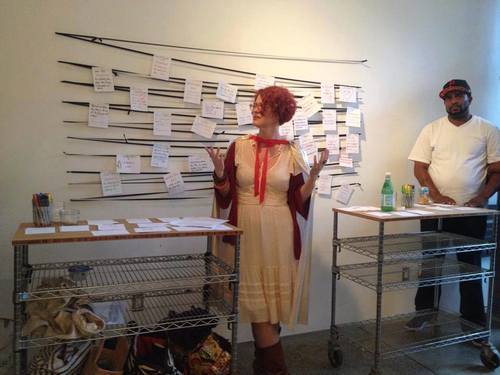
When I showed up to a pop-up exhibit of photography by HIV-affected families from San Francisco General Hospital, I did not expect for Shannon Weber, whom I quote in the book and who first introduced me to Poppy, to announce to the assembled crowd that she likes to "cape" people who are doing good work with HIV. Then she said things that were so kind toward me and Positively Negative that I've mostly blocked them out. But suffice to say, I took the cape and the compliments with gratitude. I'm honored. Thank you, Shannon. That's an image above of me doing a reading of the Epilogue for the assembled crowd, cape and all. Here's Shannon'sHall of Gratitude for the caped, and her entry for me.
(She has also caped Poppy and Caroline, and I'd be willing to bet that she would also cape Susan if she could get ahold of her!)
11. #HIVLoveWins
When the book launched, and even before, I was in conversation with people on Twitter (my handle is @HeatherBoerner, if you'd like to connect!) about what love for HIV-affected couples means, and how that love translates to families. This resulted in some Twitter chats, which we followed with the hashtag #HIVLoveWins. Maybe it's more accurate to say #HIVScience+LoveWins but it's all the same. I was blown away by the people who showed up to talk--people as far as South Africa, Poppy, Ted (under the guise of an anonymous Twitter handle), and new friends made this not just about the book, but about what it's like to live and love with HIV today. The best compliment I heard about the chat--well, actually there were two. First, a colleague of mine said the chat felt more like a chat than any other Twitter chat she'd attended. Given the Wild West nature of Twitter, that was high praise. But more important to me was that I learned, through Poppy, that Ted was so energized by the chat that it made him open to doing more press and, eventually, to talking to me. (Keep an eye out for the bonus chapter those of you who elected that perk were promised. It will include my first-ever interview with Ted!)
10. Book Readings
It's a special (and, not gonna lie, nerve-wracking) experience standing in front of a room of people and reading the words that have, so far, only been sounded out in my head or in the privacy of my home office. So when I got a chance to read for the people at the photography pop-up, and then, after the book's publication, at Shannon Weber's house, it was scary. But also amazing.
I'm just sorry you guys didn't get to all be there. In Shannon's lovely San Francisco apartment, prominent researchers (UCSF's Bob Grant, lead investigator of the ground-breaking iPrEx study), Poppy, Caroline, folks from the larger San Francisco HIV community, and my own friends and colleagues all gathered. I did a reading of pieces of it, but the most powerful moments came when Caroline, Shannon and Poppy read the parts of the story that were most poignant to them. When Poppy passed around the birth announcement for her daughter, and then started crying when reading the section about her positive pregnancy test, it moved the whole room. It was moving beyond what I can say.
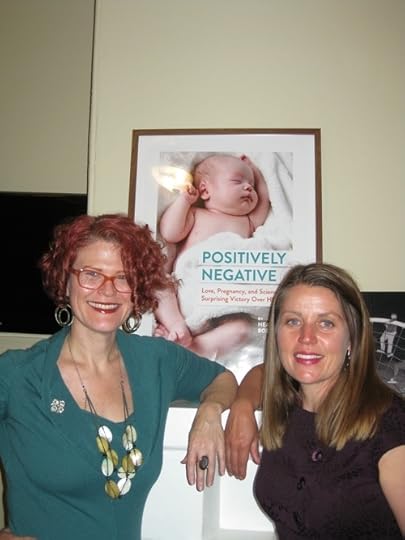
Here's an image of Shannon and I with a framed cover of the book:
9. AIDS Walk SF
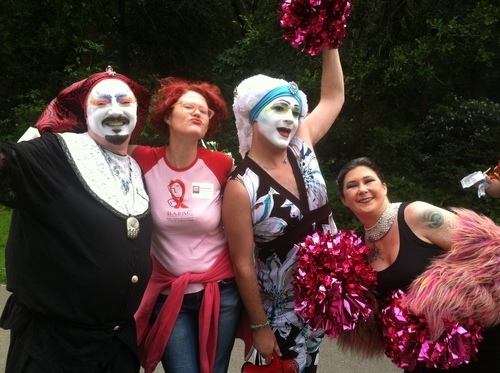
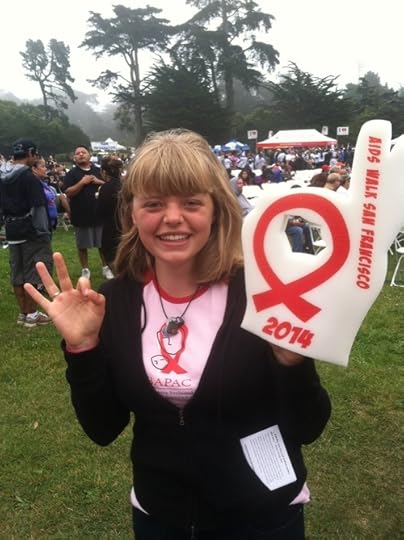
Just before the book was published, Caroline, Shannon and I got the great idea to create a Positively Negative AIDS Walk Team. Yes, this is self-promotion, but it turned in to a good cause, too. It turned out, when Caroline talked to the AIDS Walk staff, she was able to get theUCSF Bay Area Perinatal AIDS Center (BAPAC) assigned as one of the benefiting organizations. And because of that, some of the money raised by the walk (and by us!) went back to giving HIV-affected family access to all the parenthood options available to them. Plus, Caroline got to represent BAPAC (and HIV-affected families everywhere) by speaking at the beginning of the walk. I'll admit--I am not in good enough shape for all this. But we had a fantastic time. Shannon's daughter Taft was a champ, handing out Positively Negative postcards to all the families around us. Check us out: Me mugging with the Sisters of Perpetual Indulgence, and Taft giving the foggy, cold moring the A-OK. There may also be video of us dancing around as we warmed up before the walk, which I could be convinced to share if you ask nicely.
8. All The Reviews!
When a book is published, it goes out into the void and, as an author, you never know if it's landing. That's why the amazing reviews the book has received, both from readers and bloggers, have been so heartening to me.
First, the World Science Festival declared Positively Negative a "smart read." Then, blogger Mayra Bitsko called the overlapping structure of the book, juxtaposing the parenthood journeys of the Morgans and the Hartmanns with the researchers who were investigating the plausibility of condomless sex for these couples "phenomenal." "[Boerner's] HIV medical research opens your eyes to new possibilities, hope and the continuous fight to stop stigma," she writes. "I highly recommend this compelling page-turner to everyone." The well-read science, culture and history blog NursingClio, featured Positively Negative, and really got it, saying:
"To me, though, the real lesson here is that public health and medical establishments move slowly, and people’s whole lives can be spent struggling in the gap between innovation and implementation. As a society, when it came to HIV and childbearing, we did not let couples make their own decisions and take their own risks. We did not really take infertility seriously, as a potentially devastating condition. We made it impossible for couples to decide that a small risk of HIV transmission was worth the possibility of building a family together. And we left those couples dangling for almost two decades, too long for many of them to ever bear children. In the future, will we do better in recognizing fertility and reproductive decision-making as a critical element ofreproductive justice? Might we find a way to accommodate individuals’ thoughtful decisions about risk-taking, rather than making their decisions for them?"
And just recently, the Adoption Blog at Psychology Today featured a Q&A with me, allowing me to explore something I don't explore much in the book: adoption options for HIV-affected couples.
Nurse-turned-health journalist Marijke Durning not only reviewed the book, calling it "well written, well researched and worth your time." And she asked to do a Q&A with me about the role of HIV (the idea of it vs. the reality) as a character in the book, and who I thought would benefit most from the book.
The book also got a positive nod from the My PrEP Experience blog.
Flattering? You betcha. But it's more important for the sake of the couples who will be helped by the news getting out there. That's the point of all this. The more people who hear about the book, the more likely it is to reach the people who need it.
But more important than professional reviews are your reviews. Seeing reviews from strangers and friends have been amazing. Here's a great review posted just last week by Darcy Ogden:
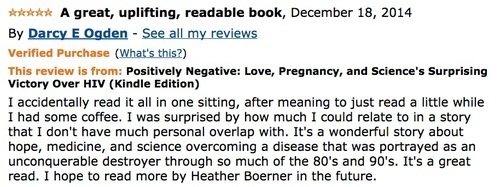
Darcy also emailed me directly to let me know that she bought the book for all her friends and family for Christmas. (And yes, this is a friendly reminder that the book is available for just $1.99 in Kindle, PDF and iBooks format on my website--less than the $2.99 cost at Amazon.) And if you were moved by the book, it's not too late for you to leave a review on the Amazon page, either. The more reviews, the more likely people are to discover the book!
7. Using Positively Negative to Report the New Era of HIV
I had no idea when I started writing this piece that it would coincide with a focus on biomedical HIV prevention. (I mean, obviously I knew about the FDA's Truvada approval. But I didn't know that this would be the story of the year for HIV.)
This became a great opportunity to promote Positively Negative through news stories that drew the attention of the people who might need the technology most. First, I did a story on how Truvada offers the first woman-controlled HIV prevention option, for BETABlog, the publication of the San Francisco AIDS Foundation. Then I did a story for The Star-Ledger in New Jersey, in which I got to talk to exactly the kind of woman who needs HIV protection the most: A straight, African American woman, dating in a community with an extremely high level of uncontrolled and undiagnosed HIV, who found out her longtime boyfriend was positive. Her sister had died of complications to AIDS. She knew what a grisly death it could be.
“No matter who you love, what situation you’re going through or who you’re with, it’s always going to be you,” she told me. “PrEP is excellent for saving your life. It’s saving my life. I believe that.”
It really pointed out a huge blind spot in the book--the fact that both couples in it are white. More and more, HIV is a Southern, African American epidemic. As I work on updating the book, I'm going to work to incorporate a more balanced view into it.
And then there was the story I wrote for The Daily Beast on women and HIV prevention (which was then referred to in a story on the same topic on TakePart). The word is getting out there!
Speaking of good news....
6. More Research Shows That Truvada is Safe for Pregnant Women
When I wrote Positively Negative, I didn't think of it as only or even primarily about Truvada and pre-exposure prophylaxis (PrEP). To me, the book and this moment is about choices and options. In fact, what I came to believe during the reporting and writing process was that PrEP is not necessary for many couples like the Hartmanns and even the Morgans--couples where the HIV-positive partner's viral load is fully suppressed. However, that's the moment we're in, as people get their mind around another option besides condoms. So I was delighted to get to write for BETAblog about some new research that continues to show that women who take Truvada for PrEP (as opposed to HIV-positive women who have been taking Truvada during pregnancy for years) are no more likely to see birth defects in their babies than women who don't. The science is nascent on women who don't have the virus, but it's exciting to see the science roll in. I'll be monitoring this and adding this to Positively Negative as the news evolves.
5. Japan Calling
The best part of the crowdfunding campaign, by far, was connecting with you guys--the readers, the advocates and the people for whom this issue is close to your heart. So I was moved when one of you gave $200 for the chance to speak to me on the phone. I won't go into the details of the call, because I told the caller I wouldn't. But suffice to say that through that call I discovered what a lifeline Positively Negative could be for couples who are isolated, getting contradictory or even stigmatizing advice from their healthcare providers, and don't know where else to turn. You are who I wrote this book for. I'm so glad I got to talk to you.
4. The Washington Post
I have to include this in the list of highs from this year because it's a professional high for me, and without Positively Negative I never would have gotten to do it. In addition to adding "Author" to my title, this year, I got to add The Washington Post to my credentials. In support of the book, I pitched a story to the editor there about how local governments were stepping up to turn PrEP from a policy to an accessible option. The story itself featured an African American man, not a woman, but it was a moving piece for me, especially the trust Nick, the man I featured, placed in me.
The story got some flack from activists for the headline. If only they'd added "yet" to the end of the headline--"The World's Most Effective HIV Prevention Drug Hasn't Lived Up to Its Potential, Yet"--I think it would have been more accurate.
3. The Morgans' and the Hartmanns' Stories Get Deserved Attention
When I started this story, I knew the Hartmanns had been interviewed before. After all, that's how I met them--I interviewed them for a story on parenthood options for HIV-affected families. But when I started what turned in to Positively Negative, I had no idea how their stories would resonate outside the book. This year has seen a story featuring the Hartmanns' condomless conception in the Washington Post (sadly, not written by me!) and a segment by CNN's Sanjay Gupta.
The Morgans, meanwhile, really went with the pseudonym I chose for them, and allowed themselves to be filmed (I'm so proud of them!) for a Dutch film crew (I spoke to the reporter, and he told me they are considered the Dutch 60 Minutes). And just this week, an interview they did with Fusion went live.
I've always said this is their story, not mine. I just hope that they feel I've done their story justice.
2. Positively Negative Excerpted on The Atlantic!
This is where it all started. In the Fall of 2012, I got an assignment from The Atlantic's Health channel to write about pregnancy for HIV-affected couples. That spiraled into a 9,000 (then 10,000)-word article that was too long for their pages. After much thought and focus, I decided that, rather than cut the piece from 9,000 words to 6,000 words, I would publish it myself. And so it was gratifying when I approached The Atlantic about running an excerpt and they whole-heartedly agreed. The excerpt, Getting Pregnant When One Partner Has HIV, tells just a piece of Poppy and Ted's story. I hope it whets people's appetites for the full story. For me, it's a professional honor.
1. Publishing Positively Negative
Maybe this seems anticlimactic after everything I've listed, but I'm here to tell you that this is the biggest deal of all. When I was raising funds for the book, I set Valentine's Day as the release date for the book, at least in my head. How hard could it be? I thought. I'd already done the heavy lifting. The draft was done, and I loved it.
But Valentine's Day turned in to March 10 for National Women and Girls HIV/AIDS Awareness Day, and then I stopped setting deadlines. The hard work of editing, and then fact-checking were, in fact, work. Figuring out the format and contemplating images and hiring graphic designers and other professionals on my own dime followed. There were dark nights of the soul in there. I often wondered if I'd made a mistake. Publishing with The Atlantic certainly would have been easier, though I don't believe it would have served the story nearly as well.
When I finally told my colleague and consultant Damon Brown that I was ready to publish, he congratulated me. "Most people don't ever do this," he told me. "You should be really, really proud."
And you know? I am.
I am enormously proud of this piece of journalism and the courage and generosity of all my sources. It shouldn't take courage to talk about wanting to have a child, but the fact that it does shows how far we still have to go to bring the culture up to date with the science. I am hopeful we will get there, and I hope Positively Negative contributes to steps in that direction.
So I end this (very long) recap with a tremendous bow of gratitude. I literally could not have done this without you. I wish you a peaceful holiday season--and where that's not possible, I wish you acceptance and compassion for yourself and others. I wish you a beautiful 2015.
And stay tuned: The new year promised an expansion of the book, more articles, a panel on the new era of HIV for the Association of Health Care Journalists (organized and moderated by yours truly), and perhaps even a few awards.
Wishing you and yours love.
Heather Boerner


December 1, 2014
Celebrate Love on this World AIDS Day, with Discounts and Promotions
World AIDS Day: Typically this is a somber occassion--as it should be. Millions of people have died of AIDS, the end result of uncontrolled HIV in the system.
But this year, there's reason to hope. About a quarter of those with HIV have completely suppressed viral loads. That is, if you look at their blood under a microscope, you won't find any HIV. Nada. Zip. At least with the technology we have. That's why stories like Positively Negative exist. The science that got us here is not just a miracle--it's the result of the painstaking, thoughtful, determined work of researchers around the globe, and the women and men--trans and nontrans--who have been willing to put themselves on the line to see if new treatments work.
They do. And they are the reason babies like Pom-Pom and Ryan, the two little girls in Positively Negative exist.
So on this World AIDS Day, lets not be sad. Let's celebrate the scientific will and the determination of researchers and couples who took the risks, were the pioneers and discovered for all of us that HIV can be tamed.
And to help us celebrate this year, I'm offering some discounts on the book. At Amazon, you can get Positively Negative at the discounted price of $1.29 (normally $1.99). And if you buy directly from me here on the Positively Negative website, you get it for even less--just 99 cents, for today only.
Today is World AIDS Day, and it's time we start celebrating. Share Positively negative with those you love. Celebrate love. Because #HIVLoveWins
July 28, 2014
Virtual Book Readings--Find them on YouTube
One of the great gifts of writing an ebook is that, once it's published, it's available immediately all around the world. One of the unfortunate things about ebooks is that I can't reach all of you and I can't do book readings in all of your home towns.
It turns out, though, that where the internet takes away, it gives, too. So I've decided to take the Internet up on its offer of instant, worldwide access, and am posting to my YouTube channel a series of book readings. I posted the first this weekend.
I hope you enjoy!
July 22, 2014
Team Positively Negative at AIDS Walk San Francisco
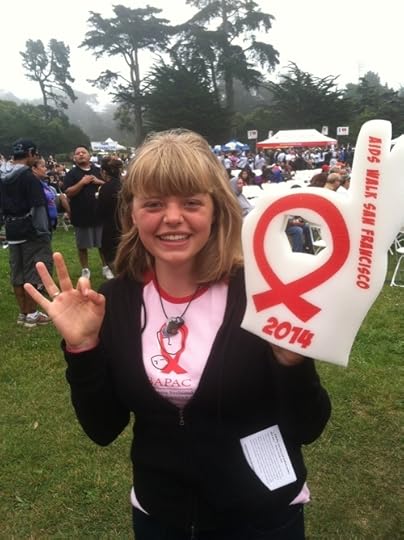
Taft Weber-Kilpack, 15, is NOT the youngest member of Team Positively Negative.
On Sunday, July 20, I and five other people dedicated to stopping HIV's spread to babies joined the 20,000 other people at Golden Gate Park for AIDS Walk San Francisco. Our contingent was small but mighty. Caroline Watson, who I feature in the Epilogue of Positively Negative, was a featured speaker and part of the Walk's #becauseyouwalk campaign.
And while Taft, above, was one of our younger walkers, she wasn't the youngest. No, that honor belongs to 18-month-old Valerie. She and her mom make an appearance in Positively Negative, in the Epilogue.
Here, we walked not only in support of this book and in support of people with HIV; we walked for the Bay Area Perinatal AIDS Center at UCSF. We all wore our BAPAC t-shirts and some of the money raised from the Walk will go to support HIV-affected families through BAPAC.
To see the full photo gallery, visit the Positively Negative Facebook Page here.
July 18, 2014
Today is Launch Day & Bonus #HIVLoveWins Tweet Chat Tomorrow
Today's the day, friends! After two years of work in earnest and five years of work total, Positively Negative is live on Amazon. Already, it's racking up some great reviews:
I am an unapologetic sucker for a (good) love story and a (believable) happy ending. Despite the hopeful title of this article, I admit that I wasn’t expecting either. This is HIV, after all, but Boerner deftly distills (in clear, comprehensible language despite all the scientific terms) both the controversial issues of unprotected sex and HIV and the science that makes it possible for these couples to safely conceive. This work documenting the medical advancement and courageous trail-blazers is a thrilling page-turner, but the white-hot center of this meticulously researched work is the compelling story of the families and their unfolding struggles for a child of their own. That such a thing is safely possible boggles the mind and lifts the spirit.
Heather Boerner’s razor sharp reporting with her open eyes and heart offers fantastic documentation of the tremendous transition during the last decade of HIV research. Perhaps more importantly she contributes to a new lexicon of possibility. I have spoken with hundreds of couples like the Morgans and Hartmanns who feel isolated as they search for answers. This book is an answer and offers solid science describing the possibility of an HIV-free generation - it is full of hope and possibility.Thank you for sharing your gift of words, your beautiful mind and your dedication to publishing this in long form. So many people will feel seen and know that they are not alone
... [I]f you are interested in issues of reproductive science and fertility, public health policy, women’s sexual health (including the way science sometimes ignores women’s sexual health), and the future of HIV treatment. I was especially intrigued by her analysis of how the history of the stigma and fear surrounding AIDS has in some ways prevented progress and changes in policy, even in the face of scientific-medical advances. Ultimately an uplifting story and timely in a way no one could have have expected, given the news today about the tragic loss of so many researchers who have been working toward cures and treatment for HIV/AIDS.
I am so delighted that the message is getting out there, especially in light of the devastating news that up to 100 HIV researchers may have been killed in the Malaysia Airlines flight disaster over Russia yesterday. We have not seen the last of this, and the ripples will go on for years. As I told a reporter I spoke to today, who know what those researchers could have achieved? Might one of them been the one (or team) to cure HIV? The thought makes me shaky.
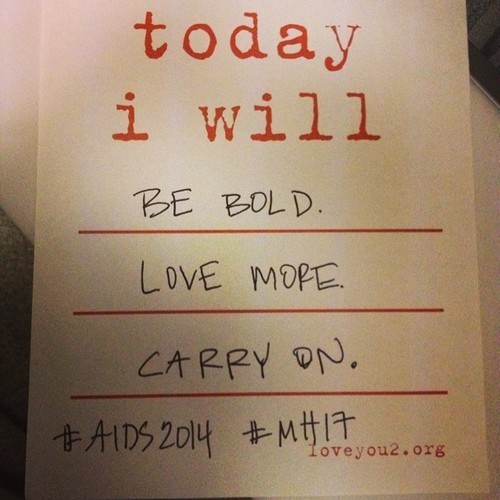
As Shannon Weber from BAPAC (and the doyenne of LoveYou2.org) notes in the above image (taken from Melbourne, where she is attending the International AIDS Conference), we will carry on.
For me and for HIV-affected couples, that means that we'll be getting together on Twitter at 4:30 pm Eastern tomorrow for another #HIVLoveWins twitter chat and virtual book launch. I'm delighted to bring my book launch to Twitter. Poppy, one of the women I followed in the book, will be on hand to talk about her experience. If you're interested, log on to Twitter at 4:30 p.m. Eastern and search for #HIVLoveWins. Please join us. Ask questions, talk to Poppy and let's start the healing from this terrible tragedy.
Positively Negative: Love, Pregnancy, and Science's Surprising Victory Over HIV
By Heather Boerner
May 14, 2014
Let's Launch!
It's getting to be that time: Only weeks until we launch Positively Negative out into the world. Do you want to be a part of it? Join the Positively Negative Launch Team! All you have to do is fill out this application to get started. On the team, you'll get direct access to me, a behind-the-scenes look at what it's like to self-publish a longform ebook, a FREE copy of the book in exchange for an HONEST review on Amazon, Goodreads, you name it, membership in the Positively Negative/BAPAC AIDS Walk San Francisco team, and a few other perks to be named later.
This is a minor commitment--answer a few questions on Facebook, read and review the book on whatever social networking sites you use, etc. Like I said on Twitter last week, it's my belief that #HIVLoveWins when we share our stories and break the stigma. That's why I wrote Positively Negative. The next step is to put it in the hands of people who need it the most. To do that, the book needs to have a broad reach. Will you help?
Here's how it works:
As a member of the Positively Negative Launch Team, you'll get:
▪ A free advance copy of Positively Negative
▪ Access to a private group where I'll share a behind-the-scenes look at what it's like to write and launch a book
▪ The opportunity to give feedback on certain aspects of the book during the production process
▪ A special "thank you" with a link to your blog (if you like) on the Positively Negative blog and on the book's Facebook page.
▪ Other special rewards, to be announced later.
In return, I'll ask for:
▪ An honest review on Amazon, Goodreads or other retailer sites.
▪ Any promotional ideas you might have to help get Positively Negative in front of as many readers as possible.
▪ If feasible, your participation in the San Francisco AIDS Walk as part of the Positively Negative walking team.
▪ Your help spreading the word about the book before and during the launch.
Not sure if the Launch Team is a good fit for you? Here are some questions you might have - and my answers:
"Do I have to be a blogger or have a large social following to join the launch team?" No! There are a lot of valuable ways to help get the word out. Maybe you'll email the members of your mom's group or social circle to let them know about the book, tell your family and friends on Facebook, or even put together a small group of moms to create a Positively Negative book club. Word of mouth is one of the best ways to help an idea spread.
"I'm not a marketing mastermind. Is my input valuable?" Absolutely! If you're a mom and a reader, you are exactly the person whose opinions I need to help me make Positively Negative the best resource it can be.
"I'm not on Facebook. Can I still join the Launch Team?" To keep everything streamlined we really need to run the Launch Team via a private Facebook group. It's where the majority of people already hang out, so it keeps everything easiest for the most members. But even if you don't join the actual launch team, there will be other opportunities to help spread the word about Positively Negative, so keep an eye out for updates!
"What is the time commitment to join the Launch Team?" A lot of this depends on how long it takes you to read and write :) It won't be super time-consuming, but I will expect members to put some time into reading the book, answering a few of my questions in the private group, and writing a fair review. The book will launch in late May/early June, so the most intense period of promotion will be the last half of May through July, culminating in the San Francisco AIDS Walk Positively Negative walk team. But I know you have other priorities and certainly don't expect for you to spend all your free time on Positively Negative! Give what you feel you can.
Have a question that's not answered above? Feel free to comment below and ask away. I'm here to answer and as always, I so appreciate your help and support.
May 11, 2014
Happy Mothers Day to the Courageous Ones

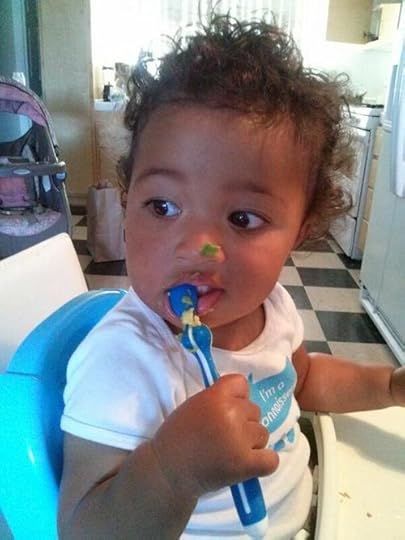
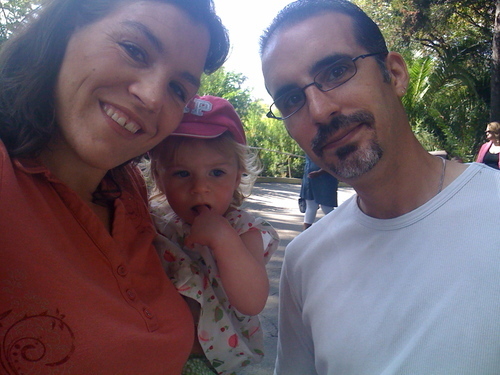
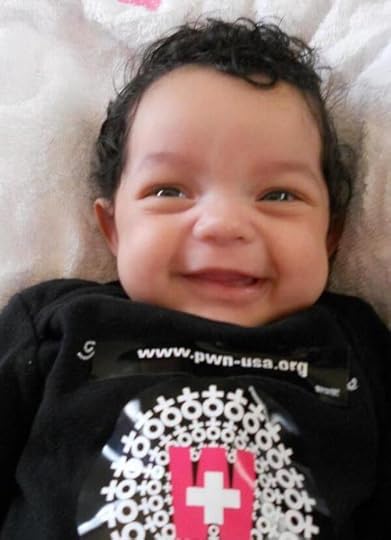
Babies, from top to bottom: Poppy Morgan's daughter Pom-Pom, Caroline Watson's daughter, Valerie, Susan and Dan Hartmann and their daughter Ryan, and Nicole Seguin's daughter. All children are HIV negative even though the families are affected by HIV.
Twenty years ago, when Meg Sullivan started as an infectious disease specialist at Boston Medical Center, working with HIV-positive women, the treatments were moderate, and the caseload small. Sullivan and an ob-gyn worked in tandem with women who were HIV positive and pregnant. Often the pregnancies were accidental and the prognosis grim. Either the child would be born with HIV, went the conventional wisdom, or the mother might not live to care for the child. However wished for or wanted the child, often the women made the decision to terminate the pregnancy.
But then something funny started happening. The drugs got better. Fewer women had to make that gut-wrenching decision. The women weren’t focused on their immediate health. As HIV became a chronic, treatable illness, they wanted to know how to have babies safely. On this Mother's Day, I was reminded of this story, that Sullivan told me, and it seemed appropriate to share. It's an important piece of the #HIVLoveWins story, and an important history that we don't talk about often enough.
She told me more. Her caseload shifted from only HIV-positive women. Her HIV-positive male patients started bringing their girlfriends and wives into the clinic, wondering if they could have a child—and if there were a way to keep both mother and child negative. This was a tricky question. Even though there were methods to protect the HIV-negative women from the virus, most of those methods are expensive. They range from adoption and using donor sperm to assisted reproductive technology. Methods such as intrauterine insemination, which involves injecting partner sperm into a woman’s cervix, to in-vitro fertilization (IVF), which involves harvesting several eggs from the woman and placing the sperm and eggs together in a lab setting. And then there's IVF with a procedure called ICSI, which. For the couples who decided to use the HIV-positive man’s sperm, none of this could be done without also paying a few hundred dollars for a procedure called sperm washing. The procedure separates the seminal fluid, which holds the virus, from the sperm.
For Sullivan’s patients, who were mostly low-income and sometimes precariously housed, none of those pricey procedures were an option. She tried to make them available anyway, bootstrapping a low cost, in-house sperm washing/IUI procedure from essentially donated labor and on-the-fly IUI training. Most of the time, she didn’t have anything to offer them. As a woman starting her own family at that time, not being able to help them was frustrating.
“I know what it’s like to want to start a family or expand a family and come across challenges," she told me. "Their challenges were much more enormous than mine. I felt a connection with them. Having a family with someone you love is not the primary reason, but it’s one of the main reasons to get married.”
So when results started coming in from research showing that some HIV medications, used by the HIV-negative partner, could stave off infection, Sullivan became hopeful. This, she thought, could be the long-awaited solution for her patients—and herself as a doctor.
Early news from studies of men who have sex with men (MSM) and transwomen showed some efficacy, but early studies on cis-women weren’t so positive. In the studies of single straight cis-women in Africa, they found the treatment, called pre-exposure prophylaxis, didn’t work but not because the medication didn’t work. It didn’t work because the women didn’t take it.
All this left Sullivan in a quandary: How to counsel the increasing number of straight women in relationships with HIV-positive men on how to have a baby.
“There is just not a lot of in-depth awareness of reproductive health for women with HIV-positive men, or HIV-positive women,” she said. “Some people say, ‘How can you even advocate that, that HIV-positive people have children?’ It shows a real lack of understanding of how the field has moved forward.”
On this Mother's Day, I offer congratulations to the couples who are courageously in love, and who have built families in whatever ways they choose--whether it's adoption, reproductive technology, PrEP or careful condomless sex. Here's to the courage that makes motherhood possible for these families.
May 8, 2014
#HIVLoveWins Won Twitter
Well, not really. But it was a smashing success! More than 20 participants, including a doctor in South Africa, advocates in Atlanta and allies elsewhere--along with two couples who are affected by HIV AND, as the hashtag goes, #courageouslyinlove.
Here's the Storify of the chat. I apologize for any tweets that got dropped or any continuity errors. This was my best attempt to organize a lot of tweets that came in rapid succession.
May 6, 2014
#HIVLoveWins When We Share Our Stories
So I logged on to Twitter this morning (you can follow me @HeatherBoerner) and this is what I saw when I searched for #HIVLoveWins, the hashtag for our chat tomorrow morning with Positively Negative couple Susan and Dan Hartmann:
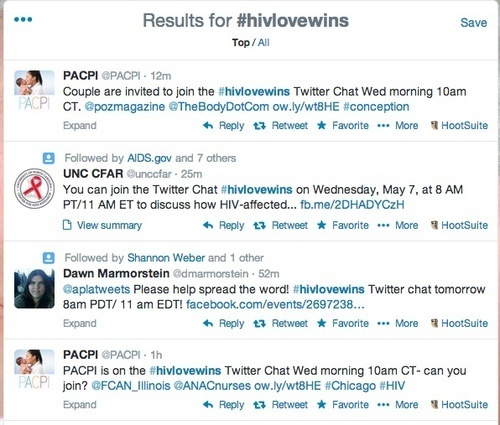
And it continues from there. At current count, at 10:17 a.m. PT on Tuesday, there are already 29 tweets at the #HIVLoveWins hashtag. Just imagine what it will be like tomorrow at 8am, when we all converge and talk about what it's like to be an HIV-affected couple with a natural longing for a family.
I hope you will join us--especially if you, like the Hartmanns, are an HIV-affected couple in search of a family. I hear from clinicians that most couples are reticent to be public--and for understandable reasons. It's the same reason Poppy and her husband are anonymous in my book.
But that doesn't mean you can't share your story. Use a throw-away Gmail account to create an anonymous Twitter account, and join us.
I wrote Positively Negative because I got the sense that most couples live in isolation, often hiding their status from the world. Sunlight and connection are healing. And Twitter is nothing if not a place to connect. So I encourage you to take a few minutes, join in, and at least read along. And then, if you're willing, let me know how it affected you at heather @ heatherboerner.com.
And there's an update! In addition to Susan and Dan Hartmann, Caroline Watson and Shannon Weber, a lot of heavy hitters will be joining the conversation. Talk to folks at AVAC, women from the Atlanta-based, woman-centered HIV-prevention group SisterLove, The Well Project, AVAC, PACPI and others. If you are curious about HIV prevention and pregnancy, these are the people to ask, and you'll have a rare opportunity tomorrow.
So at 8 a.m. Pacific/11 a.m. Eastern TOMORROW, Wednesday, May 7, jump on Twitter, do a search for #HIVLoveWins, and join the chat. Ask your questions. Share your story. Break the stigma and learn about the science.
#HIVLoveWins when we come out of the shadows. Looking forward to seeing you tomorrow.
May 2, 2014
Have Twitter? Meet the Hartmanns on Wednesday!
As we approach the release of the book (best estimates now have the book coming out at the end of May/early June), there's a lot more going on. The most exciting is a chance for you to talk personally with the Hartmanns, who were featured in the Washington Post last week and are one of two couples I follow in my book.
I've organized a Twitter chat with the Hartmanns, some HIV and pregnancy experts and another mom who had a baby with her HIV-positive husband the old fashioned way. They'll talk about their experience, the challenges they faced, and also about what it means to have protected sex without condoms. It'll be a fun time! Please join us if you can. Here are the details:
When: Wednesday, May 7, at 8 a.m. Pacific/11 a.m. Eastern
Where: On Twitter! Search for and use the hashtag #HIVnegpreg to find the conversation, and to contribute.
Why: To break the silence, remove stigma, and talk about what it's really like to live with HIV today.
RSVP here: ow.ly/wqHDw
Never been to a Twitter chat before? It's simple. It's just like getting together with friends at a coffee shop to talk: We all show up at the same place (Twitter) at the same time (Wednesday 5/7 at 8 a.m. Pacific/11 a.m. Eastern), and we talk about the same thing (#HIVnegpreg) for an hour. You can search twitter for the hashtag and then follow along that way. The Hartmanns will be there to share their story and talk about what it's like to be in the spotlight. I'm also happy to talk about the process of the book. You can ask any questions you like, provided that they're respectful.
So please join us.
Want to attend but afraid you'll forget? Sign up for updates or join the conversation on the Facebook events page (ow.ly/wqHDw).
Let's connect, break down barriers and bust through the stigma about what it's like to live with HIV today.