Greg Ross's Blog
April 22, 2026
Double Duty
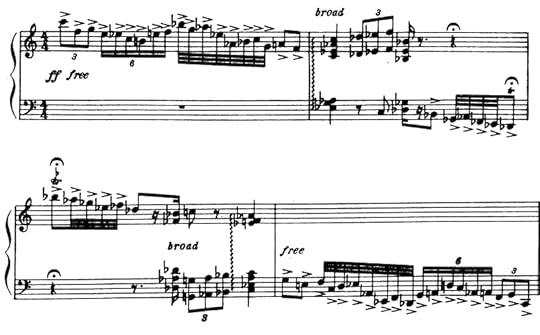
The last movement of Paul Hindemith’s 1942 piano work Ludus Tonalis is identical to the first movement, only backward and upside down.


Epithet
[Screenwriter Harry] Kurnitz’ most quoted observation was made when he became involved in a running feud with Lynn Loesser, then the wife of Frank Loesser, the songwriter.
‘Lynn,’ Kurnitz said, ‘is the evil of two Loessers.’
— Richard Gehman, “The Little World of Harry Kurnitz,” Playboy, June 1958
April 21, 2026
Borrowed Time
A striking detail from Martha Tyson’s Sketch of the Life of Benjamin Banneker (1854):
Whilst they were conversing his clock struck the hour, and at their request he gave an interesting account of its construction. With his imperfect tools, and with no other model than a borrowed watch, it had cost him long and patient labor to perfect it, to make the variation necessary to cause it to strike the hours, and produce a concert of correct action between the hour, the minute, and the second machinery. He confessed that its regularity in pointing out the progress of time had amply rewarded all his pains in its construction.
This seems to be at least plausibly true: In 1753, the 21-year-old Banneker, who had never seen a clock, borrowed a watch from a trader, made drawings of its workings, and designed a wooden clock of his own. Peter N. Stearns writes in Time in World History (2020), “Banneker, the son of former slaves, borrowed a watch from an acquaintance, took it apart, ultimately using this as a model to build an impressively accurate clock entirely from carved wooden pieces, and then capitalized on the notoriety of this product to set up his own repair operation.” The clock continued to operate until Banneker’s death more than half a century later.
April 20, 2026
In a Word
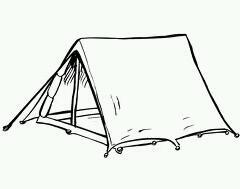
contubernal
adj. living in the same tent
Twilight
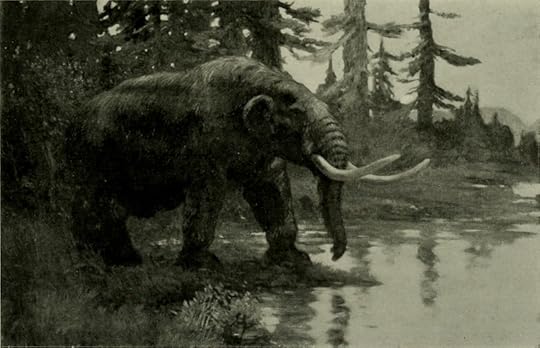
We do not know what thoughts stirred in the mind of the last of the mastodons, but we can take it that they were nothing very remarkable. It is hardly likely that the last man will have the mind of a Goethe. He will die, and that will be the last stage of human progress.
— Anatole France, Under the Rose, 1925
April 19, 2026
Hidato
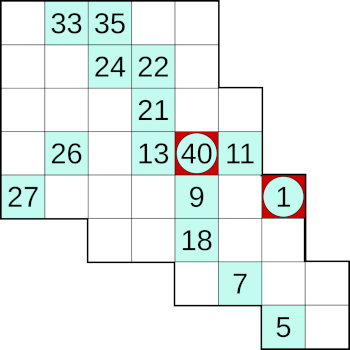
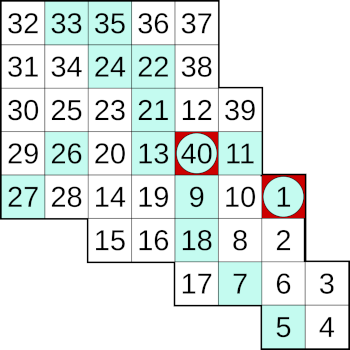
This logic puzzle game was invented by Israeli mathematician Gyora Benedek. The task is simple: Write a number in each blank square so that, in the finished diagram, a continuous chain of consecutive numbers connects the lowest number, 1, to the highest, 40. The numbers can connect horizontally, vertically, or diagonally. For example, the number 8 must go in the square above 7 because 7, 8, and 9 must occupy adjacent squares. Can you complete the rest of the diagram?
April 18, 2026
Ready to Hand
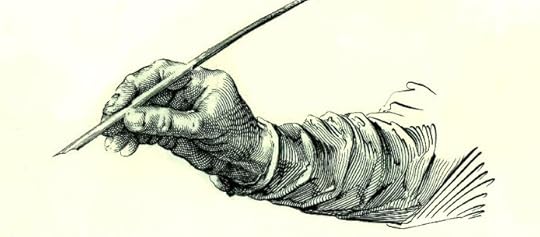
Synonyms for WRITER’S CRAMP collected by Dmitri Borgmann in 1987:
CHIROSPASM
WRITERS’ PALSY
GRAPHOSPASM
SCRIVENERS’ PALSY
MOGIGRAPHIA or MOGOGRAPHIA
PENMAN’S SPASM
WRITERS’ NEUROSIS
HYPERKINESIA
DYSGRAPHIA
WRITERS’ SPASM
A STUTTERING OF THE HAND
MOGIGRAPHIA has four principal forms: SPASTIC, PARALYTIC, NEURALGIC, and TREMULOUS. Borgmann wrote, “No longer need you suffer from the WRITER’S CRAMP of the masses — you can, instead, discourse eloquently and frequently about the plethora of more elegant-sounding ailments that I have made available to you!”
(Dmitri A. Borgmann, “Quelque Chose,” Word Ways 20:1 [February 1987], 44-53.)
Intermission
You’ve dealt about half the cards for a bridge game when you’re momentarily called away. When you return, no one can remember where you left off dealing. Without counting cards, how can you finish the deal accurately, so that each player receives the cards she’d have got if you hadn’t been interrupted?
Deal cards from the bottom of the remaining deck, taking the first card for yourself and proceeding counterclockwise around the table.
April 16, 2026
Time Check
The true test of happiness is whether you know what day of the week it is. A miserable man is aware of this even in his sleep. To be as cheerful and rosy-cheeked on Monday as on Saturday, and at breakfast as at dinner is to — well, make an ideal husband.
— W.N.P. Barbellion, The Journal of a Disappointed Man, 1919
Ghost Tint
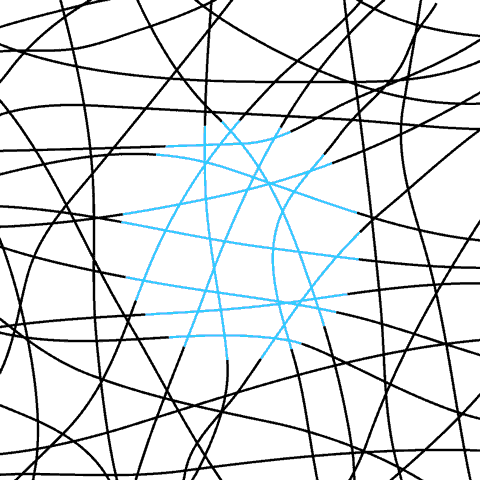 Image: Wikimedia Commons
There’s no blue circle here. The space among the lines is white. In the presence of black lines, the hue of a colored object seems to bleed into the surrounding background.
The phenomenon was first discovered in 1971. It’s known as neon color spreading.