Stephanie Pedersen's Blog
May 17, 2021
4 Things That Are Better Than Work Life Balance
Sure, we all want work life balance. But is it possible?
Do you feel as if everyone has work life balance but you? Do you look at pinterest boards, your instagram feed, and your friend’s facebook posts with a sick feeling of envy for all the calm they have, vacations they take, and fun in their lives? You’re not alone. For a long time I felt that everyone else had work life balance but me. No matter how I tried to arrange my work and my family and my everything else, my life was never balanced. I always had too many tasks, to many requests, to many demands… and too little rest. In other words, too much to do, and not enough to enjoy. In order to create a little me time (and get all my career and family obligations met), I created schedules for myself. Kept a daily to do list. Batched tasks. Read productivity books ad nauseum. Woke up an hour earlier. Went to bed an hour later. And so on.
And still, my life was not my own.
I realized I needed to address my out-of-control life several years ago, on an ordinary, insane day. I sat at my desk in my home office, staring out the window at passing traffic. In the background, I could hear my kids arguing. It was 6 pm and I knew they were hungry, but because of the day’s constant interruptions (texts, PTA emails, calls from teachers, a co-writer who kept calling me to talk about “important” elements of the book we working on, a dog to walk, documents to get into my accountant, and so on), I was late finishing an assignment that my editor needed. To help me, she’d moved the deadline from 5 to 6:30, but told me that if I couldn’t turn it in by then, I wouldn’t be paid. My head hurt, my eyes hurt, my left leg was asleep, my stomach was growling, my teeth felt fuzzy (did I forget to brush them?), and there was a knot in my hair that was distracting me more than the fight going on in the next room.
I looked up at my calendar. I’d written the name of a choral group I’d been waiting for two years to see. They went on at that night at 7 pm. Six months earlier— as soon as I learned this group would be performing in my city—I’d preordered a ticket for myself. Listening to live choral music was one of my favorite activities and it had been years since I was able to do it. But there was no way I was going to be able to complete this assignment, feed the kids and get uptown to the venue where the choir was singing. I yelled in the direction of the living room, where the kids were, telling them to shut up and make themselves sandwiches so I could work. I reached for a pair of earplugs and willed myself to finish the rest of my assignment, ignoring the tears of disappointment that were forming. Why was my life so unbalanced, I wondered. Something needed to give. But what?
Work Life Balance: What Worked For Me
To find out, I spent the following months studying the concept of work life balance. I read studies and books and interviewed all kinds of work and productivity and spirituality experts. I meditated. I journaled. I learned to say no. And what I learned was that work life balance was like the Emperor’s New Clothes. Something everyone spoke about as if it existed. But in truth, few people have ever seen or experienced work life balance. Knowing that I was not the only one who no idea what the heck work life balance even looked like, made it easier for me to find things that worked for me. Here are my top four:
Stop multi-tasking. A ton of research, including from the American Psychological Association, has proved what none of us want to hear: Multitasking affects our cognitive ability. There’s a lag time while your brain shifts attention from one task to another. And while it feels like this shift is seamless, it actually takes time. How much time? Research has shown that multitasking takes as much as 40 percent more time than focusing on one task at a time — more for complex tasks. In addition, there is the unpleasantness of being interrupted when you’re trying to get something done. Every text, email, phone call, Facebook IM, What’s App message was a small, but significant fire, requiring me to pull my focus away from my paid work and my parenting, so that I could douse the flames with my attention. One interruption is dangerous enough to your productivity. A non-stop barrage of electronic interruptions can prevent you from getting a task finished. When you consider that most of us get at least one electronic interruption every five minutes, it’s easily to see why so many of us struggle to complete our daily tasks. And the thing about an incomplete daily task, is it will get forwarded to the next day, to be rushed through so you can attend to tomorrow’s tasks. Once I committed to turning off all notifications (except my kids’ school and my husband), and keeping my phone out of arm’s reach, my ability to finish tasks (and finish them before their deadline) increased. My stress levels meanwhile, thankfully plummeted.Stop using the term “work life balance.” I’m going to let you in on a little secret here: You cannot possibly balance so many things at one time. Not, at least, in the way you balance weight on a teeter-totter. That said, when people ask about life balance, what they usually want to know is how can they have more of what they want and less of what they don’t want. How can you have more pleasure and less drudgery? Personally, I think “harmony” is a better word than balance. To me, harmony means everything is co-existing in a spirit of cooperation. A much less guilt-inducing image than work life balance. After all, who wants to feel like they are the only one who can’t achieve work life balance?Get clear on what matters to you, then focus on that. Ask yourself what you want to accomplish in your life—or in this week or day. And focus 50% or more of your attention on tasks related to that. What do you desire? Focus on it. Or focus on them, because if you are like me, you have several desires going on at once: For me, it’s living healthfully, having great relationships with people I love, running my awesome business, and working on a documentary.Cut the time-sucking tasks that are cluttering your day. If you’ve gotten clear on what you want (see tip 3), you know what tasks are essential. If you need some help in this area, though, you can also ask yourself what is weighing you down? What isn’t serving you? What doesn’t need to be in your life? Have you identified a few things? Now get rid of them. Right this moment. (Or fix them. Pronto.)While there is no such thing as true work life balance, you can call a truce between the things you have to do each day to have a smooth-running, safe, and secure life, and the things you want to do to have happiness, health and well-being.
Go ahead and get clear on what you need to do, and be willing to let go of a few things you don’t. I dare you. And see how much more harmonious your life can be.
Work Life Balance Resources
* American Cozy: Hygge-Inspired Ways to Create Comfort & Happiness (Sterling Publishing), by Stephanie Pedersen. American Cozy was written to help readers create comfort by pinpointing what is important, and easily letting go of what’s not. You’ll find simple, sane, practical systems and tools for creating an easy, powerful, joy-filled life.
* Balance is B.S.: How to have a work. Life. Blend. (Wiley Publishing), by Tamara Loehr. This gutsy book is a case against work life balance, by a brilliant, irreverent Australian author.
* Drive: The Surprising Truth About What Motivates Us (Riverhead Books), by Daniel H. Pink. Sometimes the question isn’t even whether work life balance exists. It is, why am I making myself crazy with activities I loathe? This is a must-read book for anyone whose life is jam-packed with meaningless obligations.
* How to Not Always Be Working: A Toolkit for Creativity and Radical Self-Care (Morrow Gift), by Marlee Grace. Prompts, quotes, and fun exercises to bring you back to center and encourage you to let go of what doesn’t matter in your life.
* Off Balance: Getting Beyond the Work-Life Balance Myth to Personal and Professional Satisfaction, (Hudson Street Press), by Matthew Kelly. What are your thoughts–do you feel that life can ever truly be balanced? Kelly looks instead at the idea of satisfaction to create a life you love.
* Stress Less, Accomplish More: Meditation for Extraordinary Performance (William Morrow), by Emily Fletcher. While this book isn’t going to help you clear off your to-do list, it is going to help you develop the mindset you need to stay calm and focused in the presence of multiple obligations. Do what you have to do, but more easily and more chill.
* The Well Life: How to Use Structure, Sweetness and Space to Create Balance, Happiness and Peace (Adams Media), by Briana Borten and Dr. Peter Borten. According to the Borten’s, the secret to living a sane, livable life–with fulfilling work and leisure, meaningful relationships, and time for oneself–is finding comfort in the face of chaos.
* To Do List in a Book (Go Into Greatness): A simple, brilliant way of deciding what to do—and what to ditch—each day.
* What Happy Working Mothers Know: How New Findings in Positive Psychology Can Lead to a Happy Work/Life Balance (Wiley), by Cathy L Greenberg, Ph.D. While you may not be the happiest of working mothers, this book can help you adopt some of the mindset and behaviors that can help you get through your day in a more comfortable, happier way. Studies have shown that children do better when their mothers are happy, making this book worth a read.
As an Amazon Associate, StephaniePedersen.com may receive commissions for qualifying purchases made through links in this post.


Struggling to succeed? Take a look at your friends.
If you’ve tried everything to upgrade an area of your life with no success, it’s time to step back and look at the people you are hanging out with. Think about the five people you spend most of your time with. Are they positive? Do they leave you reaching for the stars? Do they challenge you to go higher? Are they living their best? Are they motivated, determined, take-action kinds of people?
Or are they whiners? Naysayers? Victims? Do they have martyr complexes? Do they worry for you and about you? Do they complain and gossip and make excuses for their behavior, their lack of success, their situations, their lives?
You’ve heard the saying “like attracts like,” or “you can tell a lot about a person by whom she spends time with.” Or even “if you want to be a better tennis player, play tennis with someone better than you.” There’s even the line from Don Quixote that goes “Tell me thy company, and I’ll tell thee what thou art.”
These nuggets of wisdom point to a universal truth: Your success is influenced by those around you. Even obesity researchers—such as those scientists at Yale who published the famous study— have found that if you hang out with overweight people, you have a 57 percent chance of becoming overweight yourself. A similar study found that if a friend gained or lost weight, you were more likely to do the same.
I challenge to think about who you call friend. Is it time to find a few new, more inspiring chums to hang out with? Individuals who can help you create better health? Push you to higher heights? It may be difficult at first to find these new friends, but keep looking. They are out there. In the meantime, consider getting support from an inspiring holistic health practitioner, take a group class at the gym, or enroll in a whole foods cooking class.
Practice reaching out to people who are already successful and going where these inspiring people mingle. Your success may depend upon it.
Resources
— Want to learn more about this phenomenon? What Got You Here Won’t Get You There: How Successful People Become Even More Successful, by Marshall Goldsmith
— The Healing Power of Friendship: How to Create Your Best Life Through Female Connection (Galleria Publishing), by Deborah Olson. Women thrive on connection, and research studies continue to show that we are happier and healthier when we share close connections with other women. The Healing Power of Friendship will help you avoid toxic friendships, understand the role expectations play in women’s friendships, and learn how power dynamics can hurt or heal these special relationships.
— Belong: Find Your People, Create Community, and Live a More Connected Life (Workman Publishing), by Radha Agrawal. Looking for a tribe to call your own? Here’s how to create one!
— Here to Make Friends: How to Make Friends as an Adult: Advice to Help You Expand Your Social Circle, Nurture Meaningful Relationships, and Build a Healthier, Happier Social Life (Ulysses Press), by Hope Kelahar, LCSW, acknowledges that sometimes it seems as if everyone has a big, happy, fulfilling social life, full of lifelong friendships…except you. As we grow older and school friendships fade, it can be difficult to meet new people and cultivate meaningful friendships. Here’s help.
— Toxic Friends/True Friends: How Your Friends Can Make Or Break Your Health, Happiness, Family, And Career (William Morrow), by Florence Isaacs. Explore the complex interplay of affection, obligation, and competition in women’s friendships and shows how these dynamics emerge between close, casual, or collegial friends confronting life’s ups and downs — career demands, single life, marriage, divorce, retirement, and more.
As an Amazon Associate, StephaniePedersen.com may receive commissions for qualifying purchases made through links in this post.
Get your dream life now using one powerful action
Let’s explore the detrimental state known as “settling.”
Wouldn’t it feel amazing to have the health, the body, the financial security, the relationships, the homelife, the career, and the social network that you dream of? The fastest, most direct way to get any or all of those things is to replace what does not absolutely, completely benefit you with what does support you.
In fact, swapping your negative, health-sapping, success-stopping habits and beliefs with positive, health-supportive, success-creating habits and beliefs is essential to shaping a life you love.
That’s where today’s fast, powerful “assignment” comes in: Explore those things you are merely tolerating in your life. If you’re like most of us, you probably have at least one area of your life that you’re putting up with—for whatever reason. This is so common that there have been actual studies on this, including fascinating research on settling in relationships published in the Journal of Personal Social Psychology. Law of Attraction gurus state that tolerating a less-than-ideal situation tells the universe things are just fine the way they are. That you don’t need to be fitter, healthier, more vibrant. That you don’t need anything better, easier, bigger. You’re doing just fine with what is in your life at the present, thanks very much.
So today, we examine the things that are not “just fine” with you. Get out a piece of paper and a pen. From loose door hinges to sticky points in your relationships, list ten unacceptable situations with the goal of working on them, one situation at a time. Right this minute, choose the easiest item. Commit to doing whatever is necessary this week to take this item from its current unacceptable status to fixed and perfectly fine. If it can’t be fixed, then get rid of it. Quickly. Then move on to the next-easiest item and fix it. And so on, and so on.
It is my hope that you will be revisiting this list regularly, adding and committing to new items, until there is not a single unacceptable situation you are tolerating in your big, bright, vibrant life!
Resources
— The Power of Habit: Why We Do What We Do in Life and Business, by Charles Duhigg talks about how settling is simply a habit—the habit of putting up with something that doesn’t serve you. Habits can be broken!
— Marry Him: The Case for Settling for Mr. Good Enough (Berkley), by Lori Gottlieb, offers up a bit of a contrarian view that good enough really can be good enough. Worth a read for anyone who feels they are settling in their romantic relationships.
— Stop Settling, Settle Smart: Rethinking Work Life Balance Re-design Your Busy Life (Jones Media Publishing), by Dana Look-Arimoto, offers up an interesting take on the idea of settling by encouraging readers to “settle smartly” in certain areas of their lives in order to create a happy life.
— Hustle, Believe, Receive (Skyhorse), by Sarah Centrella, celebrates what the power of focused change can do to turn around a life. While you only need small steps to make a change, this shows you what a dedicated person can do.
— One Small Step Can Change Your Life: The Kaizen Way (Workman Publishing), by Rober Mauer, is a potent guide to easing into new habits—and turning your life around. Learn how to steadily build your confidence and make insurmountable-seeming goals suddenly feel doable.
— Morning Mindset: A Daily Journal to Get You in the Best Headspace Every Day. Change Your Mornings, Change Your Life. A bit of journaling done every morning is a powerful way to create change, see what you would like to improve, and keep motivated. You can use a notepad for this, but a special journal, like this one, is fun.
As an Amazon Associate, StephaniePedersen.com may receive commissions for qualifying purchases made through links in this post.
If you love something, (kind of) let it go
Passionate Non-Attachment? Is that a thing?
It is! It is the paradoxical state known in Law of Attraction circles as “passionate non-attachment” or “passionate detachment.”
Passionate detachment is important in the Law of Attraction world because it ensures that you are so committed to enjoying this moment that you don’t over-focus on something you can’t ever completely control: Future outcome. It’s a fantastic reminder to stay flexible and be grateful for even those outcomes that look nothing like what we expected.
The definition of passionate is “expressing or being ruled by strong feeling.” It is these big, in-the-moment feelings that make it fun to go for your dream. Passion is the car that drives you, the vehicle that enables you to travel the necessary road to manifest your want. Passion is also the energy that alerts the universe that you are serious about your desire. You are not detached about the action itself. On the contrary, you are filled with passion in each passing moment.
Detachment, on the other hand, is about the future. Defined as “the state of being objective, separated or aloof,” detachment requires that you completely surrender and let go of your concern for the outcome of your action.
On the surface, combining detachment with passion seems nearly impossible. But I’ll tell you a secret: It’s doable if you remember that passion is you, sitting in a moving car, windows rolled down, your favorite song playing, being fully present and “in the moment” as you enjoy the sensations of sun, sound, wind and speed. Detachment is your future destination—the restaurant or roadstop or relative’s home you are traveling toward.
Let’s say you want to lose 20 pounds before your high school reunion. You add in plenty of exercise and even work on your “appearance mindset.” You joyfully hit the gym, learn to love leafy green veggies and give up processed food. By the time your reuinion rolls around, you have not lost 20 pounds. What you have done, however, is shed 14 pounds, two dress sizes, and your persistent acne. You’ve also gained great muscle definition and outrageous energy. By passionately doing the work, you traveled from your original out-of-shape life toward great health. Did great health look like the 20 pound weight loss you originally set out for? In this case, no. But what you got was still pretty damn fabulous.
For another view of passionate detachment, have a look at this Hay House article.
Focus on doing your desire’s work and you are guaranteed to be in a better place than you are now—even if that place doesn’t look exactly like the place you originally envisioned.
Resources:
— Passionate detachment is a tough concept. If you need further support, Karen Casey has a number of great books on the subject. Her Let Go Now: Embracing Detachment is an easy (yet powerful) book on affirmations.
— Longing and Letting Go: Christian and Hindu Practices of Passionate Non-Attachment (Oxford University Press), by Holly Hillgardner. This scholarly book offers a deep, theology-based look at the concept of non-attachment.
— First Steps to Freedom: Achieving Non-Attachment in Everyday Life (Harper Collins), by Ronald Shone, is a practiceal guide to achieving non-attachment.
— Let Go Now: Embracing Detachment as a Path to Freedom (Conari Press), by Karen Casey. If codependency is derailing your life, this is your book. Do you ever feel like you might be giving other people too much power over your mood? Do you find yourself feeling immobilized by expectations and demands? The cure for codependency is detachment, says Karen Casey, best-selling author of over forty books that have helped fans around the world.
— Let Go Now: Embrace Detachment as a Path to Freedom, (Tantor Audio), by Karen Casey. This seeming paradox holds the key to your inner peace and that of those around you. This is the audio version of the book, Let Go Now.
As an Amazon Associate, StephaniePedersen.com may receive commissions for qualifying purchases made through links in this post.
Why are you still doing that thing?
“So…if you know it’s not working, why are you still doing it?”
This is one of those questions that life coaches ask a lot—with good reason: It’s a great question! A great question with several great variations:
What do you want for yourself instead of what you’re experiencing right now?Why do you think it is that you do that?What do you have this particular issue?What is truly standing in your way of making that change?What are you doing to achieve your dreams?But what it boils down to, is a way to find out what is stronger: Your habit or your desire. Your need to stay in your comfort zone, or your longing to step into your brilliance. You see, you have a choice. Stay put, do what you’ve always done and get what you’ve always got. Or, try something new and get something new.
Notice I said try something new. I didn’t mention it would be easy. Because it probably won’t be.
Even small change is difficult. Comfort and habit are powerful adaptive measures, designed to keep our early ancestors from venturing too far into unknown territory (which could be dangerous) or trying anything that may shine uncessary attention on them (which could lead in them being seen—and eaten—by a family of saber tooth tigers).
Realizing you are choosing your comfort zone over your desire is a great first step. Knowing you do this may be enough to shake yourself free of comfort’s iron grip.
Or, you may have to do some work around this. Try writing a letter to your comfort zone, explaining what you want to do with your life and how it will benefit you. Or, break down a desire into non-threatening baby steps, then take a single one of these steps each day. Or list the cost of staying in your comfort zone for the next two years. Then list what your life will look like in two years if you brazenly go after your desires. Whatever of these tools you try, letting ago of what isn’t working for you will change your life. For the better.
Resources:
— Want to dive deeper with this fascinating subject? I love I Could Do Anything If I Only Knew What It Was: How to Discover What You Really Want and How to Get It by Barbara Sher.
— Deliberate Discomfort: How U.S. Special Operations Forces Overcome Fear and Dare to Win by Getting Comfortable Being Uncomfortable (Ballast Books), by Jason Van Camp. Deliberate Discomfort follows the journey of Jason Van Camp as a new Green Beret commander taking over a team of combat-hardened Special Forces veterans. This true story tells firsthand the intense, traumatic battles these warriors fought and won, sharing lessons learned from their incredible backgrounds. A cadre of scientists further break down each experience, translating them into digestible and relatable action items, allowing the reader to apply these lessons forged under fire to their own lives.
— The Courage to Be Disliked: The Japanese Phenomenon That Shows You How to Change Your Life and Achieve Real Happiness (Atria Books), by Ichiro Kishimi. Described as “Marie Kondo for the mind,” this book is based on stoic philiosphy. It powerfully makes the point that your past habits do not need to be your present—or your future—habits.
— Imperfect Courage: Live a Life of Purpose by Leaving Comfort and Going Scared (Waterbrook Publishing), by Jessica Honegger. A book written by a women for women, Honegger takes you by the hand and invites you to trade your comfort zone for a life of impact and meaning.
— Taking the Leap: Freeing Ourselves from Old Habits and Fears (Shambala Press), Pema Chondron. Ever feel trapped in the same old habits and painful emotions time and time again? Drawing on time-honored Buddhist teachings on shenpa (all the attachments and compulsions that cause us suffering), Pema Chödrön shows how certain habits of mind tend to “hook” us and get us stuck in states of anger, blame, self-hatred, addiction, and so much more—and, most of all, how we can liberate ourselves from them.
As an Amazon Associate, StephaniePedersen.com may receive commissions for qualifying purchases made through links in this post.
Fear no more. Make a list and face what scares you
Today, we are exploring what I call Your Fear List.
Because how you perceive and handle fear has everything to do with what kind of life you are currently living.
First off, living with a constant, nagging sense of fear stresses your mind and your body. For an interesting look at the biology of fear, check out this scientific article, published in Current Biology. For the purposes of this article, however, let’s use your weight as an example. Your body loves you so much. It senses your fear and wonders if something bad or stressful or even catastrophic is making you afraid. One of the ways the body protects you against any potential threat is with extra weight—I call this “safety weight.” This is stubborn, won’t-budge weight that your dear body refuses to let go of just in case an emergency looms near.
Fear also leads to unconscious, subtle (or not-so-subtle) self-sabotage. You say you want to be at your goal weight. You say you want to go for that promotion, lower your cholesterol, repair your relationship with a family member. You say this, but these nagging fears of yours hold you back. They cause you to skip the morning pages, the daily exercise, the conversation with your boss or a loved one that can affect change. They lead you to the sofa, to the carton of Ben & Jerry’s, to health-sapping relationships, thoughts and behavior.
Enter Your Fear List: Get out a piece of paper and writing implement. List all of your fears. Definitely list the big ones. But also list the medium ones, the small ones, the insignificant ones. If you need to get a second (or third) sheet of paper, do so. Get every single thing you dread onto the page.
Explore this list. Make a commitment right this minute to tackle your fears. Each and every day. Start with the small fears. Each day, explore one, confront it, free yourself from it. The larger fears—such as fear of swimming or public speaking—may require several steps performed over several days or weeks, including lessons, professional help, and tons of practice.
You’ll find that as you move through your list you’ll begin to feel braver and braver. You’ll also feel lighter, wiser, more intuitive, more open, and (yes!) thinner and more attractive! You’ll find it easier to honor your commitments when you don’t have all that fear holding you back. You’ll also learn to respect fear for what it is: An evolutionary mechanism designed to keep you safe—and often stuck. This greatly diminishes the charge fear has on you.
Resources:
— Face Your Fears: A Proven Plan to Beat Anxiety, Panic, Phobias, and Obsessions, by David F. Tolin, offers a way for the perpetually fearful to find the peace necessary to create a comfortable life.
— Love over Fear: Facing Monsters, Befriending Enemies, and Healing Our Polarized World (Moody Publishers), by Dan White Jr. Whether it’s the news, social media, or well-intentioned friends, we’re told daily to fear “others.” We fear strangers, neighbors, the other side of the aisle, even those who parent differently. And when we’re confronted with something that frightens us, our brain sees only two options: Run or Attack. But there is a third option.
— Fear (HarperOne), by Thich Nhat Hanh, explores the origins of our fears, illuminating a path to finding peace and freedom from anxiety and offering powerful tools to help us eradicate it from our lives
— Fear is Fuel: The Surprising Power to Help You Find Purpose, Passion and Performance (Rowman & Littlefield Publishers) by Patrick Sweeney II, explores fear’s positive side. Fear is Fuel discusses the underlying phenomenon that heightens awareness and optimizes physical performance, and can drive ambition, courage, and success. Harnessing fear can heighten emotional intelligence and bring success to every aspect of your life.
— Feel the Fear… And Do it Anyway (Ballentine Books), by Susan Jeffers, is a classic in the world of self-help. If you haven’t yet read it, pick up a copy! ADr. Susan Jeffers inspires us with dynamic techniques and profound concepts that have helped countless people grab hold of their fears and move forward with their lives.
As an Amazon Associate, StephaniePedersen.com may receive commissions for qualifying purchases made through links in this post.
Got a minute? Here’s how to reduce your stress!
Stress is one of the top health hazards we face today. From politics to personal finances to global health, there is a lot that we worry about (check out this illuminating round-up of stressors from The American Institute of Stress.) Unfortunately, it’s impossible to go through life without the irritations that make us tense. Fortunately, there is something you can do to minimize their power to aggravate you. It’s called deep breathing, and it can be done anywhere and anytime you need to calm and center yourself. Here’s how to do it:
1. Inhale deeply through your nose.
2. Hold your breath for up to three seconds, then exhale through your mouth.
3. Continue as needed.
Deep breathing pulls a person’s attention away from a given stressor and refocuses it on his or her breath. This type of breathing is not only comforting (thanks to its rhythmic quality), but also has been shown to lower rapid pulse and shallow respiration—two temporary symptoms of stress.
If you’re interested in experimenting more with breathwork, one of my favorite breathwork books is The Breathwork Experience: Exploration and Healing in Nonordinary States of Consciousness, by Kylea Taylor. A great audio is Dr. Andrew Weil’s Breathing: The Master Key to Self Healing (The Self Healing Series)
Resources
—Stress Less Cards: 50 Mindfulness & Meditation Exercises to relieve stress and anxiety, are an unusual, very effective way to combat bouts of stress. Pull a card, read the prompt, and commit to completing the action. You’ll feel instantly better.
—Poetry may seem like an odd suggestion for stress relief, but immersing yourself in the power of words—chosen with care, love, and purpose–is tremendously relaxing and gives one a sense of calm and hope. Your local library is a great source of poetry collections, but if you need a recommendation, take a look at 101 Famous Poems (McGraw Hill Education)
—Aromatherapy is an easy, on-the-spot way to feel better. Organic Stress Relief Blend Roll On Essential Oil Rollerballis a no-mess, calming blend of essential oils that can be carried with you.
—The Breathwork Experience: Exploration and Healing in Nonordinary States of Consciousness, by Kylea Taylor, is a fascinating look into using breath to feel better.
–Audios provide an easy way to work through stress. I like Breathing: The Master Key to Self Healing (The Self Healing Series)
As an Amazon Associate, StephaniePedersen.com may receive commissions for qualifying purchases made through links in this post.
Books that make you better: Essentialism
Every feel like the more you do, the further away you get from your dream life? Recently, a dear friend recommended I read the book Essentialism: The Disciplined Pursuit of Less, by Greg McKeown. I bought it, tucked it in my handbag, and ignored it. But as I watched my friend’s life change in enormous ways by committing to one thing and getting rid of things that stood in the way of that commitment (the book’s central message), my interest piqued. I began reading, one chapter per night.
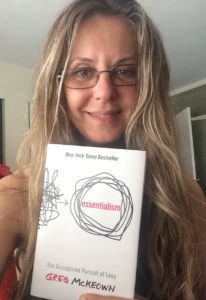
I won’t give away all of McKeown’s secrets (you can go to his website for more), but the book’s premise is that you can become a more powerful force for good (and experience a new level of calm and joy) if you get rid of those things (activities, commitments, people, items, beliefs, etc.) that don’t serve you. Even if those things are things you feel an obligation around or (perversely) things you enjoy.
Each night I fell asleep with “aha’s” swimming in my thoughts. At one point in the book, McKeown asks you to commit to a single priority and get rid of anything that gets in the way of that commitment (again, even if it is something you enjoy; if it clashes with your commitment, it goes—at least temporarily).
I committed to my kids.
As many of you know, I am the mom of three boys. WHen I read Essentialism, they were 15, 13 and 9. Each is facing interesting (and kind of boring) challenges. Each is being given huge opportunities to grow, face fears, do the right thing, and to course-correct after doing the wrong thing.
There is a belief that as children grow into their tween and teen years, they need adults less. What I was finding, however, was the opposite: My kids needed me more. My job as a parent is to help createkind, proactive, thinking adults who spend their time on this planet making a positive difference. That will not happen if I steal away my sons’ ability to navigate the NYC subway or if I email their teachers for them or rescue them from a series of uncomfy interpersonal exchanges at school. While I was in no danger of intruding upon my son’s learning opportunities, it became clear that I had gone too far in the other direction.
In other words, I was the furthest thing possible from those helicopter parents so many people mock: I was forcing my kids to tackle so much on their own that they were getting scared or, (depending upon the kid), surly. My constant busyness was keeping me from being with them after school and in the evenings—the very times when each of them was showing their vulnerability and taking a chance on telling me the scary things they were facing in their lives.
Up until I read Essentialism, I worked every waking moment. At the time I was a nutrition counselor and I saw clients in the morning and early afternoon, then I returned home, where I wrote at night, often letting the two boys I have at home (my then-13-year-old was at a boarding school for choir boys, so at the time I had just my 9-year-old and 15-year old at home) alone to eat the meal I made for them, do their homework, practice their voicework and instruments and get their stuff ready for the next day. When they would wander into my home office, I would listen to them distractedly or (I am so ashamed!) even ask if we could table the conversation for later because I had to get something to my editor. Usually they would mumble an okay, but hover behind me (for an uncomfortably long time!), as if they were hoping I’d change my mind, turn off my computer and chat, with them. Alas, I rarely did this. And while I didn’t miss many writing deadlines, I did miss many opportunities to support boys who were emotionally struggling—even hurting—with confusing activities or relationships or exchanges happening in their daily lives.
After committing to make my boys my priority, I realized something had to go. I am an often-solo parent (my husband lives and works in another city, returning to our family home on weekends), so I am in charge of every kid-related activity and responsibility you can think of—plus running the household, walking the dog, paying for the math tutor, feeding everyone, managing schedules and earn the money we need to pay for everything from groceries to new socks to tuition. Which is fine: I enjoy working immensely. I repeat: I enjoy working immensely. But I realized I had to do less of it if I wanted to focus more on my kids.
Lucky me! Around this time, I was hired to write two books for a well-known publisher. Suddenly, I knew exactly what to do to make my commitment work: Give up seeing clients and use my mornings and early afternoons for writing. My nights and weekends—suddenly freed up from work—would be spent “being there” for the kids.
You read the above correctly: I gave up seeing clients. Quietly I stopped marketing my nutrition sessions, my detox groups, my Wellness Circle, and more. I stopped going to BNI meetings and other network meetups meant to find referral partners and ultimately, new clients. I went weeks without jumping on my business social media accounts. I declined “get to know you” coffee dates with other professionals who wanted to learn about my nutritional counseling.
I can’t tell you that letting go of nutritional counseling was easy. I am great at coaching people. I am a deep listener. I know nutrition inside and out and find it fun and easy to pinpoint just the thing that can help you lose weight or heal a health condition. But, like McKeown says, just because you’re good at something, and just because you enjoy something, doesn’t mean it is going to help you stick to your priorities.
Have I seen differences in the boys since making them my priority? Yes! One’s constant anxiety has eased up as I share my struggle with childhood anxiety and give him the strategies I used as a young adult to face fears. Another one has suddenly begun doing his homework on his own! Another’s rebellious attitude toward teachers has changed to a curiosity about them, once I shared with him how my knee-jerk youthful rebelliousness led to very specific not-fabulous outcomes. Plus, I have learned Common Core math, one of the things I was insisting my math-challenged youngest child tackle on his own because I didn’t have time at night to support him.
So why I am sharing all this? Because you’ve been with me, as a subscriber, perhaps a client, and as a friend, for awhile now and you are going to be seeing a change in what I send to you, what I talk about, and what I share on my social media accounts. We have Essentialisms, by Greg McKeown, to thank.
As an Amazon Associate, StephaniePedersen.com may receive commissions for qualifying purchases made through links in this post.
Fight Back Against the Ultimate Time-Suck
Procrastination is one more cup of coffee. It is one more load of laundry. One more unnecessary celebrity news story or Facebook post or interesting blog. It is picking up the phone call or answering the text that you know you probably should not. It is the needy friend who you’ve already given so much to and yet, perhaps unsurprisingly, still needs more. It is grocery shopping during those precious few hours you’ve given yourself to work. It is staring blankly at a wall or a screen or your cuticles for longer than you need to, instead of just starting. Call it a lack of focus, difficulty concentrating, inattention, or just plain old laziness, procrastination is the ultimate time-suck, which steals your motivation and makes it difficult to live the live you want to live.

Time continues to move forward. Whether we move with it, is up to us.
At the very base of it, procrastination begins with a moment of hesitation, that then spirals into an extended period of catatonic, brain-foggy, unremarkable, non-productiveness.
Merriam Webster defines procrastination as the action of postponing or delaying something. And we do it for all kinds of reasons, some common to humankind, some unique to you.
One of my greatest procrastination triggers is having someone in my office (a corner of the master bedroom that features a desk and filing cabinets) when I am on assignment. If someone is lurking about, I stop writing and start answering emails, and updating my calendar, and cleaning out files on my hard drive until this person leaves and I can return to my writing. By then, hours may have passed and I have missed my deadline. So my behavior actually affects not only my output, but my income. Which in turn affects my entire family.
A more common cause of procrastination is feeling we need to “be there” for a friend or family member who is only all too happy to call or text you during work hours so you can be her sounding board, his cheerleader, their life coach.
Or you tell yourself that your hesitation is a mental health break, a moment to clear your head and enjoy the gorgeous tree outside your window. (Two hours later when you’re still staring at the tree, however, your mental health break has veered into full-blown procrastination.)
In the greater scheme of things, one or two days lost to inaction really aren’t so much of a big deal. But what if you’ve lost a week? A month? A year? A decade?
Or a lifetime?
You see what I’m getting at?
It’s not the things we do that make it hard to meet our goals and give life to our dreams. It’s the things we do all the time that make it challenging to meet our goals and give life to our dreams.
Put in another way: Losing a lifestime to procrastination can mean there is no time left for you to create your dreams and enjoy your desires.
For proof, just look at the power of water droplets. A trickle of water, after a decade, can split a rock. A trickle of water, after a millennia, can create a canyon.
That realization has hit me hard.
I am not someone whom you would think of as a slacker. I have written more than 20 books. I was a nutrition counselor and a life coach for many years. I am involved in charitable works. I have three very busy showbiz children whose careers I manage. Due to my husband’s job in another state, I am also a solo parent four or five days each week. In other words, there is a lot going on in my life. So much so, that I could easily pretend that I have achieved everything I have set out to create.
But I would be lying. In truth, there is a lot I desperately want to bring into the world, but due to my own inaction, I have not yet created.
Such as:
A best-selling non-cookbook, non- health book, which requires a best-selling publicity campaign. (Which in return requires a bit of work on my part!)A regular, radio show—one that generates income.A yearly telesummit interview series.A YouTube television talk show.A Broadway musical.A television series.A creator’s lab/retreat center.I take ownership of every single one of these things that I have not created. It would be so easy for me to blame the kids’ schedules, the lack of parenting help, and the needier people I have in my life for “using up” all of my work time.
I can’t do that, because I know—without doubt—that I am the reason I don’t have everything what I want.
When an acquaintance mentioned Mel Robbins’ five-second rule, and how it helped him overcome procrastination, I listened. Mel Robbins’ five-second rule is basically counting backwards from five the moment you feel yourself slipping into inaction.
Go here for a YouTube video about the five second rule.
Go here for a look at Mel’s Robbins book, The 5 Second Rule.
The five second rule works because it bypasses your brain which often pulls you down into fear-based inaction. “Your brain is designed to keep you where you are right now, because it is safe,” says Robbins, explaining why doing something new is often so hard.
Think of when you were a child and you were walking home with a friend from school and one of you would suddenly blurt out “Race you to the corner! Five, four, three, two, one, go!” And without even stopping to think—about whether or not it was a good idea to race to the corner, or that your friend was faster than you and you’d probably lose, or that you were wearing shoes that pinched your feet—your body would take over with no input from your brain whatsoever and your legs would immediately begin sprinting to the corner.
According to Robbins, hesitation can turn to procrastination: that split-second when you hesitate can grow into an hour of web surfing or a half a day of mindless whatever.
What I find what I find is if I can bypass that moment of inaction, procrastination does not have an opportunity to gain a foothold.
We all have our reasons for hesitating.
I hesitate when I feel overwhelmed. Hesitating—and then procrastinating—is how my subconscious intentionally lightens my workload. If I am busy “researching” something on the web, I can’t complete my kid’s work permit forms. If I am searching for seventh or eighth or eleventh expert opinion regarding whether or not my teenagers should have paying summer jobs, I can’t answer those half-dozen very lengthy client emails. If I am spending hours of (un)necessary research on summer camps, I get to feel busy while simultaneously not finishing up the overdue manuscript that my editor has been begging me to complete.
Here’s where I share that confession I promised. This example comes to you from my own life, circa October 217. I was four months away from turning in a manuscript for a dream book that was to be published Fall 2018. I was so late in finishing, in fact, that my publisher almost scrapped the project. Why was I so late? Because I was busy procrastinating with “family related stuff.” I procrastinated so severely that weeks would go by without me even writing a word on that manuscript.
This was a book I fought to write. A book that could launch me out of the health world that I feel ready to leave behind. A book on a topic that I grew up with, that I adore, that I want to share with the world. A book that I was tremendously excited to write. But, at the same time, I felt so overwhelmed with caring for my family, that I began to feel resentful of having another thing on plate. I didn’t want to deal with another task each day—even if it was my dream project. So I procrastinated, making snacks that my kids could have made themselves, picking up children who could have walked themselves home, wiping noses that could have been left alone. In the end, adopting he five-second rule stopped my frequent hesitation, and redirected me back to the writing (and away from the kids, who really did not need me to be constantly swooping in.) In the three weeks I used this technique, I wrote five chapters, finishing the manuscript and turning it in to my editor.
What I learned in this process is that the procrastination that came from hesitating was threatening to become more important than my goal of writing that book. Does the five-second rule work for everyone? I have no idea!
If you do try it, stop in here and let me know how it worked for you. Or, if you have another procrastination-busting tip, share it in the comments below! I am always looking for ways to make getting my work done even easier!
Procrastination Resources
The 5-Second Rule: Transform Your Life, Work and Confidence Witih Everyday Courage, by Mel Robbins, teaches you how to use the “five second rule” to bypass procrastination the moment it starts. Easy and effective!The 5-Second Rule Journal, by Mel Robbins, features prompts, inspiration and plenty of space for lists, to help make your dreams a reality.Eat That Frog: 21 Great Ways to Stop Procrastinating and Get More Done in Less Time, by Brian Tracy. This self-help favorite espouses getting your least favorite tasks done first, so you can sail through the rest of your day.Get Sh*t Done motivational poster. I am a big fan of surrounding myself with motivational props, and this poster is one of my favorites. It’s funny, irreverent, and to-the-point.Music for Studying: Instrumental Learning Collection, by Moonlit Records. The right music energizes me and makes me both focused and relaxed. I especially like this collection when I am writing.As an Amazon Associate, StephaniePedersen.com may receive commissions for qualifying purchases made through links in this post.
September 25, 2018
Meet Your Soul

Hello!
If you have ever wondered what inner resources may be available to you to help you achieve your deepest desires, The Soul Mentor, Christiaan Oranje, can help. Here is an interview I have done with him. Have a listen!
https://stephaniepedersen.com/wp-content/uploads/2018/09/ChristiaanStephanie_Edit.mp3