Roger Gordon's Blog
February 4, 2020
THE DREAMER
To die, to sleep–to sleep, perchance to dream…(Hamlet)
“Roger. Wake up. You’re having a bad dream.” My wife, Alison, is shaking me to snap me out of yet another episode of sleep paralysis. My eyes are wide open, but I cannot move my limbs. I’m in a catatonic state. Over in the open doorway to the bedroom, there is a terrifying presence. It evinces evil, yet I cannot see any form to it. Eventually, once my arms and legs become free to move, I make my way to the washroom to shake off this awful episode.
I have this kind of dream once in a while. There is no obvious correlation between having them and my state of mind at the time. But, the more common type of dream that I have is one that has a storyline embedded within it–a storyline that is rooted in my past, mostly my childhood, with present day figures thrown in for good measure. Accordingly, the setting for most of these dreams is Sheffield, England. I am attending High Storrs Grammar School or Sheffield University, either as a pupil, teacher, or visitor. I often forget that I’m supposed to be teaching a class or taking an exam, so that I adopt the characteristic of ineptitude. In one dream, the semester was almost over before I realized that I was supposed to be teaching the class.
Not all of these dreams are situated in my childhood. Memorial University of Newfoundland (MUN) and less often, Simon Fraser University (SFU), feature in some of them. While I am just as forgetful and neglectful about my responsibilities as I am if I were teaching in England, the Newfoundland dreams take an odd twist. I persuade the Head of the Biology department, a department that I was a member of between 1971 and 1997, to give me an office so that I can recommence my teaching and research programs. Of course, the 2020 Roger Gordon knows hardly anyone in a department that has undergone a complete change of personnel in the 23 years since I left. But, there are people whom I do know, ones who drop in to see me. These include my former postdoctoral Supervisor at SFU. John Webster, and a good but deceased former friend and colleague of mine, Bill Threlfall.
A fair number of my dreams about Sheffield University embody a sub-theme of rejection. I decide to return to Sheffield to study a different discipline than Biology, my area of expertise in real life. I encounter two of my former friends, fellow members of the Addy Street Five jazz band that I used to belong to–that is, until a guy who was so much more accomplished than me took my place in the ensemble. Just as in real life, I am rebuffed in my dream. My trumpet playing is not of the calibre of the guy who had actually replaced me in the band all those years ago in real life. I felt deeply hurt then and still feel that way in my dreams. Since this dream replays so many times and given the depth of feeling that I undergo within the dream, perhaps I was affected by the actual incident more than I had realized.
In my SFU dreams, I am a contented researcher in its Biological Sciences’ department. Strangely, I have not dreamt about the University of Prince Edward Island, where I was happily employed as Dean of Science from 1997 to 2006.
Benign dreams, in which I am eating, are common within my repertoire. Usually, I am at a scientific conference. John Webster is there, as are a large number of people whom I do not know. Other than the fact that food is important to me, and that much of the business at conferences occurs at the dining table, I can’t attach much significance to these dreams.
The types of dreams I have discussed are all connected with my career. I have many dreams that involve my past as they bring into play my unhappy childhood. In a weird combination of the past with the present, Alison, my young children, and I decide not only to live in England, but in the actual corporation estate house in which I spent my teen years–the house of unhappiness in which my parents’ marriage broke up. I can’t recall anything significant happening after we move into the home, nor can I offer insight into why we decide to do it. Many dreams have an element of absurdity built into them and this is just one of those.
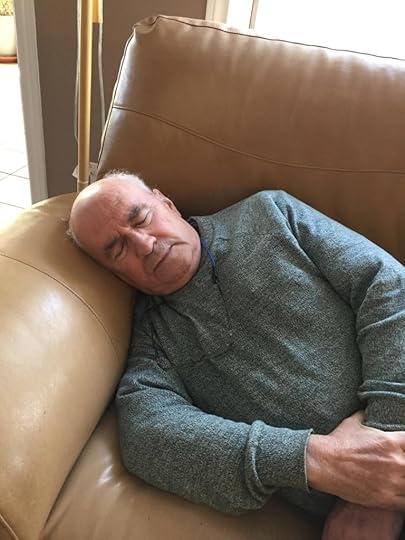
“To die, to sleep–to sleep, perchance to dream (Hamlet).
All of my dreams are vivid and in technicolor. That’s the result of the panoply of antidepressant medications that I take. I don’t know what to make of them, nor do I think it useful for me to ponder and analyze. There are experts who analyze dreams; others think they are just random experiences stored in the hippocampus. For me, they just happen. When I go to sleep at night, I embark upon an adventure. For better, or for worse.


May 21, 2018
WITHDRAWAL FROM ELAVIL: ON PARADISE ISLAND?
“The dirtiest little secret of all is the fact that antidepressants are among the most difficult drugs to taper off from, more so than alcohol and opiates.” (Kelly Brogan, M.D. 2016. A Mind of your Own. Harper Wave publ.)
Elavil is a commonly-prescribed antidepressant. “Included below is a list of some of the most common symptoms that occur after amitriptyline (Elavil) cessation. …anxiety and panic attacks…blurred vision..brain zaps…dizziness…heart palpitations…insomnia…irritability…suicidal thinking.” ( https://www.4mind4life.com/amitriptyl... ).
Listen up everyone, my name is Reg and I’m your happy tour guide over to Nassau. It’ll take 10 minutes and I’m gonna make it interesting for you. So, at the count of three I want everyone to say ‘Yaman.’ One..two…..”
The small craft carrying a couple of dozen or so passengers pulls away from the dock on Paradise Island and put-puts toward a group of monstrous cruise ships anchored just off the capital city of the Bahamas. On another bright sunny, cloudless day, replete with a refreshing breeze, I look back to see the fronds of coconut palm trees waving us off. I look down at the aqua blue, clear water, which I’ve been told is caused by the sun’s reflection from the sea grass on the sandy bottom. The scene around me is amazingly beautiful. Then, my mind starts to wander off in a different direction.

It’s been three whole nights, I’m thinking. Three sodding nights without that effing
Elavil. How have I done it? I’ll damn well keep going.
My wife Alison and I had arrived at our hotel and, after a long day travelling from PEI, I had forgotten to take the miserable pill on the first night. The next night, I didn’t bother. Yet, I slept. Soundly. My mouth felt normal, no longer a cavity lined with cardboard and bearing a leather strap, otherwise known as a tongue. At night, sweet, harmless dreams, eclectic meanderings of a contented mind. A combination of lowering the offensive drug in my system, together with the stress-free atmosphere of this place, caused me to feel so relaxed. For some unfathomable reason, I took the wretched thing on night three, along with several glasses of cheap red wine courtesy of my “all inclusive” package at the hotel. That night was horrendous for both of us. I dreamt I was trapped in the room of a house that we used to own in Newfoundland. Nobody else believed it was haunted. But the ghosts screamed at me. Our dog barked. It knew what everyone else couldn’t get.
“Nooooooooo!”
“Roger, wake up. You’re screaming,” said Alison as she shook me. I stumbled to the washroom, then piled back into bed. Back into the same dream. This frightening and disruptive scenario played out several more times for God knows how long. Next morning, we both felt like we’d been on an an all-night bender.
If I can manage the first two nights without the pill, why for God’s sake did I go back to taking it? I’ll carry on without it.
 By Lambrook24 – Own work, CC BY-SA 4.0, https://commons.wikimedia.org/w/index.php?curid=36783128
“And when you get into Nassau, you must try some conch salad,” says Reg, a young Bahamian man with a keen eye on his tips. “Why? Because conch is an aphrodisiac and I see some tired older men on this boat. Conch salad. Enjoy.”
“Maybe everyone should take it,” I pipe up.
“Yaman. Ladies, you too, try some conch….”
Oh, joy. This is what the real world is like. Calm, lucid, funny–and all with a moist mouth. After three nights, I feel free. No longer shackled. How I hate that rotten medication, with its evil, vivid dreams, horribly dry mouth, and pound after pound of fat that it causes me to pile on my less than robust frame. I’m just not built to be the Michelin tire man. Besides, I’ll break the bank buying new clothes that fit.
***
“Look out the windows on the right hand side, you’ll see a shark resting on the sea bed.” We’re in a strange kind of flat-bottomed boat, with a hull that has windows on either side so the passengers can see fish swimming by. The guide is just as loquacious as all the others and draws from the same barrel of one-liners.
“What’s the funniest fish in the sea?” he intones.
“A clown fish,” chimes a ten-year-old lad.
“Young man. I must see you afterward. All my jokes are protected by copyright,” the guide deadpanned.
Damn. I can feel the anxiety coming back. Queasiness in my stomach, just a tinge of cramps in my calf muscles. It’s been five nights now. Withdrawal symptoms kicking in. Could get worse. Still a few days left in the holiday. What to do? Only one thing I can. Shit.
So, with greatest reluctance, I started back on the pill again. Half dose. A compromise. I’ll tail it off gradually when I get home.
The rest of the vacation went fine. We sipped Burgundy wine on Cabbage Beach, caught fish (each of us) from the dock by the hotel, visited friends of ours from way back in Newfoundland. They were in charge of the Salvation Army in the Bahamas. Doing a great job. Running a K to 12 school for blind children, providing after school access to computers for regular kids whose families couldn’t afford them, gave a cooked breakfast to street people. Quite a contrast from the mansions owned by the rich folk on Paradise Island, but inspiring.
We swam in the outdoor pool at the hotel, partook of the occasional cocktail, refraining from all-day drinking that some patrons indulged in. We waved at passengers on the “Booze and Cruise”-titled boat that came chugging past our hotel regularly. Wayward souls yelling and shouting, hanging over the rails of the ship, glasses in hand. Whatever turns one’s crank. Did they sign a waiver form?
Most important, I didn’t look upon my unplanned attempt to come completely off Elavil as unsuccessful. I had proven I could do it, given the right circumstances, which were not while on vacation. Prior to the holiday, I had tried four times to come off this lousy drug, with no success. But, my five nights drug-free made me believe I can see daylight ahead. I’m half way through my half dose on the drug-tapering regime set by my psychiatrist. Though it’s not been plain sailing, soon I’ll be down to a quarter, then free. I know this will happen.
July 28, 2017
DEPRESSION: DRUG WITHDRAWAL
I am a drug addict. I am not part of the recreational drug scene. Those drugs–speed, crystal meth, cocaine, heroin and its countless variants–hold no allure for me. During the giddy ‘60s, I did take a puff or two of weed, and I don’t mean dandelions. Didn’t everybody? But, that’s as far as my foray into la-la land went. Yet, I insist that I am a drug addict. Does that sound a bit melodramatic? Why?
The simple answer is that it’s hard not to be addicted to drugs if you suffer from some form of mental illness. In my case, endogenous clinical depression rears its ugly head episodically, and I am forced to submit myself to the standard treatment of drugs, drugs, and more drugs. The problem with this is that while it is relatively easy for most people to take all these pharmaceuticals on board, it is not so easy to rid the body of them. As occurs with any drug, whether it is acquired on the street or through a doctor’s prescription, withdrawal symptoms can occur when the doses of them are tapered, even gradually over time, as part of the recovery treatment. Nerve circuits that have become accustomed to being fed the drugs cry out for more when they are withdrawn.

In my case, I was discharged from hospital on a daily regime of five different medications, one to be taken in the morning, another to be taken up to three times daily, the remaining three to be taken before bedtime. I was taking between seven and ten pills a day. Once I started to feel better, I set about trying to reduce my pill intake, so that my liver could be given some respite. After five months, I had weaned myself down to two pills a day; one in the morning, one at night. However, it was not an easy journey to get to this point due to recurring bouts of insomnia.
All that remained for me to do was to eliminate the one pill that was left from my cocktail and I would be on the same maintenance regime that I was on before I became ill–just one pill in the morning. However, when I tried cutting the remaining night time drug to half a pill, insomnia recurred along with anxiety. I started to feel unwell again. So, I’ve decided to place a temporary stop on my drug reduction program until I have the inner resources to tackle that one remaining pill again.

Since I was quite ill some five months ago when I was placed on this panoply of pills, I really can’t criticize the well-meaning and highly-trained medics who prescribed them. It’s the way that psychiatry deals with mental illnesses. Pop the pills, let them do the job. After all, the whole area of psychiatric medicine is so grossly underfunded by governments, so pitifully resourced, that the “quick fix” approach has become the first line of treatment by default. How can it be otherwise when governments spend billions of our tax dollars on bypasses and roundabouts that we don’t need, short changing areas such as mental health? Shameful, indeed.
It is time that governments remember who elected them in the first place and bring their priorities in line with those whom they are elected to serve. They need to re-direct monies within the public purse so that the one in five Canadians who will suffer from a mental illness during their lives can receive the most basic of services. Then, building upon such an improved system, a more comprehensive, less drug-reliant treatment plan can see the light of day–alternative or complementary treatments such as acupuncture, breathing exercises, meditation, yoga, naturopathy, group activities. To deal with my drug withdrawal problem, I am experimenting with the first two on this list. But, there is no government coverage for such therapies, so low income people are unable to access them.
There is wisdom in the biblical concept that our bodies should be treated as temples. They are not sinks into which all manner of chemicals should be dumped. The liver should not be called upon to detoxify an unreasonable load of manufactured drugs that do not exist in the natural world. With a broader approach to treating mental illnesses, made possible by enhanced funding to this much neglected health area, it is my hope that fellow sufferers do not become drug addicts like myself.
February 8, 2017
INSOMNIA AND DEPRESSION: MY PERSONAL STRUGGLE
I wonder how many people really understand the meaning of the term “depression.” In everyday parlance, people use it as a synonym for melancholia, usually a temporary state of mind linked to some unhappy news or low pressure weather event. Nothing wrong with that. To coin the cliché, context is everything.
I wish there were a different word to describe the condition that I suffer from, endogenous clinical depression, because there is a tendency to downplay it as a serious medical problem. “Oh, not feeling the best are you?” I recall the male nurse saying to me one sunny Saturday afternoon a few years ago in the triage office at the E.R. down at the Q.E. Hospital in Charlottetown (PEI). “Maybe just a change in medication will help. We’ll soon fix you up.” Right. Six and a half hours later, having watched numerous patients skip the line ahead of me with cuts and bruises visible to all and sundry, I was still waiting. My symptoms were hidden. How convenient. And after all, what did it matter if I hadn’t slept at all for a whole week? My wife, Alison, took my pulse and discovered that it had skyrocketed during the wait. Being a nurse herself, she was able to talk to the triage staff and get their attention. I did manage to get a knockout prescription and slept that night.

Sleep and depression are intertwined in a vicious circle. I am willing to accept that there are many people who suffer from insomnia who are not depressed. But, those of us who are depressed need sleep and if we don’t get it, we become anxious, which in and of itself prevents sleep, which exacerbates the depression, and on it goes, around and around. Sleeping medications can help, but if taken over time, they can become habit forming and the body becomes habituated to them. They don’t work. I worry about this, but my psychiatrist, one of the top professionals in his field, keeps re-assuring me I’ll be alright.
I even bought a book on how to sleep, authored by a specialist. She advises not to go to bed until one feels tired. But, I am a creature of habit and besides, I can only take so much of CBC’s Peter Mansbridge. Don’t read in bed, she says. Read in another room before you go to bed. Hello. I like reading in bed. If you can’t sleep, get out of bed and do something. She even mentions washing dishes. At three in the morning? Are you kidding? Bed, she says, is for sleep and sex. Hasn’t she heard of multi-tasking?
So, while I haven’t thrown the book away yet, I’m reading it with a critical eye. I’m on the waiting list to go to the sleep clinic in Halifax (Nova Scotia), where they’ll attach electrodes all over me, as though I’m about to get zapped into the great unknown. And they’ll undoubtedly come up with a physical cause, like sleep apnea, and provide me with a sleeping mask to cover my face, so I’ll look like Hannibal Lecter. Such an outcome would leave me pondering why, if the problem is my not getting to sleep in the first place, would a solution be for me to wear something to stop me waking up.
One psychiatrist told me that 90 per cent of recovering from depression is rooted in being able to sleep properly. Do you have any tips or thoughts to offer on fighting off insomnia?
November 26, 2015
Divorce in the 1960s: UK
When I write or talk about my memoir “Starting to Frame” I refer to my parents’ divorce as one of the “stigmas” of the day. My parents separated in 1961. Their divorce was culminated a year or so later. But, why would divorce have been a stigma, given that nowadays a conservative estimate of the divorce rates are 42% in the UK and 48% in Canada, where I live.
First, divorces were not the norm in 1960s Britain, which still operated under the 1937 Matrimonial Causes Act. One partner had to prove against the other commission of a matrimonial “offence” of cruelty, desertion, adultery, or incurable insanity; no divorce at all was allowed within the first 3 years of marriage. It was only in 1969 that the divorce laws were changed to allow a “no fault” option. Do you see how the system was set up in a manner that conveyed the sense of shame and guilt?
To add insult to injury, the status of divorce proceedings were published in listed form and with the cause included in the local newspaper, much like the Births and Deaths columns. Since there was a decree nisi (provisional granting) followed 6 months later by a decree absolute (final), this was public shaming twice over.
Cast against this backdrop, when my parents separated and divorced, the community around us looked at us with disapproval. One night, while we were asleep, someone tipped the contents of the dustbin (garbage bin) all over the yard. Because marital infidelity was involved on the part of my mother, I was made fun of at school and had to listen to my mother being called names that I would not wish to print on here. Would the taunting have been so virulent had it been my father who was “unfaithful?” Or might he have been given an easier ride; just being “one of the boys?”
Then, aside from the societal indignation, there was the fact that in my parents’ case, it was a fractious, highly destructive breakup that necessitated my brother and I having to take sides. This would have been hard to take regardless of the era.
Divorce is a messy business. Perhaps it doesn’t have quite the “stigma” that it used to have, but there is still a responsibility on the part of the couples involved to insure that their children do not become participants in the drama of antagonism. Trust me. Healing doesn’t come easy. “Starting to Frame” depicts the fallout from my parents’ divorce and how a measure of healing was accomplished.
http://www.amazon.ca/s/ref=nb_sb_noss?url=search-alias%3Daps&field-keywords=starting+to+frame
March 18, 2015
Marketing my book: a labor of love
Especially when an author self-publishes, as I have done, writing the book is just the beginning. First, there is the need to select a cover, page style and formatting software for it. In my case, I opted to hire a cover and page designer, as I am IT-challenged. But, once the book is up and running, the real work begins – marketing the book.
A successful launch, imaginatively designed to appeal to people with a broader interest than reading books, was helpful to me in kick-starting the whole process. I went with a British 1950s theme, because that’s where and when much of the book was set. Aggressive, yet tactfully-executed local PR proved helpful. This included issuing press releases, approaching local bookstores, social media campaigns, and contacting social and professional groups with whom I have been or am still affiliated. I make it a habit to always carry 5-10 books in the car as I’m driving around on everyday business. Last, but by no means least, I have organized book signings and a tour of 6 libraries in PEI, where I carry out readings, engage in Q & A, and do signings.
To spread the word beyond where I live on Prince Edward Island, I have engaged the services of a marketing company in Ontario, Canada. They are organizing placements for my books in several bookstores across the Maritime provinces, along with 2 tours involving bookstores and libraries. This same company is helping organize my social media postings and is exploring the possibility of an event during Canadian Mental Health Week (May 4-10, 2015), as my memoir has a mental health theme.
I post on several web sites that are author and reader-orientated. As well, I belong to a number of Facebook groups that are based in Sheffield, UK, the backdrop for my memoir. This includes 2 web sites operated by the alumni of my old Grammar School. Since the book is set in Sheffield and uses the Sheffield dialect in its dialog sections, I am very anxious to spread the word about it in my “home town.” For this reason, I am considering hiring another professional to help me make this happen. I have also been in contact with authors and book bloggers in the UK, as well as with the Mental Health Foundation (UK), to solicit help in promoting my book and in the latter instance, facilitate awareness about mental health issues.

Looked at in purely financial terms, this memoir would be considered a loss. In the best possible scenario, I could break even. And all this work that is going into it–why am I doing it?
Thankfully, this is not how I look at it. I look upon it as a labor of love. In meeting with groups, talking to people, receiving feedback, I am deriving immense satisfaction from the project. I am discovering that my book appeals to some people for its nostalgic elements, to others for its ironic humour, while some people find it speaks to them at a more fundamental level, inspiring conversations about such topics as divorce and mental illness. This makes the effort I am putting into the marketing very worthwhile.
Marketing is not what I was trained to do. But, I am enjoying that part of it which is opening up important conversations.
November 21, 2014
Thoughts on my book launch
To simply say that the recent (Nov 14) launch of my new book “Starting to Frame” was a huge success would be doing a disservice to all the planning and emotions that lay behind it.
Following advice that I received, I decided that this would be an “out of the ordinary” launch. In keeping with the subject matter of my memoir, it would adopt a 1950s/60s British theme. People would be encouraged to wear period clothing (some did), British snacks and drinks would be available, music from the era to fill out the ambiance, a Union Jack if we could find one (we did – it graced my father-in-law’s casket, as he was a WW2 vet). Social media, printed invitations placed around coffee shops and libraries, personal and email contacting with all the various groups in which I’m involved, a press release in local newspapers and a radio interview. Special guests were invited – a lot of “heavy lifting” to promote the event. Plus all the work that my wife put in baking close to 150 Cornish pasties.
A week before the date, the long term weather forecast took an ominous turn. Snow and high winds, first winter storm. Are you kidding? For the next week, I was glued to the Environment Canada web site. Early on, it looked like it wasn’t going to be so bad. Then, 2 days before the occasion, it bounced back again – high winds and up to 10 cm of snow. I was a wreck. How does one cancel an event such as this? The events coordinator and I decided to make a final decision based on the 11 a.m. forecast on “Launch day.” The forecast-ed wind speed had gone down, as had the amount of snow. We decided to go ahead.
Around 100 people braved the nasty weather and road conditions; beyond my wildest expectations. The atmosphere was relaxed and supportive. After short speeches from the province’s Poet Laureate, an author and content editor of my book, then the ED of the PEI Canadian Mental Health Assocn., I read from my book, then took out my cornet, the same one that I used 50 years ago to play in a traditional jazz band while I was a university student. I joined my son, who is an accomplished keyboard player, for a couple of numbers. I didn’t care that many of the notes were hit and miss, nor do I think did the audience. I was so relieved that my book launch was going ahead and that it was well attended that my musical talents, or lack thereof, seemed irrelevant. I sold out of my first shipment of books during and shortly after the event. Thanks to everyone who came and special thanks to Kele Redmond, David Gordon, Alison Gordon, Jaime Mann and Christine Gordon Manley who played key roles in pulling this off. Also, thanks to Diane Morrow, Jane Ledwell, and Reid Burke for their speeches.
November 14, 2014
Mainstreet Interview
I was so thrilled to sit down and chat with CBC Mainstreet’s host Karen Mair this week about Starting to Frame.
September 23, 2014
British football in the 1940s, 50s, and 60s.
 I have always been an avid supporter of Sheffield Wednesday, a British football club that is known, if at all, in North America for its quirky name rather than on field successes. I always have a soft spot for the underdog.
When I was growing up in the 40s, 50s, and 60s, all football players were subject to a maximum salary set by the Football League.The maximum wage was £20 in 1958, not a lot more than the average industrial wage. Players had to work at a trade to complement their football wages. So, the legendary Preston and England forward Tom Finney was a plumber, while Sheffield Wednesday great Johnny Fantham opened up a hairdressing salon. In those days, footballers played for the love of the sport, not for mega salaries that today’s prima donnas command. Rooney, Messsi and Ronaldo – how would you have fared?
But, during times when television had not been invented or was at least in its infancy, when being “on line” would have conveyed a message about traffic and roadways, people flocked to the football games, they were affordable to the average person and the atmosphere was dynamic. Here is an excerpt from my book:
“It was April 1950. Sheffield Wednesday, “the Owls,” were playing Coventry City, “the Sky Blues.” It was a key game because our lads were in the running for promotion from Division 2 to the First Division. It was a packed stadium of over 44,000 people and the tension was high. Dad and I stood alongside one another, pinned by a crash barrier behind one of the goals on the Spion Kop. Exposed to the elements, it was open-air standing in that part of the stadium. Men stood shoulder-to-shoulder and I was cramped in among them. Dad told me that an acquaintance of his had once had his coat pocket filled with piss, courtesy of the man who was standing next to him. I kept looking around, making sure nobody like that was near me. At my height, it wasn’t my pockets that would be vulnerable. Now and again, Dad would lift me up so I could see over the many silhouettes that were blocking my view. Several times during the game, I was able to see the same scene unfolding—the play had stopped as a player lay on the pitch injured, clutching his legs or groin. No such things as substitute players back then. A man ran out onto the pitch with a wet sponge and gave him the once over with it. The supposedly crippled player then stood up and got back into the game. A miracle.
“Iz ee urt, Dad?”
“ No. Magic sponge, that,” replied Dad, smirking broadly.
For the entire first half, groans from the crowd permeated the air as Wednesday had the jitters. Then, just before half time, a chorus of “Oh, shit,” “Bloody ell,” and “What are tha playin at Gannon” rang out as the Coventry defence man George Allen put one in the net by Wednesday goalkeeper Dave McIntosh…”
Photo: Eddie Gannon. Sheffield Wednesday wing half 1949-55. Irish international. Not sure who the cocky bloke in the background is.
August 25, 2014
Have we really made progress re: mental illness
The tragic suicide of popular actor Robin Williams has puzzled a lot of people. Mental illness is not a disease or disorder that society in general understands, let alone recognizes. There are some who choose to ignore it, pretending that it doesn’t exist. Others have the notion that it is not a serious illness at all, maybe not even real. I have found that even in medical health circles, it is given secondary consideration to physical ailments which are there for all to see.
That’s the problem, you see. Unlike a broken arm or a ruptured appendix, mental illness itself cannot be seen, either visually or with probative equipment. A light shone up someone’s backside may reveal a polyp or tumor, but where does the light shine to pick up mental illness? Only its manifestations, often concealed by the sufferer, are on display.
When I was growing up in England during the ’60s, I encountered the best and the worst that mental health care had to offer. For someone like myself, who experienced depression but not chronic, persistent illness, there was a wonderfully supportive psychiatric clinic, staffed by highly trained and caring health care providers, with a progressive attitude. Whiteley Wood Clinic resembled a country home and was set in a pristine, green belt of the industrial city (Sheffield) in which I lived. It was a healing environment. But, space was limited and on one occasion, I had to go to the Victorian era institution known colloquially as the Mental Home. Charles Dickens could have gleaned his Dotherboys’ Hall image from Middlewood Hospital. It was an awful place that treated sufferers as inmates as opposed to patients.
I understand that now, as in many other places in North America, both these institutions have closed down. Where the seriously incapacitated patients who would be unable to lead independent lives have gone, I would not know. But, many patients have been off loaded into the larger society in “group homes.” Is this a progressive move or has it been done to save money, I wonder? Mental health across Canada receives a scant share of the overall health budgets and I suspect the same is true in the U.K.
Meanwhile, I recall the time that I was made to wait over 6 hours in a hospital waiting room to be seen by a doctor. I had not slept for a week and my anxiety level was sky high. Patient after patient kept being triaged ahead of me – a cut arm, a broken thumb, a bad cough – until my vital signs started to skyrocket and I insisted on being seen.
Has mental illness really made any progress during my lifetime? Not a lot. It’s why I am donating 50% of the royalties from my book, which has mental illness within my family as a major theme, to mental health organizations in Canada and the U.K.
Do you think that mental health care or even the understanding of the illness has improved?