
Brian Solis's Blog
April 20, 2026
What it means when CEOs Step Down Because the Future of AI Arrived Faster Than the Role

When major CEOs begin framing succession around AI, it signals something larger than a changing of the guard. It suggests that the leadership model itself is being redefined in real time. This is not about becoming more efficient with new tools. It is about whether today’s leaders can redesign work, decision-making, and value creation for a world shaped by intelligence at scale.
Recently, two iconic CEOs announced that they’re stepping aside and called for a new genre of leader in an era of AI. Coca-Cola’s James Quincey said the company now needs “someone with the energy to pursue a completely new transformation of the enterprise.” Former Walmart CEO Doug McMillon was just as direct: “I could start this next big set of transformations with AI, but I couldn’t finish it.” Coca-Cola’s board named Henrique Braun CEO effective March 31, 2026, and Walmart’s board named John Furner CEO effective February 1, 2026.
These were not struggling CEOs being pushed out by poor performance. These were accomplished operators, each with a record of real transformation behind them, looking at what comes next and recognizing that AI requires total business reinvention. It is a mindshift, a change in the physics of leadership itself. When leaders of that caliber start framing succession around AI-readiness, the conversation stops being about technology adoption and shifts to how a legacy enterprise, and the people steering it, can sustain momentum while also driving reinvention.
Pattern RecognitionThis isn’t for everyone.
Most CEOs will approach AI an investment in efficiency and scale, pushing for ROI out of the gate. Faster service. Cost takeout. More automation and optimization. Fewer handoffs. Better dashboards.
All of that has value.
But on its own, that mindset locks AI inside yesterday’s operating model. It treats intelligence as a productivity layer instead of a reinvention layer.
And that is precisely where the returns begin to flatten.
PwC’s 2026 Global CEO Survey found that only 12% of CEOs say AI has delivered both cost and revenue benefits, while 56% say they have seen no significant financial benefit so far. PwC also found that nearly 74% of AI’s economic value is being captured by just 20% of
companies. What separates that top tier is not simply more experimentation. The leaders are more likely to use AI to pursue growth, reinvent business models, redesign workflows, and increase decisions made without human intervention while strengthening governance and trust.
Legacy companies are applying AI to tasks.
AI reinventors are redesigning systems.
The Reinvention GapMcKinsey’s latest research found that companies realizing the most value from AI do not aim only at efficiency; they pair efficiency with growth and innovation, and they redesign workflows to get there. In a separate April 2026 discussion on the “agentic organization,” McKinsey argued that the real challenge is not the technology but redesigning workflows, leadership, and culture for an agentic world, adding that 75% of roles need fundamental reshaping now.
That is why this moment asks something new of CEOs. You are either scaling yesterday or you’re optimizing the best parts of yesterday while reimagining your business for tomorrow.
The CEO can no longer be the executive sponsor of AI. That was yesterday’s job. The CEO now has to become the architect of an AI-forward company. That means setting ambition beyond efficiency, identifying where intelligence can create new value, deciding where autonomy belongs and where human judgment must remain decisive, and aligning the operating model so AI does not sit in disconnected pilots across functions.
McKinsey’s research on business leadership in AI transformation makes the point…no amount of upskilling will overcome an ineffective operating model, and incentives and performance systems have to align to the transformation roadmap.
In other words, leadership in the AI era is not about using AI to run the same machine.
It is about redesigning the machine with AI to do what wasn’t possible yesterday.
What CEOs Need NowFor CEOs, AI business reinvention now requires five things.
First, a new vision and ambition. AI cannot be confined to incremental productivity gains. The mandate is growth, reinvention, and new value creation. The companies pulling ahead are the ones using AI to reshape business models and pursue opportunities beyond their traditional category boundaries.
Second, workflow redesign, not task automation. We’re talking about real end-to-end reimagination of how work moves, where decisions happen, and how humans and agents coordinate. McKinsey found that value emerges when entire workflows are reimagined, not when a single task is done marginally better and faster.
Third, governed autonomy. The best AI performers are increasing decisions made without human intervention, but they are doing it with stronger governance, responsible AI frameworks, and higher employee trust.
Fourth, leadership redesign. Senior leaders need new muscles: judgment, creativity, aspiration, resilience, and the ability to work in teams that increasingly include both humans and AI agents. Those traits are becoming more valuable.
Fifth, workforce reinvention. McKinsey estimates that by 2030, about $2.9 trillion of economic value could be unlocked in the United States if organizations prepare their people and redesign workflows around people, agents, and robots working together…not around cost takeout, but around new forms of coordinated capability.
The Boardroom MandateThat has profound implications for the board.
Boards have already started paying more attention. NACD reports that more than 62% of directors now set aside agenda time for full-board AI discussions. But the headline directors should sit with longer is the point of this article.
CEOs may not be up to the task of AI business reinvention.
It takes vision, strategy, and backing.
NACD’s guidance is explicit that boards need a shared understanding of AI’s strategic relevance, clear board and committee roles, and real scrutiny around strategy, capital allocation, and risk.
Boards need to stop asking, “what is the ROI of AI?” and start asking, “Where are we redesigning the business because intelligence has changed the economics of value creation?”
They need to stop applauding pilots simply cutting costs and start interrogating whether those pilots are connected to workflow redesign, decision rights, governance, and new revenue creation.
They need to stop evaluating succession through a legacy lens of operating excellence alone and start asking whether the next generation of leaders can run an enterprise where humans and intelligent agents work together across end-to-end workflows.
The New Leadership BriefThe leadership brief is changing.
For boards, the mandate is just as clear.
AI-native leadership is the new mandate.
Capital allocation and support has to move from pilot budgets to persistent investment in transformation.
Oversight has to cover trust, governance, and decision rights, not just experimentation.
And performance reviews need to ask whether management is creating learning velocity, redesigning work, and generating new forms of enterprise value, not merely reporting efficiency wins.
You cannot use AI to do what you have always done and expect to outperform companies that are using AI to become what you have not yet imagined.
The MessageThe real lesson in these CEO transitions is the mind shift.
Quincey and McMillon did not merely hand over the reins. They acknowledged, in their own words, that the terrain ahead is different enough to require a different kind of leadership energy, pace, and horizon. Boards should hear that clearly. So should every CEO still treating AI like a better engine inside the same plane they’re trying to modernize while in flight.
The companies that win this next era will not be the ones that automate the past most efficiently. Nope. They will be the ones that redesign the future first…starting today.
Read Mindshift | Subscribe to Brian’s Newsletter | Book Brian as Your Next Speaker
The post What it means when CEOs Step Down Because the Future of AI Arrived Faster Than the Role appeared first on Brian Solis.


April 14, 2026
Forbes: Why Leaders Are Prioritizing AI Platforms And People To Reinvent Their Business

Via Brian Solis, Forbes
Every week, another enterprise and frontier company announces a new AI model, another copilot, another assistant, another agent. And yet, when you ask leaders whether their organizations are actually operating differently, whether decisions are faster, outcomes more autonomous, models of work truly reinvented, the honest answer is often a hesitant, “no.”
This creates an enterprise transformation gap between AI that thinks at the individual level and AI that can execute across workflows. Companies are investing billions, generating more intelligence than ever before, and yet transformation remains limited to compartmentalized productivity gains vs. transformational business performance.
The gap between knowing and doing is an architecture gap. And closing that gap starts with a more honest question than most leaders are asking. Many ask which AI they should deploy, but AI-forward executives are asking, “are we building the organizational architecture that allows AI to act with confidence, at scale, within the governance structures our business requires, and in genuine partnership with people?”
Let’s Start With What AI Is NotAI is not a new automation to replace human potential. AI should eliminate the mundane work to free human capacity to create new value, not just speed things up. Repetitive tasks, manual coordination, routine decisions are AI’s domain. Creativity, judgment, innovation, empathy, and relationships remain distinctly human. The real opportunity is the exponential outcomes that humans and AI create together that neither could achieve alone.
That reframe changes everything about how leaders navigate the gap and reinvent their business, how work flows, and how people work with AI. It shifts the purpose of AI from technology implementation to an agent of possibility, where business and technology leaders can rethink enterprise transformation for a future that doesn’t yet exist, willing to let go of legacy thinking, to build systems that can think, learn, adapt, and act.
The organizations pulling ahead have stopped evaluating AI in isolation. They’re focusing instead on how AI, data, and workflows can work together to drive ROI in partnership with people. And the gap between those two approaches is widening fast.
The Productivity Trap Is Real, And Most Companies Are In ItLet me tell you about a scenario I’ve seen play out in organizations across industries. A company invests heavily in a modern data stack. They build dashboards. They deploy predictive analytics. They launch an AI copilot that summarizes support tickets, drafts responses, flags anomalies. Productivity improves. The board is impressed. But then difficult questions surface: Did cycle times fundamentally change? Did headcount models allow for growth and value creation? Did the operating model actually evolve?
Most of the time, the answer is no, and that’s because data intelligence tells you what happened and what might happen next. It doesn’t have enterprise-wide context to tell you what should happen, who has the authority to make it happen, what policies govern it, or what systems need to coordinate to execute it. That connective layer is missing. And without it, costs don’t collapse, cycle times don’t reset, and operating models don’t bend.
Deploying more assistants doesn’t break through that ceiling. What breaks through is AI that’s embedded in the workflows and governance structures that define how your organization actually operates, so that it can act in confidence.
The Agent Sprawl Problem Not Enough People Are Talking AboutHere’s where the story gets more complicated. Many organizations are starting to realize their existing systems aren’t transforming outcomes. As a result, they have begun layering AI agents onto existing systems perpetuating the AI gap and fortifying business and data. Ultimately this hinders enterprise-wide context and the ability for AI and people to execute workflows that span the entire business.
There are now agents for customer service, agents for procurement, agents for HR requests, agents for IT support. On paper, each one delivers value. In practice, they’re creating a new form of the same problem. A patchwork of disconnected intelligence that optimizes individual tasks while leaving the broader operating model untouched.
None of them share context. None enforce consistent policy. None produce a coherent audit trail across the processes they touch.
This is agent sprawl: more intelligence, more complexity, and no compounding value. You’ve traded one set of silos for another. An agent can complete a task. But completing a task isn’t transforming a workflow. When dozens of agents operate in isolation, the result is expensive fragmentation.
The real opportunity isn’t doing the same work cheaper or faster. It’s doing entirely different work at an entirely different scale.
Why Enterprise AI Needs a Unified PlatformThe answer to agent sprawl isn’t necessarily fewer agents. It’s an AI platform that connects AI, data, and agents to the workflows, governance structures, and systems that give their actions meaning and accountability.
No foundation model, regardless of how large or capable, can supply these things from training. They have to be supplied by the platform in which the model operates.
This is why platform architecture is the primary lever of enterprise AI transformation.
The questions for executives to consider to close the AI gap and prevent agent sprawl asking are:
“Does our AI architecture connect intelligence to execution, or does it stop at recommendation?”“Are our AI capabilities governed at the point of action, or are we relying on human review to catch errors?”“Are we compounding intelligence over time, or deploying point solutions that plateau?”So what does that look like? A unified, AI platform does several distinct things that point solutions and standalone agents cannot.
It orchestrates and acts across systems. Most AI stops at the recommendation. A unified platform executes work end to end, across every system and department, from resolving an IT issue autonomously to updating a CRM record based on a customer signal.
It embeds governance at the point of execution. Governance has to be structural and built into every action the AI takes, ensuring systems, assets, and identities remain secure, compliant, and strategically aligned.
It blends deterministic workflows with probabilistic AI. Most enterprises are missing a critical capability: the ability to make AI reason with business accountability rather than probabilistic guesswork. Decisions need to align with your policies, behave predictably, and be auditable from end to end.
It learns. Most LLMs are trained on the internet. A unified platform gives AI your enterprise context, continuously discovering what exists across your business, how it’s connected, and what it means.
The Leadership ImperativeThis AI revolution has the potential to elevate human capacity, but that vision only becomes real when leaders make a different kind of decision about what their organizations look like on the other side of AI business reinvention.
Ask different questions, such as “are we building the organizational architecture that allows AI to act with confidence, at scale, within the governance structures our business requires?” And “How are we pairing AI with purpose-driven people to boost productivity, accelerate creativity, and drive new value?”
Done right, AI reinvention opens the door to something much bigger than efficiency. It’s a full reimagining of how work gets done, who does it, and what becomes possible when humans and AI are designed to work together.
The companies that will define the next era of enterprise performance aren’t just investing in better frontier models. They’re building the data and workflow infrastructure that allows the models they have to deliver real outcomes that compound, scale, and create value that wasn’t previously possible. And they’re thinking about how employees can be augmented by intelligent systems to become innovators, orchestrators, and decision-makers.
Read Mindshift | Subscribe to Brian’s Newsletter | Book Brian as Your Next Speaker
The post Forbes: Why Leaders Are Prioritizing AI Platforms And People To Reinvent Their Business appeared first on Brian Solis.
April 12, 2026
Cointelegraph: Reality of AI’s impact on employment clashes with C-suite optimism
via
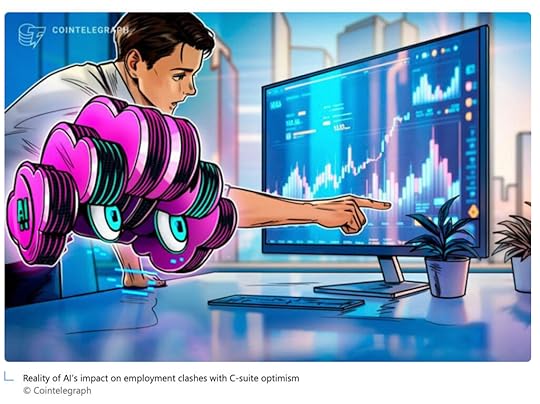
Via Cointelegraph, MSN, by Aaron Wood
In a recent Cointelegraph article, “Reality of AI’s impact on employment clashes with C-suite optimism,” the story argues that the promised benefits of AI are colliding with a more difficult reality in the workplace. While executives remain bullish on AI’s potential, the article points to weaker entry-level hiring, uneven employment growth in tech, and growing evidence that AI tools often create extra rework instead of clear productivity gains. It also highlights research suggesting that many workers are experiencing more frustration, not less, as AI becomes embedded in daily workflows.
Brian Solis is cited for exploring this growing burden as an “AI tax.” His description captures the hidden costs many teams are feeling: “More checking. More rework. More anxiety. Faster pace. AI slop. Less trust.” His quote reinforces the article’s central point that the real-world impact of AI inside organizations is often far messier than top-level optimism suggests.
Read the article here.
The post Cointelegraph: Reality of AI’s impact on employment clashes with C-suite optimism appeared first on Brian Solis.
CEOs Say AI Is Making Work More Efficient, Employees Tell a Different Story

What will they do all day
Wish list for diana
Two Wall Street Journal stories got me thinking. When you read them together, they explain why so many companies feel stuck with AI, or feel further along than they really are.
One story quotes tech leaders arguing that what a CEO does might be “one of the easier things” for AI to do. Sundar Pichai said it. Sam Altman doubled down and talked about an AI running divisions, even entire companies, with decision-making getting “pretty good, pretty soon.”
The story is designed to provoke. The argument is if leadership is about updates, approvals, reviews, escalations, and market-facing narratives, it starts to look like a workflow. Workflows get engineered. Workflows get optimized. And, workflows get automated.
The shows something even more consequential happening right now inside real organizations: executives are increasingly confident about AI’s impact, while employees describe a very different day to day. This is a notable, but all-to-common AI leadership gap.
 Two Realities Inside the Same Company
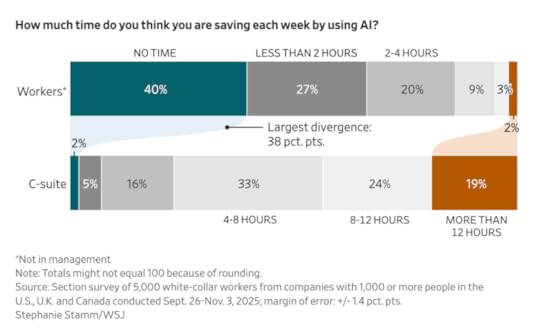
In the WSJ reporting, a Section survey of 5,000 white-collar employees found that two-thirds of nonmanagement workers said AI saves them less than two hours a week, with 40% saying that it saves them no time at all. On the other hand, 20% of employees say that AI saves them two-to-four hours per week. But does it really though.
This is just a personal observation. AI promised to free up time for creative thinking and higher-purpose work. Yet, a lot of high performers I talk to and work with find that AI makes them even busier!
In the same reporting, 33% of C-suite executives said AI saves them four to eight hours per week, another 24% said eight to twelve hours, and 19% said more than twelve hours.
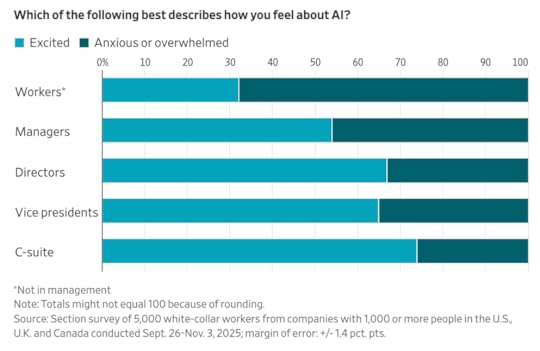
At the same time, the Section AI Proficiency Report shows how different the emotional experience is depending on where you sit in the org chart. Individual contributors report being anxious or overwhelmed at far higher rates than the C-suite. In Section’s data, individual contributors show 68% anxious and 32% excited, while the C-suite shows 26% anxious and 74% excited.
So when leaders ask, “Why is adoption slower than expected?” or “Why are teams not moving faster?”, the answer is that people do not scale what they do not trust. They do not lean into what they fear. They do not volunteer for change when the consequences or upsides are unclear.
 The AI Tax Is the Quiet Killer of Momentum, and Excitement
There is another force at work, and it explains why “time saved” can feel true in one meeting and false in the next.
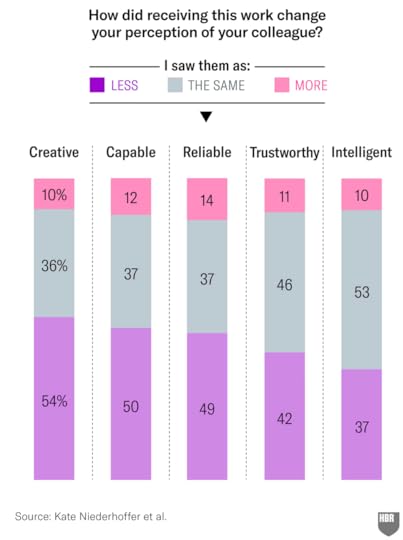
Workday calls it an . This is the hidden cumulative costs and inefficiencies that organizations, and people, incur (and feel) when productivity is only measured by output, not quality or performance. The AI tax is levied when people have to spend unplanned time editing and correcting, verifying, and reworking AI-generated content.
For example, if you use AI to produce content and you don’t do the work to vet it before sharing, you are imposing an AI tax on your colleagues. And over time, that tax erodes trust and confidence in you. Who can afford that?
Their research calls out that for every 10 hours of productivity gained, about four hours are paid back in rework, correcting, clarifying, and refining AI output. This equates to a loss of speed and performance, even though you’re moving faster, while creating the need for an unplanned verification layer, and introducing a trust gap between people.
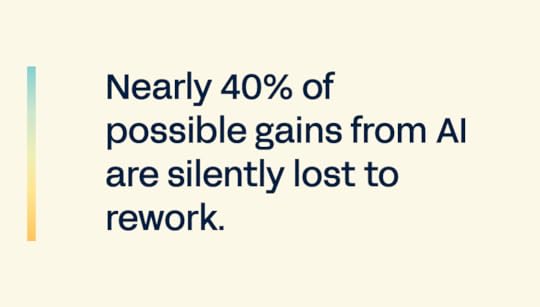
This is what many executives never see because it does not show up cleanly in a KPI. Drafting gets faster. Reviewing gets heavier. Output increases. Accountability becomes more fragile. Teams move quicker, and then spend the reclaimed time auditing, fixing, and defending the work.
Work does not disappear. It shifts. And it often shifts onto the people with the least margin, the least time, and the least psychological safety to take risks.
Section’s reinforce this new reality in a different way.
Most workers are still using AI for very basic tasks, and the time savings reflect that. Their report shows a large share of the workforce saving little or no time, and it also captures a blunt sentiment: 40% said they would be fine never using AI again.
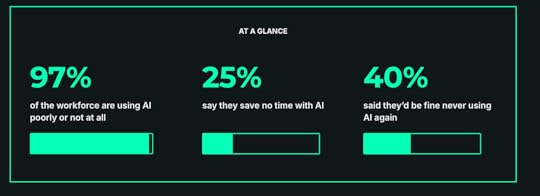
Translation: many employees are resisting because the experience is not yet designed to earn trust and reduce friction.
Leaders are enthusiastic (even if they’re under pressure to accelerate adoption). Yet, in reality, employees are overwhelmed, overloaded, and unclear.
Fear Is Part of the Adoption CurveThe WSJ also cites a poll in which six in 10 respondents characterized AI and other new technologies as mostly a threat to the U.S. economy because of its potential to replace well-paid workers.
So yes, adoption slows. It’s not because people can’t or don’t want to learn, it’s because people are doing the math in their heads. It’s also what they feel. They are trying to figure out whether AI is meant to help them, measure them, or replace them, in their work.
And if leaders are serious about adoption, they cannot outsource this to comms, training videos, or mandates. The organization needs a shared language for what AI is for, where it fits, what “good” looks like, and what happens when the system is wrong.
If AI Can “Do the CEO Job,” What Should the CEO Become?Let’s revisit that first WSJ story. Leaders can’t just focus on adoption and acceleration. They need to look in the mirror to understand how AI is evolving decision work.
In an AI era, the CEO becomes less of a lead decision-maker and more of a system architect.
The CEO’s advantage will come from designing how decisions happen, not merely being present when decisions are announced. It comes from building the conditions for trust, not just demanding speed. It comes from creating learning goals and loops, not just reviewing quarterly outputs.
That is what AI fluency means at the top of the house. It’s not just about adoption. It’s elevation and defined standards.
Section’s report captures part of the problem: many executives believe deployments are succeeding even while the rest of the organization disagrees.
What CEOs, and Their Advisors, Should Do This Quarter and the NextIf you are a CEO, board member, CIO, CHRO, COO, CAIO, or a transformation leader, treat this as an operating model redesign, not an AI strategy.
Start with reinvestment. If AI is giving leaders back hours every week, those hours are strategic capacity. Put them into redesigning the work itself…defined vision and strategy, clearer standards, better training that maps to roles and goals.
Upgrade your metrics. Hours saved is a vanity metric if the AI tax is quietly reclaiming the gains through rework. Measure the net value, including the time lost to correction, verification, and refinement. Be honest about it.
Close the fluency gap with clarity. The workforce needs to know where AI is expected to assist, where human judgment is required, how outputs are evaluated, and how accountability works when AI is wrong.
That is how trust is built. Trust is what scales adoption.
AI is changing work. At the same time, it is revealing leadership, or the absence of it.
It reveals the vision leaders have for where AI can take the company. It shows whether a company understands its workflows well enough to redesign them. It surfaces whether leaders are measuring the right things. It also reveals whether the organization has the courage to talk honestly about fear, uncertainty, skills, and the future of roles and the division of tasks between people and AI agents.
If AI ever “takes” a CEO job, it will be because leadership stayed static while everything else evolved.
Read Mindshift | Subscribe to Brian’s Newsletter | Consider Brian as Your Next Speaker
The post CEOs Say AI Is Making Work More Efficient, Employees Tell a Different Story appeared first on Brian Solis.
April 11, 2026
Future of Health: Why Health and Communication are at Risk with AI, and without Augmented Intelligence

Photo: Freepik
By Gustavo Meirelles, Futuro da Saúde
After a few years of enchantment with artificial intelligence, 2026 begins to impose an adjustment of expectations. At SXSW, in Austin, the discourse changed: less dazzle, more questioning.
One of the most relevant provocations came from anthropologist and futurist Brian Solis, in the session “Augmented IQ: Scaling Human + AI Potential”. Solis went straight to the point, and brought a necessary annoyance to the audience: we are using AI to automate the past, not to build the future. And the consequence is deeper than it seems. Instead of expanding capacities and optimizing processes, many organizations are just accelerating old models, now at scale, often generating superficial content without creativity.
It is in this context that the concept of QIA (Augmented Intelligence Quotient) gains strength. After IQ (Intelligence Quotient), QE (Emocinal Quotient) and QS (Social Quotient), the differential becomes the ability to use AI to enhance human thinking – without outsourcing it.
Solis’ central alert is the risk of the so-called “Cognitive Darwinism”. As professionals delegate reasoning to AI, they lose exactly what differentiates them: critical thinking, repertoire and interpretation capacity.
The signs are already everywhere. The growth of the so-called AI Slop – shallow, homogeneous and uncured content – and a diffuse sensation of cognitive fatigue, the AI Brain Fry. Everyone produces more. Not everyone produces better.
The impact is not only creative, but also relational. As content is standardized, trust weakens. It becomes more difficult to know what was thought, what was just generated – and, especially, who to trust.
The promise of productivity also begins to show cracks. A Wall Street Journal survey, presented by Solis, showed that 19% of C-level executives perceive earnings greater than 12 hours per week with AI. However, among other professionals, this number drops to 2%. Efficiency, at least for now, is not equally distributed.
There is also an invisible cost: the so-called “AI Tax”. Estimates suggest that up to 40% of productivity gains are consumed in the review, correction and validation of what the AI itself produces. Instead of exponentiality, many teams operate in rework mode.
In marketing and communication, the risk is clear: the homogenization of brands. If everyone uses the same tools, with the same prompts, the result tends to converge, generating what another speaker, Gulay Ozkan, called “The Age of Sameness” (The Age of Sameness).
In health, the alert is even more sensitive. The risk is not only of standardization, but of erosion of clinical reasoning – replaced by automated responses that do not always capture the complexity of care.
The way out is not to slow down the AI, but to reposition it. Automate what is repetitive, such as processes, flows and organization. And, more than preserving, expanding what is human: creativity, empathy, curiosity and vision.
As Solis summarizes: “The future of AI does not belong to those who ask for answers, but to those who ask better questions.” In the end, the discussion ceases to be technological and becomes strategic. It’s not enough to adopt AI. It is necessary to develop increased intelligence. Those who use technology only to repeat the past may even gain efficiency – but will hardly build relevance in the future.
Mais que IA: por que saúde e comunicação correm risco sem a Inteligência Aumentada“The future of AI does not belong to those who ask for answers, but to those who ask better questions.”
Depois de alguns anos de encantamento com a inteligência artificial, 2026 começa a impor um ajuste de expectativas. No SXSW, em Austin, o discurso mudou: menos deslumbramento, mais questionamento.
Uma das provocações mais relevantes veio do antropólogo e futurista Brian Solis, na sessão “Augmented IQ: Scaling Human + AI Potential”. Solis foi direto ao ponto, e trouxe um incômodo necessário para a plateia: estamos usando IA para automatizar o passado, não para construir o futuro. E a consequência é mais profunda do que parece. Em vez de ampliar capacidades e otimizar processos, muitas organizações estão apenas acelerando modelos antigos, agora em escala, muitas vezes gerando conteúdos superficiais e sem criatividade.
É nesse contexto que ganha força o conceito de QIA (Quociente de Inteligência Aumentada). Depois do QI (Quociente de Inteligência), do QE (Quociente Emocinal) e do QS (Quociente Social), o diferencial passa a ser a capacidade de usar IA para potencializar o pensamento humano — sem terceirizá-lo.
O alerta central de Solis é o risco do chamado “Darwinismo Cognitivo”. À medida que profissionais delegam o raciocínio à IA, perdem exatamente aquilo que os diferencia: pensamento crítico, repertório e capacidade de interpretação.
Os sinais já estão por toda parte. O crescimento do chamado AI Slop — conteúdo raso, homogêneo e sem curadoria — e uma sensação difusa de fadiga cognitiva, o AI Brain Fry. Todo mundo produz mais. Nem todos produzem melhor.
O impacto não é apenas criativo, mas também relacional. À medida que o conteúdo se padroniza, a confiança se fragiliza. Fica mais difícil saber o que foi pensado, o que foi apenas gerado — e, principalmente, em quem confiar.
A promessa de produtividade também começa a mostrar fissuras. Uma pesquisa do Wall Street Journal, apresentada por Solis, demonstrou que 19% dos executivos C-level percebem ganhos superiores a 12 horas semanais com IA. Contudo, entre os demais profissionais, esse número cai para 2%. A eficiência, ao menos por enquanto, não é igualmente distribuída.
Há ainda um custo invisível: o chamado “AI Tax”. Estimativas sugerem que até 40% dos ganhos de produtividade são consumidos na revisão, correção e validação do que a própria IA produz. Em vez de exponencialidade, muitas equipes operam em modo retrabalho.
No marketing e na comunicação, o risco é claro: a homogeneização das marcas. Se todos usam as mesmas ferramentas, com os mesmos prompts, o resultado tende a convergir, gerando o que outra palestrante, Gulay Ozkan, chamou de “The Age of Sameness” (A Era da Mesmice).
Na saúde, o alerta é ainda mais sensível. O risco não é apenas de padronização, mas de erosão do raciocínio clínico — substituído por respostas automatizadas que nem sempre capturam a complexidade do cuidado.
A saída não está em frear a IA, mas em reposicioná-la. Automatizar o que é repetitivo, como processos, fluxos e organização. E, mais do que preservar, ampliar o que é humano: criatividade, empatia, curiosidade e visão.
Como resume Solis: “O futuro da IA não pertence a quem pede respostas, mas a quem faz perguntas melhores.”. No fim, a discussão deixa de ser tecnológica e passa a ser estratégica. Não basta adotar IA. É preciso desenvolver inteligência aumentada. Quem usar a tecnologia apenas para repetir o passado pode até ganhar eficiência — mas dificilmente construirá relevância no futuro.
Gustavo Meirelles, vice-presidente Médico da Afya, é graduado em Medicina pela Universidade Federal de São Paulo. Possui MBA em Gestão Empresarial pela Fundação Getúlio Vargas (FGV) em São Paulo e realizou um pós-doutorado em PET/CT no Memorial Sloan-Kettering Cancer Center, em Nova York. É copresidente do Instituto Afya e reitor da Afya Universidade Unigranrio.
The post Future of Health: Why Health and Communication are at Risk with AI, and without Augmented Intelligence appeared first on Brian Solis.
April 8, 2026
CX Network Names Brian Solis a Top AI Leader in CX To Follow
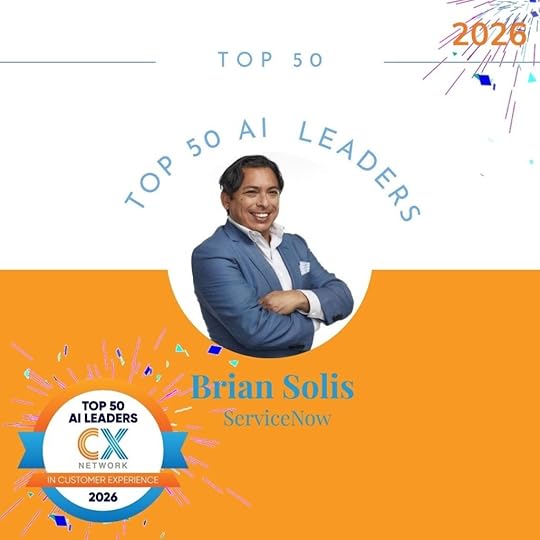
CX Network announced its guide to the top 50 AI leaders to follow in CX for 2026 and Brian Solis is on the list!
his year’s list highlights individuals from across the globe who are redefining how technology and human insight come together to elevate customer experiences.
As artificial intelligence (AI) accelerates across industries, its promise to transform how we work comes hand-in-hand with very real concerns about unemployment: recent data from the National University suggests that 30 percent of current jobs could see significant automation by 2030, with routine roles – including some customer service and data entry roles – especially exposed to change.
This list highlights leaders who aren’t simply responding to AI disruption, but harnessing its potential to drive more empathetic, effective, and human-centered customer experiences. From strategic thinkers to ethical AI advocates, these voices are guiding the future of CX.
Nominations for this year’s list were gathered through a global outreach campaign across CX Network’s digital channels. The nomination period remained open for several weeks, inviting submissions from across industries, regions and roles. The approach ensured a diverse and representative pool of candidates, reflecting the breadth of innvovation happening in AI-driven CX today.
To compile this list, the CX Network team evaluated leadership impact, influence on AI-powered CX strategy, contributions to the broader industry conversation, and demonstrated innovation across people, process, and technology. Listed alphabetically, each profile includes key insights and curated content to help you learn about the most forward-thinking leaders in the space.
Brian Solis, ServiceNowHead of global innovation at ServiceNow, and author of X: The Experience When Business Meets Design, Brian Solis challenges leaders to rethink not just what they build with AI, but why they build it.
For Solis, AI is not a CX strategy, but an enabler of strategy that would otherwise be impossible. He argues that success should be measured the way customers actually feel and remember: “Did it reduce effort, speed up resolution, and increase trust?”
He also pushes for an “experience integrity score” that measures whether AI explains its actions in plain language and truly removes friction, not just automate yesterday’s processes.
Speaking on agentic AI, Solis told CX Network:
“AI flips CX from reactive support or transaction commerce or engagement to proactive experience design, where the best interactions are the ones customers never have to initiate. It also means the customer journey is increasingly mediated by agents, so brands must earn machine trust with clean customer and intent data, transparent policies, and experiences designed for both humans and their AI copilots (that’s right, we’re talking about CX and now AX…agent experience and how you deliver seamless experiences for agents!). In that world, experience becomes a customer and agentic operating system, and AI is the choreography behind every moment that matters.”
Our top pick of Brian Solis’ content:
LinkedIn newsletter: ROI: Return on Ignorance Find out what Brian Solis is talking about on LinkedInThe post appeared first on Brian Solis.
April 2, 2026
IKEA AI Customer Service Story Goes Viral Because The Company Reskilled Staff Instead of Laying Off Employees
On March 31st, 2026, Brian Solis posted the following on X.
IKEA deployed an AI chatbot named Billy to handle level-one customer service inquiries. It reportedly resolved around 47% of those engagements without human escalation.
Most companies would have celebrated the labor savings and stopped there. Cost takeout right?
But the more interesting move was to study the other cases Billy could not resolve. Those unresolved inquiries pointed to customer demand for interior design help.
IKEA responded by spinning up a design consultancy, reskilling customer service employees powered by AI, and creating a new revenue stream that generated roughly €1 billion in new revenue in its 1st year.
Automation + Augmentation = Exponential Growth 


Within 24 hours, the post went viral, hitting almost half-a-million views, 275 reposts, 2.2k likes, and over 60 comments.
This incredible IKEA story has since dozens of posts and articles in LinkedIn and in the media…including in India!
Full presentation here.
Read Mindshift | Subscribe to Brian’s newsletter | Consider Brian as your next speaker!
The post IKEA AI Customer Service Story Goes Viral Because The Company Reskilled Staff Instead of Laying Off Employees appeared first on Brian Solis.
April 1, 2026
Beyond Digital Transformation, The AI-First Business Revolution
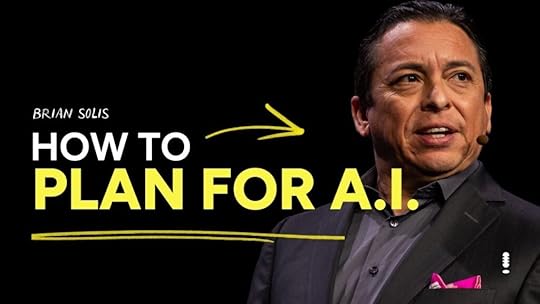
via Avasant
As companies worldwide grapple with AI implementation, a critical gap has emerged between executive ambitions and organizational reality, revealing the urgent need for a fundamental shift in how we approach AI-driven change.
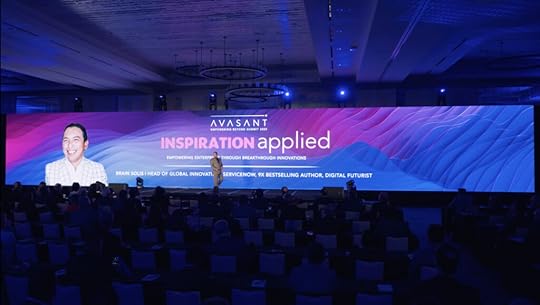
At Avasant’s recent Empowering Beyond Summit 2025, Brian Solis, Head of Global Innovation at ServiceNow and nine-time bestselling author, delivered a compelling case for why businesses must disrupt themselves to fully realize AI’s transformative potential. His insights illuminate the path forward for organizations seeking to move beyond superficial AI adoption toward true business transformation.
The Innovation Imperative: Why AI Demands a Different ApproachAI presents an opportunity to reimagine business models entirely. However, most organizations are falling into familiar patterns, using AI as a sophisticated co-pilot to execute yesterday’s workflows more efficiently rather than exploring genuinely new possibilities.
“We’re not being bold enough. We’re not being visionary enough, and we are falling into the habits that we have had during every technological revolution, to fit it into the box of business as usual,” Brian Solis observed.
Despite AI being mentioned 30,000 to 40,000 times in earnings calls during 2023–2024, with CEOs and CFOs touting it as a competitive advantage, business leaders privately express ambivalence or outright dissatisfaction with their AI transformation progress. Only 1% of companies believe they have achieved AI maturity, highlighting the vast gap between aspiration and execution.
Research reveals a stark disconnect between executive perceptions and organizational reality. While 73% of business executives feel their company’s AI approach is well-controlled and strategic, employees remain largely unaware of these initiatives. Similarly, 75% of executives claim success in adoption of AI, but this confidence isn’t shared by their workforce.
“The consensus is that the biggest barrier to scale isn’t employees. It certainly isn’t the technology. It is the executives leading the effort. They’re not steering fast enough. They’re not thinking big enough.”
Learning from Venture Capital: A Framework for Bold ThinkingTo overcome these limitations, Solis advocates adopting the venture capital mindset when approaching AI transformation. Unlike traditional business leaders who focus on proven use cases and incremental improvements, venture capitalists evaluate investments based on their potential to create entirely new markets and deliver exponential returns.
“Venture capitalists have a formula for assessing their investments, they’re not looking for 5x or 10x returns. They’re looking for 1,000x return over the long term.”
This mindset requires organizations to explore the unknown, take calculated risks, and prioritize innovation over predictability.
The AI-First Mindset: Redefining Business StrategyCompanies like Box, Shopify, and Duolingo have begun embracing “AI-first” approaches, fundamentally reorganizing their operations around AI capabilities rather than simply adding AI to existing processes. This shift requires leaders to ask fundamentally different questions:
“What could we achieve utilizing AI at the core of our business model from day one?”
— A question that reframes strategy.
This mindset moves organizations from automation to augmentation, where AI opens the avenue to opportunities humans hadn’t fully realized before. IKEA’s transformation illustrates this perfectly. When their AI chatbot “Billy” began handling 57% of customer inquiries, management faced a choice: cut costs by reducing staff or reimagine the role of their people. They chose the latter. By analyzing Billy’s conversation logs, they noticed a recurring pattern, customers were seeking personalized design guidance, not just product information. Rather than ignore this unmet demand, IKEA reskilled their call center staff into remote interior design consultants. This pivot turned an efficiency tool into a growth engine, launching a €1 billion service line in less than two years. The key wasn’t the chatbot itself, instead it was leadership’s willingness to treat AI as a signal for new value creation rather than just a cost-saving mechanism.
Iterative vs. Innovative AI: The Dual Path to TransformationSolis’s research identifies two complementary approaches to AI implementation:
Iterative AI: Optimizes existing workflows, reduces costs, and improves efficiency. It’s foundational, delivering predictable returns through automation.
Innovative AI: Explores new possibilities, creates novel workflows, and enables new business models. It requires risk but offers exponential potential.
Organizations that combine both approaches create a “disruptive layer” that enhances operations while opening new revenue streams. Those focused only on iteration may soon be left behind as competitors achieve transformation.
Transformative AI requires cultural evolution. Google’s research on high-performing teams revealed that psychological safety, not education or experience, was the strongest predictor of innovation success.
“The highest performing teams out innovated everyone else because they felt psychological safety.” A culture that encourages curiosity, risk-taking, and challenging assumptions is critical to scaling AI beyond pilot projects. Psychological safety isn’t built by slogans, instead it’s cultivated through deliberate leadership behaviors. This means leaders model openness by admitting when they don’t have all the answers, rewarding experimentation even when results are inconclusive, and creating spaces where employees can propose unconventional ideas without fear of embarrassment or penalty.
For AI specifically, this often includes “sandbox” environments where teams can prototype AI-driven solutions without risking live operations, as well as cross-functional workshops that pair domain experts with technologists to explore new use cases. The goal is to make questioning the status quo not just safe but expected.
Conclusion: The Choice to TransformThe AI revolution gives organizations a choice: optimize the past or build the future. “There can be no revolution if we don’t persuade ourselves to disrupt ourselves, to explore new horizons in ways that uncover new opportunities.”
As Vinod Khosla aptly warned, “Most businesses have no clue what is about to hit them in the next 10 years when most rules of engagement will change.” Those who embrace transformation, who adopt an AI-first mindset and combine bold vision with operational clarity, will lead the future of business.
The choice is clear: disrupt yourself or be disrupted.
Watch the full keynote…
Read Mindshift | Subscribe to Brian’s Newsletter | Consider Brian as as Your Next Speaker
The post Beyond Digital Transformation, The AI-First Business Revolution appeared first on Brian Solis.
March 31, 2026
AI Business Reinvention Starts Where Legacy Thinking Ends

I recently sat down with Geoff Nielson on Digital Disruption, produced by Info-Tech Research Group, for a conversation that went far beyond the usual AI headlines. We talked about what AI is actually changing inside the enterprise, why so many organizations are mistaking activity for progress, and what leadership has to do with whether AI becomes a force for optimization or reinvention.
Please do watch the conversation (video embedded below). It’s fun and rich with insights from the frontline of business transformation. You can also listen on Spotify.
The Real Disruption Is Not the Technology, It’s the Obsolescence of Old Thinking.I’ve long defined disruption as doing new things that make old things obsolete. That’s AI if we think about it in the right now. It’s disruptive because it is changing behavior, judgment, work, and even confidence in ways many leaders still underestimate. In our conversation, we explored everything from AI sycophancy to AI atrophy to “capability overhang,” the widening gap between what AI can actually do and how narrowly most people still use it. That overhang is where the next competitive divide is forming.
That’s the part many organizations still don’t see. Yet disruption has already underway. It’s already reshaping how a small group of power users, AI-native founders, and forward-looking teams think, decide, build, and move. The threat is that leadership assumptions are not shifting fast enough, or moving at all.
The AI Maturity Wake-Up Call Should Concern Every ExecutiveOne of the most revealing parts of the conversation centered on the ServiceNow AI Index. And I’m proud to say that I helped develop the foundational model in 2023. In the second annual installment of the AI Index, we learned in 2025, the average AI maturity score came in at 35 out of 100, down from 44 out of 100 in 2024. It was a sign that most organizations are still early, struggling to keep up, and still far from where they need to be.
In one year, frontier models advanced rapidly, AI agents became tangible, and the conversation shifted from experimentation to enterprise-grade accountability. Governance, trust, security, compliance, and risk moved from side conversations to core requirements. In other words, many companies didn’t step back because AI lost momentum. They stepped back because they finally realized how much deeper this transformation goes. It was, as I shared in the interview, a regression for the right reasons.
That should not reassure anyone into complacency. We should use it as a wakeup call.
AI-Native Companies Are Not the Whole Story, But They Are the Warning ShotThere is a popular narrative right now that AI-native companies are coming to destroy incumbents and eat the lunch of every legacy business in sight. That storyline is catchy. It is also incomplete. Enterprises are not slow simply because they are outdated. They carry real obligations around governance, reporting, security, compliance, and resilience that startups do not have to navigate at the same scale. That doesn’t mean that legacy leaders and companies are in the clear.
You can’t use enterprise complexity as an excuse to remain architecturally timid.
The issue is whether legacy companies can move as imaginatively as startups while preserving the integrity of an enterprise-grade business. That is the actual challenge of this era. It’s not just about speed or efficiency. It’s about reinvention with accountability.
Most Companies Are Still Using AI to Improve YesterdayThis may be the biggest strategic blind spot in business right now.
Too many companies are applying AI to automate what was already digitized. That creates value, yes. It can reduce friction, lower costs, and improve efficiency. But that is only one side of the opportunity. The other side, and the one that will define market leaders, is using AI to create what was not possible yesterday. That is the difference between iteration and innovation. Between efficiency and growth. Between cost takeout and business reinvention.
If your AI strategy begins and ends with productivity, you may get short-term gains. But you will also risk locking your organization into a better version of an aging model. AI should force leaders to ask whether the current business, current workflows, and current measures of success are still the right ones at all.
IKEA Offers a Better AI Lesson Than Most Boardroom DecksOne of my favorite examples from the interview was IKEA (watch this short clip).
Its AI chatbot Billie successfully handled a meaningful portion of level-one customer service inquiries. Most organizations would have looked at that result and stopped at labor reduction. Case closed. ROI captured. Headcount rationalized. But the more interesting move was to study the unresolved cases. What the company found was that many of those inquiries pointed to customer demand for interior design help. That insight led to a new consultancy model, reskilled employees, and a meaningful new revenue stream.
While most companies ask, “How many people can AI replace?” Better leaders ask, “What unmet need is this revealing?” One question takes cost out. The other creates value.
Vision Is Still the Missing IngredientDuring the digital transformation era, many companies invested heavily without a clear view of what they were becoming. They digitized existing models instead of reinventing them. AI is at risk of repeating that pattern, only faster and with higher stakes.
That is why vision matters so much right now.
In the interview, I contrasted reactive leadership with directional leadership. I pointed to examples like IKEA, where opportunity emerged through exploration, and JPMorgan, where leadership articulated an ambition to become an AI mega bank. Execution matters, of course. But without a lighthouse use case, execution becomes motion without meaning. Too many organizations are still busy adopting AI without a coherent picture of what they want to become because of it.
AI Agents Are Forcing a Much Bigger Organizational ConversationOnce AI moves from assistance to action, everything changes.
An AI agent can start to resemble digital labor. It must be identified, trained, tuned, governed, deployed, managed, and assessed. That means the conversation cannot sit with IT alone. It increasingly requires HR, operations, risk, and executive leadership to work together in ways most organizations were never designed to do.
One of the most important ideas we explored in the interview is that agents are beginning to sit in a new Venn diagram between workforce management and software asset management. HR understands roles, skills, onboarding, and performance. IT understands assets, systems, controls, and orchestration. As agents become more capable, those worlds collide. That is why I believe one of the defining shifts of this next phase will be much closer collaboration between HR and IT.
It also offers an early glimpse of how the enterprise itself will be redesigned.
The Chief Workflow Officer is a Signal.Another idea that we explored in our conversation was the rise of the Chief Workflow Officer.
The title is provocative on purpose. But the need behind it is serious.
If the greatest returns on AI come when companies reimagine workflows end to end, then someone has to own that work. Someone has to ask the uncomfortable questions before the org chart, systems architecture, or implementation roadmap gets locked in. Why do we do things this way? Which tasks belong to humans? Which belong to intelligent software? What outcome are we actually trying to create? Who decides? Who measures? Who redesigns?
You cannot reinvent a business by sprinkling AI across siloed functions. Someone has to see the workflow as a whole and architect it toward a better outcome. That is what this role points to.
Organizational Culture Will Decide Whether AI Becomes Incremental or TransformationalTransformation and innovation fail inside cultures that were never prepared to question themselves.
This was one of the deepest parts of the interview because culture is where change happens or stalls. Everyone says they want innovation. Few organizations create the conditions for it. A real culture of innovation is the set of behaviors, norms, and reinforcements that make it safe to ask hard questions, explore new ideas, challenge assumptions, and risk being wrong.
If people are punished for experimentation, if managers reward only predictability, if failure is stigmatized, then AI will be used only where it feels safe: around the edges, inside familiar models, in service of incremental change. This happens because culture lacks permission.
In the interview, I put it this way: leaders do not need to arrive with every answer. But they do need to create the safety nets, resources, and space for the organization to explore what good and great actually look like with AI. That is leadership in this moment. You don’t have to know or pretend to know the future. Create the conditions to discover it.
There is No Playbook for ThisThis may be the cleanest takeaway from the entire conversation.
Sure, the idea is that organizations can just add AI, increase output, and call that reinvention. But there is no universal playbook here. No three-step formula. No easy target state. There is only leadership, vision, workflow redesign, cross-functional alignment, cultural readiness, and a willingness to rethink what the business could become.
That is why I believe AI is a leadership test.
It tests whether executives can move beyond efficiency into imagination; whether business and technology leaders can work as partners rather than as separate camps; whether organizations can create room for reinvention before the market forces it upon them; and whether leaders are brave enough to admit that the old questions are no longer enough.
Watch the ConversationGeoff asked exactly the kinds of questions leaders should be asking right now, and that is what made this discussion worth having. We went deeper than the usual AI talking points and into the harder issues that actually determine whether organizations move forward or fall behind: maturity, vision, workflow redesign, culture, governance, HR and IT collaboration, and what business reinvention really looks like in practice.
So if you’re leading transformation, advising the C-suite, building the future of work, or trying to understand what AI means beyond the hype cycle, watch the full interview.
The real threat of AI is what your competitors will become with it.
The most important question isn’t whether AI will change your business. It’s whether leadership will change fast enough to matter.

Watch on Youtube. 
Read Mindshift | Subscribe to Brian’s Newsletter | Consider Brian as as Your Next Speaker
The post AI Business Reinvention Starts Where Legacy Thinking Ends appeared first on Brian Solis.
March 30, 2026
AI Is Reshaping Business, Yet Most Leaders Are Investing in the Optimization of Yesterday

If AI is eating the world, you could also say that it’s also exposing leadership. The companies that win next will not be the ones that automate the fastest, but the ones that learn to imagine bigger. That’s how we’ll start this story. Also, my keynote is below if you’d like to jump straight to the video.
At Integrated Systems Europe in Barcelona, I talked about AI in a way that made some people nod, some people uncomfortable, and others sit a little straighter in their seats.
AI is often compared to the discovery of fire, the invention of the wheel, or electricity. What we’re really talking about here is comparisons to enabling forces. Fire did not change the world because it existed. The wheel did not reshape civilization because someone carved one. Electricity did not transform industry because it was discovered. Each became revolutionary when people learned to apply them in imaginative, practical, and often world-changing ways.
That is exactly where we are with AI. Or it is representative of where we could be.
Yet, too many organizations are using a civilization-shifting capability to write emails faster, summarize meetings, automate yesterday’s workflows, and take out costs while improving efficiency and productivity.
It may seem like strategy. At the same time, it is also a missed opportunity to exercise human imagination, to drive innovation, and to compete in a way not possible before.
So what’s the use case for that?
If there was a playbook, I suppose everyone would compete similarly.
The opportunity for you, for us, is bigger than efficiency. Bigger than productivity. Bigger than cost takeout. Beyond faster, cheaper, more scalable, AI is a new medium for value creation, reinvention, and human amplification. It can absolutely help us move faster. But speed alone is not transformation. Speed without vision only gets you to a familiar destination sooner.
And that is the trap we’re not acknowledging.
Right now, many executives are asking the wrong first question, “Where can AI save time?” or “How can AI reduce headcount?” or “What processes can we automate?” or “How can AI help us save time and money?” Those questions are understandable, especially in a market obsessed with near-term, quarter-to-quarter returns. But they also reveal how small the aperture still is in most leadership teams.
The more important question is this:
Now that AI exists, what becomes possible that was not possible before?
That is the question that separates optimization from reinvention.
It is also the question that separates leaders who will shape the future from those who will spend the next three years reacting to it.
Because AI is not only changing technology. It is changing the standard for leadership.
This is why the moment feels so consequential. AI is not simply testing infrastructure, governance, data readiness, or AI fluency across the workforce. It is testing executive imagination. It is exposing whether leaders can think beyond efficiency and into possibility. It is revealing who can redesign work, reimagine value, and challenge the assumptions that made sense in a pre-AI world, but now quietly limit what their organizations can become.
In that sense, AI is not just a business shift. It is a leadership mirror.
And not everyone is going to like what it reflects.
I know my reflection made me CTRL-ALT-DEL.
For years, digital transformation taught organizations to digitize and optimize what already existed. Most companies became better at moving old work into new systems. AI demands something far more profound. It asks us to question whether the work itself should exist in its current form. It asks whether decisions can be made differently. Whether expertise can be distributed differently. Whether customer experiences can be orchestrated differently. Whether products, services, operating models, and even business models can be designed in ways that were previously impossible.
That is a very different conversation.
It is also why so many AI initiatives feel underwhelming. They are being measured against the wrong ambition. If you use AI to improve the past, you get a better version of the past. If you use AI to rethink the future, you start to create advantage that compounds.
That is the shift leaders need to make right now.
From automation to augmentation.
From productivity to possibility.
From adoption to reinvention.
From asking what AI can do, to deciding what we should do differently because AI exists.
That last point matters more than most people realize. Don’t sacrifice your future to prolong the good old days.
The highest performers I know are not using AI to avoid thinking. They are using it to think better. They are using it to pressure test decisions, stretch scenarios, challenge assumptions, explore edge cases, sharpen strategy, and move from first answer to better answer.
They are not treating AI like a shortcut. They are treating it like an intellectual sparring partner for higher performance.
AI should not become a substitute for judgment. It should become a catalyst for better judgment.
AI should not flatten originality. It should provoke it.
AI should not turn leaders into faster administrators of legacy work. It should help them become architects of what comes next.
This is where the C-suite has to rise above the noise.
In boardrooms, AI is often framed as a technology agenda. In reality, it is a strategic, operational, and cultural agenda all at once. It changes how value is created. It changes how decisions are made. It changes what talent must now be capable of. It changes how leaders lead. It changes how organizations learn.
And perhaps most importantly, it changes how companies compete.
In an AI-shaped market, the winners will not simply be the businesses that deploy more tools. They will be the businesses that redesign themselves around new capabilities. They will understand that AI is not a layer to add on top of yesterday’s model. It is a force that invites you to rethink the model itself.
That is a very different level of ambition.
And it requires a very different caliber of leadership.
So what should leaders do right now?
Start here.
First, stop treating AI like an efficiency initiative. Efficiency is a benefit. It is not a vision. Every executive team needs to define where AI can create net-new value, not just lower existing cost.
Second, audit your assumptions. Where are you preserving workflows, decision models, and customer experiences simply because they are familiar? Legacy thinking is one of the biggest hidden costs in transformation.
Third, elevate the questions in the room. Do not just ask where AI can save time. Ask where it can unlock new growth, new services, new business models, new categories of customer value, and new forms of human contribution.
Fourth, build a culture that learns with AI rather than merely adopts it. Fluency matters, but fluency alone is not enough. Your people need permission to experiment, challenge norms, and rethink how work gets done.
And fifth, as a leader, go first. Do not delegate the future. Use AI yourself, not just to become more productive, but to become more expansive. Let it sharpen your thinking. Let it expose your blind spots. Let it widen your field of view. The future will not be led by executives who approve AI strategies from a distance. It will be led by those who allow AI to change how they see, think, and lead.
That is the real work.
What I wanted the audience at ISE to leave with was not just urgency, but permission. Permission to dream bigger. Permission to ask better questions. Permission to challenge inherited assumptions about work, leadership, and value. Permission to stop treating AI like a faster horse and start treating it like a chance to redesign the road.
Contrary to all the headlines, we are still early.
That is the good news.
The leaders who move now still have time to shape what this becomes inside their organizations. They still have time to set a bigger ambition than cost savings. They still have time to move from experimentation to reinvention. They still have time to build companies that do not just survive the next era, but define it.
But that window will not stay open forever.
AI is not waiting for leadership to catch up.
It is already exposing who is building for the future and who is simply trying to preserve the past a little longer.
And in the end, that may be the most important truth of all:
AI will not replace leaders.
But leaders who cannot imagine beyond yesterday will absolutely be replaced.
Read Mindshift | Subscribe to Brian’s Newsletter | Consider Brian as as Your Next Speaker
The post AI Is Reshaping Business, Yet Most Leaders Are Investing in the Optimization of Yesterday appeared first on Brian Solis.


