
The Candidate
The first poster appeared in the window of a small pharmacy selling Chinese herbs to the people of Dawlstone, Tennessee. It showed a face: two eyes and a wide nose above a flat grin. Locals disagreed over what kind of face it was. Light or dark, if it stared or just looked upon the world, whether it seemed kind or ambivalent to their fate. One old boy, who claimed to have worked as a trapeze artist, but who now lived in a three-wheeled supermarket trolley, flagged down a passing police car, telling an officer the face looked guilty, of something.
Plastered on the window’s outside, the poster soon caught the sun, was pulled down, rolled and used by a customer to smoke the extract of a plant. That’s how the pharmacy owner, the son of an immigrant, remembered it.
Within a month, a second poster appeared, two blocks from the first, upon the sidewall of a garage specialising in fixing America’s cheapest motor vehicles. It looked much like the first, but the auto mechanics recall it in colour; with the same face sitting under a mop of brown, or perhaps black, hair. A third was glued to the window of the Italian barbers and a fourth on the side of a yellow garbage truck that drove the same twelve streets each Wednesday morning. No one recollects a name accompanying the face.
After the summer passed and colder winds began to blow, a spate of posters appeared across Yellow County, each showing a clearer face, the subject eyeing its audience more intently. Modern, richer inks improved the quality of the prints. The improved definition led many to speculate the face wore a hat, one covered in Uncle Sam’s Stars and Stripes.
The hat began to divide opinion. At that time, in those parts of Tennessee, some people didn’t take kindly to the Stars, while the Stripes offended others. A few liked the Stars and the Stripes, but not on a hat. And at least one youth was arrested for staging a sit-down protest in front of a poster that he admitted stealing from the bark of a tree and pasting onto a placard. Before being led away, he was heard shouting that the colours red, white and blue offended his God.
Then the rumours started.
Maybe it was because the value of the dollar had fallen, and the good folk of Yellow County had, over the past four generations, grown to become suspicious of their neighbours, and any person they could not recognise. Or because of the disagreements about the style of hat this face wore, or the morality of sporting a hat covered in a flag. It could have been because the policeman, forewarned by the old drunken tramp, had taken in his spare time to searching shopping malls for vendors of such attire, in the hope of finding a clue to the wearer’s identity.
But people began to suggest the face in the posters was wanted by the authorities. For more than a misdemeanour. Possibly wire-fraud, or embezzlement. Robbery even, or murder. That would explain the sudden rise in the number of posters appearing, and their placement high above the children’s heads. An editorial in Yellow County’s newspaper described how wanted posters didn’t depict felons wearing hats, especially those of colour. It suggested the face in the poster wanted to be recognised. Editors of the official newspaper of neighbouring Blue River County countered, stating that any such person must be a narcissist, but one of great sophistication, given they had not added their name to their picture now pasted upon the walls of empty tenement houses corroding the capitals of counties across the State. And that editorial caught the attention of Tennessee Public Radio, which conducted a midnight poll asking if listeners knew of such a person. It received hundreds of names, suggested by those drunk, lonely, addicted to the airwaves passing through their skulls, or suffering from insomnia.
At that point, speculation turned to confusion. Many names attributed to the face were fictional. A number belonged to people already dead, who looked nothing like the posters’ face when living. But a few resonated with the audience. And for some inexplicable reason, men and women whispered these names, over dinner and during the ad breaks of daily soap operas appearing on cable television. The mutterings became sirens, and the more these names were said, the more posters appeared. Each beckoned the face, with its brown or perhaps black hair covered by a hat depicting the national flag of the United States of America, out from the ether, until there were so many posters, portraying so many eyes staring down upon the people of Tennessee, that they finally caught the attention of the federal agencies.
The Federal Bureau of Investigation sent their best to solve the mystery. They examined the face a thousand times, and heard the same name mentioned a thousand more, the others now sticking in the throats, no longer making it past people’s lips. But they could find no evidence of a crime having been committed. So they placed the name and the image in the posters on file, pending further inquiries. Without prompting, the Inland Revenue Service said it would examine the financial affairs of the named individual, to check they were in order. And the Department of Homeland Security sent a team to remove the posters from the state of Tennessee, just in case.
But the day they arrived to begin their work in the town of Dawlstone, posters began appearing across the country, in the states of Washington, Maine, Florida, and Texas where they billowed across the sand with the tumbleweeds. Loud and proud, people young and old called one name, as if speaking of a friend, whose picture they hung in the windows of their homes and businesses, and even from telegraph poles they did not own. For a brief time, everyone agreed the face was benevolent, the name a good one, and they wished the person in the posters might visit them, perhaps on Thanksgiving.
The owner of Dawlstone’s Chinese pharmacy received more customers than he’d ever known. He sold the window pane that hosted the first poster, the one that went up in smoke. He gave the money to the tramp, helping him move out of his supermarket trolley, to under a bridge, and the tramp told the town sheriff that the face in the poster was guilty only of great feats of leadership and charity. The policeman hoped one day to find a red, white and blue hat of his own.
And then the sightings began. A boy said he had seen the face in the Port of Milwaukee, visiting the dock workers. An old lady who lived next to a Florida golf course recalled the person in the posters knocking at her door, asking if she was well. A merchant banker claimed to have seen the person ring the bell of the New York Stock Exchange, minutes before shares in the hundred largest companies lifted an average of twenty four points. Folk singers and rock stars weaved the name into their lyrics. The President of Venezuela suggested she, and the person in the poster with the wide nose and flat grin, had much in common.
The nation celebrated, and one entrepreneur thought up the greatest idea.
Backed by the country’s largest bank, he would put on a show. He would hire the largest convention centre in the whole of Tennessee. He would get flags printed, and plastic copies of the hat covered in the Stars and Stripes. He would invite newspapers, magazines, radio stations and chat show hosts, and he would sell $50 tickets so the hometown people of Dawlstone, of Yellow County and Blue River County, of Tennessee, Kentucky, Alabama and beyond, of the United States of America, and anyone visiting from Canada or Mexico, might sit and stand. So they might meet the face in the posters, hear the timbre of its voice and watch it wave in the air an arm and hand that most of America had not yet seen. So they might tell their grandchildren they had shared a giant room with the person whose name once passed the lips of half a nation, whose face had adorned a million posters stuck to walls and windows in every small town and city from west coast to east.
And supposedly, such an event took place, though no one can quite remember it now.
Some people recollect the event being advertised, others the convention centre, its big stage and bright lights. A few, including the pharmacy owner and town sheriff, admit to buying a ticket, sitting in a plastic, spring-loaded bucket seat, and clapping and hollering as the entrepreneur whipped them into frenzy. But when asked directly, they shy from saying who their applause and cheers were for, and deny seeing anyone appearing on stage.
Only one person has gone on record stating they visited the convention centre, bought a flag, and waved it. The old tramp who once swung from the roof of a circus tent, who lived now under a bridge, told the National Enquirer that when the music started, he stood as best he could. He saw an image of the poster he’d first seen in Dawlstone projected upon a huge screen. He heard the entrepreneur announce a name he cannot now remember.
He saw the face he’d used his last $50 to witness, and watched as it leapt onto the stage, and tried to stand upright before him. There it thumped its chest. It pulled its lips back into its wide nose, shrieking and screaming, baring its teeth at those gathered beneath. It tried to speak but made no sense, said the old boy. It attempted to scratch its head, but the blue, red and white hat it wore was made of tin, making a noise that drowned out all rational thought.
And then the old tramp who’d spent most of his adult life inside a three-wheeled supermarket trolley realised he did recognise the face in the posters, and he was right to have seen guilt in its eyes.
For the face was not that of a man, woman, or even a child, he told the Enquirer. It was of an ape. A trained chimpanzee that had, for a few years at least, learned to juggle, before slipping its chains, escaping the circus in which the old boy had once worked, taking with it a stolen piece of metal attire.
The National Enquirer published his account but few read it, and fewer believed it. No one could understand how so many posters had been printed of such an animal, nor fathom how or why any nation, especially the United States of America, could have become so enthralled by the pictures, stories and candidature of a chimpanzee. Especially a chimp wearing a tin hat.
© 2016 MJ Walker
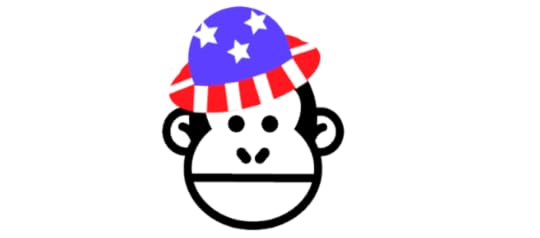 Chimp in a hat (MJ Walker/freepix)


