
Beyond Watson and on (as The Good Soldier Schweik demanded) "to Belgrade!"
This blog begins with a review of Derrick Belanger's fine new anthology of Holmes pastiches "NOT narrated by Dr. John H. Watson." It then moves on to discuss two books I found invaluable in writing my forthcoming story "A Scandal in Serbia." At least one of them--or its companion volumes--may be of use to other authors who have not already discovered this remarkable historical resource.
Other narrators fill in capably for the doctor in Beyond Watson
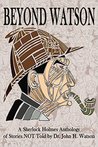 Beyond Watson by Derrick Belanger
My rating: 4 of 5 stars
While he is by no means “anti-Watson,” Derrick Belanger has compiled the first in a new series of anthologies that allow other characters to narrate Sherlockian tales. He has been well served by veteran Sherlockian authors. Besides Belanger’s own touching story, Geri Shear, Marcia Wilson, David Marcum, and David Ruffle contribute excellent entries, told (respectively) by Mrs. Hudson, Inspector Lestrade, Colonel Moran, and Holmes himself. Kieran Lyne’s finely crafted tale demonstrates why his controversial first novel received the seal of the Conan Doyle Estate. Elizabeth Varadan’s story amusingly stars the budding detective from her young adult novels, while Daniel D. Victor’s incorporates both Raymond Chandler (“The Last Page of Baker Street”) and Charlie Chaplin. Other historical, literary, or Canonical figures (Winston Churchill, H.L. Mencken, and Violet Hunter from “The Copper Beeches”) show up elsewhere. Among the non-Sherlockian contributors, Belanger has scored a major coup by acquiring Jack McDevitt’s first Holmes pastiche for the anthology. On the downside, a few stories suffer from poor writing and/or inauthentic renditions of Canonical or historical characters. At least one is so bad that it should not have been included. After this excellent beginning, let us trust that the anthology's editor will consistently employ a Watson-like “power of selection,” even if the good doctor is excluded from narrating the tales.
I found links to Beyond Watson on Amazon and Amazon UK, as well as Barnes and Noble; and as an e-book on Amazon Kindle and Nook.
All you could ever want to know of Yugoslavia, told by a fascinating woman
The multi-faceted Rebecca West (1892-1983), known as a novelist for The Return of the Soldier, as a journalist for her many essays and her coverage of the Nuremberg Trials, and as a socialist and feminist ("People call me a feminist whenever I express sentiments that differentiate me from a doormat or a prostitute."), is perhaps best remembered for the massive travelogue, historical treatise, and polemic she produced after visiting Yugoslavia on the eve of World War II. I found Black Lamb and Grey Falcon a wonderful source while drafting "A Scandal in Serbia," which centers on the 1903 assassinations of King Alexander Obrenović and Queen Draga. Ms. West's derisive portrait of that ill-fated couple, and her magical descriptions of the places Holmes and Watson passed through on their journey, greatly lengthened and enriched my tale. Regardless of one's interest--or lack thereof--in Yugoslavia, this book should be sampled, if not read in its entirety, for a glimpse of the remarkable personality behind it.
 Black Lamb and Grey Falcon by Rebecca West
My rating: 5 of 5 stars
Shortly before the outbreak of World War II, the noted British novelist, journalist, socialist, and feminist Rebecca West made three trips to Yugoslavia and subsequently wrote this book, her masterpiece. Published in 1941, it is in part a travelogue, but more profoundly a long meditation on the history, mythology, and culture of a region that Ms. West regarded as “the nexus of European history since the late Middle Ages.” Central to her tale is the Battle of Kossovo (1389), which ended the medieval Serbian Empire and doomed its people to 500 years of foreign rule. Ms. West writes of that half-millennium with passion that becomes polemical and compassion that makes no pretense of being even-handed. The South Slavs—especially the Serbs—are the heroes of her story; anyone who stands in the way of their unity and freedom (Turks, Austrians, Nazis, even their own unworthy rulers) is fair game. Yet, Ms. West’s passion is so pure, and her prejudice so frank, that she seldom misleads and invariably fascinates. Who else could write this summation of the Sarajevo murders: “At last the bullets had been coaxed out of the reluctant revolver to the bodies of the eager victims?” South Slavic history is, in any case, a tapestry of murders; the assassination of King Alexander in 1934 was the event that drew Ms. West’s attention to the region. It also, as she feared, signaled the failure of the Yugoslavian experiment years before the country fell to Hitler. Rebecca West poignantly dedicated Black Lamb and Grey Falcon “to my friends in Yugoslavia, who are now all dead or enslaved.” Her book remains a lasting memorial to that lost nation, and to one of the most remarkable women the 20th century produced.
Penguin Classics publishes a thick but attractive paperback edition of BLGF. It was sturdy enough to survive both my initial slog through it and repeated returns while writing "Serbia." It is available on Amazon USA and Barnes and Noble. A new paperback edition, published by Canongate Books, is available from Amazon UK. E-book versions may be acquired from Amazon Kindle and Nook. Old hardback editions, with original photographs, are also worth searching for.
Through Austria-Hungary with gun and camera
Without the Internet, guides published by the German firm of Karl Baedeker (1801-1859) must have been indispensable for European travel in Holmes’ day. They are also important to the writer who is trying to get the logistics of a story right. "A Scandal in Serbia" requires Holmes and Watson to follow a tortuous itinerary from London to Montenegro, and to shuttle from there to Serbia and back before returning home to England. While Rebecca West's descriptions of people and places provided delightful "local color," I needed something more detailed and accurate for hotels, train schedules, and travel routes. The timing of our heroes' arrival in Belgrade was crucial to the story.
To the rescue came the 9th English edition of Baedeker's Austria, Including Hungary, Transylvania, Dalmatia, and Bosnia (London, Dulau and Co., 1900). It was available online, through the courtesy of Emory University Libraries, at: https://archive.org/stream/01703017.5.... (I also consulted the 1905 and 1911 editions.) Using this resource, I could have been teleported to 1903 Austria-Hungary and made my way from Prague to Belgrade, knowing which trains to catch, which hotels and inns to patronize, and how much to tip the waiters. Baedeker offered a fascinating snapshot of a vanished realm and saved me from many oversights or errors I might otherwise have made. (That's not to say there won't be others!)
Thankfully, there is a whole series of Baedeker guides online. I had not had occasion to make use of them before, but I certainly will again in plotting Holmes and Watson's future travels. If you're writing a Sherlock Holmes pastiche, or anything "historical," you may want to check them out yourself.
Other narrators fill in capably for the doctor in Beyond Watson
Beyond Watson by Derrick BelangerMy rating: 4 of 5 stars
While he is by no means “anti-Watson,” Derrick Belanger has compiled the first in a new series of anthologies that allow other characters to narrate Sherlockian tales. He has been well served by veteran Sherlockian authors. Besides Belanger’s own touching story, Geri Shear, Marcia Wilson, David Marcum, and David Ruffle contribute excellent entries, told (respectively) by Mrs. Hudson, Inspector Lestrade, Colonel Moran, and Holmes himself. Kieran Lyne’s finely crafted tale demonstrates why his controversial first novel received the seal of the Conan Doyle Estate. Elizabeth Varadan’s story amusingly stars the budding detective from her young adult novels, while Daniel D. Victor’s incorporates both Raymond Chandler (“The Last Page of Baker Street”) and Charlie Chaplin. Other historical, literary, or Canonical figures (Winston Churchill, H.L. Mencken, and Violet Hunter from “The Copper Beeches”) show up elsewhere. Among the non-Sherlockian contributors, Belanger has scored a major coup by acquiring Jack McDevitt’s first Holmes pastiche for the anthology. On the downside, a few stories suffer from poor writing and/or inauthentic renditions of Canonical or historical characters. At least one is so bad that it should not have been included. After this excellent beginning, let us trust that the anthology's editor will consistently employ a Watson-like “power of selection,” even if the good doctor is excluded from narrating the tales.
I found links to Beyond Watson on Amazon and Amazon UK, as well as Barnes and Noble; and as an e-book on Amazon Kindle and Nook.
All you could ever want to know of Yugoslavia, told by a fascinating woman
The multi-faceted Rebecca West (1892-1983), known as a novelist for The Return of the Soldier, as a journalist for her many essays and her coverage of the Nuremberg Trials, and as a socialist and feminist ("People call me a feminist whenever I express sentiments that differentiate me from a doormat or a prostitute."), is perhaps best remembered for the massive travelogue, historical treatise, and polemic she produced after visiting Yugoslavia on the eve of World War II. I found Black Lamb and Grey Falcon a wonderful source while drafting "A Scandal in Serbia," which centers on the 1903 assassinations of King Alexander Obrenović and Queen Draga. Ms. West's derisive portrait of that ill-fated couple, and her magical descriptions of the places Holmes and Watson passed through on their journey, greatly lengthened and enriched my tale. Regardless of one's interest--or lack thereof--in Yugoslavia, this book should be sampled, if not read in its entirety, for a glimpse of the remarkable personality behind it.
Black Lamb and Grey Falcon by Rebecca WestMy rating: 5 of 5 stars
Shortly before the outbreak of World War II, the noted British novelist, journalist, socialist, and feminist Rebecca West made three trips to Yugoslavia and subsequently wrote this book, her masterpiece. Published in 1941, it is in part a travelogue, but more profoundly a long meditation on the history, mythology, and culture of a region that Ms. West regarded as “the nexus of European history since the late Middle Ages.” Central to her tale is the Battle of Kossovo (1389), which ended the medieval Serbian Empire and doomed its people to 500 years of foreign rule. Ms. West writes of that half-millennium with passion that becomes polemical and compassion that makes no pretense of being even-handed. The South Slavs—especially the Serbs—are the heroes of her story; anyone who stands in the way of their unity and freedom (Turks, Austrians, Nazis, even their own unworthy rulers) is fair game. Yet, Ms. West’s passion is so pure, and her prejudice so frank, that she seldom misleads and invariably fascinates. Who else could write this summation of the Sarajevo murders: “At last the bullets had been coaxed out of the reluctant revolver to the bodies of the eager victims?” South Slavic history is, in any case, a tapestry of murders; the assassination of King Alexander in 1934 was the event that drew Ms. West’s attention to the region. It also, as she feared, signaled the failure of the Yugoslavian experiment years before the country fell to Hitler. Rebecca West poignantly dedicated Black Lamb and Grey Falcon “to my friends in Yugoslavia, who are now all dead or enslaved.” Her book remains a lasting memorial to that lost nation, and to one of the most remarkable women the 20th century produced.
Penguin Classics publishes a thick but attractive paperback edition of BLGF. It was sturdy enough to survive both my initial slog through it and repeated returns while writing "Serbia." It is available on Amazon USA and Barnes and Noble. A new paperback edition, published by Canongate Books, is available from Amazon UK. E-book versions may be acquired from Amazon Kindle and Nook. Old hardback editions, with original photographs, are also worth searching for.
Through Austria-Hungary with gun and camera
Without the Internet, guides published by the German firm of Karl Baedeker (1801-1859) must have been indispensable for European travel in Holmes’ day. They are also important to the writer who is trying to get the logistics of a story right. "A Scandal in Serbia" requires Holmes and Watson to follow a tortuous itinerary from London to Montenegro, and to shuttle from there to Serbia and back before returning home to England. While Rebecca West's descriptions of people and places provided delightful "local color," I needed something more detailed and accurate for hotels, train schedules, and travel routes. The timing of our heroes' arrival in Belgrade was crucial to the story.
To the rescue came the 9th English edition of Baedeker's Austria, Including Hungary, Transylvania, Dalmatia, and Bosnia (London, Dulau and Co., 1900). It was available online, through the courtesy of Emory University Libraries, at: https://archive.org/stream/01703017.5.... (I also consulted the 1905 and 1911 editions.) Using this resource, I could have been teleported to 1903 Austria-Hungary and made my way from Prague to Belgrade, knowing which trains to catch, which hotels and inns to patronize, and how much to tip the waiters. Baedeker offered a fascinating snapshot of a vanished realm and saved me from many oversights or errors I might otherwise have made. (That's not to say there won't be others!)
Thankfully, there is a whole series of Baedeker guides online. I had not had occasion to make use of them before, but I certainly will again in plotting Holmes and Watson's future travels. If you're writing a Sherlock Holmes pastiche, or anything "historical," you may want to check them out yourself.


No comments have been added yet.
Senile Musings of an Ex-Boy Wonder

An occasional blog on Sherlock Holmes, other historical and literary topics, and whatever else occurs to me
- Thomas A. Turley's profile
- 8 followers

