
Thomas A. Turley's Blog: Senile Musings of an Ex-Boy Wonder
August 20, 2019
An Interview with MX Publishing
The next three volumes of MX Publishing's ongoing anthology of traditional Sherlock Holmes pastiches will be published in October. In advance of that event, publisher Steve Emecz has asked participating authors to be interviewed about their stories. (Mine, "The Solitary Violinist," appears in Part XVIII.) Here's the interview that I submitted. Besides the new story, it discusses all my other MX publications.
How did you first get introduced to Sherlock Holmes?
When I was maybe twelve years old, my mother gave me a volume called A Treasury of Sherlock Holmes. It contained two of the novels (A Study in Scarlet and The Hound of the Baskervilles) and 27 of the best short stories, plus an introduction in which Adrian Conan Doyle wrote entertainingly about growing up with his father and Sir Arthur’s attitude toward Sherlock Holmes. Once I read Hound, I never looked back. I acquired other Holmes collections as a teen-ager and eventually read all the Canon, although I didn’t purchase The Complete Sherlock Holmes until I was in college. I also sampled The Exploits of Sherlock Holmes and Nicholas Meyer’s first two Holmes novels, but I never developed a real interest in pastiches until I had an idea for one while mowing the yard one afternoon. That idea became “Sherlock Holmes and the Adventure of the Tainted Canister,” which MX published as an e-book in 2014 (https://www.amazon.com/Sherlock-Holme...), but which David Marcum turned down for the anthology because its ending is extremely un-Canonical. Fortunately, David was nice enough to invite me to submit a less controversial story, and my next two efforts—“A Scandal in Serbia” and “A Ghost from Christmas Past”—appeared in Parts VI and VII of the MX anthology. We agreed that these stories were “traditional” enough to make the cut, even though they’re not strictly Canonical because they contain elements from Baring-Gould. “Serbia” was panned on that account by one reviewer, but “Ghost” got a nice mention in Publisher’s Weekly’s Part VII review. It was also included in The Art of Sherlock Holmes—West Palm Beach Edition. I’ll stop bragging now, having long since outrun this question’s boundaries.
Which is your favourite story from The Canon and why?
Hound is still my favorite. I was disappointed that Granada’s television version with Jeremy Brett didn’t quite match The Sign of Four. Among the short stories, undoubtedly “The Speckled Band,” which is both wonderfully creepy and masterfully deduced, even though it’s based upon a faulty premise. (Dr. Roylott—one of Doyle’s best villains—could not have trained the “swamp adder” to return to him by whistling, because snakes are deaf.) My other favorites include “A Scandal in Bohemia,” “The Five Orange Pips,” and the bookends to the Great Hiatus: “The Final Problem” and “The Empty House.” All of those stories have contributed usefully to my own works in one way or another.
What was the inspiration for your pastiche?
The underlying inspiration for “The Solitary Violinist” was that David Marcum decided to do another round of pseudo-supernatural tales for the Fall 2019 anthology. I was already working on two stories, but neither had any place for ghosts or goblins. Having missed the last few volumes, I badly wanted to submit something but was stuck for an idea. Happily, at about that time I learned that my favorite composer, Gustav Mahler, had an extremely talented friend and fellow student at the Vienna Conservatory who came to a sad end. Their relationship, and its subsequent (unacknowledged) influence upon Mahler’s music, started my creative juices flowing; and I eventually concocted another “ghostly” tale that met David’s criterion of having a non-supernatural explanation in the end.
What is your story about? Where and when does it take place?
Hans Rott, who wrote a wonderful “Mahlerian” symphony several years before Gustav Mahler wrote his First, is “The Solitary Violinist” in my story. Rott ended up in an asylum, and his little-known symphony was not performed until 1989, long after Mahler’s music had become world-famous. Holmes tells Watson the story in 1911, just before departing for the United States as “Altamont.” However, its main action takes place in Vienna in 1902, when Mahler persuades the visiting detective to investigate his apparent “haunting” by a long-dead former friend. To discover why Holmes—whose maxim, as we know, is “No ghosts need apply”—accepted this commission, we return briefly to his college days. The story ends back in Watson’s study with a final ghostly echo, which David kindly permits to authors of “pseudo-supernatural” anthology selections.
What do you believe readers will most enjoy most about your tale?
Classical music lovers who have not heard of him will find Hans Rott of interest. I have included references to information on the young composer’s life and to recordings of his music. Whether readers love, hate, or ignore the symphonies of Gustav Mahler, he was a fascinating personality. My story treats him less unsympathetically than its plot implies. Mahler’s wife Alma—that seductive “Muse to Genius” who snared two more famous husbands and was parodied in a Tom Lehrer ballad—makes a brief appearance, as does Sigmund Freud. The story explores Holmes’ own fondness for Wagnerian music, which is well-established in the Canon. Finally, there is the fun of seeing him grapple with a case that he finds utterly ridiculous, but which he is compelled to take for reasons of his own.
Any upcoming projects?
I’m currently working on “A Game of Skittles,” a submission for the next MX anthology. It features a famous Victorian courtesan and two eminent statesmen who—in one way or another—made her acquaintance. Had Holmes not solved this case so tactfully, it might have been the Profumo Scandal of the 1880s.
Then it’s back to the next installment of Sherlock Holmes and the Crowned Heads of Europe: four historical tales that immerse our heroes in the diplomacy that preceded World War I. When finished, the collection will include “A Scandal in Serbia” and two more stories I have yet to write. I hope to enlist Marcia Wilson—a talented artist as well as an outstanding Sherlockian pasticheur who focuses on Scotland Yard—to illustrate Crowned Heads.
Meanwhile, Crowned Heads’ longest and earliest story chronologically, “The Case of the Dying Emperor,” is already done and is available from MX Publishing as a separate e-book (https://www.amazon.com/Sherlock-Holme...). It takes place in 1888, during the brief reign of Frederick III, the son-in-law of Queen Victoria and father of the notorious “Kaiser Bill.” Frederick’s premature demise inaugurated Sherlock Holmes' espionage campaign against the German Empire, which (as we know) ended only in August 1914 with "His Last Bow." My story has received kind reviews from three Sherlockian authors I very much admire—S.F. Bennett, David Marcum, and Daniel D. Victor—although Dan did suggest that Crowned Heads substitute a bibliographic essay for the “overabundance” of end notes in the e-book. (I spent way too long in grad school!) Readers who like combining Holmes with history will, I hope, enjoy the story, whether they acquire it now or wait for the entire collection.
One other tale on my horizon requires a return to the vexed question of Dr. Watson’s wives. “A Ghost from Christmas Past” introduced Constance Adams, the first of them (courtesy of W.S. Baring-Gould), while “Sherlock Holmes and the Adventure of the Tainted Canister” recorded the sad fate of Mary Morstan. My candidate for Wife Number Three—Priscilla Prescott—has lurked in the wings of other stories; but the case that introduces her to the good doctor will be a Boer War tale, “The Adventure of the Disgraced Captain.” No idea yet how soon it will appear!
Tell us three things about yourself that few people would guess?
Politically, I am a liberal Democrat, which is uncommon among old white men in Alabama.
My other hobby is building model sailing ships, my latest being the frigate U.S.S. President. She was the Constitution’s sister ship and quite a showpiece in her day.
My wife Paula is an aspiring science fiction writer, who has recently finished a novel called The Winds of Onega. We’re looking for a publisher, if MX decides to take on science fiction!
How did you first get introduced to Sherlock Holmes?
When I was maybe twelve years old, my mother gave me a volume called A Treasury of Sherlock Holmes. It contained two of the novels (A Study in Scarlet and The Hound of the Baskervilles) and 27 of the best short stories, plus an introduction in which Adrian Conan Doyle wrote entertainingly about growing up with his father and Sir Arthur’s attitude toward Sherlock Holmes. Once I read Hound, I never looked back. I acquired other Holmes collections as a teen-ager and eventually read all the Canon, although I didn’t purchase The Complete Sherlock Holmes until I was in college. I also sampled The Exploits of Sherlock Holmes and Nicholas Meyer’s first two Holmes novels, but I never developed a real interest in pastiches until I had an idea for one while mowing the yard one afternoon. That idea became “Sherlock Holmes and the Adventure of the Tainted Canister,” which MX published as an e-book in 2014 (https://www.amazon.com/Sherlock-Holme...), but which David Marcum turned down for the anthology because its ending is extremely un-Canonical. Fortunately, David was nice enough to invite me to submit a less controversial story, and my next two efforts—“A Scandal in Serbia” and “A Ghost from Christmas Past”—appeared in Parts VI and VII of the MX anthology. We agreed that these stories were “traditional” enough to make the cut, even though they’re not strictly Canonical because they contain elements from Baring-Gould. “Serbia” was panned on that account by one reviewer, but “Ghost” got a nice mention in Publisher’s Weekly’s Part VII review. It was also included in The Art of Sherlock Holmes—West Palm Beach Edition. I’ll stop bragging now, having long since outrun this question’s boundaries.
Which is your favourite story from The Canon and why?
Hound is still my favorite. I was disappointed that Granada’s television version with Jeremy Brett didn’t quite match The Sign of Four. Among the short stories, undoubtedly “The Speckled Band,” which is both wonderfully creepy and masterfully deduced, even though it’s based upon a faulty premise. (Dr. Roylott—one of Doyle’s best villains—could not have trained the “swamp adder” to return to him by whistling, because snakes are deaf.) My other favorites include “A Scandal in Bohemia,” “The Five Orange Pips,” and the bookends to the Great Hiatus: “The Final Problem” and “The Empty House.” All of those stories have contributed usefully to my own works in one way or another.
What was the inspiration for your pastiche?
The underlying inspiration for “The Solitary Violinist” was that David Marcum decided to do another round of pseudo-supernatural tales for the Fall 2019 anthology. I was already working on two stories, but neither had any place for ghosts or goblins. Having missed the last few volumes, I badly wanted to submit something but was stuck for an idea. Happily, at about that time I learned that my favorite composer, Gustav Mahler, had an extremely talented friend and fellow student at the Vienna Conservatory who came to a sad end. Their relationship, and its subsequent (unacknowledged) influence upon Mahler’s music, started my creative juices flowing; and I eventually concocted another “ghostly” tale that met David’s criterion of having a non-supernatural explanation in the end.
What is your story about? Where and when does it take place?
Hans Rott, who wrote a wonderful “Mahlerian” symphony several years before Gustav Mahler wrote his First, is “The Solitary Violinist” in my story. Rott ended up in an asylum, and his little-known symphony was not performed until 1989, long after Mahler’s music had become world-famous. Holmes tells Watson the story in 1911, just before departing for the United States as “Altamont.” However, its main action takes place in Vienna in 1902, when Mahler persuades the visiting detective to investigate his apparent “haunting” by a long-dead former friend. To discover why Holmes—whose maxim, as we know, is “No ghosts need apply”—accepted this commission, we return briefly to his college days. The story ends back in Watson’s study with a final ghostly echo, which David kindly permits to authors of “pseudo-supernatural” anthology selections.
What do you believe readers will most enjoy most about your tale?
Classical music lovers who have not heard of him will find Hans Rott of interest. I have included references to information on the young composer’s life and to recordings of his music. Whether readers love, hate, or ignore the symphonies of Gustav Mahler, he was a fascinating personality. My story treats him less unsympathetically than its plot implies. Mahler’s wife Alma—that seductive “Muse to Genius” who snared two more famous husbands and was parodied in a Tom Lehrer ballad—makes a brief appearance, as does Sigmund Freud. The story explores Holmes’ own fondness for Wagnerian music, which is well-established in the Canon. Finally, there is the fun of seeing him grapple with a case that he finds utterly ridiculous, but which he is compelled to take for reasons of his own.
Any upcoming projects?
I’m currently working on “A Game of Skittles,” a submission for the next MX anthology. It features a famous Victorian courtesan and two eminent statesmen who—in one way or another—made her acquaintance. Had Holmes not solved this case so tactfully, it might have been the Profumo Scandal of the 1880s.
Then it’s back to the next installment of Sherlock Holmes and the Crowned Heads of Europe: four historical tales that immerse our heroes in the diplomacy that preceded World War I. When finished, the collection will include “A Scandal in Serbia” and two more stories I have yet to write. I hope to enlist Marcia Wilson—a talented artist as well as an outstanding Sherlockian pasticheur who focuses on Scotland Yard—to illustrate Crowned Heads.
Meanwhile, Crowned Heads’ longest and earliest story chronologically, “The Case of the Dying Emperor,” is already done and is available from MX Publishing as a separate e-book (https://www.amazon.com/Sherlock-Holme...). It takes place in 1888, during the brief reign of Frederick III, the son-in-law of Queen Victoria and father of the notorious “Kaiser Bill.” Frederick’s premature demise inaugurated Sherlock Holmes' espionage campaign against the German Empire, which (as we know) ended only in August 1914 with "His Last Bow." My story has received kind reviews from three Sherlockian authors I very much admire—S.F. Bennett, David Marcum, and Daniel D. Victor—although Dan did suggest that Crowned Heads substitute a bibliographic essay for the “overabundance” of end notes in the e-book. (I spent way too long in grad school!) Readers who like combining Holmes with history will, I hope, enjoy the story, whether they acquire it now or wait for the entire collection.
One other tale on my horizon requires a return to the vexed question of Dr. Watson’s wives. “A Ghost from Christmas Past” introduced Constance Adams, the first of them (courtesy of W.S. Baring-Gould), while “Sherlock Holmes and the Adventure of the Tainted Canister” recorded the sad fate of Mary Morstan. My candidate for Wife Number Three—Priscilla Prescott—has lurked in the wings of other stories; but the case that introduces her to the good doctor will be a Boer War tale, “The Adventure of the Disgraced Captain.” No idea yet how soon it will appear!
Tell us three things about yourself that few people would guess?
Politically, I am a liberal Democrat, which is uncommon among old white men in Alabama.
My other hobby is building model sailing ships, my latest being the frigate U.S.S. President. She was the Constitution’s sister ship and quite a showpiece in her day.
My wife Paula is an aspiring science fiction writer, who has recently finished a novel called The Winds of Onega. We’re looking for a publisher, if MX decides to take on science fiction!


January 15, 2019
“Tampering with the Canon”: Taking Holmes and Watson beyond the “Petty Puzzles of the Police-Court” as Participants in Historical Events
Few things are more thought-provoking (or maybe just provoking!) to a writer than a bad review. In an otherwise positive assessment of Part VI of The MX Book of New Sherlock Holmes Stories: 2017 Annual, one reader complained that my story “A Scandal in Serbia” “meanders all over the place, tampers with the [C]anon and tries to reintroduce a particularly popular and elusive character” (Irene Adler). I admit to the first charge, given that travel to Serbia and Montenegro was inherently meandering in 1903. To the second, I plead an unqualified “Not guilty!” for reasons to be explained below. As for Irene Adler, it was not I who first reintroduced her. I was following a line that extended, if not quite back to the Gospel, at least to the Apocrypha as it was revealed to Doyle’s best-known disciple, W.S. Baring-Gould. More on him below as well.
It may, of course, be fairly stated that my pastiches have not often focused upon solving crimes. Like his brother Mycroft, I prefer to see Sherlock Holmes’ deductive talents devoted to more important matters than the “petty puzzles of the police-court.” Yet, I deny that this preference amounts to “tampering with the Canon,” for the Canon is replete with cases that immersed the great detective in international intrigue or service to “one of the royal houses of Europe.” Long before “His Last Bow” brought Holmes’ anti-German espionage exploits to a triumphant end, the Kaiser’s shadow loomed over such cases as “The Bruce-Partington Plans,” “The Naval Treaty,” and “The Second Stain.” Thus, a pasticheur who presents Holmes and Watson as historical figures participating in historical events (what David Marcum calls “Playing the Game”) is no more tampering with the Canon than was Conan Doyle when his characters joined “The Great Game” of imperial rivalry before the First World War. My forthcoming collection Sherlock Holmes and the Crowned Heads of Europe (which will include “A Scandal in Serbia”) contains four previously unrecorded cases that led directly to that war. The first of them, “The Case of the Dying Emperor,” marked the beginning of Holmes’ personal crusade against the German Empire. It is already available as an e-book from MX Publishing (https://www.amazon.com/Sherlock-Holme...). In support of my preoccupation, I cite Marcum’s thesis that Holmes “retired” in 1903 at the behest of Mycroft, in order to concentrate more closely on the coming conflict. Why else, indeed, should a celebrated sleuth “retire” when he was only forty-nine? (“A Scandal in Serbia” suggests a secondary motive, but more—again—on that below.)
“Tampering” might more reasonably be charged against Crowned Heads because, in those stories, Watson finally wrote openly of historical events. During the years when most of the Canon was compiled, the identities of near-contemporary luminaries had perforce to be concealed. As the Doctor noted in his introduction:
As Holmes’ biographer, I was required to exercise more than usual discretion when writing of such cases, or those that could be presented to the public if suitably disguised. Some of my disguises were less than adequate, I fear, for readers with more than a passing knowledge of contemporary politics. No doubt they identified “Lord Bellinger” or “the Duke of Holderness” with ease, aware that no “King of Bohemia” had ruled an independent kingdom for four centuries. However, given the gravity of the events that lay behind them, these mythical figures had to populate my stories in order for them to be read at all.
By the late 1920s, Watson recognized that with Armageddon having come and gone:
. . . the necessity for such feeble deceptions has now passed. Our Victorian statesmen have long since departed the political arena. The Great War has swept away the dynasties of Europe. It becomes possible, therefore, to write openly of cases Holmes could not have permitted to be published only a decade ago, even in the fictionalized manner I have hitherto employed. All but one of the royal principals is dead; the survivor’s reputation cannot be diminished further by my revelations. These four inconclusive cases . . . may finally be recorded, although they shall not be published until well beyond my lifetime.
Note that sad word “inconclusive.” “A Scandal in Serbia’s” lack of resolution was another disappointment for my poor reviewer. He rightly grumbled that “[T]here seemed no clear outcome of the adventure, especially since Holmes and Watson [could] spend hours observing and waiting for prey, then act like reporters on the scene.” Deprived of the introduction to Crowned Heads, his complaint was understandable, for only there did Watson reveal that in “these four inconclusive cases” he and the great detective had failed to alter history:
[I]n every instance, Holmes’ scrupulous investigation remained unresolved, my own account unwritten, and the historical facts behind the cases faded with each passing year.
Despite the most valiant efforts of our heroes, “The Dying Emperor” died before his time; the “scandalous” Obrenovićs perished pitifully; and Franz Ferdinand survived at Welbeck Abbey only to succumb at Sarajevo. In the “fateful summer” of 1914 (wrote the Doctor), the Crowned Heads cases’ “long-delayed results combined with terrible effect, erupting in the cataclysm that brought down our vanished world.” Perhaps it was some consolation that while Holmes and Watson did not save the world from war, their timely thwarting of [v]on Bork at least preserved Great Britain from immediate disaster.
A Sidelight on Baring-Gould and his Descendants
One last complaint in the review was that “A Scandal in Serbia” employed a plot element (Holmes’ love affair with Irene Adler during the Hiatus) that was not conceived by Doyle, but by the great detective’s “biographer,” W.S. Baring-Gould. My reviewer wrote that Baring-Gould was “not quite [C]anon”; therefore, his accretions should not have been included in what was advertised as a traditional anthology. While I might argue that “traditional” need not mean “strictly Canonical,” editor Marcum and I foresaw such justifiable objections when my story was accepted. Nevertheless, we remain unapologetic Baring-Gouldists. Doyle’s primary object in the Canon, as I see it, was to demonstrate Holmes’ facility for observation and deduction. He was seldom much concerned—and, indeed, was often careless—about the details of Holmes and Watson’s private lives outside of Baker Street. The vexed question of the Doctor’s wives is only one example. Baring-Gould, and those who follow him, have attempted to flesh out the Master’s sketchy portraits and turn his two creations into fully realized human beings. To return to the Holmes-Adler love affair, which my reviewer found heretical, there was a plausible justification for it in the story he’d just read:
Surely [Watson wrote] it is no wonder that two people who had shared so strong an intellectual attraction should fall in love under the charged circumstances that attended their reunion. Fleeing the horror at the Reichenbach Falls, pursued by the most formidable of Moriarty’s minions, robbed of his very identity while disguised as Sigerson, my friend was in as vulnerable a state as any man who affects to disdain all emotion can be. In Irene Adler, he discovered—besides a companion of surpassing beauty, charm, and sympathy—a mind that matched his own as well.
Must we necessarily accept that Holmes, like his modern golem “Sherlock,” was always “a high-functioning sociopath” immune to sexual attraction? A.S. Croyle, who found a marvelous first love for the young man in When the Song of the Angels is Stilled and its successor novels, explained quite cogently that the budding detective gave up Poppy Stamford to devote himself, without feminine distraction, to the science of deduction. Odd, perhaps, but hardly inexplicable. Is it not also possible that the mature Holmes might abandon his ascetic vow upon reencountering “The Woman” who was in every sense his equal? Or that her final loss in 1903 (as Marcum and I have concluded) might have been one of the factors that led him to retire?
Similarly, Baring-Gould, assisted by recent pasticheurs, has filled in some of the Canonical gaps concerning Watson. Why aren’t there more cases from the middle 1880s? Why did a man so attracted to the ladies (and the Doctor’s proclivities have never been in doubt!) wait until age thirty-seven to marry Mary Morstan? What about those inconvenient references to a wife who can’t be her? B-G solved all these problems neatly by sending Watson to America from 1884 to 1886. He returned from San Francisco with a wife (one Constance Adams) who—although she soon expired—lasted long enough to provide me with a ghost story for the MX anthology, Part VII. However, Watson’s greatest benefactor is surely Marcia Wilson, who builds upon Adrian Conan Doyle’s description of the Doctor—“an active, loyal man with a normal intelligence and more than his fair share of courage.” In You Buy Bones, in two Test of the Professionals novels, and in several episodes of yet-to-be published fan fiction, Wilson presents John H. Watson as the man he essentially was and might have remained if not for Maiwand: a soldier. She has rescued the ex-army surgeon from the last vestiges of Nigel Bruce.
I do not agree with Baring-Gould on everything. His candidates for Jack the Ripper and the “real” King of Bohemia, for example, were quite ludicrous. Nevertheless, the biographical and case chronology in Sherlock Holmes of Baker Street should in itself assure the man an honored place among Sherlockians. Nothing in his writings is incompatible with the “traditional” Holmes and Watson as conceived by Conan Doyle. In B-G’s hands, indeed—and in the hands of the best of his successors—the Master’s characters have come more fully into life.
Below are two overdue reviews of other recent novels from Sherlockian writers with an historical bent: Richard T. Ryan and Daniel D. Victor.
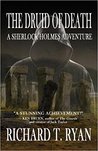 The Druid of Death: A Sherlock Holmes Adventure by Richard T. Ryan
My rating: 4 of 5 stars
As its title indicates, Richard T. Ryan’s latest Holmesian adventure delves more deeply into the British past than did its predecessors, for our great detective’s quarry seems to be resurrecting the ritual sacrifices of the ancient Druids. Young victims’ mutilated bodies are discovered at a series of Druidic sites, marked with weird symbols and surrounded by the branches of trees sacred to the cult. Because the murders take place only upon solstices, Holmes, Watson, and Lestrade have ample time to solve the case, even if the Yarder grows impatient with the pace of progress. Among the Druidic experts enlisted to assist is none other than the Rev. Sabine Baring-Gould, lyricist of “Onward, Christian Soldiers” and grandfather of another B-G venerated by Sherlockians. As in The Stone of Destiny, Ryan writes at times from the murderer’s perspective, allowing alert readers the opportunity to identify one culprit without the clues that Holmes withholds. Anachronistic dialogue and minor errors occasionally slip in, but Ryan is uniformly faithful to the characters that Conan Doyle created. His most recent tale is educational as well as entertaining, offering a tour of Druidic henges, and a primer on Druidic lore, as “icing on the cake” for a solid and satisfying mystery.
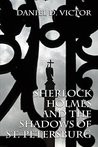 Sherlock Holmes and The Shadows of St Petersburg by Daniel D Victor
My rating: 5 of 5 stars
In this novel, Daniel D. Victor branches out from his excellent American Literati series and proves himself equally at home with Russian literature. The murder of two pawnbrokers in London’s East End appears to replicate the one in Dostoevsky’s Crime and Punishment, which Watson (while awaiting publication of his own first literary effort) happens to be reading at the time. With Holmes seeming skeptical of the connection, the Doctor, in his mentor’s absence, joins Lestrade’s investigation and interrogates a likely suspect. Naturally, the great detective is a step ahead of them, off to St. Petersburg to investigate the historical origins of Dostoevsky’s novel and consult a Russian colleague. As readers of his books expect, Victor skillfully weaves these threads into a satisfying outcome, with spot-on depictions of Doyle’s characters, impressive knowledge of the neighborhoods of London, and literary erudition that educates his readers as well as entertains them. More, please!
It may, of course, be fairly stated that my pastiches have not often focused upon solving crimes. Like his brother Mycroft, I prefer to see Sherlock Holmes’ deductive talents devoted to more important matters than the “petty puzzles of the police-court.” Yet, I deny that this preference amounts to “tampering with the Canon,” for the Canon is replete with cases that immersed the great detective in international intrigue or service to “one of the royal houses of Europe.” Long before “His Last Bow” brought Holmes’ anti-German espionage exploits to a triumphant end, the Kaiser’s shadow loomed over such cases as “The Bruce-Partington Plans,” “The Naval Treaty,” and “The Second Stain.” Thus, a pasticheur who presents Holmes and Watson as historical figures participating in historical events (what David Marcum calls “Playing the Game”) is no more tampering with the Canon than was Conan Doyle when his characters joined “The Great Game” of imperial rivalry before the First World War. My forthcoming collection Sherlock Holmes and the Crowned Heads of Europe (which will include “A Scandal in Serbia”) contains four previously unrecorded cases that led directly to that war. The first of them, “The Case of the Dying Emperor,” marked the beginning of Holmes’ personal crusade against the German Empire. It is already available as an e-book from MX Publishing (https://www.amazon.com/Sherlock-Holme...). In support of my preoccupation, I cite Marcum’s thesis that Holmes “retired” in 1903 at the behest of Mycroft, in order to concentrate more closely on the coming conflict. Why else, indeed, should a celebrated sleuth “retire” when he was only forty-nine? (“A Scandal in Serbia” suggests a secondary motive, but more—again—on that below.)
“Tampering” might more reasonably be charged against Crowned Heads because, in those stories, Watson finally wrote openly of historical events. During the years when most of the Canon was compiled, the identities of near-contemporary luminaries had perforce to be concealed. As the Doctor noted in his introduction:
As Holmes’ biographer, I was required to exercise more than usual discretion when writing of such cases, or those that could be presented to the public if suitably disguised. Some of my disguises were less than adequate, I fear, for readers with more than a passing knowledge of contemporary politics. No doubt they identified “Lord Bellinger” or “the Duke of Holderness” with ease, aware that no “King of Bohemia” had ruled an independent kingdom for four centuries. However, given the gravity of the events that lay behind them, these mythical figures had to populate my stories in order for them to be read at all.
By the late 1920s, Watson recognized that with Armageddon having come and gone:
. . . the necessity for such feeble deceptions has now passed. Our Victorian statesmen have long since departed the political arena. The Great War has swept away the dynasties of Europe. It becomes possible, therefore, to write openly of cases Holmes could not have permitted to be published only a decade ago, even in the fictionalized manner I have hitherto employed. All but one of the royal principals is dead; the survivor’s reputation cannot be diminished further by my revelations. These four inconclusive cases . . . may finally be recorded, although they shall not be published until well beyond my lifetime.
Note that sad word “inconclusive.” “A Scandal in Serbia’s” lack of resolution was another disappointment for my poor reviewer. He rightly grumbled that “[T]here seemed no clear outcome of the adventure, especially since Holmes and Watson [could] spend hours observing and waiting for prey, then act like reporters on the scene.” Deprived of the introduction to Crowned Heads, his complaint was understandable, for only there did Watson reveal that in “these four inconclusive cases” he and the great detective had failed to alter history:
[I]n every instance, Holmes’ scrupulous investigation remained unresolved, my own account unwritten, and the historical facts behind the cases faded with each passing year.
Despite the most valiant efforts of our heroes, “The Dying Emperor” died before his time; the “scandalous” Obrenovićs perished pitifully; and Franz Ferdinand survived at Welbeck Abbey only to succumb at Sarajevo. In the “fateful summer” of 1914 (wrote the Doctor), the Crowned Heads cases’ “long-delayed results combined with terrible effect, erupting in the cataclysm that brought down our vanished world.” Perhaps it was some consolation that while Holmes and Watson did not save the world from war, their timely thwarting of [v]on Bork at least preserved Great Britain from immediate disaster.
A Sidelight on Baring-Gould and his Descendants
One last complaint in the review was that “A Scandal in Serbia” employed a plot element (Holmes’ love affair with Irene Adler during the Hiatus) that was not conceived by Doyle, but by the great detective’s “biographer,” W.S. Baring-Gould. My reviewer wrote that Baring-Gould was “not quite [C]anon”; therefore, his accretions should not have been included in what was advertised as a traditional anthology. While I might argue that “traditional” need not mean “strictly Canonical,” editor Marcum and I foresaw such justifiable objections when my story was accepted. Nevertheless, we remain unapologetic Baring-Gouldists. Doyle’s primary object in the Canon, as I see it, was to demonstrate Holmes’ facility for observation and deduction. He was seldom much concerned—and, indeed, was often careless—about the details of Holmes and Watson’s private lives outside of Baker Street. The vexed question of the Doctor’s wives is only one example. Baring-Gould, and those who follow him, have attempted to flesh out the Master’s sketchy portraits and turn his two creations into fully realized human beings. To return to the Holmes-Adler love affair, which my reviewer found heretical, there was a plausible justification for it in the story he’d just read:
Surely [Watson wrote] it is no wonder that two people who had shared so strong an intellectual attraction should fall in love under the charged circumstances that attended their reunion. Fleeing the horror at the Reichenbach Falls, pursued by the most formidable of Moriarty’s minions, robbed of his very identity while disguised as Sigerson, my friend was in as vulnerable a state as any man who affects to disdain all emotion can be. In Irene Adler, he discovered—besides a companion of surpassing beauty, charm, and sympathy—a mind that matched his own as well.
Must we necessarily accept that Holmes, like his modern golem “Sherlock,” was always “a high-functioning sociopath” immune to sexual attraction? A.S. Croyle, who found a marvelous first love for the young man in When the Song of the Angels is Stilled and its successor novels, explained quite cogently that the budding detective gave up Poppy Stamford to devote himself, without feminine distraction, to the science of deduction. Odd, perhaps, but hardly inexplicable. Is it not also possible that the mature Holmes might abandon his ascetic vow upon reencountering “The Woman” who was in every sense his equal? Or that her final loss in 1903 (as Marcum and I have concluded) might have been one of the factors that led him to retire?
Similarly, Baring-Gould, assisted by recent pasticheurs, has filled in some of the Canonical gaps concerning Watson. Why aren’t there more cases from the middle 1880s? Why did a man so attracted to the ladies (and the Doctor’s proclivities have never been in doubt!) wait until age thirty-seven to marry Mary Morstan? What about those inconvenient references to a wife who can’t be her? B-G solved all these problems neatly by sending Watson to America from 1884 to 1886. He returned from San Francisco with a wife (one Constance Adams) who—although she soon expired—lasted long enough to provide me with a ghost story for the MX anthology, Part VII. However, Watson’s greatest benefactor is surely Marcia Wilson, who builds upon Adrian Conan Doyle’s description of the Doctor—“an active, loyal man with a normal intelligence and more than his fair share of courage.” In You Buy Bones, in two Test of the Professionals novels, and in several episodes of yet-to-be published fan fiction, Wilson presents John H. Watson as the man he essentially was and might have remained if not for Maiwand: a soldier. She has rescued the ex-army surgeon from the last vestiges of Nigel Bruce.
I do not agree with Baring-Gould on everything. His candidates for Jack the Ripper and the “real” King of Bohemia, for example, were quite ludicrous. Nevertheless, the biographical and case chronology in Sherlock Holmes of Baker Street should in itself assure the man an honored place among Sherlockians. Nothing in his writings is incompatible with the “traditional” Holmes and Watson as conceived by Conan Doyle. In B-G’s hands, indeed—and in the hands of the best of his successors—the Master’s characters have come more fully into life.
Below are two overdue reviews of other recent novels from Sherlockian writers with an historical bent: Richard T. Ryan and Daniel D. Victor.
The Druid of Death: A Sherlock Holmes Adventure by Richard T. RyanMy rating: 4 of 5 stars
As its title indicates, Richard T. Ryan’s latest Holmesian adventure delves more deeply into the British past than did its predecessors, for our great detective’s quarry seems to be resurrecting the ritual sacrifices of the ancient Druids. Young victims’ mutilated bodies are discovered at a series of Druidic sites, marked with weird symbols and surrounded by the branches of trees sacred to the cult. Because the murders take place only upon solstices, Holmes, Watson, and Lestrade have ample time to solve the case, even if the Yarder grows impatient with the pace of progress. Among the Druidic experts enlisted to assist is none other than the Rev. Sabine Baring-Gould, lyricist of “Onward, Christian Soldiers” and grandfather of another B-G venerated by Sherlockians. As in The Stone of Destiny, Ryan writes at times from the murderer’s perspective, allowing alert readers the opportunity to identify one culprit without the clues that Holmes withholds. Anachronistic dialogue and minor errors occasionally slip in, but Ryan is uniformly faithful to the characters that Conan Doyle created. His most recent tale is educational as well as entertaining, offering a tour of Druidic henges, and a primer on Druidic lore, as “icing on the cake” for a solid and satisfying mystery.
Sherlock Holmes and The Shadows of St Petersburg by Daniel D VictorMy rating: 5 of 5 stars
In this novel, Daniel D. Victor branches out from his excellent American Literati series and proves himself equally at home with Russian literature. The murder of two pawnbrokers in London’s East End appears to replicate the one in Dostoevsky’s Crime and Punishment, which Watson (while awaiting publication of his own first literary effort) happens to be reading at the time. With Holmes seeming skeptical of the connection, the Doctor, in his mentor’s absence, joins Lestrade’s investigation and interrogates a likely suspect. Naturally, the great detective is a step ahead of them, off to St. Petersburg to investigate the historical origins of Dostoevsky’s novel and consult a Russian colleague. As readers of his books expect, Victor skillfully weaves these threads into a satisfying outcome, with spot-on depictions of Doyle’s characters, impressive knowledge of the neighborhoods of London, and literary erudition that educates his readers as well as entertains them. More, please!
May 5, 2017
A Fine Anthology, a Peek Inside the Mind of Mycroft, and a Drood Who Isn't Edwin. Also a Preview of Coming Attractions from Yours Turley
In recent months, I've been researching and writing my next story for Sherlock Holmes and the Crowned Heads of Europe, to be entitled "The Case of the Dying Emperor." For anyone who might be interested, here is Dr. Watson's introduction:
"With the horrors of the Great War still fresh in our memories, it seems strange to recall that Great Britain’s relations with Imperial Germany were not always marked by mutual antipathy. Indeed, for much of my lifetime, our traditional European enemies were France and Russia; with the new German Empire, we shared both a common racial heritage and close dynastic ties. The events I shall narrate fatefully transformed that relationship, beginning a quarter-century of rivalry and tension that eventually would lead to war. Naturally, there were many other causes of the breach, but those I shall leave to the historians. In a symbolic sense, the change occurred with the untimely passing of one German Emperor, Frederick III, and his succession by another whose name became anathema in our new century. This was, of course, 'The Kaiser,' William II, who led his empire to destruction and engulfed all Europe in its ruin.
"The case was also a beginning for my friend Sherlock Holmes, initiating an anti-German espionage campaign that would occupy him, intermittently, until the very night the war began. Unmasking the plot behind William’s unforeseen accession was the first of Holmes’ diplomatic missions in which I was permitted to take part. For almost forty years, my notes on this case have languished in my tin dispatch box. . . ."
While studying the contents of that dispatch box, I have been eagerly awaiting the next two volumes of MX Publishing's ongoing anthology of traditional pastiches. Part VI, which debuts on May 22, includes "A Scandal in Serbia," one of my other stories from Crowned Heads. Part VII, due out in the fall, will contain "A Ghost from Christmas Past," my account of Dr. Watson's little-known--and sadly brief--first marriage. (No, dear Mary Morstan, you were not the first.)
Meanwhile, I've made a feeble stab at keeping current with other people's work. Here are my reviews of two Holmes-related publications, plus an older book that has some relevance to fans of Conan Doyle, even though it's set earlier and involves two other famous writers.
 Holmes Away From Home, Adventures From the Great Hiatus Volume I: 1891-1892 Volume II: 1893-1894
My rating: 5 of 5 stars
Having read and enjoyed Beyond Watson, the first anthology from Belanger Books, I took up this collection, which unveils the mysteries of “The Great Hiatus,” with great anticipation. Happily, the two volumes, edited by David Marcum, are even better than their predecessor. There are very few weak entries, and many of the stories are outstanding. My personal favorites were: Craig Janacek’s “The Harrowing Intermission” and Mark Mower’s “The French Affair,” in both of which Watson employs his medical expertise to solve the case; S. Subramanian’s “The Incident at Maniyachi Junction” and Daniel D. Victor’s “For Want of a Sword,” based on two compelling historical events; Marcum’s “The Adventure of the Old Brownstone,” which passes to another famous sleuth; and Richard Paolinelli’s “The Woman Returns” (no Holmes fan should need to ask which woman), a nicely plotted tale that remains true to the characters depicted in the Canon. Other stories by Deanna Baran, S.F. Bennett, Sonia Fetherston, Jayantika Ganguly, John Linwood Grant, and Shane Simmons are almost equally well done. Marcum offers enlightening introductions to both volumes, and—just for context—the new stories are bracketed by Conan Doyle’s originals that began and ended “The Great Hiatus.” Given its quality, one might justly consider Holmes Away from Home the last word on these “lost years” of Sherlock Holmes’ career. While more tales will surely follow, this anthology serves as a model to which they can aspire.
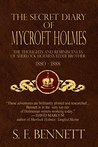 The Secret Diary of Mycroft Holmes: The Thoughts and Reminiscences of Sherlock Holmes's Elder Brother, 1880-1888 by S.F. Bennett
My rating: 5 of 5 stars
Devon-based Sherlockian S.F. Bennett, the author of several excellent short stories for MX Publishing and Belanger Books, has taken on the task of editing the long-lost diaries of Mycroft Holmes. Her initial volume (let us hope the first of many) begins in 1880. At 33, Mycroft has already founded the Diogenes Club and is well on his way to becoming both curmudgeon and gourmand. However, he is not yet the éminence gris at Whitehall that he will soon become. At this stage, therefore, Mycroft’s diary entries focus not on great events but on retaining his position, avoiding the marital ambitions of his cleaning lady, and surviving the variable offerings of his club’s chef. Naturally, it is his feckless, financially dependent brother (still “playing the game for the game’s sake” in the Montague Street years) who comes to dominate the diary. Ms. Bennett skillfully traces the often prickly—but invariably amusing—relationship between the siblings, as Sherlock glibly defends his amateur status (“What value can a man assign to knowledge?”), Mycroft glumly hosts the redoubtable Toby (“I am not my brother’s dog’s keeper”), and senior bests cadet in “our usual game of observation and deduction.” Occasionally, they must unite to fend off other members of the Holmes clan, for Mycroft and Sherlock are (remarkably!) the least eccentric of the lot. By the time the volume ends in 1888, it is evident that both their characters have grown. Mycroft may empathize with Mrs. Hudson over her tenant’s many faults, but he also rebukes Lestrade’s ingratitude at receiving Sherlock’s aid. Our emotionally aloof detective makes a touching gesture to spare the feelings of his first true friend, whose merits Mycroft has already recognized. Along the way, they combine their talents to solve at least two cases, including the Melas affair that marks Mycroft’s first appearance in the Canon. Now that her groundwork has been laid so well, we can trust Ms. Bennett to treat the manifold crises of the 1890’s, and Mycroft’s political and diplomatic work at Whitehall, with the same humor and knowledge of her characters that she exhibits in this book.
 Drood by Dan Simmons
My rating: 4 of 5 stars
Sherlockian scholar David Marcum has noted that only a single generation separates the world of Charles Dickens from the world of Conan Doyle. That fact is evident in Dan Simmons’ literary horror novel Drood, for its characters (most prominently an Iago-like Wilkie Collins and his hero and nemesis, the more famous Charles Dickens) haunt the same dismal London alleys to be prowled, a decade or two later, by Sherlock Holmes, Inspector Lestrade, and Jack the Ripper. Moreover, Collins’ private investigator from The Moonstone, Sergeant Cuff, preceded Doyle’s creation by some nineteen years, while Cuff’s real-life model, Charles Frederick Field, was borrowed even earlier for Bleak House. Obviously, finding Conan Doyle connections is not Dan Simmons’ point; nor is his monster Drood (a very different being than the feeble Edwin in Dickens’ last, unfinished novel) really the point either. Rather, Drood is at its heart a long—much too long, alas—meditation on the corrosive effects of hubris, envy, misogyny, and other typically Victorian failings. The book exhibits the same virtues as The Terror, Simmons’ 2007 re-creation of the lost Franklin Expedition, e.g., exhaustive research, marvelous scene-setting, well-developed characters, and the understanding that (as Stephen King would tell us) true evil arises less from outside forces than within ourselves. Yet, whereas Simmons had the vast Arctic for his canvas in The Terror, Drood plays out in the drawing rooms, theaters, graveyards, and—yes—even sewers of London. This more restricted setting accentuates the novel’s flaws. There is simply not enough plot here for eight hundred pages, and the story bogs down much too often as the author regurgitates factoids turned up in his research. Yet, those who persevere with Drood will be rewarded, for its final twist takes a step back from the supernatural and rises to real pathos. Along the way, readers will learn a great deal more of “The Inimitable” and the author of The Moonstone than they probably knew before. Sadly, that knowledge may prove somewhat disillusioning, for Simmons reminds us that immortal authors were not always admirable men.
This may or may not be enough to keep you busy until Crowned Heads goes to press, but at least it's a start. In the meantime, I'll get back to work!
"With the horrors of the Great War still fresh in our memories, it seems strange to recall that Great Britain’s relations with Imperial Germany were not always marked by mutual antipathy. Indeed, for much of my lifetime, our traditional European enemies were France and Russia; with the new German Empire, we shared both a common racial heritage and close dynastic ties. The events I shall narrate fatefully transformed that relationship, beginning a quarter-century of rivalry and tension that eventually would lead to war. Naturally, there were many other causes of the breach, but those I shall leave to the historians. In a symbolic sense, the change occurred with the untimely passing of one German Emperor, Frederick III, and his succession by another whose name became anathema in our new century. This was, of course, 'The Kaiser,' William II, who led his empire to destruction and engulfed all Europe in its ruin.
"The case was also a beginning for my friend Sherlock Holmes, initiating an anti-German espionage campaign that would occupy him, intermittently, until the very night the war began. Unmasking the plot behind William’s unforeseen accession was the first of Holmes’ diplomatic missions in which I was permitted to take part. For almost forty years, my notes on this case have languished in my tin dispatch box. . . ."
While studying the contents of that dispatch box, I have been eagerly awaiting the next two volumes of MX Publishing's ongoing anthology of traditional pastiches. Part VI, which debuts on May 22, includes "A Scandal in Serbia," one of my other stories from Crowned Heads. Part VII, due out in the fall, will contain "A Ghost from Christmas Past," my account of Dr. Watson's little-known--and sadly brief--first marriage. (No, dear Mary Morstan, you were not the first.)
Meanwhile, I've made a feeble stab at keeping current with other people's work. Here are my reviews of two Holmes-related publications, plus an older book that has some relevance to fans of Conan Doyle, even though it's set earlier and involves two other famous writers.
Holmes Away From Home, Adventures From the Great Hiatus Volume I: 1891-1892 Volume II: 1893-1894My rating: 5 of 5 stars
Having read and enjoyed Beyond Watson, the first anthology from Belanger Books, I took up this collection, which unveils the mysteries of “The Great Hiatus,” with great anticipation. Happily, the two volumes, edited by David Marcum, are even better than their predecessor. There are very few weak entries, and many of the stories are outstanding. My personal favorites were: Craig Janacek’s “The Harrowing Intermission” and Mark Mower’s “The French Affair,” in both of which Watson employs his medical expertise to solve the case; S. Subramanian’s “The Incident at Maniyachi Junction” and Daniel D. Victor’s “For Want of a Sword,” based on two compelling historical events; Marcum’s “The Adventure of the Old Brownstone,” which passes to another famous sleuth; and Richard Paolinelli’s “The Woman Returns” (no Holmes fan should need to ask which woman), a nicely plotted tale that remains true to the characters depicted in the Canon. Other stories by Deanna Baran, S.F. Bennett, Sonia Fetherston, Jayantika Ganguly, John Linwood Grant, and Shane Simmons are almost equally well done. Marcum offers enlightening introductions to both volumes, and—just for context—the new stories are bracketed by Conan Doyle’s originals that began and ended “The Great Hiatus.” Given its quality, one might justly consider Holmes Away from Home the last word on these “lost years” of Sherlock Holmes’ career. While more tales will surely follow, this anthology serves as a model to which they can aspire.
The Secret Diary of Mycroft Holmes: The Thoughts and Reminiscences of Sherlock Holmes's Elder Brother, 1880-1888 by S.F. BennettMy rating: 5 of 5 stars
Devon-based Sherlockian S.F. Bennett, the author of several excellent short stories for MX Publishing and Belanger Books, has taken on the task of editing the long-lost diaries of Mycroft Holmes. Her initial volume (let us hope the first of many) begins in 1880. At 33, Mycroft has already founded the Diogenes Club and is well on his way to becoming both curmudgeon and gourmand. However, he is not yet the éminence gris at Whitehall that he will soon become. At this stage, therefore, Mycroft’s diary entries focus not on great events but on retaining his position, avoiding the marital ambitions of his cleaning lady, and surviving the variable offerings of his club’s chef. Naturally, it is his feckless, financially dependent brother (still “playing the game for the game’s sake” in the Montague Street years) who comes to dominate the diary. Ms. Bennett skillfully traces the often prickly—but invariably amusing—relationship between the siblings, as Sherlock glibly defends his amateur status (“What value can a man assign to knowledge?”), Mycroft glumly hosts the redoubtable Toby (“I am not my brother’s dog’s keeper”), and senior bests cadet in “our usual game of observation and deduction.” Occasionally, they must unite to fend off other members of the Holmes clan, for Mycroft and Sherlock are (remarkably!) the least eccentric of the lot. By the time the volume ends in 1888, it is evident that both their characters have grown. Mycroft may empathize with Mrs. Hudson over her tenant’s many faults, but he also rebukes Lestrade’s ingratitude at receiving Sherlock’s aid. Our emotionally aloof detective makes a touching gesture to spare the feelings of his first true friend, whose merits Mycroft has already recognized. Along the way, they combine their talents to solve at least two cases, including the Melas affair that marks Mycroft’s first appearance in the Canon. Now that her groundwork has been laid so well, we can trust Ms. Bennett to treat the manifold crises of the 1890’s, and Mycroft’s political and diplomatic work at Whitehall, with the same humor and knowledge of her characters that she exhibits in this book.
Drood by Dan SimmonsMy rating: 4 of 5 stars
Sherlockian scholar David Marcum has noted that only a single generation separates the world of Charles Dickens from the world of Conan Doyle. That fact is evident in Dan Simmons’ literary horror novel Drood, for its characters (most prominently an Iago-like Wilkie Collins and his hero and nemesis, the more famous Charles Dickens) haunt the same dismal London alleys to be prowled, a decade or two later, by Sherlock Holmes, Inspector Lestrade, and Jack the Ripper. Moreover, Collins’ private investigator from The Moonstone, Sergeant Cuff, preceded Doyle’s creation by some nineteen years, while Cuff’s real-life model, Charles Frederick Field, was borrowed even earlier for Bleak House. Obviously, finding Conan Doyle connections is not Dan Simmons’ point; nor is his monster Drood (a very different being than the feeble Edwin in Dickens’ last, unfinished novel) really the point either. Rather, Drood is at its heart a long—much too long, alas—meditation on the corrosive effects of hubris, envy, misogyny, and other typically Victorian failings. The book exhibits the same virtues as The Terror, Simmons’ 2007 re-creation of the lost Franklin Expedition, e.g., exhaustive research, marvelous scene-setting, well-developed characters, and the understanding that (as Stephen King would tell us) true evil arises less from outside forces than within ourselves. Yet, whereas Simmons had the vast Arctic for his canvas in The Terror, Drood plays out in the drawing rooms, theaters, graveyards, and—yes—even sewers of London. This more restricted setting accentuates the novel’s flaws. There is simply not enough plot here for eight hundred pages, and the story bogs down much too often as the author regurgitates factoids turned up in his research. Yet, those who persevere with Drood will be rewarded, for its final twist takes a step back from the supernatural and rises to real pathos. Along the way, readers will learn a great deal more of “The Inimitable” and the author of The Moonstone than they probably knew before. Sadly, that knowledge may prove somewhat disillusioning, for Simmons reminds us that immortal authors were not always admirable men.
This may or may not be enough to keep you busy until Crowned Heads goes to press, but at least it's a start. In the meantime, I'll get back to work!
January 17, 2017
Of Ghostly Visitations, Moriarty's Relations, a Consummate Professional, and an Icy Figure from the Poles
Since my last blog, I've researched and written a story for a forthcoming volume of MX's ongoing anthology of traditional pastiches. Submissions for this volume, Eliminate the Impossible, may skirt the edges of the supernatural before coming to a rational conclusion. My story, "A Ghost from Christmas Past," teeters uneasily along that edge, for there seems to be a ghostly visitation in the eyes of two beholders. More broadly, "Ghost" chronicles the little-known (?) first marriage of our friend Dr. Watson. Yes, if you read the Canon closely, another wife preceded Mary. Holmes' "biographer," W.S. Baring-Gould, mentioned her briefly; so I've taken his account and a couple of others, thrown in elements from "The Five Orange Pips" and The Sign of Four, and written what I hope will be a plausible history of this elusive marriage. Whether the "ghost" is plausible depends, of course, on whether you share Doyle's devotion to the supernatural or follow his detective's dictum: "No ghosts need apply!"
Besides boning up on such diverse topics as Golden Gate Park, diphtheria, and the Ku Klux Klan in my research, I employed a resource that other Sherlockian writers may find useful. (Many thanks to Marcia Wilson for letting me know about this source!) The British Met Office (meteorological office) posts historical weather reports online, including those for the 1880's at: http://www.metoffice.gov.uk/learning/.... My correspondent there assured me that the Met Office is "always keen to see accurate meteorological depictions in pseudo-historical narratives" like mine. In return for a credit in my end notes, the office allowed me to cite official records indicating that it snowed in Brighton on December 27, 1887. While a snowstorm was not essential to my plot, it provided atmosphere to set the stage for my "ghost's" presumed appearance.
With that story now behind me, I have belatedly returned to reading other people's work. Here are reviews of three fairly recent offerings. The first two feature equally unpleasant relatives of that devoted family man, Professor Moriarty. His sister Julia returns in an expanded collection from Dick Gillman, while Kim Krisco includes Moriarty's daughter (Maeve Murtagh) in his saga of the Baker Street Irregulars:
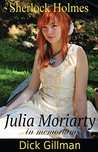 Sherlock Holmes - Julia Moriarty - in memorium by Dick Gillman
My rating: 5 of 5 stars
Beware the cover of this book! It shows a winsome and demure young redhead, but hair color is her only similarity to the formidable villain who returns in Mr. Gillman’s new collection. Only four of these fine stories are actually new; the others premiered in The Julia Moriarty Trilogy (2013). As readers of that volume know, Julia—the grieving younger sister of Professor Moriarty—has resurrected his criminal enterprise and is determined to revenge herself on Sherlock Holmes. In pursuit of her goals, she shows equal ingenuity with her late brother and a far more wanton disregard for human life. Yet—as Holmes eventually discovers—Julia has her Achilles heel as well. Mr. Gillman’s stories are always inventively plotted and true to the Canon, although two appear to be misdated if they are to follow his chronology. Of the new ones, my favorites were “The Mazlov Knot,” in which salt becomes a murder weapon, and “The Broken Watch of Meiringen,” in which Holmes obtains an artifact of compelling interest to his adversary. Sad to say, the latter story appears to bring Julia’s saga to a close, so it is pleasant to have all seven stories collected here within a single volume. Mr. Gillman is an excellent Sherlockian, and I look forward to following the future adventures he creates for Holmes and Watson.
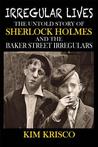 Irregular Lives: The Untold Story of Sherlock Holmes and the Baker Street Irregulars by Kim Krisco
My rating: 5 of 5 stars
Like Kim Krisco’s previous novel, Irregular Lives begins during the “golden years” of Sherlock Holmes and Dr. Watson. Soon after the end of the Great War, they are invited to an exhibition of photographs by the mysterious “S.P. Fields,” whose subjects Holmes soon recognizes as the street urchins who assisted in many of his early cases. Each photograph allows Holmes to reminisce about a particular Irregular; and Wiggins, Tessa, Benjie, Ugly, Snape, Kate, and Archie emerge as distinct, well-drawn personalities when their stories are retold. In these early tales—all set in the heyday of the Canon—Mr. Krisco demonstrates both an impressive knowledge of Victorian social history (although he imports at least one character from an earlier period) and a compassion for the lives of the young pickpockets, mudlarks, sweeps, and other deprived children whose “accomplishment lies . . . [in] the fact that they survived at all.” It becomes clear that Holmes—despite his emotional reticence—shared this compassion. “S.P. Fields’” exhibition is a tribute to him by the “fortunate few” he assisted “to find a footing on clean pavement.” Nevertheless, in the 1919 chapters the adult Irregulars test their benefactor by immersing him in a lively plot that crowds in blackmailers, kidnappers, munitions manufacturers, arms dealers, Irish revolutionaries, Brother Mycroft, and Moriarty’s daughter. (Several plot elements hark back to Mr. Krisco’s earlier book.) Holmes, Watson, Tessa, and Wiggins must all decide how far their loyalty to the Irregulars extends before the novel winds its way to a poignant but satisfying end. Mr. Krisco also includes a number of aphorisms that are good enough to stand upon their own, e.g.: “There is a cost for knowing one’s true nature, and war is too high a price.” “The best companions enjoy each other’s company, and respect each other’s privacy.” “Most people have no idea what to wish for when they throw a coin into a fountain . . . but put a penny in a child’s hand, and the hope that we once held for ourselves is rekindled.” Definitely a five-star read!
Marcia Wilson's new book was not out yet when I reviewed it in October, so I'm reposting the review. Test of the Professionals focuses on "the best of the professionals" (in Sherlock Holmes' opinion), Inspector Geoffrey Lestrade. Read Ms. Wilson's book, and you'll never again see Lestrade as a sad sack. The backstory she creates for the inspector is amazing:
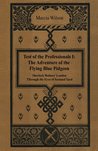 Test of the Professionals I: The Adventure of the Flying Blue Pidgeon by Marcia Wilson
My rating: 5 of 5 stars
Last year, Marcia Wilson joined the Sherlockian mainstream with her wonderful debut novel You Buy Bones. Beginning just after the fateful meeting between Sherlock Holmes and Dr. Watson, it transformed the Scotland Yarders—Gregson, Bradstreet, and Lestrade—from mere foils to be outshone by Holmes into living, breathing characters in their own right. Since then, Ms. Wilson’s short stories have been featured in several MX Publishing anthologies, edited by David Marcum, and in Derrick Belanger’s anthology Beyond Watson.
Now she carries her saga forward to the autumn of 1883, as the Yarders investigate seemingly unrelated waterfront crimes (missing seamen, stolen flour barrels) linked to an agent of the master criminal who still lurks behind the scenes. Whereas Watson was as important as the Yarders to the plot of You Buy Bones, here the focus is on Inspector Geoffrey Lestrade. In Ms. Wilson’s hands, he becomes a full-fledged personality, not the one-dimensional character we met in Doyle. While not the smartest of the Yarders, “Inspector Plod” is truly (as Holmes admits) the best of them, due to his iron sense of ethics (for which he has paid a heavy price) and his grim determination to battle both criminals and his own limitations in the pursuit of justice. In Test, we learn of an incident in Lestrade’s past that forever darkened his relations with his family, as well as his career at Scotland Yard. An old enemy returns to devil him, serving as both the charming, heartless villain of the piece and a romantic rival. For Test is also the story of Lestrade’s meeting with Clea Cheatham, a young woman of independent mind and her own unusual family and backstory. Like the inspector’s, they are woven skillfully into the tale.
Underlying these delights of plot and character is some amazing historical research. Marcia Wilson has an encyclopedic knowledge of Victorian minutia; happily, her footnotes are helpful rather than intrusive. Osage orange trees, Krakatoa, mudlarks, and tie-mates all find their places in the story. A potato pie, we learn, can be an insult. There are even notes explaining Inspector Bradstreet’s strange invective. On another level, Ms. Wilson writes with compassion of the day-to-day perils of the London poor. We see far more of Watson as a doctor, and of Mrs. Hudson as a housekeeper, than we ever did in Doyle.
Readers who buy A Test of the Professionals should not expect a traditional Sherlock Holmes pastiche. Ms. Wilson does not tell her story with Victorian reserve; her intimate, informal style is in keeping with the rough-and-tumble lives led by the Yarders. Yet, devotees of the Master will find nothing to offend them, for the characters in Test are never incompatible with their originals. The idiosyncrasies of Holmes, and his interactions with Watson and the Yarders, are as familiar and delightful here as ever. The difference is that for her canvas of Victorian London, Marcia Wilson employs a more colorful palette and a broader brush than Conan Doyle’s. Such is her artistry that she enriches and fully brings to life the world he left us.
Finally (for anyone who needs a break from Sherlock Holmes!), here is my review of a Norwegian biography of Roald Amundsen. Tor Bomann-Larsen's conclusion? "Great explorer. Not a particularly nice guy."
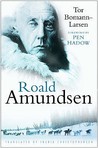 Roald Amundsen by Tor Bomann-Larsen
My rating: 4 of 5 stars
Having always been fascinated by polar exploration, one of my early heroes was Robert Falcon Scott, the second man to the South Pole. In 1979, the “Heroic Legend” of his Last Expedition was acidly debunked by fellow Briton Roland Huntford, whose Scott and Amundsen (later adapted as a TV miniseries, The Last Place on Earth) exposed Scott’s hidebound naval methodology and was utterly rancorous about his character. Huntford rightly deplored the relative neglect of Roald Amundsen, the Norwegian who beat Scott to the Pole and brought his men back safely. Furious at such iconoclasm, Captain Scott’s defenders fought back zealously to restore his reputation. Only in 2006 did David Crane’s biography achieve a balanced view (see my review at: https://www.goodreads.com/book/show/3...), convincingly rehabilitating Scott as a man, if not quite as an explorer.
Meanwhile, the victorious Amundsen also encountered a debunking countryman. Contrary to Huntford’s treatment of Scott, Tor Bomann-Larsen’s biography (1995) does not deny its subject’s greatness. He considers Amundsen the greatest of all polar explorers, and the Norwegian’s résumé makes a compelling case. Amundsen was the first man to reach both Poles: the South by dog sled in 1911, the North by air in 1926. He also took part in the first overwintering in the Antarctic and completed the first navigations of both the Northwest and Northeast Passages. Even more than Scott's, however, Amundsen’s accomplishments were undermined by the defects of his character; and Bomann-Larsen shows no hesitation in exposing them. The explorer betrayed or quarreled with almost all of his friends, patrons, and supporters, including his own brother Leon and the great Fridtjof Nansen. He ruthlessly discarded subordinates who challenged him (Hjalmar Johansen) or lost their usefulness (Helmer Hanssen). Amundsen’s mid-voyage volte-face from the North Pole to the South—stealing a march on Scott after obtaining Nansen’s Fram under false pretenses—was but one example of his deviousness. He was financially irresponsible and undertook his last expeditions partly to recover from bankruptcy. He adopted, then abandoned, two young girls brought back from Siberia. He apparently pursued only married women, spurning them—after affairs of years or even decades—at the very point he might have married them. When Amundsen disappeared into the Arctic in 1928, on a dramatic flight to rescue his bitter enemy Nobile, Bormann-Larsen speculates that the old man may have felt he had exhausted every other option.
Roald Amundsen, his biographer concludes, “laid a smokescreen over his own life.” Thanks to the discovery of the Amundsen brothers’ business correspondence (15,000 documents found only in the 1990’s), Bomann-Larsen has been able to penetrate that smokescreen. Admittedly, his book has many flaws. It has been criticized for a poor English translation; and, indeed, its breezy, almost “slangy” style sometimes seems at odds with the bleakness of its subject matter. Its treatment of Amundsen’s early explorations (the Belgica, Gjøa, and even South Polar expeditions) seems almost cursory, offering little geographic or technical detail. I did find it more informative about the later expeditions, perhaps because I knew much less about them. While there are many better books (including Roland Huntford’s) on Amundsen’s career as an explorer, it is on a personal level that Bomann-Larsen’s biography excels. He provides a fascinating portrait of an undeniably great, deeply flawed, and ultimately enigmatic man.
Besides boning up on such diverse topics as Golden Gate Park, diphtheria, and the Ku Klux Klan in my research, I employed a resource that other Sherlockian writers may find useful. (Many thanks to Marcia Wilson for letting me know about this source!) The British Met Office (meteorological office) posts historical weather reports online, including those for the 1880's at: http://www.metoffice.gov.uk/learning/.... My correspondent there assured me that the Met Office is "always keen to see accurate meteorological depictions in pseudo-historical narratives" like mine. In return for a credit in my end notes, the office allowed me to cite official records indicating that it snowed in Brighton on December 27, 1887. While a snowstorm was not essential to my plot, it provided atmosphere to set the stage for my "ghost's" presumed appearance.
With that story now behind me, I have belatedly returned to reading other people's work. Here are reviews of three fairly recent offerings. The first two feature equally unpleasant relatives of that devoted family man, Professor Moriarty. His sister Julia returns in an expanded collection from Dick Gillman, while Kim Krisco includes Moriarty's daughter (Maeve Murtagh) in his saga of the Baker Street Irregulars:
Sherlock Holmes - Julia Moriarty - in memorium by Dick GillmanMy rating: 5 of 5 stars
Beware the cover of this book! It shows a winsome and demure young redhead, but hair color is her only similarity to the formidable villain who returns in Mr. Gillman’s new collection. Only four of these fine stories are actually new; the others premiered in The Julia Moriarty Trilogy (2013). As readers of that volume know, Julia—the grieving younger sister of Professor Moriarty—has resurrected his criminal enterprise and is determined to revenge herself on Sherlock Holmes. In pursuit of her goals, she shows equal ingenuity with her late brother and a far more wanton disregard for human life. Yet—as Holmes eventually discovers—Julia has her Achilles heel as well. Mr. Gillman’s stories are always inventively plotted and true to the Canon, although two appear to be misdated if they are to follow his chronology. Of the new ones, my favorites were “The Mazlov Knot,” in which salt becomes a murder weapon, and “The Broken Watch of Meiringen,” in which Holmes obtains an artifact of compelling interest to his adversary. Sad to say, the latter story appears to bring Julia’s saga to a close, so it is pleasant to have all seven stories collected here within a single volume. Mr. Gillman is an excellent Sherlockian, and I look forward to following the future adventures he creates for Holmes and Watson.
Irregular Lives: The Untold Story of Sherlock Holmes and the Baker Street Irregulars by Kim KriscoMy rating: 5 of 5 stars
Like Kim Krisco’s previous novel, Irregular Lives begins during the “golden years” of Sherlock Holmes and Dr. Watson. Soon after the end of the Great War, they are invited to an exhibition of photographs by the mysterious “S.P. Fields,” whose subjects Holmes soon recognizes as the street urchins who assisted in many of his early cases. Each photograph allows Holmes to reminisce about a particular Irregular; and Wiggins, Tessa, Benjie, Ugly, Snape, Kate, and Archie emerge as distinct, well-drawn personalities when their stories are retold. In these early tales—all set in the heyday of the Canon—Mr. Krisco demonstrates both an impressive knowledge of Victorian social history (although he imports at least one character from an earlier period) and a compassion for the lives of the young pickpockets, mudlarks, sweeps, and other deprived children whose “accomplishment lies . . . [in] the fact that they survived at all.” It becomes clear that Holmes—despite his emotional reticence—shared this compassion. “S.P. Fields’” exhibition is a tribute to him by the “fortunate few” he assisted “to find a footing on clean pavement.” Nevertheless, in the 1919 chapters the adult Irregulars test their benefactor by immersing him in a lively plot that crowds in blackmailers, kidnappers, munitions manufacturers, arms dealers, Irish revolutionaries, Brother Mycroft, and Moriarty’s daughter. (Several plot elements hark back to Mr. Krisco’s earlier book.) Holmes, Watson, Tessa, and Wiggins must all decide how far their loyalty to the Irregulars extends before the novel winds its way to a poignant but satisfying end. Mr. Krisco also includes a number of aphorisms that are good enough to stand upon their own, e.g.: “There is a cost for knowing one’s true nature, and war is too high a price.” “The best companions enjoy each other’s company, and respect each other’s privacy.” “Most people have no idea what to wish for when they throw a coin into a fountain . . . but put a penny in a child’s hand, and the hope that we once held for ourselves is rekindled.” Definitely a five-star read!
Marcia Wilson's new book was not out yet when I reviewed it in October, so I'm reposting the review. Test of the Professionals focuses on "the best of the professionals" (in Sherlock Holmes' opinion), Inspector Geoffrey Lestrade. Read Ms. Wilson's book, and you'll never again see Lestrade as a sad sack. The backstory she creates for the inspector is amazing:
Test of the Professionals I: The Adventure of the Flying Blue Pidgeon by Marcia WilsonMy rating: 5 of 5 stars
Last year, Marcia Wilson joined the Sherlockian mainstream with her wonderful debut novel You Buy Bones. Beginning just after the fateful meeting between Sherlock Holmes and Dr. Watson, it transformed the Scotland Yarders—Gregson, Bradstreet, and Lestrade—from mere foils to be outshone by Holmes into living, breathing characters in their own right. Since then, Ms. Wilson’s short stories have been featured in several MX Publishing anthologies, edited by David Marcum, and in Derrick Belanger’s anthology Beyond Watson.
Now she carries her saga forward to the autumn of 1883, as the Yarders investigate seemingly unrelated waterfront crimes (missing seamen, stolen flour barrels) linked to an agent of the master criminal who still lurks behind the scenes. Whereas Watson was as important as the Yarders to the plot of You Buy Bones, here the focus is on Inspector Geoffrey Lestrade. In Ms. Wilson’s hands, he becomes a full-fledged personality, not the one-dimensional character we met in Doyle. While not the smartest of the Yarders, “Inspector Plod” is truly (as Holmes admits) the best of them, due to his iron sense of ethics (for which he has paid a heavy price) and his grim determination to battle both criminals and his own limitations in the pursuit of justice. In Test, we learn of an incident in Lestrade’s past that forever darkened his relations with his family, as well as his career at Scotland Yard. An old enemy returns to devil him, serving as both the charming, heartless villain of the piece and a romantic rival. For Test is also the story of Lestrade’s meeting with Clea Cheatham, a young woman of independent mind and her own unusual family and backstory. Like the inspector’s, they are woven skillfully into the tale.
Underlying these delights of plot and character is some amazing historical research. Marcia Wilson has an encyclopedic knowledge of Victorian minutia; happily, her footnotes are helpful rather than intrusive. Osage orange trees, Krakatoa, mudlarks, and tie-mates all find their places in the story. A potato pie, we learn, can be an insult. There are even notes explaining Inspector Bradstreet’s strange invective. On another level, Ms. Wilson writes with compassion of the day-to-day perils of the London poor. We see far more of Watson as a doctor, and of Mrs. Hudson as a housekeeper, than we ever did in Doyle.
Readers who buy A Test of the Professionals should not expect a traditional Sherlock Holmes pastiche. Ms. Wilson does not tell her story with Victorian reserve; her intimate, informal style is in keeping with the rough-and-tumble lives led by the Yarders. Yet, devotees of the Master will find nothing to offend them, for the characters in Test are never incompatible with their originals. The idiosyncrasies of Holmes, and his interactions with Watson and the Yarders, are as familiar and delightful here as ever. The difference is that for her canvas of Victorian London, Marcia Wilson employs a more colorful palette and a broader brush than Conan Doyle’s. Such is her artistry that she enriches and fully brings to life the world he left us.
Finally (for anyone who needs a break from Sherlock Holmes!), here is my review of a Norwegian biography of Roald Amundsen. Tor Bomann-Larsen's conclusion? "Great explorer. Not a particularly nice guy."
Roald Amundsen by Tor Bomann-LarsenMy rating: 4 of 5 stars
Having always been fascinated by polar exploration, one of my early heroes was Robert Falcon Scott, the second man to the South Pole. In 1979, the “Heroic Legend” of his Last Expedition was acidly debunked by fellow Briton Roland Huntford, whose Scott and Amundsen (later adapted as a TV miniseries, The Last Place on Earth) exposed Scott’s hidebound naval methodology and was utterly rancorous about his character. Huntford rightly deplored the relative neglect of Roald Amundsen, the Norwegian who beat Scott to the Pole and brought his men back safely. Furious at such iconoclasm, Captain Scott’s defenders fought back zealously to restore his reputation. Only in 2006 did David Crane’s biography achieve a balanced view (see my review at: https://www.goodreads.com/book/show/3...), convincingly rehabilitating Scott as a man, if not quite as an explorer.
Meanwhile, the victorious Amundsen also encountered a debunking countryman. Contrary to Huntford’s treatment of Scott, Tor Bomann-Larsen’s biography (1995) does not deny its subject’s greatness. He considers Amundsen the greatest of all polar explorers, and the Norwegian’s résumé makes a compelling case. Amundsen was the first man to reach both Poles: the South by dog sled in 1911, the North by air in 1926. He also took part in the first overwintering in the Antarctic and completed the first navigations of both the Northwest and Northeast Passages. Even more than Scott's, however, Amundsen’s accomplishments were undermined by the defects of his character; and Bomann-Larsen shows no hesitation in exposing them. The explorer betrayed or quarreled with almost all of his friends, patrons, and supporters, including his own brother Leon and the great Fridtjof Nansen. He ruthlessly discarded subordinates who challenged him (Hjalmar Johansen) or lost their usefulness (Helmer Hanssen). Amundsen’s mid-voyage volte-face from the North Pole to the South—stealing a march on Scott after obtaining Nansen’s Fram under false pretenses—was but one example of his deviousness. He was financially irresponsible and undertook his last expeditions partly to recover from bankruptcy. He adopted, then abandoned, two young girls brought back from Siberia. He apparently pursued only married women, spurning them—after affairs of years or even decades—at the very point he might have married them. When Amundsen disappeared into the Arctic in 1928, on a dramatic flight to rescue his bitter enemy Nobile, Bormann-Larsen speculates that the old man may have felt he had exhausted every other option.
Roald Amundsen, his biographer concludes, “laid a smokescreen over his own life.” Thanks to the discovery of the Amundsen brothers’ business correspondence (15,000 documents found only in the 1990’s), Bomann-Larsen has been able to penetrate that smokescreen. Admittedly, his book has many flaws. It has been criticized for a poor English translation; and, indeed, its breezy, almost “slangy” style sometimes seems at odds with the bleakness of its subject matter. Its treatment of Amundsen’s early explorations (the Belgica, Gjøa, and even South Polar expeditions) seems almost cursory, offering little geographic or technical detail. I did find it more informative about the later expeditions, perhaps because I knew much less about them. While there are many better books (including Roland Huntford’s) on Amundsen’s career as an explorer, it is on a personal level that Bomann-Larsen’s biography excels. He provides a fascinating portrait of an undeniably great, deeply flawed, and ultimately enigmatic man.
October 2, 2016
What I Did on My Summer Vacation
Despite a "great hiatus" in blogging since July, my summer has not been devoid of Sherlockian pursuits. The first of my stories for Sherlock Holmes and the Crowned Heads of Europe--"A Scandal in Serbia"--was accepted for the spring 2017 volume of MX's ongoing anthology of traditional pastiches. I'm working on another story to submit for a later volume and on a second Crowned Heads story, "The Case of the Dying Emperor."
I've also read a number of fine books or stories by other Sherlockian writers--and one writer who is not known as a Sherlockian. Let's start there:
 Blood and Ivory: A Tapestry by P.C. Hodgell
My rating: 5 of 5 stars
This is a review of Ms. Hodgell's story "A Ballad of the White Plague," which appears in this collection.
My daughter’s favorite fantasy writer is P.C. Hodgell, best known for her Kencyr series (God Stalk, Dark of the Moon, and Seeker’s Mask), published in the 1980’s-‘90’s. I haven’t read Ms. Hodgell’s fantasy (although Catherine says it’s great); but I can verify that she has written an unusual and atmospheric Sherlock Holmes pastiche, which first appeared in Marvin Kaye’s 1998 anthology The Confidential Casebook of Sherlock Holmes. Were it not already published, “A Ballad of the White Plague” would be perfect for the forthcoming MX anthology Eliminate the Impossible, for it just skirts the edges of the supernatural. Holmes and Watson, returning late from a buggy ride in Surrey, stop at a quintessential “dark old house” that once belonged to our detective’s less savory relatives on his Vernet side. What follows is a horrific story from Holmes’ childhood, which—as it should—illuminates his character as an adult. If, of course, the tale is true; and Watson (in an afterward) leaves that decision to the reader. Despite Ms. Hodgell’s obvious debts to Poe and Stoker, her story takes no liberties with Conan Doyle. It is told in proper “Watson voice”; and Holmes, even as a child, remains the man we know. His ultimate conclusion is the one we would expect: “No ghosts need apply.” Fortunately for us, Ms. Hodgell’s ghosts (if they were ghosts) at least received a thorough and fascinating interview!
Now for a couple of books that are not officially "out" yet.
Marcia Wilson's A Test of the Professionals, Part I will come out in November from MX Publishing. It is not yet available for review on Goodreads, although an older version is on Amazon. Ms. Wilson kindly provided me an advance copy of the text, but I was not smart enough to import her cover illustration (which may change for the MX edition, anyway). Here is my review:
Marcia Wilson, A Test of the Professionals, Part I, from MX Publishing (Nov. 2016)
Last year, Marcia Wilson joined the Sherlockian mainstream with her wonderful debut novel You Buy Bones. Beginning just after the fateful meeting between Sherlock Holmes and Dr. Watson, it transformed the Scotland Yarders—Gregson, Bradstreet, and Lestrade—from mere foils to be outshone by Holmes into living, breathing characters in their own right. Since then, Ms. Wilson’s short stories have been featured in several MX Publishing anthologies, edited by David Marcum, and in Derrick Belanger’s anthology Beyond Watson.
Now she carries her saga forward to the autumn of 1883, as the Yarders investigate seemingly unrelated waterfront crimes (missing seamen, stolen flour barrels) linked to an agent of the master criminal who still lurks behind the scenes. Whereas Watson was as important as the Yarders to the plot of You Buy Bones, here the focus is on Inspector Geoffrey Lestrade. In Ms. Wilson’s hands, he becomes a full-fledged personality, not the one-dimensional character we met in Doyle. While not the smartest of the Yarders, “Inspector Plod” is truly (as Holmes admits) the best of them, due to his iron sense of ethics (for which he has paid a heavy price) and his grim determination to battle both criminals and his own limitations in the pursuit of justice. In Test, we learn of an incident in Lestrade’s past that forever darkened his relations with his family, as well as his career at Scotland Yard. An old enemy returns to devil him, serving as both the charming, heartless villain of the piece and a romantic rival. For Test is also the story of Lestrade’s meeting with Clea Cheatham, a young woman of independent mind and her own unusual family and backstory. Like the inspector’s, they are woven skillfully into the tale.
Underlying these delights of plot and character is some amazing historical research. Marcia Wilson has an encyclopedic knowledge of Victorian minutia; happily, her footnotes are helpful rather than intrusive. Osage orange trees, Krakatoa, mudlarks, and tie-mates all find their places in the story. A potato pie, we learn, can be an insult. There are even notes explaining Inspector Bradstreet’s strange invective. On another level, Ms. Wilson writes with compassion of the day-to-day perils of the London poor. We see far more of Watson as a doctor, and of Mrs. Hudson as a housekeeper, than we ever did in Doyle.
Readers who buy A Test of the Professionals should not expect a traditional Sherlock Holmes pastiche. Ms. Wilson does not tell her story with Victorian reserve; her intimate, informal style is in keeping with the rough-and-tumble lives led by the Yarders. Yet, devotees of the Master will find nothing to offend them, for the characters in Test are never incompatible with their originals. The idiosyncrasies of Holmes, and his interactions with Watson and the Yarders, are as familiar and delightful here as ever. The difference is that for her canvas of Victorian London, Marcia Wilson employs a more colorful palette and a broader brush than Conan Doyle’s. Such is her artistry that she enriches and fully brings to life the world he left us.
The next book also has a November publication date, but it is already posted on Goodreads and Amazon:
 The Vatican Cameos: A Sherlock Holmes Adventure by Richard T. Ryan
My rating: 5 of 5 stars
Richard Ryan channels Dan Brown as well as Conan Doyle in this successful novel. In alternating chapters, he combines an historical thriller with a Sherlock Holmes pastiche. Holmes and Watson must recover a stolen set of cameos (sculpted by Michelangelo in the story’s other timeline) before they can undermine the political independence of the Papacy. Having studied medieval literature at Notre Dame, Mr. Ryan knows his church history, whether it occurred in 1901 or 1501. He offers unexpectedly attractive portraits of the Borgia Family: Pope Alexander VI and his notorious offspring, Cesare and Lucrezia. Other Renaissance luminaries (Leonardo, Machiavelli, Savonarola, and two future popes) fill in the political and artistic landscape. A warning: some of the Michelangelo chapters are more sexually explicit than readers of Holmes tales usually encounter.
Mr. Ryan is almost equally proficient in writing his actual pastiche. He provides a well-constructed plot and sound deductions by our hero, a likable Pope Leo as the client, and a villain whose motives partly mitigate his nasty personality. Atypically, Holmes even condescends to apprise the Pontiff of his plans, although Watson annoyingly withholds them from the reader. The doctor is otherwise a bit more of a cipher than I like to see. Stylistically, the novel’s occasional modernisms seem more noticeable in Holmes’ day than in Michelangelo’s. A minor distraction—not attributable to Mr. Ryan—is a printing format that (in my pre-publication copy) often combines two characters’ dialogue within a single paragraph.
None of these quibbles detracts seriously from this well-researched and well-told story. The Vatican Cameos is a promising addition in the Sherlockian corpus, and I look forward to reading Mr. Ryan's next book. Happily for us, it is already under way.
Now for a pair of less recent works I finally got around to and enjoyed:
 The Shepherds Bushman by John A. Little
My rating: 4 of 5 stars
Although third in a series, this is the first of Mr. Little’s books I have encountered. From what I gather of its predecessors (based on reviews), the author has conceived a grim, if plausible, family history for Sherlock Holmes to explain his personal peculiarities. Abandoning his bees in the mid-1920s, Holmes reunites in Baker Street with Dr. Watson, where they reside with updated versions of (Lily) Hudson and (Jasper) Lestrade. Mr. Little is a facile and effective writer with an interest in ciphers. His cases—which abound with murderous Masons, pedophile prelates, renegade royals, and even a witch—are cleverly plotted and uniformly entertaining. One incorporates two legends of the British monarchy familiar from the films From Hell, Murder by Decree, and Mrs. Brown. Yet, it is a timeworn and melancholy universe that Mr. Little’s characters inhabit. His portraits of the aging detective and his even more decrepit Boswell—bickering bitterly as they cope with their infirmities, each other, and the modern world—may leave some readers yearning for the comforting Victorian milieu of Conan Doyle.
 The Final Page of Baker Street by Daniel D. Victor
My rating: 5 of 5 stars
This is the second of Mr. Victor’s three-book series, Sherlock Holmes and the American Literati. (The others focus on Mark Twain and Stephen Crane.) Here, as the title indicates, young Raymond Chandler becomes the last “Billy the Page” employed by Mrs. Hudson, after her famous tenant has redeemed him from the throes of teenage lust. Later a budding writer under Dr. Watson’s tutelage, “Billy” retains his eye for a well-turned ankle. His eventual temptress is a true Raymond Chandler heroine (think Lauren Bacall, not Irene Adler) who has somehow missed her proper continent and era. Even Sherlock Holmes recognizes the lady’s duplicitous charms, while Watson—who shows an odd streak of prudery for an old soldier—stammers like a schoolboy in her presence. The alluring Mrs. Sterne leads our heroes through several false endings to this complicated case, as it is Mr. Victor’s premise that Chandler’s early experience as a detective informed the plots of his crime novels. The case itself involves a love story wherein everyone (defying Casablanca) does the wrong thing. A few surprises come along the way: for example, the villainous Colonel Moran actually shows his softer side. Throughout the novel, Mr. Victor exhibits well-drawn characters, an appropriate Edwardian style, and a commendable knowledge of his story’s historical and literary context. The Final Page of Baker Street succeeds brilliantly, both as a Sherlockian pastiche and as an “early” example of noir fiction. Having enjoyed this one, I shall certainly investigate Holmes’ interactions with Mssrs. Crane and Twain.
Finally, a return to a well one cannot drink from too often:
 The MX Book of New Sherlock Holmes Stories Part IV: 2016 Annual by David Marcum
My rating: 5 of 5 stars
For some reason, I am always a volume behind in reviewing MX Publishing’s anthologies of traditional Sherlockian pastiches, edited by David Marcum. The Kickstarter campaign for Part V: Christmas Adventures was announced last week. We can anticipate the new volume with pleasure, for Part IV was undoubtedly the most consistently excellent of the whole series. My own favorite was Marcia Wilson’s “The Adventure of the Half-Melted Wolf,” which captured perfectly how the personal relationships of Holmes, Watson, and the two best “Yarders”—Gregson and Lestrade—have mellowed like fine wine over the years. Other notable entries came from Hugh Ashton, J.R. Campbell, Jayantika Ganguly, Jeremy Holstein, Craig Janacek, Daniel McGachey, Mark Mower, Denis O. Smith, and Daniel D. Victor. Along the way, we encounter an ill-fated precursor of Watson, escape a couple of “Black Widows,” discover the origins of Maupassant’s famous tale “The Necklace,” meet Moriarty’s daughter (!), and even witness the incredible sight of Sherlock Holmes baking dumplings! In these anthologies (whose sales benefit Doyle’s home, Undershaw, and the Stepping Stones School), MX and David Marcum have set new standards of quality for traditional pastiches.
I've also read a number of fine books or stories by other Sherlockian writers--and one writer who is not known as a Sherlockian. Let's start there:
Blood and Ivory: A Tapestry by P.C. HodgellMy rating: 5 of 5 stars
This is a review of Ms. Hodgell's story "A Ballad of the White Plague," which appears in this collection.
My daughter’s favorite fantasy writer is P.C. Hodgell, best known for her Kencyr series (God Stalk, Dark of the Moon, and Seeker’s Mask), published in the 1980’s-‘90’s. I haven’t read Ms. Hodgell’s fantasy (although Catherine says it’s great); but I can verify that she has written an unusual and atmospheric Sherlock Holmes pastiche, which first appeared in Marvin Kaye’s 1998 anthology The Confidential Casebook of Sherlock Holmes. Were it not already published, “A Ballad of the White Plague” would be perfect for the forthcoming MX anthology Eliminate the Impossible, for it just skirts the edges of the supernatural. Holmes and Watson, returning late from a buggy ride in Surrey, stop at a quintessential “dark old house” that once belonged to our detective’s less savory relatives on his Vernet side. What follows is a horrific story from Holmes’ childhood, which—as it should—illuminates his character as an adult. If, of course, the tale is true; and Watson (in an afterward) leaves that decision to the reader. Despite Ms. Hodgell’s obvious debts to Poe and Stoker, her story takes no liberties with Conan Doyle. It is told in proper “Watson voice”; and Holmes, even as a child, remains the man we know. His ultimate conclusion is the one we would expect: “No ghosts need apply.” Fortunately for us, Ms. Hodgell’s ghosts (if they were ghosts) at least received a thorough and fascinating interview!
Now for a couple of books that are not officially "out" yet.
Marcia Wilson's A Test of the Professionals, Part I will come out in November from MX Publishing. It is not yet available for review on Goodreads, although an older version is on Amazon. Ms. Wilson kindly provided me an advance copy of the text, but I was not smart enough to import her cover illustration (which may change for the MX edition, anyway). Here is my review:
Marcia Wilson, A Test of the Professionals, Part I, from MX Publishing (Nov. 2016)
Last year, Marcia Wilson joined the Sherlockian mainstream with her wonderful debut novel You Buy Bones. Beginning just after the fateful meeting between Sherlock Holmes and Dr. Watson, it transformed the Scotland Yarders—Gregson, Bradstreet, and Lestrade—from mere foils to be outshone by Holmes into living, breathing characters in their own right. Since then, Ms. Wilson’s short stories have been featured in several MX Publishing anthologies, edited by David Marcum, and in Derrick Belanger’s anthology Beyond Watson.
Now she carries her saga forward to the autumn of 1883, as the Yarders investigate seemingly unrelated waterfront crimes (missing seamen, stolen flour barrels) linked to an agent of the master criminal who still lurks behind the scenes. Whereas Watson was as important as the Yarders to the plot of You Buy Bones, here the focus is on Inspector Geoffrey Lestrade. In Ms. Wilson’s hands, he becomes a full-fledged personality, not the one-dimensional character we met in Doyle. While not the smartest of the Yarders, “Inspector Plod” is truly (as Holmes admits) the best of them, due to his iron sense of ethics (for which he has paid a heavy price) and his grim determination to battle both criminals and his own limitations in the pursuit of justice. In Test, we learn of an incident in Lestrade’s past that forever darkened his relations with his family, as well as his career at Scotland Yard. An old enemy returns to devil him, serving as both the charming, heartless villain of the piece and a romantic rival. For Test is also the story of Lestrade’s meeting with Clea Cheatham, a young woman of independent mind and her own unusual family and backstory. Like the inspector’s, they are woven skillfully into the tale.
Underlying these delights of plot and character is some amazing historical research. Marcia Wilson has an encyclopedic knowledge of Victorian minutia; happily, her footnotes are helpful rather than intrusive. Osage orange trees, Krakatoa, mudlarks, and tie-mates all find their places in the story. A potato pie, we learn, can be an insult. There are even notes explaining Inspector Bradstreet’s strange invective. On another level, Ms. Wilson writes with compassion of the day-to-day perils of the London poor. We see far more of Watson as a doctor, and of Mrs. Hudson as a housekeeper, than we ever did in Doyle.
Readers who buy A Test of the Professionals should not expect a traditional Sherlock Holmes pastiche. Ms. Wilson does not tell her story with Victorian reserve; her intimate, informal style is in keeping with the rough-and-tumble lives led by the Yarders. Yet, devotees of the Master will find nothing to offend them, for the characters in Test are never incompatible with their originals. The idiosyncrasies of Holmes, and his interactions with Watson and the Yarders, are as familiar and delightful here as ever. The difference is that for her canvas of Victorian London, Marcia Wilson employs a more colorful palette and a broader brush than Conan Doyle’s. Such is her artistry that she enriches and fully brings to life the world he left us.
The next book also has a November publication date, but it is already posted on Goodreads and Amazon:
The Vatican Cameos: A Sherlock Holmes Adventure by Richard T. RyanMy rating: 5 of 5 stars
Richard Ryan channels Dan Brown as well as Conan Doyle in this successful novel. In alternating chapters, he combines an historical thriller with a Sherlock Holmes pastiche. Holmes and Watson must recover a stolen set of cameos (sculpted by Michelangelo in the story’s other timeline) before they can undermine the political independence of the Papacy. Having studied medieval literature at Notre Dame, Mr. Ryan knows his church history, whether it occurred in 1901 or 1501. He offers unexpectedly attractive portraits of the Borgia Family: Pope Alexander VI and his notorious offspring, Cesare and Lucrezia. Other Renaissance luminaries (Leonardo, Machiavelli, Savonarola, and two future popes) fill in the political and artistic landscape. A warning: some of the Michelangelo chapters are more sexually explicit than readers of Holmes tales usually encounter.
Mr. Ryan is almost equally proficient in writing his actual pastiche. He provides a well-constructed plot and sound deductions by our hero, a likable Pope Leo as the client, and a villain whose motives partly mitigate his nasty personality. Atypically, Holmes even condescends to apprise the Pontiff of his plans, although Watson annoyingly withholds them from the reader. The doctor is otherwise a bit more of a cipher than I like to see. Stylistically, the novel’s occasional modernisms seem more noticeable in Holmes’ day than in Michelangelo’s. A minor distraction—not attributable to Mr. Ryan—is a printing format that (in my pre-publication copy) often combines two characters’ dialogue within a single paragraph.
None of these quibbles detracts seriously from this well-researched and well-told story. The Vatican Cameos is a promising addition in the Sherlockian corpus, and I look forward to reading Mr. Ryan's next book. Happily for us, it is already under way.
Now for a pair of less recent works I finally got around to and enjoyed:
The Shepherds Bushman by John A. LittleMy rating: 4 of 5 stars
Although third in a series, this is the first of Mr. Little’s books I have encountered. From what I gather of its predecessors (based on reviews), the author has conceived a grim, if plausible, family history for Sherlock Holmes to explain his personal peculiarities. Abandoning his bees in the mid-1920s, Holmes reunites in Baker Street with Dr. Watson, where they reside with updated versions of (Lily) Hudson and (Jasper) Lestrade. Mr. Little is a facile and effective writer with an interest in ciphers. His cases—which abound with murderous Masons, pedophile prelates, renegade royals, and even a witch—are cleverly plotted and uniformly entertaining. One incorporates two legends of the British monarchy familiar from the films From Hell, Murder by Decree, and Mrs. Brown. Yet, it is a timeworn and melancholy universe that Mr. Little’s characters inhabit. His portraits of the aging detective and his even more decrepit Boswell—bickering bitterly as they cope with their infirmities, each other, and the modern world—may leave some readers yearning for the comforting Victorian milieu of Conan Doyle.
The Final Page of Baker Street by Daniel D. VictorMy rating: 5 of 5 stars
This is the second of Mr. Victor’s three-book series, Sherlock Holmes and the American Literati. (The others focus on Mark Twain and Stephen Crane.) Here, as the title indicates, young Raymond Chandler becomes the last “Billy the Page” employed by Mrs. Hudson, after her famous tenant has redeemed him from the throes of teenage lust. Later a budding writer under Dr. Watson’s tutelage, “Billy” retains his eye for a well-turned ankle. His eventual temptress is a true Raymond Chandler heroine (think Lauren Bacall, not Irene Adler) who has somehow missed her proper continent and era. Even Sherlock Holmes recognizes the lady’s duplicitous charms, while Watson—who shows an odd streak of prudery for an old soldier—stammers like a schoolboy in her presence. The alluring Mrs. Sterne leads our heroes through several false endings to this complicated case, as it is Mr. Victor’s premise that Chandler’s early experience as a detective informed the plots of his crime novels. The case itself involves a love story wherein everyone (defying Casablanca) does the wrong thing. A few surprises come along the way: for example, the villainous Colonel Moran actually shows his softer side. Throughout the novel, Mr. Victor exhibits well-drawn characters, an appropriate Edwardian style, and a commendable knowledge of his story’s historical and literary context. The Final Page of Baker Street succeeds brilliantly, both as a Sherlockian pastiche and as an “early” example of noir fiction. Having enjoyed this one, I shall certainly investigate Holmes’ interactions with Mssrs. Crane and Twain.
Finally, a return to a well one cannot drink from too often:
The MX Book of New Sherlock Holmes Stories Part IV: 2016 Annual by David MarcumMy rating: 5 of 5 stars
For some reason, I am always a volume behind in reviewing MX Publishing’s anthologies of traditional Sherlockian pastiches, edited by David Marcum. The Kickstarter campaign for Part V: Christmas Adventures was announced last week. We can anticipate the new volume with pleasure, for Part IV was undoubtedly the most consistently excellent of the whole series. My own favorite was Marcia Wilson’s “The Adventure of the Half-Melted Wolf,” which captured perfectly how the personal relationships of Holmes, Watson, and the two best “Yarders”—Gregson and Lestrade—have mellowed like fine wine over the years. Other notable entries came from Hugh Ashton, J.R. Campbell, Jayantika Ganguly, Jeremy Holstein, Craig Janacek, Daniel McGachey, Mark Mower, Denis O. Smith, and Daniel D. Victor. Along the way, we encounter an ill-fated precursor of Watson, escape a couple of “Black Widows,” discover the origins of Maupassant’s famous tale “The Necklace,” meet Moriarty’s daughter (!), and even witness the incredible sight of Sherlock Holmes baking dumplings! In these anthologies (whose sales benefit Doyle’s home, Undershaw, and the Stepping Stones School), MX and David Marcum have set new standards of quality for traditional pastiches.
July 12, 2016
Three Good Books
This blog will confine itself to reviews of three MX publications, including works by David Marcum, Dan Andriacco, and Claire Daines. It may be of interest to fans of Charles Dickens as well as Conan Doyle.
 Sherlock Holmes and a Quantity of Debt by David Marcum
My rating: 5 of 5 stars
This 2013 publication, set to reappear this fall in paperback and audiobook editions, is perhaps the most literary of David Marcum’s works. Its title references a line from Dickens’ Great Expectations, and plot elements from that classic aid Sherlock Holmes in his solution. However, the tale behind the case (which begins with the discovery of a mummified body on a dying philanthropist’s estate) has the retributive darkness of a Thomas Hardy novel. Marcum’s book is a worthy tribute to the Victorian writers who inspired it. Naturally, they include Sir Arthur Conan Doyle, for no modern Sherlockian is more faithful to Doyle’s style, or the relationship between his central characters, than Marcum. We find Holmes in top deductive form, unraveling a convoluted mystery while offering sympathy (if few clues) to a bereaved Dr. Watson and sandbagging (for the best of motives) his official colleague. As a bonus, Marcum provides information on Watson’s little-known first marriage. A Quantity of Debt fully satisfies as a detective story, but it is the strange fate of Martin Briley that lifts this pastiche above the common run. While David Marcum’s editing of MX Publishing’s ongoing anthology remains a boon to all Sherlockians, his novel’s pending re-release reminds us that he is also an exceptionally fine writer.
Sherlock Holmes and A Quantity of Debt is available from all good bookstores, including Amazon USA, Amazon UK, Waterstones UK, and for free shipping worldwide Book Depository. In e-book format it is in Amazon Kindle, Kobo, Nook, and Apple Book (iPad/iPhone).
 Sherlock Holmes in the Peculiar Persecution of John Vincent Harden by Dan Adriacco
My rating: 5 of 5 stars
Although Conan Doyle mentioned this case in “The Solitary Cyclist,” it was never included in the Canon. Dan Andriacco fills the gap admirably with a story in Doyle’s classic format. His “Watson voice” is excellent; Sherlock Holmes is in top acerbic form; and the persecuted Harden, a Kentucky tobacco millionaire, makes a sympathetic client. The language is true to its period throughout, and references to the Civil War and Shakespeare add interest to the tale. So deft is Andriacco’s plotting that I was as chagrined as Watson not to deduce the solution (which in its timing left Holmes chagrined as well). Steve White, the narrator, enlivens the audio version with an entertaining variety of accents. While the dulcet sweetness of a Southern belle may be a bit beyond his range, as a Tennessean I can vouch for his Kentucky twang. In short, “The Peculiar Persecution of John Vincent Harden” fully satisfies, both aurally and as a Holmes pastiche.
"The Peculiar Persecution of John Vincent Harden" is available in Kindle and Audible versions on Amazon USA, as an audiobook on Amazon UK, and as an e-book on Kobo.
 A Criminal Carol by Claire Daines
My rating: 5 of 5 stars
This short story is a clever, nicely written fusion of Dickens’ “Christmas Carol” and Doyle’s “Adventure of the Blue Carbuncle.” Ms. Daines’ tale takes place on Christmas Eve in 1890, as Professor Moriarty contemplates the growing threat to his criminal empire posed by Sherlock Holmes. At this critical juncture, he is visited (like Dickens’ miser) by the ghost of an old colleague, followed by three spirits who reveal his past, present, and future. Only the last, of course, is of real interest to him. While the Napoleon of Crime may seem less redeemable than Scrooge, he is reconciled to his future, partly by a vision of Sherlockian pastiches stretching out, like Banquo’s issue, to the crack of doom. This story‘s premonition of the Reichenbach Falls differs from the outcome Ms. Daines’ presented in her 2013 novel, A Study in Regret. Having enjoyed this brief sample of her writing, readers who have not already done so will want to take up that fine book.
"A Criminal Carol" is available on Amazon Kindle.
Sherlock Holmes and a Quantity of Debt by David MarcumMy rating: 5 of 5 stars
This 2013 publication, set to reappear this fall in paperback and audiobook editions, is perhaps the most literary of David Marcum’s works. Its title references a line from Dickens’ Great Expectations, and plot elements from that classic aid Sherlock Holmes in his solution. However, the tale behind the case (which begins with the discovery of a mummified body on a dying philanthropist’s estate) has the retributive darkness of a Thomas Hardy novel. Marcum’s book is a worthy tribute to the Victorian writers who inspired it. Naturally, they include Sir Arthur Conan Doyle, for no modern Sherlockian is more faithful to Doyle’s style, or the relationship between his central characters, than Marcum. We find Holmes in top deductive form, unraveling a convoluted mystery while offering sympathy (if few clues) to a bereaved Dr. Watson and sandbagging (for the best of motives) his official colleague. As a bonus, Marcum provides information on Watson’s little-known first marriage. A Quantity of Debt fully satisfies as a detective story, but it is the strange fate of Martin Briley that lifts this pastiche above the common run. While David Marcum’s editing of MX Publishing’s ongoing anthology remains a boon to all Sherlockians, his novel’s pending re-release reminds us that he is also an exceptionally fine writer.
Sherlock Holmes and A Quantity of Debt is available from all good bookstores, including Amazon USA, Amazon UK, Waterstones UK, and for free shipping worldwide Book Depository. In e-book format it is in Amazon Kindle, Kobo, Nook, and Apple Book (iPad/iPhone).
Sherlock Holmes in the Peculiar Persecution of John Vincent Harden by Dan AdriaccoMy rating: 5 of 5 stars
Although Conan Doyle mentioned this case in “The Solitary Cyclist,” it was never included in the Canon. Dan Andriacco fills the gap admirably with a story in Doyle’s classic format. His “Watson voice” is excellent; Sherlock Holmes is in top acerbic form; and the persecuted Harden, a Kentucky tobacco millionaire, makes a sympathetic client. The language is true to its period throughout, and references to the Civil War and Shakespeare add interest to the tale. So deft is Andriacco’s plotting that I was as chagrined as Watson not to deduce the solution (which in its timing left Holmes chagrined as well). Steve White, the narrator, enlivens the audio version with an entertaining variety of accents. While the dulcet sweetness of a Southern belle may be a bit beyond his range, as a Tennessean I can vouch for his Kentucky twang. In short, “The Peculiar Persecution of John Vincent Harden” fully satisfies, both aurally and as a Holmes pastiche.
"The Peculiar Persecution of John Vincent Harden" is available in Kindle and Audible versions on Amazon USA, as an audiobook on Amazon UK, and as an e-book on Kobo.
A Criminal Carol by Claire DainesMy rating: 5 of 5 stars
This short story is a clever, nicely written fusion of Dickens’ “Christmas Carol” and Doyle’s “Adventure of the Blue Carbuncle.” Ms. Daines’ tale takes place on Christmas Eve in 1890, as Professor Moriarty contemplates the growing threat to his criminal empire posed by Sherlock Holmes. At this critical juncture, he is visited (like Dickens’ miser) by the ghost of an old colleague, followed by three spirits who reveal his past, present, and future. Only the last, of course, is of real interest to him. While the Napoleon of Crime may seem less redeemable than Scrooge, he is reconciled to his future, partly by a vision of Sherlockian pastiches stretching out, like Banquo’s issue, to the crack of doom. This story‘s premonition of the Reichenbach Falls differs from the outcome Ms. Daines’ presented in her 2013 novel, A Study in Regret. Having enjoyed this brief sample of her writing, readers who have not already done so will want to take up that fine book.
"A Criminal Carol" is available on Amazon Kindle.
June 26, 2016
Beyond Watson and on (as The Good Soldier Schweik demanded) "to Belgrade!"
This blog begins with a review of Derrick Belanger's fine new anthology of Holmes pastiches "NOT narrated by Dr. John H. Watson." It then moves on to discuss two books I found invaluable in writing my forthcoming story "A Scandal in Serbia." At least one of them--or its companion volumes--may be of use to other authors who have not already discovered this remarkable historical resource.
Other narrators fill in capably for the doctor in Beyond Watson
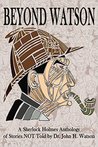 Beyond Watson by Derrick Belanger
My rating: 4 of 5 stars
While he is by no means “anti-Watson,” Derrick Belanger has compiled the first in a new series of anthologies that allow other characters to narrate Sherlockian tales. He has been well served by veteran Sherlockian authors. Besides Belanger’s own touching story, Geri Shear, Marcia Wilson, David Marcum, and David Ruffle contribute excellent entries, told (respectively) by Mrs. Hudson, Inspector Lestrade, Colonel Moran, and Holmes himself. Kieran Lyne’s finely crafted tale demonstrates why his controversial first novel received the seal of the Conan Doyle Estate. Elizabeth Varadan’s story amusingly stars the budding detective from her young adult novels, while Daniel D. Victor’s incorporates both Raymond Chandler (“The Last Page of Baker Street”) and Charlie Chaplin. Other historical, literary, or Canonical figures (Winston Churchill, H.L. Mencken, and Violet Hunter from “The Copper Beeches”) show up elsewhere. Among the non-Sherlockian contributors, Belanger has scored a major coup by acquiring Jack McDevitt’s first Holmes pastiche for the anthology. On the downside, a few stories suffer from poor writing and/or inauthentic renditions of Canonical or historical characters. At least one is so bad that it should not have been included. After this excellent beginning, let us trust that the anthology's editor will consistently employ a Watson-like “power of selection,” even if the good doctor is excluded from narrating the tales.
I found links to Beyond Watson on Amazon and Amazon UK, as well as Barnes and Noble; and as an e-book on Amazon Kindle and Nook.
All you could ever want to know of Yugoslavia, told by a fascinating woman
The multi-faceted Rebecca West (1892-1983), known as a novelist for The Return of the Soldier, as a journalist for her many essays and her coverage of the Nuremberg Trials, and as a socialist and feminist ("People call me a feminist whenever I express sentiments that differentiate me from a doormat or a prostitute."), is perhaps best remembered for the massive travelogue, historical treatise, and polemic she produced after visiting Yugoslavia on the eve of World War II. I found Black Lamb and Grey Falcon a wonderful source while drafting "A Scandal in Serbia," which centers on the 1903 assassinations of King Alexander Obrenović and Queen Draga. Ms. West's derisive portrait of that ill-fated couple, and her magical descriptions of the places Holmes and Watson passed through on their journey, greatly lengthened and enriched my tale. Regardless of one's interest--or lack thereof--in Yugoslavia, this book should be sampled, if not read in its entirety, for a glimpse of the remarkable personality behind it.
 Black Lamb and Grey Falcon by Rebecca West
My rating: 5 of 5 stars
Shortly before the outbreak of World War II, the noted British novelist, journalist, socialist, and feminist Rebecca West made three trips to Yugoslavia and subsequently wrote this book, her masterpiece. Published in 1941, it is in part a travelogue, but more profoundly a long meditation on the history, mythology, and culture of a region that Ms. West regarded as “the nexus of European history since the late Middle Ages.” Central to her tale is the Battle of Kossovo (1389), which ended the medieval Serbian Empire and doomed its people to 500 years of foreign rule. Ms. West writes of that half-millennium with passion that becomes polemical and compassion that makes no pretense of being even-handed. The South Slavs—especially the Serbs—are the heroes of her story; anyone who stands in the way of their unity and freedom (Turks, Austrians, Nazis, even their own unworthy rulers) is fair game. Yet, Ms. West’s passion is so pure, and her prejudice so frank, that she seldom misleads and invariably fascinates. Who else could write this summation of the Sarajevo murders: “At last the bullets had been coaxed out of the reluctant revolver to the bodies of the eager victims?” South Slavic history is, in any case, a tapestry of murders; the assassination of King Alexander in 1934 was the event that drew Ms. West’s attention to the region. It also, as she feared, signaled the failure of the Yugoslavian experiment years before the country fell to Hitler. Rebecca West poignantly dedicated Black Lamb and Grey Falcon “to my friends in Yugoslavia, who are now all dead or enslaved.” Her book remains a lasting memorial to that lost nation, and to one of the most remarkable women the 20th century produced.
Penguin Classics publishes a thick but attractive paperback edition of BLGF. It was sturdy enough to survive both my initial slog through it and repeated returns while writing "Serbia." It is available on Amazon USA and Barnes and Noble. A new paperback edition, published by Canongate Books, is available from Amazon UK. E-book versions may be acquired from Amazon Kindle and Nook. Old hardback editions, with original photographs, are also worth searching for.
Through Austria-Hungary with gun and camera
Without the Internet, guides published by the German firm of Karl Baedeker (1801-1859) must have been indispensable for European travel in Holmes’ day. They are also important to the writer who is trying to get the logistics of a story right. "A Scandal in Serbia" requires Holmes and Watson to follow a tortuous itinerary from London to Montenegro, and to shuttle from there to Serbia and back before returning home to England. While Rebecca West's descriptions of people and places provided delightful "local color," I needed something more detailed and accurate for hotels, train schedules, and travel routes. The timing of our heroes' arrival in Belgrade was crucial to the story.
To the rescue came the 9th English edition of Baedeker's Austria, Including Hungary, Transylvania, Dalmatia, and Bosnia (London, Dulau and Co., 1900). It was available online, through the courtesy of Emory University Libraries, at: https://archive.org/stream/01703017.5.... (I also consulted the 1905 and 1911 editions.) Using this resource, I could have been teleported to 1903 Austria-Hungary and made my way from Prague to Belgrade, knowing which trains to catch, which hotels and inns to patronize, and how much to tip the waiters. Baedeker offered a fascinating snapshot of a vanished realm and saved me from many oversights or errors I might otherwise have made. (That's not to say there won't be others!)
Thankfully, there is a whole series of Baedeker guides online. I had not had occasion to make use of them before, but I certainly will again in plotting Holmes and Watson's future travels. If you're writing a Sherlock Holmes pastiche, or anything "historical," you may want to check them out yourself.
Other narrators fill in capably for the doctor in Beyond Watson
Beyond Watson by Derrick BelangerMy rating: 4 of 5 stars
While he is by no means “anti-Watson,” Derrick Belanger has compiled the first in a new series of anthologies that allow other characters to narrate Sherlockian tales. He has been well served by veteran Sherlockian authors. Besides Belanger’s own touching story, Geri Shear, Marcia Wilson, David Marcum, and David Ruffle contribute excellent entries, told (respectively) by Mrs. Hudson, Inspector Lestrade, Colonel Moran, and Holmes himself. Kieran Lyne’s finely crafted tale demonstrates why his controversial first novel received the seal of the Conan Doyle Estate. Elizabeth Varadan’s story amusingly stars the budding detective from her young adult novels, while Daniel D. Victor’s incorporates both Raymond Chandler (“The Last Page of Baker Street”) and Charlie Chaplin. Other historical, literary, or Canonical figures (Winston Churchill, H.L. Mencken, and Violet Hunter from “The Copper Beeches”) show up elsewhere. Among the non-Sherlockian contributors, Belanger has scored a major coup by acquiring Jack McDevitt’s first Holmes pastiche for the anthology. On the downside, a few stories suffer from poor writing and/or inauthentic renditions of Canonical or historical characters. At least one is so bad that it should not have been included. After this excellent beginning, let us trust that the anthology's editor will consistently employ a Watson-like “power of selection,” even if the good doctor is excluded from narrating the tales.
I found links to Beyond Watson on Amazon and Amazon UK, as well as Barnes and Noble; and as an e-book on Amazon Kindle and Nook.
All you could ever want to know of Yugoslavia, told by a fascinating woman
The multi-faceted Rebecca West (1892-1983), known as a novelist for The Return of the Soldier, as a journalist for her many essays and her coverage of the Nuremberg Trials, and as a socialist and feminist ("People call me a feminist whenever I express sentiments that differentiate me from a doormat or a prostitute."), is perhaps best remembered for the massive travelogue, historical treatise, and polemic she produced after visiting Yugoslavia on the eve of World War II. I found Black Lamb and Grey Falcon a wonderful source while drafting "A Scandal in Serbia," which centers on the 1903 assassinations of King Alexander Obrenović and Queen Draga. Ms. West's derisive portrait of that ill-fated couple, and her magical descriptions of the places Holmes and Watson passed through on their journey, greatly lengthened and enriched my tale. Regardless of one's interest--or lack thereof--in Yugoslavia, this book should be sampled, if not read in its entirety, for a glimpse of the remarkable personality behind it.
Black Lamb and Grey Falcon by Rebecca WestMy rating: 5 of 5 stars
Shortly before the outbreak of World War II, the noted British novelist, journalist, socialist, and feminist Rebecca West made three trips to Yugoslavia and subsequently wrote this book, her masterpiece. Published in 1941, it is in part a travelogue, but more profoundly a long meditation on the history, mythology, and culture of a region that Ms. West regarded as “the nexus of European history since the late Middle Ages.” Central to her tale is the Battle of Kossovo (1389), which ended the medieval Serbian Empire and doomed its people to 500 years of foreign rule. Ms. West writes of that half-millennium with passion that becomes polemical and compassion that makes no pretense of being even-handed. The South Slavs—especially the Serbs—are the heroes of her story; anyone who stands in the way of their unity and freedom (Turks, Austrians, Nazis, even their own unworthy rulers) is fair game. Yet, Ms. West’s passion is so pure, and her prejudice so frank, that she seldom misleads and invariably fascinates. Who else could write this summation of the Sarajevo murders: “At last the bullets had been coaxed out of the reluctant revolver to the bodies of the eager victims?” South Slavic history is, in any case, a tapestry of murders; the assassination of King Alexander in 1934 was the event that drew Ms. West’s attention to the region. It also, as she feared, signaled the failure of the Yugoslavian experiment years before the country fell to Hitler. Rebecca West poignantly dedicated Black Lamb and Grey Falcon “to my friends in Yugoslavia, who are now all dead or enslaved.” Her book remains a lasting memorial to that lost nation, and to one of the most remarkable women the 20th century produced.
Penguin Classics publishes a thick but attractive paperback edition of BLGF. It was sturdy enough to survive both my initial slog through it and repeated returns while writing "Serbia." It is available on Amazon USA and Barnes and Noble. A new paperback edition, published by Canongate Books, is available from Amazon UK. E-book versions may be acquired from Amazon Kindle and Nook. Old hardback editions, with original photographs, are also worth searching for.
Through Austria-Hungary with gun and camera
Without the Internet, guides published by the German firm of Karl Baedeker (1801-1859) must have been indispensable for European travel in Holmes’ day. They are also important to the writer who is trying to get the logistics of a story right. "A Scandal in Serbia" requires Holmes and Watson to follow a tortuous itinerary from London to Montenegro, and to shuttle from there to Serbia and back before returning home to England. While Rebecca West's descriptions of people and places provided delightful "local color," I needed something more detailed and accurate for hotels, train schedules, and travel routes. The timing of our heroes' arrival in Belgrade was crucial to the story.
To the rescue came the 9th English edition of Baedeker's Austria, Including Hungary, Transylvania, Dalmatia, and Bosnia (London, Dulau and Co., 1900). It was available online, through the courtesy of Emory University Libraries, at: https://archive.org/stream/01703017.5.... (I also consulted the 1905 and 1911 editions.) Using this resource, I could have been teleported to 1903 Austria-Hungary and made my way from Prague to Belgrade, knowing which trains to catch, which hotels and inns to patronize, and how much to tip the waiters. Baedeker offered a fascinating snapshot of a vanished realm and saved me from many oversights or errors I might otherwise have made. (That's not to say there won't be others!)
Thankfully, there is a whole series of Baedeker guides online. I had not had occasion to make use of them before, but I certainly will again in plotting Holmes and Watson's future travels. If you're writing a Sherlock Holmes pastiche, or anything "historical," you may want to check them out yourself.
June 13, 2016
Return of the Blog: Publications Old and New, and a New Scandal
After taking a month off to complete my forthcoming story "A Scandal in Serbia," I'm back to blogging with a couple of book reviews and news about a past publication of my own. Let's start there:
"Sherlock Holmes and the Adventure of the Tainted Canister" joins MX audiobooks
MX Publishing has recently launched a new line of audiobooks; and I am happy to say that my story, "Sherlock Holmes and the Adventure of the Tainted Canister," has been included. Steve White narrates the tale, which recounts Dr. Watson's loss of his beloved Mary Morstan (and its chilling aftermath) with a wonderfully impressive Scots accent. Recent titles added to MX's growing list of audiobooks include works by Dan Andriacco, Kim Krisco, David Ruffle, and Dean Turnbloom. The complete list is available from Amazon and Pinterest.
Belated Book Reviews
Here is my review (written last month) of the third installment in MX's ongoing anthology of new, traditional Sherlock Holmes short stories, edited by David Marcum. Considering that Part IV has already appeared, I am woefully behind the times. I can confirm, however, that the third entry maintained the high standards established by its predecessors.
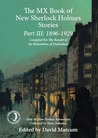 The MX Book of New Sherlock Holmes Stories Part III: 1896 to 1929 by David Marcum
My rating: 5 of 5 stars
The third volume of MX Publishing’s anthology of traditional pastiches covers a long span, from just beyond “The Great Hiatus” until the year apocryphally assigned to Watson’s death. Nonetheless, the great majority of these pastiches (like the original Canon) are set before autumn, 1903, the date of Sherlock Holmes’ supposed retirement. If this early focus comes as a minor disappointment, it is the only one. Under David Marcum’s careful editing, the stories continue to follow the classic style, characterizations, and format employed by Sir Arthur Conan Doyle. Their quality remains as high as ever. Two stories reference unpublished cases in the Canon, one involving sinking parsley and the other a “peculiar persecution.” An especially fine instance of deductive brilliance includes a stolen forgery and two Coptic Christian patriarchs. As befits the period, technology plays a crucial role in cases about a diabolical diorama and the real-life disappearance of two Charles Lindbergh rivals. Elsewhere, black cats, ghostly maidens, and reanimated corpses challenge our Great Detective’s skepticism of the supernatural. In deference to Holmes’ late-life hobby, two cases feature bees. Another provides a touching motive for his decision to retire. The final story is even more affecting, for it involves our two old friends in what appears to be the final case that they will ever solve together. On a happier note, readers who have finished the original trilogy have only days to wait before Part IV appears. Two more annual volumes are already in production. As always, profits from the anthology support the restoration of Undershaw, the house where Conan Doyle wrote The Hound of the Baskervilles and many other stories.
The MX Books of New Sherlock Holmes Stories are available from all good bookstores including
The Strand Magazine, Amazon USA, Amazon UK, Waterstones UK and for free shipping worldwide Book Depository. In ebook format it is in Kindle, Kobo, Nook, and Apple iBooks (iPad/iPhone).
Following up on "Sherlock Holmes in Love" (the theme of my last blog), my new story "A Scandal in Serbia" will--among other things--record the last meeting between Sherlock Holmes and Irene Adler. It is based on the account in Baring-Gould's "biography," which places Ms. Adler in Montenegro, a location geographically convenient to my story. In her first book on Irene Adler, Amy Thomas also followed B-G in having Holmes and Irene meet again during The Great Hiatus. For her setting, however, she chose not Montenegro but her home town of Fort Myers, Florida. Here is my review of The Detective and the Woman.
 The Detective and The Woman: A Novel of Sherlock Holmes by Amy Thomas
My rating: 4 of 5 stars
This well-written pastiche, the first in a successful trilogy, reunites Sherlock Holmes and Irene Adler, The Woman who defeated him in “A Scandal in Bohemia,” during The Great Hiatus. Like W.S. Baring-Gould in his “biography” of Holmes, Ms. Thomas clears the way by disposing of the husband Miss Adler acquired in the original story. However, the similarities end there. Instead of encountering his beautiful nemesis at an opera house in Montenegro, Holmes tracks her down—at the behest of Brother Mycroft—in Fort Myers, Florida (Ms. Thomas’s home town). They join forces to protect Holmes’ life, and Irene’s fortune, from a plot engineered by her devious attorney and the vengeful Colonel Moran. While the mystery itself is rather thinly plotted, there is much to like about this novel. The Fort Myers setting is enlivened by the presence of Thomas Edison and other real-life residents. Ms. Thomas’s depiction of Ms. Adler builds convincingly upon the character created by Sir Arthur Conan Doyle. She also does well by Sherlock Holmes, although the situation in which he finds himself is far outside his usual milieu. It is also nice that Ms. Thomas resists the temptation to rush the pair into an immediate romance. Rather, she allows their relationship to evolve from initial mistrust to grudging cooperation to mutual regard. An epilogue, which runs through 1903, may be harder to reconcile with the traditional picture of the Great Detective’s later life. It will be interesting to see how Ms. Thomas proceeds to tell that story in her sequels.
The Detective and the Woman is available from all good bookstores worldwide including in the USA Amazon and Barnes and Noble. In the UK, Amazon, and Waterstones. Elsewhere, Book Depository offers free delivery worldwide. In ebook format, it is in Amazon Kindle, iTunes(iPad/iPhone) , and Kobo, and it is available in Audible Audio Edition.
"Sherlock Holmes and the Adventure of the Tainted Canister" joins MX audiobooks
MX Publishing has recently launched a new line of audiobooks; and I am happy to say that my story, "Sherlock Holmes and the Adventure of the Tainted Canister," has been included. Steve White narrates the tale, which recounts Dr. Watson's loss of his beloved Mary Morstan (and its chilling aftermath) with a wonderfully impressive Scots accent. Recent titles added to MX's growing list of audiobooks include works by Dan Andriacco, Kim Krisco, David Ruffle, and Dean Turnbloom. The complete list is available from Amazon and Pinterest.
Belated Book Reviews
Here is my review (written last month) of the third installment in MX's ongoing anthology of new, traditional Sherlock Holmes short stories, edited by David Marcum. Considering that Part IV has already appeared, I am woefully behind the times. I can confirm, however, that the third entry maintained the high standards established by its predecessors.
The MX Book of New Sherlock Holmes Stories Part III: 1896 to 1929 by David MarcumMy rating: 5 of 5 stars
The third volume of MX Publishing’s anthology of traditional pastiches covers a long span, from just beyond “The Great Hiatus” until the year apocryphally assigned to Watson’s death. Nonetheless, the great majority of these pastiches (like the original Canon) are set before autumn, 1903, the date of Sherlock Holmes’ supposed retirement. If this early focus comes as a minor disappointment, it is the only one. Under David Marcum’s careful editing, the stories continue to follow the classic style, characterizations, and format employed by Sir Arthur Conan Doyle. Their quality remains as high as ever. Two stories reference unpublished cases in the Canon, one involving sinking parsley and the other a “peculiar persecution.” An especially fine instance of deductive brilliance includes a stolen forgery and two Coptic Christian patriarchs. As befits the period, technology plays a crucial role in cases about a diabolical diorama and the real-life disappearance of two Charles Lindbergh rivals. Elsewhere, black cats, ghostly maidens, and reanimated corpses challenge our Great Detective’s skepticism of the supernatural. In deference to Holmes’ late-life hobby, two cases feature bees. Another provides a touching motive for his decision to retire. The final story is even more affecting, for it involves our two old friends in what appears to be the final case that they will ever solve together. On a happier note, readers who have finished the original trilogy have only days to wait before Part IV appears. Two more annual volumes are already in production. As always, profits from the anthology support the restoration of Undershaw, the house where Conan Doyle wrote The Hound of the Baskervilles and many other stories.
The MX Books of New Sherlock Holmes Stories are available from all good bookstores including
The Strand Magazine, Amazon USA, Amazon UK, Waterstones UK and for free shipping worldwide Book Depository. In ebook format it is in Kindle, Kobo, Nook, and Apple iBooks (iPad/iPhone).
Following up on "Sherlock Holmes in Love" (the theme of my last blog), my new story "A Scandal in Serbia" will--among other things--record the last meeting between Sherlock Holmes and Irene Adler. It is based on the account in Baring-Gould's "biography," which places Ms. Adler in Montenegro, a location geographically convenient to my story. In her first book on Irene Adler, Amy Thomas also followed B-G in having Holmes and Irene meet again during The Great Hiatus. For her setting, however, she chose not Montenegro but her home town of Fort Myers, Florida. Here is my review of The Detective and the Woman.
The Detective and The Woman: A Novel of Sherlock Holmes by Amy ThomasMy rating: 4 of 5 stars
This well-written pastiche, the first in a successful trilogy, reunites Sherlock Holmes and Irene Adler, The Woman who defeated him in “A Scandal in Bohemia,” during The Great Hiatus. Like W.S. Baring-Gould in his “biography” of Holmes, Ms. Thomas clears the way by disposing of the husband Miss Adler acquired in the original story. However, the similarities end there. Instead of encountering his beautiful nemesis at an opera house in Montenegro, Holmes tracks her down—at the behest of Brother Mycroft—in Fort Myers, Florida (Ms. Thomas’s home town). They join forces to protect Holmes’ life, and Irene’s fortune, from a plot engineered by her devious attorney and the vengeful Colonel Moran. While the mystery itself is rather thinly plotted, there is much to like about this novel. The Fort Myers setting is enlivened by the presence of Thomas Edison and other real-life residents. Ms. Thomas’s depiction of Ms. Adler builds convincingly upon the character created by Sir Arthur Conan Doyle. She also does well by Sherlock Holmes, although the situation in which he finds himself is far outside his usual milieu. It is also nice that Ms. Thomas resists the temptation to rush the pair into an immediate romance. Rather, she allows their relationship to evolve from initial mistrust to grudging cooperation to mutual regard. An epilogue, which runs through 1903, may be harder to reconcile with the traditional picture of the Great Detective’s later life. It will be interesting to see how Ms. Thomas proceeds to tell that story in her sequels.
The Detective and the Woman is available from all good bookstores worldwide including in the USA Amazon and Barnes and Noble. In the UK, Amazon, and Waterstones. Elsewhere, Book Depository offers free delivery worldwide. In ebook format, it is in Amazon Kindle, iTunes(iPad/iPhone) , and Kobo, and it is available in Audible Audio Edition.
May 9, 2016
"Fact" or Fiction? Sherlock Holmes in Love
My first blog ("One Step into the Light") offered a review of A.S. Croyle's new novel, The Bird and the Buddha (https://www.goodreads.com/book/show/2...). Sherry Croyle has taken the daring step of introducing a love interest for young Sherlock Holmes--in the person of a budding female physician, Poppy Stamford--at the dawn of his deductive career. As can be seen in my review of her first "Before Watson" novel, I was quite blown away by both Poppy and the author's whole idea:
 When the Song of the Angels is Stilled by A.S. Croyle
My rating: 5 of 5 stars
It would be faint praise to call this novel merely a fine Sherlock Holmes pastiche. What A.S. Croyle has written is a complex, moving novel with memorable characters of her own creation (including the most appealing heroine since Irene Adler), besides a fascinating portrait of young Sherlock Holmes. Here is a callow, more vulnerable Sherlock than we are used to seeing, yet unmistakably the youth who will become the man. The case that he and Poppy Stamford undertake to solve incorporates the oldest Canon mystery, “The Gloria Scott,” and centers on an “Angel Maker.” Rooted in historical events, it reminds those who would romanticize Victorian London that its underworld was, in fact, a truly awful place. The novel’s most important revelation is that Sherlock Holmes was being less than honest when he told Dr. Watson: “I have never loved.” Disproving that claim may seem like heresy to some Sherlockians, but our lovelorn young hero loses Poppy Stamford precisely because he is already trapped inside the man that Conan Doyle created. We mourn their fate, even though it was inevitable, for love might have made the great detective (if nothing else) a far less lonely man. Happily, the author devises an ending that reconciles us to his loss. After finishing When the Song of the Angels is Stilled, I felt I fully understood, for the first time, why Sherlock Holmes became the man he was. That is the measure of Ms. Croyle’s achievement, and it took a fine novelist—not merely a fine writer of pastiches—to accomplish it.
When the Song of the Angels is Stilled: A Before Watson Novel is available from all good bookstores including Amazon USAhere, Barnes and Noble USAhere, Amazon UKhere, Waterstones UKhere, and for free shipping worldwide Book Depositoryhere. In e-book format it is in Kindlehere, Kobohere, Nookhere<, and Apple Books (iPad/iPhone)here.
While purists may balk at the idea of Holmes falling in love when "barely out of adolescence" (the age Ms. Croyle assigns him at the beginning of her saga), surely there would be more cause for concern if he had not. Young men have always possessed hormones, even if Victorian writers did not acknowledge them. Our young man's eventual decision to set aside romantic love, in pursuit of his vocation, shows a far more impressive mental discipline (or attempt at it, at least) than would a similar choice by a eunuch or ascetic. They, after all, have little to lose.
Young Sherlock, on the other hand, knew quite well what he was giving up. In Poppy Stamford, Ms. Croyle has created a love interest fully worthy of our hero: an intelligent, spirited, and progressive young woman who goes about as far toward feminism as plausible in an 1870's milieu. Nor does their author ever place the lovers in unlikely or unworthy situations. To be sure, there is one actual sex scene, but both its context and its consequences are appropriate to its time and place. I found nothing in the novel inconsistent with Conan Doyle's depiction of Holmes' character. Indeed, he ultimately loses Poppy because he is determined to become that very man.
The "Before Watson" novels, therefore, meet the standards set in my last blog for a non-traditional pastiche: treating the original Canon with deference and affection, placing Doyle’s characters in new or unexpected situations that are neither offensive nor preposterous, and succeeding on its own terms as a story. Ms. Croyle does these things very well. It was not for nothing that I called Poppy Stamford "the most appealing [Holmes] heroine since Irene Adler."
Speaking of Irene Adler, let's talk about her for awhile. . . .
I must admit, in doing so, that I have not yet read Amy Thomas's well-received series of Irene Adler novels, beginning with The Detective and the Woman (https://www.goodreads.com/book/show/1...). However, I intend to remedy that oversight, and her book is on its way. Meanwhile, what about Irene Adler as depicted by Conan Doyle and some of his other successors?
The most mossbacked of Sherlockian purists would acknowledge, i believe, that Doyle's Irene Adler would have made a worthy mate for Holmes. Dr. Watson, of course, denied that the detective ever "felt any emotion akin to love" for the Woman who had beaten him; but (as I and others have theorized) he may have had good reason to be less than truthful. W.S. Baring-Gould--whose "biography" Sherlock Holmes of Baker Street is, if not Gospel, at least Apocrypha--revealed an affair between Holmes and Irene Adler during "The Great Hiatus," the result of which was another great detective: Nero Wolfe.
Is the idea really so far-fetched, even for a mature Holmes who had never encountered Poppy Stamford? In my own forthcoming story, "A Scandal in Serbia," Watson (after admitting to misleading his readers about Holmes and Adler's true relationship) puts the matter this way:
Surely it is no wonder that two people who had shared so strong an intellectual attraction should fall in love under the charged circumstances that attended their reunion. Fleeing the horror at the Reichenbach Falls, pursued by the most formidable of Moriarty’s minions, robbed of his very identity while disguised as Sigerson, my friend was in as vulnerable a state as any man who affects to disdain all emotion can be. In Irene Adler, he discovered—besides a companion of surpassing beauty, charm, and sympathy—a mind that matched his own as well. It was truly a mating of equals. . . .
Even David Marcum, the dean of modern traditionalists, accepts Baring-Gould's startling revelation. Moreover, in "The Adventure of the Other Brother" from Holmes' collected papers (https://www.goodreads.com/book/show/2...) he posits that Holmes maintained contact with Irene and their son even after her marriage to Vukčić, a Montenegrin gentleman. I, in turn (with Mr. Marcum's kind permission), am borrowing Vukčić and the Montenegrin setting for my Crowned Heads story, which will record Sherlock Holmes and Irene Adler's last meeting before her death and his retirement.
With this solid heritage of Holmesian hanky-panky to draw upon, I feel on fairly solid ground with my Serbian tale. Although running long (which should come as no surprise to readers of this blog), it has been great fun to write. If it comes out half as well as the works I have cited, I will have done my bit for the "novel" idea of "Holmes in Love."
When the Song of the Angels is Stilled by A.S. CroyleMy rating: 5 of 5 stars
It would be faint praise to call this novel merely a fine Sherlock Holmes pastiche. What A.S. Croyle has written is a complex, moving novel with memorable characters of her own creation (including the most appealing heroine since Irene Adler), besides a fascinating portrait of young Sherlock Holmes. Here is a callow, more vulnerable Sherlock than we are used to seeing, yet unmistakably the youth who will become the man. The case that he and Poppy Stamford undertake to solve incorporates the oldest Canon mystery, “The Gloria Scott,” and centers on an “Angel Maker.” Rooted in historical events, it reminds those who would romanticize Victorian London that its underworld was, in fact, a truly awful place. The novel’s most important revelation is that Sherlock Holmes was being less than honest when he told Dr. Watson: “I have never loved.” Disproving that claim may seem like heresy to some Sherlockians, but our lovelorn young hero loses Poppy Stamford precisely because he is already trapped inside the man that Conan Doyle created. We mourn their fate, even though it was inevitable, for love might have made the great detective (if nothing else) a far less lonely man. Happily, the author devises an ending that reconciles us to his loss. After finishing When the Song of the Angels is Stilled, I felt I fully understood, for the first time, why Sherlock Holmes became the man he was. That is the measure of Ms. Croyle’s achievement, and it took a fine novelist—not merely a fine writer of pastiches—to accomplish it.
When the Song of the Angels is Stilled: A Before Watson Novel is available from all good bookstores including Amazon USAhere, Barnes and Noble USAhere, Amazon UKhere, Waterstones UKhere, and for free shipping worldwide Book Depositoryhere. In e-book format it is in Kindlehere, Kobohere, Nookhere<, and Apple Books (iPad/iPhone)here.
While purists may balk at the idea of Holmes falling in love when "barely out of adolescence" (the age Ms. Croyle assigns him at the beginning of her saga), surely there would be more cause for concern if he had not. Young men have always possessed hormones, even if Victorian writers did not acknowledge them. Our young man's eventual decision to set aside romantic love, in pursuit of his vocation, shows a far more impressive mental discipline (or attempt at it, at least) than would a similar choice by a eunuch or ascetic. They, after all, have little to lose.
Young Sherlock, on the other hand, knew quite well what he was giving up. In Poppy Stamford, Ms. Croyle has created a love interest fully worthy of our hero: an intelligent, spirited, and progressive young woman who goes about as far toward feminism as plausible in an 1870's milieu. Nor does their author ever place the lovers in unlikely or unworthy situations. To be sure, there is one actual sex scene, but both its context and its consequences are appropriate to its time and place. I found nothing in the novel inconsistent with Conan Doyle's depiction of Holmes' character. Indeed, he ultimately loses Poppy because he is determined to become that very man.
The "Before Watson" novels, therefore, meet the standards set in my last blog for a non-traditional pastiche: treating the original Canon with deference and affection, placing Doyle’s characters in new or unexpected situations that are neither offensive nor preposterous, and succeeding on its own terms as a story. Ms. Croyle does these things very well. It was not for nothing that I called Poppy Stamford "the most appealing [Holmes] heroine since Irene Adler."
Speaking of Irene Adler, let's talk about her for awhile. . . .
I must admit, in doing so, that I have not yet read Amy Thomas's well-received series of Irene Adler novels, beginning with The Detective and the Woman (https://www.goodreads.com/book/show/1...). However, I intend to remedy that oversight, and her book is on its way. Meanwhile, what about Irene Adler as depicted by Conan Doyle and some of his other successors?
The most mossbacked of Sherlockian purists would acknowledge, i believe, that Doyle's Irene Adler would have made a worthy mate for Holmes. Dr. Watson, of course, denied that the detective ever "felt any emotion akin to love" for the Woman who had beaten him; but (as I and others have theorized) he may have had good reason to be less than truthful. W.S. Baring-Gould--whose "biography" Sherlock Holmes of Baker Street is, if not Gospel, at least Apocrypha--revealed an affair between Holmes and Irene Adler during "The Great Hiatus," the result of which was another great detective: Nero Wolfe.
Is the idea really so far-fetched, even for a mature Holmes who had never encountered Poppy Stamford? In my own forthcoming story, "A Scandal in Serbia," Watson (after admitting to misleading his readers about Holmes and Adler's true relationship) puts the matter this way:
Surely it is no wonder that two people who had shared so strong an intellectual attraction should fall in love under the charged circumstances that attended their reunion. Fleeing the horror at the Reichenbach Falls, pursued by the most formidable of Moriarty’s minions, robbed of his very identity while disguised as Sigerson, my friend was in as vulnerable a state as any man who affects to disdain all emotion can be. In Irene Adler, he discovered—besides a companion of surpassing beauty, charm, and sympathy—a mind that matched his own as well. It was truly a mating of equals. . . .
Even David Marcum, the dean of modern traditionalists, accepts Baring-Gould's startling revelation. Moreover, in "The Adventure of the Other Brother" from Holmes' collected papers (https://www.goodreads.com/book/show/2...) he posits that Holmes maintained contact with Irene and their son even after her marriage to Vukčić, a Montenegrin gentleman. I, in turn (with Mr. Marcum's kind permission), am borrowing Vukčić and the Montenegrin setting for my Crowned Heads story, which will record Sherlock Holmes and Irene Adler's last meeting before her death and his retirement.
With this solid heritage of Holmesian hanky-panky to draw upon, I feel on fairly solid ground with my Serbian tale. Although running long (which should come as no surprise to readers of this blog), it has been great fun to write. If it comes out half as well as the works I have cited, I will have done my bit for the "novel" idea of "Holmes in Love."
April 26, 2016
Straying from the Canon: To Be--or Not to Be--the Characters Sir Arthur Conan Doyle Created?
If you want to start an argument, ask any two Sherlockians their opinion of the last Sherlock episode, “The Abominable Bride.” The resulting dispute will probably focus on this question: How far should modern writers go in altering the original characters created by Sir Arthur Conan Doyle? My own opinion on the matter has changed in recent years--even, in fact, since last October, when I wrote the following review:
 Mrs. Hudson in New York by Barry S. Brown
My rating: 4 of 5 stars
As this was my first encounter with this series, I was a bit startled to find Sherlock Holmes’ landlady speaking with a Cockney accent. That was but the least of the surprises, for (as his fans already know) Barry S. Brown has reinvented the relationship between Mrs. Hudson and her lodgers. It turns out that our world-famous sleuth was no more than a front man. The real brains belonged to the middle-aged, unassuming widow who hired Holmes and Watson to help with her detective agency, meanwhile renting them their rooms. In this adventure, Mrs. Hudson and her two employees travel to a wedding in New York, which must be delayed when her young cousin’s baseball player bridegroom is accused of shooting J.P. Morgan. Other luminaries (Mark Twain, for example) put in an appearance; and Mr. Brown presents a well-researched, convincing portrait of Gilded Age New York. Populated with interesting minor characters and full of twists and turns, the mystery itself is highly entertaining, even if its denouement seems closer to Agatha Christie than to Conan Doyle. For Sherlockian traditionalists, Holmes and Watson may lose much of their original lustre in their diminished roles. Readers who can accept the novel on its own terms should find Mrs. Hudson in New York a thoroughly delightful outing.
Mrs Hudson in New York is available from all good bookstores including The Strand Magazinehere, Amazon USAhere, Amazon UKhereand for free shipping worldwide Book Depositoryhere. In ebook format it is inKindlehere, Kobohere, Nookhere, and Apple Books (iPad, iPhone)here.
In retrospect, I fear I may have been unjust in denying Mr. Brown a final star. I enjoyed his book and felt that it succeeded very well in what it set out to accomplish. Yet, I never could quite overcome my shock at finding Dr. Watson, and even the famous Sherlock Holmes, reduced to mere employees, obediently taking their instructions from the brilliant detective I had somehow mistaken for their landlady. Undoubtedly, my reaction stemmed more from my own Sherlockian history than from any fault attributable to Barry Brown.
From the moment I finished The Hound of the Baskervilles at about age twelve, I was forever hooked on Holmes. Unlike my fellow Sherlockian David Marcum, however, my motto was: “Accept no substitutes.” I had no interest in pastiches, or even Baring-Gould's "biography." I did read The Exploits of Sherlock Holmes, because Doyle's son had written it. Even by my twenties, I had branched out only to the extent of reading Nicholas Meyer's first two Holmes novels. Otherwise, I remained entirely loyal to the Canon.
All that began to change about eleven years ago, when I sat down to write a Sherlock Holmes story of my own. Back in February, I discussed that story in Marcia Wilson's blog (https://graspthenettlehard.wordpress....), so please go there for more if you are interested. For now, suffice it to say that when I finished "The Adventure of the Tainted Canister," I was convinced that I had written a traditional pastiche. Only much later—when TC was finally published—was it pointed out to me that my story’s ending takes it far outside the Canon. For all my efforts to replicate Doyle faithfully, I had consigned Dr. Watson to a place where his creator had never imagined he would go.
Having taken far more interest in pastiches lately, I find that I am not alone. On the MX authors’ website, and in other venues, I have encountered Sherlock reimagined as a Lego toy, a smitten young lover, a giant Kodiak bear, a vampire (briefly), a foul-mouthed curmudgeon, a beekeeper who is a secret agent, a beekeeper who marries his young female apprentice, and a beekeeper so old and decrepit that he only keeps bees. In one famous short novel I have never had the courage to begin, he has even been accused of being Jack the Ripper.
So which of these portrayals strays too far from the intentions of Holmes' original creator? With so many opinions on that subject out there, it would be presumptuous of me to offer a definitive response. Traditionalists (as I believe David Marcum has remarked) posit that modern-day pastichuers should, at the very least, avoid damaging the characters of Holmes and Watson as they were first conceived. My own outlook--despite one glaring transgression of that principle--remains traditionalist, so I shall adhere to it in future work. Yet, I can appreciate the “public domain” argument of those who (whatever the wishes of Conan Doyle's estate) now consider his creations fair game for their experiments. Some of the examples I have cited, as well as the latest episodes of Sherlock, in my opinion go too far. Nevertheless, I am willing to concede that Holmes may once—or even twice—have had a girlfriend, and I am open-minded about the number and happiness of Watson’s wives. As for vampires, one played a pivotal role in my first published (non-Holmes) story, and I have enjoyed several well-done novels about Holmes confronting them.
Let me end by proposing “well-done” as an oil that may help to soothe these troubled waters. If a non-traditional pastiche treats the original Canon with deference and affection, if it places Doyle’s characters in new or unexpected situations that are neither offensive nor preposterous, and if it succeeds on its own terms as a story, then perhaps it is entitled—even among us traditionalists—to a respectful hearing. Barry Brown’s Mrs. Hudson in New York met all of those criteria for me. I hope, in future blogs, to feature other novels that did so as well.
Mrs. Hudson in New York by Barry S. BrownMy rating: 4 of 5 stars
As this was my first encounter with this series, I was a bit startled to find Sherlock Holmes’ landlady speaking with a Cockney accent. That was but the least of the surprises, for (as his fans already know) Barry S. Brown has reinvented the relationship between Mrs. Hudson and her lodgers. It turns out that our world-famous sleuth was no more than a front man. The real brains belonged to the middle-aged, unassuming widow who hired Holmes and Watson to help with her detective agency, meanwhile renting them their rooms. In this adventure, Mrs. Hudson and her two employees travel to a wedding in New York, which must be delayed when her young cousin’s baseball player bridegroom is accused of shooting J.P. Morgan. Other luminaries (Mark Twain, for example) put in an appearance; and Mr. Brown presents a well-researched, convincing portrait of Gilded Age New York. Populated with interesting minor characters and full of twists and turns, the mystery itself is highly entertaining, even if its denouement seems closer to Agatha Christie than to Conan Doyle. For Sherlockian traditionalists, Holmes and Watson may lose much of their original lustre in their diminished roles. Readers who can accept the novel on its own terms should find Mrs. Hudson in New York a thoroughly delightful outing.
Mrs Hudson in New York is available from all good bookstores including The Strand Magazinehere, Amazon USAhere, Amazon UKhereand for free shipping worldwide Book Depositoryhere. In ebook format it is inKindlehere, Kobohere, Nookhere, and Apple Books (iPad, iPhone)here.
In retrospect, I fear I may have been unjust in denying Mr. Brown a final star. I enjoyed his book and felt that it succeeded very well in what it set out to accomplish. Yet, I never could quite overcome my shock at finding Dr. Watson, and even the famous Sherlock Holmes, reduced to mere employees, obediently taking their instructions from the brilliant detective I had somehow mistaken for their landlady. Undoubtedly, my reaction stemmed more from my own Sherlockian history than from any fault attributable to Barry Brown.
From the moment I finished The Hound of the Baskervilles at about age twelve, I was forever hooked on Holmes. Unlike my fellow Sherlockian David Marcum, however, my motto was: “Accept no substitutes.” I had no interest in pastiches, or even Baring-Gould's "biography." I did read The Exploits of Sherlock Holmes, because Doyle's son had written it. Even by my twenties, I had branched out only to the extent of reading Nicholas Meyer's first two Holmes novels. Otherwise, I remained entirely loyal to the Canon.
All that began to change about eleven years ago, when I sat down to write a Sherlock Holmes story of my own. Back in February, I discussed that story in Marcia Wilson's blog (https://graspthenettlehard.wordpress....), so please go there for more if you are interested. For now, suffice it to say that when I finished "The Adventure of the Tainted Canister," I was convinced that I had written a traditional pastiche. Only much later—when TC was finally published—was it pointed out to me that my story’s ending takes it far outside the Canon. For all my efforts to replicate Doyle faithfully, I had consigned Dr. Watson to a place where his creator had never imagined he would go.
Having taken far more interest in pastiches lately, I find that I am not alone. On the MX authors’ website, and in other venues, I have encountered Sherlock reimagined as a Lego toy, a smitten young lover, a giant Kodiak bear, a vampire (briefly), a foul-mouthed curmudgeon, a beekeeper who is a secret agent, a beekeeper who marries his young female apprentice, and a beekeeper so old and decrepit that he only keeps bees. In one famous short novel I have never had the courage to begin, he has even been accused of being Jack the Ripper.
So which of these portrayals strays too far from the intentions of Holmes' original creator? With so many opinions on that subject out there, it would be presumptuous of me to offer a definitive response. Traditionalists (as I believe David Marcum has remarked) posit that modern-day pastichuers should, at the very least, avoid damaging the characters of Holmes and Watson as they were first conceived. My own outlook--despite one glaring transgression of that principle--remains traditionalist, so I shall adhere to it in future work. Yet, I can appreciate the “public domain” argument of those who (whatever the wishes of Conan Doyle's estate) now consider his creations fair game for their experiments. Some of the examples I have cited, as well as the latest episodes of Sherlock, in my opinion go too far. Nevertheless, I am willing to concede that Holmes may once—or even twice—have had a girlfriend, and I am open-minded about the number and happiness of Watson’s wives. As for vampires, one played a pivotal role in my first published (non-Holmes) story, and I have enjoyed several well-done novels about Holmes confronting them.
Let me end by proposing “well-done” as an oil that may help to soothe these troubled waters. If a non-traditional pastiche treats the original Canon with deference and affection, if it places Doyle’s characters in new or unexpected situations that are neither offensive nor preposterous, and if it succeeds on its own terms as a story, then perhaps it is entitled—even among us traditionalists—to a respectful hearing. Barry Brown’s Mrs. Hudson in New York met all of those criteria for me. I hope, in future blogs, to feature other novels that did so as well.
Senile Musings of an Ex-Boy Wonder

An occasional blog on Sherlock Holmes, other historical and literary topics, and whatever else occurs to me
- Thomas A. Turley's profile
- 8 followers

