
What I Did on My Summer Vacation
Despite a "great hiatus" in blogging since July, my summer has not been devoid of Sherlockian pursuits. The first of my stories for Sherlock Holmes and the Crowned Heads of Europe--"A Scandal in Serbia"--was accepted for the spring 2017 volume of MX's ongoing anthology of traditional pastiches. I'm working on another story to submit for a later volume and on a second Crowned Heads story, "The Case of the Dying Emperor."
I've also read a number of fine books or stories by other Sherlockian writers--and one writer who is not known as a Sherlockian. Let's start there:
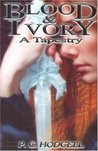 Blood and Ivory: A Tapestry by P.C. Hodgell
My rating: 5 of 5 stars
This is a review of Ms. Hodgell's story "A Ballad of the White Plague," which appears in this collection.
My daughter’s favorite fantasy writer is P.C. Hodgell, best known for her Kencyr series (God Stalk, Dark of the Moon, and Seeker’s Mask), published in the 1980’s-‘90’s. I haven’t read Ms. Hodgell’s fantasy (although Catherine says it’s great); but I can verify that she has written an unusual and atmospheric Sherlock Holmes pastiche, which first appeared in Marvin Kaye’s 1998 anthology The Confidential Casebook of Sherlock Holmes. Were it not already published, “A Ballad of the White Plague” would be perfect for the forthcoming MX anthology Eliminate the Impossible, for it just skirts the edges of the supernatural. Holmes and Watson, returning late from a buggy ride in Surrey, stop at a quintessential “dark old house” that once belonged to our detective’s less savory relatives on his Vernet side. What follows is a horrific story from Holmes’ childhood, which—as it should—illuminates his character as an adult. If, of course, the tale is true; and Watson (in an afterward) leaves that decision to the reader. Despite Ms. Hodgell’s obvious debts to Poe and Stoker, her story takes no liberties with Conan Doyle. It is told in proper “Watson voice”; and Holmes, even as a child, remains the man we know. His ultimate conclusion is the one we would expect: “No ghosts need apply.” Fortunately for us, Ms. Hodgell’s ghosts (if they were ghosts) at least received a thorough and fascinating interview!
Now for a couple of books that are not officially "out" yet.
Marcia Wilson's A Test of the Professionals, Part I will come out in November from MX Publishing. It is not yet available for review on Goodreads, although an older version is on Amazon. Ms. Wilson kindly provided me an advance copy of the text, but I was not smart enough to import her cover illustration (which may change for the MX edition, anyway). Here is my review:
Marcia Wilson, A Test of the Professionals, Part I, from MX Publishing (Nov. 2016)
Last year, Marcia Wilson joined the Sherlockian mainstream with her wonderful debut novel You Buy Bones. Beginning just after the fateful meeting between Sherlock Holmes and Dr. Watson, it transformed the Scotland Yarders—Gregson, Bradstreet, and Lestrade—from mere foils to be outshone by Holmes into living, breathing characters in their own right. Since then, Ms. Wilson’s short stories have been featured in several MX Publishing anthologies, edited by David Marcum, and in Derrick Belanger’s anthology Beyond Watson.
Now she carries her saga forward to the autumn of 1883, as the Yarders investigate seemingly unrelated waterfront crimes (missing seamen, stolen flour barrels) linked to an agent of the master criminal who still lurks behind the scenes. Whereas Watson was as important as the Yarders to the plot of You Buy Bones, here the focus is on Inspector Geoffrey Lestrade. In Ms. Wilson’s hands, he becomes a full-fledged personality, not the one-dimensional character we met in Doyle. While not the smartest of the Yarders, “Inspector Plod” is truly (as Holmes admits) the best of them, due to his iron sense of ethics (for which he has paid a heavy price) and his grim determination to battle both criminals and his own limitations in the pursuit of justice. In Test, we learn of an incident in Lestrade’s past that forever darkened his relations with his family, as well as his career at Scotland Yard. An old enemy returns to devil him, serving as both the charming, heartless villain of the piece and a romantic rival. For Test is also the story of Lestrade’s meeting with Clea Cheatham, a young woman of independent mind and her own unusual family and backstory. Like the inspector’s, they are woven skillfully into the tale.
Underlying these delights of plot and character is some amazing historical research. Marcia Wilson has an encyclopedic knowledge of Victorian minutia; happily, her footnotes are helpful rather than intrusive. Osage orange trees, Krakatoa, mudlarks, and tie-mates all find their places in the story. A potato pie, we learn, can be an insult. There are even notes explaining Inspector Bradstreet’s strange invective. On another level, Ms. Wilson writes with compassion of the day-to-day perils of the London poor. We see far more of Watson as a doctor, and of Mrs. Hudson as a housekeeper, than we ever did in Doyle.
Readers who buy A Test of the Professionals should not expect a traditional Sherlock Holmes pastiche. Ms. Wilson does not tell her story with Victorian reserve; her intimate, informal style is in keeping with the rough-and-tumble lives led by the Yarders. Yet, devotees of the Master will find nothing to offend them, for the characters in Test are never incompatible with their originals. The idiosyncrasies of Holmes, and his interactions with Watson and the Yarders, are as familiar and delightful here as ever. The difference is that for her canvas of Victorian London, Marcia Wilson employs a more colorful palette and a broader brush than Conan Doyle’s. Such is her artistry that she enriches and fully brings to life the world he left us.
The next book also has a November publication date, but it is already posted on Goodreads and Amazon:
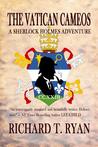 The Vatican Cameos: A Sherlock Holmes Adventure by Richard T. Ryan
My rating: 5 of 5 stars
Richard Ryan channels Dan Brown as well as Conan Doyle in this successful novel. In alternating chapters, he combines an historical thriller with a Sherlock Holmes pastiche. Holmes and Watson must recover a stolen set of cameos (sculpted by Michelangelo in the story’s other timeline) before they can undermine the political independence of the Papacy. Having studied medieval literature at Notre Dame, Mr. Ryan knows his church history, whether it occurred in 1901 or 1501. He offers unexpectedly attractive portraits of the Borgia Family: Pope Alexander VI and his notorious offspring, Cesare and Lucrezia. Other Renaissance luminaries (Leonardo, Machiavelli, Savonarola, and two future popes) fill in the political and artistic landscape. A warning: some of the Michelangelo chapters are more sexually explicit than readers of Holmes tales usually encounter.
Mr. Ryan is almost equally proficient in writing his actual pastiche. He provides a well-constructed plot and sound deductions by our hero, a likable Pope Leo as the client, and a villain whose motives partly mitigate his nasty personality. Atypically, Holmes even condescends to apprise the Pontiff of his plans, although Watson annoyingly withholds them from the reader. The doctor is otherwise a bit more of a cipher than I like to see. Stylistically, the novel’s occasional modernisms seem more noticeable in Holmes’ day than in Michelangelo’s. A minor distraction—not attributable to Mr. Ryan—is a printing format that (in my pre-publication copy) often combines two characters’ dialogue within a single paragraph.
None of these quibbles detracts seriously from this well-researched and well-told story. The Vatican Cameos is a promising addition in the Sherlockian corpus, and I look forward to reading Mr. Ryan's next book. Happily for us, it is already under way.
Now for a pair of less recent works I finally got around to and enjoyed:
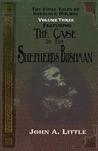 The Shepherds Bushman by John A. Little
My rating: 4 of 5 stars
Although third in a series, this is the first of Mr. Little’s books I have encountered. From what I gather of its predecessors (based on reviews), the author has conceived a grim, if plausible, family history for Sherlock Holmes to explain his personal peculiarities. Abandoning his bees in the mid-1920s, Holmes reunites in Baker Street with Dr. Watson, where they reside with updated versions of (Lily) Hudson and (Jasper) Lestrade. Mr. Little is a facile and effective writer with an interest in ciphers. His cases—which abound with murderous Masons, pedophile prelates, renegade royals, and even a witch—are cleverly plotted and uniformly entertaining. One incorporates two legends of the British monarchy familiar from the films From Hell, Murder by Decree, and Mrs. Brown. Yet, it is a timeworn and melancholy universe that Mr. Little’s characters inhabit. His portraits of the aging detective and his even more decrepit Boswell—bickering bitterly as they cope with their infirmities, each other, and the modern world—may leave some readers yearning for the comforting Victorian milieu of Conan Doyle.
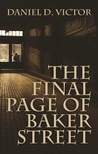 The Final Page of Baker Street by Daniel D. Victor
My rating: 5 of 5 stars
This is the second of Mr. Victor’s three-book series, Sherlock Holmes and the American Literati. (The others focus on Mark Twain and Stephen Crane.) Here, as the title indicates, young Raymond Chandler becomes the last “Billy the Page” employed by Mrs. Hudson, after her famous tenant has redeemed him from the throes of teenage lust. Later a budding writer under Dr. Watson’s tutelage, “Billy” retains his eye for a well-turned ankle. His eventual temptress is a true Raymond Chandler heroine (think Lauren Bacall, not Irene Adler) who has somehow missed her proper continent and era. Even Sherlock Holmes recognizes the lady’s duplicitous charms, while Watson—who shows an odd streak of prudery for an old soldier—stammers like a schoolboy in her presence. The alluring Mrs. Sterne leads our heroes through several false endings to this complicated case, as it is Mr. Victor’s premise that Chandler’s early experience as a detective informed the plots of his crime novels. The case itself involves a love story wherein everyone (defying Casablanca) does the wrong thing. A few surprises come along the way: for example, the villainous Colonel Moran actually shows his softer side. Throughout the novel, Mr. Victor exhibits well-drawn characters, an appropriate Edwardian style, and a commendable knowledge of his story’s historical and literary context. The Final Page of Baker Street succeeds brilliantly, both as a Sherlockian pastiche and as an “early” example of noir fiction. Having enjoyed this one, I shall certainly investigate Holmes’ interactions with Mssrs. Crane and Twain.
Finally, a return to a well one cannot drink from too often:
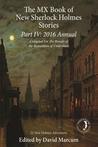 The MX Book of New Sherlock Holmes Stories Part IV: 2016 Annual by David Marcum
My rating: 5 of 5 stars
For some reason, I am always a volume behind in reviewing MX Publishing’s anthologies of traditional Sherlockian pastiches, edited by David Marcum. The Kickstarter campaign for Part V: Christmas Adventures was announced last week. We can anticipate the new volume with pleasure, for Part IV was undoubtedly the most consistently excellent of the whole series. My own favorite was Marcia Wilson’s “The Adventure of the Half-Melted Wolf,” which captured perfectly how the personal relationships of Holmes, Watson, and the two best “Yarders”—Gregson and Lestrade—have mellowed like fine wine over the years. Other notable entries came from Hugh Ashton, J.R. Campbell, Jayantika Ganguly, Jeremy Holstein, Craig Janacek, Daniel McGachey, Mark Mower, Denis O. Smith, and Daniel D. Victor. Along the way, we encounter an ill-fated precursor of Watson, escape a couple of “Black Widows,” discover the origins of Maupassant’s famous tale “The Necklace,” meet Moriarty’s daughter (!), and even witness the incredible sight of Sherlock Holmes baking dumplings! In these anthologies (whose sales benefit Doyle’s home, Undershaw, and the Stepping Stones School), MX and David Marcum have set new standards of quality for traditional pastiches.
I've also read a number of fine books or stories by other Sherlockian writers--and one writer who is not known as a Sherlockian. Let's start there:
Blood and Ivory: A Tapestry by P.C. HodgellMy rating: 5 of 5 stars
This is a review of Ms. Hodgell's story "A Ballad of the White Plague," which appears in this collection.
My daughter’s favorite fantasy writer is P.C. Hodgell, best known for her Kencyr series (God Stalk, Dark of the Moon, and Seeker’s Mask), published in the 1980’s-‘90’s. I haven’t read Ms. Hodgell’s fantasy (although Catherine says it’s great); but I can verify that she has written an unusual and atmospheric Sherlock Holmes pastiche, which first appeared in Marvin Kaye’s 1998 anthology The Confidential Casebook of Sherlock Holmes. Were it not already published, “A Ballad of the White Plague” would be perfect for the forthcoming MX anthology Eliminate the Impossible, for it just skirts the edges of the supernatural. Holmes and Watson, returning late from a buggy ride in Surrey, stop at a quintessential “dark old house” that once belonged to our detective’s less savory relatives on his Vernet side. What follows is a horrific story from Holmes’ childhood, which—as it should—illuminates his character as an adult. If, of course, the tale is true; and Watson (in an afterward) leaves that decision to the reader. Despite Ms. Hodgell’s obvious debts to Poe and Stoker, her story takes no liberties with Conan Doyle. It is told in proper “Watson voice”; and Holmes, even as a child, remains the man we know. His ultimate conclusion is the one we would expect: “No ghosts need apply.” Fortunately for us, Ms. Hodgell’s ghosts (if they were ghosts) at least received a thorough and fascinating interview!
Now for a couple of books that are not officially "out" yet.
Marcia Wilson's A Test of the Professionals, Part I will come out in November from MX Publishing. It is not yet available for review on Goodreads, although an older version is on Amazon. Ms. Wilson kindly provided me an advance copy of the text, but I was not smart enough to import her cover illustration (which may change for the MX edition, anyway). Here is my review:
Marcia Wilson, A Test of the Professionals, Part I, from MX Publishing (Nov. 2016)
Last year, Marcia Wilson joined the Sherlockian mainstream with her wonderful debut novel You Buy Bones. Beginning just after the fateful meeting between Sherlock Holmes and Dr. Watson, it transformed the Scotland Yarders—Gregson, Bradstreet, and Lestrade—from mere foils to be outshone by Holmes into living, breathing characters in their own right. Since then, Ms. Wilson’s short stories have been featured in several MX Publishing anthologies, edited by David Marcum, and in Derrick Belanger’s anthology Beyond Watson.
Now she carries her saga forward to the autumn of 1883, as the Yarders investigate seemingly unrelated waterfront crimes (missing seamen, stolen flour barrels) linked to an agent of the master criminal who still lurks behind the scenes. Whereas Watson was as important as the Yarders to the plot of You Buy Bones, here the focus is on Inspector Geoffrey Lestrade. In Ms. Wilson’s hands, he becomes a full-fledged personality, not the one-dimensional character we met in Doyle. While not the smartest of the Yarders, “Inspector Plod” is truly (as Holmes admits) the best of them, due to his iron sense of ethics (for which he has paid a heavy price) and his grim determination to battle both criminals and his own limitations in the pursuit of justice. In Test, we learn of an incident in Lestrade’s past that forever darkened his relations with his family, as well as his career at Scotland Yard. An old enemy returns to devil him, serving as both the charming, heartless villain of the piece and a romantic rival. For Test is also the story of Lestrade’s meeting with Clea Cheatham, a young woman of independent mind and her own unusual family and backstory. Like the inspector’s, they are woven skillfully into the tale.
Underlying these delights of plot and character is some amazing historical research. Marcia Wilson has an encyclopedic knowledge of Victorian minutia; happily, her footnotes are helpful rather than intrusive. Osage orange trees, Krakatoa, mudlarks, and tie-mates all find their places in the story. A potato pie, we learn, can be an insult. There are even notes explaining Inspector Bradstreet’s strange invective. On another level, Ms. Wilson writes with compassion of the day-to-day perils of the London poor. We see far more of Watson as a doctor, and of Mrs. Hudson as a housekeeper, than we ever did in Doyle.
Readers who buy A Test of the Professionals should not expect a traditional Sherlock Holmes pastiche. Ms. Wilson does not tell her story with Victorian reserve; her intimate, informal style is in keeping with the rough-and-tumble lives led by the Yarders. Yet, devotees of the Master will find nothing to offend them, for the characters in Test are never incompatible with their originals. The idiosyncrasies of Holmes, and his interactions with Watson and the Yarders, are as familiar and delightful here as ever. The difference is that for her canvas of Victorian London, Marcia Wilson employs a more colorful palette and a broader brush than Conan Doyle’s. Such is her artistry that she enriches and fully brings to life the world he left us.
The next book also has a November publication date, but it is already posted on Goodreads and Amazon:
The Vatican Cameos: A Sherlock Holmes Adventure by Richard T. RyanMy rating: 5 of 5 stars
Richard Ryan channels Dan Brown as well as Conan Doyle in this successful novel. In alternating chapters, he combines an historical thriller with a Sherlock Holmes pastiche. Holmes and Watson must recover a stolen set of cameos (sculpted by Michelangelo in the story’s other timeline) before they can undermine the political independence of the Papacy. Having studied medieval literature at Notre Dame, Mr. Ryan knows his church history, whether it occurred in 1901 or 1501. He offers unexpectedly attractive portraits of the Borgia Family: Pope Alexander VI and his notorious offspring, Cesare and Lucrezia. Other Renaissance luminaries (Leonardo, Machiavelli, Savonarola, and two future popes) fill in the political and artistic landscape. A warning: some of the Michelangelo chapters are more sexually explicit than readers of Holmes tales usually encounter.
Mr. Ryan is almost equally proficient in writing his actual pastiche. He provides a well-constructed plot and sound deductions by our hero, a likable Pope Leo as the client, and a villain whose motives partly mitigate his nasty personality. Atypically, Holmes even condescends to apprise the Pontiff of his plans, although Watson annoyingly withholds them from the reader. The doctor is otherwise a bit more of a cipher than I like to see. Stylistically, the novel’s occasional modernisms seem more noticeable in Holmes’ day than in Michelangelo’s. A minor distraction—not attributable to Mr. Ryan—is a printing format that (in my pre-publication copy) often combines two characters’ dialogue within a single paragraph.
None of these quibbles detracts seriously from this well-researched and well-told story. The Vatican Cameos is a promising addition in the Sherlockian corpus, and I look forward to reading Mr. Ryan's next book. Happily for us, it is already under way.
Now for a pair of less recent works I finally got around to and enjoyed:
The Shepherds Bushman by John A. LittleMy rating: 4 of 5 stars
Although third in a series, this is the first of Mr. Little’s books I have encountered. From what I gather of its predecessors (based on reviews), the author has conceived a grim, if plausible, family history for Sherlock Holmes to explain his personal peculiarities. Abandoning his bees in the mid-1920s, Holmes reunites in Baker Street with Dr. Watson, where they reside with updated versions of (Lily) Hudson and (Jasper) Lestrade. Mr. Little is a facile and effective writer with an interest in ciphers. His cases—which abound with murderous Masons, pedophile prelates, renegade royals, and even a witch—are cleverly plotted and uniformly entertaining. One incorporates two legends of the British monarchy familiar from the films From Hell, Murder by Decree, and Mrs. Brown. Yet, it is a timeworn and melancholy universe that Mr. Little’s characters inhabit. His portraits of the aging detective and his even more decrepit Boswell—bickering bitterly as they cope with their infirmities, each other, and the modern world—may leave some readers yearning for the comforting Victorian milieu of Conan Doyle.
The Final Page of Baker Street by Daniel D. VictorMy rating: 5 of 5 stars
This is the second of Mr. Victor’s three-book series, Sherlock Holmes and the American Literati. (The others focus on Mark Twain and Stephen Crane.) Here, as the title indicates, young Raymond Chandler becomes the last “Billy the Page” employed by Mrs. Hudson, after her famous tenant has redeemed him from the throes of teenage lust. Later a budding writer under Dr. Watson’s tutelage, “Billy” retains his eye for a well-turned ankle. His eventual temptress is a true Raymond Chandler heroine (think Lauren Bacall, not Irene Adler) who has somehow missed her proper continent and era. Even Sherlock Holmes recognizes the lady’s duplicitous charms, while Watson—who shows an odd streak of prudery for an old soldier—stammers like a schoolboy in her presence. The alluring Mrs. Sterne leads our heroes through several false endings to this complicated case, as it is Mr. Victor’s premise that Chandler’s early experience as a detective informed the plots of his crime novels. The case itself involves a love story wherein everyone (defying Casablanca) does the wrong thing. A few surprises come along the way: for example, the villainous Colonel Moran actually shows his softer side. Throughout the novel, Mr. Victor exhibits well-drawn characters, an appropriate Edwardian style, and a commendable knowledge of his story’s historical and literary context. The Final Page of Baker Street succeeds brilliantly, both as a Sherlockian pastiche and as an “early” example of noir fiction. Having enjoyed this one, I shall certainly investigate Holmes’ interactions with Mssrs. Crane and Twain.
Finally, a return to a well one cannot drink from too often:
The MX Book of New Sherlock Holmes Stories Part IV: 2016 Annual by David MarcumMy rating: 5 of 5 stars
For some reason, I am always a volume behind in reviewing MX Publishing’s anthologies of traditional Sherlockian pastiches, edited by David Marcum. The Kickstarter campaign for Part V: Christmas Adventures was announced last week. We can anticipate the new volume with pleasure, for Part IV was undoubtedly the most consistently excellent of the whole series. My own favorite was Marcia Wilson’s “The Adventure of the Half-Melted Wolf,” which captured perfectly how the personal relationships of Holmes, Watson, and the two best “Yarders”—Gregson and Lestrade—have mellowed like fine wine over the years. Other notable entries came from Hugh Ashton, J.R. Campbell, Jayantika Ganguly, Jeremy Holstein, Craig Janacek, Daniel McGachey, Mark Mower, Denis O. Smith, and Daniel D. Victor. Along the way, we encounter an ill-fated precursor of Watson, escape a couple of “Black Widows,” discover the origins of Maupassant’s famous tale “The Necklace,” meet Moriarty’s daughter (!), and even witness the incredible sight of Sherlock Holmes baking dumplings! In these anthologies (whose sales benefit Doyle’s home, Undershaw, and the Stepping Stones School), MX and David Marcum have set new standards of quality for traditional pastiches.


No comments have been added yet.
Senile Musings of an Ex-Boy Wonder

An occasional blog on Sherlock Holmes, other historical and literary topics, and whatever else occurs to me
- Thomas A. Turley's profile
- 8 followers

