
Of Ghostly Visitations, Moriarty's Relations, a Consummate Professional, and an Icy Figure from the Poles
Since my last blog, I've researched and written a story for a forthcoming volume of MX's ongoing anthology of traditional pastiches. Submissions for this volume, Eliminate the Impossible, may skirt the edges of the supernatural before coming to a rational conclusion. My story, "A Ghost from Christmas Past," teeters uneasily along that edge, for there seems to be a ghostly visitation in the eyes of two beholders. More broadly, "Ghost" chronicles the little-known (?) first marriage of our friend Dr. Watson. Yes, if you read the Canon closely, another wife preceded Mary. Holmes' "biographer," W.S. Baring-Gould, mentioned her briefly; so I've taken his account and a couple of others, thrown in elements from "The Five Orange Pips" and The Sign of Four, and written what I hope will be a plausible history of this elusive marriage. Whether the "ghost" is plausible depends, of course, on whether you share Doyle's devotion to the supernatural or follow his detective's dictum: "No ghosts need apply!"
Besides boning up on such diverse topics as Golden Gate Park, diphtheria, and the Ku Klux Klan in my research, I employed a resource that other Sherlockian writers may find useful. (Many thanks to Marcia Wilson for letting me know about this source!) The British Met Office (meteorological office) posts historical weather reports online, including those for the 1880's at: http://www.metoffice.gov.uk/learning/.... My correspondent there assured me that the Met Office is "always keen to see accurate meteorological depictions in pseudo-historical narratives" like mine. In return for a credit in my end notes, the office allowed me to cite official records indicating that it snowed in Brighton on December 27, 1887. While a snowstorm was not essential to my plot, it provided atmosphere to set the stage for my "ghost's" presumed appearance.
With that story now behind me, I have belatedly returned to reading other people's work. Here are reviews of three fairly recent offerings. The first two feature equally unpleasant relatives of that devoted family man, Professor Moriarty. His sister Julia returns in an expanded collection from Dick Gillman, while Kim Krisco includes Moriarty's daughter (Maeve Murtagh) in his saga of the Baker Street Irregulars:
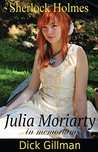 Sherlock Holmes - Julia Moriarty - in memorium by Dick Gillman
My rating: 5 of 5 stars
Beware the cover of this book! It shows a winsome and demure young redhead, but hair color is her only similarity to the formidable villain who returns in Mr. Gillman’s new collection. Only four of these fine stories are actually new; the others premiered in The Julia Moriarty Trilogy (2013). As readers of that volume know, Julia—the grieving younger sister of Professor Moriarty—has resurrected his criminal enterprise and is determined to revenge herself on Sherlock Holmes. In pursuit of her goals, she shows equal ingenuity with her late brother and a far more wanton disregard for human life. Yet—as Holmes eventually discovers—Julia has her Achilles heel as well. Mr. Gillman’s stories are always inventively plotted and true to the Canon, although two appear to be misdated if they are to follow his chronology. Of the new ones, my favorites were “The Mazlov Knot,” in which salt becomes a murder weapon, and “The Broken Watch of Meiringen,” in which Holmes obtains an artifact of compelling interest to his adversary. Sad to say, the latter story appears to bring Julia’s saga to a close, so it is pleasant to have all seven stories collected here within a single volume. Mr. Gillman is an excellent Sherlockian, and I look forward to following the future adventures he creates for Holmes and Watson.
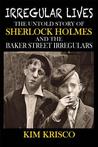 Irregular Lives: The Untold Story of Sherlock Holmes and the Baker Street Irregulars by Kim Krisco
My rating: 5 of 5 stars
Like Kim Krisco’s previous novel, Irregular Lives begins during the “golden years” of Sherlock Holmes and Dr. Watson. Soon after the end of the Great War, they are invited to an exhibition of photographs by the mysterious “S.P. Fields,” whose subjects Holmes soon recognizes as the street urchins who assisted in many of his early cases. Each photograph allows Holmes to reminisce about a particular Irregular; and Wiggins, Tessa, Benjie, Ugly, Snape, Kate, and Archie emerge as distinct, well-drawn personalities when their stories are retold. In these early tales—all set in the heyday of the Canon—Mr. Krisco demonstrates both an impressive knowledge of Victorian social history (although he imports at least one character from an earlier period) and a compassion for the lives of the young pickpockets, mudlarks, sweeps, and other deprived children whose “accomplishment lies . . . [in] the fact that they survived at all.” It becomes clear that Holmes—despite his emotional reticence—shared this compassion. “S.P. Fields’” exhibition is a tribute to him by the “fortunate few” he assisted “to find a footing on clean pavement.” Nevertheless, in the 1919 chapters the adult Irregulars test their benefactor by immersing him in a lively plot that crowds in blackmailers, kidnappers, munitions manufacturers, arms dealers, Irish revolutionaries, Brother Mycroft, and Moriarty’s daughter. (Several plot elements hark back to Mr. Krisco’s earlier book.) Holmes, Watson, Tessa, and Wiggins must all decide how far their loyalty to the Irregulars extends before the novel winds its way to a poignant but satisfying end. Mr. Krisco also includes a number of aphorisms that are good enough to stand upon their own, e.g.: “There is a cost for knowing one’s true nature, and war is too high a price.” “The best companions enjoy each other’s company, and respect each other’s privacy.” “Most people have no idea what to wish for when they throw a coin into a fountain . . . but put a penny in a child’s hand, and the hope that we once held for ourselves is rekindled.” Definitely a five-star read!
Marcia Wilson's new book was not out yet when I reviewed it in October, so I'm reposting the review. Test of the Professionals focuses on "the best of the professionals" (in Sherlock Holmes' opinion), Inspector Geoffrey Lestrade. Read Ms. Wilson's book, and you'll never again see Lestrade as a sad sack. The backstory she creates for the inspector is amazing:
 Test of the Professionals I: The Adventure of the Flying Blue Pidgeon by Marcia Wilson
My rating: 5 of 5 stars
Last year, Marcia Wilson joined the Sherlockian mainstream with her wonderful debut novel You Buy Bones. Beginning just after the fateful meeting between Sherlock Holmes and Dr. Watson, it transformed the Scotland Yarders—Gregson, Bradstreet, and Lestrade—from mere foils to be outshone by Holmes into living, breathing characters in their own right. Since then, Ms. Wilson’s short stories have been featured in several MX Publishing anthologies, edited by David Marcum, and in Derrick Belanger’s anthology Beyond Watson.
Now she carries her saga forward to the autumn of 1883, as the Yarders investigate seemingly unrelated waterfront crimes (missing seamen, stolen flour barrels) linked to an agent of the master criminal who still lurks behind the scenes. Whereas Watson was as important as the Yarders to the plot of You Buy Bones, here the focus is on Inspector Geoffrey Lestrade. In Ms. Wilson’s hands, he becomes a full-fledged personality, not the one-dimensional character we met in Doyle. While not the smartest of the Yarders, “Inspector Plod” is truly (as Holmes admits) the best of them, due to his iron sense of ethics (for which he has paid a heavy price) and his grim determination to battle both criminals and his own limitations in the pursuit of justice. In Test, we learn of an incident in Lestrade’s past that forever darkened his relations with his family, as well as his career at Scotland Yard. An old enemy returns to devil him, serving as both the charming, heartless villain of the piece and a romantic rival. For Test is also the story of Lestrade’s meeting with Clea Cheatham, a young woman of independent mind and her own unusual family and backstory. Like the inspector’s, they are woven skillfully into the tale.
Underlying these delights of plot and character is some amazing historical research. Marcia Wilson has an encyclopedic knowledge of Victorian minutia; happily, her footnotes are helpful rather than intrusive. Osage orange trees, Krakatoa, mudlarks, and tie-mates all find their places in the story. A potato pie, we learn, can be an insult. There are even notes explaining Inspector Bradstreet’s strange invective. On another level, Ms. Wilson writes with compassion of the day-to-day perils of the London poor. We see far more of Watson as a doctor, and of Mrs. Hudson as a housekeeper, than we ever did in Doyle.
Readers who buy A Test of the Professionals should not expect a traditional Sherlock Holmes pastiche. Ms. Wilson does not tell her story with Victorian reserve; her intimate, informal style is in keeping with the rough-and-tumble lives led by the Yarders. Yet, devotees of the Master will find nothing to offend them, for the characters in Test are never incompatible with their originals. The idiosyncrasies of Holmes, and his interactions with Watson and the Yarders, are as familiar and delightful here as ever. The difference is that for her canvas of Victorian London, Marcia Wilson employs a more colorful palette and a broader brush than Conan Doyle’s. Such is her artistry that she enriches and fully brings to life the world he left us.
Finally (for anyone who needs a break from Sherlock Holmes!), here is my review of a Norwegian biography of Roald Amundsen. Tor Bomann-Larsen's conclusion? "Great explorer. Not a particularly nice guy."
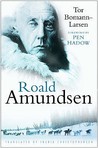 Roald Amundsen by Tor Bomann-Larsen
My rating: 4 of 5 stars
Having always been fascinated by polar exploration, one of my early heroes was Robert Falcon Scott, the second man to the South Pole. In 1979, the “Heroic Legend” of his Last Expedition was acidly debunked by fellow Briton Roland Huntford, whose Scott and Amundsen (later adapted as a TV miniseries, The Last Place on Earth) exposed Scott’s hidebound naval methodology and was utterly rancorous about his character. Huntford rightly deplored the relative neglect of Roald Amundsen, the Norwegian who beat Scott to the Pole and brought his men back safely. Furious at such iconoclasm, Captain Scott’s defenders fought back zealously to restore his reputation. Only in 2006 did David Crane’s biography achieve a balanced view (see my review at: https://www.goodreads.com/book/show/3...), convincingly rehabilitating Scott as a man, if not quite as an explorer.
Meanwhile, the victorious Amundsen also encountered a debunking countryman. Contrary to Huntford’s treatment of Scott, Tor Bomann-Larsen’s biography (1995) does not deny its subject’s greatness. He considers Amundsen the greatest of all polar explorers, and the Norwegian’s résumé makes a compelling case. Amundsen was the first man to reach both Poles: the South by dog sled in 1911, the North by air in 1926. He also took part in the first overwintering in the Antarctic and completed the first navigations of both the Northwest and Northeast Passages. Even more than Scott's, however, Amundsen’s accomplishments were undermined by the defects of his character; and Bomann-Larsen shows no hesitation in exposing them. The explorer betrayed or quarreled with almost all of his friends, patrons, and supporters, including his own brother Leon and the great Fridtjof Nansen. He ruthlessly discarded subordinates who challenged him (Hjalmar Johansen) or lost their usefulness (Helmer Hanssen). Amundsen’s mid-voyage volte-face from the North Pole to the South—stealing a march on Scott after obtaining Nansen’s Fram under false pretenses—was but one example of his deviousness. He was financially irresponsible and undertook his last expeditions partly to recover from bankruptcy. He adopted, then abandoned, two young girls brought back from Siberia. He apparently pursued only married women, spurning them—after affairs of years or even decades—at the very point he might have married them. When Amundsen disappeared into the Arctic in 1928, on a dramatic flight to rescue his bitter enemy Nobile, Bormann-Larsen speculates that the old man may have felt he had exhausted every other option.
Roald Amundsen, his biographer concludes, “laid a smokescreen over his own life.” Thanks to the discovery of the Amundsen brothers’ business correspondence (15,000 documents found only in the 1990’s), Bomann-Larsen has been able to penetrate that smokescreen. Admittedly, his book has many flaws. It has been criticized for a poor English translation; and, indeed, its breezy, almost “slangy” style sometimes seems at odds with the bleakness of its subject matter. Its treatment of Amundsen’s early explorations (the Belgica, Gjøa, and even South Polar expeditions) seems almost cursory, offering little geographic or technical detail. I did find it more informative about the later expeditions, perhaps because I knew much less about them. While there are many better books (including Roland Huntford’s) on Amundsen’s career as an explorer, it is on a personal level that Bomann-Larsen’s biography excels. He provides a fascinating portrait of an undeniably great, deeply flawed, and ultimately enigmatic man.
Besides boning up on such diverse topics as Golden Gate Park, diphtheria, and the Ku Klux Klan in my research, I employed a resource that other Sherlockian writers may find useful. (Many thanks to Marcia Wilson for letting me know about this source!) The British Met Office (meteorological office) posts historical weather reports online, including those for the 1880's at: http://www.metoffice.gov.uk/learning/.... My correspondent there assured me that the Met Office is "always keen to see accurate meteorological depictions in pseudo-historical narratives" like mine. In return for a credit in my end notes, the office allowed me to cite official records indicating that it snowed in Brighton on December 27, 1887. While a snowstorm was not essential to my plot, it provided atmosphere to set the stage for my "ghost's" presumed appearance.
With that story now behind me, I have belatedly returned to reading other people's work. Here are reviews of three fairly recent offerings. The first two feature equally unpleasant relatives of that devoted family man, Professor Moriarty. His sister Julia returns in an expanded collection from Dick Gillman, while Kim Krisco includes Moriarty's daughter (Maeve Murtagh) in his saga of the Baker Street Irregulars:
Sherlock Holmes - Julia Moriarty - in memorium by Dick GillmanMy rating: 5 of 5 stars
Beware the cover of this book! It shows a winsome and demure young redhead, but hair color is her only similarity to the formidable villain who returns in Mr. Gillman’s new collection. Only four of these fine stories are actually new; the others premiered in The Julia Moriarty Trilogy (2013). As readers of that volume know, Julia—the grieving younger sister of Professor Moriarty—has resurrected his criminal enterprise and is determined to revenge herself on Sherlock Holmes. In pursuit of her goals, she shows equal ingenuity with her late brother and a far more wanton disregard for human life. Yet—as Holmes eventually discovers—Julia has her Achilles heel as well. Mr. Gillman’s stories are always inventively plotted and true to the Canon, although two appear to be misdated if they are to follow his chronology. Of the new ones, my favorites were “The Mazlov Knot,” in which salt becomes a murder weapon, and “The Broken Watch of Meiringen,” in which Holmes obtains an artifact of compelling interest to his adversary. Sad to say, the latter story appears to bring Julia’s saga to a close, so it is pleasant to have all seven stories collected here within a single volume. Mr. Gillman is an excellent Sherlockian, and I look forward to following the future adventures he creates for Holmes and Watson.
Irregular Lives: The Untold Story of Sherlock Holmes and the Baker Street Irregulars by Kim KriscoMy rating: 5 of 5 stars
Like Kim Krisco’s previous novel, Irregular Lives begins during the “golden years” of Sherlock Holmes and Dr. Watson. Soon after the end of the Great War, they are invited to an exhibition of photographs by the mysterious “S.P. Fields,” whose subjects Holmes soon recognizes as the street urchins who assisted in many of his early cases. Each photograph allows Holmes to reminisce about a particular Irregular; and Wiggins, Tessa, Benjie, Ugly, Snape, Kate, and Archie emerge as distinct, well-drawn personalities when their stories are retold. In these early tales—all set in the heyday of the Canon—Mr. Krisco demonstrates both an impressive knowledge of Victorian social history (although he imports at least one character from an earlier period) and a compassion for the lives of the young pickpockets, mudlarks, sweeps, and other deprived children whose “accomplishment lies . . . [in] the fact that they survived at all.” It becomes clear that Holmes—despite his emotional reticence—shared this compassion. “S.P. Fields’” exhibition is a tribute to him by the “fortunate few” he assisted “to find a footing on clean pavement.” Nevertheless, in the 1919 chapters the adult Irregulars test their benefactor by immersing him in a lively plot that crowds in blackmailers, kidnappers, munitions manufacturers, arms dealers, Irish revolutionaries, Brother Mycroft, and Moriarty’s daughter. (Several plot elements hark back to Mr. Krisco’s earlier book.) Holmes, Watson, Tessa, and Wiggins must all decide how far their loyalty to the Irregulars extends before the novel winds its way to a poignant but satisfying end. Mr. Krisco also includes a number of aphorisms that are good enough to stand upon their own, e.g.: “There is a cost for knowing one’s true nature, and war is too high a price.” “The best companions enjoy each other’s company, and respect each other’s privacy.” “Most people have no idea what to wish for when they throw a coin into a fountain . . . but put a penny in a child’s hand, and the hope that we once held for ourselves is rekindled.” Definitely a five-star read!
Marcia Wilson's new book was not out yet when I reviewed it in October, so I'm reposting the review. Test of the Professionals focuses on "the best of the professionals" (in Sherlock Holmes' opinion), Inspector Geoffrey Lestrade. Read Ms. Wilson's book, and you'll never again see Lestrade as a sad sack. The backstory she creates for the inspector is amazing:
Test of the Professionals I: The Adventure of the Flying Blue Pidgeon by Marcia WilsonMy rating: 5 of 5 stars
Last year, Marcia Wilson joined the Sherlockian mainstream with her wonderful debut novel You Buy Bones. Beginning just after the fateful meeting between Sherlock Holmes and Dr. Watson, it transformed the Scotland Yarders—Gregson, Bradstreet, and Lestrade—from mere foils to be outshone by Holmes into living, breathing characters in their own right. Since then, Ms. Wilson’s short stories have been featured in several MX Publishing anthologies, edited by David Marcum, and in Derrick Belanger’s anthology Beyond Watson.
Now she carries her saga forward to the autumn of 1883, as the Yarders investigate seemingly unrelated waterfront crimes (missing seamen, stolen flour barrels) linked to an agent of the master criminal who still lurks behind the scenes. Whereas Watson was as important as the Yarders to the plot of You Buy Bones, here the focus is on Inspector Geoffrey Lestrade. In Ms. Wilson’s hands, he becomes a full-fledged personality, not the one-dimensional character we met in Doyle. While not the smartest of the Yarders, “Inspector Plod” is truly (as Holmes admits) the best of them, due to his iron sense of ethics (for which he has paid a heavy price) and his grim determination to battle both criminals and his own limitations in the pursuit of justice. In Test, we learn of an incident in Lestrade’s past that forever darkened his relations with his family, as well as his career at Scotland Yard. An old enemy returns to devil him, serving as both the charming, heartless villain of the piece and a romantic rival. For Test is also the story of Lestrade’s meeting with Clea Cheatham, a young woman of independent mind and her own unusual family and backstory. Like the inspector’s, they are woven skillfully into the tale.
Underlying these delights of plot and character is some amazing historical research. Marcia Wilson has an encyclopedic knowledge of Victorian minutia; happily, her footnotes are helpful rather than intrusive. Osage orange trees, Krakatoa, mudlarks, and tie-mates all find their places in the story. A potato pie, we learn, can be an insult. There are even notes explaining Inspector Bradstreet’s strange invective. On another level, Ms. Wilson writes with compassion of the day-to-day perils of the London poor. We see far more of Watson as a doctor, and of Mrs. Hudson as a housekeeper, than we ever did in Doyle.
Readers who buy A Test of the Professionals should not expect a traditional Sherlock Holmes pastiche. Ms. Wilson does not tell her story with Victorian reserve; her intimate, informal style is in keeping with the rough-and-tumble lives led by the Yarders. Yet, devotees of the Master will find nothing to offend them, for the characters in Test are never incompatible with their originals. The idiosyncrasies of Holmes, and his interactions with Watson and the Yarders, are as familiar and delightful here as ever. The difference is that for her canvas of Victorian London, Marcia Wilson employs a more colorful palette and a broader brush than Conan Doyle’s. Such is her artistry that she enriches and fully brings to life the world he left us.
Finally (for anyone who needs a break from Sherlock Holmes!), here is my review of a Norwegian biography of Roald Amundsen. Tor Bomann-Larsen's conclusion? "Great explorer. Not a particularly nice guy."
Roald Amundsen by Tor Bomann-LarsenMy rating: 4 of 5 stars
Having always been fascinated by polar exploration, one of my early heroes was Robert Falcon Scott, the second man to the South Pole. In 1979, the “Heroic Legend” of his Last Expedition was acidly debunked by fellow Briton Roland Huntford, whose Scott and Amundsen (later adapted as a TV miniseries, The Last Place on Earth) exposed Scott’s hidebound naval methodology and was utterly rancorous about his character. Huntford rightly deplored the relative neglect of Roald Amundsen, the Norwegian who beat Scott to the Pole and brought his men back safely. Furious at such iconoclasm, Captain Scott’s defenders fought back zealously to restore his reputation. Only in 2006 did David Crane’s biography achieve a balanced view (see my review at: https://www.goodreads.com/book/show/3...), convincingly rehabilitating Scott as a man, if not quite as an explorer.
Meanwhile, the victorious Amundsen also encountered a debunking countryman. Contrary to Huntford’s treatment of Scott, Tor Bomann-Larsen’s biography (1995) does not deny its subject’s greatness. He considers Amundsen the greatest of all polar explorers, and the Norwegian’s résumé makes a compelling case. Amundsen was the first man to reach both Poles: the South by dog sled in 1911, the North by air in 1926. He also took part in the first overwintering in the Antarctic and completed the first navigations of both the Northwest and Northeast Passages. Even more than Scott's, however, Amundsen’s accomplishments were undermined by the defects of his character; and Bomann-Larsen shows no hesitation in exposing them. The explorer betrayed or quarreled with almost all of his friends, patrons, and supporters, including his own brother Leon and the great Fridtjof Nansen. He ruthlessly discarded subordinates who challenged him (Hjalmar Johansen) or lost their usefulness (Helmer Hanssen). Amundsen’s mid-voyage volte-face from the North Pole to the South—stealing a march on Scott after obtaining Nansen’s Fram under false pretenses—was but one example of his deviousness. He was financially irresponsible and undertook his last expeditions partly to recover from bankruptcy. He adopted, then abandoned, two young girls brought back from Siberia. He apparently pursued only married women, spurning them—after affairs of years or even decades—at the very point he might have married them. When Amundsen disappeared into the Arctic in 1928, on a dramatic flight to rescue his bitter enemy Nobile, Bormann-Larsen speculates that the old man may have felt he had exhausted every other option.
Roald Amundsen, his biographer concludes, “laid a smokescreen over his own life.” Thanks to the discovery of the Amundsen brothers’ business correspondence (15,000 documents found only in the 1990’s), Bomann-Larsen has been able to penetrate that smokescreen. Admittedly, his book has many flaws. It has been criticized for a poor English translation; and, indeed, its breezy, almost “slangy” style sometimes seems at odds with the bleakness of its subject matter. Its treatment of Amundsen’s early explorations (the Belgica, Gjøa, and even South Polar expeditions) seems almost cursory, offering little geographic or technical detail. I did find it more informative about the later expeditions, perhaps because I knew much less about them. While there are many better books (including Roland Huntford’s) on Amundsen’s career as an explorer, it is on a personal level that Bomann-Larsen’s biography excels. He provides a fascinating portrait of an undeniably great, deeply flawed, and ultimately enigmatic man.


No comments have been added yet.
Senile Musings of an Ex-Boy Wonder

An occasional blog on Sherlock Holmes, other historical and literary topics, and whatever else occurs to me
- Thomas A. Turley's profile
- 8 followers

